


A range of intervention studies have shown effects in reducing self-harming ideation and/or behaviour in adolescents (Reference Wood, Trainor and RothwellWood et al, 2001; Reference Huey, Henggeler and RowlandHuey et al, 2004). Despite these advances, poor adherence to follow-up is a major obstacle in providing practical help to adolescents who self-harm, with up to 77% non-adherent with out-patient treatment (Reference Trautman, Stewart and MorishimaTrautman et al, 1993). Poor adherence to community follow-up was demonstrated in a local audit of emergency self-harm presentations (Reference Ougrin and NgOugrin & Ng, 2006). Research indicates that adolescents who engage with follow-up after a self-harm presentation are likely to attend on average four to six follow-up appointments, most of these in the first 3 months after the initial presentation (Reference Rotheram-Borus, Piacentini and CatwellRotheram-Borus et al, 2000; Reference Spirito, Boergers and DonaldsonSpirito et al, 2002). There is growing evidence that non-adherence is a marker of poor psychosocial outcomes in these young people (Reference Cremniter, Payan and MeidingerCremniter et al, 2001; Reference Votta and ManionVotta & Manion, 2004). Studies aimed at improving adherence to follow-up care (e.g. Reference Rotheram-Borus, Piacentini and Van RoosemRotheram-Borus et al, 1996; Reference Spirito, Boergers and DonaldsonSpirito et al, 2002) have shown modest results overall. Most have been done using a single therapeutic modality with highly trained therapists and utilising significant resources.
We designed a pragmatic quasi-experimental study of therapeutic assessment - a brief, manualised model based on cognitive-analytic therapy, which can be delivered in different settings by professionals from a range of disciplines. It was predicted that therapeutic assessment v. assessment as usual would lead to better adherence to the first follow-up appointment, as required by the National Institute for Health and Clinical Excellence (NICE) guidelines (National Institute for Health and Clinical Excellence, 2004) and a better engagement with the community follow-up.
Method
Adolescents aged 12-18 years who had self-harmed and been referred for a psychosocial assessment were eligible for participation in the project. The referral for psychosocial assessment was made either following a screening at the accident and emergency department of one of two inner-London hospitals or following a general practitioner referral to local child and adolescent mental health services (CAMHS). Both the referring practitioner and the accident and emergency staff were masked to the allocation of the young people to either therapeutic assessment or usual assessment. Exclusion criteria were gross reality distortion (e.g. owing to psychotic illness or intoxication), known history of moderate or severe learning disability, lack of fluent English, risk of violence and the need for in-patient admission.
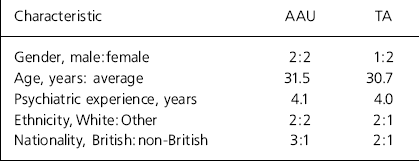
Seven front-line clinicians from a variety of ethnic backgrounds with no previous experience of research in self-harm received 10 h of training in therapeutic assessment. Five of the clinicians were trainee psychiatrists (two specialist registrars and three senior house officers), one was a nurse and one a clinical psychologist. These clinicians were divided into two groups matched on the following variables: mental health experience, age, gender and ethnicity (Table 1). Four out of seven clinicians continued to assess the adolescents in the usual way and three implemented therapeutic assessment for all of the eligible adolescents referred for assessment.
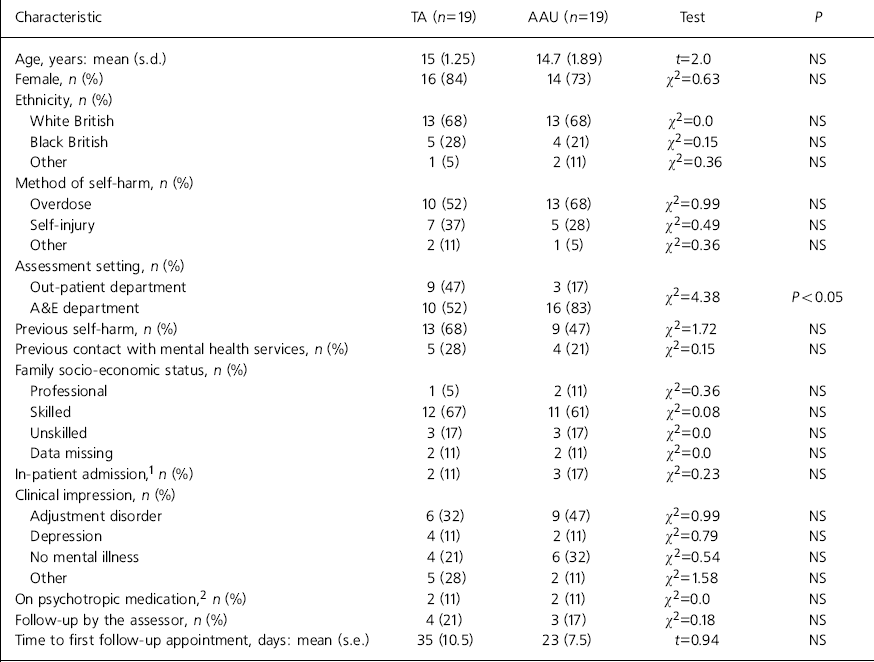
Baseline characteristics of adolescents in the therapeutic assessment and assessment as usual groups
| Characteristic | TA (n=19) | AAU (n=19) | Test | P |
|---|---|---|---|---|
| Age, years: mean (s.d.) | 15 (1.25) | 14.7 (1.89) | t=2.0 | NS |
| Female, n (%) | 16 (84) | 14 (73) | χ2=0.63 | NS |
| Ethnicity, n (%) | ||||
| White British | 13 (68) | 13 (68) | χ2=0.0 | NS |
| Black British | 5 (28) | 4 (21) | χ2=0.15 | NS |
| Other | 1 (5) | 2 (11) | χ2=0.36 | NS |
| Method of self-harm, n (%) | ||||
| Overdose | 10 (52) | 13 (68) | χ2=0.99 | NS |
| Self-injury | 7 (37) | 5 (28) | χ2=0.49 | NS |
| Other | 2 (11) | 1 (5) | χ2=0.36 | NS |
| Assessment setting, n (%) | ||||
| Out-patient department | 9 (47) | 3 (17) | χ2=4.38 | P<0.05 |
| A&E department | 10 (52) | 16 (83) | ||
| Previous self-harm, n (%) | 13 (68) | 9 (47) | χ2=1.72 | NS |
| Previous contact with mental health services, n (%) | 5 (28) | 4 (21) | χ2=0.15 | NS |
| Family socio-economic status, n (%) | ||||
| Professional | 1 (5) | 2 (11) | χ2=0.36 | NS |
| Skilled | 12 (67) | 11 (61) | χ2=0.08 | NS |
| Unskilled | 3 (17) | 3 (17) | χ2=0.0 | NS |
| Data missing | 2 (11) | 2 (11) | χ2=0.0 | NS |
| In-patient admission, 1 n (%) | 2 (11) | 3 (17) | χ2=0.23 | NS |
| Clinical impression, n (%) | ||||
| Adjustment disorder | 6 (32) | 9 (47) | χ2=0.99 | NS |
| Depression | 4 (11) | 2 (11) | χ2=0.79 | NS |
| No mental illness | 4 (21) | 6 (32) | χ2=0.54 | NS |
| Other | 5 (28) | 2 (11) | χ2=1.58 | NS |
| On psychotropic medication, 2 n (%) | 2 (11) | 2 (11) | χ2=0.0 | NS |
| Follow-up by the assessor, n (%) | 4 (21) | 3 (17) | χ2=0.18 | NS |
| Time to first follow-up appointment, days: mean (s.e.) | 35 (10.5) | 23 (7.5) | t=0.94 | NS |
AAU, assessment as usual; A&E, accident and emergency; NS, not significant; TA, therapeutic assessment
1. Psychiatric hospitalisation
2. At the time of assessment
Cases and controls were ascertained by asking clinicians to log their referrals. This was cross-checked with hospital and community electronic patient records. All patients in the study were followed up for 17 weeks after emergency presentation and were compared on the following measures: attendance at the first follow-up appointment and engagement with services. The latter was operationalised as attendance at 50% or more of the appointments offered (excluding cancellations). Following a consultation with a range of professionals, this measure was deemed more meaningful than the raw number of appointments attended, because the need for follow-up care varies considerably in this group (National Institute for Health and Clinical Excellence, 2004). We analysed attendance on an intention-to-treat basis.
Assessments
Assessment as usual
Assessment as usual included a standard psychosocial history and risk assessment, and followed the recommendations set out in the NICE guidelines (National Institute for Health and Clinical Excellence, 2004). The assessment letter was sent to the relevant community team and a copy was sent to the family in accordance with the ‘copying letters to patients’ policy. If a community follow-up was deemed appropriate the young person received a letter with the details of the next appointment.
Therapeutic assessment
The major components of the therapeutic assessment were as follows.
-
1. Standard psychosocial history and risk assessment.
-
2. A10-min break to review the information gathered and to prepare for the rest of the session.
-
3. Joint construction of a diagram (based on the cognitive-analytic therapy paradigm) consisting of three elements: reciprocal roles, ‘core pain’ and maladaptive procedures (see Reference Ryle and KerrRyle & Kerr, 2002 for a review).
-
4. Identifying the target problem.
-
5. Considering and enhancing motivation for change.
-
6. Searching for potential ‘exits’ (i.e. ways of breaking the vicious cycles identified) facilitated by one or more of the following: examining influence and control of the target problem on the young person, his or her family and social network; looking for exits tried in the past and exploring the options at present; using future-oriented reflexive questioning; using problem-solving techniques; exploring alternative views of ‘core pain’; and behavioural techniques including relaxation.
-
7. Summarising the issues discussed in an ‘understanding letter’; this included a summary of the diagram as well as the possible exits identified and usually contained an invitation for further exploration.
The four aims of therapeutic assessment were to develop a joint understanding of the young person's difficulties; to enhance motivation for change; to instil hope; and to explore possible alternatives to self-harm. The assessment process was manualised, although assessing clinicians used clinical judgement when deciding on the best approach to ‘exits’. All professionals received monthly 1 h group-supervision sessions.
Results
Over a period of 5 months, seven clinicians received a total of 38 referrals of young people for self-harm assessment: 19 individuals (14 female, 5 male) were referred to the three clinicians who were required to carry out therapeutic assessment and 19 (16 female, 5 male) to the four clinicians who continued assessment as usual. Of the referred young people, 31 met the inclusion criteria and all agreed to participate. There was no significant difference between the two groups on baseline characteristics studied (Table 2) apart from the assessment setting: assessment was more likely to have occurred at a tertiary CAMHS than in an accident and emergency department in the therapeutic assessment group, and this reflected the relevant clinicians’ work setting.
Clinicians’ characteristics in therapeutic assessment and assessment as usual groups
| Characteristic | AAU | TA |
|---|---|---|
| Gender, male:female | 2:2 | 1:2 |
| Age, years: average | 31.5 | 30.7 |
| Psychiatric experience, years | 4.1 | 4.0 |
| Ethnicity, White:Other | 2:2 | 2:1 |
| Nationality, British:non-British | 3:1 | 2:1 |
AAU, assessment as usual; TA, therapeutic assessment
A direct comparison of attendance at the first follow-up appointment revealed a statistically significant difference between therapeutic assessment and usual assessment: 75% (12 of 16) v.40% (6 of 15); χ2=3.89 (d.f.=1, n=31), P<0.05. There was also a statistically significant difference between the two groups on subsequent engagement with services: 62% (8 of 13) v.30% (3 of 10); χ2=4.49 (d.f.=1, n=23), P<0.05. We used multiple logistic regression to adjust for the differences in the assessment setting, using attendance at the first follow-up appointment as a dependent variable. The effect of therapeutic assessment remained robust when adjusted for the assessment setting (OR=11.92, 95% CI 1.27-112.22, P<0.04).
Discussion
This study focused on improvement of adherence to community follow-up, which has been identified as one of the principal obstacles in delivering psychological therapy to adolescents presenting with self-harm. Compared with other studies in this field (Reference Rotheram-Borus, Piacentini and CatwellRotheram-Borus et al, 2000; Reference Spirito, Boergers and DonaldsonSpirito et al, 2002), our study shows a more robust improvement in adherence to follow-up.
Therapeutic assessment was initially conceived as a modification of cognitive-analytic therapy for the assessment of adolescents presenting with self-harm. However, as the method developed, many original features emerged, with an emphasis on meeting a range of needs shown by the young people presenting with self-harm. Using a single therapeutic method (e.g. problem-solving, cognitive-behavioural therapy, family therapy or cognitive-analytic therapy) in the assessment of the young people presenting with self-harm is unlikely to engage all such young people and a variety of therapeutic tools may need to be used to achieve the best result.
The design of this study was quasi-experimental and therefore all of the limitations of non-randomised studies apply. We attempted to match therapists on factors such as age, experience, gender and ethnicity, but there might have been other therapist variables important for the outcome that were not measured. Significantly more young people in the therapeutic assessment group were assessed at tertiary CAMHS, potentially marking a lower severity of disturbance in this group and greater motivation to engage with services. This is an important variable to consider in the further evaluation of the method. The follow-up appointments were not arranged on the day of the initial assessment in most cases in either study arm, and the young people were informed of the next follow-up appointment by a letter. All of the follow-up appointments were offered by a community team and so there was a change of clinical setting for the participants assessed in accident and emergency departments.
Our study showed that it is feasible to establish a training programme in therapeutic assessment with in-built evaluation and supervision. It may be important to evaluate this method in non-urgent cases of self-harm and perhaps in other patient groups. Therapeutic assessment will be further evaluated in a random allocation study.
Declaration of interest
None.
Acknowledgements
We thank Dr Peter Hindley, Consultant Child and Adolescent Psychiatrist at St Thomas’ Hospital, for his contribution and advice. This work was supported by the Psychiatry Research Trust.


 Open access


eLetters
No eLetters have been published for this article.