

Introduction
Americans of different racial backgrounds have long held different collective memories and understandings of the history of racialized policing and state-sanctioned violence that affect perceptions of each new incident (Desmond et al., Reference Desmond, Papachristos and Kirk2016). One important source of these divergent views is the ways protests about police violence are described in news sources. While Black Lives Matter protests that spread after the 2014 police killing of Michael Brown in Ferguson, Missouri and again in 2020 after the murder of George Floyd in Minneapolis, Minnesota received unprecedented global attention (Della Porta et al., Reference Della Porta, Lavizzari and Reiter2022) U.S. mainstream news media often diminished its legitimacy (Carney and Kelekay, Reference Carney and Kelekay2022). In contrast, for those familiar with Black protests in earlier decades, these demonstrations appeared not as a sudden rupture, but as the latest iteration in a movement that had been going on for a long time (Strickland Reference Strickland2022). There was extensive publicity about New York police sodomizing Abner Louima in a police bathroom in 1997 and shooting forty-two bullets into Amadou Diallo in 1999 as he stood unarmed on his own doorstep, and about the months of protests that followed. The news coverage of the Diallo case was so extensive that it affected the way mainstream news sources covered other police killings for the next few years (Hirschfield and Simon, Reference Hirschfield and Simon2010). And yet, these cases that were big news at the time were rarely mentioned in mainstream news articles about the protests after 2014. Did the way the cases were discussed in contemporaneous sources affect how they were remembered later?
News stories not only select which facts about events to report as relevant; they locate actions in a relational context that gives them meaning. Scholars of media and political communication have identified the varied and complex ways in which powerful people and organizations interact with news writers to “govern with the news” (Cook Reference Cook1998, Reference Cook2006). Mainstream news media with different partisan political positions typically agree that the important actors are politicians and other elites and give voice to disagreements as they are defined by political elites (Cook Reference Cook1998; Wasow Reference Wasow2020). Scholars including Daniel Kreiss and colleagues (Reference Kreiss, Lawrence and McGregor2024) and John Budarick (Reference Budarick2023) have criticized the racelessness of most treatments of the relation between institutional politics and the media. We extend this critique by demonstrating how the omission of race in such coverage conceals what Charles Mills (Reference Mills1997) calls the “racial contract,” the tacit agreement that White supremacy is the unnamed and unremarked norm. We draw on Mills’ racial contract thesis to illuminate how mainstream news coverage contributes to what he called the “epistemology of ignorance,” in which White institutions actively avoid knowing the history and present reality of racial domination. We join scholars of Black newspapers (Huspek Reference Huspek2004; Newkirk Reference Newkirk2000; Roychoudhury Reference Roychoudhury2023; Weiner Reference Weiner2011) who advocate for the inclusion of Black newspapers, which offer alternative and even oppositional perspectives. Our study extends this scholarship by demonstrating how Black newspapers challenge the racial contract and its blinders by treating non-elite collective actors as full humans whose politics matter.
This study informs the question of how events come to be remembered by comparing the contemporaneous coverage of The New York Times and two New York Black Newspapers (New York Amsterdam News and The New York Beacon) of protests about the killing of Amadou Diallo and three cases that were intertwined with the Diallo protests—the police torture of Abner Louima in 1997 and the police killings of Malcolm Ferguson and Patrick Dorismond in March, 2000. Although both The New York Times and the Black newspapers offered a diversity of perspectives and agreed on most of the basic facts of what had happened in these episodes, their coverage implicitly located the protests within markedly different political and social contexts.
The New York Times emphasized partisan politics, frequently portrayed police sympathetically, and gave much more coverage of official accounts that offered negative characterizations of the victims and justifications for the police officers’ actions. For The New York Times, the episodes were primarily about the political jostling of interest groups in the political moment of elite-dominated institutional politics where Black people were viewed primarily as part of a Democratic voting bloc, police were political actors who deserved representation, and personalities dominated. In contrast, Black newspapers emphasized systemic issues and the ongoing failure to hold police accountable, highlighted the organizing of diverse community groups, and emphasized the growing political consciousness of young people and Black immigrants. For Black newspapers, the episodes were about systemic racial injustice, community organizing, collective identity formation, and solidarity in an ongoing global struggle for justice.
Our study makes several contributions. Empirically, it offers an examination of important cases that have not previously received detailed study. Our focus on partisan politics and movement formation differs from that of similar scholarship reviewed below. Additionally, our analysis weaves together several lines of theory and research that have not previously been integrated: the ways news coverage informs collective memories and challenges or upholds the racial contract, the importance of ethnic or racial differences in collective memories, the close relationships between institutionalized political actors and mainstream media, discussions of the role of oppositional media in public discourse on racial violence, and the ways different news sources construct political subjects. We leverage this synthesis to show how racialized collective memories and collective identities are formed, sustained, and/or erased in interaction with institutional politics in media discourse.
The paper proceeds as follows. First, we situate our research in the empirical literature in three sections that examine collective meanings and news sources, the relation between institutional politics and news media, and empirical research comparing mainstream and Black news sources. Next, we outline the four New York cases, sketch the broader context for these cases, and describe our methods. The results section provides a thematic content analysis of the difference in coverage between the two source types supplemented by quantitative keyword analyses. The conclusion draws out the implications of our analysis for understanding whether and how events become collective memories that inform understandings of subsequent events, with an emphasis on the constructions of political agency and subjectivity in the context of the latent racial contract.
Literature Review and Theoretical Frameworks
Contested Collective Meanings and News Sources
Collective memories are often central elements of the collective identities undergirding social movements (Farthing and Kohl, Reference Farthing and Kohl2013; Harris Reference Harris2006). As Crystal M. Fleming and Aldon Morris (Reference Fleming and Morris2015) contend, “ethnoracial movements develop when people organize and mobilize as members of ethnic and/or racial groups and engage in collective action to realize collective interests” (p. 106). Connecting past ethnoracial oppression to present struggles is “one of the key tools activists use for framing and advancing demands on power holders” (Fleming and Morris, Reference Fleming and Morris2015, p. 107). Fredrick C. Harris (Reference Harris2006) demonstrates this by showing how memories of key events, especially Emmett Till’s murder, undergird civil rights activism in the 1960s. Linda Farthing and Benjamin Kohl (Reference Farthing and Kohl2013) similarly describe the ways Indigenous Bolivian activists define their current activism in relation to often-recounted stories of past resistance. As these studies demonstrate, collective memory has power in advocating for change, but is also vulnerable to control and erasure.
Many have written about the contestations between dominant U.S. collective memories that erase or dilute the violence and oppression of Black Americans, and how collective memories of past struggles animate interpretations of current protests (e.g., Cunningham et al., Reference Cunningham, Nugent and Slodden2010; Jackson Reference Jackson2021; Jackson Reference Jackson2022; Roychoudhury Reference Roychoudhury2023; Tabor Reference Tabor2020; Theoharis Reference Theoharis2018; Yazdiha Reference Yazdiha2023). People who, for example, remembered the Civil Rights Movement and its victories as significant had more racially liberal opinions than those with different memories (Griffin and Bollen, Reference Griffin and Bollen2009). Scholars have noted that dominant sanitized collective memories often erase the violent conflict of the Civil Rights Era (Theoharis Reference Theoharis2018; Yazdiha Reference Yazdiha2023) and recent research finds that framing current problems as about “civil rights” produced backlash (Silva et al., Reference Silva, Bloemraad and Voss2025) as current issues are viewed unfavorably with this idealized past.
Alongside the sanitized rewriting of the Civil Rights Movement is another thread of persistent Black protests about police violence. Black protests against police violence are typically framed as being about racial discrimination in policing, not about policing in general (Burch Reference Burch2023; Frankham Reference Frankham2020; Lawrence Reference Lawrence1996, Reference Lawrence2000). Yet, mainstream news coverage rarely acknowledges this persistent racial thread. Instead, mainstream news tends to treat egregious incidents as unusual occurrences that get a great deal of attention before attention dies down again, leaving behind only a vague memory of past Black disruptiveness or rioting (Lawrence Reference Lawrence2000).
Mainstream news coverage has historically upheld existing racial hierarchies by distorting events involving Black people (Huspek Reference Huspek2004; Roychoudhury Reference Roychoudhury2023). For example, White newspapers characterized the 1921 Tulsa riot as an appropriate response to armed Black residents (Messer and Bell, Reference Messer and Bell2010). Mainstream news coverage of the 1960s York, Pennsylvania riots and related trials decades later ignored systemic inequalities and provided misleading characterizations of the earlier events (Morrow Reference Morrow2016). Mainstream coverage of the riotous protests after police killings in Los Angeles in 1992 and Cincinnati in 2001 portrayed them as ineffective and illogical (Campbell et al., Reference Campbell, Chidester, Royer and Bell2004). More recently, FOX News coverage of the Ferguson, Missouri protests after the killing of Michael Brown in 2014 blamed Black protesters and underplayed the systemic issues in the case (Mills Reference Mills2017). Pamela Newkirk (Reference Newkirk2000) argues that Black and other non-White reporters hired by mainstream news organizations after the Civil Rights Movement were still expected to cater to the sensibilities of the majority.
Black newspapers have long offered oppositional news to counter what Ida B. Wells-Barnett (Reference Wells-Barnett1892) called “The Malicious and Untruthful White Press.” Michael Huspek (Reference Huspek2004, Reference Huspek2007, Reference Huspek, Lacy and Ono2011) emphasizes the rhetorical opposition offered in Black newspapers. Debanjan Roychoudhury (Reference Roychoudhury2023) stresses the importance of “Black-owned-and-operated institutions in the making and remaking of social conditions, challenging police authority in court, in the news, and on the streets” (p. 112). Newkirk (Reference Newkirk2000) emphasizes the current role of Black newspapers as offering a supplement and alternative or oppositional interpretation of events. Melissa F. Weiner (Reference Weiner2011) contends “The mainstream media represents the values and ideologies of the nation’s majority, which have, since America’s founding, been infused with racism,” (p. 300) emphasizing biased portrayals of Black Americans and the exclusion of many of their concerns. In her examination of protest events in the 1950s about New York schools, Weiner finds that The New York Times omitted many events covered by the Amsterdam News, arguing that any study of the historical trajectory and logic of protests should examine the ethnic press.
While these comparative studies offer valuable insights into how mainstream media distorts racial violence, they do not focus on the importance of institutional relationships in shaping media coverage, collective memory, and the maintenance of racial hierarchies. As the next section demonstrates, mainstream reporting is often shaped by close ties between journalists and institutional actors, whose collaboration serves to reinforce the prevailing structures of White supremacy.
Institutional Politics in News Coverage of Protest and Police
We draw heavily on the extensive discussions within the field of political communication about the relation between institutional politics and mainstream news media (Cook Reference Cook1998; Schudson Reference Schudson2002; Sparrow Reference Sparrow2006) as well as recent critiques about the “racelessness” of much of the discussion (Budarick Reference Budarick2023; Kreiss et al., Reference Kreiss, Lawrence and McGregor2024). Timothy Cook (Reference Cook1998) argues that news media are not merely observers of politics but tools of governance, shaped by officials who use media to promote their agendas. In contrast, others emphasize the role of a free press in providing information to citizens and holding state officials accountable (Fredricks and Phillips, Reference Fredricks and Phillips2021).
Despite these differing theoretical perspectives, there is broad agreement that mainstream news production is deeply intertwined with institutional actors. Journalists rely heavily on access to public officials, which shapes both the content and framing of news coverage (Schudson Reference Schudson2002; Sparrow Reference Sparrow2006). As Bartholomew H. Sparrow (Reference Sparrow2006) notes, journalists are dependent on politicians for information but strive to maintain an appearance of independence. One way to accomplish this is to achieve balance through horse race coverage that stresses how issues affect support for the next election. Michael Schudson (Reference Schudson2002) similarly finds news gathering is an “interinstitutional collaboration” between reporters and officials. Thus, new outlets do not simply reflect political reality–they help construct it. All news sources are constructed by people who make choices about which sources to treat as credible and what concerns will be interesting and important for their audiences. As Cook (Reference Cook1998) contends, “neither concern is free from politics” (p. 5).
Political communication studies that focus specifically on mainstream news sources reveal how deeply their coverage is shaped by institutional relationships. There is a large body of scholarship on the construction of mainstream news sources and how politicians and officials—including police—use media strategies as governing strategies, and how media organizations treat them as authorized knowers (Bennett Reference Bennett1990; Lawrence Reference Lawrence1996, Reference Lawrence2000; Schudson Reference Schudson2002). Politicians and media outlets are mutually dependent, with state actors often serving as chief sources (Edwards and Wood, Reference Edwards and Wood1999). This mutual dependence restricts the range of debate (Bennett Reference Bennett1990), as criticism of officials typically centers disagreements among elites (Cook Reference Cook1998; Wasow Reference Wasow2020).
Research on mainstream news coverage of protests emphasizes the “protest paradigm,” in which news coverage focuses on possible disruption and police management of disruption, rather than on the substantive issues (Gil-Lopez Reference Gil-Lopez2021; Gruber Reference Gruber2023; Harlow and Brown, Reference Harlow and Brown2023; Martin et al., Reference Martin, Rafail and McCarthy2017), or the “public nuisance paradigm” that depicts protests as bothersome and impotent (Di Cicco Reference Di Cicco2010). The variation in the news coverage of protests depends on who is protesting and what they are protesting about, with coverage often being more negative for protests challenging dominant institutions (Herman Reference Herman1988; Parenti Reference Parenti1986).
The relationship between institutional politics and mainstream media is especially evident in coverage of police and protests. Research shows that close working relations between mainstream news reporters and police agencies lead to generally favorable media treatment of police. This symbiotic relationship shapes how both police and protests are covered, with local news sources often emphasizing crime and relying on police for access to critical information needed for their stories (Chermak Reference Chermak1995; Chermak and Weiss, Reference Chermak and Weiss2005; Chibnall Reference Chibnall1975; Crandon Reference Crandon1995; Ericson Reference Ericson, Baranek and Janet1989; Mawby Reference Mawby2014). Police, in turn, seek coverage that portray them positively, believing that hostile media coverage reduces police legitimacy, increases false accusations against police, and increases crime (Nix and Pickett, Reference Nix and Pickett2017). As a result, official police accounts of interactions between police and civilians are typically treated as unquestioned facts (Lawrence Reference Lawrence2000), reinforcing the dominance of institutional perspectives in mainstream reporting.
While building on this research tradition, our study advances the conversation by demonstrating what recent critiques have highlighted—the failure of much existing political communications scholarship to fully account for the central role of race and ethnicity in shaping the relationship between institutional politics and mainstream media (Budarick Reference Budarick2023; Kreiss et al., Reference Kreiss, Lawrence and McGregor2024). As Charles Mills (Reference Mills1997) says, in the current period, the racial contract no longer formally exists, and there is “tension between continuing de facto White privilege and the formal extension of rights” and “a failure to ask certain questions, taking for granted as a status quo and baseline the existing color-coded configurations” (p. 73). Mills (Reference Mills1997) argued that challenging structures built on racial privilege is viewed as a transgression of the terms of the social contract. Summer Harlow and Danielle K. Brown (Reference Harlow and Brown2023) argue that recognizing the media’s role in reinforcing power hierarchies allows scholars to move beyond the traditional protest paradigm and call for a reimagining of protest coverage that centers historic and systemic injustices.
Our study heeds this call by demonstrating how the entanglement of institutional politics and mainstream media in a context of racial hierarchy results in mainstream news coverage that upholds the implicit racial contract. Mainstream news sources condition audiences to ignore, deny, or misinterpret the realities of racial injustice. Through selective omission and emphasis, news coverage often reinforces dominant narratives that obscure systemic violence and uphold the legitimacy of states actors, thereby perpetuating the racial contract. Despite increased hiring of Black journalists after the Civil Rights Movement, mainstream news sources remain largely White-centric in their orientation (Newkirk Reference Newkirk2000), often portraying Black communities through stereotypes of criminality and poverty (Dreier Reference Dreier2005; Gans Reference Gans1995). Social movement research using the Dynamics of Collective Action (DCA) protest event dataset that draws solely from The New York Times generally finds more reports of police presence when protesters are Black (Beyerlein at al., Reference Beyerlein, Soule and Martin2015; Davenport et al., Reference Davenport, Soule and Armstrong2011). Most of the difference is attributed to tactical extremism or targeting the state, especially when the issue is police brutality (Reynolds-Stenson Reference Reynolds-Stenson2017). Media coverage of recent Black anti-police movements has been shown to portray the struggles of Black victims unfavorably by relying on elite sources rather than protestors’ own accounts (Everbach et al., Reference Everbach, Clark and Nisbett2018).
Although police violence is widespread in the United States (Durán Reference Durán2016), most incidents go unprotested and receive minimal attention or are described only by reprinting of the official police report justifying police actions, both in the 1990s (Hirschfield and Simon Reference Hirschfield and Simon2010; Lawrence Reference Lawrence2000) and more recently (Burch Reference Burch2023, Reference Burch2022; Lu Reference Lu2024; McCray Reference McCray2023; Stone and Socia, Reference Stone and Socia2019). Police protests are more likely to occur when the victim was unarmed and presented no threat (Burch Reference Burch2023; Lu Reference Lu2024). Public officials and law enforcement often justify officer involved shootings by claiming suspect criminality or blaming individual police officers as “bad apples” (Durán Reference Durán2016; Lawrence Reference Lawrence2000). Police public relations officers play a key role in managing narratives following incidents of racialized violence, often facing criticism when they fail to do so effectively (Lachlan et al., Reference Lachlan, Blair, Skalski, Westerman and Spence2007). Comparing mainstream and Black news coverage of police protests helps to shed further light on these dynamics.
Comparing Mainstream and Black News Sources
Black newspapers have long offered an important counterpoint (Newkirk Reference Newkirk2000) and opposition (Huspek Reference Huspek2004) to the anti-Blackness of mainstream news sources and their implicit support of the racial contract. Although Black newspaper circulation fell in the 1960s during the Civil Rights Era (Newkirk Reference Newkirk2000; Wilson Reference Wilson1991), circulation rose in the 1990s (Owens Reference Owens, Berry and Manning-Miller1999). Larry Muhammad (Reference Muhammad2003) discusses efforts in that era to retain Black control of Black newspapers, including the efforts of the National Newspaper Publishers Association (NNPA) to support Black newspapers. Even with lower circulations, Black newspapers continued to focus on speaking to the concerns and perspectives of Black people, though their readership likely extends to people from diverse backgrounds. Thus, while Black newspapers vary in their political standpoints, they all share the assumption that their audience is Black people and align themselves with their communities (Huspek Reference Huspek2004).
A few empirical studies have compared mainstream and Black newspaper coverage of protest-relevant events. Melissa Weiner (Reference Weiner2009, Reference Weiner2011) found that The New York Times emphasized anti-Black stereotypes and official positions while Black newspapers focused on protesters’ grievances and actions. Christian Davenport (Reference Davenport2010) found that mainstream newspapers depicted the Oakland Black Panthers as violent, whereas the Black Panther newspaper portrayed them as resisting violent police attacks. Black sources also paid more attention to broader social conditions and impacts on Black people in coverage of a 1995 Supreme Court decision about affirmative action (Clawson et al., Reference Clawson, Strine, Harry and Waltenburg2003), and a Baltimore case of a family murdered in a house fire (Fields and Newman, Reference Fields and Newman2020).
A few studies compare Black to non-Black news coverage of protests about police violence. Three focus on the 1991 beating of Rodney King and the 1992 riots after the not guilty verdict. Ronald N. Jacobs (Reference Jacobs1996) found that the Los Angeles Times portrayed civic leaders as resolving the conflict, while the Black Los Angeles Sentinel depicted the Black community as heroes in an ongoing struggle against racism. Jane L. Twomey (Reference Twomey2001) found that Black newspapers emphasized moral outrage and multiracial protest, while Korean outlets depicted Koreans as innocent victims. Douglas J. Phillips (Reference Phillips2018) examined narrative icons in Black and White newspapers but did not compare them. In analyzing coverage of the 1998 killing of Tyisha Miller, Huspek (Reference Huspek2004) found that Black newspapers focused on activism and racial bias, while White outlets relied on official sources and disparaged protesters. Roychoudhury (Reference Roychoudhury2023) compared The New York Times and Amsterdam News coverage of the fatal police shootings of Clifford Glover (1973) and Sean Bell (2006), showing differing usage of natural disaster metaphors to describe actual or feared community violence and disorder.
More recent studies of Black Lives Matter coverage echo these patterns. Travis A. Riddle and colleagues (Reference Riddle, Turetsky, Bottesini and Leach2020) found that Black sources emphasized racial injustice and the legitimacy of the 2014 Ferguson protests, while White sources emphasized conflict between protesters and police. Zoe Deal (Reference Deal2020) reports that Black sources treated the #IfTheyGunnedMeDown Twitter campaign as an instance of resistance to injustice, while White-centric sources focused on the novelty of Twitter and the problem of stereotyping by mainstream media. William Singleton and colleagues (Reference Singleton, Lowrey and Buzzelli2024) examined forty-five news stories about the George Floyd protests written by eight Black journalists in three Charlotte, North Carolina publications, finding more unapologetic subjectivity and advocacy in the Black newspapers.
Taken together, these studies lead us to expect that different sources will construct different collective memories of the four episodes of protests about police violence in New York in the late 1990s. We expect The New York Times to give more attention to police and official sources and Black newspapers to give more sympathetic attention to the grievances and the actions of Black communities. None of the previous studies emphasize the themes that emerged inductively in our study—partisan politics, humanizing the police, and mobilizing diasporic identities. Before detailing our methods and analytical approach, we turn to outlining the four New York cases and the protests that followed.
Background and Cases
In the late 1990s, New York City was the largest U.S. municipality and home to the largest Black population (U.S. Census Bureau 1990). Often referred to as “the media capital of the world”, New York City has a great influence on the global media landscape, bolstered by The New York Times’ large local, national, and international readerships and news coverage (Grieco Reference Grieco2019; Weiner Reference Weiner2011). The New York Times characterizes itself as the newspaper of record and is often treated as such by academics and elites. Although generally seen as politically liberal and reliably Democratic in national presidential elections, New York is a dynamic political landscape, electing both Democrats and Republicans to both state and local offices (Gerald Reference Gerald2012). Despite its liberal reputation, in the late 1990s, the city had a disproportionately large police force relative to the population (Reaves and Hickman, Reference Reaves and Hickman2002) represented by the Police Benevolent Association.
There have been longstanding political conflicts over restraining New York City police violence. In 1966, Mayor John Lindsay’s attempt to add civilians to the police review board was met with 5,000 picketing police and defeated in a police-drafted referendum (Reiss Reference Reiss1971). “Broken windows” policing under Mayor Koch intensified street-level policing and more arrests at protests (Rafail Reference Rafail2015). Black and multiracial organizing led to the 1989 election of New York’s first Black mayor, Democrat David Dinkins (Jennings Reference Jennings2000; Lawson Reference Lawson2014), who advocated for an all-civilian police complaint review board and investigations of police corruption. In 1992, thousands of police officers rioted against Dinkin’s policies, using racially derogatory language and images. Republican Rudy Giuliani, who had lost to Dinkins in 1989, gave a vitriolic speech at the police rally. Dinkins accused Giuliani of inciting a riot; Giuliani accused Dinkins of trying to inject race into the issue (Dao Reference Dao1992). After defeating Dinkins in 1993 and becoming mayor, Giuliani defunded the civilian review board, replaced it with a police commission, and ushered in a new get-tough-on-crime era (Taylor Reference Taylor2019). These developments mark the 1990s as a pivotal period in the history of racial politics and aggressive policing and resistance in the United States, setting the stage for the four New York cases we examine.
Abner Louima
In the early hours of Saturday August 9, 1997, Abner Louima, a thirty-year-old Haitian immigrant, was working as a private security guard in Brooklyn, New York, when he became involved in a street fight outside a popular Flatbush nightclub. Several White police officers intervened and dragged Louima into the Flatbush police station. One officer held Louima down in the bathroom while Officer Justin Volpe jammed a wooden stick (first reported to be a toilet plunger handle and later a broomstick) up his rectum and then into his mouth. Police took Louima to the emergency department at Coney Island Hospital, claiming he had been injured in homosexual activities. Louima was in critical condition for days and spent sixty-four days in the hospital. On Monday August 11, New York Daily News reporter Mike McAlary received an anonymous phone call from a police source about the case, interviewed family members and Louima himself on Tuesday, and told officials he would be reporting the story the next day. By the time the first news accounts in the Daily News and The New York Times were published on August 13, the involved officers had been reassigned and officials were condemning the brutality. On August 28, stories in The New York Times and the Amsterdam News reported that Magalie Laurent, a Haitian American nurse, had pretended to be a family member to report the case to police internal affairs on Saturday evening, the day Louima was first admitted, and that police had not responded to the report until Sunday afternoon and did nothing after interviewing family members on Monday. Volpe was quickly charged and convicted in December 1997. Volpe’s sentencing and the trials and successful appeals of the other involved officers continued into 1999 and 2000.
Large protest demonstrations began days after Louima’s assault. On August 16, 1997, there was a large Haitian protest involving several thousand protesters carrying plungers and chanting, flanked by a thousand police officers, and a smaller protest led by Al Sharpton. On August 29, six to ten thousand protesters marched from Grand Army Plaza over the Brooklyn Bridge to City Hall. There were a few sympathy protests elsewhere, including protests in Washington, DC in September to demand that the federal government do more to track and punish police brutality, and smaller New York events later that fall. The larger project includes four New York Times articles and twelve New York Black newspaper articles about the protests about this case.
Amadou Diallo
Amadou Diallo, a twenty-two-year-old street vendor and Guinean immigrant, was shot to death on February 4, 1999, by four plainclothes police officers allegedly searching for a rape suspect. Diallo, who was holding only a wallet, was hit by nineteen of forty-one bullets fired at him in the doorway of his apartment in the Bronx, New York. Witnesses disputed police claims that they had heard shots. This became a huge protest episode. Most protests occurred in two waves. The first wave began with almost daily protests between Diallo’s death and late March when the officers were indicted. Protests blocking the police station doors every weekday between March 9 and March 29 generated civil disobedience arrests, protest participants, and news coverage as celebrities and politicians were arrested. The second protest wave began in December 1999 when the trial was given a change of venue to Albany, New York, and continued during the trial. Protests were particularly intense in the weeks following the officers’ acquittal on February 25, 2000. Post-acquittal protests were generally described as more disorderly and decentralized. In March, a contingent of several thousand protesters went to Washington, DC to support calls for federal action on the case. The larger project identified at least eighty events in a total of 159 articles about the case, including fifty articles in The New York Times Newswire and thirty-eight in the Amsterdam News and the Beacon.
Malcolm Ferguson and Patrick Dorismond
Malcolm Ferguson was killed on March 1, 2000 and Patrick Dorismond on March 16, 2000, while protests about the Diallo verdict were ongoing. Abner Louima and relatives of Amadou Diallo participated in the protests following these murders. A life-long resident of the Bronx, New York, Malcolm Ferguson was shot three blocks from Diallo’s home by a plainclothes officer who alleged Ferguson was involved in drug dealing. A 2007 civil court awarded damages for an unjustified killing, and this was upheld in 2010 after appeal. Ferguson had been arrested at a Diallo protest just days before being killed. We identified three protest events about Ferguson. The first and most contentious protest occurred shortly after the shooting, where dozens of protesters confronted police, and one was arrested for throwing a bottle. The two subsequent protests were smaller, including a community vigil on March 3, 2000. The larger project selected only two articles about this case, one in The New York Times and one in the Beacon.
Patrick Dorismond, an off-duty security guard whose parents were Haitian immigrants, was shot by undercover police officer Anthony Vasquez after a fight that began when Dorismond angrily refused police attempts to buy drugs from him. To defend the police, Mayor Rudy Giuliani released Dorismond’s sealed juvenile delinquency records. The larger project identifies twenty-three events about the episode. More than a thousand people protested on March 16, 2000, in Midtown Manhattan. The largest demonstration took place during Dorismond’s funeral on March 25, 2000, reportedly drawing 15,000 participants. Police arrived in riot helmets carrying batons. Protesters resisted and threw bottles; twenty-seven were arrested. Protests continued into April, many organized and led by Al Sharpton and his National Action Network. Protests rose again in late July following a grand jury’s decision not to indict the officer. Dorismond’s family received a $2.25 million civil settlement in 2003. The larger project includes five articles from The New York Times articles and thirteen from Black newspapers about the Dorismond case.
Data and Methods
The core data source is articles about the Diallo, Louima, Ferguson, and Dorismond cases in The New York Times, New York Amsterdam News, or The New York Beacon collected as part of a larger quantitative protest event project (Oliver et al., Reference Oliver, Lim, Matthews and Hanna2022; Oliver et al., Reference Oliver, Hanna and Lim2023; Oliver et al., Reference Oliver, Gaede, Milewski and Lim2025). The archival source for New York Times articles is a compilation of newswire articles archived in a dataset compiled for researchers called Annotated English Gigaword which is available from the Linguistic Data Consortium (Napoles et al., Reference Napoles, Gormley and Van Durme2012). This source overlaps heavily with the print newspaper but is not identical to it. Black newspaper articles were retrieved from the Ethnic NewsWatch database through the university library. As described in more detail in the Appendix, the larger project screened mainstream newswire and Black newspaper articles for descriptions of Black protest events.Footnote 1 Articles about the cases that did not mention protest events would not be in the core data source. These core articles are supplemented in the qualitative analysis by other sources from the project’s archive (which includes two other newswire services and thirty-five other Black newspapers) and additional news articles retrieved from other sources to address specific questions or issues that arose in the process of thematic analysis. Analyzed news articles are listed among the other references. Quantitative analyses of keyword prevalence summarized in Figures 1 and 2 and Table A1 in the Appendix are based on the 125 core articles.
Normed mean difference between The New York Times and Black newspapers in the rate of occurrence of keywords relevant to partisan politics. See Appendix tables for details of computation.

Figure 1. Long description
The chart displays political keywords on the y-axis, including Republicans, Republican, Politics, Political, Democrats, Democratic, Democrat, Sharpton, Giuliani, and Dinkins, ordered top to bottom. The x-axis ranges from negative one to one, labeled as Normed Difference Between N Y T and Black newspapers. For each keyword, three horizontal bars represent Louima (light green), Diallo (medium green), and Dorismond (dark green) clusters. Bars extending right of zero indicate higher frequency in N Y T, while bars left of zero indicate higher frequency in Black newspapers. Solid bars denote statistical significance at p less than 0.05, empty bars are not significant, and absence of a bar means the keyword was not present in articles about that cluster. Republicans, Republican, Politics, Democrats, Democratic, and Democrat show consistently positive bars, indicating greater use in N Y T. Political, Sharpton, Giuliani, and Dinkins show negative bars, especially Dinkins for Louima, indicating greater use in Black newspapers. The legend at the bottom identifies the color for each case cluster.
Normed mean difference between The New York Times and Black newspapers in the rate of occurrence of keywords relevant to thematic concepts. See Appendix tables for lists of words for each concept and details of computation.

Figure 2. Long description
The y-axis lists themes from top to bottom: Brutality, Justice, Community, Moral words, Anger, Rioting, Tension, Movement history, Movement groups, Protest Actions, Youth, Police said, Cop. The x-axis ranges from negative one to one, labeled Normed Difference Between N Y T and Black newspapers. For each theme, three bars represent Louima (light green), Diallo (medium green), and Dorismond (dark green). Bars to the left indicate higher frequency in Black newspapers, right indicates higher in N Y T. Solid bars denote statistical significance at p less than point zero five, empty bars are not significant. For example, Dorismond shows strong positive differences for Anger, Tension, Police said, and Cop, while Louima and Diallo show negative differences for Brutality, Justice, and Movement groups. Some themes lack bars for certain clusters, indicating absence in those articles. The legend at the bottom identifies the color for each cluster.
While The New York Times is generally recognized a major elite and White-dominant news institution (Roychoudhury Reference Roychoudhury2023; Seguin and Davoodi, Reference Seguin and Rigby2025), we do not assume that all readers of The New York Times are White or elite. We analyze the content of news coverage, not the characteristics of readers.
New York Amsterdam News was founded in 1909 and has long been one of the most influential Black newspapers in the country. According to Newkirk (Reference Newkirk2000), its circulation in 1999 was 26,000 and it had only one full time staff member. The Beacon was founded in 1976 as a numerology sheet named Big Red News that grew into a weekly newsletter attracting advertisers by serving people playing the numbers. It was purchased in 1982 by Walter “Ball” Smith Jr. who in 1991 founded the Northeast Publishers Association for New York’s African American newspapers. In 1993 he renamed it the Beacon, included it in the National Newspaper Publishers Association, and enhanced its news-reporting ability. Again, we analyze the content of these specific Black-centric sources, acknowledging that they do not capture the full diversity of perspectives and opinion among Black people.
Qualitative thematic analysis of the coverage content was guided by two broad questions and included line-by-line coding to inform the development of the coding scheme. Thematic analysis was selected as our analytic approach because it offered the possibility of an inductively-oriented, exploratory analysis that focused on patterns of interpretation and meaning across newspapers (Braun and Clarke, Reference Braun and Clarke2021). MaxQDA software was used to facilitate all stages of coding and retrieval of quotations from the articles. In the initial phase, the first author used techniques from the grounded theory tradition to conduct exploratory open coding (Glaser and Strauss, Reference Glaser and Strauss1967) by closely reading every news article and labeling each segment with descriptive codes. The two broad questions that guided this initial phase of analysis were (1) the use of police and protesters as sources, and the extent of emphasis on their perspectives and (2) how protests and protesters were portrayed. We developed two core thematic codes for the second question about sources—“police perspective” and “protester perspective.” The police perspectives coding scheme included quotations from police officers and members of the police department, as well as any emphasis on police efforts at crowd control or police tactics. The protester perspective coding scheme included quotations from protesters, community members, and other activists, as well as information about how the protests were organized that would have activists as the source.
Through iterative rounds of more focused coding to ensure methodological robustness (Saldaña Reference Saldaña2021), we identified two subthemes that addressed our second question—how protests and protesters were portrayed. These two subthemes were (1) how the protest episode was contextualized in relation to New York politics or other events and (2) the identification and mobilization of Black diasporic identities. These subthemes illustrate the distinct and complex ways in which the different newspapers portrayed police, protests, and protesters. Together, all four central themes—portrayals of police, protesters and protests, New York politics, and diasporic identities—structure our findings into four subsequent sections.
Qualitative analysis is supplemented by quantitative assessment of the prevalence of keywords in The New York Times versus the two Black newspapers combined. The Appendix explains the calculation of the normed difference in keyword prevalence.
Findings
We focus primarily on differences in coverage of protests, not on coverage of the cases themselves. Overall, The New York Times treated the protests from the standpoint of partisan institutional politics. In line with journalistic norms of balance, it covered Black activists’ criticisms of the police alongside material that was overtly sympathetic to police and critical of protesters. The Times gave much more attention to police sources and police perspectives than Black newspapers, published police-provided information about victims’ criminal backgrounds, and sometimes portrayed Black protests as violent or threatening. It printed material that humanized police and treated them as collective political subjects with standing comparable to Black communities, rather than as an arm of the state. When it presented positive information about protesters, it often downplayed organizations and ongoing struggle, instead featuring spontaneous responses to the specific case. The New York Times normalized racialized policing by suggesting there were justified tradeoffs between crime control and the deaths of innocent Black residents.
By contrast, Black newspapers emphasized longstanding patterns of systemic discrimination by police and located these episodes in a historical context of ongoing struggles. They not only offered more positive images of protesters, but gave much more emphasis to movement building, specifically identifying the diverse organizations involved and discussing the development of a new generation of activists, and solidarity among Black diasporic identities, linking the struggles in New York to global struggles for justice. This coverage treated Black communities as political subjects with agency. We explore these themes in more detail in the following sections.
Partisanship Versus Systemic Critiques
Our analysis reveals how The New York Times downplayed the political agency of protesters by diverting attention away from systemic racialized injustices affecting Black communities and omitting community organizing from the discussion. Instead, the protests were reduced to partisan disputes within institutional politics that primarily centered on individuals. Figure 1 displays the normed differences between The New York Times and the two Black newspapers in the prevalence of keywords capturing partisan politics for the Louima, Diallo, and Dorismond cases, showing a generally higher rate of such terms in the Times, especially those referring to Democrats, but no consistent differences in the references to specific named politicians.
Although both The New York Times and Black newspapers featured Al Sharpton’s mobilization efforts and criticisms of Mayor Rudy Giuliani, they had different emphases. The New York Times emphasized the protests as a partisan political issue for the Giuliani administration and protesters as motivated by partisanship. For example, Diallo’s memorial service was described as an angry political demonstration. One New York Times article described the Diallo memorial as “a rallying point for critics of the Giuliani administration, who turned the religious service at the Islamic Cultural Center in Manhattan into a sometimes unruly political rally” (NYT 1999b). The article goes on to describe the memorial service from the standpoint of political partisanship: “The pine coffin holding the body of Amadou Diallo became the centerpiece of both an emotion-fraught memorial service Friday and a furious demonstration against racism and Mayor Rudolph W. Giuliani, who was heckled when he made a brief appearance to pay his respects” (NYT 1999b).
The political partisanship perspective was also evident in the way The New York Times interpreted the intentions behind Al Sharpton’s role in the Diallo protests. After protests in February got no response, beginning in March 1999, Al Sharpton led near-daily civil disobedience demonstrations involving intentional arrests in front of the One Police Plaza in lower Manhattan to demand the indictment of the four officers who killed Diallo. New York Times coverage of these daily protests portrays Sharpton as a partisan political actor. One article described a March protest as “the handiwork of the Reverend Al Sharpton” whose “racial protests of the past have stirred much controversy” (NYT 1999a). The article interprets Sharpton’s mobilization efforts as politically motivated: “His cause is so lauded, his tactics have been so skillful, and his opponents have reacted so gracelessly, that Sharpton stands on the verge of fulfilling his long-standing dream—to become the preeminent Black leader of New York City” (NYT 1999a).
Mayor Giuliani is quoted extensively throughout The New York Times coverage of Al Sharpton’s daily demonstrations. His quotes accuse the protesters of having “purely political motives,” denouncing the daily protests as “silly,” and describing them as a “publicity stunt” (NYT 1999a). In reaction to a planned protest event outside the New York Police Department headquarters on March 22, 1999, a Guiliani aide told the newspaper that this had nothing to do with the police, but instead was about “Rudy the Republican governing the city better than his predecessors ever wished they could have and they’re angry about that” (NYT 1999a). A few days later, the newspaper described Sharpton’s daily demonstrations at the police headquarters as “political theater” (NYT 1999e). Thus, for The New York Times, partisan institutional actors were the primary agents of political action.
Systemic Criticisms
Black newspapers not only include oppositional perspectives that treat non-elite collective actors of various races and ethnicities as important media but also harbor important features of Black collective memory. In the coverage of the four New York cases, Black newspapers provided more positive information about Black protests and located specific incidents in a broader historical context of patterns of police violence, systemic racism, and mobilization efforts in pursuit of justice. Coverage included criticisms of Giuliani, but with a different emphasis—treating systemic police misconduct as the core issue and faulting Giuliani for his alliance with the police. For example, in the Diallo coverage, the Amsterdam News quoted Dinkins reminding people about Giuliani’s “heated rhetoric” at the infamous Patrolmen’s Benevolent Association City Hall rally in 1993. Dinkins says, “creating a climate for change in police culture and attitude does not seem to be a priority for this administration” (NYAN 1997a). These differences in coverage can be seen quantitatively in Figure 2 where the keywords referencing brutality, justice, and community, were more common in Black newspapers, along with words connoting moral condemnation.
Black newspapers’ coverage of the Louima and Diallo protests emphasized these incidents as part of a historical struggle to demand policies addressing patterns of police brutality against all low-income communities of color, not just Black people. In discussing the Louima protests, the Amsterdam News, but not The New York Times, reminded readers of previous cases in which it was alleged that police sexually abused Black and Latino men they arrested (Browne Reference Browne1997). Both the Louima and Diallo cases led to large protests in Washington, DC, demanding federal oversight to what protesters understood as a nationwide pattern of police violence and the collective efforts of police officers to protect each other from scrutiny (NYAN 1997b). Black newspaper coverage of these DC protests highlights the presence of victims’ family members, including Louima’s cousin, Samuel Nicoles, who stated, “this is a problem that is eating away at the core of our country. This wall of silence must be torn down brick by brick” (NYB 1997a). Protesters emphasize that Louima’s torture was part of a broader pattern of police violence against poor communities of color. One DC protester described the ongoing problem of police brutality as “an issue that has and will continue to haunt African American, Latino, Asian and poor communities in this country” (NYAN 1997b). In contrast, The New York Times coverage of this DC rally was limited to a few sentences in metro news briefs (NYT 1997c).
Black newspapers counter the tendency of The New York Times to depict police protests as isolated incidents by connecting current police protests to the broader historical Black movement that directly impact other races and ethnicities. For example, coverage of the March 23, 2000 Diallo rally contextualized the protest by comparing it to the first public rally of the Montgomery Improvement Association in 1955 (NYAN 2000a). Another example is a Dorismond protest where the Beacon quotes a community member as saying, “historically, we know the pain of our ancestors, and the pain of our loved ones being lynched, and the pain of not knowing which brother will be the next Amadou Diallo or Patrick Dorismond. We are still seeking justice for these and many other horrors” (NYAN 2001a). An Amsterdam News story linked the heavy policing at the Dorismond funeral to the 1943 Harlem Riots, highlighting the historical connection between police brutality and racial and class oppression (NYAN 2000b). Referencing ancestors is another way Black newspapers portrayed the New York protests as part of a historical trajectory of Black resistance. The practice of simultaneously calling out names of the present and past is used to mobilize memory to link patterns of police and racial violence, strengthening collective memories of struggles against police brutality. On the 37th anniversary of the March on Washington, the Beacon drew on the history of the Black movement to interpret the current New York cases and advocate for social change:
Let us shake the Capitol with a loud cry because Abner Louima, Tyisha Miller, Anthony Baez, Amadou Diallo, Gideon Busch, Patrick Dorismond, and other nameless people have been wrongly victimized. We will not break against the oppressive rod of cruel police. We will march on to redeem the dream! We will not break against the oppressive rod of cruel police (NYB 2000a).
The litany of naming victims adds them to the collective memory to be passed along to future years. Non-Black people—Anthony Baez (Hispanic) and Gideon Busch (Jewish)—are incorporated into the litany of victims, signaling their understanding of the Black struggle as part of a universal struggle against repression. These acts of connecting past and present are a form of political agency, a form through which communities of color engage in a sustained critique of institutional power in which the “racial contract” of the past is still shaping the present. Black newspapers challenge the epistemology of ignorance of the racial contract by elevating marginalized voices, asserting political agency, and highlighting the structures and practices that sustain racial inequality.
Portrayal of Collective Action and Protesters
The newspapers used markedly different frameworks for discussing protesters’ dispositions, backgrounds, and motivations in relation to police. Figure 2 shows more use of terms referring to anger and hostility by The New York Times than Black newspapers across all episodes, and more use of terms referencing rioting and tension by The New York Times for the Louima and Dorismond episodes, but not for the Diallo episode.
Blame in a Disorderly Event
Coverage of the Dorismond funeral demonstrates how media sources can either reinforce the legitimacy of institutional power or amplify the political agency of marginalized communities. Dorismond’s funeral was the only significant instance of riotous actions in these episodes. The funeral on March 24, 2000 reportedly attracted 15,000-20,000 mourners (NYT 2000c). Even within New York Times stories, there were claims that police actions had inadvertently provoked rioting through unreasonable crowd control measures. Overall, however, The New York Times accounts emphasized protesters as inexplicably aggressive in pushing down barriers and frightening police:
On a day of solemnity and outrage that degenerated into violence, Patrick Dorismond was carried across Brooklyn, eulogized as a martyr and laid to rest Saturday by 15,000 anguished mourners and angry protesters. Witnesses described scenes of tense confrontation and tumult: bottles smashing on the street, American flags burned and a rain of curses falling on police and an absent Mayor Rudolph Giuliani. Police barricades were shoved down all along the block. At least two officers fell under the metal stanchions and were injured, one with a broken nose, the other with a broken leg. The crowds surged into the avenue. A thin line of police officers, clearly panicked, retreated toward the church, where reinforcements were posted on a side street (NYT 2000c).
Some New York Times articles and other newswire sources claimed that the police barricades were trying to contain crowds in spaces that were too small to hold them. In the face of these claims, several New York Times articles quoted Giuliani as denouncing the protest as an “orchestrated attack,” vehemently dismissing his critics, and praising the New York police department for having handled the funeral crowds in “a professional and restrained way” (NYT 2000b).
Black newspapers told a different story. The Amsterdam News explained that barricades were pushed aside because the police failed to remove the barriers to allow vehicles in the funeral procession to enter the church grounds and instead blocked the vehicles (Boyd Reference Boyd2000). The Amsterdam News claimed the heavy police presence was “intimidating and prevented others from accessing the rally” (NYAN 2000c). The Beacon reported that demonstrators both wanted to express their heartfelt grief and “expose the conspiratorial roles of Mayor Giuliani and Police Commissioner Howard Safir who have given a political green light to the NYPD to murder and maim unarmed Black and Latino men without any reprisals” (NYB 2000b). The article condemned “the brutal attack by the New York Police department on the Haitian community” during the funeral, describing the event as police provocation:
Why were thousands of police in riot gear including shields at the funeral of Patrick Dorismond in the first place? This in-your-face kind of provocation by the police was planned by Giuliani and Safir, who support an unspoken policy of unleashing the police to terrorize and occupy the oppressed and immigrant communities. The NYPD was attempting to give the public the impression that the Haitian community is dangerous, and that the police were just trying to “protect” themselves. This is a bold face lie
(NYB 2000b).Another Beacon article portrayed the event as an instance of police brutality, describing the “indiscriminate assault on mourners, the insane beating of an 80-year-old man and the arrest of well-known WBAI reporter Errol Maitland, clubbed to the ground while reporting live on the melee” (NYB 2000d). Another article describes a young female protester who filed a formal complaint against the police after suffering a broken finger as evidence of “Giuliani and the police having no remorse and no intention of stepping back” (NYB 2000c).
In general, The New York Times portrayed police in riot gear struggling to maintain control over a violent crowd of mourners who inexplicably turned on the police. In contrast, the Amsterdam News and the Beacon described police in riot gear as an unnecessary and provocative show of force. The New York Times highlighted injuries to police, while the Black newspaper focused on injuries to Black mourners. Police-sympathetic at worst and police-neutral at best, the New York Times coverage of the Dorismond funeral legitimized institutional actors by obscuring police culpability and implicitly blaming Black protesters for violence. This framing reflects the logic of the racial contract by privileging institutional perspectives and treating aggressive policing of mourning crowds as an inevitable outcome of the profession, thereby reinforcing a social order that normalizes racial violence and inequality.
First time Protesters Versus Ongoing and Future Resistance
As the keywords differences shown in Figure 2 for movement history, movement groups, and protest actions indicate, Black newspapers more often contextualized present struggles within the broader history of Black collective action and gave more attention to the specifics of collective action. By contrast, The New York Times often depicted protesters as newly emergent and disconnected from larger political organizations and institutions. During the 1999 Diallo protests, New York Times articles often highlighted participants who had never protested before (NYT 1999h). For example, one article quotes a fifty-eight-year-old hospital worker who had “never been to a demonstration before but felt it was important to add her voice to the protest” (NYT 1999i). Another article quotes a woman who became “a spontaneous protester” on her way home from Brooklyn Heights during the Diallo protests. She stated, “I do not go to marches. I did not plan to come, but I just have to say my peace. This is not a Black issue. It’s a people issue” (NYT 1999g). While they highlight the significance of the protests, these quotations also present protests as reactive and detached from sustained movements, erase the extensive organizing efforts of seasoned activists, and diminish the protester’s role as active political agents.
By contrast, Black newspapers emphasized organizing and broad coalition-building among diverse groups, including the role of unions. As the Beacon stated, “only a major increase in the level of organizing will make a difference” (NYB 2000d). The Amsterdam News reported that one of the largest Diallo protests on the Brooklyn Bridge was organized by the city’s powerful unions, Local 1199 Hospital Workers and District 37 Municipal Workers (NYAN 1999c). The same article connected the rally to other cases of police brutality, mentioning Iris Baez, whose son Anthony Baez was killed by New York police in 1994. The New York Times also recognized the crowd’s diversity but did not mention its organizational underpinnings and collapsed it into simple political opposition, describing the protest as “a massive thumbs-down to Mayor Rudolph W. Giuliani” (NYT 1999g).
Figure 2 also shows more use of keywords referencing youth in Black newspapers. Black newspapers, but not The New York Times, gave extensive attention to the importance of youth organizing in the 1999 and 2000 New York Diallo protests. The controversial and highly newsworthy Million Youth Marches in September 1998 and 1999 were interlaced with the Louima and Diallo protests. Black newspapers depicted youth as both targets of police brutality and key organizers in the citywide movements demanding justice for Diallo. For instance, the Beacon quoted a youth organizer at the April 15, 2000, Diallo protest as saying, “we are all walking targets, especially Black and Latino youth who are constantly profiled, harassed, brutalized, and murdered because we have been criminalized as suspects first, humans later” (NYB 2000e).
Black newspaper articles depict New York City’s youth uniting to protest Diallo’s killing and using the rallies to mobilize for systemic change through voting. The Amsterdam News includes quotes from youth organizers from the Crown Heights Youth Collective urging Diallo protesters not to focus on “the antagonism among groups,” but instead to “start working on how we’re going to build bridges and not construct any more wars” (NYAN 1999a). Another article quotes a CHHANGE’s million youth organizer urging protesters to “turn this anger into the action that changes things the most—voting” (NYAN 1999b). By emphasizing the pivotal role of youth organizers in pushing for change through civic engagement and collective organizing, Black newspapers embed the Diallo protests within the broader narrative of the ongoing struggle to dismantle systemic racial barriers and give voice to patterns of police violence that target Black and Latino youth.
Black newspaper coverage of the Ferguson protests similarly focuses on interviews with youth activists who knew and organized with Malcolm Ferguson. Quotations feature youth arrested with Ferguson at a Diallo protest describing his death as “unbelievable.” One teenager described “one of the last acts of Malcolm’s life was to stand up against police murder. Now, days later, he’s been killed by same police force” (NYB 2000e). The fourteen teenagers arrested with Ferguson on February 25, 2000, wrote a statement from jail that night noting that they had already done more time in jail than the police who murdered Amadou Diallo (NYB 2000e). The statement added, “they had the freedom to pump 41 bullets into an innocent man, but we didn’t even have the freedom to walk through his neighborhood to speak out about it” (NYB 2000e). This statement was published solely by Black newspapers.
By portraying protests against police violence as spontaneous reactions to one-time, ahistorical events, The New York Times diminishes the political agency and public memory of the broader history of Black collective action against police brutality. Black newspapers offer an alternative. Their coverage contextualized events within the broader historical and political context of Black collective action, as indicated by the greater use of references to Black movement history, justice, community action, and the role of youth. This coverage emphasizes the importance of the enduring political commitment of the Black movement being carried forward by a new generation. Rather than viewing police protests as random and episodic, Black newspapers mobilize memories in order to offer a vision of social change through intergenerational coalition building. Similar to the Bolivian movements described by Farthing and Kohl (Reference Farthing and Kohl2013), Black newspapers describe movements being expanded and reconstructed as collective memories link them to an ongoing movement.
Diasporic Identities and Multiracial Organizing
We build on previous research on the central importance of collective identities undergirding social movements (Farthing and Kohl, Reference Farthing and Kohl2013; Harris Reference Harris2006) by examining the role of diasporic identities in mobilizing police protests. Louima, Diallo, and Dorismond were tied to Black immigrant communities. The New York Times discussed these identities through the lens of New York’s institutional actors and partisan politics. They portrayed Haitians as a distinct ethnic-political community, both in the discussions of the Louima protests, and then later referring to Dorismond’s death as “a bitter blow to Haitian Americans, still reeling from the brutalization by the police of Abner Louima” (NYT 2000a). In describing Diallo’s funeral, The New York Times depicted the attendees as not knowing Diallo personally but relating to him as an African immigrant. One such article quotes a Senegalese immigrant who viewed Diallo as “a brother” because he was also African: “This could have happened to me too. So, I have to be here to show support and strength” (NYT 1999b).
Black newspapers highlighted the political consciousness of protesters at the Diallo and Louima events who interpreted police brutality in New York City within global practices of state sanctioned violence against Black people. Chants in Creole and posters that read “N.Y.P.D. same as Tonton Macoute,” held up at a Louima protest march on August 16, 1997 illustrate the connection made by Haitian and Afro-Caribbean communities between authoritarian practices in Haiti and police brutality in the United States. In her research on cultural frames of interpretation, Paula Ioanide (Reference Ioanide2007) argues that Louima’s story fostered “the development of Haitians’ collective political awareness of their entanglement in and susceptibility to American forms of state violence” (p. 20). In drawing parallels between Louima’s torture, state-sanctioned violence against Black Americans, and authoritarian violence in Haiti, protestors were able to wage a diasporic political critique of police brutality as part of a larger, global structure of violent racial oppression (Ionide 2007).
Consistent with Ioanide’s findings, the Beacon portrayed Haitian protesters as correlating authoritarian forms of Haitian state violence with police brutality in New York City. At a Louima protest in 1997, a protester is quoted as saying, “the police should have a better way of communicating with civilians, not acting like the Tonton Macoute,” referring to the secret police under Haiti’s former dictator, François Duvalier (NYB 1997b). This correlation is interpreted by the Beacon as having the potential to motivate collective action among the New York Haitian community in new ways:
Some say the Louima case could be a watershed for the area’s 400,000 to 1 million Haitians, who wield little political power and have formed few alliances with other ethnic groups. Leaders say it could galvanize immigrants to stay and commit themselves to the kind of social and political activism that Haitian immigrants have engaged in only sporadically (NYB 1997b).
The Beacon discussed the development of pan-ethnic racial identities in the experiences of Black immigrants during the New York protests as they recognized their collective vulnerability to institutionalized racism, as evidenced by global patterns of racialized police violence. Articles described “the in-between life” of Black immigrants who are caught between different national identities and yet unified by the collective liability of being Black. For example, one Beacon article described how “many Haitian immigrants agree that the attack on Louima was not based on his Creole language or his national origin, but on the color of his skin” (NYB 1997b). The article explained how “the scandal has forced many Haitian immigrants to a new awareness of racism and their own vulnerability” (NYB 1997b). Black newspapers similarly interpreted the police killing of Diallo within the context of the collective vulnerability of Black diasporic identities to excessive police violence: “The simple truth is that it is not safe to be Black. You could be from the Bronx or the Caribbean or Guinea. But in the eyes of the law, you are Black, and to them that means a criminal” (NYB 1999a).
These findings on diasporic identities and multiracial organizing reveal how Black newspapers help (re)construct political subjectivities and collective memory, offering counter-narratives to dominant discourses that uphold racial hierarchies. The diasporic approach to memory mobilization offers a framework for understanding how marginalized groups resist and reconstruct racial politics and racial identities with the support of community facing news sources that are essential to uplifting the voices of impacted communities.
Sympathetic Portrayals of Police
As we expected based on prior research, The New York Times quoted police more and gave more attention to police perspectives and justifications for police actions than Black newspapers did. The quantitative keyword counts in Figure 2 reveal much more reliance on police as sources in The New York Times than in the Black newspapers while Black newspapers were more likely to use the more disparaging term “cop”. Going beyond this well-documented reliance on police as sources, we also found that The New York Times offered sympathetic and humanizing portrayals of individual police officers who committed the acts of violence and the feelings of other police officers in response to protests. In doing so, The New York Times diverted attention from the institutional role of police in maintaining racial hierarchies and positioned police as political subjects having the right to make their own political claims. For example, at the first protest following Louima’s torture, the newspaper reported that “police appeared determined not to get into any confrontations” while “marchers climbed up telephone poles and others pelted insults at police but drew no physical response” (NYT 1997a). Another article titled “Facing Storm of Rage, Officers Are Impassive,” about the second big Louima march, described police as both “crowd-control officers and the targets of many demonstrators’ anger,” emphasizing their stoicism in the face of protester provocation:
Jaw clenched, hands clasped, and eyes focused straight ahead, Sgt. Gregory Fors didn’t flinch when two marchers in Friday’s protest against police brutality began waving a Jamaican flag an inch from his nose. ‘KKK, go away!’ screamed one of the marchers. The sergeant took a deep breath. ‘New York Plunger Department!’ shouted the other, Carol Simmons. The protesters glared a moment and then moved on to an officer 10 feet away. Fors exhaled, shook his head and then resumed his imitation of an impassive Buckingham Palace guard (NYT 1997b).
While previous research has demonstrated that police are frequently cited as sources in coverage of police protests (Bennett Reference Bennett1990; Lawrence Reference Lawrence1996, Reference Lawrence2000; Schudson Reference Schudson2002), our findings expand the scope of existing research by illustrating how The New York Times often humanized the police by evoking public sympathy for them through the voices of institutional actors. The coverage of the Diallo case offers additional examples. Just a few days after Diallo was killed, The New York Times published an article quoting Stephen Worth, the lawyer hired to represent the four police officers, as saying, “these men are human beings. They have a job to do, and they try to do it well. They did not wake up and say, ‘Let’s shoot a street peddler today’” (NYT 1999d).
The New York Times coverage of the protests frequently mentioned Mayor Giuliani’s support for the police and referenced the police support for him as a significant part of his political base. On the Sunday following Diallo’s death, the newspaper quoted the mayor’s support at a City Hall press conference where he commended the actions of police officers, claiming that “when people in other major urban police departments want to learn about restraint, they come to the city of New York and look at the things the Police Department in New York City does to teach police officers restraint, cultural awareness, cultural sensitivity” (NYT 1999c). Our analysis shows that The New York Times didn’t just rely on police as sources in coverage of police protests; the reporting painted a sympathetic picture of New York police officers, who dutifully and stoically do their job, even when faced with angry protesters. These portrayals define the conflict within the institutional system, in terms laid out by institutional actors. In addition to functioning as agents of the state, we show how police act as “agents of memory” (Vinitzky-Seroussi Reference Vinitzky-Seroussi2002, p. 32) shaping public discourse in ways that deflect attention from the racial dimensions of these protests and the systemic issues they confront. More broadly, the centrality of police participation in the coverage of these protests illuminates their role as a political group acting to defend their own interests as part of these protest episodes. This dynamic reflects the workings of the racial contract, wherein institutions like the media privilege state narratives, thereby reinforcing a racialized social order (Mills Reference Mills1997). This insight is further substantiated by the newspaper’s coverage of pro-police counter-demonstrations.
Pro-Police Counter-Demonstrations
The New York Times provided coverage of counter-demonstrations by police held in response to the Diallo protests. On March 25, 1999, as the grand jury deliberated the Diallo case, police held their own demonstration at which they “somberly read the names of 100 colleagues slain in the line of duty since 1977, marking each with the ring of a small bell” as they “watched the theatrics” of the Sharpton-led protest (NYT 1999e). Coverage of this pro-police counter-demonstration focused on police officers who felt attacked and unfairly judged. One police officer described that while Diallo’s death was “a tragedy, there is no excuse for turning it into a full-scale attack on police officers” (NYT 1999e). Another police officer at the demonstration explains the negative impact these protests have had on his profession, telling The New York Times that while patrolling the city neighborhoods “you can actually see people look at you funny” (NYT 1999e). Together, these accounts emphasize the negative impact of Diallo’s death and subsequent protests on the lived experience and profession of New York police officers.
Coverage of the March counter-demonstration also captures the police officers’ collective efforts to defend their interests and reputation against public criticism. One police officer is quoted as complaining that the public was “labeling the whole department for a few mistakes a couple of officers made” (NYT 1999e), relying on the traditional framework of blaming “bad apples” (Durán Reference Durán2016). Police officers are depicted as dismayed individuals struggling to absorb the responsibility for injustices they did not perpetrate. As one officer at the pro-police protest explained, “there’s a lot of questions people ask that you just don’t have answers to” (NYT 1999e). The only counter to the sympathetic portrayal of police in the article was a short statement from Rev. Jesse Jackson stating “the atmosphere is toxic. We are in a very explosive moment” (NYT 1999e).
The New York Times covered other pro-police events, including one on March 21, 1999. The Sunday Mass was led by Cardinal John O’Connor, who dedicated the service to the grieving four officers who killed Diallo. Cardinal O’Connor commented, “we cannot have reconciliation if the talks begin with assumptions that the police department is rotten to the core” (NYT 1999f). The article includes quotes from a police detective stating that “only officers understand the difficulty of making lightning-fast decisions about whether a suspect is dangerous” (NYT 1999f). The article concludes with a description of a police sergeant and “his proud wife,” who was “beaming beside him” as the sergeant tells The New York Times, “I am proud to put on this uniform” (NYT 1999f). We found no Black newspaper coverage of this event.
Interpreting the New York Times’ portrayals of police solely as an attempt to garner sympathy for the police overlooks what is often implied but rarely theorized: the police are a political group acting to defend their own interests, not just guardians of peace or agents of elites. It was obvious in New York that the police acted as a political bloc whose support helped candidates. The newspaper portrayed police officers as a legitimate interest group counterposed to Black residents who were similarly portrayed as a political interest group whose concerns about discrimination and violence needed to be balanced against the concerns of other interest groups. The New York Times coverage of the New York protests frequently mentioned Mayor Giuliani’s support for the police and referenced the police support for him as a significant part of his political base. Some articles described the anti-police protests, especially in the Diallo episode, as being in large part about partisan politics and Giuliani’s failure to treat Black leaders as incorporated political actors. These complex dynamics underscore the ways in which prior theorizing has failed to fully capture the racial-political dimensions that are unique to Black anti-police protests and the role police play in shaping collective memory of these protest events.
Discussion
Our comparison of contemporaneous New York Times and Black newspaper coverage of the major protests about police violence in New York in the late 1990s offers an answer to the question of why these incidents were rarely recalled in mainstream news accounts of later seemingly similar cases of police violence. Black newspapers located the specific episodes in a context of longstanding discriminatory practices and persistent Black collective action against violent oppression that stretched back in history to encompass KKK violence and through space to other cities and continents. By contrast, The New York Times located these episodes primarily in the short-term context of partisan politics and rarely linked them to a longer history.
The partisan focus of The New York Times illuminates how the relationship between institutional politics and mainstream news media can obscure systemic violence and reinforce the legitimacy of White domination. In covering the protests, The New York Times frequently framed the protests in partisan horse race terms, as a contest between Mayor Giuliani and his opponents, where the only significant political actors were institutional or contesting for elected office. Their articles often adopted the mayor’s framing in which aggressive policing was needed for crime control and employed colorblind frames in discussing tradeoffs between crime control and police violence. Instead of positioning racially discriminatory policing as part of a system upholding White domination and Black people as seeking to defend themselves from attacks on their ability to live unbothered lives (Bracey Reference Bracey2021), the newspaper’s partisan focus positions Black people primarily as a voting bloc in a colorblind partisan power struggle among political elites. In the New York Times constructions, coordinated and sustained protests were the product of individuals with political aspirations, particularly Al Sharpton. The partisan political arena was the most important field of action and other participants were portrayed as players in a contest that was primarily happening at the partisan institutional level. Other Black organizations with different ideologies and agendas were rarely mentioned, as was the logic of coalitional action.
While The New York Times portrayed protests as led by a few frequently named people, Black newspapers described widespread Black agency and community emerging from coalition-building among multiracial, multigenerational organizers and organizations. The newspapers treated new movement participants differently. The New York Times highlighted the spontaneous participation of newly outraged individuals, while Black newspapers stressed the growth and revitalization of a Black movement in the coming of political age of a new generation and the growing racial consciousness and solidarity of Black immigrants confronting anti-Blackness. In the New York Times constructions, protesters and ordinary citizens were understood as individuals. In Black newspapers, protesters were constructed as collective political subjects. Thus, The New York Times and Black newspapers implicitly offered contrasting images and understandings of the relation between people and the state.
Our study advances research on police protests by demonstrating the need to theorize the police as political actors and curators of public memory surrounding police protests. Our findings illustrate how, in line with Mill’s (Reference Mills1997) racial contract thesis, The New York Times often treated police not simply as agents of the state enacting racially discriminatory policies that threatened individual Black lives, but as humanized individuals and as a legitimate political bloc. Pro-police counterdemonstrations and rallies were covered as legitimate expressions of police as collective political actors whose interests should be considered in the context of police protests. In contrast, Black collective actions to protect Black lives and counter discrimination were recast as hurting the feelings of individualized police officers. Future research on protests should consider how police operate as politically organized groups defending institutional interests and how this shapes news coverage of protests and protesters.
Humanizing police and treating police as legitimate political actors had the additional consequence of diverting attention from the question of who was benefitting from policies about policing that were putting Black lives at risk. How police protests are discussed in news sources shape public consciousness about what public problems are, who they happen to, and why (Lawrence Reference Lawrence2000). The New York Times and Black newspapers gave fundamentally different answers to these questions.
Conclusion
The contemporaneous treatment of these late-1990s incidents by The New York Times made them largely unavailable to mainstream collective memories as precedents for the wave of Black Lives Matter protests that grew after the 2014 killing of Michael Brown in Ferguson. Similarly unavailable to the mainstream collective memories were the widely publicized beating of Rodney King in 1991, the killing of Timothy Thomas in 2001, the killing of Sean Bell in 2006, or the killing of Oscar Grant in 2009. Although these incidents were widely publicized and sometimes led to short-term racial reckonings that shifted some public attitudes (Engelhardt and Kam, Reference Engelhardt and Kam2025), mainstream news coverage rarely connected the most recent incident to the longer history of racial violence in America and fundamental structural inequalities. The consequence is a mainstream collective ignorance of the long-term relation between racially biased policing and structures of White supremacy. Such ruptures allow racialized police violence to persist, as this fragmentation of memory obscures the legacy of Black collective resistance. By contrast, the Black newspaper treatment of the cases we studied reveals the ways each new case is added to a historic lineage and helps to construct and preserve collective memory not only of victimization but of collective resistance and community building for long-term survival. This coverage pushes for social change by informing how the public understands not just police protests but the history of governing institutions like the police and demanding change in the relation between people and the state itself.
Supplementary material
The supplementary material for this article can be found at http://doi.org/10.1017/S1742058X26100095.
Acknowledgements
This research has been funded by National Science Foundation grants SES1423784 and SES 1918342 and SES2214160. Any Opinions, findings and conclusions or recommendations expressed in this material are those of the author(s) and do not necessarily reflect those of the National Science Foundation. The larger project benefited from the collaboration of Chaeyoon Lim and Alex Hanna and the research assistance of John Lemke, Morgan Matthews, David Skalinder, and Anna Milewski. We received helpful feedback on the manuscript from Anna Milewski, Jessica Calarco, Chandra Russo, and participants in the Race and Ethnicity workshop at the University of Wisconsin-Madison.
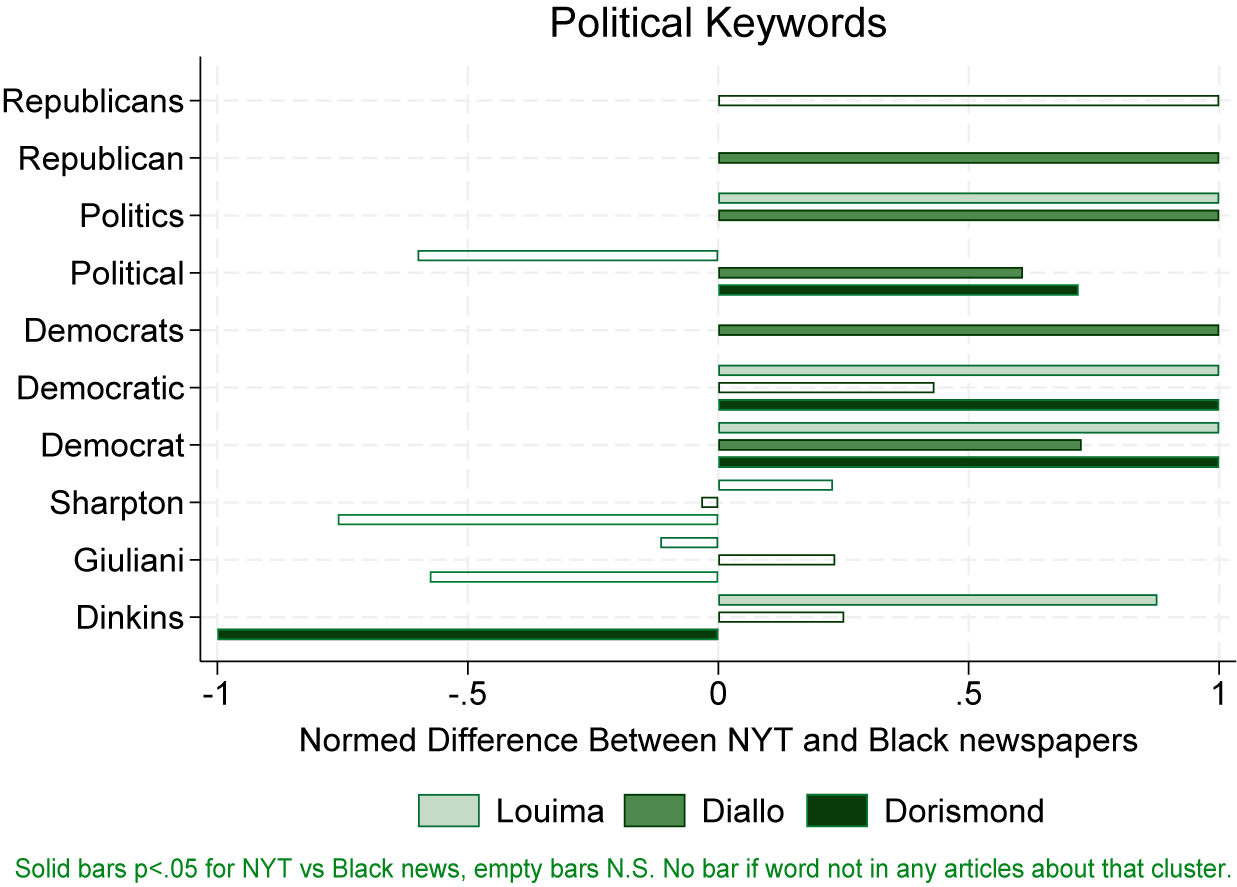
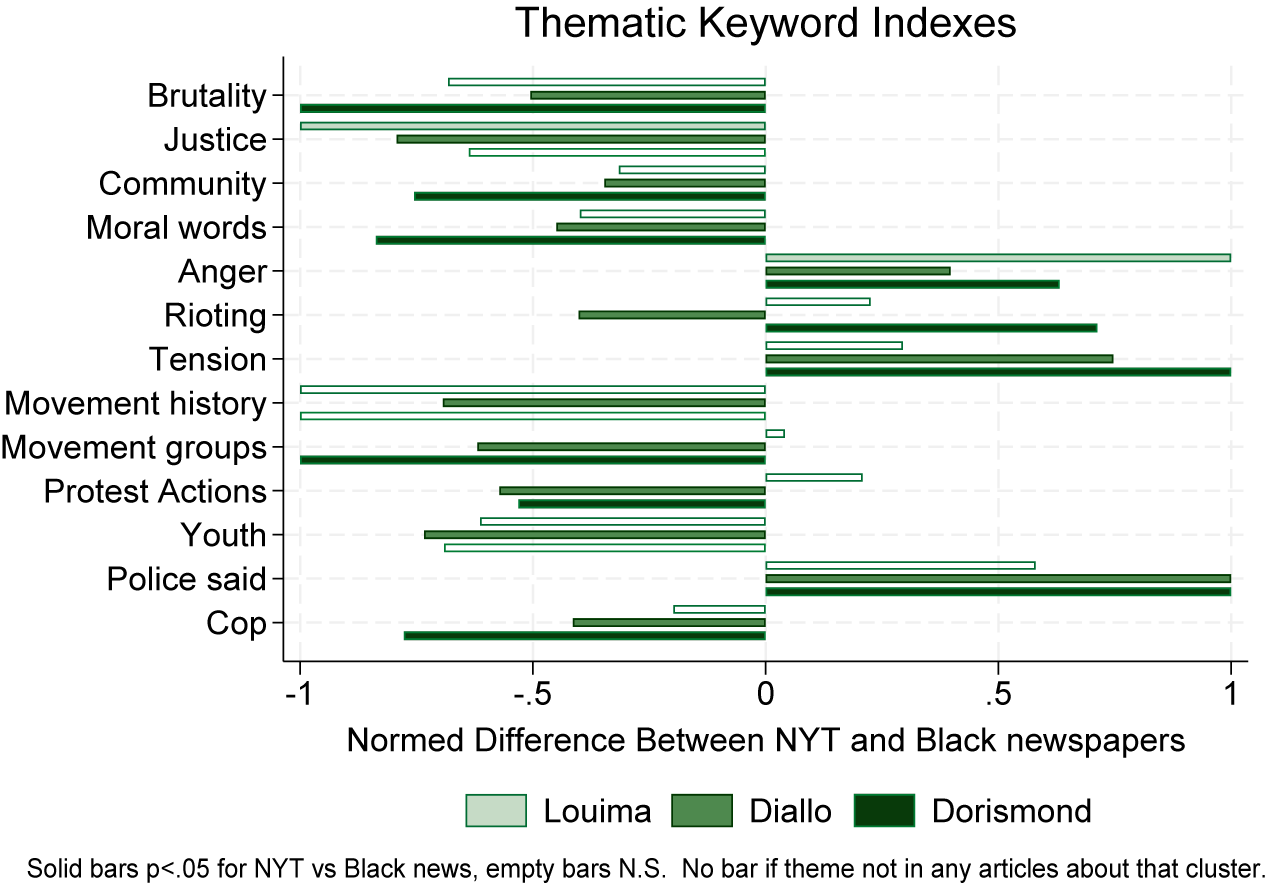


 Open access

