





The most recent of the British Forces’ Chaplains’ departments, the RAF Chaplains’ Branch was created in 1918, ‘accepted without demur by parliamentarians, the Air Ministry, the military authorities, the British churches, and the British public’, as Eleanor Rance and Michael Snape have observed.Footnote 1 No doubt reflecting the limited nature of the RAF Chaplains’ Branch archive, there has been little research into the experiences and ministry of RAF chaplains in the interwar period or during the Second World War.Footnote 2 This article contributes to our understanding of RAF chaplaincy in that period by considering the experiences of one RAF chaplain, the Rev. Charles Hooper, who, from October 1942 until August 1946, served as an RAF chaplain, first at RAF stations in Wales and England, and then, from spring 1945, in South East Asia.Footnote 3 Drawing on Hooper’s letters to his wife Mary,Footnote 4 it first explores what Hooper’s correspondence reveals about the approach taken to chaplaincy at RAF stations in England, before turning to Hooper’s role in setting up and running the RAF Moral Leadership courses in the area covered by South East Asia Air Command (SEAC), later Air Command, South East Asia (ACSEA). Hooper’s letters shed light on the shifting balance between what he termed ‘parochial’ (or liturgical and pastoral) work and leadership training in the RAF Chaplains’ Branch in the final stages of the war. They also testify to the changing situation of the RAF and other Allied Forces in South East Asia in the unsettled period that followed the unexpected surrender of the Japanese on 15 August 1945.
Charles German Hooper (1911–95)
Charles Hooper was born in Cardiff on Easter Sunday, 16 April 1911. Leaving Cardiff High School aged 17, he entered St Augustine’s Canterbury, the Church of England’s missionary college, in 1928. There, he won a scholarship to read English at Lincoln College, Oxford, matriculating in 1929 and graduating in 1932.Footnote 5 Returning to St Augustine’s, he completed his General Ordination Examination in 1934. After a five-month round-the-world trip in an open-top car, he was ordained deacon by the bishop of Bristol on 16 December 1934, to serve as curate at St Bartholomew’s Corsham.Footnote 6 In Corsham, he met Mary, daughter of the architect Sir Harold Brakspear, and they married on 19 April 1936.Footnote 7 That summer, they sailed for Cape Town, where Hooper was licensed on 23 November 1936 to serve as assistant priest at St Saviour’s Claremont, and where their daughter, Jane, was born. In summer 1939, alarmed by the political situation in Europe, they returned to England, and in spring 1941, Hooper was appointed rector at Castle Combe, Wiltshire.Footnote 8 Their son, Andrew, was born that December. In 1942, Hooper enlisted as an RAF chaplain (Figure 1), arriving at RAF Athan, near Cardiff, on 1 October 1942, for a period of initial training.Footnote 9 On 21 October, he was transferred to RAF Uxbridge, and on 19 November received his first posting, to Balloon Command at RAF Stanmore Park, Middlesex. In late February 1944, he was transferred to RAF Stradishall, Suffolk, with responsibility also for RAF Chedburgh and RAF Wratting Common, and at times a fourth RAF station which is never named in his letters.Footnote 10 In February 1945, after a short preparation period in Morecambe, he was deployed to South East Asia, where he was based first in Kandy, Ceylon (now Sri Lanka), and subsequently, from January 1946, in Singapore. Hooper sailed from Singapore for England on 15 July 1946, where he was demobbed on 15 August 1946. On 2 November 1946, he was inducted as rector of Sandy, Bedfordshire. In 1953, he was appointed vicar of Bishop’s Stortford, Hertfordshire. From 1963 until he retired in 1976, he was archdeacon of Ipswich, serving concurrently, until 1967, as rector of Bildeston, Suffolk, and then, until 1974, as rector of St Lawrence’s and St Stephen’s, Ipswich. He died on 22 March 1995.
Charles Hooper as Chaplain: enclosed in a letter from St Athan, 5 October 1942. Author’s collection.

RAF Chaplaincy during the Second World War
As an RAF chaplain, Hooper joined a growing number of clergy serving the RAF in various capacities. Based on RAF Chaplains’ Branch records and the Air Force Lists, Bruce Johnson has calculated that, from thirty-five chaplains in early 1934, their number had grown to over 100 by 1 September 1939. By June 1940, just before the Battle of Britain, there were 250 RAF chaplains and, by March 1941, this had increased to 430. In total, around 1,000 clergy served in the RAF Chaplains’ Branch over the course of the Second World War, with the RAF latterly aiming to appoint one chaplain to every 1,163 personnel.Footnote 11 The majority of RAF chaplains were, like Hooper, priests in the Church of England, reflecting the fact that the vast majority of RAF personnel seems to have been Anglican.Footnote 12 However, chaplains also included ministers from Presbyterian, Methodist, and the United Board of Baptist and Congregational churches (known collectively in the RAF as PMUB), Roman Catholic priests and Jewish rabbis.Footnote 13 There were several categories of chaplain: RAF commissioned chaplains; RAF volunteer reserve chaplains (the majority, of whom Hooper was one); and chaplains assigned to Commonwealth squadrons under the operational control of the RAF, such as the Royal Australian Air Force. All, notes Johnson, ‘functioned identically and directives to “chaplains” were addressed to all of them’.Footnote 14 In addition, there were officiating chaplains, who were local clergy who provided religious services at particular RAF stations; and Auxiliary Air Force chaplains, who served as part of the Reserve of Air Force Officers (RAFO) or were allocated part-time to the Auxiliary Air Force (AAF) units, which included fighter, coastal, and balloon squadrons.Footnote 15
Some balloon squadrons, however, had a full-time chaplain: Hooper’s first posting as chaplain would be to Balloon Command, based at RAF Stanmore Park, Middlesex, under the command of Air Vice-Marshal Sir Leslie Gossage (whose younger son, a pilot, had been killed in 1940).Footnote 16 He had been told, Hooper wrote to Mary on learning of this posting, that ‘Air Vice-Marshal Gossage is a very good churchman & makes a point of attending all the services. I have been in the RAF long enough to know just how much that can mean to the padre.’Footnote 17 The King’s Regulations for the RAF stipulated that religious observance on a station was ultimately the responsibility of the commanding officer: ‘An air or other officer commanding is responsible that stations under their command of administration are provided for, either by chaplains or by officiating chaplains.’Footnote 18 The relationship between commanding officers and chaplains in large part determined what was possible for the chaplain.
RAF Chaplaincy: ‘Parochial’ Work
Hooper’s stint as RAF chaplain began with a period of training at St Athan, near Cardiff, ‘a vast station’, as he wrote on his arrival in October 1942. There were, he reported, regular services: ‘2 weekday H[oly] C[ommunion]s and a fairly full Sunday.’ At the daily Colours parade, ‘the parson’s duty is to “BEEF OUT” a few prayers’, as Richard Wilkie, the senior chaplain at St Athan, put it, in a voice ‘supposed to carry across the parade ground.’Footnote 19 Services were the mainstay of the chaplain’s ministry, whether compulsory parades or voluntary. Still in training, but now in Uxbridge, Hooper recorded the pattern of a Sunday: ‘Flight Colours hoisting, Holy Communion 7:30 a.m. and again at 11:00 after the parade service.’ There were also hospital services and evening services: ‘Next Sunday I am preaching three times! I have the big parade all to myself at 9:45 (H.C. at 7:30), then Hospital Service at 11:00 and the Evening Service again at 6:15. Luckily I can get away with the same sermon at Hospital and E[vening] P[rayer].’Footnote 20 The evening service, he noted, was ‘held in collaboration with the O[ther] D[enominations]’,Footnote 21 a reminder that this was not normally the case.
Preaching at an RAF parade service on 3 September 1942, shortly before his appointment as chaplain, Hooper had commented: ‘Organized worship doesn[’]t “Go down well” with the Forces, & quite frankly I believe that it is as much the fault of the Churches as of the Forces.’Footnote 22 Once posted to Stanmore Park, Hooper proved himself imaginative in his approach to worship and was quick to identify and make use of the resources available to him. ‘First big 100 p[er] c[ent] Church Parade on Sunday morning,’ he wrote in anticipation on 3 December.Footnote 23 The following Monday, he reflected:
Everything went off well yesterday. We had a very nice parade service in Stanmore church. I managed to get the choir from the Station to sit in the choir stalls (they are really a madrigal society, but they sing hymns very nicely). This was a great success, being quite a new venture. The air marshal read the lesson and I preached on Christmas. Everybody keeps coming up to tell me how nice everything was and how different everything was going to be now.Footnote 24
Services might also be held off the station. On a Sunday in January 1943, Hooper had taken ‘a big parade in London in the morning and the afternoon service at the parish church here [i.e. in Stanmore] as well as two services on the station.’Footnote 25 Timing mattered, he noted: he was, he wrote, ‘not at all satisfied with my service at 5 p.m. and may be changing the time of it. … I must have the service when I can get most people at it.’Footnote 26
At this time, Sunday parade services were compulsory in the RAF, as was attendance at larger celebrations marking national events.Footnote 27 Hooper would arrive in Kandy shortly before the celebrations of victory in Europe, which took place on 9 May 1945 in the form of ‘a great combined Thanksgiving Service.’Footnote 28 He reflected later that this had been expected for so long that it was ‘a complete anticlimax’.Footnote 29 On 17 August 1945, victory over Japan was marked by a ‘Grand Thanksgiving “Do” in the station cinema’: these were ‘more spontaneous and less of a flop than V-E day.’Footnote 30 Such services were compulsory for all personnel. On occasion, Hooper also participated in services of celebration elsewhere in addition to his services at the stations. One Sunday in late June or early July 1944, he told Mary: ‘I had my usual four services this morning and this afternoon I have been out to Group 3 headquarters at Exning near Newmarket to take a service celebrating the fifth birthday of the WAAF! I had tea with the WAAF officers in their mess afterwards (the only man!).’Footnote 31 Sometimes these extra services were too much. A few weeks later he wrote: ‘I have been asked to preach at the Cathedral in Bury [St Edmunds] on the afternoon of Sept[ember] 17th (Battle of Britain Sunday) – but am trying to get out of it as it will be a very heavy day without the extra burden.’Footnote 32 From Kandy, he sent Mary photographs of the 1945 Battle of Britain parade (Figure 2), which included ‘a short drumhead service through a microphone,’ held on the parade ground. There was also a Sunday parade service that day; this, like the V.J. celebration, was held in the station cinema.Footnote 33
Hooper conducting the Battle of Britain Parade, Kandy, September 1945. Author’s collection.

Figure 2. Long description
In the foreground, an officer in a dark robe stands on a raised platform facing a group of uniformed soldiers arranged in rows. The soldiers stand at attention on a lower level, with a staircase to the right leading up to a higher terrace. Behind the soldiers, more uniformed personnel line the edge of the terrace, extending from left to right. In the background, large trees partially obscure a building with columns, where additional spectators are visible. Several vehicles, including cars, are parked near the building. The scene is shaded by the tree canopy, and the overall composition emphasizes the formal arrangement and scale of the parade.
The King’s Regulations instructed that ‘Sunday, Good Friday, and Christmas Day will, as far as possible, be observed as days of rest’.Footnote 34 Curiously, Hooper’s letters never mention Good Friday, but Christmas was a highlight, marked by services and other festivities. Hooper’s first Christmas at Stanmore Park included not only services but two dances, interspersed by a lunch at which the officers and NCOs waited on the other ranks (‘very tiring; I had to say grace’), and as much good food as rationing would permit (‘Xmas Day breakfast was two fried eggs each’; dinner was ‘terrific. In fact for a wartime dinner I thought it was quite iniquitous. I can’t think where the catering offices managed to get it all’).Footnote 35 Altogether, Hooper looked back on a ‘very satisfactory Christmas Day’. The day had begun with communion services at 7.30 a.m. and 8.30 a.m. followed by sick communions: ‘39 communicants in all: not many out of a station of 600, but at least half were away on Christmas leave and some went to the parish church. In any case, nearly twice the number of last Christmas.’Footnote 36 A larger service held at 10:00 a.m. in the NAAFI was more informal: ‘We had a little band and they played splendidly. The service was short and “bright”(!). They sang the Christmas hymns with gusto. The Air Marshal came up onto the stage and read the lesson.’ It proved unexpectedly popular: ‘They had put out 200 chairs which I thought was far too many, but they were practically all taken. Not bad for a voluntary service – there must have been two thirds of the effective strength there.’Footnote 37 Using the NAAFI for a service was a new departure at Stanmore, but it was, Hooper reflected, ‘by far the best solution. My little chapel would only have held about 50 at the outside. And the Main Hall at the NAAFI was all decked up for Christmas and looked very nice with plenty of holly and paper streamers.’Footnote 38
Providing suitable worship space was a challenge. In his first weeks at Stanmore Park, Hooper had the room used as a chapel refurbished, and reported at Christmas that he was pleased with the results: ‘Chapel looked really nice: redecorated with white walls and green paintwork. Carpenters made communion rails and I requisitioned three carpets. Can’t be consecrated as it is a lecture room sometimes and it’s used for court martials.’Footnote 39 The situation was similar when Hooper moved to Stradishall. There, he cultivated the station’s choral society ‘as I want them to help me over Easter.’Footnote 40 He continued to make considerable efforts to ensure that liturgy was accompanied and enhanced by music. During his final posting in Singapore in spring 1946, Hooper wrote of one evensong that the congregation was ‘roughly 60 or 70 including a choir of 12 who sang an anthem extremely well. The evensong is full and choral.’ In contrast, he complained, his predecessor ‘used to mutilate it and it was all said.’Footnote 41 However, his ability to provide choral evensong was dependent on availability of musicians. By this point in 1946 the demobilization process was well underway, with two ships departing imminently, taking with them ‘unfortunately, the best part of my church choir and also the organist (or rather pianist).’Footnote 42 Hooper’s ability to make the best of the resources at hand was shared by other chaplains, but the need for them to do so testifies that the arrangements for RAF chaplaincy were often somewhat makeshift.Footnote 43
Soon after his arrival at Stradishall, Hooper described to Mary a typical Sunday across the three stations:
8:00 H[oly] C[ommunion] here at Strad[ishall] in a small lecture room in the NAAFI. (No chapel as yet, though I hope there will be soon.) At this service there were 9 communicants – all men. Then 10 a.m. service (C[hurch of]/E[ngland] and O[ther]/D[enominations] combined in the Old Cinema – a sort of semi parade at which we had a hundred or so. Then over to Chedburgh to take a parade service in the chapel-cum-gym, followed by late H.C. (an innovation of mine) to which five stayed – all aircrew.Footnote 44
Services also took place during the week, as he described to Mary: ‘C.O.’s Parade Tuesday, H.C. Wratting Common 8 a.m. Wednesday, H.C. Chedburgh 8 a.m. Thursday, “Padre’s Hour” (innovation) 6.30 or 7:30 one day a week at each of the stations.’Footnote 45 While acknowledging the need for parades, Hooper pushed to be allowed to hold voluntary services.Footnote 46 One Sunday soon after D-Day, he reported: ‘I persuaded the C.O. to let me have a purely voluntary service instead of the usual parade: he was very sceptical – but we had a packed house. Had a big parade at Chedburgh too.’Footnote 47 It was, however, difficult to maintain adequate cover for all three stations. For a time an ‘O[ther] D[enominations] Chaplain’ stationed at RAF Shepherd’s Grove ‘“did” Chedburgh’, but he was moved to another post in early December 1944. Hooper needed, he said, ‘a C[hurch of] E[ngland] Assistant, then I should be able to do the job properly’.Footnote 48 It was a relief when he could report that at Christmas Stephen Mariott, ‘Canon of Westminster and one of the Archbishop’s visitors is coming to do Wratting for me … . I am having full Sunday services Christmas Eve as usual – then a midnight celebration of H.C. then a 7:30 at Strad[ishall], 8:30 at Chedburgh, 10 and 11 at Strad[ishall].’Footnote 49
On these stations too it was a challenge to find a suitable venue to hold services: when he arrived, there was no chapel at all at Stradishall; a ‘chapel-cum-gym’ served Chedburgh; and at Wratting Common, he ‘had to run round making arrangements for the Station chapel (not yet properly furnished).’Footnote 50 By the end of May, he could report that he had been ‘working in the new church today … I must say it really looks very nice indeed inside and the outside is graced with a large white cross and a notice “St Andrew’s Chapel”.’Footnote 51 Although Hooper commented on being appointed to Stradishall that his predecessor, Peter Marrow, was ‘a good bloke’ and ‘energetic’, so that he would ‘have plenty to live up to’,Footnote 52 he nonetheless found the worship spaces he had inherited left a great deal to be desired.
Marrow also bequeathed Hooper a more serious problem. Chedburgh was eight miles from Stradishall in one direction, and Wratting Common eight miles from Stradishall in the other. Marrow had been driving ‘up to 8 or 900 miles a month’,Footnote 53 but ‘Bomber Command seems to expect its padres to own their own cars’; Hooper was, he said, considering buying a motorcycle.Footnote 54 Alternatively, he warned Mary that he might need to claim the family car: ‘I am afraid I shall find it impossible to keep up [Marrow’s] programme unless I have ours.’Footnote 55 The Air Commodore had advised that ‘by far the best solution would be … to use a private car as an authorised user.’ Hooper had explained that Mary needed the car to take their daughter Jane to school, but the Air Commodore ‘simply said we must put first things first.’Footnote 56 The somewhat fraught situation was resolved when Hooper was able to buy, not a motorcycle, but a second car, which enabled him to minister across all three stations as well as undertaking hospital visits in Cambridge and Newcastle, local funerals, and occasional trips to Bury St Edmunds for services in the cathedral. Again, this episode highlights the limited resources available to RAF chaplains and chaplaincy.
Chaplaincy involved more than services. Chaplains attended – and organized – social events, although they were explicitly instructed that participation in ‘the many activities (physical and social) of [the] station’ was ‘in no sense … to be regarded as a necessary part of [their] duties.’Footnote 57 Soon after he arrived in Stanmore Park, Hooper recounted: ‘I am going to the Stanmore Church Institute with the rector – it has been turned into a club for the forces and as several of our people go it’s a good thing to show up there occasionally. I have promised to do the prayers there once a week.’Footnote 58 At Stradishall he was asked to organize a children’s party at Christmas ‘(as at Stanmore) – but not many children’.Footnote 59 RAF chaplains also offered instruction in the faith. Hooper introduced a ‘Padre’s Hour’ at Stradishall, a practice that had been initiated by Army chaplains in 1942, with the aim of increasing religious knowledge amongst serving personnel.Footnote 60 Padre’s Hours might be voluntary or part of required training; they could provide a formal course of religious instruction or take the form of more open discussion.Footnote 61 From their timing as evening events, it seems likely that Hooper’s were voluntary, but he gives no indication of the content.Footnote 62 Hooper also frequently mentions ‘interviews’ in his letters, which would appear to be references to pastoral conversations. At Stanmore, he spent at good deal of time visiting ‘sites’ – the places where individual barrage balloons were moored and from which they were managed – presumably spending time with the AAF personnel who served there. Unsurprisingly (given the need for confidentiality) he made no detailed comments to Mary about what was discussed during these encounters or in the course of his site visits.Footnote 63 Hospital visiting was another key aspect of the chaplain’s role, frequently mentioned by Hooper while he was stationed at St Athan, Stanmore Park and Stradishall. He was also offering support and guidance to personnel who had received difficult news from home, such as one man whose wife had turned to prostitution,Footnote 64 and another whose wife had had a baby whom he could not have fathered.Footnote 65 He did, he said to Mary, ‘certainly see something of the “seamy side”’.Footnote 66 His commanding officer was not above consulting him: when Gossage was invited to preach at a boys school, he wanted Hooper’s advice about what to say: ‘Talk about being a friend and adviser to all souls!’, Hooper commented to Mary,Footnote 67 referring to the one of the guiding principles of chaplaincy, that ‘nothing may interfere with [the chaplain’s] being regarded by all ranks as their friend and adviser.’Footnote 68
It is clear that Hooper and other chaplains’ hope was that such conversations and encounters might draw station personnel not only to explore their faith, but also to request confirmation, and some certainly did. At the outset of his ministry as an RAF chaplain, Hooper was struck by the number of confirmations. On the Sunday after his arrival at St Athan for training, the bishop of Llandaff confirmed eighteen candidates. Hooper observed that classes would begin again immediately, with another confirmation planned two months later: ‘this goes on the whole time, which is a good show’; sometimes there were even higher numbers of candidates.Footnote 69 During his time at Stanmore Park, Hooper several times referred in his letters to ‘visiting [balloon] sites and trying to get candidates for confirmation’ or to ‘trying to organise confirmation classes’.Footnote 70 Anglican confirmations required the ministrations of a bishop: chaplains would prepare candidates, and might baptize previously unbaptized candidates, but could not confirm them. It is not clear where the Stanmore candidates were confirmed, or by whom. At Stradishall, confirmations took place at St Edmundsbury Cathedral.Footnote 71 Similarly, in Ceylon, there were confirmations of RAF personnel when the bishop of Colombo visited Kandy to dedicate a new chapel, a visit that coincided with the celebration of the unexpected victory over Japan, leading to a hectic weekend: ‘I baptized two WAAF in St Paul’s Church, Kandy, this afternoon. Dedication of the station chapel tomorrow night at 7:00, confirmation at 7:30 a.m. on Sunday, followed by Holy Communion [at] 8:00 a.m. Grand Thanksgiving “Do” in the Station cinema at 9:30. … Evensong at 7:00 p.m.’Footnote 72 In Kandy, there were also a number of weddings; indeed, Hooper remarked somewhat cynically to Mary: ‘I am preaching on Christian marriage on Sunday … lots of our WAAF are “getting their men” which I firmly believe was their object in volunteering for overseas service.’ As for the baptisms, he arranged for the weddings to take place at St Paul’s.Footnote 73
In his time at Stanmore Park, Hooper’s letters do not mention his taking a single funeral, although that does not mean that there were no deaths on the balloon sites. During an air raid on the evening of 17 January 1943, Hooper was with the commanding officer of Stanmore Park at Kensington squadron:
We went to the Squadron Headquarters in Kensington Palace Gardens, then went to visit a few sites. They were all in very good form and the WAAF stood up to it very well. There wasn’t a great load of bombing, but a tremendous amount of shrapnel falling. One man was killed and a WAAF injured, neither in my squadron.Footnote 74
This quickly changed when he moved to Stradishall and to Bomber Command, when references to crashes and funerals begin to punctuate his letters.Footnote 75 In his first week there, a plane crashed with only one survivor; Hooper visited the survivor in Ely hospital, wrote to the families of those killed, and took the funerals of two of the crew on successive days in Cambridge.Footnote 76 It had been, he told Mary, nevertheless a ‘lovely day today. Enjoyed my trip to Cambridge, though would prefer to have been taking a wedding.’Footnote 77 In April, he wrote: ‘I managed to get into Cambridge after the funeral yesterday – bought pyjamas and did a sketch of a windmill. I am burying three New Zealanders at Cambridge tomorrow and from this go on to Ely hospital.’Footnote 78 In June, he ‘had hoped to see the Derby at Newmarket on Saturday but we have a funeral just at the time of the race which is bad luck.’ This was not the funeral of a crash victim, but of an airman who had been shot by another member of his crew: ‘Frightful business. … I am not looking forward to meeting the relatives.’Footnote 79 Mostly, though, he was taking funerals of the victims of crashes: in an undated letter, he warned Mary, who was planning to visit him: ‘We have had another prang, so I may have to cope with a funeral about that time.’Footnote 80 In October, ‘there was a bad prang at Wratting … Only one survivor, so plenty of letters to write.’Footnote 81 On 15 December, he reported that ‘Wratting and Chedburgh lost 5 kites between them yesterday.’Footnote 82 Not all the funerals were local: he told Mary in September that he was taking one in ‘a place called Hintlesham, not far from Ipswich.’Footnote 83 Many bodies were not recovered and others were transported home for their burial; in June he recorded: ‘Two officers killed in recent crashes were from Cardiff and were buried there – but that is out of my effective burying range!’Footnote 84 Cardiff was his own home town and he would have been glad of an excuse to visit his family; but it was too far to go to take these officers’ funerals. However, when his grandmother died in December 1944, arrangements were made to fly him there for hers.Footnote 85 Occasionally, there was also a baptism: when Jean Sturdy, a former WAAF officer with whom he had become friendly and who had made the altar frontal for the chapel, had a baby, Hooper took the christening, commenting that this was ‘a pleasant change from funerals.’Footnote 86 It was a relief to return from a short period of leave to find that ‘there have been no losses from this Squadron in my absence – for which I am v[ery] thankful.’Footnote 87
The ‘parochial’ side of chaplaincy which Hooper describes in his letters is, in many ways, the normal work of a chaplain, adapted to the particular situation of RAF stations. Parade services, voluntary services, pastoral conversations, catechetical discussions, hospital visits, baptisms, confirmations and funerals were regular features in the ministry of all serving chaplains, and the king’s Regulations emphasized that these were to be the chaplain’s priority, supported by the station’s commanding officer.Footnote 88 Hooper seems to have placed a stronger emphasis on the liturgical life of the chaplaincy than was the case with some of his colleagues, and he clearly made considerable efforts to develop informal forms of worship and to involve musicians. Although every chaplain was ‘responsible generally for the building set aside as a church for the use of his denomination,’Footnote 89 Hooper’s emphasis on creating attractive worship spaces with a good atmosphere may have been somewhat unusual, although it was far from unique. It is apparent that he was valued by his commanding officers, being ‘mentioned in despatches’ in 1944 (the reason for this is unknown).Footnote 90 This ‘parochial’ work was, however, only one aspect of his ministry: during 1943 and 1944, Hooper became increasingly involved in the RAF’s Moral Leadership courses, and in 1945 his posting to South East Asia made him responsible for organizing and delivering them.
The Cambridge Chaplains’ School and the RAF’s Moral Leadership Courses
It was apparent from early on in Hooper’s time as RAF chaplain that chaplains were not being left to bear their burdens alone. National RAF chaplains’ conferences had come to be a regular occurrence, and Hooper attended several of these. In addition, in November 1943, the RAF established a ‘Chaplains’ School’ which was based at Magdalene College, Cambridge, as part of the RAF No. 2 Initial Training Wing, also based in Cambridge.Footnote 91 This ran ‘Chaplains’ Courses’, which were aimed at RAF chaplains who had already been in service for some time and had seen the effects of war on aircrews.Footnote 92 It also supported a programme of ‘Moral Leadership Courses’: these were run by chaplains and aimed at developing and enhancing the leadership of serving personnel, particularly officers.Footnote 93 Joan Clifford sees the Moral Leadership courses as an expanded version of the Padre’s Hour, and it is clear that throughout the war chaplains had been involved in providing lectures and discussion space on local bases.Footnote 94 However, the aim of the Moral Leadership courses went beyond religious education. Neville Stuart Talbot, former bishop of Pretoria, who took a considerable interest in the RAF, pointed to the high calibre of RAF officers and personnel: ‘the R.A.F. is a wonderful body of young men, the most intelligent on the whole to be found anywhere and [with] the most potential.’Footnote 95 Those who survived would be important leaders after the war: ‘I think we can, generally speaking, hold on and see the whole thing through, as regards downing Hitler and Co., but how about what lies beyond that?’Footnote 96 Talbot wanted serving RAF personnel to be brought together ‘for retreats, conferences, real vital discussion’ to prepare them for their leadership responsibilities after the war.Footnote 97 The Moral Leadership courses were intended to fulfil this purpose. They were more formalized than Padre’s Hour; they were generally held off the station; and they might include an element of spiritual retreat. Hooper participated in the first Cambridge chaplains’ course and quickly became involved in lecturing on Moral Leadership courses. When he arrived in India, it was to discover that he was tasked with organizing and running Moral Leadership courses for the entirety of SEAC/ACSEA. It would, he commented ruefully, ‘have been so much easier if I had known I was to do this work before I left England.’Footnote 98
Hooper’s first mention of a chaplains’ conference was in November 1942, during his posting to Uxbridge, when he told Mary that he was attending a conference for ‘all RAF CofE padres, … a beastly nuisance and probably a complete waste of time.’Footnote 99 Speakers included the air minister for personnel,Footnote 100 the under-secretary of state for air,Footnote 101 and the ‘Queen WAAF of the WAAFS.’Footnote 102 There was daily holy communion at a church in St John’s Wood. In total, 260 chaplains attended, and Hooper ‘found several people that I knew.’Footnote 103 In the event, he admitted, ‘I quite enjoyed the conference, though they kept us hard at it.’Footnote 104
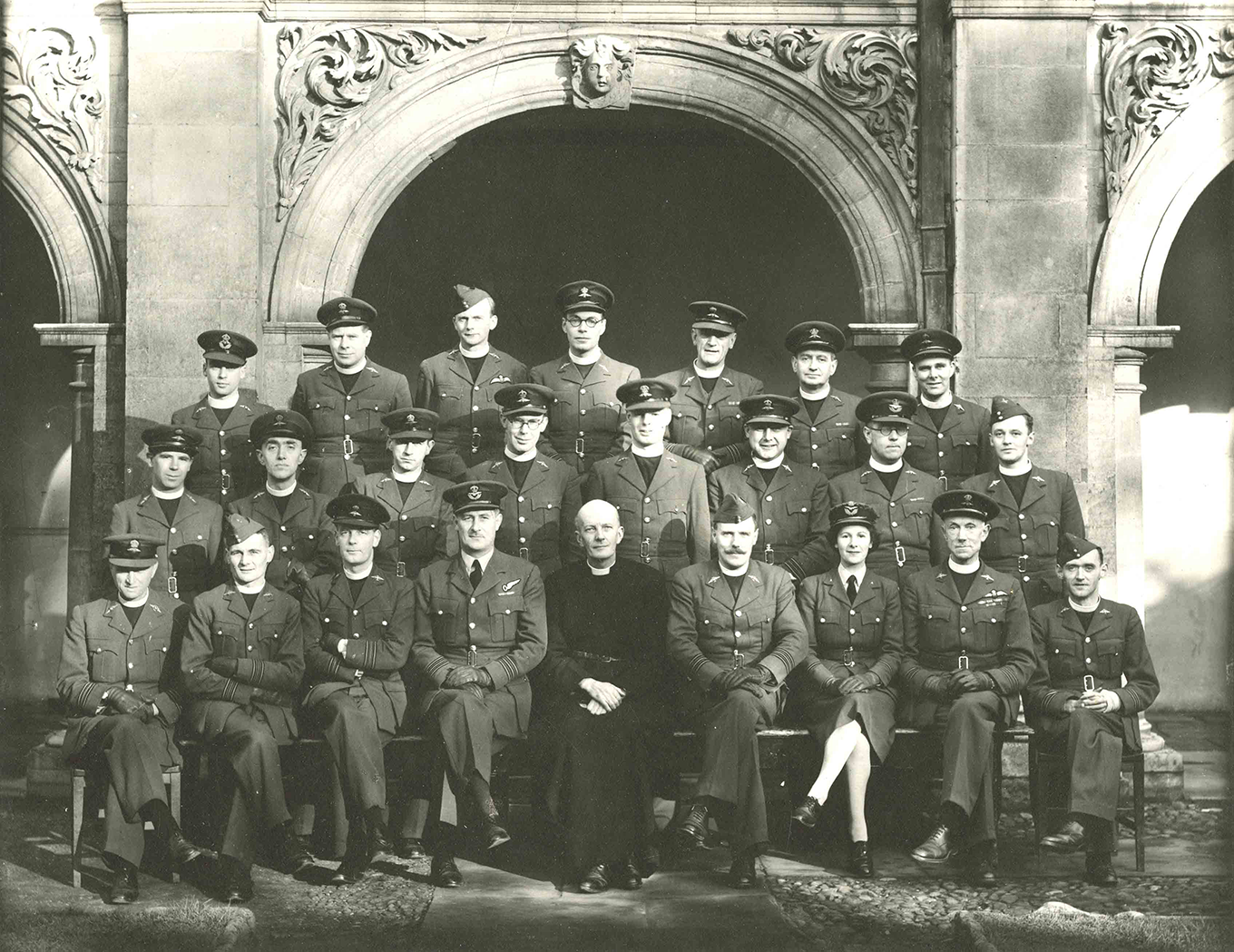
Later that year, 28 November 1943, he wrote from the ‘RAF Chaplains’ Centre, Magdalene College, Cambridge’, where he was attending the first chaplains’ course in Cambridge (Figure 3),Footnote 105 which took place from 23 November to 2 December. No records survive indicating the content of the course,Footnote 106 and Hooper’s letter recounts nothing of the theological input. Always a keen rugby fan (and himself a former blue), he told Mary that he had ‘managed to see the Inter-Varsity match … . Cambridge won – a good game 13-4.’ He had also been to choral eucharist at King’s College Chapel; ‘we are now “in Retreat” until Tuesday.’Footnote 107 The chaplains’ course seems to have been more relaxed than the chaplains’ conference.
No. 1 Chaplains’ Course, Magdalene College, Cambridge, November 1943. Image courtesy of the RAF Museum, X004-4896: RAF Chaplaincy Branch Archive, Box 55: Photographs – Chaplains. Used with permission.
The Cambridge centre also ran Moral Leadership courses for Church of England personnel, aimed at serving officers and senior aircrew. Johnson has found that two three-day courses were run in March and April 1944; in July 1944, a programme of six-day courses began, with seventeen being run before the Cambridge Chaplains’ School closed at the end of February 1945. From December 1944, these Moral Leadership courses were also adapted for RAF ordinands.Footnote 108 Johnson suggests that they originated before the Cambridge Chaplains’ School, having previously ‘been held in other venues’ (although these venues are not specified).Footnote 109 Israel Brodie, however, asserts that the Moral Leadership courses for all denominations began in 1944:
In 1944, the Air Ministry instituted Courses of Instruction in Moral Leadership, to be held under the auspices of certain religious denominations. The object of these courses was to further the development of ideals of leadership, not only in religious faith and practice, but in morale, discipline and fighting spirit. Those selected had to be especially recommended by the Chaplains and approved by their commanding officers, and were to be men and women likely to exercise an uplifting influence on their comrades in their daily life and especially in times of danger.Footnote 110
Brodie’s account provides good grounds for believing that the Moral Leadership courses were not only conceived as ‘an introduction to Christian belief and ethics for both officers and airmen,’Footnote 111 as Johnson suggests, but that they were also intended to help counter what in the RAF was known as ‘Lack of Moral Fibre’ (LMF).Footnote 112 Indeed, as Johnson shows, the Chaplains’ School itself had been envisaged as a place in which both chaplains and men could seek respite from the strains they faced on the station. The Rev. Wing Commander Charles J. F. Gilmore, the school’s first commandant, seems to have believed that ‘to provide for a time of rest, spiritual retreat, and theological reflection was more than prudent. If a school for this purpose could be established, it could also be used as a place of spiritual retreat for other military personnel.’Footnote 113 The chaplains’ courses were intended to sustain the chaplains (and it certainly seems that Hooper experienced the one he attended as a time of recuperation and spiritual retreat); the Moral Leadership courses were to support aircrew.Footnote 114
It is evident from his letters that Hooper had encountered and worked with service personnel who were suspected of lacking moral fibre. Such cases were initially referred to ‘Not Yet Diagnosed Neuropsychiatric Centres’. Until October 1943, those who were discharged from these centres as unfit to return to operational duties were sent to No. 1 RAF Depot at Uxbridge.Footnote 115 Soon after his arrival there, Hooper described it to Mary as ‘a kind of sorting out place’:
There is a constant influx of L.M.F. people – very tragic cases. They are all people who have been on operations & haven’t stood the test. Most of them get ‘stripped’ i.e. downgraded and have to start again on ground jobs. Some of them get Bowler hats – i.e. no longer any use so kicked out. It seems a bit hard when some of them have been on operational flights some 40 or 50 times. Some are extraordinarily nice chaps – but some are frightful types whose chief trouble is drink.Footnote 116
Once posted to Stradishall, Hooper was directly confronted with the challenges faced by serving officers and aircrew. Perhaps this led to his involvement in the Moral Leadership courses; in addition, the location of Stradishall, about twenty-two miles from Cambridge, made his involvement possible. In April 1944, he wrote to Mary: ‘I spent yesterday in Cambridge at the Moral Leadership Course, and I’m going to take on a few lectures, but it will only mean going to Cambridge every now and then – no question of posting or attachment.’Footnote 117 This must have been the second of the two three-day courses identified by Johson. It is possible that Hooper also went on to contribute to some of the later six-day courses as a lecturer; however, his letters say nothing more about his involvement; nor do they reveal anything about the content of his teaching at this period.
Nine months later, his confident prediction that there was ‘no question of posting or attachment’ relating to his involvement in the Moral Leadership courses was proved incorrect. In early January 1945, Hooper was told that he was to be posted overseas on a three-year tour. ‘Have just phoned Chaplain-in-Chief’s department though they won’t tell me much. … Apparently it is a “senior” job (may be a Win[g] Co[mmander] yet!) and I am specially selected for it. … They think I shall be leaving at [the] end of [the] 1st week of February.’Footnote 118 RAF policy meant that Hooper did not know at this stage where he was being sent:Footnote 119 his letters noted only that he was ‘posted to No. 2 P[ersonnel] D[espatch] C[entre] in Morecambe to report no later than 16:00 hours on 5th Feb (Monday),’Footnote 120 and that he needed to ‘go ahead with [his] inoculations and clearance so as to be ready to depart.’Footnote 121 After a brief period of leave in Wiltshire to say goodbye to Mary and the children, Hooper duly reported to Morecambe, only to discover that he would not be sailing for another week or so; Mary was able to visit him there before he left. He sailed – as is clear from later letters, since he was not permitted to give this information at the time – from Glasgow on 15 February 1945, on the SS Ranchi.Footnote 122 It was a busy voyage for Hooper, who had been appointed chief chaplain for the ship, with another RAF chaplain, the Church of Scotland minister C. E. Paull, and a Church of England army chaplain named Griffiths to assist him.Footnote 123 He did not much like either of them: Griffiths, he found, ‘was more concerned with putting it across than with having something worth listening to to talk about,’ while Paull was ‘very parsonish’ and ‘a dreadful bore.’ Nonetheless, he could soon report, they had had a ‘very successful Sunday. Holy Communion in the Officers’ Lounge at 7:30 – more than 50 communicants. Main service at 10:30 in the First Class Dining Saloon. We were packed out with well over 400 and had to turn numbers away. Evening hymn singing also crowded out.’Footnote 124 On 16 March, he sent a telegram and a letter to tell Mary that he had arrived, was in a transit camp and about to take a train to Calcutta, where ‘the Chaplain-in-Chief will give me my final destination.’Footnote 125 This proved to be Kandy, in Ceylon (now Sri Lanka), and it was at this point that he was informed that the ‘senior job’ for which he had been deployed was to take responsibility for running Moral Leadership courses for Air Command South East Asia.
As a first step, Hooper was required to give a report on his plans to the RAF chaplains’ conference in Darjeeling in May. There was, he said, ‘Plenty of stimulating work in this matter of the M[oral] L[eadership] courses,’ but he was determined that his approach would not simply model what he had experienced in England:
At the moment I am preparing a pretty comprehensive Report to give to the Chaplains at their Annual Conference at Darjeeling at the end of May. I have got to make it clear to them that if I am to continue to be responsible for getting the courses going out here I am not going to copy the English effort which appears to me to be degenerating into a sort of retreat for pious airmen. I have very definite ideas both about the men to be sent on the courses and the stuff to give them when they get there.Footnote 126
As the war in Europe drew to its end, Hooper was convinced ‘that the real aim of the leadership courses now is leadership in the world after the war – in all walks of life, not just running Sunday School classes as some seem to think.’ This was what he was hoping to ‘put across to the Chaplains at Darjeeling.’Footnote 127 He shared his proposed approach with senior RAF officers and with the bishop of Colombo, Cecil Horsley, and found that they agreed with him.Footnote 128 Shortly before he left for the conference, he could report:
I had an interview with the Air Chief this morning – he gives the whole thing his blessing and said that he will support in every way. This is grand of course as I shall now be able to tell the chaplains that the Air Chief entirely supports my view as to how the courses should be run.Footnote 129
The challenge, as he saw it, was to convince the chaplains: ‘you know what parsons are like – they like things to be “churchy”.’Footnote 130
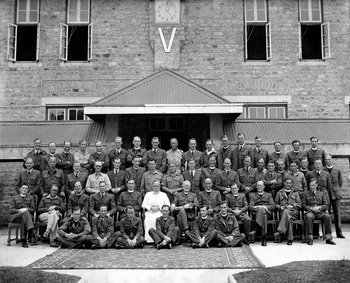
The chaplains’ conference took place in Darjeeling from 25 to 31 May 1945 (Figure 4). Fifty-two Church of England chaplains gathered under the leadership of Canon Reginald Diggle, the assistant chaplain-in-chief. The bishop of Newcastle, Noel Baring Hudson, led the retreat.Footnote 131 Hooper had been given Tuesday morning for his presentation and discussion;Footnote 132 he was, he confided, ‘a little nervous of introducing my ideas about the M[oral] L[eadership] courses … ; however, I’m sure that my ideas are right and I’ll do what I can to persuade them. I think I have got Canon Diggle on my side.’Footnote 133 In the event, he need not have worried:
My talk on Moral Leadership went over far better than I had expected. Everybody seems most enthusiastic & they have unanimously agreed that I go ahead on my own lines, & that we do not imitate the English courses. This is very encouraging though I must admit that I am more than a little fearful when I think of the labour it’s all going to involve. You see, I alone shall be responsible for the whole scheme & must attend to every detail of organisation & to the ‘briefing’ of all lecturers, etc. etc. etc. Also we are going to have a special course for certain wings that are now resting in South India before returning to the fray – the proposed date is 23 July: i.e. five weeks before the proposed course at Bangalore which was to have been the first.Footnote 134
Church of England Chaplains’ Conference, Darjeeling, 25–31 May 1945. Image courtesy of the RAF Museum, X004-4896: RAF Chaplaincy Branch Archive, Box 70: Photographs – Chaplains. Used with permission.

Figure 4. Long description
In the foreground, five rows of men are arranged for a formal group portrait. The front row is seated on chairs and the ground, with two individuals in clerical robes at the center. The next three rows consist of men in military uniforms, standing closely together. The back row stands on a raised step. Behind the group is a stone building with four open windows on the upper floor, a central entrance with a corrugated metal awning, and a large clock above the doorway. Below the clock is a prominent letter V affixed to the wall. The ground in front of the group is covered by a patterned rug, and grass is visible at the bottom edge.
Overall, he concluded, despite his concern at the outset that he would ‘get rather bored with so many parsons,’ the conference ‘has been a success & I have enjoyed it.’Footnote 135 He had learned a great deal about the way in which RAF chaplaincy functioned in South East Asia: ‘chaplains have vast areas including often 5 or 6 units.’ He was, he recognized, ‘in rather a unique position here with my “special job”.’Footnote 136 Before leaving Darjeeling, he had arranged to run a course there in November.Footnote 137 Waiting in Calcutta for transport back to Kandy, he set about writing a report on his ‘activities as Director of Moral Leadership courses’ for Diggle to pass on to the chaplain-in-chief on a forthcoming visit to London.Footnote 138 He had also learned to appreciate the advantages of Kandy: he was, he wrote in early July,
a tiny bit afraid that they may take me away from my beautiful Kandy to go to the ‘Black Hole’ (Calcutta). John Burke, the R[oman] C[atholic] chaplain here, who like me, is responsible for their leadership courses, has been told pretty definitely that he will have to work from the Chaplains’ HQ (Calcutta).Footnote 139
On his return to Kandy, with the support of a WAAF administrator named Lucy, he settled down to plan a programme of courses which ran to the end of 1946.Footnote 140
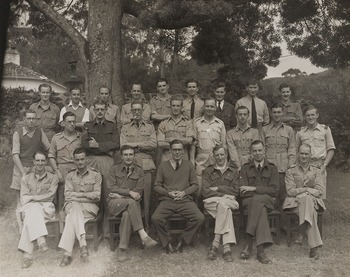
The first Moral Leadership course under Hooper’s direction took place at the American Lutheran Mission in Kodaikanal, India, in the last week of July 1945 (Figure 5).Footnote 141 Hooper was, he admitted, ‘Het up about this first course and shall be quite relieved when it’s over, tho’ in point of fact I shall probably quite enjoy the whole thing.’Footnote 142 Judging from the course photograph, there were twenty-one participants, and Hooper was assisted by three other chaplains: Harry Cullen, Bob McCulloch and Jack Pearman.Footnote 143 Hooper found the course participants to be ‘a good crowd with a very high proportion of officer air crew – in fact a far better crowd than they used to get on the courses in England.’Footnote 144
Moral Leadership Course, Kodaikanal, India, 23–28 July 1945. Author’s collection.

The days were structured around services, ‘which were voluntary but well attended’: matins at 7.30 a.m., followed by holy communion at 8.00 a.m.; evensong at 5:10 p.m. and night prayer at 10.00 p.m.Footnote 145 Each day, there was a lecture followed by discussion from 9.30 a.m. until 12.30 p.m. Afternoons were free, with a further lecture and discussion from 5.30 until 7.30 p.m. and usually another session after dinner. The course opened on Tuesday 24 July with a lecture by Hooper giving a ‘general picture of the world we live in and the problems that face us.’ Harry Cullen offered ‘human answers (Communism and Fascism)’ and Hooper then talked about ‘the Christian answer.’ Wednesday was taken up with ‘Three good stiff lectures by McCullough [i.e. McCulloch] on “God’s purpose for Man” which was a general survey of the growth and meaning of the Xtian Faith.’ On Thursday morning, Hooper lectured first on Christian leadership in the RAF, offering ‘practical suggestions for when they got back to their units’, and then on Christian leadership in the family, which ‘dealt with Sex, Marriage, Divorce, Birth Control, Parental Responsibility & Christian education.’ On Friday morning, Cullen considered Christian leadership in the Church of England and Christian leadership in the community. On the Thursday and Friday evenings, Pearman ‘gave talks on Prayer, the basis of Christian leadership.’ Overall, Hooper concluded, ‘The course has been a great success – that I can say without any qualification.’ While it had been ‘tremendously hard work’, it had also been immensely satisfying:
From the point of view of my job, this course has been by far the most worthwhile thing I have done in the RAF, or for that matter, since my ordination. The men who came on it were a grand crowd & the atmosphere throughout has been very happy. There is no doubt that they mean to get on with the job (Christian Leadership) in their units.Footnote 146
The participants were, he noted, ‘all expecting to be in action very shortly.’ Despite Hooper’s conviction that courses needed to prepare participants to take leadership in the post-war world, this course also explicitly sought to foster and support leadership amongst officers and aircrews in combat.
Very few records of the Church of England Moral Leadership courses run in England survive, so it is difficult to know the extent to which the South East Asia courses differed. However, Moral Leadership courses were run across the RAF, and some records of courses run at this period in the Middle East are extant. These mostly relate to the courses run by the Presbyterian, Methodist and United Board [PMUB] chaplains, but the papers include the programme for a Church of England Moral Leadership course, probably held in January 1945 at the Friends School, Ramallah (Table 1).Footnote 147
Moral Leadership Course – Levant (Church of England) no. 2 – Programme

Table 1. Long description
Starting at the top, Friday January 12th begins with reporting at the Chaplains Office H Q Levant by 17:00 hours, followed by 19:00 Evensong, 20:00 first lecture titled ‘Christ and Moral Leadership’ by the Rev. F. de Jonge, and 21:30 Compline. Saturday January 13th starts with Matins and H C at 07:00 hours, 09:00 lecture ‘Patience’ by the Rev. F. de Jonge, 11:00 lecture ‘The Infancy of Christ’ by the Rev. C. D. Hulbert, 13:30 pilgrimage to Bethlehem led by the Rev. B. Langmaid, 17:30 talk and discussion ‘Work’, and 20:15 Religious Brains Trust. Sunday January 14th is a free day with religious services at St George's Cathedral or Christchurch and optional afternoon excursions. Monday January 15th includes 09:00 lecture ‘Courage’ by the Rev. F. de Jonge, 11:00 lecture ‘The Baptism’ by the Rev. C. D. Hulbert, 13:30 pilgrimage to Ain Karim led by the Rev. R. T. G. Pearson, 17:30 talk and discussion ‘Sex’, and 20:15 Quiz. Tuesday January 16th features 09:00 lecture ‘Understanding’ by the Rev. F. de Jonge, 09:45 visit to the Temple area with the Rev. A. M. Cutley, 14:00 lecture ‘The Mission’ by the Rev. C. D. Hulbert, 13:30 pilgrimage to Ain Karim with the Rev. R. T. G. Pearson, 17:30 talk and discussion ‘The Church’ by F/Lt F. Challon, and after dinner, a free evening. Wednesday January 17th includes 09:00 lecture ‘Self-denial’ by the Rev. F. de Jonge, 11:00 lecture ‘The Cross’ by the Rev. C. D. Hulbert, 13:30 pilgrimage the Way of the Cross led by the Rev. E. L. P. Evans, 17:30 talk and discussion ‘Prayer’ by W/O G. Ring, and 20:15 ‘Question Time’. Thursday January 18th has 09:00 lecture ‘Single-heartedness’ by the Rev. F. de Jonge, 11:00 lecture ‘The Risen Christ’ by the Rev. C. D. Hulbert, 13:30 pilgrimage to Mount of Olives led by the Rev. H. E. Jones, 17:30 special talk on ‘Vocation’ by Capt. Thomas (Church Army), and 20:15 open discussion of practical steps. Friday January 19th concludes with a short closing service and address by the Rev. A. M. Catley.
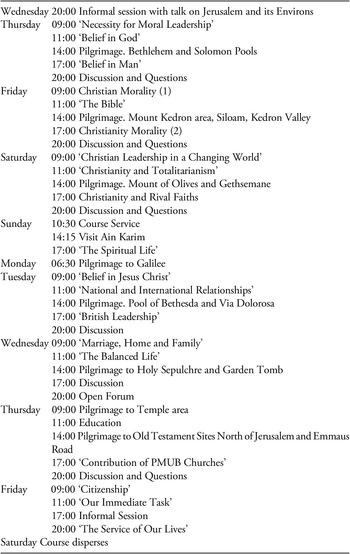
It is apparent from this programme that the first course organized by Hooper addressed a wider range of different aspects of Christian leadership. The courses held in or near Jerusalem had a much stronger focus on the gospel story: the location provided an opportunity for biblical pilgrimage which was simply not possible for courses run in South East Asia.Footnote 148 The pilgrimage aspect was also a key element of the PMUB courses, although these seem – at least in their early iterations – to have had more of an emphasis on leadership, with sessions on ‘Christian Leadership in a Changing World’, ‘British Leadership’ and ‘Citizenship’ (see Table 2).Footnote 149 Planning for the seventh PMUB course in January 1945 determined that the sessions should be grouped into four series of themes: ‘The beginning of the New Order (Studies of the Galilean Ministry of Jesus Christ); The basis of the New Order (An outline of Christian Belief); The individual in the New Order (Studies of ethical questions); The New Order in Society (Studies of the social, economic, and political implications of Christianity).’Footnote 150 In comparison with the Middle East courses, therefore, there are grounds for thinking that Hooper’s courses had a stronger focus on leadership than did other Church of England courses.
Moral Leadership Course – Levant (PMUB) no. 1, 19–29 July 1944, Ramallah, Friends’ Girls’ School – Programme
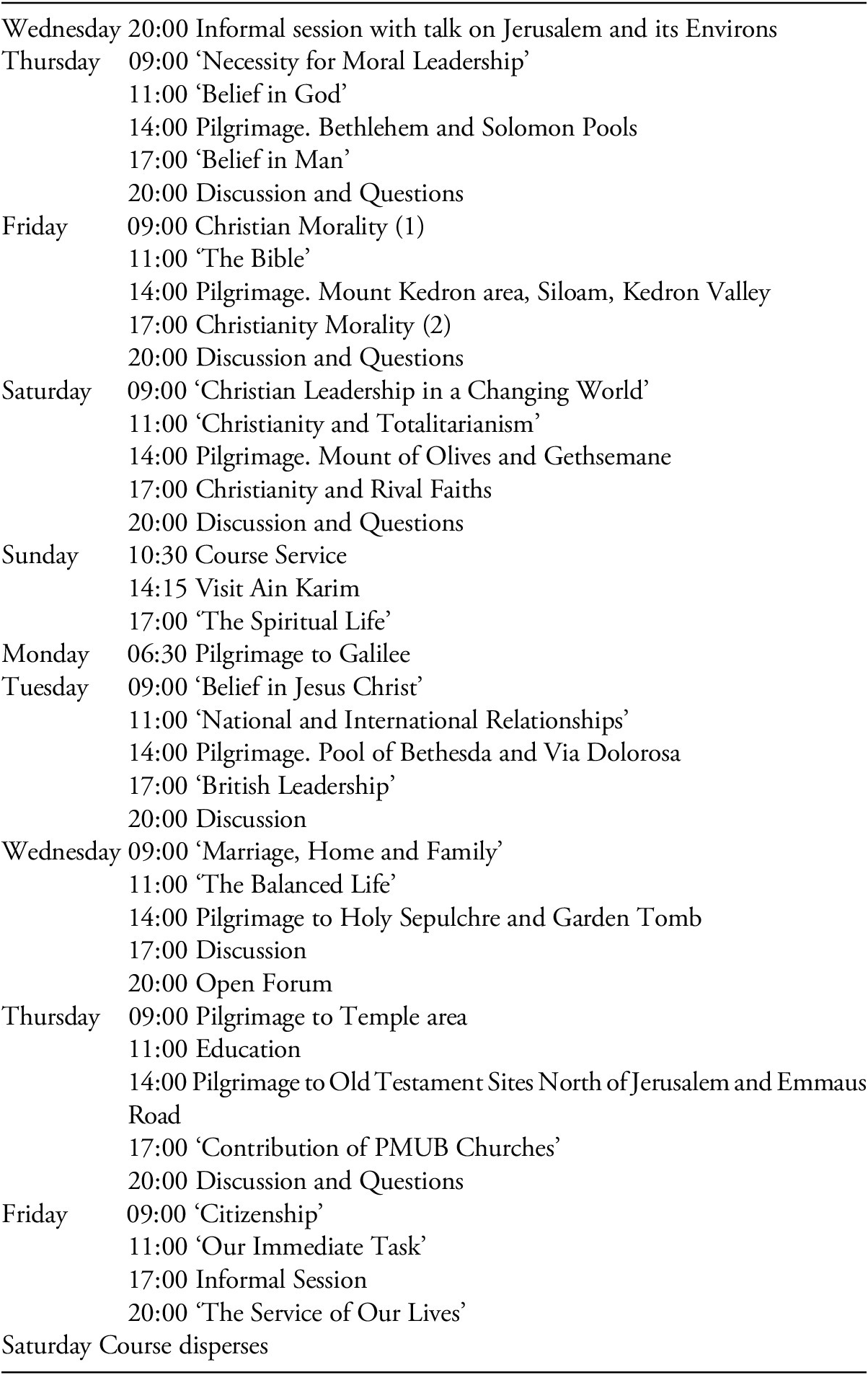
Table 2. Long description
The table presents the Moral Leadership Course programme for 19 to 29 July 1944 at Friends’ Girls’ School, Ramallah. From top to bottom, the schedule begins with Wednesday 20:00 Informal session with talk on Jerusalem and its Environs. Thursday includes 09:00 ‘Necessity for Moral Leadership’, 11:00 ‘Belief in God’, 14:00 Pilgrimage to Bethlehem and Solomon Pools, 17:00 ‘Belief in Man’, and 20:00 Discussion and Questions. Friday lists 09:00 Christian Morality (1), 11:00 ‘The Bible’, 14:00 Pilgrimage to Mount Kedron area, Siloam, Kedron Valley, 17:00 Christianity Morality (2), and 20:00 Discussion and Questions. Saturday features 09:00 ‘Christian Leadership in a Changing World’, 11:00 ‘Christianity and Totalitarianism’, 14:00 Pilgrimage to Mount of Olives and Gethsemane, 17:00 Christianity and Rival Faiths, and 20:00 Discussion and Questions. Sunday has 10:30 Course Service, 14:15 Visit Ain Karim, and 17:00 ‘The Spiritual Life’. Monday 06:30 Pilgrimage to Galilee. Tuesday 09:00 ‘Belief in Jesus Christ’, 11:00 ‘National and International Relationships’, 14:00 Pilgrimage to Pool of Bethesda and Via Dolorosa, 17:00 ‘British Leadership’, and 20:00 Discussion. Wednesday 09:00 ‘Marriage, Home and Family’, 11:00 ‘The Balanced Life’, 14:00 Pilgrimage to Holy Sepulchre and Garden Tomb, 17:00 Discussion, and 20:00 Open Forum. Thursday 09:00 Pilgrimage to Temple area, 11:00 Education, 14:00 Pilgrimage to Old Testament Sites North of Jerusalem and Emmaus Road, 17:00 ‘Contribution of P M U B Churches’, and 20:00 Discussion and Questions. Friday 09:00 ‘Citizenship’, 11:00 ‘Our Immediate Task’, 17:00 Informal Session, and 20:00 ‘The Service of Our Lives’. Saturday marks course dispersal. Each day is structured with time slots for lectures, themed discussions, and pilgrimages to religious or historical sites.
The courses in Ramallah were also longer: the Church of England course was an evening plus six full days, while the first PMUB course was an evening plus ten full days, in comparison with the four full days of the first South East Asia course. Over the course of 1945, the Church of England courses in Jerusalem became longer still: an ‘RAF Middle East Circular’ of 22 November 1945 authorized the ‘establishment of the Moral Leadership School in Jerusalem’ which was to provide Moral Leadership courses for Church of England personnel (12 days duration with 30 students); for PMUB personnel (10 days with 25 students) and Roman Catholic personnel (7 days duration with 25–30 students).Footnote 151 Until the establishment of the Moral Leadership School, courses were held in a range of locations. Of the first seven PMUB courses, three were held at the Friends’ Girls’ School in Ramallah; one in Appolonia, near Cyrene, in former Italian barracks; one at St Andrews House (Church of Scotland) in Jerusalem; and two at St Andrews House (Church of Scotland) in Tiberias. Participants came from Palestine, Cyprus, Iraq, Egypt and the Levant Command.Footnote 152 Hooper’s courses were closer in length to those proposed in 1945 for Roman Catholic personnel, and they seem also generally to have had a similar number of participants, that is, between twenty-five and thirty.Footnote 153 By contrast, the South East Asia courses were extremely peripatetic: each of the eight courses he ran (and two others that were planned but did not take place) had a different venue.
Hooper drew up a programme of courses to take place in various locations across South East Asia, at roughly monthly intervals. The first course in Kodaikanal in July 1945 was followed by one in Bangalore in early September.Footnote 154 By then, Japan had surrendered; the combination of demobilization and the liberation of prisoners-of-war meant that large numbers of service personnel were being sent to Bombay to embark on ships home. In consequence, a course that had been planned for Bombay in early October 1945 had to be called off due to the lack of accommodation.Footnote 155 The third course took place at Solon, near Simla, from 22 to 27 October 1945.Footnote 156 The fourth, at Darjeeling in late November and early December, was severely disrupted due to riots in Calcutta.Footnote 157 A putative course planned for Poona in January 1946 did not take place.Footnote 158 Instead, Hooper was relocated to Singapore, where the headquarters of ACSEA had moved in late 1945. From there he ran his fifth course in Rangoon, from 21 to 26 January 1946. The sixth course took place in Singapore from 27 February to 5 March. For his seventh course, from 26 April to 1 May, Hooper returned to Trinity College, Kandy. The final course under his direction was held in Hong Kong from 29 May to 5 June 1946. A further course planned for Japan could not take place due to a lack of facilities. As in the Middle East, there were long-term plans for the establishment of a chaplaincy centre for South East Asia from which Moral Leadership courses for all denominations would be run, along with ‘Chaplains’ conferences, ordinands’ Retreats, etc.’Footnote 159 After he was posted to Singapore, Hooper was involved in realizing this idea, although he had some reservations: ‘the difficulty is the enormous travel distances involved for men coming on the courses.’Footnote 160 These plans were subsequently abandoned after the reinstatement of civil government and the withdrawal of allied air and land forces in 1945 and 1946 in consequence of Operation Python.Footnote 161
In his letters to Mary, Hooper never repeated the detailed description he had given of the first course. His letters are nonetheless revealing of his thoughts about the appropriate number of participants and the best venues. The second course, held at Bangalore, he thought, ‘seems to have been a great success.’Footnote 162 On his way to the course at Solon, Hooper left his attaché case in the transport plane, in which were his ‘chequebook, paybook, spare glasses. Travelling clock … and all my notes for my lectures.’Footnote 163 Nonetheless, he wrote half-way through, ‘Everything seems to be going well.’ This was a much larger course: ‘we have more “bods” than usual – 43. Reason being that we can accommodate that here.’ However, he later reflected that this was too large a group: ‘we were far too many at Solon.’Footnote 164 In addition, he was not entirely happy with the venue: ‘although this place is 5,000 feet up in the hills, it is still an RAF station – so the men don’t get the complete break we would like them to get.’Footnote 165 He was clearly increasingly conscious of the importance of the courses as opportunities for respite. Nonetheless, he concluded, ‘the course … seems to have been as successful as the others.’Footnote 166
Riots in Calcutta disrupted travel to the November course in Darjeeling.Footnote 167 From Calcutta, Hooper wrote on 23 November that ‘at present there is no transport of any kind’.Footnote 168 On 26 November, having himself reached Darjeeling, he reported that there was ‘a ban on service personnel travelling to Calcutta and practically all of the men must come through there.’Footnote 169 He had been expecting thirty-four participants; in the end, sixteen made it: ‘in fact in many ways it was better only having a few – [it] meant that it was easier to get to know everybody.’Footnote 170 On his return from Darjeeling, he was posted to Singapore, leaving Kandy by ship on 22 December, with the contents of his office and his bicycle, and arriving on 27 December.
In January 1946, Hooper ran a Moral Leadership course in Rangoon, at a school which had been taken over by the Army chaplains for conferences and retreats: ‘it is very pleasant … [and] we shall find everything laid on.’Footnote 171 Preparing for the course, he thanked Mary for sending F. R. Barry’s Church and Leadership, which was ‘exactly along the right lines and will be an enormous help.’Footnote 172 Canon Diggle attended this course (‘the first time he has been to one of the M[oral] L[eadership] C[ourses]’) and they were also ‘visited by an Air Marshal and an Air Commodore who stayed to one of my lectures.’Footnote 173 Hooper was supported by John Rutherford, the RAF chaplain in Bangkok, whom he had met at the Darjeeling conference and had visited while preparing the Rangoon course. Hooper told Mary: ‘I like him immensely – a quiet scholarly sort of bloke – and I have persuaded Diggle to let me have him for future courses.’Footnote 174 For the Singapore course in March 1946, Hooper was able to secure more help, including the services of ‘a real expert to do some of the sociological talks – the head of the Publicity Department of the British Military Administration.’ Hooper shared the remainder of the lecturing with Rutherford, two other RAF chaplains and an Army chaplain, so he had a much lighter load himself.Footnote 175 It had been, he thought, ‘a good course, better I think than the one in Rangoon.’Footnote 176
Pastoral or parochial work also continued. Hooper was increasingly frustrated that Rogers, the chaplain in Singapore, took ‘no Pastoral responsibilities except when I am away. I get the whole of the Unit work which I cannot do justice to because of my M[oral] L[eadership] C[ourse] work which I put first.’Footnote 177 Diggle had promised that ‘when he came to Singapore with the Chaplains’ HQ I should join him and be take off all pastoral work except for Sunday duties,’ but that move had been postponed.Footnote 178 Instead, Hooper was asked to take on the role of ordination candidates’ secretary. ‘For the moment,’ he wrote, ‘I am, carrying on here alone doing (ostensibly) 4 jobs (M[oral] L[eadership] C[ourses], Ordinands, Unit and Senior Chaplain). But next week sees the arrival of my successor on the unit and also of O’Neil to be Senior Chaplain.’Footnote 179 Longer term, there was still talk of ‘a project, very much in the air as yet, to have some sort of a Centre at some place like Penang, and there hold M[oral] L[eadership] C[ourse]s, ordinands courses, Retreats etc.’Footnote 180 Diggle had told Hooper that he was to run the centre, with an assistant; he initially hoped this might be Rutherford, but Rutherford was then posted to Kandy.Footnote 181 However, at the end of March, Hooper reported that ‘the setup here is changing rapidly. … [T]he Civil Administration is taking over again. A.C.S.E.A. [Air Command South East Asia] and A.L.F.S.E.A. [Allied Land Forces South East Asia] continue to function, but numbers are going down all the time.’Footnote 182
It was suggested that Hooper should return to England in May 1946 to take part in an RAF conference on the future of Moral Leadership courses, and he began to discuss a possible mid-tour leave with Mary.Footnote 183 Meanwhile, plans for the next phase of Moral Leadership courses were taking shape. One proposal was for ‘a mixed M[oral] L[eadership] course (WAAF and RAF) at Kandy or somewhere in Ceylon,’Footnote 184 although in the end the course was held in Kandy in April 1946 does not seem to have been mixed. On his return from that course to Singapore, Hooper was told that he would be demobilized in August, and therefore would not be attending the Moral Leadership conference in May. (He was adamant that ‘I shall refuse to attend any conferences or render any reports after I am out.’)Footnote 185 Hooper expected to use his remaining time in Singapore to run two further courses: ‘I am off to Hong Kong at the end of this week and will stay there to organise and conduct a course – this may take a month. I am then going straight on to Japan to do the same there.’Footnote 186 He realized that ‘it’s not going to be easy working up M[oral] L[eadership] C[ourse]s in these places from scratch, but naturally I’m rather thrilled at the prospect of going.’Footnote 187 The course in Hong Kong was to be held at ‘a Lutheran Mission built exactly on the style of a Buddhist monastery,’ run by missionaries from Scandinavia. Numbers proved smaller than usual, for there were fewer RAF stations in the area, but it went well: ‘The Bishop gave a most inspiring talk on Sunday and yesterday the AOC came to visit.’Footnote 188 In contrast, Japan, which had always promised to be a particular challenge (Hooper gathered that the RAF ‘are somewhere in the South near Hiroshima and are still accommodated in tents’Footnote 189), was called off when the senior chaplain in Japan objected that ‘a proper course will be out of the question owing to accommodation and catering deficiencies.’Footnote 190 Hooper hoped to go to Japan anyway to see ordinands and run evening lectures and discussion groups,Footnote 191 but Leslie Wright, Diggle’s successor as assistant chaplain-in-chief, instructed him to return to Singapore. He was to prepare a Moral Leadership course to be held in Singapore in July or August,Footnote 192 but Wright was not expecting him to be there to run it.Footnote 193 Hooper reported that he was now mostly doing ‘odd jobs’: preaching and broadcasting, and preparing his paperwork on the courses and the ordinands to hand over to his successor.Footnote 194 He also took part in a ‘most crashingly boring’ chaplains’ conference with the bishop of Rangoon, George West.Footnote 195 Since Wright had ‘the right (!) ideas and agrees with me that the more pleasant the place the more successful the course,’ Hooper’s final task was to undertake with Wright ‘a tour of Malaya to find a suitable spot for future M[oral] L[eadership] C[ourse]s etc.’Footnote 196 He had, he wrote to Mary, ‘set my heart on being with you for August 15. V.J. Day, Ted’s birthday and my 18 months tour exactly to the day.’Footnote 197 On 16 July, he boarded the Cunard ship RMS Mauretania and sailed for England.
Conclusion
In 2012, Murray Earl, drawing on twenty years of experience in the Australian Air Force, suggested that ‘military chaplaincy is “truth through personality, via relationships over time”.’Footnote 198 Truth he regarded as ‘centred in [a chaplain’s] denominational worship’: providing such worship while facilitating the worship of other faith groups and seeking to care for all.Footnote 199 Here, he highlighted the need for chaplains to be flexible: ‘Many services are held outside of chapels, and chaplains have to be adept in adaptive liturgical reform to meet the myriad of circumstances in which worship occurs.’Footnote 200 Personality is important for the chaplain because ‘encounters with personnel are often brief and in passing’, requiring ‘the gift of immediate engagement’.Footnote 201 In establishing relationships, ‘firstly, chaplains have to work out their relationship with their commanding officer’. They must then focus on ‘establishing various levels of relationships’ with personnel. In addition, Earl emphasized the importance of relationships with other chaplains, especially those of other denominations.Footnote 202 Finally, Earl, writing as a career chaplain in peacetime, pointed to the important of time, suggesting that ‘Most military chaplains remain in the armed forces for some years,’ and can therefore build longer-term relationships. Although Earl was serving as chaplain in a very different context to Hooper’s experiences at and after the end of the Second World War, it is apparent that the first three aspects he describes – truth (worship), personality and relationships – were all important aspects of Hooper’s ‘parochial’ ministry as an RAF chaplain. However, while Hooper remained committed to the ‘parochial’ work of the chaplaincy once he was posted to South East Asia, and continued to engage with it throughout his time as an RAF chaplain, he was adamant that it was ‘in no way connected with my main job which is, of course, the M[oral] L[eadership] courses.’Footnote 203
What was more distinctive was Hooper’s involvement in those Moral Leadership courses. As discussed above, these had been originally conceived as a means to boost and support the morale of officers and senior aircrew, which Andrew Totten understands to be a key aspect of chaplaincy to serving military personnel,Footnote 204 and specifically to support RAF personnel as they faced horrific losses. However, as he began to plan his programme of courses in the summer of 1945, Hooper’s perspective was necessarily a different one. He viewed the courses in a much larger context: his focus was less on the needs of combat, and much more on them as training for the leadership that would be needed in post-war society. His daughter, Jane, remembers that he continued to run Moral Leadership courses (or an equivalent) in his parishes long after the end of the war. Moral Leadership courses also continued to be a feature of RAF chaplaincy in the post-war period.Footnote 205 They testify to the efforts made by RAF chaplains not only to support and minister to the immediate pastoral, liturgical and spiritual needs of RAF personnel, but also to equip that personnel for their responsibilities, both in the immediate demands of the war and in wider society.



 Open access

