


Modern state formation usually implies increasing state control over the legal sphere. The new powers and ambitions of modern bureaucracies allow nation-states to unify the legal field in unprecedented fashion. Against the messiness of legal pluralism, legal centralization promises to deliver equality, predictability, and standardization. Developing states worldwide have invested considerable resources for expanding state law and combating competing legalities. What appeal could nonstate legal forums have in the modernizing contexts of the twentieth century? If modern state formation is not as comprehensive and intractable as it was once assumed, what insights might the history of religious courts in the Middle East offer students of law in modernity? And what kind of postcolonial histories emerge when we start to question state-centric visions of legality?
In this article, I pursue these questions in the scarcely researched context of the Arabian Gulf sheikhdoms. The twentieth-century legal history of the sheikhdoms is usually told as a secularization story, that is, a history marked by the gradual displacement of Islamic and customary law by “Western” legal concepts and practices. Drawing mainly on sources produced by the state and the British colonial administration, previous studies have tracked the increasing ability of modern administrations to centralize legal authority, eliminate competing legal forms, and participate in the international legal order.Footnote 1 The resulting histories reproduce familiar assumptions about law, society, and the postcolonial state. Moving away from teleological accounts of transformation, I show instead that the twentieth-century legal history of the Gulf is more aptly characterized by ongoing jurisdictional struggles between civil courts, Islamic legal institutions, and customary modes of dispute resolution, in the context of the progressive integration of the sheikhdoms into the international political system. Until 1971, these jurisdictional struggles took place under the watchful eye of British authorities. They continued afterward in the context of an independent rentier state. I suggest that jurisdictional struggles provide privileged vantage points for rewriting the region’s legal history and re-examining the shifting political dynamics of the Gulf. The forms and outcomes of these struggles were specific to each sheikhdom, reflecting “institutional legacies, modes of state and rulership, elite networks, and political-economic structures.”Footnote 2 The questions raised by jurisdictional politics in the Gulf, and by the forms of judicial activism and resistance that they enabled, speak to the legal trajectories of political regimes elsewhere.Footnote 3
The article focuses specifically on Qatar, where a peculiar “dual legal system” emerged gradually from contestations over political community and legal authority in the aftermath of imperialism and oil.Footnote 4 These contestations mobilized members of the ruling family, civil society, and the British Empire—as well as Saudi officials, Egyptian legal advisors, international legal firms, and transnational networks of Arab political activists. Although the story I tell here is a distinctly national one, anchored in the institutions of the modern Qatari state, it is shaped by a set of transnational forces and processes.
In this article, I offer an account of jurisdictional politics in twentieth-century Qatar, which parochializes common assumptions about modern state power, secularization, and the appeal of religious law in modernizing polities. I draw on judicial reports, Islamic legal texts, British records, media sources, and oral histories. Although Sharia Court proceedings are difficult to find, sharia judges intervened in public debates about the relevance of Islamic law in a variety of print and audio media: treatises, magazines, newspapers, and sermons broadcast on radio and television. In their professional and vocational work as judges and muftis, they related the norms and values expressed in the Islamic legal tradition to the practical cases they encountered. As public intellectuals and judicial activists, they sought to persuade their audiences of the relevance of Islamic legal concepts for emerging state bodies, new economic regimes, and changing social practices. The families and students of these sharia judges have continued to disseminate their work with the support of government bodies, as part of a burgeoning state-led heritage industry. As a result, we now have ample material to reconstruct the social and intellectual worlds that twentieth-century sharia scholars inhabited.
The perspective of proponents of civil law (or, for that matter, customary practice) is accessible more indirectly: in the way sharia scholars anticipate or respond to their critiques, in summaries of discussions written by Western officials, in the political tracts of the pan-Arab nationalist movement in the Gulf, in occasional Arab media depictions of Qatar’s twentieth century transformation, and in accounts of legal development written by retired civil judges.
I start with a brief historical overview of the legal field in modern Qatar. I offer a new account of Qatar’s dual legal system on the basis of the statistics published by the Presidency of Sharia Courts. I reconstruct the terms of legal debate in mid- and late-twentieth-century Qatar, paying particular attention to the arguments for and against sharia law. Finally, I locate the appeal of Qatar’s Sharia Courts in the socially embedded nature of Islamic legal practice, the extra-legal functions fulfilled by sharia judges, and the transnational networks of Islamic institutions. While these factors were unable to eliminate the civil judiciary, as some sharia judges hoped, they explain the resilience of Qatar’s Islamic legal institutions in a century of great social and economic transformation.
Historical Context
In order to situate Qatar’s twentieth-century jurisdictional politics, a brief historical detour seems necessary. The British established an “informal empire” in the Gulf in the course of the nineteenth century with the aim of creating new markets for British Indian goods, pacifying Indian Ocean trade routes, and fending off European imperial competition.Footnote 5 A series of maritime treaties cast the British government of India as ultimate arbiter of disputes between sheikhdoms.Footnote 6 British imperial authority was “informal” because it was mostly limited to “external affairs.” Outside Bahrain, the center of the British imperial presence in the Gulf, the British ability to shape internal affairs, including domestic legal processes and outcomes, was limited. British authorities ruled the Gulf’s foreign residents and made half-hearted attempts at organizing the legal pluralism of the sheikhdoms through the enactment of orders-in-council, but only in the 1960s did they take internal legal reform seriously as a policy objective. As Nathan Brown’s work has shown, British attempts at shaping the legal landscape of the Gulf frequently ended in failure.Footnote 7
In the Gulf, as elsewhere in the Arab world, legal developments were fashioned primarily by local dynamics rather than by grand imperial designs.Footnote 8 Two figures disproportionately shaped Qatar’s twentieth-century legal history. A sharia judge originally from Najd, ‘Abd Allāh b. Zayd Āl Maḥmūd (henceforth, Ibn Maḥmūd), who was appointed Chief Qāḍī in 1940, and an Egyptian legal advisor hired in 1960, Ḥasan Kāmil, were responsible for drafting many of the laws enacted by the Qatari state. If Ibn Maḥmūd is known as “the founder of Qatar’s sharia courts,”Footnote 9 Kāmil can legitimately claim to have established the basis of the civil judiciary. Both men continue to be honored by the Qatari state, but the personal animosity between them was legendary.Footnote 10
Qatar’s reliance on Saudi sharia judges and Egyptian secular legal advisors drew on existing networks of legal and religious knowledge, reproducing well-established patterns across the Gulf. The institutionalization of sharia and civil law in the second half of the twentieth century can be represented as new historical developments. In the Gulf, as in other peripheral regions of the Muslim world, Islamic law was never the only normative framework undergirding legal practice.Footnote 11 Before the mid-twentieth century, a wide variety of legal forums were available, including the ruler’s court, marine courts based on customary law, British courts, and tribal modes of dispute resolution.Footnote 12 Legal authority centered around the figure of the ruling shaykh, while the institutional authority of the sharia judge appeared limited to the family. In February 1929, a British report about Qatar read as follows:
The Ruler of Qatar is now in the hinterland. His Amir Said… looks after the town and settles all disputes except those of a matrimonial nature, which are referred to the Qadhi, while Husain an Naamah looks after the Customs. According to an informant the affairs of the country move “by the might of God, like a sailing boat which runs in the sea without a pilot.”Footnote 13
Islamic law was not necessarily dominant in the informal legal structures of the sheikhdoms, which privileged customary practice and tribal authority. Nevertheless, references to religion retained, as the “informant” cited above suggests, a powerful ideological resonance. This resonance was enhanced in the early twentieth century through the Islamization efforts of the Third Saudi state, and again in the 1970s with the spread of the “Islamic Revival” across the Arabian Peninsula.Footnote 14
These historical processes shaped Qatar’s twentieth-century debates about jurisdictional authority. In the second half of the century, sharia judges represented the application of Islamic law variously as a religious necessity, a practical advantage, and a civilizational achievement. The persuasiveness of their arguments was nevertheless limited by the processes set in motion by the oil industry and modern state formation. Although they condemned civil courts and state legislation, sharia judges showed no interest in participating in the major legal debates of the mid-twentieth century: the codification of labor and nationality laws, the negotiation of contracts with oil companies, and the settlement of territorial disputes. The ruling family turned to local merchants, Egyptian legal advisors, and international legal firms instead. It is in this particular context, amidst wide political contestation, that Qatar’s dual legal system took form.
Qatar’s Dual Legal System
In the mid-twentieth-century Qatar, the ruling Āl Thānī family empowered both a sharia and a civil judiciary as tools of modern state formation. The Presidency of Sharia Courts was established in 1958, and the first civil court, the Labor Court, in 1962. After the 1971 departure of the British, both the sharia and the civil judiciary became complex legal bureaucracies comprising various courts and structures of appeal. The expansion of formal legal institutions was welcomed because it served to consolidate emerging state bodies without challenging the ruler’s authority.Footnote 15 It also served to wrestle social authority away from potentially unruly tribal formations. For reasons of political expediency associated with the nature of shaikhly rule,Footnote 16 jurisdictional boundaries between civil and Sharia Courts remained relatively undefined until the unification of the judiciary through Law 10 of 2003 Promulgating the Law on Judicial Authority.
What exactly was the jurisdictional authority of civil and Sharia Courts before 2003? Family law was the exclusive purview of the Sharia Courts, but civil and criminal law fell into a gry zone. The official publications of the Qatari state appear to privilege the civil judiciary. The laws published in the Official Gazette (est. 1961) limit the authority of the Sharia Courts to personal status law and the implementation of Qur’anic punishments for cases of homicide, theft, banditry, extramarital sex, and alcohol consumption. Qur’anic punishments for murder and theft were rarely applied due to stringent procedural rules,Footnote 17 appearing to leave family and morality as the main domains of sharia jurisdiction. Several authors have taken these laws at face value and reproduced, in their scholarly accounts, state-centric views of legality in Qatar.
Although state legislation appeared to limit the authority of Sharia Courts in civil and criminal law, the annual reports of the Presidency of Sharia Courts confirm that the latter continued to adjudicate five types of cases well into the 1990s: criminal cases (jināyāt), cases involving Qur’anic penalties (ḥudūd), civil cases involving rights violations (ḥuqūq), marital affairs (al-shu’ūn al-zawjiyya), and divorce (ṭalāq). In 1983–84, only approximately 8% of the decisions issued by the Sharia Courts fell under personal status law.Footnote 18 Until the late 1980s, the bulk of cases submitted to the Sharia Courts pertained to criminal and civil law. Twentieth-century Qatar thus in many ways resembled Saudi Arabia, where sharia judges were able to adjudicate cases with little oversight from the state, partly because of ambiguities in founding legal documents and structures.Footnote 19
For much of the second half of the twentieth century, then, Muslim litigants in Qatar were able to take civil and criminal cases to a civil or Sharia Court. According to a judge who worked in both judiciaries, ‘Abd al-‘Azīz al-Khulayfī, sharia and civil judges refused to hear a case submitted to the other judiciary.Footnote 20 This was rationalized as part of an unwritten “gentlemen’s agreement” which gave the legal system some order and ensured chaos did not ensue.Footnote 21
The dual system not only posited two judiciaries claiming jurisdictional authority over large spans of social and economic life. At stake were also two distinct conceptions of legality. In Sharia Courts, punishments are part of a “flexible hermeneutical exercise sporadically used to maintain social harmony” in a system grounded in revelation.Footnote 22 In civil courts, the imperatives of standardization and predictability point to modern law’s secular time and national homogeneity.
Judges in each judiciary made conflicting claims regarding the popularity of their legal forums. Given the lack of adequate documentation, very little is known about the ways in which this legal structure was managed, the kind of competition that it set between the two judiciaries, and the opportunities for forum shopping and exercise of legal agency it may have created.Footnote 23
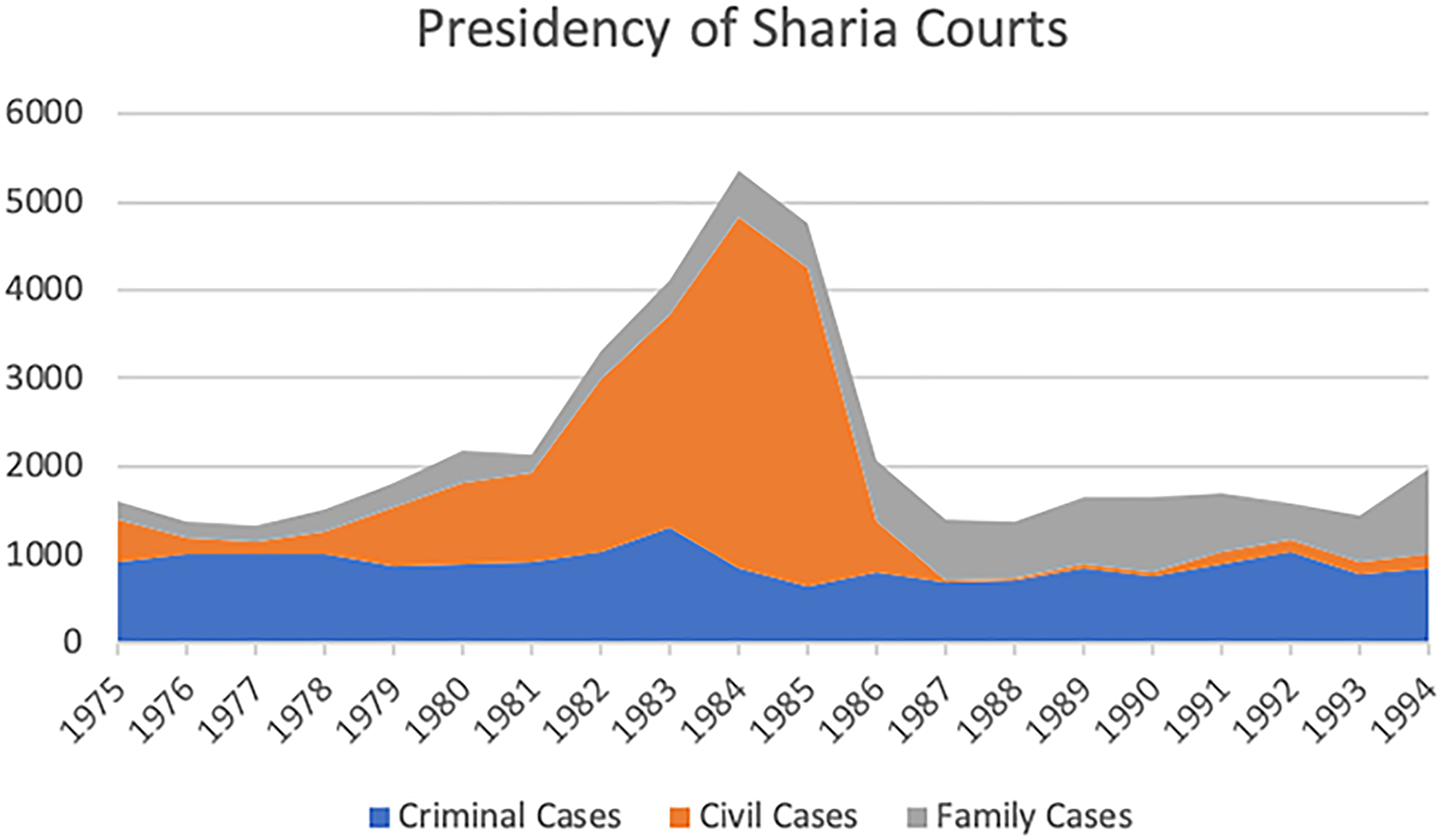
The statistics of the Presidency of Sharia Courts shed important new light on the issue. Figure 1 below highlights the distribution of cases in the Sharia Courts over a twenty-year period.Footnote 24
Distribution of Cases in Qatar’s Sharia Courts.

The figure shows a number of unexplained variations. The most striking fluctuation pertains to civil cases (ḥuqūq), which increased greatly in the late 1970s before petering out in the mid-1980s. It is possible that the Presidency of Sharia Courts developed in the late 1970s more systematic methods for accounting for civil cases. The dramatic collapse of civil cases in the Sharia Courts is suggestive of a sovereign intervention. The state seems to have played a role in limiting the ability of sharia judges to settle civil disputes (e.g., by reversing Sharia Court decisions in the civil appeal court).
The relative stability in the number of criminal cases over the twenty-year period, despite the fact that the population grew threefold, indicates a growing unwillingness of the Public Prosecution to refer cases to the Sharia Courts. The adjudication of theft cases moved from the sharia to the civil courts in the mid-1980s.Footnote 25 On the other hand, the state’s failure to codify the laws and procedures of the Sharia Courts suggests that its ability to dictate the work of the qāḍīs was limited. Crucially, the overall distribution of cases presented in Figure 1 demonstrates that the work of the Sharia Courts did not fall entirely within the parameters set by the state for religious authority. If one factors in population growth, the distribution of cases reveals that the state was able to contain the work of the sharia judiciary with increasing effectiveness from the mid-1980s onward.
The reports of the Presidency also reveal that, in multicultural Qatar, Sharia Courts were used primarily by Qataris, followed by Pakistanis, Iranians, Indians, Egyptians, and citizens of Gulf Cooperation Council (GCC) states.Footnote 26 Sharia Courts were overwhelmingly male arenas. Apart from family matters, where the number of women plaintiffs from the GCC is equal to that of men, the litigants in criminal and civil cases are almost exclusively male.Footnote 27 The absence of women from criminal and civil cases during this period seems to reflect prevailing cultural norms in a patriarchal society (low female participation in the labor market) and perhaps gendered attitudes toward sharia (women’s preference for civil law).
Citizens of non-GCC countries relied less frequently on Sharia Courts to settle marital issues because many were single, working-class men working temporarily in the Gulf. However, as late as the 1980s, they regularly used—or were drawn into—Sharia Courts for criminal and civil matters.Footnote 28
Since the civil courts have not published comparable data, the statistics of the Presidency of Sharia Courts shed only partial light on the ways in which Qatar’s inhabitants made use of its legal structure. I turn below to printed sources to examine the cultural assumptions that judges and litigants brought to the legal field and to explore the relative appeal of Sharia Courts in the modernizing contexts of Qatari society.
The Critique of Islamic Law
The mid-twentieth century was a period of intense political activism across the Arab world. Arab nationalism, liberalism, and pan-Islamism offered three competing visions of a postcolonial order in the Gulf.Footnote 29 These ideologies shaped the terms of Qatar’s legal debate in critical ways. More or less explicit critiques of sharia institutions fashioned public discourse.
In a familiar move, British authorities in the mid-twentieth century sought to persuade the ruling families of the Gulf that the proper domain of Islamic legal jurisdiction was the family.Footnote 30 Sharia Courts were deemed arbitrary and unsuited for modern conditions.Footnote 31 They lacked proper rules and procedures. Laws were not codified, and decisions did not allow for the possibility of appeal.Footnote 32 Given the institutional setup of the sheikhdoms, there were no mechanisms that could ensure the independence of sharia judges from political authority. Sharia judges, one British official noted, are not made to act like “heroes.” Their dependence on the rulers makes them compliant and unable to speak truth to power.Footnote 33 The “paternal and palm-tree system of justice based on vague principles in the Koran” was bound to disappear in the wake of progress in education and nationalism.Footnote 34 The imperial infrastructure of the British Empire, and the extensive networks of knowledge and expertise which replaced it in the postimperial era, facilitated the circulation of legal discourses across the Indian Ocean world.Footnote 35
Criticism of Islamic legal institutions was also voiced by new legal professionals, public intellectuals, and political activists. They argued that the scope of the sharia is limited to the prescribed Qur’anic punishments, and that Islamic law is not relevant for most areas of public and private law. Some contended that the Islamic legal philosophy is outdated and that social scientists have developed better ways of combating crime and creating a harmonious society.Footnote 36 Sharia was depicted as a normative system removed from daily life. Its idealism (mithāliyya) precluded the incorporation of customary practice, notably in commercial life, where speed and intelligibility were critical.Footnote 37 Islamic legal discourse was also said to operate from an ivory tower.Footnote 38 Furthermore, sharia judges appeared insufficiently professional. They interrupted court hearings to receive guests and preferred to go on pilgrimage to Mecca or summer holidays to Lebanon rather than to serve in the court.Footnote 39
The call to apply the sharia was seen as divisive, as it splits Muslim communities into factions and sows division (fitna). The project was associated with advocates of “political Islam” who politicize religion for their own interests.Footnote 40 Some contended that a state ruled by Islamic law is a “theocratic state” which does not respect individual freedoms.Footnote 41 The absence of codified law, others argued, gives the judge extensive discretionary powers. On the one hand, given the intimate connections that sharia judges entertain with members of the political and economic elite, the lack of written rules makes justice for the weak and oppressed members of society unlikely.Footnote 42 On the other hand, the absence of codified rules means that each sharia judge may rule differently, creating chaos and uncertainty. In a patriarchal society that limits women’s access to legal resources and their ability to speak publicly in front of the judge, women may not be able to get a fair hearing. Furthermore, Islamic legal provisions are discriminatory toward non-Muslims.
Socialists in the Arab world contended that sharia judges are reactionary agents who stifle the Arab revolutionary impetus.Footnote 43 They condemned the unholy alliance between British imperialists, ruling families, and sharia scholars in the maintenance of the status quo in the Gulf. In a 1966 pamphlet, activists called for the separation of executive, legislative, and judicial authority. The anonymous authors connected insecurity, the stagnation of commercial life, and increasing corruption to the despotism of the ruling family and the tacit support of the British authorities. They decried the inability of legal institutions to provide justice to the oppressed and to make the ruling family accountable for its misdeeds.Footnote 44
Many of these debates were not specific to Qatar or the Gulf. Competing legal ideologies circulated around the Arabian Peninsula through print media, radio, educational exchanges, and trade networks.
The Case for Civil Law
Attached to the more or less overt critique of sharia were arguments in favor of civil law. Civil laws codified by a benign state were seen by many as a necessary adaptation to the requirements of the modern age. At a time when Arab leaders framed governance in terms of development and renaissance (nahḍa), the civil judiciary appeared as part of a broader “civilizational trend” in the Arab world. There were competing visions of positive law in the Gulf. While the British stressed the advantages of common law, Egyptian lawyers worked to implement the principles of civil law tradition in the sheikhdoms. Both agreed that sharia was irrelevant for running a modern state and developing a modern economy.
In the turbulent 1960s and 1970s, when government policy in Qatar was justified primarily in terms of national development, “the spirit of the times” (rūḥ al-‘aṣr) was invoked to justify a wide range of state policies.Footnote 45 In what Shaykh Khalīfa (r. 1972–1995) himself dubbed “The Economic Era” in a 1973 address to the Advisory Council, civil law and civil courts were seen as integral to the project of “catching up with the caravan of progress in the world.”Footnote 46
The 1964 editorial of a special issue of the Egyptian newspaper al-Ahrām dedicated to Qatar captures this perspective aptly. The journalist, Muḥammad Sāmī, starts by highlighting the specificities of the sheikhdom, where the figure of the emir traditionally concentrates all power and rules according to the customs of the Arabs. However, Sāmī pursues, “the logic of historical development” in the Arab world requires a system, the rule of law, and the separation of powers, so that every citizen knows clearly his rights and obligations. Legal codification in this perspective is part of “civilized rule” (al-ḥukm al-ḥaḍārī). Written laws are the instruments through which the policy aims can be achieved, such as the protection of the people’s interests and the safeguarding of their future.Footnote 47
Under pressure from Arab nationalist movements inside and outside Qatar, the ruling family sought to highlight important legal codifications in the local and regional press.Footnote 48 Ḥasan Kāmil highlighted the role of laws establishing the Commercial Register (1962) and the Chamber of Commerce (1963) for providing the legal infrastructure necessary for the establishment of a “national economy.”Footnote 49 The legal codifications of the early 1970s were hailed in the local press as landmarks in Qatar’s “comprehensive modern renaissance,” important steps toward progress, Arab unity, and democracy.Footnote 50
Arguments for legal codification in the Arabian Peninsula often involved utilitarian considerations. Codification was seen as a panacea to the fragmentation of religious and legal authority stemming from weakening levels of scholarship among judges, the novelty of modern practices, and the increasing reliance on whims and artifices.Footnote 51 Advocates of civil law in Qatar pushed for the separation of legal and political authority, adopting Montesquieu’s ideas about tripartite powers.Footnote 52 The move toward codification and standardization was justified by legal practitioners in the civil judiciary in terms of accessibility. As a retired civil judge put it several decades later,
It was imperative [after independence] to work on the establishment of a criminal code and a law on criminal procedure for people to know which works constitute offenses as well the procedure, degree, and implementation of the punishments. In this way, people may feel safe in the knowledge that their bodies, property, and wealth are protected.Footnote 53
According to this line of reasoning, the need to provide citizens with clear guidelines on lawful and unlawful behavior reflects the growing complexity of social and economic life in postindependent Qatar. Under modern conditions, Zamān suggests, the individual’s ability to recognize what is right and wrong can no longer be taken for granted. Social order cannot rely on common morality alone; it now requires clear legal rules. The civil courts and codes represented efforts to “keep up with the civilization and the great renaissance.”Footnote 54
The Appeal of Sharia Courts
Given the public criticisms of Islamic law and the emergence of a body of civil law, what may have been the reasons for the strength of the Sharia Courts in the emirate? Why were Sharia Courts deemed to be, as late as the 1990s, the most likely forum for limiting executive authority in Qatar?Footnote 55 Where exactly did the appeal of sharia lie?
Sharia judges offered their own accounts of the popularity of Sharia Courts in the emirate. The arguments they put forward combined eclectically philosophical claims, theological assumptions, and empirical observations. They argued that Sharia Courts bring peace and tranquility to litigants and assist the ruler in delivering justice and governing the population.Footnote 56 They contended that sharia offers a deterrent force which minimizes crime and maximizes stability. Sharia imprints itself upon the hearts of the believers, imposing limits to judicial maneuvering and legal instrumentalization.Footnote 57 These arguments echoed debates in Saudi Arabia, where codification was prohibited by a 1973 fatwa of the Board of Senior ‘Ulama.Footnote 58 According to the Saudi judge ‘Abd Allāh al-Bassām (d. 2004), three reasons make codification a “harm” and a “perversion”: a fixed code clashes with the eternal vocation of the sacred law (sharī‘a) and the richness of the historical legal tradition (fiqh); judges need to be able to keep their freedom of conscience and space for maneuver when adjudicating; calls for codification are part of a conspiracy designed to sideline sharia and undermine Islam from the inside.Footnote 59
Qatar’s sharia scholars resorted to print to press their case. They cast the independence of the judiciary as a key Islamic principle.Footnote 60 They argued that the man-made laws applied in the civil courts are products of colonial power and undermine the societal consensus over good and evil which is necessary for a legal system to thrive.Footnote 61 They depicted the changing character of civil law as fickleness.Footnote 62 They connected the flourishing of Islamic civilization and Arab cultural refinement to Muslim adherence to the sacred law. They grounded the suitability of Islamic law in its preservation of public interest and its warding off of corruption.Footnote 63 In the 1980s, the call for application of sharia also took the form of a critique of popular religion/superstition.Footnote 64 In making these claims, they drew once again inspiration from Saudi Arabia, where throughout the twentieth century, the ‘Ulama categorically refused to allow civil law, courts of grievances (maẓālim) presided by political authorities, and attempts to revive customary law.Footnote 65
Part of the appeal of the sharia, for the judges involved in its application, lay in the efficiency of Islamic legal institutions. Whereas civil courts require the use of lawyers and lead to protracted legal processes, proceedings in the Sharia Court were free, simple, and speedy.Footnote 66 Decisions were usually reached within one or two sessions.Footnote 67 The expediency of the Sharia Court was highly valued. In 1954, a British official recognized that “delays in hearing cases in the British Court for Qatar, sometimes resulting in accused persons being held on remand for long periods, had occasioned much local criticism.”Footnote 68 “Prompt justice,” another official quipped, is “the only form of the commodity which the community appreciates.”Footnote 69
The speed of legal proceedings was tied to the procedural law adopted by sharia judges. Sharia judges relied primarily on confessions, witness reports, and oaths. The Chief Qāḍī Ibn Maḥmūd deemed photographic evidence inadmissible. He did not condone the use of medical technologies such as blood tests to assert levels of alcohol consumption in the driver’s body.Footnote 70 For British officials overseeing legal affairs in the Gulf, it was a puzzle how sharia judges were able to solve cases “without evidence.”
The reports of the Presidency of Sharia Courts suggest that, in the 1980s, the ability of the qāḍīs to deliver swift justice varied significantly from one year to the other. In the first year for which data is available, 1982, only 56,6% of the cases submitted to the Sharia Courts were solved within the year. This percentage peaked at 94,4% in 1986, but then went down gradually to 78,6% for the last year for which statistics are available (1994).Footnote 71 The Sharia Courts were most effective in criminal cases, and least effective in family law. The latter may be due to a principled preference for reconciliation over divorce. Civil cases, which fall in between criminal and family lawsuits, show great disparity from one year to the other.
The fluctuations of the data render interpretation difficult. The important number of cases dropped, which represented in some years as much as 36% of the cases presented, may result from the “gentleman’s agreement” that governed relations between the civil and the sharia judiciary.Footnote 72 Judged by contemporary standards, however, the efficiency rates of the Sharia Courts are still relatively impressive.Footnote 73
In the second half of the twentieth century, the proximity between sharia judges and state officials also contributed to the speedy delivery of justice. Ibn Maḥmūd and his peers could summon defendants to court through the police, reducing the delays caused by absent litigants.
Since the simplicity of legal proceedings was part of Ibn Maḥmūd’s argument for the superiority of Islamic over civil law, the Chief Qāḍī was very critical of judges who delayed cases. In an undated fatwa, Ibn Maḥmūd condemns judges who do not have an open-door policy, who keep litigants and witnesses waiting for a long time, and who frequently go on holiday. For Ibn Maḥmūd, it is reckless for a judge to spend the whole summer in Lebanon or go to Mecca on pilgrimage every other month. These acts are humiliating and tiring for people. They betray the sacred trust (amāna) of the office, which is supposed to bring mercy (raḥma) and comfort (rāḥa) to people. To serve as a judge is a more meritorious act than to perform a supererogatory religious worship.Footnote 74
Sharia Courts were also readily accessible. Unlike the civil courts, which were based exclusively in Doha, a sharia judge based in al-Khor (Qatar’s second largest city) complemented the work of the sharia judges in the capital. More importantly, sharia law rested on informal networks of religious and legal knowledge that did not require the mediation of the state to be effective.
Although the Hanbali school of law was privileged by the ruling family, Qatar’s Sharia Courts comprised Hanbali (Ibn Maḥmūd), Shafi‘i (Ibn Ḥajar), and Maliki (‘Abd al-‘Azīz al-Khulayfī) judges.Footnote 75 The legal representation of different schools allowed the sharia judiciary to connect with various segments of Qatar’s population: the Hanbalī Bedouin who moved between Saudi Arabia and Qatar; the Arabs from Iraq and Persia who followed the Shāfi‘ī school; the Mālikī tribes who predated the arrival of Wahhabism in the Peninsula. In a context where social and ethnic bonds were connected to centers of religious authority, the diversity of legal schools in the Sharia Courts contributed to their relevance in a changing society.
Social embeddedness
The broad representativeness found in Sharia Courts stood in contrast to the civil judiciary, where judges were usually foreign Arabs (Egyptian, Sudanese, Mauritanian) with limited knowledge of local dialects and customs. Civil courts were first established in the 1960s by the ruling family: a Labor Court followed by a Traffic Court and a Court for Municipal Affairs. These courts were replaced by a system of first instance, appeal and cassation courts after independence. However, the necessity to rely on Arab judges from outside the Arabian Peninsula diminished the appeal of these legal forums. Many Qataris avoided the Labor Court presided by an Egyptian judge, Ahmad Abu Douma, because they refused to be judged by a foreign judge.Footnote 76
By contrast, Sharia Courts were culturally and socially embedded in Qatari society. The judges came from the Arabian Peninsula—Najd, Ra’s al-Khayma, Doha—and were familiar with local traditions. People from various backgrounds frequently sat in the majlis where Ibn Maḥmūd adjudicated cases, passing time, meeting people, and educating themselves. The Sharia Court was a space of male sociability frequented by notables and visitors. The sharia judges were charismatic figures who prided themselves on their hospitality.
A number of procedures enhanced the social embeddedness of Qatar’s Sharia Courts. Sharia judges consulted “the people of experience” (ahl al-khibra)—craftsmen and other professionals—in specialized matters requiring technical expertise.Footnote 77 They also worked with local notables and sheikhs to solve problems related to tribe or family.Footnote 78
As late as the 1990s, a local sharia judge could boast, in front of an audience of legal professionals and academics, that sharia judges faced no difficulty in applying Islamic law in Qatar because disputing parties gladly submit to the sacred law. Constraint, he argued, plays an insignificant role.Footnote 79 This was only partially true, of course, but it may help to explain why an institutional mechanism for the implementation of Sharia Court decisions only appeared in state law in 1978.Footnote 80 Perhaps, the decisions of the sharia judges carried moral weight rather than legal force, but, then, the distinction between law and morality may not have always been entirely clear to the litigants who used Sharia Courts to settle disputes.
The social embeddedness of the sharia law was also manifest in the personalized justice that Sharia Courts offered litigants. This personalized justice stemmed from the internal legal pluralism of sharia and from the wide discretionary powers of the judge in Qatar. Since the sharia judge was not bound by any specific legal doctrine or school, he was able to adapt rulings to specific situations.
A rare account of a divorce case settled in the Sharia Court in the 1970s shows how Muslim judges exercised their discretionary powers in an attempt to reconcile an estranged couple. The story was told by “Miriam,” a young woman who married—and then divorced—at a very young age.
I was fifteen when I married [in 1972]. I saw my former husband before we were married, and I liked him. I divorced [in 1974] because of my mother-in-law and for other reasons. He didn’t leave me. But he never gave me any money and he didn’t let me visit my mother Moreover, he drinks. So I went to the Qadi and asked for a divorce. I told him that my husband didn’t want me to go to school. The Qadi told my husband: ‘I can’t stop her from going to school because that would not be in the interest of the State. If we start with this, then others will follow and there will be no girls going to school. Then the girls will not be useful to the country.’ My husband told the Qadi that he would take me back only if I gave up school. The Qadi said to me: ‘We cannot force you to give up school, but if you do, we can make your husband give you a monthly allowance.’ My husband didn’t give me any money and refused to let me go to school, so we parted. I was granted a monthly allowance of 200 riyals to be paid by my husband [for her and their two children]. I never bothered to collect the allowance. I could support myself and my children, God be praised.Footnote 81
Opposition to one’s wife’s schooling seems to have been widespread in the 1970s. As Miriam’s strategy illustrates, it constituted a plausible reason for a divorce petition even when used as a mere pretext. The unnamed judge’s views regarding female education appear uncertain. The judge tried to separate his opinion from the specifics of the legal case. Adapting his discourse to each party, he sought to reason and find common ground in order to reconcile the couple. He told the husband that he cannot oppose female education for raison d’état: the education of girls has become a priority of the state. Preventing a woman from divorcing her husband due to her ongoing schooling sets a legal precedent that might undermine public policy. This rather peculiar argument suggests that the judge may have, in fact, actively supported female education. Since Islamic family law limits the wife’s ability to divorce, he would have been entitled to refuse a divorce for lack of valid cause. Given the absence of state oversight over the workings of the Sharia Courts in the 1970s, any fallout from the judge’s decision not to adhere to a policy objective would have been extremely unlikely. Perhaps, the wife’s financial independence (often associated with supportive kinship networks) played a role in the judge’s decision not to force the woman to abandon school. Once he ascertained that the husband would not bulge, the judge offered Miriam a bargain—a cash allowance in exchange for staying at home—which demonstrates that reconciliation ranked higher in the qāḍī’s priority list than female education. The ability of the judge to make specific offers to each party is possible because of his understanding of the cultural norms and social expectations of the litigants.
While Sharia judge’s discretionary powers were much decried by civil lawyers and colonial officials, these powers must have helped the qāḍī to bridge the gap between law and justice, between the application of a universal rule and the achievement of a fair outcome. Ibn Maḥmūd was willing to participate financially in the settlement of a debt when he perceived that the debtor was too poor to pay back. It is not clear how often this happened, but the relatives and students of Chief Qāḍī appear to take great pride in the occurrence.Footnote 82 The willingness of the sharia judge to make use of these funds to force a compromise and compensate a creditor points to the distinctive nature of Islamic adjudication. Islamic justice is more adversarial than inquisitive. As Lawrence Rosen put it, the aim of the qāḍī is less to find out the truth than to reconcile parties and enable them to resume social life outside the courtroom normally.Footnote 83 The imperative of judicial neutrality differs here from mere indifference.
The financial autonomy of the Presidency of Sharia Court rested on the collection of alimony (zakāt), the management of religious endowments (awqāf), and the distributive policies of the rentier state. The social embeddedness of the Sharia Courts is reflected in the fact that most mosques constructed in the 1980s were financed by private donations rather than public funds.Footnote 84
Extra-legal functions
Adjudication, historically, represented only a small fraction of the sharia judge’s work.Footnote 85 In twentieth-century Qatar, too, the Presidency of Sharia Courts fulfilled functions that went far beyond modern understandings of the legal. In addition to solving cases, the Presidency advised rulers, managed endowments, took care of the property of orphans, settled bankruptcy cases, built mosques, administered cemeteries, trained imams, and enforced religious orthodoxy. In the mid-twentieth century, the Sharia Courts were also involved in the provision of water to villages in the North, effectively taking on the role of the state at a time when state institutions were still emerging.Footnote 86
Similarly, in the commercial realm, Ibn Maḥmūd did not simply settle conflicts between business partners. A number of recently published letters demonstrate the role that the Chief Qāḍī played in commercial transactions across the Arabian Peninsula. Although modern financial institutions existed, Ibn Maḥmūd received and distributed money on behalf of private individuals in Qatar and in Saudi Arabia.Footnote 87 His close associations with judges across the Arabian Peninsula allowed the Chief Qāḍī to deal with social and economic issues effectively, including the distribution of the estate of a deceased person leaving relatives scattered across various emirates.Footnote 88
A number of nonbinding opinions (fatwas) illustrate how sharia judges acted as commercial agents and mediators in the latter part of the twentieth century. In 1976, a petitioner wrote to Ibn Maḥmūd detailing the following case:
We asked a man named Salim who was travelling to Oman to buy us two camels according to certain specifications. Talib and ‘Alī are our witnesses. Salim went and brought two camels with totally different features. When we told him that the camels do not meet our needs, he left them at our place and refused to collect them. We are feeding and caring for the camels every day, but we cannot continue like this. May I suggest that we sell these camels through you and leave the money with you for Salim to come and collect it?Footnote 89
Ibn Maḥmūd’s short affirmative answer suggests that the request was both legitimate and banal. The fatwa suggests that economy practice in the Arabian Peninsula was embedded in social relationships rather than impersonal markets and financial institutions. The legitimacy of commercial exchange was based on Islamic law and guaranteed by the figure of the Qāḍī.
Qatar’s Sharia Courts thus illustrate Rosen’s argument that “Islamic law and practice is a phenomenon in which the features westerners think of as ‘legal’ may be worked out in the domain we think of as the ‘extra-legal’.”Footnote 90 The extra-legal functions performed by sharia judges, and the transnational networks that made these possible, provided the Islamic courts with a comparative advantage over the civil judiciary.
The ambivalent role of the state
A further reason for the appeal of Sharia Courts in twentieth-century Qatar stems from the state itself. Qatar’s constitutional commitment to Islamic law contributed to authorizing the role of Sharia Courts in the emirate. The 1972 Amended Provisional Constitution adopted by Shaykh Khalīfa b. Ḥamad identified sharia as “the primary source” (al-maṣdar al-ra’īsī) of legislation, aligning Qatar with a number of postcolonial Arab states. The reliance on Islamic law made political sense because it offered the ruling family a much safer basis for social cohesion than tribalism or Arab nationalism after the turbulent 1960s. Under Shaykh Khalīfa, in the context of increasing oil wealth, the state enhanced its financial support to the Presidency of Sharia Courts substantially. State patronage of religious institutions increased significantly after independence, peaking in the mid-1980s.
In the second half of the twentieth century, the ruling families of the Gulf sheikhdoms developed modern state institutions and relied on legislation to define areas of jurisdictional authority and circumscribe the scope of Islamic law. This did not eliminate forum shopping and jurisdictional politics in Qatar for a number of reasons. First, the legal texts adopted by the state were the product of negotiated compromises that contained ambiguities. The Sharia Court’s jurisdiction over criminal cases, for example, depended on procedural matters whose correct interpretation was not fully spelled out in the 1971 Criminal Code and which could therefore be subjectively interpreted.
Second, the unwillingness, or inability, of the rulers to effectively regulate the work of the Sharia Courts allowed the latter to continue to claim jurisdictional authority over a large span of social and economic activity.
The public prosecutor played a role in directing criminal cases to the Sharia Court or the civil judiciary. In the 1990s, cases involving alcohol consumption were systematically referred to the Sharia Court, while issues related to drug abuse were sent to the civil court. However, before the passing of Law 10 of 2002 on the Public Prosecution (al-Niyāba al-‘Āmma), his role was not fully defined by law. Personal connections and sensibilities impacted the way cases were allocated to the judiciaries.
While the state contributed to authorize the role of Sharia Courts, the latter drew part of their force from an oppositional stance toward modern state bureaucracy.
This opposition was legitimated by Qatar’s constitutional commitment to Islamic law, which enabled sharia judges to object vocally to a wide range of policies and regulations. They categorically refused to be excluded from political debate. In the early 1980s, the Doha Sharia Court Judge Aḥmad b. Ḥajar (1915–2002), deemed any attempt to separate sharia from politics (siyāsa) to constitute an unequivocal act of disbelief (kufr).Footnote 91 Qatar’s sharia judges criticized the rulers publicly for failing to enforce Islamic orthodoxy, allowing interest in national banking institutions, sending young women to study in the West, and neglecting the collection of the mandatory alms tax (zakāt).Footnote 92
A story in the biography of the Chief Qāḍī illustrates how Sharia Courts positioned themselves against the alienation of a modern state bureaucracy. The story involved an Armenian businessman who found himself in the middle of a legal imbroglio. It is meant to illustrate the authority of the Qāḍī among state officials and non-Muslim visitors alike. The Armenian businessman had come to Qatar with his family on a short business trip, but found himself in prison due to a visa incorrectly issued by a tourist company. As a last resort, a fellow Armenian went to the Chief Qāḍī’s court asking for help.Footnote 93 After listening to the case, Ibn Maḥmūd interceded on behalf of the businessman, writing a letter to the relevant authorities asking them to drop the case. The Chief Qāḍī was able to successfully mediate this case because of his ability to take personal circumstances into account, willingness to simplify matters, and ability to neutralize the complex bureaucratic requirements of modern state institutions via personal connections. The commonsensical approach of the sharia judge contrasts with the impersonal world of legal artifice and instrumentalism, which supposedly characterize the civil judiciary and the state bureaucracy writ large.
Stories such as these explain why Qatar’s twentieth century sharia judges are celebrated in religious circles today for their international renown, their commitment to Islamic law, and their ability to speak truth to power.Footnote 94 They condemned civil courts and positive law as grave sins and chastised rulers for paying lip-service to sharia in constitutional documents while failing to seriously fulfill their commitments to the sacred law. The relative independence of Qatar’s sharia judges in the second half of the twentieth century stemmed from two main factors. On the one hand, the sharia judges were connected to the Saudi monarchy, a powerful actor in Qatar’s internal politics, and to the Saudi religious establishment. On the other hand, as both their supporters and critics agree, Qatar’s sharia judges were charismatic figures popular among large sections of the local population.Footnote 95 Given their commitment to the idea that sharia has authority over all the spheres of life, sharia judges resisted attempts by the state to limit the scope of their jurisdiction rather successfully for much of the twentieth century.
Conclusion
The history of the Gulf sheikhdoms provides important insights into the nature of colonial power, processes of state formation, and possibilities for forum shopping in modernizing contexts. The Gulf experience differs in this regard from those British colonies and protectorates where imperial legal reforms were more effective and far-reaching.Footnote 96 The twentieth-century transformations of the legal field in places like Qatar are best understood as the product of local power struggles shaped by a myriad of different actors. These transformations reflect both internal politics and regional dynamics, including the nature of shaikhly rule, the persistence of tribalism, and the expansion of the international legal order. Twentieth-century struggles for legal authority mobilized a wide range of participants, including members of the ruling family, tribal shaykhs, merchants, religious scholars, new legal professionals, British officials, Egyptian legal advisors, and Arab political activists. Many of these actors were transnational players, operating in multiple terrains, and inhabiting multiple social worlds. They deployed a combination of strategic calculus and instrumental reason, drawing selectively on ideological orientations ranging from Salafism and Islamism to nationalism, socialism, and liberalism.
Qatar’s dual legal system allowed for possibilities for jurisdictional jockeying not based on the possibility of “migration between territorial, religious, and customary blocks of law.”Footnote 97 Although the Qatari state shaped the ability of individuals to access courts, forum shopping was a distinct possibility in light of the popularity of sharia law, the weakness of territorialized civil courts, and the imperatives of a rentier economy. The ability of the sharia judiciary to resist legal centralization by the emerging state speaks to the resourcefulness of sharia judges in the modernizing contexts of the Gulf.
The privileged links between Qatar’s sharia judges and the Saudi political and religious establishment played an important role in the maintenance and reproduction of the dual legal system. However, as I have shown in this article, political dynamics provide insufficient explanations for the vitality of Sharia Courts in twentieth-century Qatar. While the appeal of the Sharia Courts was partly produced by the state, Islamic legal actors positioned themselves as viable and authentic cultural mediators against the alienating structures of modern state institutions, even as they were progressively integrated into the institutional network of the modern Qatari state. In the second half of the century, Sharia Courts offered an alternative model of justice and provided services that exceeded modern understandings of religion and law. In a context where social life routinely transgressed political boundaries, Islamic legal scholars drew on extensive informal networks to settle cases across borders. As Salim’s botched camel purchase suggests, the wide geographical distribution and transnational networks of Sharia Courts, coupled with their willingness to provide extra-legal services, enhanced the relevance of Sharia Courts for actors whose social and economic lives routinely crossed the territorial boundaries of Gulf States.
One may argue that, just as the colonial state was naturalized through the jurisdictional manipulations of colonized subjects,Footnote 98 the authority of the independent Qatari state was ultimately reinforced by the multiple possibilities that the dual legal system offered its users. Scholars have shown that legal diversity and contradiction may constitute solutions rather than obstacles to the problem of modern governance. Political elites may benefit from legal arrangements that privilege ambiguity, flexibility, and informality.Footnote 99 The civil courts allowed the Qatari state to embrace modernity and national development and to meet the expectations of the international legal order. The Sharia Courts enabled the state to claim religious purity and cultural authenticity. Both ultimately helped to cast the state as a modernizing agency protective of traditional values. Seen in this perspective, Qatar’s twentieth-century legal dualism appears less exceptional. It becomes part of a single political strategy through which the ruling families of the sheikhdoms have been able to constitute themselves simultaneously as guardians of tradition and creative modernizers.Footnote 100
The statistics of the Presidency of Sharia Courts demonstrate that Qatar’s Islamic legal institutions, although not impervious to state intervention, remained important legal forums until the 1990s. The integration of the sharia and civil judiciary in 2003 should therefore be seen as the result of a political choice rather than the symptom of a structural contradiction. Three main reasons explain the 2003 legal unification: broad political changes, generational transformations in the composition of the Sharia Courts, and a long process of legal convergence between the judiciaries.
The first reason pertains to the shifting priorities of the regime. Shaykh Ḥamad b. Khalīfa’s coming to power in 1995 signaled a new political orientation for the Qatari state and initiated a series of legal reforms. Ḥamad b. Khalīfa moved away from Saudi vassalage and started to chart a new course for the small Gulf emirate. The political re-orientation of Qatari policy away from Saudi Arabia and its local allies impacted negatively upon the sharia scholars who maintained close relations with the Kingdom. Qatar’s political elites were ready for this change. The rapidity with which the Council of Ministers adopted more liberal versions of Islamic doctrines in the 2000s—against the judgment of sharia judges—suggests that the values of Qatar’s political class had become increasingly divorced from those of the religious establishment.Footnote 101 These new values reflect broader social transformations among the population.
The second reason that facilitated the implementation of Shaykh Ḥamad’s new political vision relates to the internal dynamics of the Presidency of Sharia Courts. In the 1990s, the generation of qāḍīs who had built the sharia judiciary in the second half of the twentieth century retired. Ibn Maḥmūd became too frail in the early 1990s to run the institution and passed away a few years later. Ibn Ḥajar retired. The generation of qāḍīs who replaced them lacked the social connections that Ibn Maḥmūd and Ibn Ḥajar had established over the course of several decades. The relationship between sharia judges and Qatar’s population—including its political and economic elites—needed to be remade.
The third reason pertains to a longer process of legal convergence between the two judiciaries. This process comprised two dimensions: the sharia judges’ growing familiarity with, and participation in, the workings of the civil judiciary, on the one hand; and the increasing amenability of civil judges to Islamic law, on the other. Facilitated by the consolidated impact of the Islamic Revival upon the professors and the students of Qatar University’s faculty of law, this convergence enabled the swift integration of the sharia judges into the unified legal system. The involvement of sharia judges in the drafting of Law 10 of 2003 helped the process. The law specifically outlined the judge’s solemn obligation to “respect the rulings of the Islamic sharia and the laws of the land” (in this order).Footnote 102
The juxtaposition of state and nonstate archives helps us move away from linear histories of transformation toward a more complex world of overlapping legal practice. Islamic legal texts, biographies of judges, and reports of Sharia Courts cast new light on everyday legal experiences, throwing state claims about jurisdictional authority into question and problematizing assumptions about legal modernity in the Arabian Peninsula. The resilience of Qatar’s Sharia Courts in the second half of the twentieth century appears as a regional anomaly in the Arabian Gulf. Elsewhere in the Gulf, Sharia Courts followed much more clearly the parameters for religious authority set by the modern state. But if one broadens the perspective, Qatar’s case adds to a growing list of modern experiences which revise our understanding of the incompatibility between sharia and the modern state.Footnote 103 There may be strong pressures for religious courts to conform to specific modern scripts, but these pressures can be resisted—if not always overcome—when legal actors position themselves as authentic cultural mediators against the alienating structures of modern bureaucracy and offer an alternative model of justice grounded in a dense network of social relations. In doing so, one may also start to think of legal scholars as political actors, constrained and enabled by specific power relations and responding to the logics of modern state formation in differentiated manners.
Acknowledgements
I am grateful to the editor and the anonymous reviewers for their thoughtful feedback. Open Access funding provided by the Qatar National Library.
Competing interests
The author declares none.

 Open access

