





‘Chile, happiness is coming’.
– Chilean opposition slogan, 1988
‘Everything is going to be alright’.
– Turkish opposition slogan, 2019
Introduction
Since the fourth wave of democratization in the 1990s, significant resources have been invested in educational campaigns to foster democratic orientations among the public of newly democratizing countries (Finkel, Neundorf and Rascón Ramírez Reference Finkel, Lim, Neundorf, Öztürk and Shephard2022). More recently, however, there has been a worrying global increase in the number and popularity of electoral authoritarian regimes that combine the facade of democratic institutions with de facto authoritarian control (Boese, Lundstedt, Morrison et al. Reference Boese, Lundstedt, Morrison, Sato and Lindberg2022). These trends raise pressing questions about the viability and effectiveness of democracy promotion efforts and pro-democracy messaging under electoral authoritarianism.
In this article, we pose two research questions. First, can democracy promotion conducted online effectively build democratic support among citizens living under electoral authoritarianism and affect citizens’ evaluations of authoritarian incumbents? Democracy promotion efforts face unique challenges in authoritarian contexts (Hyde, Lamb and Samet Reference Hyde, Lamb and Samet2023). Propaganda by authoritarian regimes often blurs the distinction between genuine democratic institutions and their authoritarian facades. As a result, citizens frequently hold serious misconceptions about the nature of their political systems (Windecker, Vergioglou and Jacob Reference Windecker, Vergioglou and Jacob2025). Moreover, the repressive and polarized political climate forces many civil society organizations to act cautiously and subtly to avoid state retaliation, limiting their capacity to engage in democracy promotion (Bush Reference Bush2015). Taking into account these constraints, we investigate whether online educational interventions, delivering short video messages without referencing the local political context, can improve democratic support and political evaluations among citizens in authoritarian settings. Such online interventions may offer a safer and more scalable alternative to in-person initiatives, allowing democracy promoters to mitigate risks while reaching broader audiences.Footnote 1
The second research question we pose is whether certain message frames are more effective than others in fostering democratic support in authoritarian contexts. Specifically, we consider the differential impact of negative versus positive framing in pro-democracy messaging. Recent research in post-authoritarian Tunisia by Finkel, Neundorf and Rascón Ramírez (Reference Finkel, Neundorf and Rascón Ramírez2024) suggests that messages emphasizing the costs of authoritarianism, often accompanied by negative emotions, are more persuasive than those highlighting the benefits of democracy. Could this dynamic also hold in authoritarian contexts, where opposition actors frequently coalesce around shared grievances and, by necessity, may adopt a predominantly negative tone (Beissinger Reference Beissinger2013; Mironov and Petrachkova Reference Mironov and Petrachkova2025)? At the same time, notable historical exceptions exist – most famously the 1988 plebiscite against Pinochet in Chile, where opposition coalitions achieved significant electoral success through campaigns infused with hope and positive messaging (Boas Reference Boas2015; González and Prem Reference González and Prem2018; Wuthrich and Ingleby Reference Wuthrich and Ingleby2020; Zinser, Angell, Cavarozzi et al. Reference Zinser, Angell, Cavarozzi, Drake, Gil, Lomnitz, Loveman, Menéndez-Carrión, Nunn, Pásara, Sigmund, Stallings, Valenzuela and Winn1988). Might these cases signal a broader lesson for democracy promotion strategies?
Our primary outcome of interest is democratic support, which we conceptualize as comprising two distinct components in authoritarian contexts: democratic demand and perceived democratic supply (Mattes and Bratton Reference Mattes and Bratton2007; Mattes Reference Mattes2019). Democratic demand refers to support for general democratic principles and institutions. Perceived democratic supply refers to the recognition of the level of democracy in the country. It is only the combination of high levels of democratic demand coupled with the correct recognition of the authoritarian nature of the system that constitutes a truly pro-democratic political orientation among citizens in authoritarian countries. As such, successful democracy promotion campaigns in authoritarian countries should increase democratic demand and decrease perceptions of democratic supply, especially among voters who misperceive the regime to be democratic. We test the effects of pro-democratic educational campaigns on these two attitudinal components, as well as on the likelihood of voting for parties aligned with the authoritarian regime, which can be considered the ultimate goal of democracy promotion.
Our research was conducted in Turkey, a paradigmatic case of contemporary authoritarianism. Over the past two decades, Recep Tayyip Erdoğan has consolidated an electoral authoritarian regime that maintains the formal appearance of democracy through regular elections, yet systematically undermines political rights and the fairness of the electoral process (Cleary and Öztürk Reference Cleary and Öztürk2022). Despite these authoritarian features, a significant share of Turkish citizens continue to believe that their country is a democracy (see Figure 2). To examine the effectiveness of democracy promotion under such conditions, we conducted two online survey experiments in Turkey, with over 6,000 participants.
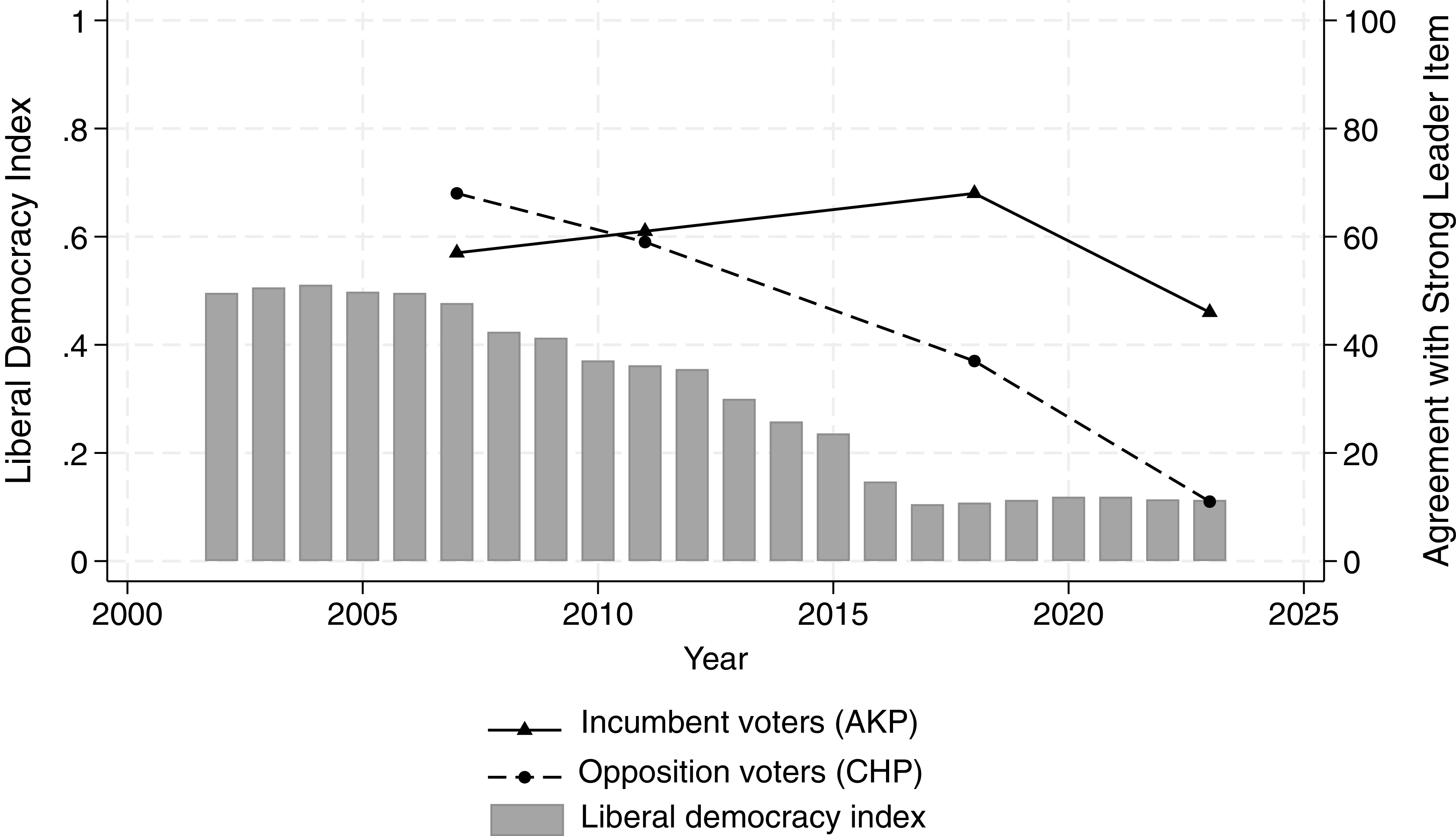
Support for a strong leader in Turkey.
Note: Data: WVS Surveys and own survey. See Online Appendix Section A for more information.

Our research yields important insights. In the first study, we found that both negatively and positively framed online educational interventions were effective in strengthening democratic demand in Turkey. This suggests that general democratic attitudes in authoritarian settings are responsive to online democracy promotion efforts (see also Ferrali, Grossman and Larreguy Reference Ferrali, Grossman and Larreguy2023; Hyde, Lamb and Samet Reference Hyde, Lamb and Samet2023). However, only the positively framed intervention significantly improved perceptions of democratic supply and, crucially, reduced the likelihood of voting for the authoritarian incumbent. This divergence highlights that while both frames can foster democratic aspirations, only positive messaging appears to translate into shifts in regime evaluations and electoral behavior. These findings were corroborated by our second study, which incorporated additional measures to provide a more nuanced interpretation of these effects.
Our findings on the power of positive frames diverge from those of Finkel, Neundorf and Rascón Ramírez (Reference Finkel, Neundorf and Rascón Ramírez2024) in post-authoritarian Tunisia but align with some well-known examples of the effectiveness of positive campaigns in authoritarian settings, such as the campaign against the Pinochet dictatorship in 1988, also dramatized in the film No (2012), or for Istanbul mayorship in 2019 (Wuthrich and Ingleby Reference Wuthrich and Ingleby2020; Zinser, Angell, Cavarozzi et al. Reference Zinser, Angell, Cavarozzi, Drake, Gil, Lomnitz, Loveman, Menéndez-Carrión, Nunn, Pásara, Sigmund, Stallings, Valenzuela and Winn1988). Drawing on insights from prospect theory, we propose a new theoretical framework to explain how the effectiveness of pro-democratic messages varies across political regimes. We argue that individuals’ responses are shaped by the perceived gap between their ‘current’ reference point – their lived political experience – and the ‘alternative’ reference points presented in the message, which draw on examples from other democracies or autocracies. The larger this gap, the greater the message’s impact. In authoritarian contexts, when the alternative appears significantly better, this contrast can elicit a sense of loss, sharpen awareness of limited democratic supply, and intensify criticism of the regime. Conversely, when the alternative appears equally bad or worse, the message fails to disrupt the status quo, even if it affirms democratic values. This dynamic helps explain why positively framed, gain-oriented messages are more effective under authoritarianism: they encourage critical reflection on the shortcomings of one’s own political system.
The remainder of the article is organized into seven sections. We begin with a theory section that examines how democracy promotion operates under authoritarianism and introduces our reference points framework. The next two sections present the case and outline our research design. These are followed by two empirical sections, each detailing one of the studies we conducted in Turkey. In the discussion section, we connect our findings back to the theoretical framework developed earlier. We conclude by reflecting on the limitations of our studies and outlining directions for future research.
Theory: promoting democracy under authoritarianism
Electoral authoritarian regimes have become increasingly common around the world during the last two decades, and there is little question that public support plays an important role in their rise. Most of these regimes emerged as leaders elected through free and fair elections dismantled democratic institutions, without facing a serious backlash from voters. In other instances, however, voters have successfully halted democratic erosion by would-be authoritarian incumbents or have limited its extent (Markowski Reference Markowski2024; Svolik Reference Svolik2023). While partisanship and polarization are crucial factors, citizens’ ‘democratic support’ also matters in determining their political behavior in the face of autocratization (Claassen Reference Claassen2020a; Eroglu, Finkel, Neundorf et al. Reference Eroglu, Finkel, Neundorf, Öztürk and Ramírez2025; Graham and Svolik Reference Graham and Svolik2020; Jacob Reference Jacob2025; Wunsch, Jacob and Derksen Reference Wunsch, Jacob and Derksen2025). In the rest of this section, we focus on what democratic support means in authoritarian contexts and whether pro-democracy educational campaigns can help promote democratic support in these contexts.
Two components of democratic support
We conceptualize democratic support as having two components: democratic demand and perceptions of democratic supply.
Democratic demand refers to principled support and preference for democratic institutions, expressed independently of partisan preferences or evaluations (Mattes and Bratton Reference Mattes and Bratton2007). Democratic demand can extend from the preference for free, fair, and regular elections for the highest national office to the support for media freedom, the rule of law, and institutional checks and balances. To express a consistent preference, especially in the context of authoritarianism, democratic demand should also include the rejection of prevalent authoritarian alternatives, such as rule by a strong leader or the military, at least in principle.
Most political scientists believe that democratic demand matters in determining regime trajectories (Claassen Reference Claassen2020a; Jacob Reference Jacob2025; Lipset Reference Lipset1959). There has been a long line of research exploring under what conditions democratic demand develops or recedes, focusing particularly on the role of government effectiveness, economic factors, and experiences with democracy (Chu, Bratton, Lagos et al. Reference Chu, Bratton, Lagos, Shastri and Tessler2008; Claassen Reference Claassen2020b; Magalhães Reference Magalhães2014). Research shows that democratic demand cannot be taken for granted even in advanced democracies and among younger generations (Claassen and Magalhães Reference Claassen and Magalhães2023; Foa and Mounk Reference Foa and Mounk2017).
Beyond this, however, a democratic bulwark against authoritarian regimes also depends on citizens’ ability to apply democratic principles to the specific realities of their own country. This, in turn, requires that citizens are able to assess accurately the state of democracy where they live, so they can take political positions that advance democratic practices and principles. This second component of democratic support is therefore focused on the evaluations of a country’s level of democracy (Brunkert Reference Brunkert2022; Heyne Reference Heyne2019) or perceived democratic supply (Mattes Reference Mattes2019).
We argue that the perceived supply of democracy matters, especially in electoral authoritarian regimes. The normative appeal of democracy is one of the reasons why leaders in these countries feel obliged to tolerate certain democratic institutions, even as they undermine the relevance of these institutions for de facto politics. In other words, in the context of growing democratic demand worldwide, authoritarian leaders use the facade of democracy and elections to manipulate voters’ perceptions of democratic supply. If citizens living under an authoritarian regime cannot recognize the undemocratic nature of the current political regime, their demand for democracy will not be translated into pro-democratic party preferences, such as voting for the pro-democratic candidates or at least abstaining from voting in sham elections.
It is important to note that democratic demand and perceived democratic supply may be grounded in distinct attitudinal domains. Democratic demand often arises from a moral conviction about what is right and wrong (Skitka, Hanson, Morgan et al. Reference Skitka, Hanson, Morgan and Wisneski2021). When citizens support democracy because they view it as intrinsically valuable, rather than for its outcomes, their commitment reflects a moral stance (Bratton and Mattes Reference Bratton and Mattes2001). In such cases, democracy is seen as an objective, universal good and is often held with emotional intensity. Alternatively, democratic demand may also stem from consequentialist logic: individuals may favor democracy because they believe that it delivers better societal outcomes related to the economy, health, and other aspects of human development.
In contrast, perceptions of democratic supply are more rooted in cognitive processes and are closely tied to individuals’ capabilities and resources. To meaningfully evaluate the democratic quality of political institutions in the country they live, citizens need a clear understanding of what democracy entails (Brunkert Reference Brunkert2022). Comparative awareness of alternative regime types, gained through life experiences or exposure to information from other countries, can also help. Wegscheider and Stark (Reference Wegscheider and Stark2020) find that citizens’ knowledge about democracy, measured through a battery of questions about the essential components of democracy, determines whether they will be able to correctly assess the level of democracy in the country. Similarly, Brunkert (Reference Brunkert2022) finds that when citizens hold liberal notions of democracy, authoritarian regimes’ efforts to oversell the level of democracy in the country fail. Research shows that citizens living in countries with heightened exposure to transnational flows of communication and citizens consuming more information are less likely to overrate the amount of democracy in a country (Kruse, Ravlik and Welzel Reference Kruse, Ravlik and Welzel2019).
Still, cognitive factors alone do not fully shape perceptions of democratic supply. Political preferences matter as well. Windecker, Vergioglou and Jacob (Reference Windecker, Vergioglou and Jacob2025) find that there is a substantial partisan gap in voters’ evaluations of the democraticness in electoral authoritarian regimes, and this gap occurs especially during the process of autocratization. This is because, they argue, incumbent voters accept the regimes’ claims about a country’s level of democracy, while other voters adjust their evaluations in line with the increasing violations of democratic norms and institutions (see also Graham and Svolik Reference Graham and Svolik2020; Krishnarajan Reference Krishnarajan2023).
These differences in attitudinal domains matter because they shape the kinds of pro-democratic messages that are likely to be effective in a given context (Mason Reference Mason2020; Albarracin and Shavitt Reference Albarracin and Shavitt2018). Moral attitudes, for instance, tend to respond more strongly to moral justifications (Luttrell, Philipp-Muller and Petty Reference Luttrell, Philipp-Muller and Petty2019). However, such justifications may backfire or fall flat when they do not align with the audience’s underlying moral values (Feinberg and Willer Reference Feinberg and Willer2015). Neundorf, Öztürk, Finkel and Ramírez (Reference Neundorf, Öztürk, Finkel and Ramírez2026) find that democracy promotion arguments grounded in intrinsic principles, such as civic rights or the separation of powers, were more persuasive than those emphasizing the superior outcomes of democratic institutions. We return to these distinctions below when further developing our theoretical framework on the differential effects of message framing.
Democracy promotion under authoritarianism
The effectiveness of democracy promotion differs greatly (Finkel, Lim, Neundorf et al. Reference Finkel, Lim, Neundorf, Öztürk and Shephard2022), as these programs vary widely depending on their content and context. Most recently, however, Finkel, Neundorf and Rascón Ramírez (Reference Finkel, Neundorf and Rascón Ramírez2024) found promising results in (then newly democratized) Tunisia, demonstrating that online pro-democratic educational campaigns targeted toward adults can be effective at building democratic support. Is there a potential for democracy promotion to be successful under authoritarian conditions as well?
Crucial constraints to the success of pro-democratic campaigns under authoritarianism exist (Hyde, Lamb and Samet Reference Hyde, Lamb and Samet2023). Autocratic regimes criminalize and punish criticism, particularly when it comes from national or international non-governmental organizations that are perceived as threatening their survival (Chaudhry Reference Chaudhry2022). Autocratization also goes together with polarization and political propaganda, resulting in strong partisan identities. In these contexts, it may be dangerous or counterproductive to conduct pro-democratic educational campaigns that openly condemn the regime’s authoritarian nature.
Democracy promoters may, therefore, choose to limit themselves to programs that do not directly confront the political regime and its leaders (Bush Reference Bush2015). However, this leads to the question of whether these ‘tamed’ pro-democracy programs can be effective against government propaganda and indoctrination. National (school) education in authoritarian countries generally lacks democratic content, focusing instead on authoritarian indoctrination (Neundorf, Nazrullaeva, Northmore-Ball et al. Reference Neundorf, Nazrullaeva, Northmore-Ball, Tertytchnaya and Kim2024). Government propaganda through the mass and social media further obfuscates the difference between democracy and authoritarianism. Electoral authoritarian regimes skillfully use the facade of democratic institutions to convince their supporters that the country is democratic (Brunkert Reference Brunkert2022; Kruse, Ravlik and Welzel Reference Kruse, Ravlik and Welzel2019). In such a context, it is unclear whether voters can apply the lessons from pro-democracy programs to their political realities.
Given these challenges, it is critical to develop a better understanding of how citizens in authoritarian countries engage with the content of various democracy promotion programs. A review of the literature shows that there is a limited amount of research in this field, along with mixed findings. Hyde, Lamb and Samet (Reference Hyde, Lamb and Samet2023) explore the effectiveness of in-person constituency meetings with party representatives in Cambodia. They demonstrate that such adult civic education can increase voters’ engagement with politics but do not find conclusive evidence about perceptions of democratic supply or partisan preferences. There have also been studies aiming to increase voters’ electoral participation in authoritarian contexts with mixed results. In an experimental study conducted in Morocco in 2021, Ferrali, Grossman and Larreguy (Reference Ferrali, Grossman and Larreguy2023) concluded that online pro-democracy educational programs can be useful in promoting better-informed voting in authoritarian regimes, despite being unable to increase youth electoral participation. Aker, Collier and Vicente (Reference Aker, Collier and Vicente2017) report the success of interventions in Mozambique in 2009 in increasing voter turnout; strikingly, however, their educational treatment increased ‘the demand for authority’,Footnote 2 and vote share of the incumbent party. There are also studies exploring the effects of information provision campaigns, such as campaigns sharing information on government corruption and on pro-democratic political behavior in electoral autocracies (Buntaine, Jablonski, Nielson et al. Reference Buntaine, Jablonski, Nielson and Pickering2018; Kolstad and Wiig Reference Kolstad and Wiig2019). However, unlike our study, these studies do not convey an educational message on democratic institutions.
Like the democracy promotion treatment of Ferrali, Grossman and Larreguy (Reference Ferrali, Grossman and Larreguy2023), our study relies on short online videos for educational purposes. Rather than emphasizing voting, however, the content of our educational interventions aims to increase support for democracy by describing the superiority of democratic over authoritarian regimes. Most importantly, our goal is to study the impact of message frames while keeping the content and other elements of pro-democracy campaigns as similar as possible.
Message frames and the theory of reference points
Which message frames are most likely to increase democratic demand in authoritarian settings and encourage citizens to adopt a more critical perspective on the democratic supply? In this section, we develop a theoretical framework to address these questions by extending the prospect theory approach to the context of democracy promotion under authoritarian regimes.Footnote 3
Despite the breadth of research on framing in political communication (Oxley Reference Oxley2020), few studies have examined how different frames affect the effectiveness of pro-democracy messages. A notable exception is the study by Finkel, Neundorf and Rascón Ramírez (Reference Finkel, Neundorf and Rascón Ramírez2024), which evaluated a pro-democracy educational campaign in post-authoritarian Tunisia. Drawing on prospect theory, which posits that individuals weigh potential losses more heavily than equivalent gains when making decisions (Kahneman and Tversky Reference Kahneman and Tversky1979), Finkel, Neundorf and Rascón Ramírez (Reference Finkel, Neundorf and Rascón Ramírez2024) compared the effects of positively and negatively framed messages. Their findings indicate that negative (loss) frames, emphasizing the harms of authoritarianism, were significantly more effective at reducing support for authoritarian rule than positive (gain) frames, which highlighted the benefits of democracy.
Prospect theory has inspired a large literature on gain and loss frames, but the evidence shows that neither frame type is universally more persuasive. Instead, contextual and individual-level moderators shape their impact (Nabi, Walter, Oshidary et al. Reference Nabi, Walter, Oshidary, Endacott, Love-Nichols, Lew and Aune2020; O’Keefe and Jensen Reference O’Keefe and Jensen2007; Quick and Bates Reference Quick and Bates2010). This raises a critical question: Do the insights from Finkel, Neundorf and Rascón Ramírez (Reference Finkel, Neundorf and Rascón Ramírez2024) travel to more repressive authoritarian contexts, where people are more likely to overestimate the level of democratic supply (Kruse, Ravlik and Welzel Reference Kruse, Ravlik and Welzel2019) while also often harboring lower levels of democratic demand (Claassen Reference Claassen2020b)?
We argue that the political regime serves as an important moderator in determining the effectiveness of these frames because it shapes how political messages are received at the individual level. According to prospect theory, individuals assess outcomes not in absolute terms but relative to a reference point that is shaped by their past and present experiences (Kahneman and Tversky Reference Kahneman and Tversky1979, 277): the ‘past and present context of experience define an adaptation level or reference point, and stimuli are perceived in relation to this reference point’.Footnote 4 Thus, the effectiveness of a message in triggering loss aversion depends on the reference point against which gains and losses are judged.
Citizens’ democratic support can be shaped by two types of reference points. The first is their everyday perception and lived experience within their own country; we refer to this as the current reference point. The second consists of alternative reference points, or benchmarks used for comparison. These may be grounded in individuals’ past experiences with different political regimes or in international comparisons. For instance, political scientists have shown that international benchmarks play a significant role in shaping political evaluations. A growing literature on economic voting suggests that citizens often assess their country’s economic performance relative to that of other countries (Aytaç Reference Aytaç2018; Duch and Stevenson Reference Duch and Stevenson2010; Hansen, Olsen and Bech Reference Hansen, Olsen and Bech2015). Likewise, research in political socialization has consistently demonstrated that previous exposure to other regime types influences current political attitudes (Neundorf Reference Neundorf2010; Pop-Eleches and Tucker Reference Pop-Eleches and Tucker2011). These benchmarks can also inform how citizens evaluate democracy and shape their broader democratic support.
We argue that interventions promoting democracy, especially those employing positive or negative message frames, can activate or introduce such alternative benchmarks. Positive frames that idealize democracy tend to present aspirational standards against which citizens can judge their own regime. Negative frames that emphasize the harms of authoritarianism, in contrast, foreground worrying alternative futures, which may then influence how the current regime is evaluated. The effectiveness of pro-democracy messages depends on the distance between the audience’s current reference point, that is, their perception of the political context, and the alternative reference point invoked by the message. The greater this distance, the more salient and cognitively engaging the message becomes.
In authoritarian contexts, when the alternative appears significantly more appealing or inspiring, this contrast can evoke both a sense of loss and a sense of aspiration. As a result, the positive message is more likely to resonate, prompting critical reflection on the limitations of the current system. In democratic contexts, by contrast, negatively framed messages may prove more effective, as shown by Finkel, Neundorf and Rascón Ramírez (Reference Finkel, Neundorf and Rascón Ramírez2024). By highlighting how much worse things could become, such messages expand the perceived gap between the status quo and the alternative, thereby enhancing salience and triggering stronger evaluative responses.
An important extension of this debate concerns how reference points interact with the two distinct components of democratic support: democratic demand and perceptions of democratic supply. As noted above, these components reflect different domains, even if they cannot be neatly confined to one or the other. Democratic demand is more closely tied to moral judgments and beliefs in universal political values. In contrast, perceptions of democratic supply involve a stronger cognitive component, shaped by individuals’ understanding of political alternatives and the information they hold about other regimes.
We expect message frames to have particularly divergent effects on perceptions of democratic supply, given how different message frames introduce different benchmarks against which perceptions of democratic supply are evaluated. In contrast, the impact of message framing on democratic demand is likely to be more limited, as democratic demand tends to be rooted in more universal moral judgments. While some variation across frames may still occur, shifts in democratic demand are more likely to result from the endorsement of these universal justifications conveyed through the message content than from changes in relative benchmarks. Moreover, in the Turkish context, regime and non-regime voters may interpret these benchmarks differently, leading to heterogeneous framing effects within the same political context.
Autocratization and democratic support in Turkey
We conducted our experimental study in Turkey, a country with many of the typical features found in electoral autocratic regimes. Recep Tayyip Erdoğan and his Justice and Development Party (AKP) came to power through free and fair elections in 2002. Over time, Erdoğan exploited social cleavages in the country and political and economic developments to expand his executive authority and erode the country’s democratic institutions (Akkoyunlu and Sarfati Reference Akkoyunlu and Sarfati2025; Aydin-Duzgit Reference Aydin-Duzgit2025; Cleary and Öztürk Reference Cleary and Öztürk2022; Selçuk Reference Selçuk2024).
Under Erdoğan’s personalist authoritarian rule, elections became increasingly unfair (Öztürk and Reilly Reference Öztürk and Reilly2024). For example, the charismatic leader of the Kurdish opposition party, Selahattin Demirtas, has been imprisoned since 2016. In the same year, Erdoğan used his influence over courts to prevent a pro-opposition political actor from gaining control of the third-biggest political party in the country. During the last few years, dozens of opposition mayors were replaced by state-appointed trustees (Tutkal Reference Tutkal2022). Finally, the arrest of Ekrem İmamoğlu in March 2025 – the mayor of Istanbul and the opposition’s most likely presidential candidate – marked a further step in the deepening of authoritarianism in Turkey (Esen and Gumuscu Reference Esen and Gumuscu2025b; Esen and Gumuscu Reference Esen and Gumuscu2025a).
Civil society in Turkey has also faced increasing levels of political repression (Yabanci Reference Yabanci2019). Hundreds of civil society organizations have been banned, especially after the coup attempt in 2016. Prominent civil society activists in the country have been jailed with baseless accusations, including ‘attempting to overthrow the government’ (Coskun and Dueck Reference Coskun and Dueck2025, 1691). Since Erdoğan became president in 2014, Turkish prosecutors have launched more than 150,000 investigations for the crime of ‘insulting the president’, and around 40,000 citizens, including prominent journalists, have stood trial (Guardian 2022; Topcu Reference Topcu2022). Arslanalp and Erkmen (Reference Arslanalp and Erkmen2023) report 694 protest bans enacted in 53 provinces, including 220 curfew decisions in the southeast, between 2007 and 2019. The Turkish authorities have also repeatedly restricted nationwide access to social media platforms during moments of political crisis, such as terrorist attacks or natural disasters, effectively curbing citizens’ access to information and their ability to criticize the government. These restrictions are complemented by the systematic use of pro-government trolls and orchestrated online harassment campaigns (Yesil Reference Yesil2021).
Despite the opposition bloc’s efforts, Erdoğan has managed to sustain his popularity among a significant segment of the Turkish public for more than two decades, largely by benefiting from his extensive control over state institutions and the media, and he went on to win the presidential election once again in 2023 (Aydin-Duzgit Reference Aydin-Duzgit2025; Balta, Demiralp and Demiralp Reference Balta, Demiralp and Demiralp2023; Balta and Demiralp Reference Balta and Demiralp2024). However, this does not mean that Turkish voters do not harbor democratic attitudes. As we show below, there is a complex relationship between citizens’ democratic attitudes in Turkey and Erdoğan’s authoritarian regime.
To start with, Figure 1 demonstrates the levels of democratic demand in Turkey throughout the last decade. On the right y-axis, we present the proportion of respondents among opposition and incumbent voters who agree with the statement that ‘a strong leader unencumbered with parliament and elections is good for Turkey’. We chose this item as it best captures the process of personalist autocratization in Turkey and the emerging strongman rule. The data points from 2007, 2011, and 2018 are from the World Values Survey. The last data point is from another national representative survey that we fielded in Turkey in 2023.Footnote 5 The left y-axis demonstrates the level of the liberal democracy index, as measured by V-Dem data.
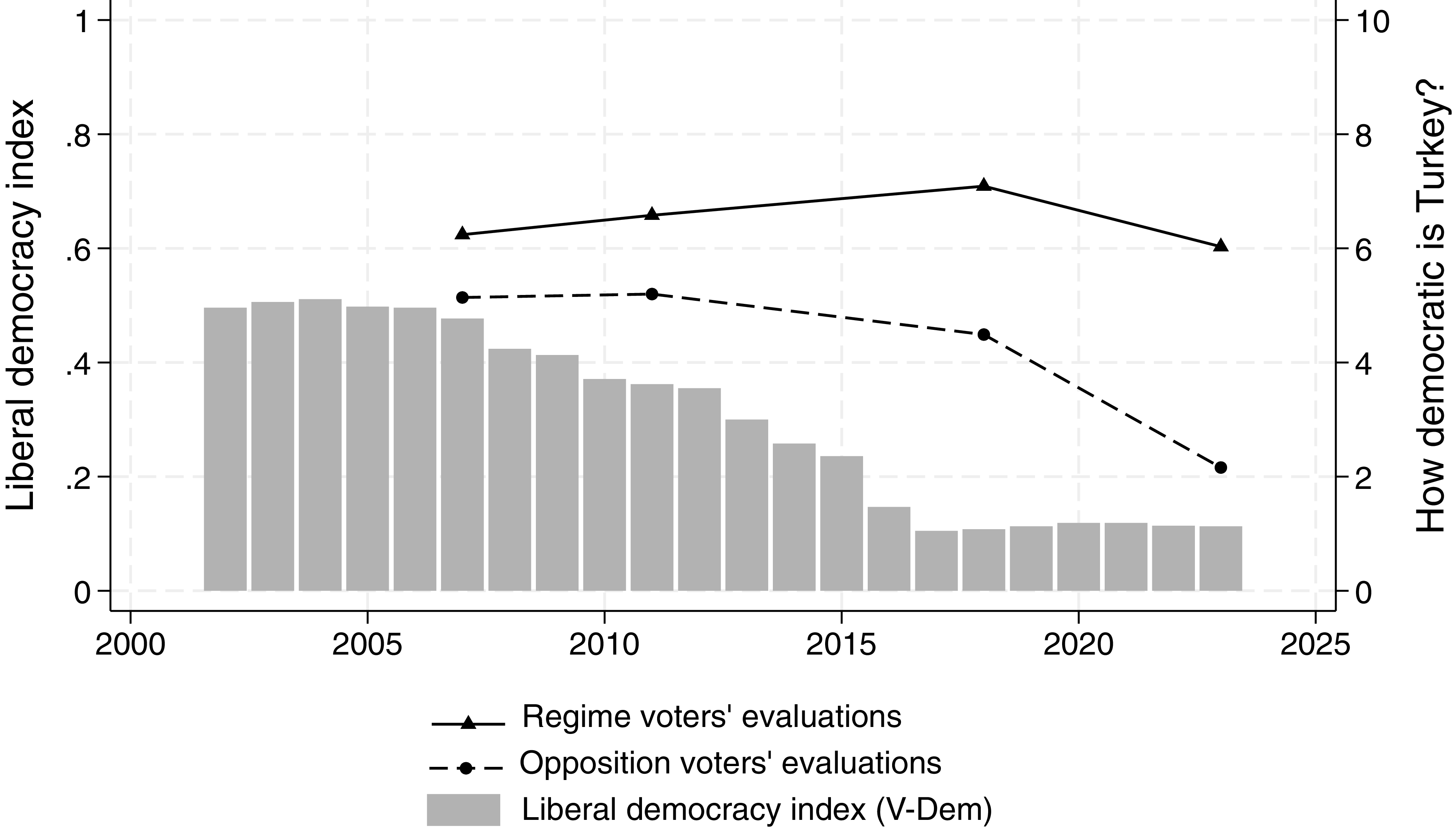
Divergence of perceptions of democratic supply in Turkey.
Note: Data: WVS Surveys and own survey. See Online Appendix Section A for more information.
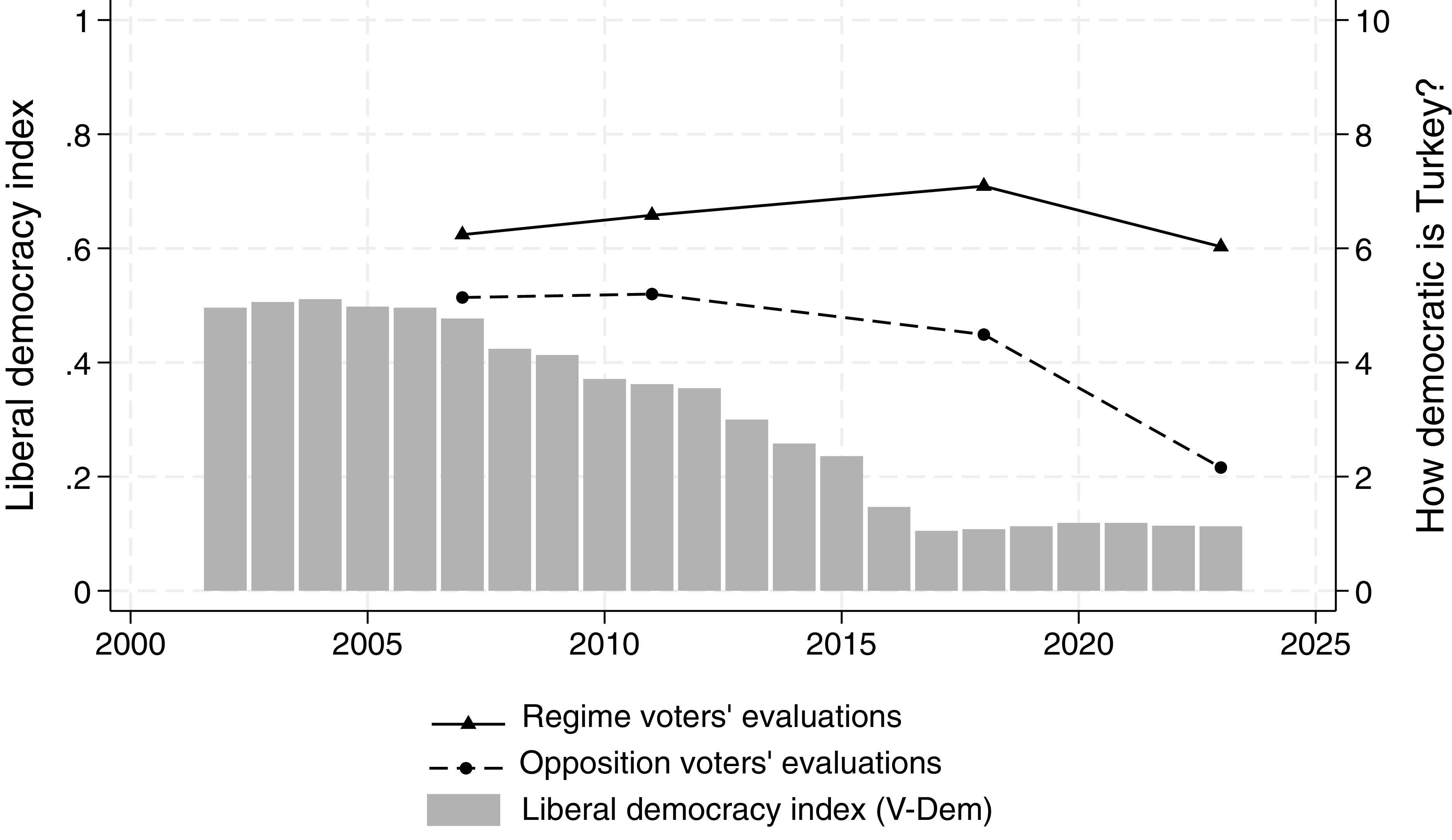
Figure 1 demonstrates that in the early years of the AKP regime, when Turkey could still be considered an electoral democracy, a significant portion of Turkish voters preferred a strongman rule and there was no partisan polarization over this issue (Schafer Reference Schafer2021).Footnote 6 Since then, as the AKP dismantled democratic institutions in the country, voters sorted into democratic and authoritarian political blocs (Selçuk and Hekimci Reference Selçuk and Hekimci2020). Today, opposition voters staunchly reject a strongman rule in the country. This is in line with the ‘negative thermostatic effect’, as advanced by Claassen (Reference Claassen2020b). Nearly half of the incumbent voters, on the other hand, still express support for the authoritarian principles, indicating that Turkey’s authoritarian regime holds a certain level of ‘normative support’ among its voter base (Neundorf, Ozturk, Northmore-Ball, Tertytchnaya and Gerschewski Reference Neundorf, Ozturk, Northmore-Ball, Tertytchnaya and Gerschewski2025).
What about perceptions of democratic supply? Figure 2 presents responses to another question in the same surveys, measuring the extent to which respondents think Turkey is a democracy, with the scale standardized to range from 0 to 10. This figure offers an account that is very similar to what Windecker, Vergioglou and Jacob (Reference Windecker, Vergioglou and Jacob2025)’s cross-national analysis shows. As Turkey autocratized, a partisan gap in respondents’ perceptions of democratic supply emerged. According to the opposition voters, the current Turkey is no longer a democracy. From the incumbent voters’ perspective, however, Turkey is still more of a democratic than an autocratic regime.
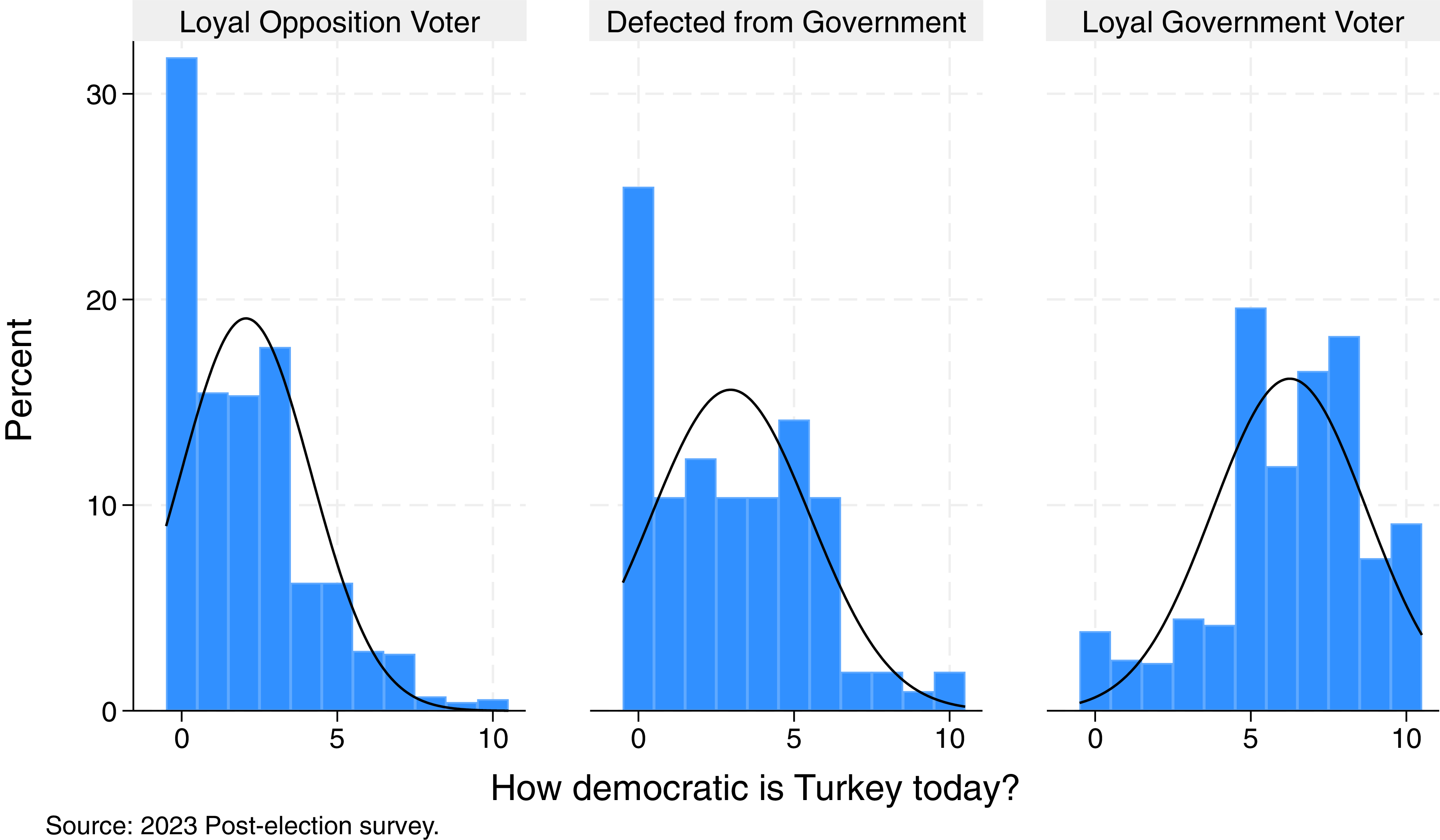
Do the perceptions of democratic supply matter in terms of voter behavior? Or do they simply follow partisan preferences? It is difficult to answer this question simply by looking at observational data. However, some indications suggest that these two variables are very closely related, even in the short term. In Figure 3, we plot the perceptions of the democratic supply by Turkish voters who had voted for the incumbent in 2018 but did not do so in 2023 and compare their distribution to voters who were loyal to the opposition or incumbent across both elections. The analysis suggests that even among respondents who voted for Erdoğan in 2018, lower levels of democratic supply are correlated with a higher likelihood of defection.Footnote 7 It is plausible to argue that as voters update their perceptions of democratic supply, their preferences for authoritarian incumbents also change.
Perceptions of democratic supply in Turkey in 2023.
Note: Data: Own survey. See Online Appendix Section A for more information.

Furthermore, we have also seen that when democratic violations are obvious and flagrant, some of the incumbent voters can withhold their support from the regime and punish Erdoğan’s authoritarian acts. This was the case when Erdoğan forced a repeat election after his party lost the Istanbul mayoral election in 2019 (Svolik Reference Svolik2023). Thus, whether voters perceive Turkey as a democracy is a matter of intense political contestation as well as having important implications for the nature and survival of the current political regime.
Research design
Our treatments
Our educational interventions aimed to promote democracy as a political system. Overall, we produced three short treatment videos and one placebo video, which discussed space exploration.Footnote 8 Each video was about 3 minutes long. We prepared the videos in a mostly abstract fashion, not mentioning Turkey or anything related specifically to the Turkish political context, and without the use of any real-world images. Instead, they relied on animations and animated characters. The only real-life reference in the videos was a comparison of Belarus and Lithuania, respectively, representing authoritarian and democratic contexts. All three treatment videos focused on democratic liberties, such as the right to vote, the right to protest, the right to equal treatment before the law, and the freedom of expression, with the interventions varying in terms of positive, negative, or neutral frames.
Our first treatment video uses a positive frame, focusing on democratic gains. This video presents a relatively idealized picture of life under democracy, for example, by emphasizing the freedom to speak against incumbents, join independent associations, and enjoy equal treatment under the law. Referring to the gains experienced under a democratic regime, the video aims to encourage and inspire people to choose democratic institutions and candidates over authoritarian alternatives.
Our second treatment video uses a negative frame, focusing on democratic losses, and it depicts an authoritarian context in which citizens lack political rights and freedoms and suffer from political repression. This video aims to warn people against the dangers of authoritarianism by focusing on the losses individuals living under authoritarian regimes experience, for example, unjust imprisonment, torture, or the limitations on free speech and association.
The text was written to be as symmetric as possible across these two videos. To give an example, here is how the positive treatment introduces the right to vote in free and fair elections:
‘Democracies give individuals the opportunity to influence what the government does. This means that all citizens have a say in the public policies and other actions the government takes by exercising political rights such as the right to vote in free and fair elections’.
Here is the part that corresponds with this text in the negative treatment:
‘In non-democratic countries, citizens have almost no influence in what the government does. Elections are neither free nor fair. Those holding power can influence elections through their judicial and propaganda powers’.
In line with the theoretical expectations documented in the literature on prospect theory, our negatively framed videos produce lower levels of enthusiasm, happiness, and hope and higher levels of anxiety, anger, and despair, compared to the positively framed videos (Nabi, Walter, Oshidary et al. Reference Nabi, Walter, Oshidary, Endacott, Love-Nichols, Lew and Aune2020).Footnote 9
We also had a third pro-democracy educational treatment, combining the positive and negative treatments. We call this a mixed treatment. The final treatment arm was a placebo video about the benefits of space exploration.
Data collection
We conducted two rounds of data collection. The first study, a preregistered experiment, was conducted between 10 June and 19 June 2022.Footnote 10 In June 2023, we conducted the second survey with a new sample. The goal of the second study was to better interpret the results from Study 1.
Like Ferrali, Grossman and Larreguy (Reference Ferrali, Grossman and Larreguy2023) and Finkel, Neundorf and Rascón Ramírez (Reference Finkel, Neundorf and Rascón Ramírez2024), we recruited our respondents for both surveys through paid social media advertisements, which invited Facebook and Instagram users in Turkey to participate in ‘a survey on current issues’. This recruitment method, which has become increasingly popular among comparative political scientists over the past few years, allowed us to reach millions of Turkish social media users and create a diverse sample of respondents (Neundorf and Öztürk Reference Neundorf and Öztürk2023). To increase the representativeness of our samples, we offered material incentives, that is, a lottery for grocery store vouchers to social media users, in return for participation in the survey (Neundorf and Öztürk Reference Neundorf and Öztürk2025). Facebook then directed social media users who clicked on these advertisements to our survey page hosted on Qualtrics.
Before taking the survey, respondents were informed about the purpose of the study, their rights, and the length of the survey (about 10 minutes). After answering some pretreatment questions (eg demographics), respondents were randomly assigned to watch one of the treatment videos mentioned above or the placebo video. All respondents then answered a set of posttreatment questions. We provide more information on our recruitment, sample composition, and descriptive statistics in Online Appendix Sections D, E.2, and F.2. Our balance tests, presented in Online Appendix Sections E.3 and F.3, showed no indications of biases arising from randomization or survey attrition.
Study 1: democracy promotion frames, support for democracy, and evaluations of the Turkish regime
In Study 1, 4,079 respondents completed the entire survey. Our outcomes of interest captured two separate components of democratic support under autocracies: democratic demand and evaluations of the current authoritarian regime.
Effects on democratic demand: We measured democratic demand using four variables. First, we asked respondents to what extent they agreed that ‘Democracy may have its problems, but it is still the best type of political regime’ before and after the treatments and created an outcome variable measuring the change in this variable. Our second outcome variable is support for authoritarianism, measured as an index averaging the level of support for non-democratic alternatives: a strong leader, one-party rule, and army rule. Our third outcome variable is an index averaging the level of support for eight specific democratic institutions and practices, such as media freedom and the right to protest (Claassen, Ackermann, Bertsou et al. Reference Claassen, Ackermann, Bertsou, Borba, Carlin, Cavari, Dahlum, Gherghina, Hawkins and Lelkes2024). The fourth variable in this set is what we call the individual’s willingness to defend democracy, comprised of four questions, measuring how likely respondents would be to vote against or criticize a political actor who violated democratic institutions and rights. All these index variables are created based on the preregistered analysis plan. We present the treatment effects on each of the mentioned items separately in the Online Appendix Section E.4.Footnote 11
In Figure 4, we present the results for the full sample in the upper half and for a restricted sample of respondents who voted for regime parties in the previous parliamentary election in the lower half.Footnote 12 The findings show that all pro-democracy educational treatments significantly improved each of the four measures of democratic demand. Compared to the placebo group, treated respondents reported greater support for democracy, less support for authoritarian alternatives, stronger endorsement of democratic rights and liberties, and a greater willingness to punish politicians who violate democratic norms. The effects on ‘support for authoritarianism’ and ‘willingness to defend democracy’ are approximately 5 percentage points – representing a moderate shift by the standards of previous public opinion research. The effect size for the ‘change in democratic support’ variable is small and statistically insignificant among regime voters. However, the baseline level for this measure was already very high (8.1 out of 10).
Treatment effects: democratic demand.
Note: 95 and 90% significance levels are presented. All outcome variables range from 0 to 1. No covariates were included. More details, tables, and robustness checks can be found in Online Appendix Section E.

Overall, the results show that both regime voters and the other respondents are responsive to democracy promotion messages. Importantly, there is also no divergence across treatments: all three treatments are relatively equally effective on the four democratic demand outcomes. These findings demonstrate the efficacy of online educational interventions in building democratic demand.
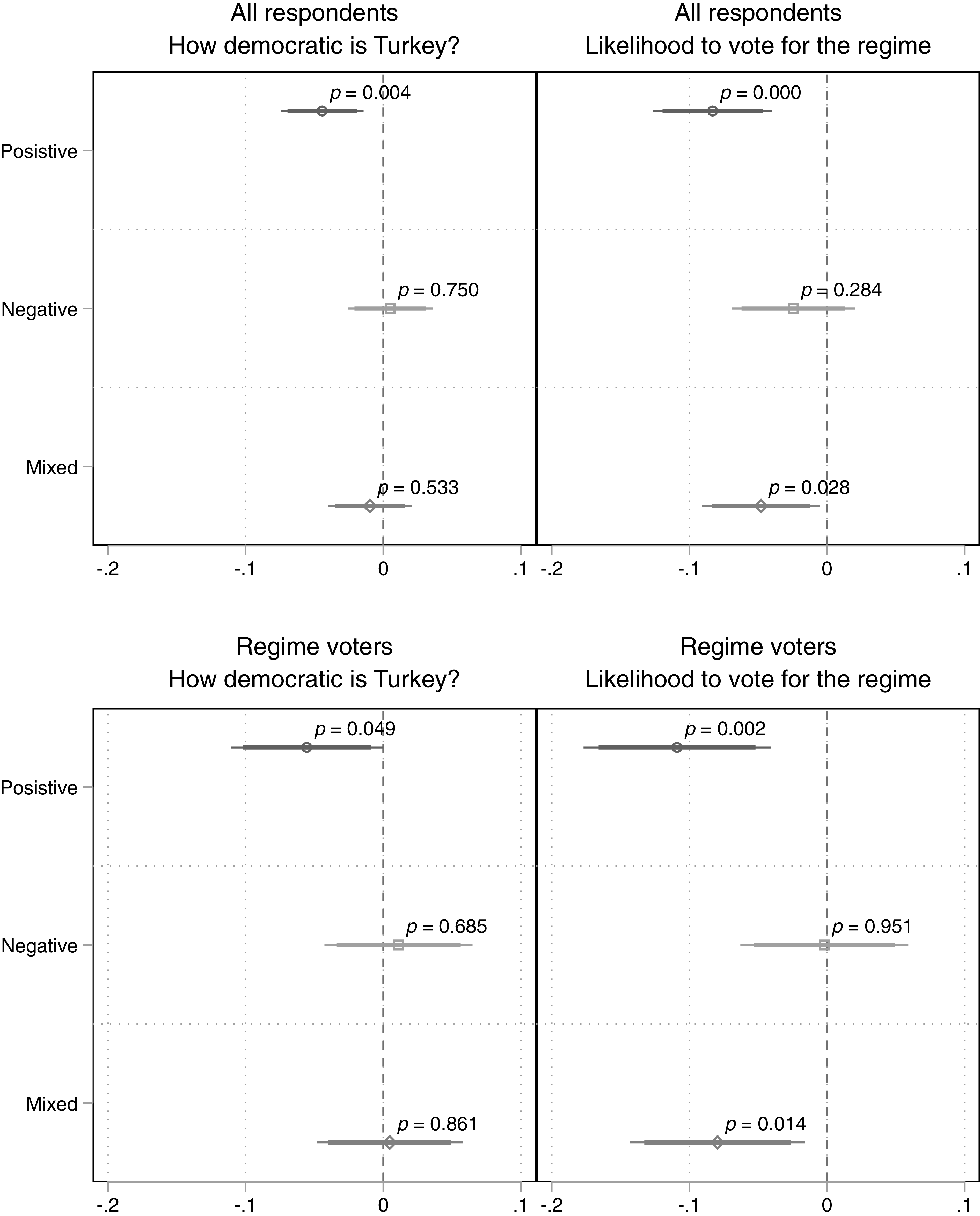
Effects on perceived democratic supply and regime support: In this section, we examine the effects of democracy promotion on perceptions of democratic supply and support for the incumbent regime. We measured perceived democratic supply by asking respondents how democratic they believe Turkey is. Support for the authoritarian regime was measured by asking how likely they would be to vote for the regime parties, as defined above. Figure 5 presents the results for both the full sample and a restricted sample of regime voters. As discussed earlier, misconceptions about the level of democratic supply among ruling party voters can have particularly important implications for regime stability.
Effects on perceived democratic supply and regime support.
Note: 95 and 90% significance levels are presented. All outcome variables range from 0 to 1. No covariates were added. More details, tables, and robustness checks can be found in Online Appendix Section E.

Figure 5 reveals a notable divergence in outcomes. Respondents who viewed the positively framed video were more likely to evaluate Turkey’s regime as authoritarian compared to those exposed to the other two videos. This confirms that the positive frame functioned as an aspirational benchmark, shifting individuals’ reference points and widening the perceived gap between the current regime and a more democratic alternative. In line with our theoretical framework, this shift also led to a reduction in vote intentions for the regime parties in a hypothetical future election. These findings support the idea that positive frames can trigger critical reflection when they present aspirational benchmarks. Importantly, these effects are observable among both regime voters, who tend to perceive Turkey as relatively democratic, and non-regime voters.Footnote 13
The negative-framed video, by contrast, did not have a consistent impact on these outcomes. The mixed treatment, which includes elements of both positive and negative frames, produces results that are somewhere in between the two, though not statistically significant relative to the placebo condition. Effect sizes for the statistically significant relationships range around 5 percentage points. These findings are supported by robustness checks presented in the Online Appendix Section E.6. Importantly, our heterogeneous treatment effects analyses, presented in Online Appendix Section E.8, show that these effects are usually valid for both regime parties’ voters and other voters.
A mediation analysis, presented in the Online Appendix Section E.7, demonstrates that the effect of the positive-framed treatment on voting for the regime is primarily mediated (65%) by its effect on the perceptions of Turkey’s democratic level, that is, by the change in reference point. While not providing definitive causal evidence, given the lack of randomization of the mediating variable, the results are consistent with a process such that positive frames about democracy, but not negative, led respondents to assess the Turkish regime as less democratic and then punish the autocratic incumbent parties as a result.
These results show that online democracy promotion can increase democratic demand. However, it is only the positive treatment that is effective at changing political evaluations. To further explore the mechanisms behind the results, we conducted a second survey with a new sample of research participants.
Study 2: understanding the effects
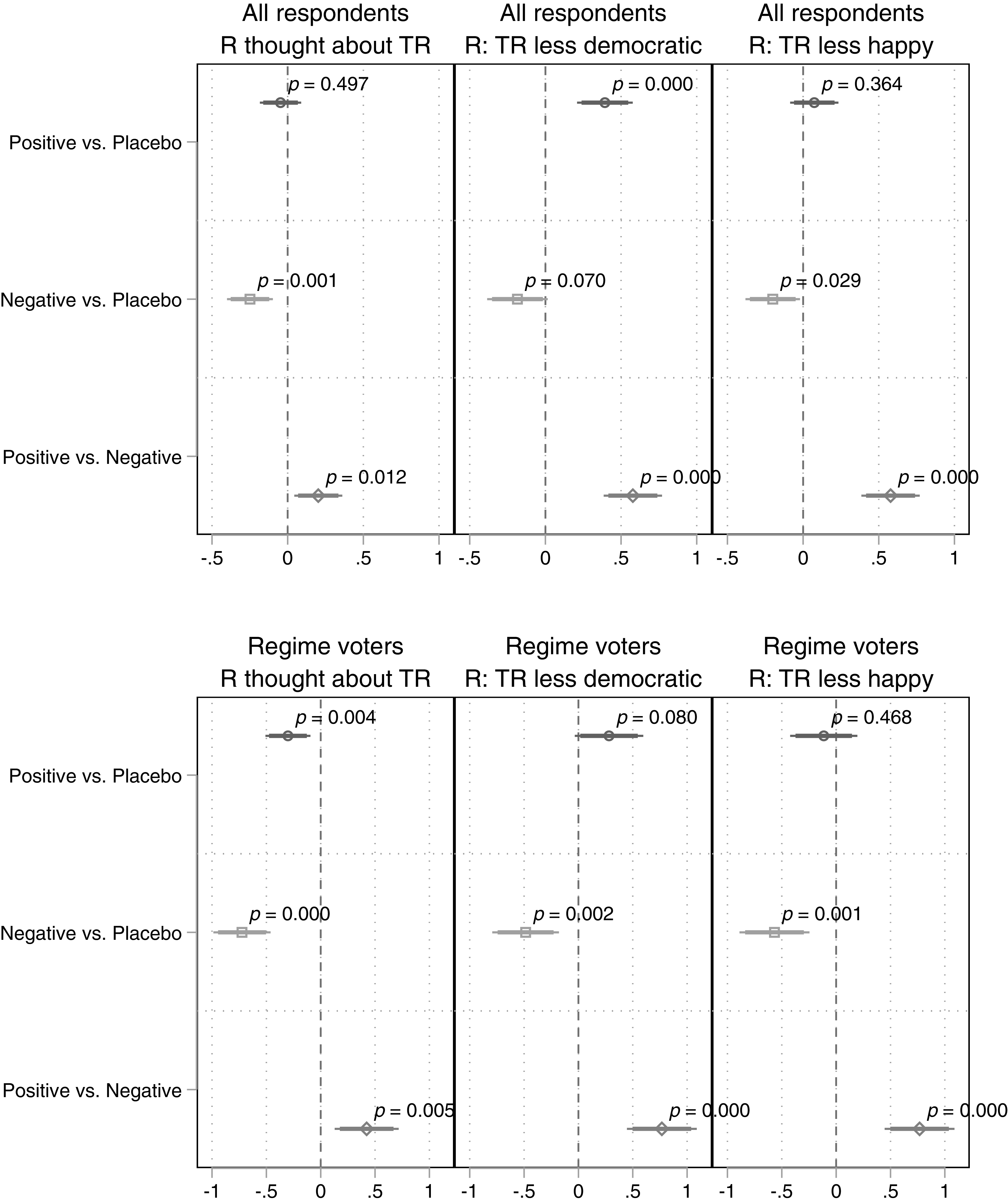
In June 2023, we conducted a second survey with 2,433 new participants. These participants were randomly assigned to either the positive-framed, the negative-framed, or the placebo treatment; we did not include a mixed frame in this study. We included three questions measuring the extent to which respondents agreed with the following statements: (1) ‘Watching the video made me think about the political system in Turkey’, (2) ‘Watching the video made me think that the level of democracy in Turkey is lower than in many other countries in the world’, and (3) ‘People in Turkey could become happier if political institutions in Turkey were more democratic’. Footnote 14 We used these questions to explore the cognitive processes our respondents experienced while watching the videos. Again, there were no explicit mentions made of Turkey or the Turkish political process in any of the videos.
The results are presented in Figure 6. First, it can be seen that the respondents watching the negative-framed video were less likely to apply the video content to the Turkish context, as shown in the left column of Figure 6. Second, as shown in the middle column, respondents watching the negative (positive) video were less (more) likely to think that Turkey has a lower level of democracy than many other countries in the world. Finally, as shown in the right column of Figure 6, the negative video weakened the association respondents established between Turkey’s level of democracy and the happiness of its citizens. The differences between positive and negative videos are statistically and substantially significant across all three questions. Effects are essentially identical if we focus on regime voters only (lower panel in Figure 6).
Evaluations of Turkish democracy.
Note: ‘R thought about Turkey’ ‘Watching the video made me think about the political system in Turkey’.‘R: TR less democratic’ ‘Watching the video made me think that the level of democracy in Turkey is lower than in many other countries in the world’.‘R: TR less happy’: ‘People in Turkey could become happier if political institutions were more demo-cratic’Note: 95 and 90% significance levels are presented. All outcome variables range from 0 to 1. No covariates were added. More details and robustness checks can be found in Online Appendix Section F.

Responses to our posttreatment open-ended question, which asked respondents what the educational video reminded them about Turkish politics, revealed similar dynamics. When asked, many regime voters assigned to the negative-framed treatment said that the video had nothing to do with Turkey and that Turkey is a democratic country. Regime voters assigned to the positive treatment, on the other hand, were more likely to refer to problems with the current political system in Turkey, supporting our claim that the positive video encourages an aspirational benchmark that promotes critical thinking among individuals exposed to the positive frame. One of the respondents summarized their engagement with the video: ‘I thought how Turkey is not like this’.
In sum, respondents watching the positive frame are more likely to associate the abstract discussion in the videos with the political context of Turkey and more likely to withhold support for parties aligned with the authoritarian regime, compared to respondents watching the negative-framed video. These findings support and help clarify the results from the first survey.
Discussion
This research project began as a theory-testing exercise aimed at examining whether the findings of Finkel, Neundorf and Rascón Ramírez (Reference Finkel, Neundorf and Rascón Ramírez2024) would hold in an authoritarian context. Using similar online comparisons of positively and negatively framed pro-democracy messages, we found results that diverged from those reported in post-authoritarian Tunisia. These unexpected findings, along with additional data we collected, led us to develop the reference points framework as an extension of the prospect theory approach to democracy promotion. In this section, we review our results and link them directly to the reference points framework introduced earlier in the theory section.
The findings presented in this article demonstrate that positively framed pro-democracy educational interventions are more effective than negatively framed interventions in authoritarian contexts like Turkey. While both frames were effective at building democratic demand, only the positive frame led to a more accurate evaluation of Turkey’s authoritarian regime and the withdrawal of support for parties aligned with the regime.
It is the difference between current and alternative reference points that forms the respondents’ perceptions of how democratic their country is and determines the effectiveness of the message frame. The promise of gain and the fear of loss, as described in the prospect theory literature, are formed based on this difference. Our negative video provided negative repressive scenes from an authoritarian context. Campaigning on the dangers of authoritarianism triggered emotional reactions among our respondents. However, set against the mundane life in autocracies, where democratic violations have been normalized, the video’s message seemed irrelevant. As a result, we can see that respondents assigned to the negative videos thought less about Turkey. They were less likely to agree with the statement that ‘Turkey is less democratic than most other countries in the world’, when we asked this question in the second study. Apparently, in authoritarian settings like Turkey, a discussion of authoritarianism that is supported with vivid examples from other countries decreases respondents’ expectations of the political system in their own countries.
Positive videos, on the other hand, helped our respondents to realize what they lack in Turkey. When authoritarian regimes are compared to a positive or idealized democratic environment, the defects of the authoritarian rule in the home country become more salient, shifting their reference point by prompting people to reconsider how democratic their country is and providing an alternative aspirational benchmark. An enthusiastic discussion of democratic regimes and their merits leads respondents living in autocracies to ponder more on the political situation in their countries, to conclude that their countries are less democratic than they should normatively be, and to withdraw their support from the parties associated with the authoritarian regime. Thus, it is the positive messages that change the reference point by offering a new aspirational benchmark. Study 2 demonstrated that respondents assigned to the positive video were more likely to agree with the statements that Turkey was less democratic than many other countries in the world and that the people in Turkey would be happier if the country were a democracy.
In democratic contexts, things work differently, as documented by Finkel, Neundorf and Rascón Ramírez (Reference Finkel, Neundorf and Rascón Ramírez2024)’s work in Tunisia. Unlike our work, their treatment videos were not abstract; they openly discussed the old authoritarian regime and the democratic freedoms people had recently achieved. As such, alternative reference points that respondents were presented were a democratic future versus a return to authoritarianism. The current reference point was the democratization in Tunisia and the embrace of new political rights. Within this context, citizens perceived something substantial to lose when they were exposed to the loss frame’s depiction of the negative consequences of the absence of such freedoms.
Conclusion
Our study makes important contributions to the literature on democracy promotion and the development of democratic support among ordinary citizens. As noted earlier, existing research offers mixed evidence on the effectiveness of pro-democratic education under authoritarianism (Aker, Collier and Vicente Reference Aker, Collier and Vicente2017; Hyde, Lamb and Samet Reference Hyde, Lamb and Samet2023; Ferrali, Grossman and Larreguy Reference Ferrali, Grossman and Larreguy2023). Our findings show that online democracy promotion can increase democratic demand among citizens living in electoral authoritarian regimes. More importantly, we demonstrate that individuals in autocratic contexts are capable of applying abstract messages about regime types to their own political environment, adjusting their evaluations of democratic deficiencies and of the parties associated with them accordingly. These are encouraging results for both scholars and practitioners of democracy promotion, suggesting that abstract educational content – lacking specific references to the domestic context – can still be effective while also being safer and easier to implement in repressive settings. At the same time, our findings underscore an important distinction: educational materials that succeed in increasing democratic demand do not necessarily influence perceptions of democratic supply. This highlights the need for researchers to treat these two dimensions of democratic support as analytically distinct and design their messages accordingly.
Looking ahead, one question that remains is how durable these effects are. Our findings would still be significant even if the treatment effects were only short-lived. For example, strategically placed online interventions promoting democracy using positive frames during election campaigns may significantly decrease support for authoritarian incumbent parties, a key source of legitimacy for these regimes. Important avenues for future research are to determine the most effective ways in terms of intensity and timing of delivering these messages, as well as to determine how their effects may vary more generally across countries with different levels of democracy and other macro-political and economic characteristics.
Further research is also needed to assess the extent to which these findings apply to real-world electoral campaigns against authoritarian incumbents. As discussed above, there are notable historical cases in which opposition movements achieved significant electoral victories – against the odds – by adopting positively framed campaigns (Boas Reference Boas2015; Wuthrich and Ingleby Reference Wuthrich and Ingleby2020; Zinser, Angell, Cavarozzi et al. Reference Zinser, Angell, Cavarozzi, Drake, Gil, Lomnitz, Loveman, Menéndez-Carrión, Nunn, Pásara, Sigmund, Stallings, Valenzuela and Winn1988). While these efforts did not shy away from addressing rights violations or authoritarian practices, they ultimately emphasized forward-looking aspirations, offering hope to electorates accustomed to an authoritarian status quo. We believe the insights from our study of democracy promotion are relevant in this context: under authoritarianism, articulating a credible and aspirational positive vision may be crucial for effective opposition mobilization. However, our study relied on abstract educational materials rather than real campaign content. Additional research is therefore needed to examine this dynamic more directly in the context of real-world electoral campaigns.
Supplementary material
To view supplementary material for this article, please visit https://doi.org/10.1017/S1475676525100583
Data availability statement
The datasets and the do-file required to replicate our analyses are available online at https://doi.org/10.7910/DVN/LNNRYW.
Acknowledgements
We are grateful for the feedback we received at the Virtual Workshop on Authoritarian Regimes (VWAR), the 2023 MPSA Annual Meeting, the 2023 EPSA mini-conference on Authoritarian Politics, and the 2024 EPSA panel session. We thank Quintin Beazer, Hanna Folsz, Erik Jones, Holger Kern, Horacio Larreguy, Jeremy Siow, Erin York, and Alper H. Yağcı, as well as all other discussants and participants, for their valuable feedback. We also thank the editors and anonymous reviewers for their contributions to our article and Murat Akdoğan for his research assistance. We thank Melis Laebens for allowing us to use the 2023 post-election survey data.
Funding statement
The research of this project is generously funded by a European Research Council Consolidator Grant ‘Democracy under Threat: How Education can Save it’ (DEMED) (Grant number: 865305).



 Open access

