









1 Introduction
The canonical bundle formula over the field $\mathbb {C}$
of complex numbers is developed to study fibrations whose general fibers have numerically trivial (log-)canonical divisors. Roughly speaking, for a fibration
$\mathbb {C}$
of complex numbers is developed to study fibrations whose general fibers have numerically trivial (log-)canonical divisors. Roughly speaking, for a fibration $f\colon X\to S$
of projective varieties with certain mild singularities such that
$f\colon X\to S$
of projective varieties with certain mild singularities such that $K_X \sim _{\mathbb {Q}} f^{*}D$
for some divisor D on S, the canonical bundle formula predicts that
$K_X \sim _{\mathbb {Q}} f^{*}D$
for some divisor D on S, the canonical bundle formula predicts that $D \sim _{\mathbb {Q}} K_S + \Delta _S$
, where
$D \sim _{\mathbb {Q}} K_S + \Delta _S$
, where $\Delta _S$
contains the information of singular fibers and moduli of general fibers, and
$\Delta _S$
contains the information of singular fibers and moduli of general fibers, and $(S, \Delta _S)$
is expected to have mild singularities [Reference Fujino and Mori18, Reference Ambro1, Reference Ambro2]. The canonical bundle formula plays an important role in birational geometry, for example, in the proof of subadjunction and effectivity of pluricanonical systems [Reference Kawamata24, Reference Birkar and Zhang4]. We refer the interested reader to [Reference Floris and Lazić17] for a nice survey. Remark that over
$(S, \Delta _S)$
is expected to have mild singularities [Reference Fujino and Mori18, Reference Ambro1, Reference Ambro2]. The canonical bundle formula plays an important role in birational geometry, for example, in the proof of subadjunction and effectivity of pluricanonical systems [Reference Kawamata24, Reference Birkar and Zhang4]. We refer the interested reader to [Reference Floris and Lazić17] for a nice survey. Remark that over $\mathbb {C}$
, to derive the information about
$\mathbb {C}$
, to derive the information about $\Delta _S$
, the key ingredients are results from moduli theory and Hodge theory (variations of Hodge structure).
$\Delta _S$
, the key ingredients are results from moduli theory and Hodge theory (variations of Hodge structure).
In characteristic $p>0$
, there are quite few results about canonical bundle formulas. For elliptic fibrations, by taking advantage of the moduli theory of elliptic curves, Chen-Zhang [Reference Chen and Zhang10] proved that
$p>0$
, there are quite few results about canonical bundle formulas. For elliptic fibrations, by taking advantage of the moduli theory of elliptic curves, Chen-Zhang [Reference Chen and Zhang10] proved that $\Delta _S$
is
$\Delta _S$
is $\mathbb {Q}$
-linearly equivalent to an effective divisor (denoted by
$\mathbb {Q}$
-linearly equivalent to an effective divisor (denoted by $\Delta _S \succeq _{\mathbb {Q}} 0$
for short). Cascini-Tanaka-Xu [Reference Cascini, Tanaka and Xu8, Section 6.2] investigated fibrations of log canonical pairs
$\Delta _S \succeq _{\mathbb {Q}} 0$
for short). Cascini-Tanaka-Xu [Reference Cascini, Tanaka and Xu8, Section 6.2] investigated fibrations of log canonical pairs $f\colon (X, \Delta ) \to S$
of relative dimension one. Assuming that the geometric generic fiber
$f\colon (X, \Delta ) \to S$
of relative dimension one. Assuming that the geometric generic fiber $(X_{\overline {K(S)}}\cong \mathbb {P}^1_{\overline {K(S)}}, \Delta _{\overline {K(S)}})$
has log canonical singularities, they proved similar results as in characteristic zero by use of the moduli theory of stable rational curves. However, the geometric generic fiber can be quite singular. For example, in characteristic
$(X_{\overline {K(S)}}\cong \mathbb {P}^1_{\overline {K(S)}}, \Delta _{\overline {K(S)}})$
has log canonical singularities, they proved similar results as in characteristic zero by use of the moduli theory of stable rational curves. However, the geometric generic fiber can be quite singular. For example, in characteristic $p<5$
, there exist quasi-elliptic fibrations ([Reference Bădescu3, Chapter 7]), whose general fibers are singular rational curves with arithmetic genus one. For a quasi-elliptic fibration
$p<5$
, there exist quasi-elliptic fibrations ([Reference Bădescu3, Chapter 7]), whose general fibers are singular rational curves with arithmetic genus one. For a quasi-elliptic fibration $f\colon X\to S$
, the relative canonical divisor
$f\colon X\to S$
, the relative canonical divisor $K_{X/S}$
is not necessarily
$K_{X/S}$
is not necessarily $\mathbb {Q}$
-linearly equivalent to an effective
$\mathbb {Q}$
-linearly equivalent to an effective $\mathbb {Q}$
-divisor. To treat fibrations fibered by wildly singular varieties (log pairs), Witaszek [Reference Witaszek36] obtained the following result.
$\mathbb {Q}$
-divisor. To treat fibrations fibered by wildly singular varieties (log pairs), Witaszek [Reference Witaszek36] obtained the following result.
Theorem 1.1 [Reference Witaszek36, Theorem 3.4]
Let $(X, \Delta )$
be a projective log canonical pair defined over an algebraically closed field k of characteristic
$(X, \Delta )$
be a projective log canonical pair defined over an algebraically closed field k of characteristic $p> 0$
, and let
$p> 0$
, and let $f\colon X \to S$
be a fibration of relative dimension one such that
$f\colon X \to S$
be a fibration of relative dimension one such that $K_X + \Delta \sim _{\mathbb {Q}} f^{*}D$
for some
$K_X + \Delta \sim _{\mathbb {Q}} f^{*}D$
for some $\mathbb {Q}$
-Cartier
$\mathbb {Q}$
-Cartier $\mathbb {Q}$
-divisor D on S. Assume that the generic fiber is smooth. Then there exists a finite purely inseparable morphism
$\mathbb {Q}$
-divisor D on S. Assume that the generic fiber is smooth. Then there exists a finite purely inseparable morphism $\tau \colon T \to S$
such that
$\tau \colon T \to S$
such that
 $$ \begin{align*}\tau^{*}D\sim_{\mathbb{Q}} t\tau^{*}K_S + (1-t)(K_T+\Delta_T)\end{align*} $$
for some rational number $t\in [0,1]$
and an effective
$t\in [0,1]$
and an effective $\mathbb {Q}$
-divisor
$\mathbb {Q}$
-divisor $\Delta _T$
on T.
$\Delta _T$
on T.
Witaszek noticed that if $(X_{\overline {K(S)}}, \Delta _{\overline {K(S)}})$
is not log canonical, then
$(X_{\overline {K(S)}}, \Delta _{\overline {K(S)}})$
is not log canonical, then $\Delta $
has a horizontal component T purely inseparable over S. By doing the base change
$\Delta $
has a horizontal component T purely inseparable over S. By doing the base change $T\to S$
and applying the adjunction formula, he proved the above canonical bundle formula. Stimulated by Witaszek’s observation, we attempt to treat fibrations of relative dimension one with singular general fibers, which happen only when
$T\to S$
and applying the adjunction formula, he proved the above canonical bundle formula. Stimulated by Witaszek’s observation, we attempt to treat fibrations of relative dimension one with singular general fibers, which happen only when $p=2$
or
$p=2$
or $3$
. Here we remark that if
$3$
. Here we remark that if $\dim S>1$
, then the fibration f is not necessarily a separable morphism; this means that the generic geometric fiber
$\dim S>1$
, then the fibration f is not necessarily a separable morphism; this means that the generic geometric fiber $X_{\overline {K(S)}}$
is not necessarily reduced. To treat inseparable fibrations, we apply the language of foliations, developed in [Reference Patakfalvi and Waldron28, Reference Ji and Waldron23], which makes it convenient to compare the canonical divisors under purely inseparable base changes.
$X_{\overline {K(S)}}$
is not necessarily reduced. To treat inseparable fibrations, we apply the language of foliations, developed in [Reference Patakfalvi and Waldron28, Reference Ji and Waldron23], which makes it convenient to compare the canonical divisors under purely inseparable base changes.
First, we get a similar result for separable fibrations as Theorem 1.1.
Theorem 1.2 (see Theorem 6.2)
Let $f\colon X\to S$
be a separable fibration of relative dimension one between normal quasi-projective varieties where X is
$f\colon X\to S$
be a separable fibration of relative dimension one between normal quasi-projective varieties where X is $\mathbb {Q}$
-factorial. Let
$\mathbb {Q}$
-factorial. Let $\Delta $
be an effective
$\Delta $
be an effective $\mathbb {Q}$
-divisor on X. Assume that
$\mathbb {Q}$
-divisor on X. Assume that
-
(C1) $(X_{K(S)}, \Delta _{K(S)})$
is lc; and
$(X_{K(S)}, \Delta _{K(S)})$
is lc; and -
(C2)
$K_X+\Delta \sim _{\mathbb {Q}} f^{*}D$
for some
$\mathbb {Q}$
-Cartier
$\mathbb {Q}$
-divisor D on S.


Then there exist finite purely inseparable morphisms $\tau _1\colon \bar {T} \to S$
,
$\tau _1\colon \bar {T} \to S$
, $\tau _2\colon \bar {T}' \to \bar {T}$
, an effective
$\tau _2\colon \bar {T}' \to \bar {T}$
, an effective $\mathbb {Q}$
-divisor
$\mathbb {Q}$
-divisor $E_{\bar T'}$
on
$E_{\bar T'}$
on $\bar T'$
and rational numbers
$\bar T'$
and rational numbers $a,b,c\geq 0$
such that
$a,b,c\geq 0$
such that
 $$ \begin{align*}\tau_2^{*} \tau_1^{*}D \sim_{\mathbb{Q}} a K_{\bar{T}'} + b\tau_2^{*}K_{\bar{T}} + c\tau_2^{*}\tau_1^{*}K_S + E_{\bar T'}.\end{align*} $$
Moreover, if $(X_{K(S)}, \Delta _{K(S)})$
is klt, then
$(X_{K(S)}, \Delta _{K(S)})$
is klt, then $c \geq c_0$
for some positive number
$c \geq c_0$
for some positive number $c_0$
relying only on the maximal coefficient of prime divisors in
$c_0$
relying only on the maximal coefficient of prime divisors in $\Delta _{K(S)}$
.
$\Delta _{K(S)}$
.
For inseparable fibrations, we can only treat fibrations with the base S being of maximal Albanese dimension (m.A.d.). We distinguish the cases according to whether the Albanese morphism $a_S$
of S is separable or not and summarize the results in the following theorem.
$a_S$
of S is separable or not and summarize the results in the following theorem.
Theorem 1.3 (see Subsection 8.3)
Let X be a normal $\mathbb {Q}$
-factorial projective variety and
$\mathbb {Q}$
-factorial projective variety and $\Delta $
an effective
$\Delta $
an effective $\mathbb {Q}$
-divisor on X. Let
$\mathbb {Q}$
-divisor on X. Let $f\colon X \to S$
be an inseparable fibration of relative dimension one onto a normal projective variety S. Assume that
$f\colon X \to S$
be an inseparable fibration of relative dimension one onto a normal projective variety S. Assume that
-
(C1)
$(X_{K(S)}, \Delta _{K(S)})$
is lc; -
(C2) there exists a big open subset
$S^{\circ }$
and a
$\mathbb {Q}$
-Cartier
$\mathbb {Q}$
-divisor
$D^{\circ }$
on
$S^{\circ }$
such that
$(K_X+\Delta )|_{f^{-1}(S^{\circ })} \sim _{\mathbb {Q}} f^{*}D^{\circ }$
; -
(C3) S is of maximal Albanese dimension.



Denote by $a_S\colon S \to A$
the Albanese morphism of S and
$a_S\colon S \to A$
the Albanese morphism of S and $D:=\overline {D^{\circ }}$
the closure divisor of
$D:=\overline {D^{\circ }}$
the closure divisor of $D^{\circ }$
in S. Then the following statements hold true:
$D^{\circ }$
in S. Then the following statements hold true:
-
(1) If
$a_S$
is separable, then
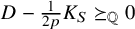
$D - \frac {1}{2p}K_S \succeq _{\mathbb {Q}} 0$
(
$\mathbb {Q}$
-linearly to an effective divisor). In particular,
$\kappa (S,D) \geq \kappa (S)$
. -
(2) If
$a_S$
is inseparable then
$\kappa (S,D) \geq 0$
, and the equality is attained only when
$a_S: S \to A$
is purely inseparable of height one; and if moreover
$(X_{K(S)}, \Delta _{K(S)})$
is klt,
$a_S$
is finite and
$K_X+\Delta \sim _{\mathbb {Q}} f^{*}D$
, under the assumption that resolutions of singularities hold in
$\dim S$
, we have
$\kappa (S,D)\ge 1$
.



Remark 1.4. When $a_S$
is inseparable and
$a_S$
is inseparable and $\kappa (S,D)= 0$
, we can derive additional information, see Theorem 7.3.
$\kappa (S,D)= 0$
, we can derive additional information, see Theorem 7.3.
Varieties with a nef anti-canonical divisor are of special interest and expected to have good structures. For example, over $\mathbb {C}$
, for a projective klt pair
$\mathbb {C}$
, for a projective klt pair $(X,\Delta )$
, if
$(X,\Delta )$
, if $-(K_X + \Delta )$
is nef, then the Albanese morphism
$-(K_X + \Delta )$
is nef, then the Albanese morphism $a_X\colon X\to A$
is a fibration which has certain isotrivial structure ([Reference Ambro2, Reference Cao6, Reference Campana, Cao and Matsumura5]). In characteristic
$a_X\colon X\to A$
is a fibration which has certain isotrivial structure ([Reference Ambro2, Reference Cao6, Reference Campana, Cao and Matsumura5]). In characteristic $p>0$
, under the condition that the geometric generic fiber has certain mild singularities, similar results hold (see [Reference Wang35, Reference Ejiri14]). In a recent paper, under certain conditions on singularities, Ejiri and Patakfalvi ([Reference Ejiri and Patakfalvi15]) prove that
$p>0$
, under the condition that the geometric generic fiber has certain mild singularities, similar results hold (see [Reference Wang35, Reference Ejiri14]). In a recent paper, under certain conditions on singularities, Ejiri and Patakfalvi ([Reference Ejiri and Patakfalvi15]) prove that $a_X\colon X\to A$
is surjective, and if
$a_X\colon X\to A$
is surjective, and if $X\buildrel f\over \to S\buildrel g\over \to A$
is the Stein factorization of
$X\buildrel f\over \to S\buildrel g\over \to A$
is the Stein factorization of $a_X$
, then g is purely inseparable. More precisely, [Reference Ejiri and Patakfalvi15] shows that if
$a_X$
, then g is purely inseparable. More precisely, [Reference Ejiri and Patakfalvi15] shows that if $f\colon X\to S$
or
$f\colon X\to S$
or $g\colon S\to A$
is separable, then
$g\colon S\to A$
is separable, then $a_X\colon X\to A$
is a fibration. In this paper, by applying the canonical bundle formula established above and an additional careful analysis of certain purely inseparable base changes and the related foliations, we can prove that if
$a_X\colon X\to A$
is a fibration. In this paper, by applying the canonical bundle formula established above and an additional careful analysis of certain purely inseparable base changes and the related foliations, we can prove that if $a_X\colon X\to A$
is of relative dimension one, then it is a fibration.
$a_X\colon X\to A$
is of relative dimension one, then it is a fibration.
Theorem 1.5 (see Theorem 8.1)
Let $(X, \Delta )$
be a projective normal
$(X, \Delta )$
be a projective normal $\mathbb {Q}$
-factorial klt pair. Assume that
$\mathbb {Q}$
-factorial klt pair. Assume that $-(K_X+\Delta )$
is nef. If the Albanese morphism
$-(K_X+\Delta )$
is nef. If the Albanese morphism $a_X\colon X \to A$
is of relative dimension one over the image
$a_X\colon X \to A$
is of relative dimension one over the image $a_X(X)$
. Then
$a_X(X)$
. Then $a_X\colon X\to A$
is a fibration.
$a_X\colon X\to A$
is a fibration.
This is an important preparation for further studies of varieties with nef anti-canonical divisors. In a later paper [Reference Chen, Wang and Zhang9], we focus on the case $K_X\equiv 0$
and show that X can be obtained by a sequence of quotients of group actions and foliations beginning with a product of an abelian variety and an elliptic (or a rational) curve, and we give specific descriptions of those quotients in some special cases.
$K_X\equiv 0$
and show that X can be obtained by a sequence of quotients of group actions and foliations beginning with a product of an abelian variety and an elliptic (or a rational) curve, and we give specific descriptions of those quotients in some special cases.
Conventions
-
○ For a scheme Z, we use
$Z_{\text {red}}$
to denote the scheme with the reduced structure of Z. -
○ By a variety over a field k, we mean an integral quasi-projective scheme over k. For a variety X, we use
$K(X)$
to denote the function field of X, and for a morphism
$f\colon X \to S$
of varieties, we use
$X_{K(S)}$
to denote the generic fiber of f. -
○ By a fibration, we mean a projective morphism
$f\colon X \to S$
of normal varieties such that
$f_*\mathcal {O}_X=\mathcal {O}_S$
, which implies that
$K(S)$
is algebraically closed in
$K(X)$
. -
○ A morphism
$f\colon X\to Y$
of varieties is said to be separable (resp. inseparable) if the field extension
$K(X)/K(f(X))$
is separable (resp. inseparable). -
○ Let
$f\colon X\to S$
be a fibration. A divisor D on X is said to be f-exceptional (resp. vertical, horizontal) if
$f(\operatorname {\mathrm {Supp}} D)$
is of codimension
$\ge 2$
in S (resp. of codimension
$\ge 1$
in S, dominant over S). -
○ Let k be a field of characteristic
$p>0$
and X be a variety over k. We denote by the absolute Frobenius morphism. -
○ Let
$ f\colon X \to Y $
be a morphism. The pullback
$ f^{*}D $
is well-defined under one of the following conditions:-
(1)
$ D $
is a
$ \mathbb {Q} $
-Cartier divisor on
$ Y $
, or -
(2) both
$ X $
and
$ Y $
are normal,
$ D $
is a
$ \mathbb {Q} $
-divisor, and
$ f $
is equidimensional.
-
-
○ For a morphism
$\sigma \colon Z \to X$
of varieties, if D is a divisor on X such that the pullback
$\sigma ^{*}D$
is well defined, we often use
$D|_Z$
to denote
$\sigma ^{*}D$
for simplicity. -
○ Let X be a normal variety and denote by
$i\colon X^{\circ }\hookrightarrow X$
the inclusion of the regular locus of X. For a Weil divisor D on X,
$\mathcal {O}_X(D)$
is a subsheaf of the constant sheaf
$K(X)$
of rational functions, with the stalk at a point x being defined by We may identify
$\mathcal {O}_X(D)=i_*\mathcal {O}_{X^{\circ }}(D|_{X^{\circ }})$
.
-
○ We denote by
$\sim $
,
$\sim _{\mathbb {Q}}$
and
$\equiv $
the linear,
$\mathbb {Q}$
-linear and numerical equivalence of divisors, respectively. -
○ Let
$A = \sum a_i C_i$
and
$B = \sum b_i C_i$
be effective divisors. We define
$A \land B := \sum \min (a_i, b_i) C_i$
. -
○ For two
$\mathbb {Q}$
-divisors
$D,D'$
on a normal variety X, by
$D \geq D'$
we mean that
$D-D'$
is an effective divisor; and by
$D\succeq D'$
(resp.
$D\succeq _{\mathbb {Q}} D'$
) we mean that
$D-D'$
is linearly (resp.
$\mathbb {Q}$
-linearly) equivalent to an effective divisor. -
○ Let X be a normal variety. If a coherent sheaf
$\mathcal {F}$
on X is reflexive (of rank r), then we denote
$\det \mathcal {F} := (\bigwedge ^r \mathcal {F})^{\vee \vee }$
. When
$\mathcal {F}$
is just locally free in codimension one (e.g., torsion free), we define
$\det \mathcal {F} := i_*\det (\mathcal {F}|_U)$
, where
$i\colon U\hookrightarrow X$
is an inclusion of a big open subset (meaning its complement in X has codimension at least
$2$
) on which
$\mathcal {F}$
is locally free. -
○ Let X be a normal projective variety. The Kodaira dimension
$\kappa (X)$
of X is defined to be the Iitaka dimension
$\kappa (X,K_X)$
. More precisely, it is the dimension of the image of
$\Phi \colon X\dashrightarrow \mathbb {P} H^0(X, nK_{X})$
for n big and divisible enough. -
○ Let X be a normal projective variety and let D be an
$\mathbb {R}$
-Cartier
$\mathbb {R}$
-divisor on X. Let H be an ample Cartier divisor on X. If D is nef, then the numerical dimension of D is the largest integral number
$j\ge 0$
such that
$(D^j\cdot H^{n-j}) \ne 0$
, see [Reference Cascini, Hacon, Mustaţă and Schwede7, Remark 4.6]. -
○ Let X be a normal projective variety over an algebraically closed field k. We say that X is of maximal Albanese dimension, abbreviated as m.A.d., if the Albanese morphism
$a_X\colon X\to A_X$
of X is generically finite, or equivalently if
$\dim a_X(X) = \dim X$
.


 the absolute Frobenius morphism.


2 Preliminaries
In this section, we collect some basic results about divisors and linear systems that will be used in the sequel. We work over an algebraically closed field k.
Lemma 2.1 [Reference Zhang37, Lemma 4.2]
Let $\mathcal {E}$
be a coherent sheaf which is locally free in codimension one on a normal projective variety X. Assume that
$\mathcal {E}$
be a coherent sheaf which is locally free in codimension one on a normal projective variety X. Assume that $\mathcal {E}^{\vee \vee }$
is generically globally generated and
$\mathcal {E}^{\vee \vee }$
is generically globally generated and $h^0(X, \mathcal {E}^{\vee \vee })> \operatorname {\mathrm {rank}} \mathcal {E}$
. Then
$h^0(X, \mathcal {E}^{\vee \vee })> \operatorname {\mathrm {rank}} \mathcal {E}$
. Then $h^0(X, \det \mathcal {E})>1$
.
$h^0(X, \det \mathcal {E})>1$
.
Lemma 2.2. Let $\sigma \colon Y \to X$
be a proper dominant morphism of normal varieties, generically finite of degree d. Let
$\sigma \colon Y \to X$
be a proper dominant morphism of normal varieties, generically finite of degree d. Let $D, D'$
be
$D, D'$
be $\mathbb {Q}$
-Cartier
$\mathbb {Q}$
-Cartier $\mathbb {Q}$
-divisors on
$\mathbb {Q}$
-divisors on $X, Y$
respectively. Assume that there exists a divisor N on Y exceptional over X such that
$X, Y$
respectively. Assume that there exists a divisor N on Y exceptional over X such that $\sigma ^{*}D \sim _{\mathbb {Q}} D' + N$
. Then
$\sigma ^{*}D \sim _{\mathbb {Q}} D' + N$
. Then $\sigma _*D' \sim _{\mathbb {Q}} dD$
.
$\sigma _*D' \sim _{\mathbb {Q}} dD$
.
Proof. See [Reference Fulton19, Theorem 1.4].
Covering Theorem 2.3 [Reference Iitaka22, Theorem 10.5]
Let $f\colon Y \to X$
be a proper surjective morphism between normal complete varieties. If D is a Cartier divisor on X and E an effective f-exceptional divisor on Y, then
$f\colon Y \to X$
be a proper surjective morphism between normal complete varieties. If D is a Cartier divisor on X and E an effective f-exceptional divisor on Y, then
 $$ \begin{align*}\kappa(Y,f^{*}D + E) = \kappa(X,D).\end{align*} $$
Remark. If furthermore, f is equidimensional, so that pulling back Weil $\mathbb {Q}$
-divisors makes sense, then the equality
$\mathbb {Q}$
-divisors makes sense, then the equality $\kappa (Y,f^{*}D+E) = \kappa (X,D)$
still holds for Weil
$\kappa (Y,f^{*}D+E) = \kappa (X,D)$
still holds for Weil $\mathbb {Q}$
-divisors D. Indeed, by the proof of [Reference Iitaka22, Theorem 10.5], we have
$\mathbb {Q}$
-divisors D. Indeed, by the proof of [Reference Iitaka22, Theorem 10.5], we have $\kappa (f^{-1}(X^{\text {reg}}),f^{*}(D|_{X^{\text {reg}}})+E) = \kappa (X^{\text {reg}},D|_{X^{\text {reg}}})$
, where
$\kappa (f^{-1}(X^{\text {reg}}),f^{*}(D|_{X^{\text {reg}}})+E) = \kappa (X^{\text {reg}},D|_{X^{\text {reg}}})$
, where $X^{\text {reg}}$
denotes the regular locus of X. Here,
$X^{\text {reg}}$
denotes the regular locus of X. Here, $\kappa (X^{\text {reg}},D|_{X^{\text {reg}}})$
etc., are well defined since
$\kappa (X^{\text {reg}},D|_{X^{\text {reg}}})$
etc., are well defined since $H^0(X,mD)\cong H^0(X^{\text {reg}},mD|_{X^{\text {reg}}})$
for any positive integer m.
$H^0(X,mD)\cong H^0(X^{\text {reg}},mD|_{X^{\text {reg}}})$
for any positive integer m.
Lemma 2.4. If a linear system $\mathfrak M$
(without fixed components) on a normal proper variety X has a reduced and connected member
$\mathfrak M$
(without fixed components) on a normal proper variety X has a reduced and connected member $M_0$
, then every
$M_0$
, then every $M\in \mathfrak M$
is connected.
$M\in \mathfrak M$
is connected.
Proof. To prove the connectedness of M, we consider the pencil $\Phi \colon X\dashrightarrow \mathbb {P}^{1}$
induced by M and
$\Phi \colon X\dashrightarrow \mathbb {P}^{1}$
induced by M and $M_0$
. Let
$M_0$
. Let $\Gamma \subset X\times \mathbb {P}^{1}$
be the closure of the graph of
$\Gamma \subset X\times \mathbb {P}^{1}$
be the closure of the graph of $\Phi $
with projection
$\Phi $
with projection $\widetilde \Phi \colon \Gamma \to \mathbb {P}^1$
. Denote by
$\widetilde \Phi \colon \Gamma \to \mathbb {P}^1$
. Denote by $\widetilde {M_0}\subset \Gamma $
the strict transform of
$\widetilde {M_0}\subset \Gamma $
the strict transform of $M_0$
. Then
$M_0$
. Then $\widetilde \Phi $
has a fiber
$\widetilde \Phi $
has a fiber $\widetilde {M_0}+E$
with E exceptional over X. Since the fiber
$\widetilde {M_0}+E$
with E exceptional over X. Since the fiber $\widetilde {M_0} + E$
is connected and non-multiple, by Stein factorization, each fiber of
$\widetilde {M_0} + E$
is connected and non-multiple, by Stein factorization, each fiber of $\widetilde \Phi $
is connected. Therefore, M is connected.
$\widetilde \Phi $
is connected. Therefore, M is connected.
While the subsequent two lemmas are standard results in the literature, we provide detailed proofs here for the reader’s convenience and to make our exposition self-contained.
Lemma 2.5. Let X be a normal projective variety. If D is a nef and big Cartier divisor on X, then for any $\epsilon>0$
, there exists an effective
$\epsilon>0$
, there exists an effective $\mathbb {Q}$
-Cartier
$\mathbb {Q}$
-Cartier $\mathbb {Q}$
-divisor
$\mathbb {Q}$
-divisor $D_\epsilon $
with coefficients
$D_\epsilon $
with coefficients $<\epsilon $
such that
$<\epsilon $
such that $D_\epsilon \sim _{\mathbb {Q}} D$
.
$D_\epsilon \sim _{\mathbb {Q}} D$
.
Proof. Since D is nef and big, there exists an effective $\mathbb {Q}$
-Cartier divisor N such that
$\mathbb {Q}$
-Cartier divisor N such that $D-N$
is ample. Therefore, the
$D-N$
is ample. Therefore, the $\mathbb {Q}$
-divisor
$\mathbb {Q}$
-divisor $A_k:=D - \frac {1}{k}N=\frac {k-1}{k}D+\frac {1}{k}(D-N)$
is ample for
$A_k:=D - \frac {1}{k}N=\frac {k-1}{k}D+\frac {1}{k}(D-N)$
is ample for $k\geq 1$
. As
$k\geq 1$
. As $D=A_k+ \frac {1}{k}N$
, it is easy to find the desired divisor
$D=A_k+ \frac {1}{k}N$
, it is easy to find the desired divisor $D_\epsilon $
.
$D_\epsilon $
.
Lemma 2.6. Let $f\colon X\to S$
be a fibration of normal projective varieties and L a nef
$f\colon X\to S$
be a fibration of normal projective varieties and L a nef $\mathbb {Q}$
-Cartier
$\mathbb {Q}$
-Cartier $\mathbb {Q}$
-divisor on X. Assume that
$\mathbb {Q}$
-divisor on X. Assume that $L|_{X_{K(S)}}\sim _{\mathbb {Q}} 0$
, where
$L|_{X_{K(S)}}\sim _{\mathbb {Q}} 0$
, where $X_{K(S)}$
is the generic fiber. Then there exists a big open subset
$X_{K(S)}$
is the generic fiber. Then there exists a big open subset $S^{\circ } \subset S^{\text {reg}}$
and a pseudo-effective divisor D on S such that
$S^{\circ } \subset S^{\text {reg}}$
and a pseudo-effective divisor D on S such that $L|_{f^{-1}(S^{\circ })}\sim _{\mathbb {Q}} f^{*}D|_{S^{\circ }}$
.
$L|_{f^{-1}(S^{\circ })}\sim _{\mathbb {Q}} f^{*}D|_{S^{\circ }}$
.
Proof. Applying the flattening trick of [Reference Raynaud and Gruson30] (cf. [Reference Witaszek36, Theorem 2.3]), there exists a commutative diagram

where $h_1$
is a projective birational morphism,
$h_1$
is a projective birational morphism, $f_1$
is flat,
$f_1$
is flat, $X_1$
is the closure of the generic fiber
$X_1$
is the closure of the generic fiber $X_{K(S)}$
of f in
$X_{K(S)}$
of f in $X\times _S S_1$
,
$X\times _S S_1$
, $h_2$
is the normalization morphism and
$h_2$
is the normalization morphism and $X_2$
is the normalization of
$X_2$
is the normalization of $X_1\times _{S_1}S_2$
. Let
$X_1\times _{S_1}S_2$
. Let $h = h_1\circ h_2$
and
$h = h_1\circ h_2$
and $h' = h^{\prime }_1\circ h^{\prime }_2$
. Now
$h' = h^{\prime }_1\circ h^{\prime }_2$
. Now $f_2$
is equidimensional, therefore by [Reference Witaszek36, Lemma 2.18], there exists a
$f_2$
is equidimensional, therefore by [Reference Witaszek36, Lemma 2.18], there exists a $\mathbb {Q}$
-divisor
$\mathbb {Q}$
-divisor $D_2$
on
$D_2$
on $S_2$
such that
$S_2$
such that $h^{\prime }* L \sim _{\mathbb {Q}} f_2^{*} D_2$
. Since
$h^{\prime }* L \sim _{\mathbb {Q}} f_2^{*} D_2$
. Since $f_2^{*}D_2$
is
$f_2^{*}D_2$
is $\mathbb {Q}$
-Cartier and
$\mathbb {Q}$
-Cartier and $f_2$
is equidimensional,
$f_2$
is equidimensional, $D_2$
is
$D_2$
is $\mathbb {Q}$
-Cartier too (see [Reference Druel13, Lemma 2.6]). Then, since
$\mathbb {Q}$
-Cartier too (see [Reference Druel13, Lemma 2.6]). Then, since $f_2^{*}D_2$
is nef, by [Reference Kleiman25, § I.4, Proposition 1],
$f_2^{*}D_2$
is nef, by [Reference Kleiman25, § I.4, Proposition 1], $D_2$
is nef, and it follows that
$D_2$
is nef, and it follows that $D := h_*D_2$
is pseudo-effective. Take
$D := h_*D_2$
is pseudo-effective. Take $S^{\circ } \subseteq S^{\text {reg}}$
to be a big open subset over which
$S^{\circ } \subseteq S^{\text {reg}}$
to be a big open subset over which $h_1$
is an isomorphism, then
$h_1$
is an isomorphism, then $L|_{f^{-1}(S^{\circ })}\sim _{\mathbb {Q}} f^{*}(D|_{S^{\circ }})$
.
$L|_{f^{-1}(S^{\circ })}\sim _{\mathbb {Q}} f^{*}(D|_{S^{\circ }})$
.
Recall the adjunction formula and inversion of adjunction as follows.
Proposition 2.7 ([Reference Kollár26, Proposition 4.5] and [Reference Das12, Theorem 4.1])
Let X be a normal variety and S be a prime Weil divisor on X. Let $S^\nu \to S$
be the normalization map. Assume that
$S^\nu \to S$
be the normalization map. Assume that $K_X + S$
is
$K_X + S$
is $\mathbb {Q}$
-Cartier. Then
$\mathbb {Q}$
-Cartier. Then
-
(1) There exists an effective
$\mathbb {Q}$
-divisor
$\Delta _{S^\nu }$
on
$S^\nu $
such that where
$$ \begin{align*}(K_X+ S)|_{S^{\nu}} \sim_{\mathbb{Q}} K_{S^{\nu}} + \Delta_{S^\nu} ,\end{align*} $$
$\Delta _{S^\nu } = 0$
if and only if both
$X,S$
are regular at codimension-one points of S.
-
(2) If moreover the pair
$(S^\nu , \Delta _{S^\nu })$
is strongly F-regular (e.g.,
$S^\nu $
is regular and
$\Delta _{S^\nu }=0$
), then S is normal.


Applying the adjunction formula we obtain the following result, which will be used frequently to study the behavior, under purely inseparable morphisms, of the restriction of the (log-)canonical divisor on certain divisors.
Lemma 2.8. Let X be a normal $\mathbb {Q}$
-factorial quasi-projective variety,
$\mathbb {Q}$
-factorial quasi-projective variety, $\Delta $
an effective
$\Delta $
an effective $\mathbb {Q}$
-divisor on X and T a prime divisor on X. Write
$\mathbb {Q}$
-divisor on X and T a prime divisor on X. Write $\Delta = aT + \Delta '$
with
$\Delta = aT + \Delta '$
with $T\not \subset \operatorname {\mathrm {Supp}}\Delta '$
. Then there exists an effective divisor
$T\not \subset \operatorname {\mathrm {Supp}}\Delta '$
. Then there exists an effective divisor $B_{T^\nu }$
on the normalization
$B_{T^\nu }$
on the normalization $T^\nu $
of T such that
$T^\nu $
of T such that
 $$ \begin{align} (1-a)T|_{T^\nu} \sim_{\mathbb{Q}} K_{T^\nu} + B_{T^\nu} - (K_X+\Delta)|_{T^\nu}. \end{align} $$
Proof. Applying the adjunction formula of Lemma 2.7, we may write that
 $$ \begin{align*}\bigl( (K_X+ \Delta) + (1-a)T \bigr)|_{T^\nu}\sim_{\mathbb{Q}} (K_X + T + \Delta')|_{T^\nu} \sim_{\mathbb{Q}} K_{T^\nu} + \Delta_{T^\nu} + \Delta'|_{T^\nu},\end{align*} $$
where $\Delta _{T^\nu }\ge 0$
. We then deduce (1) by setting
$\Delta _{T^\nu }\ge 0$
. We then deduce (1) by setting $B_{T^\nu } = \Delta _{T^\nu } + \Delta '|_{T^\nu }$
.
$B_{T^\nu } = \Delta _{T^\nu } + \Delta '|_{T^\nu }$
.
The following results are consequences of [Reference Hacon, Patakfalvi and Zhang20, Theorem 0.2] and [Reference Ejiri and Patakfalvi15, Proposition 3.2].
Proposition 2.9. Let X be a normal projective variety with maximal Albanese dimension, namely the Albanese morphism $a_X\colon X\to A$
is generically finite. Then
$a_X\colon X\to A$
is generically finite. Then
-
(1) the Kodaira dimension
$\kappa (X, K_{X}) \geq 0$
, and if
$a_X$
is inseparable, then
$\kappa (X,K_X) \ge 1$
. -
(2) Assume that X admits a resolution of singularities
$\rho \colon Y \to X$
. If
$\kappa (X,K_X) = 0$
, then X is birational to an abelian variety. -
(3) If
$K_X \equiv 0$
, then X is isomorphic to an abelian variety.


Proof. The statement (1) follows from [Reference Zhang37, Theorem 4.1], where X is assumed to be smooth, but the proof also applies to normal varieties.
To show (2), let $\kappa (X,K_X) = 0$
. We may chose
$\kappa (X,K_X) = 0$
. We may chose $K_Y$
so that
$K_Y$
so that $\rho _*K_Y = K_X$
, then
$\rho _*K_Y = K_X$
, then $\kappa (X,K_X)\ge \kappa (Y,K_Y) \ge 0$
. Thus
$\kappa (X,K_X)\ge \kappa (Y,K_Y) \ge 0$
. Thus $\kappa (Y,K_Y) = 0$
. By [Reference Hacon, Patakfalvi and Zhang20, Theorem 0.2], the Albanese morphism
$\kappa (Y,K_Y) = 0$
. By [Reference Hacon, Patakfalvi and Zhang20, Theorem 0.2], the Albanese morphism $a_Y\colon Y\to A_Y$
is birational. Note that, the composition morphism
$a_Y\colon Y\to A_Y$
is birational. Note that, the composition morphism $Y\to X\to A$
factors into
$Y\to X\to A$
factors into $Y\buildrel a_Y\over \to A_Y \buildrel \pi \over \to A$
. We see that
$Y\buildrel a_Y\over \to A_Y \buildrel \pi \over \to A$
. We see that $\pi \colon A_Y \to A$
is surjective. Moreover, since
$\pi \colon A_Y \to A$
is surjective. Moreover, since $a_X\colon X\to A$
is generically finite,
$a_X\colon X\to A$
is generically finite, $\pi $
is generically finite. Then, as
$\pi $
is generically finite. Then, as $\pi $
is a morphism of abelian varieties, it is finite. It follows that
$\pi $
is a morphism of abelian varieties, it is finite. It follows that $A_Y$
is the normalization of A in
$A_Y$
is the normalization of A in $K(Y)=K(X)$
. Thus, there is a birational morphism
$K(Y)=K(X)$
. Thus, there is a birational morphism $X\to A_Y$
.
$X\to A_Y$
.
The statement (3) is [Reference Ejiri and Patakfalvi15, Proposition 3.2].
3 The behavior of the canonical divisor under quotient of foliations and purely inseparable base changes
In this section, we investigate finite purely inseparable morphisms arising from base changes and compare the canonical divisors under these base changes. We borrow the notions and constructions from [Reference Ji and Waldron23]. As our setting mildly differs from that of [Reference Ji and Waldron23, Section 3.1], to avoid ambiguity, we sketch the construction of the divisors involved and include some statements in a reasonable order.
Throughout this section, we work over a perfect field k of characteristic $p>0$
.
$p>0$
.
3.1 Foliations and purely inseparable morphisms
Let Y be a normal variety over k. By a foliation on Y we mean a saturated subsheaf $\mathcal {F}\subseteq \mathcal {T}_Y$
of the tangent bundle that is p-closed and involutive. Then
$\mathcal {F}\subseteq \mathcal {T}_Y$
of the tangent bundle that is p-closed and involutive. Then $\operatorname {\mathrm {Ann}}\mathcal {F}\subseteq \mathcal {O}_Y$
is a subsheaf of ring containing
$\operatorname {\mathrm {Ann}}\mathcal {F}\subseteq \mathcal {O}_Y$
is a subsheaf of ring containing $\mathcal {O}_Y^p$
. There is a one-to-one correspondence:
$\mathcal {O}_Y^p$
. There is a one-to-one correspondence:

which is given by
 $$ \begin{align*}\mathcal{F} ~\mapsto ~\pi\colon Y \to \text{Spec}( \operatorname{\mathrm{Ann}}\mathcal{F}) \text{ \ and \ } \pi\colon Y\to X~\mapsto \mathcal{F}_{Y/X}:=\Omega_{X\to Y}^{\perp}\end{align*} $$
where $\Omega _{X \to Y}:=\text {im }(\pi ^{*}\Omega _X^1 \to \Omega _Y^1)$
and
$\Omega _{X \to Y}:=\text {im }(\pi ^{*}\Omega _X^1 \to \Omega _Y^1)$
and $\Omega _{X\to Y}^{\perp }$
is the sheaf of tangent vectors in
$\Omega _{X\to Y}^{\perp }$
is the sheaf of tangent vectors in $\mathcal {T}_Y$
annihilated by
$\mathcal {T}_Y$
annihilated by $\Omega _{X \to Y}$
. As a side note,
$\Omega _{X \to Y}$
. As a side note, $(\Omega _{Y/X}^1)^\vee \cong \mathcal {F}_{Y/X}$
, and under the above correspondence
$(\Omega _{Y/X}^1)^\vee \cong \mathcal {F}_{Y/X}$
, and under the above correspondence $\operatorname {\mathrm {rank}} \mathcal {F}_{Y/X} =\log _p\deg f$
. Let
$\operatorname {\mathrm {rank}} \mathcal {F}_{Y/X} =\log _p\deg f$
. Let $y\in Y$
be a smooth point and
$y\in Y$
be a smooth point and $x:=\pi (y)$
. A foliation
$x:=\pi (y)$
. A foliation $\mathcal {F}\subseteq \mathcal {T}_Y$
is said to be smooth at y if around y the subsheaf
$\mathcal {F}\subseteq \mathcal {T}_Y$
is said to be smooth at y if around y the subsheaf $\mathcal {F}$
is a subbundle, namely both
$\mathcal {F}$
is a subbundle, namely both $\mathcal {F}$
and
$\mathcal {F}$
and $\mathcal {T}_{Y}/\mathcal {F}$
are locally free. It is known that ([Reference Ekedahl16, Page 142])
$\mathcal {T}_{Y}/\mathcal {F}$
are locally free. It is known that ([Reference Ekedahl16, Page 142])
 $$ \begin{align} \mathcal{F} \text{ is smooth at } y \Leftrightarrow Y/\mathcal{F} \text{ is smooth at } x \Rightarrow \Omega^1_{Y/X} \text{ is locally free at } y. \end{align} $$
Recall the following well-known result (cf. [Reference Patakfalvi and Waldron28, Proposition 2.10]).
Proposition 3.1. Let $\pi \colon Y\to X$
be a finite purely inseparable morphism of height one between normal varieties. Then
$\pi \colon Y\to X$
be a finite purely inseparable morphism of height one between normal varieties. Then
 $$ \begin{align} \pi^{*}K_X \sim K_Y - (p-1)\det \mathcal{F}_{Y/X}\sim K_Y + (p-1)\det \Omega_{Y/X}^1. \end{align} $$
Remark 3.2. (1) To verify the linear equivalence of two Weil divisors on a normal variety, it suffices to do this in codimension one. So to treat $\det \mathcal {F}_{Y/X}$
, we may assume that
$\det \mathcal {F}_{Y/X}$
, we may assume that $\mathcal {F}_{Y/X}$
is smooth by working on a big open subset.
$\mathcal {F}_{Y/X}$
is smooth by working on a big open subset.
(2) On a normal variety X, a foliation $\mathcal {F}$
is uniquely determined by its restriction
$\mathcal {F}$
is uniquely determined by its restriction $\mathcal {F}|_{X^{\circ }}$
over a dense open subset
$\mathcal {F}|_{X^{\circ }}$
over a dense open subset $X^{\circ } \subset X$
since
$X^{\circ } \subset X$
since $\mathcal {F}$
is saturated in
$\mathcal {F}$
is saturated in $\mathcal {T}_X$
.
$\mathcal {T}_X$
.
(3) Let $f\colon X\to S$
be a morphism of varieties. For any coherent sheaf
$f\colon X\to S$
be a morphism of varieties. For any coherent sheaf $\mathcal {G}$
on S, there is a natural homomorphism
$\mathcal {G}$
on S, there is a natural homomorphism
 $$\begin{align*}\alpha : f^{*}(\mathcal{G}^\vee) \to (f^{*}\mathcal{G})^\vee \end{align*}$$
which is an isomorphism under one of the conditions: (i) f is flat; (ii) $\mathcal {G}$
is locally free (see the proof of [Reference Hartshorne21, Proposition 1.8]).
$\mathcal {G}$
is locally free (see the proof of [Reference Hartshorne21, Proposition 1.8]).
Consequently, if either f is flat or $\Omega ^1_S$
is locally free, the dual of
$\Omega ^1_S$
is locally free, the dual of $df\colon f^{*}\Omega _{S}^1 \to \Omega ^1_{X}$
gives a homomorphism
$df\colon f^{*}\Omega _{S}^1 \to \Omega ^1_{X}$
gives a homomorphism
 $$\begin{align*}\varphi : \mathcal{T}_X \to f^{*}\mathcal{T}_S. \end{align*}$$
3.1.1 “Pushing-down” foliations along a fibration
Let $f\colon X\to S$
be a fibration of normal varieties and let
$f\colon X\to S$
be a fibration of normal varieties and let $\mathcal {F}$
be a foliation on X. We define a foliation
$\mathcal {F}$
be a foliation on X. We define a foliation $\mathcal {G}$
on S as follows.
$\mathcal {G}$
on S as follows.
The composition $X\to S \buildrel F_{S/k}\over \to S^{(1)}$
factors through the morphism
$X\to S \buildrel F_{S/k}\over \to S^{(1)}$
factors through the morphism $h\colon \bar {X}:= X/\mathcal {F} \to S^{(1)}$
. Let
$h\colon \bar {X}:= X/\mathcal {F} \to S^{(1)}$
. Let $\bar {X} \buildrel \bar {f}\over \to \bar {S} \to S^{(1)}$
be the Stein factorization of h. Then there exists a foliation
$\bar {X} \buildrel \bar {f}\over \to \bar {S} \to S^{(1)}$
be the Stein factorization of h. Then there exists a foliation $\mathcal {G}$
on S corresponding to the morphism
$\mathcal {G}$
on S corresponding to the morphism $\sigma \colon S \to \bar {S}$
. In summary, we have
$\sigma \colon S \to \bar {S}$
. In summary, we have

We characterize $\mathcal {G}$
as follows.
$\mathcal {G}$
as follows.
Lemma 3.3. We use the notation above. Assume further that S is regular. Let $\eta : \mathcal {F} \hookrightarrow \mathcal {T}_X \buildrel \varphi \over \to f^{*}\mathcal {T}_S$
be the composition homomorphism, where
$\eta : \mathcal {F} \hookrightarrow \mathcal {T}_X \buildrel \varphi \over \to f^{*}\mathcal {T}_S$
be the composition homomorphism, where $\varphi $
is defined as in Remark 3.2. Then
$\varphi $
is defined as in Remark 3.2. Then
-
(1) the sheaf
$\mathcal {G}$
is the minimal foliation on S such that (here “” means that the inclusion holds over certain open dense subset of X). -
(2) if f is separable, then
$\bar {f}$
is separable if and only if
$\eta \colon \mathcal {F}\to f^{*}\mathcal {G}$
is surjective generically.

 (here “
 ” means that the inclusion holds over certain open dense subset of X).

Proof. Let $X^{\circ } \subset X^{\text {reg}}$
be an open dense subset in the regular locus of X where f is flat. By [Reference Ekedahl16, Corollary 3.4] we have the following commutative diagram with exact rows:
$X^{\circ } \subset X^{\text {reg}}$
be an open dense subset in the regular locus of X where f is flat. By [Reference Ekedahl16, Corollary 3.4] we have the following commutative diagram with exact rows:

where $F_X,F_S$
are the absolute Frobenius morphisms of
$F_X,F_S$
are the absolute Frobenius morphisms of $X,S$
respectively.
$X,S$
respectively.
(1) Note that for any two foliations $\mathcal {H}', \mathcal {H}"$
on S, the saturation of the sheaf
$\mathcal {H}', \mathcal {H}"$
on S, the saturation of the sheaf $\mathcal {H}'\cap \mathcal {H}"$
is still a foliation. Let
$\mathcal {H}'\cap \mathcal {H}"$
is still a foliation. Let $\mathcal {G}'$
be the saturation of the intersection of those foliations
$\mathcal {G}'$
be the saturation of the intersection of those foliations $\mathcal {H}\subseteq \mathcal {T}_S$
such that
$\mathcal {H}\subseteq \mathcal {T}_S$
such that  . Then $\mathcal {G}'$
is a foliation. We aim to show that
$\mathcal {G}'$
is a foliation. We aim to show that $\mathcal {G} = \mathcal {G}'$
. By the diagram (5), we have
$\mathcal {G} = \mathcal {G}'$
. By the diagram (5), we have  , thus $\mathcal {G}' \subseteq \mathcal {G}$
. Let us show the inverse inclusion
$\mathcal {G}' \subseteq \mathcal {G}$
. Let us show the inverse inclusion $\mathcal {G} \subseteq \mathcal {G}'$
. Since
$\mathcal {G} \subseteq \mathcal {G}'$
. Since  , for any $s\in K(S)$
such that
$s\in K(S)$
such that $\langle \mathcal {G}' ,s\rangle = 0$
, we have
$\langle \mathcal {G}' ,s\rangle = 0$
, we have $\langle \mathcal {F},f^{*}(s)\rangle = 0$
. This implies that
$\langle \mathcal {F},f^{*}(s)\rangle = 0$
. This implies that $h\colon \bar X\to S^{(1)}$
factors through
$h\colon \bar X\to S^{(1)}$
factors through $\bar X \to S/\mathcal {G}'$
. Since
$\bar X \to S/\mathcal {G}'$
. Since $\bar X \to S/\mathcal {G}$
is a fibration, we conclude that
$\bar X \to S/\mathcal {G}$
is a fibration, we conclude that $\mathcal {G} \subseteq \mathcal {G}'$
.
$\mathcal {G} \subseteq \mathcal {G}'$
.
(2) Since f is separable, $\varphi _1$
is generically surjective. Then
$\varphi _1$
is generically surjective. Then $\varphi _0\colon \mathcal {F}\to f^{*}\mathcal {G}$
being generically surjective
$\varphi _0\colon \mathcal {F}\to f^{*}\mathcal {G}$
being generically surjective $\iff \,\varphi _3$
being generically surjective
$\iff \,\varphi _3$
being generically surjective $\buildrel \text {by ~}({5})\over \iff \,\varphi _2$
being generically surjective
$\buildrel \text {by ~}({5})\over \iff \,\varphi _2$
being generically surjective $\iff \,\mathcal {T}_{\bar X} \to \bar f^{*}\mathcal {T}_{\bar S}$
being generically surjective
$\iff \,\mathcal {T}_{\bar X} \to \bar f^{*}\mathcal {T}_{\bar S}$
being generically surjective $\iff \, \bar {f}$
being separable.
$\iff \, \bar {f}$
being separable.
3.2 Foliations associated with morphisms arising from base changes
An important kind of foliation is associated with morphisms arising from purely inseparable base changes. Let us briefly recall a relation of the canonical divisors built in [Reference Ji and Waldron23, Section 3 and Section 4] and [Reference Patakfalvi and Waldron28, Section 3].
3.2.1 Purely inseparable base changes
Let $X, S, T$
be normal varieties over k,
$X, S, T$
be normal varieties over k, $f\colon X\to S$
a dominant morphism, and
$f\colon X\to S$
a dominant morphism, and $\tau \colon T\to S$
a finite purely inseparable morphism of height one. Let Y be the normalization of
$\tau \colon T\to S$
a finite purely inseparable morphism of height one. Let Y be the normalization of $(X_T)_{\text {red}}$
. Consider the following commutative diagram
$(X_T)_{\text {red}}$
. Consider the following commutative diagram

Then there exists a natural homomorphism
 $$ \begin{align} \delta\colon g^{*}\Omega_{T/S}^1\to \Omega_{Y/X}^1 \end{align} $$
as the composition
 $$ \begin{align} g^{*}\Omega_{T/S}^1 \buildrel\cong\over\to \Omega_{X_T/X}^1\otimes\mathcal{O}_Y \twoheadrightarrow \Omega_{(X_T)_{\text{red}}/X}^1\otimes\mathcal{O}_Y \to \Omega_{Y/X}^1, \end{align} $$
where the first arrow is induced by the isomorphism $f_T^{*}\Omega _{T/S}^1 \cong \Omega _{X_T/X}^1$
([33, Tag 01V0]). Note that
$f_T^{*}\Omega _{T/S}^1 \cong \Omega _{X_T/X}^1$
([33, Tag 01V0]). Note that $\delta $
is surjective except over the preimage of the non-normal locus of
$\delta $
is surjective except over the preimage of the non-normal locus of $(X_T)_{\text {red}}$
(see [Reference Ji and Waldron23, Lemma 4.5]).
$(X_T)_{\text {red}}$
(see [Reference Ji and Waldron23, Lemma 4.5]).
Since S is normal and $\tau $
is a finite purely inseparable morphism of height one, we may take a big open subset
$\tau $
is a finite purely inseparable morphism of height one, we may take a big open subset $S^{\circ }\subset S$
such that
$S^{\circ }\subset S$
such that $S^{\circ }$
and
$S^{\circ }$
and $T^{\circ }:=\tau ^{-1}S^{\circ }$
are both regular. This ensures that
$T^{\circ }:=\tau ^{-1}S^{\circ }$
are both regular. This ensures that $\Omega ^1_{T^{\circ }/S^{\circ }}$
is locally free (see Section 3.1). By Remark 3.2 (3), there is an isomorphism
$\Omega ^1_{T^{\circ }/S^{\circ }}$
is locally free (see Section 3.1). By Remark 3.2 (3), there is an isomorphism $g^{*}\mathcal {F}_{T^{\circ }/S^{\circ }} \buildrel \sim \over \to (g^{*}\Omega ^1_{T^{\circ }/S^{\circ }})^\vee $
. This isomorphism together with the dual of
$g^{*}\mathcal {F}_{T^{\circ }/S^{\circ }} \buildrel \sim \over \to (g^{*}\Omega ^1_{T^{\circ }/S^{\circ }})^\vee $
. This isomorphism together with the dual of $\delta $
yields a homomorphism
$\delta $
yields a homomorphism
 $$ \begin{align*}\gamma\colon \mathcal{F}_{Y^{\circ}/X^{\circ}} \to g^{*}\mathcal{F}_{T^{\circ}/S^{\circ}}, \end{align*} $$
where $ Y^{\circ } := g^{-1}(T^{\circ })$
and
$ Y^{\circ } := g^{-1}(T^{\circ })$
and $X^{\circ } := f^{-1}(S^{\circ })$
. Since
$X^{\circ } := f^{-1}(S^{\circ })$
. Since $\delta $
is generically surjective, its dual homomorphism
$\delta $
is generically surjective, its dual homomorphism $\gamma $
is injective. We regard
$\gamma $
is injective. We regard $\mathcal {F}_{Y^{\circ }/X^{\circ }}$
as a subsheaf of
$\mathcal {F}_{Y^{\circ }/X^{\circ }}$
as a subsheaf of $g^{*}\mathcal {F}_{T^{\circ }/S^{\circ }}$
and let
$g^{*}\mathcal {F}_{T^{\circ }/S^{\circ }}$
and let $\widetilde {F_{Y^{\circ }/X^{\circ }}}$
be the saturation of
$\widetilde {F_{Y^{\circ }/X^{\circ }}}$
be the saturation of $\mathcal {F}_{Y^{\circ }/X^{\circ }}$
in
$\mathcal {F}_{Y^{\circ }/X^{\circ }}$
in $g^{*}\mathcal {F}_{T^{\circ }/S^{\circ }}$
.
$g^{*}\mathcal {F}_{T^{\circ }/S^{\circ }}$
.
We conclude that
-
(i) the inclusion
$\mathcal {F}_{Y^{\circ }/X^{\circ }} \subseteq \widetilde {F_{Y^{\circ }/X^{\circ }}}$
induces an effective divisor E on
$Y^{\circ }$
such that
$\det \mathcal {F}_{Y^{\circ }/X^{\circ }} = \det \widetilde {F_{Y^{\circ }/X^{\circ }}}(-E)$
, where
$\operatorname {\mathrm {Supp}} E$
is contained in the preimage of the non-normal locus of
$(X_{T^{\circ }})_{\text {red}}$
; and -
(ii) the generic fiber
$X_{K(T)}$
of
$f_T$
is reduced if and only if
$\operatorname {\mathrm {rank}}\mathcal {F}_{Y/X} = \operatorname {\mathrm {rank}} g^{*}\mathcal {F}_{T/S}$
by comparing the degree of the morphisms
$\pi $
and
$\tau $
.


3.2.2 The movable part and fixed part
The following is a slight generalization of [Reference Ji and Waldron23, Theorem 1.1], which follows from almost the same argument. For the convenience of the reader, we sketch the proof.
Proposition 3.4. Let $f\colon X\to S$
be a fibration and we use the notation in §3.2.1. Let
$f\colon X\to S$
be a fibration and we use the notation in §3.2.1. Let $\Gamma \subseteq H^0(T,\Omega _{T/S}^1)$
be a finite-dimensional k-vector subspace. Assume that there is an open subset
$\Gamma \subseteq H^0(T,\Omega _{T/S}^1)$
be a finite-dimensional k-vector subspace. Assume that there is an open subset $U\subseteq T$
such that
$U\subseteq T$
such that $\Omega _{U/S}^1$
is locally free and globally generated by
$\Omega _{U/S}^1$
is locally free and globally generated by $\Gamma $
. Set
$\Gamma $
. Set $r= \operatorname {\mathrm {rank}} \Omega _{Y/X}^1$
and
$r= \operatorname {\mathrm {rank}} \Omega _{Y/X}^1$
and $\Gamma _Y= \text {Im}\bigl (\bigwedge ^r \Gamma \to H^0(Y,\det \Omega _{Y/X}^1)\bigr )$
. Let
$\Gamma _Y= \text {Im}\bigl (\bigwedge ^r \Gamma \to H^0(Y,\det \Omega _{Y/X}^1)\bigr )$
. Let $\mathfrak M +F \subseteq \lvert \det \Omega _{Y/X}^1 \rvert $
be the sub-linear system determined by
$\mathfrak M +F \subseteq \lvert \det \Omega _{Y/X}^1 \rvert $
be the sub-linear system determined by $\Gamma _Y$
with the fixed part F and the movable part
$\Gamma _Y$
with the fixed part F and the movable part $\mathfrak M$
. Then
$\mathfrak M$
. Then
-
(1)
$\nu (F)|_{(X_U)_{\text {red}}}$
is supported on the codimension one part of the union of the non-normal locus of
$(X_U)_{\text {red}}$
and the exceptional locus over U; -
(2) the g-horizontal part
$M_{h}$
of
$M \in \mathfrak M$
is zero if and only if
$X_{K(T)}$
is reduced.


Proof. Consider the following composition homomorphism
 $$\begin{align*}\gamma : \bigwedge\nolimits^r \Gamma\otimes_k \mathcal{O}_{Y_U} \to g^{*}\bigwedge\nolimits^r\Omega_{U/S}^1 \to \Bigl(\bigwedge\nolimits^r\Omega_{Y/X}^1\Bigr)^{\vee\vee}\Big|_{Y_U}=\det \Omega_{Y/X}^1 \Big|_{Y_U}. \end{align*}$$
Note that $\operatorname {\mathrm {Supp}} F$
corresponds to the codimension one part of the locus where the above homomorphism is not surjective. More precisely,
$\operatorname {\mathrm {Supp}} F$
corresponds to the codimension one part of the locus where the above homomorphism is not surjective. More precisely, $\text {Im}(\gamma ) = \det \Omega _{Y_U/U}^1(-F)$
holds up to codimension one. Combining this with the result (i) in §3.2.1, we conclude the assertion (1).
$\text {Im}(\gamma ) = \det \Omega _{Y_U/U}^1(-F)$
holds up to codimension one. Combining this with the result (i) in §3.2.1, we conclude the assertion (1).
Let us prove the assertion (2). If $X_{K(T)}$
is reduced, which is equivalent to that
$X_{K(T)}$
is reduced, which is equivalent to that $\operatorname {\mathrm {rank}} \Omega _{U/S}^1 = \operatorname {\mathrm {rank}} \Omega _{Y/X}^1=r$
, then
$\operatorname {\mathrm {rank}} \Omega _{U/S}^1 = \operatorname {\mathrm {rank}} \Omega _{Y/X}^1=r$
, then $\text {Im}(\gamma )_{K(T)}= K(T)(\alpha _1\wedge \cdots \wedge \alpha _r)$
for some
$\text {Im}(\gamma )_{K(T)}= K(T)(\alpha _1\wedge \cdots \wedge \alpha _r)$
for some $\alpha _1, \ldots , \alpha _r \in \Gamma $
generating
$\alpha _1, \ldots , \alpha _r \in \Gamma $
generating $\Omega _{U/S}^1$
over the generic point of U, thus
$\Omega _{U/S}^1$
over the generic point of U, thus $M_{h}=0$
. For the converse direction, assume that
$M_{h}=0$
. For the converse direction, assume that $X_{K(T)}$
is non-reduced. Then
$X_{K(T)}$
is non-reduced. Then $m=\operatorname {\mathrm {rank}} \Omega _{U/S}^1>\operatorname {\mathrm {rank}} \Omega _{Y/X}^1$
. Remark that the argument of [Reference Ji and Waldron23, Section 5] shows precisely the following statement
$m=\operatorname {\mathrm {rank}} \Omega _{U/S}^1>\operatorname {\mathrm {rank}} \Omega _{Y/X}^1$
. Remark that the argument of [Reference Ji and Waldron23, Section 5] shows precisely the following statement
-
○ if
$e_1,\ldots , e_m$
are local basis of
$\Omega _{U/S}^1$
, then the sections like
$\gamma (e_{i_1}\wedge \cdots \wedge e_{i_r})$
produce a nontrivial horizontal movable part of
$\lvert \det \Omega _{Y_U/X}^1 \rvert $
.


We conclude the proof after noticing that the sections like $\alpha _1\wedge \cdots \wedge \alpha _r$
for
$\alpha _1\wedge \cdots \wedge \alpha _r$
for $\alpha _1, \ldots , \alpha _r$
in
$\alpha _1, \ldots , \alpha _r$
in $\Gamma $
generate
$\Gamma $
generate $\bigwedge ^r\Omega _{U/S}^1$
.
$\bigwedge ^r\Omega _{U/S}^1$
.
3.3 The behavior of the relative canonical divisors under base changes
The following result can be proved by use of duality theory similarly to [Reference Chen and Zhang10, Theorem 2.4]Footnote 1. But here we give a proof by use of the language of foliation.
Proposition 3.5. Let $f\colon X \rightarrow S$
be a fibration of normal varieties. Let T be a normal variety and
$f\colon X \rightarrow S$
be a fibration of normal varieties. Let T be a normal variety and $\tau \colon T\to S $
a finite, purely inseparable morphism of height one. Assume that
$\tau \colon T\to S $
a finite, purely inseparable morphism of height one. Assume that $X_{K(T)}$
is integral. Consider the commutative diagram
$X_{K(T)}$
is integral. Consider the commutative diagram

Assume moreover that either f is equidimensional or that $T,S$
are
$T,S$
are $\mathbb {Q}$
-Gorenstein, then there exists an effective divisor E and a g-exceptional
$\mathbb {Q}$
-Gorenstein, then there exists an effective divisor E and a g-exceptional $\mathbb {Q}$
-divisor N on Y such that
$\mathbb {Q}$
-divisor N on Y such that
 $$ \begin{align} \pi^{*}K_{X/S} \sim_{\mathbb{Q}} K_{Y/T} + (p-1)E +N. \end{align} $$
Proof. To prove the assertion, we may restrict ourselves to the regular locus of $X, Y$
. So we may assume that
$X, Y$
. So we may assume that $X, Y$
are both regular. Let
$X, Y$
are both regular. Let $S^{\circ }$
be a big regular open subset such that
$S^{\circ }$
be a big regular open subset such that $T^{\circ } := \tau ^{-1}S^{\circ }$
is regular. Let
$T^{\circ } := \tau ^{-1}S^{\circ }$
is regular. Let $X^{\circ } = X_{S^{\circ }}$
and
$X^{\circ } = X_{S^{\circ }}$
and $Y^{\circ }=Y_{T^{\circ }}$
. Since
$Y^{\circ }=Y_{T^{\circ }}$
. Since $X_{K(T)}$
is assumed to be integral, the natural homomorphism
$X_{K(T)}$
is assumed to be integral, the natural homomorphism $\delta \colon g^{*}\Omega _{T^{\circ }/S^{\circ }}^1 \to \Omega _{Y^{\circ }/X^{\circ }}^1$
is injective and has the same rank, hence induces an injective homomorphism
$\delta \colon g^{*}\Omega _{T^{\circ }/S^{\circ }}^1 \to \Omega _{Y^{\circ }/X^{\circ }}^1$
is injective and has the same rank, hence induces an injective homomorphism $\det (\delta )\colon g^{*}\det \Omega _{T^{\circ }/S^{\circ }}^1 \to \det \Omega _{Y^{\circ }/X^{\circ }}^1$
. Therefore we may identify
$\det (\delta )\colon g^{*}\det \Omega _{T^{\circ }/S^{\circ }}^1 \to \det \Omega _{Y^{\circ }/X^{\circ }}^1$
. Therefore we may identify $g^{*}\det \Omega _{T^{\circ }/S^{\circ }}^1 \cong \det \Omega _{Y^{\circ }/X^{\circ }}^1(-E_0)$
for some effective divisor
$g^{*}\det \Omega _{T^{\circ }/S^{\circ }}^1 \cong \det \Omega _{Y^{\circ }/X^{\circ }}^1(-E_0)$
for some effective divisor $E_0$
on
$E_0$
on $Y^{\circ }$
. Applying Proposition 3.1, we have
$Y^{\circ }$
. Applying Proposition 3.1, we have
 $$ \begin{align*} \pi^{*}K_{X^{\circ}} &\sim K_{Y^{\circ}} + (p-1)\det \Omega_{Y^{\circ}/X^{\circ}}^1 \sim K_{Y^{\circ}} + (p-1)g^{*}\det \Omega_{T^{\circ}/S^{\circ}}^1 + (p-1)E_0 \\ &\sim K_{Y^{\circ}} + g^{*}(\tau^{*}K_{S^{\circ}} - K_{T^{\circ}}) + (p-1)E_0, \end{align*} $$
which gives
 $$ \begin{align*}\pi^{*}K_{X^{\circ}/S^{\circ}} \sim K_{Y^{\circ}/T^{\circ}} + (p-1)E_0.\end{align*} $$
Let E be the closure of $E_0$
on Y. We may extend the above relation to the whole variety Y up to some g-exceptional
$E_0$
on Y. We may extend the above relation to the whole variety Y up to some g-exceptional $\mathbb {Q}$
-divisor N, which is the relation (8) as desired.
$\mathbb {Q}$
-divisor N, which is the relation (8) as desired.
Remark 3.6. It is worth mentioning that the restriction of E on the generic fiber $Y_{K(T)}$
of g coincides with the conductor of the normalization
$Y_{K(T)}$
of g coincides with the conductor of the normalization $\nu \colon Y\to X_T$
. In particular, if
$\nu \colon Y\to X_T$
. In particular, if $X_{K(T)}$
is normal, then E is g-vertical.
$X_{K(T)}$
is normal, then E is g-vertical.
4 Curves of Arithmetic genus one
This section focuses on regular but non-smooth projective curves of arithmetic genus one defined over an imperfect field. We will look closely at the behavior of the non-smooth locus under height-one base changes.
4.1 Auxiliary results
First, we may deduce the following result from [Reference Liu27, Subsection 3.2.2, Corollary 2.14 and Proposition 2.15].
Proposition 4.1. Let $f\colon X \to S$
be a fibration of normal varieties over a field k of characteristic
$f\colon X \to S$
be a fibration of normal varieties over a field k of characteristic $p>0$
. Then
$p>0$
. Then $(X_{\overline {K(S)}})_{\text {red}}$
is integral, and the fibration f is separable if and only if the geometric generic fiber
$(X_{\overline {K(S)}})_{\text {red}}$
is integral, and the fibration f is separable if and only if the geometric generic fiber $X_{\overline {K(S)}}$
is reduced.
$X_{\overline {K(S)}}$
is reduced.
We now consider a curve X over a field K. To be precise, by a curve over K we mean a purely one-dimensional quasi-projective scheme over K. Let $D =\sum _i a_i \mathfrak p_i$
be a Cartier divisor on X. The degree of D is defined to be the integer
$D =\sum _i a_i \mathfrak p_i$
be a Cartier divisor on X. The degree of D is defined to be the integer
 $$\begin{align*}\deg_K D= \sum_i a_i [\kappa(\mathfrak p_i):K], \end{align*}$$
where $\kappa (\mathfrak p_i)$
denotes the residue field of
$\kappa (\mathfrak p_i)$
denotes the residue field of $\mathfrak p_i$
.
$\mathfrak p_i$
.
We will need the following classification of curves of arithmetic genus zero.
Proposition 4.2 [Reference Tanaka34, Theorem 9.10]
Let X be a normal projective integral K-curve with ${H^0(X, \mathcal {O}_X)=K}$
and
${H^0(X, \mathcal {O}_X)=K}$
and $H^1(X, \mathcal {O}_X)=0$
. Then the following statements hold.
$H^1(X, \mathcal {O}_X)=0$
. Then the following statements hold.
-
(1)
$\deg _K K_X = -2$
. -
(2) X is isomorphic to a conic in
$\mathbb {P}^2_K$
and
$X \cong \mathbb {P}^1_K$
if and only if it has a K-rational point. -
(3) Either X is a smooth conic or X is geometrically non-reduced. In the latter case, we have
$\operatorname {\mathrm {char}} K =2$
, and X is isomorphic to the curve defined by a quadric
$sx^2 + ty^2 + z^2 = 0$
for some
$s,t\in K\setminus K^2$
.


4.2 Notation and assumptions
From now on to the end of this section, we work over a field K of characteristic $p>0$
such that
$p>0$
such that $[K:K^p] < \infty $
. Denote by
$[K:K^p] < \infty $
. Denote by $\overline {K}$
the algebraic closure of K. Let X be a regular projective curve over K with
$\overline {K}$
the algebraic closure of K. Let X be a regular projective curve over K with $H^0(X,\mathcal {O}_{X}) = K$
. Assume that X has arithmetic genus one, that is,
$H^0(X,\mathcal {O}_{X}) = K$
. Assume that X has arithmetic genus one, that is, $h^1(X,\mathcal {O}_X) = 1$
. Assume further that X is not smooth over K. Then there exists an intermediate field L with
$h^1(X,\mathcal {O}_X) = 1$
. Assume further that X is not smooth over K. Then there exists an intermediate field L with $K\subset L \subseteq K^{1/p}$
such that
$K\subset L \subseteq K^{1/p}$
such that $X_L := X\otimes _K L$
is integral but not regular ([Reference Schröer31, Proposition 1.5]). We fix such an L. Note that if
$X_L := X\otimes _K L$
is integral but not regular ([Reference Schröer31, Proposition 1.5]). We fix such an L. Note that if $L/K$
is inseparable of degree p, then
$L/K$
is inseparable of degree p, then $X_L$
is always integral. If Y denotes the normalization of
$X_L$
is always integral. If Y denotes the normalization of $X_L$
and
$X_L$
and $\pi \colon Y\to X$
the induced morphism, then
$\pi \colon Y\to X$
the induced morphism, then $K':=H^0(Y,\mathcal {O}_Y)\subseteq K^{1/p}$
. We have the following commutative diagram:
$K':=H^0(Y,\mathcal {O}_Y)\subseteq K^{1/p}$
. We have the following commutative diagram:

Remark that if X is geometrically reduced, then $K' = L$
. For this, we adapt the proof of [Reference Tanaka34, Theorem 3.1 (2)] to our situation. Since there is an injective ring homomorphism
$K' = L$
. For this, we adapt the proof of [Reference Tanaka34, Theorem 3.1 (2)] to our situation. Since there is an injective ring homomorphism $K' \hookrightarrow K(X_L)$
and the scheme
$K' \hookrightarrow K(X_L)$
and the scheme $X_{K'}$
is integral, the induced homomorphism
$X_{K'}$
is integral, the induced homomorphism $K' \otimes _L K' \hookrightarrow K(X_L)\otimes _L K' = K(X_{K'})$
is injective. Then
$K' \otimes _L K' \hookrightarrow K(X_L)\otimes _L K' = K(X_{K'})$
is injective. Then $K' \otimes _L K'$
is reduced, which implies
$K' \otimes _L K'$
is reduced, which implies $K' = L$
because
$K' = L$
because $L \subset K'$
is purely inseparable.
$L \subset K'$
is purely inseparable.
Recall that
 $$ \begin{align} \pi^{*}K_X \sim K_Y + (p-1) C, \end{align} $$
where $C>0$
is supported on the inverse image of the non-normal point of
$C>0$
is supported on the inverse image of the non-normal point of $X_L$
and
$X_L$
and $(p-1) C$
coincides with the usual conductor divisor ([Reference Patakfalvi and Waldron28, Theorem 1.2]).
$(p-1) C$
coincides with the usual conductor divisor ([Reference Patakfalvi and Waldron28, Theorem 1.2]).
Proposition 4.3. With the setting above,
-
(1) the characteristic p equals
$2$
or
$3$
, and the normalization of
$X_{\overline {K},\text {red}}$
is isomorphic to
$\mathbb {P}^1_{\overline {K}}$
; -
(2) if X is geometrically reduced, then X is geometrically integral, and there exists a unique singular point on
$X_{\overline {K}}$
; -
(3) if X is geometrically non-reduced, then either
$X_{\overline {K},\text {red}}= \mathbb {P}^{1}_{\overline {K}}$
or
$X_{\overline {K},\text {red}}$
has a unique singular point.


Proof. (1) By (10) we have $K_Y \sim -(p-1) C < 0$
. By Proposition 4.2, we see that Y is a conic (or just
$K_Y \sim -(p-1) C < 0$
. By Proposition 4.2, we see that Y is a conic (or just $\mathbb {P}^{1}$
) and
$\mathbb {P}^{1}$
) and $\deg _{K'} K_Y = -2$
. We conclude that
$\deg _{K'} K_Y = -2$
. We conclude that $p=2$
or
$p=2$
or $3$
and that
$3$
and that $(X_{\overline {K}})_{\text {red}}^\nu \cong \mathbb {P}^{1}_{\overline {K}}$
.
$(X_{\overline {K}})_{\text {red}}^\nu \cong \mathbb {P}^{1}_{\overline {K}}$
.
By Proposition 4.1, $X_{\overline {K}, \text {red}}$
is integral. To show (2) and (3), it suffices to show that
$X_{\overline {K}, \text {red}}$
is integral. To show (2) and (3), it suffices to show that $X_{\overline {K}, \text {red}}$
has at most one singular point, or more strongly,
$X_{\overline {K}, \text {red}}$
has at most one singular point, or more strongly, $p_a(X_{\overline {K}, \text {red}}) \le 1$
.
$p_a(X_{\overline {K}, \text {red}}) \le 1$
.
If X is geometrically reduced, then $p_a(X_{\overline {K}}) = h^1(X_{\overline {K}},\mathcal {O}_{X_{\overline {K}}}) = 1$
. If X is geometrically non-reduced, and if we denote by
$p_a(X_{\overline {K}}) = h^1(X_{\overline {K}},\mathcal {O}_{X_{\overline {K}}}) = 1$
. If X is geometrically non-reduced, and if we denote by $\mathcal {N}$
the nilradical ideal sheaf of
$\mathcal {N}$
the nilradical ideal sheaf of $X_{\overline {K}, \text {red}}$
, then by the exact sequence
$X_{\overline {K}, \text {red}}$
, then by the exact sequence $0\to \mathcal {N} \to \mathcal {O}_{X_{\overline {K}}} \to \mathcal {O}_{X_{\overline {K}, \text {red}}} \to 0$
, we see that
$0\to \mathcal {N} \to \mathcal {O}_{X_{\overline {K}}} \to \mathcal {O}_{X_{\overline {K}, \text {red}}} \to 0$
, we see that $p_a(X_{\overline {K},\text {red}}) \le 1$
.
$p_a(X_{\overline {K},\text {red}}) \le 1$
.
In the following we consider the behavior of pulling back divisors. Assume for now that $K\subset L$
is a finite (not necessarily purely inseparable) field extension. Let
$K\subset L$
is a finite (not necessarily purely inseparable) field extension. Let $\mathfrak p$
be a closed point on X, and let
$\mathfrak p$
be a closed point on X, and let $\mathfrak q_1,\ldots ,\mathfrak q_r$
be the points on Y lying over
$\mathfrak q_1,\ldots ,\mathfrak q_r$
be the points on Y lying over $\mathfrak p$
. We write
$\mathfrak p$
. We write
 $$\begin{align*}\pi^{*}\mathfrak p = e_1\mathfrak q_1 +\cdots+ e_r \mathfrak q_r, \end{align*}$$
where $e_i$
are the ramification index. Let
$e_i$
are the ramification index. Let $f_i := [\kappa (\mathfrak q_i):\kappa (\mathfrak p)]$
denote the residue class degree. It is well known that (cf. [Reference Liu27, Proposition 7.1.38])
$f_i := [\kappa (\mathfrak q_i):\kappa (\mathfrak p)]$
denote the residue class degree. It is well known that (cf. [Reference Liu27, Proposition 7.1.38])
 $$ \begin{align} [L:K] = \sum_i e_i f_i. \end{align} $$
Back to our initial setting, where $K\subset L$
is purely inseparable of height one, we have that
$K\subset L$
is purely inseparable of height one, we have that $Y\to X$
is homeomorphic, and thus
$Y\to X$
is homeomorphic, and thus
 $$\begin{align*}\pi^{*}\mathfrak p = p^\gamma \mathfrak q, \end{align*}$$
for some integer $\gamma $
. Since
$\gamma $
. Since $F_X^{*} \mathfrak p = p\mathfrak p$
, by the diagram (9) we see that
$F_X^{*} \mathfrak p = p\mathfrak p$
, by the diagram (9) we see that $\gamma = 0$
or
$\gamma = 0$
or $1$
.
$1$
.
Example 4.4. Let $X/K$
be the non-smooth regular curve defined by the affine equation
$X/K$
be the non-smooth regular curve defined by the affine equation $s x^2 + t y^2 + 1 = 0$
, where
$s x^2 + t y^2 + 1 = 0$
, where $\text {char} K = 2$
and
$\text {char} K = 2$
and $s,t\in K\setminus K^2$
. Let
$s,t\in K\setminus K^2$
. Let $\mathfrak p\in X$
be the prime ideal
$\mathfrak p\in X$
be the prime ideal $(y)$
. Then
$(y)$
. Then $\kappa (\mathfrak p) = K(s^{1/2}) =: L$
. Now
$\kappa (\mathfrak p) = K(s^{1/2}) =: L$
. Now $X\times _K L = \operatorname {\mathrm {Spec}} L[x,y]/((s^{1/2}x + 1)^2 + ty^2)$
is an integral curve. Let
$X\times _K L = \operatorname {\mathrm {Spec}} L[x,y]/((s^{1/2}x + 1)^2 + ty^2)$
is an integral curve. Let $\pi \colon Y \to X\times _K L$
be the normalization morphism:
$\pi \colon Y \to X\times _K L$
be the normalization morphism:

We have $H^0(Y,\mathcal {O}_{Y}) = K(s^{1/2}, t^{1/2}) =: K'$
. If we denote by
$H^0(Y,\mathcal {O}_{Y}) = K(s^{1/2}, t^{1/2}) =: K'$
. If we denote by $\mathfrak q\in Y$
the prime ideal
$\mathfrak q\in Y$
the prime ideal $(y)\subset K'[y]$
, then
$(y)\subset K'[y]$
, then $\mathfrak q$
is a
$\mathfrak q$
is a $K'$
-rational point and
$K'$
-rational point and $\pi ^{*} \mathfrak p = \mathfrak q$
, as predicted by (11).
$\pi ^{*} \mathfrak p = \mathfrak q$
, as predicted by (11).
4.3 The case when X is geometrically reduced
Proposition 4.5. With the notation and assumptions as in subsection 4.2, assume that X is geometrically reduced, then:
-
(1) The non-smooth locus of X is supported at a closed point
$\mathfrak p$
and
$\kappa (\mathfrak p)/K$
is purely inseparable of height one with
$[\kappa (\mathfrak p):K]\le p^2$
. Let
$\mathfrak q \in Y$
be the unique point lying over
$\mathfrak p$
. -
(2) If
$p=3$
, then
$Y\cong \mathbb {P}^1_L$
,
$\pi ^{*}\mathfrak p=3\mathfrak q$
,
$\mathfrak q$
is an L-rational point, and
$[\kappa (\mathfrak p):K]=3$
. -
(3) Assume
$p=2$
.-
(a) If the point
$\mathfrak q$
is L-rational, then
$Y\cong \mathbb {P}^1_L$
,
$\pi ^{*}\mathfrak p=2\mathfrak q$
and
$[\kappa (\mathfrak p):K]=2$
. -
(b) If the point
$\mathfrak q$
is not L-rational, then
$\deg _L \mathfrak q=2$
, and
$$\begin{align*}\pi^{*}\mathfrak p= \begin{cases} \mathfrak q, &\text{ if } \deg_K(\mathfrak p) = 2;\\ 2\mathfrak q, &\text{ if } \deg_K(\mathfrak p) = 4. \end{cases}\end{align*}$$
-


Proof. (1) See Lemma 1 and Theorem 2 in [Reference Queen29].
(2) As noted before, since X is geometrically reduced, we have $L = K' = H^0(Y,\mathcal {O}_Y)$
. Then, by
$L = K' = H^0(Y,\mathcal {O}_Y)$
. Then, by $\deg _{L}(K_Y) = -2$
and
$\deg _{L}(K_Y) = -2$
and $K_Y + (p-1)C \sim 0$
where C is supported at
$K_Y + (p-1)C \sim 0$
where C is supported at $\mathfrak q$
, we see that
$\mathfrak q$
, we see that $\mathfrak q$
is an L-rational point. Hence
$\mathfrak q$
is an L-rational point. Hence $Y\cong \mathbb {P}^{1}_L$
. Assume
$Y\cong \mathbb {P}^{1}_L$
. Assume $\pi ^{*} \mathfrak p = p^\gamma \mathfrak q$
, where
$\pi ^{*} \mathfrak p = p^\gamma \mathfrak q$
, where $\gamma = 0$
or
$\gamma = 0$
or $1$
. By (11), we have
$1$
. By (11), we have $[L:K] = p^\gamma f = p^\gamma [L:\kappa (\mathfrak p)]$
, and consequently
$[L:K] = p^\gamma f = p^\gamma [L:\kappa (\mathfrak p)]$
, and consequently $p^\gamma = [\kappa (\mathfrak p):K]$
. Note that
$p^\gamma = [\kappa (\mathfrak p):K]$
. Note that $\mathfrak p$
is not a K-rational point (cf. [Reference Tanaka34, Proposition 2.13]), thus
$\mathfrak p$
is not a K-rational point (cf. [Reference Tanaka34, Proposition 2.13]), thus $\gamma = 1$
.
$\gamma = 1$
.
(3) When $\mathfrak q$
is an L-rational point, we use the proof of (2) to obtain (a). When
$\mathfrak q$
is an L-rational point, we use the proof of (2) to obtain (a). When $\mathfrak q$
is not L-rational, we have
$\mathfrak q$
is not L-rational, we have $\deg _L \mathfrak q = 2$
by Proposition 4.2 and
$\deg _L \mathfrak q = 2$
by Proposition 4.2 and $\deg _K \mathfrak p = 2$
or
$\deg _K \mathfrak p = 2$
or $4$
by (1). Now
$4$
by (1). Now $[L:K] = p^\gamma f = 2 p^\gamma [L:\kappa (\mathfrak p)]$
. The statement follows.
$[L:K] = p^\gamma f = 2 p^\gamma [L:\kappa (\mathfrak p)]$
. The statement follows.
We now give an explicit example of Proposition 4.5.
Example 4.6. Let K be a field of characteristic $2$
with
$2$
with $a,b\in K\setminus K^2$
. Consider the following affine regular curve
$a,b\in K\setminus K^2$
. Consider the following affine regular curve
 $$ \begin{align} X : y^2 = x^3 + ax + b. \end{align} $$
Let $\alpha =a^{1/2}$
,
$\alpha =a^{1/2}$
, $\beta = b^{1/2}$
and
$\beta = b^{1/2}$
and $L = k(\alpha ,\beta )$
. Then
$L = k(\alpha ,\beta )$
. Then $X_L$
has a singular point
$X_L$
has a singular point $\mathfrak p_L := (x=\alpha , y=\beta )$
. Let
$\mathfrak p_L := (x=\alpha , y=\beta )$
. Let $Y=(X_L)^\nu $
be the normalization. It is easy to see that
$Y=(X_L)^\nu $
be the normalization. It is easy to see that $t := (y+\beta )/(x+\alpha )$
is a local parameter of the point of Y lying over
$t := (y+\beta )/(x+\alpha )$
is a local parameter of the point of Y lying over $\mathfrak p_L$
, thus
$\mathfrak p_L$
, thus $Y \cong \mathbb {A}^1_{k(\alpha ,\beta )}$
. Besides, the normalization morphism is given by
$Y \cong \mathbb {A}^1_{k(\alpha ,\beta )}$
. Besides, the normalization morphism is given by
 $$\begin{align*}x \mapsto t^2,\quad y \mapsto t^3 + \alpha t + \beta. \end{align*}$$
Now, the point $\mathfrak p\in X$
defined by the prime ideal
$\mathfrak p\in X$
defined by the prime ideal $(x^2 + a)$
has residue field
$(x^2 + a)$
has residue field $K[x,y]/(x^2+a, y^2+b)\cong k(\alpha ,\beta )$
, which has degree
$K[x,y]/(x^2+a, y^2+b)\cong k(\alpha ,\beta )$
, which has degree $4$
over K. The pullback of
$4$
over K. The pullback of $\mathfrak p$
becomes the ideal
$\mathfrak p$
becomes the ideal $(t^4+\alpha ^2) = (t^2+\alpha )^2$
. If
$(t^4+\alpha ^2) = (t^2+\alpha )^2$
. If $\mathfrak q\in Y$
is the point corresponding to
$\mathfrak q\in Y$
is the point corresponding to $(t^2 + \alpha )$
, then
$(t^2 + \alpha )$
, then
 $$\begin{align*}\pi^{*} \mathfrak p = 2\mathfrak q \text{ \ and \ } [\kappa(\mathfrak q):k(\alpha,\beta)] = 2. \end{align*}$$
Therefore the completion $\overline {X}$
of X is an example of case (ii) in Proposition 4.5. By replacing a (resp. b) by
$\overline {X}$
of X is an example of case (ii) in Proposition 4.5. By replacing a (resp. b) by $0$
in (12), we obtain an example for case (a) (resp. (i)) in Proposition 4.5.
$0$
in (12), we obtain an example for case (a) (resp. (i)) in Proposition 4.5.
4.4 The case when X is geometrically non-reduced
With the notation and assumptions as in subsection 4.2, assume further that X is geometrically non-reduced. There exists, as mentioned before, a height one field extension $K\subset L$
such that
$K\subset L$
such that $X_L$
is integral but not normal, and for the normalization Y of
$X_L$
is integral but not normal, and for the normalization Y of $X_L$
, we have
$X_L$
, we have $L \subsetneq K' := H^0(Y,\mathcal {O}_Y)\subseteq K^{\frac {1}{p}}$
. Since
$L \subsetneq K' := H^0(Y,\mathcal {O}_Y)\subseteq K^{\frac {1}{p}}$
. Since $0\sim \pi ^{*} K_X \sim K_Y + (p-1)C$
, we see that
$0\sim \pi ^{*} K_X \sim K_Y + (p-1)C$
, we see that $\deg _{K'} (p-1)C = 2$
. Thus C is supported on either a single point
$\deg _{K'} (p-1)C = 2$
. Thus C is supported on either a single point $\mathfrak q\in Y$
or two points
$\mathfrak q\in Y$
or two points $\mathfrak q_1,\mathfrak q_2\in Y$
(this happens only when
$\mathfrak q_1,\mathfrak q_2\in Y$
(this happens only when $p=2$
). We list all the possibilities explicitly in the following without proof as it is straightforward.
$p=2$
). We list all the possibilities explicitly in the following without proof as it is straightforward.
Proposition 4.7.
-
(1) If we denote
$X' := (X_{K'})_{\text {red}}$
, then
$Y \cong (X')^\nu $
. -
(2) If
$p=3$
, then
$X_L$
has a unique non-normal point,
$ C= \mathfrak q$
,
$Y\cong \mathbb {P}_{K'}^1$
and either
$\pi ^{*}\mathfrak p = \mathfrak q$
or
$\pi ^{*}\mathfrak p = 3\mathfrak q$
. -
(3) If
$p=2$
, then we fall into one of the following cases:-
a)
$ C= 2\mathfrak q$
, thus
$\mathfrak q$
is a
$K'$
-rational point of Y and
$Y \cong \mathbb {P}_{K'}^1$
; -
b)
$ C= \mathfrak q_1+\mathfrak q_2$
, and also
$Y \cong \mathbb {P}_{K'}^1$
; -
c)
$ C= \mathfrak q$
,
$\kappa (\mathfrak q)/K'$
is an extension of degree two, and either-
c1)
$Y\subset \mathbb {P}^2_{K'}$
is a smooth conic (possibly
$\mathbb {P}^{1}_{K'}$
), or -
c2) Y is isomorphic to the curve defined by
$sx^2 + ty^2 + z^2 = 0$
for some
$s,t\in K'\setminus K^{\prime }2$
such that
$[K^{\prime }2(s,t):K^{\prime }2]=4$
.
-
-


5 Canonical bundle formula for fibrations with generic fiber of arithmetic genus zero
In this section, we shall treat a special kind of fibration with the generic fiber being a curve of arithmetic genus zero, which is an intermediate situation when treating inseparable fibrations. We work over an algebraically closed field k of characteristic $p>0$
.
$p>0$
.
Theorem 5.1. Let $f\colon X\to S$
be a fibration of relative dimension one from a normal
$f\colon X\to S$
be a fibration of relative dimension one from a normal $\mathbb {Q}$
-factorial quasi-projective variety X onto a normal variety S. Let
$\mathbb {Q}$
-factorial quasi-projective variety X onto a normal variety S. Let $\Delta $
be an effective
$\Delta $
be an effective $\mathbb {Q}$
-divisor on X and D a
$\mathbb {Q}$
-divisor on X and D a $\mathbb {Q}$
-Cartier
$\mathbb {Q}$
-Cartier $\mathbb {Q}$
-divisor on S. Let
$\mathbb {Q}$
-divisor on S. Let $\mathfrak M$
be a movable linear system without fixed components such that
$\mathfrak M$
be a movable linear system without fixed components such that
 $$\begin{align*}\deg_{K(S)} \mathfrak M:=\deg_{K(S)} M_0|_{X_{K(S)}}> 0 \text{ \ for some \ } M_0\in \mathfrak M.\end{align*}$$
Assume that $K_X + M_0 + \Delta \sim _{\mathbb {Q}} f^{*} D$
and that one of the following conditions holds:
$K_X + M_0 + \Delta \sim _{\mathbb {Q}} f^{*} D$
and that one of the following conditions holds:
-
(a) f is separable;
-
(b) f is inseparable, and there is a generically finite morphism from S to an abelian variety;
-
(c) f is inseparable, and
$\dim S=2$
.

Then there exists a rational number $t>0$
such that
$t>0$
such that $D\succeq _{\mathbb {Q}} tK_S$
, where we can take
$D\succeq _{\mathbb {Q}} tK_S$
, where we can take $t=1$
(resp.
$t=1$
(resp. $1/2$
,
$1/2$
, $3/4$
) under the condition (a) (resp. (b), (c)).
$3/4$
) under the condition (a) (resp. (b), (c)).
Proof. Since the statement involves only codimension one points, we may restrict to a big open subset of S and assume that S is regular.
By assumption we have $p_a(X_{K(S)})=0$
, thus
$p_a(X_{K(S)})=0$
, thus $\deg _{K(S)} (M_0+\Delta ) = 2$
. In the following, we take
$\deg _{K(S)} (M_0+\Delta ) = 2$
. In the following, we take $M\in \mathfrak M$
to be a general member and T one of its irreducible horizontal components. Write
$M\in \mathfrak M$
to be a general member and T one of its irreducible horizontal components. Write $M= T + G$
. We get
$M= T + G$
. We get $G|_{T^\nu } \succeq _{\mathbb {Q}} 0$
by the following lemma.
$G|_{T^\nu } \succeq _{\mathbb {Q}} 0$
by the following lemma.
Lemma 5.2. Let X be a normal $\mathbb {Q}$
-factorial variety and M a movable divisor on X. If T is an irreducible component of M that is not a fixed component, then
$\mathbb {Q}$
-factorial variety and M a movable divisor on X. If T is an irreducible component of M that is not a fixed component, then $(M-T)|_{T^\nu } \succeq _{\mathbb {Q}} 0$
.
$(M-T)|_{T^\nu } \succeq _{\mathbb {Q}} 0$
.
Proof. Write $M = nT + G'$
with
$M = nT + G'$
with $T\wedge G' = 0$
. Then
$T\wedge G' = 0$
. Then $(M-T)|_{T^\nu } \sim _{\mathbb {Q}} \frac 1n \bigl ( (n-1)M + G'\bigr )|_{T^\nu } \succeq _{\mathbb {Q}} 0$
.
$(M-T)|_{T^\nu } \sim _{\mathbb {Q}} \frac 1n \bigl ( (n-1)M + G'\bigr )|_{T^\nu } \succeq _{\mathbb {Q}} 0$
.
Write $\Delta =\alpha T + \Delta '$
with
$\Delta =\alpha T + \Delta '$
with $T\wedge \Delta ' = 0$
, and then
$T\wedge \Delta ' = 0$
, and then $0\le \alpha \le 1$
as
$0\le \alpha \le 1$
as $\deg _{K(S)} (M_0+\Delta ) = 2$
. We may write
$\deg _{K(S)} (M_0+\Delta ) = 2$
. We may write
 $$\begin{align*}G+\Delta = G+\alpha T+\Delta' = (1-\alpha)G+\alpha M +\Delta', \end{align*}$$
thus $(G+\Delta )|_{T^\nu } \succeq _{\mathbb {Q}} 0$
.
$(G+\Delta )|_{T^\nu } \succeq _{\mathbb {Q}} 0$
.
Case (1): $\deg _{K(S)} T =1$
. Then
$\deg _{K(S)} T =1$
. Then $T \to S$
is a birational section. By adjunction formula, there exists an effective divisor
$T \to S$
is a birational section. By adjunction formula, there exists an effective divisor $E_{T^\nu }$
on
$E_{T^\nu }$
on $T^\nu $
such that
$T^\nu $
such that
 $$ \begin{align*}(K_X+ M+\Delta)|_{T^\nu} = (K_X + T + G + \Delta)|_{T^\nu} \sim_{\mathbb{Q}} K_{T^\nu} + E_{T^\nu}.\end{align*} $$
Denote by $\sigma \colon T^\nu \to S$
the natural birational morphism. Now we have
$\sigma \colon T^\nu \to S$
the natural birational morphism. Now we have $K_{T^\nu } + E_{T^\nu } \sim _{\mathbb {Q}} \sigma ^{*}D$
, and then by Lemma 2.2 we obtain
$K_{T^\nu } + E_{T^\nu } \sim _{\mathbb {Q}} \sigma ^{*}D$
, and then by Lemma 2.2 we obtain
 $$ \begin{align*}D \sim_{\mathbb{Q}} \sigma_*(K_{T^\nu} + E_{T^\nu}) = K_S + E_S,\end{align*} $$
where $E_S \geq 0$
.
$E_S \geq 0$
.
Case (2): $\deg _{K(S)} T =2$
.
$\deg _{K(S)} T =2$
.
Case (2.1): $T \to S$
is a separable morphism. As in case (1), there exists
$T \to S$
is a separable morphism. As in case (1), there exists $E_{T^\nu } \geq 0$
such that
$E_{T^\nu } \geq 0$
such that
 $$ \begin{align} \sigma^{*}D\sim_{\mathbb{Q}} (K_X+ M + \Delta)|_{T^\nu}\sim_{\mathbb{Q}} K_{T^\nu} + E_{T^\nu}. \end{align} $$
Since $\sigma \colon T^\nu \to S$
is separable,
$\sigma \colon T^\nu \to S$
is separable, $K_{T^\nu } \succeq \sigma _*K_S+R_{T^\nu }+N_{T^\nu }$
, where
$K_{T^\nu } \succeq \sigma _*K_S+R_{T^\nu }+N_{T^\nu }$
, where $R_{T^\nu }\ge 0$
and
$R_{T^\nu }\ge 0$
and $N_{T^\nu }$
is exceptional. Now, pushing forward (13) via
$N_{T^\nu }$
is exceptional. Now, pushing forward (13) via $\sigma $
gives
$\sigma $
gives
 $$ \begin{align*}D \sim_{\mathbb{Q}} \frac12\sigma_*(K_{T^\nu} + E_{T^\nu}) \succeq_{\mathbb{Q}} K_S.\end{align*} $$
Case (2.2): $T \to S$
is inseparable, which only happens when
$T \to S$
is inseparable, which only happens when $p=2$
. Let
$p=2$
. Let $S_1$
be the normalization of S in
$S_1$
be the normalization of S in $K(T)$
. In other words, the natural morphisms
$K(T)$
. In other words, the natural morphisms $T^\nu \to S_1 \to S$
form the Stein factorization of
$T^\nu \to S_1 \to S$
form the Stein factorization of $\sigma $
. Hence,
$\sigma $
. Hence, $T^\nu \to S_1$
is birational and
$T^\nu \to S_1$
is birational and $S_1\to S$
is finite. Since
$S_1\to S$
is finite. Since $K(S_1)/K(S)$
is a purely inseparable extension of degree two,
$K(S_1)/K(S)$
is a purely inseparable extension of degree two, $X_{K(S_1)}$
is integral by Proposition 4.2. By shrinking S again, we may assume that
$X_{K(S_1)}$
is integral by Proposition 4.2. By shrinking S again, we may assume that $K_{S_1}$
is
$K_{S_1}$
is $\mathbb {Q}$
-Cartier.
$\mathbb {Q}$
-Cartier.
Case (2.2.1): $X_{K(S_1)}$
is normal. Consider the following commutative diagram
$X_{K(S_1)}$
is normal. Consider the following commutative diagram

The morphism $\pi \colon X_1 \to X$
is finite and purely inseparable, and the normalization morphism
$\pi \colon X_1 \to X$
is finite and purely inseparable, and the normalization morphism ${\nu \colon X_1 \to X_{S_1}}$
induces an isomorphism of the generic fibers over
${\nu \colon X_1 \to X_{S_1}}$
induces an isomorphism of the generic fibers over $S_1$
. Since
$S_1$
. Since $X_{S_1} \to S_1$
has a birational section which is mapped to T, the prime divisor
$X_{S_1} \to S_1$
has a birational section which is mapped to T, the prime divisor $T_1$
supported on
$T_1$
supported on $\pi ^{-1}T$
is a birational section, and
$\pi ^{-1}T$
is a birational section, and $\pi ^{*}T = 2T_1$
. Applying Proposition 3.5 and Remark 3.6, we have
$\pi ^{*}T = 2T_1$
. Applying Proposition 3.5 and Remark 3.6, we have
 $$ \begin{align} \pi^{*}(K_X - f^{*}K_S) \sim_{\mathbb{Q}} K_{X_1} - g^{*}K_{S_1} + E_1 + N, \end{align} $$
where $E_1$
is effective and g-vertical, and N is exceptional over S. Write
$E_1$
is effective and g-vertical, and N is exceptional over S. Write $\pi ^{*}M = 2T_1 + E_1'$
. Then
$\pi ^{*}M = 2T_1 + E_1'$
. Then
 $$ \begin{align*}\pi^{*}(K_X+ M+\Delta) \sim_{\mathbb{Q}} K_{X_1} + 2T_1 + g^{*}\tau^{*}K_S - g^{*}K_{S_1} + E_1 + \pi^{*}\Delta + E_1' + N.\end{align*} $$
Denote by $\sigma _1\colon T^\nu _1 \buildrel \nu \over \to T_1 \to S_1$
the composition morphism. Consider the restriction on
$\sigma _1\colon T^\nu _1 \buildrel \nu \over \to T_1 \to S_1$
the composition morphism. Consider the restriction on $T^\nu _1$
. Applying the adjunction formula
$T^\nu _1$
. Applying the adjunction formula $(K_{X_1} + T_1)|_{T^\nu _1} \sim _{\mathbb {Q}} K_{T^\nu _1} + \Delta _{T^\nu _1}$
, we have
$(K_{X_1} + T_1)|_{T^\nu _1} \sim _{\mathbb {Q}} K_{T^\nu _1} + \Delta _{T^\nu _1}$
, we have
 $$ \begin{align} \begin{aligned} \tau^{*}D|_{T^\nu_1} &\sim_{\mathbb{Q}}(K_{X_1} + T_1 + T_1 + g^{*}\tau^{*}K_S - g^{*}K_{S_1} +E_1 + \pi^{*}\Delta + E_1' + N)|_{T^\nu_1}\\ & \sim_{\mathbb{Q}} (K_{T^\nu_1} - \sigma_1^{*}K_{S_1}) + \Delta_{T^\nu_1} +(T_1+E_1' + E_1+\pi^{*}\Delta)|_{T^\nu_1}+ \sigma_1^{*}\tau^{*}K_S + N|_{T^\nu_1}. \end{aligned} \end{align} $$
Note that
-
○
$(T_1+E_1')|_{T^\nu _1}\succeq _{\mathbb {Q}} 0$
by Lemma 5.2 since
$\pi ^{*}M = 2T_1 + E_1'$
; -
○ both
$K_{T^\nu _1} - \sigma _1^{*}K_{S_1}$
and
$N|_{T^\nu _1}$
are exceptional over S; -
○ both
$E_1$
and
$\Delta $
are vertical over S, and consequently, the restriction
$(E_1+\pi ^{*}\Delta )|_{T_1^\nu }$
is effective.



Applying $\tau _*\sigma _{1*}$
to (15), by Lemma 2.2 we obtain that
$\tau _*\sigma _{1*}$
to (15), by Lemma 2.2 we obtain that $D \sim _{\mathbb {Q}} K_S + E_S$
for some divisor
$D \sim _{\mathbb {Q}} K_S + E_S$
for some divisor $E_S \geq 0$
.
$E_S \geq 0$
.
Case (2.2.2): $X_{K(S_1)}$
is not normal. This means that
$X_{K(S_1)}$
is not normal. This means that $X_{K(S)}$
is a non-smooth conic as described in Proposition 4.2 (3). In this case, f is inseparable and we assume that one of the conditions (b, c) holds.
$X_{K(S)}$
is a non-smooth conic as described in Proposition 4.2 (3). In this case, f is inseparable and we assume that one of the conditions (b, c) holds.
Applying Proposition 4.2, we see that $X_{K(S_1)}$
is not normal along the preimage of the generic point of T, and
$X_{K(S_1)}$
is not normal along the preimage of the generic point of T, and $K(S_1)$
is not algebraically closed in
$K(S_1)$
is not algebraically closed in $K(X)\otimes _{K(S)}K(S_1)$
. Let
$K(X)\otimes _{K(S)}K(S_1)$
. Let $X_1:=(X_{S_1})^\nu $
and denote by
$X_1:=(X_{S_1})^\nu $
and denote by $S_1'$
the normalization of
$S_1'$
the normalization of $S_1$
in
$S_1$
in $X_1$
. Let
$X_1$
. Let $T_1$
be the irreducible divisor corresponding to
$T_1$
be the irreducible divisor corresponding to $\pi ^{-1}T$
. Denote by
$\pi ^{-1}T$
. Denote by $\rho \colon T^\nu _1 \to T^\nu $
the induced morphism by the normalizations. These varieties fit into the following commutative diagram
$\rho \colon T^\nu _1 \to T^\nu $
the induced morphism by the normalizations. These varieties fit into the following commutative diagram

The conductor divisor of $X_1 \to X_{S_1}$
is like
$X_1 \to X_{S_1}$
is like $aT_1 + C'$
where
$aT_1 + C'$
where $a\geq 1$
, namely,
$a\geq 1$
, namely, $\nu ^{*}K_{X_{S_1}}= K_{X_1} + aT_1 + C'$
. Similarly to (14), we have
$\nu ^{*}K_{X_{S_1}}= K_{X_1} + aT_1 + C'$
. Similarly to (14), we have
 $$ \begin{align*}\pi^{*}K_X \sim_{\mathbb{Q}} K_{X_1} + aT_1 + E_1 + N_1 - \nu^{*}f_1^{*}K_{S_1/S} ,\end{align*} $$
where $E_1$
is effective and
$E_1$
is effective and $N_1$
is g-vertical. We may write that
$N_1$
is g-vertical. We may write that $\pi ^{*}T = bT_1$
and
$\pi ^{*}T = bT_1$
and $\pi ^{*}M = bT_1 + E_1'$
. Then
$\pi ^{*}M = bT_1 + E_1'$
. Then
 $$ \begin{align*}\pi^{*}(K_X+ M+\Delta) \sim_{\mathbb{Q}} K_{X_1} + (a+b)T_1 + E_2 + N_1 - \nu^{*}f_1^{*}K_{S_1/S},\end{align*} $$
where $E_2 = E_1 + \pi ^{*}\Delta + E^{\prime }_1$
is effective. Since
$E_2 = E_1 + \pi ^{*}\Delta + E^{\prime }_1$
is effective. Since $(K_X+ M+\Delta )_{K(S)} \sim 0$
, we conclude that
$(K_X+ M+\Delta )_{K(S)} \sim 0$
, we conclude that $a=b=1$
and that
$a=b=1$
and that $T_1 \to S^{\prime }_1$
is birational. Note that
$T_1 \to S^{\prime }_1$
is birational. Note that $T\not \subseteq \operatorname {\mathrm {Supp}}\Delta $
, thus Lemma 2.8 gives
$T\not \subseteq \operatorname {\mathrm {Supp}}\Delta $
, thus Lemma 2.8 gives
 $$ \begin{align*}T_1|_{T^\nu_1} = \rho^{*}(T|_{T^\nu}) \sim_{\mathbb{Q}} \rho^{*}(K_{T^\nu} + B_{T^\nu} + M|_{T^\nu}) - \pi^{*}(K_X+M+\Delta)|_{T^\nu_1},\end{align*} $$
where $B_{T^\nu }\ge 0$
. Applying the adjunction formula on
$B_{T^\nu }\ge 0$
. Applying the adjunction formula on $T_1$
we have
$T_1$
we have
 $$ \begin{align*} \begin{aligned} \pi^{*}(K_X+ M+\Delta)|_{T^\nu_1} & \sim_{\mathbb{Q}} (K_{X_1} + T_1)|_{T^\nu_1} + T_1|_{T^\nu_1} + (E_2 + N_1 - \nu^{*}f_1^{*}K_{S_1/S})|_{T^\nu_1} \\ &\sim_{\mathbb{Q}} K_{T^\nu_1} + \Delta_{T^\nu_1} + \rho^{*}(K_{T^\nu} + B_{T^\nu}+M|_{T^\nu}) - \pi^{*}(K_X+M+\Delta)|_{T^\nu_1} \\ & \qquad + (E_2 + N_1 - \nu^{*}f_1^{*}K_{S_1/S})|_{T^\nu_1} \end{aligned} \end{align*} $$
It follows that
 $$ \begin{align} \begin{aligned} 2\pi^{*}(K_X+ M+\Delta)|_{T^\nu_1} \sim_{\mathbb{Q}} {}& (\pi^{*}f^{*}K_S)|_{T_1^\nu} + K_{T^\nu_1} \\ &+ \Delta_{T^\nu_1} + \rho^{*}B_{T^\nu} + \pi^{*}M|_{T^\nu_1}+ E_2|_{T^\nu_1} + N_2 \end{aligned} \end{align} $$
where $N_2= N_1|_{T^\nu _1} + \rho ^{*}(K_{T^\nu }-\delta ^{*}K_{S_1})$
is exceptional over S.
$N_2= N_1|_{T^\nu _1} + \rho ^{*}(K_{T^\nu }-\delta ^{*}K_{S_1})$
is exceptional over S.
If condition (b) holds, then there is a generically finite morphism $T_1^\nu \to A$
, where A is an abelian variety. Using Nagata’s compactification over A, we can embed
$T_1^\nu \to A$
, where A is an abelian variety. Using Nagata’s compactification over A, we can embed $T_1^\nu $
into a proper and normal birational model
$T_1^\nu $
into a proper and normal birational model $\overline {T}_1$
over A. Since
$\overline {T}_1$
over A. Since $T_1^\nu $
is quasi-projective, by Chow’s lemma ([Reference Conrad11, Corollary 2.6]), we may assume that
$T_1^\nu $
is quasi-projective, by Chow’s lemma ([Reference Conrad11, Corollary 2.6]), we may assume that $\overline {T}_1$
is projective. Since
$\overline {T}_1$
is projective. Since $\overline {T}_1$
admits a generically finite morphism to an abelian variety,
$\overline {T}_1$
admits a generically finite morphism to an abelian variety, $\overline {T}_1$
is of m.A.d. Applying Proposition 2.9, we have that
$\overline {T}_1$
is of m.A.d. Applying Proposition 2.9, we have that $K_{\overline {T}_1} \succeq _{\mathbb {Q}} 0$
, and thus
$K_{\overline {T}_1} \succeq _{\mathbb {Q}} 0$
, and thus $K_{T_1^\nu } \succeq _{\mathbb {Q}} 0$
. Note that
$K_{T_1^\nu } \succeq _{\mathbb {Q}} 0$
. Note that $2\pi ^{*}(K_X+ M+\Delta )|_{T^\nu _1} = 2\tau ^{*}D|_{T^\nu _1}$
. Pushing down the equation (16) via the morphism
$2\pi ^{*}(K_X+ M+\Delta )|_{T^\nu _1} = 2\tau ^{*}D|_{T^\nu _1}$
. Pushing down the equation (16) via the morphism $T^\nu _1 \to S$
yields
$T^\nu _1 \to S$
yields $D \sim _{\mathbb {Q}} \frac {1}{2}K_S + E_S$
for some divisor
$D \sim _{\mathbb {Q}} \frac {1}{2}K_S + E_S$
for some divisor $E_S \geq 0$
.
$E_S \geq 0$
.
If the condition (c) holds, then $S_1'\to S$
is of height one and of degree
$S_1'\to S$
is of height one and of degree $\geq p^2=4$
, this implies
$\geq p^2=4$
, this implies  . It follows that
  where
where $N_3$
is a divisor on
$N_3$
is a divisor on $T^\nu _1$
exceptional over S. Pushing down the equation (16) via the morphism
$T^\nu _1$
exceptional over S. Pushing down the equation (16) via the morphism $T^\nu _1 \to S$
yields
$T^\nu _1 \to S$
yields $D \sim _{\mathbb {Q}} \frac {3}{4}K_S + E_S$
for some divisor
$D \sim _{\mathbb {Q}} \frac {3}{4}K_S + E_S$
for some divisor $E_S \geq 0$
.
$E_S \geq 0$
.
As an application of the above theorem, if $K_X + M_0 + \Delta $
is anti-nef, we obtain the following structure result, which will play a key role in the proof of Theorem 1.5.
$K_X + M_0 + \Delta $
is anti-nef, we obtain the following structure result, which will play a key role in the proof of Theorem 1.5.
Proposition 5.3. Let X be a $\mathbb {Q}$
-factorial normal projective variety, and let
$\mathbb {Q}$
-factorial normal projective variety, and let $\Delta $
be an effective
$\Delta $
be an effective $\mathbb {Q}$
-divisor on X. Let
$\mathbb {Q}$
-divisor on X. Let $f\colon X\to S$
be a fibration of relative dimension one, and
$f\colon X\to S$
be a fibration of relative dimension one, and $\mathfrak M$
a movable linear system without fixed components such that
$\mathfrak M$
a movable linear system without fixed components such that $\deg _{K(S)} \mathfrak M>0$
. Assume that the following three conditions hold:
$\deg _{K(S)} \mathfrak M>0$
. Assume that the following three conditions hold:
-
(1) S is of m.A.d.;
-
(2)
$-(K_X + M_0 + \Delta )$
is nef, where
$M_0\in \mathfrak M$
; and -
(3) either
$(X_{K(S)}, \Delta _{K(S)})$
is klt, or if T is a (the unique) horizontal irreducible component of
$\Delta $
with coefficient one, then
$\deg _{K(S)} T =1$
and the restriction
$T|_{T^\nu }$
on the normalization of T is pseudo-effective.


Then
-
(i) S is isomorphic to an abelian variety;
-
(ii)
$M_0$
is semi-ample with numerical dimension
$\nu (M_0) =1$
; -
(iii)
$|M_0|$
induces a fibration
$g\colon X\to \mathbb {P}^1$
; -
(iv) a fiber of g over a closed point
$t\in \mathbb {P}^{1}$
(denoted by
$G_t$
) is either isomorphic to an abelian variety or a multiple of an abelian variety, moreover a general fiber
$G_t$
is reduced and
$\Delta |_{G_t} = 0$
.


Proof. Let $M \in \mathfrak M$
be a general divisor and write
$M \in \mathfrak M$
be a general divisor and write $M = T + M' + V$
where T is a horizontal irreducible component, V is the vertical part, and
$M = T + M' + V$
where T is a horizontal irreducible component, V is the vertical part, and $M'$
is the remaining part. Since
$M'$
is the remaining part. Since $\deg _{K(S)} M_0 \leq 2$
, we have
$\deg _{K(S)} M_0 \leq 2$
, we have $M'=0$
,
$M'=0$
, $M'=T$
, or
$M'=T$
, or $M'$
is another horizontal component. Since T is dominant over S, it is of m.A.d., and we have
$M'$
is another horizontal component. Since T is dominant over S, it is of m.A.d., and we have $K_{T^\nu } \succeq _{\mathbb {Q}} 0$
. We have
$K_{T^\nu } \succeq _{\mathbb {Q}} 0$
. We have $(M'+ V)|_{T^\nu } \succeq _{\mathbb {Q}} 0$
by Lemma 5.2.
$(M'+ V)|_{T^\nu } \succeq _{\mathbb {Q}} 0$
by Lemma 5.2.
For convenience, we first establish a lemma.
Lemma 5.4. With the notation above, we have $V=0$
,
$V=0$
, $M'|_{T^\nu } \sim _{\mathbb {Q}} \Delta |_{T^\nu }\sim _{\mathbb {Q}} 0$
,
$M'|_{T^\nu } \sim _{\mathbb {Q}} \Delta |_{T^\nu }\sim _{\mathbb {Q}} 0$
, $(K_{X} + M +\Delta )|_{T^\nu } \equiv 0$
, and
$(K_{X} + M +\Delta )|_{T^\nu } \equiv 0$
, and $T = T^\nu $
is isomorphic to an abelian variety.
$T = T^\nu $
is isomorphic to an abelian variety.
Proof of the lemma
We first remark that
-
(*) Suppose
$V \neq 0$
, as M varies in
$\mathfrak M$
we get a family of numerically equivalent horizontal divisors
$\mathfrak T$
and a family of numerically equivalent vertical divisors
$\mathfrak V$
, which contains T and V respectively. Both of the families of divisors cover X, therefore,
$\operatorname {\mathrm {Supp}} T \cap \operatorname {\mathrm {Supp}} V \neq \emptyset $
.


By the adjunction formula, we have
 $$ \begin{align} (K_{X} + M +\Delta)|_{T^\nu} = (K_{X} + T+ (M'+V)+ \Delta)|_{T^\nu} \sim_{\mathbb{Q}} K_{T^\nu} + \Delta_{T^\nu} + (M'+V)|_{T^\nu} + \Delta|_{T^\nu}, \end{align} $$
which is anti-nef. Since $K_{T^\nu }, \Delta _{T^\nu }, (M'+ V)|_{T^\nu }$
and
$K_{T^\nu }, \Delta _{T^\nu }, (M'+ V)|_{T^\nu }$
and $\Delta |_{T^\nu }$
(note that
$\Delta |_{T^\nu }$
(note that $T\wedge \Delta =0$
for a general M) are
$T\wedge \Delta =0$
for a general M) are $\mathbb {Q}$
-effective, we see that
$\mathbb {Q}$
-effective, we see that
 $$ \begin{align*}(K_X + M+\Delta)|_{T^\nu} \equiv 0,\quad K_{T^\nu} \sim_{\mathbb{Q}} (M' + V)|_{T^\nu}\sim_{\mathbb{Q}} 0 \text{ \ and \ } \Delta_{T^\nu} = \Delta|_{T^\nu} = 0.\end{align*} $$
We show that $V|_{T^\nu } \sim _{\mathbb {Q}} 0$
by distinguishing the following two cases:
$V|_{T^\nu } \sim _{\mathbb {Q}} 0$
by distinguishing the following two cases:
-
1. If
$M'\neq T$
, then
$M'|_{T^\nu } \succeq _{\mathbb {Q}} 0$
and thus
$V|_{T^\nu } \sim _{\mathbb {Q}} 0$
. -
2. If
$M'=T$
, we can take another element
$M_1\in |M_0|$
so that
$T \not \subseteq M_1$
. Then by it follows that
$$\begin{align*}0 \sim_{\mathbb{Q}} (2T+2V)|_{T^\nu} \sim (M_1 + V)|_{T^\nu} \sim_{\mathbb{Q}} M_1|_{T^\nu} + V|_{T^\nu} \succeq_{\mathbb{Q}} 0 \end{align*}$$
$V|_{T^\nu } \sim _{\mathbb {Q}} 0$
.


We conclude that
-
○
$\operatorname {\mathrm {Supp}} T\cap \operatorname {\mathrm {Supp}} V =\varnothing $
, hence
$(*)$
implies that a general
$M \in \mathfrak M$
has no vertical part; -
○ by Lemma 2.7 and Proposition 2.9,
$T = T^\nu $
is isomorphic to an abelian variety; -
○
$(K_{X} + M +\Delta )|_{M} \equiv 0$
.


This completes the proof of the lemma.
We proceed with the proof of the proposition. We first prove the assertions (i) and (ii) by dividing the argument into two cases based on whether $\deg _{K(S)} (K_X + M_0 + \Delta )$
equals zero or not.
$\deg _{K(S)} (K_X + M_0 + \Delta )$
equals zero or not.
In the following we take a general divisor $M \in \mathfrak M$
. Remark that to prove that
$M \in \mathfrak M$
. Remark that to prove that $M_0$
is semi-ample, it suffices to verify that on any irreducible component T of M the restriction
$M_0$
is semi-ample, it suffices to verify that on any irreducible component T of M the restriction $ M|_{T} \equiv 0$
, which implies that
$ M|_{T} \equiv 0$
, which implies that $|M_0|$
is base-point-free with
$|M_0|$
is base-point-free with $\nu (M_0) =1$
.
$\nu (M_0) =1$
.
Case (1): $\deg _{K(S)} (K_X + M_0 + \Delta ) <0$
. In this case
$\deg _{K(S)} (K_X + M_0 + \Delta ) <0$
. In this case $\deg _{K(S)} M_0 =1$
, a general
$\deg _{K(S)} M_0 =1$
, a general $M\in |M_0|$
is reduced and irreducible, and
$M\in |M_0|$
is reduced and irreducible, and $(X_{K(S)}, \Delta _{K(S)})$
is klt. Let
$(X_{K(S)}, \Delta _{K(S)})$
is klt. Let $ N = -(K_{X} + M +\Delta )$
. Then
$ N = -(K_{X} + M +\Delta )$
. Then $ N|_{M^\nu } \equiv 0$
by Lemma 5.4.
$ N|_{M^\nu } \equiv 0$
by Lemma 5.4.
Take an ample divisor H on S. For any rational number $\epsilon>0$
, the divisor
$\epsilon>0$
, the divisor $N+ \epsilon f^{*}H$
is nef and big, thus
$N+ \epsilon f^{*}H$
is nef and big, thus $\mathbb {Q}$
-effective. Therefore
$\mathbb {Q}$
-effective. Therefore
 $$ \begin{align*}K_X+ M +\Delta+ \text{(effective)} \sim_{\mathbb{Q}} \epsilon f^{*}H.\end{align*} $$
Thus, by Theorem 5.1, we have $\epsilon H\succeq _{\mathbb {Q}} \frac 12 K_{S}$
. But
$\epsilon H\succeq _{\mathbb {Q}} \frac 12 K_{S}$
. But $K_S$
is
$K_S$
is $\mathbb {Q}$
-effective by Proposition 2.9 (1), thus letting
$\mathbb {Q}$
-effective by Proposition 2.9 (1), thus letting $\epsilon \to 0$
, we obtain
$\epsilon \to 0$
, we obtain $K_S\sim _{\mathbb {Q}} 0$
. Therefore, S is an abelian variety by Proposition 2.9 (3).
$K_S\sim _{\mathbb {Q}} 0$
. Therefore, S is an abelian variety by Proposition 2.9 (3).
Next, we show that $M_0$
is semi-ample by verifying that the restriction
$M_0$
is semi-ample by verifying that the restriction $ M|_{M} \equiv 0$
. Take a surface W which is the intersection of
$ M|_{M} \equiv 0$
. Take a surface W which is the intersection of $\dim X -2$
very general hyperplane sections on X intersecting the base locus of
$\dim X -2$
very general hyperplane sections on X intersecting the base locus of $|M|$
properly. It suffices to show that
$|M|$
properly. It suffices to show that $\nu (M|_W) =1$
. Otherwise, we have
$\nu (M|_W) =1$
. Otherwise, we have $(M |_W)^2>0$
, since both
$(M |_W)^2>0$
, since both $M|_W$
and
$M|_W$
and $N|_W$
are nef but not numerically trivial and
$N|_W$
are nef but not numerically trivial and $( M |_W)\cdot ( N |_W)=0$
by Lemma 5.4, Hodge Index Theorem implies that
$( M |_W)\cdot ( N |_W)=0$
by Lemma 5.4, Hodge Index Theorem implies that $( N|_W)^2 <0$
, which contradicts the fact that
$( N|_W)^2 <0$
, which contradicts the fact that $ N|_W$
is nef.
$ N|_W$
is nef.
Case (2): $\deg _{K(S)} (K_X + M_0 + \Delta ) = 0$
.
$\deg _{K(S)} (K_X + M_0 + \Delta ) = 0$
.
Since $(K_X + M_0 + \Delta )|_{X_{K(S)}}\sim _{\mathbb {Q}}0$
, by Lemma 2.6 there exists a big open subset
$(K_X + M_0 + \Delta )|_{X_{K(S)}}\sim _{\mathbb {Q}}0$
, by Lemma 2.6 there exists a big open subset $S^{\circ }\subseteq S$
and a pseudo-effective
$S^{\circ }\subseteq S$
and a pseudo-effective $\mathbb {Q}$
-Cartier
$\mathbb {Q}$
-Cartier $\mathbb {Q}$
-divisor D on S such that
$\mathbb {Q}$
-divisor D on S such that $-(K_X + M_0 + \Delta )|_{X_{S^{\circ }}}\sim _{\mathbb {Q}} f^{*}D^{\circ }$
, where
$-(K_X + M_0 + \Delta )|_{X_{S^{\circ }}}\sim _{\mathbb {Q}} f^{*}D^{\circ }$
, where $D^{\circ }:=D|_{S^{\circ }}$
. By Theorem 5.1, we have
$D^{\circ }:=D|_{S^{\circ }}$
. By Theorem 5.1, we have $-D^{\circ } \succeq _{\mathbb {Q}} \frac 12 K_{S^{\circ }}$
. On the other hand, since S is of m.A.d.,
$-D^{\circ } \succeq _{\mathbb {Q}} \frac 12 K_{S^{\circ }}$
. On the other hand, since S is of m.A.d., $K_{S^{\circ }} \succeq _{\mathbb {Q}} 0$
. We conclude that
$K_{S^{\circ }} \succeq _{\mathbb {Q}} 0$
. We conclude that $K_S \sim _{\mathbb {Q}} 0$
which implies that S is an abelian variety.
$K_S \sim _{\mathbb {Q}} 0$
which implies that S is an abelian variety.
Next, we prove that $M_0$
is semi-ample. With the notation at the beginning
$M_0$
is semi-ample. With the notation at the beginning $M= T+M'$
, by Lemma 5.4,
$M= T+M'$
, by Lemma 5.4, $M'|_{T} \equiv 0$
, thus we only need to show that
$M'|_{T} \equiv 0$
, thus we only need to show that $T|_{T} \equiv 0$
. We divide the argument into the following cases.
$T|_{T} \equiv 0$
. We divide the argument into the following cases.
Case (2.I): $M' \neq 0$
. If
$M' \neq 0$
. If $M'= T$
then we are done since
$M'= T$
then we are done since $M'|_{T^\nu }\equiv 0$
. Assume
$M'|_{T^\nu }\equiv 0$
. Assume $M' \neq T$
, then
$M' \neq T$
, then $M' \cap T = \emptyset $
. We apply a similar strategy as in Case (1). Take a surface W which is the intersection of
$M' \cap T = \emptyset $
. We apply a similar strategy as in Case (1). Take a surface W which is the intersection of $\dim X -2$
very general hyperplane sections on X intersecting the base locus of M properly. Since both
$\dim X -2$
very general hyperplane sections on X intersecting the base locus of M properly. Since both $M'|_W$
and
$M'|_W$
and $T|_W$
are nef but not numerically trivial and
$T|_W$
are nef but not numerically trivial and $(M'|_W)\cdot (T|_W)=0$
, we can apply Hodge Index Theorem to show that
$(M'|_W)\cdot (T|_W)=0$
, we can apply Hodge Index Theorem to show that $(T|_W)^2 = (M'|_W)^2=0$
as in in Case (1). This indicates
$(T|_W)^2 = (M'|_W)^2=0$
as in in Case (1). This indicates $T|_T \equiv 0$
.
$T|_T \equiv 0$
.
In the remaining cases, we assume that M is reduced and irreducible.
Case (2.II): $\deg _{K(S)} M_0=1$
. In this case,
$\deg _{K(S)} M_0=1$
. In this case, $\deg _{K(S)} \Delta> 0$
, thus
$\deg _{K(S)} \Delta> 0$
, thus $\operatorname {\mathrm {Supp}}\Delta $
must contain a horizontal component
$\operatorname {\mathrm {Supp}}\Delta $
must contain a horizontal component $T_1$
. By Lemma 5.4, we know that
$T_1$
. By Lemma 5.4, we know that $T_1$
does not intersect a general M, but the family of divisors in
$T_1$
does not intersect a general M, but the family of divisors in $|M_0|$
covers X, thus
$|M_0|$
covers X, thus $T_1$
is a component of certain
$T_1$
is a component of certain $M_1 \in |M_0|$
and
$M_1 \in |M_0|$
and $\deg _{K(S)} T_1 =1$
. We may write that
$\deg _{K(S)} T_1 =1$
. We may write that
 $$ \begin{align*}M_1 = T_1+ V_1\ \ \text{and}\ \ \Delta = aT_1+ \Delta',\quad 0<a\le 1\end{align*} $$
where $V_1$
is a vertical divisor and a is the coefficient of
$V_1$
is a vertical divisor and a is the coefficient of $T_1$
in
$T_1$
in $\Delta $
. Then by the adjunction formula, we have
$\Delta $
. Then by the adjunction formula, we have
 $$ \begin{align} \begin{aligned} (K_X + M_1+ \Delta)|_{T^\nu_1} &\sim_{\mathbb{Q}} (K_X + T_1 + aM_1 + (1-a)V_1 + \Delta' )|_{T^\nu_1} \\ &\sim_{\mathbb{Q}} K_{T^\nu_1} + \Delta_{T^\nu_1}+ aM_1|_{T^\nu_1} + (1-a)V_1|_{T^\nu_1} + \Delta'|_{T^\nu_1}. \end{aligned} \end{align} $$
Since $K_{T^\nu _1}, M_1|_{T_1^\nu }, V_1|_{T^\nu _1},\Delta '|_{T_1^\nu } \succeq _{\mathbb {Q}} 0$
and
$K_{T^\nu _1}, M_1|_{T_1^\nu }, V_1|_{T^\nu _1},\Delta '|_{T_1^\nu } \succeq _{\mathbb {Q}} 0$
and $K_X + M_1+ \Delta $
is anti-nef, we conclude that
$K_X + M_1+ \Delta $
is anti-nef, we conclude that
 $$ \begin{align*}(K_X + M_1+ \Delta)|_{T^\nu_1}\equiv0,\quad K_{T^\nu_1} \sim_{\mathbb{Q}} \Delta_{T^\nu_1} \sim_{\mathbb{Q}} M_1|_{T^\nu_1} \sim_{\mathbb{Q}} (1-a)V_1|_{T^\nu_1} \sim_{\mathbb{Q}} \Delta'|_{T^\nu_1} \sim_{\mathbb{Q}} 0.\end{align*} $$
Since $M_1=T_1+V_1$
is connected by Lemma 2.4, thus if
$M_1=T_1+V_1$
is connected by Lemma 2.4, thus if $a<1$
we obtain
$a<1$
we obtain $V_1=0$
by
$V_1=0$
by $V_1|_{T^\nu _1} \sim _{\mathbb {Q}} 0$
; and if
$V_1|_{T^\nu _1} \sim _{\mathbb {Q}} 0$
; and if $a=1$
, then by
$a=1$
, then by $M|_{T^\nu _1} \sim _{\mathbb {Q}} (T_1+V_1)|_{T^\nu _1} \sim _{\mathbb {Q}} 0$
and by the assumption that
$M|_{T^\nu _1} \sim _{\mathbb {Q}} (T_1+V_1)|_{T^\nu _1} \sim _{\mathbb {Q}} 0$
and by the assumption that $T_1|_{T^\nu _1}$
is pseudo-effective, we also have
$T_1|_{T^\nu _1}$
is pseudo-effective, we also have $V_1|_{T^\nu _1} \sim _{\mathbb {Q}} 0$
and thus
$V_1|_{T^\nu _1} \sim _{\mathbb {Q}} 0$
and thus $V_1=0$
. In turn we conclude that
$V_1=0$
. In turn we conclude that $M_1 = T_1$
and
$M_1 = T_1$
and $M|_{T_1^\nu } \sim _{\mathbb {Q}} 0$
. Therefore
$M|_{T_1^\nu } \sim _{\mathbb {Q}} 0$
. Therefore $|M|$
is semi-ample with
$|M|$
is semi-ample with $\nu (M)=1$
.
$\nu (M)=1$
.
Case (2.III): $\deg _{K(S)} M_0 =2$
. We fall into one of the following two cases:
$\deg _{K(S)} M_0 =2$
. We fall into one of the following two cases:
-
(III-1) The generic fiber
$X_{K(S)}$
is not geometrically normal (this can happen only when
$p=2$
), that is,
$X_{K(S)}$
is a non-smooth conic over
$K(S)$
. -
(III-2)
$X_{K(S)}$
is smooth over
$K(S)$
.


Fix a general divisor $M_1\in |M_0|$
, which is a prime divisor. By Lemma 5.4,
$M_1\in |M_0|$
, which is a prime divisor. By Lemma 5.4, $M_1$
is an abelian variety. Let us rename it by
$M_1$
is an abelian variety. Let us rename it by $S':= M_1$
and consider the base change via the degree two morphism
$S':= M_1$
and consider the base change via the degree two morphism $S'\to S$
. Note that in each of the above two cases,
$S'\to S$
. Note that in each of the above two cases, $X_{K(S')}$
is integral by Proposition 4.2 or [Reference Schröer31, Lemma 1.3]. Let
$X_{K(S')}$
is integral by Proposition 4.2 or [Reference Schröer31, Lemma 1.3]. Let $\nu \colon X_1:=(X_{S'})^{\nu }\to X_{S'}$
be the normalization morphism. Let
$\nu \colon X_1:=(X_{S'})^{\nu }\to X_{S'}$
be the normalization morphism. Let $f_1\colon X_1 \to S_1$
be the fibration arising from the Stein factorization of
$f_1\colon X_1 \to S_1$
be the fibration arising from the Stein factorization of $X_1\to S'$
. We have the following commutative diagram
$X_1\to S'$
. We have the following commutative diagram

In case (III-1), by Proposition 4.2 (3), $X_{S'}$
is not normal along
$X_{S'}$
is not normal along $\pi ^{\prime }{-1}M_1$
, and
$\pi ^{\prime }{-1}M_1$
, and $S_1 \to S'$
is a finite purely inseparable morphism of degree two. Moreover, if we denote by
$S_1 \to S'$
is a finite purely inseparable morphism of degree two. Moreover, if we denote by $T_1$
the prime divisor such that
$T_1$
the prime divisor such that $T_1 = \operatorname {\mathrm {Supp}} \pi ^{*}M_1$
, then
$T_1 = \operatorname {\mathrm {Supp}} \pi ^{*}M_1$
, then $T_1$
is a birational section over
$T_1$
is a birational section over $S_1$
and
$S_1$
and $\pi ^{*}M_1 = T_1$
. We may write that
$\pi ^{*}M_1 = T_1$
. We may write that
 $$ \begin{align*}\pi^{*}K_{X} \sim K_{X_1} + T_1 + V_1,\end{align*} $$
where $V_1 \geq 0$
(by Proposition 3.4) is a vertical divisor over
$V_1 \geq 0$
(by Proposition 3.4) is a vertical divisor over $S_1$
. Hence
$S_1$
. Hence
 $$ \begin{align*}\pi^{*}(K_{X} + M + \Delta) \sim_{\mathbb{Q}} K_{X_1} + T_1 + \pi^{*}M + V_1 + \pi^{*}\Delta .\end{align*} $$
Applying the adjunction formula on $T_1$
, we have
$T_1$
, we have
 $$ \begin{align*}(K_{X} + M + \Delta) |_{T^\nu_1} \sim_{\mathbb{Q}} (K_{X_1} + T_1 + \pi^{*}M + V_1 + \pi^{*}\Delta)|_{T^\nu_1} \sim_{\mathbb{Q}} K_{T^\nu_1} + \Delta_{T^\nu_1} + (\pi^{*}M + V_1 + \pi^{*}\Delta)|_{T^\nu_1}.\end{align*} $$
Since $K_{X} + M + \Delta $
is anti-nef and
$K_{X} + M + \Delta $
is anti-nef and $K_{T^\nu _1}, \Delta _{T^\nu _1}, \pi ^{*}M|_{T^\nu _1}, (V_1 + \pi ^{*}\Delta )|_{T^\nu _1}\ge 0$
, we conclude that
$K_{T^\nu _1}, \Delta _{T^\nu _1}, \pi ^{*}M|_{T^\nu _1}, (V_1 + \pi ^{*}\Delta )|_{T^\nu _1}\ge 0$
, we conclude that $\pi ^{*}M|_{T^\nu _1}=0$
. Since
$\pi ^{*}M|_{T^\nu _1}=0$
. Since $\pi ^{*}M\sim T_1$
, we have
$\pi ^{*}M\sim T_1$
, we have $T_1|_{T_1^{\nu }} \succeq _{\mathbb {Q}} 0$
, which implies that
$T_1|_{T_1^{\nu }} \succeq _{\mathbb {Q}} 0$
, which implies that $M|_M \equiv 0$
.
$M|_M \equiv 0$
.
In case (III-2), we have $S_1=S'$
and
$S_1=S'$
and
 $$ \begin{align*}\pi^{*}K_{X} \sim K_{X_1} + V_1\end{align*} $$
for some effective divisor $V_1$
vertical over
$V_1$
vertical over $S_1$
.
$S_1$
.
If $M_1 \to S$
is purely inseparable, then
$M_1 \to S$
is purely inseparable, then $\pi ^{*}M_1 = 2T_1$
where
$\pi ^{*}M_1 = 2T_1$
where $T_1$
is a birational section over
$T_1$
is a birational section over $S_1$
. Applying the adjunction formula, we have
$S_1$
. Applying the adjunction formula, we have
 $$ \begin{align*}(K_{X} + M + \Delta) |_{T^\nu_1} \sim_{\mathbb{Q}} (K_{X_1} + T_1 + T_1 + V_1 + \pi^{*}\Delta)|_{T^\nu_1} \sim_{\mathbb{Q}} K_{T^\nu_1} + \Delta_{T^\nu_1} + (T_1 + V_1 + \pi^{*}\Delta)|_{T^\nu_1}.\end{align*} $$
Since $T_1|_{T^\nu _1} \sim _{\mathbb {Q}} \frac {1}{2}\pi ^{*}M_1|_{T^\nu _1} \succeq _{\mathbb {Q}} 0$
, we conclude as before that
$T_1|_{T^\nu _1} \sim _{\mathbb {Q}} \frac {1}{2}\pi ^{*}M_1|_{T^\nu _1} \succeq _{\mathbb {Q}} 0$
, we conclude as before that $\pi ^{*}M|_{T^\nu _1} \sim _{\mathbb {Q}} 0$
, which implies that
$\pi ^{*}M|_{T^\nu _1} \sim _{\mathbb {Q}} 0$
, which implies that $M|_{M} \sim _{\mathbb {Q}} 0$
.
$M|_{M} \sim _{\mathbb {Q}} 0$
.
Now consider the case that for general $M \in |M_0|$
,
$M \in |M_0|$
, $M \to S$
is a separable morphism of degree two. Since M is isomorphic to an abelian variety, the natural morphism
$M \to S$
is a separable morphism of degree two. Since M is isomorphic to an abelian variety, the natural morphism $M \to S$
is an étale morphism of abelian varieties. Note that
$M \to S$
is an étale morphism of abelian varieties. Note that
-
○ up to isomorphism, there are only finitely many abelian varieties étale over S of degree two;
-
○ if
$M\in |M_0|$
is birationally equivalent to
$M_1$
then
$K(M_1)\otimes _{K(S)} K(M) \cong K(M)\times K(M)$
, hence
$\pi ^{*}M$
splits into two distinct components.


From this we conclude that general M belongs to the same birational equivalent class, and $\pi ^{*}M$
splits into the sum of two divisors
$\pi ^{*}M$
splits into the sum of two divisors $T_1 + T_2$
which varies as M varies. We may consider the fibration
$T_1 + T_2$
which varies as M varies. We may consider the fibration $X_{S'} \to S'$
and apply the argument of Case (2.I) to conclude that
$X_{S'} \to S'$
and apply the argument of Case (2.I) to conclude that $M|_{M}\equiv 0$
.
$M|_{M}\equiv 0$
.
We now prove the statement (iii). By (ii), the linear system $|M_0|$
induces a fibration
$|M_0|$
induces a fibration $g\colon X\to C$
onto a smooth curve C. Since the generic fiber
$g\colon X\to C$
onto a smooth curve C. Since the generic fiber $X_\eta $
of
$X_\eta $
of $f\colon X\to S$
has arithmetic genus zero and is dominant over C, the curve C is isomorphic to
$f\colon X\to S$
has arithmetic genus zero and is dominant over C, the curve C is isomorphic to $\mathbb {P}^{1}$
.
$\mathbb {P}^{1}$
.
Finally, let us prove the statement (iv). Denote by $G_t$
the fiber of
$G_t$
the fiber of $g\colon X\to \mathbb {P}^{1}$
over
$g\colon X\to \mathbb {P}^{1}$
over $t\in \mathbb {P}^{1}$
. Let T be an f-horizontal component of
$t\in \mathbb {P}^{1}$
. Let T be an f-horizontal component of $G_t$
. Write that
$G_t$
. Write that
 $$\begin{align*}G_t = aT + G_t' \text{ \ and \ } \Delta = bT + \Delta' \end{align*}$$
with $(G_t' + \Delta ')\wedge T = 0$
, where
$(G_t' + \Delta ')\wedge T = 0$
, where $0\le b\le 1$
.
$0\le b\le 1$
.
If $b<1$
, setting
$b<1$
, setting $c = (1-b)/a$
, we have
$c = (1-b)/a$
, we have
 $$\begin{align*}(K_X + cG_t + \Delta)|_{T^\nu} = (K_X + T + cG_t' + \Delta')|_{T^\nu} \sim_{\mathbb{Q}} K_{T^\nu} + \Delta_{T^\nu} + cG_t'|_{T^\nu} + \Delta'|_{T^\nu}, \end{align*}$$
which is anti-nef since $G_t|_{T^\nu } \sim 0$
. Since
$G_t|_{T^\nu } \sim 0$
. Since $\Delta _{T^\nu },cG_t'|_{T^\nu },\Delta '|_{T^\nu },K_{T^\nu } \succeq _{\mathbb {Q}}0$
, it follows that
$\Delta _{T^\nu },cG_t'|_{T^\nu },\Delta '|_{T^\nu },K_{T^\nu } \succeq _{\mathbb {Q}}0$
, it follows that $\Delta _{T^\nu }=G_t'|_{T^\nu }=\Delta '|_{T^\nu }=0$
and
$\Delta _{T^\nu }=G_t'|_{T^\nu }=\Delta '|_{T^\nu }=0$
and $K_{T^\nu } \equiv 0$
. By Lemma 2.7 and Proposition 2.9, T is normal and isomorphic to an abelian variety. Moreover, as
$K_{T^\nu } \equiv 0$
. By Lemma 2.7 and Proposition 2.9, T is normal and isomorphic to an abelian variety. Moreover, as $c>0$
, we have
$c>0$
, we have $G_t' |_{ T } \sim _{\mathbb {Q}} 0$
, which implies
$G_t' |_{ T } \sim _{\mathbb {Q}} 0$
, which implies $G_t' = 0$
since
$G_t' = 0$
since $G_t$
is connected. Therefore,
$G_t$
is connected. Therefore, $G_t$
is isomorphic to either an abelian variety or a multiple of an abelian variety. By the above argument, we have
$G_t$
is isomorphic to either an abelian variety or a multiple of an abelian variety. By the above argument, we have $\Delta |_{T} \equiv 0$
; in turn we conclude that
$\Delta |_{T} \equiv 0$
; in turn we conclude that $\text {Supp}\, \Delta $
is contained in finitely many closed fibers of g. Moreover, since g is a fibration onto a curve, the generic fiber of g is geometrically reduced (see [Reference Schröer31, Corollary 2.5]). Therefore, a general fiber
$\text {Supp}\, \Delta $
is contained in finitely many closed fibers of g. Moreover, since g is a fibration onto a curve, the generic fiber of g is geometrically reduced (see [Reference Schröer31, Corollary 2.5]). Therefore, a general fiber $G_t$
of g is reduced and thus is isomorphic to an abelian variety.
$G_t$
of g is reduced and thus is isomorphic to an abelian variety.
If $b=1$
, then by assumption,
$b=1$
, then by assumption, $T|_{T^\nu }$
is pseudo-effective, and thus so is
$T|_{T^\nu }$
is pseudo-effective, and thus so is $\Delta |_{T^\nu }$
. Applying the adjunction formula, we have
$\Delta |_{T^\nu }$
. Applying the adjunction formula, we have
 $$\begin{align*}(K_X + G_t + \Delta)|_{T^\nu} = (K_X + T + G_t' + \Delta)|_{T^\nu} \sim_{\mathbb{Q}} K_{T^\nu} + \Delta_{T^\nu} + G_t'|_{T^\nu} + \Delta|_{T^\nu}. \end{align*}$$
By a similar argument as in the case $b<1$
, we can finish the proof.
$b<1$
, we can finish the proof.
6 Canonical bundle formula for separable fibrations
Throughout this section, we work over an algebraically closed field k of characteristic $p>0$
. We aim to deduce a canonical bundle formula for a separable fibration. We first treat a general case and obtain the following theorem, which can be regarded as an addendum of Witaszek’s result (Theorem 1.1).
$p>0$
. We aim to deduce a canonical bundle formula for a separable fibration. We first treat a general case and obtain the following theorem, which can be regarded as an addendum of Witaszek’s result (Theorem 1.1).
Theorem 6.1. Let $f\colon X\to S$
be a fibration of relative dimension one between normal quasi-projective varieties, where X is
$f\colon X\to S$
be a fibration of relative dimension one between normal quasi-projective varieties, where X is $\mathbb {Q}$
-factorial. Let
$\mathbb {Q}$
-factorial. Let $\Delta $
be an effective
$\Delta $
be an effective $\mathbb {Q}$
-divisor on X. Let
$\mathbb {Q}$
-divisor on X. Let $\tau _1\colon S_1 \to S$
be a finite purely inseparable morphism of height one with
$\tau _1\colon S_1 \to S$
be a finite purely inseparable morphism of height one with $S_1$
normal. Assume that
$S_1$
normal. Assume that
-
(C1)
$(X_{K(S)}, \Delta _{K(S)})$
is lc; -
(C2)
$K_X+\Delta \sim _{\mathbb {Q}} f^{*}D$
for some
$\mathbb {Q}$
-Cartier
$\mathbb {Q}$
-divisor D on S; and -
(C3)
$X_{K(S_1)}$
is reduced but not normal (which happens only when
$p=2,3$
).


Then there exist finite morphisms $\tau \colon \bar {T} \to S$
,
$\tau \colon \bar {T} \to S$
, $\tau '\colon \bar {T}' \to \bar {T}$
and
$\tau '\colon \bar {T}' \to \bar {T}$
and $\tau _1'\colon \bar {T}' \to S_1$
fitting into the following commutative diagram
$\tau _1'\colon \bar {T}' \to S_1$
fitting into the following commutative diagram

and an effective $\mathbb {Q}$
-divisor
$\mathbb {Q}$
-divisor $E_{\bar {T}'}$
on
$E_{\bar {T}'}$
on $\bar {T}'$
such that
$\bar {T}'$
such that
 $$ \begin{align*}(\tau_1\circ\tau_1')^{*}D \sim_{\mathbb{Q}} a K_{\bar{T}'} + b\tau^{\prime}*K_{\bar{T}} + c\tau_1^{\prime}*(\tau_1^{*}K_S - K_{S_1}) + E_{\bar{T}'}\end{align*} $$
where $a,b, c \geq 0$
are rational numbers relying on the coefficients of
$a,b, c \geq 0$
are rational numbers relying on the coefficients of $\Delta _{K(S)}$
.
$\Delta _{K(S)}$
.
The finite morphisms $\tau '$
,
$\tau '$
, $\tau _1$
are purely inseparable, and
$\tau _1$
are purely inseparable, and $\tau $
,
$\tau $
, $\tau _1'$
are also purely inseparable if f is separable. Moreover, if
$\tau _1'$
are also purely inseparable if f is separable. Moreover, if $(X_{K(S)}, \Delta _{K(S)})$
is klt, then
$(X_{K(S)}, \Delta _{K(S)})$
is klt, then $c\ge \frac {1-\theta }{p(p-1)}>0$
where
$c\ge \frac {1-\theta }{p(p-1)}>0$
where $\theta $
is the maximum of the coefficients of
$\theta $
is the maximum of the coefficients of $\Delta _{K(S)}$
.
$\Delta _{K(S)}$
.
Proof. Since the statements involve only codimension one points, we may assume that S and $S_1$
are both regular. Here, once
$S_1$
are both regular. Here, once $\bar T$
is constructed over an open subset of S, we can replace it with the normalization of S in
$\bar T$
is constructed over an open subset of S, we can replace it with the normalization of S in $K(\bar T)$
. This ensures that
$K(\bar T)$
. This ensures that $\tau $
is finite. The same applies to
$\tau $
is finite. The same applies to $\bar T'$
and
$\bar T'$
and $\tau ^{\prime }_1$
.
$\tau ^{\prime }_1$
.
Let $\nu \colon X'\to X_{S_1}$
be the normalization morphism. Since
$\nu \colon X'\to X_{S_1}$
be the normalization morphism. Since $X_{K(S_1)}$
is not normal, we can find an f-horizontal irreducible component
$X_{K(S_1)}$
is not normal, we can find an f-horizontal irreducible component $T'$
on
$T'$
on $X'$
of the conductor divisor. Denote by
$X'$
of the conductor divisor. Denote by $\pi \colon X'\to X$
the induced morphism, which is purely inseparable of height one. Let
$\pi \colon X'\to X$
the induced morphism, which is purely inseparable of height one. Let $f'\colon X' \to S'$
be the fibration arising from the Stein factorization of
$f'\colon X' \to S'$
be the fibration arising from the Stein factorization of $X' \to S_1$
. These varieties fit into the following commutative diagram
$X' \to S_1$
. These varieties fit into the following commutative diagram

By Proposition 3.5, we have
 $$ \begin{align} \pi^{*}(K_X + \Delta) \sim_{\mathbb{Q}} K_{X'}+ (p-1)(\gamma_1T' + E') + \pi^{*}\Delta + f_1^{*}(\tau_1^{*}K_S - K_{S_1}) + N, \end{align} $$
where $E'$
is effective,
$E'$
is effective, $T'\wedge E'=0$
and N is exceptional over S. Since
$T'\wedge E'=0$
and N is exceptional over S. Since $p_a(X^{\prime }_{K(S')})=0$
, we have
$p_a(X^{\prime }_{K(S')})=0$
, we have $\deg _{K(S')}(p-1)(\gamma _1 T' + E' + \pi ^{*} \Delta ) = 2$
, thus
$\deg _{K(S')}(p-1)(\gamma _1 T' + E' + \pi ^{*} \Delta ) = 2$
, thus $\deg _{K(S')}T'=\gamma _1=1$
if
$\deg _{K(S')}T'=\gamma _1=1$
if $p=3$
and
$p=3$
and $\gamma _1\cdot \deg _{K(S')} T' \le 2$
if
$\gamma _1\cdot \deg _{K(S')} T' \le 2$
if $p=2$
. We may assume
$p=2$
. We may assume $N=0$
since it does not affect our result.
$N=0$
since it does not affect our result.
Let $\rho \colon T^{\prime }\nu \to T^\nu $
be the morphism arising from the normalization of
$\rho \colon T^{\prime }\nu \to T^\nu $
be the morphism arising from the normalization of $T'\to T$
. We may write
$T'\to T$
. We may write $\pi ^{*}T = \gamma _2T'$
where
$\pi ^{*}T = \gamma _2T'$
where $\gamma _2 = 1$
or p. Write
$\gamma _2 = 1$
or p. Write $\Delta = \alpha T+\Delta '$
with
$\Delta = \alpha T+\Delta '$
with $T\wedge \Delta '=0$
. By the adjunction formula there exists an effective
$T\wedge \Delta '=0$
. By the adjunction formula there exists an effective $\mathbb {Q}$
-divisor
$\mathbb {Q}$
-divisor $\Delta _{T^{\prime }\nu }$
on
$\Delta _{T^{\prime }\nu }$
on $X'$
such that
$X'$
such that $(K_{X'} + T')|_{T^{\prime }\nu } \sim _{\mathbb {Q}} K_{T^{\prime }\nu } + \Delta _{T^{\prime }\nu }$
. By the relation (19) we have
$(K_{X'} + T')|_{T^{\prime }\nu } \sim _{\mathbb {Q}} K_{T^{\prime }\nu } + \Delta _{T^{\prime }\nu }$
. By the relation (19) we have
 $$ \begin{align} \begin{aligned} \pi^{*}(K_X+\Delta)|_{T^{\prime}\nu} &{}\sim_{\mathbb{Q}} (K_{X'} + T')|_{T^{\prime}\nu} + \bigl((p-1)\gamma_1+\alpha \gamma_2-1\bigr)T'|_{T^{\prime}\nu} \\ & \quad \quad+\bigl((p-1)E'+\pi^{*}\Delta'\bigr)|_{T^{\prime}\nu} + f_1^{*}(\tau_1^{*}K_S - K_{S_1})|_{T^{\prime}\nu}\\ &{}\sim_{\mathbb{Q}} K_{T^{\prime}\nu} + \Delta_{T^{\prime}\nu} + \bigl((p-1)\gamma_1+\alpha \gamma_2-1\bigr)T'|_{T^{\prime}\nu} \\ &\quad \quad+\bigl((p-1)E'+\pi^{*}\Delta'\bigr)|_{T^{\prime}\nu} + f_1^{*}(\tau_1^{*}K_S - K_{S_1})|_{T^{\prime}\nu}. \end{aligned} \end{align} $$
By Lemma 2.8, there exists an effective divisor $B_{T^\nu }$
on
$B_{T^\nu }$
on $T^\nu $
such that
$T^\nu $
such that
 $$ \begin{align} (1-\alpha )\gamma_2T'|_{T^{\prime}\nu} \sim (1-\alpha )\rho^{*}(T|_{T^\nu}) \sim_{\mathbb{Q}} \rho^{*}(K_{T^\nu} + B_{T^\nu})|_{T^{\prime}\nu} - \pi^{*}(K_X+\Delta)|_{T^{\prime}\nu}. \end{align} $$
Multiplying the equations (20) and (21) by $(1-\alpha )\gamma _2$
and
$(1-\alpha )\gamma _2$
and $\bigl ((p-1)\gamma _1+\alpha \gamma _2-1\bigr )$
respectively and then summing up, we obtain
$\bigl ((p-1)\gamma _1+\alpha \gamma _2-1\bigr )$
respectively and then summing up, we obtain
 $$ \begin{align} \begin{aligned} &\bigl((1-\alpha )\gamma_2+ (p-1)\gamma_1 + \alpha \gamma_2-1\bigr)\pi^{*}(K_X+\Delta)|_{T^{\prime}\nu} \\ &\sim_{\mathbb{Q}} (1-\alpha )\gamma_2K_{T^{\prime}\nu} + \bigl((p-1)\gamma_1+ \alpha \gamma_2-1\bigr)\rho^{*}K_{T^\nu} \\ & + (1-\alpha )\gamma_2f_1^{*}(\tau_1^{*}K_S - K_{S_1})|_{T^{\prime}\nu} +E_{T^{\prime}\nu}, \end{aligned} \end{align} $$
where $E_{T^{\prime }\nu }:= (1-\alpha )\gamma _2\Delta _{T^{\prime }\nu } + (1-\alpha )\gamma _2\bigl ((p-1)E'+\pi ^{*}\Delta '\bigr )|_{T^{\prime }\nu } + \bigl ((p-1)\gamma _1+\alpha \gamma _2-1\bigr )\rho ^{*}B_{T^\nu }\ge 0$
.
$E_{T^{\prime }\nu }:= (1-\alpha )\gamma _2\Delta _{T^{\prime }\nu } + (1-\alpha )\gamma _2\bigl ((p-1)E'+\pi ^{*}\Delta '\bigr )|_{T^{\prime }\nu } + \bigl ((p-1)\gamma _1+\alpha \gamma _2-1\bigr )\rho ^{*}B_{T^\nu }\ge 0$
.
Finally we denote by $\bar {T}, \bar {T}'$
the normalization of S in
$\bar {T}, \bar {T}'$
the normalization of S in $T^\nu , T^{\prime }\nu $
respectively. By the construction the varieties
$T^\nu , T^{\prime }\nu $
respectively. By the construction the varieties $\bar {T}, \bar {T}', S_1, S$
fit into the commutative diagram
$\bar {T}, \bar {T}', S_1, S$
fit into the commutative diagram

as claimed in the theorem. We push down the relation (22) via $\sigma $
to
$\sigma $
to $\bar {T}'$
and obtain the relation
$\bar {T}'$
and obtain the relation
 $$ \begin{align*} &(\tau_1'\circ\tau_1)^{*}\bigl( \gamma_2 + (p-1)\gamma_1 -1 \bigr)D \\ &\qquad\sim_{\mathbb{Q}} (1-\alpha)\gamma_2K_{\bar{T}'} +\bigl((p-1)\gamma_1+\alpha \gamma_2-1\bigr)\tau^{\prime}*K_{\bar{T}} + (1-\alpha)\gamma_2\tau_1^{\prime}*(\tau_1^{*}K_S - K_{S_1}) + \sigma_*E_{T^{\prime}\nu}. \end{align*} $$
The rational numbers $a,b,c$
and the divisor
$a,b,c$
and the divisor $E_{\bar {T}'}$
are determined by the above equation. In particular, if
$E_{\bar {T}'}$
are determined by the above equation. In particular, if $\theta $
denotes the maximum of the coefficients of
$\theta $
denotes the maximum of the coefficients of $\Delta _{K(S)}$
, then we have
$\Delta _{K(S)}$
, then we have
 $$ \begin{align*}c=\frac{(1-\alpha)\gamma_2}{ \gamma_2+ (p-1)\gamma_1 -1 }\ge \frac{1-\theta}{p(p-1)}.\end{align*} $$
Moreover, if f is a separable fibration, applying Proposition 4.5, we know that both $\tau $
and
$\tau $
and $\tau _1'$
are purely inseparable by construction.
$\tau _1'$
are purely inseparable by construction.
Theorem 6.2. Let $f\colon X\to S$
be a separable fibration of relative dimension one between normal quasi-projective varieties, where X is
$f\colon X\to S$
be a separable fibration of relative dimension one between normal quasi-projective varieties, where X is $\mathbb {Q}$
-factorial. Let
$\mathbb {Q}$
-factorial. Let $\Delta $
be an effective
$\Delta $
be an effective $\mathbb {Q}$
-divisor on X. Assume that
$\mathbb {Q}$
-divisor on X. Assume that
-
(C1)
$(X_{K(S)}, \Delta _{K(S)})$
is lc; and -
(C2)
$K_X+\Delta \sim _{\mathbb {Q}} f^{*}D$
for some
$\mathbb {Q}$
-Cartier
$\mathbb {Q}$
-divisor D on S.


Then there exist finite purely inseparable morphisms $\tau _1\colon \bar {T} \to S$
,
$\tau _1\colon \bar {T} \to S$
, $\tau _2\colon \bar {T}' \to \bar {T}$
, an effective
$\tau _2\colon \bar {T}' \to \bar {T}$
, an effective $\mathbb {Q}$
-divisor
$\mathbb {Q}$
-divisor $E_{\bar T'}$
on
$E_{\bar T'}$
on $\bar T'$
and rational numbers
$\bar T'$
and rational numbers $a,b,c\geq 0$
such that
$a,b,c\geq 0$
such that
 $$ \begin{align*}\tau_2^{*} \tau_1^{*}D \sim_{\mathbb{Q}} a K_{\bar{T}'} + b\tau_2^{*}K_{\bar{T}} + c\tau_2^{*}\tau_1^{*}K_S + E_{\bar T'}.\end{align*} $$
Moreover, if $(X_{K(S)},\Delta _{K(S)})$
is klt, then
$(X_{K(S)},\Delta _{K(S)})$
is klt, then $c \geq c_0$
for some positive number
$c \geq c_0$
for some positive number $c_0$
relying only on the maximal coefficient of prime divisors in
$c_0$
relying only on the maximal coefficient of prime divisors in $\Delta _{K(S)}$
.
$\Delta _{K(S)}$
.
Proof. If the generic fiber of f is smooth then we may apply [Reference Witaszek36, Theorem 3.4], which tells that there exists a finite purely inseparable morphism $\tau \colon T \to S$
such that
$\tau \colon T \to S$
such that
 $$ \begin{align*}\tau^{*}D \sim_{\mathbb{Q}} t\tau^{*}K_S + (1-t)(K_T+\Delta_T)\end{align*} $$
for some rational number $t\in [0,1]$
and some effective
$t\in [0,1]$
and some effective $\mathbb {Q}$
-divisor
$\mathbb {Q}$
-divisor $\Delta _T$
on T. Here we remark that when
$\Delta _T$
on T. Here we remark that when $(X_{K(S)}, \Delta _{K(S)})$
is klt, the argument of [Reference Witaszek36, Theorem 3.4] actually shows that
$(X_{K(S)}, \Delta _{K(S)})$
is klt, the argument of [Reference Witaszek36, Theorem 3.4] actually shows that $t\ge c_0> 0$
, where
$t\ge c_0> 0$
, where $c_0$
relies on the maximal coefficient of prime divisors in
$c_0$
relies on the maximal coefficient of prime divisors in $\Delta _{K(S)}$
. We may set
$\Delta _{K(S)}$
. We may set $\bar {T}' = \bar {T} = T$
to get our assertion as a special case.
$\bar {T}' = \bar {T} = T$
to get our assertion as a special case.
Now assume that the generic fiber of f is not smooth. Since f is separable, if we set  , then $X_{K(S_1)}$
is integral but not smooth. We may apply Theorem 6.1 and obtain the assertion once noticing that
$X_{K(S_1)}$
is integral but not smooth. We may apply Theorem 6.1 and obtain the assertion once noticing that $\tau _1^{*}K_S - K_{S_1} \sim _{\mathbb {Q}} \tau _1^{*}\bigl (\frac {p-1}{p}K_S\bigr )$
.
$\tau _1^{*}K_S - K_{S_1} \sim _{\mathbb {Q}} \tau _1^{*}\bigl (\frac {p-1}{p}K_S\bigr )$
.
7 Canonical bundle formula for inseparable fibrations
In this section, we shall treat inseparable fibrations of relative dimension one. We work over an algebraically closed field k of characteristic $p>0$
.
$p>0$
.
7.1 A special base change
Let $X, S$
be normal projective varieties over k. Let
$X, S$
be normal projective varieties over k. Let $f\colon X \to S$
be an inseparable fibration of relative dimension one such that the generic fiber
$f\colon X \to S$
be an inseparable fibration of relative dimension one such that the generic fiber $X_{K(S)}$
has arithmetic genus
$X_{K(S)}$
has arithmetic genus $\le 1$
. In the following, we shall treat the case when S has m.A.d. Remind that
$\le 1$
. In the following, we shall treat the case when S has m.A.d. Remind that  is not necessarily globally generated. We construct a base change $S_1 \to S$
such that
$S_1 \to S$
such that $\Omega _{S_1/S}^1$
is generically globally generated as follows.
$\Omega _{S_1/S}^1$
is generically globally generated as follows.
Assume that S is of m.A.d. and denote by $a_S\colon S \to A$
the Albanese morphism of S. Let
$a_S\colon S \to A$
the Albanese morphism of S. Let $X_1, S_1$
be the normalization of
$X_1, S_1$
be the normalization of  respectively. Note that the natural morphism $f_1\colon X_1 \to S_1$
is not necessarily a fibration; we denote by
$f_1\colon X_1 \to S_1$
is not necessarily a fibration; we denote by $f^{\prime }_1\colon X_1 \to S_1'$
the fibration arising from the Stein factorization of
$f^{\prime }_1\colon X_1 \to S_1'$
the fibration arising from the Stein factorization of $f_1$
. We have the following commutative diagram
$f_1$
. We have the following commutative diagram

Note that $a_{S_1}$
is the Albanese morphism of
$a_{S_1}$
is the Albanese morphism of $S_1$
by the universal property of the Albanese morphism
$S_1$
by the universal property of the Albanese morphism $S^{\frac 1p} \to A^{\frac 1p}$
.
$S^{\frac 1p} \to A^{\frac 1p}$
.
We make the following important remark by results of Section 3.2.1
-
○
coincides with
$(X_{S_1})_{\text {red}}^{\nu }$
, the sheaves coincide with each other over a nonempty open subset of, and the morphisms and are induced by the foliations and respectively.
 coincides with

 , and the morphisms
  and
and  are induced by the foliations
  and
and  respectively.
Proposition 7.1. Let the notation be as above.
-
(1) Over an open subset of
$S_1$
,
$\Omega _{S_1/S}^1$
is globally generated by , and the natural map is injective. -
(2) We have
$h^0(S_1, \tau _1^{*}K_S- K_{S_1}) \geq 1$
, and if
$a_S\colon S \to A$
is inseparable then the strict inequality holds. -
(3) If
$X_{K(S_1)}$
is integral, then there exist an effective divisor
$E_1$
and an
$f_1$
-exceptional divisor
$N_1$
on
$X_1$
such that
$$ \begin{align*}\pi_1^{*}K_X \sim_{\mathbb{Q}} K_{X_1} + E_1 + f_1^{*}(\tau_1^{*}K_S- K_{S_1}) + N_1.\end{align*} $$
-
(4) If
$X_{K(S_1)}$
is non-reduced, then the movable part of the linear system
$\lvert \det (\Omega _{X_1/X}^1)\rvert $
has nontrivial horizontal components over
$S_1$
. -
(5) If
$X_{K(S_1)}$
is normal, then
$f_1\colon X_1 \to S_1$
is a fibration. We may do base change as above. Repeating this process we can obtain a number n such that
$X_{K(S_{n-1})}$
is normal, but
$X_{K(S_n)}$
is not normal.


 , and the natural map
  is injective.


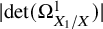


 as above. Repeating this process we can obtain a number n such that

Proof. (1) First we note that, the natural homomorphism  is generically surjective. Since
  is a trivial vector bundle, over an open subset of $S_1$
,
$S_1$
, $\Omega _{S_1/S}^1$
is globally generated by
$\Omega _{S_1/S}^1$
is globally generated by  ,
,  . For the second assertion, since the morphism
  is the Albanese morphisms of
  , by [Reference Serre32, Théorème 4], the natural map
  is injective. However, this map factors through
  , which is injective too.
(2) By the assertion (1), we have $\det \Omega _{S_1/S}^1 \succeq 0$
. Then by
$\det \Omega _{S_1/S}^1 \succeq 0$
. Then by $\tau _1^{*}K_S= K_{S_1} +(p-1) \det \Omega _{S_1/S}^1$
, we have
$\tau _1^{*}K_S= K_{S_1} +(p-1) \det \Omega _{S_1/S}^1$
, we have $h^0(S_1, \tau _1^{*}K_S- K_{S_1}) \geq 1$
.
$h^0(S_1, \tau _1^{*}K_S- K_{S_1}) \geq 1$
.
Next, assume $a_S$
is inseparable. Let B be the image of S in A. Since
$a_S$
is inseparable. Let B be the image of S in A. Since $a_S$
is inseparable,
$a_S$
is inseparable, $S \otimes _{K(B)} K(B)^{1/p}$
is non-reduced. As
$S \otimes _{K(B)} K(B)^{1/p}$
is non-reduced. As $S_1 = (S \times _B B^{\frac 1p})_{\text {red}}^\nu $
, by the assertion (ii) in Section 3.2.1, we have
$S_1 = (S \times _B B^{\frac 1p})_{\text {red}}^\nu $
, by the assertion (ii) in Section 3.2.1, we have  . Now, using the assertion (1), we have

Then by Lemma 2.1, we have $h^0(S_1, \det \Omega _{S_1/S}^1) \ge 2$
, which implies that
$h^0(S_1, \det \Omega _{S_1/S}^1) \ge 2$
, which implies that $h^0(S_1, \tau _1^{*}K_S- K_{S_1}) \geq 2$
.
$h^0(S_1, \tau _1^{*}K_S- K_{S_1}) \geq 2$
.
The assertion (3) is a direct consequence of Proposition 3.5.
(4) Note that $X_1$
coincides with
$X_1$
coincides with $(X_{S_1})_{\text {red}}^{\nu }$
. By assertion (1), over an open subset U of
$(X_{S_1})_{\text {red}}^{\nu }$
. By assertion (1), over an open subset U of $S_1$
,
$S_1$
, $\Omega _{S_1/S}^1$
is globally generated by
$\Omega _{S_1/S}^1$
is globally generated by  . Shrinking U, we may assume $\Omega _{U/S}^1$
is locally free. Then we can apply Proposition 3.4 to conclude the assertiont.
$\Omega _{U/S}^1$
is locally free. Then we can apply Proposition 3.4 to conclude the assertiont.
(5) If $X_{K(S_1)}$
is normal, then the inclusion
$X_{K(S_1)}$
is normal, then the inclusion $\mathcal {O}_{S_1} = \tau _1^{*}f_{*} \mathcal {O}_{X} \subseteq f_{1*} \mathcal {O}_{X_1}$
is an isomorphism over the generic point of
$\mathcal {O}_{S_1} = \tau _1^{*}f_{*} \mathcal {O}_{X} \subseteq f_{1*} \mathcal {O}_{X_1}$
is an isomorphism over the generic point of $S_1$
. In turn, since
$S_1$
. In turn, since $S_1$
is normal, we conclude that
$S_1$
is normal, we conclude that $f_1\colon X_1 \to S_1$
is a fibration.
$f_1\colon X_1 \to S_1$
is a fibration.
Denote by B the Albanese image $a_X(X)$
. If
$a_X(X)$
. If $K(S)/K(B)$
is inseparable, then
$K(S)/K(B)$
is inseparable, then  . Finally we may attain some m such that
  is separable, which implies that
  . Since $X_{K(S)}$
is not geometrically normal, there must exist some n such that
$X_{K(S)}$
is not geometrically normal, there must exist some n such that $X_{K(S_n)}$
is not normal.
$X_{K(S_n)}$
is not normal.
7.2 Canonical bundle formula for inseparable fibrations
Our first result for inseparable fibrations is the following, under the condition that the Albanese morphism $a_S\colon S \to A$
is separable.
$a_S\colon S \to A$
is separable.
Theorem 7.2. Let X be a normal $\mathbb {Q}$
-factorial projective variety and S be a normal projective variety. Let
$\mathbb {Q}$
-factorial projective variety and S be a normal projective variety. Let $\Delta $
be an effective
$\Delta $
be an effective $\mathbb {Q}$
-divisor on X. Let
$\mathbb {Q}$
-divisor on X. Let $f\colon X \to S$
be an inseparable fibration of relative dimension one. Assume that
$f\colon X \to S$
be an inseparable fibration of relative dimension one. Assume that
-
(C1)
$(X_{K(S)}, \Delta _{K(S)})$
is lc; -
(C2) there exists a big open subset
$S^{\circ }$
contained in the regular locus
$S^{\text {reg}}$
of S and a
$\mathbb {Q}$
-divisor
$D^{\circ }$
on
$S^{\circ }$
such that
$(K_X+\Delta )|_{f^{-1}(S^{\circ })} \sim _{\mathbb {Q}} f^{*}D^{\circ }$
; -
(C3) S is of m.A.d., and the Albanese morphism
$a_S\colon S \to A$
is separable.


Then $D \succeq _{\mathbb {Q}} \frac {1}{2p}K_S$
, where
$D \succeq _{\mathbb {Q}} \frac {1}{2p}K_S$
, where $D:=\overline {D^{\circ }}$
is the closure divisor of
$D:=\overline {D^{\circ }}$
is the closure divisor of $D^{\circ }$
in S. In particular,
$D^{\circ }$
in S. In particular, $\kappa (S,D) \geq \kappa (S)$
.
$\kappa (S,D) \geq \kappa (S)$
.
Proof. To prove the assertion, we may restrict ourselves on $S^{\circ }$
. So in the following, we assume
$S^{\circ }$
. So in the following, we assume $S=S^{\circ }$
. By the assumption (C3) we have
$S=S^{\circ }$
. By the assumption (C3) we have  . Since the fibration
  factors through $f_1\colon X_1 \to S_1$
, the morphism
$f_1\colon X_1 \to S_1$
, the morphism $f_1$
is also a fibration. By Proposition 4.7, the generic fiber of
$f_1$
is also a fibration. By Proposition 4.7, the generic fiber of $X_1 \to S_1$
has arithmetic genus zero, and
$X_1 \to S_1$
has arithmetic genus zero, and
 $$ \begin{align*}\pi_1^{*}K_X \sim_{\mathbb{Q}} K_{X_1} + (p-1)\det (\Omega_{X_1/X}^1).\end{align*} $$
By Proposition 7.1 (4), the movable part of the linear system $\lvert \det (\Omega _{X_1/X}^1) \rvert $
has nontrivial horizontal components. We may write that
$\lvert \det (\Omega _{X_1/X}^1) \rvert $
has nontrivial horizontal components. We may write that

Applying Theorem 5.1, we have $\tau _1^{*}D\succeq _{\mathbb {Q}} \frac {1}{2}K_{S_1}$
. In turn, by
$\tau _1^{*}D\succeq _{\mathbb {Q}} \frac {1}{2}K_{S_1}$
. In turn, by $\tau _1^{*}K_S \sim _{\mathbb {Q}} pK_{S_1}$
we conclude that
$\tau _1^{*}K_S \sim _{\mathbb {Q}} pK_{S_1}$
we conclude that $D \succeq _{\mathbb {Q}}\frac {1}{2p}K_{S}$
.
$D \succeq _{\mathbb {Q}}\frac {1}{2p}K_{S}$
.
The second theorem treats the case when the Albanese morphism $a_S\colon S \to A$
is inseparable.
$a_S\colon S \to A$
is inseparable.
Theorem 7.3. Let the notation be as in Theorem 7.2. Assume (C1,C2) and the following condition
-
(C3’) S is of m.A.d., and the Albanese morphism
$a_S\colon S \to A$
is inseparable.

Then $\kappa (S,D)\ge 0$
where
$\kappa (S,D)\ge 0$
where $D:=\overline {D^{\circ }}$
. More precisely, letting
$D:=\overline {D^{\circ }}$
. More precisely, letting $X_1$
,
$X_1$
, $S_1$
,
$S_1$
, $f_1$
be as in Section 7.1, we have:
$f_1$
be as in Section 7.1, we have:
-
(a) if
$X_{K(S_1)}$
is integral, then
$\tau _1^{*}D \succeq _{\mathbb {Q}} \tau _1^{*}K_S - K_{S_1}$
, hence
$\kappa (S, D) \geq 1$
; -
(b) if
$X_{K(S_1)}$
is non-reduced, then
$\tau _1^{\prime }*\tau _1^{*}D \succeq _{\mathbb {Q}} \frac {1}{2}K_{S^{\prime }_1}$
, and if moreover
$\kappa (S,D)= 0$
and
$S_1'$
admits a resolution of singularities, then is birational, and thus
$S_1 = S_1'$
.


 is birational, and thus
In particular, if $\dim S=2$
then
$\dim S=2$
then $\kappa (S,D)\ge 1$
.
$\kappa (S,D)\ge 1$
.
Proof. We may also restrict us on $S^{\circ }$
and assume
$S^{\circ }$
and assume $S=S^{\circ }$
.
$S=S^{\circ }$
.
If $X_{K(S_1)}$
is normal, by Proposition 7.1 (3) there exist divisors
$X_{K(S_1)}$
is normal, by Proposition 7.1 (3) there exist divisors $E_1\ge 0$
and
$E_1\ge 0$
and $N_1$
(exceptional over
$N_1$
(exceptional over $S_1$
) fitting into the following equation
$S_1$
) fitting into the following equation
 $$ \begin{align} \pi_1^{*}(K_{X} + \Delta) \sim_{\mathbb{Q}} K_{X_1} + E_1 + \pi_1^{*}\Delta + f_1^{*}(\tau_1^{*}K_{S}- K_{S_1}) + N_1. \end{align} $$
Let $\Delta _1 = E_1 +\pi _1^{*}\Delta $
and
$\Delta _1 = E_1 +\pi _1^{*}\Delta $
and $D_1= \tau _1^{*}D + K_{S_1} - \tau _1^{*}K_{S}$
, then
$D_1= \tau _1^{*}D + K_{S_1} - \tau _1^{*}K_{S}$
, then
 $$\begin{align*}K_{X_1} + \Delta_1+N_1\sim_{\mathbb{Q}} f_1^{*}D_1. \end{align*}$$
Repeating this process, by Proposition 7.1 (5), we obtain a minimal n such that $(X_{n-1})_{K(S_n)}$
is not normal. We have the following commutative diagram:
$(X_{n-1})_{K(S_n)}$
is not normal. We have the following commutative diagram:

where $f^{\prime }_n$
is a fibration.
$f^{\prime }_n$
is a fibration.
Note that $(\Delta _{n-1})_{K(S_{n-1})} = \Delta _{K(S_{n-1})}$
. We claim that
$(\Delta _{n-1})_{K(S_{n-1})} = \Delta _{K(S_{n-1})}$
. We claim that $(X_{K(S_{n-1})},\Delta _{K(S_{n-1})})$
is lc. By construction, for
$(X_{K(S_{n-1})},\Delta _{K(S_{n-1})})$
is lc. By construction, for $1\leq i\leq n-1$
, each
$1\leq i\leq n-1$
, each $X_{K(S_{i})}= X_{K(S)}\otimes _{K(S)} K(S_{i})$
is not geometrically reduced. It is trivial if
$X_{K(S_{i})}= X_{K(S)}\otimes _{K(S)} K(S_{i})$
is not geometrically reduced. It is trivial if $X_{K(S_{n-1})}$
has arithmetic genus one because then
$X_{K(S_{n-1})}$
has arithmetic genus one because then $\Delta _{K(S_{n-1})} =0$
. We only need to consider the case
$\Delta _{K(S_{n-1})} =0$
. We only need to consider the case $p=2$
and
$p=2$
and $X_{K(S_{n-1})}$
is a non-smooth conic over
$X_{K(S_{n-1})}$
is a non-smooth conic over $K(S_{n-1})$
, on which each prime divisor has degree
$K(S_{n-1})$
, on which each prime divisor has degree $\geq 2$
. Since
$\geq 2$
. Since $\deg _{K(S_{n-1})}K_{X_{K(S_{n-1})}} = -2$
and
$\deg _{K(S_{n-1})}K_{X_{K(S_{n-1})}} = -2$
and $K_{X_{K(S_{n-1})}} + \Delta _{K(S_{n-1})}\equiv 0$
, we see that if
$K_{X_{K(S_{n-1})}} + \Delta _{K(S_{n-1})}\equiv 0$
, we see that if $(X_{K(S_{n-1})},\Delta _{K(S_{n-1})})$
is not klt, then it is lc and
$(X_{K(S_{n-1})},\Delta _{K(S_{n-1})})$
is not klt, then it is lc and $\Delta _{K(S_{n-1})}$
is a prime divisor of degree two.
$\Delta _{K(S_{n-1})}$
is a prime divisor of degree two.
Case (1): $(X_{n-1})_{K(S_n)}$
is reduced but not normal. By Proposition 7.1 (3) we have
$(X_{n-1})_{K(S_n)}$
is reduced but not normal. By Proposition 7.1 (3) we have
 $$ \begin{align} K_{X_n} + E_n + \pi_n^{*}\Delta_{n-1} +N_n \sim_{\mathbb{Q}} f^{\prime}*_n\tau^{\prime}*_n(\tau_n^{*} D_{n-1} + K_{S_n} - \tau_n^{*} K_{S_{n-1}}). \end{align} $$
If necessary replacing S with a big open subset, we may assume $N_n=0$
. Applying Theorem 6.1 to the fibration
$N_n=0$
. Applying Theorem 6.1 to the fibration $f_{n-1}\colon X_{n-1} \to S_{n-1}$
and the base change
$f_{n-1}\colon X_{n-1} \to S_{n-1}$
and the base change $\tau _n\colon S_n\to S_{n-1}$
, we see that there exist finite morphisms
$\tau _n\colon S_n\to S_{n-1}$
, we see that there exist finite morphisms $\tau '\colon \bar {T} \to S_n$
,
$\tau '\colon \bar {T} \to S_n$
, $\tau "\colon \bar {T}' \to \bar {T}$
, an effective
$\tau "\colon \bar {T}' \to \bar {T}$
, an effective $\mathbb {Q}$
-divisor
$\mathbb {Q}$
-divisor $E_{\bar T'}$
and rational numbers
$E_{\bar T'}$
and rational numbers $a,b,c\geq 0$
such that
$a,b,c\geq 0$
such that
 $$ \begin{align} (\tau_n^{*} D_{n-1} + K_{S_n} - \tau_n^{*} K_{S_{n-1}})|_{\bar{T}'} \sim_{\mathbb{Q}} a K_{\bar{T}'} + b\tau^{\prime\prime}*K_{\bar{T}} + c\tau^{\prime\prime}*\tau^{\prime}*K_{S_n} + E_{\bar T'}. \end{align} $$
Since $K_{\bar {T}'},K_{\bar {T}},K_{S_n}\succeq _{\mathbb {Q}} 0$
, we see that
$K_{\bar {T}'},K_{\bar {T}},K_{S_n}\succeq _{\mathbb {Q}} 0$
, we see that
 $$ \begin{align*}\bigl(D_n:=\tau_n^{*} D_{n-1} - ( \tau_n^{*} K_{S_{n-1}}-K_{S_n} )\bigr)\big|_{\bar{T}'} \succeq_{\mathbb{Q}} 0.\end{align*} $$
By Covering Theorem 2.3 we have
 $$ \begin{align*}\kappa(S_{n-1},D_{n-1})= \kappa(S_n,\tau_n^{*}D_{n-1})\ge \kappa(S_n,\tau_n^{*}K_{S_{n-1}}-K_{S_n}).\end{align*} $$
Remark that
-
○ if
is separable, then , therefore
$\kappa (S_n,\tau _n^{*}K_{S_{n-1}}-K_{S_n}) = \kappa (S_{n-1},K_{S_{n-1}}) \geq 0$
; -
○ otherwise by Proposition 7.1 (2), we have
$\kappa (S_n,\tau _n^{*}K_{S_{n-1}}-K_{S_n}) \geq 1$
.
 is separable, then
  , therefore

In particular each $D_i \succeq _{\mathbb {Q}} 0$
,
$D_i \succeq _{\mathbb {Q}} 0$
, $i=1, \ldots , n-1$
, and inductively we obtain that
$i=1, \ldots , n-1$
, and inductively we obtain that
 $$ \begin{align*}\tau_1^{*}D = D_1 + (\tau_1^{*}K_{S}-K_{S_1}) \succeq_{\mathbb{Q}} \tau_1^{*}K_{S}-K_{S_1}.\end{align*} $$
Then by Covering Theorem and the assumption that $a_S$
is inseparable, we have
$a_S$
is inseparable, we have $\kappa (S,D) \geq \kappa (S_1,\tau _1^{*} K_S - K_{S_1}) \ge 1$
.
$\kappa (S,D) \geq \kappa (S_1,\tau _1^{*} K_S - K_{S_1}) \ge 1$
.
Case (2): $(X_{n-1})_{K(S_n)}$
is non-reduced. In this case
$(X_{n-1})_{K(S_n)}$
is non-reduced. In this case $\bigl \lvert \det (\Omega _{X_{n}/X_{n-1}}^1)\bigr \rvert $
has nontrivial horizontal movable part by Proposition 7.1 (4). We have
$\bigl \lvert \det (\Omega _{X_{n}/X_{n-1}}^1)\bigr \rvert $
has nontrivial horizontal movable part by Proposition 7.1 (4). We have
 $$ \begin{align*}f_n^{*}\tau_{n}^{*}D_{n-1} \sim_{\mathbb{Q}}\pi_n^{*}(K_{X_{n-1}} + \Delta_{n-1}) \sim_{\mathbb{Q}} K_{X_{n}} + (p-1)\det (\Omega_{X_{n}/X_{n-1}}^1) + \pi_n^{*}\Delta_{n-1}.\end{align*} $$
Applying Theorem 5.1 to the fibration $f_n'\colon X_n \to S_n'$
, we see that
$f_n'\colon X_n \to S_n'$
, we see that
 $$ \begin{align*}\tau_n^{\prime}* \tau_n^{*}D_{n-1} \succeq_{\mathbb{Q}} \frac{1}{2} K_{S_n'},\end{align*} $$
thus $\kappa (S_n', \tau _n^{\prime }*\tau _n^{*}D_{n-1}) \geq \kappa (S_n', K_{S_n'}) \geq 0$
. Therefore,
$\kappa (S_n', \tau _n^{\prime }*\tau _n^{*}D_{n-1}) \geq \kappa (S_n', K_{S_n'}) \geq 0$
. Therefore, $D_{n-1} \succeq _{\mathbb {Q}} 0$
.
$D_{n-1} \succeq _{\mathbb {Q}} 0$
.
If $n\geq 2$
, using
$n\geq 2$
, using $D_i = \tau _i^{*}D_{i-1} - (\tau _i^{*}K_{S_{i-1}}-K_{S_i})$
and
$D_i = \tau _i^{*}D_{i-1} - (\tau _i^{*}K_{S_{i-1}}-K_{S_i})$
and $\tau _i^{*}K_{S_{i-1}}-K_{S_i} \succeq _{\mathbb {Q}} 0$
(
$\tau _i^{*}K_{S_{i-1}}-K_{S_i} \succeq _{\mathbb {Q}} 0$
( $1<i\leq n$
) inductively we prove that
$1<i\leq n$
) inductively we prove that $D_1 \succeq _{\mathbb {Q}} 0$
. It follows that
$D_1 \succeq _{\mathbb {Q}} 0$
. It follows that
 $$ \begin{align*}\tau_1^{*}D = D_1 + (\tau_1^{*}K_{S}-K_{S_1}) \succeq_{\mathbb{Q}} \tau_1^{*}K_{S} - K_{S_1},\end{align*} $$
thus $\kappa (S,D) \geq 1$
.
$\kappa (S,D) \geq 1$
.
If $n=1$
, since
$n=1$
, since $\tau _1^{\prime }*\tau _{1}^{*}D\succeq _{\mathbb {Q}} \frac {1}{2} K_{S_1'}$
, applying Covering Theorem 2.3 we obtain
$\tau _1^{\prime }*\tau _{1}^{*}D\succeq _{\mathbb {Q}} \frac {1}{2} K_{S_1'}$
, applying Covering Theorem 2.3 we obtain
 $$ \begin{align*}\kappa(S,D) = \kappa(S_1', \tau_1^{\prime}*\tau_1^{*}D) \geq \kappa(S_1', K_{S_1'}) \geq 0.\end{align*} $$
If moreover $\kappa (S,D)=0$
, then
$\kappa (S,D)=0$
, then $\kappa (S_1', K_{S_1'}) = 0$
. Since by assumption
$\kappa (S_1', K_{S_1'}) = 0$
. Since by assumption $S_1'$
admits a resolution of singularities, we can apply Proposition 2.9 to show that the Albanese morphism
$S_1'$
admits a resolution of singularities, we can apply Proposition 2.9 to show that the Albanese morphism  is birational. In turn, we see that $S_1 = S_1'$
.
$S_1 = S_1'$
.
Finally, if $\dim S = 2$
, then
$\dim S = 2$
, then $\deg \tau _1\le p$
, thus
$\deg \tau _1\le p$
, thus $X_{K(S_1)}$
is reduced (e.g., [Reference Schröer31, Lemma 1.3]). We fall into case (1), and it follows that
$X_{K(S_1)}$
is reduced (e.g., [Reference Schröer31, Lemma 1.3]). We fall into case (1), and it follows that $\kappa (S,D)\ge 1$
.
$\kappa (S,D)\ge 1$
.
8 Albanese morphism of varieties with nef anticanonical divisor
In this section, we apply the canonical bundle formulas obtained in the previous sections to investigate varieties with nef anticanonical divisor. We work over an algebraically closed field k of characteristic $p>0$
.
$p>0$
.
Theorem 8.1. Let X be a normal projective $\mathbb {Q}$
-factorial variety and
$\mathbb {Q}$
-factorial variety and $\Delta $
an effective
$\Delta $
an effective $\mathbb {Q}$
-divisor on X such that
$\mathbb {Q}$
-divisor on X such that $-(K_X+\Delta )$
is nef. Let
$-(K_X+\Delta )$
is nef. Let $X \buildrel f\over \to S \buildrel a_S\over \to A_X$
be the Stein factorization of the Albanese morphism of X. Suppose that the fibration f has relative dimension one and that
$X \buildrel f\over \to S \buildrel a_S\over \to A_X$
be the Stein factorization of the Albanese morphism of X. Suppose that the fibration f has relative dimension one and that $(X_{K(S)},\Delta _{K(S)})$
is klt. Then S is an abelian variety.
$(X_{K(S)},\Delta _{K(S)})$
is klt. Then S is an abelian variety.
8.1 A preliminary lemma
Lemma 8.2. Let X be a normal projective variety equipped with two fibrations:

where A and a general fiber $G_t$
of g are abelian varieties for which the induced map
$G_t$
of g are abelian varieties for which the induced map $G_t\to A$
is finite and dominant. Let
$G_t\to A$
is finite and dominant. Let $\mathcal {F}$
be a foliation on X and assume that
$\mathcal {F}$
be a foliation on X and assume that $\det (\mathcal {F})|_{G_t} \sim _{\mathbb {Q}} 0$
for a general
$\det (\mathcal {F})|_{G_t} \sim _{\mathbb {Q}} 0$
for a general $t\in \mathbb {P}^{1}$
. Then the “pushing down” foliation
$t\in \mathbb {P}^{1}$
. Then the “pushing down” foliation $\mathcal {G}$
of
$\mathcal {G}$
of $\mathcal {F}$
along f (see §3.1.1) is generated by a subspace of
$\mathcal {F}$
along f (see §3.1.1) is generated by a subspace of $H^0(A,\mathcal {T}_A)$
. In particular,
$H^0(A,\mathcal {T}_A)$
. In particular, $A/\mathcal {G}$
is an abelian variety.
$A/\mathcal {G}$
is an abelian variety.
Proof. Recall from Lemma 3.3 that, under the natural $\mathcal {O}_X$
-linear homomorphism
$\mathcal {O}_X$
-linear homomorphism $\eta \colon \mathcal {F} \subseteq \mathcal {T}_X \to f^{*}\mathcal {T}_A$
, the foliation
$\eta \colon \mathcal {F} \subseteq \mathcal {T}_X \to f^{*}\mathcal {T}_A$
, the foliation $\mathcal {G}$
is the minimal foliation on A such that
$\mathcal {G}$
is the minimal foliation on A such that $\eta (\mathcal {F}) \subseteq f^{*}\mathcal {G}$
holds generically.
$\eta (\mathcal {F}) \subseteq f^{*}\mathcal {G}$
holds generically.
Claim. For a general $t\in \mathbb {P}^{1}$
, there exists a big open subset
$t\in \mathbb {P}^{1}$
, there exists a big open subset $G_{t}^{\circ }$
of
$G_{t}^{\circ }$
of $G_t$
such that the image of
$G_t$
such that the image of $\eta _t\colon \mathcal {F}|_{G_t^{\circ }}\to (f|_{G_t^{\circ }})^{*}\mathcal {T}_A$
is a free sheaf.
$\eta _t\colon \mathcal {F}|_{G_t^{\circ }}\to (f|_{G_t^{\circ }})^{*}\mathcal {T}_A$
is a free sheaf.
Proof of the claim
Let $G_t$
be a general fiber. Since both X and
$G_t$
be a general fiber. Since both X and $G_t$
are normal, there exists a big open subset
$G_t$
are normal, there exists a big open subset $G_t^{\circ } \subset G_t$
such that X is regular along
$G_t^{\circ } \subset G_t$
such that X is regular along $G^{\circ }_t$
, and that both
$G^{\circ }_t$
, and that both $\mathcal {F}|_{G^{\circ }_t}$
and
$\mathcal {F}|_{G^{\circ }_t}$
and $(\mathcal {T}_X/\mathcal {F})|_{G_t^{\circ }}$
are locally free. Note that the normal bundle
$(\mathcal {T}_X/\mathcal {F})|_{G_t^{\circ }}$
are locally free. Note that the normal bundle $\mathcal {N}_{G_t/X}|_{G^{\circ }_t} \cong \mathcal {O}_{G^{\circ }_t}$
. By assumption
$\mathcal {N}_{G_t/X}|_{G^{\circ }_t} \cong \mathcal {O}_{G^{\circ }_t}$
. By assumption $\mathcal {T}_{G_t^{\circ }} \cong \bigoplus ^n\mathcal {O}_{G_t^{\circ }}$
where
$\mathcal {T}_{G_t^{\circ }} \cong \bigoplus ^n\mathcal {O}_{G_t^{\circ }}$
where $n := \dim A$
. Then we have the following commutative diagram of
$n := \dim A$
. Then we have the following commutative diagram of $\mathcal {O}_{G^{\circ }_t}$
-linear homomorphisms
$\mathcal {O}_{G^{\circ }_t}$
-linear homomorphisms

where the two horizontal sequences are exact. We have $\det (\mathcal {F}|_{G^{\circ }_t}\cap \mathcal {T}_{G^{\circ }_t}) \preceq 0$
and
$\det (\mathcal {F}|_{G^{\circ }_t}\cap \mathcal {T}_{G^{\circ }_t}) \preceq 0$
and $\det (\operatorname {\mathrm {Im}}\theta )\preceq 0$
since they are subsheaves of free sheaves. Therefore, the assumption
$\det (\operatorname {\mathrm {Im}}\theta )\preceq 0$
since they are subsheaves of free sheaves. Therefore, the assumption $\det (\mathcal {F}|_{G^{\circ }_t}) \sim _{\mathbb {Q}} 0$
implies that
$\det (\mathcal {F}|_{G^{\circ }_t}) \sim _{\mathbb {Q}} 0$
implies that $\det (\mathcal {F}|_{G^{\circ }_t}\cap \mathcal {T}_{G^{\circ }_t}) \sim 0$
and
$\det (\mathcal {F}|_{G^{\circ }_t}\cap \mathcal {T}_{G^{\circ }_t}) \sim 0$
and $\det (\operatorname {\mathrm {Im}}\theta ) \sim 0$
. By shrinking
$\det (\operatorname {\mathrm {Im}}\theta ) \sim 0$
. By shrinking $G_t^{\circ }$
, Lemma 8.3 implies that both
$G_t^{\circ }$
, Lemma 8.3 implies that both $\mathcal {F}|_{G^{\circ }_t}\cap \mathcal {T}_{G^{\circ }_t}$
and
$\mathcal {F}|_{G^{\circ }_t}\cap \mathcal {T}_{G^{\circ }_t}$
and $\text {Im}\,\theta $
are free sheaves. That is to say,
$\text {Im}\,\theta $
are free sheaves. That is to say, $\mathcal {F}|_{G_t^{\circ }}$
is an extension of free sheaves. Denote by
$\mathcal {F}|_{G_t^{\circ }}$
is an extension of free sheaves. Denote by $\mathcal {K}$
the kernel of
$\mathcal {K}$
the kernel of $\eta _t$
. Then
$\eta _t$
. Then $\mathcal {K}$
is a subsheaf of a sheaf which is an extension of free sheaves, thus
$\mathcal {K}$
is a subsheaf of a sheaf which is an extension of free sheaves, thus $\det \mathcal {K}\preceq 0$
. Since
$\det \mathcal {K}\preceq 0$
. Since $(\mathcal {F}|_{G_t^{\circ }})/\mathcal {K} \cong \operatorname {\mathrm {Im}} \eta _t \subseteq \bigoplus ^{n}\mathcal {O}_{G^{\circ }_t}$
, we have
$(\mathcal {F}|_{G_t^{\circ }})/\mathcal {K} \cong \operatorname {\mathrm {Im}} \eta _t \subseteq \bigoplus ^{n}\mathcal {O}_{G^{\circ }_t}$
, we have $\det ((\mathcal {F}|_{G_t^{\circ }})/\mathcal {K}) \preceq 0$
. Therefore by
$\det ((\mathcal {F}|_{G_t^{\circ }})/\mathcal {K}) \preceq 0$
. Therefore by $\det (\mathcal {F}|_{G^{\circ }_t}) \equiv 0$
, we conclude that
$\det (\mathcal {F}|_{G^{\circ }_t}) \equiv 0$
, we conclude that $\det \mathcal {K} \sim \det (\operatorname {\mathrm {Im}}\eta _t) \sim 0$
. Applying Lemma 8.3 again, if necessary replacing
$\det \mathcal {K} \sim \det (\operatorname {\mathrm {Im}}\eta _t) \sim 0$
. Applying Lemma 8.3 again, if necessary replacing $G_t^{\circ }$
with a big open subset, we see that
$G_t^{\circ }$
with a big open subset, we see that $\operatorname {\mathrm {Im}}\eta _t$
is a free sheaf.
$\operatorname {\mathrm {Im}}\eta _t$
is a free sheaf.
There exists a non-empty open subset $V\subseteq \mathbb {P}^{1}$
such that the claimed assertion holds for all
$V\subseteq \mathbb {P}^{1}$
such that the claimed assertion holds for all $t\in V$
. Fix
$t\in V$
. Fix $t\in V$
, there exist
$t\in V$
, there exist $\alpha _{t, 1}, \ldots , \alpha _{t, k_t}\in H^0(G_t^{\circ }, \operatorname {\mathrm {Im}}\eta _t)$
such that
$\alpha _{t, 1}, \ldots , \alpha _{t, k_t}\in H^0(G_t^{\circ }, \operatorname {\mathrm {Im}}\eta _t)$
such that $\operatorname {\mathrm {Im}}\eta _t =\bigoplus _{i=1}^{k_t}\mathcal {O}_{G^{\circ }_t}\cdot \alpha _{t,i}$
. Since
$\operatorname {\mathrm {Im}}\eta _t =\bigoplus _{i=1}^{k_t}\mathcal {O}_{G^{\circ }_t}\cdot \alpha _{t,i}$
. Since $G_t^{\circ }$
is a big open subset of
$G_t^{\circ }$
is a big open subset of $G_t$
, we have a natural isomorphism
$G_t$
, we have a natural isomorphism $H^0(A,\mathcal {T}_A = \mathcal {O}_A^n) \cong H^0(G_t^{\circ }, f_t^{*}\mathcal {T}_A|_{G_t^{\circ }})$
, which is induced by the pullback of the map
$H^0(A,\mathcal {T}_A = \mathcal {O}_A^n) \cong H^0(G_t^{\circ }, f_t^{*}\mathcal {T}_A|_{G_t^{\circ }})$
, which is induced by the pullback of the map $f_t:=f|_{G_t^{\circ }}\colon G_t^{\circ } \to A$
. Let
$f_t:=f|_{G_t^{\circ }}\colon G_t^{\circ } \to A$
. Let $\beta _{t,i} \in H^0(A,\mathcal {T}_A)$
be the element corresponding to
$\beta _{t,i} \in H^0(A,\mathcal {T}_A)$
be the element corresponding to $\alpha _{t, i}$
. Let
$\alpha _{t, i}$
. Let $\mathcal {G}_t$
be the subsheaf of
$\mathcal {G}_t$
be the subsheaf of $\mathcal {T}_A$
generated by
$\mathcal {T}_A$
generated by $\{\beta _{t,i}\}$
.
$\{\beta _{t,i}\}$
.
Set $\mathcal {G}' := \sum _{t\in V} \mathcal {G}_t$
. It follows that
$\mathcal {G}' := \sum _{t\in V} \mathcal {G}_t$
. It follows that $\mathcal {G}'$
is globally generated by
$\mathcal {G}'$
is globally generated by $\Lambda '=H^0(A, \mathcal {G}') \subseteq H^0(A,\mathcal {T}_A)$
. Here we remind that
$\Lambda '=H^0(A, \mathcal {G}') \subseteq H^0(A,\mathcal {T}_A)$
. Here we remind that $\Lambda '$
is not necessarily a p-Lie subalgebra of
$\Lambda '$
is not necessarily a p-Lie subalgebra of $H^0(A,\mathcal {T}_A)$
, because it is not necessarily p-closed, in other words,
$H^0(A,\mathcal {T}_A)$
, because it is not necessarily p-closed, in other words, $\mathcal {G}'$
is not necessarily a foliation. Let
$\mathcal {G}'$
is not necessarily a foliation. Let $\bar {\Lambda }$
be the p-Lie subalgebra of
$\bar {\Lambda }$
be the p-Lie subalgebra of $H^0(A,\mathcal {T}_A)$
generated by
$H^0(A,\mathcal {T}_A)$
generated by $\Lambda '$
, which corresponds to a smooth foliation
$\Lambda '$
, which corresponds to a smooth foliation $\overline {\mathcal {G}}$
on A. Note that
$\overline {\mathcal {G}}$
on A. Note that $\overline {\mathcal {G}}$
is the minimal foliation containing
$\overline {\mathcal {G}}$
is the minimal foliation containing $\mathcal {G}'$
.
$\mathcal {G}'$
.
To finish the proof, we are left to verify that $\overline {\mathcal {G}} = \mathcal {G}$
. On one hand, for
$\overline {\mathcal {G}} = \mathcal {G}$
. On one hand, for $t\in V$
, by the construction,
$t\in V$
, by the construction, $\mathcal {G}_t$
is the smallest the subsheaf of
$\mathcal {G}_t$
is the smallest the subsheaf of $\mathcal {T}_A$
such that
$\mathcal {T}_A$
such that $\operatorname {\mathrm {Im}}\eta _t \subseteq f^{*}\mathcal {G}_t|_{G_t^{\circ }} $
, thus
$\operatorname {\mathrm {Im}}\eta _t \subseteq f^{*}\mathcal {G}_t|_{G_t^{\circ }} $
, thus $\mathcal {G}_t \subseteq \mathcal {G}$
, we conclude that
$\mathcal {G}_t \subseteq \mathcal {G}$
, we conclude that $\mathcal {G}' \subseteq \mathcal {G}$
, which implies that
$\mathcal {G}' \subseteq \mathcal {G}$
, which implies that $\overline {\mathcal {G}} \subseteq \mathcal {G}$
. On the other hand, over a nonempty open subset
$\overline {\mathcal {G}} \subseteq \mathcal {G}$
. On the other hand, over a nonempty open subset $U \subseteq g^{-1} V$
we have
$U \subseteq g^{-1} V$
we have $\eta (\mathcal {F})|_U\subseteq f^{*}\overline {\mathcal {G}}|_U$
, but
$\eta (\mathcal {F})|_U\subseteq f^{*}\overline {\mathcal {G}}|_U$
, but $\mathcal {G}$
is the minimal foliation in this sense, therefore
$\mathcal {G}$
is the minimal foliation in this sense, therefore $\mathcal {G} \subseteq \overline {\mathcal {G}}$
. To summarize, we obtain that
$\mathcal {G} \subseteq \overline {\mathcal {G}}$
. To summarize, we obtain that $\overline {\mathcal {G}} = \mathcal {G}$
and finish the proof.
$\overline {\mathcal {G}} = \mathcal {G}$
and finish the proof.
Lemma 8.3. Let X be a regular variety satisfying $H^0(X,\mathcal {O}_X) = k$
, and let
$H^0(X,\mathcal {O}_X) = k$
, and let $\mathcal {F}$
be a subsheaf of
$\mathcal {F}$
be a subsheaf of $\bigoplus ^{n}\mathcal {O}_X$
. Then
$\bigoplus ^{n}\mathcal {O}_X$
. Then $\det \mathcal {F} \preceq 0$
.
$\det \mathcal {F} \preceq 0$
.
Moreover, if $\det \mathcal {F} \sim 0$
, then
$\det \mathcal {F} \sim 0$
, then $\mathcal {F}^{\vee \vee } \cong \bigoplus ^r \mathcal {O}_X$
for some integer r.
$\mathcal {F}^{\vee \vee } \cong \bigoplus ^r \mathcal {O}_X$
for some integer r.
Proof. By replacing $\mathcal {F}$
with
$\mathcal {F}$
with $\mathcal {F}^{\vee \vee }$
, we may assume that
$\mathcal {F}^{\vee \vee }$
, we may assume that $\mathcal {F}$
is reflexive. We may also assume that
$\mathcal {F}$
is reflexive. We may also assume that $\operatorname {\mathrm {rank}} \mathcal {F} \ge 1$
. If
$\operatorname {\mathrm {rank}} \mathcal {F} \ge 1$
. If $n=1$
, then
$n=1$
, then $\mathcal {F} \hookrightarrow \mathcal {O}_X$
is a subsheaf of rank one and locally free in codimension one. Thus
$\mathcal {F} \hookrightarrow \mathcal {O}_X$
is a subsheaf of rank one and locally free in codimension one. Thus $\mathcal {F}$
defines an effective divisor D such that
$\mathcal {F}$
defines an effective divisor D such that $\mathcal {F}\cong \mathcal {O}_X(-D)$
. So the statements hold for
$\mathcal {F}\cong \mathcal {O}_X(-D)$
. So the statements hold for $n=1$
. We then prove the lemma by induction on n. Assume the assertion holds for
$n=1$
. We then prove the lemma by induction on n. Assume the assertion holds for $n\leq l$
where
$n\leq l$
where $l>0$
. We prove it for
$l>0$
. We prove it for $n=l+1$
. Write
$n=l+1$
. Write $\mathcal {W}:=\bigoplus ^{l}\mathcal {O}_X \subset \bigoplus ^{l+1}\mathcal {O}_X$
for the sum of the first l summands. We may assume that
$\mathcal {W}:=\bigoplus ^{l}\mathcal {O}_X \subset \bigoplus ^{l+1}\mathcal {O}_X$
for the sum of the first l summands. We may assume that $\mathcal {F} \not \subseteq \mathcal {W}$
. We have the following commutative diagram
$\mathcal {F} \not \subseteq \mathcal {W}$
. We have the following commutative diagram

where $\pi $
is the projection onto
$\pi $
is the projection onto $\mathcal {W}$
. We remark that the third column
$\mathcal {W}$
. We remark that the third column $\mathcal {F}/(\mathcal {F}\cap \mathcal {W})\to \mathcal {O}_X$
is injective by Snake Lemma; hence
$\mathcal {F}/(\mathcal {F}\cap \mathcal {W})\to \mathcal {O}_X$
is injective by Snake Lemma; hence $\mathcal {F}/(\mathcal {F}\cap \mathcal {W})$
is torsion free. Thus,
$\mathcal {F}/(\mathcal {F}\cap \mathcal {W})$
is torsion free. Thus, $\operatorname {\mathrm {rank}} \mathcal {F} \cap \mathcal {W} < \operatorname {\mathrm {rank}} \mathcal {F}$
. Now, by induction hypothesis,
$\operatorname {\mathrm {rank}} \mathcal {F} \cap \mathcal {W} < \operatorname {\mathrm {rank}} \mathcal {F}$
. Now, by induction hypothesis, $\det (\mathcal {F}\cap \mathcal {W})\preceq 0$
and
$\det (\mathcal {F}\cap \mathcal {W})\preceq 0$
and $\det (\mathcal {F}/(\mathcal {F}\cap \mathcal {W}))\preceq 0$
. So we have
$\det (\mathcal {F}/(\mathcal {F}\cap \mathcal {W}))\preceq 0$
. So we have $\det \mathcal {F} \preceq 0$
.
$\det \mathcal {F} \preceq 0$
.
Moreover, if $\det \mathcal {F} \sim 0$
, we conclude that
$\det \mathcal {F} \sim 0$
, we conclude that $\det (\mathcal {F}\cap \mathcal {W})\sim \det ( \mathcal {F}/(\mathcal {F}\cap \mathcal {W}))\sim 0$
. By the induction hypothesis we have
$\det (\mathcal {F}\cap \mathcal {W})\sim \det ( \mathcal {F}/(\mathcal {F}\cap \mathcal {W}))\sim 0$
. By the induction hypothesis we have $\mathcal {F}/(\mathcal {F}\cap \mathcal {W})\cong \mathcal {O}_X$
and
$\mathcal {F}/(\mathcal {F}\cap \mathcal {W})\cong \mathcal {O}_X$
and $(\mathcal {F}\cap \mathcal {W}) \cong \bigoplus ^{r}\mathcal {O}_X$
for some r (here we may shrink X so that these sheaves are reflexive). Regard
$(\mathcal {F}\cap \mathcal {W}) \cong \bigoplus ^{r}\mathcal {O}_X$
for some r (here we may shrink X so that these sheaves are reflexive). Regard $H^0(X,\mathcal {F}\cap \mathcal {W})\cong k^{r}$
as a k-linear subspace of
$H^0(X,\mathcal {F}\cap \mathcal {W})\cong k^{r}$
as a k-linear subspace of $H^0(X,\mathcal {W})\cong k^{l}$
. Take a splitting
$H^0(X,\mathcal {W})\cong k^{l}$
. Take a splitting $\theta _{k}\colon H^0(X,\mathcal {W})\to H^0(X,\mathcal {F}\cap \mathcal {W})$
, which determines uniquely a splitting
$\theta _{k}\colon H^0(X,\mathcal {W})\to H^0(X,\mathcal {F}\cap \mathcal {W})$
, which determines uniquely a splitting $\theta \colon \mathcal {W}\to \mathcal {F}\cap \mathcal {W}$
of
$\theta \colon \mathcal {W}\to \mathcal {F}\cap \mathcal {W}$
of $\mathcal {F}\cap \mathcal {W} \hookrightarrow \mathcal {W}$
. Thus the composition of homomorphisms
$\mathcal {F}\cap \mathcal {W} \hookrightarrow \mathcal {W}$
. Thus the composition of homomorphisms $\mathcal {F}\hookrightarrow \bigoplus ^{k+1}\mathcal {O}_X\stackrel {\pi }{\to } \mathcal {W} \stackrel {\theta }{\to } \mathcal {F}\cap \mathcal {W}$
splits
$\mathcal {F}\hookrightarrow \bigoplus ^{k+1}\mathcal {O}_X\stackrel {\pi }{\to } \mathcal {W} \stackrel {\theta }{\to } \mathcal {F}\cap \mathcal {W}$
splits $\mathcal {F}\cap \mathcal {W}\to \mathcal {F}$
. As a consequence
$\mathcal {F}\cap \mathcal {W}\to \mathcal {F}$
. As a consequence $\mathcal {F} \cong (\mathcal {F}\cap \mathcal {W})\oplus (\mathcal {F}+\mathcal {W}) /\mathcal {W} \cong \bigoplus ^{r}\mathcal {O}_X \oplus \mathcal {O}_X$
, which completes the proof.
$\mathcal {F} \cong (\mathcal {F}\cap \mathcal {W})\oplus (\mathcal {F}+\mathcal {W}) /\mathcal {W} \cong \bigoplus ^{r}\mathcal {O}_X \oplus \mathcal {O}_X$
, which completes the proof.
8.2 Proof of Theorem 8.1
We use the notation from Section 7.1 and recall the following commutative diagram

First, in the following lemma, we deal with the cases where one of f and $a_S$
is separable.
$a_S$
is separable.
Lemma 8.4. Under the assumptions of Theorem 8.1, S is an abelian variety unless the following conditions hold simultaneously
-
(i) both the morphisms f and
$a_S$
are inseparable; -
(ii)
$X_{K(S_1)}$
is non-reduced; and -
(iii)
$a_{S_1}\colon S_1 \to A^{\frac 1p}$
is an isomorphism.


Proof. We treat the following two cases separately:
-
(1)
$-(K_X+\Delta )|_{X_{K(S)}}$
is ample, -
(2)
$-(K_X+\Delta )|_{X_{K(S)}}\sim _{\mathbb {Q}} 0$
.


Case (1): $-(K_X+\Delta )|_{X_{K(S)}}$
is ample. Let H be an ample divisor on S and
$-(K_X+\Delta )|_{X_{K(S)}}$
is ample. Let H be an ample divisor on S and $0<\epsilon \ll 1$
a rational number. Then
$0<\epsilon \ll 1$
a rational number. Then $-(K_X+\Delta )+\epsilon f^{*}H$
is nef and big. By Lemma 2.5,
$-(K_X+\Delta )+\epsilon f^{*}H$
is nef and big. By Lemma 2.5, $-(K_X+\Delta )+\epsilon f^{*}H\sim _{\mathbb {Q}} \Delta _{\epsilon }$
for some effective
$-(K_X+\Delta )+\epsilon f^{*}H\sim _{\mathbb {Q}} \Delta _{\epsilon }$
for some effective $\mathbb {Q}$
-divisor
$\mathbb {Q}$
-divisor $\Delta _{\epsilon }$
with coefficients small enough, such that
$\Delta _{\epsilon }$
with coefficients small enough, such that $(X_{K(S)},(\Delta +\Delta _{\epsilon })_{K(S)})$
is klt and the maximal value of the coefficients of
$(X_{K(S)},(\Delta +\Delta _{\epsilon })_{K(S)})$
is klt and the maximal value of the coefficients of $(\Delta +\Delta _{\epsilon })_{K(S)}$
is smaller than some number
$(\Delta +\Delta _{\epsilon })_{K(S)}$
is smaller than some number $\theta <1$
(independent of
$\theta <1$
(independent of $\epsilon $
). By construction we have
$\epsilon $
). By construction we have
 $$ \begin{align*}K_X+\Delta+\Delta_{\epsilon}\sim_{\mathbb{Q}} \epsilon f^{*}H.\end{align*} $$
Case (1.1): The fibration f is separable. We can apply Theorem 6.2 to obtain finite purely inseparable morphisms $\tau _1\colon \bar {T} \to S$
,
$\tau _1\colon \bar {T} \to S$
, $\tau _2\colon \bar {T}' \to \bar {T}$
and effective
$\tau _2\colon \bar {T}' \to \bar {T}$
and effective $\mathbb {Q}$
-divisor
$\mathbb {Q}$
-divisor $E_{\bar T'}$
on
$E_{\bar T'}$
on $\bar T'$
such that
$\bar T'$
such that
 $$\begin{align*}\epsilon \tau_2^{*} \tau_1^{*}H \sim_{\mathbb{Q}} a K_{\bar{T}'} + b\tau_2^{*}K_{\bar{T}} + c\tau_2^{*}\tau_1^{*}K_S + E_{\bar T'}, \end{align*}$$
with $a,b\ge 0$
, and
$a,b\ge 0$
, and $c\ge c_0>0$
with
$c\ge c_0>0$
with $c_0$
independent of
$c_0$
independent of $\epsilon $
. Letting
$\epsilon $
. Letting $\epsilon \to 0$
, we obtain
$\epsilon \to 0$
, we obtain $K_S \equiv 0$
, thus S is an abelian variety by Proposition 2.9.
$K_S \equiv 0$
, thus S is an abelian variety by Proposition 2.9.
Case (1.2): The fibration f is inseparable and $a_S$
is separable. By Theorem 7.2 we have
$a_S$
is separable. By Theorem 7.2 we have $\epsilon H \succeq _{\mathbb {Q}} \frac {1}{2p}K_S$
. Then
$\epsilon H \succeq _{\mathbb {Q}} \frac {1}{2p}K_S$
. Then $K_S \equiv 0$
, and thus S is an abelian variety.
$K_S \equiv 0$
, and thus S is an abelian variety.
Case (1.3): Both f and $a_S$
are inseparable.
$a_S$
are inseparable.
We first show that $X_{K(S_1)}$
is non-reduced. Otherwise,
$X_{K(S_1)}$
is non-reduced. Otherwise, $X_{K(S_1)}$
is integral, and by Theorem 7.3, we have
$X_{K(S_1)}$
is integral, and by Theorem 7.3, we have $\epsilon \tau _1^{*}H\succeq _{\mathbb {Q}} \tau _1^{*}K_{S}-K_{S_1} $
. But this contradicts that
$\epsilon \tau _1^{*}H\succeq _{\mathbb {Q}} \tau _1^{*}K_{S}-K_{S_1} $
. But this contradicts that $\kappa (S_1,\tau _1^{*}K_{S}-K_{S_1})\ge 1$
(Proposition 7.1 (2)).
$\kappa (S_1,\tau _1^{*}K_{S}-K_{S_1})\ge 1$
(Proposition 7.1 (2)).
Now assume that $X_{K(S_1)}$
is non-reduced. We define
$X_{K(S_1)}$
is non-reduced. We define $X_1$
to be the normalization of
$X_1$
to be the normalization of $(X_{K(S_1)})_{\text {red}}$
and denote by
$(X_{K(S_1)})_{\text {red}}$
and denote by $S^{\prime }_1$
the normalization of
$S^{\prime }_1$
the normalization of $S_1$
in
$S_1$
in $X_1$
. Then by Theorem 7.3 we have
$X_1$
. Then by Theorem 7.3 we have $\tau ^{\prime }*_1 \tau ^{*}_1 \epsilon H \succeq _{\mathbb {Q}} \frac 12 K_{S_1'}$
. Letting
$\tau ^{\prime }*_1 \tau ^{*}_1 \epsilon H \succeq _{\mathbb {Q}} \frac 12 K_{S_1'}$
. Letting $\epsilon \to 0$
, we see that
$\epsilon \to 0$
, we see that $K_{S_1'} \equiv 0$
and thus
$K_{S_1'} \equiv 0$
and thus $S_1'$
is an abelian variety by Proposition 2.9. By the universal property of the Albanese morphism
$S_1'$
is an abelian variety by Proposition 2.9. By the universal property of the Albanese morphism $X^{\frac 1p} \to A^{\frac 1p}$
, we conclude that
$X^{\frac 1p} \to A^{\frac 1p}$
, we conclude that  , which means that $f_1\colon X_1 \to S_1$
is a fibration.
$f_1\colon X_1 \to S_1$
is a fibration.
Case (2): $(K_X+\Delta )|_{X_{K(S)}}\sim _{\mathbb {Q}} 0$
.
$(K_X+\Delta )|_{X_{K(S)}}\sim _{\mathbb {Q}} 0$
.
By Lemma 2.6, there exists a big open subset $S^{\circ } \subseteq S^{\text {reg}}$
and a
$S^{\circ } \subseteq S^{\text {reg}}$
and a $\mathbb {Q}$
-divisor
$\mathbb {Q}$
-divisor $D^{\circ }$
on
$D^{\circ }$
on $S^{\circ }$
, such that
$S^{\circ }$
, such that $-(K_X+\Delta )|_{f^{-1}(S^{\circ })}\sim _{\mathbb {Q}} f^{*}D^{\circ }$
and that
$-(K_X+\Delta )|_{f^{-1}(S^{\circ })}\sim _{\mathbb {Q}} f^{*}D^{\circ }$
and that $D:=\overline {D^{\circ }}$
is pseudo-effective.
$D:=\overline {D^{\circ }}$
is pseudo-effective.
We first show that if at least one of f and $a_S$
is separable, then S is isomorphic to an abelian variety. Indeed, by applying Theorem 6.2 or Theorem 7.2 to the fibration
$a_S$
is separable, then S is isomorphic to an abelian variety. Indeed, by applying Theorem 6.2 or Theorem 7.2 to the fibration $f^{\circ }\colon X_{S^{\circ }} \to S^{\circ }$
, we obtain that
$f^{\circ }\colon X_{S^{\circ }} \to S^{\circ }$
, we obtain that $-D^{\circ } \succeq _{\mathbb {Q}} \frac 12 K_{S^{\circ }}\succeq _{\mathbb {Q}} 0$
. Thus both D and
$-D^{\circ } \succeq _{\mathbb {Q}} \frac 12 K_{S^{\circ }}\succeq _{\mathbb {Q}} 0$
. Thus both D and $-D$
are pseudo-effective, so
$-D$
are pseudo-effective, so $D^{\circ } \sim _{\mathbb {Q}} 0$
and therefore
$D^{\circ } \sim _{\mathbb {Q}} 0$
and therefore $K_S \sim _{\mathbb {Q}} 0$
, which implies that S is isomorphic to an abelian variety.
$K_S \sim _{\mathbb {Q}} 0$
, which implies that S is isomorphic to an abelian variety.
Finally, assume both f and $a_S$
are inseparable. We can prove the statements (ii) and (iii) by applying a similar argument as in Case (1.3).
$a_S$
are inseparable. We can prove the statements (ii) and (iii) by applying a similar argument as in Case (1.3).
To finish the proof of Theorem 8.1, let us treat the remaining case. We argue by contradiction and assume $\kappa (S)>0$
. We only need to consider the case
$\kappa (S)>0$
. We only need to consider the case
-
○
$X_{K(S_1)}$
is non-reduced,
$S\to A$
is inseparable and .


 .
.By Proposition 7.1 (4), we may write that
 $$ \begin{align*}\pi^{*}K_X \sim_{\mathbb{Q}} K_{X_1} + (p-1)\mathfrak{C},\end{align*} $$
where the movable part $\mathfrak M$
of the linear system
$\mathfrak M$
of the linear system $\mathfrak {C} = \mathfrak M + V$
has
$\mathfrak {C} = \mathfrak M + V$
has $\deg _{K(S_1)} \mathfrak M>0$
, and then
$\deg _{K(S_1)} \mathfrak M>0$
, and then
 $$ \begin{align*}\pi^{*}(K_X + \Delta) \sim_{\mathbb{Q}} K_{X_1} + \mathfrak M + \Delta_1,\end{align*} $$
where $\Delta _1 = \pi ^{*}\Delta + (p-2)M_0 + (p-1)V$
for some
$\Delta _1 = \pi ^{*}\Delta + (p-2)M_0 + (p-1)V$
for some $M_0\in \mathfrak M$
.
$M_0\in \mathfrak M$
.
Claim. $\mathfrak {M}$
is base-point-free with
$\mathfrak {M}$
is base-point-free with $\nu (\mathfrak M) =1$
iand hence induces a fibration
$\nu (\mathfrak M) =1$
iand hence induces a fibration $g\colon X_1\to \mathbb {P}^{1}$
. iMoreover, a general fiber
$g\colon X_1\to \mathbb {P}^{1}$
. iMoreover, a general fiber $G_t$
of g iis isomorphic to an abelian variety, and
$G_t$
of g iis isomorphic to an abelian variety, and $\Delta _1|_{G_t} \sim _{\mathbb {Q}} 0$
.
$\Delta _1|_{G_t} \sim _{\mathbb {Q}} 0$
.
This assertion can be deduced by applying Proposition 5.3 to the pair $(X_1, \mathfrak {M} + \Delta _1)$
, provided that the following condition holds:
$(X_1, \mathfrak {M} + \Delta _1)$
, provided that the following condition holds:
-
○ if
$((X_1)_{K(S_1)}, (\Delta _1)_{K(S_1)})$
is not klt, say,
$T_1$
is the unique irreducible horizontal component of
$\Delta _1$
, then
$T_1|_{T^\nu _1}$
is pseudo-effective, where
$T^\nu _1$
is the normalization of
$T_1$
.


Let T be the prime divisor supported on $\pi (T_1)$
and
$\pi (T_1)$
and $T^\nu $
denote the normalization of T. Denote by
$T^\nu $
denote the normalization of T. Denote by $\pi _{T^\nu _1}\colon T^\nu _1 \to T^\nu $
the natural morphism. We may write that
$\pi _{T^\nu _1}\colon T^\nu _1 \to T^\nu $
the natural morphism. We may write that $\pi ^{*}T = c T_1$
for some
$\pi ^{*}T = c T_1$
for some $c>0$
. Let a be the coefficient of T in
$c>0$
. Let a be the coefficient of T in $\Delta $
. Then
$\Delta $
. Then $a<1$
and by Lemma 2.8 we have
$a<1$
and by Lemma 2.8 we have
 $$ \begin{align*}cT_1|_{T^\nu_1} \sim_{\mathbb{Q}} \pi_{T_1^\nu}^{*}(T|_{T^\nu}) \sim_{\mathbb{Q}} \pi_{T^\nu_1}^{*}\biggl(\frac{1}{1-a}\Bigl(K_{T^\nu} + B_{T^\nu} - (K_X+\Delta)|_{T^\nu}\Bigr)\biggr).\end{align*} $$
This divisor is pseudo-effective since $K_{T^\nu } \succeq _{\mathbb {Q}} 0$
and
$K_{T^\nu } \succeq _{\mathbb {Q}} 0$
and $- (K_X+\Delta )$
is assumed nef.
$- (K_X+\Delta )$
is assumed nef.
Granted the above Claim, the condition $\Delta _1|_{G_t} \sim _{\mathbb {Q}} 0$
implies that
$\Delta _1|_{G_t} \sim _{\mathbb {Q}} 0$
implies that
 $$ \begin{align*}\det \mathcal{F}_{X_1/X}|_{G_t}= -\mathfrak{C}|_{G_t} \sim_{\mathbb{Q}} 0.\end{align*} $$
Applying Lemma 8.2, we can show that S is an abelian variety, which contradicts our assumption.
8.3 Proof of Theorem 1.3
If the Albanese morphism $a_S\colon S \to A$
is separable, we can apply Theorem 7.2. If
$a_S\colon S \to A$
is separable, we can apply Theorem 7.2. If $a_S$
is inseparable, we have
$a_S$
is inseparable, we have $\kappa (S,D)\ge 0$
by Theorem 7.3.
$\kappa (S,D)\ge 0$
by Theorem 7.3.
Now assume that $a_S\colon S \to A$
is finite and inseparable and that
$a_S\colon S \to A$
is finite and inseparable and that $(X_{K(S)},\Delta _{K(S)})$
is klt. To show
$(X_{K(S)},\Delta _{K(S)})$
is klt. To show $\kappa (S,D)\ge 1$
, we argue by contradiction, assuming that
$\kappa (S,D)\ge 1$
, we argue by contradiction, assuming that $\kappa (S,D)=0$
. Then by Theorem 7.3, the Frobenius map
$\kappa (S,D)=0$
. Then by Theorem 7.3, the Frobenius map  factors into
  . By Covering Theorem 2.3,
  . Note that any effective divisor on an abelian variety is semi-ample, thus $\tau ^{*}D \sim _{\mathbb {Q}} 0$
. This implication yields
$\tau ^{*}D \sim _{\mathbb {Q}} 0$
. This implication yields $D \sim _{\mathbb {Q}} 0$
, which leads to
$D \sim _{\mathbb {Q}} 0$
, which leads to $K_X + \Delta \equiv 0$
. Applying Theorem 8.1, we deduce that S must be an abelian variety. Consequently, the morphism
$K_X + \Delta \equiv 0$
. Applying Theorem 8.1, we deduce that S must be an abelian variety. Consequently, the morphism $a_S$
becomes an isomorphism, a contradiction.
$a_S$
becomes an isomorphism, a contradiction.
Acknowledgments
The authors would like to thank the referee for giving many helpful comments to correct errors and improve the presentation and the proof.
Competing interests
The authors have no competing interests to declare.
Financial support
This research is partially supported by CAS Project for Young Scientists in Basic Research (No. YSBR-032), National Key R and D Program of China (No. 2020YFA0713100) and NSFC (No.12122116 and No. 12471495). The first author is also supported by Hubei Minzu University (Grant No. XN24040).


 Open access

