


Tics are defined as repetitive non-voluntary contractions of functionally related groups of skeletal muscles in one or more parts of the body. Tics occur across all cultures and have been reported anecdotally since classical times. Currently, the Diagnostic Statistical Manual of the American Psychological Association (DSM-APA) distinguishes chronic tic disorders and Gilles de la Tourette syndrome. Tourette syndrome (or disorder) is recognised in the DSM-IV and 5 as a separate diagnostic category with multiple tics including vocal (phonic) tics occurring several times per day, for at least 1 year with onset before age 18. Tics may be simple or complex. Simple tics include blinking, cheek twitches, head or knee jerks and shoulder shrugs. Complex tics may involve sequences of movements, and may be bizarre mannerisms involving limbs, head or extremities. Tics are mainly confined to the upper body and the most common occur in the eye, head, shoulders and face. Vocal tics include coughs, tongue clacking, sniffing, throat clearing, hiccing, barking and growling.
Tics are usually preceded by discomforting bodily sensations, known as sensory phenomena, which provide an involuntary urge to tic.Reference Bliss1 Sensory phenomena include feelings of discomfort, incompleteness, pressure, tension, tingling, warmth, increased energy or even an attribution and are correlated with tic severity.Reference Woods, Piacentini, Himle and Chang2,Reference Crossley and Cavanna3 Tourette syndrome is commonly diagnosed around the age of 6 years and follows a waxing and waning course of tic severity, intensity and frequency.Reference Block and Leckman4 Estimates have placed the prevalence of Tourette syndrome as high as 1% in adults and 3% in children, and chronic tic disorders at >10% of the population.Reference Robertson, Eapen and Cavanna5 The ratio of males to females is approximately 4:1 and tics peak around age 11 and stay stable or decline in adulthood, although whether tics disappear or adapt in adults remains controversial.Reference Pappert, Goetz, Louis, Blasucci and Leurgans6
Current treatments
Current pharmacological treatment options include drugs that lower or block the action of dopamine including typicalReference Shapiro, Shapiro, Fulop, Hubbard, Mandeli and Nordlie7 and atypicalReference Lombroso, Scahill, King, Lynch, Chappell and Peterson8 antipsychotics which improve Tourette syndrome symptoms. Current Canadian and European guidelines, while recognising pharmacotherapy, consider behavioural interventions as the treatment of choice.Reference Steeves, McKinlay, Gorman, Billinghurst, Day and Carroll9,Reference Verdellen, van de Griendt, Hartmann and Murphy10
The treatments of choice for managing the tics include habit reversal training (HRT).Reference Azrin and Peterson11 Comprehensive Behavioural Intervention for Tics (CBIT) is an updated version of habit reversal whose key component is rehearsal of a competing response to the tic, and one large-scale multisite study comparing CBIT with support therapy found a significantly greater decrease in tics following CBIT in childrenReference Piacentini, Woods, Scahill, Wilhelm, Peterson and Chang12 as well as in adults.Reference Wilhelm, Peterson, Piacentini, Woods, Deckersbach and Sudhodolsky13 Previous studies applying CBIT to tic disorders have reported effect sizes (standardised mean differences in post-test) between 0.55 and 0.63 for adults and 0.68 for childrenReference Piacentini, Woods, Scahill, Wilhelm, Peterson and Chang12 compared with active control. A comparable behavioural treatment for managing tics may be exposure and response prevention (ERP) which has been shown as effective as HRT in reducing tic frequency,Reference Verdellen, Keijsers, Cath and Hoogduin14 although duration of treatment differed across modality.Reference McGuire, Piacentini, Brennan, Lewin, Murphy and Small15
The cognitive psychophysiological model of tic behaviour presents an alternative cognitive–behavioural approach to ERP and HRT (CBIT). Rather than addressing the tic in isolation, the cognitive psychophysiological intervention aims to change the background activity against which the tic occurs. The cognitive psychophysiological model is based on experimental findings that people with tic disorders show problems planning optimally and in particular inhibiting responses when the tasks involve automatic planning. Other motor faculties involving motor speed, proprioceptive feedback and guided aiming movements seem intact.Reference Lavoie, Imbriglio, Stip and O'Connor16 The difficulty in planning and inhibiting movements seems to manifest itself in everyday life through overactivity and overpreparation in planning action as measured by a style of planning action (STOP) questionnaire and manifested in a high level of sensorimotor activation.Reference O'Connor17 Hence a key factor in the cognitive psychophysiological intervention is to modify planning and inhibiting motor action, centrally and peripherally, so preventing tic onset.
Although these problems in planning seem to be organisational, they are not exclusively linked to executive function, hyperactivity and impulsivity. The STOP subscales measuring everyday overactivity relate rather more to perfectionism than to impulsivity.Reference Laverdure, O'Connor and Lavoie18 The cognitive psychophysiological approach involves also (meta)cognitive identification of how the person evaluates high-risk compared with low-risk situations/activities and exploring how the planning style fits with pre-existing perfectionist beliefs.
An initial randomised (3:1) waitlist controlled trial incorporating some aspects of the cognitive psychophysiological programme into habit reversal demonstrated its efficacy on 47 individuals with mild–moderate chronic tic disorder and 43 individuals with body focused repetitive impulse disorders (e.g. hair pulling, nail biting, teeth grinding) receiving a 4-month treatment programme.Reference O'Connor, Brault, Loiselle, Robillard, Borgeat and Stip19 Furthermore, normalisation of motor performance and electrocortical motor potentials changes were correlated with symptom improvement, further validating the cognitive psychophysiological model.Reference Lavoie, Imbriglio, Stip and O'Connor20
The aim of the present study was to further validate the cognitive psychophysiological programme of addressing tic disorders via targeting Tourette-specific planning processes and accompanying sensorimotor activation (rather than the isolated tics themselves) through a combination of cognitive–behavioural and psychophysiological interventions.
The reasons for conducting an open trial of the cognitive psychophysiological programme prior to a controlled randomised trial was to evaluate the efficacy of the programme over a range of tics including simple, complex, vocal, motor and tic locations with all degrees of severity (chronic tic disorders and Tourette syndrome). Since steps in the programme were additive, a secondary aim examined whether the process of change where it occurred was uniform and cumulative over tic samples.
Method
Recruitment
Recruitment was via announcements and journalist reporting addressed to the general public. Consecutive referrals were screened and evaluated by a two-stage process. Initially they were screened by telephone for suitability and authenticity, then, they were invited to attend a semi-structured interview where they also completed questionnaires, plus a semi-structured evaluation.
Criteria for inclusion were: presenting a simple/complex tic for at least 1 year occurring daily. Those included in the Tourette syndrome group, ages 18–65, had a diagnosis of Tourette syndrome as the principal presenting problem accompanied by vocal tics. Those included in the chronic tic disorder group presented a simple/complex tic (vocal or motor) for at least 1 year occurring daily, and were French or English speaking. Criteria for exclusion were: any major medical history, head injury including sensorimotor impairment, history of autism, IQ <75; other psychiatric problem on Axis I or II requiring treatment (minor comorbidities were accepted); any neurological problems (e.g. Parkinson's, hemifacial spasms, Meige syndrome, sclerosis; Huntington's disease, Wilson's disease); currently receiving treatment from a psychologist, acupuncturist, hypnotherapist, massotherapist; currently receiving psychotropic drugs non-relevant to Tourette syndrome or attention-deficit hyperactivity disorder (ADHD), or misuse of alcohol or drugs.
Subsequent to passing the telephone screening, an appointment was made with the neurologist collaborating on the project (P.B.) for neurological screening. An independent clinical psychologist then administered the Tourette Syndrome Global Scale (TSGS)Reference Harcherik, Leckman, Detlor and Cohen21 to assess participants on tic disorder and severity of Tourette syndrome symptom rating, and a subset received also the Yale Global Tic Severity Scale (YGTSS).Reference Leckman, Riddle, Hardin, Ort, Swartz and Stevenson22 The evaluators were masked to the treatment and hypotheses. After confirmation that the person met the inclusion criteria for the study (and none of the exclusion criteria), the participant received a psychological assessment. The psychological assessment included the Obsessive-Compulsive-Tourette ScaleReference Roth, Farah, O'Connor, Pélissier and Laverdure23 (OC-TS; a semi-structured interview) and aimed to uncover in more detail the person's tic problem, history, current situation, motivation and degree of disruption of everyday life by the tic and other factors surrounding the problem.
Participants
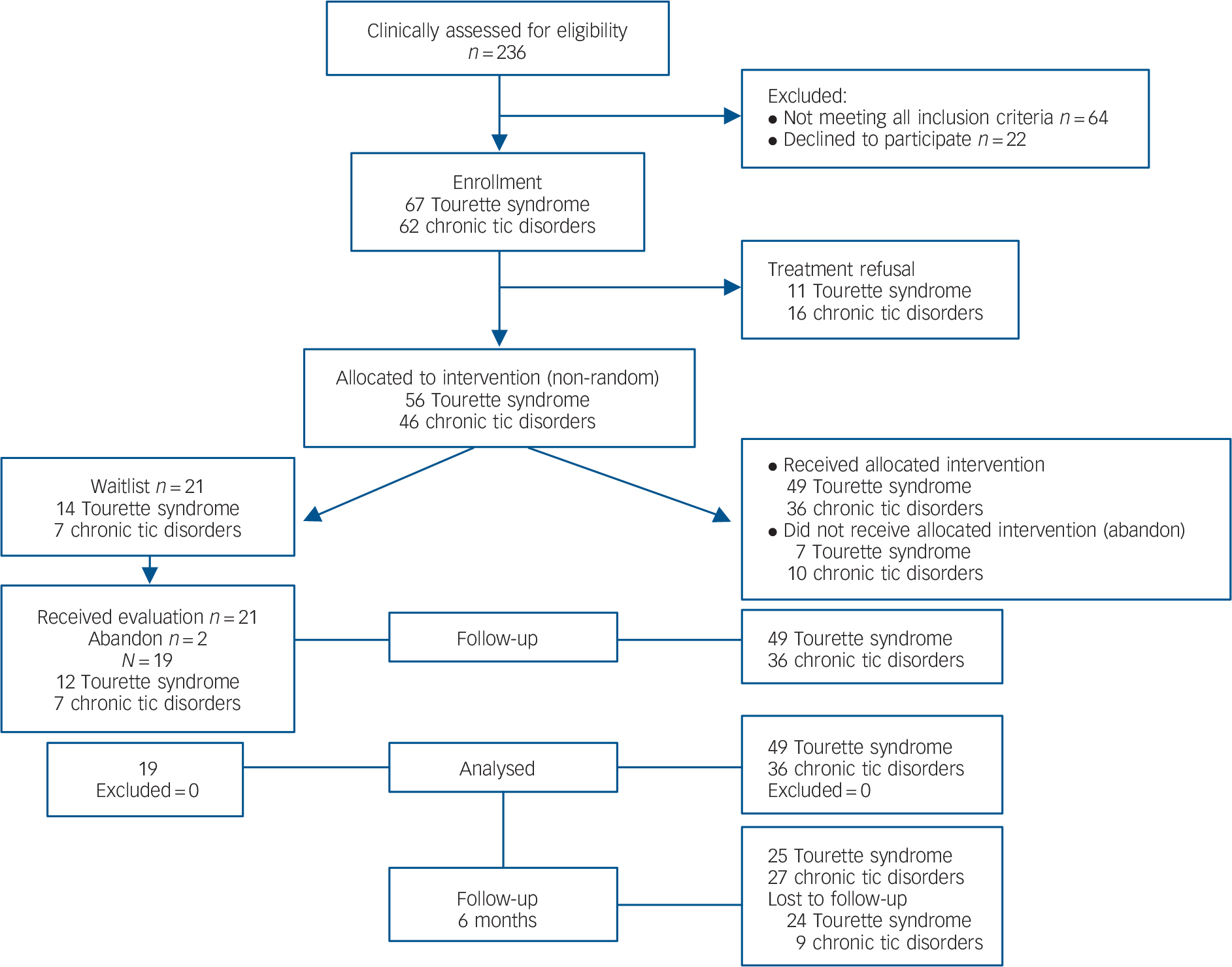
At the start of therapy, the two groups included 67 individuals with Tourette syndrome and 62 individuals with chronic tic disorders. Eleven people in the Tourette syndrome group and 16 people in the chronic tic disorders group refused treatment, leaving 56 and 46 participants respectively (subsequently 7 individuals with Tourette syndrome and 10 individuals with tic disorders abandoned treatment before completion). The total sample in each group was: Tourette syndrome (pre = 56; post = 49; follow-up = 25); chronic tic disorders (pre = 46; post = 36; follow-up = 27). All participants read and gave witnessed signed informed consent and the project was approved by the local institutional ethics board. The consort flow chart is given in Fig. 1.
Consort flow chart.
Clinical assessment
Axis I disorders were assessed with the Structured Clinical Interview for DSM-IV (SCID-I).Reference First, Spitzer, Gibbon and Williams24 Axis II personality disorders were screened with the Personality Disorder Questionnaire (PDQ-4)Reference Hyler25 prior to assessment. Assessment of ADHD followed current guidelinesReference Conners, March, Frances, Wells and Ross26 and included ADHD rating scales, a diagnostic interview and symptom-specific measures.
Tic disorder symptom severity was assessed principally with the TSGSReference Harcherik, Leckman, Detlor and Cohen21 but the Yale Global Tourette Syndrome Scale (YGTSS)Reference Leckman, Riddle, Hardin, Ort, Swartz and Stevenson22 was administered to a subset of participants. Both questionnaires were administered by the clinician via a structured interview. The TSGS is the older tic symptom rating scale and was preferred over the YGTSS due to its multidimensional nature and increased sensitivity of its scoring to multidimensional change. The TSGS norms also allow classification into mild, moderate and severe symptoms. The first TSGS subscale rates the nature of the tic (i.e. motor or phonic), whereas the second scale rates the tic complexity. A third scale assesses functional impairment, including behavioural, learning, motor restlessness and occupational problems. According to past research,Reference Leckman, Riddle, Hardin, Ort, Swartz and Stevenson22 the interrater reliability of the TSGS global score was found to be very good (k = 0.77, P<0.001). The YGTSS is also a clinician-rated scale used to assess tic severity and impairment due to tics.Reference Leckman, Riddle, Hardin, Ort, Swartz and Stevenson22 Motor and vocal tics are rated separately from 0 to 5 on distinct dimensions (number, frequency, intensity, complexity and interference). The scale yields a total score for motor tics (0–25), a total score for vocal tics (0–25) and a combined total tic score (0–50). Convergent validity of the motor and phonic tic factors is shown by strong correlations between the TSGS and the YGTSS, ranging from r = 0.86 to r = 0.91.Reference Leckman, Riddle, Hardin, Ort, Swartz and Stevenson22 The YGTSS was given to a random percentage of participants (24 with chronic tic disorders, 15 with Tourette syndrome) as a check on TSGS evaluation to give some indication of convergence between two measures. Participants were also assessed on the OC-TS semi-structured interview, which poses questions on history, onset, form, location and nature of the tic and the presence, nature and duration of any premonitory sensory urge (OC-TS). After this clinical assessment, the participant was asked to read and, if they were willing, to sign a consent form to enter the neurocognitive evaluation phase.
The SCID-I, TSGS, YGTSS and OC-TS evaluations were carried out by trained evaluators (psychologists, doctoral students) who had previously received training in administering the semi-structured interviews. Further, they did not receive other than basic demographic information prior to their evaluation. As far as possible, the same evaluator evaluated the participant pre and post intervention. Six-month follow-up was also conducted by an independent evaluator.
Medication
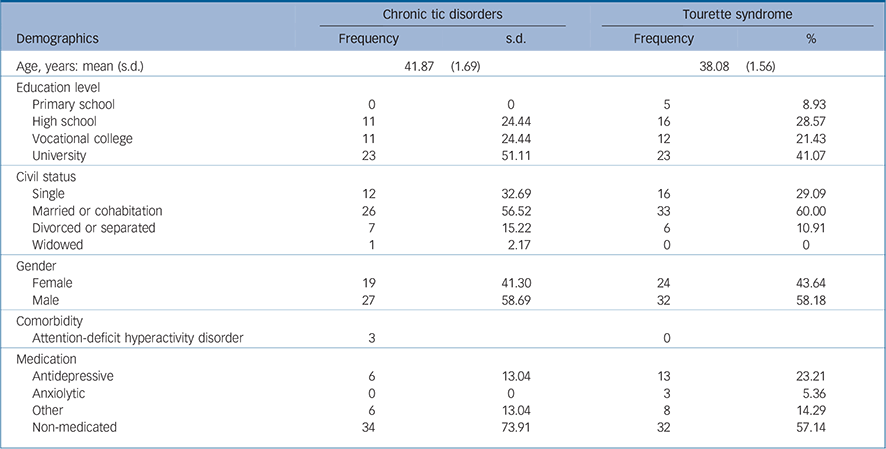
Patients with Tourette syndrome who were currently under medication and stabilised were also included. Stabilisation on medication implied receiving typical or atypical antipsychotic medication or antidepressant or psychostimulant medication over at least a 3-month period with no further improvement in symptoms and willing to keep dosage constant over the period of the study. Medications seem not to influence CBIT outcome.Reference O'Connor, Laverdure, Taillon, Stip, Borgeat and Lavoie27 Table 1 lists participant medications.
Demographic data by separated chronic tic disorders and Tourette syndrome groups

| Chronic tic disorders | Tourette syndrome | |||
|---|---|---|---|---|
| Demographics | Frequency | s.d. | Frequency | % |
| Age, years: mean (s.d.) | 41.87 (1.69) | 38.08 (1.56) | ||
| Education level | ||||
| Primary school | 0 | 0 | 5 | 8.93 |
| High school | 11 | 24.44 | 16 | 28.57 |
| Vocational college | 11 | 24.44 | 12 | 21.43 |
| University | 23 | 51.11 | 23 | 41.07 |
| Civil status | ||||
| Single | 12 | 32.69 | 16 | 29.09 |
| Married or cohabitation | 26 | 56.52 | 33 | 60.00 |
| Divorced or separated | 7 | 15.22 | 6 | 10.91 |
| Widowed | 1 | 2.17 | 0 | 0 |
| Gender | ||||
| Female | 19 | 41.30 | 24 | 43.64 |
| Male | 27 | 58.69 | 32 | 58.18 |
| Comorbidity | ||||
| Attention-deficit hyperactivity disorder | 3 | 0 | ||
| Medication | ||||
| Antidepressive | 6 | 13.04 | 13 | 23.21 |
| Anxiolytic | 0 | 0 | 3 | 5.36 |
| Other | 6 | 13.04 | 8 | 14.29 |
| Non-medicated | 34 | 73.91 | 32 | 57.14 |
Waitlist
A natural waitlist control group consisted of 21 participants who completed clinical assessment but were not treated (for a variety of natural reasons, e.g. availability, wait for therapist, absence) before 3 months when 19 were clinically reassessed (12 Tourette syndrome, 7 chronic tic disorders, 57% male). A planned waitlist is prohibited by Canadian tri-council policy where an empirically based effective treatment already exists.
Refusers, withdrawals and completers
Participants were considered treatment refusals if they never progressed to full evaluation for entry criteria. Completers were defined as those completing post-treatment evaluation, and withdrawals were defined as those voluntarily or involuntarily stopping therapy after evaluation and before completion.
Diagnosis and treatment integrity
Treatment diagnosis was checked by an independent trained evaluator on whether she concurred with classification of the patient as having Tourette, chronic tic or other disorder. The diagnosis was checked on a random sample of 30 (25%) audiotapes. Similarly, treatment integrity and delivery were assessed by rating the presence of each stage of therapy in the treatment notes.
Questionnaire measures
The Beck Anxiety Inventory (BAI)Reference Beck, Epstein, Brown and Steer28 was administered and consists of a 21-item anxiety symptom checklist rating symptom intensity for the past week on a 0–3 scale. Its total score ranges from 0 to 63. The French version of the BAI shows good psychometric properties (internal consistency, test–retest stability, convergent and divergent validity).Reference Freeston, Ladouceur, Thibodeau, Gagnon and Rhéaume29
The Beck Depression Inventory (BDI-II)Reference Beck, Ward, Mendelson, Mock and Erbaugh30 consists of a 21-item relative to depression. The BDI assesses cognitive, emotional and somatic depressive symptoms on a 0–3 scale. Its total score ranges from 0 to 63. The French version of the BDI shows good psychometric properties (internal consistency and test–retest reliability).Reference Bourque and Beaudette31
The Frost Multidimentional Perfectionism Scale (MPS)Reference Frost, Marten, Lahart and Rosenblate32 is a self-administered questionnaire of 35 items (0–5) covering six dimensions (1 – concern over mistakes; 2 – personal standards; 3 – parental expectations; 4 – parental criticism; 5 – doubts about actions; and 6 – importance of organisation and order). The coefficient of internal consistency in both English and French is satisfactory with good test–retest reliability. Total score ranges from 35 to 175.
The Barratt Impulsiveness Scale (BIS-10)Reference Patton, Stanford and Barratt34 is one of the oldest and most widely used measures of impulsive personality traits on a 4-point scale (1–4). It includes 34 items measuring attention, motor, impulsiveness and non-planned impulsiveness. A total score ranges from 34 to 136. The internal consistency coefficient for the total score is good. The scale has been validated in French.Reference Bouvard, Robbe Grillet, Pham, Milliery, Amireche and Fanget35
The Padua Inventory (PI)Reference Sanavio36 assesses obsessive–compulsive behaviour. The psychometric properties of the French version of the PI are adequate (test–retest validity, convergent and divergent validity).Reference Freeston, Ladouceur, Letarte, Rhéaume, Gagnon and Thibodeau37 A revised version of the PI was used for the current study,Reference van Oppen, Hoekstra and Emmelkamp38 with subscales representing impulse phobia, washing, checking, rumination and precision symptoms. On this revised version, the score ranges from 1 to 5.
The Social Self-Esteem Inventory (SSEI)Reference Lawson, Marshall and McGrath39 is a 30-item measure of the self-esteem which shows internal consistency (α = 0.93) and test–retest reliability (r = 0.95).Reference Gauthier, Samson and Turbide40 Scores range from 30 to 180.
Credibility, expectancy, motivation and therapist evaluation
Credibility, expectancy and motivation were derived from the Devilly–Borkovec credibility/expectancy questionnaire.Reference Devilly and Borkovec41 This questionnaire consists of a total set of six items measuring credibility (feeling) and expectancy (thinking) on two scales rated from 1 to 9 on each item, except two items (0–100) for a total score of 236. Cronbach's alpha is respectively 0.79 and 0.81 for each scale, with high test–retest reliability 0.83. The expectancy scale correlates with outcome changes (r = 0.74). The adapted motivation questionnaireReference Keijsers, Schaap, Hoogduin, Hoogsteyns and de Kemp42 contains 10 items (5 reversed) and focuses on reasons to change tic behaviour and willingness to change for a total score of 10.
Daily diary
The participants also kept a daily diary at baseline and throughout treatment monitoring frequency, intensity and degree of control in a specially prepared booklet. The participants were trained in the use of the booklet and a unit of tic or habit defined at the beginning of the evaluation. These records were computerised and displayed as graphics mainly to give clinical feedback to the participant. However, an average of 14 completed daily diaries (7 chronic tic disorders, 7 Tourette syndrome) was chosen randomly from the completers to calculate the linearity of progress over therapy components.
Treatment protocol
The cognitive psychophysiological treatment comprises 10 cumulative stages administered over 10 sessions: (a) awareness exercises (daily diary, video); (b) muscle discrimination (normalise contractions, gain in tic-affected muscle flexibility; exercises are independent of tic occurrence; (c) prevention of tension through decontraction; (d) identifying activities at high and low risk for tics; (e) highlighting differences in behaviours, thoughts and feelings and approach associated with high- and low-risk activities; (f) identifying STOP producing tension (overpreparation, overactivity, inflexibility); (g) behavioural restructuring of overpreparation and overactive style of action; (h) cognitive–behavioural restructuring of metacognitive and perfectionist beliefs linked to tension; (i) generalisation; and (j) relapse prevention. So the treatment sequence for one individual at high risk for shoulder tics while driving was to increase flexibility in the tic-affected muscles and normalise the contraction appropriate for gripping a steering wheel. Perfectionist beliefs about intensely staring into ongoing traffic were restructured and the individuals' agenda reorganised to leave more time and less rush between travel appointments. As noted, the programme is based on a series of findings suggesting that people with Tourette syndrome experience perfectionist beliefs when planning action, feeding an impulsive overactive style which then feeds frustration, tension and tics. Tics are not directly addressed either by the practice of antagonist competing response contingency management and positive reinforcement of competing responses or exposure to the premonitory urge.
Each individual, whether in the Tourette syndrome or chronic tic disorders group, received the identical 10 stages during 10-week therapy, with 1-month home practice and 6 months of follow-up. All therapists were licensed psychologists with between 5 and 7 years of experience specialising in cognitive–behavioural therapy for tic disorders.
Analysis
An initial multivariate analysis of variance was carried out to look at pre–post differences in main clinical outcome measures (TSGS, YTSS) and other mood-related and psychosocial measures (BIS-10, BAI, BDI, SSEI, PI) in both completers and in an intention to treat (ITT) analysis. In the ITT, scores at end-point of abandon were carried forward to represent final scores (end-point carried forward). A further analysis was performed post 6-month follow-up on completers to look at relapse from post-treatment levels. Finally, outcome was compared according to baseline classifications of TSGS tic severity.
Results
Demographic differences between completers and those who dropped out
Baseline demographic data are given in Table 2. Differences were found on age: completers were older ( = 41.05; s.d. = 12.84) compared with those who dropped out ( = 35.9; s.d. = 5.93); more educated (chi-squared = 8.69; P<0.03); and more likely to be married (chi-squared = 18.38; P<0.003). But there were no differences in level of symptom severity as measured by the TSGS, either between dropouts and completers. There were no demographic differences between completers and the natural waitlist control group.
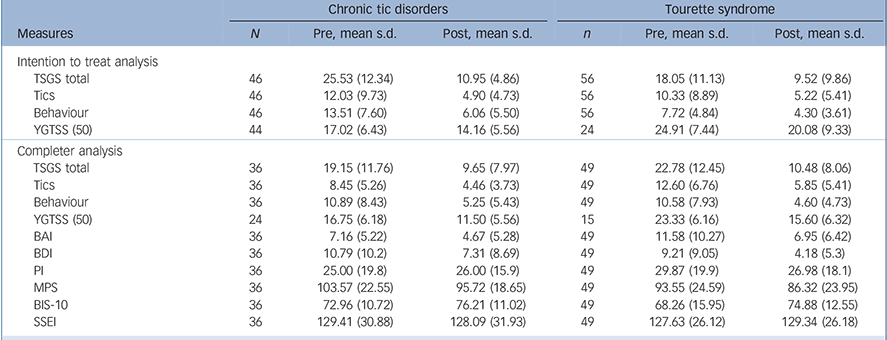
Clinical and questionnaire data separated by Tourette syndrome and chronic tic disorders for intention to treatment analysis and completer groups

| Chronic tic disorders | Tourette syndrome | |||||
|---|---|---|---|---|---|---|
| Measures | N | Pre, mean s.d. | Post, mean s.d. | n | Pre, mean s.d. | Post, mean s.d. |
| Intention to treat analysis | ||||||
| TSGS total | 46 | 25.53 (12.34) | 10.95 (4.86) | 56 | 18.05 (11.13) | 9.52 (9.86) |
| Tics | 46 | 12.03 (9.73) | 4.90 (4.73) | 56 | 10.33 (8.89) | 5.22 (5.41) |
| Behaviour | 46 | 13.51 (7.60) | 6.06 (5.50) | 56 | 7.72 (4.84) | 4.30 (3.61) |
| YGTSS (50) | 44 | 17.02 (6.43) | 14.16 (5.56) | 24 | 24.91 (7.44) | 20.08 (9.33) |
| Completer analysis | ||||||
| TSGS total | 36 | 19.15 (11.76) | 9.65 (7.97) | 49 | 22.78 (12.45) | 10.48 (8.06) |
| Tics | 36 | 8.45 (5.26) | 4.46 (3.73) | 49 | 12.60 (6.76) | 5.85 (5.41) |
| Behaviour | 36 | 10.89 (8.43) | 5.25 (5.43) | 49 | 10.58 (7.93) | 4.60 (4.73) |
| YGTSS (50) | 24 | 16.75 (6.18) | 11.50 (5.56) | 15 | 23.33 (6.16) | 15.60 (6.32) |
| BAI | 36 | 7.16 (5.22) | 4.67 (5.28) | 49 | 11.58 (10.27) | 6.95 (6.42) |
| BDI | 36 | 10.79 (10.2) | 7.31 (8.69) | 49 | 9.21 (9.05) | 4.18 (5.3) |
| PI | 36 | 25.00 (19.8) | 26.00 (15.9) | 49 | 29.87 (19.9) | 26.98 (18.1) |
| MPS | 36 | 103.57 (22.55) | 95.72 (18.65) | 49 | 93.55 (24.59) | 86.32 (23.95) |
| BIS-10 | 36 | 72.96 (10.72) | 76.21 (11.02) | 49 | 68.26 (15.95) | 74.88 (12.55) |
| SSEI | 36 | 129.41 (30.88) | 128.09 (31.93) | 49 | 127.63 (26.12) | 129.34 (26.18) |
TSGS, Tourette Symptom Global Scale; YGTSS, Yale Global Tic Severity Scale; BAI, Beck Anxiety Inventory; BDI, Beck Depression Inventory; MPS, Multidimensional Perfectionist Scale; BIS-10, Barratt Impulsivity Scale; SSEI, Social Self-Esteem Inventory; PI, Padua Inventory.
Clinical measures
Multivariate repeated measures on the two groups pre- and post-treatment revealed for the chronic tic disorders group a significant main treatment effect for the total TSGS scale (F[1,35] = 25.86; P<0.001; d − = 1.72) (95% CI pre = 15.35–22.94; post = 7.16–12.15); and for the separate tic subscale (F[1,35] = 20.2; P<0.001; d − = 1.52) and behavioural subscale (F[1,35] = 19.01; P<0.0001; d − = 1.48) and on the YGTSS total score (F[1,23] = 30.93; P = 0.001; d − = 2.36): tic disorders (95% CI pre = 14.72–18.78; post = 0.35–13.65).
In the Tourette syndrome group the results pre- and post-treatment were for the total TSGS scale (F[1,48] = 82.72; P<0.0001; d − = 2.63) (95% CI pre = 19.52–22.94; post = 8.34–12.62), for the separate TSGS tic scale (F[1,48] = 74.1; P>0.0001; d − = 2.49), TSGS behavioural scale (F[1,48] = 43.24; P<0.001; d − = 1.89) and on the YGTSS (50) total score (F[1,14] = 27.61; P<0.001; d − = 2.81): Tourette syndrome (95% CI pre = 20.76–25.90; post = 12.88–18.32). ITT analysis using the end-point carry forward method confirmed the significant findings pre- and post-treatment on TSGS for combined chronic tic disorders and Tourette syndrome groups (F[1,112] = 78.39; P<0.001; d − = 1.40). There were no differences in outcome between participants with simple and complex tics (P>0.11) or across tic locations (P>0.08). Tic locations were analysed separately. The tics were classified as follows: simple tics (n = 49) d = 1.17; complex tics (n = 36) d = 0.99; eyes (n = 10) d = 1.03; face (n = 6) d − = 1.06; head (n = 7) d − = 0.95; neck and shoulder (n = 17) d − = 1.61; trunk and abdomen (n = 9) d = 1.14; phonic (n = 11) d = 1.16, for individual tic locations.
There were no differences in outcome on the TSGS between genders (P<0.14) or between those taking or not taking medication (chronic tic disorders, P<0.70; Tourette syndrome, P<0.37). The YTGSS and TSGS total scores pre-treatment showed a highly significant positive correlation (F[38] = 0.45; P<0.0001). Clinical and questionnaire data are given in Table 2.
Clinical significance
In terms of clinically significant reductions, in the chronic tic disorders group, 64.7% and in the Tourette syndrome group, 73.9% showed significant (<35%) improvement in symptoms on the TSGS post-treatment which is considered a full response to treatment.Reference Pallanti, Hollander, Bienstock, Koran, Leckman and Marazziti43 Completers with baseline ratings on the TSGS between mild (>10), moderate (>20) and severe (>30) as categorised by TSGS norms improved equally post-therapy. The odds of clinical improvement depending on initial mild, severe, moderate category of TSGS total score were equal in both groups. In the chronic tic disorders group, 64% of mild and 67% of moderate-severe showed >35% improvement (odds ratio (OR) = 1.1:1). In the Tourette syndrome group, 71% with mild Tourette syndrome and 79% with moderate-severe syndrome showed improvement (OR = 1.5:1). The likelihood of improving with the treatment compared with waitlist was 6:1 in the total sample (Tourette syndrome and chronic tic disorders). At post-therapy, of 85 completers, 78 were classified as mild or below, regardless of starting severity (mild, moderate, severe, extreme) and the other 7 were classified as moderate.
Waitlist results
The waitlist was small but there were no demographic differences in this group, compared with treatment groups. The TSGS total score showed a slight decrease (pre(19) = 19.62 (3.81), post(19) = 17.05 (2.67)). This post-waitlist decrease was non-significant over the 19 participants (tic disorders+Tourette syndrome) allocated to the waitlist (F[1,18] = 0.80; P>0.38, d − = 0.29).
Questionnaire measures
In the tic disorders group, the BAI showed a decrease pre–post treatment (F[1,35] = 3.79; P<0.006; d − = 0.68) with no interaction effect. But BAI levels were subclinical at baseline. The BDI-II also showed a decrease (F[1,35] = 7.95; P<0.008; d − = 0.92). BDI-II levels were again subclinical. The PI total showed no decrease pre–post treatment. The BIS-10 questionnaire showed a trend in groups pre–post treatment. The SSEI showed no change. The MPS showed a significant pre–post treatment effect (F[1,35] = 7.81; P<0.001; d − = 1.06).
The Tourette syndrome group, likewise, showed improvement in depression and anxiety: BDI-II (F[1,48] = 15.01; P<0.001; d − = 1.67); BAI (F[1,48] = 6.79; P<0.013; d − = 0.88); MPS (F[1,30 = 5.45; P<0.03; d − = 0.86); and the BIS-10 (F[1,23] = 6.56; P<0.02). But there was no significant change in PI or SSEI.
Six-month follow-up
A 6-month follow-up with clinical assessment was conducted on completers showing improvement post-treatment. At 6-month follow-up, there was no relapse in the TSGS (chronic tic disorders = 7.47 [6.8]; Tourette syndrome = 11.91 [8.2]). In the chronic tic disorders group there was a further decrease in BAI (F[1,20] = 3.94; P<0.06; d − = 0.89) and in total MPS (F[1,17] = 7.46; P<0.01; d − = 1.32). In the Tourette syndrome group there was an increase of SSEI from post-level (F[−1,18] = 7.96; P<0.01; d − = 1.33) and in total MPS (F[1,28] = 7.81; P<0.001; d − = 1.06), but in no other measure. In both the chronic tic disorders and Tourette syndrome group, there was further change at follow-up on the MPS on the personal standards scale (chronic tic disorders: F[1,17] = 6.17; P<0.02; d − = 1.20; Tourette syndrome: F[1,17] = 4.48; P<0.05; d − = 1.02) and in the Tourette syndrome group on personal organisation (F[1,17] = 5.74; P<0.03; d − = 1.16). Pearson correlation coefficients were calculated between change in the MPS and change in the TSGS scales at follow-up. Change in the personal organisation subscale of the MPS correlated significantly with the change in TSGS behaviour scale post-treatment (r[85] = 0.31; P<0.02) and at 6-month follow-up with change in the TSGS behaviour scale (r[27] = 0.39; P<0.05) and the TSGS tic scale (r[27] = 0.40; P<0.04), and the TSGS total score (r[27] = 0.49; P<0.009).
Treatment motivation, credibility, adherence and satisfaction
The groups were equivalent post-treatment in terms of motivation (chronic tic disorders [46] = 7.38 [0.98]; Tourette syndrome [56] = 7.10 [1.57]); combined credibility and feeling of therapy pre-treatment (chronic tic disorders [46] pre = 157.70 [32.57]; Tourette syndrome [56] pre = 162.41 [30.22]); and adherence to programme as monitored by attendance, homework completion and exercise practice as computed mid- and post-treatment by therapist (chronic tic disorders [15] 6.32/12 [2.58], Tourette syndrome [17] 7.05/12 [3.28] and close other post-treatment (0 = not at all; 2 = diligently; Tourette syndrome [11] = 1.55 [0.52]; tic disorders [12] = 1.33 [0.49]).
Evolution of progress during therapy
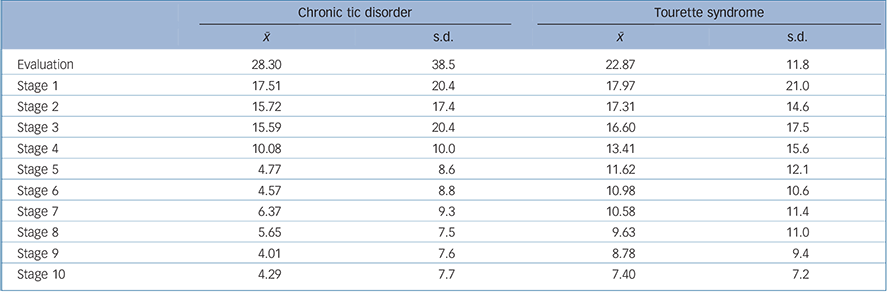
Fourteen case samples from each group (7 tic disorders and 7 Tourette syndrome) were extracted from the completed daily diary to measure the evolution of tic and distress reduction over the 10 sessions of therapy to see whether the reduction followed a linear or curvilinear path in each group. The therapy was administered additively in that all participants received the same stages of therapy in the same order. There was a cumulative and linear improvement over each component of the therapy: frequency (F[1,13] = 6.74; P<0.02); intensity (F[1,13] = 20.00; P<0.001); control (F[1,13] = 11.04; P<0.006); resistance (F[1,13] = 12.23; P<0.004). The results illustrate that progress in control of tics showed a linear trend in both Tourette syndrome and chronic tic disorders, suggesting that strategies were additive and cumulatively integrated into the learning process (Table 3).
Daily tic unit frequency from daily diary showing mean (standard deviation) averaged over 7 chronic tic disorder and 7 Tourette syndrome completers for each of the 10 weekly stages of the programme

| Chronic tic disorder | Tourette syndrome | |||
|---|---|---|---|---|
 | s.d. | | s.d. | |
| Evaluation | 28.30 | 38.5 | 22.87 | 11.8 |
| Stage 1 | 17.51 | 20.4 | 17.97 | 21.0 |
| Stage 2 | 15.72 | 17.4 | 17.31 | 14.6 |
| Stage 3 | 15.59 | 20.4 | 16.60 | 17.5 |
| Stage 4 | 10.08 | 10.0 | 13.41 | 15.6 |
| Stage 5 | 4.77 | 8.6 | 11.62 | 12.1 |
| Stage 6 | 4.57 | 8.8 | 10.98 | 10.6 |
| Stage 7 | 6.37 | 9.3 | 10.58 | 11.4 |
| Stage 8 | 5.65 | 7.5 | 9.63 | 11.0 |
| Stage 9 | 4.01 | 7.6 | 8.78 | 9.4 |
| Stage 10 | 4.29 | 7.7 | 7.40 | 7.2 |
Discussion
The purpose of the open trial was to evaluate the efficacy of the cognitive psychophysiological intervention over a range of tic locations in chronic tic and Tourette disorders. The overall effect size for all groups was robust but in particular the Cohen d − effect sizes were large compared with waitlist (relative d − = 2.34 and 1.43 for Tourette and chronic tic respectively) and large over all tic locations and subtypes (motor, phonic, complex and simple), and cognitive psychophysiological intervention worked effectively in decreasing symptoms regardless of whether baseline TSGS severity was in the mild, moderate or severe category. The results confirm that the cognitive psychophysiological treatment is efficacious for all tic subtypes. Furthermore, it is clear from improvement on both tic and behavioural subscales of the TSGS that not only tics but other behaviour (perfectionism, impulsivity) improved as well as measures of well-being. In the Tourette syndrome group, self-esteem improved at 6-month follow-up.
The cognitive psychophysiological programme targets ways of thinking, feeling and planning, and evaluating motor action characteristic of tic disorders. The cognitive psychophysiological programme, unlike other behavioural interventions, does not directly address the tics themselves, either by encouraging toleration of the premonitory urge or through the habit reversal strategy of implementing an action antagonist to the muscle. The present open trial study shows that the cognitive psychophysiological programme produces equivalent or larger reported effect sizes to other behavioural treatments, as reported in the literature.Reference Piacentini, Woods, Scahill, Wilhelm, Peterson and Chang12,Reference Wilhelm, Peterson, Piacentini, Woods, Deckersbach and Sudhodolsky13 The cognitive psychophysiological programme may sound more complex than other behavioural interventions in tying tic behaviour to motor planning and style of action, but in practice, it has several advantages. First, in identifying high- and low-risk tic situations, it immediately educates people in how they already albeit indirectly have some control over the fluctuations in tic onset. It also directs attention to motor planning processes preceding onset, so permitting the person to realise that reducing the risk of tic onset is often a case of doing less and investing less effort than usual to control tics. In other words, the means of control are often already in the patient's repertoire and cognitive behaviour modification within the cognitive psychophysiological model focuses on normalising thought and action in high-risk tic situations by taking low-risk situations as a point of reference. The cognitive psychophysiological programme does however also contain a component of motor re-education involving improving muscle use and discrimination (gaining muscle flexibility and control) and aiding overactive and inhibitory control. These cognitive and psychophysiological factors may relate to the processes particular to tic production such as high sensorimotor activation, elevated muscle contraction, and so complement application of behavioural principles.
Process measures taken daily over the treatment period revealed that the decrease in tics and increase in control was linear and cumulative over stages of the programme. Each stage was built on the previous stage, improvements in all measures were maintained at 6-month follow-up and perfectionism and self-esteem further improved. The further improvement in social self-esteem at 6-month follow-up is interesting since there was no improvement in those measures post-treatment. Maybe time is required before improvement affects social image. Change in perfectionist personal organisation correlated with change in both behavioural and tic symptom subscales at 6-month follow-up, so confirming a key component of the cognitive psychophysiological model, namely that style of planning and organisation is related to tic onset. Other authorsReference Wright, Rickards and Cavanna44 have suggested that motive in impulse control disorders varies with comorbidity and degree of attributionReference Eddy, Mitchell, Beck, Cavanna and Rickards45 and may affect treatment choice.
There are a variety of clinical implications from this study. The importance of the findings is that improvement in tic occurrence can be accomplished by addressing cognitive and motor factors of planning action in tic disorders and not just by targeting antagonist actions in isolated muscles. This route may be more satisfactory for some individuals than directly addressing the tic since, in principle, it aids generalisation. The type and location of a tic in Tourette syndrome are notoriously variable and volatile, and patients with Tourette syndrome talk of experiencing the tic of the day.Reference Seligman46
The limitations of the present study include it being an open trial, without a substantial placebo and only a small natural waitlist arm. The participants were on a variety of medications and though measures of self-esteem and other traits were measured, wider psychosocial adaptation and functioning were not measured. The drop-out rate was 20% but there were no differences between completers and those who withdrew on clinical severity. A key reason for drop-out was difficulty scheduling time for appointments and homework perhaps due to an overactive style of action. Future research might use a dismantling design to assess the utility of components of the cognitive psychophysiological programme. It will of course be important to relate the current findings to changes in motor performance pre- and post-treatment to further validate the cognitive psychophysiological process model. Also a randomised controlled comparison of cognitive psychophysiological and CBIT would establish comparable efficacy over subtypes and process and symptom change in adults and children.
Funding
The study was supported by grant no. from the Canadian Institute of Health Research and grant no. from the Fonds de la recherche en santé du Quebec to K.O'C. and M.L.
Acknowledgements
The authors thank Benoit Deslauriers for statistical assistance.



eLetters
No eLetters have been published for this article.