

Introduction
The modern human-horse relationship spans a large spectrum of interactions which can be characterised by the context and duration of the contact (Goodwin Reference Goodwin1999; Hausberger et al. Reference Hausberger, Roche, Henry and Visser2008). Some human-horse interactions, such as veterinary care or farriery, are brief and infrequent — but still contribute to a horse’s perception of human interactions (Hausberger et al. Reference Hausberger, Roche, Henry and Visser2008). Conversely, more long-term human-horse interactions, like ownership, allow the development and maintenance of the human-horse bond (Hausberger et al. Reference Hausberger, Roche, Henry and Visser2008; Merkies et al. Reference Merkies, Hayman and Ijichi2024). Horses (Equus caballus) involved in riding lesson programmes or in equine-assisted services may experience a degree of consistency in their connection with students or clients across multiple sessions or programmes but also a regular turnover in clients creating a mixture of both long- and short-term human-horse interactions (Hausberger et al. Reference Hausberger, Roche, Henry and Visser2008; Arrazola & Merkies Reference Arrazola and Merkies2020; Ekholm Fry Reference Ekholm Fry2021). Due to this repeated turnover of human participants, it is imperative to ensure that human-horse interactions are on the whole positive, as a horse that experiences frequent negative interactions with people may become fearful or resistant, making them more difficult to handle, risking both human and horse safety (Waiblinger et al. Reference Waiblinger, Boivin, Pedersen, Tosi, Janczak, Visser and Jones2006; Luke et al. Reference Luke, McAdie, Smith and Warren-Smith2022).
From the horse’s point of view, interactions with humans involve most of their senses: visual, tactile, olfactory and auditory (Rørvang et al. Reference Rørvang, Nielsen and McLean2020; Merkies & Franzin Reference Merkies and Franzin2021). Individual horses may perceive each interaction as positive, neutral or negative, however we cannot rely upon self-reporting to confirm these subjective emotions as we do in humans; instead we must rely upon the horse’s outward expressions of behaviour as a proxy for their true emotional valence (Russell Reference Russell2003). Horses are highly expressive animals, and their affective state can be inferred by analysing both observable and measurable qualities, such as their physical behaviours and vocalisations, or physiological markers such as heart rate (de Santis et al. Reference de Santis, Contalbrigo, Borgi, Cirulli, Luzi, Redaelli, Stefani, Toson, Odore, Vercelli, Valle and Farina2017; Merkies & Franzin Reference Merkies and Franzin2021). Physical messaging can range from obvious signals like biting or kicking to subtle signals like changing ear positioning or tightening of the lips (McDonnell & Haviland Reference McDonnell and Haviland1995; Pierard et al. Reference Pierard, McGreevy and Geers2019). Correctly deciphering these behaviours is central to inferring the valence of the horse’s affective state (positive, neutral or negative) and thereby encouraging positive interactions for both the horse and the human while protecting human safety and improving the overall welfare of the horse (Ladewig Reference Ladewig2019).
Affiliative behaviours are indicative of long-term positive affective states in farm animals (Hausberger & Muller Reference Hausberger and Muller2002). They promote welfare through building the human-horse bond and reducing the incidence of aggressive behaviours (Boissy et al. Reference Boissy, Manteuffel, Jensen, Moe, Spruijt, Keeling, Winckler, Forkman, Dimitrov, Langbein, Bakken, Veissier and Aubert2007). Animals that exhibit affiliative behaviours may be labeled as ‘relaxed’, ‘friendly’, ‘affectionate’, ‘playful’ or ‘social’ by their caretakers (Boissy et al. Reference Boissy, Manteuffel, Jensen, Moe, Spruijt, Keeling, Winckler, Forkman, Dimitrov, Langbein, Bakken, Veissier and Aubert2007). Affiliative behaviours from horses directed toward humans can include allogrooming, approaching, olfactory investigation, following human direction, nudging or licking (Pierard et al. Reference Pierard, McGreevy and Geers2019; Arrazola & Merkies Reference Arrazola and Merkies2020). Within these physical indicators of positive affective states, there are subtleties that may not be immediately noticeable to someone unfamiliar with horse behaviour, like slight turning towards a human or loosening of the lower lip (Arrazola & Merkies Reference Arrazola and Merkies2020; de Oliveira et al. Reference de Oliveira, Gozalo-Marcilla, Ringer, Schauvliege, Fonseca, Trindade, Filho and Luna2021).
Agonistic behaviours are characterised by the use of force or aggression to terminate an interaction and when observed it can then be assumed that the current interaction was negative or unpleasant for the instigating horse (McDonnell & Haviland Reference McDonnell and Haviland1995; Briefer Freymond et al. Reference Briefer Freymond, Briefer, von Niederhäusern and Bachmann2013; Ekholm Fry Reference Ekholm Fry2021). Typically, horses only exhibit agonistic behaviours to the minimum degree required to terminate an unpleasant interaction prior to returning to a normal state, but behaviours will escalate as required until the negative interaction ceases (Briefer Freymond et al. Reference Briefer Freymond, Briefer, von Niederhäusern and Bachmann2013; Burla et al. Reference Burla, Ostertag, Patt, Bachmann and Hillmann2016). Agonistic behaviours can include both the action itself or the threat of the same action (McDonnell & Haviland Reference McDonnell and Haviland1995; McGreevy Reference McGreevy2012). For example, a bite is a common agonistic behaviour across a variety of species (e.g. dogs, cats, horses), but the threat of a bite also represents an agonistic behaviour even if no contact is made (McDonnell & Haviland Reference McDonnell and Haviland1995; McGreevy Reference McGreevy2012). Other agonistic behaviours include: (threat of) kicking, (threat of) striking, alert posture and approach, pinned ears, head threat (head lowered with neck extended and ears pinned) or tightened facial musculature (McDonnell & Haviland Reference McDonnell and Haviland1995; McGreevy Reference McGreevy2012; Pierard et al. Reference Pierard, McGreevy and Geers2019). More passive avoidance strategies to cease an interaction may be indicated by subtle behaviours like turning away to increase distance between the horse and the stressor, even though the horse may not be fully removed from the situation (McDonnell & Haviland Reference McDonnell and Haviland1995; McGreevy Reference McGreevy2012; Pierard et al. Reference Pierard, McGreevy and Geers2019; Ekholm Fry Reference Ekholm Fry2021). Both agonistic and avoidant behavioural responses exhibited by horses are assumed to be indicative of a negative affective state and embody the physical display of the fight or flight response (Ekholm Fry Reference Ekholm Fry2021).
The physical expression of positive or negative affective states are subjective to each individual horse’s temperament but dampened by training which acts to suppress unwanted behaviours (Seaman et al. Reference Seaman, Davidson and Waran2002; McGreevy et al. Reference McGreevy, Oddie, Burton and McLean2009). Within these individual differences horses may be categorised as either ‘active’ or ‘passive’ copers (Wechsler Reference Wechsler1995; Seaman et al. Reference Seaman, Davidson and Waran2002). The major difference between coping styles is that passive copers do not present major outward signs of aversion to stimuli, with agonistic or avoidant behaviours being muted (Wechsler Reference Wechsler1995; Seaman et al. Reference Seaman, Davidson and Waran2002). In this passive and often immobile state, animals are attempting to go undetected while waiting for the aversive stimuli to pass (Wechsler Reference Wechsler1995). This passive reaction may be mistaken for a calm state, as no obvious negative behaviours are detected, but may not be a true representation of the horse’s affective state (Wechsler Reference Wechsler1995; Squibb et al. Reference Squibb, Griffin, Favier and Ijichi2018). On the other hand, active copers may overtly display their response to a stressor (Budzyńska Reference Budzyńska2014) which can alert the human to change their approach to a situation.
It is advantageous for humans to be aware of various behaviours their horse displays, nonetheless they are often oblivious to them, especially the more subtle behaviours (Bell et al. Reference Rogers, Taylor and Busby2019). When assessing an animal’s emotional state, individuals may bias their evaluation through their personal, subjective lens and imbue their observations with anthropomorphism (Bradshaw & Casey Reference Bradshaw and Casey2007; Thompson & Clarkson Reference Thompson and Clarkson2019). The complexity and subjectivity when assessing an animal’s affective state has been flagged as an issue, and even when using accepted behavioural markers, many studies and welfare assessments have struggled with inter-observer reliability (Green & Mellor Reference Green and Mellor2011; Yeates Reference Yeates2011).
Empathy is the ability to relate to another being’s emotions which implies that one is aware of their own bodily sensations to be able to resonate with another being (Marson et al. Reference Marson, Revital, Paoletti, Glicksohn, Harris, Elliott, Carducci and Ben-Soussan2024). Humans more readily empathise with other beings viewed as similar or that they can relate to, and anthropomorphism may act as a catalyst to endow other beings with human qualities thereby making them more like us (Vanutelli & Balconi Reference Vanutelli and Balconi2015). As Thompson and Clarkson (Reference Thompson and Clarkson2019) argue, the application of anthropomorphism may actually strengthen interspecies relationships as we can see that horses are like us in some ways, although unlike us in others. Empathy involves processing and recognising one’s own internal states, making interoception an important component of empathy (Ernst et al. Reference Ernst, Northoff, Böker, Seifritz and Grimm2013). Interoception is defined as the ability in which one can sense and interpret what is going on within their own body, which can include either conscious or subconscious processes (Mehling et al. Reference Mehling, Acree, Stewart, Silas and Jones2018). Neural pathways involved in affective states are linked to neural pathways involved in physiological responses to the point that interoceptive awareness is believed to drive emotional behaviours meant to fulfill social needs (Craig Reference Craig, Barrett, Lewis and Haviland-Jones2016). Those possessing a higher level of bodily awareness are likely to be more empathetic (Li et al. Reference Li, Peng, Qin, Luo, Ren, Wang, Feng, Liu, Li, Wei and Qiu2024). Specifically, those with a higher interoceptive sensibility were better able to recognise facial expressions of emotions in other people (Hübner et al. Reference Hübner, Trempler, Gietmann and Schubotz2021).
This study investigated whether humans with a higher self-awareness of their own bodily state are better able to recognise a horse’s affective state. To the authors’ knowledge, the influence of interoception on the evaluation of affective states of horses has not been researched. Using a survey methodology whereby participants viewed a number of media depicting horses interacting with humans in various scenarios, their ability to recognise behavioural cues indicating positive, neutral and negative affective states in horses was compared to expert evaluations of each scenario. The percent agreement of participant responses was then related to their scores on the Multidimensional Assessment of Interoceptive Awareness (Version 2) (MAIA-2). The MAIA-2 is one of the most popular validated psychometric scales that serves as a self-reported measure of the participant’s interoception (Vig et al. Reference Vig, Köteles and Ferentzi2022). The 37 MAIA-2 items represent eight subcategories, termed factors, of interoception: noticing, not-distracting, not-worrying, attention regulation, emotional awareness, self-regulation, body listening and trust (Mehling et al. Reference Mehling, Acree, Stewart, Silas and Jones2018). It was hypothesised that those scoring higher in the MAIA-2 would better categorise interactions between humans and horses because they are more aware of their own emotional responses and affective states.
Materials and methods
Ethical approval
This research protocol was approved by the institutional Research Ethics Board for the use of humans in research (REB21-12-026).
Survey development: Media selection and categorisation
All media (photographs and video) were collected from researchers’ personal files. Media depicted positive, negative and neutral horse behavioural responses to humans in a variety of human-horse interactions. Media were selected to portray both overt and subtle responses from the horse. The overt category contained obvious affiliative, agonistic or avoidant behaviours, such as a horse trying to bite a human. Conversely, the subtle category contained less noticeable physical responses from the horse such as a horse backing away while the human is trying to place a halter on their head. To account for potential dampened expression of positive or negative behavioural responses due to the horse’s training, and at the suggestion of the experts, instances of passive coping were grouped as neutral responses to human-horse interactions.
An initial media bank (n = 77 pieces) was distributed to seven external equine behaviour experts for validation to confirm the media categorisations. External experts comprised equine behaviour researchers who had an average of 50 peer-reviewed articles focused on horse behaviour. For media categorisations to be considered validated, at least 85% of the experts (i.e. six of the seven external validators) must have agreed with the categorisation. The final survey contained 31 pieces of media (Table 1) which included 22 videos and nine images.
Brief descriptions of selected media as agreed upon by equine behaviour experts (n = 7) and included in the final survey to assess how well humans can recognise horse behavioural responses to human interactions. Categories of affective state were divided into positive, negative and neutral, with overt and subtle scenarios for positive and negative situations. Media explanations describe what the horse is doing in the scenario in response to human interactions

The videos ranged from 4–20 s in length, averaging 8.5 s each, with a total running time of 187.5 s (approximately 3 min). All human faces or identifying features were blurred to respect the privacy of those depicted in the media. In some instances, other horses that were not interacting with the humans in frame were also blurred to avoid any confusion for participants regarding which horse they should be assessing. To focus on the human ability to read solely the physical responses of horses, only visual cues were explored, and all audio was removed from videos to avoid influence from horse vocalisations (e.g. whinny, nicker, snort) or human commentary.
Data collection
The survey was created using Qualtrics (Qualtrics, Provo, UT, USA), a web-based survey platform. The survey was divided into four main sections: (1) Informed consent; (2) Participant demographics; (3) Categorisation of the 31 media pieces; and (4) the Multidimensional Assessment of Interoceptive Awareness (Version 2) (MAIA-2) (for survey questions, see S1 in the Supplementary material).
Participants were recruited using snowball sampling across relevant social media platforms (e.g. Facebook, Instagram and LinkedIn). Recruitment letters were distributed to university faculty and students via e-mail lists and advertisements were placed in equine newsletters (e.g. Equine Guelph). The survey was accessible either by a URL link or QR code. The survey was open to any participant aged 18 or older and previous experience with horses was not required. The survey was available from June 30 to July 27 2022 (total of 29 days).
After informed consent, the survey collected demographic data from participants including age, gender, education, country of residence and experience with horses. The survey then moved into the media categorisations, however prior to starting this section, participants were provided with the following definitions of positive, neutral and negative human-horse interactions:
Positive interaction: The horse exhibits a positive response to human interaction. The horse may seem attentive, engaged or appear to enjoy the interaction with the human.
Neutral interaction: The horse does not exhibit a noticeable response to human interaction. The horse may seem disengaged while still following human direction or participating in the interaction.
Negative interaction: The horse exhibits a negative response to human interaction. The horse may seem fearful, avoidant or attempt to stop the interaction.
The 31 pieces of media were presented to participants in randomised order. All nine images were uploaded directly onto Qualtrics and all 22 videos were uploaded to YouTube (www.youtube.com) then embedded in Qualtrics using HTML code. YouTube controls were left on, allowing the participants to replay the video as often as required before selecting their answer. Each piece of media was displayed independently from the others and once an answer had been submitted participants were unable to return to previous questions to change their answers. For each media piece, participants were asked to categorise the experience from the horse’s point of view as Positive, Likely Positive, Neutral, Likely Negative or Negative. To avoid biasing participant categorisation of media, the adjective ‘overt’ was omitted, and the adjective subtle was replaced with ‘likely’.
Two attention check questions were included within the media analysis section, roughly splitting it into three parts. The attention checks served to monitor the participant’s attention to detail and flag potential instances of the participants selecting answers at random before moving on to the next question.
Each media question collected data pertaining to the participant’s time budget while completing the survey which included the time of their first and last click per question, total click counts, and the time of page submission. At the end of the media section, an open-ended question asked participants to describe what behavioural clues from the horse they used to classify both positive and negative human-horse interactions (e.g. ear position).
The final part of the survey consisted of the Multidimensional Assessment of Interoceptive Awareness (Version 2) (MAIA-2) to assess participants’ interoception (Mehling et al. Reference Mehling, Acree, Stewart, Silas and Jones2018). The MAIA-2 consists of 37 items and the participant selected how often they identified with each item on a scale of 0 to 5, 0 being never and 5 being always. For example, participants were presented with the following prompt: “When I feel pain or discomfort, I try to power through it”, then asked to rate the degree to which they relate to the prompt. This section was purposely placed last to avoid any ‘emotional warm-up’ the participants could have experienced, as participant self-reflection of their own feelings and emotions prior to media assessment could better prepare them to evaluate the horses’ reactions to human interaction. Of the 37 questions within the MAIA-2, each belonged to a subset of one to seven questions that paired with the one following eight factors: noticing, not-distracting, not-worrying, attention regulation, emotional awareness, self-regulation, body listening and trust. The MAIA-2 questions were presented in random order to each participant and can be seen in S2 in the Supplementary material.
Data curation
The attention checks, in conjunction with the total time participants spent viewing the media, served as a means of response exclusion. If the participant spent less than the total video run time on the entire media section (approximately 3 min) it was assumed that the media were not viewed in their entirety and random answers were selected. In this case the participant’s data were removed. If the participant failed one or both attention checks, their data were flagged and compared to the total time spent in the section. The data from any participant that failed one or both attention checks and had a view time less than the media run time for that section were excluded. Some data-sets were incomplete, which represented participants who skipped questions and did not complete the entire survey prior to submission. If a participant’s data-set was only missing responses within the MAIA-2 section, their data were still used for analysis within the media section but excluded during subsequent analyses directly related to the MAIA-2. Incomplete questionnaires did not represent withdrawal of consent, as participants who wished to withdraw were instructed not to submit the survey and their data were not recorded. Withdrawal after submission was not possible as no identifying information was collected to link a response to a particular person.
Data analysis
All analyses were conducted using SAS (v9.4, SAS Institute, Cary, NC, USA) with significance levels specified at α = 0.05. Expert categorisations of all media pieces were considered to be 100% correct. The ability of participants to accurately characterise the human-horse interactions compared to the expert categorisations was analysed using two criteria. The first criterion required the participant to exactly match the expert categorisation of any media piece (expert exact match). The second criterion accepted participant responses that were close to expert categorisations (expert close match): for example, if the experts categorised a media piece as a ‘positive’ interaction, participant responses of both ‘positive’ or ‘likely positive’ were accepted as correct. Similarly, if the experts categorised a media piece as ‘negative’, participant responses of both ‘negative’ or ‘likely negative’ were accepted as correct. If the experts categorised a media piece as ‘neutral’, participant responses of ‘neutral’, ‘likely negative’ or ‘likely positive’ were all accepted as correct. The percent agreement between the expert and participant categorisations for both criteria were separately analysed for each media piece using a Pearson’s Chi-squared test. A General Linear Mixed Model with participant as a random factor examined the main factors of participant age, gender, education and level of experience with horses on their percent agreement with expert categorisations under both criteria. Tukey-Kramer post hoc multiple comparisons further examined significant results between the percent agreement of participant responses relative to the experts and the main factors.
The MAIA-2 scores were calculated as described by Mehling et al. (Reference Mehling, Acree, Stewart, Silas and Jones2018) and as available in the public domain (www.osher.ucsf.edu/maia). Total scores represent the average of a six-point scale across all 37 questions and all scores ranged from zero to five. Each of the eight factors (e.g. Noticing) that contributed to the total MAIA-2 score also had a factor-specific score. Factor-specific scores were determined by taking the average response value across all factor-specific questions (e.g. Q1–Q4 are questions specific to the ‘Noticing’ factor). Higher total scores in the MAIA-2 represent a higher degree of interoception, and higher factor-specific scores represent a higher aptitude for each factor. Pearson’s product-moment correlations were run individually to determine any relationship with total and factor-specific MAIA-2 scores on the percent agreement between the participants’ and the experts’ categorisations of the media for both criteria.
Responses to the open-ended questions describing what behavioural clues from the horse participants used to classify both positive and negative human-horse interactions were analysed qualitatively using content analyses. Each response was coded using a priori themes of horse body parts (eyes, ears, face, head and neck, body, tail), engagement with or avoidance of the human, and general demeanour describing either positive or negative affective states. The frequency of the mention of each theme was calculated as the number of mentions divided by the total number of responses.
Results
A total of 618 surveys were received, with 84 surveys excluded as being incomplete or failing the time or attention tests, resulting in 534 useable surveys. Not every participant answered every question as all questions were optional.
Participant demographics
Participants (n = 534) were mostly females (n = 482; 90.3%) residing in Canada (n = 395; 75.2%). Participant age was fairly evenly distributed across categories (18–25 years: n = 111; 20.8%; 26–35 years: n = 122; 22.8%; 36–45 years: n = 84; 15.7%; 46–55 years: n = 77; 14.4%; > 55 years: n = 139; 26.0%). The majority of participants indicated they had advanced (n = 174; 32.6%) or expert (n = 199; 37.3%) level horse experience. Most participants were well-educated having completed a college or university degree (n = 196; 36.7%) or pursued further qualifications (n = 222; 41.6%), with 21.8% (n = 117) having no college or university education.
Percent agreement of participants to experts’ categorisations
Criterion 1
Expert categorisations were considered 100% correct and under Criterion 1 participants had to match expert categorisations exactly. Participant categorisations ranged from 32.5–87.5% agreement and did not reflect expert exact matches for any of the 31 media pieces (χ2 = 1,392.8, df = 4; P < 0.0001). Overall expert exact matches by participants occurred 52.5% of the time. However, participants performed better for certain scenarios relative to others. On average, participants were better at identifying overt positive and overt negative human-horse interaction scenarios relative to subtle positive, neutral and subtle negative categorisations (Figure 1). Participant categorisations in only four questions exceeded 80% agreement to expert categorisations and these were all in the overt negative category (Q 27, 29, 30 and 31).
Mean percentage (dark grey bars [± SEM]) of human participants (n = 534) exactly matching categorisations by experts (considered to be 100% correct; light grey bars) of various positive, negative and neutral scenarios of human-horse interactions. Responses did not match expert categorisations in any of the categories (P < 0.0001).

Criterion 2
Expert categorisations were considered 100% correct and under Criterion 2 participants had to closely match expert categorisations. For example, if the participant selected likely positive but the correct answer was overt positive, it would still be considered correct. Participant percent agreement was higher under Criterion 2 compared to Criterion 1 (P < 0.0001 for all categories) but still did not closely match expert categorisation for any question (χ2 = 470.0, df = 3; P < 0.0001). On the whole, participants closely matched expert categorisations 78.5% of the time with a range of 15.3–98.5%. Participants were somewhat better at correctly identifying positive scenarios (80.4% agreement) compared to neutral (75.4% agreement) or negative (78.2% agreement) scenarios.
Influence of participant age
Criterion 1
Participants who were older than 55 years had lower percent agreement to expert exact matches of neutral scenarios (F 4,518 = 5.24; P = 0.0004) compared to participants under 46 years. Participant age did not influence percent agreement in any other category (all P > 0.1000).
Criterion 2
Participants who were older than 55 years had lower percent agreement to expert close matches of neutral (F 4,518 = 3.73; P = 0.0053) and subtle negative (F 4,518 = 3.74; P = 0.0052) scenarios compared to participants aged 26–35 years. Participant age did not influence percent agreement in any other category (all P > 0.2100).
Influence of participant gender
Criterion 1
Women outperformed men in exactly matching expert categorisations of overt positive (F 2,518 = 3.83; P = 0.0223) human-horse interaction scenarios. Women tended to outperform men in exactly matching expert categorisations of subtle negative (F 2,518 = 2.35; P = 0.0961) and overt negative (F 2,518 = 3.35; P = 0.0963). Participant gender did not influence percent agreement in any other category (all P > 0.2200).
Criterion 2
Women outperformed men in closely matching expert categorisations of overt positive (F 2,518 = 3.75; P = 0.0242) and subtle negative (F 2,518 = 5.92; P = 0.0029) human-horse interaction scenarios. Women tended to outperform men in closely matching expert categorisations of overt negative (F 2,518 = 2.87; P = 0.0577) scenarios. Participant gender did not influence percent agreement in any other category (all P > 0.1200).
Influence of participant level of education
Criterion 1
Education did not influence participants’ exact expert matches of overt positive (F 2,518 = 0.73; P = 0.4801) and subtle negative (F 2,518 = 1.04; P = 0.3542) human-horse interaction scenarios compared to expert categorisations. However, participants with more education did better at exactly matching expert categorisations of subtle positive (F 2,518 = 3.52; P = 0.0304), neutral (F 2,518 = 11.60; P < 0.0001) and overt negative (F 2,518 = 4.52; P = 0.0114) scenarios than those with less education (Figure 2).
Mean (± SEM) percentages of human participants (n = 534) exactly matching expert categorisations (considered to be 100% correct) of various positive, negative and neutral scenarios of human-horse interactions according to their level of education. Within a category, bars with different superscripts (a,b) differ significantly (P < 0.031).

Criterion 2
Participants with more education did better at closely matching expert categorisations of neutral (F 2,518 = 13.18; P < 0.0001), subtle negative (F 2,518 = 4.34; P = 0.0135) and overt negative (F 2,518 = 3.73; P = 0.0246) scenarios than those with less education. Participant education did not influence percent agreement in any other category (all P > 0.1000).
Influence of horse experience
Criterion 1
Participants with more experience with horses performed better at exactly matching the experts than those with less horse experience when categorising both overt positive (F 4,518 = 2.72; P = 0.0290) and overt negative (F 4,518 = 4.38; P = 0.0017) human-horse interaction scenarios (Figure 3). Horse experience did not affect the percentage of exact matches of subtle positive, neutral or subtle negative scenarios (all P > 0.2770).
Mean (± SEM) percentages of human participants (n = 534) exactly matching categorisations by experts (considered to be 100% correct) of varying depictions of positive, negative and neutral human-horse interactions relative to their level of horse experience. Within a category, bars with different superscripts (a,b,c) differ significantly (P < 0.03).

Criterion 2
Participants with more experience with horses performed better at closely matching the experts than those with less horse experience when categorising subtle negative (F 4,518 = 6.87; P < 0.0001) human-horse interaction scenarios. Participants with more experience with horses tended to perform better at closely matching the experts than those with less horse experience when categorising subtle positive (F 4,518 = 2.19; P = 0.0689) human-horse interaction scenarios. Horse experience did not affect the percentage of closely matched categorisations of overt positive, neutral or overt negative scenarios (all P > 0.5735).
Influence of MAIA-2 scores
Participant responses to the MAIA-2 are found in Table 2. Participant scores for any of the MAIA-2 factor-scales were not correlated to the percent agreement of categorisations of various scenarios of human-horse interactions compared to expert categorisations for either exact matches (Criterion 1; r = 0.087, n = 455; P = 0.0631) or close matches (Criterion 2; r = –0.062, n = 455; P = 0.1989).
Average human participant (n = 534) scores for each factor scale answered within the Multidimensional Assessment of Interoceptive Awareness questionnaire (MAIA-2). Scores ranged from 0–5 with higher scores indicating higher interoception for that scale

Qualitative analysis
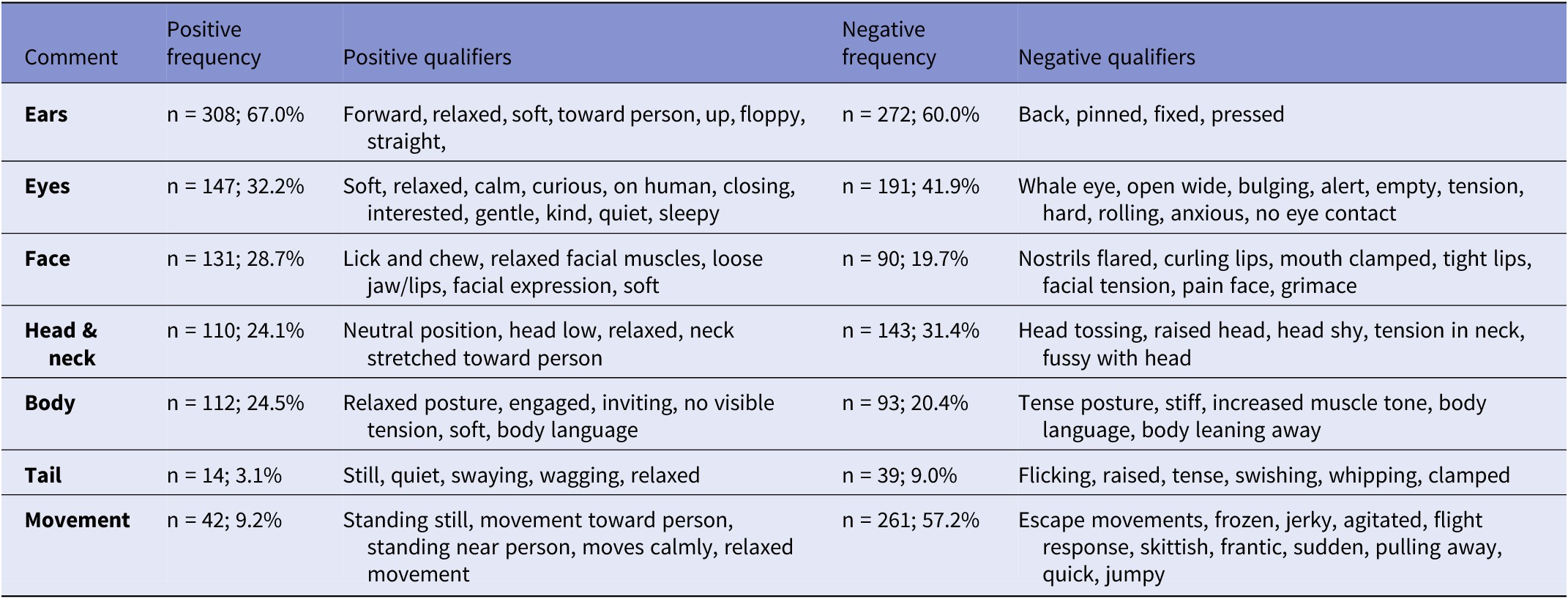
Participants were asked to describe what clues from the horse’s behaviour they used to categorise both positive and negative human-horse interactions. Responses involving the ears, eyes, face, head and neck, body, tail and movement appeared in both the positive and negative descriptors provided by participants (Table 3).
Responses provided by survey participants (n = 457) for both positive and negative indicators of horse affective state after viewing media pieces (n = 31). Frequencies represent the number of participants (n; %) who indicated that they utilised these physical horse traits to categorise human-horse interactions during the media analysis. Qualifiers are examples of the qualitative descriptions respondents wrote
Along with body parts, participants also referred to whether the horse was engaged with the human (n = 271; 59.3%) during positive interactions or avoided (n = 229; 50.2%) the human during negative interactions. Engagement was described as seeking human attention, voluntarily approaching, leaning in or staying close to the human, initiating contact, nuzzling, doing what the human asked of them and their ability to leave if they chose. Seventeen respondents (3.7%) specifically referred to the horse as ‘happy’ while the majority of respondents (n = 286; 62.6%) described the demeanour of the horse in other ways, including curious, inquisitive, calm and relaxed. A small number of respondents (n = 11; 2.4%) explicitly mentioned the actions of the human contributing to their assessment of the scenario, such as maintaining a loose lead rope connection, being relaxed themselves or providing treats or release cues to the horse.
Avoidance was described as being evasive, looking away, pulling back, trying to get away from human, displaying defensive reactions or being uncooperative to the human’s request. The demeanour of the horse included descriptors such as fear, tension, disinterest, jaded, aggression, stress, anxious, inhibited, reactive, unsure, unhappy, irritated, apprehensive and distant. Fifteen respondents (3.3%) indicated the actions of the human being responsible for the horse’s response, either by the human pulling on the reins or using a lot of tension on the lead rope, forcing the horse to do something they did not want to do or using tools to restrict motion, not ensuring the horse understood their request, not being aware of the horse’s reactions or being rushed.
Discussion
The results presented here corroborate findings from other researchers in that generally humans are not very successful in distinguishing the affective state of horses during their interactions with humans (Bell et al. Reference Rogers, Taylor and Busby2019; Rogers & Bell Reference Rogers and Bell2022; Luke et al. Reference Luke, Rawluk, McAdie, Smith and Warren-Smith2023). Participants did better at correctly characterising the valence of the interactions as positive or negative but may have lacked the finesse required to observe the more subtle signs. In particular, neutral responses to human interaction were challenging for the participants to identify in horses. Age, gender, education and horse experience all affected the participants’ ability to categorise the horses’ affective states. Older participants struggled more to correctly categorise neutral scenarios, women generally outperformed men, and those with more education and more horse experience were better able to categorise certain scenarios. How well a participant was in touch with their own inner bodily sensations did not impact their categorisations of the affective states of the horses. Participants provided many descriptors of horse behaviour to qualify their categorisations, mostly relying upon the ears and eyes of the horse and how engaged they were with the human. While participants were able to define various behaviours the horse might portray, there seemed to be a disconnect between recognising the behaviours and linking them to affective states.
In this study, the expert categorisations were taken as 100% correct, although others have shown that experts do not always agree. Pearson et al. (Reference Pearson, Waran, Reardon, Keen and Dwyer2021) showed a poor agreement among equine behaviour experts and veterinarians when assessing behavioural indicators of stress in horses undergoing veterinary treatment. Bell et al. (Reference Rogers, Taylor and Busby2019) showed imperfect consensus of horse affective state among six equine behaviour experts rating videos. However, Pannewitz and Loftus (Reference Pannewitz and Loftus2023) reached consensus among 30 equine behaviour experts on behavioural indicators of frustration in horses. Young et al. (Reference Young, Creighton, Smith and Hosie2012) found the ratings of thirteen equine professionals on the behavioural responses of horses in various stressful situations (e.g. clipping, fireworks) using a simple behaviour scale ranging from no stress (1) to extreme stress (10) to reliably correspond to both heart rate and cortisol measures from those horses. Since at least six of our seven (> 85%) experts had to agree on the behavioural categorisation of the media, and those media that did not reach that benchmark were not included in the survey, we can be fairly confident that the included media depicted the assigned affective state. However, this resulted in our media not being divided evenly among the various categories, with fewer media pieces in slightly negative scenarios. This could imply that even our experts had difficulty interpreting these scenarios since there were fewer media pieces agreed upon in this category.
On average, our survey participants matched expert categorisations of the affective states of the horses depicted in the media only 52.5% of the time, which does not differ much from chance. Similar to Bell et al. (Reference Rogers, Taylor and Busby2019), participants were better at recognising overt positive and negative behaviours the horses displayed but were less discerning of the subtle behaviours. This lack of awareness of subtle signals can lead to escalation of dangerous behaviours and compromise both human and horse safety (Bell et al. Reference Rogers, Taylor and Busby2019; Rogers & Bell Reference Rogers and Bell2022).
When analysed under broader standards (i.e. Criterion 2), our survey participants’ responses improved although they still did not match the expert responses. Under this less stringent analysis, it was clear the participants recognised the valence of the horses’ affective states as positive or negative even if they missed the more subtle signals. Participants struggled most with identifying neutral situations where the horse did not appear responsive to or engaged with the human, highlighting how difficult it can be to accurately identify both subtle and neutral horse behaviours. A horse’s response to human interaction is a combination of their own temperament, previous experiences with humans, individual coping styles and training (Wechsler Reference Wechsler1995; Seaman et al. Reference Seaman, Davidson and Waran2002; McGreevy et al. Reference McGreevy, Oddie, Burton and McLean2009; Bell et al. Reference Rogers, Taylor and Busby2019; Hausberger et al. Reference Hausberger, Lesimple and Henry2021). These factors may lead to minimal behavioural responses that may mask the horse’s affective state. It could be that participants misidentified neutral human-horse interactions to be more positively valanced (Lesimple & Hausberger Reference Lesimple and Hausberger2014; Bell et al. Reference Rogers, Taylor and Busby2019). If the horse depicted in the neutral media was a passive coper, this may improperly translate to humans as the horse being calm or relaxed, which are desirable traits (Bell et al. Reference Rogers, Taylor and Busby2019). Recent research suggests that relying solely upon physical behaviours may not be a reliable indicator of horse affect during stressful situations or interactions as physiological measures may still indicate a stress response (Squibb et al. Reference Squibb, Griffin, Favier and Ijichi2018). For the purposes of this study, human-horse interactions depicting a horse that was disengaged from or minimally participating in the interaction with a human was assigned a neutral categorisation by the experts, but this highlights that despite expert consensus, it may still be an inaccurate categorisation of the true valance of affect being experienced by the horse.
In general, age did not influence the participants’ ability to match expert categorisation of human-horse interactions with the exception of those older than 55 years performing poorer than younger participants when categorising neutral (Criteria 1 and 2) and subtle negative (Criterion 2) scenarios. Older participants viewing photographs of cats were similarly less successful in identifying positive or negative affect than younger participants (Dawson et al. Reference Dawson, Cheal, Niel and Mason2019). Others have shown that the ability to recognise emotions in human facial expressions decreased with age, most particularly when regarding images of neutral or negative emotions (Malykhin et al. Reference Malykhin, Pietrasik, Aghamohammadi-Sereshki, Ngan Hoang, Fujiwara and Olsen2023).
In this study, women outperformed men in correctly categorising obvious positive and negative affective states in horses and tended to outperform men in correctly categorising subtle indicators of affective state. The participants in this study represented more females than males, which is typical of the equine industry in general (Dashper Reference Dashper2016; Fenner et al. Reference Fenner, Caspar, Hyde, Henshall, Dhand, Probyn-Rapsey, Dashper, McLean and McGreevy2019). More women than men believe that horses can feel emotions (Hötzel et al. Reference Hötzel, Vieira and Leme2019) and this, together with the fact that women are more empathic toward animals than men (e.g. Christov-Moore et al. Reference Christov-Moore, Simpson, Coudé, Grigaityte, Iacoboni and Ferrari2014), may account for this result. Similarly, women were better at decoding the valence of horse whinnies than men (Merkies et al. Reference Merkies, Crouchman and Belliveau2021).
Survey participants with a higher level of education were better able to categorise some horse affective states than those with less education. However, Pannewitz and Loftus (Reference Pannewitz and Loftus2023) showed no difference among equine behaviour professionals with or without a PhD in identifying behavioural indicators of frustration in horses. Similarly, education was not found to be a significant factor in human ability to distinguish affective states in cats (Dawson et al. Reference Dawson, Cheal, Niel and Mason2019). Formal education in general is believed to increase human cognitive abilities and was shown to be a stronger factor than experience in recognition of the importance of ecosystems (Lima & Bastos Reference Lima and Bastos2019). However, the influence of formal education on recognition of horse behaviours remains inconclusive.
Within the overt positive and negative categories, participants with more horse experience did perform better than those with little horse experience, although this pattern did not appear in the subtle positive, neutral or subtle negative categories. Horse experience has been related to the ability to distinguish horse behaviours with conflicting outcomes. Fox (Reference Fox2023) showed that lay people performed just as well as practitioners of equine-assisted services when describing the affective states of horses in videos even though they reported a lower level of horse experience. Contrarily, Braun et al. (Reference Braun, Müller-Klein, Sopp, Michael, Link-Dorner and Lass-Hennemann2024) showed that those with more horse experience did better at characterising the affective state of horses in photographs compared to inexperienced people, although they still only correctly identified affective state 50% of the time. Fourth year veterinary students were better at characterising horse behaviour than first year students with less self-reported horse experience (Guinnefollau et al. Reference Guinnefollau, Gee, Bolwell, Norman and Rogers2019). Participants with more experience performed better when assessing the videos depicting in-hand dressage and behavioural rehabilitation but not when assessing ridden horse videos (Bell et al. Reference Rogers, Taylor and Busby2019). It could be that experience interplays with cognitive bias – we process information and make decisions based upon our own perceptions and memories, which are led by our experiences (Azzopardi Reference Azzopardi2021). Those who spend extended periods of time with horses tend to overconfidently assess their horses’ affective state as positive and misinterpret indicators of negative affect (Lesimple & Hausberger Reference Lesimple and Hausberger2014; Bell et al. Reference Rogers, Taylor and Busby2019; Bornmann et al. Reference Bornmann, Randle and Williams2021) and those involved in the daily care of horses underestimate the expression of negative affect as they are likely desensitised to behaviours that, in their opinion, do not affect a horse’s overall well-being (Lesimple & Hausberger Reference Lesimple and Hausberger2014).
Empathy is the ability to recognise the affective state of another and to respond with appropriate emotion. Despite there being a close relationship between empathy seen between humans and interoception (Ernst et al. Reference Ernst, Northoff, Böker, Seifritz and Grimm2013; Hübner et al. Reference Hübner, Trempler, Gietmann and Schubotz2021) results from this study showed no correlation between participant interoception as assessed by the MAIA-2 and their ability to correctly categorise the affective states of horses interacting with humans. The MAIA-2 is a commonly used measure of interoception (Desmedt et al. Reference Desmedt, Heeren, Corneille and Luminet2022; Vig et al. Reference Vig, Köteles and Ferentzi2022) and has demonstrated relationships to interpreting facial expressions of others (Hübner et al. Reference Hübner, Trempler, Gietmann and Schubotz2021). To the authors’ knowledge, the MAIA-2 has not been used to evaluate interpretation of affective states of animals. The lack of correlation between participants’ interoception and their ability to correctly categorise human-horse interactions could indicate that the MAIA-2 is not transferrable across species, as even experts struggle to reach a consensus regarding which behavioural markers suggest a horse may be stressed (Pearson et al. Reference Pearson, Waran, Reardon, Keen and Dwyer2021). An alternate explanation is that people’s perceptions of their own thoughts and emotions are more subjective than their perception of others, as observed within the human medical field where practitioners tend to underestimate their patients’ pain (Marquié et al. Reference Marquié, Raufaste, Lauque, Mariné, Ecoiffier and Sorum2003).
Typically, those actively involved in equestrian activities pride themselves on being able to read their horse, often attributing anthropomorphic states to their horse’s expression of emotion (Hötzel et al. Reference Hötzel, Vieira and Leme2019). Our results did not show much evidence of anthropomorphism in the qualitative responses provided by participants. Despite performing poorly in recognising subtle positive and negative categories, some survey participants were still able to describe subtle indicators of affect (e.g. muscular tension). However, most qualitative descriptions were either excessively broad (e.g. ears, eyes) or referred to more overt indicators of behaviour (e.g. biting). Similarly, Bell et al. (Reference Rogers, Taylor and Busby2019) concluded that participants were more likely to list overt indicators of behaviour although some would be able to identify more subtle cues, like changes in eye aperture (Bell et al. Reference Rogers, Taylor and Busby2019). Survey participants gauged horse affective state mainly in terms of expression of specific body parts. In particular, the eyes and ears were referred to most often as indicative of how a horse was feeling. More body descriptors were suggested to evaluate negative affective state (e.g. head and neck position) than positive affective state, and more comments in general were provided for negative states. This supports the idea that identifying positive affective states in horses is much more challenging than identifying negative affective states (Zeitler-Feicht et al. Reference Zeitler-Feicht, Hartmann, Erhard and Baumgartner2024). Participants also voiced more concern over human actions creating or exacerbating the scenarios leading to negative affective states in the horse than scenarios leading to positive affective states. It is reassuring that survey participants were able to recognise the harmful actions of humans in the scenarios but disappointing that overall they were still unable to characterise when horses were experiencing negative affective states. A similar study evaluating human ability to recognise distress in horses also found that some participants would be comfortable with their horse being subjected to the same treatment or situation that could result in negative affect (Bell et al. Reference Rogers, Taylor and Busby2019).
Rapid advances in technology make it now increasingly possible to decipher horse behaviour using artificial intelligence. Simple detection of key body points and their change over time allows for gross determination of animal activity as an indicator of health and well-being (Kleanthous et al. Reference Kleanthous, Hussain, Khan, Sneddon, Al-Shamma’a and Liatsis2022). More sophisticated approaches utilise deep learning to determine patterns and features specific to affective states reflecting potential pain in horses based on more frequent changes in posture (Martin-Cirera et al. Reference Martin-Cirera, Nowak, Norton, Auer and Oczak2024) and the Horse Grimace Scale (Lencioni et al. Reference Lencioni, de Sousa, de Souza Sardinha, Corrêa and Zanella2021). While these techniques are very promising for behaviour recognition and would drastically reduce time commitment for assessment in a non-invasive manner, the methodology still remains in its infancy (Rohan et al. Reference Rohan, Saad Rafaq, Md, Asghar, Kashif Bashir and Dottorini2024).
Animal welfare implications
To safeguard both human and horse welfare during human-horse interactions, it is imperative that humans recognise positive human-horse interactions to promote their reoccurrence, and negative human-horse interactions to avoid subjecting horses to unnecessary stress. However, similar to other studies, our survey participants were unable to successfully deduce horse affective state in various scenarios compared to expert categorisations. Participants were more successful at identifying overt indicators of affect over subtle indicators and could generally infer the positive or negative valence of a scenario. Human literature suggests that those who are more aware of their own internal body sensations may have more empathy for others. To our knowledge, this is the first study that has attempted to relate human interoception to identification of horse affective states. However, our results showed participants’ interoception determined by the MAIA-2 questionnaire did not impact their ability to match expert categorisations of human-horse interactions. Despite participants being able to qualitatively describe negative affect in horses, this did not translate to their ability to characterise affective state, underscoring the subconscious disconnect between behavioural signals and affective states. Future research would benefit from focusing on subtle indicators of horse affect, to identify if participants misconstrue subtle indicators of negative affect as neutral, or even positive, as many involved in horse care inaccurately identify or ignore negative indicators of affect. Although participants with more self-reported experience with horses performed better at identify affective states, continued improvement in education and awareness of horse behaviour will ensure continued improvement for horse welfare.
Supplementary material
The supplementary material for this article can be found at http://doi.org/10.1017/awf.2024.55.
Competing interest
None.




 Open access

