





Early language skills are among the broadest predictors of childhood outcomes, including academic achievements (Pace et al., Reference Pace, Alper, Burchinal, Golinkoff and Hirsh-Pasek2019). During the first years of a child’s life, language development is supported by the quality and quantity of caregiver language input, which varies across infants and caregivers as a function of numerous factors. These include maternal–infant interactions, which can be impacted by postnatal depression and anxiety. Postnatal depression and anxiety are common conditions that often present together during the postnatal period and can be very debilitating (Matthey et al., Reference Matthey, Barnett, Howie and Kavanagh2003; Reck et al., Reference Reck, Noe, Gerstenlauer and Stehle2012; Farr et al., Reference Farr, Dietz, O’Hara, Burley and Ko2014). There is some evidence to suggest that maternal anxiety and depression are associated with an increased risk of poor language outcomes in infants (e.g., Kaplan et al., Reference Kaplan, Danko, Everhart, Diaz, Asherin, Vogeli and Fekri2014; Reck et al., Reference Reck, Van Den Bergh, Tietz, Müller, Ropeter, Zipser and Pauen2018). Understanding any direct and indirect effects of these conditions on maternal input and later child language outcomes is important for informing any early interventions. Here, we investigate the effects of maternal language input on children’s early vocabulary development from 24 to 30 months as part of a larger longitudinal study tracking child development and maternal depression and anxiety symptoms from birth to 30 months.
Maternal input and vocabulary development
One view of language development is that it is socially mediated (Kuhl, Reference Kuhl2007). Mothers, who are often the primary caregivers, provide input that helps scaffold language development through maternal–child interactions. These early interactions are critical to later language development. For example, the classic Hart and Risley (Reference Hart and Risley1995) study revealed that cumulative maternal input profoundly impacted children’s vocabulary development. More recently, there has been a recognition that both the quantity (e.g., number of words) and quality of maternal input (e.g., word complexity, diversity, etc.) are important, with quality possibly gaining importance as children’s language develops. A study that compared quantity (word tokens) against diversity (word types) in computational models of input suggests that lexical diversity grows in importance with child age along with children’s expanding vocabularies (Jones & Rowland, Reference Jones and Rowland2017). Similarly, while the quantity of maternal input at 18 months predicted children’s vocabulary at 30 months, parents’ vocabulary diversity but not quantity at 30 months predicted children’s vocabulary at 42 months (Rowe, Reference Rowe2012). As children’s language skills develop, maternal input becomes more complex not just in terms of lexical but also in syntactic and grammatical complexity, as measured using mean length of utterance (MLU). For 2-year-olds, in addition to lexical complexity, MLU is also predictive of child vocabulary development (Hoff & Naigles, Reference Hoff and Naigles2002). These research findings suggest that while infants initially require large quantities of input to kick start their vocabulary learning, once the process takes off during the third year of life, children need diverse quality of input (e.g., increasing word diversity and MLU) to develop more complex vocabulary and language use.
Effects of postnatal depression and anxiety on maternal input
During the first 3 months after birth, up to 1 in 5 mothers experience symptoms of postnatal depression (Gavin et al., Reference Gavin, Gaynes, Lohr, Meltzer-Brody, Gartlehner and Swinson2005). These symptoms are similar to those of major depressive disorder and can include a loss of appetite, sleep disturbance, loss of interest in pleasurable activities, agitation, concentration difficulties, feelings of guilt and worthlessness, and suicidal thoughts (DSM-Reference Campbell, Matestic, von Stauffenberg, Mohan and Kirchner5-TR, 2022). Anxiety disorders commonly co-occur with postnatal depression and include generalised anxiety, specific phobias, and panic disorders (DSM-Reference Campbell, Matestic, von Stauffenberg, Mohan and Kirchner5-TR, 2022), with an estimated prevalence ranging from 3% to 43% in Western societies (Leach et al., Reference Leach, Poyser and Fairweather-Schmidt2017).
All of the above symptoms could have profound impacts on how well mothers function in their everyday lives, including how they interact with their children, affecting the quantity and quality of mother–infant communicative interactions. For example, postnatal depression has been linked to a reduced number of words spoken, fewer conversational turns, and reduced maternal sensitivity (Brookman et al., Reference Brookman, Kalashnikova, Conti, Xu Rattanasone, Grant, Demuth and Burnham2020a; Campbell et al., Reference Campbell, Matestic, von Stauffenberg, Mohan and Kirchner2007; Clifford et al., Reference Clifford, Stockdale, Coyne, Rainey and Benitez2022). For instance, maternal depression symptoms were shown to be associated with decrease in the amount/quantity of child-directed speech (Scheiber et al., Reference Scheiber, Ryckman and Demir-Lira2022), a special speech register used with young children and adapted to their cognitive and linguistic needs. Despite these findings on the direct impact of maternal depression symptoms on maternal input, a recent systematic review reported discrepant findings on the role of maternal depression on children’s receptive and expressive language development (Clifford et al., Reference Clifford, Rainey and Eggum2024). Detecting maternal depression as having a negative impact on children’s language development is more likely with chronic depression and/or in children older than 1 year (Clifford et al., Reference Clifford, Rainey and Eggum2024). This suggests that prolonged depressive symptoms may affect the social dynamic of maternal–child interactions, leading to poorer language outcomes, whereas similar effects may not be observed for mother-infant dyads in which the mother has experienced transient depressive symptoms.
Much less is known about the effect of maternal anxiety on language development. Postnatal anxiety symptoms can also significantly impair daily functioning (Barlow, Reference Barlow2004), which could impact the quality of mother–infant interactions (e.g., Nicol-Harper et al., Reference Nicol-Harper, Harvey and Stein2007) and potentially have negative consequences for child language development. For example, 12-month-olds of mothers with anxiety scored significantly lower on the language subtests of the Bayley-III than controls (Reck et al., Reference Reck, Tietz, Müller, Seibold and Tronick2018). However, whether maternal anxiety negatively impacts the quantity and quality of maternal input to infants is less known. This is partly due to the high comorbidity of depression and anxiety conditions (Leach et al., Reference Leach, Poyser and Fairweather-Schmidt2017) and depression masking anxiety symptoms (Grant et al., Reference Grant, McMahon and Austin2008; Kaitz et al., Reference Kaitz, Maytal, Devor, Bergman and Mankuta2010). As it is not always possible to understand the independent effects of postnatal depression and anxiety disorders on infants’ development, recent studies have considered the two conditions together in a single community sample. For example, Brookman et al. (Reference Brookman, Kalashnikova, Conti, Xu Rattanasone, Grant, Demuth and Burnham2020a) studied a community group of mothers with and without elevated depression and/or anxiety and showed that fewer mother-infant conversational turns and infant vocalisations at six and 12 months were linked to elevated depression and/or anxiety symptoms, and individual variations in conversational turns and number of vocalisations at these earlier points of development predicted infants’ expressive vocabulary size at 18 months. Similarly, while levels of maternal depression and anxiety symptoms predicted infants’ vocabulary size at 18 months in a subgroup of this community sample, maternal responsiveness (contingent on infants’ needs) was a stronger predictor (Brookman et al., Reference Brookman, Kalashnikova, Conti, Levickis, Xu Rattanasone, Grant, Demuth and Burnham2023). Both studies thus suggest that it is through maternal input that both depression and anxiety may influence early language development.
About this study
This study investigated the effects of maternal language input on children’s early vocabulary development from 24 to 30 months as part of a larger longitudinal study tracking child development and maternal depression and anxiety symptoms from birth to 30 months.
The study included a subset of mother-infant dyads from the longitudinal cohort from Brookman et al. (Reference Brookman, Kalashnikova, Conti, Xu Rattanasone, Grant, Demuth and Burnham2020a, Reference Brookman, Kalashnikova, Conti, Xu Rattanasone, Grant, Demuth and Burnhamb, Reference Brookman, Kalashnikova, Conti, Levickis, Xu Rattanasone, Grant, Demuth and Burnham2023).
Following Brookman et al. (Reference Brookman, Kalashnikova, Conti, Xu Rattanasone, Grant, Demuth and Burnham2020a, Reference Brookman, Kalashnikova, Conti, Xu Rattanasone, Grant, Demuth and Burnhamb, Reference Brookman, Kalashnikova, Conti, Levickis, Xu Rattanasone, Grant, Demuth and Burnham2023), we performed two approaches for treating maternal depression and anxiety scores: categorical and continuous. First, we allocated mother-infant dyads to a risk or no-risk control group, that is, based on the mothers’ diagnosis and/or elevated symptoms of depression and anxiety (reaching a clinical threshold) at any sampling point during their participation in the larger project (when their infants were from 6 to 30 months of age). This addresses our first research question about clinical status: whether having clinical diagnosis/clinical levels of symptoms negatively impact early language development (expressive vocabulary size).
Second, concurrent data for this study (when infants were 24 and 30 months of age) from the entire sample were collapsed, placing mothers on a continuum of current depression and anxiety measures. This addresses our second research question about timing: whether having concurrent higher levels of symptoms negatively impacts language development (expressive vocabulary size).
Given that mothers’ depression and anxiety scores may have changed over the two years since their child’s birth, we expect that higher concurrent anxiety and depression scores (not historical clinical status) may have a negative effect on child vocabulary development.
Finally, for each research question (RQ), we also explore any interactions between a history of clinical symptoms (RQ1) and/or higher concurrent symptoms (RQ2) with maternal input measures. Given that this study focuses on children’s language development in the third year of life, our analyses focussed on input quality and quantity measures that are significant predictors of children’s language abilities in this age range (Rowe, Reference Rowe2012). We predicted that if maternal depression and anxiety symptoms affected the quality of the input, then mothers with a history or concurrent elevated scores would have lower maternal input measures (quantity and diversity of words, as well as input complexity (MLU)), which will predict smaller expressive vocabulary size.
Method
Sample
Thirty mother-infant dyads (12 female infants) participated, with 15 in the risk group and 15 in the control group. Mothers commenced the study when their infants were six months old. This article reports on data collected at 24 and 30 months. To account for the potential variation in the severity and persistence of symptoms of maternal emotional health concerns during the postnatal period, which is known to influence child development outcomes, mean postnatal depression scores and mean postnatal anxiety scores at six, nine, 12, 18, 24, and 30 months (see Maternal measures below) were calculated for each participant by averaging scores obtained at each data collection point (see Supplementary Materials, S1, for details). Mothers were allocated to the risk group if they: (i) had a self-reported current diagnosis of depression or anxiety or (ii) depression and or anxiety scores, either or both of which exceeded the clinical threshold (i.e., CESD-R ≥ 16; State-Trait Anxiety Inventory [STAI] ≥ 40) at any of the six testing time points. The remaining mothers were allocated to the control group. Mother-infant dyads remained in the risk group for the duration of the study despite potential changes to their emotional health scores due to evidence that impaired mother–infant interaction styles can persist beyond the remission of depression with ongoing risks to infant developmental outcomes (e.g., Murray et al., Reference Murray, Halligan and Cooper2010).
All infants were born into households with two heterosexual parents, full-term (37–42 weeks), with normal birth weight and no history of birth or postnatal complications. Infants were acquiring English in a monolingual context and were not exposed to a second language, and they had no reported hearing difficulties, neurological conditions, or health problems. As a measure of socioeconomic status, mothers reported their highest education level, with most having a graduate degree or above (13 in the risk group and 12 controls).Footnote 1 This study was approved by the [blind for review] Human Research Ethics Committee [approval number: H11703]
Instruments
Maternal measures
All mothers completed self-reported measures of both depression and anxiety symptomatology. The Centre for Epidemiologic Studies Depression Scale-Revised (CESD-R) was used to measure depression symptoms (Eaton et al., Reference Eaton, Smith, Ybarra, Muntaner and Tien2004). The CESD-R is a 20-item self-reported scale of depressive symptoms and has been used widely with maternal populations in the perinatal period (Engle, Reference Engle2009). The total score ranges from 0 to 60, with higher scores indicating more severe depressive symptoms. A total score of ≥16 indicates clinically significant levels of depression. It has excellent psychometric properties, including strong factor loadings, high internal consistency, and theoretically consistent convergent and divergent validity (Van Dam & Earleywine, Reference Van Dam and Earleywine2011).
The State Scale of the STAI was used to measure anxiety symptoms (Spielberger et al., Reference Spielberger, Gorsuch, Lushene, Vagg and Jacobs1983). The total score ranges from 20 to 80 with higher scores indicating more severe state anxiety symptoms. Scores of 20 to 39 are considered low anxiety and scores of ≥40 have been used to indicate clinical or high levels of state anxiety in childbearing women in prior Australian studies. The STAI is a reliable and valid measure of current self-reported anxiety that is one of the most commonly used measures to capture clinical and subclinical anxiety levels (Spielberger et al., Reference Spielberger, Gorsuch, Lushene, Vagg and Jacobs1983; Glasheen et al., Reference Glasheen, Richardson and Fabio2010). The STAI has demonstrated good internal consistency in prior Australian studies with childbearing women (Grant et al., Reference Grant, McMahon and Austin2008).
Maternal input measures
Recordings of 10-minute mother-infant free play sessions using an iPad were collected in a sound-treated laboratory room. In each session, mothers were provided with a box of toys and were asked to engage in play with their children using these toys. Maternal speech was transcribed using the CLAN software (MacWhinney, Reference MacWhinney2000). The MLU using words (MLUw) as well as word types and tokens were extracted from the transcriptions. The transcriptions were conducted by trained intern students enrolled in undergraduate linguistic courses, and the first author checked all transcriptions for accuracy.
Infant measure: expressive vocabulary checklist
When the infants were 24 and 30 months of age, mothers were invited to complete the Australian English adaptation of the MacArthur-Bates Communicative Inventory (Fenson, Reference Fenson2007), known as the OZI (Kalashnikova et al., Reference Kalashnikova, Schwarz and Burnham2016). Mothers were asked to identify words on the checklist that their children could produce.
Results
Two linear mixed-effects models were created and analysed using jamovi and R (Gallucci, Reference Gallucci2019; R Core Team, 2021; The jamovi project, 2021). The maximal random-effects models allowed by the data are presented. See Table 1 for descriptive information on depression, anxiety, vocabulary, MLU, word tokens, and types.
Means and standard deviations for depression (CESD-R), anxiety (STAI), vocabulary (OZI), MLU, word token, and types by age and group

The first model addressed our first RQ: whether having clinical diagnosis/clinical levels of symptoms negatively impacts early language development (expressive vocabulary size). Model 1 treated groups as categorical factors: risk vs. no-risk based on whether mothers did or did not have a diagnosis of depression or anxiety and/or had elevated symptoms. Model 2 did not include a group comparison but instead treated the depression and anxiety scores as continuous variables. Both models included the same mother-child dyads.
In Model 1, children’s OZI scores were entered as the dependent variable and ages (24 vs. 30 months) and group (risk vs. no-risk) as fixed factors with interaction. MLU, word token, and type were entered as covariates, and participants were entered as a random variable with random intercepts (see Table 2 for results). The model detected the main effect of age and MLU, with no other significant effects detected. The main effect of age suggests that both groups showed an increase in OZI scores between 24 and 30 months (M24 = 263 vs. M30 = 457), and the main effect of MLU suggests that increases in MLU predicted increases in OZI scores.
Model 1 fixed-effects parameter estimates

R-code: OZI ~ 1 + Age + Group + MLU + WordToken + WordType + Risk:Child_Age + (1 | Participant).
** p <.01,
*** p <.001
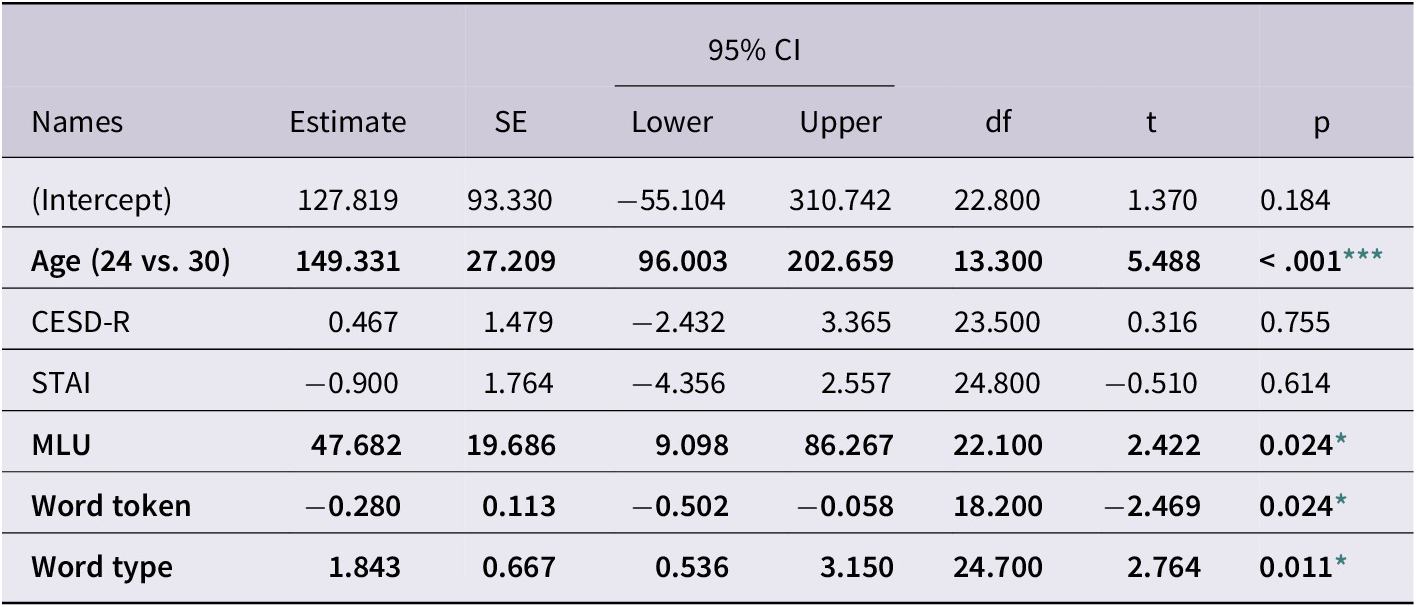
The second model addressed our second RQ about timing: whether having concurrent higher levels of symptoms negatively impacts language development (expressive vocabulary size). Model 2 included children’s OZI scores as the dependent variable, ages (24 vs. 30 months) as a categorical factor, and STAI, CESD-R, MLU, word type, and token as continuous covariates and participants entered as a random variable with random intercepts (see Table 3 for results). The model detected a main effect of age, MLU, word token, and type, with no other significant effects detected. The main effects of age and MLU are consistent with Model 1, but with the addition of anxiety and depression scores as continuous variables, both word type and token significantly predicted OZI scores. The significant word token and type effects suggest that decreasing tokens and increasing types predicted increases in OZI scores. These results suggest that child vocabulary development is predicted by increasing the use of word diversity (type) and decreasing the use of word repetition (token) in the third year of development.
Fixed-effects parameter estimates

R-code: OZI ~ 1 + Age + MLU + STAI + CESD-R + WordToken + WordType +(1 | Participant).
* p <.05,
*** p <.001
A correlation analysis using Pearson’s r at 24 and 30 months was conducted to explore any possible correlation among the predictors (see Supplementary Materials S2). Significant moderate positive correlations were detected between STAI and CESD-R (anxiety and depression symptoms) at both 24 and 30 months – this is consistent with past research (Brookman et al., Reference Brookman, Kalashnikova, Conti, Xu Rattanasone, Grant, Demuth and Burnham2020a, Reference Brookman, Kalashnikova, Conti, Xu Rattanasone, Grant, Demuth and Burnhamb; Dol et al., Reference Dol, McDonald and Ferro2022). Significant moderate negative correlations were also detected for CESD-R with MLU at 24 months and with token at 30 months. Significant moderate negative correlations were detected between MLU and Type at both 24 and 30 months, and significant strong positive correlations were detected between type and token at both 24 and 30 months.
Discussion
We found no support for our main hypotheses. The analyses did not detect clinical status (history of clinical diagnosis/elevated symptoms) or timing (concurrent levels of depression and anxiety symptoms) as significant predictors of vocabulary size in children during the third year of life. However, maternal input measures, especially MLU, did predict vocabulary size at 24 and 30 months, and the effect is similar for children with mothers who did vs. did not experience (historical or concurrent) clinical levels of depression and/or anxiety symptoms during early development. These findings suggest that children’s vocabulary size increased between 24 and 30 months, and maternal depression and anxiety did not play a direct role in vocabulary development in our community sampleFootnote 2.
Our results suggest that maternal input measures, especially complexity of the input, continue to be strong predictors of vocabulary development during the third year of life for both children of mothers with and without a clinical diagnosis/elevated depression and/or anxiety symptoms. The complexity of the language input, as measured by MLU, consistently predicted vocabulary size across development at 24 to 30 months. Quantity and diversity (token and type) of words in the maternal input were the only significant predictors of vocabulary development when the entire sample was treated as a single group (with depression and anxiety scores as continuous variables). This suggests that MLU may be a more sensitive measure. Overall, our results show that vocabulary development in 2-year-olds was predicted by a decrease in word tokens and an increase in word types and general complexity of the linguistic model (MLU). This suggests that mothers are using more diverse vocabulary and complex language while reducing word repetitions as children develop larger vocabularies – consistent with previous studies with typically developing 2-year-olds (Hoff & Naigles, Reference Hoff and Naigles2002). This finding, together with Brookman et al. (Reference Brookman, Kalashnikova, Conti, Xu Rattanasone, Grant, Demuth and Burnham2020a, Reference Brookman, Kalashnikova, Conti, Levickis, Xu Rattanasone, Grant, Demuth and Burnham2023), echoes the importance of mothers speaking to their infants as much as possible over the first two years of development to kick start the language learning process, but by the third year, mothers are using more diverse vocabulary and increasing the complexity of their language model.
The lack of any difference in vocabulary size between groups is consistent with our previous findings with this longitudinal cohort (Brookman et al., Reference Brookman, Kalashnikova, Conti, Xu Rattanasone, Grant, Demuth and Burnham2020a, Reference Brookman, Kalashnikova, Conti, Levickis, Xu Rattanasone, Grant, Demuth and Burnham2023) and may suggest that good management of clinical symptoms during early development can protect against poor language development. Those studies found that the effect of depression and anxiety symptoms during the first year of life on vocabulary development at 18 months was moderated by maternal input – conversational turns and maternal responsiveness. Our current findings also suggest similar direct effects of depression and anxiety symptoms on vocabulary. While neither depression nor anxiety predicted vocabulary development, correlations were detected between depression and maternal input. Mothers with higher depression symptoms produced shorter and less complex sentences (smaller MLUs) and fewer words (tokens). The correlation found between depression and anxiety means that we cannot tease apart their independent effects. Therefore, the current findings are consistent with past reports that depression and anxiety symptoms exert an indirect effect on vocabulary development through maternal input, highlighting the importance of social facilitation in language development. Similar significant findings with depression as a moderating effect have been reported, but this is by no means a consistent finding (see Clifford et al., Reference Clifford, Rainey and Eggum2024, for a broader discussion). The different focus across studies on various ages of children, length of depression, the timing of symptoms, and diagnosis makes concluding studies challenging. However, given that our risk sample did not report prolonged elevated clinical levels of depression over the entire duration of the study, our findings do suggest that good clinical management of maternal depression and anxiety symptoms is beneficial to children’s language development – consistent with the findings of the recent systematic review (Clifford et al., Reference Clifford, Rainey and Eggum2024).
Related to the above point, some caution must be taken when generalising the results of our community sample to the larger clinical population. First, during the course of our longitudinal study, and especially after the first year of life, nearly all mothers in our sample reported subclinical levels of depression and anxiety, i.e., only reporting elevated clinical levels at a few sampling points. This could reflect different developmental phases where acute postnatal depression subsides into the second and third years of life with time, or it could reflect good clinical management in our sample. This is especially likely given the generally high maternal education levels of this sample and, therefore, higher SES. Second, the number of mothers returning to the study at 24 and 30 months was reduced as most returned to full-time employment. Therefore, the effect of depression and anxiety symptoms may not be detectable in the current sample but may be present in the larger clinical population. For example, our results should not be generalised to mothers with continued elevated clinical levels of depression and anxiety symptoms throughout their children’s early development. The sustained effect of elevated clinical levels of symptoms could not be evaluated by this study. Despite the need for more studies, especially those with longitudinal data, to more effectively evaluate the impact of clinical status and timing on child language development, our study does highlight the critical importance of early and continued management of symptoms during early development for language outcomes. Our results, together with the recent systematic review (Clifford et al., Reference Clifford, Rainey and Eggum2024), suggest that short periods of clinical levels of maternal depression and anxiety symptoms during early development may not have lasting effects on children’s language development, especially if high-quality maternal input in both quantity and quality can be maintained.
One point of difference in the findings among our longitudinal sample is the effect of depression and anxiety on vocabulary size vs. word processing. While the current study together with Brookman et al. (Reference Brookman, Kalashnikova, Conti, Xu Rattanasone, Grant, Demuth and Burnham2020a) and (Reference Brookman, Kalashnikova, Conti, Levickis, Xu Rattanasone, Grant, Demuth and Burnham2023) reported no group differences for vocabulary size at 18, 24, and 30 months, Brookman et al. (Reference Brookman, Kalashnikova, Conti, Xu Rattanasone, Grant, Demuth and Burnham2020b) found that children in the risk group were slower to process words in a lexical identification task at 18 months. Therefore, it is possible that the vocabulary measure used here is not sensitive enough to capture more fine-grained differences in, e.g., how robustly words are encoded, represented, and/or retrieved during online processing for at-risk children. While caregiver vocabulary reports are time efficient in evaluating children’s linguistic knowledge, they are not designed to evaluate children’s language processing skills. The cumulative effect of slower word (and sentence) processing can have profound impacts on children’s social and academic outcomes. Future studies should further probe these linguistically dependent cognitive processes as a function of development to fully understand the impact of early exposure to risk factors on later development so that we can better prepare and support at-risk children as they enter schools.
Two additional limitations should be considered when interpreting the results of this study. First, only mothers were included in the assessments as children’s primary caregivers. However, it is the case that more fathers become primary carers or take on equal caring responsibilities, and their role in children’s language development should be considered (see Ferjan Ramírez, Reference Ferjan Ramírez2022, for a discussion on language input from fathers versus mothers). However, the finding that good mental health management may be critical in ensuring good early language development should also extend to fathers and others responsible for the primary care of infants. Second, the majority of our sample have a graduate degree or higher, which could lead to better access to mental healthcare. Our findings have important implications for families with lower socioeconomic status and government policies. Mental health services must be delivered to all mothers in need of support in a timely fashion in response to the narrow early child developmental window.
Conclusion
In a community sample, we found that maternal emotional health concerns did not predict poorer vocabulary outcomes in 2-year-olds. Our results suggest that good management of maternal depression and anxiety symptoms, as well as providing a language model with increasing complexity as children’s language develops, are critical during early development. Our series of longitudinal studies together suggest that continued clinical management of depression and anxiety symptoms from birth is critical in reducing the risk of poor language development in young children. These studies also call for future longitudinal studies to track development beyond the first 3 years of life and examine the impact of depression and anxiety on later language and literacy development.
Supplementary material
The supplementary material for this article can be found at http://doi.org/10.1017/S0305000924000308.




 Open access

