


In Chapter 2, we showed that informal social control varied significantly across the street types we study, and that cold spots had much higher levels of informal social control than crime hot spots. Additionally, in Chapter 3, we showed that informal social control at crime hot spots did not vary significantly across communities, illustrating that hot spots across the city are more like each other in terms of informal social control than the communities they are nested in. Moreover, in Chapter 4, we found that informal social control was a significant and strong predictor of crime in the street segments in our study. These findings are consistent with a long tradition of viewing informal social control as a key element in understanding crime in communities (Armstrong et al., Reference Armstrong, Katz and Schnebly2015; Lanfear, Reference Lanfear2022; Mazerolle et al., Reference Mazerolle, Wickes and McBroom2010; Sampson, Reference Sampson2012; Sampson and Raudenbush, Reference Sampson and Raudenbush1999; Sampson et al., Reference Sampson, Raudenbush and Earls1997; Zahnow et al., Reference Zahnow, Corcoran, Kimpton and Wickes2022). Beginning with the Chicago School in the early twentieth century, informal social control has been at the heart of efforts to understand why some communities have higher rates of crime than others (Bursik and Grasmick, Reference Bursik and Grasmick1993; Kornhauser, Reference Kornhauser1978; Shaw and McKay, 1942 [Reference Shaw and McKay1969]). Given the significance of informal social control in traditional criminological explanations of crime, and in our models explaining crime at street segments, we focus in this chapter on what impacts levels of informal social control at crime hot spots.
Over the last half century, the importance of informal social control emerged as a central idea for understanding and responding to crime in communities in two influential restatements of the role of informal social control in crime causation and prevention. The first, proposed by James Q. Wilson and George Kelling (Reference Wilson and Kelling1982), identified a developmental sequence that begins with disorder on a street (the “broken windows,” in the title of their influential article published in The Atlantic), leads to fear and withdrawal in the community, and finally, to spiraling crime rates. While broken windows theory has been associated primarily with policing reforms, it identifies the failures of informal social control in the community as the key mechanism through which crime develops (Weisburd et al., Reference Weisburd2015). As Wilson and Kelling (Reference Wilson and Kelling1982) noted in their article: “The essence of the police role in maintaining order is to reinforce the informal control mechanisms of the community itself. The police cannot, without committing extraordinary resources, provide a substitute for that informal control” (p. 34). Wilson and Kelling (Reference Wilson and Kelling1982) argued that increasing disorder is the prime cause of declining informal social control in communities.
In the second restatement, Sampson, Raudenbush, and Earls, published a seminal article in Science in 1997, which also sought to renew interest in the role of informal social control in crime causation and prevention. They noted that traditional social disorganization theory focused on the underlying structural conditions that led to a breakdown of informal social control, rather than informal social control itself. Drawing from work by Bandura (Reference Bandura1982), Sampson et al. (Reference Sampson, Raudenbush and Earls1997) emphasized the importance of declines in collective efficacy (their direct measure of informal social control in the community introduced in Chapter 2) to understand what leads to high-crime in communities (see also Sampson, Reference Sampson2012). They proposed a series of structural features of communities, such as concentrated disadvantage and residential stability (i.e., residential tenure and homeownership), that would impact a community’s level of collective efficacy.
In this chapter, we focus directly on these explanations for lower levels of informal social control and apply them to crime hot spots. We found in Chapter 2 that informal social control varied greatly across the hot spot and non–hot spot streets in our study. In this chapter, we seek to understand what leads to the variability we observed.
5.1 What Influences Informal Social Control?
Wilson and Kelling (Reference Wilson and Kelling1982; see also Kelling and Coles, Reference Kelling and Coles1996) proposed a developmental sequence for understanding the decline of community controls that is tightly linked to disorder in the community. The spiral toward crime begins simply with broken windows which are left untended:
Social psychologists and police officers tend to agree that if a window in a building is broken and is left unrepaired, all the rest of the windows will soon be broken. … Window-breaking does not necessarily occur on a large scale because some areas are inhabited by determined window-breakers whereas others are populated by window-lovers; rather, one unrepaired broken window is a signal that no one cares …
The pathway to declines in informal social control in the community is through what Wilson and Kelling (Reference Wilson and Kelling1982) described as “…a kind of developmental sequence” (p. 31):
A stable neighborhood of families who care for their homes, mind each other’s children, and confidently frown on intruders can change, in a few years or even a few months, to an inhospitable and frightening jungle. A piece of property is abandoned, weeds grow up, a window is smashed… Families move out, unattached adults move in. Teenagers gather in front of the corner store. The merchant asks them to move, they refuse. Fights occur. Litter accumulates… Such an area is vulnerable to criminal invasion. Though it is not inevitable, it is more likely that here, rather than in places where people are confident they can regulate public behavior by informal controls…
Social and physical disorder are the key antecedents of the sequence described by Wilson and Kelling (Reference Wilson and Kelling1982), signaling to outsiders and offenders that residents do not care about their community and that they can engage in criminal behavior in the area without being bothered (see also, Innes Reference Innes2004). Wilson and Kelling (Reference Wilson and Kelling1982) claimed that disorder problems, and perhaps the resulting increased levels of fear, lead to withdrawal from the community (see Hinkle, Reference Hinkle2013, Reference Hinkle2015). This took two forms – people moving away from the area and those remaining residents becoming less likely to intervene in community affairs. Studies of broken windows have generally focused on the relationships between disorder and crime (e.g., see Sampson and Raudenbush, Reference Sampson and Raudenbush1999; Taylor, Reference Taylor2001; Vilalta et al., Reference Vilalta, Lopez, Fondevila and Siordia2020, Yang, Reference Yang2010) and have seldom examined the intervening mechanism of informal social controls in the community (for reviews, see Braga et al., Reference Braga, Welsh and Schnell2015; Hinkle, Reference Hinkle2013; Weisburd et al., Reference Weisburd2015). Wilson and Kelling (Reference Wilson and Kelling1982), in this context, are clear that informal social control in the community is the key mechanism through which crime is reduced (see also, Bratton and Kelling, Reference Bratton and Kelling2006; Gault and Silver, Reference Gault and Silver2008; Weisburd et al., Reference Weisburd2015; Weisburd et al., Reference Weisburd, Gill, Wooditch, Barritt and Murphy2021; Xu et al., Reference Xu, Fiedler and Flaming2005).
The causal mechanisms proposed by Sampson et al. (Reference Sampson, Raudenbush and Earls1997) suggested a very different pathway to low informal social control. Like Wilson and Kelling (Reference Wilson and Kelling1982), Sampson et al. (Reference Sampson, Raudenbush and Earls1997) focus more generally on informal social control and its importance for reducing crime:
In contrast to formally or externally induced actions (for example, a police crackdown), we focus on the effectiveness of informal mechanisms by which residents themselves achieve public order. Examples of informal social control include the monitoring of spontaneous play groups among children, a willingness to intervene to prevent acts such as truancy and street-corner “hanging” by teenage peer groups, and the confrontation of persons who are exploiting or disturbing public space. Even among adults, violence regularly arises in public disputes, in the context of illegal markets (for example, prostitution and drugs), and in the company of peers. The capacity of residents to control group-level processes and visible signs of social disorder is thus a key mechanism influencing opportunities for interpersonal crime in a neighborhood
Their focus is not directly on disorder, however, and links back to the Chicago School of Sociology (see Shaw and McKay, 1942 [Reference Shaw and McKay1969]), focusing on the social structural characteristics of communities and how those characteristics impact informal social control. Sampson et al. (Reference Sampson, Raudenbush and Earls1997) hypothesized that informal social control, defined as collective efficacy in their work (see Chapter 2), would mediate the relationship between structural characteristics and neighborhood crime rates. Their “collective efficacy model” identified a series of social structural features of communities that would impact on a community’s level of informal social control. Residential tenure and home ownership were two key elements of their model, which were seen to “promote collective efforts to maintain social control” (Sampson et al., Reference Sampson, Raudenbush and Earls1997 p. 919). In turn, concentrated disadvantage was seen as a central concern because the “alienation, exploitation, and dependency wrought by resource deprivation act as a centrifugal force that stymies collective efficacy” (p. 919; see also Sampson, Reference Sampson2012; Wilson, Reference Wilson1987). Social ties and social networks were also important to collective efficacy theory as it enabled the development of informal social control. But even if personal ties are strong in areas of concentrated disadvantage, they noted that “they may be weakly tethered to collective actions” (Sampson et al., Reference Sampson, Raudenbush and Earls1997, p. 919; Wickes and Lanfear, Reference Wickes, Lanfear, Oberwittler and Wickes2025). Sampson and Raudenbush (Reference Sampson and Raudenbush1999) also predicted that collective efficacy may be impacted by crime. They note that residents’ sense of efficacy and their willingness to engage with others to exercise informal social control can be undermined by social disorder and violence in the community (also see Armstrong et al., Reference Armstrong, Katz and Schnebly2015; Hipp, Reference Hipp2016; Kleinhans and Bolt, Reference Kleinhans and Bolt2014).
Studies of collective efficacy have focused primarily on its relationship to crime, and there have been few empirical examinations of the factors that predict collective efficacy (for exceptions, see Armstrong et al., Reference Armstrong, Katz and Schnebly2015; Gerell and Kronkvist, Reference Gerell and Kronkvist2016; Sampson and Raudenbush, Reference Sampson and Raudenbush1999). Our study is the first effort to examine the antecedents of collective efficacy at the micro geographic level.
5.2 Understanding Informal Social Control at Crime Hot Spots
In trying to identify the factors that influence informal social control at crime hot spots, we face two key methodological problems that were introduced in Chapter 4. The first is causal ordering. Can we establish that the antecedents of informal social control actually come before informal social control itself? As in Chapter 4, the longitudinal nature of our data provides an advantage over commonly used cross-sectional analyses. We can measure the antecedents of informal social control in the first wave of our survey (2013–2014) to predict informal social control in wave 3 (2017–2018) of our survey. But even if informal social control is constrained to come after the antecedent or independent variables in our analysis, our conclusions may be influenced by the fact that informal social control influenced that relationship before wave 1. Similar to Chapter 4, we address this issue by looking at change during the observation period, or what is sometimes called residualized change. In this case, our model asks whether the measurement in wave 1 influences the change in informal social control between wave 1 and wave 3. As we noted in Chapter 4, there is generally a cost to statistical solutions such as these, and this example is no different. By looking only at change between waves 1 and 3, we are limiting the amount of variability we observe, and this influences our ability to observe significant outcomes in our models. Recognizing this, as we noted in Chapter 4, our significant findings later reflect the most important variables of interest, but our approach may to some extent limit our ability to observe more marginal influences on informal social control.
The second methodological problem, as we noted in Chapter 4, is that social variables are highly correlated with one another, and therefore it is necessary to use multiple regression approaches to identify specific influences. Again, the limitation here is that such models assume we have identified the key antecedents of informal social control to include in our model. Any estimate we gain might be influenced by a factor that was not included. To address this problem, we again include a large number of variables that have been identified as important in understanding informal social control.
Finally, our sampling approach requires us to account for the “nesting” of our street segments within larger communities. Similar to our approach in Chapter 4, we address this problem by using multilevel models, which account for the sampling design of our study.Footnote 1 The street segment corresponds with level 1 in the model – at this level we measure informal social control, as well as key antecedents of informal social control. Our interest is not predicting individual perceptions of informal social control, but rather the overall levels of informal social control found in the micro-communities of street segments. We use community statistical areas, or CSAs described in Chapter 3 to account for the clustering of street segments in communities. In formal terms, CSAs serves as the level 2 in our analysis.Footnote 2
Our dependent variable is informal social control in wave 3 measured here using Sampson et al.’s conceptualization of informal control as collective efficacy which combines measures of social cohesion and trust among neighbors, and willingness to intervene (see Chapter 2). We think that Sampson et al.’s (Reference Sampson, Raudenbush and Earls1997) informal social control measure also reflects Wilson and Kelling’s (Reference Wilson and Kelling1982) desire to emphasize the importance of social cohesion and trust among neighbors in their concept of “community social control.” For example, in their willingness to “…mind each other’s children, and confidently frown on unwanted intruders” (Wilson and Kelling, Reference Wilson and Kelling1982, p. 31), and their more general willingness to intervene in community problems, for example, in “…the determination of a neighborhood or community to reassert control over its turf” (p. 33). At the same time, we recognize that some scholars might argue that it is only the “willingness to intervene” component of collective efficacy that directly measures informal social control (Gau, Reference Gau2014; Hipp, Reference Hipp2016; Hipp and Wickes, Reference Hipp and Wickes2017; Wickes et al., Reference Wickes, Hipp, Sargeant and Mazerolle2017). Accordingly, as noted below, we examined the social control component of collective efficacy independently in a sensitivity analysis.
5.3 Measures
As in Chapter 4, we used principal components factor analyses to create composite variables for use in our regression models when several measures indicated a single theoretical construct.Footnote 3 Table 5.1 provides descriptive statistics for all the variables included, and results from the factor analyses are provided in Table A2.1.Footnote 4
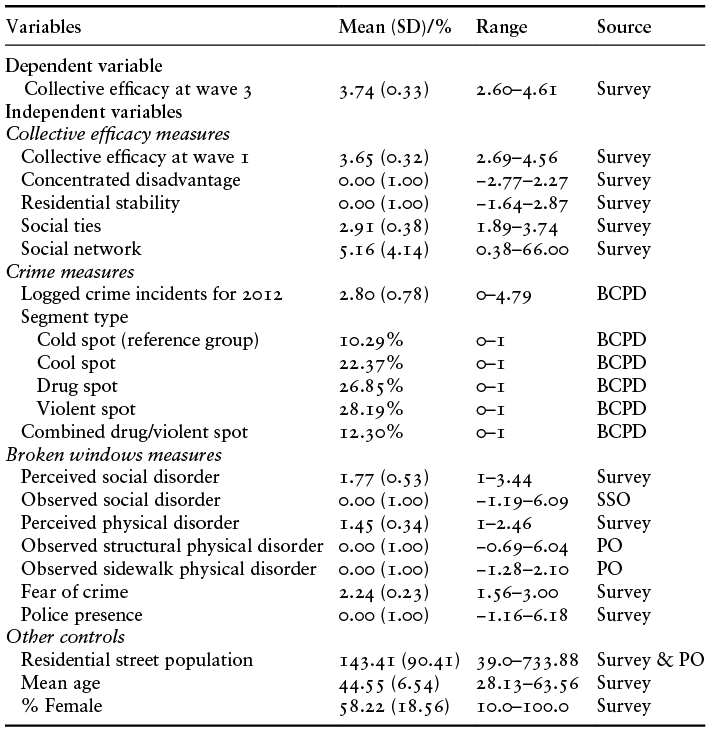
Note: N = 447; SSO = systematic social observation; PO = physical observation; BCPD = Baltimore City Police Department.
5.3.1 Measures Drawn from the Collective Efficacy/Social Disorganization Framework
Sampson et al. (Reference Sampson, Raudenbush and Earls1997) proposed a series of structural features of communities that would impact a community’s level of collective efficacy (see Chapter 2 for descriptions of the measures). Concentrated disadvantage was seen as a central concern because it “stymies collective efficacy” (Sampson et al. Reference Sampson, Raudenbush and Earls1997, p. 919; see also Sampson, Reference Sampson2012; Hipp and Wickes, Reference Hipp and Wickes2017; Wickes et al., Reference Wickes, Hipp, Sargeant and Mazerolle2017). In turn, residential stability – measured as a combination of residential tenure and homeownership – was also a key component of their model, which was found to “promote collective efforts to maintain social control” (Sampson et al., Reference Sampson, Raudenbush and Earls1997, p. 919).Footnote 5 Social ties and social networks, are also linked to informal social control in this model because they provide a foundation to allow collective efficacy to form in this model.
5.3.2 Measures Drawn from the Broken Windows Model
Measures of Perceived disorder and observed disorder described in Chapter 2, are seen as key causes of reductions in informal social control in the Broken Windows model.Footnote 6 When disorder continues to occur on a street, it sends a message to potential offenders that it is a place where the community does not intervene and where it is “okay” to cause problems, or at least the community is unlikely to intervene. Our study is one of the first to distinguish clearly between the impacts of physical and social disorder in tests of the Broken Windows model, and one of the first to include both perceptual measures and observations by researchers. We also measure fear of crime as described in Chapter 2. Fear has been defined as an important mechanism in Broken Windows theory for understanding the problems that will emerge at places with high levels of disorder, because fear is assumed to lead people to change their routine activities. As people who live on the street become fearful, they will start to avoid going on the street, and they will be less likely to intervene as they see problems emerge. Fear may also lead residents to move out of the community, or to other streets that may have lower levels of disorder or crime.
Another important measure in the Broken Windows model is the alternative to informal social control – formal social controls of the police (Sargeant et al., Reference Sargeant, Wickes and Mazerolle2013; Silver and Miller, Reference Silver and Miller2004; Warner, Reference Warner2007). A key innovation of Wilson and Kelling’s (Reference Wilson and Kelling1982) model was its proposal that the police could play a key role in reinforcing informal social control by being present in high-crime communities and responding to problems of disorder. As noted in Chapter 4, to create a measure of police presence, we used a factor score developed from two measures from our survey that asked the respondents the number of police cars they see driving on their block on an average day and how often they see police walking on their block.Footnote 7
5.3.3 Crime Measures
Crime is seen as impacting levels of informal social control (Sampson and Raudenbush, Reference Sampson and Raudenbush1999) because it can undermine the trust and sense of efficacy of residents (see also Hipp, Reference Hipp2016). We include two measures that relate to crime. First, to recognize official crime levels on the streets in wave 1 we examine the natural log of crime incidents for 2012. Based on the original design of the study, we also accounted for the street segment type, with cold streets serving as the reference category.Footnote 8
5.3.4 Other Measures
We also examine other measures not directly linked to either the Broken Windows or Collective Efficacy models. We include residential street population given its salience in understanding crime on streets, and our sense that the size of the street population could influence the degree to which residents are able to develop high levels of collective efficacy. As in Chapter 4, we also control for two demographic characteristics, including the mean age of respondents on the street and the percentage of female respondents.
5.4 Findings
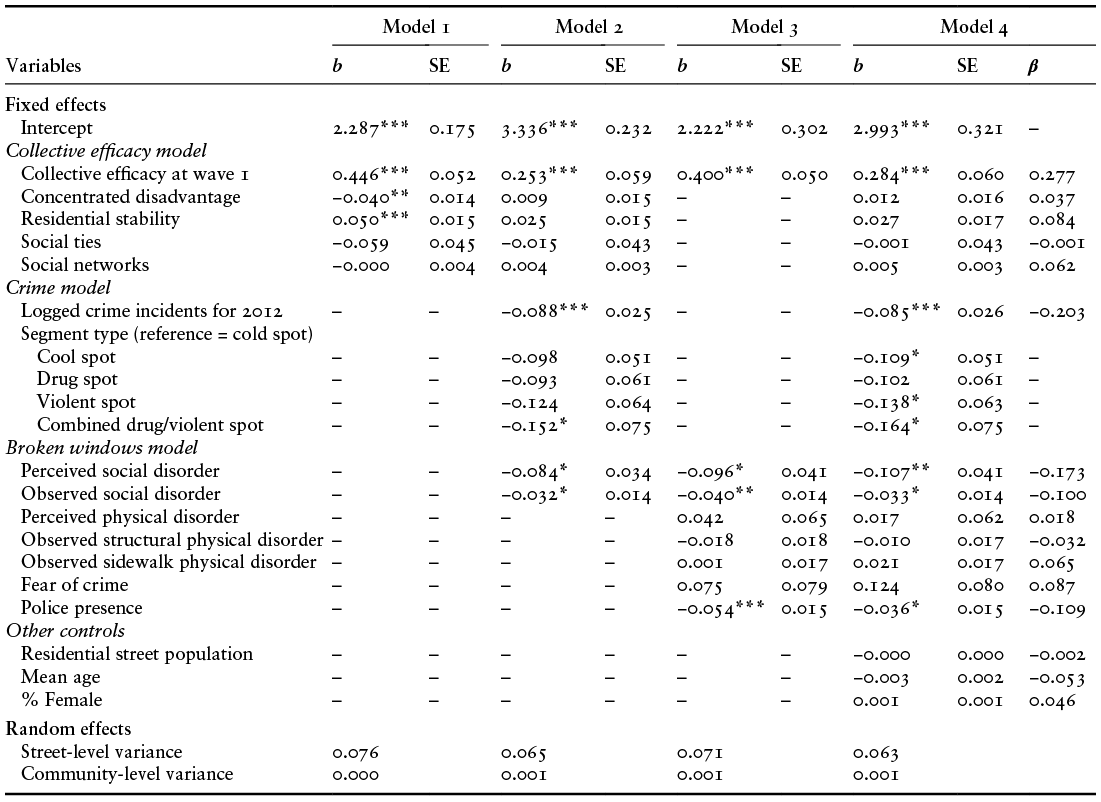
Table 5.2 reports a series of multilevel models. Model 1 shows only the model including the social structural variables suggested by Sampson et al. (Reference Sampson, Raudenbush and Earls1997). Model 2 adds measures of social disorder and crime as proposed by Sampson and Raudenbush (Reference Sampson and Raudenbush1999). Model 3 includes only variables included in the Broken Windows model. Finally, Model 4 includes all these measures, including the demographic control variables. In the final model of Table 5.2, we provide standardized coefficients (β) for all explanatory variables. Variables are standardized at the street-level, presented in equivalent standard deviation units, allowing us to compare the relative influences of the street-level variables on informal social control.Footnote 9
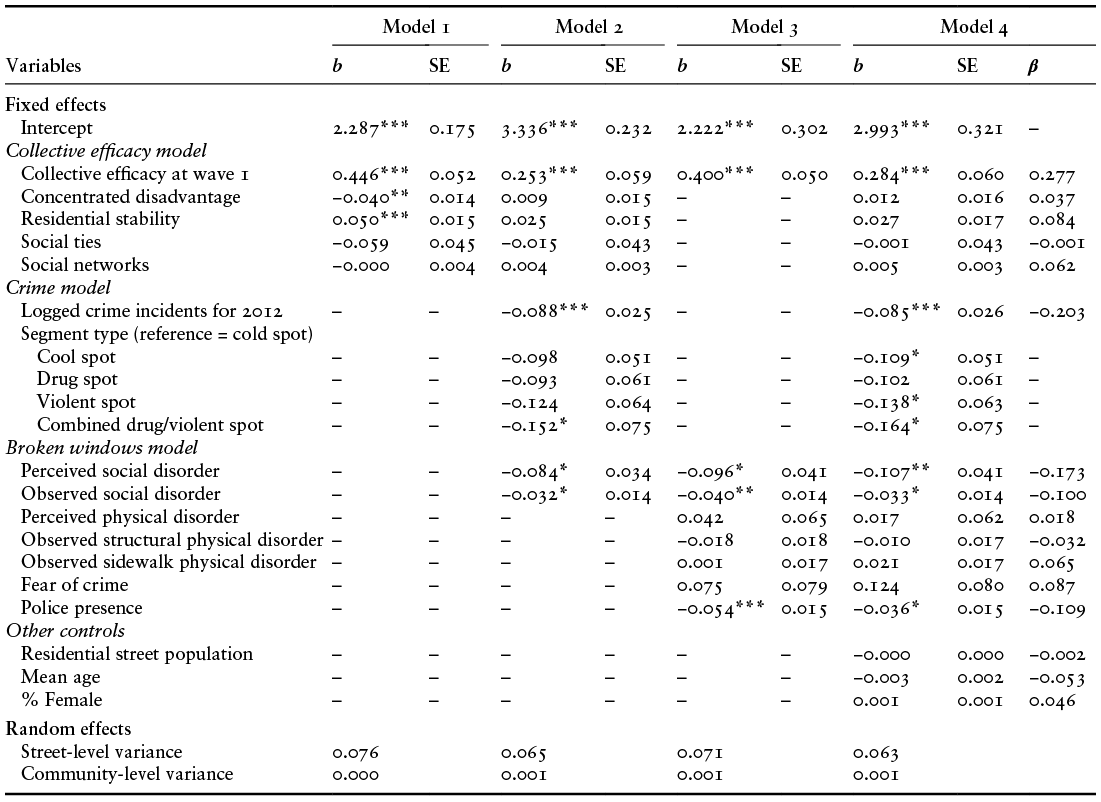
Note: N = 447; SE = standard error;
* p < 0.05, **p < 0.01, ***p < 0.001.
The first conclusion we draw from these analyses is that collective efficacy at wave 1 has the strongest impact of any variable we examine across the models, and is highly statistically significant (p < 0.001). This suggests that there is a considerable degree of stability in levels of informal social control on a street over time (Sampson, Reference Sampson2012). However, the models suggest that informal social control is influenced by other variables in the models as well.
The collective efficacy model of Sampson et al. (Reference Sampson, Raudenbush and Earls1997) is reflected in Model 1, where concentrated disadvantage (p < 0.01) and residential stability (p < 0.001) in wave 1 have highly significant influences on informal social control in wave 3. When the social disorder and crime-related variables are included, these variables are no longer statistically significant (see Model 2 in Table 5.2). This suggests that structural factors do not directly influence collective efficacy at wave 3, while they may have an indirect influence via crime or social disorder. At the same time, both social disorder and crime are significantly related to informal social control, as suggested by Sampson and Raudenbush (Reference Sampson and Raudenbush1999). Indeed, in the final model (Model 4), perceived social disorder with a standardized coefficient of −0.17 (p < 0.01), and logged crime incidents in 2012 with a standardized coefficient of −0.20 (p < 0.001) represent the two strongest impacts in the model after collective efficacy at wave 1. Following the outcome for logged crime, we also find that violent and combined crime hot spots, as well as cool spots, have significantly lower levels of informal social control than cold spots. However, the overall segment type measure is not statistically significant (p = 0.164).Footnote 10 Social ties and social networks are also not statistically significant across models in these analyses.
Elements of the Broken Windows model are important in influencing informal social control as indicated by Models 3 and 4. As we already noted, the coefficient for perceived social disorder is strong and significant. Observed social disorder is also statistically significant in this model (p < 0.05). In contrast, neither of the two measures of observed physical disorder, nor the measure of perceived physical disorder are statistically significant. This finding is particularly important given the nomenclature in Wilson and Kelling’s (Reference Wilson and Kelling1982) seminal article. While their theory revolved around disorder more generally, they chose to title their article “Broken Windows,” giving emphasis to the importance of physical disorder in the decline of informal social control. But it is social disorder rather than physical disorder that we find most salient at crime hot spots. Fear of crime is also not statistically significant in the model, contrary to Wilson and Kelling’s (Reference Wilson and Kelling1982) emphasis on fear leading to withdrawal.
Finally, we find that police presence significantly (p < 0.05) decreases informal social control, a result that appears to contradict one of the key implications of the Broken Windows perspective. Resident perceptions of more police presence appear to decrease rather than increase informal social control, though the impact of this variable is relatively small, with a standardized value of −0.11. We turn to this finding in more detail later in the chapter. None of the other control variables at the street-segment level have a significant association with informal social control/collective efficacy at wave 3.
5.4.1 A Closer Look at Physical Disorder
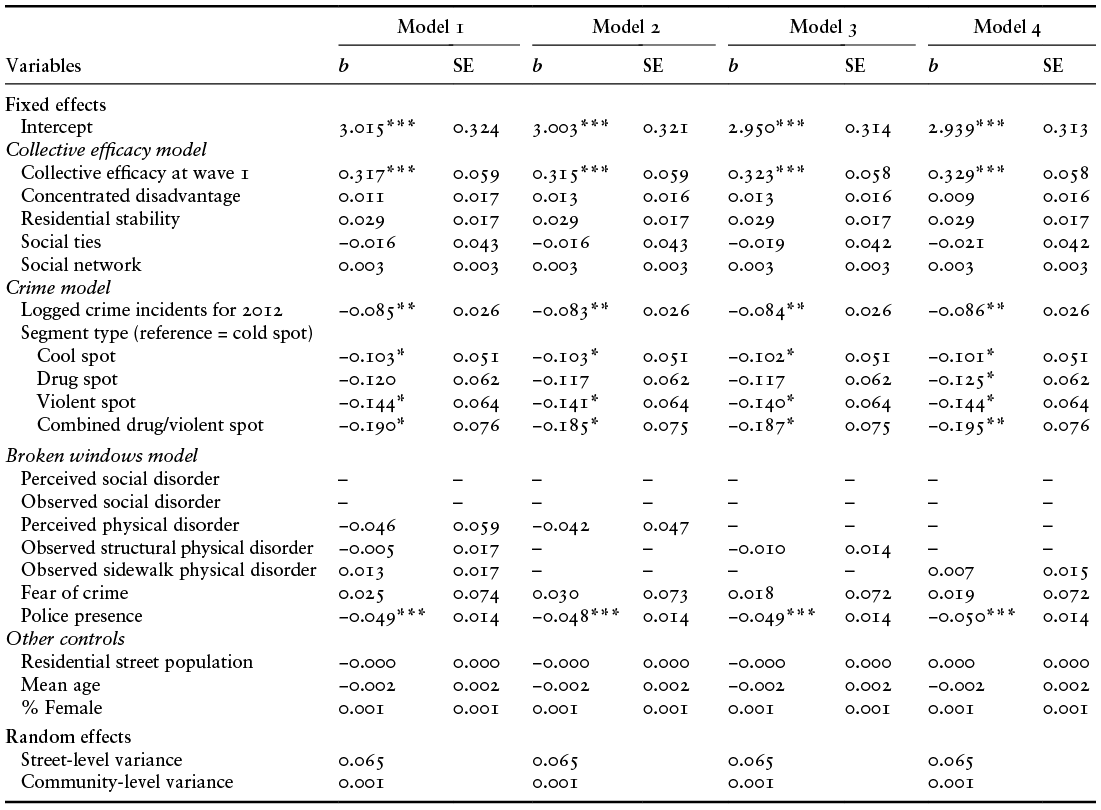
Due to the importance of physical disorder in the broken windows model, we thought it important to look more closely at our measures. One objection to our findings might be that by including social disorder, the impacts of physical disorder are being masked. In Table 5.3, Model 1, we examine the impacts of the three physical disorder measures, absent the inclusion of social disorder in the model. We find that the measures of physical disorder are again not statistically significant. It might also be argued that by including three separate measures of physical disorder we have confounded possible significant outcomes; therefore, in Models 2 through 4, we include each of the physical disorder measures individually in the multilevel models. Again, none of the measures are significantly related to informal social control/collective efficacy at wave 3.
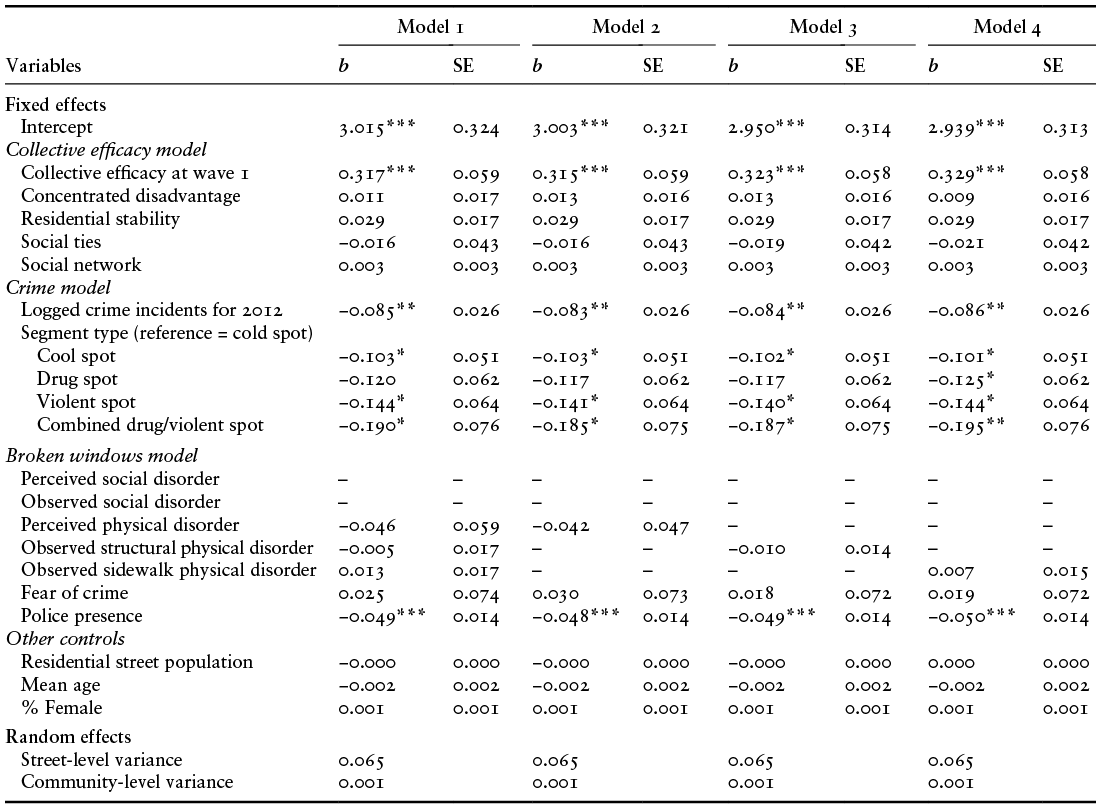
Note: N = 447; SE = standard error;
* p < 0.05, **p < 0.01, ***p < 0.001.
5.4.2 Other Model Specifications
While we think our models are stable and provide important findings regarding the antecedents of informal social control, we also wanted to consider possible alternative model specifications suggested by other scholars.
As noted earlier, some have argued that the “willingness to intervene” component of collective efficacy is a better fit for assessing informal community social control than the overall measure of collective efficacy, which includes both social cohesion and willingness to intervene (Gau, Reference Gau2014; Hipp, Reference Hipp2016; Hipp and Wickes, Reference Hipp and Wickes2017). Table A5.3 shows the results when predicting only willingness to intervene. As is apparent from Table A5.3, the results closely follow those in our analyses of collective efficacy with social disorder measures and logged crime having significant impacts on social control, while physical disorder and fear are not significant across the measures.
Since there is a possibility that perceptions of social disorder mediate the relationship between observed social disorder and collective efficacy, we also conducted a sensitivity analysis as reported in Table A5.4 with Models 1 and 2 to examine this possibility. When perceived social disorder was not included (see Model 1 in Table A5.4), observed social disorder has a negative and significant impact on collective efficacy (b = −0.037, p < 0.01). After including perceptions of social disorder and physical disorder in the model (see Model 2 in Table A5.4), the negative coefficient of observed social disorder decreased by 11 percent (−0.037 to −0.033), providing little support for a mediating effect of perceptions of social disorder.Footnote 11 Thus, our data indicated that perception and observation of social disorder have primarily independent effects on collective efficacy at the street level.
As in Chapter 4, we also recognize that the inclusion of logged crime incidents in 2012 and the street segment type indicator (based on emergency calls to the police) might create potential multicollinearity in our final model. Accordingly, we report our results without the street segment type measure or the logged crime incidents in 2012, respectively, in Table A5.5. The coefficients for the other indicators and significance levels remain similar, whichever models are estimated.Footnote 12
5.5 What Have We Learned?
Our analyses provide new insights into how informal social controls are formed in micro geographic level communities. In the first case, our work both reinforces and challenges key elements of Broken Windows theory. Below we discuss those findings and link them to our qualitative interviews of people who live on and frequent the streets in an effort to better understand our findings. We then turn to what our analyses say about the mechanisms suggested by collective efficacy theory as proposed by Sampson et al. (Reference Sampson, Raudenbush and Earls1997). Here too, our analyses suggest some reinterpretation of this model of the antecedents of informal social control, at least as it is applied to crime hot spots.
5.5.1 The Primacy of Social Rather than Physical Disorder
While our study supports one of the key principles underlying broken windows theory – that informal social control is conditioned by social disorder – it appears to challenge strongly the nomenclature and emphasis of this approach on physical disorder. This perspective was termed Broken Windows by James Q. Wilson and George Kelling (Reference Wilson and Kelling1982), but at least in the case of crime hot spots, broken windows (sic “physical disorder”) does not appear to affect informal social control, as indicated by our measure of collective efficacy. This finding is a strong challenge to the Broken Windows perspective. What can explain the lack of significance of physical disorder, especially in light of the strong significance of social disorder?
One explanation could be that there is simply not enough variation in physical disorder in a city like Baltimore to observe an effect. If every place is disorderly, then it would not be possible to observe an effect of disorder on community social controls. While Baltimore has experienced severe disrepair and lack of city investment (Gunts Reference Gunts2021; Scott Reference Scott2022), our data suggest that it would be unfair to generalize high levels of physical and social disorder to all streets in Baltimore. While physical disorder such as vacant lots, boarded-up buildings, or an unkept yard may exist in places with very little crime, it is not nearly to the extent observed in crime hot spots as demonstrated in Chapter 2. There is simply a good deal of variability in physical disorder across street segments, and such variability would allow us to observe physical disorder impacts on informal social control if they were meaningful.
Another explanation for our findings could be that broken windows, and other signs of physical disorder, have different meanings within different micro geographic communities. This is something Wilson and Kelling (Reference Wilson and Kelling1982) spoke to in their original article as they highlighted the fact that different neighborhoods can have different standards of what constitutes disorder. As Sampson (Reference Sampson2012) notes, graffiti or disorderly streets may be seen as trendy or stylish in some places, while in others they may represent a decline in community standards. Alternatively, residents may not “see” or notice the physical disorder as it has become commonplace on their street (see Hinkle et al., Reference Hinkle, White, Weisburd and Kuen2023). For example, on one violent street segment our field researchers noted the large amount of trash on the segment –
there was a good amount of trash on the block, mostly household items like pizza boxes, ripped apart magazines, water bottles, with some beer bottles and clothes as well. In between two of the public housing sections there was a trash dump that was overflowing with seemingly just as much trash on the outside as there had been on the inside. In the dump area, there was a baby bassinette to be thrown away, and a dresser.
At the same time, the field researchers spoke with another resident who talked about how the street was “fine and quiet,” and that “there is crime and drugs nearby, but there isn’t anything I would change about the neighborhood, and I don’t mind being here for now.”
Furthermore, physical disorder may not be a problem that residents associate with their neighbors and crime, but rather with a lack of investment from the city. In our qualitative interviews residents often attributed vacant lots, trash, and rats to the city not doing anything. A resident of a drug hot spot highlights this idea. He complained that “the city doesn’t provide the basic services they should provide such as trash collecting and cleaning in the area.” On another drug spot a resident “blamed the city for not doing a good job in keeping the area clean of trash … the vacant houses are owned by people who couldn’t stand living in the area and that is why they fled a couple of years ago without even renting the space.” On a violent hot spot, reflecting informal social control by residents, one respondent spoke of “the strong Muslim community (noted in Chapter 2) in the area and our ability to work together – see how clean the area is? – It’s because of us, we communicate with the city and encourage them to come more frequently for cleaning.”
Accordingly, simply measuring levels of disorder may miss a key perceptual element of the broken windows model. We recognize this possibility and think it should be an important focus for future research. At the same time, if physical disorder was a key factor in predicting community social control, we would expect in any case for places with less physical disorder to have on average higher levels of informal community control and those with higher levels of physical disorder to have on average lower levels of informal community control. Importantly, the effect sizes in our analyses are very small both for observed and perceived physical disorder when other variables are controlled for.
Furthermore, if it is the case that physical disorder is not a key factor in understanding declines in community social control, it might be asked how our data relate to recent work that shows that greening/restoring vacant lots can reduce crime and improve public health outcomes (Branas et al., Reference Branas, Cheney, MacDonald, Tam, Jackson and Ten Have2011; Branas et al., Reference Branas, South, Kondo, Hohl, Bourgois, Wiebe and MacDonald2018), as can police-led reductions in physical disorder through situational crime prevention efforts (Braga and Bond, Reference Braga and Bond2008). We want to emphasize that the results of our study do not suggest that addressing physical disorder has no impact on crime or social ills. Indeed, in Chapter 4 we saw how street-level physical disorder had a statistically significant impact on crime calls. Rather it suggests that the mechanism for the impacts of physical disorder does not derive from its influence on informal social control measured in our study as collective efficacy. Other mechanisms such as reductions in opportunities for crime or increases in useable public space for leisure activities (and subsequent increases in guardianship) may be generating such outcomes.
In contrast to our findings regarding physical disorder, social disorder was found to be a trigger for the kind of declines in community social control that Wilson and Kelling (Reference Wilson and Kelling1982) suggest. Social disorder on the street, as reflected by such behaviors as people fighting or arguing, or publicly selling or using drugs, is found to significantly impact informal social control. These types of antisocial behaviors may lead to the physical disorder in a place, such as drug paraphernalia, but it is the behaviors themselves that residents find problematic and that inhibit informal community controls, rather than their impacts on the physical environment. In the qualitative interviews, residents often spoke of people “causing trouble” when describing drug dealers and teenagers loitering.
Social disorder appeared to present challenges for residents. One resident of a drug hot spot pointed out a neighbor’s building at the opposite direction from her house – “See how loud they are? … Those people shout every day … they disrespect their neighbors. I’ve had tried several times to ask those neighbors to lower their voices and stop the noise but with no luck.” A sign hung at this resident’s entrance that said, “No trespassing: violators will be shot, survivors will be shot again.” We asked her if they really apply this rule, she said, “Yes we do, if anybody trespasses, he will be shot once and twice.”
Another resident on a violent hot spot said, “The main problem in the area was drug addicts.” The resident seemed to think that drug addicts hang out on the street, and drug dealers come by to sell to them because they know that there are drug addicts there. He said, “To fix up the neighborhood you would need to get rid of the drug addicts.” On the same street segment, the field researchers described an encounter with a couple who may have been engaging in drug use (or sales). The man said, “I’ve lived here for a few months and we are moving out because we are scared.” “Of what?” the researcher asked. He replied, “from drug lords, man” and as the field researcher was attempting to continue the questions, the girl looked at him and said, “I think we should go, sorry.” He then asked her “why?” She responded, “because it’s not good to talk about drugs, let’s just go.” The field researchers noted that the girl seemed to be scared of drug dealers, and she kept looking around her as she was headed home with her boyfriend. The field researchers thought she may have been using drugs because the woman was “hanging onto his arm, seemingly exhausted.”
An intriguing finding was that both observed and perceived social disorder had independent impacts on informal social control, and that our sensitivity analyses showed that there was no evidence for a mediation effect. As we noted in Chapter 2, this suggests that social disorder is real on these streets, and that citizens recognize this. However, the fact that both of these variables have independent impacts also suggests that they are each picking up independent and unique elements of the social disorder phenomenon. One possible explanation for this is to recognize that there are subjective elements to perceived disorder that are not captured by researchers who collect “objective” measures of disorder. For example, studies have found that neighborhood racial and socioeconomic composition strongly influences disorder perceptions (Sampson and Raudenbush, Reference Sampson and Raudenbush2004; Ward et al., Reference Ward, Link and Taylor2017; Wickes et al., Reference Wickes, Hipp, Zahnow and Mazerolle2013), and that perceptions of disorder at micro-places vary by race/ethnicity of the resident (Hinkle et al., Reference Hinkle, White, Weisburd and Kuen2023; see also Lee et al., Reference Lee, Kuen, Kim and Moon2025).
5.5.2 Rethinking the Role of Fear of Crime and Police Presence
While fear of crime is an important part of the mechanisms described in Broken Windows theory, we did not find a significant relationship between fear of crime and informal social control in our models. We suspect that objective assessments of safety (an issue we return to later) are different from fear of crime, and residents of our hot spots may objectively understand that there are safety concerns on their street, but they often seem to figure out how to live with such safety concerns. On a violent hot spot, for example, a resident spoke about crime in Baltimore generally and the street he lived on. He indicated that “there are definitely drugs, crime, and violence around like anywhere you go in Baltimore, but the street itself was relatively quiet.” He noted how quiet the street was at that moment while we were talking and said, “What you see is what you get, it’s like this day and night.” On another violent hot spot, a resident also talked about the safety of the area – he thought the area was safe enough for his grandchildren to visit him frequently with their parents. He said, “I don’t worry about them, even when they play in the nearby park.” Another resident of a drug hot spot told us, “I feel it would be a good place to raise a family because it is safe enough and people are generally nice.” The field researchers noted some ambivalence from the resident when he shrugged his shoulders with comments like, “It’s not the best place, but it’s fine” and “I guess.” It is not that people do not recognize the dangers on hot spot streets. For instance, on the same drug hot spot, when asked about crime and drugs in the area, a different resident said, “There is a lot of it, mostly 16- and 17-year-old boys, and some girls, who have no education and no jobs and not trying to do right … people around here are willing to kill each other over drugs.” Rather, it seems that people often grow accustomed to danger on the street and learn how to live with it. In this context, fear may not be the right concept in trying to understand declines in informal social control. Instead, it may be the assessments that residents make about their and their family’s safety if they attempted to exercise informal social controls.
Finally, in regard to police presence, there are a few possible interpretations of the surprising finding that more observed police presence seems to lead to lower levels of informal social control. Seeing more police on the street may be perceived by residents as an indication that there is more crime, and that it is unsafe to exercise social control (Hinkle and Weisburd, Reference Hinkle and Weisburd2008). For example, in a randomized trial of hot spots policing in Brooklyn Park, MN, researchers found a strong and significant impact of the police intervention on perceptions of safety on the street, with citizens feeling less safe in the treatment condition that received more police attention (see Weisburd, Gill, et al., Reference Weisburd, Gill, Wooditch, Barritt and Murphy2021). In our qualitative interviews residents also expressed this type of concern. One female resident of a drug hot spot said, “I see the police patrolling every day and because of this, I do not leave my house after 6pm.”
But it may be as well, that a history of difficult relations between police and minority and disadvantaged communities in Baltimore influences the way residents view the police. It is important to note that in general surveys people in Baltimore are much more negative about the police than in many other large urban areas (Kuen et al., Reference Kuen, Appleton, Weisburd and Uding2025; White et al., Reference White and Weisburd2018). This is reflected in our qualitative work. Residents often expressed a strong distrust of the police and noted their lack of effectiveness, so it may also be that the presence of police contributes to a lack of trust among residents as well as a reduced willingness to intervene in problems because the police are around. For example, one resident of a drug street segment said, “I don’t like the police and would rather see drug dealers than the police. I would not talk to police and have never had good interactions with them.” Another resident of a violent segment noted, “Police presence is weak. There are some drug dealings, but I am not aware of its details; the police relationship with neighborhood is bad – it’s full of dishonesty and no trust, especially since most of the cops who oversee the area are White.”
One resident we interviewed on a drug spot highlighted the way police presence can disrupt residents’ achieving higher levels of informal social control. She noted, “The police are around sometimes and often bothered people who were just trying to say ‘hi’ to friends and interact with others – asking them what they’re doing or why they’re hanging around.” She continued, “The police get mad at people for just stopping to talk to each other and get on them to keep moving, or for being somewhere they think you shouldn’t be.” Ultimately though, she thought the police were just doing their job, and “hanging out in front of stores or on corners isn’t good and is bad for business.”
Overall, it is apparent from these passages from residents that police presence is not something that necessarily contributes to strengthening informal social control and rather can do quite the opposite. Our findings suggest that the police can play a key role in encouraging informal social controls at crime hot spots by reducing crime and social disorder. However, how the police “police” an area matters, and policing that is disruptive and disrespectful toward residents can undermine collective efficacy. As we will detail in Chapter 8 when we examine policy implications of our research in more detail, attention to community policing and procedural justice in policing is key if the police are to encourage informal social controls to prevent crime.
5.5.3 Social Disorganization and Collective Efficacy Theory
Sampson and Raudenbush (Reference Sampson and Raudenbush1999) argue that “neighborhood social trust and residents’ sense of control are simultaneously undermined by crime, most notably interpersonal crimes of violence and those committed in public by strangers” (p. 630). In this context, social disorder and crime are seen not only as consequences of low collective efficacy, but also as causes of low collective efficacy. The fact that crime levels and perceptions of social disorder in wave 1 of our study are important in predicting collective efficacy in wave 3 provides strong support for this perspective at crime hot spots. Sampson (Reference Sampson2012) has argued that social disorder measures capture behaviors that are often crimes, such as loitering and drug dealing. In this context, we think it reasonable to see crime and social disorder as part of a more general construct that informs the degree to which people on a street feel efficacy in terms of exercising informal social controls.
In this context, social disorder and crime provide information for residents of streets about how realistic or safe it is to intervene in problems on the street. Willingness to intervene is likely to be strongly impacted by whether interventions will lead to victimization of people who live on a street. In some sense, high levels of crime and disorder on the street indicate “how dangerous” it is to intervene, a key element of collective efficacy. Reflecting this, one resident of a violent hot spot shared a story of a family who a few years back “called the police on drug dealers who then lit the family’s home on fire, killing all of them in retaliation.” On a drug hot spot, a resident expressed concern about the drug dealing nearby, “up the street there are drug dealers who stand in the markets, and they know where people live, so no one says anything to the police and they can just deal drugs without any consequences.” He also mentioned that there was a shooting at a gas station up the street just the night before. On a different drug spot, a resident explained how neighbors respond to crime on the street, “When we hear gun shots, we stay where we are and stay out of sight” as he physically leaned back into his door to show us what he meant. “Young people get into trouble because they want to be a part of the action and be seen, when they hear gunshots they run toward it, and then they end up getting into trouble or getting hurt.”
Importantly, these stories shed light on the difference between safety and fear of crime, which did not have a direct influence on collective efficacy in our models. We propose that when crime and social disorder are high on a street, residents’ sense of self-efficacy is challenged (see Bandura, Reference Bandura1982), and this leads to low informal social control at the street segment. The mechanism leading to breakdowns in community social controls is not necessarily through “fear,” but rather through assessments of whether community social control can be effective, which are constantly updated by observations of the street. As Sampson and Raudenbush (Reference Sampson and Raudenbush1999; see also Sampson, Reference Sampson2012) note, it may be that residents’ sense of efficacy and their willingness to engage with others to exercise collective efficacy are undermined by crime and violence (also see Armstrong et al., Reference Armstrong, Katz and Schnebly2015; Hipp, Reference Hipp2016).
In turn, high levels of crime and social disorder are likely to inhibit the degree of social cohesion that is found on a street. Sampson and Raudenbush (Reference Sampson and Raudenbush1999), citing to work by Liska and Warner (Reference Liska and Warner1991), argue “that robbery constrains social interactions in public settings, thereby potentially dampening social cohesion and the emergence of shared expectations among residents for taking action to protect the community” (p. 631). Our findings suggest that this mechanism underlying the development of informal social controls also operates at the micro geographic level. High crime and social disorder at a crime hot spot impedes the ability of people who live on a street to develop cohesiveness, and accordingly to more generally advance street level informal social control. This is illustrated by a couple who lived on a violent hot spot, who noted the way drug crime on the street impedes social cohesion –
look at what [we are] both doing, sitting outside and talking and that’s what we do, that’s what people want to do, just sit outside in their own neighborhoods peacefully and the drugs make it harder to do that. We intend to stay in the neighborhood and just mind our own business, but would like to see the drug dealers leave and would like things to improve.
5.5.4 Concentrated Disadvantage, Residential Stability, and Social Ties
In Model 1 of our analyses, we can see that when simply testing the collective efficacy model, both concentrated disadvantage and residential stability impact informal social control. Nonetheless, once crime and social disorder are accounted for, these significant impacts dissipate. This suggests that the impacts of these structural measures of social disorganization are indirect. Our qualitative data suggest that residential instability can have impact on social disorder. One resident noted for example, that “house owners on the street who started to leave the area, rented their places to reckless people.”
Our findings that social networks and social ties do not directly impact informal social control follow our observations from Chapter 2 that social ties and social networks do not differ significantly across the segment types. More generally, social networks and social ties are surprisingly strong on hot spot streets. Sampson and colleagues argue that even if social ties are strong, they may be stymied by high concentrated disadvantage (Sampson et al., Reference Sampson, Raudenbush and Earls1997, p. 919). As we have highlighted in other narratives from the qualitative interviews, residents express the minimal investment from the city, the ineffectiveness of the police, and the lack of opportunities for youth to avoid crime, even when they get along and socialize with their neighbors.
5.6 Conclusions
We began by noting two key perspectives in understanding the antecedents of informal social control that have had substantial influence in criminology. Broken windows theory (Wilson and Kelling, Reference Wilson and Kelling1982) emphasizes the role of social and physical disorder in producing changes in informal social control. Considering our findings, we think that the perspective of “broken windows theory” can be misleading and perhaps harmful at the level of crime hot spots if the broken windows metaphor is taken literally. We find that social disorder is an important antecedent of informal social control at crime hot spots; but importantly, physical disorder measured in various ways did not have significant impact on informal social control.
In regard to collective efficacy or social disorganization theory, we also found indications that informal social control at crime hot spots may operate differently than those in communities. Structural indicators of social disorganization did not have a direct effect in our models, once crime and social disorder are accounted for. At the same time, our analyses confirm the findings at the community level that social disorder and crime, which can be seen as part of a general indicator of levels of safety at crime hot spots, have negative impacts on informal social control. In our data, they seem to inhibit the ability of communities on street segments to develop high levels of social cohesion and collective action.

 Open access