





1. Introduction
The motion of a general viscous compressible, isentropic fluid in a domain $\Omega \subset \mathbb{R}^3$
is governed by the following compressible Navier–Stokes equations
$\Omega \subset \mathbb{R}^3$
is governed by the following compressible Navier–Stokes equations
 \begin{equation} \begin{cases} \partial _t\rho +{\mathrm {div}}\,(\rho u)=0, \\ \partial _t(\rho u)+{\mathrm {div}}\,(\rho u\otimes u)-\mu \Delta u-(\mu +\lambda )\nabla {\mathrm {div}}\, u+\nabla P=0, \end{cases} \end{equation}
where $\rho$
,
$\rho$
, $u$
,
$u$
, $P=a\rho ^{\gamma }$
(
$P=a\rho ^{\gamma }$
( $a\gt 0$
) denote the density, velocity and pressure, respectively,
$a\gt 0$
) denote the density, velocity and pressure, respectively, $\gamma \gt 1$
is the adiabatic exponent and
$\gamma \gt 1$
is the adiabatic exponent and $\mu$
and
$\mu$
and $\lambda$
represent the shear viscosity and bulk viscosity coefficients satisfying the physical restrictions:
$\lambda$
represent the shear viscosity and bulk viscosity coefficients satisfying the physical restrictions:
 \begin{equation} \mu \gt 0,\quad \lambda +\frac {2}{3}\mu \geq 0. \end{equation}
The equations (1.1) will be equipped with initial data
 \begin{equation} (\rho , u)(x,0)=(\rho _0, u_0)(x), \quad x\in \Omega . \end{equation}
In this paper, we assume that $\Omega \subset \mathbb{R}^3$
is a simply connected bounded domain with smooth boundary
$\Omega \subset \mathbb{R}^3$
is a simply connected bounded domain with smooth boundary $\partial \Omega$
. The system (1.1) is studied under the Navier-slip boundary conditions:
$\partial \Omega$
. The system (1.1) is studied under the Navier-slip boundary conditions:
 \begin{equation} u\cdot n=0,\, {\mathrm {curl}}\, u\times n=-Au\ \mathrm { on }\ \partial \Omega , \end{equation}
where $n$
is the unit outer normal to
$n$
is the unit outer normal to $\partial \Omega$
, and
$\partial \Omega$
, and $A=A(x)$
is a
$A=A(x)$
is a $3\times 3$
symmetric matrix defined on
$3\times 3$
symmetric matrix defined on $\partial \Omega$
. There exist some different forms of slip boundary conditions related to (1.4), where the detailed discussions can be found in [Reference Cai and Li4].
$\partial \Omega$
. There exist some different forms of slip boundary conditions related to (1.4), where the detailed discussions can be found in [Reference Cai and Li4].
There are large amounts of literature concerning the well-posedness theory for the compressible Navier–Stokes equations (1.1). The one-dimensional problem has been investigated extensively by many people, see, for instance, [Reference Hoff16, Reference Kazhikhov28, Reference Kazhikhov and Shelukhin29, Reference Serre41, Reference Serre42] and references therein. The local well-posedness of multidimensional problem was studied by Nash [Reference Nash36] and Serrin [Reference Serrin43] in the absence of vacuum, while for the initial density with vacuum, the existence and uniqueness of local strong solution were proved in [Reference Cho, Choe and Kim6–Reference Choe and Kim9, Reference Salvi and Straškraba40]. Matsumura and Nishida [Reference Matsumura and Nishida35] first proved the global existence of strong solutions with initial data close to the equilibrium and later was extended to the discontinuous initial data by Hoff [Reference Hoff17, Reference Hoff and Serre20]. For the existence of solutions for arbitrary large initial data in 3D, the major breakthrough was made by Lions [Reference Lions32], in which he showed global existence of weak solutions for the whole space, periodic domains or bounded domains with Dirichlet boundary conditions with $\gamma \geq \frac {9}{5}$
and later was extended to the case
$\gamma \geq \frac {9}{5}$
and later was extended to the case $\gamma \gt \frac {3}{2}$
by Feireisl [Reference Feireisl, Novotný and Petzeltová12–Reference Feireisl14]. When the initial data are assumed to have some spherically symmetric or axisymmetric properties, Jiang and Zhang [Reference Jiang and Zhang25, Reference Jiang and Zhang26] proved the existence of global weak solutions for any
$\gamma \gt \frac {3}{2}$
by Feireisl [Reference Feireisl, Novotný and Petzeltová12–Reference Feireisl14]. When the initial data are assumed to have some spherically symmetric or axisymmetric properties, Jiang and Zhang [Reference Jiang and Zhang25, Reference Jiang and Zhang26] proved the existence of global weak solutions for any $\gamma \gt 1$
. Shortly thereafter, Hoff [Reference Hoff18] gave a new type of global weak solutions with small energy, which have extra regularity compared with the ones constructed by Lions-Feireisl in [Reference Feireisl, Novotný and Petzeltová12, Reference Lions32] under an additional condition on viscosity coefficients and the far-field density
$\gamma \gt 1$
. Shortly thereafter, Hoff [Reference Hoff18] gave a new type of global weak solutions with small energy, which have extra regularity compared with the ones constructed by Lions-Feireisl in [Reference Feireisl, Novotný and Petzeltová12, Reference Lions32] under an additional condition on viscosity coefficients and the far-field density $\tilde {\rho }\gt 0$
.
$\tilde {\rho }\gt 0$
.
Up to now, the uniqueness and regularity for weak solutions in [Reference Feireisl, Novotný and Petzeltová12, Reference Lions32] (with arbitrarily large initial data) still remain open. Recently, many important progress on global existence and uniqueness of classical solutions with large oscillations and vacuum to viscous compressible fluids in a barotropic regime has been made. Huang, Li and Xin [Reference Huang, Li and Xin24] first established the global existence of classical solutions to 3D Cauchy problem of the isentropic compressible Navier–Stokes equations with small initial total energy but possibly large oscillations. Later, Li and Xin [Reference Li and Xin30] studied the 2D Cauchy problem and the large time asymptotic behaviour of solutions with small initial total energy. Very recently, Hong-Hou-Peng-Zhu [Reference Hong, Hou, Peng and Zhu22] provided a positive result under the condition that the adiabatic exponent $\gamma$
is close to 1, which says that classical solutions to Cauchy problem of the isentropic compressible Navier–Stokes equations exist globally with allowing the large initial energy and the presence of vacuum. This type of solution can be viewed as the Nishida–Smoller type large solution, which is originally studied for the conservation laws with BV initial data in [Reference Nishida and Smoller38], where Nishida and Smoller showed the global existence of solutions to the Cauchy problem of 1D isentropic Euler equations under the condition that
$\gamma$
is close to 1, which says that classical solutions to Cauchy problem of the isentropic compressible Navier–Stokes equations exist globally with allowing the large initial energy and the presence of vacuum. This type of solution can be viewed as the Nishida–Smoller type large solution, which is originally studied for the conservation laws with BV initial data in [Reference Nishida and Smoller38], where Nishida and Smoller showed the global existence of solutions to the Cauchy problem of 1D isentropic Euler equations under the condition that $(\gamma -1)\,\text{total var.}\{u_0,\rho _0\}$
Footnote
1
is sufficiently small. In particular, this result implies that the initial energy could be large as
$(\gamma -1)\,\text{total var.}\{u_0,\rho _0\}$
Footnote
1
is sufficiently small. In particular, this result implies that the initial energy could be large as $\gamma$
is sufficiently close to 1. For some generalizations of the Nishida–Smoller type results on inviscid or viscous flow, one can see, for instance, [Reference Hong, Hou, Peng and Zhu21, Reference Kawashima and Nishida27, Reference Liu, Yang, Zhao and Zou33, Reference Liu34, Reference Tan, Yang, Zhao and Zou44, Reference Temple45]. For compressible Navier–Stokes equations (1.1) in half space
$\gamma$
is sufficiently close to 1. For some generalizations of the Nishida–Smoller type results on inviscid or viscous flow, one can see, for instance, [Reference Hong, Hou, Peng and Zhu21, Reference Kawashima and Nishida27, Reference Liu, Yang, Zhao and Zou33, Reference Liu34, Reference Tan, Yang, Zhao and Zou44, Reference Temple45]. For compressible Navier–Stokes equations (1.1) in half space $\mathbb{R}^3_+$
with slip boundary conditions, Hoff [Reference Hoff18] established the global existence of weak solutions under the assumption that the initial energy is suitably small. For compressible Navier–Stokes equations (1.1) in a non axis-symmetric domain, Novotný and Străskraba [Reference Novotný and Străskraba39] proved global existence of weak solutions. For compressible Navier–Stokes equations (1.1) in a general bounded smooth domain, the global existence of strong (or classical) solutions has been investigated for the 3D case with slip boundary condition in [Reference Cai and Li4], and the 2D case with similar boundary condition in [Reference Fan, Li and Li11], both of which are equipped with small initial total energy and vacuum. Even for the 3D bounded domain with non-slip boundary condition, Fan and Li [Reference Fan and Li10] proved the global existence of classical solutions to the barotropic compressible Navier–Stokes system with small initial energy. Also, one can refer to [Reference Cai, Li and Lü5] for the exterior domain case.
$\mathbb{R}^3_+$
with slip boundary conditions, Hoff [Reference Hoff18] established the global existence of weak solutions under the assumption that the initial energy is suitably small. For compressible Navier–Stokes equations (1.1) in a non axis-symmetric domain, Novotný and Străskraba [Reference Novotný and Străskraba39] proved global existence of weak solutions. For compressible Navier–Stokes equations (1.1) in a general bounded smooth domain, the global existence of strong (or classical) solutions has been investigated for the 3D case with slip boundary condition in [Reference Cai and Li4], and the 2D case with similar boundary condition in [Reference Fan, Li and Li11], both of which are equipped with small initial total energy and vacuum. Even for the 3D bounded domain with non-slip boundary condition, Fan and Li [Reference Fan and Li10] proved the global existence of classical solutions to the barotropic compressible Navier–Stokes system with small initial energy. Also, one can refer to [Reference Cai, Li and Lü5] for the exterior domain case.
In conclusion, all the works [Reference Cai and Li4, Reference Cai, Li and Lü5, Reference Hoff18, Reference Hong, Hou, Peng and Zhu22, Reference Huang, Li and Xin24, Reference Li and Xin30, Reference Nishida and Smoller38] depend essentially on small initial energy or the advantage of the whole space. Therefore, a natural and important problem is to study what will happen if both large initial energy and boundary effects are involved. That is to say, we aim to investigate the global well-posedness and long-time behaviour of Nishida–Smoller type large solutions to the compressible Navier–Stokes equations (1.1) with slip boundary conditions (1.4) and vacuum. However, to the best of our knowledge, up to now, this problem still remains open. The main purpose of this work is to resolve this problem. More precisely, we prove the global existence and uniqueness of classical solutions to the initial-boundary-value problem (1.1)–(1.4) with large initial energy and vacuum provided that the adiabatic exponent is sufficiently close to 1. Moreover, we also prove that the classical solutions have an exponential decay rate, which is decreasing with respect to the adiabatic exponent. Finally, we prove that the gradient of the density will grow unboundedly with an exponential rate if the vacuum appears (even at a point) initially. This generalizes the previous related works in [Reference Cai and Li4, Reference Cai, Li and Lü5, Reference Hoff18, Reference Hong, Hou, Peng and Zhu22, Reference Huang, Li and Xin24, Reference Li and Xin30, Reference Nishida and Smoller38], where either small initial energy is required or boundary effects are absent.
Before stating our result, let us introduce the following notations and conventions used throughout this paper. We set
 \begin{equation*} \int f=\int _{\Omega }fdx,\quad \int _0^Tg=\int _0^Tgdt \end{equation*}
and
 \begin{equation*} \bar {f}\,:\!=\frac {1}{|\Omega |}\int _{\Omega }fdx \end{equation*}
which is the average of $f$
on
$f$
on $\Omega$
.
$\Omega$
.
For $1\leq r\leq \infty$
, and integer
$1\leq r\leq \infty$
, and integer $k\geq 1$
, we denote the standard Sobolev spaces as follows:
$k\geq 1$
, we denote the standard Sobolev spaces as follows:
 \begin{equation} \begin{cases} L^r=L^r(\Omega ),\,D^{k,r}=\{u\in L_{loc}^1(\Omega )\ :\ \|\nabla ^ku\|_{L^r}\lt \infty \},\\ W^{k,r}=L^r\cap D^{k,r},\,H^k=W^{k,2},\, D^k=D^{k,2},\\ D_0^1=\{u\in L^6\ :\ \|\nabla u\|_{L^2}\lt \infty ,\ \mathrm { and\ (1.4)\ holds}\},\\ H_0^1=L^2\cap D_0^1,\,\|u\|_{D^{k,r}}=\|\nabla ^ku\|_{L^r}. \end{cases} \end{equation}
For some $s\in (0,1)$
, the fractional Sobolev space
$s\in (0,1)$
, the fractional Sobolev space $H^s(\Omega )$
is defined by
$H^s(\Omega )$
is defined by
 \begin{equation*} H^s(\Omega )\,:\!=\left \{u\in L^2(\Omega ): \int _{\Omega \times \Omega }\frac {|u(x)-u(y)|^2}{|x-y|^{n+2s}}dxdy\lt \infty \right \} \end{equation*}
with the norm:
 \begin{equation*} \|u\|_{H^s(\Omega )}\,:\!=\|u\|_{L^2(\Omega )}+\left (\int _{\Omega \times \Omega }\frac {|u(x)-u(y)|^2}{|x-y|^{n+2s}}dxdy\right )^{\frac {1}{2}}. \end{equation*}
Additionally, the Einstein summation convention will be frequently used in the later sections:
 \begin{equation*} A_iB_i=\sum _{i=1}^3A_iB_i. \end{equation*}
The initial total energy of (1.1) is defined as
 \begin{equation} E_0\,:\!=\int \left(\frac {1}{2}\rho _0|u_0|^2+\frac {1}{\gamma -1}P(\rho _0)\right)\!, \end{equation}
and the modified initial energy involving $\gamma -1$
is denoted as
$\gamma -1$
is denoted as
 \begin{equation} \mathcal{E}_0\,:\!=\int \frac {1}{2}\rho _0|u_0|^2+(\gamma -1)E_0. \end{equation}
In the following, we denote by $C\gt 0$
a generic constant depending on
$C\gt 0$
a generic constant depending on $\mu , \lambda , a, \tilde {\rho }, \Omega , M$
and the matrix
$\mu , \lambda , a, \tilde {\rho }, \Omega , M$
and the matrix $A$
, but independent of
$A$
, but independent of $\gamma -1, E_0, \mathcal{E}_0$
and
$\gamma -1, E_0, \mathcal{E}_0$
and $t$
. And we write
$t$
. And we write $C(\alpha )$
to emphasize the dependence of
$C(\alpha )$
to emphasize the dependence of $C$
on the parameter
$C$
on the parameter $\alpha$
.
$\alpha$
.
Now, we are in a position to state our main results.
Theorem 1.1.
Let $\Omega$
be a simply connected bounded domain in
$\Omega$
be a simply connected bounded domain in $\mathbb{R}^3$
and its smooth boundary
$\mathbb{R}^3$
and its smooth boundary $\partial \Omega$
has a finite number of 2-dimensional connected components. For given positive constants
$\partial \Omega$
has a finite number of 2-dimensional connected components. For given positive constants $M$
and
$M$
and $\tilde {\rho }$
, suppose that the
$\tilde {\rho }$
, suppose that the $3\times 3$
symmetric matrix
$3\times 3$
symmetric matrix $A$
in (1.4) is smooth and positive semi-definite, and the initial data
$A$
in (1.4) is smooth and positive semi-definite, and the initial data $(\rho _0,u_0)$
satisfy for some
$(\rho _0,u_0)$
satisfy for some $q\in (3,6)$
,
$q\in (3,6)$
,
 \begin{equation} (\rho _0,P(\rho _0))\in W^{2,q},\quad u_0\in \{\,f\in H^2\ :\ \ f\cdot n=0,\,{\mathrm {curl}}\ f\times n=-A\,f\ \mathrm { on }\ \partial \Omega \}, \end{equation}
 \begin{equation} 0\leq \rho _0\leq \tilde {\rho },\quad \|\nabla u_0\|_{L^2}\leq M, \end{equation}
and the compatibility condition
 \begin{equation} -\mu \Delta u_0-(\mu +\lambda )\nabla {\mathrm {div}}\, u_0+\nabla P(\rho _0)=\rho _0^{\frac {1}{2}}g, \end{equation}
for some $g\in L^2$
. Then, the initial-boundary value problem (1.1)–(1.4) admits a unique classical solution
$g\in L^2$
. Then, the initial-boundary value problem (1.1)–(1.4) admits a unique classical solution $(\rho ,u)$
in
$(\rho ,u)$
in $\Omega \times (0,\infty )$
satisfying that
$\Omega \times (0,\infty )$
satisfying that
 \begin{equation} 0\leq \rho (x,t)\leq 2\tilde {\rho },\,(x,t)\in \Omega \times (0,\infty ), \end{equation}
and for any $0\lt \tau \lt T\lt \infty$
,
$0\lt \tau \lt T\lt \infty$
,
 \begin{equation} \begin{cases} (\rho ,P)\in C([0,T];\ W^{2,q}),\\ \nabla u\in C([0,T];\ H^1)\cap L^{\infty }(\tau ,T;\ W^{2,q}),\\ u_t\in L^{\infty }(\tau ,T;\ H^2)\cap H^1(\tau ,T;\ H^1),\\ \sqrt {\rho }u_t\in L^{\infty }(0,\infty ;\ L^2), \end{cases} \end{equation}
provided that
 \begin{equation} \mathcal{E}_0\leq \epsilon , \quad \|A\|_{W^{1,6}}\leq \hat {\epsilon }. \end{equation}
Here, $\epsilon \gt 0$
is a small constant depending only on
$\epsilon \gt 0$
is a small constant depending only on $\mu , \lambda , \gamma , a, \tilde {\rho }, \Omega , M, E_0$
, and the matrix
$\mu , \lambda , \gamma , a, \tilde {\rho }, \Omega , M, E_0$
, and the matrix $A$
, but independent of
$A$
, but independent of $\gamma -1$
and
$\gamma -1$
and $t$
,
$t$
, $\hat {\epsilon }\gt 0$
is a small constant depending only on
$\hat {\epsilon }\gt 0$
is a small constant depending only on $\mu , \lambda$
and
$\mu , \lambda$
and $\Omega$
. According to (3.45), (3.51), (3.56), (3.79) and (3.57),
$\Omega$
. According to (3.45), (3.51), (3.56), (3.79) and (3.57), $\epsilon$
and
$\epsilon$
and $\hat {\epsilon }$
can be, respectively, precisely characterized in the following form:
$\hat {\epsilon }$
can be, respectively, precisely characterized in the following form:
 \begin{equation*} \begin{aligned} \epsilon &=\min \left \{ \vphantom{\left (\frac {\tilde {\rho }}{4C(\tilde {\rho })(1+E_0)}\right )^3} 1,(4C(\tilde {\rho }))^{-12},(C(\tilde {\rho },M))^{-2}, (2C(\tilde {\rho }))^{-16},(2C(\tilde {\rho },M)(E_0+1))^{-2},\big(2C(\tilde {\rho })E_0^{\frac {1}{2}}\big)^{-32},\right .\\ &\qquad \quad \left . (2C(\tilde {\rho },M))^{-\frac {16}{9}},\left (\frac {\tilde {\rho }}{2C(\tilde {\rho },M)}\right )^{-12},(C(\tilde {\rho }))^{-1},\left (\frac {\tilde {\rho }}{4C(\tilde {\rho })(1+E_0)}\right )^3\right \} \end{aligned} \end{equation*}
and
 \begin{equation*} \hat {\epsilon }=\min \big\{(2C)^{-\frac {1}{3}}, (27C(\Omega ))^{-\frac {1}{3}}, (2CC(\Omega ))^{-\frac {1}{3}}\big\} \end{equation*}
with $C$
here depending only on
$C$
here depending only on $\mu ,\lambda$
and
$\mu ,\lambda$
and $\Omega$
and
$\Omega$
and $C(\Omega )$
only depending on
$C(\Omega )$
only depending on $\Omega$
and
$\Omega$
and $\mu$
.
$\mu$
.
Moreover, if $\bar {\rho }\leq 1$
and
$\bar {\rho }\leq 1$
and $\frac {\tilde {\rho }}{\bar {\rho }}\geq 3$
, then for any
$\frac {\tilde {\rho }}{\bar {\rho }}\geq 3$
, then for any $\gamma \in (1,\frac {3}{2}]$
,
$\gamma \in (1,\frac {3}{2}]$
, $r\in [1,\infty )$
and
$r\in [1,\infty )$
and $p\in [1,6]$
, there exists positive constants
$p\in [1,6]$
, there exists positive constants $\tilde {C}$
and
$\tilde {C}$
and $\eta _0$
, with
$\eta _0$
, with $\tilde {C}$
depending only on
$\tilde {C}$
depending only on $\mu ,\lambda ,\gamma ,a,\tilde {\rho },\bar {\rho },M,\Omega ,r,p$
and the matrix
$\mu ,\lambda ,\gamma ,a,\tilde {\rho },\bar {\rho },M,\Omega ,r,p$
and the matrix $A$
, and
$A$
, and $\eta _0$
depending only on
$\eta _0$
depending only on $\mu ,\lambda ,a,\Omega ,r,p$
,
$\mu ,\lambda ,a,\Omega ,r,p$
, $\tilde {\rho }$
and
$\tilde {\rho }$
and $\frac {\tilde {\rho }}{\bar {\rho }}$
, but independent of
$\frac {\tilde {\rho }}{\bar {\rho }}$
, but independent of $\gamma -1$
, such that for any
$\gamma -1$
, such that for any $t\geq 1$
, it holds that
$t\geq 1$
, it holds that
 \begin{equation} \|\rho -\bar {\rho }\|_{L^r}+\|u\|_{W^{1,p}}+\|\sqrt {\rho }\dot {u}\|_{L^2}\leq \tilde {C}e^{-\eta _0\bar {\rho }^{\gamma }t}. \end{equation}
On the other hand, if $\gamma \gt \frac {3}{2}$
, there exists similar exponent decay result as follows:
$\gamma \gt \frac {3}{2}$
, there exists similar exponent decay result as follows:
 \begin{equation} \|\rho -\bar {\rho }\|_{L^r}+\|u\|_{W^{1,p}}+\|\sqrt {\rho }\dot {u}\|_{L^2}\leq \tilde {C}_1e^{-\eta _1t} \end{equation}
where positive constants $\tilde {C}_1$
and
$\tilde {C}_1$
and $\eta _1$
depend only on
$\eta _1$
depend only on $\mu ,\lambda ,\gamma ,a,\tilde {\rho },\bar {\rho },\Omega ,r,p$
and the matrix
$\mu ,\lambda ,\gamma ,a,\tilde {\rho },\bar {\rho },\Omega ,r,p$
and the matrix $A$
(with
$A$
(with $\tilde {C}_1$
depending on
$\tilde {C}_1$
depending on $M$
as well).
$M$
as well).
With Theorem1.1 in hand, we will give a corollary to state the large-time behaviour of $\nabla \rho$
when vacuum appears initially. This corollary is a direct consequence from the exponent decay of classical solutions as in (1.14) and (1.15), and the proof can be referred to [Reference Cai and Li4] for details and is omitted here.
$\nabla \rho$
when vacuum appears initially. This corollary is a direct consequence from the exponent decay of classical solutions as in (1.14) and (1.15), and the proof can be referred to [Reference Cai and Li4] for details and is omitted here.
Corollary 1.2.
Under the conditions of Theorem
1.1
, assume further that there exists certain point $x_0\in \Omega$
such that
$x_0\in \Omega$
such that $\rho (x_0)=0$
. Then, the unique classical solution
$\rho (x_0)=0$
. Then, the unique classical solution $(\rho , u)$
obtained in Theorem
1.1
satisfies that for any
$(\rho , u)$
obtained in Theorem
1.1
satisfies that for any $r_1\gt 3$
, there exist positive constants
$r_1\gt 3$
, there exist positive constants $\tilde {C}_2$
and
$\tilde {C}_2$
and $\eta _2$
, with
$\eta _2$
, with $\tilde {C}_2$
depending only on
$\tilde {C}_2$
depending only on $\mu ,\lambda ,\gamma ,a,\tilde {\rho },\bar {\rho },\Omega ,r_1$
, and
$\mu ,\lambda ,\gamma ,a,\tilde {\rho },\bar {\rho },\Omega ,r_1$
, and $\eta _2$
depending only on
$\eta _2$
depending only on $\mu ,\lambda ,a,\Omega ,r_1$
,
$\mu ,\lambda ,a,\Omega ,r_1$
, $\tilde {\rho }$
and
$\tilde {\rho }$
and $\frac {\tilde {\rho }}{\bar {\rho }}$
, but independent of
$\frac {\tilde {\rho }}{\bar {\rho }}$
, but independent of $\gamma -1$
, such that for any
$\gamma -1$
, such that for any $\gamma \in (1,\frac {3}{2}]$
and
$\gamma \in (1,\frac {3}{2}]$
and $t\geq 1$
,
$t\geq 1$
,
 \begin{equation} \|\nabla \rho (t)\|_{L^{r_1}}\geq \tilde {C}_2e^{\eta _2\bar {\rho }^{\gamma }t}, \end{equation}
and positive constants $\tilde {C}_3$
and
$\tilde {C}_3$
and $\eta _3$
depending only on
$\eta _3$
depending only on $\mu ,\lambda ,\gamma ,a,\tilde {\rho },\bar {\rho },\Omega ,r_1$
such that for any
$\mu ,\lambda ,\gamma ,a,\tilde {\rho },\bar {\rho },\Omega ,r_1$
such that for any $\gamma \in \left(\frac {3}{2},\infty \right)$
and
$\gamma \in \left(\frac {3}{2},\infty \right)$
and $t\geq 1$
,
$t\geq 1$
,
 \begin{equation} \|\nabla \rho (t)\|_{L^{r_1}}\geq \tilde {C}_3e^{\eta _3t}. \end{equation}
Here we list some remarks as follows.
Remark 1.3. Compared to Hong-Hou-Peng-Zhu [ Reference Hong, Hou, Peng and Zhu22 ] where a Nishida–Smoller type large solution is obtained for the Cauchy problem of compressible Navier–Stokes equations, the main novelties here can be outlined as follows. First, we need to deal with additional difficulties from boundary effects. Second, we prove that the classical solution has an exponential decay rate, which is decreasing with respect to the adiabatic exponent provided that the fluid is nearly isothermal. This is totally new as compared to [ Reference Hong, Hou, Peng and Zhu22 ] where there is no information on the large time behaviour of the solution. Third, we show that the gradient of the density will grow unboundedly with an exponential rate when the initial state contains vacuum (even at a point), which is also completely new as compared to [ Reference Hong, Hou, Peng and Zhu22 ].
Remark 1.4.
Compared to Cai-Li [
Reference Cai and Li4
] where the global existence and large time behaviour of classical solutions to (1.1)–(1.4) with small initial energy and vacuum are obtained, the main novelties can be outlined as follows. First, in our case, the initial energy $E_0$
is allowed to be large when
$E_0$
is allowed to be large when $\gamma -1$
and the matrix
$\gamma -1$
and the matrix $A$
are suitably small. Therefore, Theorem
1.1
is still applicable to the case that the initial energy
$A$
are suitably small. Therefore, Theorem
1.1
is still applicable to the case that the initial energy $E_0$
is small for any given
$E_0$
is small for any given $\gamma$
and
$\gamma$
and $A$
. Second, we give the explicit exponent decay rate presented in (1.14), which is decreasing with respect to
$A$
. Second, we give the explicit exponent decay rate presented in (1.14), which is decreasing with respect to $\gamma$
. This can be verified by
$\gamma$
. This can be verified by $\bar {\rho }^{\gamma }\leq (a|\Omega |)^{-1}(\gamma -1)E_0$
in (3.86). It is worth mentioning that this phenomenon is totally new as compared to [
Reference Cai and Li4
].
$\bar {\rho }^{\gamma }\leq (a|\Omega |)^{-1}(\gamma -1)E_0$
in (3.86). It is worth mentioning that this phenomenon is totally new as compared to [
Reference Cai and Li4
].
Remark 1.5.
Since our results allow large initial energy $E_0$
as
$E_0$
as $\gamma -1$
tends to 0, Theorem
1.1
can be viewed as a special extension of the uniqueness and regularity theory of weak solutions constructed by Lions [
Reference Lions32
] and Feireisl [
Reference Feireisl, Novotný and Petzeltová12
], which require that the initial energy is small, but allow large initial energy for
$\gamma -1$
tends to 0, Theorem
1.1
can be viewed as a special extension of the uniqueness and regularity theory of weak solutions constructed by Lions [
Reference Lions32
] and Feireisl [
Reference Feireisl, Novotný and Petzeltová12
], which require that the initial energy is small, but allow large initial energy for $\gamma \gt \frac {3}{2}$
. However, although the initial energy could be large as
$\gamma \gt \frac {3}{2}$
. However, although the initial energy could be large as $\gamma$
close to 1, it is still open whether global classical solutions exist or not when the initial data are large for any given
$\gamma$
close to 1, it is still open whether global classical solutions exist or not when the initial data are large for any given $\gamma$
.
$\gamma$
.
Remark 1.6.
In our results, we can extract that $(\gamma -1)E_0^{17}\leq C$
, which means
$(\gamma -1)E_0^{17}\leq C$
, which means $E_0\leq C(\gamma -1)^{-\frac {1}{17}}$
. This is very different from [
Reference Hong, Hou, Peng and Zhu21, Reference Hong, Hou, Peng and Zhu22
] due to the slip boundary conditions (1.4). This allows the large initial energy as
$E_0\leq C(\gamma -1)^{-\frac {1}{17}}$
. This is very different from [
Reference Hong, Hou, Peng and Zhu21, Reference Hong, Hou, Peng and Zhu22
] due to the slip boundary conditions (1.4). This allows the large initial energy as $\gamma$
is close to 1. In addition, the smallness condition in (1.13) imposed on the matrix
$\gamma$
is close to 1. In addition, the smallness condition in (1.13) imposed on the matrix $A$
is different from [
Reference Hong, Hou, Peng and Zhu22
], but it can be seen as a similar constraint on boundary as compared to the smallness assumption on far-field density in [
Reference Hong, Hou, Peng and Zhu22
]. In particular, our results hold for the usual case that the matrix
$A$
is different from [
Reference Hong, Hou, Peng and Zhu22
], but it can be seen as a similar constraint on boundary as compared to the smallness assumption on far-field density in [
Reference Hong, Hou, Peng and Zhu22
]. In particular, our results hold for the usual case that the matrix $A=0$
. It should be mentioned that the smallness of
$A=0$
. It should be mentioned that the smallness of $A$
only depends on
$A$
only depends on $\mu ,\lambda$
and
$\mu ,\lambda$
and $\Omega$
, but is independent of the density
$\Omega$
, but is independent of the density $\rho$
, velocity
$\rho$
, velocity $u$
and pressure
$u$
and pressure $P$
.
$P$
.
Remark 1.7.
In addition to the conditions of Theorem
1.1
, if assuming further that $\|u_0\|_{H^{\beta }}\leq \tilde {M}$
with
$\|u_0\|_{H^{\beta }}\leq \tilde {M}$
with $\beta \in (\frac {1}{2},1]$
instead of
$\beta \in (\frac {1}{2},1]$
instead of $\|\nabla u_0\|_{L^2}\leq M$
, then the conclusions in Theorem
1.1
still hold. This can be achieved in a similar way as in [
Reference Cai and Li4
]. In our results, we also do not focus on the regularity of the bounded domain
$\|\nabla u_0\|_{L^2}\leq M$
, then the conclusions in Theorem
1.1
still hold. This can be achieved in a similar way as in [
Reference Cai and Li4
]. In our results, we also do not focus on the regularity of the bounded domain $\Omega$
and the matrix
$\Omega$
and the matrix $A$
, but we can make analogous discussions as in [
Reference Cai and Li4
].
$A$
, but we can make analogous discussions as in [
Reference Cai and Li4
].
Now, we make some comments on the analysis of this paper. Similar to the arguments in [Reference Cai and Li4] and [Reference Hong, Hou, Peng and Zhu22], the key issue in our proof is to derive the time-independent upper bound on the density $\rho$
(see Lemma 3.9). Compared to [Reference Cai and Li4] where the analysis relies heavily on the smallness of the initial energy
$\rho$
(see Lemma 3.9). Compared to [Reference Cai and Li4] where the analysis relies heavily on the smallness of the initial energy $E_0$
, the new difficulty here lies in the fact that in our case, the initial energy could be large when the adiabatic exponent
$E_0$
, the new difficulty here lies in the fact that in our case, the initial energy could be large when the adiabatic exponent $\gamma$
is sufficiently close to 1. Indeed, with the help of the smallness of the initial energy
$\gamma$
is sufficiently close to 1. Indeed, with the help of the smallness of the initial energy $E_0$
, Cai-Li [Reference Cai and Li4] derives the smallness of
$E_0$
, Cai-Li [Reference Cai and Li4] derives the smallness of $\displaystyle \int _0^T\|\nabla u\|_{L^2}^2$
and
$\displaystyle \int _0^T\|\nabla u\|_{L^2}^2$
and $\displaystyle \|P\|_{L^1}$
by the elementary energy estimate directly (see Lemma 3.2). However, due to the absence of smallness on the initial energy, we cannot extract the smallness of
$\displaystyle \|P\|_{L^1}$
by the elementary energy estimate directly (see Lemma 3.2). However, due to the absence of smallness on the initial energy, we cannot extract the smallness of $\displaystyle \int _0^T\|\nabla u\|_{L^2}^2$
from the elementary energy estimate. Therefore, we need to develop some new ingredients to overcome this difficulty. On the other hand, as compared to Hong-Hou-Peng-Zhu [Reference Hong, Hou, Peng and Zhu22] where the Cauchy problem is considered, we need to employ some new observations and ideas to overcome the difficulties from the Navier-slip boundary conditions (1.4). We now highlight the main differences and ingredients as follows:
$\displaystyle \int _0^T\|\nabla u\|_{L^2}^2$
from the elementary energy estimate. Therefore, we need to develop some new ingredients to overcome this difficulty. On the other hand, as compared to Hong-Hou-Peng-Zhu [Reference Hong, Hou, Peng and Zhu22] where the Cauchy problem is considered, we need to employ some new observations and ideas to overcome the difficulties from the Navier-slip boundary conditions (1.4). We now highlight the main differences and ingredients as follows:
-
• As mentioned before, to derive the time-independent upper bound of the density $\rho$
, due to the lack of smallness of
$E_0$
, the smallness of
$\displaystyle \int _0^T\|\nabla u\|_{L^2}^2$
cannot be extracted from the basic energy estimate directly. However, we can obtain the smallness of
$\|P\|_{L^1}$
by the basic energy estimate directly. This is very different from [Reference Hong, Hou, Peng and Zhu22] where the proof depends heavily on the relation between
$\|P(\rho )-P(\tilde {\rho })\|_{L^2}^2$
and
$\displaystyle \int G(\rho )$
. It should be mentioned that we give an explicit relation of these two terms in Remark A.2 by employing a careful analysis.
$\rho$
, due to the lack of smallness of
$E_0$
, the smallness of
$\displaystyle \int _0^T\|\nabla u\|_{L^2}^2$
cannot be extracted from the basic energy estimate directly. However, we can obtain the smallness of
$\|P\|_{L^1}$
by the basic energy estimate directly. This is very different from [Reference Hong, Hou, Peng and Zhu22] where the proof depends heavily on the relation between
$\|P(\rho )-P(\tilde {\rho })\|_{L^2}^2$
and
$\displaystyle \int G(\rho )$
. It should be mentioned that we give an explicit relation of these two terms in Remark A.2 by employing a careful analysis. -
• Since the initial energy
$E_0$
could be large in our analysis, we can only get the smallness of
$\displaystyle \int _0^{\sigma (T)}\|\nabla u\|_{L^2}^2$
rather than
$\displaystyle \int _0^T\|\nabla u\|_{L^2}^2$
(see Lemma 3.3). By making delicate energy estimates, we can get the estimates of
$A_1(T)$
and
$A_2(T)$
stated in Lemma 3.4:(1.18)
\begin{align} A_2(T)&\leq C A_1(\sigma (T))+CA_1^{\frac {3}{2}}(T)+C(\tilde {\rho })A_1^3(E_0+1)\nonumber\\ &\quad +\cdots +\int _0^T\sigma ^3\big(\|\nabla u\|_{L^4}^4+\|P-\bar {P}\|_{L^4}^4\big), \end{align}
(1.19)
\begin{align} A_1(T)&\leq A_1(\sigma (T))+C\int _{\sigma (T)}^T\int \sigma (|P-\bar {P}||\nabla u|^2+|\nabla u|^3)+C(\tilde {\rho })\int _{\sigma (T)}^T\sigma \|\nabla u\|_{L^2}^4\nonumber\\ &\leq A_1(\sigma (T))+C(\tilde {\rho })\left (\int _{\sigma (T)}^T\|\nabla u\|_{L^2}^2\right )^{\frac {1}{2}}A_1^{\frac {3}{4}}(T)A_2^{\frac {1}{4}}(T)\nonumber\\ &\leq A_1(\sigma (T))+C(\tilde {\rho })E_0^{\frac {1}{2}}A_1^{\frac {3}{4}}(T)A_2^{\frac {1}{4}}(T),\quad (\mathrm {see\ (3.75){-}(3.77)}) \end{align}
which is new and very different from those in [Reference Cai and Li4, Reference Hong, Hou, Peng and Zhu22]. Indeed, by virtue of the Navier-slip boundary conditions (1.4), the term
$A_1^{\frac {3}{2}}(T)$
in (1.18) is caused by boundary term
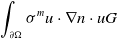
$\displaystyle \int _{\partial \Omega }\sigma ^mu\cdot \nabla n\cdot uG$
(see (3.38)), which is inevitable. This term combined with the second estimate (1.19) implies that the order of
$A_2(T)$
should be higher than that of
$A_1(T)$
, but lower than that of
$A_1^{\frac {3}{2}}(T)$
. Based on this key observation, we specifically choose
$A_2(T)\sim A_1(T)^{\frac {4}{3}}$
in Proposition 3.1. It is worth mentioning that this is different from [Reference Hong, Hou, Peng and Zhu22] where
$A_1(T)\sim A_2(T)^2$
is chosen. In addition, due to lack of the smallness of
$E_0$
, we have to derive new estimates on almost all boundary terms and intermediate terms appearing in the control of
$A_2(T)$
, such as
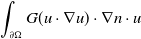
$\displaystyle \int _{\partial \Omega }G(u\cdot \nabla u)\cdot \nabla n\cdot u$
in (3.26) and
$\|\nabla u\|_{L^2}^2\|\nabla G\|_{L^3}^2$
in (3.32), which is very different from [Reference Cai and Li4]. -
• The control of
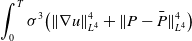
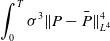
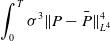
$\displaystyle \int _0^T\sigma ^3\big(\|\nabla u\|_{L^4}^4+\|P-\bar {P}\|_{L^4}^4\big)$
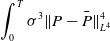
appearing in (1.18) is the most difficult part of this paper. Applying Lemma 2.7 or using the similar procedure to deal with
$\displaystyle \int _0^T\sigma ^3\|P-\bar {P}\|_{L^4}^4$
as in Lemma 3.7 will yield the same trouble that(1.20)
\begin{equation} \int _0^T\sigma ^3\|P-\bar {P}\|_{L^4}^4\leq C\int _0^T\sigma ^3\|\nabla u\|_{L^2}^4+\hbox{good terms}, \end{equation}
(1.21)where the trouble term
\begin{equation} \int _0^T\sigma ^3\|\nabla u\|_{L^4}^4\leq C\int _0^T\sigma ^3(\|\nabla u\|_{L^2}^4+\|P-\bar {P}\|_{L^4}^4)+\hbox{good terms}, \end{equation}
$\displaystyle \int _0^T\sigma ^3\|\nabla u\|_{L^2}^4$
in (1.20) and (1.21) is out of control due to lack of smallness on
$\displaystyle \int _{\sigma (T)}^T\sigma ^3\|\nabla u\|_{L^2}^4$
(smaller than
$A_2(T)$
). Notice that, for the Cauchy problem in [Reference Hong, Hou, Peng and Zhu22], the troubling term
$\displaystyle \int _0^T\sigma ^3\|\nabla u\|_{L^2}^4$
in (1.20) and (1.21) exactly disappears. Then, by combining the relations (1.20) and (1.21), the authors in [Reference Hong, Hou, Peng and Zhu22] succeed in controlling
$\displaystyle \int _0^T\sigma ^3\|P-\bar {P}\|_{L^4}^4$
and hence
$\displaystyle \int _0^T\sigma ^3\|\nabla u\|_{L^4}^4$
. Therefore, we need to employ some new thoughts to overcome this difficulty. Fortunately, we observe that the term
$\displaystyle \int _{\sigma (T)}^T\sigma ^3\|\nabla u\|_{L^2}^4$
is actually from
${\mathrm {curl}}\, u\times n|_{\partial \Omega }=-Au$
of Navier-slip boundary conditions (1.4). If some smallness condition is imposed on the matrix
$A$
, then we can close the estimate of
$\displaystyle \int _{\sigma (T)}^T\sigma ^3\|\nabla u\|_{L^4}^4$
and hence that of
$\displaystyle \int _0^T\sigma ^3\|P-\bar {P}\|_{L^4}^4$
. This part is discussed in Remark 2.8, (3.61), (3.64) and (3.65). It is worth mentioning that the smallness condition in (1.13) imposed on the matrix
$A$
is different from [Reference Hong, Hou, Peng and Zhu22], but it can be seen as a similar constraint on boundary as compared to the smallness assumption on far-field density in [Reference Hong, Hou, Peng and Zhu22]. In particular, our results hold for the usual case that the matrix
$A=0$
. Additionally, we should remark that the smallness of
$A$
only depends on
$\mu ,\lambda$
and
$\Omega$
but is independent of the density
$\rho$
, velocity
$u$
and pressure
$P$
.
-
• The next important issue is to give the exponent decay of the classical solution obtained in Theorem1.1. Since we aim to describe the monotonicity of exponent decay rate with respect to the adiabatic exponent
$\gamma$
, the rough relation among
$(\rho -\bar {\rho })^2,G(\rho )$
and
$(P(\rho )-P(\bar {\rho }))(\rho -\bar {\rho })$
in [Reference Cai and Li4] is not applicable for our case. To overcome this difficulty, by employing several key observations, we give an explicit relation among three terms above in Lemma A.1. With the crucial Lemma A.1 in hand, we succeed in deriving the exponent decay rate for any
$\gamma \in (1,\frac {3}{2}]$
in Proposition 3.10.























The rest of the paper is organized as follows: In the next section, we introduce some elementary lemmas that will be needed later. In Section 3, we give the proof of Theorem1.1.
2. Preliminary
This section mainly introduces some elementary lemmas used later. First, we give the local existence of strong solutions as follows.
Lemma 2.1.
Let $\Omega$
be as in Theorem
1.1
and assume that
$\Omega$
be as in Theorem
1.1
and assume that $(\rho _0,u_0)$
satisfies (1.8)–(1.10). Then, there exist a small
$(\rho _0,u_0)$
satisfies (1.8)–(1.10). Then, there exist a small $T\gt 0$
and a unique strong solution
$T\gt 0$
and a unique strong solution $(\rho ,u)$
to the problem (1.1)–(1.4) on
$(\rho ,u)$
to the problem (1.1)–(1.4) on $\Omega \times (0,T]$
satisfying for any
$\Omega \times (0,T]$
satisfying for any $\tau \in (0,T)$
,
$\tau \in (0,T)$
,
 \begin{equation*} \begin{cases} (\rho ,P)\in C([0,T];\ W^{2,q}),\\ \nabla u\in C([0,T];\ H^1)\cap L^{\infty }(\tau ,T;W^{2,q}),\\ u_t\in L^{\infty }(\tau ,T;\ H^2)\cap H^1(\tau ,T;\ H^1),\\ \sqrt {\rho }u_t\in L^{\infty }(0,\infty ;\ L^2). \end{cases} \end{equation*}
This lemma can be deduced by combining the local existence result in [Reference Huang23] and the initial-boundary-value problem under Navier boundary conditions without vacuum in [Reference Hoff19].
Next, the well-known Poincaré inequality and Gagliardo–Nirenberg interpolation inequality will be used frequently later.
Lemma 2.2. Assume that $\Omega$
is a bounded domain in
$\Omega$
is a bounded domain in $\mathbb{R}^3$
with Lipschitz boundary. Then,
$\mathbb{R}^3$
with Lipschitz boundary. Then,
-
(1) For any
$p\in (1,\infty )$
, there exists a constant
$C\gt 0$
such that (see [
Reference Berselli and Spirito3
])
(2.1)
\begin{equation} \|f\|_{L^p}\leq C\|\nabla f\|_{L^p},\ \ \mathrm {if}\ f\cdot n|_{\partial \Omega }=0\ \mathrm {or}\ f\times n|_{\partial \Omega }=0\ \mathrm {or\ if}\ \ \bar {f}=0\ \mathrm {and}\ \Omega\ \mathrm {is\ connected}. \end{equation}
-
(2) For
$p\in [2,6]$
,
$q\in (1,\infty )$
and
$r\in (3,\infty )$
, there exist generic constants
$C_i\gt 0(i=1,\ldots ,4)$
that depend only on
$p,q,r$
and
$\Omega$
such that (see [
Reference Nirenberg37
])
(2.2)
\begin{equation} \|f\|_{L^p}\leq C_1\|f\|_{L^2}^{\frac {6-p}{2p}}\|\nabla f\|_{L^2}^{\frac {3p-6}{2p}}+C_2\|f\|_{L^2}, \end{equation}
(2.3)
\begin{equation} \|g\|_{C(\bar {\Omega })}\leq C_3\|g\|_{L^q}^{\frac {q(r-3)}{3r+q(r-3)}}\|\nabla g\|_{L^r}^{\frac {3r}{3r+q(r-3)}}+C_4\|g\|_{L^2}. \end{equation}
In particular, if either
$f\cdot n|_{\partial \Omega }=0$
or
$\bar {f}=0$
with
$\Omega$
connected, we can set
$C_2=0$
. Similarly, the constant
$C_4=0$
if
$g\cdot n|_{\partial \Omega }=0$
or if
$\bar {g}=0$
with
$\Omega$
connected.





The following Zlotnik’s inequality is introduced to get the upper bound of the density $\rho$
.
$\rho$
.
Lemma 2.3 (see [Reference Zlotnik47]). Suppose the function $y$
satisfies
$y$
satisfies
 \begin{equation*} y'(t)=g(y)+b'(t),\, t\in [0,T], \quad y(0)=y_0, \end{equation*}
with $g\in C(\mathbb{R})$
and
$g\in C(\mathbb{R})$
and $y,b\in W^{1,1}(0,T)$
. If
$y,b\in W^{1,1}(0,T)$
. If $g(\infty )=-\infty$
and
$g(\infty )=-\infty$
and
 \begin{equation} b(t_2)-b(t_1)\leq N_0+N_1(t_2-t_1) \end{equation}
for all $0\leq t_1\lt t_2\leq T$
with some
$0\leq t_1\lt t_2\leq T$
with some $N_0\geq 0$
and
$N_0\geq 0$
and $N_1\geq 0$
, then
$N_1\geq 0$
, then
 \begin{equation*} y(t)\leq \max \{y_0,\zeta _0\}+N_0\lt \infty\ \mathrm { on }\ [0,T], \end{equation*}
where $\zeta _0$
is a constant such that
$\zeta _0$
is a constant such that
 \begin{equation} g(\zeta )\leq -N_1\ \mathrm { for }\ \zeta \geq \zeta _0. \end{equation}
Next, we consider the Lamé’s system
 \begin{equation} \begin{cases} -\mu \Delta u-(\lambda +\mu )\nabla {\mathrm {div}}\, u=f,\text{ in }\Omega ,\\ u\cdot n=0,\, {\mathrm {curl}}\, u\times n=-Au,\text{ on }\partial \Omega . \end{cases} \end{equation}
This system belongs to the elliptic systems, and thus the standard elliptic estimates hold as follows.
Lemma 2.4 (see [Reference Agmon, Douglis and Nirenberg1]). Let $u$
be a smooth solution of the Lamé’s system (2.6). Then, for
$u$
be a smooth solution of the Lamé’s system (2.6). Then, for $p\in (1,\infty )$
and integer
$p\in (1,\infty )$
and integer $k\geq 0$
, there exists a constant
$k\geq 0$
, there exists a constant $C\gt 0$
depending only on
$C\gt 0$
depending only on $\lambda ,\mu ,p,k,\Omega$
and the matrix
$\lambda ,\mu ,p,k,\Omega$
and the matrix $A$
such that
$A$
such that
-
• If
$f\in W^{k,p}$
, then
(2.7)
\begin{equation} \|u\|_{W^{k+2,p}}\leq C(\|f\|_{W^{k,p}}+\|u\|_{L^p}); \end{equation}
-
• If
$f=\nabla g$
and
$g\in W^{k,p}$
, then
(2.8)
\begin{equation} \|u\|_{W^{k+1,p}}\leq C(\|g\|_{W^{k,p}}+\|u\|_{L^p}). \end{equation}


Next, the following two Hodge-type decompositions are given in [Reference Aramaki2, Reference von Wahl46].
Lemma 2.5.
Let integer $k\geq 0$
and
$k\geq 0$
and $p\in (1,\infty )$
and assume that
$p\in (1,\infty )$
and assume that $\Omega$
is a simply connected bounded domain in
$\Omega$
is a simply connected bounded domain in $\mathbb{R}^3$
with
$\mathbb{R}^3$
with $C^{k+1,1}$
boundary
$C^{k+1,1}$
boundary $\partial \Omega$
. Then, there exists a constant
$\partial \Omega$
. Then, there exists a constant $C=C(p,k,\Omega )\gt 0$
such that
$C=C(p,k,\Omega )\gt 0$
such that
-
• If
$v\in W^{k+1,p}$
with
$v\cdot n|_{\partial \Omega }=0$
,(2.9)In particular, for
\begin{equation} \|v\|_{W^{k+1,p}}\leq C(\|{\mathrm {div}}\, v\|_{W^{k,p}}+\|{\mathrm {curl}}\, v\|_{W^{k,p}}). \end{equation}
$k=0$
, we have
\begin{equation*} \|\nabla v\|_{L^p}\leq C(\|{\mathrm {div}}\, v\|_{L^p}+\|{\mathrm {curl}}\, v\|_{L^p}). \end{equation*}
-
• If the boundary
$\partial \Omega$
only has a finite number of 2-dimensional connected components and
$v\in W^{k+1,p}$
with
$v\times n|_{\partial \Omega }=0$
, then
(2.10)In particular, if
\begin{equation} \|v\|_{W^{k+1,p}}\leq C(\|{\mathrm {div}}\, v\|_{W^{k,p}}+\|{\mathrm {curl}}\, v\|_{W^{k,p}}+\|v\|_{L^p}). \end{equation}
$\Omega$
has no holes, then
(2.11)
\begin{equation} \|v\|_{W^{k+1,p}}\leq C(\|{\mathrm {div}}\, v\|_{W^{k,p}}+\|{\mathrm {curl}}\, v\|_{W^{k,p}}). \end{equation}


Next, we introduce the Bogovskii operator $\mathcal{B}$
that solves the following problem
$\mathcal{B}$
that solves the following problem
 \begin{equation} \begin{cases} {\mathrm {div}}\,\mathcal{B}[f] = f,\text{ in }\Omega , \\ \mathcal{B}[f]=0,\text{ on }\partial \Omega . \end{cases} \end{equation}
Then, we have the following conclusion.
Lemma 2.6 (see [Reference Galdi15]). There exists a linear operator $\mathcal{B}(f)\ :\ \{\,f\in L^p\,:\, \bar {f}=0\}\longrightarrow \mathbb{R}^3$
solving the problem (2.12) and satisfying that for any
$\mathcal{B}(f)\ :\ \{\,f\in L^p\,:\, \bar {f}=0\}\longrightarrow \mathbb{R}^3$
solving the problem (2.12) and satisfying that for any $p\in (1,\infty )$
,
$p\in (1,\infty )$
,
 \begin{equation} \|\mathcal{B}(f)\|_{W_0^{1,p}(\Omega )}\leq C(p)\|f\|_{L^p(\Omega )}. \end{equation}
In particular, if $f={\mathrm {div}}\, g$
with
$f={\mathrm {div}}\, g$
with $g\in L^r(\Omega )$
and
$g\in L^r(\Omega )$
and $g\cdot n|_{\Omega }=0$
, then
$g\cdot n|_{\Omega }=0$
, then
 \begin{equation} \|\mathcal{B}(f)\|_{L^r(\Omega )}\leq C(r)\|g\|_{L^r(\Omega )},\,\forall r\in (1,\infty ). \end{equation}
Next, we write (1.1) $_2$
as
$_2$
as
 \begin{equation} \rho \dot {u}=\nabla G-\mu \nabla \times {\mathrm {curl}}\, u \end{equation}
with
 \begin{equation*} {{\mathrm {curl}}\, u}=\nabla \times u,\, G=(2\mu +\lambda ){\mathrm {div}}\, u-(P-\bar {P}),\, \dot {f}\,:\!=f_t+u\cdot \nabla f, \end{equation*}
where the vorticity ${\mathrm {curl}}\, u$
and the effective viscous flux
${\mathrm {curl}}\, u$
and the effective viscous flux $G$
both play an important role in the following analysis. Here, we give the following key a priori estimates on
$G$
both play an important role in the following analysis. Here, we give the following key a priori estimates on ${\mathrm {curl}}\, u$
and
${\mathrm {curl}}\, u$
and $G$
, which will be used frequently.
$G$
, which will be used frequently.
Lemma 2.7.
Assume $\Omega$
is a simply connected bounded domain in
$\Omega$
is a simply connected bounded domain in $\mathbb{R}^3$
and its smooth boundary
$\mathbb{R}^3$
and its smooth boundary $\partial \Omega$
only has a finite number of 2D connected components. Let
$\partial \Omega$
only has a finite number of 2D connected components. Let $(\rho ,u)$
be a smooth solution of (1.1) with Navier-slip boundary conditions (1.4). Then, for any
$(\rho ,u)$
be a smooth solution of (1.1) with Navier-slip boundary conditions (1.4). Then, for any $p\in [2,6]$
and
$p\in [2,6]$
and $q\in (1,\infty )$
, there exist constants
$q\in (1,\infty )$
, there exist constants $C_1,\, C\gt 0$
depending only on
$C_1,\, C\gt 0$
depending only on $p,q,\mu ,\lambda$
and
$p,q,\mu ,\lambda$
and $\Omega$
(with
$\Omega$
(with $C$
depending on
$C$
depending on $A$
as well) such that
$A$
as well) such that
 \begin{equation} \|\nabla u\|_{L^q}\leq C_1(\|{\mathrm {div}}\, u\|_{L^q}+\|{\mathrm {curl}}\, u\|_{L^q}), \end{equation}
 \begin{equation} \|\nabla G\|_{L^p}+\|\nabla {\mathrm {curl}}\, u\|_{L^p}\leq C(\|\rho \dot {u}\|_{L^p}+\|\nabla u\|_{L^2}+\|P-\bar {P}\|_{L^p}), \end{equation}
 \begin{equation} \|G\|_{L^p}\leq C\|\rho \dot {u}\|_{L^2}^{\frac {3p-6}{2p}}(\|\nabla u\|_{L^2}+\|P-\bar {P}\|_{L^2})^{\frac {6-p}{2p}}+C(\|\nabla u\|_{L^2}+\|P-\bar {P}\|_{L^2}), \end{equation}
 \begin{equation} \|{\mathrm {curl}}\, u\|_{L^p}\leq C\|\rho \dot {u}\|_{L^2}^{\frac {3p-6}{2p}}\|\nabla u\|_{L^2}^{\frac {6-p}{2p}}+C\|\nabla u\|_{L^2}. \end{equation}
Moreover,
 \begin{equation} \|G\|_{L^p}+\|{\mathrm {curl}}\, u\|_{L^p}\leq C(\|\rho \dot {u}\|_{L^2}+\|\nabla u\|_{L^2}), \end{equation}
 \begin{equation} \|\nabla u\|_{L^p}\leq C\|\rho \dot {u}\|_{L^2}^{\frac {3p-6}{2p}}(\|\nabla u\|_{L^2}+\|P-\bar {P}\|_{L^2})^{\frac {6-p}{2p}}+C(\|\nabla u\|_{L^2}+\|P-\bar {P}\|_{L^p}). \end{equation}
In particular, for $p=2$
, the term
$p=2$
, the term $\|P-\bar {P}\|_{L^p}$
can be removed in (2.17).
$\|P-\bar {P}\|_{L^p}$
can be removed in (2.17).
Proof. Since the proof of this lemma is similar to that of [Reference Cai and Li4], we only give a sketch for simplicity. First, the inequality (2.16) just follows the Hodge-type decomposition in Lemma (2.5). For the estimate on $\nabla F$
, we consider the following elliptic equations:
$\nabla F$
, we consider the following elliptic equations:
 \begin{equation} \begin{cases} \Delta G={\mathrm {div}}\,(\rho \dot {u}), & x\in \Omega , \\ \frac {\partial G}{\partial n}=(\rho \dot {u}-\mu \nabla \times (Au)^{\bot })\cdot n, & x\in \partial \Omega . \end{cases} \end{equation}
with the notation
 \begin{equation} f^{\bot }=-f\times n=n\times f. \end{equation}
Here, we should notice that the normal vector $n$
only makes sense on the boundary
$n$
only makes sense on the boundary $\partial \Omega$
and can be extended to a smooth vector-valued function on
$\partial \Omega$
and can be extended to a smooth vector-valued function on $\bar {\Omega }$
. Thus,
$\bar {\Omega }$
. Thus, $f^{\bot }$
is well defined on
$f^{\bot }$
is well defined on $\bar {\Omega }$
. Similar arguments can be also applicable to
$\bar {\Omega }$
. Similar arguments can be also applicable to $(Au)^{\bot }$
.
$(Au)^{\bot }$
.
Due to (1.4), $({\mathrm {curl}}\, u+(Au)^{\bot })\times n=0$
on
$({\mathrm {curl}}\, u+(Au)^{\bot })\times n=0$
on $\partial \Omega$
. Then, we have for any
$\partial \Omega$
. Then, we have for any $\eta \in C^{\infty }(\bar {\Omega })$
 \begin{equation*} \begin{aligned} \int \nabla \times {\mathrm {curl}}\, u\cdot \nabla \eta &=\int (\nabla \times ({\mathrm {curl}}\, u+(Au)^{\bot })\cdot \nabla \eta -\int \nabla \times (Au)^{\bot }\cdot \nabla \eta \\ &=-\int \nabla \times (Au)^{\bot }\cdot \nabla \eta , \end{aligned} \end{equation*}
which combined with (2.15) implies that
 \begin{equation*} \int \nabla G\cdot \nabla \eta =\int (\rho \dot {u}-\mu \nabla \times (Au)^{\bot })\cdot \nabla \eta ,\quad \forall \eta \in C^{\infty }(\bar {\Omega }). \end{equation*}
Then, the standard elliptic estimate on (2.22) yields that for any $q\in (1,\infty )$
 \begin{equation} \|\nabla G\|_{L^q}\leq C\|\rho \dot {u}-\mu \nabla \times (Au)^{\bot }\|_{L^q}\leq C(\|\rho \dot {u}\|_{L^q}+\|\nabla u\|_{L^q}), \end{equation}
where we have applied Poincaré’s inequality (2.1), and for any integer $k\geq 0$
,
$k\geq 0$
,
 \begin{equation} \|\nabla G\|_{W^{k+1,q}}\leq C(\|\rho \dot {u}\|_{W^{k+1,q}}+\|\nabla \times (Au)^{\bot }\|_{W^{k+1,q}}). \end{equation}
For the vorticity ${\mathrm {curl}}\, u$
, due to
${\mathrm {curl}}\, u$
, due to $({\mathrm {curl}}\, u+(Au)^{\bot })\times n|_{\partial \Omega }=0$
and (2.15), by Lemma 2.5, we get that for any
$({\mathrm {curl}}\, u+(Au)^{\bot })\times n|_{\partial \Omega }=0$
and (2.15), by Lemma 2.5, we get that for any $q\in (1,\infty )$
 \begin{align} \|\nabla {\mathrm {curl}}\, u\|_{L^q}&\leq C(\|\nabla \times {\mathrm {curl}}\, u\|_{L^q}+\|\nabla (Au)^{\bot }\|_{L^q}{+\|{\mathrm {curl}}\, u+(Au)^{\bot }\|_{L^q}})\nonumber\\ &\leq C(\|\rho \dot {u}\|_{L^q}+\|\nabla G\|_{L^q}+\|\nabla u\|_{L^q})\nonumber\\ &\leq C(\|\rho \dot {u}\|_{L^q}+\|\nabla u\|_{L^q}), \end{align}
and for any integer $k\geq 0$
,
$k\geq 0$
,
 \begin{align} \|\nabla {\mathrm {curl}}\, u\|_{W^{k+1,q}}&\leq C(\|\nabla \times {\mathrm {curl}}\, u\|_{W^{k+1,q}}+\|{\mathrm {curl}}\, u\|_{L^q}+\|(Au)^{\bot }\|_{W^{k+2,q}})\nonumber\\ &\leq C(\|\rho \dot {u}\|_{W^{k+1,q}}+\|\nabla (Au)^{\bot }\|_{W^{k+1,q}}+\|\nabla u\|_{L^q}). \end{align}
Since $\bar {F}=0$
, one can deduce (2.18) and (2.19) from Gagliardo–Nirenberg interpolation inequality (2.2), (2.24) and (2.26). The inequality (2.20) follows from Sobolev embedding, Poincaré’s inequality (2.1), (2.24) and (2.26) directly. The last inequality (2.21) is a combination of (2.16), (2.18) and (2.19). The second inequality (2.17) follows from (2.21), (2.24) and (2.26).
$\bar {F}=0$
, one can deduce (2.18) and (2.19) from Gagliardo–Nirenberg interpolation inequality (2.2), (2.24) and (2.26). The inequality (2.20) follows from Sobolev embedding, Poincaré’s inequality (2.1), (2.24) and (2.26) directly. The last inequality (2.21) is a combination of (2.16), (2.18) and (2.19). The second inequality (2.17) follows from (2.21), (2.24) and (2.26).
Remark 2.8.
In fact, we may need some refined inequalities to deal with $\displaystyle \int _0^T\sigma ^3\|\nabla u\|_{L^4}^4$
in Lemma 3.7
. Here, we have the modified estimates as follows:
$\displaystyle \int _0^T\sigma ^3\|\nabla u\|_{L^4}^4$
in Lemma 3.7
. Here, we have the modified estimates as follows:
 \begin{equation} \|\nabla G\|_{L^2}+\|\nabla {\mathrm {curl}}\, u\|_{L^2}\leq C(\|\rho \dot {u}\|_{L^2}+\|\nabla (Au)^{\bot }\|_{L^2})\leq C(\|\rho \dot {u}\|_{L^2}+\|A\|_{W^{1,6}}\|\nabla u\|_{L^2}), \end{equation}
and due to $({\mathrm {curl}}\, u+(Au)^{\bot })\times n|_{\partial \Omega }=0$
and Poincaré inequality (2.1),
$({\mathrm {curl}}\, u+(Au)^{\bot })\times n|_{\partial \Omega }=0$
and Poincaré inequality (2.1),
 \begin{align} \|{\mathrm {curl}}\, u\|_{L^2}&\leq C\|\nabla ({\mathrm {curl}}\, u+(Au)^{\bot })\|_{L^2}+\|(Au)^{\bot }\|_{L^2}\nonumber\\ &\leq C(\|\nabla {\mathrm {curl}}\, u\|_{L^2}+\|\nabla (Au)^{\bot }\|_{L^2})\nonumber\\ &\leq C(\|\rho \dot {u}\|_{L^2}+\|A\|_{W^{1,6}}\|\nabla u\|_{L^2}), \end{align}
and henceforth
 \begin{align} \|G\|_{L^6}+\|{\mathrm {curl}}\, u\|_{L^6}&\leq C(\|\nabla G\|_{L^2}+\|\nabla {\mathrm {curl}}\, u\|_{L^2}+\|{\mathrm {curl}}\, u\|_{L^2})\nonumber\\ &\leq C(\|\rho \dot {u}\|_{L^2}+\|A\|_{W^{1,6}}\|\nabla u\|_{L^2}). \end{align}
Now we give the estimate on $\|\nabla u\|_{L^4}^4$
as
$\|\nabla u\|_{L^4}^4$
as
 \begin{align} \|\nabla u\|_{L^4}^4&\leq C(\|G\|_{L^4}^4+\|{\mathrm {curl}}\, u\|_{L^4}^4+\|P-\bar {P}\|_{L^4}^4)\nonumber\\ &\leq C(\|G\|_{L^2}\|G\|_{L^6}^3+\|{\mathrm {curl}}\, u\|_{L^2}\|{\mathrm {curl}}\, u\|_{L^6}^3)+C\|P-\bar {P}\|_{L^4}^4\nonumber\\ &\leq C(\|\nabla u\|_{L^2}+\|P-\bar {P}\|_{L^2})(\|\rho \dot {u}\|_{L^2}^3+\|A\|_{W^{1,6}}^3\|\nabla u\|_{L^2}^3)+C\|P-\bar {P}\|_{L^4}^4\nonumber\\ &\leq C\|A\|_{W^{1,6}}^3\|\nabla u\|_{L^4}^4+C(\|\nabla u\|_{L^2}+\|P-\bar {P}\|_{L^2})\|\rho \dot {u}\|_{L^2}^3+C(\|A\|_{W^{1,6}}^3+1)\|P-\bar {P}\|_{L^4}^4, \end{align}
which implies that
 \begin{equation} \|\nabla u\|_{L^4}^4\leq C(\|\nabla u\|_{L^2}+\|P-\bar {P}\|_{L^2})\|\rho \dot {u}\|_{L^2}^3+C\|P-\bar {P}\|_{L^4}^4 \end{equation}
provided that
 \begin{equation} C\|A\|_{W^{1,6}}^3\leq \frac {1}{2},\quad \mathrm {i.e.},\quad \|A\|_{W^{1,6}}\leq (2C)^{-\frac {1}{3}} \end{equation}
with $C$
only depending on
$C$
only depending on $\mu ,\lambda$
and
$\mu ,\lambda$
and $\Omega$
.
$\Omega$
.
Next, we give the a priori estimate on $\dot {u}$
that will be used later. The detailed proof of following lemma also can be found in [Reference Cai and Li4], and here we still present a sketch.
$\dot {u}$
that will be used later. The detailed proof of following lemma also can be found in [Reference Cai and Li4], and here we still present a sketch.
Lemma 2.9.
Let $(\rho ,u)$
be a smooth solution of (1.1) with Navier-slip boundary conditions (1.4). Then, there exists a constant
$(\rho ,u)$
be a smooth solution of (1.1) with Navier-slip boundary conditions (1.4). Then, there exists a constant $C\gt 0$
depending only on
$C\gt 0$
depending only on $\Omega$
such that
$\Omega$
such that
 \begin{equation} \|\dot {u}\|_{L^6}\leq C\big(\|\nabla \dot {u}\|_{L^2}+\|\nabla u\|_{L^2}^2\big), \end{equation}
 \begin{equation} \|\nabla \dot {u}\|_{L^2}\leq C(\|{\mathrm {div}}\,\dot {u}\|_{L^2}+\|{\mathrm {curl}}\,\dot {u}\|_{L^2}+\|\nabla u\|_{L^4}^2). \end{equation}
Proof. Since it holds thatFootnote 2
 \begin{equation*} \dot {u}\cdot n=u\cdot \nabla u\cdot n=-u\cdot \nabla n\cdot u=-u\cdot \nabla n\cdot (u^{\bot }\times n)=-(u\cdot \nabla n)\times u^{\bot }\cdot n\ \mathrm { on }\ \partial \Omega \end{equation*}
from the simple fact that
 \begin{equation*} (a\times b)\cdot c=(b\times c)\cdot a=(c\times a)\cdot b, \end{equation*}
we have
 \begin{equation} (\dot {u}+(u\cdot \nabla n)\times u^{\bot })\cdot n=0\ \mathrm { on }\ \partial \Omega . \end{equation}
This together with Sobolev embedding and Poincaré’s inequality (2.1) yields that
 \begin{equation*} \begin{aligned} \|\dot {u}\|_{L^6}&\leq C\big(\|\nabla \dot {u}\|_{L^2}+\|\bar {\dot {u}}\|_{L^6}\big)\leq C\big(\|\nabla \dot {u}\|_{L^2}+\|\dot {u}\|_{L^{\frac {3}{2}}}\big)\\ &\leq C\big(\|\nabla \dot {u}\|_{L^2}+\|\nabla (\dot {u}+(u\cdot \nabla n)\times u^{\bot })\|_{L^{\frac {3}{2}}}+\|(u\cdot \nabla n)\times u^{\bot }\|_{L^{\frac {3}{2}}}\big)\\ &\leq C\big(\|\nabla \dot {u}\|_{L^2}+\|\nabla u\|_{L^2}^2\big). \end{aligned} \end{equation*}
Finally, combining (2.36) with (2.9) and Poincaré’s inequality (2.1), we deduce
 \begin{equation*} \begin{aligned} \|\nabla \dot {u}\|_{L^2}&\leq C(\|{\mathrm {div}}\,\dot {u}\|_{L^2}+\|{\mathrm {curl}}\,\dot {u}\|_{L^2}+\|\nabla ((u\cdot \nabla n)\times u^{\bot })\|_{L^2})\\ &\leq C(\|{\mathrm {div}}\,\dot {u}\|_{L^2}+\|{\mathrm {curl}}\,\dot {u}\|_{L^2}+\|\nabla u\|_{L^4}^2). \end{aligned} \end{equation*}
3. Proof of Theorem1.1
3.1. Lower-order a priori estimates
In this subsection, we are devoted to establishing some necessary a priori estimates for smooth solution $(\rho ,u)$
to the problem (1.1)–(1.4) on
$(\rho ,u)$
to the problem (1.1)–(1.4) on $\Omega \times (0,T]$
for some fixed time
$\Omega \times (0,T]$
for some fixed time $T\gt 0$
. Setting
$T\gt 0$
. Setting $\sigma =\sigma (t)=\min \{1,t\}$
, we define
$\sigma =\sigma (t)=\min \{1,t\}$
, we define
 \begin{equation} \begin{cases} A_1(T)=\sup \limits _{t\in [0,T]}\sigma \displaystyle \int |\nabla u|^2+\int _0^T\displaystyle \int \sigma \rho |\dot {u}|^2, \\ A_2(T)=\sup \limits _{t\in [0,T]}\sigma ^3\displaystyle \int \rho |\dot {u}|^2+\int _0^T\displaystyle \int \sigma ^3|\nabla \dot {u}|^2, \\ A_3(T)=\sup \limits _{t\in [0,T]}\displaystyle \int \rho |u|^3. \end{cases} \end{equation}
Since for the large adiabatic exponent $\gamma \gt 1$
, the initial energy
$\gamma \gt 1$
, the initial energy $E_0$
in (1.6) correspondingly becomes small from the smallness of
$E_0$
in (1.6) correspondingly becomes small from the smallness of $\mathcal{E}_0$
in (1.13), without loss of generality, we assume that
$\mathcal{E}_0$
in (1.13), without loss of generality, we assume that
 \begin{equation} \epsilon \leq 1, \quad 1\lt \gamma \leq \frac {3}{2}. \end{equation}
Then, we give the following proposition that can guarantee the existence of a global classical solution of (1.1)–(1.4).
Proposition 3.1.
Assume that the initial data satisfy (1.8), (1.9) and (1.10). If the solution $(\rho ,u)$
satisfies
$(\rho ,u)$
satisfies
 \begin{equation} A_1(T)\leq 2\mathcal{E}_0^{\frac {3}{8}},\quad A_2(T)\leq 2\mathcal{E}_0^{\frac {1}{2}},\quad A_3(\sigma (T))\leq 2\mathcal{E}_0^{\frac {1}{4}},\quad 0\leq \rho \leq 2\tilde {\rho }, \end{equation}
then the following estimates hold:
 \begin{equation} A_1(T)\leq \mathcal{E}_0^{\frac {3}{8}},\quad A_2(T)\leq \mathcal{E}_0^{\frac {1}{2}},\quad A_3(\sigma (T))\leq \mathcal{E}_0^{\frac {1}{4}},\quad 0\leq \rho \leq \frac {7}{4}\tilde {\rho }, \end{equation}
provided that $\mathcal{E}_0\leq \epsilon$
and
$\mathcal{E}_0\leq \epsilon$
and $\|A\|_{W^{1,6}}\leq \hat {\epsilon }$
, where
$\|A\|_{W^{1,6}}\leq \hat {\epsilon }$
, where $\epsilon \gt 0$
is a small constant depending on
$\epsilon \gt 0$
is a small constant depending on $\mu , \lambda , a, \tilde {\rho }, \Omega , M, E_0$
, and the matrix
$\mu , \lambda , a, \tilde {\rho }, \Omega , M, E_0$
, and the matrix $A$
, but independent of
$A$
, but independent of $\gamma -1$
and
$\gamma -1$
and $t$
(see (3.45), (3.51), (3.56) and (3.79)), and
$t$
(see (3.45), (3.51), (3.56) and (3.79)), and $\hat {\epsilon }\gt 0$
is a small constant depending only on
$\hat {\epsilon }\gt 0$
is a small constant depending only on $\mu , \lambda$
and
$\mu , \lambda$
and $\Omega$
(see (3.57)).
$\Omega$
(see (3.57)).
We begin with the following standard energy estimate for $(\rho ,u)$
.
$(\rho ,u)$
.
Lemma 3.2.
Let $(\rho ,u)$
be a smooth solution of (1.1)–(1.4) on
$(\rho ,u)$
be a smooth solution of (1.1)–(1.4) on $\Omega \times (0,T]$
. Then, it holds that
$\Omega \times (0,T]$
. Then, it holds that
 \begin{equation} \sup _{t\in [0,T]}\int \left(\frac {1}{2}\rho |u|^2+\frac {1}{\gamma -1}P(\rho )\right)+\int _0^T\int (\mu |{\mathrm {curl}}\, u|^2+(2\mu +\lambda )|{\mathrm {div}}\, u|^2)\leq E_0. \end{equation}
Proof. Rewriting (1.1) $_1$
as
$_1$
as
 \begin{equation} P_t+{\mathrm {div}}\,(uP)+(\gamma -1)P{\mathrm {div}}\, u=0, \end{equation}
and integrating over $\Omega$
, then adding it to the
$\Omega$
, then adding it to the $L^2$
-inner product of (1.1)
$L^2$
-inner product of (1.1) $_2$
with
$_2$
with $u$
yields that
$u$
yields that
 \begin{equation} \frac {d}{dt}\int \left(\frac {1}{2}\rho |u|^2+\frac {1}{\gamma -1}P(\rho )\right)+\int (\mu |{\mathrm {curl}}\, u|^2+(2\mu +\lambda )|{\mathrm {div}}\, u|^2)+\mu \int _{\partial \Omega }Au\cdot u=0, \end{equation}
where we have used the fact that
 \begin{equation*} \Delta u=\nabla {\mathrm {div}}\, u-\nabla \times {\mathrm {curl}}\, u. \end{equation*}
A direct integration on $[0,T]$
gives the inequality (3.5).
$[0,T]$
gives the inequality (3.5).
The following a priori estimate is essential to close the a priori assumption (3.3).
Lemma 3.3. Under the conditions of Proposition 3.1 , it holds that
 \begin{equation} \sup _{t\in [0,\sigma (T)]}\int \rho |u|^2+\int _0^{\sigma (T)}\int |\nabla u|^2\leq C(\tilde {\rho })\mathcal{E}_0. \end{equation}
Proof. Taking $L^2$
-inner product of (1.1)
$L^2$
-inner product of (1.1) $_2$
with
$_2$
with $u$
, it follows from integration by parts that
$u$
, it follows from integration by parts that
 \begin{equation} \frac {d}{dt}\int \frac {1}{2}\rho |u|^2+\int (\mu |{\mathrm {curl}}\, u|^2+(2\mu +\lambda )|{\mathrm {div}}\, u|^2)+\mu \int _{\partial \Omega }Au\cdot u=\int P{\mathrm {div}}\, u. \end{equation}
Integrating (3.9) over $[0,\sigma (T)]$
and using Cauchy–Schwarz inequality and (3.5), we have
$[0,\sigma (T)]$
and using Cauchy–Schwarz inequality and (3.5), we have
 \begin{align} &\sup _{t\in [0,\sigma (T)]}\int \frac {1}{2}\rho |u|^2+\int _0^{\sigma (T)}\int \left(\mu |{\mathrm {curl}}\, u|^2+\frac {1}{2}(2\mu +\lambda )|{\mathrm {div}}\, u|^2\right)\nonumber\\ &\quad \leq \int \frac {1}{2}\rho _0|u_0|^2+C\int _0^{\sigma (T)}\int |P|^2\leq \int \frac {1}{2}\rho _0|u_0|^2+C(\tilde {\rho })\int P\\ &\quad \leq \frac {1}{2}\rho _0|u_0|^2+C(\tilde {\rho })(\gamma -1)E_0\leq C(\tilde {\rho })\mathcal{E}_0,\nonumber \end{align}
The next lemma gives the estimates on $A_1(T)$
and
$A_1(T)$
and $A_2(T)$
.
$A_2(T)$
.
Lemma 3.4. Under the conditions of Proposition 3.1 , it holds that
 \begin{equation} A_1(T)\leq C(\tilde {\rho })\mathcal{E}_0+C\mathcal{E}_0E_0+C\int _0^T\int \sigma P|\nabla u|^2+C\int _0^T\sigma \|\nabla u\|_{L^3}^3+C(\tilde {\rho })\int _0^T\sigma \|\nabla u\|_{L^2}^4, \end{equation}
 \begin{align} A_2(T)&\leq C(\tilde {\rho })\mathcal{E}_0+CA_1^{\frac {3}{2}}(T)(1+C(\tilde {\rho })A_1(T))^{\frac {1}{2}}+CA_1(\sigma (T))+C(\tilde {\rho })A_1^3(T)(E_0+1)\nonumber\\ &\quad +C\int _0^T\sigma ^3(\|\nabla u\|_{L^4}^4+\|P|\nabla u|\|_{L^2}^2+\|P-\bar {P}\|_{L^4}^4), \end{align}
provided that $\mathcal{E}_0\leq \epsilon _1=1$
.
$\mathcal{E}_0\leq \epsilon _1=1$
.
Proof. For any integer $m\geq 0$
, multiplying (1.1)
$m\geq 0$
, multiplying (1.1) $_2$
by
$_2$
by $\sigma ^m\dot {u}$
and integrating over
$\sigma ^m\dot {u}$
and integrating over $\Omega$
, we obtain
$\Omega$
, we obtain
 \begin{align} \int \sigma ^m\rho |\dot {u}|^2&=-\int \sigma ^m\dot {u}\cdot \nabla P+(2\mu +\lambda )\int \sigma ^m\nabla {\mathrm {div}}\, u\cdot \dot {u}-\mu \int \sigma ^m\nabla \times {\mathrm {curl}}\, u\cdot \dot {u}\nonumber\\ &=I_1+I_2+I_3. \end{align}
We will estimate $I_1,I_2$
and
$I_1,I_2$
and $I_3$
. First, a direct calculation by integration by parts yields that
$I_3$
. First, a direct calculation by integration by parts yields that
 \begin{align} I_1&=-\int \sigma ^m\dot {u}\cdot \nabla P\nonumber\\ &=\int \sigma ^mP{\mathrm {div}}\, u_t-\int \sigma ^mu\cdot \nabla u\cdot \nabla P\nonumber\\ &=\left (\int \sigma ^mP{\mathrm {div}}\, u\right )_t-m\sigma ^{m-1}\sigma '\int P{\mathrm {div}}\, u+\int \sigma ^mP\nabla u\,:\,\nabla u^T+(\gamma -1)\int \sigma ^mP({\mathrm {div}}\, u)^2\nonumber\\ &\quad -\int _{\partial \Omega }\sigma ^mPu\cdot \nabla u\cdot n, \end{align}
where we have used the equation (3.6)
 \begin{equation*} P_t+{\mathrm {div}}\,(Pu)+(\gamma -1)P{\mathrm {div}}\, u=0. \end{equation*}
Similarly, we estimate $I_2$
as
$I_2$
as
 \begin{align} I_2&=(2\mu +\lambda )\int \sigma ^m\nabla {\mathrm {div}}\, u\cdot \dot {u}\nonumber\\ &=(2\mu +\lambda )\int _{\partial \Omega }\sigma ^m{\mathrm {div}}\, u\dot {u}\cdot n-(2\mu +\lambda )\int \sigma ^m{\mathrm {div}}\, u{\mathrm {div}}\,\dot {u}\nonumber\\ &=(2\mu +\lambda )\int _{\partial \Omega }\sigma ^m{\mathrm {div}}\, uu\cdot \nabla u\cdot n-\frac {2\mu +\lambda }{2}\left (\int \sigma ^m|{\mathrm {div}}\, u|^2\right )_t\nonumber\\ &\quad -(2\mu +\lambda )\int \sigma ^m{\mathrm {div}}\, u{\mathrm {div}}\,(u\cdot \nabla u)+\frac {1}{2}m(\mu +\lambda )\sigma ^{m-1}\sigma '\int |{\mathrm {div}}\, u|^2\nonumber\\ &=(2\mu +\lambda )\int _{\partial \Omega }\sigma ^m{\mathrm {div}}\, uu\cdot \nabla u\cdot n-\frac {2\mu +\lambda }{2}\left (\int \sigma ^m|{\mathrm {div}}\, u|^2\right )_t\nonumber\\ &\quad +\frac {2\mu +\lambda }{2}\int \sigma ^m({\mathrm {div}}\, u)^3-(2\mu +\lambda )\int \sigma ^m{\mathrm {div}}\, u\nabla u\,:\,\nabla u^T\nonumber\\ &\quad +\frac {1}{2}m(2\mu +\lambda )\sigma ^{m-1}\sigma '\int |{\mathrm {div}}\, u|^2. \end{align}
Combining the boundary terms in (3.14) and (3.15), we have
 \begin{align} &\int _{\partial \Omega }\sigma ^m[(2\mu +\lambda ){\mathrm {div}}\, u-P]u\cdot \nabla u\cdot n\nonumber\\ &\quad =\int _{\partial \Omega }\sigma ^m(G-\bar {P})u\cdot \nabla u\cdot n=-\int _{\partial \Omega }\sigma ^m(G-\bar {P})u\cdot \nabla n\cdot u\nonumber\\ &\quad =-\int _{\partial \Omega }\sigma ^m(u^{\bot }\times n)\cdot \nabla n_iu_iG+\bar {P}\int _{\partial \Omega }\sigma ^mu\cdot \nabla n\cdot u\nonumber\\ &\quad =-\int _{\partial \Omega }\sigma ^m(\nabla n_i\times u^{\bot })\cdot nu_iG+\bar {P}\int _{\partial \Omega }\sigma ^mu\cdot \nabla n\cdot u\nonumber\\ &\quad =-\int \sigma ^m{\mathrm {div}}\,((\nabla n_i\times u^{\bot })u_iG)+\bar {P}\int _{\partial \Omega }\sigma ^mu\cdot \nabla n\cdot u\nonumber\\ &\quad \leq C\int \sigma ^m(|G||u|^2+|G||u||\nabla u|+|\nabla G||u|^2)+C\bar {P}\sigma ^m\|u\|_{H^1}^2\nonumber\\ &\quad \leq C\sigma ^m(\|G\|_{L^2}\|u\|_{L^4}^2+\|G\|_{L^3}\|u\|_{L^6}\|\nabla u\|_{L^2}+\|\nabla G\|_{L^2}\|u\|_{L^4}^2)+C\bar {P}\sigma ^m\|u\|_{H^1}^2\nonumber\\ &\quad \leq C\sigma ^m\|G\|_{H^1}\|u\|_{H^1}^2+C\bar {P}\sigma ^m\|u\|_{H^1}^2\nonumber\\ &\quad \leq C\sigma ^m(\|\rho \dot {u}\|_{L^2}\|\nabla u\|_{L^2}^2+\|\nabla u\|_{L^2}^3)+C\bar {P}\sigma ^m\|\nabla u\|_{L^2}^2\nonumber\\ &\quad \leq \frac {1}{4}\sigma ^m\|\sqrt {\rho }\dot {u}\|_{L^2}^2+C(\tilde {\rho })\sigma ^m\|\nabla u\|_{L^2}^4+C\sigma ^m(\|\nabla u\|_{L^2}^3+\bar {P}\|\nabla u\|_{L^2}^2\big), \end{align}
where we have used Poincaré’s inequality, Sobolev embedding and the simple argument on deriving (2.36) and Lemma 2.7.
Finally, by (1.4), a similar computation on $I_3$
gives that
$I_3$
gives that

where we have used the simple fact that by (2.17), Sobolev embedding and Poincaré’s inequality,
 \begin{equation*} \begin{aligned} &\int {\mathrm {div}}\,((u\cdot \nabla u)\times (Au)^{\bot })\\ &\quad =\int Au^{\bot }\cdot (\nabla \times (u\cdot \nabla u))-\int (u\cdot \nabla u)\cdot (\nabla \times (Au)^{\bot })\\ &\quad =\int (Au)^{\bot }\cdot (u\cdot \nabla {\mathrm {curl}}\, u+\nabla u_i\times \nabla _i u)-\int (u\cdot \nabla u)\cdot (\nabla \times (Au)^{\bot })\\ &\quad \leq C\int \big(|u|^2|\nabla {\mathrm {curl}}\, u|+|u||\nabla u|^2+|u|^2|\nabla u|+|u|^3\big)\\ &\quad \leq C\big(\|\nabla {\mathrm {curl}}\, u\|_{L^2}\|u\|_{L^4}^2+\|u\|_{L^3}\|\nabla u\|_{L^3}^2+\|\nabla u\|_{L^2}\|u\|_{L^4}^2+\|u\|_{L^3}^3\big)\\ &\quad \leq C\big(\|\rho \dot {u}\|_{L^2}\|\nabla u\|_{L^2}^2+\|\nabla u\|_{L^2}^3+\|\nabla u\|_{L^2}\|\nabla u\|_{L^3}^2\big). \end{aligned} \end{equation*}
It follows from (3.13)–(3.17) that
 \begin{align} &\left (\int \sigma ^m(\mu |{\mathrm {curl}}\, u|^2+(2\mu +\lambda )|{\mathrm {div}}\, u|^2-2P{\mathrm {div}}\, u)+\mu \int _{\partial \Omega }\sigma ^mAu\cdot u\right )_t+\int \sigma ^m\rho |\dot {u}|^2\nonumber\\ &\quad\leq Cm\sigma ^{m-1}\sigma '\left(\int P|\nabla u|+\|\nabla u\|_{L^2}^2\right)+C\sigma ^m\left(\int P|\nabla u|^2+\|\nabla u\|_{L^3}^3+\bar {P}\|\nabla u\|_{L^2}^2\right)\nonumber\\ &\qquad +C(\tilde {\rho })\sigma ^m\|\nabla u\|_{L^2}^4. \end{align}
Then integrating (3.18) over $[0,T]$
and using (3.5), (3.3), (2.16) and (3.8), we have that for any integer
$[0,T]$
and using (3.5), (3.3), (2.16) and (3.8), we have that for any integer $m\geq 1$
,
$m\geq 1$
,
 \begin{align} & \sup _{t\in [0,T]}\sigma ^m\|\nabla u\|_{L^2}^2+\int _0^T\int \sigma ^m\rho |\dot {u}|^2\nonumber\\ &\quad \leq C(\tilde {\rho })\mathcal{E}_0+C\int _0^{\sigma (T)}\int (P^2+|\nabla u|^2)+C\int _0^T\int \sigma ^mP|\nabla u|^2+C\int _0^T\bar {P}\|\nabla u\|_{L^2}^2\nonumber\\ &\qquad +C\int _0^T\sigma ^m\|\nabla u\|_{L^3}^3+C(\tilde {\rho })\int _0^T\sigma ^m\|\nabla u\|_{L^2}^4\nonumber\\ &\quad\leq C(\tilde {\rho })\mathcal{E}_0+C\mathcal{E}_0E_0+C\int _0^T\int \sigma ^mP|\nabla u|^2+C\int _0^T\sigma ^m\|\nabla u\|_{L^3}^3+C(\tilde {\rho })\int _0^T\sigma ^m\|\nabla u\|_{L^2}^4, \end{align}
which implies (3.11) by taking $m=1$
.
$m=1$
.
Now, we turn to prove (3.12). Recalling (2.15) as
 \begin{equation} \rho \dot {u}=\nabla G-\mu \nabla \times {\mathrm {curl}}\, u, \end{equation}
then taking $\sigma ^m\dot {u}_j[\partial _t+{\mathrm {div}}\,(u{\cdot})]$
on the
$\sigma ^m\dot {u}_j[\partial _t+{\mathrm {div}}\,(u{\cdot})]$
on the $j$
th component of (3.20), summing over
$j$
th component of (3.20), summing over $j$
and integrating over
$j$
and integrating over $\Omega$
yields
$\Omega$
yields
 \begin{align} & \left (\frac {1}{2}\int \sigma ^m\rho |\dot {u}|^2\right )_t-\frac {1}{2}m\sigma ^{m-1}\sigma '\int \rho |\dot {u}|^2\nonumber\\[3pt] &\quad =\,\int \sigma ^m(\dot {u}\cdot \nabla G_t+\dot {u}_j{\mathrm {div}}\,(u\partial _jG))+\mu \int \sigma ^m({-}\dot {u}\cdot \nabla \times {\mathrm {curl}}\, u_t-\dot {u}_j{\mathrm {div}}\,(u(\nabla \times {\mathrm {curl}}\, u)_j))\nonumber\\[3pt] &\quad =\,J_1+\mu J_2. \end{align}
For $J_1$
, by virtue of (1.4) and (3.6), we have
$J_1$
, by virtue of (1.4) and (3.6), we have
 \begin{align} J_1&=\int \sigma ^m\dot {u}\cdot \nabla G_t+\int \sigma ^m\dot {u}_j{\mathrm {div}}\,(u\partial _jG)\nonumber\\[3pt] &=\int _{\partial \Omega }\sigma ^mG_t\dot {u}\cdot n-\int \sigma ^mG_t{\mathrm {div}}\,\dot {u}-\int \sigma ^mu\cdot \nabla \dot {u}\cdot \nabla G\nonumber\\[3pt]&=\int _{\partial \Omega }\sigma ^mG_t\dot {u}\cdot n-(2\mu +\lambda )\int \sigma ^m|{\mathrm {div}}\,\dot {u}|^2+(2\mu +\lambda )\int \sigma ^m{\mathrm {div}}\,\dot {u}\nabla u\,:\,\nabla u^T\nonumber\\[3pt]&\quad +\int \sigma ^m{\mathrm {div}}\,\dot {u}u\cdot \nabla G-\gamma \int \sigma ^mP{\mathrm {div}}\, u{\mathrm {div}}\,\dot {u}+(\gamma -1)\overline {P{\mathrm {div}}\, u}\int \sigma ^m{\mathrm {div}}\,\dot {u}-\int \sigma ^mu\cdot \nabla \dot {u}\cdot \nabla G\nonumber\\[3pt]&\leq \int _{\partial \Omega }\sigma ^mG_t\dot {u}\cdot n-(2\mu +\lambda )\int \sigma ^m|{\mathrm {div}}\,\dot {u}|^2+\delta \sigma ^m\|\nabla \dot {u}\|_{L^2}^2\nonumber\\[3pt] &\quad +C(\delta )\sigma ^m\big(\|\nabla u\|_{L^2}^2\|\nabla G\|_{L^3}^2+\|\nabla u\|_{L^4}^4+\|P|\nabla u|\|_{L^2}^2\big), \end{align}
where we have used
 \begin{equation*} \begin{aligned} G_t&=(2\mu +\lambda ){\mathrm {div}}\, u_t-(P_t-\bar {P}_t)\\[3pt] &=(2\mu +\lambda ){\mathrm {div}}\,\dot {u}-(2\mu +\lambda ){\mathrm {div}}\,(u\cdot \nabla u)+u\cdot \nabla P+\gamma P{\mathrm {div}}\, u-(\gamma -1)\overline {P{\mathrm {div}}\, u}\\[3pt]&=(2\mu +\lambda ){\mathrm {div}}\,\dot {u}-(2\mu +\lambda )\nabla u\,:\,\nabla u^T-u\cdot \nabla G+\gamma P{\mathrm {div}}\, u-(\gamma -1)\overline {P{\mathrm {div}}\, u}. \end{aligned} \end{equation*}
For the boundary term in (3.21), we have
 \begin{align} & \int _{\partial \Omega }\sigma ^mG_t\dot {u}\cdot n =-\int _{\partial \Omega }\sigma ^mG_tu\cdot \nabla n\cdot u\nonumber\\[3pt] &\quad=-\left (\int _{\partial \Omega }\sigma ^mG(u\cdot \nabla n\cdot u)\right )_t+m\sigma ^{m-1}\sigma '\int _{\partial \Omega }G(u\cdot \nabla n\cdot u)\nonumber\\[3pt] &\qquad +\sigma ^m\int _{\partial \Omega }G(\dot {u}\cdot \nabla n\cdot u+u\cdot \nabla n\cdot \dot {u})-\sigma ^m\int _{\partial \Omega }G((u\cdot \nabla u)\cdot \nabla n\cdot u+u\cdot \nabla n\cdot (u\cdot \nabla u))\nonumber\\[3pt] &\quad\leq -\left (\int _{\partial \Omega }\sigma ^mG(u\cdot \nabla n\cdot u)\right )_t+Cm\sigma ^{m-1}\sigma '\|\nabla u\|_{L^2}^2\|G\|_{H^1}+C\sigma ^m\|G\|_{H^1}\|\dot {u}\|_{H^1}\|\nabla u\|_{L^2}\nonumber\\[3pt] &\qquad -\sigma ^m\int _{\partial \Omega }G((u\cdot \nabla u)\cdot \nabla n\cdot u+u\cdot \nabla n\cdot (u\cdot \nabla u)), \end{align}
where we have used the similar technical argument in (3.16) to derive that
 \begin{align} &\int _{\partial \Omega }G(\dot {u}\cdot \nabla n\cdot u+u\cdot \nabla n\cdot \dot {u})=\int _{\partial \Omega }Gu\cdot (\nabla n+\nabla n^T)\cdot \dot {u}\nonumber\\ &\quad =\int _{\partial \Omega }(u^{\bot }\times n)\cdot (\nabla n+\nabla n^T)\cdot \dot {u}G=\int _{\partial \Omega }((\nabla n+\nabla n^T)\cdot \dot {u}G\times u^{\bot })\cdot n\nonumber\\ &\quad =\int {\mathrm {div}}\,((\nabla n+\nabla n^T)\cdot \dot {u}G\times u^{\bot })\nonumber\\ &\quad \leq C\int (|\nabla G||\dot {u}||u|+|G|(|\nabla \dot {u}||u|+|\dot {u}||u|+|\dot {u}||\nabla u|)\nonumber\\ &\quad \leq C\|G\|_{H^1}\|\dot {u}\|_{H^1}\|u\|_{H^1}\leq C\|G\|_{H^1}\|\dot {u}\|_{H^1}\|\nabla u\|_{L^2}, \end{align}
and
 \begin{equation} \left |\int _{\partial \Omega }G(u\cdot \nabla n\cdot u)\right |\leq C\|G\|_{H^1}\|u\|_{H^1}^2\leq C\|G\|_{H^1}\|\nabla u\|_{L^2}^2. \end{equation}
Similar to the proof of (3.16), we have from Lemma 2.7, Sobolev embedding, Poincaré’s inequality (2.1) and Lemma 2.9 that
 \begin{align} & -\int _{\partial \Omega }G(u\cdot \nabla u)\cdot \nabla n\cdot u=-\int _{\partial \Omega }u^{\bot }\times n\cdot \nabla u_i\nabla _in\cdot uG\nonumber\\ &\quad =\int _{\partial \Omega }(u^{\bot }\times \nabla u_i\nabla _in\cdot uG)\cdot n=\int {\mathrm {div}}\,(u^{\bot }\times \nabla u_i\nabla _in\cdot uG)\nonumber\\ &\quad =\int (u^{\bot }\times \nabla u_i)\cdot \nabla (\nabla _in\cdot uG)+\int (\nabla \times u^{\bot })\cdot \nabla u_i\nabla _in\cdot uG\nonumber\\ &\quad \leq C\int |\nabla G||u|^2|\nabla u|+C\int |G|(|\nabla u|^2|u|+|\nabla u||u|^2)\nonumber\\ &\quad \leq C\|\nabla G\|_{L^4}\|\nabla u\|_{L^4}\|u\|_{L^4}^2+C\|G\|_{L^3}\|\nabla u\|_{L^4}^2\|u\|_{L^6}+C\|G\|_{L^6}\|\nabla u\|_{L^2}\|u\|_{L^6}^2\nonumber\\ &\quad \leq C\|\nabla G\|_{L^4}\|\nabla u\|_{L^4}\|\nabla u\|_{L^2}^2+C\|\nabla G\|_{L^2}\|\nabla u\|_{L^4}^2\|\nabla u\|_{L^2}\nonumber\\ &\quad \leq 2\delta \|\nabla \dot {u}\|_{L^2}^2+C\big(\|\nabla u\|_{L^4}^4+\|P-\bar {P}\|_{L^4}^4\big)+C(\delta ,\tilde {\rho })\big(\|\nabla u\|_{L^2}^8+\|\sqrt {\rho }\dot {u}\|_{L^2}^2\|\nabla u\|_{L^2}^4\big), \end{align}
where we have used the simple fact that
 \begin{equation*} {\mathrm {div}}\,(a\times b)=(\nabla \times a)\cdot b-(\nabla \times b)\cdot a, \end{equation*}
and the following estimates as
 \begin{align} &\|\nabla G\|_{L^4}\|\nabla u\|_{L^4}\|\nabla u\|_{L^2}^2\nonumber\\ &\quad \leq C\big(\|\rho \dot {u}\|_{L^4}+\|\nabla u\|_{L^2}+\|P-\bar {P}\|_{L^4}\big)\|\nabla u\|_{L^4}\|\nabla u\|_{L^2}^2\nonumber\\ &\quad \leq C(\tilde {\rho })\big(\|\nabla \dot {u}\|_{L^2}+\|\nabla u\|_{L^2}^2\big)\|\nabla u\|_{L^4}\|\nabla u\|_{L^2}^2+C(\|\nabla u\|_{L^2}+\|P-\bar {P}\|_{L^4})\|\nabla u\|_{L^4}\|\nabla u\|_{L^2}^2\nonumber\\ &\quad \leq \delta \|\nabla \dot {u}\|_{L^2}^2+C\|\nabla u\|_{L^4}^4+C(\delta ,\tilde {\rho })\|\nabla u\|_{L^2}^8+C\|P-\bar {P}\|_{L^4}^4 \end{align}
and
 \begin{align} & \|\nabla G\|_{L^2}\|\nabla u\|_{L^4}^2\|\nabla u\|_{L^2}\nonumber\\ &\quad\leq C(\|\rho \dot {u}\|_{L^2}+\|\nabla u\|_{L^2})\|\nabla u\|_{L^4}^2\|\nabla u\|_{L^2}\nonumber\\ &\quad \leq C\|\nabla u\|_{L^4}^4+C\|\rho \dot {u}\|_{L^2}^2\|\nabla u\|_{L^2}^2\nonumber\\ &\quad \leq C\|\nabla u\|_{L^4}^4+C(\tilde {\rho })\|\rho \dot {u}\|_{L^2}\|\dot {u}\|_{L^6}\|\nabla u\|_{L^2}^2\nonumber\\ &\quad \leq C\|\nabla u\|_{L^4}^4+C(\tilde {\rho })\|\sqrt {\rho }\dot {u}\|_{L^2}\big(\|\nabla \dot {u}\|_{L^2}+\|\nabla u\|_{L^2}^2\big)\|\nabla u\|_{L^2}^2\nonumber\\ &\quad \leq \delta \|\nabla \dot {u}\|_{L^2}^2+C\|\nabla u\|_{L^4}^4+C(\delta ,\tilde {\rho })\|\sqrt {\rho }\dot {u}\|_{L^2}^2\|\nabla u\|_{L^2}^4. \end{align}
Similarly, we have
 \begin{align} & -\int _{\partial \Omega }Gu\cdot \nabla n\cdot (u\cdot \nabla u)\nonumber\\ &\quad \leq 2\delta \|\nabla \dot {u}\|_{L^2}^2+C\big(\|\nabla u\|_{L^4}^4+\|P-\bar {P}\|_{L^4}^4\big)+C(\delta ,\tilde {\rho })\big(\|\nabla u\|_{L^2}^8+\|\sqrt {\rho }\dot {u}\|_{L^2}^2\|\nabla u\|_{L^2}^4\big). \end{align}
Indeed, from Lemmas 2.7 and 2.9, we get
 \begin{equation} \|G\|_{H^1}+\|{\mathrm {curl}}\, u\|_{H^1}\leq C(\|\rho \dot {u}\|_{L^2}+\|\nabla u\|_{L^2}), \end{equation}
and for any $p\in [2,6]$
,
$p\in [2,6]$
,
 \begin{align} \|\nabla G\|_{L^p}+\|\nabla {\mathrm {curl}}\, u\|_{L^p}&\leq C(\|\rho \dot {u}\|_{L^p}+\|\nabla u\|_{L^2}+\|P-\bar {P}\|_{L^p})\nonumber\\ & \leq C(\tilde {\rho })\|\dot {u}\|_{L^6}+C(\|\nabla u\|_{L^2}+\|P-\bar {P}\|_{L^p})\nonumber\\ & \leq C(\tilde {\rho })\big(\|\nabla \dot {u}\|_{L^2}+\|\nabla u\|_{L^2}^2\big)+C(\|\nabla u\|_{L^2}+\|P-\bar {P}\|_{L^p}). \end{align}
Consequently, it holds that
 \begin{align} & \|\nabla u\|_{L^2}^2\|\nabla G\|_{L^3}^2\nonumber\\ &\quad \leq C\|\nabla u\|_{L^2}^2\big(\|\rho \dot {u}\|_{L^3}^2+\|\nabla u\|_{L^2}^2+\|P-\bar {P}\|_{L^3}^2\big)\nonumber\\ &\quad \leq C(\tilde {\rho })\|\nabla u\|_{L^2}^2\|\sqrt {\rho }\dot {u}\|_{L^2}\|\dot {u}\|_{L^6}+C\big(\|\nabla u\|_{L^2}^4+\|P-\bar {P}\|_{L^3}^4\big)\nonumber\\ &\quad \leq C(\tilde {\rho })\|\nabla u\|_{L^2}^2\|\sqrt {\rho }\dot {u}\|_{L^2}\big(\|\nabla \dot {u}\|_{L^2}+\|\nabla u\|_{L^2}^2\big)+C\big(\|\nabla u\|_{L^2}^4+\|P-\bar {P}\|_{L^3}^4\big)\nonumber\\ &\quad \leq \delta \|\nabla \dot {u}\|_{L^2}^2+C(\delta ,\tilde {\rho })\|\sqrt {\rho }\dot {u}\|_{L^2}^2\|\nabla u\|_{L^2}^4+C\big(\|\nabla u\|_{L^2}^4+\|P-\bar {P}\|_{L^3}^4\big) \end{align}
and
 \begin{align} & \|G\|_{H^1}\|\dot {u}\|_{H^1}\|\nabla u\|_{L^2}\nonumber\\ &\quad \leq C(\|\rho \dot {u}\|_{L^2}+\|\nabla u\|_{L^2})\big(\|\nabla \dot {u}\|_{L^2}+\|\nabla u\|_{L^2}^2\big)\|\nabla u\|_{L^2}\nonumber\\ &\quad \leq \delta \|\nabla \dot {u}\|_{L^2}^2+C(\delta )\|\rho \dot {u}\|_{L^2}^2\|\nabla u\|_{L^2}^2+C(\delta )\|\nabla u\|_{L^2}^4\nonumber\\ &\quad \leq \delta \|\nabla \dot {u}\|_{L^2}^2+C(\delta ,\tilde {\rho })\|\rho \dot {u}\|_{L^2}\|\dot {u}\|_{L^6}\|\nabla u\|_{L^2}^2+C(\delta )\|\nabla u\|_{L^2}^4\nonumber\\ &\quad \leq 2\delta \|\nabla \dot {u}\|_{L^2}^2+C(\delta ,\tilde {\rho })\|\sqrt {\rho }\dot {u}\|_{L^2}^2\|\nabla u\|_{L^2}^4+C(\delta )\|\nabla u\|_{L^2}^4. \end{align}
Then combining (3.22), (3.23), (3.26), (3.29), (3.32) and (3.33), we obtain
 \begin{align} J_1&\leq -\left (\int _{\partial \Omega }\sigma ^mG(u\cdot \nabla n\cdot u)\right )_t+Cm\sigma ^{m-1}\sigma '(\|\nabla u\|_{L^2}^2(\|\sqrt {\rho }\dot {u}\|_{L^2}^2+C(\tilde {\rho }))+\|\nabla u\|_{L^2}^4)\nonumber\\ &\quad -(2\mu +\lambda )\int \sigma ^m|{\mathrm {div}}\,\dot {u}|^2+C\delta \sigma ^m\|\nabla \dot {u}\|_{L^2}^2 +C\sigma ^m(\|\nabla u\|_{L^2}^4+\|P-\bar {P}\|_{L^4}^4)\nonumber\\ &\quad +C(\delta ,\tilde {\rho })\sigma ^m(\|\sqrt {\rho }\dot {u}\|_{L^2}^2\|\nabla u\|_{L^2}^4+\|\nabla u\|_{L^2}^8)+C(\delta )\sigma ^m(\|\nabla u\|_{L^4}^4+\|P|\nabla u|\|_{L^2}^2). \end{align}
Similarly, for $J_2$
, we have
$J_2$
, we have
 \begin{align} J_2&=\int \sigma ^m({-}\dot {u}\cdot \nabla \times {\mathrm {curl}}\, u_t-\dot {u}_j{\mathrm {div}}\,(u(\nabla \times {\mathrm {curl}}\, u)_j))\nonumber\\ &=-\int \sigma ^m|{\mathrm {curl}}\,\dot {u}|^2+\int \sigma ^m{\mathrm {curl}}\,\dot {u}\cdot (\nabla u_i\times \nabla _iu)+\int \sigma ^mu\cdot \nabla {\mathrm {curl}}\, u\cdot {\mathrm {curl}}\,\dot {u}\nonumber\\ &\quad +\int _{\partial \Omega }\sigma ^m{\mathrm {curl}}\, u_t\times n\cdot \dot {u}+\int \sigma ^mu\cdot \nabla \dot {u}\cdot (\nabla \times {\mathrm {curl}}\, u)\nonumber\\ &\leq -\int \sigma ^m|{\mathrm {curl}}\,\dot {u}|^2-\int _{\partial \Omega }\sigma ^mA\dot {u}\cdot \dot {u} +\delta \sigma ^m\|\nabla \dot {u}\|_{L^2}^2+C(\delta )\sigma ^m(\|\nabla u\|_{L^4}^4+\|u|\nabla {\mathrm {curl}}\, u|\|_{L^2}^2)\nonumber\\ &\quad +C\sigma ^m(\|\dot {u}\|_{L^6}\|\nabla u\|_{L^2}\|u\|_{L^3}+\|\nabla u\|_{L^4}^2\|\dot {u}\|_{L^2}+\|u\|_{L^3}\|\nabla u\|_{L^2}\|\dot {u}\|_{L^6})\nonumber\\ &\leq -\int \sigma ^m|{\mathrm {curl}}\,\dot {u}|^2-\int _{\partial \Omega }\sigma ^mA\dot {u}\cdot \dot {u} +3\delta \sigma ^m\|\nabla \dot {u}\|_{L^2}^2+C(\delta )\sigma ^m\|\nabla u\|_{L^4}^4\nonumber\\ &\quad +C(\delta ,\tilde {\rho })\sigma ^m\|\sqrt {\rho }\dot {u}\|_{L^2}^2\|\nabla u\|_{L^2}^4, \end{align}
where we have applied the facts that
 \begin{equation*} {\mathrm {curl}}\, u_t={\mathrm {curl}}\,\dot {u}-u\cdot \nabla {\mathrm {curl}}\, u-\nabla u_i\times \nabla _iu \end{equation*}
and
 \begin{align} & \int _{\partial \Omega }{\mathrm {curl}}\, u_t\times n\cdot \dot {u}=-\int _{\partial \Omega }Au_t\cdot \dot {u}\nonumber\\[3pt] &\quad=-\int _{\partial \Omega }A\dot {u}\cdot \dot {u}+\int _{\partial \Omega }(u\cdot \nabla u)\cdot A\cdot \dot {u}\nonumber\\[3pt] &\quad=-\int _{\partial \Omega }A\dot {u}\cdot \dot {u}+\int _{\partial \Omega }(u^{\bot }\times n\cdot \nabla u)\cdot A\dot {u}\nonumber\\[3pt] &\quad=-\int _{\partial \Omega }A\dot {u}\cdot \dot {u}+\int _{\partial \Omega }(\nabla u_i(A\dot {u})_i\times u^{\bot })\cdot n\nonumber\\[3pt] &\quad=-\int _{\partial \Omega }A\dot {u}\cdot \dot {u}+\int {\mathrm {div}}\,(\nabla u_i(A\dot {u})_i\times u^{\bot })\nonumber\\[3pt] &\quad=-\int _{\partial \Omega }A\dot {u}\cdot \dot {u}+\int \nabla \times (\nabla u_i(A\dot {u})_i)\cdot u^{\bot }-\int \nabla \times u^{\bot }\cdot \nabla u_i(A\dot {u})_i\nonumber\\[3pt] &\quad=-\int _{\partial \Omega }A\dot {u}\cdot \dot {u}+\int \nabla (A\dot {u})_i\times \nabla u_i\cdot u^{\bot }-\int \nabla \times u^{\bot }\cdot \nabla u_i(A\dot {u})_i, \end{align}
and the simple estimate from Lemmas 2.7 and 2.9
 \begin{equation*} \begin{aligned} \|u|\nabla {\mathrm {curl}}\, u|\|_{L^2}^2&\leq \|u\|_{L^6}^2\|\nabla {\mathrm {curl}}\, u\|_{L^3}^2\leq C\|\nabla u\|_{L^2}^2\big(\|\rho \dot {u}\|_{L^3}^2+\|\nabla u\|_{L^2}^2+\|P-\bar {P}\|_{L^3}^2\big)\\[3pt] &\leq C\|\nabla u\|_{L^2}^2\big(\|\rho \dot {u}\|_{L^2}\|\rho \dot {u}\|_{L^6}+\|\nabla u\|_{L^2}^2+\|P-\bar {P}\|_{L^3}^2\big)\\[3pt] &\leq C(\tilde {\rho })\|\nabla u\|_{L^2}^2\|\rho \dot {u}\|_{L^2}\big(\|\nabla \dot {u}\|_{L^2}+\|\nabla u\|_{L^2}^2\big)+C\big(\|\nabla u\|_{L^2}^4+\|P-\bar {P}\|_{L^3}^4\big)\\[3pt] &\leq \delta \|\nabla \dot {u}\|_{L^2}^2+C(\delta ,\tilde {\rho })\|\sqrt {\rho }\dot {u}\|_{L^2}^2\|\nabla u\|_{L^2}^4+C\big(\|\nabla u\|_{L^2}^4+\|P-\bar {P}\|_{L^3}^4\big). \end{aligned} \end{equation*}
Therefore, combining (3.21), (3.34) and (3.35) gives that
 \begin{align} & \left (\int \sigma ^m\rho |\dot {u}|^2+2\int _{\partial \Omega }\sigma ^mu\cdot \nabla n\cdot uG\right )_t+2\sigma ^m\int (\mu |{\mathrm {curl}}\,\dot {u}|^2+(2\mu +\lambda )|{\mathrm {div}}\,\dot {u}|^2)\nonumber\\[3pt] &\quad\leq Cm\sigma ^{m-1}\sigma '\big(\|\nabla u\|_{L^2}^2\big(\|\sqrt {\rho }\dot {u}\|_{L^2}^2+C(\tilde {\rho })\big)+\|\sqrt {\rho }\dot {u}\|_{L^2}^2+\|\nabla u\|_{L^2}^4\big)+C\delta \sigma ^m\|\nabla \dot {u}\|_{L^2}^2 \nonumber\\[3pt] &\qquad +C(\delta )\sigma ^m\big(\|\nabla u\|_{L^4}^4+\|P|\nabla u|\|_{L^2}^2\big)+C(\delta ,\tilde {\rho })\sigma ^m\big(\|\nabla u\|_{L^2}^8+\|\sqrt {\rho }\dot {u}\|_{L^2}^2\|\nabla u\|_{L^2}^4\big)\nonumber\\[3pt] &\qquad +C\big(\|\nabla u\|_{L^2}^4+\|P-\bar {P}\|_{L^4}^4\big). \end{align}
Thus, using Lemma 2.9 and choosing $\delta \gt 0$
sufficiently small yields that
$\delta \gt 0$
sufficiently small yields that
 \begin{align} & \left (\int \sigma ^m\rho |\dot {u}|^2+2\int _{\partial \Omega }\sigma ^mu\cdot \nabla n\cdot uG\right )_t+\sigma ^m\int (\mu |{\mathrm {curl}}\,\dot {u}|^2+(2\mu +\lambda )|{\mathrm {div}}\,\dot {u}|^2)\nonumber\\[3pt] &\quad \leq Cm\sigma ^{m-1}\sigma '\big(\|\nabla u\|_{L^2}^2\big(\|\sqrt {\rho }\dot {u}\|_{L^2}^2+C(\tilde {\rho })\big)+\|\sqrt {\rho }\dot {u}\|_{L^2}^2+\|\nabla u\|_{L^2}^4\big) \nonumber\\[3pt] &\qquad +C\sigma ^m\big(\|\nabla u\|_{L^4}^4+\|P|\nabla u|\|_{L^2}^2+\|P-\bar {P}\|_{L^4}^4\big)+C(\tilde {\rho })\sigma ^m\big(\|\nabla u\|_{L^2}^8+\|\sqrt {\rho }\dot {u}\|_{L^2}^2\|\nabla u\|_{L^2}^4\big). \end{align}
Integrating the above inequality over $[0,T]$
, taking
$[0,T]$
, taking $m=3$
and using (3.3), (3.5), (3.8), (3.25) and Lemma 2.9, we have
$m=3$
and using (3.3), (3.5), (3.8), (3.25) and Lemma 2.9, we have
 \begin{align} &\sup _{t\in [0,T]}\sigma ^3\int \rho |\dot {u}|^2+\int _0^T\int \sigma ^3|\nabla \dot {u}|^2\nonumber\\ &\quad \leq C\sup _{t\in [0,T]}\sigma ^3\|G\|_{H^1}\|\nabla u\|_{L^2}^2+C\int _0^{\sigma (T)}\sigma ^2\big(\|\nabla u\|_{L^2}^2\big(\|\sqrt {\rho }\dot {u}\|_{L^2}^2+C(\tilde {\rho })\big)+\|\sqrt {\rho }\dot {u}\|_{L^2}^2+\|\nabla u\|_{L^2}^4\big)\nonumber\\ &\qquad +C\int _0^T\sigma ^3\big(\|\nabla u\|_{L^4}^4+\|P|\nabla u|\|_{L^2}^2+\|P-\bar {P}\|_{L^4}^4\big)+C(\tilde {\rho })\int _0^T\sigma ^3\big(\|\nabla u\|_{L^2}^8+\|\sqrt {\rho }\dot {u}\|_{L^2}^2\|\nabla u\|_{L^2}^4\big)\nonumber\\ &\quad\leq \sup _{t\in [0,T]}\sigma ^3\left(\frac {1}{4}\|\sqrt {\rho }\dot {u}\|_{L^2}^2+C\|\nabla u\|_{L^2}^3+C(\tilde {\rho })\|\nabla u\|_{L^2}^4\right)+C(\tilde {\rho })\mathcal{E}_0+CA_1^2(\sigma (T))+CA_1(\sigma (T))\nonumber\\ &\qquad +C(\tilde {\rho })A_1(\sigma (T))\mathcal{E}_0+C(\tilde {\rho })A_1^3(T)(1+E_0)+C\int _0^T\sigma ^3\big(\|\nabla u\|_{L^4}^4+\|P|\nabla u|\|_{L^2}^2+\|P-\bar {P}\|_{L^4}^4\big), \end{align}
which implies
 \begin{align} A_2(T)&\leq CA_1^{\frac {3}{2}}(T)+C(\tilde {\rho })A_1^2(T)+C(\tilde {\rho })\mathcal{E}_0+CA_1^2(\sigma (T))+CA_1(\sigma (T)) +C(\tilde {\rho })A_1(\sigma (T))\mathcal{E}_0\nonumber\\ &\quad +C(\tilde {\rho })A_1^3(T)(1+E_0)+C\int _0^T\sigma ^3\big(\|\nabla u\|_{L^4}^4+\|P|\nabla u|\|_{L^2}^2+\|P-\bar {P}\|_{L^4}^4\big)\nonumber\\ &\leq C(\tilde {\rho })\mathcal{E}_0+CA_1^{\frac {3}{2}}(T)(1+C(\tilde {\rho })A_1(T))^{\frac {1}{2}}+CA_1(\sigma (T))+C(\tilde {\rho })A_1^3(T)(E_0+1)\nonumber\\ &\quad +C\int _0^T\sigma ^3\big(\|\nabla u\|_{L^4}^4+\|P|\nabla u|\|_{L^2}^2+\|P-\bar {P}\|_{L^4}^4\big) \end{align}
provided that $\mathcal{E}_0\leq 1$
. Thus, we complete the proof of Lemma 3.4.
$\mathcal{E}_0\leq 1$
. Thus, we complete the proof of Lemma 3.4.
Lemma 3.5. Under the conditions of Proposition 3.1 , it holds that
 \begin{equation} \sup _{t\in [0,\sigma (T)]}\int |\nabla u|^2+\int _0^{\sigma (T)}\int \rho |\dot {u}|^2\leq C(\tilde {\rho }, M), \end{equation}
 \begin{equation} \sup _{t\in [0,\sigma (T)]}t\int \rho |\dot {u}|^2+\int _0^{\sigma (T)}\int t|\nabla \dot {u}|^2\leq C(\tilde {\rho }, M), \end{equation}
 \begin{equation} \sup _{t\in [0,T]}\int |\nabla u|^2+\int _0^{T}\int \rho |\dot {u}|^2\leq C(\tilde {\rho }, M), \end{equation}
 \begin{equation} \sup _{t\in [0,T]}\sigma \int \rho |\dot {u}|^2+\int _0^{T}\int \sigma |\nabla \dot {u}|^2\leq C(\tilde {\rho }, M), \end{equation}
provided that
 \begin{equation} \mathcal{E}_0\leq \epsilon _2=\min \{\epsilon _1,(4C(\tilde {\rho }))^{-12}\} \end{equation}
with $\epsilon _1$
defined in Lemma 3.4
.
$\epsilon _1$
defined in Lemma 3.4
.
Proof. Multiplying (1.1) $_2$
by
$_2$
by $u_t$
and integrating over
$u_t$
and integrating over $\Omega$
, we get
$\Omega$
, we get

where we have used (3.6), (3.3), (2.17) and (2.21).
Then, integrating (3.46) on $[0,\sigma (T)]$
and using (2.16), (3.5) and (3.8), we have
$[0,\sigma (T)]$
and using (2.16), (3.5) and (3.8), we have
 \begin{align} &\sup _{t\in [0,\sigma (T)]}\|\nabla u\|_{L^2}^2+\int _0^{\sigma (T)}\int \rho |\dot {u}|^2\nonumber\\ &\quad \leq C(M)+C(\tilde {\rho })\mathcal{E}_0+C(\tilde {\rho })A_3^{\frac {1}{3}}(\sigma (T))\big(\mathcal{E}_0+\mathcal{E}_0^{\frac {1}{3}}\big)\leq C(\tilde {\rho },M) \end{align}
provided that
 \begin{equation*} C(\tilde {\rho })A_3^{\frac {1}{3}}(\sigma (T))\leq \frac {1}{4},\quad \mathrm {i.e.}, \quad \mathcal{E}_0\leq (4C(\tilde {\rho }))^{-12}. \end{equation*}
Thus, we complete the proof of (3.41).
Next, we turn to prove (3.42). Taking $m=1$
and
$m=1$
and $T=\sigma (T)$
in (3.39), we have from (3.41) that
$T=\sigma (T)$
in (3.39), we have from (3.41) that
 \begin{align} &\sup _{t\in [0,\sigma (T)]}\sigma \int \rho |\dot {u}|^2+\int _0^{\sigma (T)}\int \sigma |\nabla \dot {u}|^2\nonumber\\ &\quad \leq \sup _{t\in [0,\sigma (T)]}\sigma \big(C\|\nabla u\|_{L^2}^3+C(\tilde {\rho })\|\nabla u\|_{L^2}^4\big)+C\int _0^{\sigma (T)}\big(\|\nabla u\|_{L^2}^2\big(\|\sqrt {\rho }\dot {u}\|_{L^2}^2+C(\tilde {\rho })\big)+\|\sqrt {\rho }\dot {u}\|_{L^2}^2+\|\nabla u\|_{L^2}^4\big)\nonumber\\ &\qquad +C\int _0^{\sigma (T)}\sigma \big(\|\nabla u\|_{L^4}^4+\|P|\nabla u|\|_{L^2}^2+\|P-\bar {P}\|_{L^4}^4\big)+C(\tilde {\rho })\int _0^{\sigma (T)}\sigma \big(\|\nabla u\|_{L^2}^8+\|\sqrt {\rho }\dot {u}\|_{L^2}^2\|\nabla u\|_{L^2}^4\big)\nonumber\\ &\quad \leq C(\tilde {\rho },M)A_1(\sigma (T))+C(\tilde {\rho },M)+C(\tilde {\rho },M)\mathcal{E}_0+C(\tilde {\rho },M)A_1(\sigma (T))\mathcal{E}_0+C(\tilde {\rho },M)A_1(\sigma (T))\nonumber\\ &\qquad +\frac {1}{2}\sup _{t\in [0,\sigma (T)]}\sigma \|\sqrt {\rho }\dot {u}\|_{L^2}^2, \end{align}
where we have used the following estimate
 \begin{equation*} \begin{aligned} C\int _0^{\sigma (T)}\sigma \|\nabla u\|_{L^4}^4&\leq C\int _0^{\sigma (T)}\sigma \|\nabla u\|_{L^2}\|\nabla u\|_{L^6}^3\\ &\leq C\int _0^{\sigma (T)}\sigma \|\nabla u\|_{L^2}(\|\rho \dot {u}\|_{L^2}+\|\nabla u\|_{L^2}+\|P-\bar {P}\|_{L^6})^3\\ &\leq C(\tilde {\rho },M)\sup _{t\in [0,\sigma (T)]}\sigma \|\sqrt {\rho }\dot {u}\|_{L^2}\int _0^{\sigma (T)}\|\sqrt {\rho }\dot {u}\|_{L^2}^2+C(\tilde {\rho })A_1(\sigma (T))\mathcal{E}_0+C(\tilde {\rho })\mathcal{E}_0\\ &\leq \frac {1}{2}\sup _{t\in [0,\sigma (T)]}\sigma \|\sqrt {\rho }\dot {u}\|_{L^2}^2+C(\tilde {\rho },M)+C(\tilde {\rho })A_1(\sigma (T))\mathcal{E}_0+C(\tilde {\rho })\mathcal{E}_0 \end{aligned} \end{equation*}
due to (2.21), (3.5) and (3.8). Then, (3.48) implies
 \begin{equation} \sup _{t\in [0,\sigma (T)]}\sigma \int \rho |\dot {u}|^2+\int _0^{\sigma (T)}\int \sigma |\nabla \dot {u}|^2\leq C(\tilde {\rho },M), \end{equation}
immediately. Therefore, we complete the proof of (3.42). The estimates (3.48) and (3.49) are the combinations of (3.46)–(3.42) and assumption (3.3). Thus, we have completed the proof of Lemma 3.5.
Lemma 3.6. Under the conditions of Proposition 3.1 , it holds that
 \begin{equation} A_3(\sigma (T))\leq \mathcal{E}_0^{\frac {1}{4}}, \end{equation}
provided that
 \begin{equation} \mathcal{E}_0\leq \epsilon _3=\min \{\epsilon _2,(C(\tilde {\rho },M))^{-2}\}. \end{equation}
Proof. Multiplying (1.1) $_2$
by
$_2$
by $3|u|u$
and integrating over
$3|u|u$
and integrating over $\Omega$
yields that
$\Omega$
yields that
 \begin{align} &\frac {d}{dt}\int \rho |u|^3+3(2\mu +\lambda )\int {\mathrm {div}}\, u{\mathrm {div}}\,(u|u|)+3\mu \int {\mathrm {curl}}\, u\cdot {\mathrm {curl}}\,(u|u|)+3\mu \int _{\partial \Omega }Au\cdot u|u|\nonumber\\ &\quad =3\int P{\mathrm {div}}\,(u|u|) \end{align}
which together with (2.21) implies that
 \begin{align} &\frac {d}{dt}\int \rho |u|^3+3(2\mu +\lambda )\int |{\mathrm {div}}\, u|^2|u|+3\mu \int |{\mathrm {curl}}\, u|^2|u|+3\mu \int _{\partial \Omega }Au\cdot u|u|\nonumber\\ &\quad\leq C\int |u||\nabla u|^2+C\int P|u||\nabla u|\nonumber\\ &\quad \leq C\|u\|_{L^6}\|\nabla u\|_{L^2}^{\frac {3}{2}}\|\nabla u\|_{L^6}+C\|u\|_{L^6}\|\nabla u\|_{L^2}\|P\|_{L^3}\nonumber\\ &\quad \leq C\|\nabla u\|_{L^2}^{\frac {5}{2}}(\|\rho \dot {u}\|_{L^2}+\|\nabla u\|_{L^2}+\|P-\bar {P}\|_{L^6})^{\frac {1}{2}}+C\|\nabla u\|_{L^2}^2\|P\|_{L^3}. \end{align}
Then integrating over $[0,\sigma (T)]$
, we have from (3.41), (3.42), (3.3) and (3.8) that
$[0,\sigma (T)]$
, we have from (3.41), (3.42), (3.3) and (3.8) that
 \begin{align} A_3(\sigma (T))&\leq C(\tilde {\rho })\sup _{t\in [0,\sigma (T)]}\|\nabla u\|_{L^2}\left(\int _0^{\sigma (T)}\|\nabla u\|_{L^2}^2\right)^{\frac {3}{4}}\left(\int _0^{\sigma (T)}\|\sqrt {\rho }\dot {u}\|_{L^2}^2\right)^{\frac {1}{4}}\nonumber\\ &\quad +\int \rho _0|u_0|^3+C(\tilde {\rho },M)\mathcal{E}_0\nonumber\\ &\leq C(\tilde {\rho },M)\mathcal{E}_0^{\frac {3}{4}}++C(\tilde {\rho },M)\mathcal{E}_0 +C(\tilde {\rho })\|\sqrt {\rho _0}u_0\|_{L^2}^{\frac {3}{2}}\|\nabla u_0\|_{L^2}^{\frac {3}{2}}\nonumber\\ &\leq C(\tilde {\rho },M)\mathcal{E}_0^{\frac {3}{4}}\leq \mathcal{E}_0^{\frac {1}{4}} \end{align}
provided that
 \begin{equation*} C(\tilde {\rho },M)\mathcal{E}_0^{\frac {1}{2}}\leq 1,\quad \mathrm {i.e.},\quad \mathcal{E}_0\leq (C(\tilde {\rho },M))^{-2}. \end{equation*}
Thus, we prove (3.50) and thus complete the proof of 3.6.
With the following lemma, we can complete the proof of Proposition 3.1.
Lemma 3.7. Under the conditions of Proposition 3.1 , there holds that
 \begin{equation} A_1(T)\leq \mathcal{E}_0^{\frac {3}{8}},\quad A_1(T)\leq \mathcal{E}_0^{\frac {1}{2}}, \end{equation}
provided that
 \begin{equation} \mathcal{E}_0\leq \epsilon _4=\min \big\{\epsilon _3,(2C(\tilde {\rho }))^{-16},(2C(\tilde {\rho },M)(E_0+1))^{-2},\big(2C(\tilde {\rho })E_0^{\frac {1}{2}}\big)^{-32},(2C(\tilde {\rho },M))^{-\frac {16}{9}}\big\} \end{equation}
and
 \begin{equation} \|A\|_{W^{1,6}}\leq \min \big\{(2C)^{-\frac {1}{3}}, (27C(\Omega ))^{-\frac {1}{3}}, (2CC(\Omega ))^{-\frac {1}{3}}\big\} \end{equation}
with $C$
here depending only on
$C$
here depending only on $\mu ,\lambda$
and
$\mu ,\lambda$
and $\Omega$
and
$\Omega$
and $C(\Omega )$
only depending on
$C(\Omega )$
only depending on $\Omega$
and
$\Omega$
and $\mu$
.
$\mu$
.
Proof. Due to the lack of smallness of $\displaystyle \int _0^T\int |\nabla u|^2$
, motivated by [Reference Hong, Hou, Peng and Zhu22], we first estimate
$\displaystyle \int _0^T\int |\nabla u|^2$
, motivated by [Reference Hong, Hou, Peng and Zhu22], we first estimate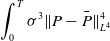 $\displaystyle \int _0^T\sigma ^3\|P-\bar {P}\|_{L^4}^4$
rather than
$\displaystyle \int _0^T\sigma ^3\|P-\bar {P}\|_{L^4}^4$
rather than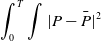 $\displaystyle \int _0^T\int |P-\bar {P}|^2$
in [Reference Cai and Li4]. To begin with, it follows from (1.1)
$\displaystyle \int _0^T\int |P-\bar {P}|^2$
in [Reference Cai and Li4]. To begin with, it follows from (1.1) $_1$
that
$_1$
that
 \begin{equation} (P-\bar {P})_t+u\cdot \nabla (P-\bar {P})+\gamma (P-\bar {P}){\mathrm {div}}\, u+\gamma \bar {P}{\mathrm {div}}\, u-(\gamma -1)\overline {P{\mathrm {div}}\, u}=0. \end{equation}
Multiplying (3.58) by $3\sigma ^3(P-\bar {P})^2$
and integrating the resultant equation over
$3\sigma ^3(P-\bar {P})^2$
and integrating the resultant equation over $\Omega \times [0,T]$
, we get from the fact that
$\Omega \times [0,T]$
, we get from the fact that $(2\mu +\lambda ){\mathrm {div}}\, u=G+(P-\bar {P})$
that
$(2\mu +\lambda ){\mathrm {div}}\, u=G+(P-\bar {P})$
that
 \begin{align} &\frac {d}{dt}\int \sigma ^3(P-\bar {P})^3+\frac {3\gamma -1}{2\mu +\lambda }\int \sigma ^3|P-\bar {P}|^4\nonumber\\[3pt] &\quad=3\sigma ^2\sigma '\int (P-\bar {P})^3-\frac {3\gamma -1}{2\mu +\lambda }\int \sigma ^3(P-\bar {P})^3G+3(\gamma -1)\overline {P{\mathrm {div}}\, u}\sigma ^3\int (P-\bar {P})^2\nonumber\\[3pt] &\qquad -3\gamma \bar {P}\int \sigma ^3(P-\bar {P})^2{\mathrm {div}}\, u\nonumber\\[3pt] &\quad\leq 3\sigma ^2\sigma '\int (P-\bar {P})^3+\frac {3\gamma -1}{2(2\mu +\lambda )}\int \sigma ^3|P-\bar {P}|^4+\frac {27}{4}\frac {3\gamma -1}{2\mu +\lambda }\sigma ^3\|G\|_{L^4}^4\nonumber\\[3pt] &\qquad +C(\gamma -1)\sigma ^3\|P\|_{L^2}^2\|\nabla u\|_{L^2}^2+C\gamma \sigma ^3\bar {P}^2\|\nabla u\|_{L^2}^2. \end{align}
From (2.30), (3.3) and (3.5), it follows that
 \begin{align} \int _0^T\sigma ^3\|G\|_{L^4}^4&\leq \int _0^T\sigma ^3\|G\|_{L^2}\|G\|_{L^6}^3\nonumber\\[3pt]& \leq C(\Omega )\int _0^T\sigma ^3(\|\nabla u\|_{L^2}+\|P-\bar {P}\|_{L^2})(\|\rho \dot {u}\|_{L^2}^3+\|A\|_{W^{1,6}}^3\|\nabla u\|_{L^2}^3)\nonumber\\[3pt]& \leq C(\Omega )\int _0^T\sigma ^3(\|\nabla u\|_{L^2}+\|P-\bar {P}\|_{L^2})\|\rho \dot {u}\|_{L^2}^3+C(\Omega )\|A\|_{W^{1,6}}^3\int _0^T\sigma ^3\|P-\bar {P}\|_{L^4}^4\nonumber\\[3pt]&\quad +C(\Omega )\|A\|_{W^{1,6}}^3\int _0^T\sigma ^3\|\nabla u\|_{L^4}^4\nonumber\\[3pt]& \leq C(\tilde {\rho })\big(A_1^{\frac {1}{2}}(T)+\mathcal{E}_0^{\frac {1}{2}}\big)A_1(T)A_2^{\frac {1}{2}}(T)+C(\Omega )\|A\|_{W^{1,6}}^3\int _0^T\sigma ^3\|P-\bar {P}\|_{L^4}^4\nonumber\\[3pt]&\quad +C(\Omega )\|A\|_{W^{1,6}}^3\int _0^T\sigma ^3\|\nabla u\|_{L^4}^4, \end{align}
which, combined with inequalities (3.3) and (3.5) and the estimate (3.59), yields that
 \begin{align} \int _0^T\int \sigma ^3|P-\bar {P}|^4&\leq C(\tilde {\rho })\mathcal{E}_0+C(\tilde {\rho })A_1^{\frac {3}{2}}(T)A_2^{\frac {1}{2}}(T) +C(\tilde {\rho })\mathcal{E}_0^2+C\mathcal{E}_0^2E_0\nonumber\\ &\quad +C(\Omega )\|A\|_{W^{1,6}}^3\int _0^T\sigma ^3\|\nabla u\|_{L^4}^4 \end{align}
provided that
 \begin{equation} \frac {27}{4}C(\Omega )\|A\|_{W^{1,6}}^3\leq \frac {1}{4},\quad \mathrm {i.e.},\quad \|A\|_{W^{1,6}}\leq (27C(\Omega ))^{-\frac {1}{3}} \end{equation}
with $C(\Omega )$
depending only on
$C(\Omega )$
depending only on $\Omega$
and
$\Omega$
and $\mu$
.
$\mu$
.
Then, for $A_2(T)$
, by virtue of (3.61) and (3.62), we have
$A_2(T)$
, by virtue of (3.61) and (3.62), we have
 \begin{align} & \int _0^T\sigma ^3\big(\|\nabla u\|_{L^4}^4+\|P|\nabla u|\|_{L^2}^2+\|P-\bar {P}\|_{L^4}^4\big)\nonumber\\ &\quad\leq C\int _0^T\sigma ^3\|\nabla u\|_{L^4}^4+C\int _0^T\sigma ^3\|P-\bar {P}\|_{L^4}^4+C\int _0^T\bar {P}^2\sigma ^3\|\nabla u\|_{L^2}^2\nonumber\\ &\quad\leq C\int _0^T\sigma ^3\|\nabla u\|_{L^4}^4+C(\tilde {\rho })\mathcal{E}_0+C(\tilde {\rho })A_1^{\frac {3}{2}}(T)A_2^{\frac {1}{2}}(T) +C(\tilde {\rho })\mathcal{E}_0^2+C\mathcal{E}_0^2E_0. \end{align}
Next, we aim to control $\int _0^T\sigma ^3\|\nabla u\|_{L^4}^4$
. If a certain smallness condition is imposed on
$\int _0^T\sigma ^3\|\nabla u\|_{L^4}^4$
. If a certain smallness condition is imposed on $A$
(see (2.33)), due to the discussion in (2.32) and the estimate (3.61), we finally give the control of
$A$
(see (2.33)), due to the discussion in (2.32) and the estimate (3.61), we finally give the control of $\displaystyle \int _0^T\sigma ^3\|\nabla u\|_{L^4}^4$
as follows:
$\displaystyle \int _0^T\sigma ^3\|\nabla u\|_{L^4}^4$
as follows:
 \begin{align} \int _0^T\sigma ^3\|\nabla u\|_{L^4}^4&\leq C\int _0^T\sigma ^3(\|\nabla u\|_{L^2}+\|P-\bar {P}\|_{L^2})\|\rho \dot {u}\|_{L^2}^3+C\int _0^T\sigma ^3\|P-\bar {P}\|_{L^4}^4\nonumber\\ &\leq C(\tilde {\rho })A_1^{\frac {3}{2}}(T)A_2^{\frac {1}{2}}(T) +C(\tilde {\rho })\mathcal{E}_0+C(\tilde {\rho })\mathcal{E}_0^2+C\mathcal{E}_0^2E_0\nonumber\\ &\quad +CC(\Omega )\|A\|_{W^{1,6}}^3\int _0^T\sigma ^3\|\nabla u\|_{L^4}^4,\nonumber\\ &\quad (\mathrm {with}\ C\ \mathrm {only\ depending\ on}\ \mu , \lambda\ \mathrm {and}\ \Omega\ \mathrm {here}) \end{align}
which implies that
 \begin{align} \int _0^T\sigma ^3\|\nabla u\|_{L^4}^4&\leq C(\tilde {\rho })A_1^{\frac {3}{2}}(T)A_2^{\frac {1}{2}}(T) +C(\tilde {\rho })\mathcal{E}_0+C(\tilde {\rho })\mathcal{E}_0^2+C\mathcal{E}_0^2E_0\nonumber\\ & \leq C(\tilde {\rho })A_1^{\frac {3}{2}}(T)A_2^{\frac {1}{2}}(T)+C\mathcal{E}_0^2E_0, \end{align}
provided that
 \begin{equation*} \|A\|_{W^{1,6}}\leq \min \big\{(2C)^{-\frac {1}{3}}, (27C(\Omega ))^{-\frac {1}{3}}, (2CC(\Omega ))^{-\frac {1}{3}}\big\} \end{equation*}
with $C$
here depending only on
$C$
here depending only on $\mu ,\lambda$
and
$\mu ,\lambda$
and $\Omega$
and
$\Omega$
and $C(\Omega )$
only depending on
$C(\Omega )$
only depending on $\Omega$
and
$\Omega$
and $\mu$
.
$\mu$
.
Then inserting (3.63) and (3.65) into (3.12), we obtain
 \begin{align} A_2(T)&\leq C(\tilde {\rho })\mathcal{E}_0+CA_1^{\frac {3}{2}}(T)(1+C(\tilde {\rho })A_1(T))^{\frac {1}{2}}+CA_1(\sigma (T))+C(\tilde {\rho })A_1^3(T)(E_0+1)\nonumber\\ &\quad +C(\tilde {\rho })A_1^{\frac {3}{2}}(T)A_2^{\frac {1}{2}}(T) +C(\tilde {\rho })\mathcal{E}_0^2+C\mathcal{E}_0^2E_0\nonumber\\ &\leq C(\tilde {\rho })A_1^{\frac {3}{2}}(T)+CA_1(\sigma (T))+C(\tilde {\rho })A_1^3(T)(1+E_0). \end{align}
Recalling (3.11), we have
 \begin{align} A_1(T)&\leq C(\tilde {\rho })\mathcal{E}_0+C\mathcal{E}_0E_0+C\int _0^T\int \sigma P|\nabla u|^2+C\int _0^T\sigma \|\nabla u\|_{L^3}^3+C(\tilde {\rho })\int _0^T\sigma \|\nabla u\|_{L^2}^4\nonumber\\ &\leq C(\tilde {\rho })\mathcal{E}_0(1+E_0)+C\int _0^T\int \sigma |P-\bar {P}||\nabla u|^2+C\bar {P}\int _0^T\int \sigma |\nabla u|^2+C\int _0^T\sigma \|\nabla u\|_{L^3}^3\nonumber\\ &\quad +C(\tilde {\rho })\int _0^T\sigma \|\nabla u\|_{L^2}^4\nonumber\\ &\leq C(\tilde {\rho })\mathcal{E}_0(1+E_0)+C\int _0^T\int \sigma |P-\bar {P}||\nabla u|^2+C\int _0^T\sigma \|\nabla u\|_{L^3}^3+C(\tilde {\rho })\int _0^T\sigma \|\nabla u\|_{L^2}^4. \end{align}
Then from (3.8), (2.21), (3.5), (3.3) and (3.42), it holds that
 \begin{align} &A_1(\sigma (T))\nonumber\\ &\quad \leq C(\tilde {\rho })\mathcal{E}_0(1+E_0)+C\int _0^{\sigma (T)}\int \sigma |P-\bar {P}||\nabla u|^2+C\int _0^{\sigma (T)}\sigma \|\nabla u\|_{L^3}^3\nonumber\\ &\qquad +C(\tilde {\rho })\int _0^{\sigma (T)}\sigma \|\nabla u\|_{L^2}^4\nonumber\\ &\quad \leq C(\tilde {\rho })\mathcal{E}_0(1+E_0)+C(\tilde {\rho })\mathcal{E}_0(1+A_1(\sigma (T)))+C\int _0^{\sigma (T)}\sigma \|\nabla u\|_{L^2}^{\frac {3}{2}}\|\nabla u\|_{L^6}^{\frac {3}{2}}\nonumber\\ &\quad \leq C(\tilde {\rho })\mathcal{E}_0(1+E_0)+C\int _0^{\sigma (T)}\sigma \|\nabla u\|_{L^2}^{\frac {3}{2}}(\|\rho \dot {u}\|_{L^2}+\|\nabla u\|_{L^2}+\|P-\bar {P}\|_{L^6})^{\frac {3}{2}}\nonumber\\ &\quad \leq C(\tilde {\rho })\mathcal{E}_0(1+E_0)+C(\tilde {\rho })\sup _{t\in [0,\sigma (T)]}\sigma ^{\frac {1}{2}}\|\sqrt {\rho }\dot {u}\|_{L^2}\left(\int _0^{\sigma (T)}\|\nabla u\|_{L^2}^2\right)^{\frac {3}{4}}\left(\int _0^{\sigma (T)}\sigma ^2\|\sqrt {\rho }\dot {u}\|_{L^2}^2\right)^{\frac {1}{4}}\nonumber\\ &\qquad +C(\tilde {\rho })A_1^{\frac {1}{2}}(\sigma (T))\mathcal{E}_0+C\left(\int _0^{\sigma (T)}\|\nabla u\|_{L^2}^2\right)^{\frac {3}{4}}\left(\int _0^{\sigma (T)}\|P-\bar {P}\|_{L^6}^6\right)^{\frac {1}{4}}\nonumber\\ &\quad \leq C(\tilde {\rho })\mathcal{E}_0(1+E_0)+C(\tilde {\rho },M)\mathcal{E}_0^{\frac {3}{4}}A_1^{\frac {1}{4}}(\sigma (T))+C(\tilde {\rho })\mathcal{E}_0\nonumber\\ &\quad \leq C(\tilde {\rho })\mathcal{E}_0(1+E_0)+C(\tilde {\rho },M)\mathcal{E}_0+\frac {1}{2}A_1(\sigma (T)), \end{align}
which implies
 \begin{equation} A_1(\sigma (T))\leq C(\tilde {\rho },M)\mathcal{E}_0(1+E_0). \end{equation}
Then, we turn back to (3.66) and get
 \begin{align} A_2(T)&\leq C(\tilde {\rho })A_1^{\frac {3}{2}}(T)+C(\tilde {\rho },M)\mathcal{E}_0(1+E_0)+C(\tilde {\rho })A_1^3(T)(1+E_0)\nonumber\\ &\leq C(\tilde {\rho })A_1^{\frac {3}{2}}(T)+C(\tilde {\rho },M)\mathcal{E}_0(1+E_0)\nonumber\\ &\leq C(\tilde {\rho })\mathcal{E}_0^{\frac {9}{16}}+C(\tilde {\rho },M)\mathcal{E}_0(1+E_0)\nonumber\\ &\leq \mathcal{E}_0^{\frac {1}{2}} \end{align}
provided that
 \begin{equation*} C(\tilde {\rho })\mathcal{E}_0^{\frac {1}{16}}\leq \frac {1}{2},\,C(\tilde {\rho },M)\mathcal{E}_0^{\frac {1}{2}}(1+E_0)\leq \frac {1}{2}, \end{equation*}
i.e.,
 \begin{equation} \mathcal{E}_0\leq \min \{(2C(\tilde {\rho }))^{-16},(2C(\tilde {\rho },M)(E_0+1))^{-2}\}. \end{equation}
Thus, we finish the estimate on $A_2(T)$
.
$A_2(T)$
.
It is easy to check that under the condition (3.71),
 \begin{equation} A_1(\sigma (T))\leq \mathcal{E}_0^{\frac {1}{2}}\leq \mathcal{E}_0^{\frac {3}{8}} \end{equation}
and also by (3.65) and (3.61),
 \begin{equation} \int _0^T\sigma ^3\|\nabla u\|_{L^4}^4\leq C(\tilde {\rho })A_1^{\frac {3}{2}}(T)A_2^{\frac {1}{2}}(T),\quad \int _0^T\int \sigma ^3|P-\bar {P}|^4\leq C(\tilde {\rho })A_1^{\frac {3}{2}}(T)A_2^{\frac {1}{2}}(T). \end{equation}
To estimate $A_1(T)$
, it suffices to control
$A_1(T)$
, it suffices to control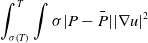 $\displaystyle \int _{\sigma (T)}^T\int \sigma |P-\bar {P}||\nabla u|^2$
and
$\displaystyle \int _{\sigma (T)}^T\int \sigma |P-\bar {P}||\nabla u|^2$
and $\displaystyle \int _{\sigma (T)}^T\sigma \|\nabla u\|_{L^3}^3$
. Due to (3.3), we have
$\displaystyle \int _{\sigma (T)}^T\sigma \|\nabla u\|_{L^3}^3$
. Due to (3.3), we have
 \begin{equation} C(\tilde {\rho })\int _{\sigma (T)}^T\sigma \|\nabla u\|_{L^2}^4\leq C(\tilde {\rho })A_1^{\frac {1}{2}}(T)\int _{\sigma (T)}^T\sigma \|\nabla u\|_{L^3}^3. \end{equation}
From (3.73), (3.5) and (3.3), we obtainFootnote 3
 \begin{align} &\int _{\sigma (T)}^T\int \sigma |P-\bar {P}||\nabla u|^2\nonumber\\ &\quad\leq \left (\int _{\sigma (T)}^T\|P-\bar {P}\|_{L^4}^4\right )^{\frac {1}{4}}\left (\int _{\sigma (T)}^T\|\nabla u\|_{L^4}^4\right )^{\frac {1}{4}}\left (\int _{\sigma (T)}^T\|\nabla u\|_{L^2}^2\right )^{\frac {1}{2}}\nonumber\\ &\quad\leq C(\tilde {\rho })A_1(T)^{\frac {3}{4}}A_2^{\frac {1}{4}}(T)E_0^{\frac {1}{2}}\nonumber\\ &\quad\leq C(\tilde {\rho })\mathcal{E}_0^{\frac {13}{32}}E_0^{\frac {1}{2}}. \end{align}
Similarly, it holds from (3.73), (3.5) and (3.3) that
 \begin{align} \int _{\sigma (T)}^T\sigma \|\nabla u\|_{L^3}^3&\leq \int _{\sigma (T)}^T\|\nabla u\|_{L^2}\|\nabla u\|_{L^4}^2\leq \left (\int _{\sigma (T)}^T\|\nabla u\|_{L^2}^2\right )^{\frac {1}{2}}\left (\int _{\sigma (T)}^T\|\nabla u\|_{L^4}^4\right )^{\frac {1}{2}}\nonumber\\ &\leq C(\tilde {\rho })\mathcal{E}_0^{\frac {13}{32}}E_0^{\frac {1}{2}}. \end{align}
Then, plugging (3.74)–(3.76), (3.69) and (3.3) into (3.67) yields that
 \begin{align} A_1(T)&\leq A_1(\sigma (T))+C\int _{\sigma (T)}^T\int \sigma |P-\bar {P}||\nabla u|^2+C\int _{\sigma (T)}^T\sigma \|\nabla u\|_{L^3}^3+C(\tilde {\rho })\int _{\sigma (T)}^T\sigma \|\nabla u\|_{L^2}^4\nonumber\\ &\leq C(\tilde {\rho },M)\mathcal{E}_0(1+E_0)+C(\tilde {\rho })\mathcal{E}_0^{\frac {13}{32}}E_0^{\frac {1}{2}}(1+A_1^{\frac {1}{2}}(T))\nonumber\\ &\leq C(\tilde {\rho },M)\mathcal{E}_0(1+E_0)+C(\tilde {\rho })\mathcal{E}_0^{\frac {13}{32}}E_0^{\frac {1}{2}}\nonumber\\ &\leq \frac {1}{2}\mathcal{E}_0^{\frac {3}{8}}+C(\tilde {\rho },M)\mathcal{E}_0^{\frac {15}{16}}\leq \mathcal{E}_0^{\frac {3}{8}} \end{align}
provided that
 \begin{equation*} \mathcal{E}_0\leq \min \big\{\big(2C(\tilde {\rho })E_0^{\frac {1}{2}}\big)^{-32},(2C(\tilde {\rho },M))^{-\frac {16}{9}}\big\}. \end{equation*}
Thus, we have completed the proof of Lemma 3.7.
Remark 3.8.
Note that in this lemma, the condition $\|\nabla u_0\|_{L^2}\leq M$
is only applied in (3.68) through Lemma 3.5
.
$\|\nabla u_0\|_{L^2}\leq M$
is only applied in (3.68) through Lemma 3.5
.
Next lemma closes the estimate on bound of density $\rho$
.
$\rho$
.
Lemma 3.9.
Under the conditions of Proposition 3.1
, it holds that for any $(x,t)\in \Omega \times [0,T]$
,
$(x,t)\in \Omega \times [0,T]$
,
 \begin{equation} 0\leq \rho (x,t)\leq \frac {7\tilde {\rho }}{4}, \end{equation}
provided that
 \begin{equation} \mathcal{E}_0\leq \epsilon _5=\min \left \{\epsilon _4,\left(\frac {\tilde {\rho }}{2C(\tilde {\rho },M)}\right)^{-12},(C(\tilde {\rho }))^{-1},\left(\frac {\tilde {\rho }}{4C(\tilde {\rho })(1+E_0)}\right)^3\right \}. \end{equation}
Proof. First, we rewrite the equation of mass conservation (1.1) $_1$
as
$_1$
as
 \begin{equation} D_t\rho =g(\rho )+b'(t), \end{equation}
where
 \begin{equation*} D_t\rho =\rho _t+u\cdot \nabla \rho ,\quad g(\rho )=-\frac {\rho P}{2\mu +\lambda },\quad b(t)=\frac {1}{2\mu +\lambda }\int _0^t(\rho \bar {P}-\rho G). \end{equation*}
Then for $t\in [0,\sigma (T)]$
, we obtain from (3.5), (3.3), (2.3), (3.72), Lemmas 2.7, 2.9 and 3.5 that for any
$t\in [0,\sigma (T)]$
, we obtain from (3.5), (3.3), (2.3), (3.72), Lemmas 2.7, 2.9 and 3.5 that for any $0\leq t_1\lt t_2\leq \sigma (T)$
,
$0\leq t_1\lt t_2\leq \sigma (T)$
,
 \begin{align} &|b(t_2)-b(t_1)|\nonumber\\ &\quad\leq C(\tilde {\rho })\mathcal{E}_0+C(\tilde {\rho })\int _0^{\sigma (T)}\|G\|_{L^{\infty }}\nonumber\\ &\quad\leq C(\tilde {\rho })\mathcal{E}_0+C(\tilde {\rho })\int _0^{\sigma (T)}\|G\|_{L^6}^{\frac {1}{2}}\|\nabla G\|_{L^6}^{\frac {1}{2}}\nonumber\\ &\quad\leq C(\tilde {\rho })\mathcal{E}_0+C(\tilde {\rho })\int _0^{\sigma (T)}(\|\sqrt {\rho }\dot {u}\|_{L^2}+\|\nabla u\|_{L^2})^{\frac {1}{2}}\big(\|\nabla \dot {u}\|_{L^2}+\|\nabla u\|_{L^2}^2+\|\nabla u\|_{L^2}+\|P-\bar {P}\|_{L^6}\big)^{\frac {1}{2}}\nonumber\\ &\quad\leq C(\tilde {\rho })\mathcal{E}_0+C(\tilde {\rho })\left (\int _0^{\sigma (T)}t\|\nabla \dot {u}\|_{L^2}^2\right )^{\frac {1}{4}} \left (\int _0^{\sigma (T)}t^{-\frac {1}{3}}\|\sqrt {\rho }\dot {u}\|_{L^2}^{\frac {2}{3}}\right )^{\frac {3}{4}}\nonumber\\ &\qquad +C(\tilde {\rho })A_1^{\frac {1}{4}}(\sigma (T))\int _0^{\sigma (T)}t^{-\frac {1}{2}}\big(t\|\nabla \dot {u}\|_{L^2}^2\big)^{\frac {1}{4}} +C(\tilde {\rho },M)\int _0^{\sigma (T)}t^{-\frac {1}{4}}\big(\|\nabla u\|_{L^2}+\|\nabla u\|_{L^2}^{\frac {1}{2}}+\mathcal{E}_0^{\frac {1}{12}}\big)\nonumber\\ &\quad\leq C(\tilde {\rho })\mathcal{E}_0+C(\tilde {\rho },M)\left (\int _0^{\sigma (T)}t^{-\frac {2}{3}}\big(t\|\sqrt {\rho }\dot {u}\|_{L^2}^2\big)^{\frac {1}{4}}\right )^{\frac {3}{4}} +C(\tilde {\rho },M)A_1^{\frac {1}{4}}(\sigma (T))+C(\tilde {\rho },M)\mathcal{E}_0^{\frac {1}{12}}\nonumber\\ &\quad\leq C(\tilde {\rho },M)\big(A_1^{\frac {3}{16}}(\sigma (T))+\mathcal{E}_0^{\frac {1}{12}}\big)\nonumber\\ &\quad\leq C(\tilde {\rho },M)\big(\mathcal{E}_0^{\frac {3}{32}}+\mathcal{E}_0^{\frac {1}{12}}\big)\leq C(\tilde {\rho },M)\mathcal{E}_0^{\frac {1}{12}} \end{align}
provided that $\mathcal{E}_0\leq \epsilon _4$
. Then, by choosing
$\mathcal{E}_0\leq \epsilon _4$
. Then, by choosing $N_1=0$
,
$N_1=0$
,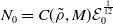 $N_0=C(\tilde {\rho },M)\mathcal{E}_0^{\frac {1}{12}}$
and
$N_0=C(\tilde {\rho },M)\mathcal{E}_0^{\frac {1}{12}}$
and $\zeta _0=\tilde {\rho }$
in Lemma 2.3, we have from (3.80) and (3.81) that
$\zeta _0=\tilde {\rho }$
in Lemma 2.3, we have from (3.80) and (3.81) that
 \begin{equation} \sup _{t\in [0,\sigma (T)]}\|\rho \|_{L^{\infty }}\leq \tilde {\rho }+C(\tilde {\rho },M)\mathcal{E}_0^{\frac {1}{12}}\leq \frac {3\tilde {\rho }}{2} \end{equation}
provided that $\mathcal{E}_0\leq \min \big\{\epsilon _4,\big(\frac {\tilde {\rho }}{2C(\tilde {\rho },M)}\big)^{-12}\big\}$
.
$\mathcal{E}_0\leq \min \big\{\epsilon _4,\big(\frac {\tilde {\rho }}{2C(\tilde {\rho },M)}\big)^{-12}\big\}$
.
For $t\in [\sigma (T),T]$
and any
$t\in [\sigma (T),T]$
and any $\sigma (T)\leq t_1\lt t_2\leq T$
, we also have
$\sigma (T)\leq t_1\lt t_2\leq T$
, we also have
 \begin{align} |b(t_2)-b(t_1)|&\leq C\tilde {\rho }\int _{t_1}^{t_2}\|G\|_{L^{\infty }}+C\int _{t_1}^{t_2}\rho \bar {P}\nonumber\\ &\leq \frac {(1+C(\tilde {\rho })\mathcal{E}_0)\tilde {\rho }P(\tilde {\rho })}{2(2\mu +\lambda )}(t_2-t_1)+C(\tilde {\rho })\int _{\sigma (T)}^{T}\|G\|_{L^{\infty }}^4\nonumber\\ &\leq \frac {\tilde {\rho }P(\tilde {\rho })}{2\mu +\lambda }(t_2-t_1)+C(\tilde {\rho })\mathcal{E}_0^{\frac {1}{3}}(1+E_0), \end{align}
where we have used that by Lemmas 2.7, 2.9, (3.5) and (3.3),
 \begin{equation*} \begin{aligned} &\int _{\sigma (T)}^{T}\|G\|_{L^{\infty }}^4 \leq \int _{\sigma (T)}^{T}\|G\|_{L^6}^2\|\nabla G\|_{L^6}^2\\ &\quad \leq C\int _{\sigma (T)}^{T}\big(\|\rho \dot {u}\|_{L^2}^2+\|\nabla u\|_{L^2}^2\big)\big(\|\rho \dot {u}\|_{L^6}^2+\|\nabla u\|_{L^2}^2+\|P-\bar {P}\|_{L^6}^2\big)\\ &\quad \leq C(\tilde {\rho })\int _{\sigma (T)}^{T}\big(\|\sqrt {\rho }\dot {u}\|_{L^2}^2+\|\nabla u\|_{L^2}^2\big)\big(\|\nabla \dot {u}\|_{L^2}^2+\|\nabla u\|_{L^2}^4+\|\nabla u\|_{L^2}^2+\|P-\bar {P}\|_{L^6}^2\big)\\ &\quad \leq C(\tilde {\rho })\big(A_1(T)A_2(T)+A_2^2(T)+A_1^3(T)+A_1^2(T)+A_1(T)\mathcal{E}_0^{\frac {1}{3}}\big)+C(\tilde {\rho })\big(A_1^2(T)+A_1(T)+\mathcal{E}_0^{\frac {1}{3}}\big)E_0\\ &\quad \leq C(\tilde {\rho })\mathcal{E}_0^{\frac {1}{3}}(1+E_0) \end{aligned} \end{equation*}
provided that $\mathcal{E}_0\leq \min \{1,(C(\tilde {\rho }))^{-1}\}=\hat {\epsilon }_4$
.
$\mathcal{E}_0\leq \min \{1,(C(\tilde {\rho }))^{-1}\}=\hat {\epsilon }_4$
.
Therefore, by choosing $N_0=C(\tilde {\rho })\mathcal{E}_0^{\frac {1}{3}}(1+E_0)$
,
$N_0=C(\tilde {\rho })\mathcal{E}_0^{\frac {1}{3}}(1+E_0)$
, $N_1=\frac {\tilde {\rho }P(\tilde {\rho })}{2\mu +\lambda }$
and
$N_1=\frac {\tilde {\rho }P(\tilde {\rho })}{2\mu +\lambda }$
and $\zeta _0=\tilde {\rho }$
in Lemma 2.3, we have from Lemma 2.3, (3.82) and (3.83) that
$\zeta _0=\tilde {\rho }$
in Lemma 2.3, we have from Lemma 2.3, (3.82) and (3.83) that
 \begin{equation} \sup _{t\in [\sigma (T),T]}\|\rho \|_{L^{\infty }}\leq \frac {3\tilde {\rho }}{2} +C(\tilde {\rho })\mathcal{E}_0^{\frac {1}{3}}(1+E_0)\leq \frac {7\tilde {\rho }}{4}, \end{equation}
provided that $\mathcal{E}_0\leq \min \big\{\hat {\epsilon }_4,\big(\frac {\tilde {\rho }}{4C(\tilde {\rho })(1+E_0)}\big)^3\big\}$
. Then, combining (3.82) and (3.84), we complete the proof of Lemma 3.9.
$\mathcal{E}_0\leq \min \big\{\hat {\epsilon }_4,\big(\frac {\tilde {\rho }}{4C(\tilde {\rho })(1+E_0)}\big)^3\big\}$
. Then, combining (3.82) and (3.84), we complete the proof of Lemma 3.9.
With Proposition 3.1 well prepared, we are now in a position to prove the following result concerning the exponential decay rate of classical solutions.
Proposition 3.10.
Assume $\bar {\rho }\leq 1$
and
$\bar {\rho }\leq 1$
and $\frac {\tilde {\rho }}{\bar {\rho }}\geq 3$
. Then, for any
$\frac {\tilde {\rho }}{\bar {\rho }}\geq 3$
. Then, for any $\gamma \in (1,\frac {3}{2}]$
,
$\gamma \in (1,\frac {3}{2}]$
, $r\in [1,\infty )$
and
$r\in [1,\infty )$
and $p\in [1,6]$
, there exist two positive constants
$p\in [1,6]$
, there exist two positive constants $C$
and
$C$
and $\eta _0$
with
$\eta _0$
with $C$
depending only on
$C$
depending only on $\mu ,\lambda ,\gamma ,a,\tilde {\rho },\bar {\rho },M,\Omega ,r,p$
and the matrix
$\mu ,\lambda ,\gamma ,a,\tilde {\rho },\bar {\rho },M,\Omega ,r,p$
and the matrix $A$
, and
$A$
, and $\eta _0$
depending only on
$\eta _0$
depending only on $\mu ,\lambda ,a,\Omega ,\tilde {\rho },r,p$
and
$\mu ,\lambda ,a,\Omega ,\tilde {\rho },r,p$
and $\frac {\tilde {\rho }}{\bar {\rho }}$
, but independent of
$\frac {\tilde {\rho }}{\bar {\rho }}$
, but independent of $\gamma -1$
, such that for any
$\gamma -1$
, such that for any $t\geq 1$
, it holds that
$t\geq 1$
, it holds that
 \begin{equation} \|\rho -\bar {\rho }\|_{L^r}+\|u\|_{W^{1,p}}+\|\sqrt {\rho }\dot {u}\|_{L^2}\leq Ce^{-\eta _0\bar {\rho }^{\gamma }t}. \end{equation}
Proof. First, by virtue of the mass conservation, we have
 \begin{equation*} \bar {\rho }=\frac {1}{|\Omega |}\int _{\Omega }\rho dx=\bar {\rho }_0. \end{equation*}
Then, by the convexity of $P(\rho )$
and (3.5), it holds that
$P(\rho )$
and (3.5), it holds that
 \begin{equation} P(\bar {\rho })\leq \bar {P}(\rho )\leq |\Omega |^{-1}(\gamma -1)E_0\leq |\Omega |^{-1}\mathcal{E}_0,\quad \mathrm {i.e.},\quad \bar {\rho }\leq (a|\Omega |)^{-\frac {1}{\gamma }}\mathcal{E}_0^{\frac {1}{\gamma }}. \end{equation}
Here, we shall give the relation among $(\rho -\bar {\rho })^2$
,
$(\rho -\bar {\rho })^2$
, $G(\rho )$
and
$G(\rho )$
and $(P(\rho )-P(\bar {\rho }))(\rho -\bar {\rho })$
with
$(P(\rho )-P(\bar {\rho }))(\rho -\bar {\rho })$
with
 \begin{equation*} G(\rho )=\rho \int _{\bar {\rho }}^{\rho }\frac {P(s)-P(\bar {\rho })}{s^2}ds \end{equation*}
for any $\rho \in [0,2\tilde {\rho }]$
and
$\rho \in [0,2\tilde {\rho }]$
and $\gamma \in (1,\frac {3}{2}]$
. Note that
$\gamma \in (1,\frac {3}{2}]$
. Note that $\bar {\rho }\leq 1$
and
$\bar {\rho }\leq 1$
and $\bar {\rho }\ll \tilde {\rho }$
if
$\bar {\rho }\ll \tilde {\rho }$
if $\mathcal{E}_0\leq a|\Omega |$
is small enough.
$\mathcal{E}_0\leq a|\Omega |$
is small enough.
A direct analysis on the three terms above yields that (see Lemma A.1 in Appendix for details)
 \begin{align} &\frac {P(\bar {\rho })}{\bar {\rho }}(\rho -\bar {\rho })^2\leq (P(\rho )-P(\bar {\rho }))(\rho -\bar {\rho }),\nonumber\\ &(\rho -\bar {\rho })^2\leq \frac {1}{C_1}\tilde {\rho }\bar {\rho }^{1-\gamma }G(\rho ),\nonumber\\ &\bar {\rho }G(\rho )\leq (P(\rho )-P(\bar {\rho }))(\rho -\bar {\rho }). \end{align}
with constant $C_1\gt 0$
depending only on
$C_1\gt 0$
depending only on $a$
and
$a$
and $\frac {\tilde {\rho }}{\bar {\rho }}$
.
$\frac {\tilde {\rho }}{\bar {\rho }}$
.
Similar to (3.7), we have
 \begin{equation} \frac {d}{dt}\int \left(\frac {1}{2}\rho |u|^2+G(\rho )\right)+\phi (t)\leq 0 \end{equation}
with
 \begin{equation*} \phi (t)=(2\mu +\lambda )\|{\mathrm {div}}\, u\|_{L^2}^2+\mu \|{\mathrm {curl}}\, u\|_{L^2}^2. \end{equation*}
Then, multiplying (1.1) $_2$
by
$_2$
by $\mathcal{B}[\rho -\bar {\rho }]$
, we have from Lemma 2.6 and Proposition 3.1 that
$\mathcal{B}[\rho -\bar {\rho }]$
, we have from Lemma 2.6 and Proposition 3.1 that
 \begin{align} &\int (P(\rho )-P(\bar {\rho }))(\rho -\bar {\rho })\nonumber\\ &\quad=\frac {d}{dt}\int \rho u\cdot \mathcal{B}[\rho -\bar {\rho }]-\int \rho u\cdot \nabla \mathcal{B}[\rho -\bar {\rho }]\cdot u+\int \rho u\cdot \mathcal{B}[{\mathrm {div}}\,(\rho u)]+\mu \int \nabla u\cdot \nabla \mathcal{B}[\rho -\bar {\rho }]\nonumber\\ &\qquad +(\mu +\lambda )\int (\rho -\bar {\rho }){\mathrm {div}}\, u\nonumber\\ &\quad\leq \frac {d}{dt}\int \rho u\cdot \mathcal{B}[\rho -\bar {\rho }]+C\|\sqrt {\rho }u\|_{L^4}^2\|\rho -\bar {\rho }\|_{L^2} +C\|\rho u\|_{L^2}^2+C\|\nabla u\|_{L^2}\|\rho -\bar {\rho }\|_{L^2}\nonumber\\ &\quad\leq \frac {d}{dt}\int \rho u\cdot \mathcal{B}[\rho -\bar {\rho }]+C(\tilde {\rho })\|\rho ^{\frac {1}{3}}u\|_{L^3}\|u\|_{L^6}\|\rho -\bar {\rho }\|_{L^2}+C(\tilde {\rho })\|\nabla u\|_{L^2}^2+C\|\nabla u\|_{L^2}\|\rho -\bar {\rho }\|_{L^2}\nonumber\\ &\quad\leq \frac {d}{dt}\int \rho u\cdot \mathcal{B}[\rho -\bar {\rho }]+\frac {P(\bar {\rho })}{2\bar {\rho }}\|\rho -\bar {\rho }\|_{L^2}^2+C(\tilde {\rho })\frac {\bar {\rho }}{P(\bar {\rho })}\|\nabla u\|_{L^2}^2, \end{align}
which together with (3.87) and (2.16) yields
 \begin{align} \int (P(\rho )-P(\bar {\rho }))(\rho -\bar {\rho })&\leq \frac {d}{dt}\int 2\rho u\cdot \mathcal{B}[\rho -\bar {\rho }]+C(\tilde {\rho })\bar {\rho }^{1-\gamma }\|\nabla u\|_{L^2}^2\nonumber\\ &\leq \frac {d}{dt}\int 2\rho u\cdot \mathcal{B}[\rho -\bar {\rho }]+C_1(\tilde {\rho })\bar {\rho }^{1-\gamma }\phi (t). \end{align}
Moreover, it follows from (3.87) that there exists a constant $C_2(\tilde {\rho })\gt 0$
such that
$C_2(\tilde {\rho })\gt 0$
such that
 \begin{equation} \left|\int 2\rho u\cdot \mathcal{B}[\rho -\bar {\rho }]\right|\leq C_2(\tilde {\rho })\bar {\rho }^{\frac {1-\gamma }{2}}\int \left(\frac {1}{2}\rho |u|^2+G(\rho )\right), \end{equation}
which combined with (3.88) and (3.90) gives that
 \begin{equation} \frac {d}{dt}W(t)+\delta _1\bar {\rho }^{\gamma -1}\int (P(\rho )-P(\bar {\rho }))(\rho -\bar {\rho })+\frac {1}{2}\phi (t)\leq 0 \end{equation}
with
 \begin{equation*} W(t)=\int \left(\frac {1}{2}\rho |u|^2+G(\rho )\right)-\delta _1\bar {\rho }^{\gamma -1}\int 2\rho u\cdot \mathcal{B}[\rho -\bar {\rho }],\quad \delta _1=\min \left \{\frac {1}{2C_1(\tilde {\rho })},\frac {1}{2C_2(\tilde {\rho })}\right \} \end{equation*}
satisfying
 \begin{equation} \frac {1}{2}\int \left(\frac {1}{2}\rho |u|^2+G(\rho )\right)\leq W(t)\leq \frac {3}{2}\int \left(\frac {1}{2}\rho |u|^2+G(\rho )\right). \end{equation}
due to (3.91) and $\bar {\rho }\leq 1$
.
$\bar {\rho }\leq 1$
.
By virtue of Poincaré’s inequality (2.1) and (2.16), we have
 \begin{equation*} \int \rho |u|^2\leq C(\tilde {\rho })\|\nabla u\|_{L^2}\leq C_3(\tilde {\rho })\phi (t), \end{equation*}
which together with (3.87) implies that
 \begin{equation} \delta _1\bar {\rho }^{\gamma -1}\int (P(\rho )-P(\bar {\rho }))(\rho -\bar {\rho })+\frac {1}{2}\phi (t)\geq \delta _2\bar {\rho }^{\gamma }W(t) \end{equation}
with $\delta _2=\frac {2}{3}\min \{\delta _1,\frac {1}{C_3(\tilde {\rho })}\}$
.
$\delta _2=\frac {2}{3}\min \{\delta _1,\frac {1}{C_3(\tilde {\rho })}\}$
.
Thus, we deduce from (3.92) and (3.94) that
 \begin{equation*} \frac {d}{dt}W(t)+\delta _2\bar {\rho }^{\gamma }W(t)\leq 0, \end{equation*}
which combined with (3.93) yields that
 \begin{equation} \int \left(\frac {1}{2}\rho |u|^2+G(\rho )\right)\leq 2E_0e^{-\delta _2\bar {\rho }^{\gamma }t}. \end{equation}
Furthermore, it holds from (3.88) that for $0\lt \delta _3\lt \delta _2$
,
$0\lt \delta _3\lt \delta _2$
,
 \begin{equation} \int _0^{\infty }\phi (t)e^{\delta _3\bar {\rho }^{\gamma }t}dt\leq CE_0. \end{equation}
Choosing $m=0$
in (3.18), and using (3.43), (2.16) and (2.17), we have
$m=0$
in (3.18), and using (3.43), (2.16) and (2.17), we have
 \begin{align} &\frac {d}{dt}\left (\phi (t)+\mu \int _{\partial \Omega }Au\cdot u-\int 2(P(\rho )-P(\bar {\rho })){\mathrm {div}}\, u\right )+\int \rho |\dot {u}|^2\nonumber\\ & \quad \leq C(\tilde {\rho },M)\|\nabla u\|_{L^2}^2+C\|\nabla u\|_{L^2}^{\frac {3}{2}}(\|\rho \dot {u}\|_{L^2}+\|\nabla u\|_{L^2}+\|P(\rho )-P(\bar {\rho })\|_{L^6})^{\frac {3}{2}}\nonumber\\ &\quad \leq \frac {1}{2}\|\sqrt {\rho }\dot {u}\|_{L^2}^2+C(\tilde {\rho },M)\|\nabla u\|_{L^2}^2+C(\tilde {\rho })\|P(\rho )-P(\bar {\rho })\|_{L^2}^2\nonumber\\ &\quad \leq \frac {1}{2}\|\sqrt {\rho }\dot {u}\|_{L^2}^2+C(\tilde {\rho },M)\phi (t)+C(\tilde {\rho })\int G(\rho ), \end{align}
where we have used from (3.87), (A.17) and (A.18) thatFootnote 4
 \begin{equation} \|P(\rho )-P(\bar {\rho })\|_{L^2}^2\leq C(\tilde {\rho })\int (P(\rho )-P(\bar {\rho }))(\rho -\bar {\rho })\leq C(\tilde {\rho })\int G(\rho ). \end{equation}
By multiplying (3.97) by $e^{\delta _3\bar {\rho ^{\gamma }}t}$
, we have
$e^{\delta _3\bar {\rho ^{\gamma }}t}$
, we have
 \begin{equation} \begin{aligned} &\quad \frac {d}{dt}\left (e^{\delta _3\bar {\rho }^{\gamma }t}\phi (t)+\mu e^{\delta _3\bar {\rho }^{\gamma }t}\int _{\partial \Omega }Au\cdot u-e^{\delta _3\bar {\rho }^{\gamma }t}\int 2(P(\rho )-P(\bar {\rho })){\mathrm {div}}\, u\right )+\frac {1}{2}e^{\delta _3\bar {\rho }^{\gamma }t}\int \rho |\dot {u}|^2\\ &\qquad \leq C(\tilde {\rho },M)e^{\delta _3\bar {\rho }^{\gamma }t}\left(\phi (t)+\int G(\rho )\right), \end{aligned} \end{equation}
where we have used the facts that
 \begin{equation*} 0\leq \int _{\partial \Omega }Au\cdot u\leq C\|\nabla u\|_{L^2}^2\leq C\phi (t), \end{equation*}
and
 \begin{equation*} \left |\int 2(P(\rho )-P(\bar {\rho })){\mathrm {div}}\, u\right |\leq C(\tilde {\rho })\int G(\rho )+\frac {1}{2}\phi (t), \end{equation*}
due to the trace inequality, Poincaré’s inequality and (3.98). This together with (3.95) and (3.96) yields that
 \begin{equation} \|\nabla u\|_{L^2}^2\leq C(\tilde {\rho },M)e^{-\delta _3\bar {\rho }^{\gamma }t} \end{equation}
and
 \begin{equation} \int _0^{\infty }e^{\delta _3\bar {\rho }^{\gamma }t}\|\sqrt {\rho }\dot {u}\|_{L^2}^2\leq C(\tilde {\rho },M). \end{equation}
A similar analysis based on (3.38) for $m=3$
, (3.25), Lemma 3.5, (3.98), (3.100) and (3.101) gives that
$m=3$
, (3.25), Lemma 3.5, (3.98), (3.100) and (3.101) gives that
 \begin{equation} \|\sqrt {\rho }\dot {u}\|_{L^2}^2\leq Ce^{-\delta _3\bar {\rho }^{\gamma }t}, \end{equation}
which together with (3.95), (3.100), (3.87) and (2.21) yields (3.85) and finishes the proof of Proposition 3.10.
Proof of Theorem
1.1. In the following, we will prove the main results of this paper. First of all, we derive the time-dependent higher-order estimates of the smooth solution $(\rho , u)$
. From now on, we will always assume that (3.79) holds and denote the positive constant by
$(\rho , u)$
. From now on, we will always assume that (3.79) holds and denote the positive constant by $C$
depending on
$C$
depending on
 \begin{equation*} T,\,\|g\|_{L^2},\,\|\nabla u_0\|_{H^1},\,\|\rho _0\|_{W^{2,q}},\,\|P(\rho )\|_{W^{2,q}}, \end{equation*}
for $q\in (3,6)$
, as well as
$q\in (3,6)$
, as well as $\mu ,\lambda ,\gamma ,a,\tilde {\rho },\Omega ,M$
and the matrix
$\mu ,\lambda ,\gamma ,a,\tilde {\rho },\Omega ,M$
and the matrix $A$
, where
$A$
, where $g$
is given in (1.10). Here, we only sketch the higher-order estimates in the following lemma, which have been proved in [Reference Cai and Li4].
$g$
is given in (1.10). Here, we only sketch the higher-order estimates in the following lemma, which have been proved in [Reference Cai and Li4].
Lemma 3.11. Under the conditions of Theorem 1.1 , it holds that
 \begin{equation*} \begin{aligned} &\sup _{t\in [0,T]}\int \rho |\dot {u}|^2+\int _0^T\|\nabla \dot {u}\|_{L^2}^2\leq C,\\ &\sup _{t\in [0,T]}(\|\nabla \rho \|_{L^6}+\|u\|_{H^2})+\int _0^T\big(\|\nabla u\|_{L^{\infty }}+\|\nabla ^2u\|_{L^6}^2\big)\leq C,\\ &\sup _{t\in [0,T]}\|\sqrt {\rho }u_t\|_{L^2}^2+\int _0^T\|\nabla u_t\|_{L^2}^2\leq C,\\ &\sup _{t\in [0,T]}(\|\rho \|_{H^2}+\|P\|_{H^2})\leq C,\\ &\sup _{t\in [0,T]}(\|\rho _t\|_{H^1}+\|P_t\|_{H^1})+\int _0^T\big(\|\rho _{tt}\|_{L^2}^2+\|P_{tt}\|_{L^2}^2\big)\leq C,\\ &\sup _{t\in [0,T]}\sigma \|\nabla u_t\|_{L^2}^2+\int _0^T\sigma \|\sqrt {\rho }u_{tt}\|_{L^2}^2\leq C,\\ &\sup _{t\in [0,T]}\sigma \|\nabla u\|_{H^2}^2+\int _0^T\big(\|\nabla u\|_{H^2}^2+\|\nabla ^2u\|_{W^{1,q}}^{p_0}+\sigma \|\nabla u_t\|_{H^1}^2\big)\leq C,\\ &\sup _{t\in [0,T]}(\|\rho \|_{W^{2,q}}+\|P\|_{W^{2,q}})\leq C,\\ &\sup _{t\in [0,T]}\sigma (\|\nabla u_t\|_{H^1}+\|\nabla u\|_{W^{2,q}})+\int _0^T\sigma ^2\|\nabla u_{tt}\|_{L^2}^2\leq C, \end{aligned} \end{equation*}
for $q\in (3,6)$
and
$q\in (3,6)$
and $p_0=\frac {9q-6}{10q-12}\in (1,\frac {7}{6})$
.
$p_0=\frac {9q-6}{10q-12}\in (1,\frac {7}{6})$
.
Thus, combining Propositions 3.1, 3.10 with the higher-order estimates above as well as the local existence in Lemma 2.1, we can prove Theorem1.1 by similar arguments as in [Reference Cai and Li4]. Here, we omit the details for brevity.
Data availability statement
No data were used for the research described in the article.
Author contributions
Saiguo Xu and Yinghui Zhang wrote and reviewed the main manuscript text.
Funding statement
This work was supported by Guangxi Natural Science Foundation $\#$
2026GXNSFFA00640002,
$\#$
2026GXNSFFA00640002, $\#$
2026GXNSFBA00640192,
$\#$
2026GXNSFBA00640192, $\#$
2024GXNSFDA010071, National Natural Science Foundation of China
$\#$
2024GXNSFDA010071, National Natural Science Foundation of China $\#$
12271114,
$\#$
12271114, $\#$
12501306, Center for Applied Mathematics of Guangxi (Guangxi Normal University) and the Key Laboratory of Mathematical Model and Application (Guangxi Normal University), Education Department of Guangxi Zhuang Autonomous Region.
$\#$
12501306, Center for Applied Mathematics of Guangxi (Guangxi Normal University) and the Key Laboratory of Mathematical Model and Application (Guangxi Normal University), Education Department of Guangxi Zhuang Autonomous Region.
Competing interests
The authors declare no conflict of interest.
Appendix A. The mathematical analysis on three terms about density
In this appendix, we will give a mathematical analysis on the precise relation among $(\rho -\bar {\rho })^2$
,
$(\rho -\bar {\rho })^2$
, $G(\rho )$
and
$G(\rho )$
and $(P(\rho )-P(\bar {\rho }))(\rho -\bar {\rho })$
.
$(P(\rho )-P(\bar {\rho }))(\rho -\bar {\rho })$
.
Lemma A.1.
There exists a clear relation among $(\rho -\bar {\rho })^2$
,
$(\rho -\bar {\rho })^2$
, $G(\rho )$
and
$G(\rho )$
and $(P(\rho )-P(\bar {\rho }))(\rho -\bar {\rho })$
for any
$(P(\rho )-P(\bar {\rho }))(\rho -\bar {\rho })$
for any $\rho \in [0,\tilde {\rho }]$
and
$\rho \in [0,\tilde {\rho }]$
and $\gamma \in (1,\frac {3}{2}]$
. If
$\gamma \in (1,\frac {3}{2}]$
. If $\bar {\rho }\ll \tilde {\rho }$
, then we obtain
$\bar {\rho }\ll \tilde {\rho }$
, then we obtain
 \begin{align} &\frac {P(\bar {\rho })}{\bar {\rho }}(\rho -\bar {\rho })^2\leq (P(\rho )-P(\bar {\rho }))(\rho -\bar {\rho }),\nonumber\\ &(\rho -\bar {\rho })^2\leq \frac {1}{C_1}\tilde {\rho }\bar {\rho }^{1-\gamma }G(\rho ),\nonumber\\ &\bar {\rho }G(\rho )\leq (P(\rho )-P(\bar {\rho }))(\rho -\bar {\rho }). \end{align}
with constant $C_1\gt 0$
depending only on
$C_1\gt 0$
depending only on $a$
and
$a$
and $\frac {\tilde {\rho }}{\bar {\rho }}$
. In fact, it suffices to assume
$\frac {\tilde {\rho }}{\bar {\rho }}$
. In fact, it suffices to assume $\frac {\tilde {\rho }}{\bar {\rho }}\geq 3$
here.
$\frac {\tilde {\rho }}{\bar {\rho }}\geq 3$
here.
Proof. Here, we assume $\bar {\rho }\ll \tilde {\rho }$
, which means
$\bar {\rho }\ll \tilde {\rho }$
, which means $\bar {\rho }$
is much smaller than
$\bar {\rho }$
is much smaller than $\tilde {\rho }$
. First set
$\tilde {\rho }$
. First set
 \begin{equation*} f(\rho )=\frac {(P(\rho )-P(\bar {\rho }))(\rho -\bar {\rho })}{(\rho -\bar {\rho })^2}=\frac {P(\rho )-P(\bar {\rho })}{\rho -\bar {\rho }}, \end{equation*}
and let
 \begin{equation*} f(\bar {\rho })=\lim _{\rho \rightarrow \bar {\rho }}f(\rho )=P'(\bar {\rho }). \end{equation*}
Then, a direct calculation yields that
 \begin{equation} f'(\rho )=\frac {P'(\rho )(\rho -\bar {\rho })-(P(\rho )-P(\bar {\rho }))}{(\rho -\bar {\rho })^2} =(\rho -\bar {\rho })^{-2}\int _{\bar {\rho }}^{\rho }(P'(\rho )-P'(s))ds\geq 0, \end{equation}
which implies
 \begin{equation} f(\rho )\in [f(0),f(\tilde {\rho })]=\left[\frac {P(\bar {\rho })}{\bar {\rho }},f(\tilde {\rho })\right]\!. \end{equation}
We then define
 \begin{equation*} h(\rho )=\frac {G(\rho )}{(\rho -\bar {\rho })^2} \end{equation*}
and also set
 \begin{equation*} h(\bar {\rho })=\lim _{\rho \rightarrow \bar {\rho }}h(\rho )=\frac {1}{2}G''(\bar {\rho })=\frac {P'(\bar {\rho })}{2\bar {\rho }}. \end{equation*}
A similar calculation gives that
 \begin{equation} h'(\rho )=\frac {G'(\rho )(\rho -\bar {\rho })-2G(\rho )}{(\rho -\bar {\rho })^3}=\frac {h_1(\rho )}{(\rho -\bar {\rho })^3}, \end{equation}
It is easy to verify that
 \begin{equation*} h_1(\bar {\rho })=0 \end{equation*}
and
 \begin{equation} h_1'(\rho )=G''(\rho )(\rho -\bar {\rho })-G'(\rho )=\int _{\bar {\rho }}^{\rho }(G''(\rho )-G''(s))ds\leq 0 \end{equation}
due to the decreasing monotonicity of $G''(\rho )=\frac {P'(\rho )}{\rho }$
for
$G''(\rho )=\frac {P'(\rho )}{\rho }$
for $\gamma \in (1,\frac {3}{2}]$
.
$\gamma \in (1,\frac {3}{2}]$
.
Then, we obtain
 \begin{equation*} h_1(\rho )=\begin{cases} \gt 0, & \mbox{if }\rho \lt \bar {\rho }, \\ \lt 0, & \mbox{if }\rho \gt \bar {\rho }, \end{cases} \end{equation*}
which implies
 \begin{equation*} h'(\rho )=\begin{cases} \lt 0, & \mbox{if }\rho \lt \bar {\rho }, \\[4pt] =\dfrac {1}{6}G'''(\bar {\rho })\lt 0, &\mbox{if }\rho =\bar {\rho },\\[8pt] \lt 0, & \mbox{if }\rho \gt \bar {\rho }. \end{cases} \end{equation*}
That means
 \begin{equation} h(\rho )\in [h(\tilde {\rho }),h(0)]=\left[h(\tilde {\rho }),\frac {P(\bar {\rho })}{\bar {\rho }^2}\right]. \end{equation}
Here, we need to estimate $h(\tilde {\rho })$
. Since
$h(\tilde {\rho })$
. Since $\bar {\rho }\ll \tilde {\rho }$
, it holds thatFootnote
5
$\bar {\rho }\ll \tilde {\rho }$
, it holds thatFootnote
5
 \begin{align} h(\tilde {\rho })&=\left (1-\frac {\bar {\rho }}{\tilde {\rho }}\right )^{-2}\tilde {\rho }^{-1}a\left (\frac {1}{\gamma -1}(\tilde {\rho }^{\gamma -1}-\bar {\rho }^{\gamma -1}) +\bar {\rho }^{\gamma }(\tilde {\rho }^{-1}-\bar {\rho }^{-1})\right )\nonumber\\ &=a(1-A^{-1})^{-2}\left (\frac {1}{\gamma -1}A^{-(2-\gamma )}-\frac {\gamma }{\gamma -1}A^{-1}+A^{-2}\right )\bar {\rho }^{\gamma -2}\nonumber\\ &=a(1-A^{-1})^{-2}\left (\frac {1}{\gamma -1}(A^{\gamma -1}-\gamma )A^{-1}+A^{-2}\right )\bar {\rho }^{\gamma -2}\nonumber\\ &\geq a(1-A^{-1})^{-2}\left (({\ln}\, A-1)A^{-1}+A^{-2}\right )\bar {\rho }^{\gamma -2}\nonumber\\ &\geq \frac {a({\ln}\, A-1)}{(1-A^{-1})^2}A^{-1}\bar {\rho }^{\gamma -2}=\frac {a({\ln}\, A-1)}{(1-A^{-1})^2}\frac {\bar {\rho }^{\gamma -1}}{\tilde {\rho }} \end{align}
with $A=\frac {\tilde {\rho }}{\bar {\rho }}\gg 1$
(actually it suffices to set
$A=\frac {\tilde {\rho }}{\bar {\rho }}\gg 1$
(actually it suffices to set $A\geq 3$
). Then, there exists a constant
$A\geq 3$
). Then, there exists a constant $C_1\gt 0$
depending only on
$C_1\gt 0$
depending only on $a$
and
$a$
and $\frac {\tilde {\rho }}{\bar {\rho }}$
, such that
$\frac {\tilde {\rho }}{\bar {\rho }}$
, such that
 \begin{equation} h(\rho )\in \left[C_1\frac {\bar {\rho }^{\gamma -1}}{\tilde {\rho }},\frac {P(\bar {\rho })}{\bar {\rho }^2}\right]. \end{equation}
Finally, define
 \begin{equation*} k(\rho )=\frac {(P(\rho )-P(\bar {\rho }))(\rho -\bar {\rho })}{G(\rho )}=\frac {F(\rho )}{G(\rho )} \end{equation*}
and also set
 \begin{equation*} k(\bar {\rho })=\lim _{\rho \rightarrow \bar {\rho }}k(\rho )=\frac {2P'(\bar {\rho })}{P'(\bar {\rho })\bar {\rho }^{-1}}=2\bar {\rho }. \end{equation*}
Then, an analogous computation gives that
 \begin{equation} k'(\rho )=\frac {F'(\rho )G(\rho )-F(\rho )G'(\rho )}{G^2(\rho )}=\frac {k_1(\rho )}{G^2(\rho )}. \end{equation}
It is easy to verify that
 \begin{equation*} k_1(\bar {\rho })=0 \end{equation*}
and
 \begin{align} k_1'(\rho )&=F''(\rho )G(\rho )-F(\rho )G''(\rho )\nonumber\\[2pt]&=[P''(\rho )(\rho -\bar {\rho })+2P'(\rho )]\left[\frac {1}{\gamma -1}P(\rho )+P(\bar {\rho })\left(1-\frac {\gamma }{\gamma -1}\frac {\rho }{\bar {\rho }}\right)\right]\nonumber\\[3pt] &\quad -(P(\rho )-P(\bar {\rho }))(\rho -\bar {\rho })\frac {P'(\rho )}{\rho }\nonumber\\[2pt] &=\frac {\gamma }{\gamma -1}P(\bar {\rho })P''(\rho )(\rho -\bar {\rho })\left(1-\frac {\rho }{\bar {\rho }}\right)+2P'(\rho )G(\rho )\nonumber\\[2pt] &=\frac {2P'(\rho )}{\rho }\left[\rho G(\rho )-\frac {\gamma }{2}\frac {P(\bar {\rho })}{\bar {\rho }}(\rho -\bar {\rho })^2\right]=\frac {2P'(\rho )}{\rho }k_2(\rho ). \end{align}
Obviously, $k_2(\rho )$
satisfies that
$k_2(\rho )$
satisfies that
 \begin{equation*} k_2(\bar {\rho })=k_2'(\bar {\rho })=k_2''(\bar {\rho })=0, \end{equation*}
and
 \begin{align} k_2'(\rho )&=\rho G'(\rho )+G(\rho )-P'(\bar {\rho })(\rho -\bar {\rho }),\nonumber\\ k_2''(\rho )&=\rho G''(\rho )+2G'(\rho )-P'(\bar {\rho })=2G'(\rho )+P'(\rho )-P'(\bar {\rho }),\nonumber\\ k_2'''(\rho )&=2G''(\rho )+P''(\rho )=2\frac {P'(\rho )}{\rho }+P''(\rho )\geq 0. \end{align}
That means
 \begin{equation*} \begin{aligned} k_2''(\rho )&=\begin{cases} \lt 0, & \mbox{if }\rho \lt \bar {\rho }, \\ \gt 0, & \mbox{if }\rho \gt \bar {\rho }, \end{cases}\\ k_2'(\rho )&\geq 0,\\ k_2(\rho )&=\begin{cases} \lt 0, & \mbox{if }\rho \lt \bar {\rho }, \\ \gt 0, & \mbox{if }\rho \gt \bar {\rho }, \end{cases} \end{aligned} \end{equation*}
which implies
 \begin{equation*} k_1(\rho )\geq 0,\quad k'(\rho )\geq 0. \end{equation*}
Thus, we get the bound of $k(\rho )$
as
$k(\rho )$
as
 \begin{equation} k(\rho )\in [k(0),k(\tilde {\rho })]=[\bar {\rho },k(\tilde {\rho })]. \end{equation}
Therefore, we conclude from (A.3), (A.8) and (A.12) that
 \begin{equation*} \begin{aligned} &\frac {P(\bar {\rho })}{\bar {\rho }}(\rho -\bar {\rho })^2\leq (P(\rho )-P(\bar {\rho }))(\rho -\bar {\rho }),\\ &(\rho -\bar {\rho })^2\leq \frac {1}{C_1}\tilde {\rho }\bar {\rho }^{1-\gamma }G(\rho ),\\ &\bar {\rho }G(\rho )\leq (P(\rho )-P(\bar {\rho }))(\rho -\bar {\rho }). \end{aligned} \end{equation*}
and complete the proof of Lemma A.1.
Remark A.2.
Indeed, we can still show the following relation between $(P(\rho )-P(\bar {\rho }))(\rho -\bar {\rho })$
and
$(P(\rho )-P(\bar {\rho }))(\rho -\bar {\rho })$
and $G(\rho )$
. As in (A.12), for any
$G(\rho )$
. As in (A.12), for any $\rho \in [0,\tilde {\rho }]$
,
$\rho \in [0,\tilde {\rho }]$
,
 \begin{equation} (P(\rho )-P(\bar {\rho }))(\rho -\bar {\rho })\leq k(\tilde {\rho })G(\rho ). \end{equation}
Here, we aim to determine the upper bound of $k(\tilde {\rho })$
. Just as done in (A.7), we have
$k(\tilde {\rho })$
. Just as done in (A.7), we have
 \begin{align} k(\tilde {\rho })&=\frac {\bar {\rho }^{\gamma +1}A^{\gamma +1}(1-A^{-\gamma })(1-A^{-1})}{\bar {\rho }^{\gamma } A\left (\frac {1}{\gamma -1}(A^{\gamma -1}-\gamma )+A^{-1}\right )}\nonumber\\ &=\frac {\bar {\rho }A^{\gamma }(1-A^{-\gamma })(1-A^{-1})}{\frac {1}{\gamma -1}(A^{\gamma -1}-\gamma )+A^{-1}}\nonumber\\ &\leq \frac {\bar {\rho }A^{\gamma }(1-A^{-\gamma })(1-A^{-1})}{\ln A-1+A^{-1}}\nonumber\\ &=\frac {\tilde {\rho }A^{\gamma -1}(1-A^{-\gamma })(1-A^{-1})}{\ln A-1+A^{-1}} \end{align}
with $A=\frac {\tilde {\rho }}{\bar {\rho }}\geq 3$
and
$A=\frac {\tilde {\rho }}{\bar {\rho }}\geq 3$
and $\gamma \in (1,\frac {3}{2}]$
. However, if we choose
$\gamma \in (1,\frac {3}{2}]$
. However, if we choose $A\gg 1$
as
$A\gg 1$
as $\gamma \rightarrow 1$
, we can get a better estimate as
$\gamma \rightarrow 1$
, we can get a better estimate as
 \begin{align} k(\tilde {\rho })&=\frac {\bar {\rho }A^{\gamma }(1-A^{-\gamma })(1-A^{-1})}{\frac {1}{\gamma -1}(A^{\gamma -1}-\gamma )+A^{-1}}\nonumber\\ &\leq \frac {\bar {\rho }A^{\gamma }(1-A^{-\gamma })(1-A^{-1})}{\frac {1}{3(\gamma -1)}A^{\gamma -1}}\nonumber\\ &\leq 3(\gamma -1)\tilde {\rho }. \end{align}
under the condition
 \begin{equation} A\geq 3^{\frac {1}{\gamma -1}} \end{equation}
which implies
 \begin{equation*} A^{\gamma -1}\geq 3\geq 2\gamma \end{equation*}
for any $\gamma \in (1,\frac {3}{2}]$
.
$\gamma \in (1,\frac {3}{2}]$
.
Thus, we conclude that if $A=\frac {\tilde {\rho }}{\bar {\rho }}\geq 3^{\frac {1}{\gamma -1}}$
, then for any
$A=\frac {\tilde {\rho }}{\bar {\rho }}\geq 3^{\frac {1}{\gamma -1}}$
, then for any $\gamma \in (1,\frac {3}{2}]$
,
$\gamma \in (1,\frac {3}{2}]$
,
 \begin{equation} (P(\rho )-P(\bar {\rho }))(\rho -\bar {\rho })\leq 3\tilde {\rho }(\gamma -1)G(\rho ), \end{equation}
and if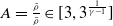 $A=\frac {\tilde {\rho }}{\bar {\rho }}\in [3,3^{\frac {1}{\gamma -1}}]$
with
$A=\frac {\tilde {\rho }}{\bar {\rho }}\in [3,3^{\frac {1}{\gamma -1}}]$
with $\gamma \in (1,\frac {3}{2}]$
, it holds from (A.14) that
$\gamma \in (1,\frac {3}{2}]$
, it holds from (A.14) that
 \begin{equation} (P(\rho )-P(\bar {\rho }))(\rho -\bar {\rho })\leq \frac {3\tilde {\rho }}{\ln 3-1}G(\rho ). \end{equation}





















 Open access

