Background
Community nurse practice teachers are qualified community nurses responsible for post qualifying nursing students in practice settings prepare for their role as community nurses (NMC, 2006). Practice teachers have the key role in facilitating and assessing the professional development of community nursing students in practice and crucially deciding their fitness to practise (Sayer, Reference Sayer2011). While undertaking a study to explore practice teachers perceptions of their role in the professional development of community nursing students a review of education theory was undertaken. This review resulted in an analysis of contemporary professional education.
The dominant discourse of conventional educational theory, tends to remove learners from their social contexts and considers knowledge to be transmitted from one individual to another. Nurse education texts (Neary, Reference Neary2000; Quinn, Reference Quinn2000; Canham and Bennett, Reference Canham and Bennett2002) display a bias towards this ‘standard paradigm’ (Beckett and Hager, Reference Beckett and Hager2002) of learning. These texts emphasise individualistic approaches to learning where the learner is perceived to acquire competence through the transmission of knowledge and skills. This literature aimed at preparing nurse educators for their role therefore continues to stereotype pedagogy as the passage of knowledge and skills from one individual to another (Scribner and Cole, Reference Scribner and Cole1973). Even more explicit adult education approaches where ‘facilitation’ is emphasised and students are deemed to recognise their own needs and learning opportunities (Knowles, Reference Knowles1984) still position the individual as amassing knowledge and skills (Bleakley, Reference Bleakley2002). Such approaches miss the cultural process of socialisation and the social construction of a professional identity.
In opposition to individualistic approaches are cultural models of learning, which themselves have been accused of being deterministic in the way they present culture, moulding identity (Hodkinson and Hodkinson, Reference Hodkinson and Hodkinson2004). These opposed approaches result in a continuum, with the middle ground being taken by proponents of situated learning and socio-cultural approaches who view learning as both culturally situated and individually constructed (Figure 1). Proponents, mainly from backgrounds of social psychology and anthropology, theorise learning in practice placements as a social activity, where individual learners are integral components of the situations in which they work and learn (Brown and Palincsar, Reference Brown and Palincsar1989; Wenger, Reference Wenger1998). Lave and Wenger's (Reference Lave and Wenger1991) ‘communities of practice’ is located within this perspective.
Approaches to learning.

Situated learning considers knowledge to be socially and culturally situated and therefore learning this knowledge must also be situated within real life contexts. As a consequence situated learning provides a framework of social participation not an experience of learning located within the mind of the individual. This radical change in educational thinking is attributed in part to the work of Rogoff and Lave (Reference Rogoff and Lave1984). Rogoff (Reference Rogoff1990) believes that the social context includes everything that needs to be learnt and therefore it is the context which is the most important aspect of the learning process (Field, Reference Field2004). As part of this context Rogoff emphasises the value of guided participation between the learner and an experienced colleague such as a practice teacher.
So what is a community of practice? Lave and Wenger (Reference Lave and Wenger1991) consider it to be a close knit group of workers sharing knowledge, tasks, activities and a common physical location. Snyder and Wenger (Reference Snyder and Wenger2004) outline three dimensions of communities of practice. First community, comprising the collective membership, it is the quality of the relationships that tie members together that provides the foundation for learning and collaboration. The quality of the relationships depends to a large extent on the degree of acceptance, trust and respect between members. Second practice, this is what each community does, the activities undertaken by the members. Finally domain, which refers to the area the community focuses on and defines its identity, such as health visiting, school nursing or occupational health nursing. A community's effectiveness as a social learning system depends on its strength in all three dimensions.
Wheatley (Reference Wheatley2004) states that every organisation is filled with self-organised communities of practice, networks that people spontaneously create to help them work. These communities of practice are evidence of people's willingness to learn and to share what they know. Wheatley views them as powerful knowledge sharing devices, which function best when members voluntarily engage with each other because they feel connected and trust each other. What is viewed as ‘expertise’ by the community of practice’ is not simply what an individual holds, but is a collaborative definition within a working group of what is valued and beneficial at a certain moment in time. The value of communities of practice within healthcare has been recognised by the large number of studies published since 2005. This has resulted in three systematic reviews into the impact communities of practice have on healthcare practice (Fung-Kee-Fung et al., Reference Fung-Kee-Fung, Watters, Crossley, Goubanova, Abdulla, Stern and Oliver2009; Li et al., Reference Li, Grimshaw, Nielsen, Judd, Coyte and Graham2009; Ranmuthugala et al., Reference Ranmuthugala, Plumb, Cunningham, Georgiou, Westbrook and Braithwaite2011). Within community nursing the Department of Health (2012) is supporting the development of health visiting communities of practice locally through Strategic Health Authorities. This study is therefore timely as it recognises that a strong community of practice can hold the key to transforming new community nurse students as they participate in the activities of the community under the sponsorship of their practice teacher.
Method
Grounded theory (Strauss and Corbin, Reference Strauss and Corbin1998) using the concept of ‘emergent fit’ (Glaser, Reference Glaser1978) was used within this study of 30 community nurse practice teachers who had worked with 113 students (Sayer, Reference Sayer2011). Following University and UK NHS ethical approval, theoretical sampling led to data being collected from interviews with practice teachers. A grounded theory of professional (re)production of community nursing was developed from constant comparison of the interview data and theorising the social process within a community of practice theoretical framework.
Findings
Learning within communities of practice was reflected with the data emerging from this study of practice teachers who explicitly recognised learning taking place through participation in a social context (Sfard, Reference Sfard1998; Hodkinson and Hodkinson, Reference Hodkinson and Hodkinson2004). The data led to the development of a framework using many of the features of Lave and Wenger's (Reference Lave and Wenger1991) communities of practice, including learning in authentic situations where newcomers through a process of legitimate peripheral participation move in a centripetal direction to become journierFootnote †, then full participants in the community of practice. Newcomers are sponsored by full participants who enable them to gain access to the community of practice in order to learn.
Lauder et al. (Reference Lauder, Sharkey and Booth2004) proposed that for community nurse students to learn to become community nurses they needed to be in authentic practice placements working with families, communities and populations. When a learner arrives in the authentic context, that is, the practice placement, it is likely that the situation is unfamiliar. Lave and Wenger (Reference Lave and Wenger1991) developed the concepts of sponsorship and legitimate peripheral participation within communities of practice to explain the process that occurs when the learner arrives in the work place and begins to acquire professional competence. According to Lave and Wenger the learner is a co-participant in the community of practice from the very beginning, albeit on the periphery (Burkitt et al., Reference Burkitt, Husband, MacKenzie and Torn2000). Support and guidance are provided by an experienced member or experienced members of the community while the newcomer is engaged in everyday activities, this is termed ‘sponsorship’. Within this process the practice teacher would act as the experienced member of the community of practice, or sponsor, to the community nurse student. As the learner becomes more settled and familiar the activities they undertake change to promote fuller incorporation into practice. Their responsibilities increase and develop along with their expertise (Burkitt et al., Reference Burkitt, Husband, MacKenzie and Torn2000; Spouse, Reference Spouse2001). These responsibilities and activities are valued and useful to the community and as such are termed legitimate peripheral participation by Lave and Wenger (Reference Lave and Wenger1991).
Practice teachers are responsible for educating community nurses during the year-long practice placement of their professional education course. The practice teacher interviewees described how they socialise nurses to become community nurses with the support of the whole community of practice through a lengthy period of shadowing, observation of the student's participation in practice and supervision of the student's solo practice. Through shadowing, students were provided with an environment where the values, attitudes and practice of community nursing were modelled by the practice teacher and other community of practice members. Gradually students were reported to start participating in this cultural practice under the gaze of their practice teacher a process that equated to Lave and Wenger's (Reference Lave and Wenger1991) legitimate peripheral participation. When the practice teacher felt the student's community nurse identity was sufficiently formed they were allowed to undertake solo practice, where they were seen to practise and embed their new identity. The culture imbued through this socialisation process enables students to acquire the values, attitudes and practices that eventually allow them to function as full members of the communities of practice within which they are placed, before moving on to new communities of practice as qualified community nurses to continue their professional development. This finding accords with Rainbird's (Reference Rainbird2000) statement that the workplace is a significant place of socialisation, it is where workers learn about roles, power relations, discipline and control. It was the experience and interaction within the community's social practice that was perceived to gradually form the student's professional identity.
The elements of the framework drawn from Lave and Wenger's (Reference Lave and Wenger1991) theory include, accessing the community of practice and learning the role through legitimate peripheral participation under the sponsorship of a full participant. This new apprenticeship model was found to be based on strong relationships involving trust and respect which result in mutual engagement for the learner and other community of practice members. The outcome being a process of enculturation for the student whose identity is transformed as they enable the community of practice to (re)produce (Figure 2).
Theoretical framework.
Relationships
Of central importance to the effectiveness of this process was the formation and maintenance of relationships which enabled the student to access and then participate in the community. For Lave and Wenger (Reference Lave and Wenger1991) legitimate peripheral participation is the main mechanism whereby newcomers acquire the competence to become full participants in the social and cultural practices of the community. However, this study found the essential element within communities of practice to be relationships. Relationships where mutual engagement, belonging and acceptance are a feature in preparing community nurses of the future and delivering high standards of care to clients are the common goals. Trust and respect are viewed as crucial to the effectiveness of the community of practice as a social learning system, with power and conflict recognised as important elements for facilitation or inhibition of learning. As depicted in Figure 2 above features of relationships, mutual engagement, belonging, acceptance, trust and respect can be considered as inputs influencing all members of the community of practice, these inputs are represented by the arrows facing towards the community of practice. The relationship between the student and the practice teacher was raised as being very important by all interviewees even though this was not asked as a direct question. Table 1 outlines some short interview extracts that highlight the importance of relationships. Bracketed numbers are the unique code allocated to anonymise practice teacher participants.
Sample interview extracts
The relationship with the practice teacher (sponsor) was not the only one of importance, students were also said to need a good relationship with other members of the community of practice and practice teachers saw themselves as central to facilitating this as the following interview extracts in Table 2 highlight.
Sample interview extracts
The discovery that relationships had the greatest impact on the students’ learning rather than legitimate peripheral participation fits with a growing body of literature which has begun to offer a critique of Lave and Wenger's concepts. These are predominantly from a group of educational researchers who have used a range of case studies as evidence to highlight the weaknesses of Lave and Wenger's concept (Hodkinson and Hodkinson, Reference Hodkinson and Hodkinson2004; Hodkinson et al., Reference Hodkinson, Hodkinson, Evans, Kersh, Fuller, Unwin and Senker2004; Fuller et al., Reference Fuller, Hodkinson, Hodkinson and Unwin2005).
Continuity versus change
Criticism has been levelled that Lave and Wenger's (Reference Lave and Wenger1991) communities of practice are unchanging, with legitimate peripheral participation being the method of giving new generations of newcomers the means to reproduce the community of practice. It is this perceived limitation that has led socially situated learning to be viewed negatively within nursing, as it has been associated with attempts to resist modernisation of the profession (Field, Reference Field2004). The fear is that students were socialised into existing practice in a way that stifles innovation and change, with practitioners on qualifying replicating the status quo, that is merely reproduction of the profession.
However communities of practice do change and part of this is instigated by newcomers who are not merely transformed themselves through participation in communities of practice, but also transform the communities they join (Fuller et al., Reference Fuller, Hodkinson, Hodkinson and Unwin2005). This can occur where experts allow newcomers to question and challenge habitual practices. The community of practice thus learns from the student in terms of current theory, so their skills are changed and updated. Community nurse students are also qualified nurses, many of who have strong views regarding practice gained from their previous experience.
Fuller et al. (Reference Fuller, Hodkinson, Hodkinson and Unwin2005) found communities of practice were more complex than Lave and Wenger acknowledged. For example newcomers who had been experts in previous communities of practice such as a new team leader who was both a full and powerful member right from the start as well as new to the working practices of the community. They conclude that the extent of peripheral status can therefore vary for the same person, even at the same time. This study found interviewees clearly viewed students as making a valued contribution that was reciprocal and beneficial to all team members, quotes such as these below demonstrate that practice teachers strongly voice in their narratives that students were respected for their contribution. Their ability to reciprocate by giving to members of the community of practice also enhanced their integration into the community and their subsequent development. The ability of community nurse students to give to the community was enhanced by their status as qualified and experienced nurses who were viewed as brining up-to date expertise and fresh insights from a range of practice perspectives.
My student this year she has done the chest diseases stuff, when she first came we were doing the BCGs here and I was still really nervous doing them. And she was the one that was talking me through stuff and telling me things and different techniques. And when we had people come back with reactions I'd say (name) come and have a look what do you think? So it was using her skills as well which was good. (054)
Oh yes, the student was always welcomed in the team, we felt because the student was supernumerary and because they are looking at our practice and reflecting and bringing the knowledge from the University course, they will always bring something new and they always improve the care and that was the case from both students, they have had an impact on the team and the way we work. (045)
The learner is embedded in the social context and plays a crucial role in the transformation of practice through identifying contradictions usually hidden by routine practice. The community respond by creating new practice through negotiation and as a consequence new knowledge and ways of knowing for all members of the community are formed. Without contradiction or conflict Bleakley (Reference Bleakley2002) believes stagnant patterns of practice may result.
Well it's such a buzz when they come in with new ideas it's really such a buzz it does refresh the team because practice can become a bit boring and stale. You know you're bogged down in the old fashioned way of working and so its good to have students in just to kind of pull things out and you know give the team a kick start with things, so it's an advantage having students. (055)
Traditional practice was seen to become stale, boring and old fashioned by Interviewee 055 above who saw students being new and refreshing. Thus students collectively were positioned by interviewees as stimulating the team by acting as a resource, a source of current knowledge and up to date practice which gave them value. As far as practice teachers were concerned having a student motivates the team with their approach to learning, as a consequence the practice of the community of practice changes and develops. This experience of students’ contribution to community nursing practice within health visiting, school nursing, district nursing and occupational health nursing teams contradicts the often held view that established members within communities of practice resist the change novices bring. Thus this research challenges the assumption that new recruits are made to conform to the status quo, instead it highlights that change brought by students is welcomed, a finding reflected in Fuller et al.'s, (Reference Fuller, Hodkinson, Hodkinson and Unwin2005) paper regarding teacher trainees. This finding poses the question of whether the social context of community nursing makes it a conducive milieu for encouraging changes suggested by students, or whether it is the unique contribution that practice teachers who embed education, learning and change in the settings within which they work. If it is the latter practice teachers provide a value added resource within the workplace.
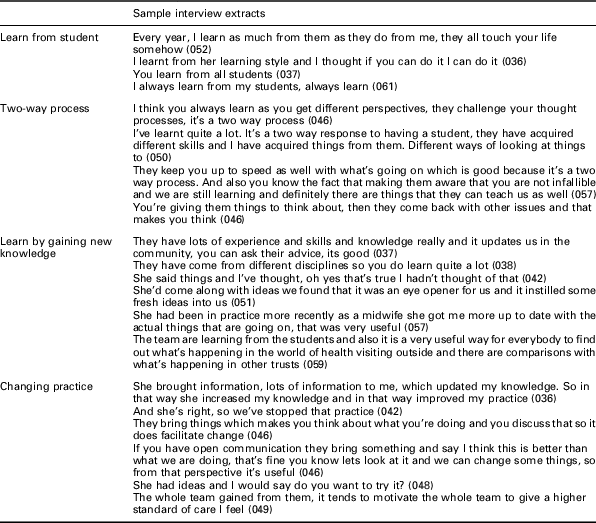
Thus learning was not found to take place solely through legitimate peripheral participation of the student, but occurred for all members of the community of practice through reciprocal relationships. The overriding view of the interviewees (90%, n = 27) was that learning was a two-way process for both practice teacher and student, with students making valuable contributions to the community of practice as a whole. In this study members of the community of practice reportedly gained not only immediate benefit from the knowledge and expertise the student brought, but also from knowing that they had helped a student continue their professional development as seen from the interview extracts in Table 3.
Reciprocity
As Table 3 above demonstrates not only does practice change but the members of the community change as well. Thus the learning process and identity transformation result in both continuity and change within the community of practice the result is that over time the community (re)produces itself (Burkitt et al., Reference Burkitt, Husband, Mackenzie and Torn2001). This transformation if the community is depicted within the study's framework by the outcome or ‘outputs’ in Figure 2 (arrows facing away from the community of practice) highlighting that all members collectively learn resulting in the transformation of their identities.
In Lave and Wenger's theory learning is a by-product of the community's primary purpose of practice. In part this appears a consequence of Lave and Wenger drawing upon a wealth of literature about apprenticeship from their own (Lave, Reference Lave1982) and other researchers (Coy, Reference Coy1989; Singleton, Reference Singleton1989). Within this literature the phenomenon of apprentices learning a craft from skilled journeymen and master craftsman involves apprentices undertaking unskilled work in order to get the job done at the expense of their learning. In nurse mentorship literature there is also evidence that student nurses spend too much of their time working on basic tasks alongside unqualified staff rather than learning the complex elements of the craft (Melia, Reference Melia1987; Gray and Smith, Reference Gray and Smith2000). In examples such as these learning is in the background. However in this study examples of student socialisation foregrounded learning, this led to a view that within each community of practice there is a learning dimension. The learning dimension is the degree to which learning within the community is made explicit. In the original framework by Lave and Wenger (Reference Lave and Wenger1991) where newcomers were integrated into the practices of the group, the learning dimension is in the background to a more dominant foregrounded practice agenda. The result is that learning occurs but often this is an unconscious process. Ball (Reference Ball2003) states that learning is an unintentional product of a community of practice, it is not the principal activity. A community of practice is not primarily a community of learners it is a community in which learning takes place in support of the primary practice.
This study found that the practice teachers within their communities of practice did not foreground practice. For these interviewees learning was considered to be conscious for the community as a whole and it was learning that took a foreground position ahead of practice. It is argued, therefore, that where a practice teacher forms part of the community of practice there is a specific remit within this community for learning, this remit envelopes the whole team not just the student as the quote below aptly states.
We (practice teachers) have a role in terms of creating a learning environment not only when students are around but on an all time basis, on an ongoing basis the learning environment is not created kind of switch on switch off, it has to be an ongoing thing. And it is a culture that needs to be developed that needs to be nurtured and that's what I feel, everybody needs to know about that, my colleagues I have to keep influencing colleagues around. (063)
Thus in communities of practice where practice teachers have a remit specifically for education, and the education of community nurse students (newcomers), the learning dimension is consciously recognised and takes a more dominant foreground position.
The concept of a learning dimension within the community of practice provides one explanation for how change takes place for the community as a whole and the members within it. The learning dimension within communities of practice where a practice teacher acts as sponsor enables learning to take centre stage in directing the development of practice. Within communities of practice with a foregrounded learning dimension, learning becomes a reason for participation in social practice rather than a by-product (Lave and Wenger, Reference Lave and Wenger1991).
The learning dimension is interpreted not as a separate reified entity, but an integral element that operationalises the development of community members. This extension to community of practice theory develops Pugach's (Reference Pugach1999: 270) view that ‘one of the most important purposes of a community of practice is to establish a learning community’. Thus although the community nursing communities of practice described within this study were perceived to possess the key elements of Lave and Wenger's (Reference Lave and Wenger1991) community of practice theory, such as legitimate peripheral participation and sponsorship. The key feature of communities of practice with a foregrounded learning dimension is that social participation is undertaken for the purpose of learning and professional development. Members of such communities, in particular practice teachers recognise the learning potential that opens up to individual members when they access the social activities that define the community's practice.
Relationships reportedly made the learning within the community of practice more effective and in such a way illuminated the learning dimension. This was seen to result in not only the development of the student but the development of all other members. Although within the interviews learning was primarily focused on the community nurse student, practice teachers saw all members within the community including the student contributing to the learning of each other in a reciprocal manner. They saw their role involve the development of staff nurses moving to become potential community nurse student recruits, moving qualified community nurses to become practice teachers and moving novice practice teachers on their journey to become experienced practice teachers (full participants). As the linchpin for this process the practice teacher was considered to be at the forefront in (re)producing the community first by protecting the community's way of working. This was seen in practice teachers talking about upholding or maintaining the standards. Second by allowing change that led the community to evolve into a different entity, this was seen by welcoming the students impact on changing practice.
Lave and Wenger demonstrated that the social processes taking place within communities of practice which led to newcomers being incorporated not only resulted in continuity (reproduction), it also led to change in the culture and practice of the community (production) where students are socialised so they recreate the knowledge, skills, values and work force. Thus creation and recreation were found to co-exist within communities of practice. The co-existence of both processes is denoted by the term (re)production, a term which has been similarly used to good effect by Griffin (Reference Griffin2007) and Holt (Reference Holt2007).
This study found that practice teachers see community nurse students (newcomers) being socialised to become practitioners of the future who are thus able to replenish communities of practice. Thus in preparing students in this way practice teachers and their community of practice colleagues are (re)producing the community nursing workforce. In so doing individuals are developed who can produce the necessary labour to undertake community nursing practice. Individuals are created who can produce discourses and working practices which produce a culture that is similar but not the same, alike but not an exact replica of the existing culture. Thus as Lundgren (Reference Lundgren1983) states the system of (re)production over time manages to sustain a process of continuity in the face of gradual change.
The evidence for communities of practice (re)producing themselves over time through the induction of new members found in this study has also be identified in the nursing research of du Toit (Reference Du Toit1995) and Burkitt et al. (Reference Burkitt, Husband, MacKenzie and Torn2000; Reference Burkitt, Husband, Mackenzie and Torn2001). It was also reported by Bauder (Reference Bauder2006) in a study about the (re)production of academic geographers and in a paper by Prior (Reference Prior1997) regarding the (re)production of the academic discipline of American Studies.
Conclusion
Within this paper the community of practice concept has been variously described. The background to the paper offered Lave and Wenger's (Reference Lave and Wenger1991) original view of a close knit group of workers whereas Wheatley's (Reference Wheatley2004) description was of self-organised networks created to help people work. The practice teachers within this study described both such communities, predominantly the one most closely aligned to Lave and Wenger's original thesis, the community nursing team, with its geographical boundary within which the student and other team members learnt and developed reciprocally until the student on qualifying moved into a new geographically bounded community of practice. However practice teachers also outlined their role within more spatially fluid and expansive communities of practice as espoused by Wheatley. Here practice teachers described supporting others, such as novice practice teachers, through loose networks which could cross organisational boundaries such as practice teacher fora. This paper therefore defines communities of practice as heterogeneous groupings which in their many forms enable individuals to learn and develop their practice and their identities through mutual engagement in the practice of the community. This broad conceptualisation supports Handley's et al (Reference Handley, Sturdy, Fincham and Clark2006: 645) paper in its opposition of the view that communities of practice are homogenous ‘social objects’.
The presence of a practice teacher within a community of practice, it could be argued adds to the potential of the community of practice changing, as such sponsors of learning were found to encourage and support innovation and development. The comment by 11 practice teachers that their position was not sufficiently used by the employing organisation would seem to reflect missed opportunities that practice teachers have to influence change within individual communities of practice and within the profession as a whole. It is they who could hold the key to the sought after changes in the form of production within the community nursing profession. The frustration by many within leadership positions in the health service that modernisation is not being embraced leads to greater attempts to impose this agenda. However when viewed from a situated learning approach it can be seen that community of practice members cannot interact with modernisation and change that is imposed from outside, as it does not currently exist as part of current social practice. Change must come through interaction and it is the interaction between students and practice teachers who are open to change that the sought for transformation could emerge.
Acknowledgements
The author would like to thank all the practice teachers who participated in this study.