


Introduction
The digital era, characterized by rapid advancements in big data, artificial intelligence, and other emerging technologies, fundamentally reshapes business landscapes, fostering new organizational structures and entrepreneurial modes (Hanelt, Bohnsack, Marz, & Marante, Reference Hanelt, Bohnsack, Marz and Marante2021). In particular, China has embraced this digital economy with great enthusiasm, witnessing the rapid emergence of technology ventures that are redefining traditional business paradigms through innovative digital business models and distribution channels, such as AI-enabled value creation, ecosystems built around digital platforms, agile organizations, and data governance (Bell, Reference Bell2022). These new business models and practices demand a sophisticated understanding of strategic leadership, decision-making processes, and governance to navigate their inherent complexities and capitalize on emerging opportunities (Tang, Du, & Deng, Reference Tang, Du and Deng2025). Our editorial essay for this special issue of Management and Organization Review addresses this gap through categorizing the evolution of innovation in Chinese firms over the last five decades, exploring key characteristics of the digital era and their effects on Chinese technology ventures, navigating their effects on strategic leadership, decision-making, and governance, and proposing avenues for future research.
Compared with their Western counterparts, the growth trajectories and sustainability of Chinese technology ventures are affected by both technology and the Chinese government (Zhou, Gao, & Zhao, Reference Zhou, Gao and Zhao2017). First, new technologies in the digital era reduce barriers for starting a business and accelerate decision-making processes. Opportunities for rapid growth intensify the competition among technology ventures. For example, many Chinese technology ventures grow by embedding themselves in platform-based ecosystems. These platforms enable rapid data accumulation, network effects, and cross-industry collaboration, which are critical for ventures and can be captured with very low costs. Meanwhile, AI is deeply integrated into operations, product development, and customer interfaces. With the assistance of AI, enhanced efficiency in decision-making and operations has catalyzed a surge of technology ventures, as these ventures no longer require certain traditional capabilities previously considered essential. Second, in China, technology ventures operate within a tightly coupled policy and market environment (Tan, Reference Tan2006). Government directives, such as national strategic initiatives, data regulation frameworks, and coordinated infrastructure development, operate alongside highly dynamic markets driven by digital technologies. This interplay between institutional and market forces creates unique incentives and constraints for the growth of Chinese technology ventures and thus affects their decision-making and organizational design (Hao, Zheng, Deng, & Zhao, Reference Hao, Zheng, Deng and Zhao2025; Wu, Eesley, & Yang, Reference Wu, Eesley and Yang2022).
Besides technological and governmental effects, recently, due to geopolitical tensions, US–China tech collision pushes the Chinese government to adopt policies that accelerate the development of critical technologies in the global arena (Li, Shapiro, Ufimtseva, & Zhang, Reference Li, Shapiro, Ufimtseva and Zhang2024). The international context, which is captured by de-globalization and de-coupling, becomes increasingly important in affecting Chinese technology ventures in the digital era. Even though the support of the Chinese government creates a friendly institutional environment for the growth and international expansion of Chinese technology ventures (e.g., Vecchi & Brennan, Reference Vecchi and Brennan2022), governmental scrutiny on anti-trust regulations and data privacy in host countries remain constraints for the internationalization of Chinese technology ventures.
These developments necessitate a critical reassessment of conventional research paradigms on strategic leadership, decision-making processes, and governance. Strategic leaders, such as chief executive officers (CEOs), top management teams, and boards of directors, who are important precursors of firm performance and innovation (Tang, Nadkarni, Wei, & Zhang, Reference Tang, Nadkarni, Wei and Zhang2021; Wei, Zou, & Ormiston, Reference Wei, Zou and Ormiston2021), face distinctive challenges. These leadership challenges arise from coordinating across platform-based ecosystems, aligning with state priorities, managing data governance, and balancing rapid experimentation with regulatory compliance. Further, decision-making in Chinese technology ventures is made in the context of high velocity, ambiguity, and policy changes, incorporating AI-enabled decision support and cross-functional coordination frameworks. Basic dimensions of decision-making processes, including when, why, where, and how entrepreneurs make decisions (Shepherd, Williams, & Patzelt, Reference Shepherd, Williams and Patzelt2015), experience fundamental challenges. Finally, Chinese technology ventures are undergoing a transition from traditional governance approaches to new patterns on examining how data governance and privacy affect the governance systems of technology ventures which are mostly embedded in a state-influenced digital ecosystem.
Our special issue seeks potential responses to the distinctive challenges faced by Chinese technology ventures in the digital era, particularly with respect to strategic leadership, decision-making processes, and corporate governance. As the introductory piece, this editorial essay proceeds as follows. First, we trace the evolution of Chinese technology ventures over the past five decades and identify the challenges related to the three dimensions in each phase. Second, we identify the key characteristics of the digital era and discuss how they shape Chinese technology ventures’ strategic leadership, decision-making, and governance. Finally, we introduce each article in this special issue and outline avenues for future research to underscore the importance of understanding strategic leadership, decision-making, and governance as an integrated system in navigating an evolving digital landscape for Chinese technology ventures.
The Evolution of Innovation of Chinese Firms and Implications on Strategic Leadership, Decision-Making Processes, and Governance
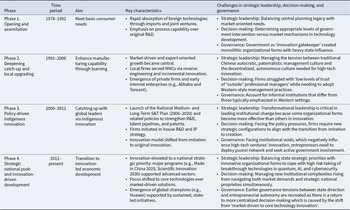
The emergence and surge of Chinese technology ventures is strongly associated with the evolution of innovation of Chinese firms. This trajectory reflects a shift from initial technological assimilation to independent innovation and, more recently, to becoming a significant force in global technological advancement (Li, Ji, & Zhang, Reference Li, Ji and Zhang2020). The evolution of innovation of Chinese firms is initiated and facilitated by the Chinese government. It was a state-led innovation strategy initially but quickly evoked the participation of private firms. The innovation paradigm gradually shifted from learning and absorption to indigenous innovation and core technology innovation (Chung & Tan, Reference Chung and Tan2017). In general, this evolution process can be broadly categorized into four distinct phases, each characterized by particular strategic approaches and policy environments that fostered technological progress, as well as distinct challenges in leadership, decision-making, and governance (see Table 1).
The evolution of innovation of Chinese firms in the last five decades

Table 1 Long description
The table outlines the evolution of innovation strategies among Chinese firms over four distinct phases from 1978 to the present. Initially, firms focused on absorbing foreign technologies and meeting basic consumer needs, with significant government influence. From 1992 to 2006, the emphasis shifted to enhancing manufacturing capabilities and fostering local innovation, marked by the rise of private firms and early internet enterprises. The period from 2006 to 2012 saw a policy-driven push towards indigenous innovation, with firms developing in-house R&D and intellectual property strategies. Since 2012, the focus has been on innovation-led economic development, prioritizing core technologies and producing global champions like Huawei. Throughout these phases, strategic leadership, decision-making, and governance have adapted to balance state priorities with market demands, highlighting the complex interplay between centralized control and entrepreneurial autonomy.
Phase 1: Opening and Assimilation (1978–1992)
China’s innovation journey began with the 1978 ‘Opening Up’ reform (Li & Wei, Reference Li and Wei2020). In early decades, from 1978 to 1992 (Phase 1), the initial attempt at innovation was to produce more necessities of life through foreign direct investment practices, such as joint ventures, importation of capital goods and know-how, and learning-by-doing (Li et al., Reference Li, Ji and Zhang2020). In this period, private firms were rare and state-owned firms (SOEs) dominated the economic growth of China (Li & Wei, Reference Li and Wei2020). As such, the state played a central role in promoting innovation through a state-led innovation strategy. For example, the State Economic Commission introduced eighteen foreign approaches to enhance the production efficiency of Chinese firms (Xu & Qin, Reference Xu and Qin1985). Phase 1 thus marked Chinese firms, primarily for SOEs rapidly absorbed foreign technology and management know-hows through imports and joint ventures, with a focus on improving production capabilities rather than original R&D.
With economic reforms laying the foundation for technological transformation, the government – especially the central government – has often acted as an innovation gatekeeper, creating governance challenges associated with monolithic organizational forms under strong state influence (Chandra & Chao, Reference Chandra and Chao2011). In this context, strategic leaders are required to balance the legacy of central planning with emerging market-oriented demands. Decision-making is similarly shaped by the need to determine appropriate levels of state intervention while still enabling market mechanisms to support technology development.
Phase 2: Deepening Catch-Up and Local Upgrading (1992–2006)
Phase 2 was a catching-up and imitation phase, spanning from 1992 to 2006. Market-driven or export-oriented growth became the central strategy for economic development. This period commenced following Deng Xiaoping’s trip to Southern China in 1992 and is marked as a break almost as deep as 1978 in the economic reform of China. Throughout Phase 2, to leverage cost advantages, Chinese firms invested in process innovation to improve production efficiency through reverse engineering and benefit from incremental product improvements. For example, Zhang Ruimin, the founder of Hair, emphasized market responsiveness and implemented business process reengineering to improve customer satisfaction. The transition from a centrally planned to a market-oriented economic model stimulated the rise of private firms, which are more flexible in meeting customer demands and learning new technologies. With the surge of private firms, the internet industry took off and internet enterprises emerged, some of which evolved into large internet corporations within a decade, such as Tencent.
During Phase 2, innovation primarily focused on knowledge absorption and organizational learning to enhance manufacturing capabilities in both SOEs and private firms. Many Chinese technology firms learned from foreign subsidiaries through imitation and gradually expanded their product development activities. In this context, firm governance must account for informal institutions that differ from those typically emphasized in Western settings (Ahlstrom & Bruton, Reference Ahlstrom and Bruton2002). Compared with foreign subsidiaries, strategic leaders need to recognize and manage tensions between traditional autocratic and paternalistic management practices and the more decentralized, autonomous culture often required for high-tech innovation (Tan & Tan, Reference Tan and Tan2005). Decision-making processes also reflect this tension: firms faced low trust in ‘outside’ professional managers while simultaneously attempting to adopt Western-style management practices (Hempel & Chang, Reference Hempel and Chang2006).
Phase 3: Policy-Driven Indigenous Innovation (2006–2012)
From 2006, the innovation of Chinese firms shifted to Phase 3 until 2012. Intensified competition and globalization were the main drivers in this phase. It was initiated by the ‘2006–2020 National Medium- and Long-Term Science and Technology Development Plan’, which was China’s strategic plan to transform the country into an ‘innovative nation’ by 2020. After this, supporting policies were issued to protect patents and to facilitate national research on science and technology. These policies set institutional foundations for innovation nationwide. The aim of Phase 3 was to catch up with global players with indigenous innovation, rather than imitating Western counterparts. With intensified competition, both domestically and internationally, many Chinese firms started in-house R&D and strategic intellectual property (IP) building. The policy-driven indigenous innovation largely increased the strategic advantages of Chinese firms worldwide. It also evoked the awareness of some Chinese firms (e.g., Huawei) that competing with only business models but without core technology was not sustainable.
In Phase 3, township and village enterprises, which had emerged in Phase 1, lost their competitive advantages. Meanwhile, private firms gradually gained legal recognition and increasingly embraced indigenous innovation rather than imitation. In this context, transformational leadership becomes critical for navigating institutional change, as some organizational forms prove more effective than others in driving innovation. This transition ‘from imitation to creation’ also reshapes decision-making, requiring firms to develop new strategic configurations and align them with evolving institutional conditions. As firms pursue proactive innovation amid institutional voids, governance often depends on mobilizing guanxi networks and seeking active government involvement (Liu, Reference Liu2011).
Phase 4: Strategic National Push and Innovation-Driven Development (2012–Present)
Starting in 2012, the innovation of Chinese firms moved to a new phase (Phase 4), which was also driven by a strong national strategic push. The aim of Phase 4 was to transform the economy from factor-driven to innovation-driven (Li & Wei, Reference Li and Wei2020). In 2012, the Chinese government launched the ‘Decision on Deepening Structural Reform on Science and Technology and Accelerating the Construction of National Innovation System’ program to facilitate the paradigm shift of innovation. The new paradigm set innovation as a core national strategy and the focus was switched from market-driven to core technology innovation. With a group of targeted programs (e.g., ‘Scientific Innovation 2030’ and ‘Made in China 2025’), advanced sectors, including aviation engines, quantum, brain-like intelligence, cyberspace security, deep space, smart manufacturing, and big data, were strongly supported and quickly developed. The continuous state-led initiatives facilitated the emergence of global champions, such as Huawei, DeepSeek, and Unitree Robotics, all of which are well-known for their breakthrough technologies and competitive standing in a global landscape.
In this phase, the development of Chinese technology firms is shaped by both emerging digital-era technologies and national strategies focused on core-technology innovation (Li, Reference Li2023). With a strong strategic push from the state, earlier governance tensions between state direction and entrepreneurial autonomy have re-emerged, including a return to more centralized decision-making as priorities shift from market-driven innovation to core-technology breakthroughs. Given the distinctive characteristics of these technologies, strategic leaders must balance state strategic priorities with organizational forms that enable experimentation and innovation, while managing the heightened risks associated with breakthroughs in areas such as quantum computing, AI, and cybersecurity. Correspondingly, decision-making processes must navigate rising institutional complexity by simultaneously responding to market demands and national strategic priorities. We discuss these challenges in strategic leadership, decision-making, and governance in the next section.
Key Characteristics of the Digital Era and Implications on Chinese Technology Ventures
The digital era is underpinned by interconnected, reprogrammable, and platform-based technologies, including AI, the Internet of Things (IoT), cloud computing, blockchain, and big data analytics. These technologies reshape business and society in multiple ways. For example, intelligent manufacturing is transforming traditional production into more flexible and responsive systems by leveraging real-time AI (Bonney et al., Reference Bonney, Breaux, Buffington, Dinlersoz, Foster, Goldschlag, Haltiwanger, Kroff and Savage2024) and cloud computing (Brand, Demirer, Finucane, & Kreps, Reference Brand, Demirer, Finucane and Kreps2024). Similarly, e-commerce platforms and intelligent logistics have reduced the constraints of geography and time, substantially improving distribution efficiency. As a result, key characteristics of the digital era are reshaping core business and management challenges, with important implications for strategic leadership, decision-making processes, and governance in Chinese technology ventures.
Key Characteristics of the Digital Era
Digital technology can be understood as a collection of technologies for processing digital information (Li et al., Reference Li, Li, Xu and Ye2024). It relies on modern computer-based electronic systems to convert complex, diverse, and continuously changing real-world information into digitally recorded data. This fundamental capability has drawn scholarly attention to research fields, such as social networks, platformization, and datafication. Building on existing literature, we summarize four key characteristics of the digital era: interconnectedness with blurred boundaries and reconfigured power (Kitchens, Johnson, & Gray, Reference Kitchens, Johnson and Gray2020), platformization and reprogrammability (Yoo et al., Reference Yoo, Henfridsson, Kallinikos, Gregory, Burtch, Chatterjee and Sarker2024), hyperconnectivity among people, firms, and devices (Zuboff, Reference Zuboff2019), and the centrality of data as a strategic asset (Leonardi & Treem, Reference Leonardi and Treem2020).
First, a main technological characteristic is the interconnectedness of digital technologies. This interconnectedness greatly accelerates cost reduction, network effects, economies of scope, innovation speed, and resource sharing. The largely increased efficiency and effectiveness brought by digital technologies unleashes the potential to shift power relations, i.e., rearranging who has influence, who gets visibility, and who sets the rules (Kitchens et al., Reference Kitchens, Johnson and Gray2020). For example, because value increasingly comes from data, network effects, and control over platform infrastructures, capital and strategic advantage tends to concentrate in a small number of dominant platforms that can shape markets through standards, interfaces, ranking mechanisms, and access to user communities. At the same time, the boundaries between private and public spheres become blurred: public authorities increasingly rely on private infrastructures and datasets to achieve policy goals, creating hybrid forms of governance. As a result, power becomes more asymmetric and less transparent, shifting from traditional institutions toward those who control data flows, algorithmic systems, and digital infrastructures.
Second, platformization refers to the expansion of digital platforms beyond ‘apps’ into the core infrastructures of markets, public governance, and everyday social life, where they mediate transactions, information flows, and coordination among users and organizations (Jiao, Wang, Libaers, Yang, & Hu, Reference Jiao, Wang, Libaers, Yang and Hu2025). These platforms are reprogrammable infrastructures built around systematic data collection, algorithmic processing, and the large-scale circulation of information. The separation between infrastructure and content means that the functionality of digital platforms can be changed by modifying its contents without altering the infrastructure (Yoo et al., Reference Yoo, Henfridsson, Kallinikos, Gregory, Burtch, Chatterjee and Sarker2024). This enables continuous experimentation and fast scaling without largely increasing costs, and reshapes value distribution across ecosystems through software updates and governance changes.
Third, in the digital era, hyperconnectivity stems from countless connections among people, firms, devices, and data. It enables real-time interaction, coordination, and transactions across physical and organizational boundaries (Zuboff, Reference Zuboff2019). This pervasive connectivity reshapes relationships and innovation processes by lowering search and coordination costs, accelerating feedback loops, and making collaboration and competition more simultaneous and network-dependent. Hyperconnectivity also amplifies consumers’ voice in the design and adoption process, expands their access to innovation, and shapes how innovations – such as IoT- or AI-enabled products and services – affect everyday life (Sorescu & Schreier, Reference Sorescu and Schreier2021). As a result, innovation becomes more iterative, data-driven, and scalable, but also more interdependent as network effects intensify.
Fourth, data have become a strategic asset for most firms. The rise of data is increasingly viewed as a driver of value creation and organizational change. There is growing recognition that value creation does not occur solely through the recombination of system-agnostic components. Rather, data homogenization – together with the aggregation and recombination of different types of data – enables platforms to create and capture value through multiple value pathways (Alaimo & Kallinikos, Reference Alaimo and Kallinikos2022; Baskerville, Myers, & Yoo, Reference Baskerville, Myers and Yoo2020). This perspective rests on a core underlying process: the systematic conversion of activities and relationships into digital, analyzable data. Digitization and digitalization reorganize social life around digital technologies, while datafication renders behavior into meaningful data that can be linked to analytic tools and commoditized (Leonardi & Treem, Reference Leonardi and Treem2020). Together, these concepts highlight data as an agent of far-reaching organizational and economic transformation, with important implications for innovation practices and knowledge generation.
In sum, these four characteristics capture how digital technologies are fundamentally reshaping organizations and management. With these characteristics in mind, we next examine the implications of the digital era for strategic leadership, decision-making processes, and governance in Chinese technology ventures.
Implications on Strategic Leadership for Chinese Technology Ventures
The digital era fundamentally redefines strategic leadership in Chinese technology ventures, requiring them to navigate technological shifts and heightened complexity driven by interconnectedness, platformization, hyperconnectivity, and the centrality of data. First, strategic leaders must adopt adaptive and visionary strategies, balancing long-term innovation with agility to respond to real-time market and regulatory changes within complex, cross-sector ecosystems (Zhang, Reference Zhang2024). Second, platformization and reprogrammability require them to foster a culture of continuous experimentation and fast learning, enabling agile development and collaboration across organizational boundaries (Chen, Yang, & Wei, Reference Chen, Yang and Wei2025). Third, hyperconnectivity and the rise of data as a strategic asset elevate the need for network-centric leadership, robust data strategies, and engagement with stakeholders, ensuring effective decision-making and compliance with evolving regulations. Overall, strategic leaders must combine adaptive vision, collaborative influence, and data stewardship to create sustained advantage in the digital era.
Specifically, the institutional environment in China exerts a significant influence on strategic leadership behavior (Li, Wei, Cao, & Chen, Reference Li, Wei, Cao and Chen2022). Close engagement with regulatory authorities, proactive political risk management, and the cultivation of connections (guanxi) with local governments and state-affiliated investors represent recurrent strategic imperatives for technology ventures (Luo, Huang, & Wang, Reference Luo, Huang and Wang2012; Wang, Reference Wang2016). While political ties provide regulatory access, public resources, and legitimacy, business ties drive market access, operational support, and commercialization (Park & Luo, Reference Park and Luo2001). Political connections are decisive in highly regulated sectors or for local scaling, whereas business networks matter most for rapid user growth, distribution, and product–market fit. These ties are complementary – political access can open doors that business partners convert into revenue – but overreliance on either creates risks (political dependency or market vulnerability) (e.g., Fu & Sun, Reference Fu and Sun2024). Strategic leaders should cultivate both: formalize relational advantages through contracts and compliance, and diversify tie portfolios to manage political and commercial contingencies.
Implications on Decision-Making Processes for Chinese Technology Ventures
Digital era technologies are profoundly reshaping decision-making processes in Chinese technology ventures, making them more iterative, data-driven, and collaborative. First, interconnectedness and blurred boundaries require leaders to access and integrate diverse information from across organizational, industry, and national lines, enabling quick and responsive choices while increasing complexity. The decision-making process should comply with strategic imperatives such as whether to build a super-app, dominate a specific platform niche, or scale an AI-enabled service, subsequently mobilizing organizational resources and capital to facilitate rapid expansion (Tse, Reference Tse2015; Xie, Feng, & Hu, Reference Xie, Feng and Hu2020). Second, platformization allows for rapid experimentation, empowering teams to test and scale innovations, but demands robust coordination and prioritization across multiple digital initiatives. Leadership teams often prioritize speed-to-scale over short-term profitability, using venture funding, aggressive customer acquisition, and cross-subsidization across business lines.
Third, hyperconnectivity amplifies collaboration and collective intelligence, as decision-making now involves broader stakeholder input through digital tools and networks. This networked approach accelerates innovation and responsiveness but also requires new strategies for managing distributed authority and aligning interests (Li & Reimers, Reference Li and Reimers2015). Fourth, the centrality of data makes decision processes more analytical, relying on big data and AI for insights and optimization. This shift brings new challenges with transparency, bias, and accountability, especially in sensitive sectors.
Generally, decision-making frameworks in Chinese technology ventures are moving from traditional, hierarchical structures to decentralized, data-driven, and collaborative models, requiring a balance between speed, agility, and strong governance.
Implications on Governance for Chinese Technology Ventures
The digital era brings new governance challenges and opportunities for Chinese technology ventures, redefining traditional governance mechanisms. First, interconnectedness and blurred boundaries create hybrid forms of oversight and control, requiring ventures to navigate overlapping regulations and collaborate across sectors. These new environments emphasize accountability, transparency, and legitimacy, especially as power concentrates among platform operators (Cai, Gao, Ling, & Kellermanns, Reference Cai, Gao, Ling and Kellermanns2023). Second, platformization shifts governance from being firm-centric to ecosystem-focused. Ventures now operate within digital platforms and multi-sided ecosystems, necessitating structures for coordination, dispute resolution, and rule-setting among diverse stakeholders (Nam & Fay, Reference Nam and Fay2025). Capabilities in platform governance and ecosystem management often need to align with national policy priorities. Third, hyperconnectivity increases the demand for dynamic and responsive governance. As connectivity amplifies cybersecurity, privacy, and reputational risks, firms require agile mechanisms for risk monitoring, stakeholder engagement, and crisis response, leveraging digital tools to enhance oversight. This demand is extremely important in facing geopolitical tensions. Fourth, with data as a strategic asset, robust data governance is pivotal. Ventures must establish frameworks for data quality, privacy, and security, ensuring compliance with regulatory standards and building trust and legitimacy with stakeholders and the public. Furthermore, the balance between state-led initiatives and market-driven innovation generates unique governance tensions; firms must reconcile autonomy and compliance, align with national strategies, and address geopolitical risks related to technology and data.
Besides, firm governance and interactions with the government opens up a unique research environment in China. The governance of Chinese technology ventures is often shaped by a distinctive confluence of concentrated ownership, founder-centric control, and embedded state relations, producing hybrid governance architectures that differ from both Western dispersed-ownership models and state-owned enterprises (Bai, Chen, & Xu, Reference Bai, Chen and Xu2021). This uniqueness offers a potential avenue to advance theory. As individuals’ decisions are embedded in culturally rooted belief systems (Greenwood, Díaz, Li, & Lorente, Reference Greenwood, Díaz, Li and Lorente2010), China offers fertile ground for theory building. The Confucius value in Chinese culture – with its emphasis on harmony, hierarchy, and the cultivation of moral character – shapes the ways individuals interpret incentives, assess risk, and coordinate with others (Chen, Reference Chen2001). Testing whether core mechanisms proposed in Western-derived models operate differently under Confucian logics, identifying boundary conditions, and specifying cultural moderators (for example, when hierarchical respect strengthens firm-level compliance but weakens bottom-up innovation) can help build theory.
Ultimately, governance in Chinese technology ventures now requires flexible, accountable, and strategically aligned models attuned to ecosystem complexity and data stewardship for sustained competitiveness.
Future Research Agenda
China’s shift from technology absorption to core innovation has created a setting where market logics and state objectives co-evolve, shaping organizational design, scaling, and risk management in Chinese technology ventures. To navigate a demanding regulatory and geopolitical environment, these ventures should strengthen their leadership and decision architectures, with proactive compliance, political risk management, and government engagement as core priorities. Beyond making agile, data-driven decisions, strategic leaders are to build adaptive governance aligned with national digital priorities. Overall, the sustainable development of Chinese technology ventures will hinge on ambidextrous organizations that scale platforms responsibly, institutionalize compliance, and cultivate talent and a culture of rapid experimentation without eroding trust.
In our editorial essay, we explore two articles related to digitization and digitalization of Chinese organizations on strategic leadership, decision-making processes and governance. The first article of this special issue (Hong, Yang, Li, Chen, Yang, & Wu, Reference Hong, Yang, Li, Chen, Yang and Wu2024) examines which types of CEOs are more likely to pursue digitalization and links CEOs’ poverty experience to firm’s digitalization. It also highlights the important role of social resources in driving a firm’s digital transformation. Focusing on such experiences within China’s unique context can thus yield insights into individual-level outcomes (e.g., opportunity evaluation; Scheaf, Loignon, Webb, & Heggestad, Reference Scheaf, Loignon, Webb and Heggestad2020), corporate-level outcomes (e.g., ownership preferences; Zeng, Ye, Kellermanns, & Li, Reference Zeng, Ye, Kellermanns and Li2025), and even societal outcomes (e.g., sustainable development; Ahmad, Youjin, Žiković, & Belyaeva, Reference Ahmad, Youjin, Žiković and Belyaeva2023).
The second article in this special issue (Peng, Wang, Jiang, Wang, Li, & Peng, Reference Peng, Wang, Jiang, Wang, Li and Peng2025) examines public-facing e-government resources that can significantly facilitate individuals’ interactions with the government, thereby illuminating the institutional backdrop we are imbedded in. Specifically, the authors employ a meta-analysis of 126 studies. Their findings suggest that e-government offerings should be specifically targeted for select services via social channels and that this approach is particularly effective in developing countries. This is salient for China, which has made notable progress in digital government that reduces institutional transaction costs for firms (Zhang & Zhang, Reference Zhang and Zhang2025).
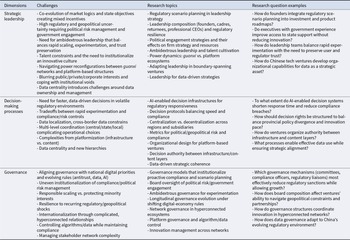
In the previous section, we outlined challenges that Chinese technology ventures may face related to strategic leadership, decision-making processes, and governance. Next, we outline various areas for future research, and highlight additional avenues for research in Table 2.
Areas for future research

Table 2 Long description
The table examines challenges, research topics, and questions across three dimensions: strategic leadership, decision-making processes, and governance in tech ventures. Strategic leadership challenges include balancing market logics with state objectives and managing talent constraints, with research focusing on regulatory resilience and ambidextrous leadership. Decision-making processes face the need for rapid, data-driven decisions amidst regulatory volatility, with research exploring AI-enabled infrastructures and decision protocols. Governance challenges involve aligning with national digital priorities and managing stakeholder complexity, with research on proactive compliance and network governance. Each dimension presents specific research questions, such as how leadership teams balance experimentation with trust preservation and how governance structures adapt to regulatory changes.
Future Research for Strategic Leadership for Chinese Technology Ventures
Future research on strategic leadership in Chinese technology ventures should address the complexities arising from the co-evolution of market logic and state objectives, high regulatory uncertainty, and the increasingly ambidextrous demands on leaders. One promising direction lies in exploring how founders and boards institutionalize regulatory scenario planning and integrate political risk management into their strategic decision-making. With leadership teams often composed of founders, cadres, returnees, and professional CEOs, studies should examine how varying backgrounds and experiences contribute to regulatory resilience, innovation, and access to crucial resources. Researchers could also investigate how leaders navigate the power reconfigurations between traditional guanxi networks and emerging platform-based ecosystems, particularly when public, private, and corporate interests blur. Examining the coping strategies leaders employ in overcoming institutional voids and adapting to boundary-spanning digital environments will further enhance our understanding. Additionally, as data becomes a core strategic asset, future research should focus on developing leadership capabilities for data-driven strategic choices – balancing data exploitation for innovation with compliance to data governance regulations.
Key questions include: How do leadership teams balance rapid experimentation and trust building? What strategies enable leaders to uphold both compliance and an entrepreneurial, innovative culture? Comparative analyses across different leadership compositions and configurations can yield insights with both theoretical and practical implications.
Future Research for Decision-Making Processes for Chinese Technology Ventures
The decision-making landscape in Chinese technology ventures is shaped by fast-changing regulatory environments, the need for rapid experimentation, and the challenges posed by data centrality and platformization. Future research should delve into the design and effectiveness of AI-enabled decision infrastructures that enhance regulatory responsiveness and compliance while maintaining strategic agility. This includes investigating protocols and processes that reconcile the need for speed and innovation with robust risk controls. A particularly important area is the structuring of decision rights, both across central, regional, and subsidiary levels, and between core infrastructure and content layers in platform-based organizations. Studies could explore what models of centralization or decentralization best support the balance between navigating local policy differences and pursuing rapid scaling. Further, as organizational hierarchies evolve, research should address how data-driven processes can be institutionalized to ensure strategic coherence without stifling experimentation.
Important questions include: How do ventures design decision-making authority for reprogrammable infrastructures? What metrics can effectively monitor political, compliance, and operational risks within these fast-moving contexts? Comparative studies of different decision models can inform best practices for optimizing speed, flexibility, and compliance.
Future Research for Governance for Chinese Technology Ventures
Governance in Chinese technology ventures faces the challenge of aligning with evolving digital and regulatory priorities, institutionalizing proactive compliance, and adapting to both domestic and global pressures. Future research should prioritize examining new governance models that embed scenario planning, political risk management, and platform scaling oversight at the board level. Investigating governance mechanisms – such as dedicated committees, compliance officers, and regulatory liaisons – can help clarify which approaches most effectively balance firm growth and regulatory risk reduction. As ventures operate within hyperconnected ecosystems, studies should further explore network and platform governance models that address the complexities of algorithmic management, data circulation, and cross-stakeholder interactions, especially in the context of geopolitical tensions. Longitudinal research is needed to track how governance practices evolve in response to recurring regulatory shocks, increased data protection requirements, and the pressures of internationalization.
Key research questions include: How does board composition impact the ability to negotiate geopolitical constraints and maintain international partnerships? What governance structures enable effective coordination of innovation processes and stakeholder engagement across hyperconnected networks? Also, how does data governance adapt to the intersection of China’s institutional and regulatory environments, in the context of geopolitical tensions? Such inquiries will contribute to deeper conceptualization and more practical frameworks for responsible, resilient, and sustainable governance.
Conclusion
In conclusion, leadership capabilities shape decision-making processes; decision-making processes reinforce governance structures; and governance structures, in turn, enable leadership development. Strategic leadership, decision-making processes, and governance therefore operate as an integrated system for Chinese technology ventures in the digital era. For example, the centrality of data as a strategic asset creates tight coupling among leadership capabilities for data strategy, analytics-based decision-making, and governance structures for data stewardship and accountability. Moreover, hyperconnectivity produces a real-time operating environment in which leadership decisions, governance responses, and decision-making processes must remain synchronized across network boundaries. Accordingly, we argue that successful Chinese technology ventures need to integrate these three dimensions and adapt them jointly to evolving technological and institutional dynamics. We therefore encourage future research to examine how strategic leadership, decision-making processes, and governance function as a coherent system in the digital era, thereby generating more comprehensive insights for both scholarship and practice.
Funding
The research is supported by the National Natural Science Foundation of China (72072038), National Natural Science Foundation of China Key Program Project (72532008), Shanghai Shuguang Project (21SG04), and Sci-Tech Innovation Foundation of School of Management, Fudan University (Key Project No. 20210103).
Tian Wei (weitian@fudan.edu.cn) is a professor and deputy department head in the School of Management, and deputy director of the Chinese MNC Research Centre at Fudan University, China. Her research interests include cross-border acquisitions, the internationalization of Chinese firms, and qualitative research methods. She has published in leading management journals, including Journal of Management Studies and British Journal of Management. She has served as a deputy editor for Management and Organization Review and as editor-in-chief of the Asian Case Research Journal.
Li-Qun Wei (weiliqun@hkbu.edu.hk) is currently professor of management at the School of Business of Hong Kong Baptist University and was the head of the department of management (2013–2014). Her research areas include strategic leadership, senior management teams, and business strategies of Chinese enterprises. She has published over 50 articles in internationally renowned management journals such as Academy of Management Journal, Journal of International Business Studies, Journal of Management Studies, Organizational Behavior and Human Decision Processes, among others. She has been an associate editor of Journal of Management Studies and co-editor-in-chief of Asia Pacific Journal of Management.
Franz Kellermanns (kellermanns@uncc.edu) is the Addison H. & Gertrude C. Reese Endowed Chair in international business and a professor of management in the Belk College of Business at the University of North Carolina–Charlotte. He holds a joint appointment with the Center for Family Business at the WHU–Otto Beisheim School of Management (Germany). He received his PhD from the University of Connecticut. He is an editor of Entrepreneurship Theory and Practice.

 Open access

