


Introduction
The visual system of vertebrates has evolved over millions of years to adapt to diverse habitats with varying spectral ranges and intensities of light. As such, many animals have developed activities that are generally restricted to particular times of the day (e.g., nocturnality, crepuscularity, or diurnality) or in response to a specific ecological niche (e.g., burrowing/fossorial or arboreal behaviors) (reviewed in Davies et al., Reference Davies, Collin and Hunt2012 and Gerkema et al., Reference Gerkema, Davies, Foster, Menaker and Hut2013). Reptiles, like many vertebrates, possess different types of retinae. Based on photoreceptor morphology, most reptilian retinas appear to be duplex (consisting of both rods and cones), but they can vary from being rod dominated to retinae that consist of pure cones (Janke & Arnason, Reference Janke and Arnason1997; Loew & Govardovskii, Reference Loew and Govardovskii2001). Generally, photoreceptor morphological diversity appears to be due to adaptive evolution of the eye to different light environments within a diverse array of habitats; however, the visual systems of reptiles (and related sister groups) are further complicated by the potential for “transmutation.”
Postulated by Walls throughout the 1930s and 1940s, the “transmutation theory” was developed to explain the rod-like morphology of cones (and vice versa) present in the retinas of many reptiles (Walls, Reference Walls1934, Reference Walls1942). Specifically, Walls argued that at some point during the evolution of early tetrapods, many ancestral forms shifted their lifestyles from nocturnality to diurnality, most likely to take advantage of the sun for warmth and increased cellular metabolism, especially since these poikilotherms were unable to regulate intrinsic body temperatures (Gerkema et al., Reference Gerkema, Davies, Foster, Menaker and Hut2013; Walls, Reference Walls1942). As such, they depended solely on photopic vision, which resulted in the partial or complete loss of rods. With the evolution of predators, such as birds and mammals, early reptilian tetrapods were forced to become nocturnal to increase their chance of survival. To be able to detect low levels of light, these species had to modify their remaining photoreceptors (i.e., cones) to functionally act as rods. As a result, morphological changes occurred such that these photoreceptors transmutated into cells that either still resembled cones (but were sensitive to low intensities of light), or in most cases became a cone–rod hybrid to maximize photon capture (Walls, Reference Walls1934, Reference Walls1942).
Snakes are generally divided into two major infraorders: Scolecophidia (blind snakes and thread snakes) and Alethinophidia (all other snakes). Alethinophidia can be further separated into two superfamilies: Henophidia, which includes boids (pythons and boas), and Caenophidia, which is far more diverse and includes vipers, elapids, and colubrids (Hsiang et al., Reference Hsiang, Field, Webster, Behlke, Davis, Racicot and Gauthier2015; Scanlon & Lee, Reference Scanlon and Lee2011). In general, scolecophidians are fossorial with reduced eyes that are covered with scales in some cases. Their visual systems have not been studied extensively; nonetheless, the few reports that are published suggest that scolecophidians have pure rod retinas (Simões et al., Reference Simões, Sampaio, Jared, Antoniazzi, Loew, Bowmaker, Rodriguez, Hart, Hunt, Partridge and Gower2015). Henophidia includes many nonvenomous, crepuscular/nocturnal, and/or burrowing snakes (Collins & Conant, Reference CollinS and Conant1998) and is considered the more primitive superfamily of the infraorder Alethinophidia thus, it is believed that the visual system of boids and pythons is ancestral to that of the more evolutionary advanced caenophidians (Crescitelli, Reference Crescitelli and DARTNALL1972). Henophidians are primarily nocturnal, but can be active during the day, and therefore have duplex retinas that are rod dominant (90% rods vs. 10% cones). Caenophidia is a much more diverse group and includes various diurnal and nocturnal snakes; therefore, it is thought that the retinal composition of these species should be greatly variable in response to the their different visual requirements; for example, diurnal colubrids have pure-cone retinas compared to rod-based vision in some nocturnal species such as vipers (Hauzman et al., Reference Hauzman, Bonci, Grotzner, Mela, Liber, Martins and Ventura2014).
Most reptiles possess five types of opsin-based photopigments (where the opsin protein is linked to a photosensitive chromophore) that are housed within each retinal photoreceptor: rod opsin (rhodopsin-like-1, RH1) is exclusively expressed in rods, with four different cone opsin classes (Bowmaker, Reference Bowmaker2008; Davies et al., Reference Davies, Collin and Hunt2012; Davies et al., Reference Davies, Cowing, Bowmaker, Carvalho, Gower and Hunt2009b; Yokoyama, Reference Yokoyama2000). The cone photopigments discretely comprised of short-wavelength-sensitive-1 (SWS1), short-wavelength-sensitive-2 (SWS2), rhodopsin-like-2 (RH2), or long-wavelength-sensitive (LWS) opsin proteins. Unlike in other reptiles, the few studies conducted on snake vision suggest that scolecophidians only express the RH1 gene (Simões et al., Reference Simões, Sampaio, Jared, Antoniazzi, Loew, Bowmaker, Rodriguez, Hart, Hunt, Partridge and Gower2015), whereas more advanced snakes possess SWS1, LWS, and RH1 opsins genes (Davies et al., Reference Davies, Cowing, Bowmaker, Carvalho, Gower and Hunt2009b; Emerling, Reference Emerling2017; Schott et al., Reference Schott, Muller, Yang, Bhattacharyya, Chan, Xu, Morrow, Ghenu, Loew, Tropepe and Chang2016; Simões et al., Reference Simões, Sampaio, Douglas, Kodandaramaiah, Casewell, Harrison, Hart, Partridge, Hunt and Gower2016a; Simões et al., 2016b).
The aim of this study is to expand knowledge of the visual system of snakes by investigating the complement of visual pigments expressed in the retina of Bothrops atrox (the common lancehead) and predict their wavelength of maximum absorbance (λ max). In particular, this species was chosen as B. atrox is a nocturnal, terrestrial viper (Viperidae) that is widely distributed in Central and South America, is known to climb trees in search of prey, and is an adept swimmer (Stocker & Barlow, Reference Stocker and Barlow1976). More specifically, the common lancehead inhabits a variety of different habitats, including low montane humid forests, savannas, and rainforests. Indeed, this species is generally associated with the presence of water, with a preference for humid environments near streams, lakes, or wetlands (Campbell & Lamar, Reference Campbell and Lamar2004; Oliveira & Martins, Reference Oliveira and Martins2001), and plays an important ecological role in tropical rainforests. Notably, it is one of the most poisonous snakes of the Amazon region, causing considerable human mortality and morbidity (Oliveira & Martins, Reference Oliveira and Martins2001). B. atrox is a predatory snake which hunts and mates at night, where only moonlight and/or starlight is present. However, light is further restricted in a tropical forest habitat given the dense foliage present; as such, the common lancehead needs to maximize photon capture in these very dim-light environments (Cummings & Partridge, Reference Cummings and Partridge2001; Lythgoe, Reference Lythgoe1984; Partridge & Cummings, Reference Partridge, Cummings, Archer, Djamgoz, Loew, Partridge and Vallerga1999).
The results of this study showed that the common lancehead expresses three photopigment genes that were phylogenetically determined to be LWS, SWS1, and RH1. In addition, spectra were predicted from the complement of known tuning sites, which showed that this species is sensitive to wavelengths that range from the ultraviolet (UV) to the long-wavelength end of the visible spectrum, and that functionally resembles the more ancient “lower order” henophidian snakes than the “higher order” caenophidians, of which B. atrox is a member. Given that B. atrox is nocturnal and dwells in tropical rainforests, where light is extremely restricted, it was expected that only rods expressing RH1 would be identified. As such, the presence of cone photopigments is biologically intriguing. The study of the visual system of this nocturnal South American snake is important as it is the first viper from the region to be investigated, as well as being one of the first to research vision of any vertebrate in Ecuador.
Materials and methods
Animals and collection of samples
An adult South American Bothrops atrox (common lancehead) snake (Fig. 1) was collected from the Zamora-Chinchipe Province, Ecuador. Since B. atrox is a relatively difficult serpent to find and collect, due to various reasons such as its activity patterns, its aggressive behavior, as well its highly cryptic color pattern, only the eyes from one specimen, which was donated to perform this study, were used. This specimen was donated by and is registered in the Herpetology Museum of Pontificia Universidad Católica del Ecuador with an ID of QCAZ 13857. The snake was euthanized using 2% lidocaine before enucleation, following the protocol of Simmons and Muñoz-Saba (Reference Simmons and Muñoz-Saba2005). After the eye was removed, the posterior eye cup was separated from the rest of ocular tissues. Dissected tissues were immersed briefly in liquid nitrogen for rapid freezing and transferred to −80°C for long-term storage.
Photographs of B. atrox, showing (A) the entire snake, with its large eye and yellow tail tip for luring prey, (B) the head and (C) a close-up of the external surface of the eye with its vertical, elliptical pupil, a feature that is common in venomous species. Photographs are taken from the BioWeb Ecuador information portal (https://bioweb.bio/portal/QCAZ/Especimen/57289), via ID of QCAZ 13857, with permission granted courtesy of Diego Quirola (A) and Juan Carlos Sanchez (B and C).

RNA extraction
The TRIzol Plus RNA purification system (Invitrogen, Carlsbad, CA) was used for RNA extraction, using the manufacturer’s instructions. Briefly, 1 ml of TRIzol was added to frozen retinal samples and homogenized using a pestle. The samples were centrifuged at 13,000 rpm for 10 min at 4°C to separate the supernatant, which contained the RNA, from the rest of the tissue debris. The supernatant was left briefly at room temperature (RT) before adding 0.2 ml of chloroform, shaking vigorously and incubating at RT for an additional 2–3 min. Samples were centrifuged again at 13,000 rpm for 15 min at 4°C, before adding an equal volume of 70% ethanol to the aqueous phase. This mixture was then transferred to a silica column and centrifuged to bind the RNA to the membrane. The RNA was washed, treated with DNase (to remove genomic DNA and assure that any resulting amplifications are the product of solely transcript sequences) and eluted in 50 µl of nuclease-free water. The RNA yield and quality were analyzed using a Nanodrop 1000™ UV-Vis spectrophotometer (Thermo Fisher Scientific, Waltham, MA), aliquoted into 1–2 µg fractions and stored at −80°C.
Complementary DNA (cDNA) synthesis
For cDNA synthesis, the GoScript system (Promega, Madison, WI) was used, following the manufacturer’s instructions. Briefly, 1–2 µg of total RNA was reverse-transcribed using an anchored oligo-dT primer, Oligo-dT-ANC (Supplementary materials, Table 1), which also contained a specific 5′-end sequence that was utilized during the subsequent rapid amplification of cDNA ends (RACE) experiments. After each reverse transcription reaction, the reverse transcriptase enzyme was heat-inactivated and the template RNA removed by the addition of RNase H (Promega, Madison, WI). The resulting cDNA was purified using a QIAquick PCR Purification Kit (Qiagen, Germantown, MD) and eluted in 50 µl of nuclease-free water.
Experimentally determined and mean spectral peaks of absorbance for SWS1, LWS, and RH1 photopigments expressed in the retinae of the royal python (Python regius), the sunbeam snake (Xenopeltis unicolor), the garter snake (Thamnophis proximus), as calculated by microspectrophotometry (MSP) and UV-Vis spectrophotometric regeneration (Regen.), and those predicted for B. atrox (the common lancehead)

a Sillman et al. (Reference Sillman, Carver and Loew1999).
b Davies et al. (Reference Davies, Cowing, Bowmaker, Carvalho, Gower and Hunt2009b).
c This work.
d Sillman et al. (Reference Sillman, Govardovskii, Rohlich, Southard and Loew1997).
e Schott et al. (Reference Schott, Muller, Yang, Bhattacharyya, Chan, Xu, Morrow, Ghenu, Loew, Tropepe and Chang2016).
n/a = not available.
Polymerase chain reaction (PCR) amplification and RACE
Visual opsin coding sequences were amplified using GoTaq Flexi DNA polymerase (Promega, Madison, WI) in various nested reverse transcription PCR (RT-PCR) experiments, where both degenerate and gene-specific primers were used. The degenerate primers were designed based on known sequences of previously identified opsins (Davies et al., Reference Davies, Cowing, Bowmaker, Carvalho, Gower and Hunt2009b) to amplify the sequence of three visual opsin gene classes that are known to be expressed in snakes, namely SWS1 and LWS (both expressed in cones), and rod opsin (RH1; usually expressed in rods). Similar experiments to PCR-amplify SWS2 and RH2 (both expressed in cones), if present in B. atrox, were also conducted since these photopigments are also expressed in the retinae of reptiles. All primers were initially designed to cross multiple exon–intron boundaries so that any resulting amplification is solely the product of cDNA, thus excluding the chance of genomic DNA (gDNA) as a potential source of contamination. For the first and second rounds of PCR, the following conditions were used to amplify a core region of each opsin sequence: 94°C for 10 min (denaturation); 40 cycles at 94°C for 30 s, 45–55°C for 1 min, and 72°C for 1.5 min (amplification and extension); and a final extension at 72°C for 10 min. The nesting procedures used followed the approach outlined by Davies et al. (Reference Davies, Cowing, Bowmaker, Carvalho, Gower and Hunt2009b). After the initial amplifications, RACE and gene-specific primers were used to determine the 5′- and 3′-ends of each opsin sequence (Davies et al., Reference Davies, Vandenberg, Sayeed and Trezise2004a,Reference Davies, Vandenberg, Sayeed and Treziseb; Schramm et al., Reference Schramm, Bruchhaus and Roeder2000). To obtain the 3′-end, oligo-dT primed cDNA was used in nested PCR amplification experiments in conjunction with gene-specific forward primers and 3′-RACE-OUT-R (i.e., OUTER) and 3′-RACE-IN-R (i.e., INNER) reverse primers (see Supplementary materials, Table 1 for details) (Davies et al., Reference Davies, Collin and Hunt2009a,Reference Davies, Cowing, Bowmaker, Carvalho, Gower and Huntb). By contrast, to amplify the 5′-end of each opsin mRNA sequence, terminal deoxynucleotidyl transferase (TdT) was used to add a poly-C tail to the 5′end of the cDNA template. For each subsequent nested amplification, an anchor primer, 5′-RACE-ANC-F, which annealed to the poly-C tail, and a gene-specific reverse primer were used (Supplementary materials, Table 1) (Davies et al., Reference Davies, Vandenberg, Sayeed and Trezise2004a,Reference Davies, Vandenberg, Sayeed and Treziseb). RACE PCR cycling conditions were identical to those used during the RT-PCR experiments. In all cases, amplicons of the correct size were excised from 1.2% agarose gels, purified using a QIAquick Gel Extraction Kit (Qiagen, Germantown, MD) following the manufacturer’s protocol, and sequenced directly (Macrogen, Seoul, Republic of Korea).
Molecular phylogenetic analysis
A codon-matched nucleotide sequence alignment of 77 gnathostome (jawed vertebrate) opsin coding regions, ranging from teleosts to mammals, was generated by ClustalW (Higgins et al., Reference Higgins, Thompson and Gibson1996) and manually manipulated to refine the accuracy of cross-species comparison. Specifically, the alignment incorporated the opsin sequences of B. atrox (the common lancehead) (accession numbers MH244490-MH244492) compared with those expressed in the retinae of the royal python (Python regius) (Davies et al., Reference Davies, Cowing, Bowmaker, Carvalho, Gower and Hunt2009b), the sunbeam snake (Xenopeltis unicolor) (Davies et al., Reference Davies, Cowing, Bowmaker, Carvalho, Gower and Hunt2009b), and the garter snake (Thamnophis proximus) (Schott et al., Reference Schott, Muller, Yang, Bhattacharyya, Chan, Xu, Morrow, Ghenu, Loew, Tropepe and Chang2016). All five opsin classes were included, with vertebrate ancient (VA) opsin sequences (Davies et al., Reference Davies, Hankins and Foster2010) used collectively as an outgroup given that this opsin type is a sister clade to all five visual photopigment classes. Phylogenetic analysis of 1000 replicates was conducted in MEGA6 (Tamura et al., Reference Tamura, Stecher, Peterson, Filipski and Kumar2013), with evolutionary history being inferred by using the maximum likelihood method based on the Tamura-Nei model (Tamura & Nei, Reference Tamura and Nei1993), resulting in a tree with a highest log likelihood of −39862.9953. The percentage of trees (>50%) in which the associated taxa clustered together is shown next to the branches. Initial trees for the heuristic search were obtained by applying the neighbor-joining method (Saitou & Nei, Reference Saitou and Nei1987) to a matrix of pairwise distances estimated using the maximum composite likelihood (MCL) approach (Tamura & Nei, Reference Tamura and Nei1993), with a homogenous pattern of nucleotide substitution among lineages, uniform rates, and bootstrapping with 1000 replicates. The tree was drawn to scale, with branch lengths measured in the number of substitutions per site. A total of 918 positions were present in the final dataset, with all positions with less than 95% site coverage being eliminated. That is, fewer than 5% alignment gaps, missing data, and ambiguous bases were allowed at any position.
Spectral analyses
There are >40 known amino acid tuning sites that alter the spectral peak of absorbance (λ max) of the five classes of opsin-based photopigments in vertebrates. As only LWS, SWS1, and RH1 opsin-based photopigment classes are relevant to snakes in this case, SWS2 and RH2 spectral tuning will not be discussed. Using conventional numbering based on the bovine rod opsin protein sequence (accession number NP001014890), a number of studies have determined that the following 27 amino acid sites are important for the spectral tuning of RH1 photopigments: 83, 90, 96, 102, 113, 118, 122, 124, 132, 164, 183, 194, 195, 207, 208, 211, 214, 253, 261, 265, 269, 289, 292, 295, 299, 300, and 317 (Chan et al., Reference Chan, Lee and Sakmar1992; Davies et al., Reference Davies, Collin and Hunt2012; Davies et al., Reference Davies, Cowing, Carvalho, Potter, Trezise, Hunt and Collin2007; Hope et al., Reference Hope, Partridge, Dulai and Hunt1997; Hunt et al., Reference Hunt, Dulai, Partridge, Cottrill and Bowmaker2001; Janz & Farrens, Reference Janz and Farrens2001; Sakmar et al., Reference Sakmar, Franke and Khorana1991; Yokoyama, Reference Yokoyama2000; Yokoyama, Reference Yokoyama2008; Yokoyama et al., Reference Yokoyama, Zhang, Radlwimmer and Blow1999; Yokoyama et al., Reference Yokoyama, Tada, Zhang and Britt2008; Yokoyama et al., Reference Yokoyama, Tada and Yamato2007). Similar studies, when applied to other photopigment classes, have determined that site 86 is critical for generating UV-sensitive (UVS) SWS1 pigments (Cowing et al., Reference Cowing, Poopalasundaram, Wilkie, Robinson, Bowmaker and Hunt2002), whereas five sites (namely 164, 181, 261, 269, and 292) are important for determining the λ max values of LWS photopigments (Davies et al., Reference Davies, Collin and Hunt2012; Yokoyama, Reference Yokoyama2000). Inspection of these sites was used to estimate the λ max value for the three photopigments, LWS, SWS1, and RH1, expressed in the eye of the common lancehead. The overall spectral effects of these sites and their relevance to snake vision are presented in the Results and Discussion sections below. Dark spectra for visual photopigments identified in B. atrox (common lancehead), P. regius (royal python), X. unicolor (sunbeam snake), and T. proximus (garter snake) (Davies et al., 2009b; Schott et al., Reference Schott, Muller, Yang, Bhattacharyya, Chan, Xu, Morrow, Ghenu, Loew, Tropepe and Chang2016) were generated using a standard A1-based rhodopsin template (Govardovskii et al., Reference Govardovskii, Fyhrquist, Reuter, Kuzmin and Donner2000).
Results
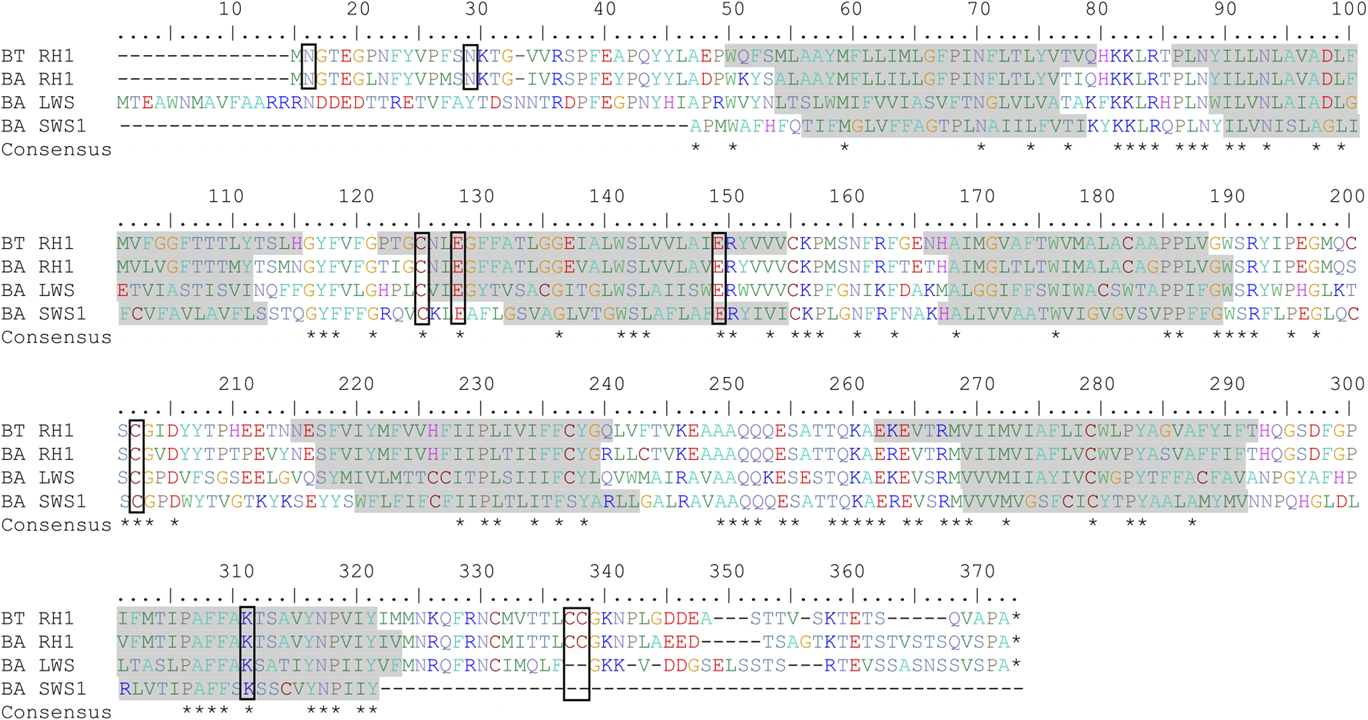
Using cDNA generated from freshly extracted B. atrox retinal RNA, the coding sequences for three visual opsin genes were successfully amplified, namely SWS1, LWS, and RH1. Despite numerous attempts, using both degenerate and reptile-specific primers (Davies et al., Reference Davies, Cowing, Bowmaker, Carvalho, Gower and Hunt2009b), RH2 and SWS2 sequences were not amplified, thus suggesting that these two opsins are not found in this snake species. Through a combination of RT-PCR, and 5′- and 3′-RACE, full-length coding sequences were obtained for RH1 (1059 bp) and LWS (1098 bp) opsin genes, whereas amplification of the SWS1 opsin gene yielded a partial sequence of 826 nucleotides. On closer inspection of a codon-match alignment, each sequence was observed to contain no indels (Fig. 2). Furthermore, the genes and their resultant photopigments were deemed to be functional based on intact sequence fidelity; expression in the retina of B. atrox; high nucleotide and amino acid sequence identity to other snake opsin sequences; and the presence of key structural and functional features, including the seven transmembrane domains that define the G protein-coupled receptor (GPCR) superfamily and the chromophore binding site at Lys296 (Dratz & Hargrave, Reference Dratz and Hargrave1983) (Figs. 2 and S1–S3).
A codon-matched alignment of the amino acid sequences of RH1, LWS, and SWS1 expressed in the retina of B. atrox. Bos taurus (BT) rod opsin (RH1) is used as a reference. Each residue is color-coded based on their biochemical properties (e.g., charged vs. hydrophobic), with asterisks denoting identical consensus residues between all snake opsin sequences and bovine RH1. Dashes represent gaps that were inserted to maintain a high degree of sequence identity present between the different opsins classes. The transmembrane domains (TMDs) shown for bovine rod opsin were determined by crystallography (Palczewski et al., Reference Palczewski, Kumasaka, Hori, Behnke, Motoshima, Fox, Le Trong, Teller, Okada, Stenkamp, Yamamoto and Miyano2000), with the seven putative TMDs for each snake photopigment being determined online using TMHMM Server Version 2.0 (http://www.cbs.dtu.dk/services/TMHMM/). In all cases, TMDs are indicated by gray shading. Residues known to be critical for both the correct opsin protein tertiary structure and biochemical function are boxed: comparison with other photopigment sequences confirm that these sites are conserved in all three visual pigments that derive from B. atrox. Using the conventional numbering system of the bovine rod opsin sequence, these key sites include (1) two conserved cysteine (C) residues at positions 110 (TMD3) and 187 (ECD2) that are involved in disulfide bond formation (Karnik et al., Reference Karnik, Sakmar, Chen and Khorana1988); (2) a conserved glutamate (E) at position 113 (TMD3) that provides the negative counterion to the proton of the Schiff base (Sakmar et al., Reference Sakmar, Franke and Khorana1989); (3) a conserved glutamate (E) at position 134 (TM3) that provides a negative charge to stabilize the inactive opsin molecule (Cohen et al., Reference Cohen, Oprian and Robinson1992); (4) a conserved lysine (K) at position 296 (TM7) that is covalently linked to the chromophore via a Schiff base (Dratz & Hargrave, Reference Dratz and Hargrave1983); (5) conservation of two cysteine (C) residues at putative palmitoylation positions 322 and 323 (Ovchinnikov et al., Reference Ovchinnikov, Abdulaev and Bogachuk1988) in the RH1 photopigment of B. atrox, but not LWS (please note that putative palmitoylation sites for SWS1 could not be determined); (6) the presence of a number of Ser (S) and Thr (T) residues in the carboxy terminus, which are potential targets for phosphorylation by rhodopsin kinases in the deactivation of metarhodopsin II (Palczewski et al., Reference Palczewski, Buczylko, Lebioda, Crabb and Polans1993; Zhao et al., Reference Zhao, Haeseleer, Fariss, Huang, Baehr, Milam and Palczewski1997) (putative phosphorylation sites for SWS1 could not be determined); and (7) the conserved glycosylation sites at positions 2 and 15 (Kaushal et al., Reference Kaushal, Ridge and Khorana1994) in the RH1 opsin identified in the retina of the lancehead. Amino acids important for the spectral tuning of LWS, SWS1, and RH1 visual pigments are indicated in Figs. S1–S3.
Phylogenetic analysis was performed using a maximum likelihood approach on a codon-matched nucleotide sequence alignment, which comprised the three common lancehead opsin sequences (accession numbers MH244490-MH244492) compared with the coding regions of 77 gnathostome sequences from all five opsin classes, namely LWS, SWS1, SWS2, RH2, and LWS. The neighbor-joining phylogenetic tree shown in Fig. 3 clearly indicated that each B. atrox opsin sequence clades within the orthologous pigment gene classes of LWS, SWS1, and RH1, which were accompanied by high bootstrap values at each node. In particular, the opsins expressed in the retina of B. atrox were robustly clustered together with other snake sequences used in the analysis, namely the royal python (Python regius) (Davies et al., Reference Davies, Cowing, Bowmaker, Carvalho, Gower and Hunt2009b), the sunbeam snake (Xenopeltis unicolor) (Davies et al., Reference Davies, Cowing, Bowmaker, Carvalho, Gower and Hunt2009b), and the garter snake (Thamnophis proximus) (Schott et al., Reference Schott, Muller, Yang, Bhattacharyya, Chan, Xu, Morrow, Ghenu, Loew, Tropepe and Chang2016). In all cases, the common lancehead opsins were more closely related to the garter snake than the two “lower order” henophidians, thus reflecting the shared evolutionary history between “higher order” snake species within Alethinophidia.
Phylogenetic analysis of nucleotide sequences derived from B. atrox (the common lancehead; accession numbers MH244490-MH244492) LWS, SWS1, and RH1 opsin genes, compared with those determined for the royal python (Python regius) (Davies et al., 2009), the sunbeam snake (Xenopeltis unicolor) (Davies et al., 2009), and the garter snake (Thamnophis proximus) (Schott et al., Reference Schott, Muller, Yang, Bhattacharyya, Chan, Xu, Morrow, Ghenu, Loew, Tropepe and Chang2016). These snake sequences were compared to other vertebrate visual pigment coding sequences for all five visual opsin classes, namely LWS, SWS1, SWS2, RH2, and RH1. All sequences were used to generate a codon-matched alignment with vertebrate ancient (VA) opsin sequences (Davies et al., Reference Davies, Hankins and Foster2010) used collectively as an outgroup given that this opsin type is a sister clade to all five visual photopigment classes. Posterior probability values (represented as a percentage, where only those greater than 50% are shown) are indicated for each resolved node. The scale bar indicates the number of nucleotide substitutions per site within each branch length. The sequences used for generating the tree are as follows: (1) RH1 opsin class: human (Homo sapiens), NM000539; mouse (Mus musculus), NM145383; fat-tailed dunnart (Sminthopsis crassicaudata), AY159786; platypus (Ornithorhynchus anatinus), EF050076; chicken (Gallus gallus), NM205490; pigeon (Columba livia), AH007730; green anole (Anolis carolinensis), AOIRHODOPS; sunbeam snake (Xenopeltis unicolor), FJ497233; python (Python regius), FJ497236; garter snake (Thamnophis proximus), KU306726; common lancehead (Bothrops atrox), MH244492; African clawed frog (Xenopus laevis), NM001087048; Comoran coelacanth (Latimeria chalumnae), AF131253; Australian lungfish (Neoceratodus forsteri), EF526295; goldfish (Carassius auratus), L11863; zebrafish (Danio rerio), NM131084 (RH1.1); (2) RH2 opsin class: chicken (Gallus gallus), NM205490; pigeon (Columba livia), AH007731; green anole (Anolis carolinensis), AH004781; Comoran coelacanth (Latimeria chalumnae), AF131258; Australian lungfish (Neoceratodus forsteri), EF526296; goldfish (Carassius auratus), L11865; zebrafish (Danio rerio), NM131253 (RH2.1); (3) SWS2 opsin class; platypus (Ornithorhynchus anatinus), EF050077; chicken (Gallus gallus), NM205517; pigeon (Columba livia), AH007799; green anole (Anolis carolinensis), AF133907; African clawed frog (Xenopus laevis), BC080123; Australian lungfish (Neoceratodus forsteri), EF526299; goldfish (Carassius auratus), L11864; zebrafish (Danio rerio), NM131192; (4) SWS1 opsin class: human (Homo sapiens), NM001708; mouse (Mus musculus), NM007538; fat-tailed dunnart (Sminthopsis crassicaudata), AY442173; tammar wallaby (Macropus eugenii), AY286017; chicken (Gallus gallus), NM205438; pigeon (Columba livia), AH007798; green anole (Anolis carolinensis), AH007736; sunbeam snake (Xenopeltis unicolor), FJ497234; python (Python regius), FJ497237; garter snake (Thamnophis proximus), KU306728; common lancehead (Bothrops atrox), MH244491; African clawed frog (Xenopus laevis), XLU23463; Australian lungfish (Neoceratodus forsteri), EF526298; goldfish (Carassius auratus), D85863; zebrafish (Danio rerio), NM131319; (5) LWS opsin class: human (Homo sapiens), NM020061; mouse (Mus musculus), NM008106; fat-tailed dunnart (Sminthopsis crassicaudata), AY430816; tammar wallaby (Macropus eugenii), AY286018; platypus (Ornithorhynchus anatinus), EF050078; chicken (Gallus gallus), NM205440; pigeon (Columba livia), AH007800; green anole (Anolis carolinensis), ACU08131; sunbeam snake (Xenopeltis unicolor), FJ497235; python (Python regius), FJ497238; garter snake (Thamnophis proximus), KU306727; common lancehead (Bothrops atrox), MH244490; African clawed frog (Xenopus laevis), XLU90895; Australian lungfish (Neoceratodus forsteri), EF526297; goldfish (Carassius auratus), L11867; zebrafish (Danio rerio), NM131175; and (6) VA opsin: chicken (Gallus gallus), GQ280390; green anole (Anolis carolinensis), LOC100552581; African clawed frog (Xenopus laevis), EU860403; zebrafish (Danio rerio), AB035276 (VA1); carp (Cyprinus carpio), AF233520; goldfish (Carassius auratus), AB383149; roach (Rutilus rutilus), AY116411; catfish (Ictalurus punctatus), FJ839436; cichlid (Astatotilapia burtoni), EU523854; medaka (Oryzias latipes), AB3831481; smelt (Plecoglossus altivelis), AB074483, salmon (Salmo salar), AF001499.

To predict RH1 spectral tuning, 27 known tuning sites were compared between the predicted B. atrox and bovine rod opsin protein sequences, namely amino acids 83, 90, 96, 102, 113, 118, 122, 124, 132, 164, 183, 194, 195, 207, 208, 211, 214, 253, 261, 265, 269, 289, 292, 295, 299, 300, and 317 (Chan et al., Reference Chan, Lee and Sakmar1992; Davies et al., Reference Davies, Collin and Hunt2012; Davies et al., Reference Davies, Cowing, Carvalho, Potter, Trezise, Hunt and Collin2007; Hope et al., Reference Hope, Partridge, Dulai and Hunt1997; Hunt et al., Reference Hunt, Dulai, Partridge, Cottrill and Bowmaker2001; Janz & Farrens, Reference Janz and Farrens2001; Sakmar et al., Reference Sakmar, Franke and Khorana1991; Yokoyama, Reference Yokoyama2000, Reference Yokoyama2008; Yokoyama et al., Reference Yokoyama, Tada and Yamato2007; Yokoyama et al., Reference Yokoyama, Tada, Zhang and Britt2008; Yokoyama et al., Reference Yokoyama, Zhang, Radlwimmer and Blow1999). With a complement of Asp-Gly-Tyr-Tyr-Glu-Thr-Glu-Ala-Ala-Ala-Met-Pro-Thr-Met-Phe-His-Ile-Met-Phe-Trp-Ala-Thr-Ala-Ala-Ala-Val-Met at these sites in the common lancehead RH1 sequence, only one site differs from bovine RH1, namely Thr195 (highlighted in bold). A residue at 195 does not shift the λ max value of RH1 photopigments when Asn or His (at 195) is present (Yokoyama et al., Reference Yokoyama, Tada, Zhang and Britt2008). In this case, the amino acid present is Thr; however, the synergistic spectral tuning effect of site 195 is only exhibited when Ser (and not Ala) is present at site 292 (Yokoyama et al., Reference Yokoyama, Yang and Starmer2008). For B. atrox, Ala is found at site 292 (underlined), so Thr195 will not affect spectral tuning; as such, the predicted λ max value for the RH1 photopigment in the common lancehead is 500 nm (i.e., identical to the bovine rod photopigment (Hubbard, Reference Hubbard1969) (Fig. 4).
Unbleached (dark) absorbance spectra (Govardovskii et al., Reference Govardovskii, Fyhrquist, Reuter, Kuzmin and Donner2000) for SWS1, RH1, and LWS visual photopigments expressed in the retinae of representative snakes. Upper panel: The garter snake (Thamnophis proximus) (red), the python (Python regius) (green), and the sunbeam snake (Xenopeltis unicolor) (blue), where average λ max values are shown based on microspectrophotometry (MSP) and UV-Vis spectrophotometric regeneration experiments (see Fig. 4 for calculated values). Lower panel: The predicted λ max values calculated from the complement of tuning sites present in the protein sequences of the common lancehead (Bothrops atrox) SWS1, RH1, and LWS opsins (black). The gray dotted line represents the B. atrox photopigment spectral peaks extending upwards for direct comparison with the other three snake species indicated in the upper panel.

For SWS1 and LWS photopigments, predictions of the spectral peaks of absorbance are far less complicated than that of RH1 photopigments. For example, the presence of Phe86 in the predicted sequence for the SWS1 photopigment of B. atrox means that it will be UVS, with a λ max value at 360 nm (Cowing et al., Reference Cowing, Poopalasundaram, Wilkie, Robinson, Bowmaker and Hunt2002) (Fig. 4). For LWS photopigments, a complement of Ala164-His181-Tyr261-Thr269-Ala292 in B. atrox only differs from the typical vertebrate complement of Ser164-His181-Tyr261-Thr269-Ala292 at one site. As such, the presence of a Ser164Ala substitution (highlighted in bold) in the predicted LWS sequence of the common lancehead will shift the λ max value from 560 nm (Davies et al., Reference Davies, Collin and Hunt2012; Yokoyama, Reference Yokoyama2000) by 7 nm (Davies et al., Reference Davies, Collin and Hunt2012; Yokoyama, Reference Yokoyama2000; Yokoyama, Yang, & Starmer, 2008) to 553 nm (Fig. 4). In summary, the λ max values for the three functional photopigments expressed in the retina of B. atrox are predicted to be 360 nm, 500 nm, and 553 nm for SWS1, RH1, and LWS opsin proteins, respectively (Fig. 4).
Discussion
In this study, three photopigment genes were identified as being expressed in the retina of Bothrops atrox, namely SWS1 (cone), LWS (cone), and RH1 (rod). By contrast, the other two opsin classes, namely SWS2 and RH2, which are expressed in many other reptiles, but have never been identified in snakes, were not identified. This is consistent with the likely loss of these genes in the ancestor to all snakes, including their omission from two sequenced snake genomes (Castoe et al., Reference Castoe, Jason de Koning, Hall, Card, Schield, Fujita, Ruggiero, Degner, Daza, Gu, Reyes-Velasco, Shaney, Castoe, Fox, Poole, Polanco, Dobry, Vandewege, Li, Schott, Kapusta, Minx, Feschotte, Uetz, Ray, Hoffmann, Bogden, Smith, Chang, Vonk, Casewell, Henkel, Richardson, Mackessy, Bronikowski, Yandell, Warren, Secor and Pollock2013; Simões et al., Reference Simões, Sampaio, Jared, Antoniazzi, Loew, Bowmaker, Rodriguez, Hart, Hunt, Partridge and Gower2015; Simões & Gower, Reference Simões and Gower2017; Vonk et al., Reference Vonk, Casewell, Henkel, Heimberg, Jansen, McCleary, Kerkkamp, Vos, Guerreiro, Calvete, Wüster, Woods, Logan, Harrison, Castoe, Jason de Koning, Pollock, Yandell, Calderon, Renjifo, Currier, Salgado, Pla, Sanz, Hyder, Ribeiro, Arntzen, van den Thillart, Boetzer, Pirovano, Dirks, Spaink, Duboule, McGlinn, Kini and Richardsont2013). This is an identical complement of opsin genes to both “lower order” (i.e., more ancestral) and “higher order” snakes, except for the burrowing blind snakes of the Order Scolecophidia, where only RH1 is present (Davies et al., Reference Davies, Cowing, Bowmaker, Carvalho, Gower and Hunt2009b; Simões et al., Reference Simões, Sampaio, Jared, Antoniazzi, Loew, Bowmaker, Rodriguez, Hart, Hunt, Partridge and Gower2015). The absence of expression of these opsins is believed to be the result of the nocturnal and fossorial nature of many snakes, and presumably of the ancestral snake as well (Davies et al., Reference Davies, Cowing, Bowmaker, Carvalho, Gower and Hunt2009b). However, as the complement of pigment genes is the same as many mammals (excluding monotremes and some trichromatic primates), it is possible that ancestral snakes were subjected to a “mesopic bottleneck” instead of a restricted nocturnal phase, where it may be predicted that all cones would be lost; this hypothesis was first proposed to explain the pigment complement in the mammalian lineage (Davies et al., Reference Davies, Collin and Hunt2012), but is also relevant to snake evolution (Davies et al., Reference Davies, Collin and Hunt2012; Davies et al., Reference Davies, Cowing, Bowmaker, Carvalho, Gower and Hunt2009b). In this investigation, visual opsin genes were identified from the first ever South American viper, where the resultant predicted protein sequences were used to calculate the spectral peaks of absorbance (i.e., the λ max values) for B. atrox.
B. atrox is a nocturnal predatory snake found in tropical forest grounds, where even moonlight and/or starlight is restricted by the dense forest foliage. The exact retinal morphology and rod-to-cone ratio are unknown in the B. atrox retina; as with many nocturnal animals, and given the common lancehead’s predatory behavior, the visual system of B. atrox may be under strong selective pressures to maximize photon absorption in dim-light environments (Cummings & Partridge, Reference Cummings and Partridge2001; Lythgoe, Reference Lythgoe1984; Partridge & Cummings, Reference Partridge, Cummings, Archer, Djamgoz, Loew, Partridge and Vallerga1999). Individuals belonging to this species need to move, hunt, and mate in nocturnal conditions (with restricted moonlight and/or starlight), which could explain their need for a more rod-rich retina and the presence of only a small population of cones.
Even under different nocturnal light environments, large differences may exist in terms of opened or closed canopies, foliage density, lunar phases, cloud cover, etc. These differences could greatly modify the amount of light available (Lythgoe, Reference Lythgoe and DARTNALL1972; Munz & McFarland, Reference Munz and McFarland1973; Pariente, Reference Pariente, Charles-Dominique, Cooper and Hladik1980). Vipers such as the African viper Echis ocellatus and South American common lancehead B. atrox inhabit rainforest grounds, where light can be extremely limited because of the dense foliage. This is likely to change the selective pressures acting upon the visual system of these snakes compared with other animals, especially those that inhabit more open environments with less foliage, for example grasslands and savannas where the African vipers Causus rhombeatus and Bitis nasicornis are found. Rainforests are also richer in longer wavelengths (i.e., red-shifted) than dry forest and grasslands (Veilleux & Cummings, Reference Veilleux and Cummings2012), which could be another reason why B. atrox and E. ocellatus visual photopigments are predicted to be more long-wavelength-shifted in comparison with those of other snakes (Simões et al., Reference Simões, Sampaio, Douglas, Kodandaramaiah, Casewell, Harrison, Hart, Partridge, Hunt and Gower2016a).
In this study, the spectral peaks for B. atrox photopigments were calculated to be 360 nm, 500 nm, and 553 nm for SWS1, RH1, and LWS, respectively. Unlike SWS2 and RH2, which require extensive in vitro regeneration of pigments and the spectral shifts associated with mutant opsins constructed via site-directed mutagenesis (Bowmaker, Reference Bowmaker2008; Davies et al., Reference Davies, Collin and Hunt2012; Yokoyama, Reference Yokoyama2000), these three photopigments are so well studied that it is possible to predict their λ max values solely from their protein sequence, without the need for further in vitro regeneration of MSP experiments.
Comparison with henophidian snakes (e.g., the sunbeam snake and the python) shows similarity in their spectral absorbance maxima [i.e., on average 361 nm (SWS1), 496 nm (Rh1), and 554 nm (LWS)]. By contrast, the garter snake possesses cone photopigments with λ max values that are shifted at either end of the light spectrum [i.e., 365 nm for SWS1 (i.e., +5 nm) and 544 nm for LWS (i.e., −10 nm)], thus decreasing the range of wavelengths being detected. As such, the photopigments of B. atrox do not resemble other phylogenetically relevant “higher order” snakes, but are similar to “lower order” species from a spectral perspective. This suggests that the visual system of B. atrox has adapted to a particular habitat and not a phylogenetic remnant, since B. atrox and “lower order” snakes generally live in dim-light or scotopic environments resembling other nocturnal vertebrates (Simões et al., Reference Simões, Sampaio, Douglas, Kodandaramaiah, Casewell, Harrison, Hart, Partridge, Hunt and Gower2016a; Veilleux & Cummings, Reference Veilleux and Cummings2012), whereas the garter snake is diurnal and possesses a pure-cone retina, despite the expression of the rod (RH1) opsin classes.
Compared with RH1 and LWS, where expression levels were high enough to obtain full-length sequences, B. atrox SWS1 was more problematic. Indeed, it was not possible to obtain a full-length sequence, which could be due to the relatively low expression within the retinae of nocturnal vertebrates (Ahnelt & Kolb, Reference Ahnelt and Kolb2000; Davies et al., Reference Davies, Cowing, Bowmaker, Carvalho, Gower and Hunt2009b; Hunt & Peichl, Reference Hunt and Peichl2014), or, alternatively, the fact that although many primers were designed to amplify this gene, none of them was adequate to amplify its full length. As RACE experiments were able to extend the sequence a little further to result in a protein sequence that did not contain indels or spurious mutations when compared to other vertebrate SWS1 photopigments, it is concluded that SWS1 is likely to be functional in this snake species. This was corroborated by the fact that the long partial SWS1 protein sequence contained all the expected residues required for structural conformity and spectral tuning. It should be noted here that in spite of the fact that the SWS1 gene was not cloned in its entirety, the spectral peak of absorbance of the respective protein could be predicted as the sequence did include amino acid 86, which has been shown to determine SWS1 spectral tuning almost exclusively (Cowing et al., Reference Cowing, Poopalasundaram, Wilkie, Robinson, Bowmaker and Hunt2002; Fasick et al., Reference Fasick, Applebury and Oprian2002). In general, animals possess far less UV or blue cones than rods, red cones, or green cones and, therefore, the corresponding SWS1 gene and protein have been found to be expressed at significantly lower levels. It would be of interest to determine whether SWS1 sensitivity to UV wavelengths is correlated with a nocturnal lifestyle within snakes. However, since the diurnal garter snake also possesses a UVS cone (Schott et al., Reference Schott, Muller, Yang, Bhattacharyya, Chan, Xu, Morrow, Ghenu, Loew, Tropepe and Chang2016), the correlation between UVS photopigments and nocturnality may not be a general observation.
To obtain a more complete appreciation of how visual adaptation is associated with both the habitat and activity patterns of animals, B. atrox was compared to further examples of nocturnal and diurnal snakes (Simões et al., Reference Simões, Sampaio, Douglas, Kodandaramaiah, Casewell, Harrison, Hart, Partridge, Hunt and Gower2016a). Oxyrhopus melanogenys is a nocturnal colubrid that occupies a similar habitat as B. atrox and possesses photopigments with λ max values similar to those of B. atrox (Simões et al., Reference Simões, Sampaio, Douglas, Kodandaramaiah, Casewell, Harrison, Hart, Partridge, Hunt and Gower2016a). By contrast, Spalerosophis diadema is a diurnal colubrid that inhabits more open locations without a canopy (such as grasslands and deserts). In S. diadema, the λ max value of the RH1 photopigment is ∼20 nm short-wavelength-shifted, whereas the SWS1 cone is likely to be violet sensitive (VS) and not UVS like in nocturnal snakes. This suggests that a narrower spectral range may be common in diurnal snake vision [e.g., ∼400 nm to 555 nm for S. diadema (Simões et al., Reference Simões, Sampaio, Douglas, Kodandaramaiah, Casewell, Harrison, Hart, Partridge, Hunt and Gower2016a); 365 nm to 544 nm for the garter snake (Schott et al., Reference Schott, Muller, Yang, Bhattacharyya, Chan, Xu, Morrow, Ghenu, Loew, Tropepe and Chang2016)] compared with the spectral range of vision in nocturnal species (360 nm to 554 nm) (Davies et al., Reference Davies, Cowing, Bowmaker, Carvalho, Gower and Hunt2009b). These spectral differences conform to the view that the habitat of an animal, as well as its behavior, plays a crucial role in the evolution of the visual system.
For henophidian snakes that are at least partly fossorial, crepuscular, or nocturnal, it was proposed that the python and the sunbeam snake could be dichromatic based on the identification of two cone photopigments (Davies et al., Reference Davies, Cowing, Bowmaker, Carvalho, Gower and Hunt2009b). However, the spectral overlap between UVS SWS1 cones and LWS cones is minimal so it was thought that they would not be involved in color vision. Physiological evidence has shown that under mesopic conditions, where both rods and cones would be active (Buck, Reference Buck1997; Reitner et al., Reference Reitner, Sharpe and Zrenner1991; Stabell & Stabell, Reference Stabell and Stabell1994), the presence of three photopigments [SWS1, LWS, and the rod (RH1) opsin] that spectrally overlapped could confer a rudimentary color visual system (a form of conditional trichromacy) (Davies et al., Reference Davies, Cowing, Bowmaker, Carvalho, Gower and Hunt2009b) to these species, despite the large spectral range covered by the outermost cone types (Davies et al., Reference Davies, Cowing, Bowmaker, Carvalho, Gower and Hunt2009b; Sillman et al., Reference Sillman, Carver and Loew1999; Sillman et al., Reference Sillman, Johnson and Loew2001). As a nocturnal species, B. atrox is not expected to possess color vision as at night (and under dense foliage that diminishes moonlight and starlight) both SWS1- and LWS-expressing cones should be inactive given their threshold for activity in bright-light conditions. Nonetheless, it has been known for the common lancehead to be occasionally partly active at twilight and during the day, especially when hunting is a necessity (Oliveira & Martins, Reference Oliveira and Martins2001). As rods and cones are active at dusk and dawn, the presence of three functional photopigments in B. atrox may also confer conditional trichromacy and a selective advantage when hunting prey.
Future work
In this work, the visual system was investigated for B. atrox, the common lancehead, one of the most poisonous snakes in the Amazon region (Oliveira & Martins, Reference Oliveira and Martins2001). More specifically, the visual opsins expressed in this viper were studied. However, many questions still remain unanswered, especially considering the transmutation theory proposed by Walls (Walls, Reference Walls1934, Reference Walls1942). It would be of great interest, for example, to examine the potential transmutation of B. atrox photoreceptors at the genetic level, something that has never been examined in a viper. To assess this, a future study could be conducted that investigates the different isoforms of the visual phototransduction cascade genes that are present and functional in the retina of the common lancehead, such as GNAT, retGC, arrestins, transducins, among others. Additionally, it would be of interest to assess photoreceptor morphology in detail using electron microscopy to visualize the different intermediate morphotypes present, if any.
Also, it would be of interest to investigate the developing visual system of B. atrox, to determine whether it is different at diverse developmental time points (e.g., embryo vs. juvenile vs. adult). Such differences have never been demonstrated in reptiles; however, it is well known that in some mammals, such as rodents, all cones start as S-cones or short-wavelength-sensitive cones and then differentiate to become L-cones or long-wavelength-sensitive cones (Lucats et al., 2005; Szél et al., Reference Szél, van Veen and Röhlich1994). It would be fascinating to discover if reptiles follow the same pattern or are more similar to other mammals like humans who express the same opsins throughout development. In addition to age-dependent differences in opsin expression in B. atrox, it would be of interest to study whether there are sex-dependent differences in the visual system, which again has never been demonstrated in reptiles.
Supplementary material
To view supplementary material for this article, please visit https://doi.org/10.1017/S0952523818000056.
Acknowledgments
This work was supported by the Proyecto Prometeo of the Secretaría de Educación Superior, Ciencia, Tecnología e Innovación del Ecuador (SENESCYT) (CK), the Pontificia Universidad Católica del Ecuador (CK), as well as the Australian Research Council (ARC) via a Future Fellowship (FT110100176) and a Discovery Project grant (DP140102117) awarded to WILD. The authors would like to thank Omar Torres Carvajal and the Proyecto Arca de Noe (SENESCYT) for collection of the specimen used in this work, as well as Diego Quirola, Juan Carlos Sanchez, and Gustavo Pazmiño for providing the photographs of B. atrox. The permit for research MAE-DNB-CM-2018-0097 was granted to CK by the Ecuadorian Ministry of Environment (Ministerio del Ambiente del Ecuador-MAE) which reviewed and approved the protocols used within this research project.


 Open access

