

Introduction
Most previous studies on children's acquisition of possessive constructions have been framed in universal grammar and therefore on the innate mechanisms (García Mayo, Lázaro Ibarrola, & Liceras, Reference García Mayo, Lázaro Ibarrola and Liceras2005; Radford, Reference Radford1990; Radford & Galasso, Reference Radford and Galasso1998; Rispoli, Reference Rispoli1994, Reference Rispoli1998, Reference Rispoli2005). Nevertheless, input frequency likely influences acquisition of possessive words and morphemes (Ambridge, Kidd, Rowland, & Theakston, Reference Ambridge, Kidd, Rowland and Theakston2015; Gülzow & Gagarina, Reference Gülzow and Gagarina2007). The link between frequency and children's acquisition is strong for words (Ambridge et al., Reference Ambridge, Kidd, Rowland and Theakston2015; Chan & Nicoladis, Reference Chan and Nicoladis2010; Goodman, Dale, & Li, Reference Goodman, Dale and Li2008) and morphemes (Bybee, Reference Bybee1995; Kirjavainen, Theakston, & Lieven, Reference Kirjavainen, Theakston and Lieven2009). In this study, we test how input and usage frequency are related to a Greek–English bilingual child's acquisition of possessives in her weaker language (English). Input frequency refers to how frequently children hear linguistic units, and usage (or output) frequency refers to how frequently they themselves use those units.
Bilingual children generally hear and produce each of their languages less often than monolinguals (Nicoladis, Reference Nicoladis, Silva-Corvalán and Treffers-Daller2016) and might therefore lag in their acquisition of frequency-related aspects relative to monolingual children, but still show the same process of acquisition (Nicoladis & Marchak, Reference Nicoladis and Marchak2011; Nicoladis & Paradis, Reference Nicoladis and Paradis2012). Indeed, several studies have shown that bilinguals lag behind monolinguals in vocabulary size (Morales, Calvo, & Bialystok, Reference Morales, Calvo and Bialystok2013; Oller, Pearson, & Cobo-Lewis, Reference Oller, Pearson and Cobo-Lewis2007; review in Bialystok, Reference Bialystok2009), and that their vocabulary is related to their input frequency (David & Li, Reference David and Li2008; Pearson, Fernández, Lewedeg, & Oller, Reference Pearson, Fernández, Lewedeg and Oller1997). Similarly, studies have shown that bilingual children learn grammatical morphemes later than monolinguals but with similar patterns of acquisition (Jia, & Fuse, Reference Jia and Fuse2007; Nicoladis & Paradis, Reference Nicoladis and Paradis2012; Nicoladis, Song, & Marentette, Reference Nicoladis, Song and Marentette2012).
Some researchers assume that it is the input and/or usage frequency of a particular language that predicts bilingual acquisition (Nicoladis et al., Reference Nicoladis, Song and Marentette2012). However, another potential source of information for bilinguals is their other language (Bernardini & Schlyter, Reference Bernardini and Schlyter2004), as observed in terms of cross-linguistic influence with regard to word order and phonology, among other aspects of language (e.g., Serratrice, Reference Serratrice2013). For example, bilingual children learning languages that differ in the order of nominal possessives (e.g., mommy's hat vs. le chapeau de maman ‘the hat of mommy’) show signs of cross-linguistic influence in both languages through reversal errors (Nicoladis, Reference Nicoladis2012). Cross-linguistic influence may bolster bilinguals’ acquisition, particularly if the two languages are similar (Nicoladis, Reference Nicoladis2003). In the present study, we test whether the child's acquisition of possessives in English is related to her own usage frequency in her stronger language, Greek. If so, the results would challenge the assumption that it is the within-language frequency that predicts acquisition.
The present study focused on the bilingual child's attempts, accuracy, and order of acquisition of possessives. We tested how these variables related to the input frequency and the child's own usage of possessives. We also explored the possibility that her acquisition of possessives shows influence from her usage frequency in Greek.
Acquisition of possessives
Studies on monolingual acquisition of possessives focus on error types and order of acquisition. Though the word order of possessives is acquired early (e.g., 17 months in English: Tomasello, Reference Tomasello and Newman1998, 2;6 in Greek: Marinis, Reference Marinis2003), common errors involve 's omission, use of nominative and accusative pronouns as pronominal possessives, intermixing of pronominal determiners with nominal pronouns, and erroneous s-inflection (e.g., me's) (for English: Bloom, Reference Bloom1970; Bowerman, Reference Bowerman1973; Chiat, Reference Chiat1981, Reference Chiat, Wiesemann and Greenberg1986; Radford, Reference Radford1990; Radford & Galasso, Reference Radford and Galasso1998; Tomasello, Reference Tomasello and Newman1998, Reference Tomasello, Kuhn and Siegler2006; for German: Clahsen, Eisenbeiss, & Penke, Reference Clahsen, Eisenbeiss, Penke and Clahsen1996; for Finnish, Luo, Samoan: Bowerman, Reference Bowerman1973). Among the pronouns, my/mine, her, unstressed your, and its are among the least marked, while his and their involve frequent errors (Chiat, Reference Chiat1981).
As for order of acquisition of possessives, distinctions of gender, person, and number are among the most marked; my/mine and your/your are appropriately produced by children starting at 2;3, but their is delayed until 3;8 (Chiat, Reference Chiat1981, Reference Chiat, Wiesemann and Greenberg1986; Radford & Galasso, Reference Radford and Galasso1998; Rispoli, Reference Rispoli1994). Rispoli (Reference Rispoli1994) showed that children between 2;0 and 3;0 used my far more frequently than his or her, which were more frequent than their. The age of first use and complete acquisition of 's varies across individual children (Christofidou, Reference Christofidou, Aksu-Koç, Taylan, Özsoy and Küntay1998; de Villiers & de Villiers, Reference De Villiers and De Villiers1973; Radford & Gallaso, Reference Radford and Galasso1998; Stephany, Reference Stephany and Slobin1997; Tomasello, Reference Tomasello and Newman1998, Reference Tomasello, Kuhn and Siegler2006).
Most studies of bilinguals’ acquisition of possessives focused on word order (Nicoladis, Reference Nicoladis2012; Van der Linden & Blok-Boas, Reference Van der Linden and Blok-Boas2005). However, one study reported a similar order of acquisition for six- to eight-year-old sequential bilingual children to that of monolingual children for a range of grammatical markers, including possessive 's (Dulay & Burt, Reference Dulay and Burt1974). These results support the argument that input frequency predicts order of acquisition (Ambridge et al., Reference Ambridge, Kidd, Rowland and Theakston2015; Bybee, Reference Bybee1995; Unsworth, Reference Unsworth, Nicoladis and Montarnari2016). However, we know of no previous studies systematically testing the link between input frequency and order of acquisition of possessives. Possessive 's is sometimes included as one datapoint in testing the relationship between input frequency and acquisition of various morphemes (Brown, Reference Brown1973; de Villiers & de Villiers, Reference De Villiers and De Villiers1973). Not all studies, however, have shown that order of acquisition is related to input frequency (e.g., Brown, Reference Brown1973; De Villiers & De Villiers, Reference De Villiers and De Villiers1973), suggesting that other variables, like complexity, also contribute to order of acquisition (Gathercole, Reference Gathercole, Nicoladis and Montarnari2016; see Ambridge et al., Reference Ambridge, Kidd, Rowland and Theakston2015).
This study
The present study tests the role of input and usage frequency in the acquisition of English possessive pronouns and 's by a Greek–English bilingual girl. She had acquired Greek possessives when data collection started at 2;6, earlier than the Greek monolingual children in Marinis (Reference Marinis2003). The child, Maria Sofia, was born and raised in Greece by native Greek parents. The input she received in English started at age 1;0 and came only from her mother. The mother's and child's speech in English and the child's code-switching in Greek during their English interactions were digitally recorded with an Olympus WS11-311M recorder about 1 hour daily, 5 days a week from 2;7 to 3;11; data at 2;6 were collected for the child only and were recorded in diary notes. The recordings were made during routine mother/child interactions, e.g., playing, eating, book-reading, etc. A CLAN (MacWhinney, Reference MacWhinney2000) database of 511 files was created with orthographic and phonetic (IPA, 1999) transcriptions of the child's utterances in the recordings. Mother utterances were entered orthographically for the first five months.
The monthly utterances of mother's English and child's English and Greek are shown in Table 1 from 2;6 to 2;11. The correlation between the mother's and child's number of English utterances is high: 0.978. There is a decrease of about 10% in the child's code-switching in Greek between 2;6 and 2;9 and between 2;10 and 2;11, showing the child's increasing ability to communicate in English.
Monthly Utterances of Mother's English and Child's English and Greek

We compare order/age of acquisition and error patterns to those of English monolinguals, also investigating likely cross-linguistic influence. Frequency correlations are investigated between the child's usage frequency (output) in English and: (a) frequency in the input; (b) accuracy/order of acquisition; (c) frequencies in monolingual adult–child interactions in ChildFreq (http://childfreq.sumsar.net); and (d) the child's usage frequency in Greek.
To determine errors, attempted usage was identified based on word order and meaning of the child's utterance in the conversational context. A major point is whether a child has acquired word-final /n/ and /s/, because adult-like production of possessives like mine, yours, ours depends on this; that is, if word-final /n/ and /s/ are not acquired, it cannot be determined whether the child uses the correct forms of possessives like mine, yours, ours, as they will be produced as my, your, our. The child acquired word-final /n/ and /s/ by 2;7.
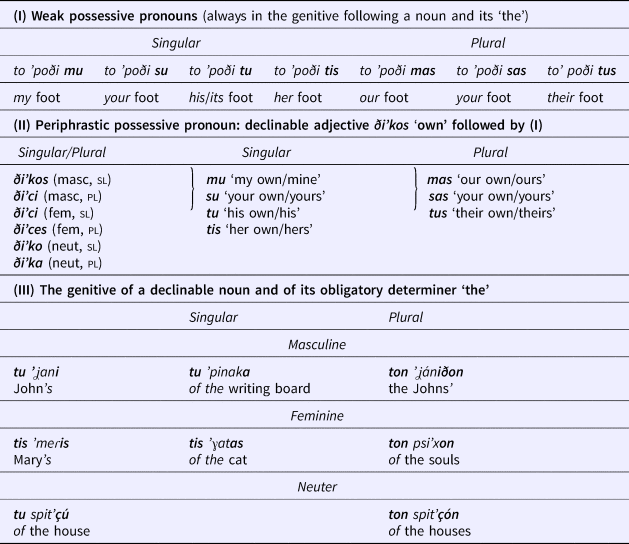
Possessive constructions in Greek are shown in Table 2. The possessives system in both Greek and English consists of weak adnominal pronouns: mu ‘my’, su-sing ‘your’, tu ‘his/its’, tis ‘her’, mas ‘our’, sas -plur ‘your’, and tus ‘their’; a periphrastic pronoun: ðikos mu, own my ‘my own’), and an inflectional genitive: Greek feminine noun ending in /a, i, u, o/ + genitive s (e.g., ’me ɾis-gen ‘Mary's’); English noun+’s (e.g., Mary's hat). Their differences lie in that: (i) only the possessor/possessum word order is permitted in English; this is the marked, emphatic option in Greek, which also permits possessum/possessor; (ii) determiner pronouns are prenominal in English (e.g., my hat) but postnominal in Greek (kapelo mu, hat my); and Iiii) Greek has no weak possessive pronouns with a nominal function, but English does (e.g., mine/yours, etc.).
Greek Possessive Constructions
Results and discussion
The child's mean length of utterance
A comparison of mean length of utterance in words between the two languages at age 2;7 shows that Greek is the child's dominant language: there is a difference of more than one word (Bernardini & Schlyter, Reference Bernardini and Schlyter2004); 3.36 in Greek, higher than the range (2.6, 3.0) of the four Greek monolinguals in Marinis (Reference Marinis2003), and 2.01 in English, seemingly lower than the mean of 2.91 and standard deviation of 0.58 of the 17 English monolinguals in Rice, Smolik, Perpich, Thompson, Rytting, and Blossom (Reference Rice, Smolik, Perpich, Thompson, Rytting and Blossom2010), ranging from 2;6 to 2;11.
Input and output
We have computed and compared the mother's frequency of possessives with the child's on a monthly basis, 2;7–2;11. The results are shown in Table 3. Their did not appear in the child's speech and only appeared six times in the mother's speech. Theirs, hers, and its are the only possessives that did not appear at all.
Mother's Input (m) and Child's Output (c) In English Possessives from 2;7 to 2;11

Note. Child's my/mine and your/yours are correlated with mother's your/yours and my/mine, respectively; all other possessives are correlated by surface form.
There is a monthly increase in both participants’ possessives, with the mother using more possessives (13.4% at 2;7: 22.9% at 2;11) than the child (4.3% at 2;7: 14.3% at 2;11); the percentages refer to the number of possessives per 100 utterances. The child–mother monthly variation in the number of possessives is characterized by a 0.893 correlation coefficient. My and your were the most frequent possessives in the child's and mother's speech, respectively (about 50% of possessives usage), with 's the next most frequent, and ours and their/theirs being the least frequent possessive for both participants.
The monthly frequency correlation coefficient between the participants’ different possessives is in the last column of Table 3. Because a mother uses your/yours and a child my/mine more often than vice versa, the correlation coefficient was computed by matching the mother's my/mine, your/yours respectively with the child's your/yours, my/mine; all other possessives were matched per type. The resulting correlation coefficient is 0.88 at 2;7, becoming higher (⩾ 0.93), at ages 2;8–2;11 and showing a strong relationship between input and output usage frequency per possessive type. The child had already acquired the distinction between 1st and 2nd person in Greek (e.g., Budwig, Reference Budwig, Slobin, Gerhardt, Kyratzis and Jiansheng1996; Caët & Morgenstern, Reference Caët, Morgenstern, Gardelle and Sorlin2015), a fact further supporting our analysis.
Attempted possessives per language
The role that the frequency of usage of possessives plays in their acquisition in this child's bilingualism is examined by computing the monthly frequency of possessives attempted in each language. This is shown in Table 4 from 2;6–2;11. While the monthly increase in the child's attempted English possessives is high: 5.1% (2;6) to 14.3% (2;11), the monthly increase in Greek is insignificant: 12.3% (2;6) to 14.3% (2;11), since they were already acquired at 2;7.
Possessives Attempted by the Bilingual Child per Language from 2;6 to 2;11 in English (E) and in Greek (G)
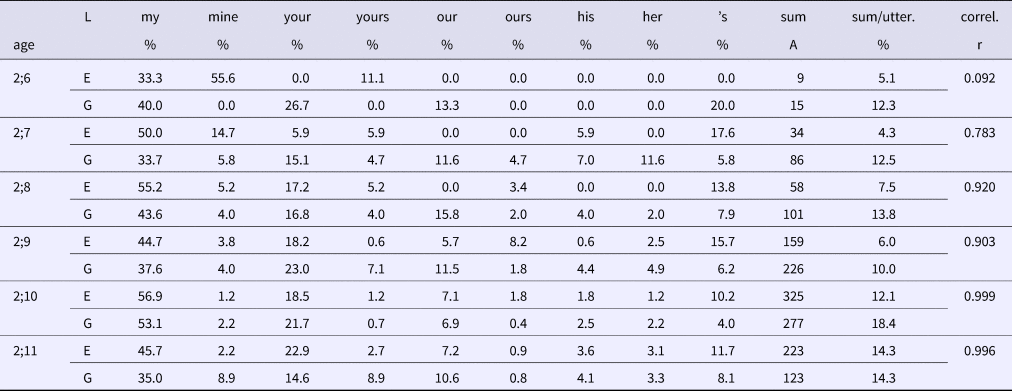
The frequency of attempts per possessive in each language is as follows: my is the most frequent (50% of the times a possessive is attempted) in both languages, followed by your and 's, while ours is the least frequent for both participants. The monthly frequency correlation coefficient of the child's attempted possessives in both languages appears in the last column of Table 4: it is almost zero at 2;6 (inadequate data), much higher (0.783) at 2;7, and perfectly matched (0.995) at 2;10–2;11. Thus, the child's attempted possessives are at a similar level in both languages in terms of distribution per possessive and their total number.
Attempted possessives and accuracy in English
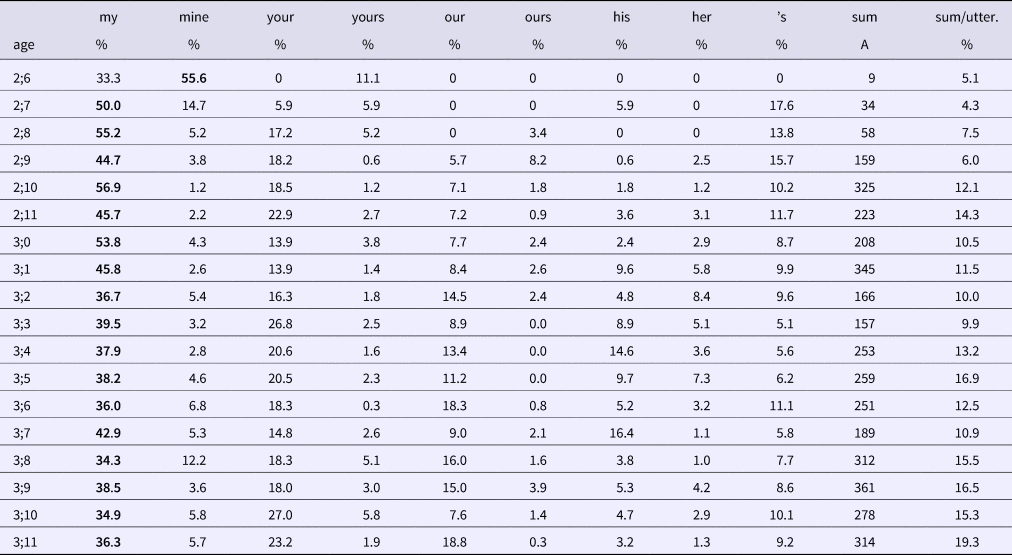
The child's possessives in English are examined next in the entire database (2;6–3;11), and monthly attempts are shown in Table 5. While my remains the most frequent possessive throughout, its frequency decreases by 3;2–3;4. The next most frequent your and the infrequent our increase at about this age. The number of possessive attempts per number of utterances increases until 2;11, reaching 14%, and remaining at about this level thereafter. At about age three, the frequency of the dominant possessives (my, your, 's) decreases, owing to the increase in frequency of the lesser used possessives.
Possessives Attempted by the Bilingual Child in English from 2;6 to 3;11
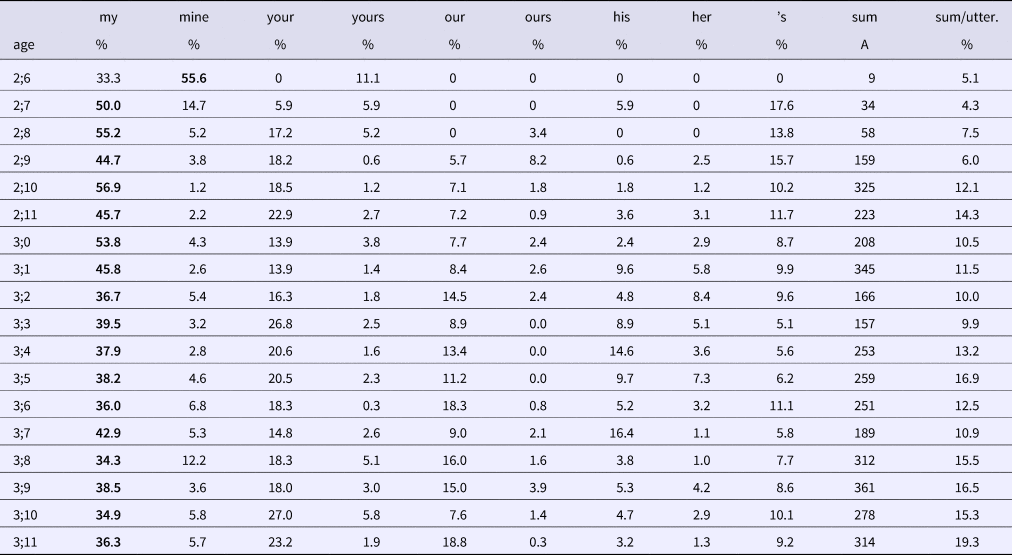
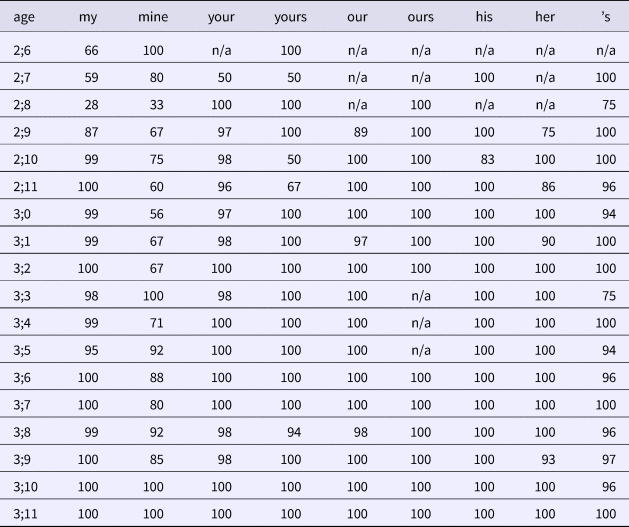
Table 6 shows the percentage of accurate (in terms of both form and function) realizations per possessive which, by about age three, is high in almost all possessives. As for accuracy and usage frequency, no significant correlation is found, meaning frequently used possessives are not necessarily the most accurate. A significant correlation emerged for my/mine, the least accurately produced longitudinally. My accuracy is positively/significantly correlated with the number of attempts (r(18) = .665, p < .01), the attempts per 100 utterances (r(18) = .531, p = .044), and child age in months (r(18) = .630, p = .047). Mine accuracy is positively correlated with number of attempts (r(18) = .434, p = .02), and positively/significantly correlated with attempts per 100 utterances (r(18) = .534, p = .045), and child age (r(18) = .515, p = . 048).
Percentage (%) of Attempted Possessives in English that Were Accurately Realized by Age
Last, the frequency data for my/mine/your/yours/our/ours/his/her were also obtained from monolingual English adult–child interactions in ChildFreq, computing the number of occurrences per million. The sum across age categories for all children in ChildFreq is used. Results, summarized in Table 7, show that there is good correspondence between the relative frequencies of words attempted by the child and of the same words in ChildFreq (see Table 7, 3rd column). In contrast, the correlations with accuracy are rarely significant and the two significant correlations are negative, meaning that the more frequently a particular word occurred in ChildFreq, the less accurate the child was. One reason for few significant correlations is the child's high accuracy.
Correlations between the Child's Possessives Attempts (and Accuracy) in English and ChildFreq Frequency
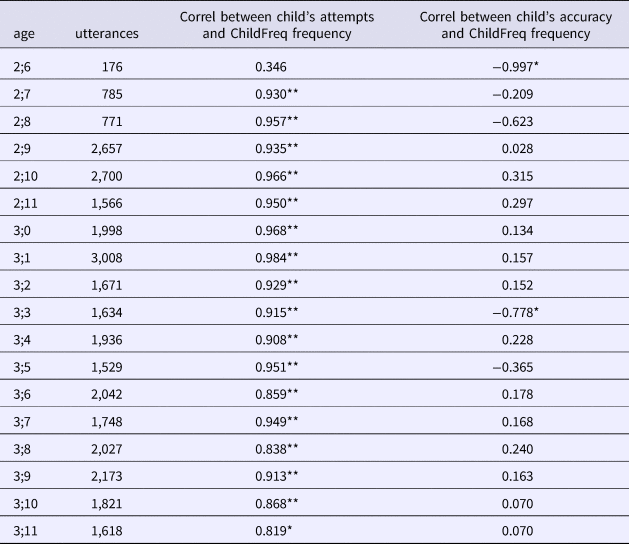
Notes. * p < .05; ** p < .01.
Order of acquisition, errors, and cross-linguistic influence
The order of acquisition of possessives was determined based on the 90% level of accuracy, yielding the following results (Table 6): your/ours (2;8), 's (2;9), my/our (2;10), his/her (2;11), yours (3;0), their (3;1), mine (3;4–3;9). Is this order of acquisition related to usage and/or input frequency? There is variability in accuracy until 2;11, when most possessives were acquired. Between 2;7 and 2;11, the frequency of possessives in the child's input (exclusively by the mother), is, in descending order: your (706), my (161), 's (122), his (111), her (78), our (67), yours (34), mine (20), their (6), ours (6), while her usage frequency is in a different descending order: my (407), your (152), 's (98), our (48), his (17), her (15), mine (23), ours (23), yours (16).
In sum: (a) the least frequent in the input and the second-least frequent in the output, ours, is acquired first, alongside your, the most frequent in the input and second-most frequent in the output; (b) my, the most frequent in the output and the second-most frequent in the input, is acquired third, together with our, considerably less frequent in both input and output (the fact that the input frequency of your is correlated with the usage frequency of my was mentioned earlier). Excluding my/ours, the higher the usage frequency, the earlier the age of acquisition.
The bilingual child's order of acquisition of possessives compares well with that of monolinguals with my, our/ours, your/yours, their/theirs (Chiat, Reference Chiat1981, Reference Chiat, Wiesemann and Greenberg1986; Tomasello, Reference Tomasello and Newman1998). She acquired his/her and 's at 90% accuracy earlier than English monolinguals (Brown, Reference Brown1973; Chiat, Reference Chiat1981, Reference Chiat, Wiesemann and Greenberg1986; Radford & Galasso, Reference Radford and Galasso1998; Tomasello, Reference Tomasello and Newman1998) but showed delay with mine compared to monolinguals, despite her acquired coda /n/, which differentiates phonologically the my/mine contrast.
There is consistency in the child's error types found both in item-based contexts (i.e., specific pronouns like my) and group contexts (e.g., determiner vs. nominal possessives), as in monolinguals (Chiat, Reference Chiat1981, Reference Chiat, Wiesemann and Greenberg1986). Similarly to monolinguals, her errors involve gender intermixing (e.g., his/her), reversals of determiners and nominals (e.g., my/mine),’s omission / erroneous epenthesis, nominatives used for possessives (e.g., negligible I/mine), nominal forms appearing before pronominal forms (e.g., yours/your), and repairs (Chiat, Reference Chiat1981, Reference Chiat, Wiesemann and Greenberg1986; Radford & Galasso, Reference Radford and Galasso1998; Tomasello, Reference Tomasello and Newman1998). Some errors that are frequent among monolinguals were non-existent or negligible for this child: our for ours, errors with theirs, delayed acquisition of mine, your for my, etc. She never used accusatives for possessives.
With regard to the pattern of frequent reversal errors in bilinguals (Nicoladis, Reference Nicoladis2012), there is little such evidence here (i.e., two errors). Evidence of cross-linguistic influence is found in the pronominal use of the nominals: mine/yours/ours for my/your/our, respectively, which, although also attested in English monolinguals, is an overwhelmingly predominant error in this child, who may be transferring the Greek periphrastic possessive that has both a nominal and pronominal function.
Concluding remarks
This study investigated a Greek–English bilingual child's development of English possessives, with English being her weaker language in terms of exposure and use. Longitudinal data from 2;6 to 3;11 showed some evidence that her English possessives developed much like those of monolinguals. The child's usage of the different possessives was generally highly correlated with both frequency from ChildFreq and her input frequency. Also, the order of acquisition of possessives was similar to that of monolingual children (Chiat, Reference Chiat1981, Reference Chiat, Wiesemann and Greenberg1986). For most possessives, our results are consistent with claims that order of acquisition and usage frequency are highly correlated (e.g., Ambridge et al., Reference Ambridge, Kidd, Rowland and Theakston2015; Bybee, Reference Bybee1995; Unsworth, Reference Unsworth, Nicoladis and Montarnari2016).
A surprising finding was that the child's accuracy in possessives was similar to that of same-aged English monolinguals (Chiat, Reference Chiat1981, Reference Chiat, Wiesemann and Greenberg1986), despite limited exposure to English. The child also showed fewer kinds of errors in her production of possessives than previously reported for monolingual children. This result provides counter-evidence to some findings that bilinguals lag behind monolinguals (Jia & Fuse, Reference Jia and Fuse2007; Nicoladis & Paradis, Reference Nicoladis and Paradis2012; Nicoladis et al., Reference Nicoladis, Song and Marentette2012).
We suggest that this child's English possessives were accurately acquired because she already knew possessives in Greek. In support of this suggestion, we found that the child's own usage of Greek possessives was highly correlated with her English possessives. Some studies have shown that bilingual children can benefit from cross-linguistic influence in acquisition (Bernardini & Schlyter, Reference Bernardini and Schlyter2004; Nicoladis, Reference Nicoladis2003), although in domains where the languages were structurally similar. While there are some surface similarities in the forms of Greek and English possessives, the differences outweigh the similarities. For that reason, this finding challenges versions of usage-based theories that assume frequency within a particular language relates to bilingual acquisition (e.g., Nicoladis et al., Reference Nicoladis, Song and Marentette2012). This finding supports the claim that bilingual children can use knowledge in one language to acquire the other (Bernardini & Schlyter, Reference Bernardini and Schlyter2004). In this case, the child knew that Greek marks possession. She did not have to learn that English marks possession, only how English marks possession. Future studies can test the generalizability of our interpretation with a larger sample of bilingual children and across other linguistic structures.