

Acknowledgments
Writing this book has been like wandering in a yellow wood with radiant sunshine, autumn air, and no visible path. Obviously at risk of being lost in a moment, I appreciate my many friends and colleagues from diverse disciplines who helped me to stop reading and navigate the way forward. I particularly wish to thank those who offered substantial comments on various aspects of the project, including Ben Ansell, Karen Anderson, Marius Busemeyer, Niccolo Durazzi, Patrick Emmenegger, Peter Hall, Leon Gooberman, Marco Hauptmeier, Rob Johns, Michele Lamont, Julia Lynch, Bruno Palier, Emmanuele Pavolini, Klaus Petersen, Margaret Weir, David Weisstanner, James Winn, and the anonymous reviewers. Special thanks also go to Terry Moe for encouraging me to consider his Cambridge Studies in the Comparative Politics of Education series and to Rachel Blaifeder for her many excellent suggestions throughout the process.
I also thank for their insights and support Elizabeth Amrien, Lucio Baccaro, Cornel Ban, Nick Beauchamp, Jens Beckert, Aaron Benavot, Mabel Berezin, Suzanne Berger, Sheri Berman, Ivar Bleiklie, Giuliano Bonoli, Taylor Boas, Mark Blyth, Cathy Boone, Thomas Bredgaard, Julia Brown, Rachel Brule, Haldor Byrkjeflot, Melani Cammet, Martin Bæk Carstensen, Tom Chevalier, Dino Christenson, Sheila Cordner, Pepper Culpepper, Johan Bo Davidsson, Caroline de la Porte, Frank Dobbin, Susan Eckstein, Fredrik Engelstad, Patrick Fessenbecker, Robert Fishman, Julia Flanders, Marion Fourcade, Niels Fuglsang, Vesko Garčević, Julian Garritzmann, Jane Gingrich, Oliver Godechot, Achim Goerres, Philipp Gonon, Lukas Graf, Bill Grimes, Randall Hale, Anke Hassel, Colin Hay, Torben Iversen, Larry Jacobs, Carsten Jensen, Desmond King, Jette Steen Knudsen, Sebastian Kohl, Nicola Lacey, Michele Lamont, Eirinn Larsen, Flemming Larsen, Patrick Le Galѐs, Johannes Lindvall, Noora Lori, Christian Lyhne Ibsen, Tim Longman, Anne-Marie Mai, Paul Manna, Jenny Mansbridge, David Mayers, Eileen McDonagh, Kate McNamara, Rachel Meade, Jeremy Menchik, Sid Milkis, Terry Moe, Jørgen Møller, Dennie Nijhuis, Paul Osterman, Agustina Paglayan, Max Palmer, Thomas Paster, Sophia Perez, Jorn Henrik Petersen, Klaus Petersen, Spencer Piston, Ilze Plavgo, Arlo Poletti, Justin Powell, Magnus Rasmussen, Philip Rathgeb, Tore Rem, Steve Rosenzweig, Bo Rothstein, Allison Rovny, Alvaro Santana-Acufia, Gina Sapiro, Vivien Schmidt, Ben Ross Schneider, Peter Schwartz, Kaija Schilde, Peter Simonsen, Øyvind Søraas Skorge, David Soskice, Lynn Spillman, Ann Swidler, Mark Thatcher, Kathleen Thelen, Dan Tichenor, Seema Tikara, Jeroen Touwen, Christine Trampusch, Peter Trubowitz, Beth Truesdale, Gunnar Trumbull, Pieter Vanhuysse, Sid Verba, Graham Wilson, Joe Wippl, and Jae-jin Yang.
Thanks also go to participants at my talks at the Aalborg University, Boston University, Cardiff University, Copenhagen Business School, University of Gothenburg, International Institute of Social History (Amsterdam), ScanCor at Harvard University, Center for European Studies at Harvard University, London School of Economics, Lund University, Max Planck Institute Cologne, the Norwegian Institute for Social Research, University of Ottawa, MaxPo Center at Sciences Po, Southern Denmark University, the University of St. Gallen, Yonsei University, the American Political Science Association, the Council for European Studies, and the Society for the Advancement of Socio-Economics.
I wish to note some of my prior works that helped me to evolve my thinking about these themes: “Imagine All the People” (World Politics), “Fiction Works” (Industrial Relations: A Journal of Economy and Society), and my chapter in Marco Hauptmeier and Leon Gooberman’s Employer Organisation in the 21st Century. I also thank my co-authors for our collaboration on other pieces: Tom Chevalier for “What we think about when we think about poverty” (British Journal of Political Science); Dennie Oude Nijhuis and Erik Olsson for “Cultural Images of Labor Conflict and Coordination” (European Journal of Sociology”; Matthew Pastore and Peter Munk Christiansen for “The Culture of Education Regimes” (Social Policy and Administration); and Lukas Graf for “Industrial Coordination and Vocational Training in the Post-Industrial Age” in Dennie Nijhuis eds. Business Interests and the Development of the Modern Welfare State.
I am deeply grateful for their generous funding to the National Endowment for the Humanities (Grant#20200128124651855), Boston University Hariri Institute for Computing (Research Award #2016-03-008), the Boston University Center for the Humanities, the MaxPo Center at Sciences Po, and the Boston University Digital Humanities Seminar.
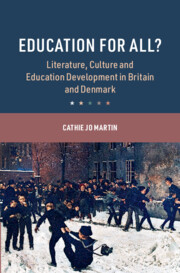
I am indebted beyond words to Azur Bestavros and the BU S.A.I.L. Team – Ben Getchell, Andrei Lapets, Frederick Jansen, and Glenn Xavier – for their superb programming and generous help in so many ways. Thanks a million to the HathiTrust and the Archive for Danish Literature (Arkiv for Dansk Litteratur) for providing full-text files of literature and to Eleanor Dickson, Vika Zafrin, and Jack Ammerman for teaching me about digital humanities. My graduate student assistants – Erik Olsson, Miguel Angel Fernandez, Ozgur Bozcaga, and Bill Murphy – helped me to build corpora for Sweden, Spain, France, and Germany. I am exceeding grateful to Thorkild Jensen for his beautiful picture of Erik Henningsen’s 1887 painting, Frikvarter i Efterslægtens Skole (Recess at the Descendents’ School) that appears on the front cover of this book, and also to Anne Frausing, the rector of the modern iteration of the very same school, the HF-Centret Efterslægten, that houses this wonderful painting. My enduring thanks go to Rhoda Bilansky at Boston University’s Mugar Library, who helped me to obtain a great many sources for this project. I greatly benefitted from the assistance of librarians at the Bodleian Library at Oxford University, the British Library, the British and Foreign School Society Archive Center, the Danish National Archives (Rigsarkivet), and the John Rylands Research Institute and Library, and the Royal Danish Library (Det Kongeligt Bibliotek). Many thanks, in particular, go to Ann Eunice Furholt Pedersen for digging up materials from the Sorø Academy library. I also thank Connor Guy for providing help with some language editing.
I am also so happy to have dear friends who have kept me going through the questionable process of writing a book during Covid (instead, e.g., of learning to draw, playing the piano, or practicing French). Elisabeth Møller, Tim Knudsen, Birgit Knudsen, and Maryse Igout have helped me to understand Danish society, literature, and politics through decades of friendship. Kari Moe, Nora Dudwick, Cathy Boone, and Fang Cohen have been there for me through many sagas since my twenties. Our Russian bath group – Michele Lamont, Susan Eckstein, Jenny Mansbridge, and Kathy Thelen – are an ongoing source of support and inspiration. Eileen McDonagh and Bob Davoli have been tremendous friends throughout this process. I also thank for the wonderful moments of laughter and forgetting about the ills of the world: Jette Steen Knudsen, John Ryan, Gunnar Trumbull Seema Tikare, Melani Cammett, Angelo Manioudakis, Torben Iversen, Charla Rudisill, Sarah Robinson, Sal D’Agastino, Sig Roos, Ruthie Rohde, Holly LeCraw Howe, Peter Howe, and my book group: Rebecca, Kari, Julie, Sarah, Jo, Rachel, Shara, Tess, Marcella and Sue.
My beautiful mother, Mary MacKenzie, left this world shortly before I received the contract for this book and my greatest sadness is that I could not share the news with her. I also deeply miss my father, Robert Martin, and step-father, Patrick Kilburn. Fortunately, I have my amazing extended family who have helped to fill the gap: Mary and Jim Kozlowski, Robin and John Hanley, Jimmy Martin, Julie and John Sheerman, Patty Skelton, Joanne and Michael Ertel, John Milkey and Lindley Boegehold, Mike and Lexi, Joe, Christina and Tim, Kate and Chris, Patty and Joe, Jay and Carly K., Carly Jo, Sidney, Lindsey, Emma, Tess, Camille, Thomas, and Dean.
Finally, I get to my own little family, the center of my universe, Jim, Julian, and Jack Milkey. Cassie, you are a dog of love. Julian and Jack, thank you for all the jokes, memes, imparted knowledge, and reminders to finish the damn book. It has been an honor to be your mom and a joy to watch you emerge into such wonderful young men. Jim, you make all the love songs and Hallmark cards of the world come true. I cannot imagine life without you.

 Open access