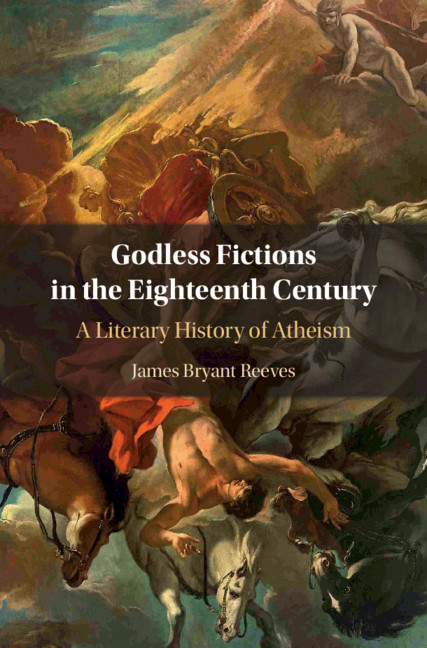

Although there were no self-avowed British atheists before the 1780s, authors including Jonathan Swift, Alexander Pope, Sarah Fielding, Phebe Gibbes, and William Cowper worried extensively about atheism's dystopian possibilities, and routinely represented atheists as being beyond the pale of human sympathy. Challenging traditional formulations of secularization that equate modernity with unbelief, Reeves reveals how reactions against atheism rather helped sustain various forms of religious belief throughout the Age of Enlightenment. He demonstrates that hostility to unbelief likewise produced various forms of religious ecumenicalism, with authors depicting non-Christian theists from around Britain's emerging empire as sympathetic allies in the fight against irreligion. Godless Fictions in the Eighteenth Century traces a literary history of atheism in eighteenth-century Britain for the first time, revealing a relationship between atheism and secularization far more fraught than has previously been supposed.
‘Godless Fictions is a powerful intervention in an ongoing conversation about the role of belief and wonder in the long eighteenth century, ...’
Misty G. Anderson Source: Eighteenth-Century Fiction
‘A lucid, richly contextualized perspective on Enlightenment religion and sociability as well as literature. Recommended.'
M. E. Burstein Source: Choice
‘… a fresh, post-secular take on the literary representation of religious non-belief in Britain … Godless Fictions pioneers the study of atheism as a shaping force for fiction in the period.’
Lisa O'Connell Source: Eighteenth-Century Studies
Loading metrics...
* Views captured on Cambridge Core between #date#. This data will be updated every 24 hours.
Usage data cannot currently be displayed.
This section outlines the accessibility features of this content - including support for screen readers, full keyboard navigation and high-contrast display options. This may not be relevant for you.
Accessibility compliance for the HTML of this book is currently unknown and may be updated in the future.
