


Introduction
The main evidence of interaction between settlements in the southern Levant and the wider region can be found in the presence of goods which do not originate in the immediate surroundings. One of the best studied of these non-local materials is obsidian, a naturally occurring volcanic glass. Obsidian outcrops are homogeneous in geochemical composition, and variations in trace elements make each source chemically distinct (Smith Reference Smith2009), making it possible to determine where a particular piece originated from and allowing insight to be gained into ancient interactions between disparate communities. Obsidian first appeared in the southern Levant in the late Natufian,Footnote 1 increased in volume during the Pre-Pottery Neolithic, peaking in the Pottery Neolithic strata of the Wadi Rabah culture (7600/500–6800 cal. bp) and thereafter declined during the Chalcolithic Ghassulian (Schechter et al. Reference Schechter, Marder, Barkai, Getzov, Gopher, Borrell, Ibáñez and Molist2013). The Wadi Rabah culture of the southern Levant is contemporaneous with part of the Middle Halafian (c. 7750–7450 cal. bp) and with the Late Halafian (7450–7300/250 cal. bp) and possibly forms part of the Halafian interaction sphere.
Hagoshrim is a site in the northern part of the Hula valley, Israel (Fig. 1), remarkable for its obsidian assemblage of the Pottery Neolithic Wadi Rabah Stratum IV (Getzov Reference Getzov, Stern, Geva, Paris and Aviram2008). The obsidian assemblage of Hagoshrim consists of about 10,000 items, originating from continuous surface collection, and over 2000 items from the 1996–97 excavations on behalf of the Israel Antiquities Authority, by N. Getzov. When considering the amount of obsidian items found in the various strata of the 1996–97 excavations,Footnote 2 the majority of the surface finds most likely originated from Hagoshrim IV based on the relative number of obsidian items belonging to this stratum.Footnote 3 The abundance of obsidian at Hagoshrim layer IV is in marked contrast to the situation in the preceding layers of the site (see note 3) where the obsidian assemblage does not seem to differ substantially from other sites of the time in the southern Levant region.
Map showing the Wadi Rabah sites discussed in this article.
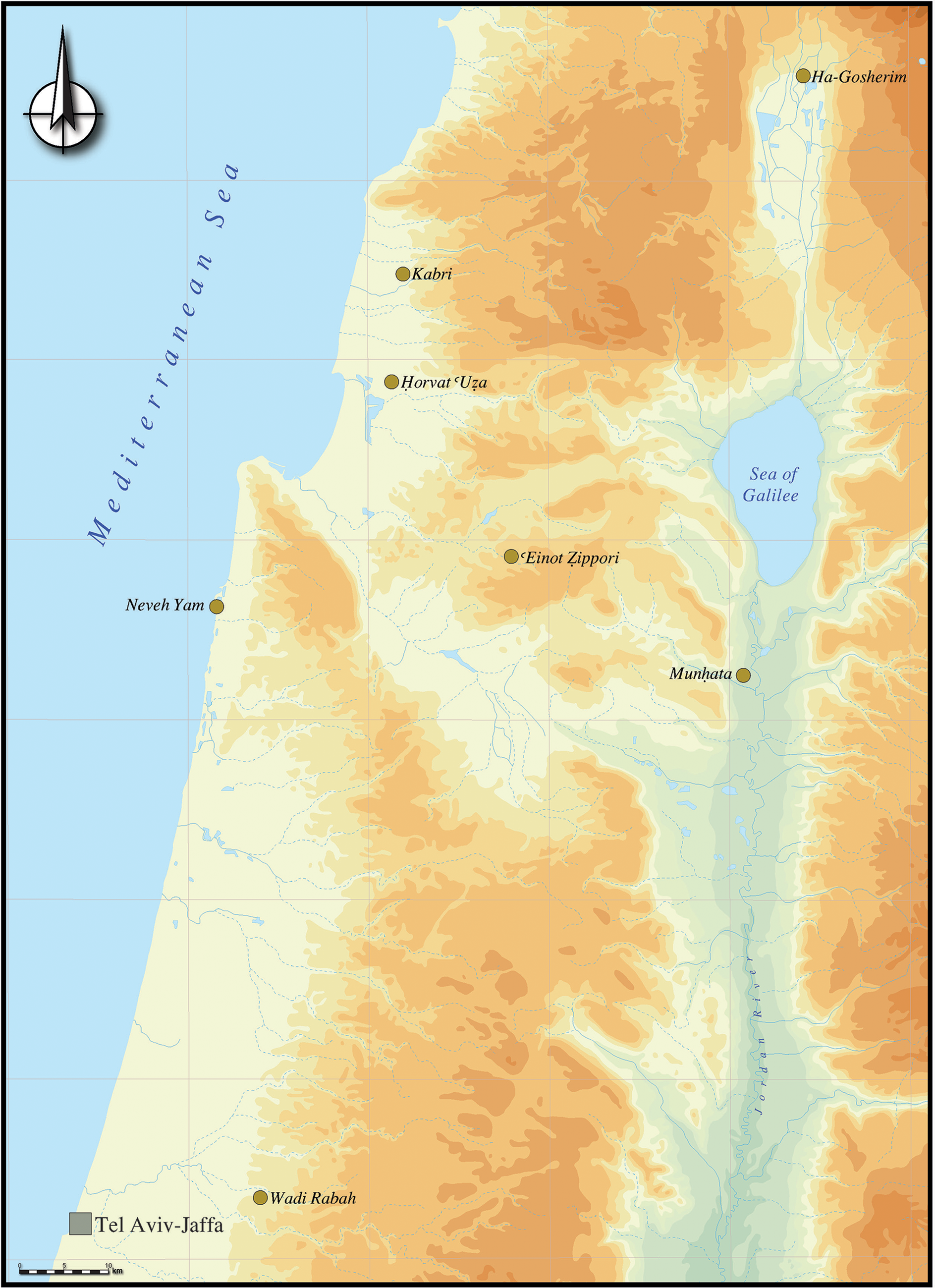
A similar abundance of obsidian seems to have existed at Kabri, a Pottery Neolithic (PN) site at the Western Galilee not far from the Mediterranean coast (see Fig. 1). While insufficient information has been published about Kabri and its obsidian assemblage, the abundance of obsidian in both of these sites led Prausnitz (Reference Prausnitz1970) to propose that Kabri and Hagoshrim were trade centres on regional trade routes—the eastern one through the rift valley and the western one on the Mediterranean coast.
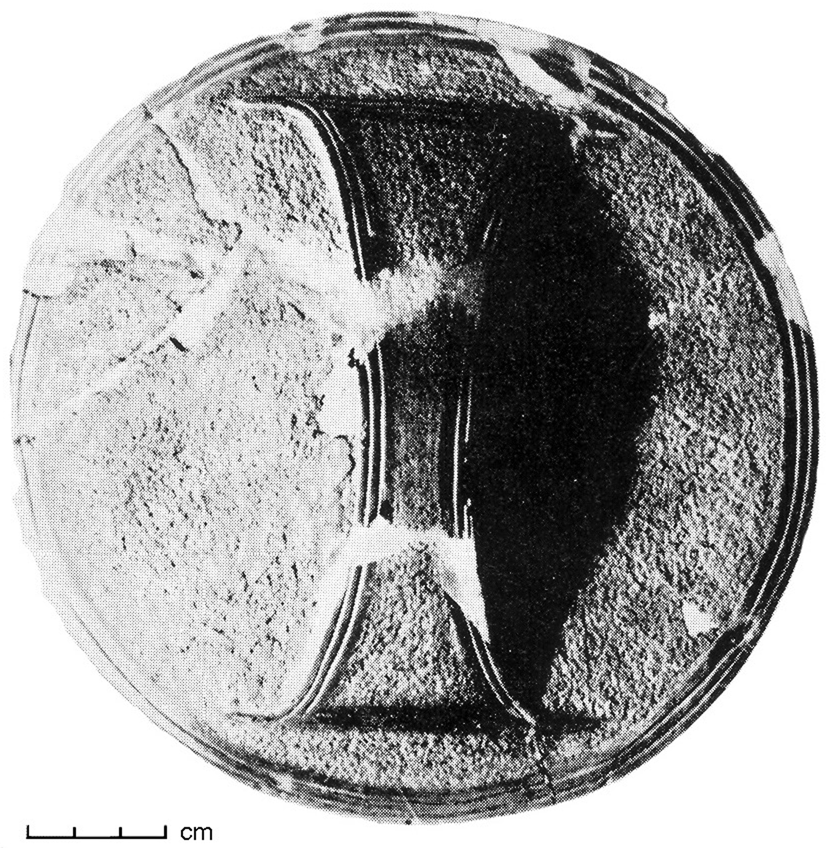
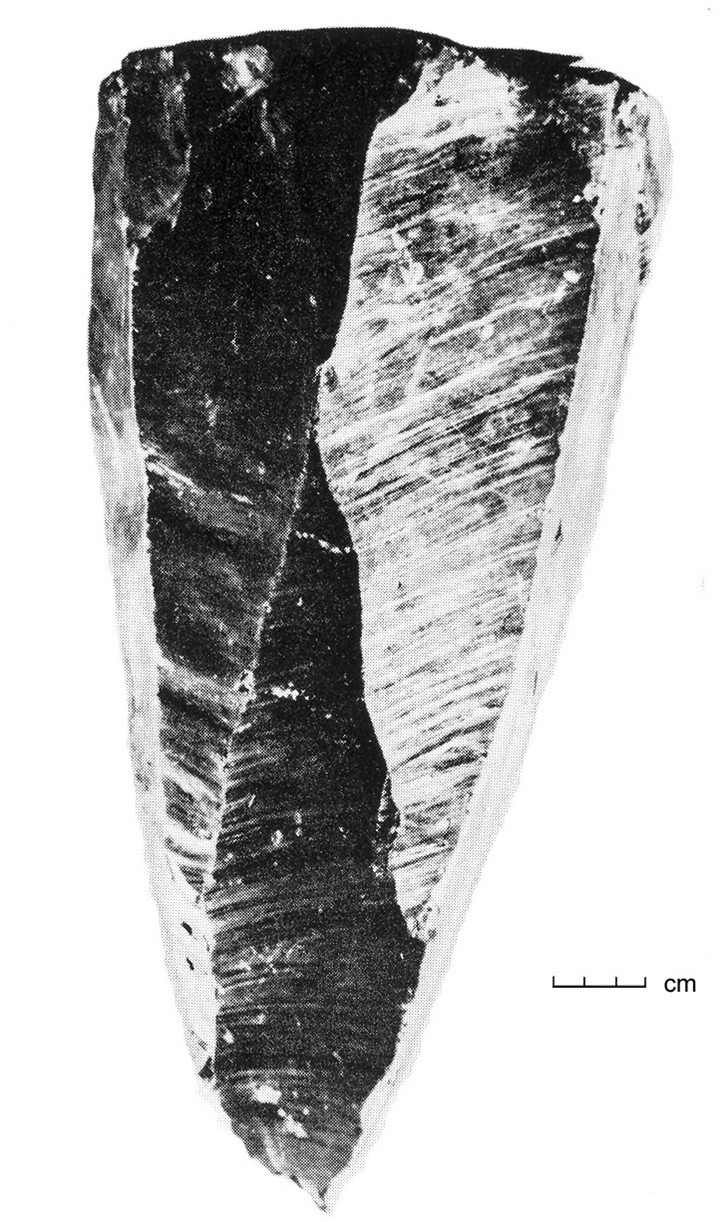
This article focuses on Hagoshrim, for which we have results of analysing a large assemblage of obsidian items as well as some information about obsidian sources (Gopher et al. Reference Gopher, Barkai, Marder and Otte1998; Reference Gopher, Marder, Barkai, Healey, Campbell and Maeda2011; Schechter et al. Reference Schechter, Marder, Barkai, Getzov, Gopher, Borrell, Ibáñez and Molist2013). In contrast, insufficient information has been published about Kabri and its obsidian assemblage. Notably, the excavations at the tell of Kabri yielded PN layers (the Wadi Rabah culture included) where obsidian items were found and briefly presented (Gopher et al. Reference Gopher, Barkai, Marder and Otte1998; Hershman Reference Hershman and Kempinski1988; Prausnitz Reference Prausnitz1969). Of note is the fact that the most important obsidian finds from Kabri, including an obsidian mirror (Fig. 2) and a large obsidian core (Fig. 3) with a length of 36 cm (Stekelis Reference Stekelis1958, pl. 4, fig. 3; Prausnitz Reference Prausnitz1969, pl. 37, 3 and 4; and see Gopher et al. Reference Gopher, Marder, Barkai, Healey, Campbell and Maeda2011), were not discovered in situ but instead were uncovered by amateur collectors in the fields of Kibbutz Kabri nearby the site and, therefore, their context is not clear.
The obsidian mirror from Kabri.
The obsidian core from Kabri.
Most models trying to explain the dispersal of obsidian to the southern Levant have discounted direct trade between sites located far away from each other and instead focused on localiszed trade. Renfrew (Renfrew et al. Reference Renfrew, Dixon and Cann1966; Reference Renfrew, Dixon and Cann1968) was the first to classify the obsidian trade as part of localized trade with his ‘down the line’ model which assumed that the obsidian was transferred between local communities, with each community consuming one part of the obsidian received and transferring the other part ‘down the line’ (Renfrew Reference Renfrew, Sabloff and Lamberg-Karlovsky1975, 78).
Ortega and Ibáñez in several works (Ibáñez et al. Reference Ibáñez, Ortega, Campos, Khalidi, Méndez and Teira2016; Ortega et al. Reference Ortega, Ibáñez, Khalidi, Méndez, Campos and Teira2014; Reference Ortega, Ibáñez, Campos, Khalidi, Méndez and Teira2016) have used ‘small world network’ analysis to examine the uneven distribution of obsidian in Pre-Pottery Neolithic B communities in the Levant based on distance from the nearest source and the amount of obsidian present. Their analysis attempts to overcome problems in Renfrew's ‘down the line’ model by creating ‘shortcuts’ allowing a certain percentage of the local communities to obtain obsidian from more distant communities, thus lowering the number of transactions required in the transportation of the obsidian (Ortega et al. Reference Ortega, Ibáñez, Khalidi, Méndez, Campos and Teira2014, 468).
Others (for example, Streit Reference Streit2016 and Carter et al. Reference Carter, Campeau and Streit2020) have suggested that the Wadi Rabah sites were engaged in ‘intensive long-distance trade with the Halaf and Halaf-related Amuq C cultural entities of northern Mesopotamia and the northern Levant’ (Streit Reference Streit2016, 35) with ‘Ein el-Jarba's relationship to the Halaf world … mediated by the better-connected community of Hagoshrim’ (Carter et al. Reference Carter, Campeau and Streit2020, 265). While they do not make any detailed suggestions as to how this trade took place, they do mention in passing the presence of emissaries, traders and itinerant specialists (Carter et al. Reference Carter, Campeau and Streit2020, 266).
We reconsider the archaeological evidence at PN Wadi Rabah Hagoshrim and other PN sites and revisit the question of how the obsidian from these sites reached the southern Levant during the late Pottery Neolithic period, taking into account not only the amount of obsidian found but also other possible trade-related evidence from these sites.
The sources and quantity of obsidian found at sites of the Wadi Rabah culture in the southern Levant
The Wadi Rabah culture was first defined by Jacob Kaplan in 1958 following excavations at Habashan St., Tel Aviv, the site of Wadi Rabah east of Tel Aviv, and the site of Teluliot Batashi some 25 km southeast of Tel Aviv (Kaplan Reference Kaplan1958a,Reference Kaplanb,Reference Kaplanc; see Fig. 1). The Wadi Rabah culture settlement distribution stretches from the Lebanese Beqa'a in the north to the Soreq Valley in the south, and the Jordan Valley in the east. Sparse, ephemeral Wadi Rabah presence was also found in the Judaean desert (Gopher Reference Gopher and Gopher2012, 1547 and fig. 41.2c). The chronology of PN cultural entities in the southern Levant is extremely important for comparing the archaeological evidence in this region with the archaeological evidence in central and eastern Anatolia where the obsidian originated. Based on stratigraphic and typological considerations and on 14C dates, the period during which the Wadi Rabah cultural entity existed is estimated to between approximately 7600/500 to 6800 cal. bp (Gopher Reference Gopher and Gopher2012, 1533 and fig. 41.1, 1534). Preceding the Wadi Rabah cultural entity were two earlier Pottery Neolithic cultural entities, the Lodian between approximately 7900/7800 cal. bp to 7600/7500 cal. bp and the Yarmukian between approximately 8500/8400 bp to 8000/7900 bp. Prior to 8500 bp is the latest Pre-Pottery Neolithic (PPNC) of the southern Levant.
Table 1 summarizes the estimated site size of the Wadi Rabah sites, the number of obsidian items found at sites of southern Levantine PN cultural entities, the rate of obsidian to flint (where available), the source of obsidian (where available) and some other relevant notes. Note that the Wadi Rabah sites in which obsidian has been discovered to date are situated in the northern parts of Israel and although some obsidian was found in southern Wadi Rabah sites, it does seem that the majority of the trade took place in the northern Wadi Rabah sites.
Estimated site size of the Wadi Rabah sites, the absolute amount of obsidian items, obsidian to flint ratio, and source of obsidian (expanding on Schechter et al. Reference Schechter, Marder, Barkai, Getzov, Gopher, Borrell, Ibáñez and Molist2013, table 2; 2016, table 7).
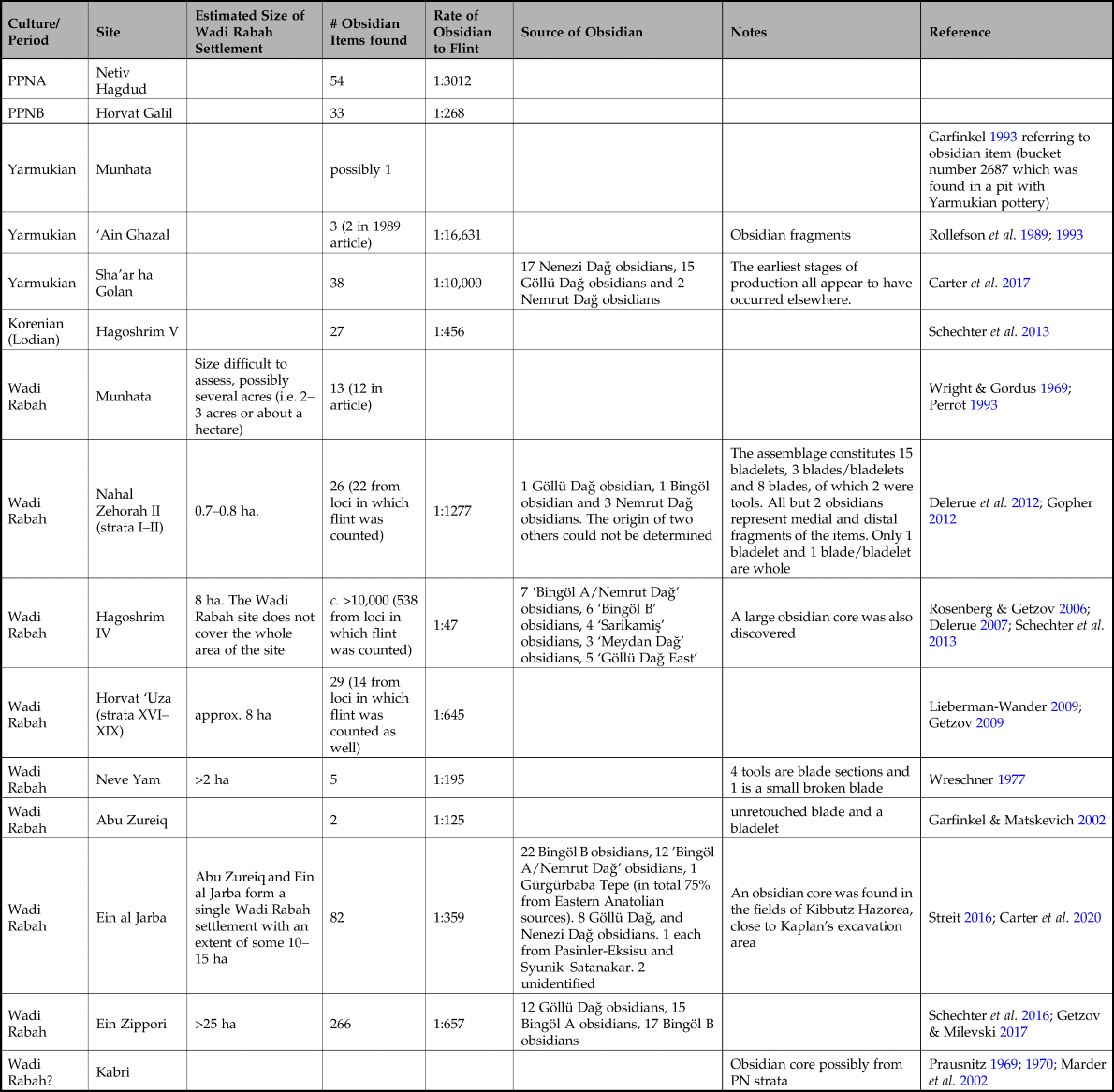
As the table shows, the amount of obsidian in the Yarmukian and subsequent Lodian cultural entities (both predating the Wadi Rabah culture) was relatively small (see also Garfinkel Reference Garfinkel, Healey, Campbell and Maeda2011; Reference Garfinkel, Renfrew and Bahn2014). Ratios of obsidian to flint items range between 1 obsidian item per many thousands of flint items in Yarmukian sites (e.g. Munhata, Shaar Hagolan, Ain Ghazal) to one obsidian item per hundreds of flint items in Lodian and most Wadi Rabah sites (e.g. Neve Yam, Horvat ‘Uza, Ein al Jarba), to one obsidian item per 47 flint items in Hagoshrim IV. This indicates a fall-off in obsidian trading during the early centuries of the PN period in comparison with the preceding Pre-Pottery Neolithic (Garfinkel Reference Garfinkel, Healey, Campbell and Maeda2011; Reference Garfinkel, Renfrew and Bahn2014). Later in the PN period, in the Wadi Rabah culture sites, however, the situation is reversed, indicating that the trade in obsidian in the southern Levant is intensified and Hagoshrim seems to play a major role in this exchange as far as the southern Levant is concerned.
Analysis of the obsidian found in the Wadi Rabah strata, where carried out, has indicated that the majority of the obsidian found in these sites of the southern Levant originated in either central Anatolia (southern Cappadocia) or eastern Anatolia (Lake Van area), with a clear majority originating in eastern Anatolian sources (see Table 1; for some details, see Supplementary material/Supplement A).
Regarding the distance from source, when considering Hagoshrim IV (the most northern Wadi Rabah site in Israel at which obsidian has been discovered), as the crow flies, the central Anatolian source of Göllü Dağ is 565 km away. Assuming some sort of land route, the source is situated approximately 665 km away. Likewise the eastern Anatolian source of Nemrut Dağ, as the crow flies, is approximately 600 km away.Footnote 4
Ortega et al. (Reference Ortega, Ibáñez, Campos, Khalidi, Méndez and Teira2016) have observed in relation to the PPNB that if a comparison is carried out between the mean ratio of obsidian to flint recovered from sites located more than 500 km from the obsidian sources, when considering three site size categories, the bigger the site, the higher the proportion of obsidian it contained. While the relative size of sites is difficult to determine, this does not seem to be the case during the PN period in the southern Levant. As can be seen in Table 1, the absolute amount of obsidian items and the obsidian to flint ratio at Hagoshrim is disproportionate to similar data found at other sites regardless of their relative size. This indicates that the obsidian found at Hagoshrim was not solely for consumption at the site and supports the idea that the obsidian was earmarked for onward exchange.
Evidence of other trade related artefacts or goods in the Pottery Neolithic period
Other than obsidian, a number of other material culture elements provide evidence of the exchange networks in existence in the Levant during the Pottery Neolithic. This manifests in the exchange of a number of commodities over significant distances including chlorite, shell, bitumen and painted pottery and is intertwined with a specific culture, the Halaf culture, evidence of which is found from the eastern shore of the Mediterranean and parts of Anatolia to Baghdad and beyond (Nieuwenhuyse Reference Nieuwenhuyse2007) (see further Figure 4 for the proposed extent of the Halafian cultural complex). The Halafian cultural complex continued from roughly 7900 to 7300/200 cal. bp (Bernbeck & Nieuwenhuyse Reference Bernbeck, Nieuwenhuyse, Nieuwenhuyse, Bernbeck, Peter, Akkermans and Rogash2013; Campbell Reference Campbell2007; Nieuwenhuyse Reference Nieuwenhuyse2007, 10) and was contemporaneous with the very end of the Yarmukian and with the Lodian (the Early Halaf), as well as with the Wadi Rabah (mostly the Middle and Late Halaf) cultures in the southern Levant. Connected to this remarkable system of exchange are distinctive stamp seals best known for their geometric patterns which are found throughout the territories connected to the Halaf cultural complex as well as adjoining areas of influence (Denham Reference Denham2018).
The proposed geographical distribution of the Halafian cultural complex. Olive green is the core area of the Halafian culture; lighter green shows the extent of Halafian influence (to the west and south along the Mediterranean); the eastern and central Anatolian obsidian sources (circled in red); and the Wadi Rabah sites of Kabri (2) and Hagoshrim (1).
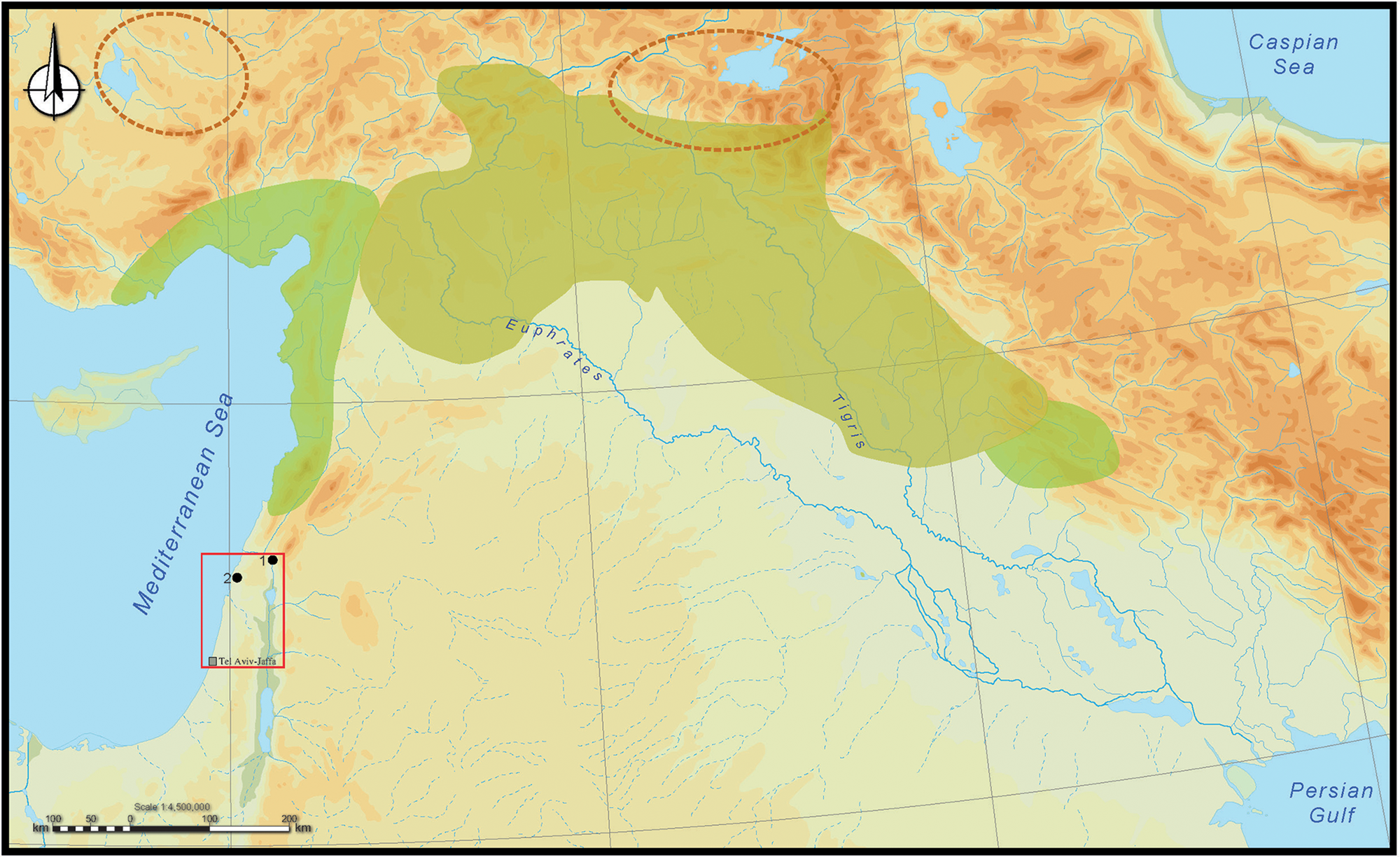
In considering the question of whether we are looking at an ancient form of direct trade, it is reasonable to assume that had such trade routes existed, not only obsidian would have been transported down such routes, but also additional trade-related artefacts. We will focus on a select few such finds which have clear provenance and are related to Anatolia and/or the Halaf cultural complex.
Stamp-seals
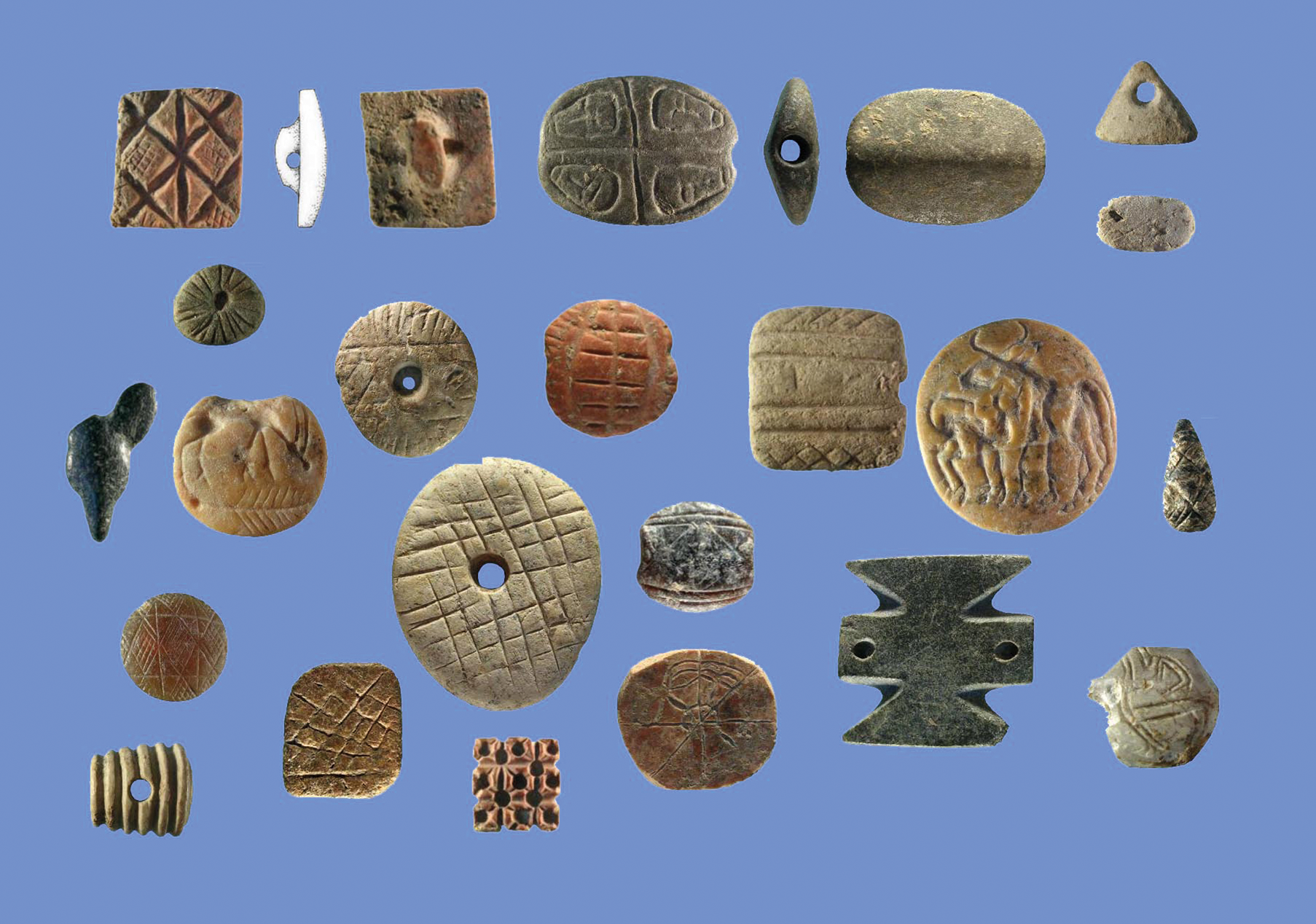
The 1996 and 1997 seasons at Hagoshrim yielded 22 stone stamp-seals (Getzov Reference Getzov2011).Footnote 5 Twenty of the seals were recovered from Stratum IV assigned to the Wadi Rabah culture (correlated to the middle and late Halaf cultural complex in Syria and northern Mesopotamia), with 17 additional seals recovered from the surface of the site (Getzov Reference Getzov2011: see Fig. 5). Most of the seals appear to have been manufactured on site; however, a few of the seals (#7, 12, 14 and 21) were apparently made of chlorite (discussed below), and Getzov believes these were brought to the site as finished artefacts. Getzov, following a comparative study, suggested that most of the seals (face shapes and profile shapes as well as the geometric designs) find equivalents in stamp-seals found in Halaf sites. Hagoshrim IV is outstanding in this aspect, too, since such finds are highly unusual in Wadi Rabah sites and only a handful are known from other PN sites (Getzov Reference Getzov2011).Footnote 6 While their precise function remains unclear, there seems, however, to be a consensus that the Halaf stamp-seals were personal objects identifying their owners as belonging to the Halaf cultural complex and could be trade-related (see further comments in Supplementary material/Supplement B).
A selection of stamp seals from Hagoshrim IV. (Courtesy of N. Getzov.)
Chlorite vessels
Rosenberg et al. (Reference Rosenberg, Getzov and Assaf2010) analysed a group of approximately 30 ‘delicate, meticulously finished’ bowls and platters discovered at Hagoshrim. These bowls and platters were discovered in secure contexts of the Wadi Rabah strata of Hagoshrim IV and were thus contemporaneous with the obsidian finds. The petrological and mineralogical analyses of the vessels revealed that they were made of chlorite. The nearest known sources of chlorite are hundreds of kilometres to the north, in locations in northwestern Syria such as Bear-Bassit and in various parts of southern, eastern and central Anatolia (Rosenberg et al. Reference Rosenberg, Getzov and Assaf2010). The remains of a chlorite vessel have also been reported from Ein al-Jarba (Streit Reference Streit2016).
The large obsidian cores
As shown in Table 1, at least three outstandingly large obsidian cores have been discovered to date in northern Israel, one at Kabri (Prausnitz Reference Prausnitz1969), one at Hagoshrim (Gopher et al. Reference Gopher, Marder, Barkai, Healey, Campbell and Maeda2011) and one near Ein el Jarba (Streit Reference Streit2016). Carter et al. (2020, 21) propose that the Ein el Jarba was reliant upon the obsidian workers of Hagoshrim, noting that the obsidian assemblage of the Ein el Jarba can be considered a subset of the assemblage manufactured at Hagoshrim.
In contrast with finished objects, the existence of cores and core preparation and maintenance items, i.e. Core Trimming Elements (CTEs), as well as debitage (and debris, and shaped tools (as well as retooling spalls), indicates that onsite obsidian knapping would have needed to take place and this includes the use of the pressure debitage technique known from the Neolithic of the northern Levant (for knapping both obsidian and other raw materials) but unknown in the Neolithic of the southern Levant (the PN Wadi Rabah culture included). This is where Nishiaki's (Reference Nishiaki, Jöris, Baena Preysler and Nishiakiin press) observations about the site of Seker al-Aheimar seem appropriate for Hagoshrim as well. As Nishiaki notes, the pressure debitage technique used in knapping obsidian requires a certain period of apprenticeship. It is unlikely that the knappers had trained locally in this technique, considering the scarcity and value of the obsidian available to them. Thus, the knappers must have learnt their profession closer to the obsidian sources where obsidian resources were abundant. The Hagoshrim case is quite instructive in this respect.
At Hagoshrim, the production of bladelets removed from cores with one striking platform using the pressure debitage technique is the most conspicuous trajectory (for details on technological aspects, see Gopher et al. Reference Gopher, Marder, Barkai, Healey, Campbell and Maeda2011). Notably, percussion technique was also used in obsidian at Hagoshrim, but it was a marginal trajectory. The large core (from Wadi Rabah stratum IV, Locus 338) was burnt and (possibly) post-depositionally fragmented into large pieces. Refitting of the core was partially successful, but the two main parts refitted could not be refitted to each other. It weighs between 1.5 and 2.0 kg (Gopher et al. Reference Gopher, Marder, Barkai, Healey, Campbell and Maeda2011; see Figure 6). It is not clear whether it reached the site as a large natural nodule or as a core after the initial shaping. Core trimming elements as well as many chips and chunks, flakes and bladelet/blades and a few shaped tools were found in the same place.
The refitted core from Hagoshrim IV.
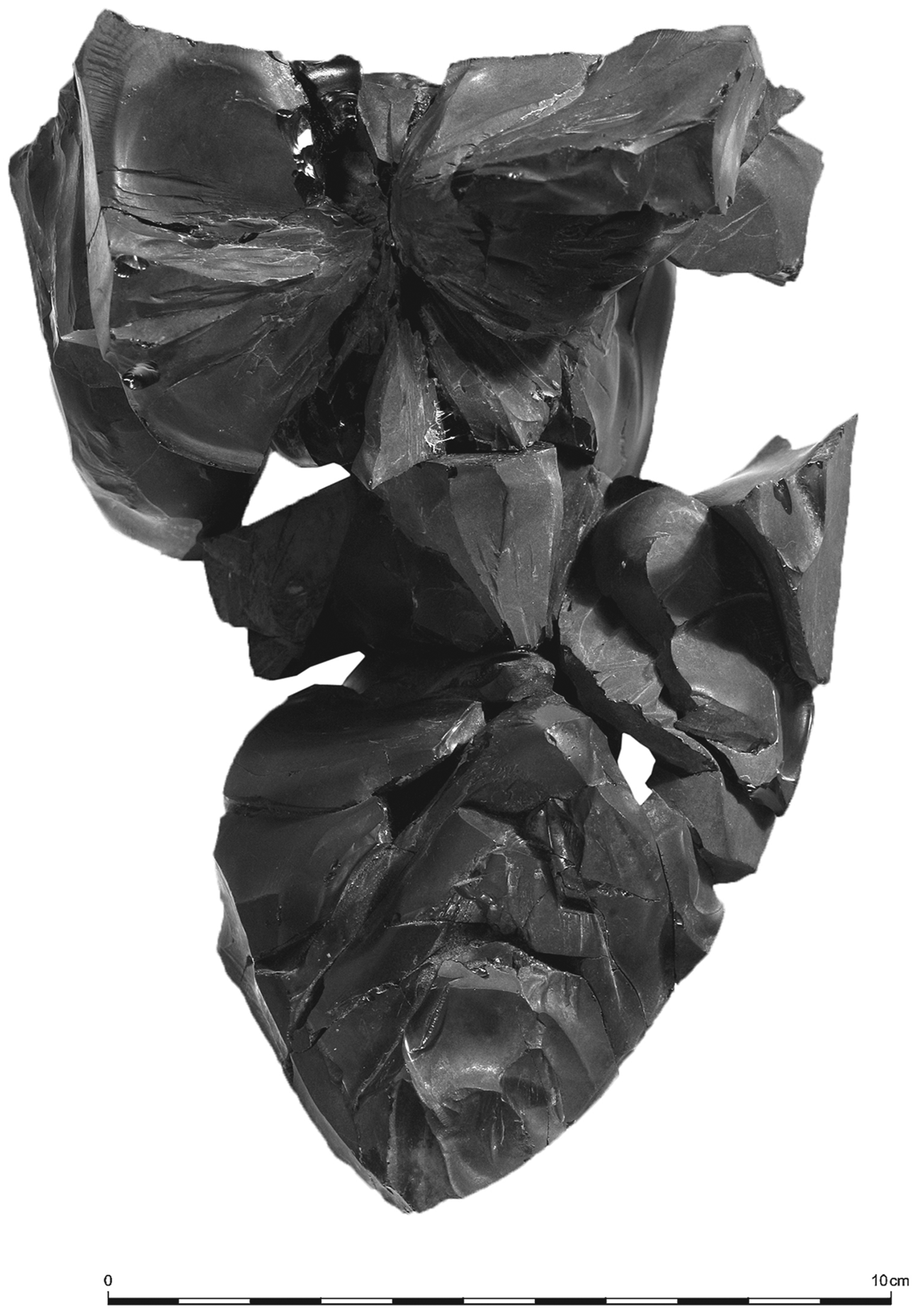
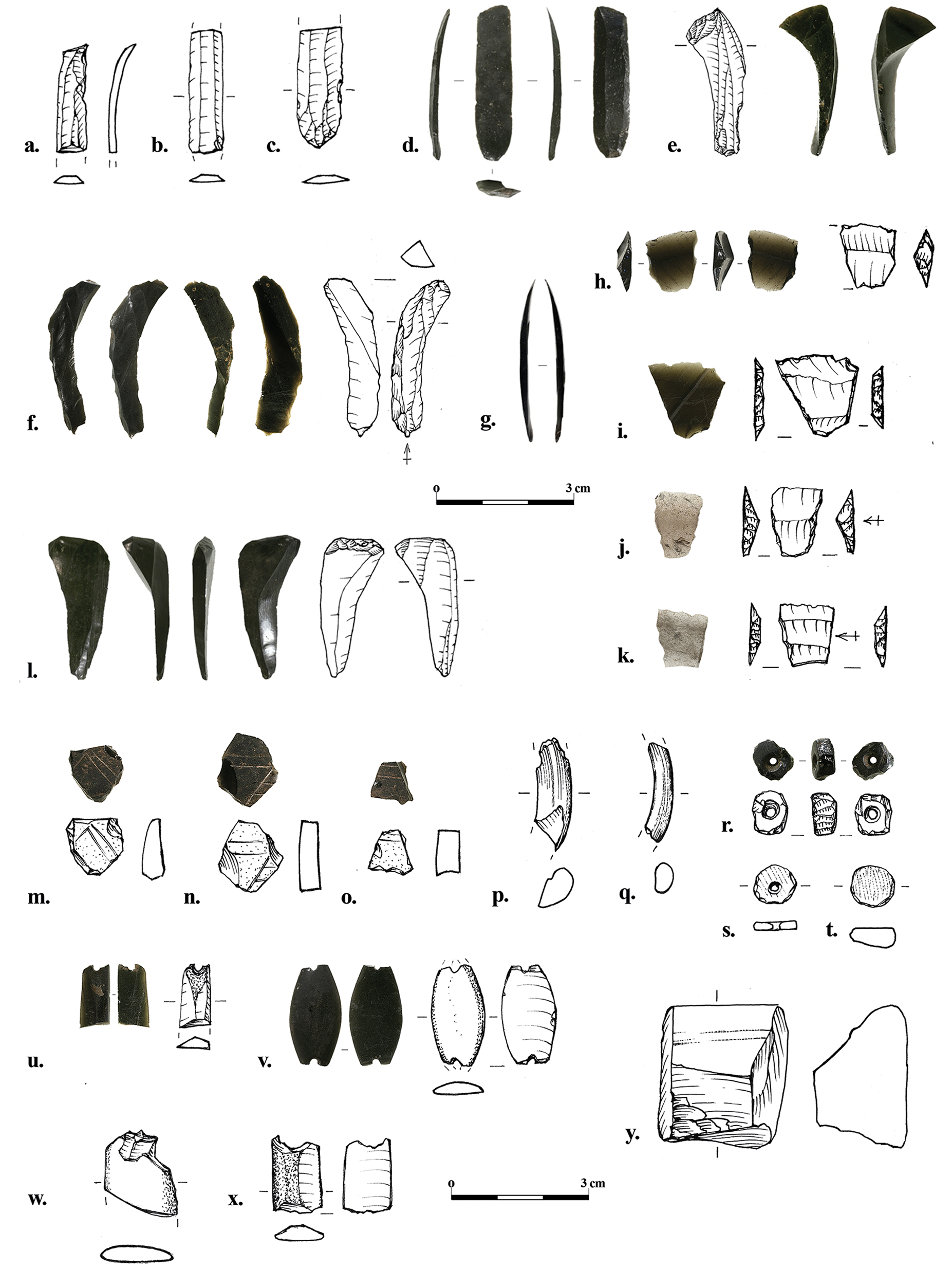
We have suggested (see discussion in Gopher et al. Reference Gopher, Marder, Barkai, Healey, Campbell and Maeda2011) that the large core was to produce potential cores for knapping onsite. No large (target) blanks were found that can match the size of this large core, nor do we know of such blank sizes in any Neolithic lithic assemblage in the region. A similar case may be claimed for the large core from Kabri (Prausnitz Reference Prausnitz1969), although in this case suggesting its arrival as a core is more plausible. We therefore suggest that such cores were not brought for blank production but rather as ‘storage’ of raw material used for making smaller cores. In this context, it may be important to mention the trajectory for producing bijouterie items (e.g. beads). It seems that large chunks or initially prepared cores were brought from the sources, split and shaped into smaller cores (and bijouterie items), knapped mainly by pressure technique to produce mainly bladelets and blades but also flakes, shaped into tools and used in different contexts, re-tooled when needed, and discarded on site. Figure 7 provides examples of the obsidian finds.
A selection of obsidian finds from Hagoshrim IV. (a–d) bladelets; (e–g, l) CTEs; (h–k) transversal arrowheads; (m–o) incisions on obsidian items; (p & q) bracelets; (r–v, w, x) beads and pendants; (y) ball fragment.
Discussion
How the obsidian most likely reached the southern Levant: the distribution models
The network through which obsidian was transported from its sources in Anatolia to the southern Levant remains an open question. The first to tackle this question was Renfrew (Renfrew et al. Reference Renfrew, Dixon and Cann1966; Reference Renfrew, Dixon and Cann1968). In the 1968 article, Renfrew set out the Law of Monotonic Decrement based on his observation that the quantity of obsidian decreased with distance from the source of origin.
Renfrew noticed that by plotting the proportion of obsidian to flint against the distance from source on a logarithmic scale (the distance remaining linear), an exponential fall-off curve appeared. Renfrew suggested that this pattern was the result of down-the-line trade—or in other words, the result of a large number of exchanges (Renfrew Reference Renfrew, Sabloff and Lamberg-Karlovsky1975, 47). Renfrew emphasized that it was the number of successive exchanges of the obsidian that was crucial rather than the spacing of villages or exchanges, with each local community consuming one part of the obsidian received and transferring the remaining part to other communities further ‘down the line’ (Renfrew Reference Renfrew, Sabloff and Lamberg-Karlovsky1975, 47) (see also Supplementary material/Supplement C).
Renfrew's proposed model represented the best fit for the data available at the time (in which no PN samples from the southern Levant were included); however, as more data have become available (and since the 1960s significantly more data have become available), the question as to the appropriate mode of trade relevant to explain the obsidian trade in the southern Levant must also be reconsidered. Renfrew himself detailed additional modes of trade, such as trade by middlemen or trade through a central place market exchange, and showed their potential impact on the abundance of obsidian available at more distant sources (Renfrew Reference Renfrew, Sabloff and Lamberg-Karlovsky1975, 41–2, 48–9). Today Renfrew's initial down-the-line model, originally an important breakthrough in studying late prehistoric trade networks, looks increasingly untenable for the Neolithic Levant.
Ortega (Ortega et al. Reference Ortega, Ibáñez, Khalidi, Méndez, Campos and Teira2014) has highlighted a number of flaws in Renfrew's ‘down the line’ model (see further Supplementary material/Supplement D), and ultimately concludes that the down-the-line model does not adequately describe and explain the distribution of obsidian across the Levant. Ortega, therefore, proposed a new type of approach—agent-based modelling—and a new model of obsidian exchange that functions through small-world networks of exchange.
Small-world networks, originally developed by Watts and Strogatz (Reference Watts and Strogatz1998; Watts Reference Watts2004), are a hybrid between regular networks, where most agents are linked with their immediate neighbours, and random networks, where most agents are linked with distant ones. In small-world networks neighbouring agents are interconnected, but some of them are also able to interact with distant agents by establishing shortcuts between the nodes (Ortega et al. 2012, 468). Small-world networks create more efficient trade routes, providing the opportunity for individual traders to amass greater wealth (Wilhite Reference Wilhite2001). The small-world network model allows some villages to obtain obsidian from more distant partners, while at the same time preserving their local networks of exchange. This model seems a more suitable model for the early distribution of obsidian from its sources and, based on Ortega and Ibáñez modelling, seems appropriate for the periods up to and including the PPNA (Ortega et al. Reference Ortega, Ibáñez, Khalidi, Méndez, Campos and Teira2014; Reference Ortega, Ibáñez, Campos, Khalidi, Méndez and Teira2016). In addition, exchanges between more distant communities, as they propose, would have set the groundwork for building up longer-distance trade and begun the process of establishing trade systems and routes. However, as Ortega and Ibáñez concede, while appropriate for the PPNA, when considering the archaeological data, even this model, in which a certain element of trade between more distant, unrelated communities is taken into account, does not sufficiently explain the movement of obsidian during the PPNB. Ortega et al. (2016, 14) therefore conclude that ‘during the PPNB, this network became more complex and included a small group of interconnected sites or hubs that dictated long-distance obsidian trade’.
Considering that in the late PN Hagoshrim IV, where the ratio of flint to obsidian (as mentioned above: see Table 1) is much lower than during the PPNB, the conclusion must be that local networks of exchange, could not have played an overriding role in the movement of obsidian from its sources in Anatolia to the southern Levant during the late PN period. This means that during this period more sophisticated long-distance interaction between communities close to the sources of the obsidian and those in the southern Levant must have existed than assumed in previous models.
Can the movement of obsidian to the southern Levant be classified as trade?
The importance of the question of when long-distance trade routes were first established is crucial in understanding the social changes which took place and, ultimately, resulted in modern societies. Within modern society, little is manufactured for self-consumption and nearly everything is either obtained by or manufactured for trade. This is in marked contrast with hunter-gatherer societies which largely would have been self-sufficient and would have been engaged in small-scale local exchange systems or in gift giving. As trade evolved from localized trade between neighbouring communities to trade between distant entities (in which the personal connections are less important), so did the opportunities for accumulating wealth and with it the creation of social inequalities and differentiated societies.
There seems to be a reluctance to consider that trade more similar to modern trade occurred in agricultural societies during the later part of the Neolithic period; reliance mainly on pre-industrial trade systems is not adequate (see comment in Supplementary material/Supplement E). A more detailed look would show that there is ample evidence from stratified urban societies in antiquity of trade, the principles of which are not dissimilar to those of modern trade today (for example, see Veenhof Reference Veenhof and Faraguna2013 and Michel Reference Michel and D'Agostino2013 on the Assyrian trading colonies in Kanesh, or Eshel et al. Reference Eshel, Erel, Yahalom-Mack, Tirosh and Gilboa2019 dealing with the early maritime trading in the Mediterranean by the Phoenicians).
It is also necessary to consider the meaning of trade in further depth. At its most basic, trade is a form of consensual exchange. However, in contrast with gift giving, one of the oldest forms of consensual exchange, which originated as an aspect of intra-personal, intra-family and clan relations as a mechanism to forge links between individuals, families and groups, the object of proper trade is to enable the creation of wealth by generating profit (Smith Reference Smith2009, 1–2). We propose that in non-monetarized societies (PN societies included, of course) the concept of profit is tied in with generating a surplus of goods—at the end of the consensual exchange, the individuals involved need to be receiving something of perceived greater value than that which they exchanged and at least one party to the transaction (the party who undertook the risks associated with transporting the goods to the place of exchange) must be generating a surplus to justify undertaking the risks (and costs) in the first place. This difference is crucial to the understanding of trade. As Smith (Reference Smith2009, 2) points out, trade required entrepreneurial behaviour and was characterized by investment and risk taking. Since the purpose of trade was to maximize returns (which is nothing new to intensifying food-producing communities) in order to enrich oneself or a community, economic considerations must have outweighed social and political considerations. Trade was negotiated and funnelled through intermediaries, who could be strangers, and the reward for each party was dependant on the terms of the specific transaction rather than only forming part of a wider socio-political relationship.
In contrast, the giver of a gift gained esteem according to the perceived value of the gift. Thus, it was not the possession of wealth that conferred prestige and power, but the giving of wealth. Gift exchange often was used to forge links between individuals and groups while the object of commercial trade was to create wealth by generating profit (Smith Reference Smith2009, 2). Gift exchange makes sense in the context of local communities establishing social networks with neighbouring (and kin-related) communities, but may not and possibly does not justify agents from distant communities embarking on long and risky journeys to supply exotic commodities. This possibly reflects a different economic system and another perception of wealth.
There is also a tendency to interpret the lack of clear social hierarchies within settlements as a sign that PN societies such as the Wadi Rabah were socially non-ranked; however, as Nieuwenhuyse (Reference Nieuwenhuyse2007) points out, egalitarianism exists only as an ideal (and see Kuijt Reference Kuijt1996; Reference Kuijt and Kuijt2000 for the PPN). He explains that inequalities are present in every human society, including among kin groups, and that the late Neolithic world offered many possibilities for social and economic advancement such as participation in exchange networks or the strategic manipulation of resources and political alliances. Furthermore, following Watson and LeBlanc (Reference Watson and Leblanc1990), Nieuwenhuyse (Reference Nieuwenhuyse2007) emphasizes that hierarchies during the late Neolithic (in their case, the Halafian) could have been built up on achieved wealth rather than inherited status position. Participation in the obsidian trade could have enabled those individuals or groups involved in the trade to advance themselves both economically and socially in comparison to their kinsmen.
Small world networks, for example, place great emphasis on the search for resources, the negotiations for them and their exchange (Wilhite Reference Wilhite2001); however, in trade there are other parameters in play such as risk. Risk has always played a crucial part in trade. The rewards must always outweigh the risks involved and thus risk mitigation is a crucial component of many trade models. Prehistoric long-distance trade would have involved many trading hazards, not least obtaining reliable information about the value or demand for goods, slow and often dangerous transport through unfamiliar territories and finding trustworthy resident trading partners. One longstanding model for international trade involves kin-based trade partnerships. Such partnerships operated by one partner (or the family) remaining in the area of origin, while one or more kin members established themselves temporarily or permanently abroad. While the precise workings of such partnerships change over time based on the type of society they are implemented in (for example the status of women in society, the state structure), due to the risk-mitigation benefits, the basic structure has remained constant. The trade model depicted in the Kanesh archives, for example, was reliant upon such a kin-based trade partnership with one or more members of the family moving to Kanesh in order to manage the Anatolia side of the business (Veenhof Reference Veenhof and Faraguna2013).Footnote 7 For example, in the Assur-idi family the father was based in Assur while his three sons functioned as his agents in Anatolia (Larsen Reference Larsen2015, 202–16). Examples of long-distance trade conducted by kin-based trade partnerships are prevalent even today and have been documented on numerous occasions throughout history (see, for example, Broekaert Reference Broekaert2013 on their use during the Roman period, or Mathers Reference Mathers1988 about the merchant families from Burgos (Spain) in England and France during the fifteenth and sixteenth centuries).
The kin-based trade partnership model seems well suited (and possible) for the late PN period. Embarking on a long and risky trade journey only makes sense if you have a trustworthy agent (such as a member of your household or of your clan) at your destination, who can procure the goods required to take back with you and ensure a market for the goods you are transporting. When considering obsidian specifically, this would also explain how the agent has knowledge of obsidian knapping or accessibility to such knowledge.Footnote 8
In addition, to mitigate the risks involved, such long journeys would have required safe places to stop during the long-distance transportation of goods, as well as intermediaries involved in the trade. Thalmann, for example, proposes that during the PN (based on flint artefacts associated with the obsidian: Thalmann Reference Thalmann2006, 4), Tell Arqa (northern Lebanon) was a stopover on the coastal trade routes linking the obsidian sources with the settlements of the southern Levant.
An alternative element of a ‘trade’ model has been proposed by Nishiaki (Reference Nishiaki, Jöris, Baena Preysler and Nishiakiin press). This trade model comprises and relies upon itinerant specialists who travel from settlements to settlement conducting activities on-site to provide demanded products or performances. Again, this movement would have necessitated the existence of secure long-distance trade routes. Furthermore, the itinerant specialists would have either needed to bring the obsidian with them, been supplied by intermediaries or invited by those who purchased obsidian to perform the work. There are a number of problems with this model when considering its economic aspects. Firstly, the question arises: what does such an itinerant specialist carry with him? To justify embarking on such a long journey, an itinerant specialist would need quite a substantial amount of obsidian cores with him to ensure he has sufficient raw material or a way of ensuring a reliable supply (an obsidian knapper with no raw material in an area with no obsidian would struggle to make a living as a craftsman). Thus, at a minimum he would need his tool kit and a minimum amount of obsidian cores. To replenish his stock, he would need to travel back to areas with obsidian or operate alongside merchants supplying other items (such as those made out of chlorite). Such merchants could provide additional obsidian cores; however, in that case he has additional competition (as they can supply finished items themselves) and from the economic perspective of these merchants it would make more sense to transport finished objects over such long distances (assuming much of the debitage and the debris had little if any value) to keep the weight they are carrying down to a minimum. This raises another issue: the benefit of being able to manufacture tools as per demand, rather than simply supplying finished objects, assuming you are constantly moving from settlement to settlement. It makes far more sense to use obsidian cores if you have a permanent base and the obsidian core is used mainly to supplement your inventory while waiting for a new supply of obsidian tools/cores as well as providing custom items to clients. A permanent base also ensures that merchants travelling these routes have a fixed destination for their goods. The question also arises: what would an itinerant specialist be exchanging for his services? Such a specialist would need to be generating some sort of surplus in goods (beyond those required for subsistence and procuring additional raw materials) to justify their endeavours in the first place. Would such a specialist be carrying these surplus goods with them as they travel from settlement to settlement?
The finds in Hagoshrim are reminiscent of the finds at the burnt house in Arpachiyah. The burnt house excavated by Mallowan (Mallowan & Rose Reference Mallowan and Rose1935) in the 1930s was unusual in that it contained an extraordinary amount of high-value items, including large amounts of obsidian. Campbell (Reference Campbell2000), when re-examining the finds, has noted that given the traditional approaches to settlement hierarchy in the early Near East, where size is equated to centrality, he found it unusual that Arpachiyah was so small and did not have a large concentration of population. We may make a similar statement about Hagoshrim, that we can estimate was a medium-sized Wadi Rabah site. Campbell (Reference Campbell2000) suggests that Arpachiyah may have been at the centre of a wide-ranging economic and probably political network. He also points out that no obvious social hierarchy could be identified, despite the major concentration of wealth in the Burnt House. The concentration of valuable goods in one building may not necessarily reflect individual or communal wealth (which assumes ownership); the goods could well be the inventory, against which obligations could exist towards investors and creditors. By analogy (if not a 1:1 analogy because of the time gap and the different socio-economic system and scale), in Kanesh (fourth millennium cal. bp) debt-notes, service contracts with personnel, transport contracts, contracts on settling accounts, and quittances were found, as well as correspondence with investors and creditors (Veenhof Reference Veenhof and Faraguna2013).Footnote 9 Arguably, such arrangements would have needed to exist in respect of the obsidian trade during the PN period, raising the possibility that the stamp-seals served some purpose connected with administering such obligations, as would the token system in place (see Schmandt-Besserat Reference Schmandt-Besserat1992).
As for the individuals conducting the trade, the most plausible explanation as to the limited presence of stamp-seals in the southern Levant, mainly to Hagoshrim, is that these relate to a trade system and may have belonged to the individuals conducting the trade (rather than being items for onward trade). This also supports the contention that the traders were not originally from the vicinity, but rather arrived there in connection with the trade and brought with them the practice of using seals either as administrative artefacts of a system of exchange or as personal objects of a symbolic nature. The fact that Getzov (Reference Getzov2011) believes that a few of these items were not locally produced is also supportive of the possibility that the owners were based at Hagoshrim yet were not local. The kin-based trade partnership model goes a long way in explaining the presence of stamp-seals connected with the Halaf cultural complex as well as skilled knappers at Hagoshrim forming part of an increasingly sophisticated long-distance trade network within the northern–southern interaction sphere proposed by Milevski et al. (Reference Milevski, Getzov, Galili, Yaroshevich and Kolska Horwitz2016).Footnote 10
Kaplan, when defining the Wadi Rabah culture in the 1950s (Kaplan Reference Kaplan1958a,Reference Kaplanb), pointed out (if in a quite naïve way) the impact of the Halafian and noted the similarities between Wadi Rabah material culture and a ‘Halaf package’ of sorts. Following the kin-based trade partnership model suggested here, we may envision trade agents from communities in the Halafian core areas (in present-day Syria, northern Iraq and southeastern Anatolia) settling in the southern Levant. The influence of the material culture of such trade agents on the local inhabitants may explain the similarities between the two cultures. It is also important to recognize that, in contrast with the distance from the obsidian sources, Hagoshrim is relatively close to the southernmost sites at which Halafian pottery sherds were discovered (such as Ard Tlaili: Kirkbride Reference Kirkbride1969; Reference Kirkbride1971) and is connected by the rift valley.
When considering the possible trade routes, considering that both central and eastern Anatolian sources were utilized during this period, the finds from Tell Arqa in north Lebanon provide a probable answer as to the routes used. Tell Arqa is strategically located between the Mediterranean coast and the rift valley via the Homs gap. The abundance of obsidian (including large cores) from both central and eastern Anatolian sources at Tell Arqa led Thalmann (Reference Thalmann2006) to propose that Tell Arqa was a stopover point on a maritime trade route linking the obsidian sources of Anatolia with Kabri on the Mediterranean coast, based on the obsidian finds at Kabri. Thalmann notes the presence in Kabri of the obsidian mirror (Fig. 2) and the obsidian core (Fig. 3), exceedingly rare objects found to date only at few sites in Anatolia (see Supplementary material/Supplement F).
Thalmann (Reference Thalmann2006) proposes that a maritime route would have been preferable to transport the obsidian due to its perceived value and weight, but accepts that the presence of obsidian from eastern Anatolian sources indicates that non-maritime routes would also have been required. The most logical supply route from eastern Anatolia would either have been along the Orontes river and thereafter through the Bekka valley between the Lebanon and the Anti-Lebanon mountain range and finally through the Hula valley to Hagoshrim following the rift valley, or alternatively the obsidian would have been transported to the Antioch region and then via maritime routes down the coast. Rafts may have been utilized during part of the journey. The Homs gap seems a likely place for the central Anatolian obsidian to have been transported inland towards the settlements along the rift valley.
One unanswered question is what could have been traded for the obsidian. The steppe environment of the Jezireh, where the core of the Halaf culture is to be found, lacks certain resources necessary to the late Neolithic economy, such as bitumen, malachite and precious minerals and certainly other perishable organic matters such as oil, perfumes, spices and moreFootnote 11 that are not known from the archaeological record (Nieuwenhuyse Reference Nieuwenhuyse2007). There is no clear evidence of what was sent from the southern Levant northwards; however, some of these resources could have been obtained by the communities in the region through the trade networks connecting the southern Levant with the Halaf cultural complex. It seems extremely unlikely that the transport of obsidian to Hagoshrim took place in order to underwrite social relationships, as Frangipane (Reference Frangipane, Nieuwenhuyse, Bernbeck, Akkermans and Rogasch2013) suggested was the main purpose of exchange within the area of the Halaf culture (due to the lack of obsidian resources in the Jezireh). It is more likely that the existence of certain resources in the southern Levant drove the trade, and further research needs to be carried out to entertain the idea and establish what these could have been; for example, by residue analyses in selected pottery vessel types in both regions, by geochemical characterization of materials, and more (see note 10).
The fall-off of exchange in the early Pottery Neolithic
The fluctuation in the amount of obsidian available between the early and late Pottery Neolithic period reflects significant changes in the exchange networks supplying the southern Levant with obsidian. As the obsidian analysis from the Yarmukian stratum at Sha'ar Hagolan and those from the Wadi Rabah strata show, the transition from the central Anatolian obsidian sources must have taken place at some point towards the end of the early PN.
The cause for this transition undoubtedly needs to be sought at the source of the obsidian rather than at the place of consumption. It seems likely that the transition to the eastern Anatolian obsidian sources in the southern Levant is connected to the rise of the Halafian cultural complex near the eastern sources. We believe that the presence of trade agents from the north during the late PN provides evidence of the development of professional trade over increasingly sophisticated long-distance trade networks. This trade network would have supplied the Wadi Rabah cultural entity in the southern Levant with exotic goods and procured similarly desired goods for the Halafian cultural complex.
Conclusion
As Ortega et al. (Reference Ortega, Ibáñez, Campos, Khalidi, Méndez and Teira2016, 14) state: ‘… higher capacities of long-distance interaction than we previously supposed, has deep implications for our understanding of the origins and spread of the farming way of life.’ As we have seen from the PPNB onwards, and clearly in the later phases of the PN due to the amount of obsidian found at sites in the southern Levant, the trade models based on the movement of goods through local exchange networks no longer provide a satisfactory explanation. The most plausible explanation is that, during the later phases of the PN, direct trade took place between Anatolia and the southern Levant. This necessitated adopting a new model of direct trade and, as this paper proposes, the kin-based trade partnership model in which members of a family relocated to the southern Levant in order to manage the business provides one possible model. Based on ancient Near Eastern archives that describe a much later trade system (dated to c. 4000 cal. bp), we suggest that there is sufficient evidence of trade in the Pottery Neolithic period which conforms far better to the principals of modern trade than to the ethnographic examples from preindustrial societies. Ultimately, modern trade is the culmination of a long process whose origins may lie with the exchange of goods between distant and unrelated communities during the Pottery Neolithic period. The impact of such trade on the Wadi Rabah culture of the southern Levant should also not be underestimated. Those conducting the trade out of Hagoshrim would have exposed the surrounding communities to a material and non-material culture different from their own. Such exposure and its influence inevitably goes some way in explaining similarities between Wadi Rabah and Halaf material culture elements such as pottery and sling stones. Furthermore, by participating in the trade, members within the local communities would have had the opportunity to distinguish themselves from their peers, starting the process of accelerated social differentiation.
Acknowledgements
We would like to thank N. Getzov of the Israel Antiquities Authority for his help and for allowing us to use the photos of stamp seals from Hagoshrim (Fig. 5). We thank I. Ben-Ezra for preparing Figures 1 and 4, and we thank Dana Ackerfeld for her help with Figure 7. Obsidian items from the Hagoshrim collection and excavation are courtesy of the late A. Assaf and of N. Getzov.
Supplementary material
Supplementary material may be found at https://doi.org/10.1017/S0959774322000397


 Open access

