

Introduction
Mosasaur remains from the Atlantic coastal plain deposits of New Jersey have been known since 1818, when Cuvier noted a report of their discovery sent by Mitchell (Russell, Reference Russell1967). Morton wrote a series of papers in the 1830s figuring mosasaur specimens from the Atlantic Highlands sea cliffs of New Jersey along Raritan Bay, and from marl pits in Monmouth, Burlington and Gloucester counties (Morton, Reference Morton1830, Reference Morton1832, Reference Morton1834). Morton correctly correlated the greensand units yielding the mosasaur specimens with the Cretaceous chalk of Europe, and specifically the Maastrichtian portion of the Upper Cretaceous beds.
These specimens came out of the inner coastal plain marl belt, which extends across New Jersey from Raritan Bay on the northeast to the head of Delaware Bay to the southwest, and thence across Delaware and into eastern Maryland. Although the Cretaceous deposits are covered by onlapping Cenozoic units in Virginia and northern North Carolina, they remerge in southeastern North Carolina and form part of the outcrop belt of the coastal plain Cretaceous in South Carolina and Georgia and through the Gulf states into eastern Texas. The older Cretaceous outcrops are located inland of the more seaward Cenozoic beds.
In New Jersey, the exposed Upper Cretaceous section ranges from Cenomanian to Maastrichtian in age (see Table 1). Although outcrops today are limited by soil, plant and construction cover, in the 19th century the industry of marl mining for fertiliser provided much more extensive and continuously worked exposures in the sequence of Late Cretaceous and Early Tertiary beds (Cook, Reference Cook1868; Gallagher, Reference Gallagher1997). Fossils were abundant in these mines and during the heyday of marl mining the pits produced numerous vertebrate fossils, including chondrichthyans, osteichthyians, turtles, plesiosaurs, crocodilians., dinosaurs and birds. A number of mosasaur specimens also came out of these workings and formed the basis for historically important taxa described by Leidy (Reference Leidy1865), Cope (Reference Cope1867, Reference Cope1869) and Marsh (Reference Marsh1869). Stratigraphic terminology when it was given for these specimens is often in the old miners’ terms for the economically productive beds, and when this information is available it can be used to determine stratigraphic provenance (see Table 1). Locality data can help with stratigraphic provenance as well.
Modern stratigraphic nomenclature for Maastrichtian–Paleocene deposits, their 19th century equivalents, fossil faunas and ages, Atlantic Coastal Plain of New Jersey (compiled from Cook, Reference Cook1868 and Gallagher, Reference Gallagher1993).

Most of the mosasaur material originating from marl belt deposits was fragmentary, and numerous names were assigned to these specimens, especially during the early stages of the Cope–Marsh competition. By the middle of the 20th century some 20 names for New Jersey mosasaurs were circulating in the literature (Miller, Reference Miller and Richards1962). Russell (Reference Russell1967) reduced the oversplitting to eight valid names; subsequently some of these have been synonymised (Mulder, Reference Mulder1999). Gallagher (Reference Gallagher1993, Reference Gallagher2005) and Gallagher et al. ( 2012) attempted to set these specimens within a more modern stratigraphic framework, especially with respect to the K/Pg boundary.
Comparative taphonomy of the Late Cretaceous and Early Paleogene deposits in the Atlantic coastal plain of New Jersey reveals patterns of preservation for vertebrate specimens from these units (Gallagher, Reference Gallagher1993, 2004; Gallagher et al., Reference Gallagher, Miller, Sherrell, Browning, Field, Gallagher, Olsson, Sugarman, Tuorto and Wahyudi2012). Specimens from these beds occur in one of three taphonomic modes: (1) isolated specimens of one or two bones or teeth, (2) as multi-element specimens of several or more associated or articulated bones and teeth, and (3) more or less worn or abraded single elements in concentrations of numerous vertebrate fossils.
Campanian glauconitic marls and sand deposits yield mostly isolated elements of mosasaur material (taphonomic mode 3, above) and only rarely the occasional multi-element specimen (Gallagher, Reference Gallagher2005; Gallagher et al., Reference Gallagher, Miller, Sherrell, Browning, Field, Gallagher, Olsson, Sugarman, Tuorto and Wahyudi2012). The Maastrichtian Navesink and New Egypt Formations have yielded more of the mosasaur-type specimens and multi-element remains (taphonomic modes 1 and 2) known from these deposits (Russell, Reference Russell1967; Gallagher et al., Reference Gallagher, Miller, Sherrell, Browning, Field, Gallagher, Olsson, Sugarman, Tuorto and Wahyudi2012.)
Stratigraphically the highest mosasaur remains known from the New Jersey Maastrichtian–Danian sequence come from the basal Hornerstown Formation, a glauconite sand deposit that was mined extensively first for fertiliser and later for use as a water conditioner. While this unit was extensively exposed in the 19th century, only one active mine remains today, the Inversand Company pit at Sewell, Gloucester County, New Jersey. Older abandoned pits have quickly reverted to overgrown and slumped swampy lakes and ponds with very little exposure left. Thus, the Inversand operation has become an important reference section for understanding the origin of specimens derived from older pits in this part of the marl belt. In other areas, adjacent existing streambank cuts expose some of the stratigraphy of the K/Pg section and can also be used to help establish the provenance of 19th century mosasaur discoveries (Gallagher et al., Reference Gallagher, Miller, Sherrell, Browning, Field, Gallagher, Olsson, Sugarman, Tuorto and Wahyudi2012).
A widespread iridium excursion plus dinoflagellate biostratigrahy places the K/Pg boundary within the bottom part of the Hornerstown near the base of the formation, in some localities associated with a concentration of marine fossils (Miller et al., Reference Miller, Sherrell, Browning, Field, Gallagher, Olsson, Sugarman, Tuorto and Wahyudi2010; Gallagher et al., Reference Gallagher, Miller, Sherrell, Browning, Field, Gallagher, Olsson, Sugarman, Tuorto and Wahyudi2012).
The basal Hornerstown fossil concentration (or Main Fossiliferous Layer, MFL) is a well-known widespread fossil horizon that extends for some 100 km along strike in this section. Although not present in every outcrop of the Hornerstown Formation (for example at Buck Pit in northern Monmouth County), this fossil layer produced a distinctive suite of invertebrate and vertebrate specimens at old excavations at the Cream Ridge Marl Company on Meirs Farm in Hornerstown, Monmouth County, in the old Zeolite Company pit at Birmingham and the Permutitt pits in Medford, Burlington County, the exposures around White Horse in Camden County, and in the West Jersey Marl Company workings variously listed at Sewell or Barnesboro, New Jersey in Gloucester County (see information and sections in Cook, Reference Cook1868).
All of these pits produced multi-element specimens of crocodilians and chelonians, as well as mosasaur remains. Some of the mosasaur-type material was derived from the New Egypt Formation; this is the probable provenance of Liodon sectorius Cope from the Birmingham Pit, Prognathodon rapax Cope from the West Jersey Company operations and Halisaurus platyspondylus Marsh from the Cream Ridge Marl Company at Meirs Farm (Gallagher et al., Reference Gallagher, Miller, Sherrell, Browning, Field, Gallagher, Olsson, Sugarman, Tuorto and Wahyudi2012). This would place them in the formation just below the Hornerstown basal Ir excursion; the New Egypt is Late Maastrichtian in age. While previous papers have focused on the Campanian mosasaurs (Gallagher, Reference Gallagher2005) and earlier Late Maastrichtian mosasaur specimens from the Navesink–New Egypt depositional sequence (Gallagher et al., Reference Gallagher, Miller, Sherrell, Browning, Field, Gallagher, Olsson, Sugarman, Tuorto and Wahyudi2012), this paper completes the cycle by considering the mosasaur specimens from the highest stratigraphic level where they are found in New Jersey, the basal greensand of the Hornerstown Formation.
Analyses and results
The institutional abbreviations used in this report are as follows: ANSP – Academy of Natural Sciences of Drexel University; NJSM – New Jersey State Museum; YPM – Yale Peabody Museum.
Most of the mosasaur material that has come out of the basal Hornerstown fossil concentration consists of single elements such as vertebrae or teeth, but there are some multi-element specimens and at least one partial skull from the Hornerstown Formation. This is YPM 773, consisting of some 32 skull elements, teeth and vertebrae. Older associated labels list the specimen as collected by Sam A. Fastlach in 1872.
This specimen consists of 16 teeth, a coronoid, pterygoid, a cervical vertebra, both left and right squamosals, the right prootic, left splenial, right angular, right surangular, a fragment of the basisphenoid, both quadrates, a fragment of the basioccipital, the right surangular, a fragment of the right maxillary and the posterior part of the maxillary with alveoli.
The teeth are typical of Mosasaurus hoffmanni (=M. maximus). Several are attached to the roots. The crowns are D-shaped in cross-section, striated but not strongly faceted, most with tips worn or broken off. Larger crowns are 4–5 cm high from the crown base at the root.
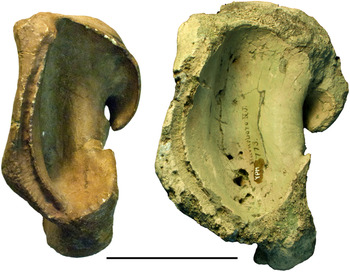
The pterygoids are massive and curved, with several alveoli apparent for pterygoid teeth. Russell (Reference Russell1967) noted that there were some differences in the nerve VII openings in YPM 773 from the other large mosasaurs from New Jersey. He also states that the splenial articulating surface is more elliptical than other mosasaur taxa, but that otherwise most of the skull and jaw elements are similar to the M. maximus holotype. However, the YPM 773 quadrate is a third to a quarter larger than the holotype specimen of M. hoffmanni (Fig. 1), and larger than the quadrates of NJSM 11052 and 11053 (both attributed to M. maximus) from the New Egypt Formation at the Inversand Pit. The quadrate of YPM 773 displays a small bump on the tympanic ridge seen in the holotype quadrate of M. maximus. The curve of the suprastapedial is also different from M. hoffmanni (see Fig. 1).
Comparison of cast of Mosasaurus hoffmanni holotype quadrate with quadrate of YPM 773, from Hornerstown Formation, Barnsboro, NJ (image courtesy of M. Polcyn). Scale bar = 1 dm.
Associated with the specimen is a vial of greensand matrix that is unique to the Hornerstown Formation. The stratigraphic provenance of the specimen is given on its label as Middle Greensand, an old 19th century term for the Hornerstown Formation (Table 1). The specimen is a large skull of M. hoffmanni assigned to M. maximus on its label. The preservational quality of the mosasaur bone itself is unlike the more dense, darkened thoroughly permineralized bone of mosasaurs found in subjacent units such as the New Egypt Formation or the Navesink Formation; YPM 773 is, like other bone from the basal Hornerstown Formation, much lighter in both colour and density, and with more open pores in the interior bone and less permineralisation.
More recent discoveries of mosasaur material from the basal Hornerstown Formation greensand include ANSP 15679, a string of four caudal vertebrae, plus newly discovered (and as yet unnumbered) vertebrae and teeth in the ANSP collection. The NJSM collections include several braincases, teeth and vertebrae from the basal Hornerstown Formation at the Inversand Pit. NJSM 11070 contains several teeth from the basal Hornerstown attributed to Plioplatecarpus depressus. NJSM 12809, 13423, 11332, 11895, 12184, 12267, 12355, 12288, 12389, 12398, and 12399 are all assigned to Mosasaurus sp. or Mosasauridae indet. from the MFL layer at the Inversand Pit. NJSM 14160 and 12184 are braincases similar to the same element in the M. maximus skulls from the underlying New Egypt Formation.
Rare earth element (REE) analyses conducted on mosasaur material in the NJSM collections from the underlying New Egypt Formation and from the superjacent Hornerstown Formation show significant differences in the REE content of mosasaur bones from the two formations (Staron et al., Reference Staron, Grandstaff, Gallagher and Grandstaff2001). This study interpreted the REE differences as evidence against reworking of the mosasaur elements from the subjacent New Egypt upward into the basal part of the Hornerstown Formation.
These Hornerstown specimens represent an understudied and underappreciated group of mosasaur remains from a critical horizon. It is likely that other historical collections contain specimens from the basal Hornerstown Formation that remain unrecognised, for example in the Cope Collection at the American Museum of Natural History. In the meantime, ongoing excavations at the Inversand Pit and at other sites continue to yield new specimens from the K/Pg boundary in New Jersey.
These are the highest and hence youngest mosasaur fossils from the Cretaceous sequence of New Jersey. Here, extinction of mosasaurs led to a trophic cascade in which smaller predators radiated and proliferated in shallow marine waters, including crocodylians (five species in the Hornerstown Formation), and basal forms of more modern selachian groups (Paleocarcharodon, Otodus) (Gallagher, Reference Gallagher1993, Reference Gallagher, Koeberl and Mackleod2002). Marine chelonians also proliferated in the wake of the mass extinction event, quite probably as a result of relaxation of predation pressure from mosasaurs, which are known to have attacked sea turtles (Everhart et al., Reference Everhart, Maltese and Jett2013).
Elvis taxon
The study of mass extinctions has generated a number of amusing new names for some of the evolutionary phenomena associated with them: Lazarus taxa, Lilliput fauna, dead clade walking and Elvis taxon (Benton & Harper, Reference Benton and Harper2009). The term ‘Elvis taxon’ refers to an interesting idea about convergence after mass extinction events. An Elvis taxon is a genus that appears at some time after the extinction event that is highly convergent on one of the taxa that was extirpated in the mass extinction. It is in effect an impersonator of the extinct taxon.
Mosasaurs had an Elvis taxon. By the Eocene Epoch, the archaeocete Basilosaurus appeared, an ecological analogue for large predaceous mosasaurs. It was originally named Basilosaurus by Harlen (1834) because when first discovered its remains were thought to be from a giant marine reptile, possibly a mosasaur. Owen sought to remedy the situation by renaming the mammalian remains Zeuglodon, but the original name stuck. Even modern reconstructions emphasise the mosasaur-like body plan of Basilosaurus, although subsequently cetaceans evolved into diverse body types. This raises an interesting speculation: if mosasaurs were not in some sense cut short in their evolutionary development by the K/Pg mass extinction, would they have gone on to converge on modern marine mammal body plans?
Biodiversity loss and marine ecosystem change today
In the modern Southern Ocean whaling has reduced populations of large cetaceans and led to the proliferation of smaller predators in Antarctic waters. This localised event suggests how the paleoecological dynamics of larger mass extinctions may have functioned in world oceans. In the early years of the 20th century the commercial whaling industry moved into Antarctic waters after many of the whale stocks in the Atlantic and Pacific Oceans were depleted (Morrissey & Sumich, Reference Morrissey and Sumich2012).
Modern factory boats with explosive harpoons rigged on their bows made whaling more effective and efficient; soon, large numbers of balenopterids were harvested. In 1929, at the height of the whaling industry, 29,000 blue whales were killed in the Southern Ocean. The population of blue whales plummeted, and whalers turned their attentions to the next consecutively smaller species of baleen whales: fin, sei and Minke. As species after species of whale was harvested, the smaller predators became more numerous, presumably because the biomass of small crustaceans and small fish became more available. Seal and sea bird populations expanded when the top trophic level was systematically eliminated (Morrissey & Sumich, Reference Morrissey and Sumich2012; Leatherwood & Foster, Reference Leatherwood and Foster1983).
This is a localised more limited biomass reduction that is not on the scale of a major mass extinction, and there are important differences between the effects of whale hunting and K/Pg plankton crash, but it still suggests how the trophic dynamics of a larger event like the K/Pg extinction functioned. Removal of apical predators can have clear effects on an ecosystem. Mosasaur populations declined and disappeared probably because the sudden collapse of the phytoplankton population could no longer support the big apical predators. Food chain effects included disappearance of major large molluscan groups such as ammonites and exogyrids, plus extinction among other prey groups (Gallagher, Reference Gallagher1992, Reference Gallagher1993, Reference Gallagher, Koeberl and Mackleod2002).
Discussion and conclusions
The basal Hornerstown Formation is the K/Pg boundary in the New Jersey coastal plain, on the basis of a widespread iridium excursion, dinoflagellate biostratigraphy, last occurrences of Late Cretaceous megafossils and shocked quartz in burrows. This horizon has consistently produced larger and more complete multi-element vertebrate specimens.
YPM 773 is a large multi-element skull from the lower Hornerstown Fm. fossil bed on the evidence of 19th century stratigraphic provenance (Middle Marl = Hornerstown Fm.), site information, associated matrix and preservational style. Specimens in older collections lacking modern stratigraphic information can be reliably attributed to specific beds if these forms of evidence are present.
Specimens of mosasaurs from this horizon represent the last populations of these apical marine predators. Collapse of marine food chains initiated by an abrupt crash in plankton populations probably affected k-selected mosasaur populations, leading to extinction.
Removal of mosasaurs led to a trophic cascade effect in which smaller predators filled the ecological niche vacated by the apical predator. At the K/Pg boundary, this meant a proliferation of marine crocodiles, sharks and sea turtles, all populations probably previously kept in check by large mosasaurs. These animals fed on lower levels of the food chain. Crocodilians, for example, were (and are) opportunistic generalists, feeding on a wide array of prey items in a wide range of environments; they became the primary predators in the marine realm with the extinction of the mosasaurs (Gallagher, Reference Gallagher1993, Reference Gallagher, Koeberl and Mackleod2002; Barbosa et al., Reference Barbosa, Kellner and Viana2008; Jouve et al., Reference Jouve, Bardet, Jalil, Suberbiola, Bouya and Amaghaz2008).
Within about 20 million years, by late Eocene, the Elvis taxon Basilosaurus appeared to reoccupy the niche of large marine apical predator.
Today the decline of large cetaceans in modern Antarctic waters leads to food chain effects that favour smaller predators feeding on trophic resources once harvested by the larger marine animals (Morrissey & Sumich, Reference Morrissey and Sumich2012). This is ecologically analogous to what may have happened on a larger scale during and after the K/Pg mass extinction.
Acknowledgements
I thank Michael Polcyn of the Southern Methodist University for inviting me along to look at mosasaurs in the Yale Peabody Museum, and for encouraging this work. I thank the Yale Peabody Museum of Natural History and Curator Jacque Gauthier for allowing me access to the YPM collections. Also, thanks to Ted Daeschler and Ned Gilmore of the Academy of Natural Sciences of Drexel University for collection access. My thanks to my colleagues at the Department of Earth and Planetary Sciences of Rutgers University, particularly Kenneth Miller and Richard Olsson, for participation in the Rutgers K/Pg drill coring project sponsored by NSF grant #070778 to PI K. Miller. I appreciated the input of reviewers Anne Schulp and Nathalie Bardet for their comments and suggestions, which improved this work. I thank Louis Jacobs and Michael Polcyn for organising the Fourth Triennial Mosasaur Meeting in Dallas, Texas, USA.



