


1. Introduction
The United States is the world’s leading beef producer, contributing 20% of global beef production (USDA-FAS, 2024). The U.S. beef supply chain is highly segmented, with cattle oftentimes changing ownership multiple times between birth and slaughter. About 95% of U.S. beef cattle are grain-finished in feedlots before slaughter (Kosto, Reference Kosto2022). The feedlot stage of production, spanning approximately six months, is a period of efficiently adding weight to the animal’s carcass. During this stage, cattle are primarily fed cereal grains and grain by-products; feed substitutions may occur in response to changing economic factors (Drouillard, Reference Drouillard2018).
Profitability for cattle feeders fluctuates considerably from month to month. Between January 2015 and December 2023, feedlot net returns in the Southern Plains averaged $30.80 per head, ranging from $457.43 to −$489.12 per head (). As margin operators, feedlots face both output price risk (fed cattle) and input price risk (feeder cattle and feed). A large body of literature has examined the determinants of feedlot profitability (e.g., Albright et al., Reference Albright, Schroeder, Langemeier, Mintert, Brazle, Luther and Johnson1993, Albright, Schroeder, and Langemeier, Reference Albright, Schroeder and Langemeier1994; Langemeier, Schroeder, and Mintert, Reference Langemeier, Schroeder and Mintert1992; Lawrence, Wang, and Loy, Reference Lawrence, Wang and Loy1999). These studies consistently find that feed prices are a key driver of feedlot gain cost and overall profitability. An important gap in the literature is the mechanism through which feed prices affect feedlot profitability. While the directional impact of higher feed costs is clear – increased feed expenses – the relationship is not likely proportional. Rational managers adjust feed input levels, placement weights, and slaughter weights in response to price changes, altering the technical relationship between inputs and outputs. Market prices for feedstuffs may cause changes in technical efficiency for profit-maximizing feedlots. Technical efficiency refers to the effectiveness of utilizing inputs to produce output. For a feedlot, changes in technical efficiency result through three pathways: changes in slaughter weight, changes in placement weight, and changes in feed input levels. Taken together, we discuss the total effect of feed price changes. Alternatively, holding slaughter weights constant, we discuss the input substitution effect (including varying placement weights) of feed price changes. The input substitution effect occurs when producers substitute inputs in response to input price changes. Lastly, holding slaughter weight and placement weight constant, we discuss the feed substitution effect.
We provide a conceptual discussion of the impact of feed prices on technical efficiency, grounded in microeconomic theory. This discussion clarifies the three pathways for the effects and gives some indications regarding the interpretation of direction. Then, using monthly closeout data from Kansas feedlots, we estimate the impact of market prices on cattle performance. We focus on three measures of technical efficiency: average daily gain (ADG), days on feed (DOF), and feed conversion ratio (FCR). Linear regression models are used to assess the effects of prices for a representative feedlot ration – including corn, dried distiller’s grain (DDGs), wheat, alfalfa, and other ingredients – on these efficiency measures. Our findings indicate that price increases in other hay, sorghum, barley, and supplements lead to a decline in technical efficiency, while higher prices for alfalfa, wheat, DDGs, soymeal, and molasses have the opposite effect. The different effects by feed type are likely due to different marginal rates of technical substitution.
Our findings have implications for feedlot management. Implicit in profit maximization and assumptions made in this paper are that producers already know the trade-offs between input substitution and production and balance these to optimize net returns. Therefore, this paper is not intended to inform these choices. Rather, as profit-maximizing production decisions are made, it is important to understand the technical efficiency implications for planning and other management purposes. Although this balance is likely familiar to feedlot managers, we are the first to quantify these relationships. Existing literature largely focuses on the impact of feed and cattle prices on the cost of gain and feeding returns. In contrast, we directly examine the pathway through which feed cost impacts occur.
Additionally, the results of this research have implications for policy as there are potential environmental impacts of changing feed prices. If a policy changes the relative price of a feed ingredient, then substitution impacts the days cattle spend on feed. Research has shown that the total greenhouse gases emitted from cattle over their lifetimes is influenced by days spent on feed (Cooprider et al., Reference Cooprider, Mitloehner, Famula, Kebreab, Zhao and Van Eenennaam2011). Our results provide estimates that could be used to quantify these effects, given projections of feed price changes due to a policy.
This paper contributes to three areas of research on fed cattle production: (1) price and production risk in cattle feeding, (2) animal performance and management decisions, and (3) determinants of feedlot profitability. Early studies focused on the impacts of corn and cattle prices on feedlot cost of gain and profitability (Albright et al., Reference Albright, Schroeder, Langemeier, Mintert, Brazle, Luther and Johnson1993; Albright, Schroeder, and Langemeier, Reference Albright, Schroeder and Langemeier1994; Lawerence, Wang, and Loy, Reference Lawrence, Wang and Loy1999; Mark, Schroeder, and Jones, Reference Mark, Schroeder and Jones2000). Belasco, Ghosh, and Goodwin (Reference Belasco, Ghosh and Goodwin2009) use data from commercial feedlots in Nebraska and Kansas to jointly model factors impacting the mean and variance of four measures of production risk. They find placement weight, gender, location, and seasonality significantly impact production risk, measured by the feed conversion ratio, average daily gain, mortality rate, and veterinary expenses. Belasco, Cheng, and Schroeder (Reference Belasco, Cheng and Schroeder2015) look at the impacts of weather-related risks on feedlot profitability. McKendree, Tonsor, and Schulz (Reference McKendree, Tonsor and Schulz2021) survey feedlots to determine how they manage different types of production and price risk. Our study extends this literature by examining how variation in feed prices influences technical efficiency outcomes, rather than focusing solely on profitability.
We also build on literature that examines feedlot performance differences due to cattle characteristics and management practices. Cernicchiaro et al. (Reference Cernicchiaro, Renter, Xiang, White and Bello2013) use hierarchical Bayesian modeling to determine factors affecting the variance of average daily gain among pens of feedlot cattle. Among these factors are feedlot arrival season (e.g., summer), placement weight, and pen cohort size. Belasco et al. (Reference Belasco, Taylor, Goodwin and Schroeder2009) examine how price and yield shocks affect conditional feedlot profit distributions, using performance variables such as average daily gain, feed conversion ratio, veterinary costs, and mortality. Cattle characteristics, location, and seasonality are key determinants of both the mean and variance of feedlot yield risk, emphasizing the importance of accounting for heterogeneity (Belasco et al., Reference Belasco, Taylor, Goodwin and Schroeder2009). Research has also estimated the economic value of animal health and performance management practices (Dennis et al., Reference Dennis, Schroeder, Renter and Pendell2018; Thompson et al., Reference Thompson, DeVuyst, Brorsen and Lusk2014). While prior studies emphasize biological and feedlot sources of heterogeneity, we show that differences in feed prices also contribute to variation in the feed conversion ratio, average daily gain, and days on feed.
The Kansas feedlot data that we use in this paper has extensive use in the literature to understand feedlot profitability (e.g., Albright et al., Reference Albright, Schroeder, Langemeier, Mintert, Brazle, Luther and Johnson1993; Albright, Schroeder, and Langemeier, Reference Albright, Schroeder and Langemeier1994; Langemeier, Schroeder, and Mintert, Reference Langemeier, Schroeder and Mintert1992; Lawerence, Wang, and Loy, Reference Lawrence, Wang and Loy1999). Langemeier, Jones, and Kuhl (Reference Langemeier, Jones and Kuhl2001) use this data to estimate improvements in cattle performance by sex and weight class. Herrington and Tonsor (Reference Herrington and Tonsor2013) study structural changes in feedlot performance using the same data, with particular attention to performance over time. Tonsor and Mollohan (Reference Tonsor and Mollohan2017) use the Kansas feedlot data to infer a time horizon for hedging. Our study builds on this work by introducing a new conceptual and econometric framework to estimate the specific channels through which feed prices influence feedlot efficiency outcomes for steers and heifers.
2. Methods
2.1. Conceptual model
This analysis aims to show how input prices for feed have a conceptual link to cattle performance measures. We show the conceptual link under both profit maximization and cost minimization with implications for the empirical model for the feed conversion ratio. This allows us to estimate total effects, substitution effects, and feed substitution effects. We focus on the impact of feed prices on FCR more formally and only infer the expected effects on ADG and DOF. Our model is not a dynamic model and thus does not directly include time as a dimension. Therefore, formally analyzing the impact of feed prices on average daily gain and days on feed is not possible in this setup. We focus on how efficiency gains might extend to these other measures. Specifically, if FCR increases, cattle become less efficient, and ADG decreases. Further, if they gain less each day, then it takes longer to reach slaughter weight, and as a result DOF may increase – dependent on any changes in total weight gain.
2.1.1. Total effect: profit maximization approach
When feed prices change, the total effect of the price change on input levels consists of an expansion/contraction effect and a substitution effect. In turn, the adjusted input mix and the new output level impact technical efficiency. To examine the total effects of input price changes, we begin with a standard profit maximization framework with one output, two feedstuffs, and the placement weight of cattle as inputs.Footnote
1
The production of fat cattle (measured by slaughter weight q) can be described by q = f(x
1, x
2, x
pw
), which is a twice continuously differentiable function of substitute feedstuffs, x
1 and x
2, placement weight, x
pw
. Moreover, we assume diminishing marginal product, implying ${\partial f \over \partial x_{i}}\lt 0$
, where i ∈ {1, 2, pw}. Producers face fat cattle price p, feeder cattle price w
fc
, feed prices w
1 and w
2, and fixed costs FC.
${\partial f \over \partial x_{i}}\lt 0$
, where i ∈ {1, 2, pw}. Producers face fat cattle price p, feeder cattle price w
fc
, feed prices w
1 and w
2, and fixed costs FC.
The producer’s problem can be defined as:
 $$\eqalign{ & \pi = {\max _{q,{x_1}, \ldots, {x_n}}}pq - {w_1}{x_1} - {w_2}{x_2} - {w_{fc}}{x_{pw}} - FC \cr & \ \ \ \ \ \ \ \ \ \ \ \ \ \ subject\ to{:}\ q = f\left( {{x_1},{x_2},{x_{pw}}} \right). \cr} $$
The first order conditions are as follows:
 $$pf_{{x_{1}}}-w_{1}=0,$$
 $$pf_{{x_{2}}}-w_{2}=0,\quad {\rm and}$$
 $$pf_{{x_{pw}}}-w_{fc}=0.$$
So long as the Hessian matrix is negative definite, then we can solve the first order conditions to obtain the following input demand functions:
 $$x_{1}=x_{1}^{*}\left(w_{1},w_{2},w_{fc},p\right),$$
 $$x_{2}=x_{2}^{*}\left(w_{1},w_{2},w_{fc},p\right), \ \ \ \ {\rm and}$$
 $$x_{pw}=x_{pw}^{*}\left(w_{1},w_{2},w_{fc},p\right).$$
The first derivatives with respect to input prices are:
 $${\partial x_{1}^{*} \over \partial w_{1}}\lt 0 {\partial x_{2}^{*} \over \partial w_{1}}\gt 0 {\partial x_{pw}^{*} \over \partial w_{1}}\gt 0 {\partial x_{1}^{*} \over \partial w_{2}}\gt 0 {\partial x_{2}^{*} \over \partial w_{2}}\lt 0 {\partial x_{pw}^{*} \over \partial w_{2}}\gt 0 {\partial x_{1}^{*} \over \partial w_{fc}}\gt 0 {\partial x_{2}^{*} \over \partial w_{fc}}\gt 0 {\partial x_{pw}^{*} \over \partial w_{fc}}\lt 0.$$
The diagonal first derivatives are all negative as we assume decreasing marginal product in each input. The signs for the off diagonals are positive because these are all substitute inputs.
The output supply is defined as:
 $$q^{*}=f\left(x_{1}^{*}\left(x_{1},x_{2},x_{pw},p\right), x_{2}^{*}\left(x_{1},x_{2},x_{pw},p\right),x_{pw}^{*}\left(x_{1},x_{2},x_{pw},p\right)\right).$$
From the duality between cost and production functions, it can be shown that ${\partial q^{*} \over \partial w_{i}}={-\partial x_{i}^{*} \over \partial p}$
. For normal inputs,
${\partial q^{*} \over \partial w_{i}}={-\partial x_{i}^{*} \over \partial p}$
. For normal inputs, ${\partial x_{i}^{*} \over \partial p}$
is positive. However, for inferior inputs,
${\partial x_{i}^{*} \over \partial p}$
is positive. However, for inferior inputs, ${\partial x_{i}^{*} \over \partial p}$
is negative.Footnote
2
Therefore,
${\partial x_{i}^{*} \over \partial p}$
is negative.Footnote
2
Therefore, ${\partial q^{*} \over \partial w_{i}}$
is negative for normal inputs but positive for inferior inputs.
${\partial q^{*} \over \partial w_{i}}$
is negative for normal inputs but positive for inferior inputs.
How does the FCR respond to a change in feed prices? First, FCR is defined as the sum of feed inputs over the weight gained in the feeding period as follows:
 $${\rm FCR}= {x_{1}^{*}+x_{2}^{*} \over q^{*}-x_{pw}^{*}}.$$
Then, the derivative of the feed conversion ratio with respect to feed prices is defined as:
 $${\partial {\rm FCR} \over \partial w_{i}}={\left(q^{*}-x_{pw}^{*}\right)\left({{\partial x_{1}^{*}} \over{\partial w_{i}}}+{{\partial x_{2}^{*}} \over{\partial w_{i}}}\right)-\left(x_{1}^{*}+x_{2}^{*}\right)\left({{\partial q^{*}}\over{\partial w_{i}}}-{{\partial x_{pw}^{*}} \over{\partial w_{i}}}\right) \over \left(q^{*}-x_{pw}^{*}\right)^{2}},$$
where i ∈ {1, 2}. Here, ${\partial x_{1}^{*} \over \partial w_{i}}$
represents the feed substitution effect of feedstuff x
1,
${\partial x_{1}^{*} \over \partial w_{i}}$
represents the feed substitution effect of feedstuff x
1, ${\partial x_{2}^{*} \over \partial w_{i}}$
represents the feed substitution effect of feedstuff x
2,
${\partial x_{2}^{*} \over \partial w_{i}}$
represents the feed substitution effect of feedstuff x
2, ${\partial q^{*} \over \partial w_{i}}$
represents the output effect, and
${\partial q^{*} \over \partial w_{i}}$
represents the output effect, and ${\partial x_{pw}^{*} \over \partial w_{i}}$
represents the placement weight substitution effect. Based on previous definitions, we determine the sign for each term as follows:
${\partial x_{pw}^{*} \over \partial w_{i}}$
represents the placement weight substitution effect. Based on previous definitions, we determine the sign for each term as follows:
 $${\partial {\rm FCR} \over \partial w_{i}}={\left(+\right)\left(?\right)-\left(+\right)\left(?\right) \over \left(+\right)}$$
The terms in question ultimately determine the sign of the response. First, $\left({\partial x_{1}^{*} \over \partial w_{i}}+{\partial x_{2}^{*} \over \partial w_{i}}\right)\lessgtr 0$
, depending on the relative magnitude of the derivatives, which is determined by the strength of substitutability and the rate of technical substitution between x
1 and x
2. Second, the sign of the term
$\left({\partial x_{1}^{*} \over \partial w_{i}}+{\partial x_{2}^{*} \over \partial w_{i}}\right)\lessgtr 0$
, depending on the relative magnitude of the derivatives, which is determined by the strength of substitutability and the rate of technical substitution between x
1 and x
2. Second, the sign of the term $\left({\partial q^{*} \over \partial w_{i}}-{\partial x_{pw}^{*} \over \partial w_{i}}\right)$
depends on the sign of
$\left({\partial q^{*} \over \partial w_{i}}-{\partial x_{pw}^{*} \over \partial w_{i}}\right)$
depends on the sign of ${\partial q^{*} \over \partial w_{i}}$
. If x
i
is a normal input, then
${\partial q^{*} \over \partial w_{i}}$
. If x
i
is a normal input, then ${\partial q^{*} \over \partial w_{i}}\lt 0$
and
${\partial q^{*} \over \partial w_{i}}\lt 0$
and $\left({\partial q^{*} \over \partial w_{i}}-{\partial x_{pw}^{*} \over \partial w_{i}}\right)\lt 0$
. However, if x
i
is an inferior input, then
$\left({\partial q^{*} \over \partial w_{i}}-{\partial x_{pw}^{*} \over \partial w_{i}}\right)\lt 0$
. However, if x
i
is an inferior input, then ${\partial q^{*} \over \partial w_{i}}\gt 0$
and the sign of
${\partial q^{*} \over \partial w_{i}}\gt 0$
and the sign of $\left({\partial q^{*} \over \partial w_{i}}-{\partial x_{pw}^{*} \over \partial w_{i}}\right)$
depends on the relative magnitude of the slaughter weight and placement weight responses, being positive if the change in slaughter weight is larger than the change in placement weight, and vice versa. The various scenario combinations are summarized in Table 1.
$\left({\partial q^{*} \over \partial w_{i}}-{\partial x_{pw}^{*} \over \partial w_{i}}\right)$
depends on the relative magnitude of the slaughter weight and placement weight responses, being positive if the change in slaughter weight is larger than the change in placement weight, and vice versa. The various scenario combinations are summarized in Table 1.
Direction of the impact of feed price changes on feed conversion ratio

The results of the profit maximization analysis shown in Table 1 demonstrate that little can be said about the mechanisms of the effect from the sign of the effect. However, under the assumption that the input is normal, the sign comes down to the relationship between the own- and cross-price effects. Yet, we still cannot determine the relative own- and cross-price effects given the sign of the total effect of a price change on FCR. Moreover, assuming inputs are normal is potentially restrictive. In summary, the sign and magnitude of the total effect is dependent on the following three sub-effects: (1) the output effect ${\partial q^{*} \over \partial w_{i}}$
, (2) the placement weight substitution effect
${\partial q^{*} \over \partial w_{i}}$
, (2) the placement weight substitution effect ${\partial x_{pw}^{*} \over \partial w_{i}}$
, and (3) the feed substitution effect
${\partial x_{pw}^{*} \over \partial w_{i}}$
, and (3) the feed substitution effect ${\partial x_{j}^{*} \over \partial w_{i}}$
. However, it is difficult to disentangle these effects under assumptions of profit maximization.
${\partial x_{j}^{*} \over \partial w_{i}}$
. However, it is difficult to disentangle these effects under assumptions of profit maximization.
2.2. Input substitution effects: cost minimization approach
To isolate the input substitution effects we simply need to hold output constant at q = q 0, so FCR is redefined as follows:
 $${\rm FCR}= {x_{1}^{*}+x_{2}^{*} \over q^{{\rm o}}-x_{pw}^{*}}.$$
Note that this is equivalent to cost minimization. However, rather than show the entire optimization problem a second time, we can simply hold q constant in the derivative of FCR with respect to feed input prices. Under these updated assumptions, the derivative of the feed conversion ratio with respect to feed prices is calculated as:
 $${\partial {\rm FCR} \over \partial w_{i}}={\left(q^{{\rm o}}-x_{pw}^{*}\right)\left({{\partial x_{1}^{*}} \over {\partial w_{i}}}+{{\partial x_{2}^{*}} \over {\partial w_{i}}}\right)-\left(x_{1}^{*}+x_{2}^{*}\right)\left({{\partial x_{pw}^{*}} \over {\partial w_{i}}}\right) \over \left(q^{{\rm o}}-x_{pw}^{*}\right)^{2}},$$
where i ∈ {1, 2}. Based on previous definitions, we determine the sign for each term as follows:
 $${\partial {\rm FCR} \over \partial w_{i}}={\left(+\right)\left(?\right)-\left(+\right)\left(+\right) \over \left(+\right)}.$$
This case is much simpler than the profit maximization case, with only two potential scenarios. First, if ${\partial x_{i}^{*} \over \partial w_{i}}\gt {\partial x_{j}^{*} \over \partial w_{i}}$
, then
${\partial x_{i}^{*} \over \partial w_{i}}\gt {\partial x_{j}^{*} \over \partial w_{i}}$
, then ${\partial {\rm FCR} \over \partial w_{i}}\lt 0$
. Second, if
${\partial {\rm FCR} \over \partial w_{i}}\lt 0$
. Second, if ${\partial x_{i}^{*} \over \partial w_{i}}\lt {\partial x_{j}^{*} \over \partial w_{i}}$
, then the sign of
${\partial x_{i}^{*} \over \partial w_{i}}\lt {\partial x_{j}^{*} \over \partial w_{i}}$
, then the sign of ${\partial {\rm FCR} \over \partial w_{i}}$
is unknown. As a result, there is little that can be inferred about the relative own- and cross-price effects given the sign of the effect of input substitution on FCR. The sign and magnitude of the substitution effect are dependent on the placement weight substitution effect
${\partial {\rm FCR} \over \partial w_{i}}$
is unknown. As a result, there is little that can be inferred about the relative own- and cross-price effects given the sign of the effect of input substitution on FCR. The sign and magnitude of the substitution effect are dependent on the placement weight substitution effect ${\partial x_{pw}^{*} \over \partial w_{i}}$
, and the feed substitution effect
${\partial x_{pw}^{*} \over \partial w_{i}}$
, and the feed substitution effect ${\partial x_{j}^{*} \over \partial w_{i}}$
.
${\partial x_{j}^{*} \over \partial w_{i}}$
.
2.3. Feed substitution effects: cost minimization approach
To isolate the feed substitution effects, we need to hold placement weight constant at x pw = x pw 0, in addition to holding constant output at q = q 0. FCR is redefined as follows:
 $${\rm FCR}= {x_{1}^{*}+x_{2}^{*} \over q^{{\rm o}}-x_{pw}^{{\rm o}}}.$$
Then, the derivative of the feed conversion ratio with respect to feed prices is:
 $${\partial {\rm FCR} \over \partial w_{i}}={\left({{\partial x_{1}^{*}} \over {\partial w_{i}}}+{{\partial x_{2}^{*}} \over {\partial w_{i}}}\right) \over q^{0}-x_{pw}^{0}}$$
Signing this derivative is straightforward, as the denominator is strictly positive. Therefore, if ${\partial x_{i}^{*} \over \partial w_{i}}\gt {\partial x_{j}^{*} \over \partial w_{i}}$
, then
${\partial x_{i}^{*} \over \partial w_{i}}\gt {\partial x_{j}^{*} \over \partial w_{i}}$
, then ${\partial {\rm FCR} \over \partial w_{i}}\lt 0$
. On the other hand, if
${\partial {\rm FCR} \over \partial w_{i}}\lt 0$
. On the other hand, if ${\partial x_{i}^{*} \over \partial w_{i}}\lt {\partial x_{j}^{*} \over \partial w_{i}}$
, then
${\partial x_{i}^{*} \over \partial w_{i}}\lt {\partial x_{j}^{*} \over \partial w_{i}}$
, then ${\partial {\rm FCR} \over \partial w_{i}}\gt 0.$
In this case we can make inference about the relative own- and cross-price effects given the sign of the effect of input substitution on FCR. The sign is determined by the relationship between the own- and cross-price effects, and by extension the relative marginal products.
${\partial {\rm FCR} \over \partial w_{i}}\gt 0.$
In this case we can make inference about the relative own- and cross-price effects given the sign of the effect of input substitution on FCR. The sign is determined by the relationship between the own- and cross-price effects, and by extension the relative marginal products.
 $${\partial {\rm FCR} \over \partial w_{i}}\gt 0 \Longleftrightarrow MP_{x_{i}^{*}}\gt MP_{x_{j}^{*}}\quad {\rm and}$$
 $${\partial {\rm FCR} \over \partial w_{i}}\lt 0 \Longleftrightarrow MP_{x_{i}^{*}}\lt MP_{x_{j}^{*}}.$$
In other words, if the substitute feed is less efficient, then cattle become less technically efficient, and vice versa. The conclusion is that substituting to a lower marginal product feed may indeed be the optimal decision in terms of cost minimization.
2.4. Summary and empirical implications
In summary, this framework links feed price variation to technical efficiency outcomes in feedlot cattle production by explicitly modeling producer decision making under profit maximization and cost minimization assumptions. We highlight the complex nature of this relationship and provide as much economic intuition as possible to interpret the results. However, for the total effect the series of various economic conditions that determine the sign of the effect are impossible to determine only from the sign of the effect. Even so, our analysis does describe several scenarios to consider depending on the direction of output and substitution effects. With regards to the input substitution effect, we note that holding output constant, the producer will optimize based on the trade-offs between different feeds and placement weight. Yet, the changing placement weights make it impossible to definitively infer the economic conditions, unless the effect on FCR is positive, indicating the substitute feedstuffs have a lower marginal product. The feed substitution effect is the most straightforward to interpret: if the marginal effect of a feed price increase on FCR is negative (improved efficiency) the substitute feedstuffs have a higher marginal product, and vice versa.
The intuition under cost minimization is that when a feed price increases, producers reduce the quantity of that feed and substitute at least one other feed in its place to reach the output goal. The new feeds that are substituted will have a different marginal product, which determines the effect of the substitution on technical efficiency. The intuition of this framework must remain attached to the key assumption that producers are making optimal decisions. Substitution toward a lower marginal product feedstuff may seem counterintuitive at first, but this type of behavior illustrates the difference between optimizing profit (or cost) versus maximizing output. Furthermore, a feedstuff with a lower marginal product may not necessarily be a feed of lower feed value, per se. The marginal product of each specific feed is dependent on the production function for cattle growth, which is determined by biological and environmental factors. Moreover, assuming diminishing marginal product, commodities which are fed at high rates may have a relatively low marginal product, despite having a high feed value. Therefore, for feeds that commonly make up significant portions of feedlot diets, a price increase may have the surprising effect of improving efficiency. As a result, hypothesizing a priori the direction of the effect of feedstuff prices on efficiency is difficult.
The implications of this conceptual analysis for empirical estimation are straightforward. First, feed prices have a clear theoretical connection to technical efficiency. Accordingly, regressions of efficiency on feed prices are justified and the coefficients contain information about producer decision making. Second, the effect may differ based on whether placement weight and slaughter weight are constant or not. In a regression analysis, holding a something “constant” is accomplished by adding it as a covariate. Therefore, we can estimate the three effects discussed above by the inclusion or omission of variables for placement weight and slaughter weight in our regression models.
2.5. Empirical model
The conceptual model in the previous section has implications for our empirical approach. The first specification aims to estimate the total effect of prices on efficiency, including via slaughter weight changes, placement weight substitution for feed, and substitution among feedstuffs. This specification is based on equation (10), where all the variables are functions of input prices and the output price. This specification is written:
 $$y_{it}=\alpha +{\boldsymbol{\beta }}{\bf \Delta}\ {\boldsymbol ln } \left({\boldsymbol w}_{\boldsymbol{it}}\right)+\gamma \Delta \mathit{\ln } \left(p_{it}\right)+{\boldsymbol{\rho }\boldsymbol{\kappa }_{it}}+\theta y_{it-1}+\varepsilon _{it},$$
where y
it
is a measure of technical efficiency at time t. Here, y ∈ {FCR, ADG, DOF}. There are two observations per period, one each for heifers and steers, represented by the subscript i. On the right-hand side of equation (20), α is an intercept term,
β
is a vector of coefficients to be estimated, $\bf \Delta\ \boldsymbol{\ln } (\boldsymbol{w}_{\boldsymbol{it}})$
is a vector of log-differenced input prices, γ is a coefficient to be estimated, Δln (p
it
) is the log-differenced price of fat cattle,
ρ
is a vector of coefficients to be estimated, and
κ
it
is a vector of controls. Most of the feed prices and control variables do not vary across i, although some do. The control vector includes the following variables: interest rate (cost of working capital), a linear trend, and the following binary variables: heifer (=1 if heifer data, 0 otherwise), the renewable fuels standard (=1 if placement month is January 2008 or after, 0 otherwise), COVID years (=1 if closeout month is March 2020 or after and placement month is April 2022 or before, 0 otherwise), and placement monthly seasonality variables. To address serial correlation of the error, y
it − 1 is also added to the right-hand side with θ representing a coefficient to be estimated. Lastly, ϵ
it
is a normally distributed error term. The input prices used are described in the data section of this paper. All feed prices were deflated by a feed cost index (further discussed in the next section) so that the interpretation is changes in relative prices as opposed to absolute changes.
$\bf \Delta\ \boldsymbol{\ln } (\boldsymbol{w}_{\boldsymbol{it}})$
is a vector of log-differenced input prices, γ is a coefficient to be estimated, Δln (p
it
) is the log-differenced price of fat cattle,
ρ
is a vector of coefficients to be estimated, and
κ
it
is a vector of controls. Most of the feed prices and control variables do not vary across i, although some do. The control vector includes the following variables: interest rate (cost of working capital), a linear trend, and the following binary variables: heifer (=1 if heifer data, 0 otherwise), the renewable fuels standard (=1 if placement month is January 2008 or after, 0 otherwise), COVID years (=1 if closeout month is March 2020 or after and placement month is April 2022 or before, 0 otherwise), and placement monthly seasonality variables. To address serial correlation of the error, y
it − 1 is also added to the right-hand side with θ representing a coefficient to be estimated. Lastly, ϵ
it
is a normally distributed error term. The input prices used are described in the data section of this paper. All feed prices were deflated by a feed cost index (further discussed in the next section) so that the interpretation is changes in relative prices as opposed to absolute changes.
The second specification aims to estimate the substitution effect of prices on efficiency, via placement weight substitution for feed and substitution among feedstuffs. This specification aims to hold slaughter weight constant as in equation (13). Therefore, we include slaughter weight as a control so that the effect of feed price changes is independent of changes in slaughter weight. The equation is defined as follows:
 $$y_{it}=\alpha +{\boldsymbol{\beta }} {\bf \Delta} {\boldsymbol ln } \left({\boldsymbol w}_{\boldsymbol it}\right)+\gamma \Delta \mathit{\ln } \left(p_{it}\right)+\delta q_{it}+{\boldsymbol{\rho \kappa }}_{it}+\theta y_{it-1}+\varepsilon _{it},$$
where all the elements are explained previously except we now include δ, a coefficient to be estimated, and cattle slaughter weight, q it .
The third specification aims to estimate the feed substitution effect of prices on efficiency, via substitution among feedstuffs in response to a price change. This specification aims to hold both placement weight and slaughter weight constant as in equation (16). Therefore, we include both placement weight and slaughter weight as controls so that the effect of feed price changes is independent of both. The equation is defined as follows:
 $$y_{it}=\alpha +{\boldsymbol{\beta }} {\bf \Delta} {\boldsymbol ln } \left({\boldsymbol w}_{\boldsymbol it}\right)+\gamma \Delta \mathit{\ln } \left(p_{it}\right)+\delta q_{it}+ \lambda x_{it}^{pw}+ {\boldsymbol{\rho \kappa }}_{it}+\theta y_{it-1}+\varepsilon _{it},$$
where all the elements are explained previously except we now include λ, a parameter to be estimated, and cattle placement weight, x t pw .
One potential limitation to identifying average feed price substitution patterns and the effect on technical efficiency is omitted variable bias. This bias arises if there are unobservable factors, such as animal genetics, feed rations, management practices, or operation size, that impact feedlot technical efficiency and are also correlated with feed prices. In our setting, this arises as a potential issue because we do not observe individual feedlot characteristics in our aggregate dataset. However, because we use aggregate market-level prices and technical efficiency indicators, it is unlikely that unobserved feedlot-level factors are systematically correlated with feed prices. For example, consider a feedlot’s growth-promoting implant protocol. This practice can affect technical efficiency by influencing average daily gain and the feed conversion ratio, but it is typically determined by animal characteristics, ownership arrangements, and marketing strategies. While it is possible that feedlots adjust their implant protocols in response to broader market prices, it is unlikely that these decisions are systematically correlated with short-run variation in aggregate feed prices. In this context, feed prices in our model can be treated as exogenous to any individual feedlot’s management. Therefore, while unobserved management practices may contribute to variation in technical efficiency, they are unlikely to bias our coefficient estimates due to lack of correlation with the explanatory variables.
3. Data
The outcome of interest is the technical efficiency of feedlot cattle and how it changes with fluctuations in feed prices. We measure technical efficiency using three variables from feedlot closeout data in Kansas: ADG, DOF, and FCR. These data comes from the Kansas Focus on Feedlots project, a monthly survey of feedlots conducted by Kansas State University (Waggoner, Reference Waggoner2024). The data, spanning April 1995 to September 2024, were organized such that each month had two rows of data – one for steer closeouts and one for heifer closeouts. The associated prices and other variables were averaged across the months between placement and slaughter.
The Kansas Focus on Feedlot data is an average of survey respondents who submit monthly closeout data. The number of responses ranges from 5 to 10 commercial feedlots. The same feedlots are surveyed each month, but the number of responses varies. One concern with using this data is the generalizability of our results to the Kansas cattle feeding sector. According to the 2022 Census, there were 114 feedlots in Kansas with a capacity of 1,000 head or more (USDA-NASS, 2024). Marketings from these feedlots totaled 446,250 head in 2022, or approximately 3,914 head per feedlot (USDA-NASS, 2022). In the same year, on average, seven feedlots contributed data to Focus on Feedlots, reporting monthly marketings totaling 49,294 head, or 7,042 head per feedlot. This implies that feedlots in the Focus on Feedlots sample represented approximately 11% of monthly feedlot marketings and 6% of commercial feedlots in Kansas in 2022. Feedlots represented in the Focus on Feedlot data tend to be larger than average and represent a substantial share of total cattle volume.
Stehle (Reference Stehle2016) compares pen-level performance data from a large commercial feedlot in the Southern Plains to the Focus on Feedlot sample and finds strong correlations, particularly for average daily gain and feed conversion ratio, and somewhat weaker correlations for days on feed. For steers, the correlation is 0.91 for average daily gain and 0.84 for feed conversion. From 2009 to 2015, average days on feed were 151 for heifers and 167 for steers in the individual feedlot (Stehle, Reference Stehle2016). In comparison, the Focus on Feedlots data reported average days on feed of 151 days for heifers and 154 days for steers over the same period. Average daily gain differed by only 0.15 pounds for steers and 0.37 pounds for heifers, while feed conversion differed by just 0.03 and 0.28 pounds for steers and heifers, respectively (Stehle, Reference Stehle2016).
One important consideration that we do not observe in our data is feedlot-specific characteristics such as management. These differences in management practices could translate to a heterogeneous response to feed price changes. Our analysis does not attempt to model individual feedlot behavior. While more detailed feedlot-level panel data would allow for richer modeling of heterogeneity, such data are difficult to obtain at the frequency needed to identify the effects of feed price changes. Instead, using the Focus on Feedlot data, our estimates reflect the average impact of feed price changes on technical efficiency for large, commercial feedlots in Kansas.
From April 1995 to September 2024, the Focus on Feedlot closeout data represented an average of 43,634 head per month, accounting for approximately 10.4% of the total monthly average fed cattle marketings from Kansas (USDA-NASS, 2024). Focus on Feedlot survey data should generally reflect overall feedlot performance in Kansas, unless there are significant differences in cattle management between survey respondents and the broader population of Kansas feedlots. We have no reason to expect this to be a serious problem limiting us from generalizing the results from this paper. However, we reiterate that heterogeneity across feedlots (e.g., size, management ability, ration flexibility, procurement contracts) may impact feedlot substitution capacity and efficiency outcomes. As such, the results found in this study should not be assumed to apply uniformly across every feedlot.
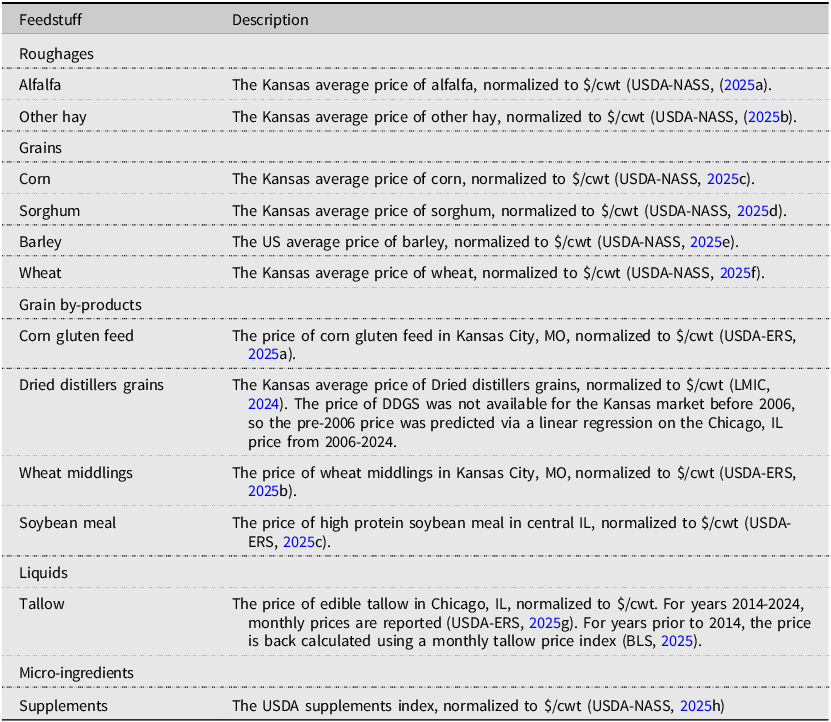
Feedlot rations are a complex blend of dozens of ingredients and change over the course of the feeding period as the cattle move through the phases of receiving, growth, and finishing. Our objective in selecting price variables is to cover as many major feed inputs as possible. However, there are limitations due to the availability of data on the price of various feedstuffs. In this process we followed the results of a survey of nutritionists conducted by Samuelson et al. (Reference Samuelson, Hubbert, Galyean and Löest2016), in which the ration components were grouped into broad categories: roughage, grains, grain by-products, other sources of protein, liquids, and micro-ingredients. The price variables included in our analysis are described in Table 2; they represent each of the major ingredient categories with as many specific feedstuffs as possible. Data for roughages, grains, and supplements are sourced from USDA-NASS, while the grain by-product and tallow data are primarily compiled by USDA-ERS. All prices are converted to dollars per hundredweight, making comparisons across feeds easier. We use days on feed to calculate average feed prices across the months from placement to slaughter. All feed prices are deflated using the Complete Feeds Index for Prices Paid (base year = 2011) from USDA-NASS, enabling us to evaluate relative, rather than absolute, price changes.
Feedstuff prices to be included in the regression model

Feeder cattle prices are monthly average auction prices in Kansas for steers weighing 700 to 800 pounds, as reported in the Kansas Weekly Cattle Auction Summary (USDA-AMS, 2021b). Fed cattle prices for steers and heifers are a weighted average of negotiated cash prices across all grades in Kansas, reported in the Kansas Direct Slaughter Cattle Report (USDA-AMS, 2021a). Feeder cattle prices correspond to the placement month, while fed cattle prices correspond to the closeout month. LMIC compiles both price series.
We also control for the cost of capital using interest rates (6-month treasury note) from the Federal Reserve Economic Data (FRED, 2024). We include placement and slaughter weights (both in pounds) to isolate the feed substitution effect. Both are included in the Kansas closeout data from Focus on Feedlots. As stated previously, the models additionally include a linear trend, monthly dummy variables for seasonality, and a dummy variable for heifers. We also incorporate post-COVID and post-RFS dummy variables into each model specification.
Figure 1 graphs the three technical efficiency measures for steers and heifers from April 1995 to September 2024. A lower FCR, measured as pounds of feed per pound of gain, indicates higher technical efficiency. When the feed conversion ratio is lower, cattle gain more weight per day and reach slaughter weight in fewer days. In Figure 1, these three measures of efficiency show significant variation across time, including obvious seasonal patterns. Over the last decade, there also appears to be an upward trend in the feed conversion ratio, as well as corresponding trends in average daily gain and days on feed, which trend slightly downward and significantly upward, respectively. FCR bottomed out (most efficient point) in 2013 and has since increased to levels that appear more in line with the late 1990s. The United States experienced drought conditions in 2012 and 2013, resulting in high feed prices. During this time, producers may have become more efficient in their feed use for economic reasons, thus explaining the minimum FCR occurring in 2013. In the timespan since the drought years, producers have increased days on feed and slaughter weights. This may partially explain the increasing FCR trend, as heavier animals require more feed for maintaining weight in addition to growth (Ojo et al., Reference Ojo, Mulim, Campos, Junqueira, Lemenager, Schoonmaker and Oliveira2024).
Monthly feed conversion ratio, average daily gain, and days on feed for Kansas Steers and Heifers, April 1995 – September 2024.

The prices of feedstuffs are plotted in Figures 2 and 3, showing individual variation in major ration ingredient prices. The prices are averaged across feeding periods and deflated by the USDA Complete Feeds price index. After being deflated by the feed price index, the trends in the individual prices are mostly removed. Some of the prices have similar patterns (particularly corn and sorghum), but all show individual variation. This is noteworthy, especially for the prices of closely related commodities like wheat and wheat middlings. This individual variation shows that cattle producers have a very dynamic and complex optimization problem as the prices of feedstuffs move relative to one another.
Average prices for roughages, grains, and grain by-products, April 1995–September 2024. Note: Feedstuff prices are averaged across the feeding periods, the date is for the closeout month. Prices are also deflated by the USDA feed price index.

Average prices for select liquid feedstuffs and supplements, April 1995–September 2024.
Note: Feedstuff prices are averaged across the feeding periods, the date is for the closeout month. Prices are also deflated by the USDA feed price index.

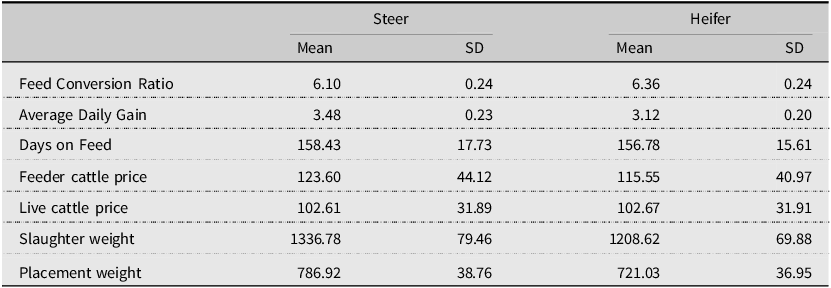
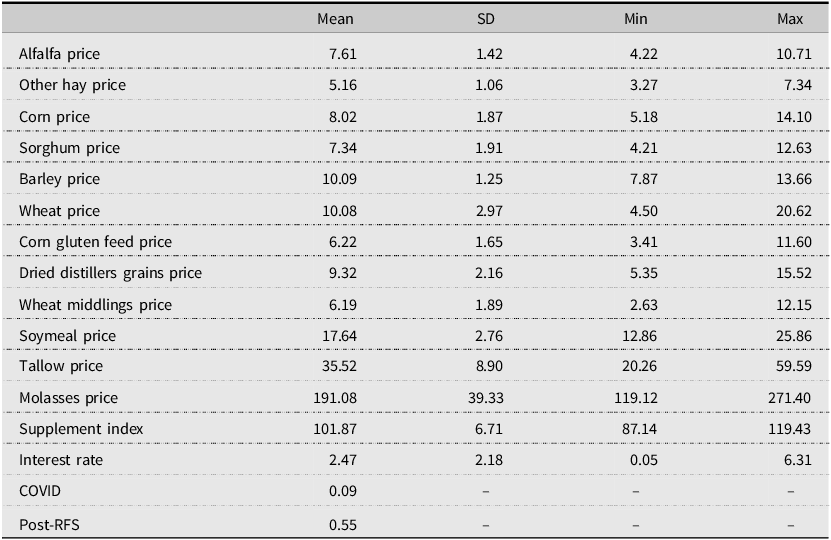
Table 3 summarizes variables related to cattle performance, weights, and price, with comparisons between steers and heifers. On average, steers are more efficient in the feedlot, with a feed conversion ratio of 6.10 compared to 6.36 for heifers. They also gain weight faster, with an average daily gain of 3.48 lbs./day versus 3.12 lbs./day for heifers, but they reach slaughter weight in approximately the same time of 157 to 158 days. Steers also require a higher price when purchased as feeder cattle, averaging $123.60/cwt compared to $115.55/cwt for heifers, likely due to their relatively higher feedlot performance. However, the average live cattle price at slaughter is nearly identical, at $102.61/cwt for steers and $102.67/cwt for heifers. Steers are heavier both at placement and slaughter, with average placement and slaughter weights of 786.92 lbs. and 1336.78 lbs., respectively, compared to 721.03 lbs. and 1208.62 lbs. for heifers. Relatively higher weight gain for steers compared to heifers reconciles the higher efficiency with equivalent feeding periods, noted earlier. Table 4 provides summary statistics for the remaining variables in our model – feed prices and other control variables.
Summary statistics for cattle variables

The dataset contains 708 observations. Feeder cattle and live cattle prices are associated with the placement and closeout months, respectively. The proportion where heifer = 1 is 50% because the closeout data is separated by sex with monthly observations, the true proportion varies.
Summary statistics for feed prices and control variables

The dataset contains 708 observations. Feed prices are deflated by the USDA feed price index (2011 base year), then averaged across the feeding periods. COVID and Post-RFS are binary variables.
4. Results
Models for each technical efficiency variable are estimated with OLS. The changes in the coefficients between the specifications can clarify which part of the effect is due to slaughter weight changes, placement weight changes, or feed substitution. Prior to estimation we used the augmented Dickey-Fuller test to identify the level of integration. All price series have a unit root, while the feedlot efficiency measures do not. Non-stationary variables were log-differenced in the regression. Since the dependent variables do not have unit root, cointegration was not tested. Post-estimation, we tested for autocorrelation using the Durbin–Watson test, which indicated that the errors were indeed correlated. Therefore, we added the dependent variable, lagged by one period, as a regressor. Following this adjustment, the errors no longer exhibited autocorrelation. Although heteroskedasticity was still evident, consequently White-type standard errors were used for statistical inference. Additionally, since feed prices are correlated with each other, we calculated the variance inflation factors (VIFs) for each of the unique sets of right-hand side variables. These statistics are available as supplementary material in Appendix B. None of the VIFs were near the levels that typically indicate concerning levels of multicollinearity. That said, included feed price variables may still be correlated with unobserved factors that influence cattle performance (e.g., broad market conditions, weather, management responses). Consequently, the following relationships estimated by our models are strictly correlational, rather than causal.
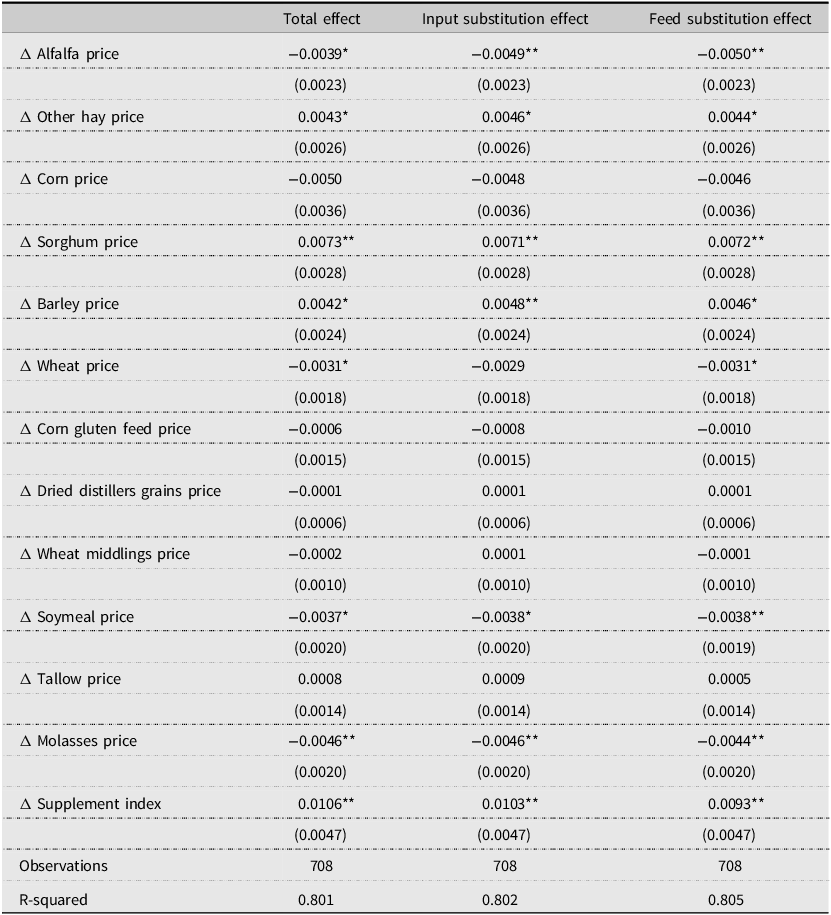
Results for the effect of feed prices on the feed conversion ratio are reported in Table 5, for tables with all coefficients please refer to Appendix A. Overall, the results suggest that feed prices do influence FCR, although the direction and magnitude vary by feed type. Furthermore, results vary across model specifications measuring the total effect, the input substitution effect, and the feed substitution effect. For a 1% increase in alfalfa prices, the total effect on FCR is estimated to be −0.0039 (p-value < 0.10), the input substitution effect is −0.0049 (p-value < 0.05), and the feed substitution effect is −0.0050 (p-value < 0.05). These results suggest improved efficiency when alfalfa prices rise. Higher sorghum prices are associated with about a 0.0073 (p-value < 0.05) increase in FCR, with similar effects across all three specifications, indicating reduced efficiency. Other hay and barley prices are both associated with increased FCR, with effects ranging from 0.0042 to 0.0048 (p-values < 0.10 or 0.05). Wheat prices are associated with decreased FCR, with total and feed substitution effects both estimated to be −0.0031 (p-value < 0.05). Higher soymeal prices also improve efficiency, with a feed substitution effect of −0.0038 (p-value < 0.05). The supplement index and molasses prices also exhibit significant effects. A one-point increase in the supplement index raises FCR by 0.0106 (p-value < 0.05), while molasses prices are associated with a −0.0046 decrease in FCR (p-value < 0.05), suggesting efficiency gains. Although primary feed sources, we find that price changes in neither corn nor DDGs are associated with statistically significant changes in FCR.
Feed price coefficient estimates for feed conversion ratio models

Robust standard errors in parenthesis. Prices are averaged across the feeding periods and then differenced between closeout months. All models are estimated with an intercept and the full set of control variables. Please refer to Appendix A for tables containing the full set of coefficients.
* p < 0.1, **p < 0.05, ***p < 0.01.
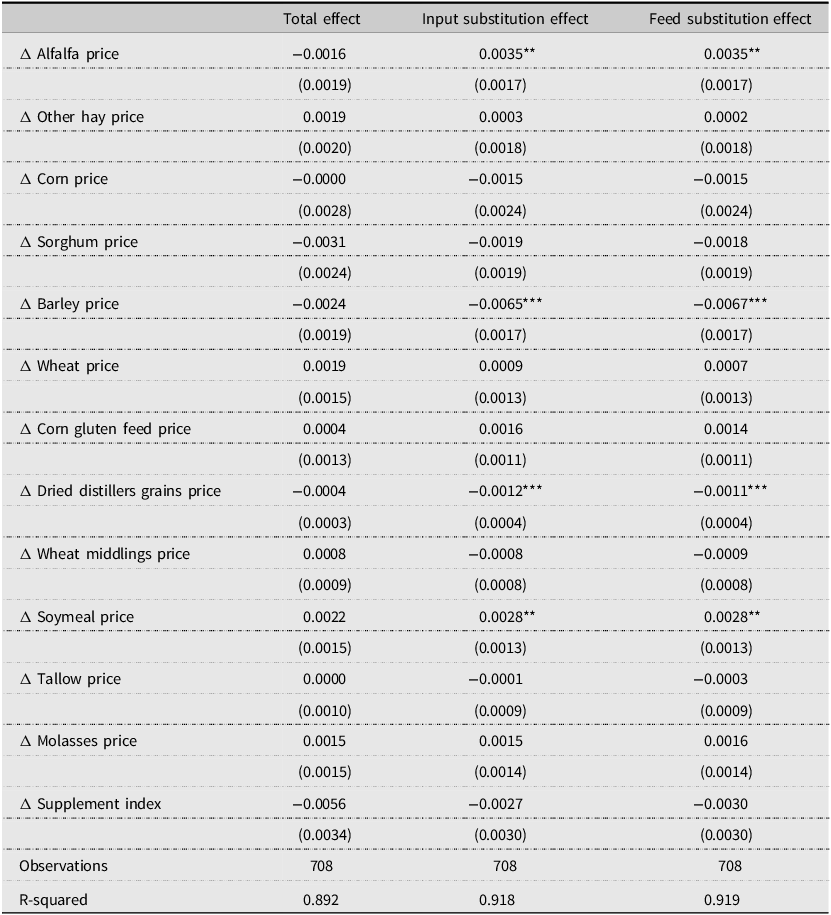
Results for average daily gain (ADG) are presented in Table 6. While the total effect estimates are not statistically significant, the input and feed substitution effects show statistically significant impacts for several feedstuffs. Higher alfalfa prices have a positive effect on ADG, through input and feed substitution. An increase of 1% in alfalfa prices results in a 0.0035 lb./day gain in ADG via both input and feed substitution (p-value < 0.05). Increases in barley prices reduce ADG, with effects of −0.0065 and −0.0067 (p-value < 0.01). Increases in the price of DDGs also worsen ADG via substitution, with effects of −0.0012 and −0.0011 (p-value < 0.01). An increase in the soymeal prices is positively associated with ADG through feed substitution effects (0.0028; p-value < 0.05). Again, we find no statistical evidence of changes in the price of corn associated with changes in ADG. However, our results suggest that ADG is sensitive to other specific feed inputs, with substitution playing a key role.
Feed price coefficient estimates for average daily gain models

Robust standard errors in parenthesis. Prices are averaged across the feeding periods and then differenced between closeout months. All models are estimated with an intercept and the full set of control variables. Please refer to Appendix A for tables containing the full set of coefficients.
* p < 0.1, **p < 0.05, ***p < 0.01.
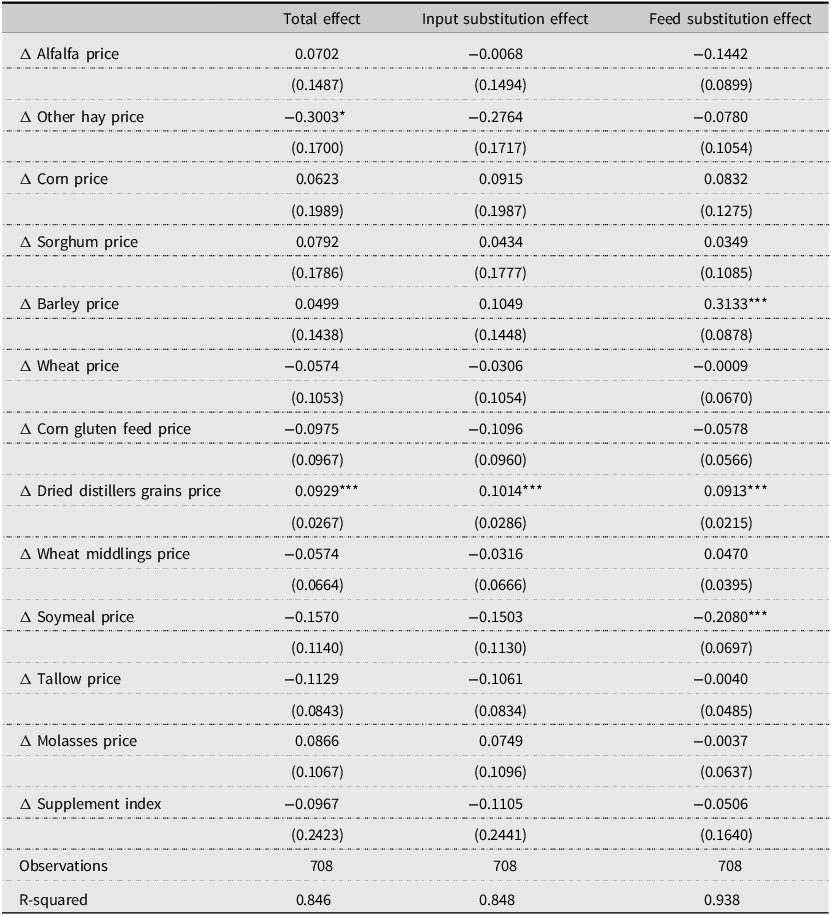
Table 7 reports the results for days on feed (DOF). Most notably, increases in the prices of DDGs are associated with increases in DOF across all specifications. For a 1% increase in the price of DDGs, the total effect is an increase of 0.093 days on feed (p-value < 0.01), with comparable values across the other models. Other hay shows a total effect of −0.300 days (p-value < 0.10), implying efficiency gains when other hay prices rise, which is inconsistent with the FCR results where higher other hay prices resulted in less efficiency. This may be the result of an effect via another channel than feed efficiency. Conversely, barley prices reduce efficiency, but only in the feed substitution model with a 0.313-day increase in DOF (p-value<0.01). Soymeal prices reduce DOF in the feed substitution model by −0.208 days (p-value < 0.01), suggesting improved efficiency when soymeal becomes more costly. Here, too, we find that changes in corn prices are not associated with statistically significant changes in days on feed.
Feed price coefficient estimates for days on feed models

Robust standard errors in parenthesis. Prices are averaged across the feeding periods and then differenced between closeout months. All models are estimated with an intercept and the full set of control variables. Please refer to Appendix A for tables containing the full set of coefficients.
* p < 0.1, **p < 0.05, ***p < 0.01.
Overall, these results demonstrate that feed price changes affect multiple dimensions of feedlot performance. Most results follow the expected pattern of the FCR and ADG effects being opposite in sign, while the FCR and DOF effects have the same signFootnote 3 . One notable exception is the price of other hay, which increases FCR and decreases DOF in the total effect. Another result that was unexpected is that corn price changes do not exhibit strong or significant effects on efficiency metrics. Instead, the prices of alfalfa, other hay, sorghum, barley, wheat, DDGs, soymeal, molasses, and supplements are statistical determinants of substitution behavior and technical efficiency.
5. Discussion & conclusion
This study examines the effects of relative feed price changes on feedlot technical efficiency, focusing on three key measures: feed conversion ratio (FCR), average daily gain (ADG), and days on feed (DOF). The direction of the estimates is typically stable across the total effect, substitution effect, and feed substitution effect, indicating that feed substitution is the dominant effect. Our findings also show that the impact of feed prices on technical efficiency varies significantly by feed type. Increases in the price of DDGs, for example, negatively affect ADG and increase DOF, reflecting reduced technical efficiency when feedlots adjust to higher costs by substituting lower-cost feeds. These results underscore the importance of DDGs as a high-energy feed ingredient and its role in achieving efficient weight gain. Barley, another concentrate feed, exhibits similar negative effects on technical efficiency, albeit with smaller magnitude. Conversely, higher prices for alternative feedstuffs such as alfalfa and soymeal are associated with improvements in FCR and increasing ADG, suggesting that substitutes for these feeds enhance technical efficiency on the margin.
The effects of alfalfa and other hay are opposite in the feed conversion ratio model but lack significance for one or the other roughage feeds in the ADG and DOF models. Still the opposite signs are worth a deeper discussion, given the similar role these play in the ration. Alfalfa tends to improve FCR when substituted by other feeds. This may be explained by the fact that alfalfa is not only a roughage but also a significant source of protein and energy as well. When substituting other feeds, feedlot managers may target high marginal product feeds to maintain the diet’s energy and protein levels. Another explanation is that – given decreasing marginal product – the high use of alfalfa noted by Samuelson et al. (Reference Samuelson, Hubbert, Galyean and Löest2016), could mean that the marginal product is relatively low. In contrast, increasing other hay prices increase FCR. This is also likely related to the marginal product of the substitute feeds used to replace other hay. Unlike alfalfa, other hay is likely used to target fiber, so substitutes might be corn stalks or straw, likely less efficient feeds. In a model with cross-price effects, other hay and molasses have a significant relationship.Footnote 4 Molasses is often used to improve palatability for coarser roughages.
To test robustness to different model specifications, models were estimated with non-linear functional forms for feed prices. The first non-linear model was quadratic in feed prices. The quadratic terms were small and none were statistically significant. The average marginal effects matched the linear effects in direction and often the statistical tests had the same results. We also estimated models with all first-order interactions among feed prices. Many of the interaction effects are significant and offer insights on substitution patterns for the interested reader. The average marginal effects agree with the linear models in direction, although several effects have different statistical test results. In general, these confirm the robustness of linear model results.
Another notable result was the lack of statical significance for corn. In feedlot diets, corn is used almost universally (Samuelson et al., Reference Samuelson, Hubbert, Galyean and Löest2016). So, the lack of a significant effect is notable. There are two explanations either of which – or a combination – could explain the absence of an effect. The input demand for corn could be relatively inelastic and thus price changes do not induce large input quantity impacts. Alternatively, the substitutes for corn are grains with similar marginal products, so the effect on technical efficiency is small.
The primary policy implication is that policies impacting commodity prices may inadvertently affect feedlot technical efficiency. For example, ethanol and biofuel policies impact several prices, either through alternative demand for cattle feedstuffs as biofuel feedstocks or through increased availability of by-products. These changes could impact technical efficiency, leading to changing greenhouse gas emissions from the livestock sector. The net effect is not immediately clear because several feedstuffs may be impacted, but this effect could be evaluated in future research. The total effect estimates are relevant for this line of inquiry because they combine the outcomes of all the choice variables that the feedlot uses to maximize profit. The changing prices of commodities following the implementation of these policies may add to the emission reduction targets or potentially offset some of the emissions reductions. These implications highlight the importance of ex-post policy evaluation and measuring unintended consequences.
From a managerial perspective, our results provide insights into the pathways through which technical efficiency is impacted. This may help feedlot managers understand what to expect from various adjustments from short-run feed cost minimization to long-run adjustments in which slaughter weights and placement weights can also be adjusted. The effects are already the result of assumed profit-maximizing behavior but may be useful for planning and logistics.
In conclusion, this study contributes to the literature by explicitly modeling the pathways through which feed prices affect technical efficiency, using both conceptual and empirical approaches. Our findings shed light on the role of feed prices in feedlot management and profitability, while also emphasizing the broader implications for policy and sustainability. The main limitation of this study is that we did not have access to feedlot-level data. Less aggregated data would have provided an opportunity for a more robust identification strategy. Furthermore, a lot of variation is lost in aggregation, masking information that is potentially useful.
Supplementary material
The supplementary material for this article can be found at https://doi.org/10.1017/aae.2025.10018.
Data availability statement
The data used in this analysis is publicly available and will be freely shared by the authors upon request.
Author contribution
AI was used to assist in minor revisions of the manuscript.
Financial support
This research received no specific grant from any funding agency, commercial or not-for-profit sectors.
Competing interests
Author A, author B, and author C declare none.





 Open access

