

The advent of vaccination has proven to be one of the most effective preventive measures in the history of medicine. Vaccines play a significant role in the prevention of debilitating and, in many cases, life-threatening infectious diseases. Vaccines also provide important benefits in terms of reducing or avoiding costs associated with illness, both direct and indirect. In spite of the absence of any kind of ideal global healthcare system and lack of resources, the World Health Organisation (WHO) and the United Nations Children's Fund (UNICEF) were able, in 1974, to establish a major global project called the Expanded Programme on Immunization (EPI).
Thanks to EPI, 75% of the world's child population is now immunized, the vast majority of which is protected against diphtheria, tetanus, whooping cough, polio, measles and TB. Immunization is the second most effective preventive measure in public health – after the chlorination of water – in history. The results are obvious: about 3 million lives saved annually, equating to almost 10,000 a day. But even this very positive statement generates its own controversy. We save lives in developing countries, but we are not able to secure a safe future for them, we are not even able to deliver enough food for those people.
The WHO has many vaccines in the pipeline. Vaccines covered with EPI are well-established and one could expect all those diseases to be under control, but the programme is not complete. The disease of polio has been eliminated but the virus itself has not yet been eradicated. There are still some countries with endemic wild polio virus and the final steps to reach total eradication are proving to be more difficult than expected.
Another example of how we are not moving forwards is immunization against measles. Here, surprisingly, the weakest links in the chain are proving to be in the most developed countries. Due to widely reported myths and delusions related to vaccination (which will be discussed in detail later) the number of children being vaccinated against measles in many developed countries has dropped dramatically.
The WHO also has vaccines such as HPV, pneumococcal conjugate, rotavirus, hepatitis A, which are not in EPI. These are merely ‘recommended’ and it is up to each country to weigh up the pros and cons of a vaccination programme, taking into account the current disease burden, epidemiological situation, strategic health priorities, public perception and financial resources.
We have a relatively wide portfolio of different vaccines; many of them are not recommended for universal programmes and tailored risk-based approaches are used for those listed above. Other vaccines are still in development. Malaria, HIV/AIDS, hepatitis C and improved TB vaccines are important examples.
Development of new, more sophisticated vaccines is however not the major issue. What is more pressing is growing public distrust in vaccines and immunization. Serious misinformation concerning side effects, chronic sequelae and claims of limited efficacy jeopardize vaccination programmes in many places.
Vaccine controversies cover morality, ethics, effectiveness, or safety. While vaccines do carry some risks along with their proven benefits, extensive safety standards and monitoring ensure that vaccines are safe for as many people as possible. But ironically, as the value of widespread immunization is proven by the continually falling incidence of vaccine-preventable diseases, controversies relating to vaccine safety are on the rise. Vaccines are, in reality, victims of their own success. Controversies and scare-stories can affect parental faith in the safety of vaccines and threaten the health of their children, when the facts are not known or alternative sources of information are accepted as equally reliable as official sources.
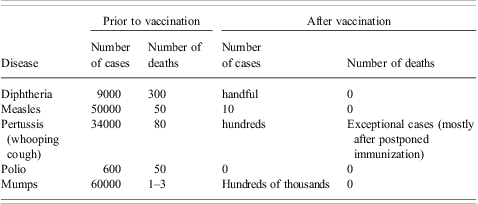
The risk of infectious diseases is gradually decreasing in developed countries and the vast majority of infectious diseases are now controlled. Table 1 shows the impact of vaccination in the Czech Republic. It is quite obvious that the burden of the infectious diseases listed has almost disappeared. When universal immunization programmes were first implemented the number of cases and deaths exceeded by far any risks of side effects, but now the public does not see the benefits but only the (rare) adverse reactions. This unfortunate trend is on the rise and governments in developed countries from time to time come under pressure stop universal programmes. Then, inevitably, a few years later they face the re-emergence of the preventable diseases.
Impact of vaccination on number of related cases and deaths (Czech Republic)
This negative attitude to immunization is not new. Since vaccination began in the late eighteenth century, opponents have raised various arguments to claim that vaccines do not work. These arguments include: vaccines may be dangerous because they contain various toxic substances; people should rely on personal hygiene instead; people should use natural immune modulators; vaccines prevent the natural development of our immune system. Finally, it has been asserted that combinations of vaccines overwhelm our immune system and that mandatory vaccinations violate individual rights or religious principles.
We need to ask what we mean by ‘democracy’ when it comes to public health? Should we allow parents a free choice to immunize their children? Should immunization be the responsibility of parents or state? In most countries there is no obligation to immunize.
However, indirect incentives to stimulate parents to immunize their children exist; for example, schools in some US states require immunization records to be shown before a child can enrol. A desire for a high rate of vaccination is perfectly understandable. Only a ‘critical mass’ of immunity can stop the spread of a particular infectious disease in the population.
Ideally, we should aim for figures of around 95%. People who are immunized are protected against diseases. They can neither be infected nor spread the disease. But of course we cannot immunize each and every single person. Some people cannot safely be vaccinated because they have other diseases or allergies to certain vaccine components and need to be protected from contact with the infection through all those they encounter having been immunized. This is known as ‘herd immunity’.
Anti-vaccine campaigners often claim that we should decide ourselves whether or not to be immunized. But this cannot be a purely personal decision, because if enough people do not receive immunization then ‘herd immunity’ will be compromised, increasing the chances of any given disease taking hold in the population.
Another controversy concerns the delivery of vaccines to the public and how different countries arrange their vaccination schedule. In the European Union, for example, there are 27 different immunization schedules, one for each member state, which creates serious problems when children move from one country to another.
Now we come to the safety of vaccines, and to the extent both reason and unreason have illustrated – and obfuscated – discussions on this matter.
We need to accept that, while vaccines, like any other medicine, can sometimes cause side-effects, the success of immunization programmes depends on public confidence in their safety. Concerns usually follow the same pattern: some investigators suggest that a medical condition is related to a particular vaccination and can be considered as an adverse effect of vaccination.
A preliminary (and premature) announcement is made concerning the alleged adverse effect and in spite of fact that the findings of the initial study is not reproduced by other groups, rumours abound and it takes several years to regain public confidence in the vaccine. Perhaps the most well-known example was the recent, spurious link drawn between the MMR vaccine and autism in children. Dubious science such as this jeopardizes trust in vaccination generally and decreases vaccination coverage and uptake.
The first signs of autism often appear concurrently to when children typically receive certain vaccinations, especially the vaccine for measles, mumps, and rubella. This false (as it turned out) correlation famously led to a British doctor, Andrew Wakefield, going public with his hypothesis that that the MMR tripe-vaccine can cause autism. In spite of fact Wakefield's paper was later retracted from the Lancet (a first in the history of this journal) huge damage had already been done and many vaccine opponents still remain convinced by Wakefield's paper.
The side-effects of this Unreason became apparent almost immediately. In parts of the UK and elsewhere, rates of measles infection shot up, some children became seriously ill and a few died.
A boy's death from the disease in April 2006 was the first UK measles fatality in 14 years. In addition, during a measles outbreak in Germany the same year, two fatalities were reported.
Various other causes of autism were postulated (MMR generally, the preservative thimerosal (mercury), aluminium and vaccines against hepatitis B). However, studies showed that these substances did not cause autism.
There is no doubt that mercury can be toxic, and vaccine producers have made great efforts to reduce the quantity of these stabilizing agents and preservatives in their products. But they cannot, for safety reasons, be excluded entirely.
There is a hypothesis that aluminium is toxic because it may possibly pass through the immature hematoencephalic barrier. There are however no double-blind controlled clinical trials proving this effect and toxicity of aluminium is overestimated. Similarly a hypothesis postulating a causal relation between diabetes mellitus and immunization against hepatitis B was subsequently disproved in large clinical trials.
The role of the media in the spread of false information is crucial. Practically all global media published information about the death of a young girl after immunization with HPV. A few days later the real cause of death – cancer – was released almost without any media attention.
Another real disaster for public trust in vaccination was the role of the media in pandemic flu. The mild course of ‘Mexican flu’ was misused by the media for a campaign against the pharmaceutical industry. Governments and public health officials were convicted of wasting public money for needless vaccination. The public generally did not comprehend the risk from flu or the fact that immunization is a preventive measure something like insurance. If somebody's car is insured and it is neither involved in an accident nor stolen, it is ridiculous to complain that somebody has lost money.
Another popular unreason for not being immunized was related to adjuvants. Squalene and adjuvants generally were considered as very hazardous substances that may cause a variety of different symptoms, particularly immunological disorders.
Experience with millions of people given the pandemic Mexican flu vaccine confirmed its safety. The only issue arose after the pandemic and concerned narcolepsy. EMA published an association between narcolepsy and the vaccine Pandemrix 2009 H1N1. In total, 31 million doses were administered in 47 countries. Three-hundred and thirty five reports of narcolepsy cases have been recorded; 68% in Sweden and Finland (as of 6 July.2011). The increased risk (6–13 times) was reported among children and young adults up to 20 years of age.
In age cohorts above 20 the risk was not detected. However, there is still no causal relation established and many unsolved issues remain. In some countries, such as Canada, no higher risk of narcolepsy was reported in spite of many doses of vaccines administered. And, vice versa, in China, where the vaccine was not used, an increased number of narcolepsy cases occurred. Discussion is ongoing about the role of echoviruses in the pathogenesis of narcolepsy and possible co-infection with the flu virus. Nevertheless, a recommendation to use Pandemrix only in persons above 20 was issued, at least until final confirmation of the cause.
There were many unreasons in the above-mentioned controversies; however, there are also some real issues. One issue, which is now more or less accepted, is tailored pricing. The cost of vaccines (affordable for developed countries) is usually out of reach for the developing world. The only ways to overcome this imbalance are either to customize prices for different countries; or to subsidize the price from international funds or foundations, such as GAVI or the Bill and Melinda Gates foundation.
Combined vaccines also trigger discussions. False arguments have been raised concerning the capacity of our immune system to deal with multiple vaccines, but this unreason cannot stop the current trend towards combined vaccines. One example relates to including hepatitis B immunization in the hexavalent vaccine given at the youngest possible age. In developed countries, particularly if there is a well-established programme for detecting HBSAg positive mothers, the risk of acquiring hepatitis B at a very young age, almost does not exist. The anti-vaccinologists argue for delaying the vaccine until adolescence. Arguments for keeping the vaccine for the younger generation include logistic reasons – it is simpler to immunize babies than adolescents and it reduces the possible, but low, risk of infection from an infected needle in drug abusers.
The global increase in pertussis (whooping cough) incidence is giving rise to concern. In spite of new booster doses being introduced into the schedule, the number of cases is still rising. The strains circulating now may have changed recently and the improvement of the vaccine should be taken into consideration.
The first rotavirus vaccine to be introduced was withdrawn in the US and worldwide owing to an increased risk of intussusception (a usually non-fatal infolding of a piece of intestine). The risk reached a ratio 1:10,000. It took many years for a new rotavirus vaccines to be licensed. During these years several million children died of rotavirus infection in Africa. This fact put the FDA decision into a different perspective.
Based on trials in Brazil and Mexico, the risk of this complication for the more recently introduced vaccines was 1:51,000–68,000 immunized. This risk is acceptable for global use of the vaccine. But risk, and the steps we take to minimize it, must be evaluated carefully. It took many years for new rotavirus vaccines to be licensed and during this time several million children died of rotavirus infection in Africa. Future vaccines may be based on individual genotype and phenotype. We will predict diseases against which it is necessary to immunize and also predict genetically-based adverse events. Even this approach can generate controversy. Is it ethical to map the individual human genome?
Vaccination is a very sensitive issue. Many controversies exist, many unreasons should be avoided. Evidence-based medicine follows only hypotheses already released and fights a never-ending battle.
Roman Prymula, MD, PhD, Professor of Hygiene, Epidemiology and Preventive Medicine is director of University Hospital in Hradec Kralove and former Dean of the Faculty of Military Health Sciences and Chair of the Department of Epidemiology at the University of Defense in Hradec Králové, Czech Republic. Professor Prymula is involved in various research activities in preventive medicine, including the clinical development of new vaccines. He is a member of the European Centre for Disease Prevention and Control (ECDC) management board, Chairman of Central European Vaccine Advisory Board (CEVAG) and Chairman of the Czech Vaccinological Society, JEP. He has published numerous articles and book chapters on vaccine-preventable infectious diseases, and monographs on bioterrorism and severe acute respiratory syndrome (SARS).


 Open access

