 Tm′∘WQ
 Tm′
Tm′ μp
μp


1. Introduction
For $N \ge 1$
and
$N \ge 1$
and $k \ge 2$
even, let
$k \ge 2$
even, let $S_k(N)$
denote the space of cusp forms of weight k and modular group
$S_k(N)$
denote the space of cusp forms of weight k and modular group $\Gamma_0(N)$
, and let
$\Gamma_0(N)$
, and let $S_k^{\mathrm{new}}(N) \subseteq S_k(N)$
denote its new subspace. For
$S_k^{\mathrm{new}}(N) \subseteq S_k(N)$
denote its new subspace. For $p^r \| N$
, let
$p^r \| N$
, let $W_{p^r}$
denote the Atkin–Lehner involutions on these spaces, and recall that these
$W_{p^r}$
denote the Atkin–Lehner involutions on these spaces, and recall that these $W_{p^r}$
can be extended multiplicatively to
$W_{p^r}$
can be extended multiplicatively to $W_Q$
for all
$W_Q$
for all $Q \| N$
(i.e.
$Q \| N$
(i.e. $Q|N$
where
$Q|N$
where $(Q,N/Q)=1$
).
$(Q,N/Q)=1$
).
Now, recall that the $W_Q$
involutions diagonalise
$W_Q$
involutions diagonalise $S_k(N)$
and
$S_k(N)$
and $S_k^{\mathrm{new}}(N)$
with eigenvalues
$S_k^{\mathrm{new}}(N)$
with eigenvalues $\pm1$
. So, we define the Atkin–Lehner sign pattern spaces by specifying these signs for all
$\pm1$
. So, we define the Atkin–Lehner sign pattern spaces by specifying these signs for all $p^r \| N$
. To be precise, define a sign pattern
$p^r \| N$
. To be precise, define a sign pattern $\sigma$
for N to be a multiplicative function on the exact divisors of N such that
$\sigma$
for N to be a multiplicative function on the exact divisors of N such that $\sigma(p^r) = \pm 1$
for all
$\sigma(p^r) = \pm 1$
for all $p^r \| N$
. Then we have the decomposition of
$p^r \| N$
. Then we have the decomposition of $S_k(N)$
 \begin{align*} S_k(N) &= \bigoplus_{\sigma} S_k^\sigma(N), \quad S_k^\sigma(N) \,:\!=\, \{ f \in S_k(N) \,:\, W_{p^r}f = \sigma(p^r) f \ \text{ for each } p^r \| N\}\end{align*}
(and similarly for $S_k^{\mathrm{new}}(N)$
). Note that these sign pattern spaces
$S_k^{\mathrm{new}}(N)$
). Note that these sign pattern spaces $S_k^\sigma(N)$
are a finer decomposition of the more well-known Fricke sign spaces
$S_k^\sigma(N)$
are a finer decomposition of the more well-known Fricke sign spaces $S_k^\pm(N)$
, which only specify the “global” sign (i.e. the sign of the Fricke involution
$S_k^\pm(N)$
, which only specify the “global” sign (i.e. the sign of the Fricke involution $W_N$
).
$W_N$
).
Now, a natural question one might ask is how all the possible sign patterns are distributed over the spaces $S_k(N)$
and
$S_k(N)$
and $S_k^{\mathrm{new}}(N)$
. For both global signs and local sign patterns, we determine the exact proportion of signs/sign patterns appearing.
$S_k^{\mathrm{new}}(N)$
. For both global signs and local sign patterns, we determine the exact proportion of signs/sign patterns appearing.
In the following theorem, ${\unicode{x1D7D9}}_{\textit{condition}}$
denotes the indicator function for condition, and the notation “
${\unicode{x1D7D9}}_{\textit{condition}}$
denotes the indicator function for condition, and the notation “ $A(N,k) \sim B(N)$
as
$A(N,k) \sim B(N)$
as $N+k \to \infty$
” means that
$N+k \to \infty$
” means that $A(N,k) / B(N) \to 1$
as
$A(N,k) / B(N) \to 1$
as $N+k \to \infty$
. We also take the convention that
$N+k \to \infty$
. We also take the convention that $0 \sim 0$
, because as discussed shortly, both sides of (1·4) are identically zero in one particular case (see Theorem 1·2).
$0 \sim 0$
, because as discussed shortly, both sides of (1·4) are identically zero in one particular case (see Theorem 1·2).
Theorem 1·1. Consider $N \ge 1$
and
$N \ge 1$
and $k \ge 2$
even. Then as
$k \ge 2$
even. Then as $N+k \to \infty$
, the proportion of cusp forms with global sign
$N+k \to \infty$
, the proportion of cusp forms with global sign $+1$
is given by
$+1$
is given by
 \begin{align} \frac{\dim S_k^+(N)}{\dim S_k(N)} &\sim \frac12 + \frac{{\unicode{x1D7D9}}_{N=1}}{2},\\[-10pt]\nonumber\end{align}
 \begin{align} \frac{\dim S_k^{{\mathrm{new}},+}(N)}{\dim S_k^{\mathrm{new}}(N)} &\sim \frac12+\frac{ {\unicode{x1D7D9}}_{N=\mathrm{cubefree\ square}}}{2} \prod_{p|N} \frac{-1}{p^2-p-1}. \end{align}
Also, consider sign patterns $\sigma$
for N. Then as
$\sigma$
for N. Then as $N+k \to \infty$
, the proportion of cusp forms with sign pattern
$N+k \to \infty$
, the proportion of cusp forms with sign pattern $\sigma$
is given by
$\sigma$
is given by
 \begin{align} \frac{\dim S_k^\sigma(N)}{\dim S_k(N)} &\sim \frac{1}{2^{\omega(N)}}, \\[-10pt]\nonumber \end{align}
 \begin{align} \frac{\dim S_k^{{\mathrm{new}},\sigma}(N)}{\dim S_k^{\mathrm{new}}(N)} & \sim \frac{1}{2^{\omega(N)}} \prod_{p^r||N} \left({ 1 + \sigma(p^r) \frac{- {\unicode{x1D7D9}}_{r=2}}{p^2 - p -1}}\right). \end{align}
We note that this theorem predicts an equal proportion of both signs (and more generally, all sign patterns) in many cases. Over the full space, both signs (respectively, all sign patterns) will have equal proportion in $S_k(N)$
for all
$S_k(N)$
for all $N \ge 2$
, by (1·1) and (1·3). Over the newspace, both global signs (respectively, all sign patterns) will have equal proportion in
$N \ge 2$
, by (1·1) and (1·3). Over the newspace, both global signs (respectively, all sign patterns) will have equal proportion in $S_k^{\mathrm{new}}(N)$
for squarefree
$S_k^{\mathrm{new}}(N)$
for squarefree $N \ge 2$
, by (1·2) and (1·4). This equiproportion property for the case of newspaces of squarefree level was also shown by Iwaniec–Luo–Sarnak [
Reference Iwaniec, Luo and Sarnak9
, equation (2·73)] (respectively, Martin [
Reference Martin11
, corollary 3·4]).
$N \ge 2$
, by (1·2) and (1·4). This equiproportion property for the case of newspaces of squarefree level was also shown by Iwaniec–Luo–Sarnak [
Reference Iwaniec, Luo and Sarnak9
, equation (2·73)] (respectively, Martin [
Reference Martin11
, corollary 3·4]).
The paper [
Reference Martin13
] recently investigated small biases in global sign, and claimed that each global sign would appear for 50% of newforms as $N+k \to \infty$
[
Reference Martin13
, section 1·3]. However, as one can see from (1·2), this is not quite accurate; the global sign in
$N+k \to \infty$
[
Reference Martin13
, section 1·3]. However, as one can see from (1·2), this is not quite accurate; the global sign in $S_k^{\mathrm{new}}(N)$
will actually be asymptotically biased towards
$S_k^{\mathrm{new}}(N)$
will actually be asymptotically biased towards $({-}1)^{\omega(N)}$
whenever N is a cubefree square. One can see this bias numerically from the data calculated in [
Reference Ross18
].
$({-}1)^{\omega(N)}$
whenever N is a cubefree square. One can see this bias numerically from the data calculated in [
Reference Ross18
].
We would also like to point out that Martin [
Reference Martin14
] recently investigated small biases in the sign of $W_{p^r}$
for a single fixed prime power
$W_{p^r}$
for a single fixed prime power $p^r$
, and observed a stronger bias at
$p^r$
, and observed a stronger bias at $r=2$
. Here, Theorem 1·1 quantifies this observation by establishing the exact proportion of each sign pattern.
$r=2$
. Here, Theorem 1·1 quantifies this observation by establishing the exact proportion of each sign pattern.
Now, observe that the proportions (1·3) and (1·4) are always nonzero, except when $4 \| N$
with
$4 \| N$
with $\sigma(4)=+1$
over the newspace
$\sigma(4)=+1$
over the newspace $S_k^{\mathrm{new}}(N)$
. For this reason, we define the notion of “admissible” sign patterns, where all sign patterns are admissible except for the one case of
$S_k^{\mathrm{new}}(N)$
. For this reason, we define the notion of “admissible” sign patterns, where all sign patterns are admissible except for the one case of $4 \| N$
with
$4 \| N$
with $\sigma(4)=+1$
over the newspace. It is worth noting here that the admissible sign patterns
$\sigma(4)=+1$
over the newspace. It is worth noting here that the admissible sign patterns $\sigma$
all have proportion within a factor of 3 of
$\sigma$
all have proportion within a factor of 3 of $1 / 2^{\omega(N)}$
. In other words, the admissible sign patterns are not too far off from being equally proportioned. This “factor of 3" comes from the lower and upper bounds on the
$1 / 2^{\omega(N)}$
. In other words, the admissible sign patterns are not too far off from being equally proportioned. This “factor of 3" comes from the lower and upper bounds on the $\prod_{p^r||N} ({ 1 + \sigma(p^r) ({- {\unicode{x1D7D9}}_{r=2}}/({p^2 - p -1}))})$
factor from (1·4) for admissible
$\prod_{p^r||N} ({ 1 + \sigma(p^r) ({- {\unicode{x1D7D9}}_{r=2}}/({p^2 - p -1}))})$
factor from (1·4) for admissible $\sigma$
:
$\sigma$
:
 \begin{align} 0.71546 \le \prod_{p \ne 2} \left({1-\frac{1}{p^2-p-1}}\right) &\le \prod_{p^r \| N} \left({1 + \sigma(p^r) \frac{-{\unicode{x1D7D9}}_{r=2}}{p^2-p-1}}\right) \nonumber\\ &\le \prod_p \left({1+\frac{1}{p^2-p-1}}\right) \le 2.67412. \end{align}
It turns out that for inadmissible sign patterns $\sigma$
, there are no newforms at all with sign pattern
$\sigma$
, there are no newforms at all with sign pattern $\sigma$
. This is because
$\sigma$
. This is because $W_4$
always has Atkin–Lehner sign
$W_4$
always has Atkin–Lehner sign $-1$
over
$-1$
over $S_k^{\mathrm{new}}(N)$
. This result was originally shown by Atkin and Lehner in [
Reference Atkin and Lehner2
, theorem 7]. We give an alternative proof here based on the trace formula.
$S_k^{\mathrm{new}}(N)$
. This result was originally shown by Atkin and Lehner in [
Reference Atkin and Lehner2
, theorem 7]. We give an alternative proof here based on the trace formula.
Theorem 1·2. Let $N \ge 1$
with
$N \ge 1$
with $4 \| N$
. Then
$4 \| N$
. Then $W_4 f = -f$
for every
$W_4 f = -f$
for every $f \in S_k^{\mathrm{new}}(N)$
.
$f \in S_k^{\mathrm{new}}(N)$
.
Now, recall that the Hecke operators $T_m$
for
$T_m$
for $(m,N)=1$
commute with the Atkin–Lehner involutions
$(m,N)=1$
commute with the Atkin–Lehner involutions $W_Q$
[
Reference Cohen and Strömberg6
, proposition 13·2·6] (see [
Reference Cohen and Strömberg6
] for the precise definition of these Hecke operators
$W_Q$
[
Reference Cohen and Strömberg6
, proposition 13·2·6] (see [
Reference Cohen and Strömberg6
] for the precise definition of these Hecke operators $T_m$
). This means that the Hecke operators preserve the sign pattern spaces
$T_m$
). This means that the Hecke operators preserve the sign pattern spaces $S_k^\sigma(N)$
and
$S_k^\sigma(N)$
and $S_k^{{\mathrm{new}},\sigma}(N)$
. So for the admissible sign patterns
$S_k^{{\mathrm{new}},\sigma}(N)$
. So for the admissible sign patterns $\sigma$
, we can then investigate how the Hecke eigenvalues over
$\sigma$
, we can then investigate how the Hecke eigenvalues over $S_k^\sigma(N)$
and
$S_k^\sigma(N)$
and $S_k^{{\mathrm{new}},\sigma}(N)$
are distributed. For
$S_k^{{\mathrm{new}},\sigma}(N)$
are distributed. For $m \ge 1$
, let
$m \ge 1$
, let $T_m' \,:\!=\, m^{-(k-1)/2} T_m$
denote the normalised Hecke operators (over both
$T_m' \,:\!=\, m^{-(k-1)/2} T_m$
denote the normalised Hecke operators (over both $S_k^\sigma(N)$
and
$S_k^\sigma(N)$
and $S_k^{{\mathrm{new}},\sigma}(N)$
). Then for a fixed prime p, let
$S_k^{{\mathrm{new}},\sigma}(N)$
). Then for a fixed prime p, let $ \mu_p(x) \,:\!=\,(({p+1})/{\pi})({(1-x^2/4)^{1/2}}/((p^{1/2}+p^{-1/2})^2-x^2))dx$
denote the p-adic Plancherel measure. We will show that the eigenvalues of
$ \mu_p(x) \,:\!=\,(({p+1})/{\pi})({(1-x^2/4)^{1/2}}/((p^{1/2}+p^{-1/2})^2-x^2))dx$
denote the p-adic Plancherel measure. We will show that the eigenvalues of $T_p'$
(over both
$T_p'$
(over both $S_k^\sigma(N)$
and
$S_k^\sigma(N)$
and $S_k^{{\mathrm{new}},\sigma}(N)$
) are
$S_k^{{\mathrm{new}},\sigma}(N)$
) are $\mu_p$
-equidistributed as
$\mu_p$
-equidistributed as $N+k\to\infty$
.
$N+k\to\infty$
.
Theorem 1·3. Fix p prime. Consider $N \ge 1$
coprime to p,
$N \ge 1$
coprime to p, $\sigma$
sign patterns for N, and
$\sigma$
sign patterns for N, and $k \ge 2$
even. Then the Hecke eigenvalues of
$k \ge 2$
even. Then the Hecke eigenvalues of $T'_p |_{S_k^\sigma(N)}$
are
$T'_p |_{S_k^\sigma(N)}$
are $\mu_p$
-equidistributed as
$\mu_p$
-equidistributed as $N+k \to \infty$
. In other words, for any sequence
$N+k \to \infty$
. In other words, for any sequence $\{(N_i,k_i,\sigma_i)\}_{i \ge 1}$
with
$\{(N_i,k_i,\sigma_i)\}_{i \ge 1}$
with $N_i + k_i \to \infty$
, the collection of Hecke eigenvalues
$N_i + k_i \to \infty$
, the collection of Hecke eigenvalues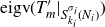 ${\mathrm{eigv}}(T'_m |_{S_{k_i}^{\sigma_i}(N_i)})$
is
${\mathrm{eigv}}(T'_m |_{S_{k_i}^{\sigma_i}(N_i)})$
is $\mu_p$
-equidistributed as
$\mu_p$
-equidistributed as $i \to \infty$
. Moreover, if we assume it is not the case that
$i \to \infty$
. Moreover, if we assume it is not the case that $4 \| N$
with
$4 \| N$
with $\sigma(4)=+1$
, then the Hecke eigenvalues of
$\sigma(4)=+1$
, then the Hecke eigenvalues of $T'_p |_{S_k^{{\mathrm{new}},\sigma}(N)}$
are also
$T'_p |_{S_k^{{\mathrm{new}},\sigma}(N)}$
are also $\mu_p$
-equidistributed as
$\mu_p$
-equidistributed as $N+k \to \infty$
.
$N+k \to \infty$
.
Note here that similar $\mu_p$
-equidistribution results have been shown before in different settings. For example, Conrey–Duke–Farmer showed
$\mu_p$
-equidistribution results have been shown before in different settings. For example, Conrey–Duke–Farmer showed $\mu_p$
-equidistribution over
$\mu_p$
-equidistribution over $S_k(1)$
[
Reference Conrey, Duke and Farmer7
] and Serre showed
$S_k(1)$
[
Reference Conrey, Duke and Farmer7
] and Serre showed $\mu_p$
-equidistribution over
$\mu_p$
-equidistribution over $S_k(N)$
,
$S_k(N)$
, $S_k^{\mathrm{new}}(N)$
, and
$S_k^{\mathrm{new}}(N)$
, and $S_k(N,\chi)$
[
Reference Serre19
]. More recently, the first author showed
$S_k(N,\chi)$
[
Reference Serre19
]. More recently, the first author showed $\mu_p$
-equidistribution over
$\mu_p$
-equidistribution over $S_k^{\mathrm{new}}(N,\chi)$
for admissible characters
$S_k^{\mathrm{new}}(N,\chi)$
for admissible characters $\chi$
[
Reference Ross17
]. Theorem 1·3 can be interpreted as strengthening Serre’s result over
$\chi$
[
Reference Ross17
]. Theorem 1·3 can be interpreted as strengthening Serre’s result over $S_k(N)$
and
$S_k(N)$
and $S_k^{\mathrm{new}}(N)$
, showing that
$S_k^{\mathrm{new}}(N)$
, showing that $\mu_p$
-equidistribution still holds over the much finer sign pattern decompositions
$\mu_p$
-equidistribution still holds over the much finer sign pattern decompositions $S_k^\sigma(N)$
and
$S_k^\sigma(N)$
and $S_k^{{\mathrm{new}},\sigma}(N)$
. In fact, this sign pattern decomposition is, in some sense, the finest (natural) decomposition possible; the
$S_k^{{\mathrm{new}},\sigma}(N)$
. In fact, this sign pattern decomposition is, in some sense, the finest (natural) decomposition possible; the $S_k^{{\mathrm{new}},\sigma}(N)$
seem to be the smallest subspaces of
$S_k^{{\mathrm{new}},\sigma}(N)$
seem to be the smallest subspaces of $S_k^{{\mathrm{new}}}(N)$
that still respect the Hecke operators and Galois conjugation [
Reference Chow and Ghitza4
, section 5].
$S_k^{{\mathrm{new}}}(N)$
that still respect the Hecke operators and Galois conjugation [
Reference Chow and Ghitza4
, section 5].
Lastly, in Section 6, we discuss several applications of Theorem 1·3, similar to those in [
Reference Serre19
, section 6]. The $\mu_p$
-equidistribution shown in Theorem 1·3 can be used to obtain information about the Galois orbits of Hecke eigenvalues, or equivalently, about the coefficient fields
$\mu_p$
-equidistribution shown in Theorem 1·3 can be used to obtain information about the Galois orbits of Hecke eigenvalues, or equivalently, about the coefficient fields ${\mathbb{Q}}(f)$
of newforms
${\mathbb{Q}}(f)$
of newforms $f \in S_k^{{\mathrm{new}},\sigma}(N)$
. In particular, we show that the degrees of these coefficient fields are unbounded as
$f \in S_k^{{\mathrm{new}},\sigma}(N)$
. In particular, we show that the degrees of these coefficient fields are unbounded as $N \to \infty$
. This can be interpreted in terms of a weak form of the generalised Maeda conjecture. We are also able to obtain information about the simple
$N \to \infty$
. This can be interpreted in terms of a weak form of the generalised Maeda conjecture. We are also able to obtain information about the simple ${\mathbb{Q}}$
-factors of the Jacobian of the modular curve
${\mathbb{Q}}$
-factors of the Jacobian of the modular curve $X_0(N)$
. See Section 6 for precise details.
$X_0(N)$
. See Section 6 for precise details.
We now give an overview of the arguments used in this paper. In Section 2, we use a trace formula from Skoruppa–Zagier [
Reference Skoruppa and Zagier20
] to estimate ${\mathrm{Tr}}\,T_m' {\circ} W_Q$
over both
${\mathrm{Tr}}\,T_m' {\circ} W_Q$
over both $S_k(N)$
and
$S_k(N)$
and $S_k^{\mathrm{new}}(N)$
. Then in Section 3, we use the results of Section 2 to obtain a trace formula for
$S_k^{\mathrm{new}}(N)$
. Then in Section 3, we use the results of Section 2 to obtain a trace formula for $T_m'$
over the sign pattern spaces. Next, in Section 4, we prove Theorems 1·1 and 1·2, computing the exact proportion of how often each sign pattern can appear. Then, in Section 5, we use the
$T_m'$
over the sign pattern spaces. Next, in Section 4, we prove Theorems 1·1 and 1·2, computing the exact proportion of how often each sign pattern can appear. Then, in Section 5, we use the ${\mathrm{Tr}} \,T_m'$
estimates of Section 3 to prove the
${\mathrm{Tr}} \,T_m'$
estimates of Section 3 to prove the $\mu_p$
-equidistribution of the Hecke eigenvalues over
$\mu_p$
-equidistribution of the Hecke eigenvalues over $S_k^\sigma(N)$
and
$S_k^\sigma(N)$
and $S_k^{{\mathrm{new}},\sigma}(N)$
. In this section, we use the same general strategy used by Serre [
Reference Serre19
]. Finally, in Section 6, we discuss applications of Theorem 1·3.
$S_k^{{\mathrm{new}},\sigma}(N)$
. In this section, we use the same general strategy used by Serre [
Reference Serre19
]. Finally, in Section 6, we discuss applications of Theorem 1·3.
2. Trace Formula for $T'_m {\circ} W_Q$

For integers $k \geq 2$
, let
$k \geq 2$
, let $p_k(t, m)$
denote the Lucas sequence of the first kind; i.e.
$p_k(t, m)$
denote the Lucas sequence of the first kind; i.e. $p_k(t, m)$
is the
$p_k(t, m)$
is the $x^{k-2}$
coefficient in the power series expansion of
$x^{k-2}$
coefficient in the power series expansion of $(mx^2 - tx + 1)^{-1}$
. Note that in particular, we have by Clayton et al. [
Reference Clayton, D, Ni, Xue and Zummo5
, lemmas 2·2, 2·3] that
$(mx^2 - tx + 1)^{-1}$
. Note that in particular, we have by Clayton et al. [
Reference Clayton, D, Ni, Xue and Zummo5
, lemmas 2·2, 2·3] that
 \begin{align} \begin{cases} p_k(t,m) = (k-1)\,m^{(k - 2)/2} &\text{if } t^2 - 4m = 0, \\[5pt] p_k(t,m) \le \dfrac{2m^{(k - 1)/2}}{\sqrt{\left\lvert{t^2-4m}\right\lvert}} &\text{if } t^2-4m \lt 0. \end{cases} \end{align}
Following Skoruppa–Zagier [
Reference Skoruppa and Zagier20
], we also define the following class numbers. For integers $N \geq 1$
and
$N \geq 1$
and $\Delta \leq 0$
, define
$\Delta \leq 0$
, define $H_N(\Delta)$
via
$H_N(\Delta)$
via
 \begin{align} H_N(\Delta) = \begin{cases} a^2b \left( \cfrac{\Delta / a^2b^2}{N/a^2b} \right) H(|\Delta / a^2b^2|) & \text{if } a^2b^2 \mid \Delta, \\ 0 & \text{otherwise}, \end{cases}\end{align}
where $a^2b\,:\!=\,(N,\Delta)$
with b squarefree,
$a^2b\,:\!=\,(N,\Delta)$
with b squarefree, $\left( \frac{\cdot}{\cdot} \right)$
denotes the Kronecker symbol, and
$\left( \frac{\cdot}{\cdot} \right)$
denotes the Kronecker symbol, and $H(\cdot)$
denotes the Hurwitz–Kronecker class number. Note that in the case of
$H(\cdot)$
denotes the Hurwitz–Kronecker class number. Note that in the case of $\Delta = 0$
,
$\Delta = 0$
, $\left({{0}/{1}}\right)=1$
and
$\left({{0}/{1}}\right)=1$
and $H(0) = {-1}/{12}$
, so that
$H(0) = {-1}/{12}$
, so that $H_N(0) = ({-1}/{12})N$
In the following, we use the notation $Q \| N$
to mean
$Q \| N$
to mean $Q | N$
and
$Q | N$
and $(Q, {N}/{Q}) = 1$
and
$(Q, {N}/{Q}) = 1$
and $\ell = \square$
to mean the integer
$\ell = \square$
to mean the integer $\ell$
is a square. In addition,
$\ell$
is a square. In addition, $\sigma_0(N) = \sum\limits_{N' | N} 1$
,
$\sigma_0(N) = \sum\limits_{N' | N} 1$
,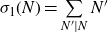 $\sigma_1(N) = \sum\limits_{N' | N} N'$
, and B(N) is defined to be the greatest integer
$\sigma_1(N) = \sum\limits_{N' | N} N'$
, and B(N) is defined to be the greatest integer $\ell$
such that
$\ell$
such that $\ell^2 | N$
.
$\ell^2 | N$
.
Proposition 2·1 (Skoruppa–Zagier [
Reference Skoruppa and Zagier20
], correction by Assaf [
Reference Assaf1
]). For $N \ge 1$
coprime to m,
$N \ge 1$
coprime to m, $Q \| N$
, and
$Q \| N$
, and $k \geq 2$
even, we have
$k \geq 2$
even, we have
 \begin{align*} {\mathrm{Tr}}_{S_k(N)} \, T'_m {\circ} W_{Q} &= \sum_{\substack{N' \mid N \\ N/N' \mathrm{ squarefree}}} \mu \left( \frac{Q}{(Q, N')} \right) s'_{k,N'} (m, (Q, N')), \\ {\mathrm{Tr}}_{S_k^{{\mathrm{new}}}(N)} \, T'_m {\circ} W_{Q} &= \sum_{N' \mid N} \alpha\left( \frac{N}{N'} \right) s'_{k,N'} (m, (Q, N')). \end{align*}
Here $\mu$
denotes the Möbius function,
$\mu$
denotes the Möbius function, $\alpha(N)$
is the nonzero multiplicative function defined on prime powers via
$\alpha(N)$
is the nonzero multiplicative function defined on prime powers via
 \begin{align*} \alpha(p^r) = \begin{cases} -1 & r = 1 \text{ or } 2 \\ 1 & r = 3 \\ 0 & r \geq 4 \end{cases} \end{align*}
and
 \begin{align} & s'_{k, N}(m,Q) \nonumber\\ & \quad = -\frac{1}{2 m^{(k-1)/2}} \sum_{Q' \mid Q} \sum_{s} p_{k} \left( \frac{s}{\sqrt{Q'}}, m \right) H_{\frac{N}{Q}} (s^2 - 4m Q') \end{align}
 \begin{align} &\qquad - \frac{1}{2 m^{(k-1)/2}} \sum_{m' \mid m} \min \left( m', \frac{m}{m'} \right)^{k - 1} \left(B(Q), m' + \frac{m}{m'}\right) \left( B\left( \frac{N}{Q} \right), m' - \frac{m}{m'}\right) \end{align}
 \begin{align} & \qquad + \frac{1}{m^{(k-1)/2}} {\unicode{x1D7D9}}_{\substack{k = 2 \\ \frac{N}{Q} = \square}} \sigma_0(Q) \sigma_1(m), \end{align}
with the summation over s ranging over all $s \in {\mathbb{Z}}$
such that
$s \in {\mathbb{Z}}$
such that $s^2 \leq 4mQ'$
,
$s^2 \leq 4mQ'$
, $Q' | s$
, and
$Q' | s$
, and $( ({s}/{Q'} )^2, {Q}/{Q'})$
is squarefree.
$( ({s}/{Q'} )^2, {Q}/{Q'})$
is squarefree.
We then estimate the $s'_{k,N}(m,Q)$
terms from this proposition. In the following, and throughout the entire paper, we use big-O notation with respect to both N and k. Note that m here is a fixed constant (so the big-O implied constants will depend on m). And Q is considered to be an arbitrary exact divisor of N (so the big-O bounds will only be stated in terms of N and k, uniform over arbitrary
$s'_{k,N}(m,Q)$
terms from this proposition. In the following, and throughout the entire paper, we use big-O notation with respect to both N and k. Note that m here is a fixed constant (so the big-O implied constants will depend on m). And Q is considered to be an arbitrary exact divisor of N (so the big-O bounds will only be stated in terms of N and k, uniform over arbitrary $Q \parallel N$
).
$Q \parallel N$
).
Lemma 2·2. Fix $m \geq 1$
. Let
$m \geq 1$
. Let $N\ge1$
be coprime to m,
$N\ge1$
be coprime to m, $Q \| N$
, and
$Q \| N$
, and $k \geq 2$
be even. Then
$k \geq 2$
be even. Then
 \begin{align*} s'_{k,N}(m,Q) = \frac{{\unicode{x1D7D9}}_{m=\square}}{\sqrt{m}} \frac{k - 1}{12} \frac{N}{Q} + O(N^{1/2}\sigma_0(N)\log N), \end{align*}
where $s'_{k,N}(m,Q)$
is as defined in Proposition 2·1.
$s'_{k,N}(m,Q)$
is as defined in Proposition 2·1.
Proof. Note that $\sigma_0(Q) \leq \sigma_0(N) = O(N^\varepsilon)$
and
$\sigma_0(Q) \leq \sigma_0(N) = O(N^\varepsilon)$
and $\sigma_1(m) = O(1)$
, so the third term (2·5) of
$\sigma_1(m) = O(1)$
, so the third term (2·5) of $s'_{k,N}(m,Q)$
is
$s'_{k,N}(m,Q)$
is $O(N^\varepsilon)$
. Also note that since
$O(N^\varepsilon)$
. Also note that since
 \begin{align*} \left(B(Q), m' + \frac{m}{m'}\right) \le 2m,\qquad \left( B\left( \frac{N}{Q} \right), m' - \frac{m}{m'}\right) \leq \sqrt{\frac{N}{Q}} \le \sqrt{N}, \end{align*}
the second term (2·4) of $s'_{k,N}(m,Q)$
is of magnitude
$s'_{k,N}(m,Q)$
is of magnitude
 \begin{align*} &\leq \frac{1}{2m^{(k-1)/2}} \sum_{m' | m} \min \left( m', \frac{m}{m'} \right)^{k - 1} (2m)\sqrt{N} \leq \frac{(2m)\sqrt{N}}{{2}} \sum_{m' | m} 1 = O(\sqrt N). \end{align*}
Lastly, we consider the first term (2·3) of $s'_{k,N}(m,Q)$
. In the double summation, denote
$s'_{k,N}(m,Q)$
. In the double summation, denote $\Delta \,:\!=\, s^2 - 4mQ'$
, and we break into two cases: when
$\Delta \,:\!=\, s^2 - 4mQ'$
, and we break into two cases: when $\Delta \lt 0$
, and when
$\Delta \lt 0$
, and when $\Delta = 0$
.
$\Delta = 0$
.
When $\Delta \lt 0$
, we have by (2·1) that
$\Delta \lt 0$
, we have by (2·1) that
 \begin{align*} \left|p_k \left( \frac{s}{\sqrt{Q'}}, m \right) \right| & \leq \frac{2m^{(k-1)/2}}{\sqrt{\left| \frac{s^2}{Q'} - 4m \right|}} = \frac{2m^{(k-1)/2}}{\sqrt{\left\lvert{\Delta}\right\lvert / Q'}}. \end{align*}
Using [ Reference Griffin, Ono and Tsai8 , lemma 2·2], we can bound the Hurwitz–Kronecker class number by
 \begin{align*} H(D) \leq \frac{\sqrt{D} (\log D +2)}{\pi}. \end{align*}
So letting $a^2b = \left({N}/{Q}, \Delta \right)$
we have
$a^2b = \left({N}/{Q}, \Delta \right)$
we have
 \begin{align*} \left| H_{\frac{N}{Q}}(\Delta) \right| & \leq \left| a^2b \left( \cfrac{\Delta / a^2b^2}{N/a^2b} \right) H(|\Delta / a^2b^2|) \right| \\[2pt] & \leq \frac{a^2 b \sqrt{|\Delta / a^2b^2|} \left( \log\left| \frac{\Delta}{a^2b^2} \right| + 2\right)}{\pi} \\[2pt] & \leq \frac{a \sqrt{|\Delta|} (\log |\Delta| + 2)}{\pi}. \end{align*}
Combining these,
 \begin{align*} \left| p_{k} \left( \frac{s}{\sqrt{Q'}}, m \right) H_{\frac{N}{Q}} (\Delta) \right| & \leq \frac{2m^{(k-1)/2}}{\sqrt{\Delta / Q'}} \frac{a \sqrt{|\Delta|} (\log|\Delta| + 2)}{\pi} \\[2pt] & = \frac{2m^{(k-1)/2} a \sqrt{Q'} (\log|\Delta| + 2)}{\pi} \\[2pt] & \leq \frac{2m^{(k-1)/2} \sqrt{N} (\log(4mN) + 2)}{\pi} \\[2pt] & = m^{(k-1)/2} O(N^{1/2} \log N), \end{align*}
where the last inequality comes from the facts that $a^2 \leq {N}/{Q} \leq {N}/{Q'}$
and
$a^2 \leq {N}/{Q} \leq {N}/{Q'}$
and $|\Delta| \le 4mQ' \le 4mN$
.
$|\Delta| \le 4mQ' \le 4mN$
.
Now, note that in (2·3), the number of terms in the summation over $Q'|Q$
is equal to
$Q'|Q$
is equal to $\sigma_0(Q) \le \sigma_0(N)$
. Furthermore, in (2·3), the number of terms in the summation over s is
$\sigma_0(Q) \le \sigma_0(N)$
. Furthermore, in (2·3), the number of terms in the summation over s is $\leq 4\sqrt{m/Q'} = O(1)$
since
$\leq 4\sqrt{m/Q'} = O(1)$
since $Q' | s$
and
$Q' | s$
and $|s| \leq 2\sqrt{mQ'}$
. Thus, the contribution of the
$|s| \leq 2\sqrt{mQ'}$
. Thus, the contribution of the $\Delta \lt 0$
terms in
$\Delta \lt 0$
terms in $s'_{k,N}(m,Q)$
is
$s'_{k,N}(m,Q)$
is $O(N^{1/2} \sigma_0(N) \log N)$
.
$O(N^{1/2} \sigma_0(N) \log N)$
.
Finally, we consider the $\Delta = 0$
terms, which will make up the main term of
$\Delta = 0$
terms, which will make up the main term of $s'_{k,N}(m,Q)$
. Recall that
$s'_{k,N}(m,Q)$
. Recall that $(m,Q')=1$
. Then note that
$(m,Q')=1$
. Then note that $\Delta \,:\!=\, s^2 - 4mQ' =0$
implies that
$\Delta \,:\!=\, s^2 - 4mQ' =0$
implies that $m=\square$
and
$m=\square$
and $Q'=\square$
. Additionally,
$Q'=\square$
. Additionally, $(Q')^2 \,|\, s^2=4mQ'$
implies that
$(Q')^2 \,|\, s^2=4mQ'$
implies that $Q' \,|\, 4$
. Hence we must have
$Q' \,|\, 4$
. Hence we must have $Q' = 1 \text{ or }4$
. It is straightforward to verify that the first case occurs precisely when
$Q' = 1 \text{ or }4$
. It is straightforward to verify that the first case occurs precisely when $m=\square$
and
$m=\square$
and $4 \nmid Q$
(for
$4 \nmid Q$
(for $Q'=1$
,
$Q'=1$
, $s=\pm 2 \sqrt m$
); and the second case occurs precisely when
$s=\pm 2 \sqrt m$
); and the second case occurs precisely when $m=\square$
and
$m=\square$
and $4 | Q$
(for
$4 | Q$
(for $Q'=4$
,
$Q'=4$
, $s=\pm 4 \sqrt m$
). This means that in all cases, the number of
$s=\pm 4 \sqrt m$
). This means that in all cases, the number of $\Delta = 0$
terms appearing in
$\Delta = 0$
terms appearing in $s'_{k,N}(m,Q)$
is exactly
$s'_{k,N}(m,Q)$
is exactly $2\,{\unicode{x1D7D9}}_{m=\square}$
.
$2\,{\unicode{x1D7D9}}_{m=\square}$
.
And when $\Delta = 0$
, we have by (2·1) and (2·2) that
$\Delta = 0$
, we have by (2·1) and (2·2) that
 \begin{align*} p_k\left({\frac{s}{\sqrt{Q'}}, m}\right) &= (k-1)\,m^{(k-2)/2} \\ \text{and}\quad H_{\frac{N}{Q}} (s^2 - 4m Q') & = H_{\frac{N}{Q}} (0) = \frac{-1}{12} \frac{N}{Q}. \end{align*}
Thus, extracting the $\Delta=0$
terms from
$\Delta=0$
terms from $s'_{k, N}(m,Q)$
, we obtain
$s'_{k, N}(m,Q)$
, we obtain
 \begin{align*} &-\frac{1}{2m^{(k-1)/2}} \sum_{Q' | Q} \sum_{\substack{s^2 = 4mQ' \\ Q' | s}} p_{k} \left( \frac{s}{\sqrt{Q'}}, m \right) H_{\frac{N}{Q}} (s^2 - 4m Q') \\ =& -\frac{1}{2m^{(k-1)/2}} (2 {\unicode{x1D7D9}}_{m=\square}) \big( (k-1) m^{(k-2)/2} \big) \Big( \frac{-1}{12} \frac{N}{Q} \Big) \\ = & \frac{{\unicode{x1D7D9}}_{m=\square}}{\sqrt{m}} \frac{k - 1}{12} \frac{N}{Q}, \end{align*}
completing the proof.
With this estimate of $s'_{k,N}(m,Q)$
, we can then estimate
$s'_{k,N}(m,Q)$
, we can then estimate ${\mathrm{Tr}} \, T'_m {\circ} W_Q$
. In the following, we use the notation
${\mathrm{Tr}} \, T'_m {\circ} W_Q$
. In the following, we use the notation $[\![{A}]\!]_{\textit{condition}}$
to denote that the term A only appears when
$[\![{A}]\!]_{\textit{condition}}$
to denote that the term A only appears when $\textit{condition}$
is satisfied.
$\textit{condition}$
is satisfied.
Proposition 2·3. Fix $m \geq 1$
. Let
$m \geq 1$
. Let $N\ge1$
be coprime to m,
$N\ge1$
be coprime to m, $Q \| N$
, and
$Q \| N$
, and $k \geq 2$
be even. Then
$k \geq 2$
be even. Then
 \begin{align*} {\mathrm{Tr}}_{S_k(N)} \, T'_m {\circ} W_Q &= \frac{{\unicode{x1D7D9}}_{m = \square}}{\sqrt{m}} \frac{k - 1}{12} \psi(N) {\unicode{x1D7D9}}_{Q = 1} + O(N^{1/2} \sigma_0(N)^2 \log N), \\ {\mathrm{Tr}}_{S_k^{{\mathrm{new}}}(N)} \, T'_m {\circ} W_Q &= \frac{{\unicode{x1D7D9}}_{m = \square}}{\sqrt{m}} \frac{k - 1}{12} \psi^{{\mathrm{new}}}(N) \eta(Q) + O(N^{1/2} \sigma_0(N)^2 \log N), \end{align*}
where $\psi$
,
$\psi$
, $\psi^{\mathrm{new}}$
, and
$\psi^{\mathrm{new}}$
, and $\eta$
are the nonzero multiplicative functions defined on prime powers via
$\eta$
are the nonzero multiplicative functions defined on prime powers via
 \begin{align*} \psi(p^r) &\,:\!=\, p^r \left({1+\frac 1p}\right), \\ \psi^{{\mathrm{new}}}(p^r) &\,:\!=\, p^r \left({1 - \frac 1p - \left[\!\!\left[{ \frac{1}{p^2} }\right]\!\!\right]_{r\ge 2} + \left[\!\!\left[{ \frac{1}{p^3} }\right]\!\!\right]_{r\ge 3} }\right), \\ \eta(p^r) &\,:\!=\, \frac{-{\unicode{x1D7D9}}_{r=2}}{p^2 - p - 1}. \end{align*}
Note in particular that when N is squarefree, $\eta(Q) = {\unicode{x1D7D9}}_{Q = 1}$
.
$\eta(Q) = {\unicode{x1D7D9}}_{Q = 1}$
.
Proof. Define the multiplicative function $\theta_M(d) \,:\!=\, {d}/{(M, d)}$
. Observe that
$\theta_M(d) \,:\!=\, {d}/{(M, d)}$
. Observe that $\mu {\circ} \theta_M$
is also multiplicative since
$\mu {\circ} \theta_M$
is also multiplicative since $\theta_M(d_1), \theta_M(d_2)$
are coprime whenever
$\theta_M(d_1), \theta_M(d_2)$
are coprime whenever $d_1,d_2$
are coprime.
$d_1,d_2$
are coprime.
To show the first desired identity, it suffices (by Lemma 2·2 and Proposition 2·1) to show that
 \begin{align} \sum_{\substack{N' \mid N \\ N/N' \mathrm{ squarefree}}} \mu \left({ \frac{Q}{(Q, N')} }\right) \frac{N'}{(Q, N')} = \psi(N){\unicode{x1D7D9}}_{Q = 1}. \end{align}
Observe that ${\unicode{x1D7D9}}_{N/N' \ \text{squarefree}} = \mu^2(N/N')$
,
${\unicode{x1D7D9}}_{N/N' \ \text{squarefree}} = \mu^2(N/N')$
, $\mu ({ {Q}/{(Q, N')} }) = \mu ({{N/N'}/{(N/N', N/Q)} }) = \mu {\circ} \theta_{N/Q}(N/N')$
, and
$\mu ({ {Q}/{(Q, N')} }) = \mu ({{N/N'}/{(N/N', N/Q)} }) = \mu {\circ} \theta_{N/Q}(N/N')$
, and ${N'}/{(Q, N')} = \theta_Q(N')$
. This means that
${N'}/{(Q, N')} = \theta_Q(N')$
. This means that
 \begin{align*} \text{LHS of (2.6)} &= [[\mu^2 \cdot\mu {\circ}\theta_{N/Q}] * \theta_Q](N) \\ & = \prod_{p^r \| N} [[\mu^2 \cdot \mu {\circ}\theta_{N/Q}] * \theta_Q](p^r) \\ & = \prod_{p^r \| N} \sum_{i = 0}^r \mu^2(p^i)\, \mu {\circ} \theta_{N/Q}(p^i) \, \theta_Q(p^{r - i}) \\ & = \prod_{p^r \| N} \big( \theta_Q(p^r) + \mu {\circ} \theta_{N/Q}(p) \,\theta_Q(p^{r - 1}) \big) \\ &= \prod_{p^r \| N} \begin{cases} p^r + p^{r-1} & \text{if } p \nmid Q \\ 0 & \text{if } p \mid Q \end{cases} \\ &= \psi(N){\unicode{x1D7D9}}_{Q = 1}. \end{align*}
Note that here, the second-to-last equality comes from the facts that
 \begin{align*} \theta_Q(p^s) &= \begin{cases} p^s & \text{if } p \nmid Q \\ 1 & \text{if } p | Q \end{cases} \qquad \text{and}\qquad \mu{\circ}\theta_{N/Q}(p) = \begin{cases} 1 & \text{if } p \nmid Q \\ -1 & \text{if } p | Q. \end{cases} \end{align*}
Similarly, to show the second desired identity, it suffices (by Lemma 2·2 and Proposition 2·1) to show that
 \begin{align} \sum_{N' | N} \alpha\left( \frac{N}{N'} \right) \frac{N'}{(Q, N')} = \psi^{\mathrm{new}}(N) \eta(Q). \end{align}
And here,
 \begin{align*} \text{LHS of (2.7)} &= [\alpha * \theta_Q](N) \\ & = \prod_{p^r \| N} [\alpha * \theta_Q](p^r) \\ & = \prod_{p^r \| N} \sum_{i = 0}^r \alpha(p^{i}) \theta_Q(p^{r-i}) \\ &= \prod_{p^r \parallel N} \big( \theta_Q(p^r) - \theta_Q(p^{r-1}) - [\![{\theta_Q(p^{r-2})}]\!]_{r \ge 2} + [\![{\theta_Q(p^{r-3})}]\!]_{r \ge 3} \big) \\ &= \prod_{p^r \parallel N} \begin{cases} \psi^{\mathrm{new}}(p^r) & \text{if } p \nmid Q \\ - {\unicode{x1D7D9}}_{r=2} & \text{if } p \mid Q \end{cases} \\ &= \psi^{\mathrm{new}}(N) \prod_{p \mid Q} \frac{- {\unicode{x1D7D9}}_{v_p(N)=2} }{ \psi^{\mathrm{new}}(p^2) } \\ &= \psi^{\mathrm{new}}(N) \prod_{p^r \| Q} \frac{- {\unicode{x1D7D9}}_{r=2} }{ p^2-p-1 } \\ &= \psi^{\mathrm{new}}(N) \eta(Q), \end{align*}
as desired.
3. Trace Formula for
$T'_m$
over the sign pattern spaces

In [
Reference Martin11
, proposition 3·2], Martin derived a formula for $\dim S_k^{{\mathrm{new}},\sigma}(N)$
in terms of the traces
$\dim S_k^{{\mathrm{new}},\sigma}(N)$
in terms of the traces ${\mathrm{Tr}}_{S_k^{{\mathrm{new}}}(N)}W_Q$
. Here, we prove a similar formula for
${\mathrm{Tr}}_{S_k^{{\mathrm{new}}}(N)}W_Q$
. Here, we prove a similar formula for ${\mathrm{Tr}}_{S_k^{\sigma}(N)}T'_m$
and
${\mathrm{Tr}}_{S_k^{\sigma}(N)}T'_m$
and ${\mathrm{Tr}}_{S_k^{{\mathrm{new}},\sigma}(N)}T'_m$
in terms of the traces
${\mathrm{Tr}}_{S_k^{{\mathrm{new}},\sigma}(N)}T'_m$
in terms of the traces ${\mathrm{Tr}}_{S_k(N)} T'_m {\circ} W_Q$
and
${\mathrm{Tr}}_{S_k(N)} T'_m {\circ} W_Q$
and ${\mathrm{Tr}}_{S_k^{\mathrm{new}}(N)} T'_m {\circ} W_Q$
, respectively.
${\mathrm{Tr}}_{S_k^{\mathrm{new}}(N)} T'_m {\circ} W_Q$
, respectively.
We note that the identity (3·1) underlying this lemma can also be interpreted as a special case of orthogonality for characters over a finite group. (The set of all exact divisors of N forms a group via the binary operation $Q_1 * Q_2 \,:\!=\, {Q_1 Q_2}/{(Q_1,Q_2)^2}$
. And sign patterns for N make up the characters on this group.)
$Q_1 * Q_2 \,:\!=\, {Q_1 Q_2}/{(Q_1,Q_2)^2}$
. And sign patterns for N make up the characters on this group.)
Lemma 3·1. For $N\geq1$
,
$N\geq1$
,
 \begin{align*} {\mathrm{Tr}}_{S_k^{\sigma}(N)}T'_m &= \frac{1}{2^{\omega(N)}}\sum_{Q\mid\mid N}\sigma(Q){\mathrm{Tr}}_{S_k(N)} \, T'_m {\circ} W_Q, \\ {\mathrm{Tr}}_{S_k^{{\mathrm{new}},\sigma}(N)}T'_m &= \frac{1}{2^{\omega(N)}}\sum_{Q\mid\mid N}\sigma(Q){\mathrm{Tr}}_{S_k^{\mathrm{new}}(N)} \, T'_m {\circ} W_Q.\end{align*}
Proof. We show this result just for the full space $S_k(N)$
, and the argument for the newspace
$S_k(N)$
, and the argument for the newspace $S_k^{\mathrm{new}}(N)$
is identical.
$S_k^{\mathrm{new}}(N)$
is identical.
First, observe that
 \begin{align} \sum_{Q\mid\mid N}\sigma(Q)\sigma '(Q) &= \prod_{p^r \| N} \sum_{Q \| p^r} \sigma(Q) \sigma'(Q) = \prod_{p^r \| N} \left({ 1 + \sigma(p^r) \sigma'(p^r) }\right)\nonumber\\ &= \prod_{p^r \| N} 2 {\unicode{x1D7D9}}_{\sigma(p^r) = \sigma'(p^r)} = 2^{\omega(N)}{\unicode{x1D7D9}}_{\sigma =\sigma '}. \end{align}
Then, proceeding by splitting ${\mathrm{Tr}}_{S_k(N)}T'_m{\circ}W_Q$
into a sum of
${\mathrm{Tr}}_{S_k(N)}T'_m{\circ}W_Q$
into a sum of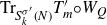 ${\mathrm{Tr}}_{S_k^{\sigma '}(N)}T'_m{\circ}W_Q$
for all sign patterns
${\mathrm{Tr}}_{S_k^{\sigma '}(N)}T'_m{\circ}W_Q$
for all sign patterns $\sigma'$
of N:
$\sigma'$
of N:
 \begin{align*} \frac{1}{2^{\omega(N)}}\sum_{Q\mid\mid N}\sigma(Q){\mathrm{Tr}}_{S_k(N)} \, T'_m{\circ}W_Q &= \frac{1}{2^{\omega(N)}}\sum_{Q \mid\mid N}\sigma(Q)\sum_{\sigma '} {\mathrm{Tr}}_{S_k^{\sigma '}(N)}T'_m {\circ}W_Q \\ &= \frac{1}{2^{\omega(N)}}\sum_{Q \mid\mid N}\sum_{\sigma '}\sigma(Q)\sigma '(Q){\mathrm{Tr}}_{S_k^{\sigma '}(N)}T'_m \\&= \frac{1}{2^{\omega(N)}}\sum_{\sigma'} 2^{\omega(N)} {\unicode{x1D7D9}}_{\sigma = \sigma'}{\mathrm{Tr}}_{S_k^{\sigma'}(N)}T_m' \\&= {\mathrm{Tr}}_{S_k^{\sigma}(N)}T'_m, \end{align*}
as desired.
We can then estimate ${\mathrm{Tr}}_{S_k^\sigma(N)} T'_m$
and
${\mathrm{Tr}}_{S_k^\sigma(N)} T'_m$
and ${\mathrm{Tr}}_{S_k^{{\mathrm{new}},\sigma}(N)} T'_m$
by applying Proposition 2·3 to Lemma 3·1.
${\mathrm{Tr}}_{S_k^{{\mathrm{new}},\sigma}(N)} T'_m$
by applying Proposition 2·3 to Lemma 3·1.
Corollary 3·2. Fix $m \geq 1$
. Then for
$m \geq 1$
. Then for $N \ge 1$
coprime to m and
$N \ge 1$
coprime to m and $k \geq 2$
even,
$k \geq 2$
even,
 \begin{align} {\mathrm{Tr}}_{S_k^\sigma(N)} \, T'_m &= \frac{{\unicode{x1D7D9}}_{m = \square}}{\sqrt{m}} \frac{k - 1}{12} \frac{\psi(N)}{2^{\omega(N)}} + O(N^{1/2}\sigma_0(N)^2\log N), \end{align}
 \begin{align} {\mathrm{Tr}}_{S_k^{{\mathrm{new}},\sigma}(N)} \, T'_m &= \frac{{\unicode{x1D7D9}}_{m = \square}}{\sqrt{m}} \frac{k - 1}{12} \frac{\psi^{{\mathrm{new}}}(N)}{2^{\omega(N)}} \prod_{p^r||N} \left({ 1 + \sigma(p^r) \frac{- {\unicode{x1D7D9}}_{r=2}}{p^2 - p -1}}\right) + O(N^{1/2} \sigma_0(N)^2 \log N). \qquad \end{align}
Proof. Using Lemma 3·1 and then Proposition 2·3, we obtain
 \begin{align*} {\mathrm{Tr}}_{S_k^\sigma(N)}T_{m}' &=\frac{1}{2^{\omega(N)}}\sum_{Q\mid\mid N}\sigma(Q){\mathrm{Tr}}_{S_k(N)}T_m'{\circ} W_Q \\ &=\frac{1}{2^{\omega(N)}} \sum_{Q \| N} \sigma(Q) \frac{{\unicode{x1D7D9}}_{m=\square}}{\sqrt{m}}\frac{k-1}{12}\psi(N) {\unicode{x1D7D9}}_{Q=1} +O(N^{1/2}\sigma_0(N)^2\log N)\\ &=\frac{{\unicode{x1D7D9}}_{m=\square}}{\sqrt{m}}\frac{k-1}{12}\frac{\psi(N)}{2^{\omega(N)}}+O(N^{1/2}\sigma_0(N)^2\log N),\\ {\mathrm{Tr}}_{S_k^{{\mathrm{new}},\sigma}(N)}T_{m}'&=\sum_{Q\mid\mid N}\sigma(Q){\mathrm{Tr}}_{S_k^{{\mathrm{new}}}(N)}T_m'{\circ} W_Q \\&=\frac{1}{2^{\omega(N)}} \sum_{Q\|N} \sigma(Q) \frac{{\unicode{x1D7D9}}_{m=\square}}{\sqrt{m}}\frac{k-1}{12}\psi^{{\mathrm{new}}}(N) \eta(Q)+O(N^{1/2}\sigma_0(N)^2\log N) \\ &=\frac{{\unicode{x1D7D9}}_{m=\square}}{\sqrt{m}}\frac{k-1}{12}\frac{\psi^{{\mathrm{new}}}(N)}{2^{\omega(N)}}\prod_{p^r||N} \left({ 1 + \sigma(p^r) \frac{- {\unicode{x1D7D9}}_{r=2}}{p^2 - p -1}}\right)+O(N^{1/2}\sigma_0(N)^2\log N),\end{align*}
as desired.
We point out here that the main term of (3·2) always grows faster than the error term $O(N^{1/2} \sigma_0(N)^2\log N) = O(N^{1/2+\varepsilon})$
. Furthermore, the main term of (3·3) grows faster than the error term, assuming it is not the case that
$O(N^{1/2} \sigma_0(N)^2\log N) = O(N^{1/2+\varepsilon})$
. Furthermore, the main term of (3·3) grows faster than the error term, assuming it is not the case that $4 \| N$
with
$4 \| N$
with $\sigma(4)=+1$
(because after excluding this one particular case, the
$\sigma(4)=+1$
(because after excluding this one particular case, the $\prod_{p^r||N} ({ 1 + \sigma(p^r) ({- {\unicode{x1D7D9}}_{r=2}}/({p^2 - p -1}))})$
factor in (3·3) is
$\prod_{p^r||N} ({ 1 + \sigma(p^r) ({- {\unicode{x1D7D9}}_{r=2}}/({p^2 - p -1}))})$
factor in (3·3) is $\ge 1/2$
by (1·5)). In other words, the main terms of this corollary grow faster than the corresponding error terms for all admissible sign patterns
$\ge 1/2$
by (1·5)). In other words, the main terms of this corollary grow faster than the corresponding error terms for all admissible sign patterns $\sigma$
.
$\sigma$
.
4. Proportion of Sign Patterns
In this section, we show Theorems 1·1 and 1·2.
Theorem 1·1. Consider $N \ge 1$
and
$N \ge 1$
and $k \ge 2$
even. Then as
$k \ge 2$
even. Then as $N+k \to \infty$
, the proportion of cusp forms with global sign
$N+k \to \infty$
, the proportion of cusp forms with global sign $+1$
is given by
$+1$
is given by
 \begin{align*} \frac{\dim S_k^+(N)}{\dim S_k(N)} &\sim \frac12 + \frac{{\unicode{x1D7D9}}_{N=1}}{2}, \\[3pt] \frac{\dim S_k^{{\mathrm{new}},+}(N)}{\dim S_k^{\mathrm{new}}(N)} &\sim \frac12+\frac{ {\unicode{x1D7D9}}_{N=\mathrm{cubefree\ square}}}{2} \prod_{p|N} \frac{-1}{p^2-p-1}. \end{align*}
Moreover, consider sign patterns $\sigma$
for N. Then as
$\sigma$
for N. Then as $N+k \to \infty$
, the proportion of cusp forms with sign pattern
$N+k \to \infty$
, the proportion of cusp forms with sign pattern $\sigma$
is given by
$\sigma$
is given by
 \begin{align} \frac{\dim S_k^\sigma(N)}{\dim S_k(N)} &\sim \frac{1}{2^{\omega(N)}},\\[-10pt]\nonumber \end{align}
 \begin{align} \frac{\dim S_k^{{\mathrm{new}},\sigma}(N)}{\dim S_k^{\mathrm{new}}(N)} &\sim \frac{1}{2^{\omega(N)}} \prod_{p^r||N} \left({ 1 + \sigma(p^r) \frac{- {\unicode{x1D7D9}}_{r=2}}{p^2 - p -1}}\right). \end{align}
Proof. First, substitute $m=1$
and
$m=1$
and $Q=1$
into Proposition 2·3 to obtain the dimensions of the entire spaces:
$Q=1$
into Proposition 2·3 to obtain the dimensions of the entire spaces:
 \begin{align} \dim S_k(N) = \frac{k-1}{12} \psi(N) + O(N^{1/2+\varepsilon}), \end{align}
 \begin{align} \dim S_k^{\mathrm{new}}(N) = \frac{k-1}{12} \psi^{\mathrm{new}}(N) + O(N^{1/2+\varepsilon}).\end{align}
Now, for the first two claims, we use Proposition 2·3 at $m=1$
and
$m=1$
and $Q=1,N$
to obtain
$Q=1,N$
to obtain
 \begin{align*} \dim S_k^+(N) &= \frac12\left({ {\mathrm{Tr}}_{S_k(N)}W_1+{\mathrm{Tr}}_{S_k(N)}W_N}\right) \\ &= \frac{k-1}{12} \psi(N) \frac{ 1 + {\unicode{x1D7D9}}_{N=1} }{2} + O(N^{1/2+\varepsilon}), \\ \dim S_k^{{\mathrm{new}},+}(N) &= \frac12\left({ {\mathrm{Tr}}_{S_k^{\mathrm{new}}(N)}W_1+{\mathrm{Tr}}_{S_k^{\mathrm{new}}(N)}W_N}\right) \\ &= \frac{k-1}{12} \psi^{\mathrm{new}}(N) \frac{ 1 + \eta(N) }{2} + O(N^{1/2+\varepsilon}) \\ &= \frac{k-1}{12} \psi^{\mathrm{new}}(N) \frac{1+{\unicode{x1D7D9}}_{N = \text{cubefree square}} \prod_{p|N} \frac{-1}{p^2-p-1} }{2} + O(N^{1/2+\varepsilon}).\end{align*}
Comparing these estimates with (4·3) and (4·4) then yields the desired result.
For the last two claims, we substitute $m=1$
into Corollary 3·2 to obtain
$m=1$
into Corollary 3·2 to obtain
 \begin{align*} \dim S_k^\sigma(N)&=\frac{1}{2^{\omega(N)}}\frac{k-1}{12}\psi(N)+O(N^{1/2+\varepsilon}), \\[4pt] \dim S_k^{{\mathrm{new}},\sigma}(N)&=\frac{1}{2^{\omega(N)}}\frac{k-1}{12}\psi^{{\mathrm{new}}}(N)\prod_{p^r||N}\left({1+\sigma(p^r)\frac{-{\unicode{x1D7D9}}_{r=2}}{p^2-p-1}}\right)+O(N^{1/2+\varepsilon}).\end{align*}
Comparing these estimates with (4·3) and (4·4) similarly yields the desired result.
Recall that we defined the notion of admissible sign patterns, where all sign patterns are admissible except for the case of $4 \| N$
with
$4 \| N$
with $\sigma(4) = +1$
over the newspace. We introduced this definition because the proportions (4·1) and (4·2) are always nonzero except in this one exceptional case.
$\sigma(4) = +1$
over the newspace. We introduced this definition because the proportions (4·1) and (4·2) are always nonzero except in this one exceptional case.
In fact, it turns out that $W_4$
always has Atkin–Lehner sign
$W_4$
always has Atkin–Lehner sign $-1$
over
$-1$
over $S_k^{\mathrm{new}}(N)$
. This means that for inadmissible sign patterns
$S_k^{\mathrm{new}}(N)$
. This means that for inadmissible sign patterns $\sigma$
, there are no forms at all in
$\sigma$
, there are no forms at all in $S_k^{\mathrm{new}}(N)$
with sign pattern
$S_k^{\mathrm{new}}(N)$
with sign pattern $\sigma$
.
$\sigma$
.
Theorem 1·2. Let $N \ge 1$
with
$N \ge 1$
with $4 \| N$
. Then
$4 \| N$
. Then $W_4 f = -f$
for every
$W_4 f = -f$
for every $f \in S_k^{\mathrm{new}}(N)$
.
$f \in S_k^{\mathrm{new}}(N)$
.
Proof. It suffices to show that ${\mathrm{Tr}}_{S_k^{\mathrm{new}}(N)} W_1 + {\mathrm{Tr}}_{S_k^{\mathrm{new}}(N)} W_4 = 0$
. Using Proposition 2·1, we compute
${\mathrm{Tr}}_{S_k^{\mathrm{new}}(N)} W_1 + {\mathrm{Tr}}_{S_k^{\mathrm{new}}(N)} W_4 = 0$
. Using Proposition 2·1, we compute
 \begin{align*} & {\mathrm{Tr}}_{S_k^{\mathrm{new}}(N)} W_1 + {\mathrm{Tr}}_{S_k^{\mathrm{new}}(N)} W_4 \\ & \quad = \sum_{N' | N} \alpha\left( \frac{N}{N'} \right) \big[{ s'_{k, N'}(1, (1, N')) + s'_{k, N'}(1,(4, N')) }\big] \\ & \quad = \sum_{L | \frac{N}{4}} \sum_{N' \in \{L, 2L, 4L\}} \alpha\left( \frac{N}{N'} \right) \big[{ s'_{k, N'}(1, (1, N')) + s'_{k, N'}(1,(4, N')) }\big] \\ & \quad = \sum_{L | \frac{N}{4}} \big[ \alpha\left( \frac{N}{L} \right) \big[ s'_{k, L}(1,1) + s'_{k, L}(1,1) \big] + \alpha\left( \frac{N}{2L} \right) \big[ s'_{k, 2L}(1,1) + s'_{k, 2L} (1,2) \big] \\ & \qquad + \alpha \left( \frac{N}{4L} \right) \big[ s'_{k, 4L}(1,1) + s'_{k, 4L}(1,4) \big] \big] \\ & \quad = \sum_{L | \frac{N}{4}} \alpha \left( \frac{N}{4L} \right) \big[{ -2 s'_{k, L}(1,1) - s'_{k, 2L}(1,1) - s'_{k, 2L}(1,2) + s'_{k, 4L}(1,1) + s_{k, 4L}(1,4) }\big]\\ & \quad =: \sum_{L | \frac{N}{4}} \alpha \left( \frac{N}{4L} \right) [{ * }]. \end{align*}
Now, we show that $[{*}] = 0$
. Computing each of the terms appearing in
$[{*}] = 0$
. Computing each of the terms appearing in $[{*}]$
(see (2·3)-(2·5) for the definition of
$[{*}]$
(see (2·3)-(2·5) for the definition of $s'_{k,L}$
) yields
$s'_{k,L}$
) yields
 \begin{align*} s'_{k,L}(1,1) & = -\frac{1}{2} \Big[{p_k(0,1)H_L({-}4) + 2p_k(1,1)H_L({-}3) + 2p_k(2,1)H_L(0) + B(L) - 2{\unicode{x1D7D9}}_{\substack{k = 2 \\ L = \square}}}\Big], \\ s'_{k, 2L}(1,1) & = -\frac{1}{2} \Big[{p_k(0,1)H_{2L}({-}4) + 2p_k(1,1)H_{2L}({-}3) + 2p_k(2,1)H_{2L}(0) + B(L)}\Big], \\ s'_{k, 2L}(1,2) & = -\frac{1}{2} \Big[ p_k(0,1)H_L({-}4) + 2p_k(1,1) H_L({-}3) + 2p_k(2,1) H_L(0) + p_k(0,1) H_L({-}8) \\ & \quad + 2p_k(\sqrt{2}, 1) H_L({-}4) + B(L) - 4 {\unicode{x1D7D9}}_{\substack{k = 2 \\ L = \square}} \Big], \\ s'_{k, 4L}(1,1) & = -\frac{1}{2} \Big[p_k(0,1)H_{4L}({-}4) + 2p_k(1,1) H_{4L}({-}3) + 2p_k(2,1) H_{4L}(0)\\ & \quad + 2B(L) - 2{\unicode{x1D7D9}}_{\substack{k = 2 \\ L = \square}}\Big], \\ s'_{k, 4L}(1,4) & = -\frac{1}{2} \Big[2p_k(1,1) H_L({-}3) + p_k(0,1) H_L({-}8) + 2p_k(\sqrt{2}, 1) H_L({-}4)\\ & \quad + p_k(0,1)H_L({-}16) + 2p_k(2,1)H_L(0) + 2B(L) - 6 {\unicode{x1D7D9}}_{\substack{k = 2 \\ L = \square}} \Big]. \end{align*}
Then grouping all the terms of $[{*}]$
by the
$[{*}]$
by the $p_k(t,m)$
yields
$p_k(t,m)$
yields
 \begin{align*} [{*}] =& \; \frac{1}{2}p_k(0,1) [{3H_L({-}4) + H_{2L}({-}4) - H_{4L}({-}4) - H_L({-}16)}] \\[1pt] & + p_k(1,1) [{ 2H_L({-}3) + H_{2L}({-}3) - H_{4L}({-}3) }] \\[1pt] & + p_k(2,1) [{ 2H_L(0) + H_{2L}(0) - H_{4L}(0) }] \\[1pt] = & \; \frac{1}{2}p_k(0,1) \left[ \frac{3}{2} \left( \frac{-4}{L} \right) - \frac{3}{2} \left( \frac{-16}{L} \right) \right] \\[1pt]& + p_k(1,1) \frac{{\unicode{x1D7D9}}_{3 {\nmid} L}}{3} \left[ 2 \left( \frac{-3}{L} \right) + \left( \frac{-3}{2L} \right) - \left( \frac{-3}{4L} \right) \right] \\[1pt]& + p_k(2,1) \frac{-1}{12} [{ 2L + 2L - 4L }] \\[1pt] = & \; 0, \end{align*}
as desired.
5.
$\mu_p$
-equidistribution of Hecke eigenvalues

In this section, we prove Theorem 1·3. For a fixed prime p, let $\mu_p$
denote the p-adic Plancherel measure
$\mu_p$
denote the p-adic Plancherel measure $\displaystyle \mu_p(x) = (({p+1})/{\pi})({(1-x^2/4)^{1/2}}/({(p^{1/2}+p^{-1/2})^2-x^2}))dx$
. Then over the spaces
$\displaystyle \mu_p(x) = (({p+1})/{\pi})({(1-x^2/4)^{1/2}}/({(p^{1/2}+p^{-1/2})^2-x^2}))dx$
. Then over the spaces $S_k^\sigma(N)$
and
$S_k^\sigma(N)$
and $S_k^{{\mathrm{new}},\sigma}(N)$
(for admissible sign patterns
$S_k^{{\mathrm{new}},\sigma}(N)$
(for admissible sign patterns $\sigma$
), we show that the Hecke eigenvalues for
$\sigma$
), we show that the Hecke eigenvalues for $T_p'$
are
$T_p'$
are $\mu_p$
-equidistributed as
$\mu_p$
-equidistributed as $N+k \to \infty$
.
$N+k \to \infty$
.
Theorem 1·3. Fix p prime. Consider $N \ge 1$
coprime to p,
$N \ge 1$
coprime to p, $\sigma$
sign patterns for N, and
$\sigma$
sign patterns for N, and $k \ge 2$
even. Then the Hecke eigenvalues of
$k \ge 2$
even. Then the Hecke eigenvalues of $T'_p |_{S_k^\sigma(N)}$
are
$T'_p |_{S_k^\sigma(N)}$
are $\mu_p$
-equidistributed as
$\mu_p$
-equidistributed as $N+k \to \infty$
. In other words, for any sequence
$N+k \to \infty$
. In other words, for any sequence $\{(N_i,k_i,\sigma_i)\}_{i \ge 1}$
with
$\{(N_i,k_i,\sigma_i)\}_{i \ge 1}$
with $N_i + k_i \to \infty$
, the collection of Hecke eigenvalues
$N_i + k_i \to \infty$
, the collection of Hecke eigenvalues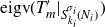 ${\mathrm{eigv}}(T'_m |_{S_{k_i}^{\sigma_i}(N_i)})$
is
${\mathrm{eigv}}(T'_m |_{S_{k_i}^{\sigma_i}(N_i)})$
is $\mu_p$
-equidistributed as
$\mu_p$
-equidistributed as $i \to \infty$
. Moreover, if we assume it is not the case that
$i \to \infty$
. Moreover, if we assume it is not the case that $4 \| N$
with
$4 \| N$
with $\sigma(4)=+1$
, then the Hecke eigenvalues of
$\sigma(4)=+1$
, then the Hecke eigenvalues of $T'_p |_{S_k^{{\mathrm{new}},\sigma}(N)}$
are also
$T'_p |_{S_k^{{\mathrm{new}},\sigma}(N)}$
are also $\mu_p$
-equidistributed as
$\mu_p$
-equidistributed as $N+k \to \infty$
.
$N+k \to \infty$
.
Proof. We just state the argument here for $S_k^{{\mathrm{new}},\sigma}(N)$
, and an identical argument works for the full space
$S_k^{{\mathrm{new}},\sigma}(N)$
, and an identical argument works for the full space $S_k^{\sigma}(N)$
.
$S_k^{\sigma}(N)$
.
To show asymptotic $\mu_p$
-equidistribution of the Hecke eigenvalues, it suffices (e.g. by Kuipers-Niederreiter [
Reference Kuipers and Niederreiter10
, theorem 1·1], Serre [
Reference Serre19
, proposition 2]) to show that
$\mu_p$
-equidistribution of the Hecke eigenvalues, it suffices (e.g. by Kuipers-Niederreiter [
Reference Kuipers and Niederreiter10
, theorem 1·1], Serre [
Reference Serre19
, proposition 2]) to show that
 \begin{equation} \frac{1}{\dim S_k^{{\mathrm{new}},\sigma}(N)}\sum_{\lambda \in \text{eigv}\big({T'_p|_{S_k^{{\mathrm{new}},\sigma}(N)}}\big)} X_n(\lambda)\longrightarrow\int_{-2}^{2} X_n(x) \mu_p(x) \quad\text{as } N+k\to\infty\end{equation}
for the Chebyshev polynomials $X_n(x) \,:\!=\, U_n(x/2)$
for
$X_n(x) \,:\!=\, U_n(x/2)$
for $n \ge 0$
, since they span the space of all polynomials, which is a dense subspace of all continuous functions on
$n \ge 0$
, since they span the space of all polynomials, which is a dense subspace of all continuous functions on $[-2,2]$
.
$[-2,2]$
.
The integral on the right hand side of (5·1) has value $p^{-n/2} {\unicode{x1D7D9}}_{{\textit{n} even}}$
, by Serre [
Reference Serre19
, equation (20)].
$p^{-n/2} {\unicode{x1D7D9}}_{{\textit{n} even}}$
, by Serre [
Reference Serre19
, equation (20)].
Additionally, it is well known (see [ Reference Serre19 , lemme 1], for example) that
 \begin{equation*}T_{p^n}' = X_n(T_p').\end{equation*}
This means that
 \begin{align*} \text{LHS of (5.1)} &= \frac{1}{\dim S_k^{{\mathrm{new}},\sigma}(N)}\sum_{\lambda \in \text{eigv}\big({T'_p|_{S_k^{{\mathrm{new}},\sigma}(N)}}\big)} X_n(\lambda) \\ &= \frac{ {\mathrm{Tr}}_{S_k^{{\mathrm{new}},\sigma}(N)} X_n(T'_{p}) }{ {\mathrm{Tr}}_{S_k^{{\mathrm{new}},\sigma}(N)} T'_{1} } \\ &= \frac{ {\mathrm{Tr}}_{S_k^{{\mathrm{new}},\sigma}(N)} T'_{p^n} }{ {\mathrm{Tr}}_{S_k^{{\mathrm{new}},\sigma}(N)} T'_{1} } \\ &\to p^{-n/2} {\unicode{x1D7D9}}_{{\textit{n}\ \mathrm{even}}} \quad \text{as } N+k \to \infty,\end{align*}
where for the last step, we used Corollary 3·2 at $m=p^n$
and
$m=p^n$
and $m=1$
(since
$m=1$
(since $\sigma$
is an admissible sign pattern). This verifies (5.1), completing the proof.
$\sigma$
is an admissible sign pattern). This verifies (5.1), completing the proof.
6. Applications
Here, we state some applications of Theorem 1·3 analogous to those in Serre [ Reference Serre19 , section 6].
For each $N\geq1$
and
$N\geq1$
and $\sigma$
admissible sign patterns for N, choose an eigenbasis
$\sigma$
admissible sign patterns for N, choose an eigenbasis $\{f_i\}_{i=1}^{\dim S_k^\sigma(N)}$
of
$\{f_i\}_{i=1}^{\dim S_k^\sigma(N)}$
of $S_k^\sigma(N)$
with respect to the Hecke operators
$S_k^\sigma(N)$
with respect to the Hecke operators $T_m$
satisfying
$T_m$
satisfying $(m,N)=1$
. For each m coprime to N, let
$(m,N)=1$
. For each m coprime to N, let $x_{i,m}$
denote the
$x_{i,m}$
denote the $T_m$
eigenvalue of
$T_m$
eigenvalue of $f_i$
. Then for each i, let
$f_i$
. Then for each i, let $K_i^\sigma \,:\!=\, {\mathbb{Q}}(\{x_{i,m}\}_{(m,N) = 1})$
denote the totally real field generated by the
$K_i^\sigma \,:\!=\, {\mathbb{Q}}(\{x_{i,m}\}_{(m,N) = 1})$
denote the totally real field generated by the $x_{i,m}$
(see Cohen–Strömberg [
Reference Cohen and Strömberg6
, corollary 10·3·7(c), remark 10·6·3(b)]). Then let
$x_{i,m}$
(see Cohen–Strömberg [
Reference Cohen and Strömberg6
, corollary 10·3·7(c), remark 10·6·3(b)]). Then let $s(N,k,\sigma)_r$
be the number of i such that
$s(N,k,\sigma)_r$
be the number of i such that $[K_i^\sigma\,:\,\mathbb{Q}]=r$
(which is well defined as the
$[K_i^\sigma\,:\,\mathbb{Q}]=r$
(which is well defined as the $K_i^\sigma$
are independent of the eigenbasis chosen, up to permutation (cf. Serre, section 6.1 [
Reference Serre19
])).
$K_i^\sigma$
are independent of the eigenbasis chosen, up to permutation (cf. Serre, section 6.1 [
Reference Serre19
])).
Similarly for $S_k^{{\mathrm{new}}, \sigma}(N)$
, we have the newform basis
$S_k^{{\mathrm{new}}, \sigma}(N)$
, we have the newform basis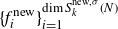 $\{f^{\mathrm{new}}_i\}_{i = 1}^{\dim S_k^{{\mathrm{new}}, \sigma}(N)}$
, and we define
$\{f^{\mathrm{new}}_i\}_{i = 1}^{\dim S_k^{{\mathrm{new}}, \sigma}(N)}$
, and we define $K_i^{{\mathrm{new}}, \sigma}$
and
$K_i^{{\mathrm{new}}, \sigma}$
and $s(N,k,\sigma)^{\mathrm{new}}_r$
analogously. Then the following improves a result of Serre [
Reference Serre19
, théorème 5] (and Binder [
Reference Binder3
, corollary 10·0·5]), by extending to the sign pattern spaces.
$s(N,k,\sigma)^{\mathrm{new}}_r$
analogously. Then the following improves a result of Serre [
Reference Serre19
, théorème 5] (and Binder [
Reference Binder3
, corollary 10·0·5]), by extending to the sign pattern spaces.
Corollary 6·1. Fix $k\geq 2$
even, p prime, and
$k\geq 2$
even, p prime, and $r \geq 1$
. Then for N coprime to p and
$r \geq 1$
. Then for N coprime to p and $\sigma$
admissible sign patterns for N,
$\sigma$
admissible sign patterns for N,
 \begin{align*} \frac{s(N, k, \sigma)_r}{\dim S_k^\sigma(N)} &\to 0 \qquad \text{as } N \to \infty,\\[5pt] \frac{s(N, k, \sigma)^{\mathrm{new}}_r}{\dim S_k^{{\mathrm{new}}, \sigma}(N)} &\to 0 \qquad \text{as } N \to \infty. \end{align*}
Proof. We show the proof only over the full space, as the proof over the newspace is identical. For N coprime to p, let $s(N,k,\sigma,p)_r$
denote the number of indices i such that
$s(N,k,\sigma,p)_r$
denote the number of indices i such that $[\mathbb{Q}(x_{i,p})\,:\,\mathbb{Q}] \leq r$
. Note that
$[\mathbb{Q}(x_{i,p})\,:\,\mathbb{Q}] \leq r$
. Note that $s(N,k,\sigma,p)_r \geq s(N,k,\sigma)_r$
, so it suffices to show
$s(N,k,\sigma,p)_r \geq s(N,k,\sigma)_r$
, so it suffices to show
 \begin{equation*}\frac{s(N,k,\sigma,p)_r}{\dim S_k^\sigma(N)}\to 0\end{equation*}
as $N\to \infty$
while
$N\to \infty$
while $(N,p)=1$
. Note that if
$(N,p)=1$
. Note that if $x=x_{i,p}$
satisfies
$x=x_{i,p}$
satisfies $[\mathbb{Q}(x_{i,p})\,:\,\mathbb{Q}]\leq r,$
then x also satisfies:
$[\mathbb{Q}(x_{i,p})\,:\,\mathbb{Q}]\leq r,$
then x also satisfies:
-
1. x is a totally real algebraic integer of degree
$\leq r$
; -
2. for
$\tau \in \text{Gal}(\overline{{\mathbb{Q}}}/{\mathbb{Q}})$
, the Galois conjugate
$x^\tau$
of x satisfies
$|x^\tau|\leq 2p^{(k-1)/2}$
.



Let A(p,k,r) be the set of all x satisfying conditions (1) and (2). Such a set must be finite, as the characteristic polynomials of its elements x must have degree $\leq r$
and bounded integer coefficients. Let
$\leq r$
and bounded integer coefficients. Let $A'\subseteq [-2,2]$
be the dilation of A(p,k,r) under the mapping
$A'\subseteq [-2,2]$
be the dilation of A(p,k,r) under the mapping $x\mapsto {x}/{p^{(k-1)/2}}.$
The set A’ is finite, so it has
$x\mapsto {x}/{p^{(k-1)/2}}.$
The set A’ is finite, so it has $\mu_p$
measure 0, and it is independent of N and
$\mu_p$
measure 0, and it is independent of N and $\sigma$
. Then since the
$\sigma$
. Then since the ${x_{i,p}}/{p^{(k-1)/2}}$
are
${x_{i,p}}/{p^{(k-1)/2}}$
are $\mu_p$
-equidistributed as
$\mu_p$
-equidistributed as $N\to\infty$
by Theorem 1·3, the proportion of i such that
$N\to\infty$
by Theorem 1·3, the proportion of i such that ${x_{i,p}}/{p^{(k-1)/2}}\in A'$
(and hence
${x_{i,p}}/{p^{(k-1)/2}}\in A'$
(and hence $x_{i,p}\in A$
) tends to 0 as
$x_{i,p}\in A$
) tends to 0 as $N\to\infty$
(e.g. by Serre [
Reference Serre19
, proposition 1]). This is equivalent to saying that
$N\to\infty$
(e.g. by Serre [
Reference Serre19
, proposition 1]). This is equivalent to saying that ${s(N,k,\sigma,p)_r}/{\dim S_k^\sigma(N)}\to0$
as
${s(N,k,\sigma,p)_r}/{\dim S_k^\sigma(N)}\to0$
as $N\to\infty,$
completing the proof.
$N\to\infty,$
completing the proof.
We note here that over the sign pattern newspaces $S_k^{{\mathrm{new}},\sigma}(N)$
, we have
$S_k^{{\mathrm{new}},\sigma}(N)$
, we have $K_i^\sigma = {\mathbb{Q}}(f_i)$
, where
$K_i^\sigma = {\mathbb{Q}}(f_i)$
, where $\{f_i\}_{i = 1}^{\dim S_k^{{\mathrm{new}},\sigma}(N)}$
is the newform basis for
$\{f_i\}_{i = 1}^{\dim S_k^{{\mathrm{new}},\sigma}(N)}$
is the newform basis for $\dim S_k^{{\mathrm{new}},\sigma}(N)$
. From this perspective, Corollary 6·1 can be interpreted as a weak form of the Maeda Conjecture for general level.
$\dim S_k^{{\mathrm{new}},\sigma}(N)$
. From this perspective, Corollary 6·1 can be interpreted as a weak form of the Maeda Conjecture for general level.
Recall that the classical Maeda Conjecture states that $\deg {\mathbb{Q}}(f) = \dim S_k(1)$
(i.e. is maximum possible) for each normalised Hecke eigenform
$\deg {\mathbb{Q}}(f) = \dim S_k(1)$
(i.e. is maximum possible) for each normalised Hecke eigenform $f \in S_k(1)$
. For squarefree levels N, a corresponding conjecture has also been stated for the newspaces. Since the Hecke operators restrict to the
$f \in S_k(1)$
. For squarefree levels N, a corresponding conjecture has also been stated for the newspaces. Since the Hecke operators restrict to the $S_k^{{\mathrm{new}},\sigma}(N)$
; for newforms
$S_k^{{\mathrm{new}},\sigma}(N)$
; for newforms $f \in S_k^{\mathrm{new}}(N)$
, the maximum possible degree of
$f \in S_k^{\mathrm{new}}(N)$
, the maximum possible degree of ${\mathbb{Q}}(f)$
is
${\mathbb{Q}}(f)$
is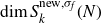 $\dim S_k^{{\mathrm{new}},\sigma_f}(N)$
, where
$\dim S_k^{{\mathrm{new}},\sigma_f}(N)$
, where $\sigma_f$
denotes the sign pattern for f. In particular, Tsaknias and Chow-Ghitza posited a version of the Maeda Conjecture for squarefree level: that for newforms
$\sigma_f$
denotes the sign pattern for f. In particular, Tsaknias and Chow-Ghitza posited a version of the Maeda Conjecture for squarefree level: that for newforms $f \in S_k^{\mathrm{new}}(N)$
,
$f \in S_k^{\mathrm{new}}(N)$
, $\deg {\mathbb{Q}}(f) = \dim S_k^{{\mathrm{new}},\sigma_f}(N)$
for sufficiently large weight k (see [
Reference Tsaknias21
, conjecture 2·4] and [
Reference Chow and Ghitza4
, conjecture 5·2]).
$\deg {\mathbb{Q}}(f) = \dim S_k^{{\mathrm{new}},\sigma_f}(N)$
for sufficiently large weight k (see [
Reference Tsaknias21
, conjecture 2·4] and [
Reference Chow and Ghitza4
, conjecture 5·2]).
For general level N, however, the picture is not as clear. In this case, there seem to be plenty of examples where $\deg {\mathbb{Q}}(f)$
is not maximal. However, weaker forms of the Maeda Conjecture have still been investigated. For example, Roberts conjectured that for any fixed weight
$\deg {\mathbb{Q}}(f)$
is not maximal. However, weaker forms of the Maeda Conjecture have still been investigated. For example, Roberts conjectured that for any fixed weight $k \ge 6$
,
$k \ge 6$
, $\deg {\mathbb{Q}}(f) = 1$
for only finitely many newforms f [
Reference Roberts16
, conjecture 1·1]. Later, Martin made the same conjecture for arbitrary fixed degree r [
Reference Martin12
, question 3]. Here, Corollary 6·1 can be interpreted as a density 1 version of these conjectures. In particular, for any fixed
$\deg {\mathbb{Q}}(f) = 1$
for only finitely many newforms f [
Reference Roberts16
, conjecture 1·1]. Later, Martin made the same conjecture for arbitrary fixed degree r [
Reference Martin12
, question 3]. Here, Corollary 6·1 can be interpreted as a density 1 version of these conjectures. In particular, for any fixed $r \ge 1$
, Corollary 6·1 shows that the proportion of newforms
$r \ge 1$
, Corollary 6·1 shows that the proportion of newforms $f \in S_k^{{\mathrm{new}},\sigma}(N)$
with
$f \in S_k^{{\mathrm{new}},\sigma}(N)$
with $\deg {\mathbb{Q}}(f) \le r$
tends to 0 as
$\deg {\mathbb{Q}}(f) \le r$
tends to 0 as $N \to \infty$
(along N coprime to p).
$N \to \infty$
(along N coprime to p).
We can also use Corollary 6·1 to obtain information about the largest degree of $K_i^\sigma$
and
$K_i^\sigma$
and $K_i^{{\mathrm{new}},\sigma}$
. The following result follows immediately from Corollary 6·1.
$K_i^{{\mathrm{new}},\sigma}$
. The following result follows immediately from Corollary 6·1.
Corollary 6·2 (cf. Serre, Théorème 6 [
Reference Serre19
]). Fix $k \geq 2$
even and p prime. Let
$k \geq 2$
even and p prime. Let $r(N,k, \sigma)$
be the maximum degree among the
$r(N,k, \sigma)$
be the maximum degree among the $K^\sigma_i$
associated with
$K^\sigma_i$
associated with $(N,k,\sigma)$
, where
$(N,k,\sigma)$
, where $\sigma$
is an admissible sign pattern for N, and similarly define
$\sigma$
is an admissible sign pattern for N, and similarly define $r(N, k, \sigma)^{\mathrm{new}}$
. Then for N coprime to p and
$r(N, k, \sigma)^{\mathrm{new}}$
. Then for N coprime to p and $\sigma$
admissible sign patterns for N,
$\sigma$
admissible sign patterns for N,
 \begin{align*} r(N,k, \sigma) &\to \infty \qquad \text{as } N \to \infty, \\ r(N,k, \sigma)^{\mathrm{new}} &\to \infty \qquad \text{as } N \to \infty. \end{align*}
Now, let $J_0(N)$
denote the Jacobian of the modular curve
$J_0(N)$
denote the Jacobian of the modular curve $X_0(N)$
. Note that the Atkin–Lehner involutions act naturally on
$X_0(N)$
. Note that the Atkin–Lehner involutions act naturally on $X_0(N)$
, and thus also act on
$X_0(N)$
, and thus also act on $J_0(N)$
by functoriality. Up to
$J_0(N)$
by functoriality. Up to ${\mathbb{Q}}$
-isogeny, we have the decomposition:
${\mathbb{Q}}$
-isogeny, we have the decomposition:
 \begin{align*} J_0(N)\cong \prod_{\sigma} J^{\sigma}_0(N), \end{align*}
where $W_Q=\sigma(Q)$
on
$W_Q=\sigma(Q)$
on $J^{\sigma}_0(N)$
for all
$J^{\sigma}_0(N)$
for all $Q||N$
. Now, each
$Q||N$
. Now, each $J_0^{\sigma}(N)$
can be decomposed into a product of
$J_0^{\sigma}(N)$
can be decomposed into a product of ${\mathbb{Q}}$
-simple factors:
${\mathbb{Q}}$
-simple factors:
 \begin{align*} J_0^{\sigma}(N)\cong \prod A^\sigma_j. \end{align*}
Following the same argument as Serre (and Ribet [
Reference Ribet15
]), we see that the number of factors $A^\sigma_j$
with dimension r is exactly
$A^\sigma_j$
with dimension r is exactly $({1}/{r})s(N,2,\sigma)_r$
for each
$({1}/{r})s(N,2,\sigma)_r$
for each $r\ge1$
. Now, Corollary 6·2 implies the following.
$r\ge1$
. Now, Corollary 6·2 implies the following.
Corollary 6·3 (cf. Serre [
Reference Serre19
, théorème 7]). Fix p prime. Let $r(N,\sigma)$
be the largest dimension of the simple
$r(N,\sigma)$
be the largest dimension of the simple ${\mathbb{Q}}$
-factors of
${\mathbb{Q}}$
-factors of $J_0^\sigma(N)$
, where
$J_0^\sigma(N)$
, where $\sigma$
is an admissible sign pattern for N. Then for N coprime to p and
$\sigma$
is an admissible sign pattern for N. Then for N coprime to p and $\sigma$
admissible sign patterns for N,
$\sigma$
admissible sign patterns for N,
 \begin{align*} r(N, \sigma) \to \infty \qquad \text{as } N \to \infty. \end{align*}
Acknowledgements
We would like to thank Kimball Martin for his helpful comments on this paper. We would also like to thank the referee for many insightful comments, and especially for pointing out the reference [ Reference Atkin and Lehner2 ] to Theorem 1·2.
This research was supported by NSF grant DMS-2349174. Research of Hui Xue is supported by Simons Foundation Grant MPS-TSM-00007911.


 Open access

