

For democracy to work, legislators must cooperate. However, legislative studies have historically focused more on rules (institutions) and results than on processes and relationships (Taylor-Robinson, Crewe, and Martin Reference Taylor-Robinson, Crewe and Martin2022). There are exceptions, as some scholars study coalitions, bipartisanship, and networks. For example, Craig (Reference Craig2023) writes about how Members of Congress frequently collaborate on policy initiatives and those with better connections tend to receive a greater share of federal grant money. Fowler (Reference Fowler2006) mapped cosponsoring in the US Congress from 1973 to 2004 and measured whether “connectedness” had an impact on legislative influence. Volden, Wiseman, and Wittmer (Reference Volden, Wiseman and Wittmer2013) found that US Congress women in the minority party, due to their consensus building efforts, are better able than men to move their bills forward. Given their centrality to politics, the everyday experience of forging, maintaining, and breaking relationships deserves more attention.
We study bipartisan cooperation through the lens of the 88th Texas state House, showing how legislators build relationships outside of their party in a context of political division where one party has the votes to pass its legislation. Our approach is inter-disciplinary, blending methods of anthropology and political science – principally ethnography and network analysis – to produce a rich and systematic analysis of relationships among legislators. Along with drawing attention to a case in state-level politics that, despite intense partisan divisions, exhibits cooperation, we offer an innovative research methodology to scholars of politics.
Introducing the Txlege
The Texas state legislature, or the Txlege as it is nicknamed, meets bi-annually for a regular session of just 140 days. Time pressure affects the process of law-making, though the Governor can call “special sessions.” The United States has a two-party system, and in Texas, the Republican Party dominates. For the 88th regular session, which met from January 10 to May 29, 2023, Republicans held all state-wide elected offices, 86 of the 150 House seats, and 19 of the 31 Senate seats. The Democratic Party has not won a state-wide elected office since 1994. This complete control by one party makes the Texas House an ideal case for studying legislator relationships across party lines. Based only on the numbers, the Republican Party can pass its initiatives with no support from the Democrats. Yet we were repeatedly told about and observed cross-party cooperation.
To research cooperation, we first need to explain the chamber’s membership. Whites are over-represented, whereas others, and especially Hispanics, are under-represented. In the 88th session, the House was comprised of 104 men and 46 women (up from 38 in the previous session). Twenty-six Representatives were new, and 36 were under 50 years old. Since they only earn $7,200 per year and must spend five months in the legislature every two years, it is financially unaffordable for most to be a Representative. Nonetheless, some have served many terms: 29 terms for the most senior Republican and 26 for the most senior Democrat. Long careers in the House are interesting, given the financial hardship of the job and the opportunities for “progressive” ambition (Schlesinger Reference Schlesinger1966).
Our research began with an ethnography, in the sense of an in-depth inquiry into a conceptually bounded world, followed by a network analysis. Ethnography has an emergent approach, developing research questions during the early phase of fieldwork rather than in advance. After several interviews with staffers and Representatives in January 2023, it became clear that a pattern of cooperation between Representatives was worth exploring. Our research question was: To what extent, how, and why do Representatives collaborate across parties despite political polarization across the parties and in society? We begin with a brief overview of the Texas political context before explaining our methodology, presenting findings, and offering conclusions.
Political context in Texas and why it is a tough case for cooperation
Many Texans see their identity as Texan more than American. The foreign researcher, Emma Crewe, an anthropologist from the United Kingdom, was struck by immense pride in their state, stubborn determination, an ethos of hospitality, and social diversity, but also intolerance and deprivation. Many Texans want politicians to leave them alone. Except when they do not. The attitude of “keep government small and out of my life” is a trait of Texas political culture that clashes with the pressure citizen groups put on Representatives to pass legislation to protect their group’s preferences. Many would like minimal interference by government, but only once they have reinstated biblical social ways. The “culture wars” about “hot button” issues between conservatives and liberals in the state and nationally have translated into highly partisan legislation. The 87th session in 2021 passed the “Heartbeat bill,” banning abortion after six weeks. The 88th regular session in 2023 passed SB14 banning care for trans children, SB15 restricting trans athletes in college sports, and SB12 regulating sexually explicit shows. During the regular session, daily, there were visits by groups from across the state advocating for their intense policy preferences by visiting offices, and protesting in the legislature’s rotunda or outside on the grounds. Cluverius (Reference Cluverius2021) found that the shorter the legislative session, the more influence grassroots lobbying was likely to have on lawmakers, and it appeared to be the case that Texan Representatives were extremely concerned to appear receptive to their constituents.
Constituents expressing Christian nationalism are not necessarily the largest group, but they are politically well organized and express their views with lethal certainty (see Figure 1). Many Republican Representatives in the 88th term and their supporters held a more moderate version of this cosmovision, and were uncomfortable with the direction their party was taking. The Ultra-Conservatives tend to be white, rural or peri-urban, and Republican (but people of color in Texan society can be on the far right too). But even among the Representatives who described their views as Ultra-Conservative, we were told about the importance of relationship building and working together, further prompting our questions of why, and who works with whom?
Monument just outside the Capitol building (by Emma Crewe).

Table 1 shows the race/ethnic makeup of Texas in the 2020 census and for the Texas House overall and by party. Both parties are concerned with winning support from the Hispanic population. Almost all African American Texans interviewed, formally or informally, had experienced racism, whether in assumptions about who they were, in being marginalized, or, less commonly, in the form of physical violence. One African American Representative was demoted from author to co-author on their own bill, and African American Representatives were given fewer amendments to lead on than white counterparts. A Hispanic Representative was told, “I’ll be damned if I will vote for a Hispanic candidate.” In the 88th session, Representatives were facing legislation that banned people from certain countries, including China, from owning land in Texas; defunding of Diversity, Equity, and Inclusion in universities; and changes in the electoral law that they judged would disadvantage people of color. According to one Representative, there is a subset of the population that champions returning to an imagined age of societal purity, when the “others” are all gone.
Race/ethnic makeup of the Texas population (2020 US Census) and the 88th Texas House

Democrats tend toward a liberal cosmovision. But the ideology of Texan Democrats is complex and fragmented, influenced by race, gender, sexuality, class, and age. Historically, Texas Democrats, like Southern Democrats generally, were relatively conservative, yet our interviews depicted tensions between older Democrats wanting to focus on the collective experience of inequality, while younger people drew attention to individual tales of personal suffering. Democrats of color point to the continuing dominance of white Democrats, whereas white Democrats stress the importance of working toward party unity.
Redistricting after each census means that Texas has few marginal seats. Consequently, the electoral contests that matter most are intra-party primaries, in which few people vote, and voters with more extreme ideologies dominate, producing a more extremist legislature relative to the general population. For the 88th session, 58 of 150 Representatives won their seats in the primary and did not face an opponent in the general election. Representatives often vote or speak with their eye on the primary rather than the general election.
Ideological polarization has been increasing in all US states legislatures over the last 20 years, but variation is pronounced (Shor and McCarty Reference Shor and McCarty2022). Legislatures in the South used to be the least polarized, with Democrats being traditionally more conservative, but they have been polarizing fastest. Texas state legislators were the fourth most polarized in 2020 in terms of voting patterns following a significant ideological shift of the Democrats to the left (Shor and McCarty Reference Shor and McCarty2022, 352, 360), whereas the Republicans have moved to the right. The Texas population is also politically polarized, and the gulf between conservative and liberal is deepening in the state, as it is across the United States. The geographical separation of political groups is exacerbated by a tendency of people to move to live near people who think the same way (Hochschild Reference Hochschild2016, 6; Yu Reference Yu2024). Divisions are reinforced by people listening to different news (the right listen to Fox News, the left MSNBC), consulting different websites, and attending churches that match their ideological disposition. This is the sociopolitical, cultural, and economic backdrop that constrains and enables Texan politics. But do these partisan and societal divides limit how Representatives build relationships within the House? Given the centrality of law-making in US state legislatures, with whom do Representatives work on legislation?
Mixing disciplines and methods
Before examining cooperation between politicians across political parties, we explain how two researchers combined to produce an innovative form of collaborative ethnography and network analysis. This research between a political scientist (Michelle) and an anthropologist (Emma) benefitted from two different backgrounds and perspectives. While both were female parliamentary scholars, the white British anthropologist met with a warm Texan welcome from almost every interlocutor and was seen as ill-informed but politically unaffiliated. This made it possible to ask basic questions, to probe attitudes and knowledge, without provoking suspicion. The white US political scientist knew Texas extremely well, having lived there for decades, but had not previously studied the Texas legislature. Her research in other regions of the world strengthened the impression of impartiality, yet her personal contacts gave us access to politicians we would not otherwise have secured interviews with.
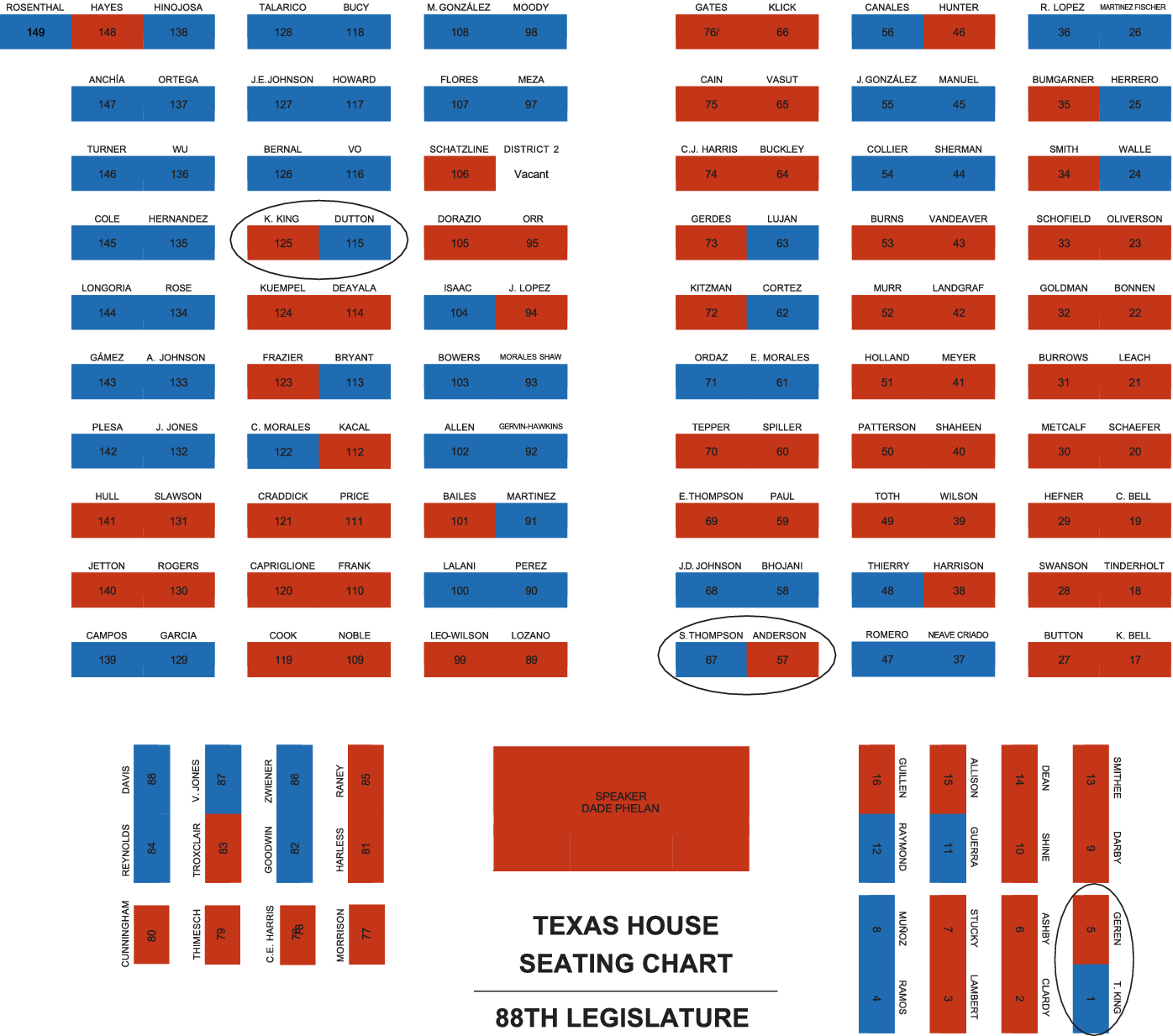
We started with primary and secondary sources ranging from biographies, newspaper articles, and tweets to scholarly articles and the legislature’s website. Engagement with interlocutors involved two overlapping phases: Phase 1 – participant observation, or immersion into a field site, from the start of the 88th session on January 10, 2023, to the end of the regular session on May 29, 2023, both in the legislature and visits beyond Austin. Phase 2 began on January 27 with formal interviews mostly conducted by both researchers. The participant observation (Emma’s part) and interviews generated insight into a surprising degree of collaboration between Representatives despite their ideological polarization. Representatives and their staff surmised that the following have an effect on cooperation: who you arrived with; proximity of desks on the chamber floor (see Figure 3); neighboring offices; shared caucus (caucuses organized around topics from ethnicity to water needs); and committees. After learning about collaboration in our ethnographic study, to further investigate cooperation, Michelle undertook a network analysis on the relationships between Representatives. The various elements were conducted consecutively as follows:
Participant observation
On January 10, Emma entered the Texas State Capitol for the first time, passing the sign that directed those carrying guns without a permit to the West entrance, and into a magnificent corridor depicting various battles. On visiting a legislator who had booked her a ticket for the gallery, she passed through his outer office and met a dead stag head before chatting to his staff. The Opening Ceremony was remarkable to someone more accustomed to the rigidity of ceremonies in Westminster for its informality, warmth, and references to politicians’ families – both historical and present – and the presence of Representatives’ children. A staffer recommended following Scott Braddock – a journalist with decades of experience watching the legislature – on X which enabled a crash course on all things related to the #Txlege.
On day two, she watched from the gallery as Speaker Dade Phelan was elected. She met Ultra-Conservative elected officials of the Republican party from outside Austin who were there to encourage Representatives to resist the continuation of the practice of appointing some Democratic committee chairs. They invited her to join them for dinner, so she spent the entire day with them, and later visited them in their small town on two occasions, spending at least 30 hours talking to them in total. She met groups or individuals every time she watched proceedings from the gallery and talked to hundreds of individuals informally in the corridors, at rallies, in the Rotunda, the cafeteria, and when watching committee hearings. The informal encounters with individuals of more than 20 minutes amounted to around 60 people (as noted in her fieldwork log; see Table 2), but some were far longer and, in some cases, repeated regularly.
Informal encounters in the Texas State Legislature 2023
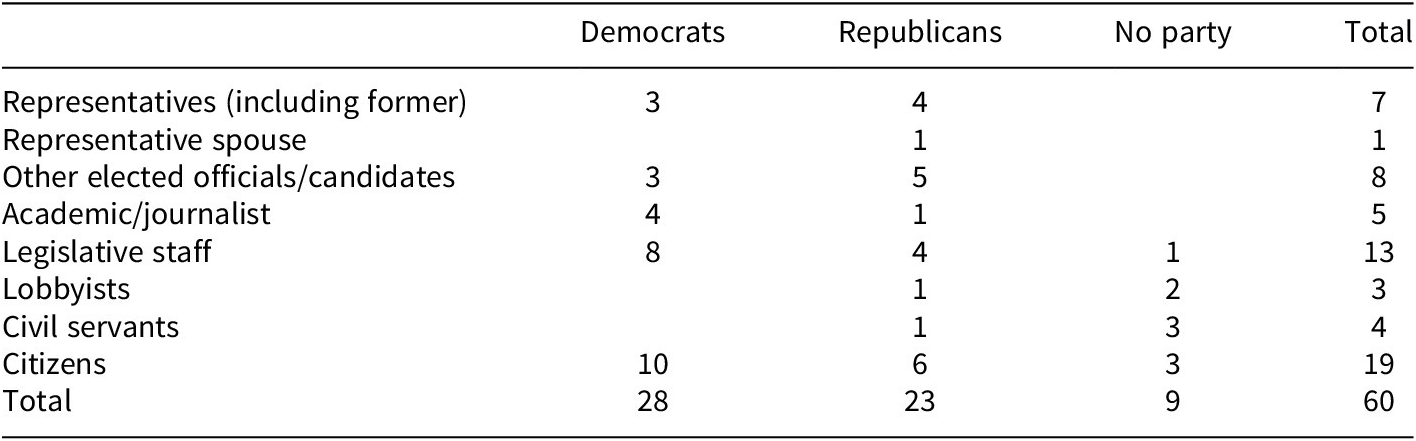
The Txlege was easy to enter, and there was always space in the House gallery. Only debates about trans rights required queueing. Committees sometimes filled up with visitors wishing to give testimony, so some hearings could only be watched online. All chamber proceedings, and most committee public hearings, were recorded and available online. She also attended rallies, protests, conferences, party meetings (both Democrat and Republican), a training for women candidates, and events at the Texas Tribune. She interviewed staff and talked to constituents with district-based staff in one district outside of Austin, and visited various places in Texas to get a sense of the state’s diversity.
Formal interviews
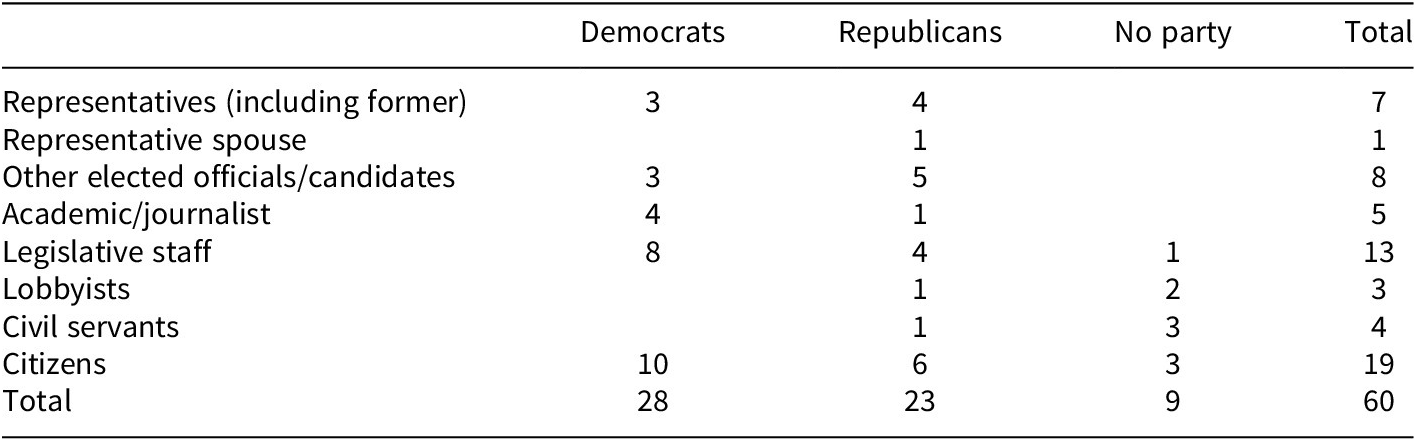
Since the Txlege only meets every two years, Representatives were extremely busy, first preparing bills, and then trying to get bills passed. After emailing every Representative and Senator, about 10% agreed to meet. Most interviews occurred in March and April, after Representatives had submitted most of their bills, but before the intense rush to pass legislation. Eight of 31 formal interviews (Table 3) were undertaken by the anthropologist researcher alone (two held in Representatives’ districts). Although we did not record interviews, we were able to take almost verbatim notes.Footnote 1
Formal interviews in the Texas State Legislature 2023

Note: One biracial Representative is included in the Hispanic group. Source for census data: https://data.census.gov/table?g=040XX00US48&d=DEC+Demographic+Profile (accessed September 6, 2025).
The more interviews we held, the more both researchers became interested in bipartisanship, and the informal norms of cooperation among members, including across parties, that was frequently described in interviews. The interviews are not, therefore, comparable, but rather build up a detailed picture of the complexity of informal norms for Representatives in their relationships with each other and how they were affected by age, seniority, race, gender, previous work experience, and party. We then conducted network analyses to test for systematic evidence of bipartisanship in lawmaking.
Network analysis
Empirically, a legislative chamber should be modeled as a network (see Gross and Jansa Reference Gross, Jansa, Victor, Montgomery and Lubel2016; Ringe, Victor, and Tam Cho Reference Ringe, Victor, Tam Cho, Victor, Montgomery and Lubell2016). Study of legislators’ social networks is not new (see, e.g., Patterson Reference Patterson1959; Young Reference Young1966), but statistical methods of network analysis are more recent. Network analysis has primarily been applied to cosponsorship and success passing legislation, information networks, and ideal-point estimates in the US Congress (e.g., Tam Cho and Fowler Reference Tam Cho and Fowler2010), in some US state legislatures (e.g., Bratton and Rouse Reference Bratton and Rouse2011; Holman, Mahoney, and Hurler Reference Holman, Mahoney and Hurler2021; Kirkland and Williams Reference Kirkland and Williams2014), and in some European (Briatte Reference Briatte2016) and Latin American legislatures (Alemán et al. Reference Alemán, Calvo, Jones and Kaplan2009; Lee, Magallanes, and Porter Reference Lee, Magallanes and Porter2017).Footnote 2 After repeatedly being told by Representatives about their cross-party relationships, we decided to use network analysis to assess systematically how common such relationships are, and what types of Representatives exhibit them, especially since it is the party divide that receives media attention.
The Texas House offers a particularly interesting case for studying relationships because Representatives work in a pressure cooker environment. With the short regular session, two years of government business, plus legislative agendas of 150 Representatives to process, workdays go late into the night as the session progresses. Representatives explained that to work in this environment, they find ways to navigate political disagreements because they have to continue to engage with each other while they virtually live together in the Capitol.
Combining anthropology and political science
Using ethnography to research parliaments has become well established within Europe (see, e.g., Abélès Reference Abélès2000; Geddes Reference Geddes2020; see also Crewe Reference Crewe2021 for further examples), even if approaches vary, as Geddes and Miller (Reference Geddes and Miller2024) explain. Examples in US political science are rarer but have been influential (e.g., Fenno Reference Fenno1978; Longo and Zacka Reference Longo and Zacka2019; Rosenthal Reference Rosenthal1986). Ethnographers share in common a commitment to an intense immersion in a social and/or political world – organization, community, and transnational network – to inquire into the lives of its inhabitants. The assumption that these worlds are continually recreated by individual histories, social relationships, meaning-making, and power struggles also tends to be held in common by all ethnographers. But scholars from varying disciplines often use different tools and theories. When studying legislatures, political scientists tend to rely on interviews, formal models, scraping, and coding historical records to examine patterns, maintaining the separation between observed and observer. When researching contexts, rules, and social processes, political scientists have mostly relied on institutionalism as their theoretical approach. Anthropologists have argued that institutionalism is too narrow for their purposes and rely on theory that is more holistic, historical, and attentive to structures, relationships, and individuals simultaneously, requiring a participatory and improvised form of reflexivity.
Anthropology’s improvisation entails a highly opportunistic and emergent approach to inquiry. In the case of this Texas research, Emma followed all leads, talking to anyone prepared to converse about politics, attending conferences or socializing with people. When she met Conservative activists in the House Gallery and they invited her to their district, she accepted the invitation and returned for further visits, to understand more about the ideology of Ultra-Conservatives. She developed a relationship with this particular group, establishing a high level of trust so that they talked to her, encouraged other activists in that district to participate in the research. All anthropologists are trained to write copious fieldnotes daily, noting down as many impressions as they can, any information gleaned and even personal reactions to people on the assumption that they do not yet know what will be relevant when it comes to analyzing and writing outputs.
Reflexivity is also distinct for anthropologists in that they make a subtly different assumption about the relationship between researcher and researched, even from political scientists employing similar interpretivist approaches. In the case of the Texas research, this meant going beyond interviews, observations, and informal encounters to extract data from informants that then required interpretation. It was a collaboration between politicians, activists, other scholars, and the two authors, with the two authors driving the inquiry but the whole group producing understanding through interaction. For example, in talking about the importance of religion in Texas politics with Tom Long, an anthropologist studying Baptists, Emma accepted his invitation to attend a church service in order to glean a sense of how emotional these events can be and what pressure Baptist Representatives are under to further certain agendas. This means that anthropologists do not study people as objects anymore, but as co-participants of the research.
The initial ethnographic phase of the research alerted us to the unexpected finding of surprising levels of bipartisan collaboration between Representatives. It was then the network analysis that subsequently enabled an in-depth inquiry into co-sponsorship and coauthorship.
Bipartisan collaboration revealed
Republicans dominated the 88th session of the Txlege within a politically polarized society. It is extremely difficult to get a bill passed. During the 88th session, more than 5,000 bills (HB) were filed in the House, and 13.4% became law.Footnote 3 Not counting an excluded Representative, then 4,169 bills (of which 2,952 HB) were introduced by 86 Republicans and 4,057 (of which 2,459 HB) by 64 Democrats. Republicans get more of their bills passed into law on average than Democrats, but Representatives from both parties pass bills. In our interviews, we were told that Representatives can expect to get at least one bill passed, and it is notable that the two Representatives who did not pass any bills (first or joint authored) are both Republicans. It is also notable that some Representatives from each party only had success with their joint authored bills: 5 Republicans and 13 Democrats. Appendix 2 in the Supplementary Material provides detailed information about bill passage by party and race/ethnicity.
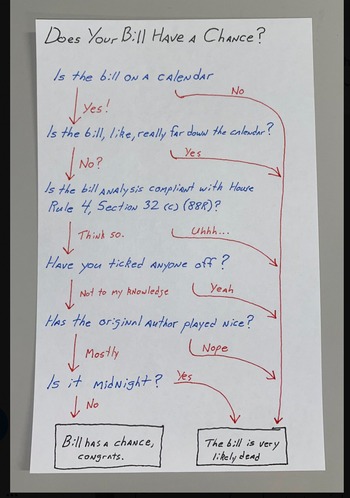
As a staffer explained, a Representative’s bill only has a chance to get passed if it is sent to a committee, passed out of committee, gets on the chamber “calendar,” gets the support of the House and then the Senate, and does not get vetoed by the Governor (Figure 2). The Republicans had a majority, but even Republicans usually need the support of Democrats to avoid their bill getting “killed,” especially if the relevant Committee Chair is in the other party, according to informants. According to the House Rules, the committee chair consults with the members of the committee and determines the order of consideration and hearings. Democrats have no chance of passing a bill unless they have Republican support. Some Representatives explained that if you do not pass any bills, it is difficult to get re-elected. You might put down some bills just to convey a message – “to appease our base,” as one Representative put it – even though you know it will not get passed. But almost all Representatives pass some bills, and some get a number of bills passed. Given the ideological polarization in Texas, and the difficulty of getting bills passed, how do Representatives do this?
The prospects of a bill explained by a staffer.

The ethnographic research indicated that “support” takes many forms: joint-author and co-author bills, speak in favor, speak against amendments or opponents, and vote in favor of proposed bills. In addition: warning people whether you are going to support or oppose, or even try and kill, a bill. A truly unpopular Representative might get others to author their bill. A Representative can introduce an amendment if they mainly like a bill, but are troubled by a specific aspect, and help it get through on condition that the authors accept the amendment. This support is given to each other on specific bills, even though they disagree on other bills, bitterly at times.
Representatives improvise from agreement to disagreement and back in a matter of days or even hours. Some Representatives estimate that 90% of bills are supported by both Democrats and Republicans. Representatives or their staff constantly phone each other, or speak face to face (including on the floor of the chamber during sessions), to find out how they are going to speak or vote on their bills. They share information across factions, neighboring desks (see Figure 3), and offices, within committees and informally when they eat or drink together. Disagreement with your bill is not a matter of dishonor, but failing to share information is considered uncooperative. Whipping by party leaders is light, especially for Democrats, and individuals vote as they wish, more bound by ties of political friendship than by party or other caucuses. The party influences who authors priority bills, Speakers’ bills, and “Freshman” bills, but much less so over voting. Both parties recognize that Representatives have to vote with their districts because they face re-election every two years. Another reason cooperation is essential is the short length of the regular session. The first 6–8 weeks are spent setting up committees and preparing bills, while the process of law-making mostly takes place in the last 10–12 weeks. Representatives must seek support fast, and they explained that existing good relationships make the process far easier. The intensity of the pressure is highlighted by two Representatives describing their early experience of joining the House as “drinking through a fire hose”; mutual support is an important coping strategy.
Representatives’ desks on the floor of the House. Red indicates Republican seats; blue indicates Democratic seats. Circles indicate senior cross-party Representatives sharing a desk.

Cooperation goes beyond legislation. Speaker Dade Phelan was voted in and supported by all Democrats and most Republicans, with only three Ultra-Conservatives supporting the alternative candidate, Representative Tinderholt.
Representatives repeatedly said they only get work done effectively if they build relationships. “It is all about creating and sustaining relationships except for a tiny minority of disrupters,” was a common refrain. About a dozen Republican Representatives were viewed as regularly refusing to collaborate (including most members of the Freedom Caucus), but the rest engaged in on-going processes of collaboration within their party and with Democrats. Democrats have to collaborate even if some do so reluctantly. One Democrat told us, “It is all about relationships that you build within this building. Even with people in conservative offices when you are far left.” Those who do not cooperate are often referred to as “bomb-throwers,” and it was generally assumed that they will not go far in politics. Another Republican echoes the same sentiments:
My strategy is to always preserve the relationship because Rep X is a good Representative with a lot of intelligence. So, I tend to focus on the things we can agree on… We can acknowledge those differences. But there is a tremendous amount that we can agree on and work together on. I think folks back home often don’t realize that, and that we need to work on nonpartisan bills together…. I don’t care what party you are, if you will always tell me what you believe, I have a good relationship with you.
We were told that a good relationship requires give and take in ways that can be relied upon – reliability is key to trust. So, if a Representative (or their staff) reveals that they will support or vote in a particular way, and they fail to, then they will be considered unreliable and not trusted. Trust depends on keeping your word; deceit engenders distrust instantly. You can change your mind – and your vote along with it – if you let the author know. But failing to keep to your word seriously damages relationships. Representatives who are trusted make reasonable requests. They talk to each other with respect, and consideration, in private and public. They are discreet with information shared when necessary and appropriate. One Republican Representative said that to make relationships work you have to, “show love: be kind, patient and avoid boasting.” A Democrat explained it in terms of Texan values, as many do: “Being polite is a cornerstone for how I grew up… I can very much disagree with someone, and still be angry, but I will still be polite.”
This ethos of respect is sometimes disrupted. Particular individuals are known for their reliability and honesty; those who lie tend to find it harder to win support over time. One Democrat Representative explained:
… if someone is operating in bad faith or has gone out of bounds in how they attack a colleague in a debate, or our constituents and their values in a debate. It is important that you call them out and do what you can to put them in their place. When people have operated in bad faith, or been dishonest, the House has a pretty good way of holding members accountable. Sometimes you might see some bipartisan cooperation in those instances, to say that we don’t tolerate that kind of behavior.
This relates to parties as well, although, of course, the ethics of disruption is in the eye of the beholder. In the 87th session, Democrats traveled to Washington, D.C., breaking quorum, in protest at proposed changes to the electoral law. In the 88th session, they were punished to some degree – the Speaker Pro Tempore was no longer a Democrat and new rules were introduced to punish members who go absent – although the House quickly returned to Representatives’ expected norm of collaboration we were told, as the session progressed. Oldham (Reference Oldham2024) points out that even in majority partisan legislatures, the day-to-day norm of bipartisan collaboration tends to persist once established because that is how they are used to doing political work.
An expected norm of collaboration is what we found in our interviews and observations. Given the popular portrayal of Texas political institutions as places of hostility, this constant finding in our ethnographic work led us to conduct a network analysis of bill joint- and coauthorship to determine whether there is systematic evidence of collaboration.
Who has relationships with whom? Network analysis of bill joint and coauthorship
We scraped from the legislature’s webpage the name of the bill’s first author, joint authors (up to four permitted), and coauthors (unlimited). We include all types of bills (5,413 HB, 123 HCR, 206 HJR, and 2,543 HR) for a total of 8,226 bills initiated by 148 Representatives. We omit the Speaker, because the Speaker’s job is running the chamber, and Representative Bryan Slaton (Republican) because he was expelled on May 8, 2023, by unanimous vote for a major ethics violation.Footnote 4 Representatives differ in how many bills they introduced (range 15–176, average 55.6), joint authored (range 0–90), and coauthored (range 5–322). (Appendix 3 in the Supplementary Material describes the distribution of coauthor and joint-author “degree” for the datasets.)
As our ethnographic study revealed, Representatives have many ways they can build relationships. Joint- and coauthorship allow Representatives to signal support for one another, so we view these activities as forms of relationship-building. Joint authoring is a more public relationship because a bill is listed with the names of the first author and joint authors (not in alphabetical order), in session transcripts, and on the bill listings linked to each Representative’s webpage. The “Bills Coauthored” link on each Representative’s webpage names the first five coauthors, in alphabetical order, and then “et al.” with a complete list of co-authors available on the Txlege website.Footnote 5
The coauthor matrix contains all coauthor dyads between 148 Representatives. Each cell is a count of the number of bills by Representative X for which Representative Y signed on as a coauthor (range 0–25). We model this as a directed measure because Representative Y chose to coauthor Representative X’s bill. Interviews explained that it is possible to remove a coauthor, but rare.Footnote 6 The joint author matrix contains all joint author dyads between 148 Representatives. Each cell is a count of the number of bills by Representative X (first author) for which Representative Y is a joint author (range 0–17). Interviews indicated that the first author typically asks another Representative to joint author; however, the Representative asked to joint author must agree, so we model joint authoring as undirected, that is, a shared relationship.
Figure 4 plots each network, using the Fruchterman–Reingold algorithm. We consider each link between two Representatives (even if it is only on one bill) as a sign they have a relationship, so both networks are dense.
Plot of coauthor network (top) and joint author network (bottom). Red dots are Republicans; blue dots are Democrats.

We want to study relationships across parties in a context of extreme polarization. We utilize the E-I Index (Krackhardt and Stern Reference Krackhardt and Stern1988): $ \frac{EL- IL}{EL+ IL} $
. EL is a count of the number of ties a Representative has with members of the other party. IL counts the number of ties with members of their own party. E-I Index scores can range from −1 (all links are to Representatives from their own party) to +1 (all links to members of the other party). We utilize the Igraph package in R to calculate E-I Index scores for each Representative for coauthoring, and for joint authoring.
$ \frac{EL- IL}{EL+ IL} $
. EL is a count of the number of ties a Representative has with members of the other party. IL counts the number of ties with members of their own party. E-I Index scores can range from −1 (all links are to Representatives from their own party) to +1 (all links to members of the other party). We utilize the Igraph package in R to calculate E-I Index scores for each Representative for coauthoring, and for joint authoring.
Figure 5 plots both E-I Index scores. More Republicans than Democrats have highly negative scores, which is unsurprising since the Republican party has a majority and can pass ordinary legislation without opposition votes.Footnote 7 But the propensity to build relationships with Representatives from the other party varies. Particularly notable, for joint authoring ten Democrats and eight Republicans work more often with Representatives from the other party than from their own party.
E-I Index scores for coauthorship and joint authorship.Footnote 9

Democrats need governing party votes to pass their bills. Figure 5 shows that Democrats generally have higher E-I Index scores, indicating that they have more bipartisan networks. Hispanic, African American, and Asian Representatives and women also lack the numbers to pass legislation on their own. Race/ethnicity or sex creates a homophilous “likeness” that can cut across party lines, though “likeness” in one area (e.g., gender) can encompass differences in another (e.g., race). Based on homophily, we hypothesize that E-I Index scores for Representatives of color will be higher than scores of white Representatives. Generally, the literature expects that women legislators will work together across party lines to pass women’s interest bills, unless their party punishes such behavior (Barnes Reference Barnes2016; Osborn Reference Osborn2012; Swers Reference Swers, Escobar-Lemmon and Taylor-Robinson2014). However, since women’s bodily autonomy is a source of polarization, women in the Texas House may not reach across party lines more than men.Footnote 8 To code race/ethnicity, we used House webpage bios, personal webpages, membership in the Black Caucus and Mexican American Caucus, news articles, and our interviews. Sex is a binary variable for biological sex.
We hypothesize that Representatives in bipartisan caucuses will have a higher E-I Index score because the caucus allowed them to know opposition party Representatives with whom they have common interests. Also of interest is the Freedom Caucus, composed of 13 far-right Republicans. We hypothesize that its members have E-I Index scores close to −1.
Seniority and committee chairs are standard controls in studies of legislator behavior, so we include both in our analysis. For joint authoring, we control for the number of bills a Representative initiated because the opportunity to joint author is a function of how many bills you initiated. Descriptive statistics are provided in Appendix 4 in the Supplementary Material.
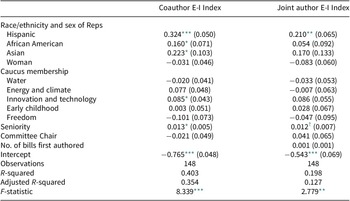
We use multivariate regression to explore which Representatives build relationships across party lines (see Table 4). Hispanic Representatives coauthor and joint author across parties more than white Representatives. All else equal, a Hispanic Representative has a Coauthor E-I score 0.32 higher than a white Representative, and a Joint Author E-I score 0.21 higher. The SD values for these E-I scores are 0.29 and 0.32, respectively, so these increases indicate a comparatively high level of “working across the aisle” by Hispanics. Both African American and Asian Representatives coauthor bills with Representatives from the other party more than white Representatives. However, women are not more bipartisan than men. Innovation and Technology (IT) Caucus members coauthor more outside of their party. It was founded as a bipartisan group in 2015 and describes itself as working “by facilitating greater interaction between House members and industry leaders to drive conversation, build relationships and collaborate on common priorities…,”Footnote 10 nonetheless the effect is small. The IT Caucus is the only bipartisan caucus with a significant effect on E-I scores. It is interesting that Freedom Caucus membership is not significant, though it is negative for coauthoring. All else equal, a member of the Freedom Caucus has a Coauthorship E-I score 0.10 lower than other Representatives. Many Republicans outside this caucus told us that the Freedom Caucus members were seen as disruptive, kept to themselves and put themselves above the cooperative norms of the legislature, but network analysis indicated that they do have some Democrat Representatives in their networks. Finally, senior Representatives coauthor and joint author across party lines significantly more than their junior colleagues. Chairing a committee does not affect coauthorship or joint authoring with the other party. Overall, joint authoring appears to be influenced by factors other than group membership, but homophily has explanatory power for coauthoring.
Effects of representatives’ attributes on their E-I Index

Note: Models are OLS regression. For race/ethnicity, the comparison category is white Representatives.
† p < .1.
* p < .05.
** p < .01.
*** p < .001.
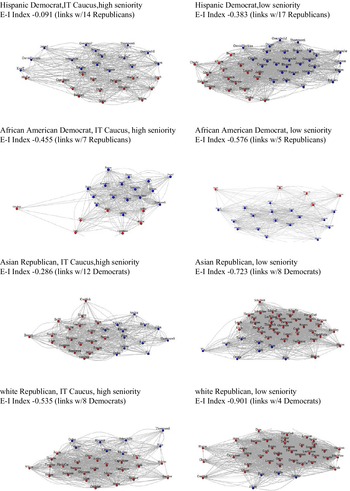
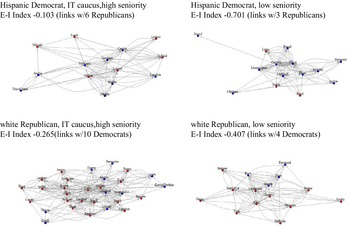
Neighbor networks illustrate significant trait variables (see Figures 6 and 7).Footnote 11 The “neighborhood” of node I (the Representative of interest) is all the Representatives who have links with node I, and the links they have with each other; in other words, who the Representative of interest coauthors/joint authors with, and whether he/she has many links with neighbors, or if other Representatives are more connected, while our Representative of interest is more peripheral.
Neighbor networks illustrating coauthorship linkages.

Neighbor networks illustrating joint authorship linkages.

Among Hispanic Representatives, five of the six positive E-I scores are for Representatives who have served more than the mean number of terms. Seven of the eight Representatives with positive Coauthor E-I Index scores are people of color, and only one is white. Half are members of the IT Caucus. Regarding Joint Author E-I Index scores, nine Hispanic Representatives (24%) have a positive score and all but one of those have served five or more terms. Six white Representatives (7%) have a positive score, and four have served five or more terms. This is further indication that experience is associated with bipartisan cooperation, though not for all Representatives.
Findings on cooperation
Through ethnographic participant observation, including interviews, we learned about bipartisan relationships. We then utilized network analysis to test if there is systematic evidence of bipartisan collaboration in the Texas House: yes, there is, even if uneven. This contrasts with the polarized hostility across the parties and in society, and supports the prediction that social ties created by some networks may help offset polarization (Holman and Mahoney Reference Holman and Mahoney2018; Ringe et al. Reference Ringe, Victor, Tam Cho, Victor, Montgomery and Lubell2016, 484). Our mixed-methods approach indicated that some Representatives operating in the highly polarized environment of Texas politics have social ties, and authoring networks that may help bridge the polarization gap.
Representatives’ collaborations began at the session’s start, building on relationships from previous sessions. First, Representatives chose the Speaker, incumbent Dade Phelan, almost unanimously, without the Democrats putting up an alternative candidate, although a few Ultra-Conservatives supported another candidate. This pragmatic behavior by the minority party ensured that they got a Speaker who favored bipartisan cooperation. Speaker Phelan then met with every Representative about their committee preferences (done after the Speaker is chosen, otherwise it would look like a quid pro quo) before making committee assignments, including chairs, and Phelan protected the tradition of giving some Chair positions to Democrats.
Each committee has members of both parties. The committee Clerk sets up the members’ seating arrangement and some rearrange the members every meeting. The Committee Chair might intervene and say, “Don’t seat those two Representatives together, they had a fight yesterday.” But generally, committees are a place where Representatives get to know each other. Representatives also get to know their desk mate, even casting votes for each other with permission. Seventy-three of 148 Representatives sit beside a member from the other party (if you ignore the aisles). The most senior Representatives choose their desk first, and some chose to share a desk with a Representative from the other party, as shown in Figure 3. Offices are also chosen by seniority. Office halls in the Extension of the Capitol Building often shared meals (even including families), and enabled regular informal meetings. Repeatedly, we heard that office proximity created relationships between Representatives.
We surmise that the opportunities to win support for your bills, or reduce opposition, are more frequent between those who interact informally. This works in uneven and unequal ways. We heard that some lobbyists approach white Representatives more than African American, Hispanic, or Asian Representatives, to author bills. When Representatives gather socially, they sometimes sit in groups organized by race. Relationships are also gendered, for example, men can talk longer in the chamber without getting into trouble. Race and gender can intersect, prompting African American women Representatives to take care when speaking not to raise their voices and be wary of being discredited or silenced (see Hawkesworth Reference Hawkesworth2003 for the US Congress). Given the importance of past as well as current networks for creating and sustaining relationships, it is unsurprising that these processes favor white men who have long dominated the chamber.
The emotional work of bipartisan relationships – bitterly disagreeing one day and then making an agreement the next – is taxing. Many talked about how they get past the feeling of alienation from a Representative by finding common ground. Most try not to take political disagreement personally and when they do, learn the capacity for forgiveness. One Democrat Representative told us:
…we force ourselves to have conversations with people on the other side, afterwards you realize they are not evil. You have to try to understand why they are so passionate about issues that are hurtful to some other people. I do that with conservative friends I have who are part of the Freedom Caucus. You learn a lot that way.
Some Representatives avoid cross-party connections, but that was relatively rare. Connections do not necessarily translate into agreement. As one Representative put it, “You can’t expect people to come here and abandon the things they campaigned for. That is not bipartisanship. Bipartisanship is when people realize that in the nation’s or the state’s issues I will have to compromise, if the other side will also compromise.” Compromise will not necessarily be harmonious. You might have to fight for your specific viewpoint, but you will also have to move your position, though whether your compromise is ethical may be contested.
Unsurprisingly, our network analysis revealed that Representatives work across the aisle to different extents. Hispanics, who are underrepresented but members of both parties, cooperate between the parties the most, whereas Asian and African American Representatives do so less than Hispanics but more than white Representatives. This collaboration by Hispanic Representatives resembles some findings by other scholars. Matthews et al. (Reference Matthews, Osborn, Schilling and Kreitzer2025), studying the 73rd–86th sessions of the Texas House, found that Hispanic Democrats cosponsor more with Hispanic Republicans, “although Republican Latinos do not return the favor” (17). Their general conclusion is that “Cosponsorship across diverse groups typically occurs only within a party” (17), and does not lead to success getting your bills passed.Footnote 12 Our study is about relationship-building, not bill passage, and in the 88th session, Hispanic, African American, and Asian Representatives from both parties have bipartisan networks, but women were not building bipartisan networks. In many states, cosponsorship appears to be common among minorities and those who are less well represented within party leadership, including women (Swift and VanderMolen Reference Swift and VanderMolen2021). In general, women lawmakers have been found to be more cooperative than men in part to counter their institutional weakness, but less so in polarized legislatures. Women lawmakers’ bills are more likely to succeed if they cosponsor each other’s bills (Holman et al. Reference Holman, Mahoney and Hurler2021). So it is telling to find that Texas women are not collaborating much across parties. This may be related to ideological polarization on women’s health and reproductive rights but also because more women legislators are junior. More senior Representatives coauthor and joint author across parties more than junior ones. That may reflect their socialization into the ethos of the House, which has a history of bipartisanship stretching back to the days of Democrat dominance, and that they took office when the Texas Democratic Party was less liberal. But there is no guarantee that cooperation in the House will remain.
A final reflection on sociality and cooperation
Bipartisan cosponsorship is seen as a strategy for improving the chance of bill success by Representatives, but other motives may be possible. In Chile Escobedo, Aránguiz and Navia (Reference Escobedo Aránguiz and Navia2020) found that parliamentarians cosponsored even if success was unlikely for name recognition, signaling policy positions to constituents, and building coalitions. Such rational choice explanations seem plausible in Texas as well but anthropology can perhaps help us interrogate how sociopolitical processes of interaction between lawmakers and those they encounter will affect how they do this. In this case study, there are two social processes that might help us understand what underlies the kind of political compromise needed to collaborate and why sociality can have a profound impact on political work. The first is reciprocity. When French anthropologist Marcel Mauss wrote his seminal book, The Gift, he focused his attention on “archaic” societies, as he put it, but he has influenced our understanding of moral political economies in all societies. His contention was that gift-giving comes with rights and duties; if you fail to give, accept, or repay a gift in ways appropriate to that culture, you are refusing friendship (Reference Mauss1954, Reference Escobedo Aránguiz and Navia11). You risk ostracism. To know what is appropriate, you have to discover how that society is organized and what is considered generous in relation to the status of the people involved. A favor, courtesy, or invitation also has to be returned. What is relevant to our study, and that has been well established within anthropology/sociology for over 70 years, is that you cannot isolate reciprocity from its context if you wish to understand it (Mauss Reference Mauss1954, 63).
When trying to understand how reciprocity works between Texas Representatives, it is important to see how their give and take of supporting each other’s political moves works over time and within networks. If you give another Representative information, or a vote in Committee or the Chamber, then they have incurred a debt that has to be repaid in a roughly equal spirit over time. You might ask them to give you something in return or get them to ask someone else on your behalf. Since disagreement must be tolerated for Representatives to be able to satisfy other demands, such as representing their constituents, reciprocity demands memory, trust, and patience. What might feel like a loss within a process of compromise in the shorter term might even out over time (Stolz Reference Stolz2020), even if Texas time is relatively short because the regular session lasts just 140 days. If you betray the spirit of reciprocity, you risk being frozen out by other Representatives and being isolated during the legislative session.
The second process that is important within compromise is resonance. German sociologist Hermut Rosa also takes the starting point that we are all socialized into specific social and cultural worlds, adding that in our contemporary globalized world, we all share certain conditions (Reference Rosa2021, Reference Briatte6). The one he is interested in arises because the world has become a point of aggression. We are under pressure to optimize our bodies, grow our economies, and innovate technologically. Humans are becoming alienated as we find ourselves in constant competition (Rosa Reference Rosa2021, 9, 22–27). Rosa asks, “How can we work against the aggression and alienation, by nurturing our capacity for resonance?” This means being touched by the world, communicating resonantly, experiencing a transformation, and accepting the uncontrollability of these processes (Rosa Reference Rosa2021, 32–39). Texas exemplifies his portrayal of the modern world. The wider culture and political economy of Texas put extreme pressure on its citizens to be estranged and aggressive in various ways (see Figure 8). They point out with pride that their GDP is ninth in the world if it was a country; there are aggressive measures to deter migrants; and resistance to limiting guns. Yet, simultaneously, within the House, you find reciprocity and resonance. Representatives create social bonds that allow them to forge deep friendships, change each other’s viewpoints, and improve to negotiate in the ever-changing and uncontrollable world of politics. They also work together joint- and coauthoring bills.
Anti-trans vs. pro-trans activists in a “relation of relationlessness” (by Emma Crewe).

However, sociality is not enough to explain the bipartisanship we found in the 88th session of the Texas House or why it changes over time. Consider historical power shifts within the House. Cox and Phillips (Reference Cox and Phillips2010) tell how the Speaker’s role evolved from one of relative obscurity to one of the most powerful posts in the state. Barnes and O’Neill (Reference Barnes and O’Neill2006, 6, 8) write about how the Texas House was a “partially bipartisan” rather than partisan legislature for 20 years until 2003 when the Republicans became the majority, and both parties struggled to adjust to their new roles, amidst a breakdown in the norms of civility and reciprocity. Craddick was a new, inexperienced Speaker who had not yet developed relationships as a leader. Two significant rule changes also affected bipartisanship. The House abandoned “substantial compliance,” which gave the Speaker the power to overrule points of order, in theory giving the minority more power to disrupt but in practice leading to fewer points of order being sustained (Barnes and O’Neill Reference Barnes and O’Neill2006, 17). Increased standing committees from 4 to 37 allowed the Speaker to select all the members, reducing the influence of the minority party (Barnes and O’Neill Reference Barnes and O’Neill2006, 20). These shifts in power contributed to strained relations, and “both sides noted that there was little respect for each other, and that civility had markedly declined on the floor and in the committee hearing rooms” (Barnes and O’Neill Reference Barnes and O’Neill2006, 25).
How does this relate to the 88th House session? Our ethnographic research indicated norms of civility and building relationships. Network analysis showed systematic evidence of bipartisan work on many bills. There are exceptions, such as when Democrats broke quorum in 2021 because Republicans planned to introduce election rules that they deemed unfavorable to African American voters. Trust had to be reforged in the 88th session although the further redistricting and resulting quorum break in 2025 may challenge it again. Legislation about abortion, LGBT rights, school vouchers, and border security brings out high levels of tension. Democrats were furious about a bill that proposed to give the police power to deport anyone found illegal in the state, and that Republicans curtailed debate. Democrat Representative Walle’s explosive and heartfelt tirade against his friend Republican Cody Harris, shared on social media by another Democrat, was notable for its exceptional heat.Footnote 13 But this is unusual. Cross-party debate is usually cordial on everyday legislation. There are various reasons for the revival of collaboration since 2003. The processes of reciprocity and strong social bonds, shaped in part by long-standing norms in the House, have been influenced by shifting power dynamics: (a) within the House, (b) between the House and Senate, and (c) between the legislature and the outside world. In the 88th session, the House had a powerful and experienced speaker, Dade Phelan, supported by the overwhelming majority, including Democrats. The minority party chose to collaborate with the Speaker, and moderate Republicans, rather than simply oppose because they would rather work with moderate Republicans than undermine them, in the face of the threat of rise in the far right. The Senate is dominated by the far right, and shows how that leaves Democrat Senators with little leverage. Democrats choose to support a Republican House Speaker in his political struggles against the Senate’s conservative agenda. Ultra-Conservatives endorsed a different Republican candidate in Phelan’s district in the primaries in 2024 and the election went to a run-off that Phelan narrowly won.
There is nothing inevitable about the level of bipartisanship we observed in the 88th Texas House; it is historically and politically contingent, and Phelan ultimately did not run for Speaker in the 89th session. The new Speaker, Dustin Burrows, elected in January 2025, told reporters during this campaign: “Some of the issues that we fight over aren’t necessarily on partisan lines. But you have to allow the majority to prevail, but the minority to have their voice heard. And the Texas House has always worked better when everybody is at the table and we find common ground.”Footnote 14 Although he did not appoint Democrats as Committee Chairs, all the Vice Chairs are from the Democratic Party. Bipartisanship in the Texas House of Representatives persists but remains in a state of flux. While bipartisanship in all political institutions fluctuates, we are on more certain ground in assuming that the intensity and regularity of sociality between politicians in any US legislature will have a significant impact on the way they conduct political work.
Supplementary material
The supplementary material for this article can be found at http://doi.org/10.1017/spq.2025.10009.
Data availability statement
Replication materials are available on SPPQ Dataverse at https://doi.org/10.7910/DVN/JO6ZB5 (Taylor-Robinson 2025). The full reference is as follows: Taylor-Robinson, Michelle, 2025, “Replication Data for ‘Co-operation in polarized legislature: Learning from the case of the Texas Legislature’ (SPPQ-2025-0005.R1),” https://doi.org/10.7910/DVN/JO6ZB5, Harvard Dataverse, V1.
Acknowledgements
We are indebted to Representatives, Senators, and their staff for generously giving time and insight; Erik Chi for his fantastic assistance with analysis (of course, any errors are our own); Scarlett Vester for helpful assistance with data inputting to create the network analysis datasets; Nicholas Sarra and anthropologist Tom Long for their reflections on Texas politics during short bouts of fieldwork during the 88th session; and Jon Bond, Mark P. Jones, Soren Jordan, and Dwight Roblyer for their consultation about Texas and US politics.
Funding statement
Emma Crewe’s fieldwork and contribution to this article is part of a project (Ethnographies of Parliaments, Politicians and People, 2021–2024) that received funding from the European Research Council (ERC) under the European Union’s Horizon 2020 research and innovation program (Grant Agreement No. 834986).
Competing interests
The authors declared no potential competing interests with respect to the research, authorship, and/or publication of this article.
Author biographies
Emma Crewe is Head of the School of Anthropology, Media and Gender and a Research Professor at SOAS, University of London, a Faculty Supervisor at the University of Hertfordshire Business School, and Chair of the Study of Parliament Group, UK. She was awarded a PhD in Social Anthropology from Edinburgh University in 1993.
Michelle M.Taylor-Robinson is Associate Dean for Research in the Bush School of Government and Public Service at Texas A&M University and Professor of Political Science with the Mays Family Foundation Building Democracy Chair. She earned her PhD in Political Science from Rice University in 1990.







 Open access

