

Policy engagement with family is a potent sign of the times. The family is increasingly becoming a point of intervention as governments seek to find a family model that fits a rapidly changing economy, polity and society. The relationship between the family and the labour market is especially prominent, but so, too, is the broader place and value of the family as articulated especially in the concerns of populist and right-wing political actors (Palazzo, Reference Palazzo, Öberg and Tryfonidou2024). In a challenging environment for the family policy analyst, this article has two aims. It first seeks to develop a framework for analysing the complexity and diversity of family policy, thereby augmenting the literature that too seldom countenances the specificity of family policy. The second aim is to review family policy in the UK over the last 30 years. The UK is a particularly interesting case because its history of liberalism suggests limits to state intervention in the family, and its strong safety net orientation might well oppose a universalist approach to the support of families. Two research questions drive the article: How might we conceive of and study family policy? What have been the core elements of family policy in the UK? These structure the article into two main parts. The first part engages in a review of a broad set of existing scholarship to develop a framework on family policy that does justice to its depth and reach. The second part utilises this analytical framework to identify trends in family policy in the UK, focusing on three main policy areas: income supports for families with children; family services, including early childhood education and care (ECEC); and parenting-related leaves from employment. A short section at the end offers some conclusions and thoughts on how the framework might be extended.
Some points of clarification are in order to begin. First, family policy is defined as policies concerning families, understanding families as units responsible for child rearing, but also in the sense of family as a relational, social and economic institution. This definition sees us step away from how governments define their family policy. We adhere more to the position that family policy can be both explicit (goal-specific in relation to the family) and implicit (oriented to other ends that affect but do not necessarily explicitly target the family and its members) (Kamerman & Kahn, Reference Kamerman and Kahn1978). The definition also means that when we use family in the singular, it is in reference to family as an institution rather than implying that ‘the family’ takes a single form. A second point of clarification underlines the article’s engagement with the welfare state. This focus on social policy forces us to omit broader state regulation, such as measures on health, housing, body politics, policing and violence prevention. Third, the article’s focal unit is the UK as a whole while recognising that there are variations within and between jurisdictions. Scotland, for example, has some elements of a different model in family law, income support and social service provision as compared with England (McEwan & Parry, Reference McEwen, Parry, McEwen and Moreno2005). But these seem like deviations from an overall UK welfare state model rather than Scotland subscribing to a different model.
The article relies on secondary sources about policy and has no associated ethical issues.
How might we conceive of and study family policy?
There is a relatively simple way to answer this question: by examining the form or content of family policy. Here we would take into account the different types of policy instruments involved; typically today cash benefits, tax allowances, employment-related leave and a range of in-kind services for children and families (Daly & Ferragina, Reference Daly and Ferragina2018). We might also probe the legal and administrative arrangements to see how family policy is institutionalised, for example whether there is a ministry for family policy and the legal conventions governing family life (Hantrais, Reference Hantrais1994). Such a review would leave a striking impression of the diversity of policy instruments, the variation in policy and legal conventions to institutionalise and organise family life and the multi-purpose aims of family policy. It would also underline family policy as located at the intersection of various policy fields (child wellbeing, income support, education, employment, health) (Gauthier, Reference Gauthier1996).
But outlines like this do not reveal much about the deeper roots and embeddedness of family policy.
An historical sketch takes us further. Some scholars start the family policy clock with preventive health and welfare measures for mothers and children in the late 19th century, which introduced regulation and basic health measures. Pensions and other income benefits for widows and orphans were another early form of family policy (Pedersen, Reference Pedersen1993). If one wanted to identify a later onset, the explicitly pronatalist policies introduced under fascist governments in the 1930s and early 1940s (in Germany, Italy and Spain, for instance) could not be ignored (Gauthier, Reference Gauthier1996). In this policy mould, ‘fertile families’ based on marriage were privileged for services and benefits in a policy set that rewarded high fertility. But most scholars start the clock with the move towards cash benefits for families with children, thereby locating the emergence of family policy around World War II or shortly thereafter. Known as child benefits or family benefits, these institutionalised public recognition of the costs of child-rearing and effected redistribution to families (either through the father or mother), with a particular concern about families with larger numbers of children (Wennemo, Reference Wennemo1994). Such payments (which were also in some countries complemented by tax allowances for the main income earner) were for long the mainstay of family policy. But from the 1980s on, it is more appropriate to think in terms of family policy packages as income support came to be flanked by the expansion of both parenting-related leaves and ECEC services (Daly & Ferragina, Reference Daly and Ferragina2018).
Historical sensitivity repays with complexity, unearthing four main drivers of family policy historically: improving the health and well-being of children and families; aiding the financial circumstances of families; protecting the health of employed mothers; addressing population/fertility concerns (Wennemo, Reference Wennemo1994). These are still in play today, signalling the persistence of the ‘old problems’ and aims. This view of family policy as solving problems and responding to pressing need draws upon structural functional explanations which have featured strongly in the literature on society as a social system (Parsons & Bales, Reference Parsons and Bales1955). The structural exigencies identified as precipitating family policy have included changing economic patterns, urbanisation, changing values and the prevalence of ill-health and poverty. Population issues – which cast a long shadow over family policy almost everywhere in Europe (Gauthier, Reference Gauthier1996) – might also be included within the functionalist set of explanations as motivating the need for policy and reform. This is an uncritical literature in the main, though, tending to operate with an unquestioned and rather apolitical view of the roots of family policy. It is necessary to go deeper, especially to probe ideological orientations to family policy.
One deep European root plumbs the nature and extent of the state’s legitimacy to take action around the family. This draws from philosophies and politics regarding the place of the family in national identity, value systems and power structures. Liberalism as a philosophy, for example, upholds a distinction between the public and private spheres of human societies, articulating principles that limit and regulate the exercise of power by the state (Spotorno, Reference Spotorno and Ivison2024). State interventions in regard to the family are tempered by the ideal of individual autonomy and self-determination. This line of thinking is influential in the family policy story in the UK. In some contrast, philosophies of familialism prevailed in parts of Europe, especially France, Germany and surrounding countries. While there is no singular version of familialism, the institution of ‘the family’ is a privileged object and its protection can justify state intervention or veto it. Any intervention needs to be undertaken with care since policy should favour and preserve the family and family life and not undermine family autonomy and family responsibility (Bahle, Reference Bahle, Daly, Pfau-Effinger, Gilbert and Besharov2023; Mätzke & Ostner, Reference Mätzke and Ostner2010; Saraceno, Reference Saraceno2016). Such philosophies are espoused by political parties (although never in a perfect fit). Left parties tended to favour individual rights of family members, whereas Conservative parties historically were cautious about state intervention, favouring a policy position that supported and protected the traditional family based on a married couple with children (Giuliani, Reference Giuliani2022). In today’s politically-charged environment, intervention to ‘protect’ the family is increasingly voiced by right-wing parties that promote a view of ‘the family’ in a traditional, paternalistic form (Palazzo, Reference Palazzo, Öberg and Tryfonidou2024, pp. 233–234). These parties especially use family policy to politicise concerns about the ‘demographic imperative’, usually read from low fertility among the ‘native’ population, and decline in family values especially due to changing gender and sexuality ‘freedoms’.
Another related political faultline focuses on state action to shape the family as an economic entity, with the focus on its relationship to the economy and associated redistributive and labour politics. Study after study has shown the welfare state’s role in incentivising particular economic behaviours and related family forms. Redistributive income politics in a social class sense are a part of this, but so too, and especially, are services. Work-life balance policies are a contemporary articulation of the challenge around accommodating caring-related activities and employment engagement by family members, parents especially (Daly & Uzunalioğlu, Reference Daly and Uzunalioğlu2026). Particular family arrangements follow from this. One of the strongest seams of work highlights the male breadwinner model as a long-standing family form supported by policy. This model differentiates between women and men as family actors and as economic actors (Lewis, Reference Lewis2001). It reinforces men’s control over resources and limits women’s personal autonomy, access to rights and capacity to maintain autonomous households (Daly & Rake, Reference Daly and Rake2003), while at the same time neglecting men’s role as fathers (Tarrant, Reference Tarrant2021). The extent to which this model has been supplanted by other models, such as the adult worker model emphasising a paid worker role for women and men, has been a vibrant seam of scholarship (Lewis, Reference Lewis2001).
There are different party political positions on the economic role and form of families, too, and no clear left-right divide prevails, which means that family policy tends to cut across traditional class politics (Fleckenstein & Mohun Himmelweit, Reference Fleckenstein, Mohun Himmelweit, Daly, Pfau-Effinger, Gilbert and Besharov2023). Left parties tend to be supportive of measures for workers’ rights, such as maternity rights and parenting-related leaves, for example, but worry about how wages and workers’ living standards and rights are affected by income supports for families and activation policies. Parties more to the right tend to favour maternal care and therefore the family as the appropriate care provider, ideally with only a necessary level of support. A prominent philosophy receiving backing from a range of political actors in Europe today grounds the legitimacy of welfare state action in the support of economic growth and market participation for those of working age. While it does not take an explicit stance on family policy, many of the policies promoted by the social investment approach involve altering family roles and functions vis-à-vis the economy. There is a view of the family as a pipeline for the labour market and of its care-giving functions being organised in such a way as to achieve ‘work-life balance’ and ultimately economic growth (Hemerijck, Reference Hemerijck2015; Morel et al., Reference Morel, Palier and Palme2012).
A further framing locates the concerns of the family in more sociological terms. This work draws attention to value positions on socio-cultural issues, concerned about factors such as gender norms and identity, as well as norms about family itself. A generational inequality perspective extends this type of framing to children, enquiring about how policy constructs children’s status, perceived needs and respective social positioning (Daly, Reference Daly2020; Lister, Reference Lister2007). The social control functions of policy are prominent here, with the family sometimes seen as part of a normative, social project. French sociologist Jacques Donzelot (Reference Donzelot1980) speaks of ‘government of the family’, highlighting how state policies seek to control families by influencing the practice of family life. The family is seen as a territory on which the state acts to discipline and control, especially through the activities of professionals. But to what end? In its social regulatory forms, family policy can be used to locate the family in societal functioning, playing a role in social integration and societal cohesion. In this guise, it may seek to quell perceived deviant behaviour, for example, and promote conformity with majority norms in the service of broad social stability.
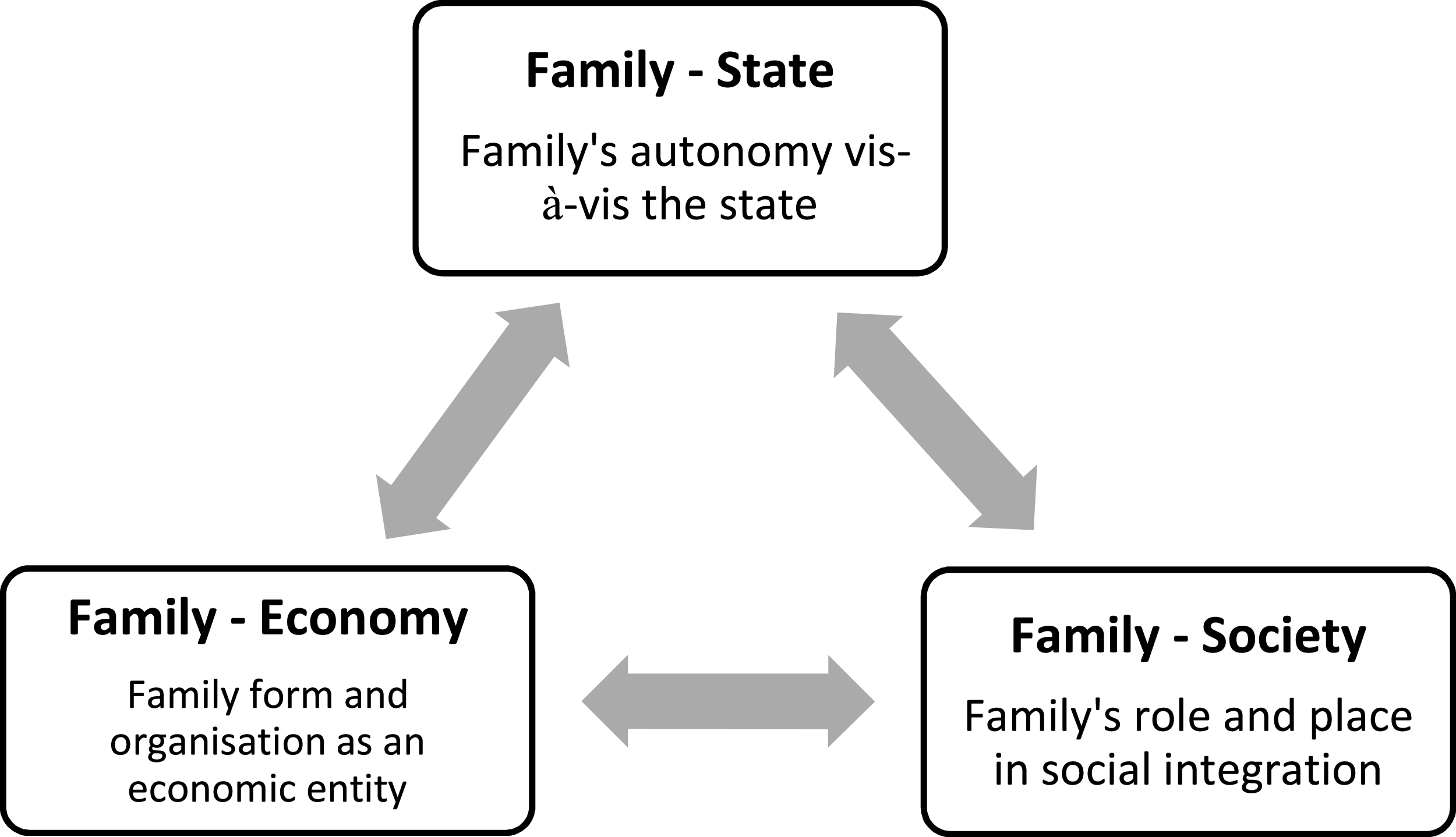
These different insights and interpretations contribute to the development of a conceptual framework. Drawing upon them, family policy is conceptualised here as engaged with three sets of relationships: between the family and the state, between the family and the economy and between the family and society (Figure 1). For the purposes of analysis, we treat these relational dimensions separately, but in reality, they meld into one another, and each policy measure has typically more than one orientation.
A framework for analysing family policy.

What dimensions should we select to examine these relations empirically? The relationship between the state and the family hinges especially on the degree to which the family is seen or desired to be a ‘private’ institution, in the sense of relative autonomy from the state (Mätzke & Ostner, Reference Mätzke and Ostner2010). A key matter is whether family is viewed and treated as an institution meriting support in its own right (that is, for reasons relating to its structure, operation and relative autonomy) or for other reasons (such as moulding family structure or behaviour for particular economic or social ends). The second relationship – that between the family and the economy – highlights the family as an economic unit and arrangement. Policy from this perspective may seek to affect matters such as the family’s economic situation, including exposure to low income, as well as the family’s articulation with the economy through labour supply, levels of living, human capital development and, via these, work-life balance. To uncover these relationships, we examine how policy engages with family-based roles and resource levels and also whether and how it aims to shift or alter practices around care-giving and employment engagement. Thirdly, family policy may aim to affect the societal positioning of the family. Of concern to policy here might be the family’s role in the maintenance of social stability and the normative order. In critical empirical focus is how the family is positioned with regard to social integration and wider societal well-being, and whether policy addresses gender inequalities.
The next section applies this framework to the UK to examine relevant policy, but also to reveal the utility of the framework in practice.
What have been the core elements of family policy in the UK in recent decades?
We start the analysis with New Labour, which came to power in 1997 and developed its policy model over three periods in government until 2010 (two under Tony Blair and one under Gordon Brown). Although there were policy variations between the three governments, space constraints permit us only to treat them in an overview fashion (similarly with the analysis of different Conservative administrations to follow). When New Labour assumed office, it encountered a social protection system with strong minimum income and anti-poverty elements, organised around a male breadwinner model with few policies supporting female employment (both public ECEC provision and parenting-related leaves were rudimentary) and a family service architecture that was oriented to vulnerability and the protection of children from harm (Clarke, Reference Clarke, Annesley, Gains and Rummery2007). From 1997 on, New Labour’s hugely reformist ambitions transformed not just family policy but many aspects of the British social policy architecture. Nearly 30 years on, it is difficult to convey the intensity and extent of the reform energy and New Labour’s preparedness to be generous to families for a range of ends.
Starting with the state-family relationship, at the very early stages, New Labour expressed support for the family in its own right. One of its early policy statements – Supporting Families (Home Office, 1998) – devoted a whole chapter to strengthening marriage through such measures as making divorce harder to obtain, better preparation for marriage and access to mediation and counselling for marital relationships in difficulty. However, New Labour later moved away from a traditional family orientation towards recognising families as more diverse (Williams, Reference Williams, Powell, Bauld and Clarke2005). The Supporting Families document announced plans in four other areas apart from support for marriage: services for parents bringing up children; financial support for families; work-home balance; support for families with ‘serious problems’. This gives a sense of how New Labour saw the world through the eyes of what families needed and merited from the state.
Universalism towards families with children led on several fronts. The extant universal and unconditional Child Benefit was made more generous; three- and four-year-olds were given an entitlement to some hours of free childcare; a Child Trust Fund was set up with the government lodging a payment of either £250 or £500 into a bank account for each child upon birth (McKay et al., Reference McKay, Tian and Lymer2024). Further, while not universalist in an all-encompassing sense, the Sure Start programme of integrated services for families and children granted universal access in those local areas where it existed (the 20–30% poorest areas – the plans for a nationwide rollout never materialised mainly because of funding cuts and a move in focus from all families in poor areas to families in difficulty). At a time when social investment is so dominant as an interpretation of contemporary social policy, it is important to point out that Sure Start concentrated not so much on cognitive goals for children as on parenting capacity and the development of healthy behavioural and emotional competence in children (Lewis, Reference Lewis2011). Rather than social investment for economic ends, of central concern were family well-being, child health and parent-child relationships, with outreach and home visits an important part of the service offer. New Labour had firm ideas about what was good for children qua children and how they should be reared and grow up, especially in a context of social exclusion (Eisenstadt & Oppenheim, Reference Eisenstadt and Oppenheim2019). Sure Start also pioneered principles of community development and neighbourhood renewal, which envisioned the involvement of local people, families especially, in decision making and a more integrated set of support services (Daly, Reference Daly2010). But there was a change in philosophy with the Children’s Centres, which replaced the Sure Start programme from 2003; these focused more on mainstreaming ECEC provision across the country and supporting parental employment participation.
Efforts to refashion the relationship between the family and the economy were also undertaken. First, as well as being made more generous for the vast majority of families, income support was reformed to incentivise employment engagement. A wide-ranging set of tax credits subsidising the costs of working and childcare played a leading role here (Oulton & Wernham, Reference Oulton and Wernham2025). Employment engagement by parents was also targeted through more punitive measures. Lone parents (effectively households headed by mothers) were targeted for benefit cuts and other ‘nudges’ towards employment. Leave policy was another part of the effort to both encourage employment and support work-life balance. Maternity protection – the only leave that the UK had at the time – was made a right for all employees, and the payment level and duration increased. Parents were given the right to three months of unpaid parental leave in 1999, and the introduction of a statutory right of fathers to two weeks of paid paternity leave in 2002/3 completed the picture. A National Childcare Strategy, which effectively developed ECEC as a new domain of policy in the UK, was launched in 1998. Mainly framed in terms of the ‘welfare to work’ agenda, this brought a major investment in childcare provision (£21 billion between 1997 and 2006 – HM Government, 2007) and gave an entitlement to 12.5 hours a week of free ECEC for all three- and four-year-olds. As well as promoting parental engagement with paid work, this spoke to New Labour’s commitment to addressing child poverty and ‘breaking the cycle of disadvantage’.
What about the family’s place in society? This, too, was a wellspring of policy activity that drew from Third Way thinking which espouses a middle path between socialist and neoliberal positions (Giddens, Reference Giddens1998). ‘Support’ turned out to be a concept with many meanings for New Labour. Over time, its policies acquired a strong sense of enforcing parental accountability and even ‘policing’ the behaviour of some parents and older children. The family’s disciplinary functions, epitomised especially by parental responsibility, were targeted in a context of anti-social behaviour by young people. This set of concerns led to some highly interventionist measures. ‘Supporting’ parents in their parental role and honing their disciplinary techniques (including self discipline) mainly took the form of ‘professionalising parenting’. This centred on instructing parents on how to parent through counselling, information services and parenting programmes (some offered under the auspices of a newly-established National Family and Parenting Institute). The legal system was called upon to control some parents and their children through Anti-social Behaviour Orders and Parenting Orders (which in practice were mainly issued to mothers). The Respect Programme, launched by the Home Office in 2006, sought to ‘tackle the behaviour of “problem families” by challenging them to accept support to change their behaviour, backed up by enforcement measures’ (Home Office, 2006, p. 3). The specific measures introduced included Family Intervention Projects, parenting contracts in respect of anti-social behaviour, and a youth taskforce. While it spoke strongly in favour of gender equality, New Labour’s credentials on gender equality were relatively modest. Viewing equality as coming through paid work, it never resolved tensions between the treatment of the household as a unitary entity for some benefit and tax credit purposes and treating women as paid workers (Rake, Reference Rake2001). One could even say that it reinforced a male breadwinner model – the new parenting-related leaves entrenching mothers’ responsibility for care rather than that of fathers, for example (Chanfreau, Reference Chanfreau2023; Clarke, Reference Clarke, Annesley, Gains and Rummery2007).
How are we to view these measures? It is clear that New Labour’s family policy was broad in that it addressed all three of the relationship sets conceptualised here. It was also strongly interventionist, generous to all families, expansionist institutionally, egalitarian in orientation from a social class perspective and expensive. It does not have a single reading, though, changing significantly over the 13 years in government, which suggests some ambivalence. It is probably best represented as a mix, seeking to balance different goals. There was a genuine programme of redistribution to families, but this was twinned with a more regulatory agenda that sought economic engagement and family behaviour consistent with social stability and conformity with mainstream values and practices. One fact is beyond doubt: New Labour narrowed the distance between the state and the family, reducing family autonomy, and positioned family and family life as a public policy concern (Gillies, Reference Gillies2011).
Did the Conservative administrations in power between 2010 and 2024 maintain the momentum in family policy? Taken as a whole, the 14 years that followed before Labour again assumed power in 2024 shared two of the three characteristics that hallmarked New Labour’s period: a reforming zeal and the use of the family as a vehicle for policy reform. The policy course pursued by the different Conservative administrations differed fundamentally from those of New Labour, though, especially in relation to spending on family policy (and on public policies generally), selectivity as against universalism and the degree of recourse to punitive measures. Whereas New Labour saw many of the issues facing families, especially poor families, as attributable to both structural factors and behavioural issues, for the Conservatives, the structural issue was a welfare state that supported a lack of engagement with paid work, encouraged child-bearing by those not able to afford children and contributed to a culture of worklessness and dependency (Department for Work and Pensions, 2010). Family was a key part of the problem with poverty and other social problems seen as linked to family breakdown, poor parental behaviour, educational failure, worklessness, addiction and crime (HM Government, 2011). Within a relatively short period, many of New Labour’s signature policies had either been eliminated, changed to an alternative form and/or reduced significantly in value and reach. The result was a period of reform arguably as significant and ground-breaking as that of New Labour, although in a different direction. A programme of austerity – in place for much of the decade – drove the reform but so, too, did a project of massive welfare reform. The resulting phased introduction from 2013 of Universal Credit was momentous, rolling six benefits into one and tying benefit receipt more closely than ever to employment in a strongly sanctions-based and heavily conditional approach (Bennett et al., Reference Bennett, Currie and Podoletz2026).
In terms of the relationship between the state and the family, the overarching stance of the different Conservative governments adhered to the long-held liberal position on the family as a private institution warranting direct state intervention only in particular circumstances. This philosophy could prevail only if the ‘difficult’ families were dealt with. This called for negative targeting of particular families and careful control of the ‘generosity’ of financial support. Three measures stand out. First, a two-child limit was imposed in 2017 for new claimants of the main social assistance benefit programme – Universal Credit – which meant that families on this benefit got no additional income support for third or subsequent children, until the current government repealed it in April 2026. Larger families with children have been particularly affected by this (Stewart et al., Reference Stewart, Patrick and Reeves2024). Second, the universal elements in the income support system for children and families were eliminated. In particular, Child Benefit was made subject to an income clawback, with families on higher incomes having to repay Child Benefit above an income threshold (as well as being frozen in value, thereby allowing inflation to erode its value). Another nail in universalism’s coffin was the ending in 2011 of new funds and government payments into Child Trust Funds, which were known to most help low-income families (McKay et al., Reference McKay, Tian and Lymer2024). The measures that New Labour had put in place to support babies born into low-income families were either restricted or eliminated.
The economic complexion of the family mattered greatly, prioritised for (rare) growth and increased investment. Engagement with the paid work agenda led. This took two forms. First, it involved reducing the support through benefits for people of working age, with the poorest households especially affected (Cooper & Hills, Reference Cooper and Hills2021). Second, to cement their overall approach of ‘work first’, the tax burden for low earners was lessened, part-time subsidised childcare for ‘disadvantaged’ two-year-olds was introduced along with a version of shared parental leave that allowed couples to share maternity leave for a period. Subsidising of childcare, especially for working parents, was one of the few areas of increased expenditure. The introduction of a national living wage (to top up the national minimum wage that New Labour had introduced in 1999) was another part of the economic strategy (Oulton & Wernham, Reference Oulton and Wernham2025). However, despite these incentives, inadequate and costly ECEC exerted a drag effect on the desired higher female employment rates. Severe cuts to local authority funding meant cut-backs in and closure of many Children’s Centres (the later iteration of Sure Start) (Smith et al., Reference Smith, Sylva, Smith, Sammons and Omonigho2018). In addition, the number and range of services offered by surviving centres were ‘hollowed out’, further dichotomising the UK system of market-provided childcare for the better off and public services for the poorer families (Eisenstadt & Oppenheim, Reference Eisenstadt and Oppenheim2019). Overall, care-giving was given little value, especially in situations of low income. Under Universal Credit, for the first time, both partners in all couples receiving means-tested benefits were supported or compelled to engage in some way with employment – to prepare for work, to seek work, or to increase working hours/earnings.
To turn to the family’s place in society, the Conservatives also used a language of family support but this was for them highly selective, defined by the classification of some families as dysfunctional or ‘troubled’ and hence needing intensive intervention, as distinct from the universe of families that could manage under their own steam. Pride of place here was the Troubled Families Programme, which, when it was introduced in 2011, consumed the lion’s share of central government funding for family services. Essentially a crisis-oriented measure, it was extremely specific in its aim to target for intervention 120,000 of England’s most ‘troubled’ families. The underlying notion – that the source of social problems is a relatively small group of families passing on poor behaviour – is not new in the UK (Thom, Reference Thom and Skinner2011, p. 35). The ‘troubles’ targeted in this programme, which was renewed in various forms for 10 years with an ambition to reach half a million families by 2020, were the social problems of employment disengagement, truancy, anti-social behaviour and criminality (HM Government, 2012). The intervention model saw a designated key worker being assigned to work with each family to ‘turn around lives’. The term ‘support’ was reinstated in 2021 when a successor programme – Supporting Families Programme 2022–2025 – was introduced. This essentially followed the same approach of intensive work with a set of families to meet such problems as children’s return to and attendance at school (after COVID 19), parental employment, mental health support and domestic abuse (Ministry of Housing, Communities and Local Government, 2021).
Summing up, the Conservative administrations did not ‘deploy’ family policy in the same way or to the same degree as New Labour. The state/family relationship was targeted only for a section of low-resourced families, which were subjected to much closer discipline by state actors. The Conservatives instituted a dualistic regime: deterrence and forced employment for ‘difficult families’ and ‘choice’ for families in general. The family, as private and generally autonomous from the state, was the norm supported by a strong role for the market (especially in providing ECEC and preventing poverty). The Conservatives took only weak steps to replace the male breadwinner model (Chanfreau, Reference Chanfreau2023); the changes to leaves, especially paternity and parental leaves, offloaded many of the costs of care-giving to families and women, and there was little practical support for a changed division of labour between women and men and between the state and the family (Fleckenstein & Mohun Himmelweit, Reference Fleckenstein, Mohun Himmelweit, Daly, Pfau-Effinger, Gilbert and Besharov2023).
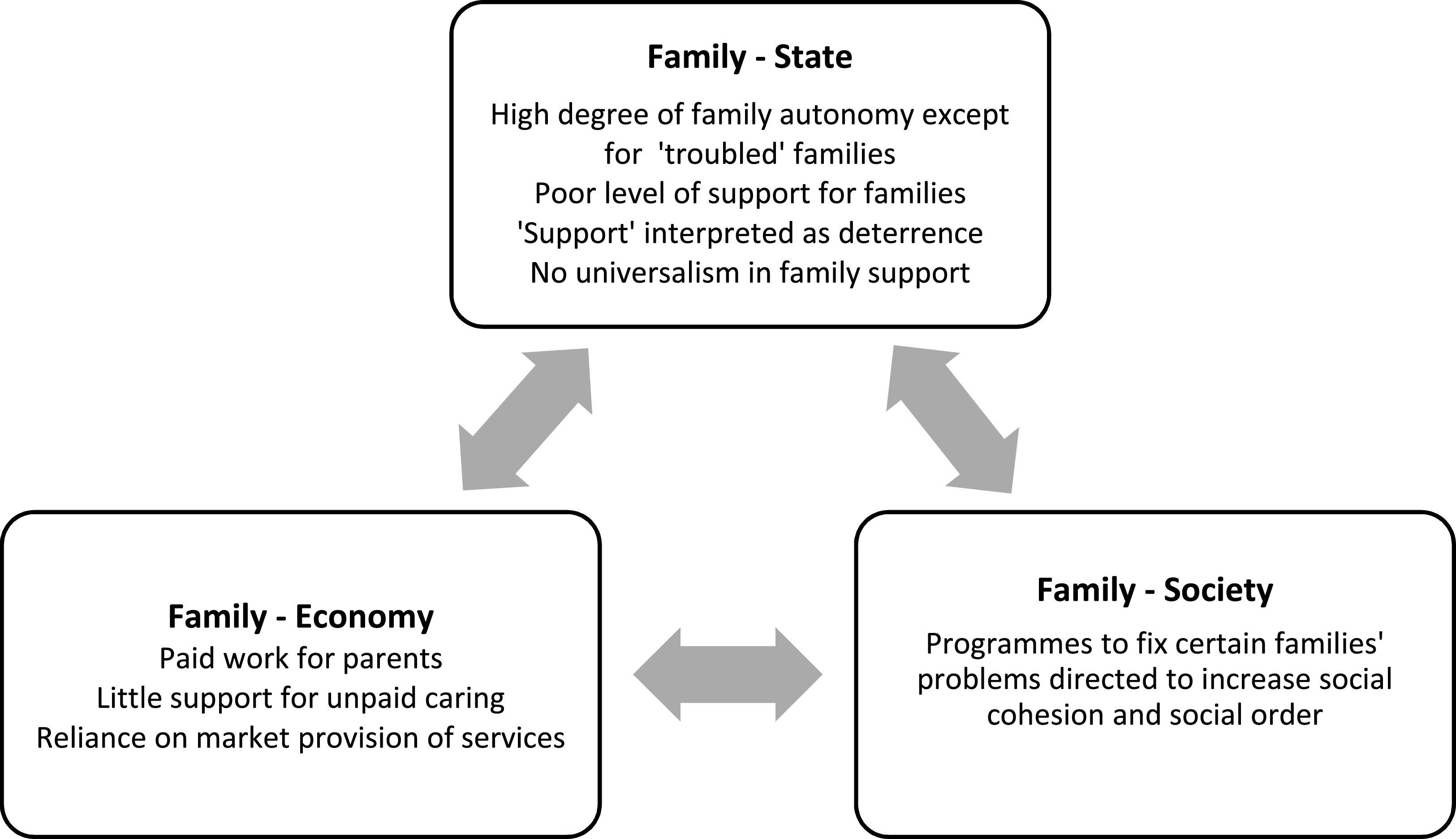
Figure 2 characterises the current policy constellation. The general approach to families is non-interventionist except for families that are seen to threaten stability and integrationist social norms. The family’s economic functions are strongly emphasised by a policy set that draws the family closer to the economy, the market and paid employment. Moreover the family’s role in social cohesion is underpinned by a strongly punitive approach to perceived familial dysfunction.
Main currents of family policy in the UK today.

How might we characterise this constellation?
There are clearly elements of a social assistance, minimum income orientation with strong targeting to lower-income sectors. This is the pattern emphasised especially by recent reforms. Social assistance programmes carry a huge load in the UK welfare system. As of January 2026, some 8.4 million adults were claiming Universal Credit, and nearly a half of all households receiving a payment had children.Footnote 1 Moreover, at 2.07% of GDP in 2021, UK expenditure on family policy is low by international standards – European Union (EU) 2.67% and Organisation for Economic Co-operation and Development (OECD) 2.35%.Footnote 2 The anti-poverty model is the UK’s legacy position (Thom, Reference Thom and Skinner2011), and the Conservative administrations cemented that with socio-economically polarising policies, especially for families.
But the policies are not adequately described as needs-based. The UK family policy accords in some respects with a social investment approach which values the role and function of social policy as an investment to support the economy. Of import here are the emphasis on labour market participation, for example, and out-of-home ECEC. But developments as a whole call for caution in labelling the UK a social investment model. The country has not followed Europe’s path in diversifying, extending and rendering parenting-related leaves more gender neutral (Daly & Ferragina, Reference Daly and Ferragina2018). Moreover, state support for and provision of ECEC is still limited, and childcare remains costly for parents. In effect, responsibility for care-giving remains with the family and is mainly problematised through a labour market participation lens (which sees children’s access governed by their parents’ earnings rather than, say, child human capital). The policy emphasis on parenting and family behaviour also has little resonance with a social investment approach, being concerned with moral questions and social cohesion through ‘rehabilitation’ of some families and parents and the quality and stability of relations in families. In truth, the UK model is a complex mix, reflecting its roots in different political missions and perspectives.
What enabled the policy approaches to come about?
The two sets of governments were helped by positive factors but also hemmed in by constraints. New Labour had two strong tailwinds: its period of office largely coincided with a period of sustained economic growth; it enjoyed majorities in parliament and the support of inclusive cross-class coalitions (Pearce & Kelly, Reference Pearce and Kelly2025). Support for the different Conservative administrations, on the other hand, came mainly from the private sector, the middle class and older voters, with greater working-class support only after the Brexit vote in 2016. New Labour was especially prepared to invest: expending some £2 billion in the Child Trust Funds alone (which is about 60% of the estimated yearly costs of removing the two-child limit from Universal Credit – £3.6 billion). But New Labour ran up against both the costs of universalism and its weak foundations in the British welfare state.
What united both sets of administrations and contributes to explaining their relative success in implementing their policy programmes is that they were strongly mission-driven. All saw in family policy a means of addressing ‘big issues’, including at least two out of the three relational axes in this article’s analytical framework. New Labour and the Conservatives were both zealous political actors in regard to both moral and material matters, suggesting the power of ideational factors in explaining family policy change in the UK (Fleckenstein & Mohun Himmelweit, Reference Fleckenstein, Mohun Himmelweit, Daly, Pfau-Effinger, Gilbert and Besharov2023). Both fitted their times in a way. In the 1990s and 2000s, the welfare state still had legitimacy as a progressive project in Europe, whereas the financial crash of 2008 and subsequent sluggish economic growth and intermittent crises entrenched neo-liberal views on the primary role of the welfare state as supporting the market and identifying some individuals and families as undeserving of public support.
Conclusion
This article has sought to deepen the understanding and analysis of family policy in two ways: first, by developing a theoretical framework and, second, by using it to explicate how recent UK policy has engaged with the family. It has broadened the focus of analysis beyond social protection instruments to include leaves from employment and services and, in another meaning of breadth, it has moved beyond economically-instrumental outcomes to sketch an understanding of family policy as political, economic and social. This way of thinking led us to a theoretical framework that views family policy as seeking to affect three sets of relationships: between the family and the state, the family and the economy and the family and society. This underlines how complex family policy is, as it has to navigate around views of the state’s appropriate relationship with the family and manage both the family’s interface with the economy and its societal role and presence.
What does the framework allow us to say about family policy in the UK? We see a country that has experienced two different but equally momentous political agendas over 30 years, proving that family has been a strong mobilising concept for social policy in the UK. New Labour’s three periods in government oversaw a wide-ranging and expensive policy programme marked by a universalist approach to supporting families and measures that expanded and innovated in regard to the family’s social and economic role, veering between support and compulsion. For the Conservatives, families were seen as not requiring significant intervention apart from a section of low-income families with children, which was represented as dysfunctional and highly in need of intervention (Churchill, Reference Churchill, Bochel and Powell2024). Whereas New Labour strongly favoured redistribution and treated the family as playing a key positive role in individual and collective well-being, the Conservatives considered that families should have choice in how to use their resources and organise themselves whilst presiding over a regressive reform of income benefits that saw low-income families with children bear heavy costs (Pearce & Kelly, Reference Pearce and Kelly2025).
Looking at policy today, the UK stands out internationally for its family policy, which is particular and underdeveloped in comparison to other European countries. Comparatively, the UK spends less on family policy, has no universal elements of income support for children, penalises low-income families, especially those with larger numbers of children, has a maternalist-oriented employment leave system and a set of family support services that is underdeveloped apart from those targeted at the so-called most ‘troubled families’. Nearly two years into the Labour government’s tenure, key aspects of family policy seem to be stalled. It took a major years-long campaign by over 100 anti-poverty organisations, faith groups and others, including government backbenchers, to get the government to eliminate the two-child limit for income support in Universal Credit. Ambivalent on income redistribution, the government seems more open to improving services: it has expanded the school meals programme and recently announced a Best Start Family Service programme to provide an integrated set of support services for families with emphasis on the child’s early development (in England) (Department for Education, 2025). This does not have the ambition or range of the Sure Start programme, although it is envisaged to be nationwide (for England).
It is not clear what family or family policy means to the current Labour government. It does not appear to have a mission and seems stuck on deservingness questions, caught up in the highly moralistic politics surrounding family policy today. For example, its resistance to eliminating the two-child limit seemed to be rooted in the moral issue of whether having more than two children is an expression of personal irresponsibility on the part of welfare beneficiaries. Moreover, trying to appeal to the broad, if shallow, electoral support that put it in office has seen it reluctant to increase spending for social amelioration purposes, especially if it involves raising taxes. So, it is caught in a dilemma of how to support families without spending more money or changing the income support architecture. The Conservatives, too, have little to say about family. It is the populist Reform Party that is setting a mark, advocating support for marriage and measures that ‘help British people have children’.Footnote 3 This type of pronatalist politics is among the leading motives nowadays for the reform of family policy in Europe and elsewhere. But apart from Reform, there is no evidence of pronatalism at play in the UK and, indeed, some of the policies, especially those put in place by the Conservatives, have an anti-fertility cast in discouraging child-bearing, especially by the poorer sectors of society.
The analytical framework will benefit from further work and deeper application. We acknowledge that the three axes of family policy are interrelated and that the individual treatment of them does not reflect cumulative and complex dynamics. Further work is therefore needed on how the three axes relate to each other, their interdependencies and the conditions under which approaches to each might enable or constrain the others. In truth, most family policies are a mix of models and values, and so the approach developed here could be of use in examining and attributing causality to underpinning philosophies as they link to political and material struggles in different settings. A further particularity of the article’s approach – the focus on family as an institution – also opens the way to future research. We need to have a much better idea of how the different emphases or ‘mixes’ involved in family policy affect individual agency, giving full weight to diversity in response and the significance of relationships and relational obligations in affecting agency on the part of individuals and families. Finally, we have analysed family policy as a relatively stand-alone entity. There are numerous reasons to connect family and welfare policies more generally. A challenge for future work, therefore, is to link the framework and analyses provided here to broader social policy analysis.

 Open access

