





Introduction
Because of staged Fontan palliation with the bidirectional cavopulmonary shunt and total cavopulmonary connection, hospital mortality of patients with a univentricular heart has decreased dramatically. Follow-up survival is now 90–97% at 10 years. Reference de Leval, Kilner, Gewillig and Bull1–Reference Mery, De León and Trujillo-Diaz7 Typical complications of the classic Fontan procedure, such as thrombus, tachyarrhythmia, Fontan pathway obstruction, and early Fontan failure, have been significantly reduced in the last three decades. However, these contemporary total cavopulmonary connection patients still face Fontan-specific adverse events, including pleural effusions, chylothorax, protein-losing enteropathy, plastic bronchitis, ascites, and failing Fontan. Reference Nakano, Kado and Tatewaki2–Reference Dalén, Odermarsky, Liuba, Johansson Ramgren and Synnergren9 Previous studies focused on the preoperative variables to identify factors affecting these morbidities. They found variables such as high pulmonary artery pressure, reduced ventricular function, atrioventricular valve regurgitation, heterotaxy syndrome, and dominant right ventricle. Reference Nakano, Kado and Tatewaki2–Reference Allen, Downing and Glatz8,Reference Soquet, Mufti and Jones10–Reference Matsubara, Dahmen and Gaebert13 Furthermore, recent studies showed that small pulmonary artery size, mal-distribution of pulmonary blood flow, or small inferior vena cava size influences the postoperative outcomes after the Fontan procedure. Reference Ridderbos, Bonenkamp and Meyer14–Reference Dasi, Krishnankuttyrema and Kitajima19 However, these studies evaluated the late outcomes after total cavopulmonary connection, not the early outcomes. Our recent study analysed how the early postoperative haemodynamic and laboratory variables after total cavopulmonary connection affect adverse events after total cavopulmonary connection and showed that higher pulmonary artery pressure and lower mean arterial pressure 12 hours after extubation and higher lactate levels 6 hours after extubation were predictors for in-hospital morbidities and adverse events after hospital discharge. Reference Di Padua, Osawa and Waschulzik20
Therefore, in this study, we hypothesised that small pulmonary artery size and/or asymmetric pulmonary artery size before bidirectional cavopulmonary shunt and total cavopulmonary connection could cause early unfavourable postoperative haemodynamics following total cavopulmonary connection. We analysed the impact of preoperative pulmonary artery size before bidirectional cavopulmonary shunt and total cavopulmonary connection on the early postoperative haemodynamic variables.
Methods
Patients and data collection
We reviewed all patients who underwent staged Fontan palliation at the German Heart Center Munich between 2012 and 2022 and whose pre-bidirectional cavopulmonary shunt and pre-total cavopulmonary connection angiograms were available. Medical records included baseline morphology and demographics as well as pre-, intra-, and postoperative data, using each patient’s digital and paper chart reviews.
Operative techniques and postoperative management
Bidirectional cavopulmonary shunt was performed using standard cardiopulmonary bypass, and ante-grade pulmonary blood flow was eliminated in most of the cases. Reference Ono, Burri and Mayr21 The operative technique for total cavopulmonary connection was extra-cardiac total cavopulmonary connection. Reference Schreiber, Hörer, Vogt, Cleuziou, Prodan and Lange22 An 18 mm polytetrafluoroethylene graft (Gore-Tex, W.L. Gore & Assoc, Flagstaff, Arizona) was used most frequently. Fenestration was not performed routinely and only applied to high-risk patients, such as patients with one-lung Fontan, severe atrioventricular valve regurgitation, or impaired systemic ventricular function. At our institute, all patients were transferred to the ICU after the procedure and received an infusion of propofol (1–2 mg/kg/hour) that was terminated when extubation was planned. According to our early extubation strategy, extubation was attempted during the first 3 hours following ICU admission, regardless of the patient’s haemodynamic status. Reference Ono, Georgiev and Burri23 After extubation, special care was taken to achieve ongoing analgesia with morphine and/or non-steroidal anti-inflammatory drugs. Administration of inotrope or inhalation of nitric oxide was terminated soon after extubation. The serial early haemodynamic and laboratory data, including pulmonary artery pressure, mean arterial pressure, and lactate levels, were collected using the electronic chart of the ICU. Reference Di Padua, Osawa and Waschulzik20
Cardiac catheterisation and measurement of pulmonary artery size
Cardiac catheterisation was performed in all patients before bidirectional cavopulmonary shunt and before total cavopulmonary connection. In addition to haemodynamic measurements, conventional pulmonary artery angiography was performed. The pulmonary artery index was calculated using pulmonary artery angiography as described by Nakata and colleagues. Reference Nakata, Imai and Takanashi24 The right and left pulmonary artery indices were calculated by dividing the cross-sectional area of each pulmonary artery branch by the body surface area. To evaluate the symmetric pulmonary artery development, the symmetry index was calculated as described by Glatz and colleagues. Reference Glatz, Petit and Goldstein25 For further evaluation of the symmetric pulmonary artery development, the ratio of the left to the right pulmonary artery index was calculated by dividing the left pulmonary artery index by the right pulmonary artery index.
Analysis of the impact of pulmonary artery indices and postoperative haemodynamic and laboratory variables
To prove our hypothesis that small pulmonary artery size and/or asymmetric pulmonary artery size could cause early unfavourable postoperative haemodynamics following total cavopulmonary connection, the impact of preoperative pulmonary artery index, symmetry index, and the ratio of the left to right pulmonary artery index on the early postoperative haemodynamic variables were analysed using a logistic regression model. Pulmonary artery index, right and left pulmonary artery index, symmetry index, and the ratio of the left to right pulmonary artery index were used as continuous variables. Therefore, we obtained the 75% percentile of these variables. As a result, pulmonary artery pressure of 17 mmHg, mean arterial pressure of 57 mmHg, and lactate levels of 4.5mg/dl were defined as endpoints for statistical analysis. Unstable haemodynamic status was defined as pulmonary artery pressure >17 mmHg 12 hours after extubation, mean arterial pressure < 45 mmHg 12 hours after extubation, and lactate levels > 4.5 mg/dl 6 hours after extubation. The outcomes of these unstable haemodynamic statuses were analysed by a logistic regression model.
Statistical analysis
Categorical variables are presented as absolute numbers and percentages. A chi-square test was used to compare categorical data. Continuous variables are expressed as medians with interquartile ranges. An independent sample t-test was used to compare normally distributed variables. The Mann–Whitney U test was used for variables that were not normally distributed. Variables regarding pulmonary artery size associated with early unstable haemodynamic status after total cavopulmonary connection were identified using a logistic regression analysis. For the variables that are significant in univariable analysis, cut-off values were estimated using receiver operating characteristics analysis using the Youden index. Furthermore, a combined model including all significant predictors of the multivariable logistic regression analysis was carried out (C statistic). P-values below 0.05 were considered significant. Data analysis and graphing were performed with the Statistical Package for the Social Sciences version 28.0 for Windows (IBM, Ehningen, Germany) and R-statistical software (R Foundation for Statistical Computing, Vienna, Austria).
Results
Patient characteristics and perioperative data
A total of 263 patients were included. Patient characteristics are shown in Table 1. More than half of the patients (57.4%) had a dominant right ventricle, and the most frequent diagnosis was hypoplastic left heart syndrome (36.1%). Prior to total cavopulmonary connection, all patients underwent bidirectional cavopulmonary shunt at a median age of 4.1 (interquartile ranges: 3.2–5.8) months and a median weight of 5.1 (interquartile range: 4.6–6.0) kg.
Baseline characteristics

RV = right ventricle; LV = left ventricle; TCPC = total cavopulmonary connection; HLHS = hypoplastic left heart syndrome; UVH = univentricular heart (not further classified); TA = tricuspid atresia; DILV = double inlet left ventricle; ccTGA = congenitally corrected TGA; PAIVS = pulmonary atresia and intact ventricular septum; UAVSD = unbalanced atrioventricular septal defect; TGA = transposition of the great arteries; DORV = double outlet right ventricle; CoA = coarctation of the aorta; TAPVC = total anomalous pulmonary venous connection; PAPVC = partial anomalous pulmonary venous connection; AP = aorto-pulmonary; PAB = pulmonary artery banding; BCPS = bidirectional cavopulmonary shunt.
Perioperative outcome
Operative and perioperative data are shown in Table 2. Median age and weight at total cavopulmonary connection were 2.2 (interquartile range: 1.8–2.7) years and 11.7 (interquartile range: 10.7–13.3) kg, respectively. Median duration between bidirectional cavopulmonary shunt and total cavopulmonary connection was 1.8 (interquartile range: 1.4–2.2) years. Aortopulmonary collaterals were observed in 120 patients at the pre-total cavopulmonary connection catheterisation. All patients underwent extra-cardiac total cavopulmonary connection, where an 18 mm polytetrafluoroethylene graft was used in 245 patients (93.2%). There was no early death within 30 days. The median ICU length of stay and hospital length of stay were 5 (3–7) and 18 (13–26) days, respectively.
Perioperative variables
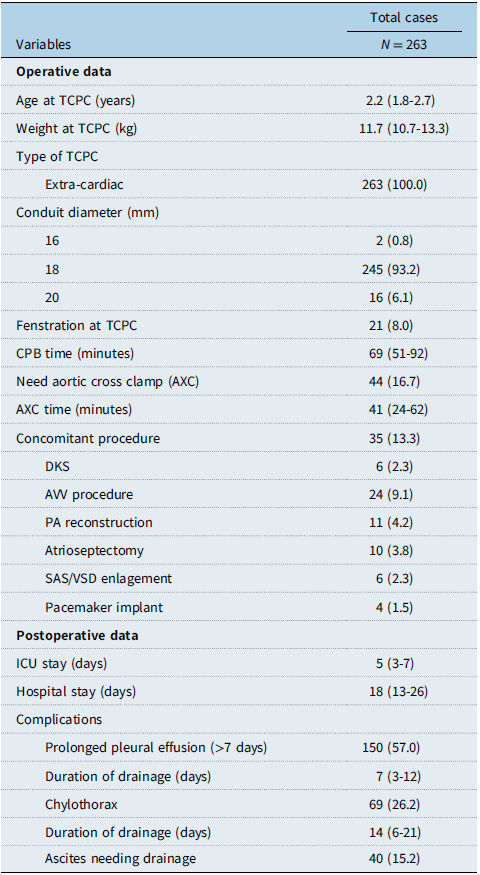
Variables were presented in N(%) or median (IQR). TCPC = total cavopulmonary connection; CPB = cardiopulmonary bypass; AXC = aortic cross-clamp; DKS = Dames–Kaye–Stansel anastomosis; AVV = atrioventricular valve; PA = pulmonary artery; SAS = subaortic stenosis; VSD = ventricular septal defect.
Pulmonary artery indices and postoperative haemodynamics
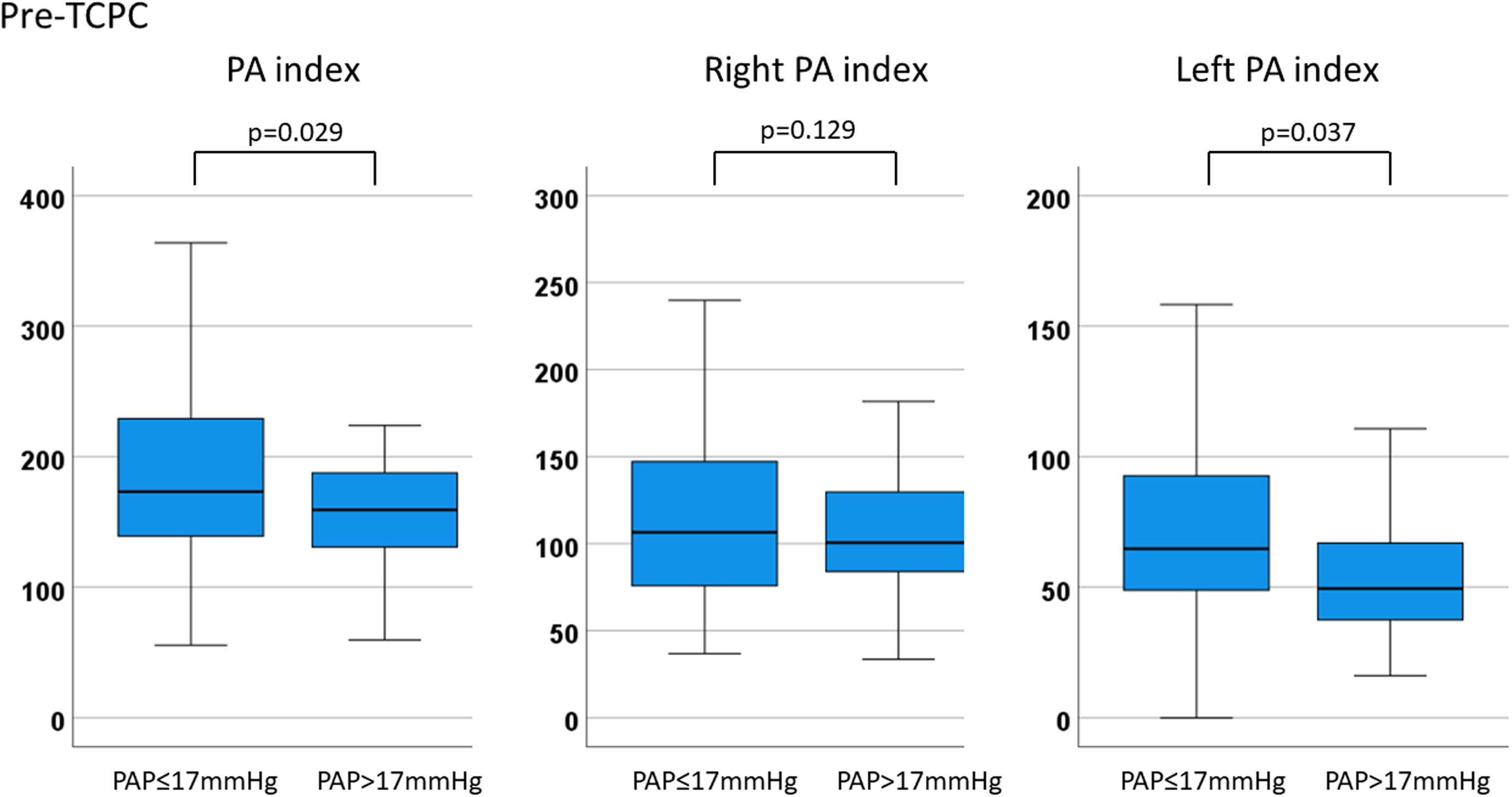
The results of the risk factor analysis are shown in Table 3. As for the high pulmonary artery pressure, lower pre-bidirectional cavopulmonary shunt pulmonary artery index (p = 0.006, odds ratio 0.992), lower pre-bidirectional cavopulmonary shunt right pulmonary artery index (p = 0.020, odds ratio 0.990), lower pre-bidirectional cavopulmonary shunt left pulmonary artery index (p = 0.014, odds ratio 0.986), lower pre-total cavopulmonary connection left pulmonary artery index (p = 0.039, odds ratio0.989), and lower asymmetry index (p = 0.004, odds ratio 0.207) were risk factors for a higher pulmonary artery pressure (> 17 mmHg) in the univariate model (Table 3A). Pre-bidirectional cavopulmonary shunt pulmonary artery index (p = 0.016, odds ratio 0.993) was an independent risk factor in the multivariable analysis. When pre-bidirectional cavopulmonary shunt pulmonary artery index was analysed with pre-total cavopulmonary connection pulmonary artery pressure, both variables were independent risk factors (pre-bidirectional cavopulmonary shunt pulmonary artery index: p = 0.020, odds ratio 0.993, and pre-total cavopulmonary connection pulmonary artery pressure: p = 0.008, odds ratio 1.246). A comparison of pre-bidirectional cavopulmonary shunt pulmonary artery indices between patients with high pulmonary artery pressure and those without is shown in Figure 1. Pulmonary artery index (168 vs. 132 mm2/m2, p < 0.001), right pulmonary artery index (89 vs. 71 mm2/m2, p = 0.002), and left pulmonary artery index (69 vs. 63 mm2/m2, p < 0.001) are significantly lower in patients who demonstrated pulmonary artery pressure > 17 mmHg 12 hours after extubation. A comparison of pre-total cavopulmonary connection pulmonary artery indices between patients with high pulmonary artery pressure and those without is shown in Figure 2. Pulmonary artery index (173 vs. 159 mm2/m2, p = 0.029) and left pulmonary artery index (65 vs. 50 mm2/m2, p = 0.037) are significantly lower in patients who demonstrated pulmonary artery pressure > 17 mmHg 12 hours after extubation. Right pulmonary artery index (107 vs. 101 mm2/m2, p = 0.129) was similar between the groups. As for the low mean arterial pressure, pre-total cavopulmonary connection right pulmonary artery index demonstrated an odds ratio of 0.994, but was not statistically significant (p = 0.09; Table 3 B). Regarding high lactate levels (> 4.5mg/dl), pre-bidirectional cavopulmonary shunt pulmonary artery index (p < 0.001, odds ratio 0.990), pre-bidirectional cavopulmonary shunt right pulmonary artery index (p < 0.001, odds ratio 0.982), pre-bidirectional cavopulmonary shunt left pulmonary artery index (p = 0.016, odds ratio 0.988), and pre-total cavopulmonary connection pulmonary artery index (p = 0.041, odds ratio: 0.995) were risk factors in the univariate model (Table 3C). The multivariable analysis identified pre-bidirectional cavopulmonary shunt right pulmonary artery index (p < 0.001, odds ratio 0.983) as an independent risk factor. When pre-bidirectional cavopulmonary shunt right pulmonary artery index was analysed with pre-bidirectional cavopulmonary shunt pulmonary artery pressure, both variables were independent risk factors (pre-bidirectional cavopulmonary shunt right pulmonary artery index: p < 0.001, odds ratio 0.981, and pre-total cavopulmonary connection pulmonary artery pressure: p = 0.047, odds ratio 1.091). A comparison of pre-bidirectional cavopulmonary shunt pulmonary artery indices between patients with high lactate levels and those without is shown in Figure 3. A comparison of pre-total cavopulmonary connection pulmonary artery indices between patients with high lactate levels and those without is shown in Figure 4. Pulmonary artery index (169 vs. 122 mm2/m2, p < 0.001), right pulmonary artery index (89 vs. 63 mm2/m2, p < 0.001), and left pulmonary artery index (69 vs. 55 mm2/m2, p = 0.013) are significantly lower in patients who demonstrated lactate levels > 4.5 mg/dl 6 hours after extubation. Pulmonary artery index (174 vs. 155 mm2/m2, p = 0.039) was significantly lower in patients who demonstrated lactate levels > 4.5 mmHg 6 hours after extubation. Right pulmonary artery index (108 vs. 94 mm2/m2, p = 0.094) and left pulmonary artery index (64 vs. 55 mm2/m2, p = 0.063) tended to be lower in patients who demonstrated lactate levels > 4.5 mmHg 6 hours after extubation, but not statistically significant. The presence of aortopulmonary collaterals before total cavopulmonary connection was not a risk for higher pulmonary artery pressure (p = 0.146, odds ratio: 1.659), lower mean arterial pressure (p = 0.422. odds ratio: 0.753), or higher lactate levels (p = 0.732, hazard ratio: 0.888).
Box-and-whiskers plots showing PA index, right PA index, and left PA index before BCPS in patients with PAP higher or lower than 17 mmHg 12 hours after extubation. PA = pulmonary artery; PAP = pulmonary artery pressure; BCPS = bidirectional cavopulmonary shunt.

Box-and-whiskers plots showing PA index, right PA index, and left PA index before TCPC in patients with PAP higher or lower than 17 mmHg 12 hours after extubation. PA = pulmonary artery, PAP = pulmonary artery pressure, TCPC = total cavopulmonary connection.
Box-and-whiskers plots showing PA index, right PA index, and left PA index before BCPS in patients with lactate higher or lower than 4.5mg/dl 6 hours after extubation. PA = pulmonary artery; BCPS = bidirectional cavopulmonary shunt.

Box-and-whiskers plots showing PA index, right PA index, and left PA index before TCPC in patients with lactate higher or lower than 4.5 mg/dl 6 hours after extubation. PA = pulmonary artery; TCPC = total cavopulmonary connection.

Impact of PA indices on early postoperative haemodynamics
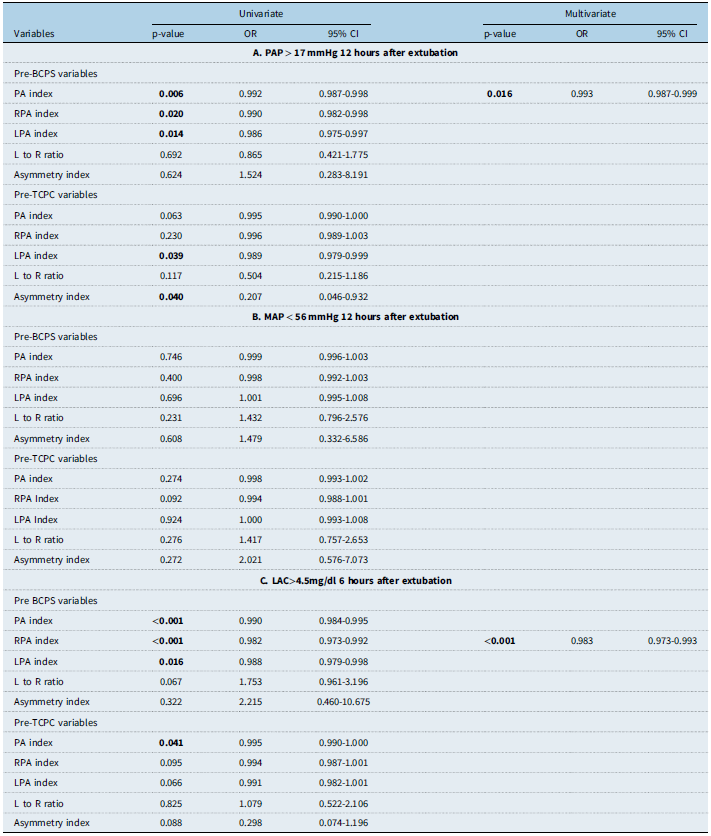
Bold indicates p < 0.05.
To exclude the effect of a fenestration, a subgroup analysis using 242 patients with non-fenestrated total cavopulmonary connection was performed (Supplementary Table S1). As a result, pre-bidirectional cavopulmonary shunt pulmonary artery index (p = 0.012, odds ratio: 0.992) was an independent risk factor for pulmonary artery pressure >17 mmHg 12 hours after extubation. No variable was identified as a risk for mean arterial pressure P < 56 mmHg 12 hours after extubation. Pre-bidirectional cavopulmonary shunt right pulmonary artery index (p < 0.001, odds ratio: 0.990) was an independent risk factor for lactate levels > 4.5 mg/dl 6 hours after extubation.
ROC curve analysis
For the variables significant in the multivariable analysis, cut-off values were calculated using receiver operating characteristics curve analysis. The results are shown in Supplementary Table S2. For variables that are significant for higher pulmonary artery pressure (> 17 mmHg) in the multivariable analysis, pre-bidirectional cavopulmonary shunt pulmonary artery index cut-off values of 154 mm2/m2 (area under the curve 0.37) were identified. When pre-bidirectional cavopulmonary shunt pulmonary artery index was combined with pre-total cavopulmonary connection pulmonary artery pressure, the receiver operating characteristic curve analysis showed an area under the curve of 0.684 (Supplementary Figure S1). For the variables that are significant for higher lactate levels (> 4.5 mg/dl) in the multivariable analysis, pre-bidirectional cavopulmonary shunt right pulmonary artery index cut-off values of 70 mm2/m2 (area under the curve 0.30) were identified. When pre-bidirectional cavopulmonary shunt right pulmonary artery index was combined with pre-bidirectional cavopulmonary shunt pulmonary artery pressure, the receiver operating characteristics curve analysis showed an area under the curve of 0.717 (Supplementary Figure S2).
Discussion
The present study demonstrated that small pulmonary artery indices before bidirectional cavopulmonary shunt and total cavopulmonary connection were risk factors for early postoperative unstable haemodynamics and laboratory variables following total cavopulmonary connection (higher pulmonary artery pressure > 17 mmHg 12 hours after extubation and lactate levels > 4.5mg/dl 6 hours after extubation). These results augment the importance of pulmonary artery size at the time of bidirectional cavopulmonary shunt and total cavopulmonary connection for outcomes after total cavopulmonary connection.
Importance of pulmonary artery size for the outcomes after total cavopulmonary connection
A well-developed pulmonary artery is essential in establishing good Fontan circulation. Reference Choussat, Fontan, Besse, Vallot, Chauve, Bricaud, Anderson and Shinebourne26,Reference Hosein, Clarke and McGuirk27 However, the lower limit of pulmonary artery size/optimal pulmonary artery size is still controversial. Reference Ridderbos, Bonenkamp and Meyer14–Reference Alsaied, Sleeper and Masci16 A decade before, several studies demonstrated that a small pulmonary artery did not affect the results after the Fontan procedure with cut-off values of 150–250 mm2/m2. Reference Adachi, Yagihara and Kagisaki28–Reference Baek, Bae and Kim30 Itatani et al. determined the lower limit of the pulmonary artery index of 110 mm2/m2 using computer flow dynamics analysis. Reference Itatani, Miyaji, Nakahata, Ohara, Takamoto and Ishii31 However, recent studies reemphasise the importance of pulmonary artery size during staged Fontan palliation. Ridderbos et al. showed that the pulmonary artery index correlated positively with peak oxygen consumption. Reference Ridderbos, Bonenkamp and Meyer14 Kido et al. demonstrated that the pulmonary artery index with a cut-off value of 170 mm2/m2 is associated with the occurrence of chylothorax after total cavopulmonary connection. Reference Kido, Stern and Heinisch15 Our study showed that a smaller pulmonary artery index with a cut-off value of around 154 mm2/m2 before bidirectional cavopulmonary shunt was a risk for unstable early haemodynamics after total cavopulmonary connection. Therefore, a small pulmonary artery with a cut-off value of 150–170 mm2/m2 is a risk for unfavourable outcomes after total cavopulmonary connection. Furthermore, the balance of pulmonary artery development is also important for a successful Fontan circulation. Yalta et al. demonstrated that mal-distribution of pulmonary blood flow in patients after the Fontan operation is associated with worse exercise capacity. Reference Alsaied, Sleeper and Masci16 Kido et al. demonstrated that a small left pulmonary artery size below 56 mm2/m2 is a risk for adverse events after total cavopulmonary connection. Reference Kido, Stern and Heinisch15 This study showed that a smaller right pulmonary artery index below 70 mm2/m2 before bidirectional cavopulmonary shunt was a risk for unstable early haemodynamics after total cavopulmonary connection. However, we evaluated only the relation between pulmonary artery size and early postoperative haemodynamics without exploring long-term Fontan complications. Therefore, further studies are needed to examine the identified pulmonary artery thresholds that could correlate with long-term outcomes.
Optimal timing of bidirectional cavopulmonary shunt and factors influencing pulmonary artery development
Previous studies demonstrated that the pulmonary artery index did not increase between bidirectional cavopulmonary shunt and Fontan completion, Reference Kansy, Brzezińska-Rajszys and Zubrzycka32,Reference Euringer, Schaeffer and Heinisch33 making the pulmonary artery size at bidirectional cavopulmonary shunt important for the outcome after Fontan procedure. We currently perform bidirectional cavopulmonary shunt at around 3 months, once the pulmonary artery pressure has decreased to 16 mmHg. The findings of this study suggest that the optimal timing of bidirectional cavopulmonary shunt should be dependent on a sufficient pulmonary artery size. While we previously considered early volume unloading of the systemic ventricle through bidirectional cavopulmonary shunt to be the most important issue in the staged Fontan palliation, it is also important to perform bidirectional cavopulmonary shunt when the pulmonary artery has grown sufficiently. Therefore the timing of bidirectional cavopulmonary shunt should be considered when pulmonary artery pressure is low enough (< 16 mmHg) and the pulmonary artery index is large enough (> 154 mm2/m2). Further studies are necessary to clarify these issues.
Several factors influence pulmonary artery development after bidirectional cavopulmonary shunt. First, aortopulmonary collaterals might influence the pulmonary artery size. Latus et al. demonstrated a significant inverse correlation between pulmonary artery size and aortopulmonary collateral flow. Reference Latus, Gummel and Diederichs34 Staehler et al. found an association of aortopulmonary collaterals with an under-developed pulmonary artery at the Fontan completion. Reference Staehler, Schaeffer and Georgiev35 A large amount of aortopulmonary collateral flow could lead to high pulmonary artery pressure after total cavopulmonary connection and also result in unstable haemodynamics. However, the presence of aortopulmonary collaterals was not identified as a risk for early postoperative unstable haemodynamics. Some of the aortopulmonary collaterals were closed before or during the Fontan procedure. Therefore, the presence of aortopulmonary collaterals is not a risk factor for unstable haemodynamics after total cavopulmonary connection. Aortopulmonary collaterals might be a confounder of the pulmonary artery size, but might not be relevant to the early haemodynamics after total cavopulmonary connection.
Second, venovenous collaterals might influence inter-stage pulmonary artery development after bidirectional cavopulmonary shunt. Lemmen et al. demonstrated that a small pulmonary artery at bidirectional cavopulmonary shunt is associated with the postoperative development of venovenous collaterals. Reference Lemmen, Schaeffer and Osawa36 Small pulmonary artery at bidirectional cavopulmonary shunt results in a high trans-pulmonary gradient and triggers the development of venovenous collaterals, and venovenous collateral flow might steal the blood flow from the superior caval vein. Therefore, the development of venovenous collaterals might disturb the pulmonary artery growth after bidirectional cavopulmonary shunt. Lastly, antegrade pulmonary blood flow at the time of bidirectional cavopulmonary shunt remains an option to promote the development of the pulmonary arteries. Previous studies demonstrated positive and negative effects of APBF. Reference Mainwaring, Lamberti, Uzark, Spicer, Cocalis and Moore37–Reference Ferns, El Zein and Multani39 Our institute has a policy to eliminate any antegrade pulmonary blood flow at the time of bidirectional cavopulmonary shunt. Reference Schreiber, Cleuziou, Cornelsen, Hörer, Eicken and Lange40 However, leaving antegrade pulmonary blood flow in patients with a small pulmonary artery might be an alternative option. Close observation and early interventions of pulmonary arteries might also be important in the interstage period between bidirectional cavopulmonary shunt and total cavopulmonary connection.
Study limitations
This study was limited by its retrospective nature and its associated biases. The single-centre design may limit generalisability. Many factors, including volume administration and inotropic support guided by the attending ICU physician, might influence the postoperative haemodynamics and bias haemodynamic and laboratory parameters. Preoperative, intra-operative, and postoperative factors, such as surgical and interventional pulmonary artery augmentation, collaterals, antegrade pulmonary flow, and fenestration, which can affect the postoperative haemodynamic parameters, were not evaluated in this study, which is another limitation. Surgical and medical management may have changed during the study period, possibly influencing the postoperative haemodynamic variables. Furthermore, postoperative haemodynamic variables might differ between centres, because institutional postoperative management strategy (timing of extubation, inotropic use, and inhalation of nitric oxide) differs. This might be another limitation in generalising the validity of the results in this study. The lack of long-term follow-up data is also another limitation.
Conclusions
In our current cohort of staged Fontan palliation through bidirectional cavopulmonary shunt and total cavopulmonary connection, a small pulmonary artery size before bidirectional cavopulmonary shunt and total cavopulmonary connection was associated with early postoperative higher pulmonary artery pressure (> 17 mmHg) and higher lactate (> 4.5 mg/dl) following total cavopulmonary connection. A pulmonary artery index larger than 154 mm2/m2 or a right pulmonary artery index larger than 70 mm2/m2 at the time of bidirectional cavopulmonary shunt was associated with more stable postoperative haemodynamics following total cavopulmonary connection. These data suggest the importance of pulmonary artery size for the outcome of staged Fontan palliation. Further analysis is required to evaluate the impact of preoperative pulmonary artery size on the long-term outcomes after total cavopulmonary connection.
Supplementary material
The supplementary material for this article can be found at https://doi.org/10.1017/S1047951125001660.
Data availability statement
The data are available from the corresponding author upon reasonable request.
Financial support
This study was supported by grants from the Förderverein des Deutschen Herzzentrums München.
Competing interests
The authors declare no potential conflicts of interest concerning the research, authorship, or publication of this article.
Ethical statement
This study was approved by the Institutional Review Board of the Technical University of Munich (approved number 2024-334-S-CB on the 8th of July 2024). Because of the retrospective nature of the study, the need for individual patient consent was waived.


 Open access

