





Introduction
Snoop Dogg: What, what do y’all miss the most, about what it used to be? You know, […] when we was out there on the road and motherf – hip-hop was what it was. What do y’all miss about that?
50 Cent: I just miss how important authenticity was. You know, […] it was so important that you have your own style, your own energy, connected to those actual records. What I find now in our culture is that things are trending, they’re just following what the last person did.
Snoop Dogg: Yeah […] Like, what the f –, when did music have to be on one groove line? […] When I used to listen to hip-hop in the 80s, […] none of them n – sounded alike. Now, every n – in the rap game sounds [the same].
(SnoopDoggTV, 2014)
In a conversation between 50 Cent and Snoop Dogg on the latter’s YouTube show, the two US rappers exchanged their thoughts on increasing trendification and stylistic sameness in hip-hop culture. The episode was released shortly after Digital Streaming Platform (DSPs), and especially Spotify, entered the stage and began to drastically change the production, distribution, and consumption of the artform. Many voices since then have applauded this shift for its democratizing effect, granting smaller artists and independent labels exposure to larger audiences (cf. Nash, Reference Nash2018; Oizumi, Reference Oizumi2019; Bird, Reference Bird2021). However, a growing number of bloggers, journalists, and artists as well as scholars from political economy and cultural studies view DSPs like Spotify as paid gatekeepers for music, creating environments where major labels reign supreme (Prey, Reference Prey2020; Hodgson, Reference Hodgson2021; Output, 2021; Liang et al., Reference Liang, Aroles and Brandl2022; Carter, Reference Carter2024). Moreover, music has, in the eyes of many, become banal and trivial (Chayka, Reference Chayka2019; Pelly, Reference Pelly2025) – as 50 Cent put it, it lacks ‘authenticity’ (SnoopDoggTV, 2014). Are new releases in fact becoming increasingly homogeneous, generic, and inauthentic? And if so, how is this linked to the rise of DSPs like Spotify?
The core of this critique is of course far from novel. In their chapter on the ‘culture industry’ in The Dialectic of Enlightenment (Reference Adorno and Horkheimer1997 [1944]), Frankfurt School scholars Theodor W. Adorno and Max Horkheimer deconstruct the state of music in the 1930s and 1940s as a mind-numbing, mass produced and, above all, standardized commodity, completely bending to the rules of Fordist production logic. New technologies, embedded in classical liberal capitalism, had made possible the ideological indoctrination of the masses through commodified art (Marcuse, Reference Marcuse1941; Adorno and Horkheimer, Reference Adorno and Horkheimer1997 [1944]). In their view, this newly emerged culture industry had facilitated a homogenization of music.
In recent decades, however, technology has given way to much more radical changes in the nature of capitalism, most strikingly marked by the financialization and platformization of the economy in the age of neoliberalism (cf. Langley and Leyshon, Reference Langley and Leyshon2017; Langley, Reference Langley2021). On the one hand, this puts into question much of Adorno’s and Horkheimer’s diagnosis. On the other hand, the political-economic core of the critique still resonates with many people, from artists to critics and journalists (cf. SnoopDoggTV 2014; Harding Reference Harding2022), and their legacy in critical social science and analysis of mid-century capitalism can hardly be denied (Leppert, Reference Leppert and Leppert2013). This merits a comprehensive and updated conceptualization of the twenty-first-century culture industry, with a particular focus on finance and the platform.
This article aims to take a first step in this direction by reviving the observations on the political economy of music that were kicked off by the Frankfurt School over seventy years ago. Our renewed interest in these ideas stems from the desire to understand how two major shifts within contemporary capitalism – financialization and platformization – have impacted the culture industry. Drawing specifically from the emerging literature on assetization (cf. Birch and Muniesa, Reference Birch and Muniesa2021), we argue that both these processes share a future-oriented asset logic, replacing the traditional Fordist commodity-profit model that Adorno and Horkheimer observed in the music industry. Importantly, this has radically transformed the mode of production of music: from the Fordist mass production of commodities to the construction of income-generating assets. We further argue that this assetization, which is mirrored in Spotify’s playlist-based business model, has intensified the standardization of music production, leading to increasing homogenization (i.e., decreasing in sonic and stylistic diversity). To substantiate these claims, we not only map changes in the political economy of music production, but also analyze music itself, illustrating that – in the wake of platformization and financialization – music itself has indeed become more homogenous and standardized.
As Samman et al. (Reference Samman, Boy, Coombs, Hager, Hayes, Rosamond, Wansleben and Westermeier2023: 98) have noted, critical finance scholarship needs to ‘continue expanding and deepening the field’ by exploring finance’s interactions across numerous planes of analysis. By analyzing the impact that assetization has on music through financialized platform capitalism, the article thus contributes to ongoing debates in political economy scholarship in three important ways. First, by demonstrating the standardization and homogenization of music through Spotify’s playlist-based business model, we contribute to ongoing discussions about the effects of platformization and financialization on music, culture, and the everyday (Martin, Reference Martin2002; Velthuis and Coslor, Reference Velthuis, Coslor, Knorr-Cetina and Preda2012; Haiven, Reference Haiven2014; Lotti, Reference Lotti2016; Nestler and Malik, Reference Nestler and Malik2016; Srnicek, Reference Srnicek2016; Lai, Reference Lai, Clark, Feldman, Gertler and Wójcik2018; Pellandini-Simányi, Reference Pellandini-Simányi, Borch and Wosnitzer2020; Watson and Leyshon, Reference Watson and Leyshon2022; Galuszka and Legiedz, Reference Galuszka and Legiedz2024). Second, by analyzing Spotify within the parameters of the ‘financialized platform-as-asset’, we also contribute to the growing literature on assetization (Leyshon and Thrift, Reference Leyshon and Thrift2007; Birch and Muniesa, Reference Birch and Muniesa2021; Langley, Reference Langley2021; Golka et al., Reference Golka, van der Zwan and van der Heide2024; Tellmann et al., Reference Tellmann, Braun and Brandl2024). Finally, we aim to contribute to the discourse of re-politicizing the production of music and culture (e.g., O’Connor, Reference O’Connor2024): who and what produces culture, and how it is distributed, has increasingly been made subject to financialized market logic, which has important social and political ramifications. Art and music have historically been crucial drivers of political consciousness and change, a potential that can hardly materialize within the technocratic cultural economy that this article makes visible.
The article is structured as follows. Section 2 discusses the Frankfurt Schools’s political-economic view of the culture industry and reconceptualizes it in the context of financialized platform capitalism, hypothesizing a novel economic incentive structure brought about by assetization that facilitates further stylistic homogenization of music. Sections 3 and 4 then trace the transformation of the music industry brought on by the rise of DSPs and the playlist-based business model as the central device for potentially facilitating this homogenization of music. After discussing our methodological approach and case selection, Section 5 illustrates the growing homogenization of hip-hop music by comparing Spotify’s largest in-house curated playlist RapCaviar Footnote 1 with hip-hop music charts in the pre-Spotify era (Apple Music: Hip-Hop/R&B Hits: 2002).Footnote 2 In this analysis we focus on: form and structure; sampling; rhythm; voice; and lyrics. Section 6 concludes, discussing the findings within broader context and proposes avenues for future research.
Financialized platforms, assetization, and the culture industry in the twenty-first century
Music does not exist within a vacuum but is always informed by and embedded within a broader set of political-economic ramifications. Among the first scholars to discuss this were the first generation of the Frankfurt School, most prominently Theodor W. Adorno, who observed a novel system of cultural exchange emerging in Fordist America – a system that had been integrated fully into capitalist market logic.
Adorno is best known as a theorist of esthetics and art as well as a music critic. While the progress of time might have done him no favor, with many portraying his work as elitist (cf. Morgan, Reference Morgan2013) and loaded with racist prejudice (Wilcock, Reference Wilcock1996), he nevertheless has been a cornerstone of cultural studies and esthetic theory (Leppert, Reference Leppert and Leppert2013). It is not our place, nor our motivation to condemn or vindicate Adorno, or to defend him as an esthetic philosopher against these claims. Instead, we perceive Adorno not primarily as a cultural critic but as an observer and analyst of the political economy of music, who mapped the economic landscape of the emerging culture industry and drew conclusions from it. As Morgan (Reference Morgan2013) argues, ‘he conducted pioneering work on the political-economic power structures involved in the production of culture’. It is these aspects of his and his colleagues’ writing that this article takes inspiration from.
The political-economic power structures of the music industry that Adorno and the Frankfurt School observed were fundamentally built around the commodity as a fetish object. In reference to Marx’s commodity fetishism, Adorno (Reference Adorno1938: 278) posits that ‘all contemporary musical life is dominated by the commodity form’ – music was fundamentally and universally ‘produced for the market and aimed at the market’.Footnote 3
In their essay on the culture industry, Adorno and Horkheimer (Reference Adorno and Horkheimer1997[1944]: 96, 107, 128) thus developed a political economy analysis, arguing that art in its commodity form is increasingly integrated with industries like banking and broadcasting and was in this process ‘transposed’ to the consumption sphere. Or, in the words of Jaques Attali (Reference Attali1985: 37) executives started thinking about music in novel ways: ‘[music] is analysed: What market does it have? How much profit does it generate? What business strategy is best for it?’ Rather than acts of self-expression or contract work, music had become a commodity that was sold to customers.
The Fordist market logic that the Frankfurt School described was fundamentally characterized by standardization and mass production. The effects of this industrialized cultural circulation go to the core of the production process as art was being subjected to rationalization processes. As Adorno and Horkheimer elaborate (Reference Adorno and Horkheimer1997[1944]: 96), art was increasingly cataloged, classified, and universalized, as executives would ‘let pass nothing which does not conform to their tables’. To reach the largest number of consumers, they themselves were ‘divided up as statistical material’ and ‘any trace of spontaneity in the audience of the official radio [was] steered and absorbed into a selection of specializations by talent-spotters’ (Adorno and Horkheimer, Reference Adorno and Horkheimer1997[1944]: 96). Increasingly, conformity thus encroached upon and restricted the creative process. Consequently, they argued that ‘the culture industry is infecting everything with sameness’ (Adorno and Horkheimer, Reference Adorno and Horkheimer1997[1944]: 94) – essentially the Fordist mode of music production facilitated the artform’s homogenization, not as an unforeseen consequence, but as a consciously provoked outcome of its increasing standardization (Adorno and Simpson, Reference Adorno and Simpson1941). The Fordist production paradigm essentially created reproducible and music that had lost its ‘aura’ (Reference BenjaminBenjamin, 2008 [1935]) as well as its subversive potential to challenge systemic power structures.
However, while Fordist (culture) industries were the first to make widespread use of positivist and quantitative knowledge technologies (Marcuse, Reference Marcuse1941), the rise of neoliberalism and the advent of modern information technology have brought about fundamental ruptures in the structure and knowledge regimes in capitalist economies – namely financialization and platformization. While financialization might be a broader process that ‘refers to the creep of financial ideas, metaphors, narratives, and measurements throughout society and culture more broadly’ (Haiven, Reference Haiven2014), it must be understood in conjuncture with the shift of socio-economic activity to digital platforms (Srnicek, Reference Srnicek2016) – both developments are essentially two sides of the same coin of increased assetization (Langley Reference Langley2021: 391).
In this sense, the financialized platform has fundamentally transformed processes of value creation within the cultural economy – by turning the culture industry from a commodity-based into an asset-based system of exchange. Not only does asset ownership gradually replace income as the defining feature of class distinction (Adkins et al., Reference Adkins, Cooper and Konings2020), turning things into income-generating assets has itself become the primary means of creating value (Birch and Muniesa, Reference Birch and Muniesa2021). Adding a temporal dimension, these assetization processes depart from the constant circulations of profit and commodity native to Fordist production that informed the Frankfurt School’s assessment, as they create ‘techniques for prospective valuation’ (Muniesa et al., Reference Muniesa, Doganova, Ortiz, Pina-Stranger, Paterson, Bourgoin and Yon2017: 12): Present asset value is calculated by using discounting models to predict future income generated, based on growing amounts of data on the past (Doganova, Reference Doganova, Beckert and Bronk2018; Lazaro and Rizzi, Reference Lazaro and Rizzi2023: 83). This process arguably ‘pre-empts’ possible future horizons (Lazaro, Reference Lazaro2018) and prompts a stagnation and repression of imaginative forward thinking across society (Adam and Groves, Reference Adam and Groves2007; Doganova, Reference Doganova2024). Whereas the Frankfurt School’s political-economic analysis of culture focused on commodity, today’s music industry must be understood within these confines of the asset economy.
In line with this estimation, scholars have found that platform businesses differ from traditional businesses in that they provide the infrastructure on which networks between customers and workers form (Langley and Leyshon, Reference Langley and Leyshon2017: 15; Liang et al., Reference Liang, Aroles and Brandl2022: 11). As Liang et al. (Reference Liang, Aroles and Brandl2022: 15) suggest, these network-effects produce a platform monopoly over all content/data produced and all future rent extracted from the interactions between workers and consumers. Therefore, not only are platform businesses tradable assets for investors, but the platform infrastructures are also themselves the primary assets of the platform company that facilitate the (future) generation of income (Langley, Reference Langley2021: 391).
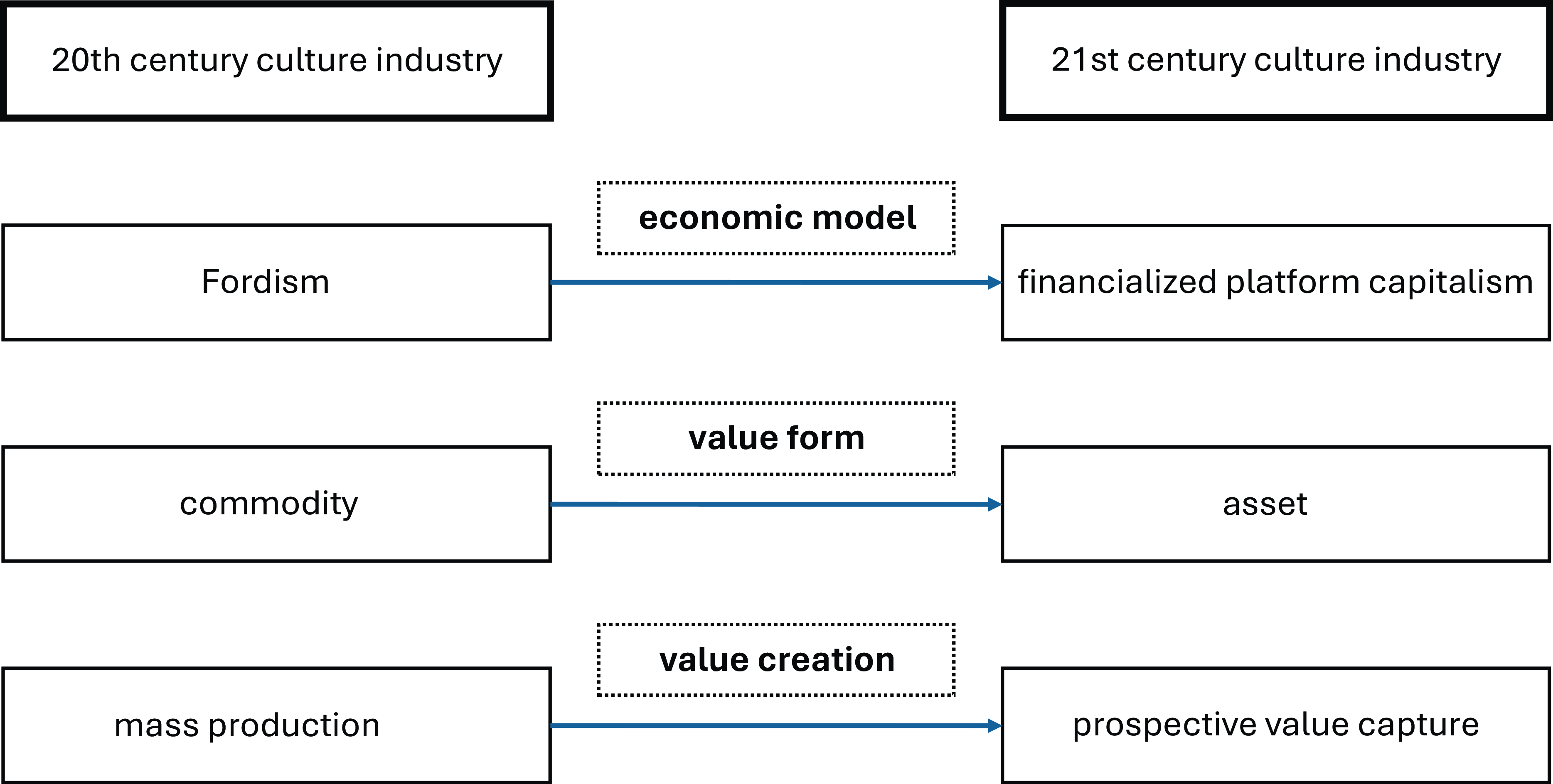
In this new environment, value is not so much derived from the production of commodities – unit-sales of albums and concert tickets – but from the platform-as-asset, a subscription-based proprietary market that captures prospective revenue streams (Figure 1). As the literature suggests, this platform-as-asset furthermore subjects universal music production to discount rate calculations over future income streams, based on past trends, resulting in an increasing stagnation, repetition, and sameness in musical output. Moreover, as music is consumed, distributed, and advertised, practically, through one platform, this facilitates a much more universalized and intensified process of homogenization than during the Fordist era of the culture industry.
The transformation of the culture industry.
Source: Authors.

Based on this conceptual framework, the next two sections establish an empirical account of the transformations of the culture industry since the days of the Frankfurt School, unpacking the large variety of actors, networks, and tools that make up today’s music market. We then investigate how far future-oriented asset logic has significantly changed how music production is organized as well as whether it has also intensified the homogenization of music itself that Adorno and Horkheimer already described.
Peak fordism: Charts and the music culture industry in the early-2000s
The turn of the millennium can be described as the peak of Fordism in the music culture industry. The total revenue of the US music industry first peaked in the late 1990s and the early 2000s, which was at the time still almost exclusively carried by Fordist exchange of mass-produced commodities like CDs (Figure 2). In this environment major labels controlled roughly 80% of the whole music market (Rigoglioso, Reference Rigoglioso1997), but their rationalization processes were interlinked with other instrumental actors in the industry, that is, magazines such as Billboard Magazine and their charts, as well as radio stations and TV channels (such as MTV), that had been around in some form or another for decades.
US music industry revenues by format (1973–2024).
Source: Recording Industry Association of America. (The US has historically been the largest music market in the world.).

The relation between chart placement and unit sales was mostly reciprocal. To boost sales, charting was extremely important for artists and labels, and sales were important to boost chart placement. A song’s time spent and position in charts like Billboard determined the financial success of music and thus became the primary objective of major labels.Footnote 4
In the early 2000s radio was still the largest promotion vehicle of music, and between 14–23% of album sales could be attributed to radio airplay alone (Dertouzos, Reference Dertouzos2008). Due to the obvious economic advantage of major labels and their personal networks, majors dominated radio airplay for decades. Although a direct payment for radio airtime, pay-to-play schemes, or so-called ‘payola’ had been illegal since the 1960s, the long-standing radio promoter industry served as an independent and well-connected middleman, that was paid by labels to ensure radio airtime and chart placement (Rossman, Reference Rossman2012; Leigh, Reference Leigh2022). At the same time, as Rossman (Reference Rossman2012) describes, radio stations are key to understanding the stylistic development of music, as songs that conform most have the highest chance of being played on the radio. Through economic means and access to the influence of radio promoters, radio for the longest time played a key role in the culture industry. Radio stations thus facilitated a high degree of standardization and a relatively seamless experience in music through conformity with established genre styles.
Although technological progress changed the medium of music distribution – shifting from vinyl to tapes and then CDs – the underlying material relations of the music industry that Horkheimer and Adorno described in the mid-twentieth century rang true even into the new millennium: The music industry made use of precise industrial production, rational market research and advertising, leading to a small group of players controlling the air play of radio stations and dominating most of the novel genres that arrived in the second half of the century. However, while becoming much more elaborate and complex toward the end of the twentieth century, the industry was still much more decentralized than today. During that time labels had to conform to an accepted diversity of distinct genres and localities that were promoted through a large set of platforms, like local radio stations and national TV channels, leaving room for the emergence of novel (sub)genres and stylistic diversity in music.Footnote 5
Until Apple opened its iTunes Store in 2003, music industry sales had been solely driven by physical goods – especially CDs which accounted for 94.8% thereof (excluding revenue from concert tickets). However, with the information technology revolution, the music industry was turned on its head (Leyshon, Reference Leyshon2014). With the advent of mass-piracy through the proliferation of PCs, the arrival of the internet in most households, and the increasing influence of first movers like Napster or iTunes, sales in the music industry came tumbling down, hitting an all-time low in the mid-2010s. By 2014, CD and other physical sales only accounted for 26.5% and 5% of industry revenues, respectively, being gradually replaced by downloads (e.g., iTunes) and streaming services (e.g., Spotify). While revenues have since recovered and even surpassed the lucrative peak-Fordism period, the music industry had dramatically changed: by 2024, CD sales had become irrelevant, accounting for only 3% of industry revenue,Footnote 6 while streaming now accounted for 86.5% of industry revenues. With most revenue generated ‘at the streaming partners’, the role of both radio and chart placement has since been dwindling (Mayfield, Reference Mayfield2021; Watkis, Reference Watkis2023). To paraphrase the Buggles, the playlist killed the radio star, or in the words of the Wall Street Journal – ‘playlists are the new radio’ (Shah, Reference Shah2018).
Music in the streaming era: Platforms, playlists, and Spotify’s culture industry in the early 2020s
Since the late-2010s, streaming has completely dominated the music industry. In this brave new world, Spotify remains the largest DSP by all measures (Laker, Reference Laker2021; Forde, Reference Forde2022). With 226 million paid subscribers, Spotify held a 31.7% market share of the global streaming music subscription market as of 2023, dwarfing competitors like Tencent (14.4%), Apple (12.6%), Amazon (11.1%), and Youtube (9.7%) (Tadesse, Reference Tadesse2024). Considering its even larger number of monthly active users worldwide – which stood at 675 million by end-2024Footnote 7 – Spotify’s dominance of music streaming is hard to dispute.
In the twenty-first-century culture industry, Spotify assumes a crucial intermediary role between the financial and the music market, that is, investors, labels, producers, and consumers (Prey, Reference Prey2020). Similar to other platforms like Uber or Netflix, Spotify does not actually generate large profits and is thus highly dependent on first venture capital and later institutional investors. In its first funding round in 2008, Spotify got $21.6 million in funding from venture capital funds like Creandum, Northzone, and Horizons Ventures,Footnote 8 and by 2012 it had raised US$537.8 million from Fidelity Ventures, Goldman Sachs, and a series of other venture capital funds. After its listing, 62.8% of shares were then held by Anglo-American institutional investors like Baillie Gifford, BlackRock, JP Morgan, or T. Rowe Price. While Spotify has a market capitalization of over US$131.83 billion (as of April 2025), it has largely been a loss-making venture. Its first profitable year was 2024, which has barely recuperated the losses of the previous three years. Since its inception, Spotify made a net loss of US$3.13 billion.Footnote 9
This is by no means accidental. As Vonderau states (Reference Vonderau2019: 15), ‘the source of its profit is […] an automated online aggregation system [whose] function for Spotify over the past decade has been to establish the prospect of future income streams that would provide venture legitimacy in the present’. The outlook that it will become profitable in the future is what sold investors on the company in the first place; as Prey (Reference Prey2020: 15) puts it: ‘it is a strategy that does not primarily aim to turn songs (or audiences) into commodities but to treat them as a form of collateral that can be mobilized to secure loans’. Most business decisions are based on the pretence of holding on to a rising stock price and keeping investors happy, by constantly proving the business’ scalability and rapid expansion potential as measured by the growth in total subscriptions and songs played or archived.
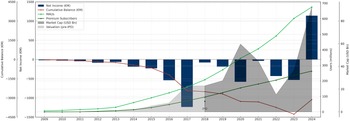
While during the Fordist culture industry (music-as-commodity) it was important to rake in profits through sales, for the financialized platform (music-as-asset)Footnote 10 the promise of future income streams is all that counts. Users are not viewed as individual agents but as bundled, forecastable dataflows – essential for modeling growth, future advertising revenue, and market expansion potential.Footnote 11 Therefore, the most important valuation metric for Spotify is their growth in monthly users, broken down into premium subscribers and ad-supported users. In all its financial reporting, these numbers will be published before any financial metrics like revenue or net profits, and sometimes financial metrics will not even feature on summaries of Spotify’s ‘earnings statement’ (Goldrick, Reference Goldrick2019). If the company has to choose one metric on its publications (such as on the cover of an investor brochure) – it usually picks a chart of its user growth. Companies like Uber, Netflix, or Spotify are not valued primarily for current profits, but for their future growth potential – with users being the core input for those future earnings. As Figure 3 illustrates, the valuation of Spotify (both pre- and post-IPO) has mostly correlated with its user growth and was largely decoupled from its profitability.
Spotify’s asset-driven business model.
Source: Spotify financial reports; authors’ figure.

The rise of financialized DSPs like Spotify have facilitated the assetization of the music industry, through which music consumption and production patterns have drastically changed. While traditionally ‘it has largely been radio play which encouraged retailers to stock recordings and consumers to purchase them’ (Negus, Reference Negus1992: 101), playlists have become a central device for both the promotion and the consumption of music (Aguiar and Waldfogel, Reference Aguiar and Waldfogel2018; Eriksson, Reference Eriksson2020; Prey, Reference Prey2020). As the Guardian noted: ‘where record labels once clamoured to have their artists heard on radio and reviewed by music magazines, the push now is to get songs into curated mixes hosted by streaming services such as Spotify […]’ (Iqbal, Reference Iqbal2019). The playlist thus replaces the radio as primary technology for generating income and becomes the essential tool for increasing asset value.
In this new setup, Spotify’s platform business model creates a peculiar relationship with major labels – such as Warner Music Group, Universal Music Group, and Sony Music Entertainment – which dominate Spotify’s playlists (see Appendix A, Table 1 and 2).Footnote 12 The platform divides its revenue from subscriptions and advertising by all clicks and pays rights holders (in most cases, labels), 70% of the ‘play share’, or revenue per click (Prey, Reference Prey2020: 6; Spotify, 2022a). How much this 70% actually amounts to thus depends on how much revenue Spotify makes through advertising and subscriptions and, crucially, on how many clicks are generated. Both parties thus have an incentive to increase clicks and keep listeners entertained, as they only earn royalties if a listener stays engaged for at least 30 seconds.
However, not all music on the platform is equal. While Spotify has a growing database of songs – increasing from 20 million (2014) to 50 million (2019) and 100 million (2024) – most of these are hardly ever played. According to a Chartmetric report (2025), 86% of artists on Spotify had fewer than 10 listeners per month, while only 5.3% of all artists had more than 1,000 monthly listeners. And for the global streaming industry, only 1.3% of all songs are streamed more than 100,000 times and less than 0.22% more than 1 million times annually (Luminate, 2025). Most songs are hardly ever played – and therefore do neither bind users nor reflect future income streams.
As a means to generate clicks, the playlist is of major strategic importance. Since music consumption is channeled through playlists, which songs are in a playlist is highly consequential. In many cases, playlists are curated by in-house curators and on the Spotify platform they are promoted and prioritized over artist discographies or albums, appearing above the individual work of an artist upon search (Prey, Reference Prey2020). Further, as Prey et al. (Reference Prey, Esteve Del Valle and Zwerwer2022: 80) noted, Spotify ‘appears to be actively pushing listeners to consume music through playlists in place of other formats [and] is using its editorial capacity to promote its own playlists over playlists created by the major labels and other third parties’. Importantly, these playlists are also curated in such a way as to avoid disruptions in the listening experience (Hracs and Webster, Reference Hracs and Webster2021). They aim to give people the music and sound they already ‘love’ (Spotify, 2022b), similar to social media platforms fixating their users on previously liked or watched content (Spohr, Reference Spohr2017).
This curation manifests the modalities imposed on the cultural economy by assetization processes, the anticipatory compulsion to use past data to predict the future. Another striking indicator of this trend of temporal contraction is the rise of music-IP investment and song management companies like Recognition Music Group (previously Hipgnosis). Recognition is an investment company that invests exclusively in artist catalogs and intellectual property rights speculating on an increase in revenue over time. It basically assetizes old music as a means to generate future income streams through direct plays or royalties from sampling and interpolation.
Generally, the setup of the twenty-first-century culture industry encourages a high degree of standardization in music production by all actors involved – artists, labels, and the platform – as this increases the playlist’s frictionlessness and thus facilitates more plays.Footnote 13 Labels and artists have an incentive to increase their share of plays among all other plays, which means they must be featured on these playlists. Large labels have much more means to make that happen through market research and focus groups, technology and production capacities, and interpersonal connections, all of which distort Spotify’s open-door policy of pitching songs for playlists (Resnikoff, Reference Resnikoff2012; Knibbe, Reference Knibbe2022). Consequently, contracts with hit machines and production teams themselves serve as assets for long-term dominance over playlists, as major labels operate increasingly like venture capitalists (Mulligan, Reference Mulligan2021). A study by Aguiar and Waldfogel (Reference Aguiar and Waldfogel2018) has shown that placement on large playlists increases the immediate revenue of a single song by up to US$163,000. Thus, the best and fastest way to a broader audience and (economic) success leads through the playlist, which major labels have privileged access to.
However, this entrepreneurial playlist fixation is by no means exclusive to major labels but extends to independent artists as well. Mühlbach and Arora (Reference Mühlbach and Arora2020) and Siles et al. (Reference Siles, Ross Arguedas, Sancho and Solís-Quesada2022) provide evidence for the central role of playlists in DSPs from the perspective of artists, largely admitting that they produce music with the goal of being featured on a playlist, minutely tracking their audience engagement, and optimizing their output. The system thus actively promotes self-screening with lesser-known music producers and artists as well. An immanent desire to distinguish oneself from others, which has given rise to many genres and subcultures has turned into a need to conform, to follow the imperative of economic gain and survival.
This imperative has also spawned the emergence of related service providers that further facilitate these pressures. The sample platform LANDR, for instance, compiles sample charts where artists and producers can offer and lease samples like hi-hats, atmospheric pads, or melody loops to increase their chance of going viral (cf. Landr, 2022) The emergence of LANDR is particularly telling of the position of producers as service providers in a highly specialized division of labor: they are part of a decoupled, de-territorialized, and global network of freelance workers who produce minor musical elements in accordance with market trends. This organization of music production has quickly become the new normal. While only founded in 2014, by 2018 two million artists used LANDR (Haughton, Reference Houghton2018), a figure that had increased to five million by 2023 and included many artists from major labels like Warner Bros. and Disney (Landr, n.d.). Arguably, platforms like LANDR accelerate, enforce, and make it easier to conform with trends.
In sum, Spotify’s platform-as-asset business model is based on the promise of future scalability, a continuous increase in subscriptions and plays – for which the company utilizes the playlist. Questions about how playlists are promoted, which songs are picked to maintain their ‘bingeability’, and what is produced in the first place to conform to these playlists’ standard, have become subject to discount calculations about future value, based on data of the past – for labels and cultural workers, investors and the platform alike.Footnote 14 The assetization of the music industry within the financialized platform thus promotes art that cannot afford to deviate much from what people ‘love’ (Spotify, 2022b). We argue that the resulting highly standardized production leads to music becoming more homogeneous, repetitive, and self-referential. The next section attempts to capture this development based on a comparative content analysis of hip-hop music.
Analyzing music: Comparing hip-hop before and after streaming
In order to fully grasp the impact of assetization on music production, we need to analyze music itself. To this end, we conduct a cross-temporal content analysis that takes inspiration from musicology (e.g., examining key, rhythm, vocals, and lyrics) and music data analysis (Weihs et al., Reference Weihs, Jannach, Vatolkin and Rudolph2016), but which is ultimately grounded in a social science framework (Woodrum, Reference Woodrum1984; Krippendorf, Reference Krippendorff2018). The objective of this analysis is to analyze whether we can observe homogenization that is linked to recent transformations of the music industry.
The aim of this analysis is to provide a snapshot of the 50 most popular hip-hop hits during the peak of Fordist culture industry and the twenty-first-century culture industry characterized by financialized platforms, and to compare them in terms of stylistic diversity according to a predetermined set of categories. We focus on hip-hop for several reasons.Footnote 15 First, hip-hop is one of the most widely followed music genres globally and thus an important case that needs to be analyzed in its own right. Second, hip-hop is the most popular music genre on Spotify. We thus expect greater incentives for facilitating revenue-generating bingeability than in more niche genres with minor economic importance for Spotify’s business model (BoySetsFire, 2022). Third, and most importantly, hip-hop had from its very beginnings been appreciative of regional and local community and individualism within that community, which led to a highly diverse sound and a desire to deviate from the norm (SnoopDoggTV, 2014).
Sample choice of each producer and rapper is – or was – the defining feature for their sound and generated the distinct regional diversity of the genre in the first place. Unlike most other genres, drums and melody are traditionally either sampled from older records or synthesized. One may think for example of the New York scene sampling mostly from old grim jazz records embedded in rough drumbeats, while Los Angeles artists favored Funk records, synthesizers, and more relaxing rhythm sections. Atlanta’s Crunk scene featured synthesized melodic elements, heavy synth basslines, and samples from a drum machine, and in 2010 the emerging Chicago Drill scene built on the Atlanta sound, introducing their own aggressive, gritty hi-hat rolls and dark bell or piano arpeggios. Rounding up the instrumental part, distinct voices, local dialects, and lyrics traditionally created distinct energies, which led to a high degree of diversity and organic development. The genre thus has a high potential of showcasing effects of homogenization.
We expect these processes to be mainly driven by the DSP-revolution and its particular form of twenty-first-century culture industry, not the creation of a hip-hop culture industry per se. Even at its pre-DSP-peak, throughout the early 2000s hip-hop music was promoted in a decentralized manner, especially through local radio stations. We thus focus on hip-hop during the period of peak-Fordism in the music culture industry. In contrast to the 1980s and 1990s, by the early-2000s hip-hop had also already been widely integrated into the mainstream music industry (Flores, Reference Flores2012). By comparing music from the early-2000s with the early-2020s DSP era, we therefore demonstrate that hip-hop was still characterized by locality and a diverse stylistic palette during the peak-Fordist music culture industry and that its homogenization was rather facilitated later by Spotify’s business model. We thus compare Spotify’s RapCaviar (2022)Footnote 16 playlist (n = 50) and the Apple Music’s Hip-Hop/R&B Hits: 2002 (n = 50) with respect to their internal homogeneity in style and sound.
With 16.2 million followers,Footnote 17 the hip-hop playlist RapCaviar is Spotify’s most popular in-house curated playlist and its third largest playlist overall, only topped by two generic ‘most listened songs’ playlists (‘Today’s Top Hits’ and ‘Top 50 – Global’). According to Vulture, RapCaviar is ‘the most influential playlist in music’ (Marks, Reference Marks2017). Joie Manda, executive vice president at Interscope Geffen A&M Records, summarized this as follows: ‘RapCaviar reminds me of Hot 97 [the powerful NYC radio station] in the early ’90s. When Hot 97 played ‘Protect Ya Neck’ by the Wu-Tang Clan, that was it, it went all over the country. RapCaviar has that influence right now. A song goes in RapCaviar, and everyone pays attention’ (cited in Marks, Reference Marks2017).Footnote 18 Since the performance of playlists is central to the business model of financialized platforms, we expect business model pressures would facilitate a thorough implementation of standardization and thus a more homogenous sound and style for such a high-profile playlist (Chosic, 2022).
We contrast RapCaviar with the Hip-Hop/R&B Hits: 2002 by Apple Music. While also a streaming playlist, this playlist was not curated under the pressures of the financialized platform, but instead represents the 50 biggest hip-hop chart hits of 2002, that is, it is based on the benchmark for the most influential and commercially successful songs in the pre-platform era.Footnote 19 The Hip-Hop/R&B Hits: 2002 playlist thus is a prime example of peak-Fordist Music culture industry before the rise of financialized platforms. Both playlists thus represent the most-played and revenue-generating hip-hop music in a given year within each production period.
We investigate the presumed homogenization along a range of categories, focusing specifically on five distinct aspects of hip-hop music: the form and structure, the usage of sampling, rhythmic elements, voice, and lyrics. We explore the technical processes behind the homogenization in each category and embed them within the logic of the playlist as a function of the assetized culture industry. To compare the development and changes in hip-hop music through the DSP revolution we follow a two-pronged analytical approach that considers both discursive elements and the comparison of quantitative song data statistics.Footnote 20 While we expect an intensified homogenization, this approach allows for an open, evidence-based analysis.
Form and structure
We first analyze the overall formal parameters of a song, such as duration and key. These have since the beginning of commercial radio been determinants for the playability of a song, as, in a serial play mode of radio and playlists, they put the song into relation to others playing before or after.
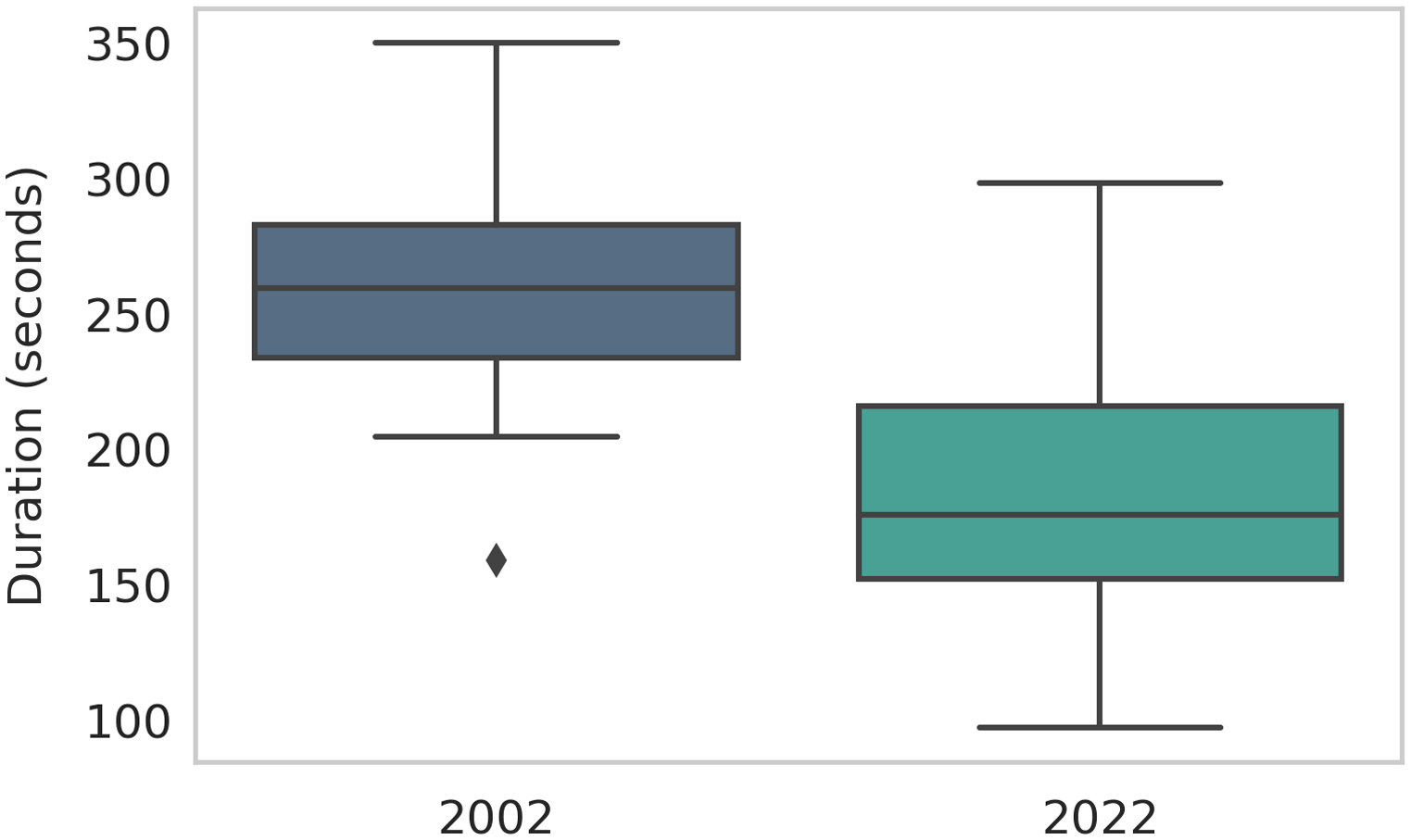
One core difference between the 2002 and 2022 playlists is, for instance, the duration of songs (Figure 4). While in 2002, songs had an average length of 4:19 min (259 seconds), they had become considerably shorter by 2022, lasting only 3:03 min (183 seconds). This shortening of songs extends beyond hip-hop and is a broader phenomenon connected to technological changes in the music culture industry, that is, the rise of platforms.
The shortening of hip-hop songs in the streaming era (2002 vs 2022).
Source: Playlist data, authors calculation.

While song length steadily increased as CDs freed artists from the time-constrains of vinyl, since the late-2000s song length considerably decreased. As the Washington Post (Chen, Reference Chen2024) points out, this is linked to the switch to streaming and its particular business model: ‘on platforms like Spotify, artists earn royalties only if a listener stays engaged for at least 30 seconds, making songs with shorter intros and instantly engaging hooks dominant as it ensures that listeners don’t skip on to the next’. In addition, shorter tracks encourage more replays, and more replays mean more revenue in Spotify’s pay-per-play model. As the famous producer Mark Ronson (Wright, Reference Wright2023) complained in 2019: ‘all your songs have to be under 3:15 because if people don’t listen to them all the way to the end they go into this ratio of ‘non-complete heard’, which sends your Spotify rating down.’ Having to place the hook early into songs to keep attention throughout, these shorter durations necessarily lead to limited variability in songs’ build-up, and an overall increased homogeneity in song structures, a feature of the culture industry that Adorno and Simpson (Reference Adorno and Simpson1941) had already recognized, but that has evidently been elevated to new heights.
We can also observe the homogenization of hip-hop by looking at the key in which songs are composed. Different keys and modes in the Western harmonic system convey differing emotions or moods in a song. Some keys like ‘C#/Db’ are generally popular for contemporary songs, while others are less used. However, between 2002 and 2022 we can see a growing homogenization of song tonality (Figure 5). In the streaming era, almost a quarter of songs are played in C# major, while previously popular keys are less present.
Increasing homogenization of tonality in hip-hop music (2002=top and 2022=bottom).
Source: Song data, authors figure.

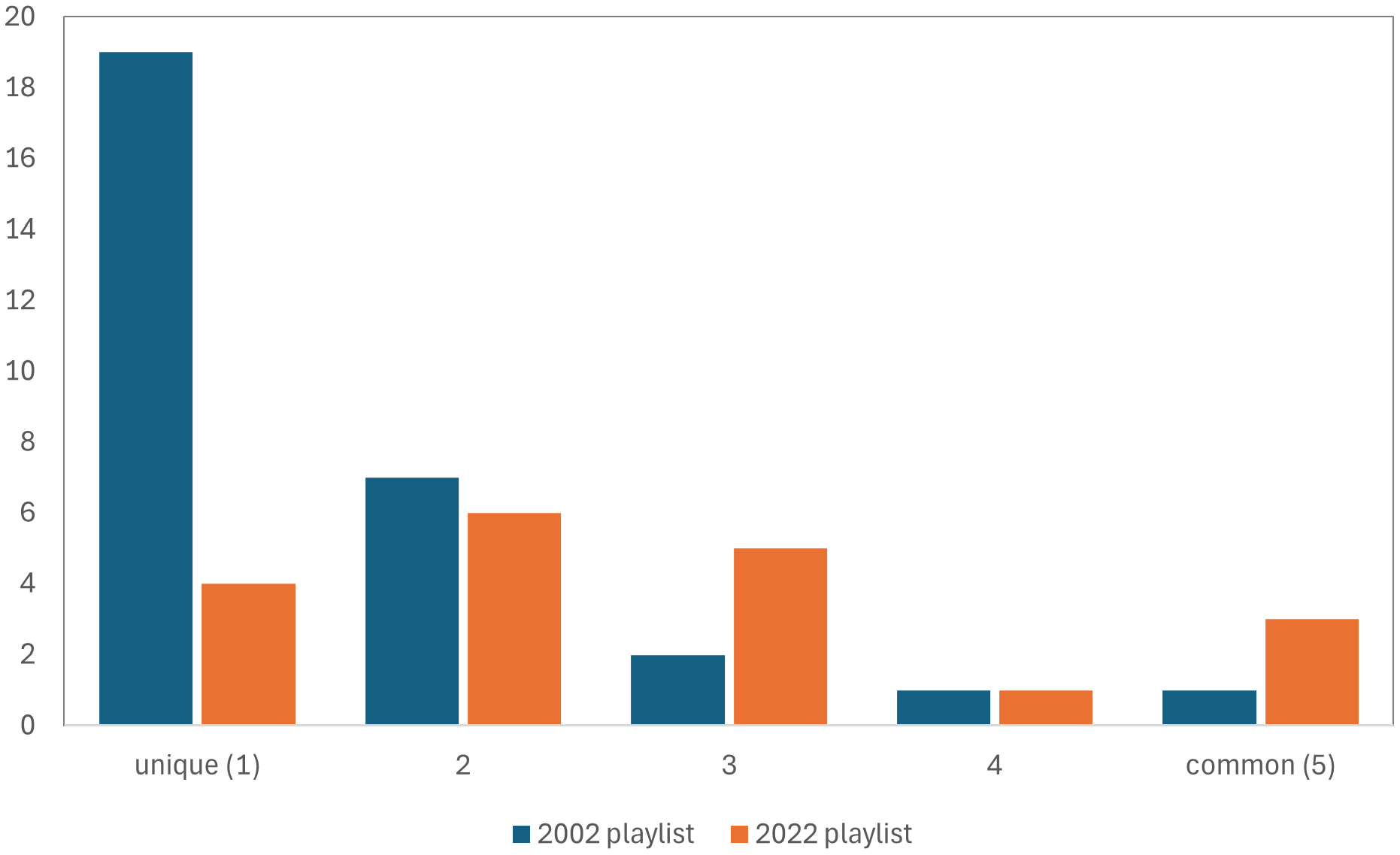
Moreover, we can observe how the tempo of hip-hop songs is increasingly being homogenized in the streaming era (Figure 6). Measuring the beats per minute (BPM) in songs, we can observe significant differences between 2002 and 2022. In 2002, songs used a variety of different tempos with 21 songs (42%) having a unique tempo. By 2022, an increasing number of songs are produced in a narrower range of BPM or even the same tempo. Fewer and less radical tempo changes within the playlist further facilitate a less disruptive listening experience.
Homogenization of song tempo between 2002 (lhs) and 2022 (rhs).
Source: Song data, authors’ calculation.

These developments are hardly surprising, given that the playlist business model of financialized platforms like Spotify facilitates bingeability. The asset logic of financialization and platformization has thus thoroughly transformed how music is formally produced, resulting in an increased homogenization of the form and structure in hip-hop music.
Samples and interpolations
The harmonic element in hip-hop is traditionally strongly connected with the lending and sampling from other genres. As previously noted, the choice of samples has always been a defining feature for regional styles in hip-hop music. In this regard, we can observe significant differences in the pre- and post-streaming era. Our analysis demonstrates that the Hip-Hop/R&B Hits: 2002 playlist is quite heterogeneous. The playlist features melodic samples from a wide range of genres and consists of a wide variety of moods. Artists used samples from indie rock songs (Missy Elliot’s Work It), 70s soul grooves (Cam’ron’s Oh Boy), Middle Eastern instruments (N.O.R.E.’s Nothin’), and jazz chord progressions (Musiq Soulchild’s Halfcrazy). There are tendencies of transregional trends owed to the shared cultural affinity to funk and soul, in and of itself rather diverse in sound, seen for instance in the wide use of disco funk samples (e.g., Nivea’s Don’t Mess With Me and Eve’s Gangsta Lovin’), and artist dependent trends like the frequent and prominent use of acoustic guitars by Ja Rule.
In some instances, melodic samples are originally composed for single songs, such as Eminem’s Lose Yourself or Ja Rule and Ashanti’s Always on Time. Both songs are very distinct from each other, and their harmonic elements are tailored to the message of the song. While ‘Lose Yourself’ lyrically and musically captures the rapper’s ambitions and passion for music as a ticket out of downright poverty, in a social environment he is by his whiteness alien to, Ja Rule and Ashanti celebrate a simple romantic relationship. The two themes, personas and styles do not necessarily go together well in one ‘seamless’ playlist, as they disrupt each other’s mood. This set consists of too many distinct harmonic elements and textures to be codified in a consistent way. The listening experience is disruptive and heterogeneous.
By contrast, RapCaviar shows a much stronger tendency of transregional trendification. Many songs feature similar samples. Many use generic ‘ominous’ violin or piano arpeggios (34%) with scattered or rolled chords (e.g., Lil Durk and EST Gee’s Burglars & Murderers or Moneybagg Yo and CMG The Label’s See wat I’m sayin), while others heavily use ‘dreamy’ guitar and piano samples with heavy hall effects and reverb (22%), invoking a melancholic and nostalgic feeling like Rod Wave’s Alone or Polo G’s Distraction. Only 22 songs (44%) do not or only marginally conform to either one of these two trends (see also Appendix B). The overall sample composition of this playlist illustrates the impact of production trends in the age of financialized platforms. The previously mentioned LANDR platform, for instance, allows producers to filter for specific vibe or mood tags, such as ‘dark’, ‘chill’, ‘dreamy’, or whatever else is trending at that moment, and then lease instrumental modules to build into one’s own song.
Finally, another interesting trend is the use of interpolations. Importantly, while samples are decontextualized snippets of songs that are used to create something new in another piece, an interpolation is the simple one-to-one copying of another song’s prominent melody element. In the RapCaviar playlist, 10% of all songs make use of such interpolations. Dah Dah DahDah by Nardo Wick, for instance, interpolates the memorable chorus of Suzanne Vega’s Tom’s Diner; Central Cee’s Doja uses the unaltered melodic sample from Eve’s and Gwen Stefani’s Let Me Blow Ya Mind; Drake and DJ Khaled copy the famous Chorus of the Bee Gees song Stayin’ Alive in their song with the same title; Pressurelicious by Megan thee Stallion and Future uses Fergie’s Fergalicious; and the iconic Super Freak instrumental by Rick James is used as a one-to-one copy in Nicki Minaj’s Super Freaky Girl. Making references to existing songs has always been part of popular music, but the extensive reheating of old hits for guaranteed revenue is a relatively new phenomenon, which most commentators say started in 2017 (Harding, Reference Harding2022; Leigh, Reference Leigh2018). It is a development that is in line with our conceptualization of assetization and the temporal contraction it leads to, and that royalty fund managers like Recognition have recognized and turned into a gold mine. Between 2017 and 2022, the number of new songs in Billboard’s ‘Hot 100’ list that interpolated old songs has more than doubled; or, as Vulture’s Charlie Harding (Reference Harding2022) put it: ‘you’re right: A lot of pop music does sound the same. Literally!’
Rhythm sections
Like sample choice, rhythmic elements have since its inception contributed heavily to the regional distinctiveness of hip-hop music, and like harmonic samples, the rhythm sections today are also becoming increasingly homogeneous. Both the style of the rhythm itself traditionally varied widely, from Funk-, Crunk-, Boombap-, Soul- to R’n’B-affiliated grooves, often complex and with a ‘human’ swing to them (see e.g., Busta Rhymes’s Make It Clap or Brandy’s What About Us). Also, drum sets/sections were fairly diverse, displaying a wide range of sampled and synthesized drums with many different characteristics. In the 2002 playlist, for instance, only once is a set of drums clearly featured more than once on this playlist, and in this case, it is the same producer on the same album (Ja Rule’s Down A – B – and Always On Time). Sameness between drum samples in this playlist are thus attributable to the distinct ‘trademark’ of individual artists or producers, rather than a broader structural trend of homogenization.
This has fundamentally changed in the age of RapCaviar. Here, 45 out of 50 songs (90%) reference or use ‘808’ drum-kits, more specifically, a refined distorted 808 bass drum with either a refined standard 808 snare, 808 clap, 808 rim, or 808 snap, or a combination of these, supported by a thin metallic hi-hat. These same 808 kits are used both in more melancholic, nostalgic songs (e.g., YoungBoy Never Broke Again’s Home Ain’t Home) and those in the ‘ominous’ category (e.g., Gucci Mane’s Dissin the dead), displaying the modular and arbitrary applicability of these drums that do not convey a particular mood (anymore). Only 10% of all songs on the playlist do not use or imitate this ‘808’ drum set but utilizes more unique, diverse rhythmic elements (see Appendix B).
The term ‘808’ refers to the Roland TR-808 drum machine that was first introduced in 1980, and consisted of trademark, completely synthesized drums that have been featured in countless world hits throughout the last decades (Hasnain, Reference Hasnain2017). The drum machine was celebrated for its unique, futuristic sound and spawned many bedroom producers who would later become stars. With the age of digitization, however, the use of the actual drum machine has fallen out of fashion. Instead, with the rise of backroom producers as creative service workers in the new culture industry, an infinite number of 808 ‘copycat kits’ now digitally imitates this sound and has become a foundational sonic pillar of global hip-hop culture (Hasnain, Reference Hasnain2017). The ‘808’ has become almost the only reference for, or type of drum set in contemporary hip-hop. With these six main 808 drum samples – the bass drum, snare, clap, rim, snap, and hi-hats – there is but a marginal difference left between drum sections in the RapCaviar songs, owed only to different mixing techniques in combination with the melody and voice elements. This proliferation of similar-sounding drum sets makes a lot of sense in an environment that is geared toward seamless listening experiences and is informed by increasing trendification, wherein producers have internalized the need to conform in order to land a spot on the playlist. The rhythm section operates like a backbone that stabilizes and carries seamlessly through the whole playlist, to build harmonic and vocal elements around it, and allowing for only marginal disruptions within it.
Regarding the actual rhythm, 43 songs on the RapCaviar playlist follow one of two, already very similar, basic drum patters (see Figure 7), with only slight alterations, and the songs are generally perfectly quantized. Quantization in the musical context means placing a note or drum hit of any instrument into the exact digitized grid of 8, 16, or 32 beats per 4/4 bar. This technology not only limits the potential for rhythmic experimentation, but it also removes human imprecisions from the recorded midi input, which on a technical level improves the rhythmic performance but also dehumanizes the music (Drum Magazine, Reference Magazine2022). In conjunction with the ‘808’ drum set, the wide majority of the 50 songs has more or less the same rhythm – perfectly pressed into this corset of a 4/4 bar – and makes for a very frictionless listening experience throughout the whole playlist.
Common drum patterns in 2022.
Source: Authors’ illustration.

In contrast, as illustrated in the Hip-Hop/R&B Hits: 2002 playlist, rhythm-related song identities are building on group or label affiliation, or region and cultural background even. In the peak of hip-hops reach and diversity during the early 2000s, many cities across the globe had their own sound defined partly through the rhythm section (e.g., London, Atlanta, Chicago, New York Boom-Bap, or Los Angeles Metropolitan area). However, such diversity in rhythmic identity cannot be observed in the RapCaviar playlist, where the regional distinctiveness of hip-hop music has almost disappeared.Footnote 21
Like the harmonic element, we can observe how the twenty-first-century culture industry that is embodied by financialized platforms like Spotify has fundamentally altered the rhythm of hip-hop music. What we observe now is a much more rationalized process of music production that has resulted in more standardized rhythmic and percussive arrangements.
Voice
Hip-hop is also the genre that, before anything else, has – quite literally – given a voice to individuals and communities that were subject to structural discrimination. A crucial element and point of distinction in hip-hop music is thus the MC’s voice itself.
In 2002, hip-hop was generally devoid of voice effects. While there might have been some aurally inconspicuous pitch correction and songs were of course mixed clean for consumption, voice effects such as auto-tune were still very sparsely used (DJ Pangburn, Reference Pangburn2018). This is noticeable in the Hip-Hop/R&B Hits: 2002 playlist, wherein each song has the unmistakable voice of the artist themselves. By 2022, this had completely changed. While a fan still might be able to differentiate between the voices on the artists on RapCaviar, it is telling that merely 6 songs (12%) feature voices without audible voice effects (Appendix B). The other 44 songs (88%) either use a heavily edited auto-tune effect (26%), a flat audible auto-tune pitch correction (58%), or even both effects (4%). The former was popularized by artists like Travis Scott and Future, adding various effects like vocoders, compressors, and reverbs to the auto-tune, which gives the voice a deep robotic, metallic, and smoky character and alters the sound in a very distinct way. The latter is a simple flat auto-tune canceling out most vocal or tonal imprecisions, like the quantization technology described above. Both are now reproduced on a massive scale, as the playlist shows.
Autotune can be a stylistic device, it can make a song or an artists’ sound unique. When T-Pain, Lil Wayne, or Kayne West first popularized using auto-tune in commercial hip-hop during the late-2000s, the effect was definitely unique. However, it was also contested within hip-hop culture. In 2009, Jay-Z even released a song titled D.O.A. (Death of Auto-Tune) which meant to ‘draw a line in the sand’, as the rapper argued: ‘the guys who did it, did it great. T-Pain, he does great melodies. If you listen to Kanye, great melodies. […] ‘Lollipop’ was a fantastic melody. Everybody can’t do it. Let them guys do it. They got their little niche, let’s move on.’ Jay-Z explained that far too many people had jumped onto the technology and that he was ‘taking aim at artists who use Auto-Tune as a crutch’ (cited in LastFm, 2009).
However, RapCaviar demonstrates the drastic homogenizing effect these digital technologies can have if used extensively and in a very similar fashion. While in the early 2000s, auto-tune was mostly used to correct some mistakes in original recordings and largely maintained the artists’ unique voice, by the early 2020s auto-tune is used as a real-time process and replaces the artist’s original voice. As Pitchfork Magazine (Reynolds, Reference Reynolds2018) put it:
Increasingly in rap – there is no uncooked original to work from. The true voice, the definitive performance, is Auto-Tuned right from the start. [Contemporary hip-hop] is where that process has played out most glaringly and compellingly: MCs like Future, Chief Keef, and Quavo are almost literally cyborgs, inseparable from the vocal prosthetics that serve as their bionic superpowers.
Through the widespread use of very similar auto-tune effects, however, the artists’ voices are increasingly robbed of their distinct character. They transpose some of the artistic work in music to the technology they interact with, lose part of their uniqueness and thus sound increasingly similar, as their individual acoustic ‘imprecisions’ are cut out of the mix.
Of course, one cannot base the difference in homogeneity between the two playlists on auto-tune alone, as the technology, which was introduced in 1997 and first used commercially in 1998, was fairly new in 2002. While this technology already existed before the financialized platform, their business model facilitates the increasing use of auto-tune as the playlist both facilitates more similar, seamless listening experiences and thus enables a global proliferation, distribution, and success of auto-tune-utilizing artists that contribute to this outcome. This consequently creates additional pressures for other artists to jump on the band-wagon, and we can see that the auto-tune effects that are used have become increasingly homogenous. Seen in the wider context of the twenty-first-century culture industry that is dominated by financialized platforms like Spotify, the technology thus strongly amplifies the homogenization in the vocal element in contemporary hip-hop music.
Lyrics
The final category that we analyze with respect to homogenization is the spoken word, or lyrics of the songs. Lyrics have always been central to hip-hop. They serve as a vehicle for storytelling, social commentary, introspection, and representation of local identities. Artists have historically differentiated themselves through wordplay, references, and flow – embedding identity and originality into language itself.
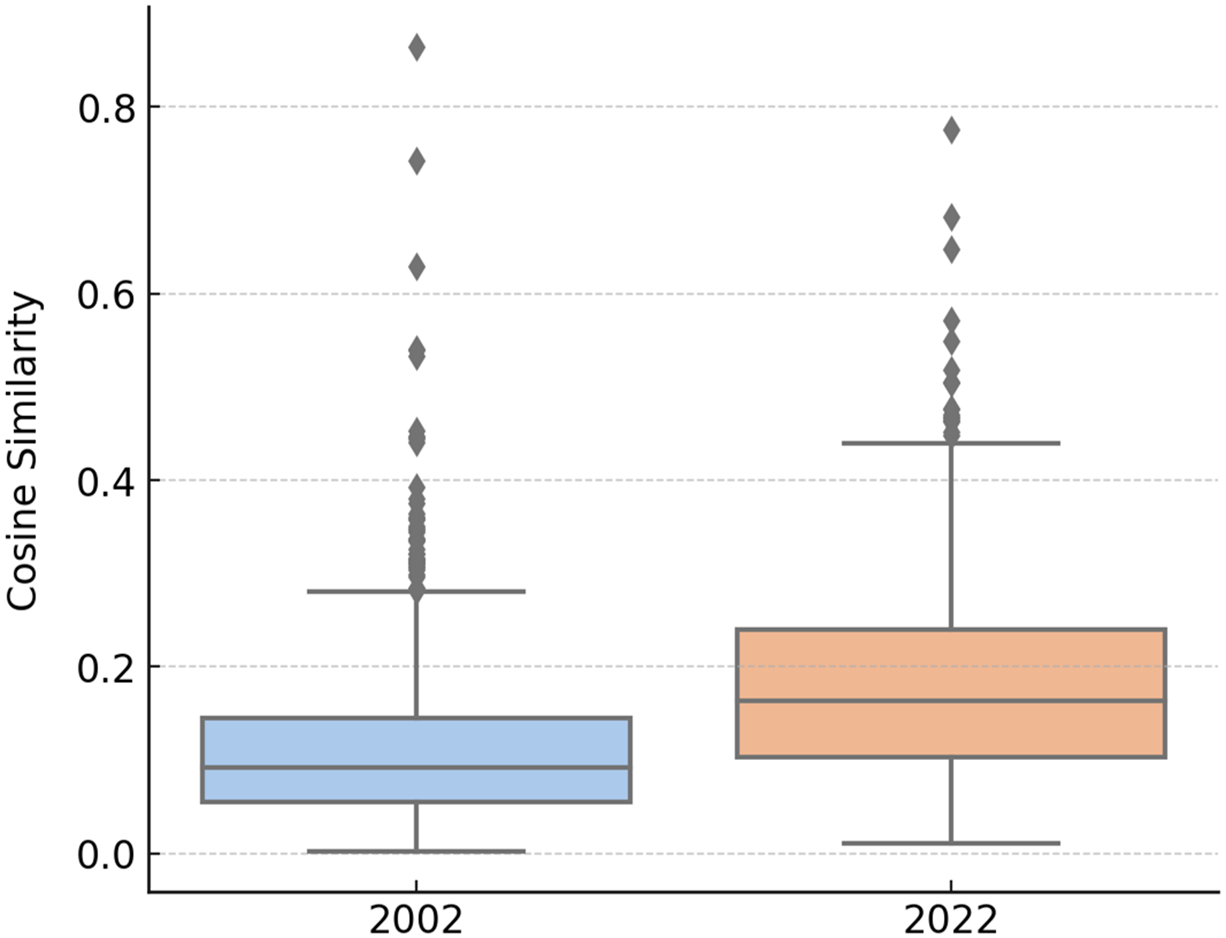
To assess whether lyrical expression has become more homogeneous over time, we operationalized linguistic similarity using cosine similarity, a standard metric in natural language processing. Each song’s lyrics were transformed into a vector based on word frequency, and the cosine of the angle between two such vectors measure how similar their vocabulary usage is. A score of 1 means the songs are textually identical; a score of 0 indicates total dissimilarity.
The results between the two playlists are striking. The average cosine similarity between songs in the 2002 playlist was 0.112, while in 2022 it was 0.179 – a substantial increase of nearly 60%. This indicates that contemporary hip-hop tracks are significantly more alike in their word usage than those from two decades earlier. Figure 8 shows that the 2022 distribution not only has a higher median, but also a much narrower interquartile range, indicating that songs are not just more similar on average, but also more consistently so. In contrast, the 2002 songs show a wider spread and more outliers, demonstrating a greater variety of lyrical vocabularies and stylistic approaches. This development is even more striking considering that 2022 songs had a larger average number of unique words per track (199) compared to 2002 (173), illustrating that similarity between songs has increased despite drawing on a larger linguistic palette.Footnote 22
Cosine similarity within song lyrics.
Source: Genius.com, authors’ illustration.

The lyrical landscape of the 2002 playlist reflects a broad spectrum of themes and vocabularies. Tracks like Missy Elliott’s Work It showcase playful, self-assertive sexuality through inventive wordplay, reversals, and slang, while Ja Rule and Ashanti’s Always On Time tap into vulnerability and emotional conflict in romantic relationships. Nelly and Kelly Rowland’s Dilemma provides sensible storytelling, centering longing and moral tension. Even party anthems like Ludacris’s Move Bitch or Cam’ron’s Oh Boy distinguish themselves through regional slang. By contrast, lyrics from the 2022 RapCaviar playlist reveal more thematic and linguistic convergence. Many tracks center around a narrow thematic range of lone-wolf mentality and nihilism. Songs like Lil Durk’s Smoking & Thinking and EST Gee’s Burglars & Murderers repeat motifs of inevitable betrayal, emotional numbness, and survival with highly similar language. Where the 2002 playlist often feels dialogic and expressive, in 2022, lyricism tends toward mono-themed autofiction.
Our findings thus suggest a measurable flattening of linguistic style – one that mirrors and materializes the logics of the twenty-first-century culture industry. Lyrical expression in mainstream hip-hop has become significantly more homogeneous in the platform era. Importantly, this homogenization is not a result of diminishing talent or creativity but a structural consequence of the assetization process. Streaming platforms like Spotify reward tracks that fit within pre-established esthetic norms – hook-heavy and linguistically familiar. RapCaviar therefore operates like a feedback loop, reinforcing a narrow band of themes and content to secure plays and maximize engagement.
Conclusion
This article has asked: does all music sounds the same nowadays? To address this question, we take inspiration from the Frankfurt School’s and particularly Adorno’s political economy analysis of the culture industry by recontextualizing its concerns for the context of financialized platform capitalism. We argue that by operating within the confines of future-oriented asset logic, the playlist-based business model of DSPs like Spotify intensifies standardization and encourages a noticeable decrease in sonic and stylistic diversity in music. We illustrate this through a diachronic content analysis of hip-hop music – comparing the Hip-Hop/R&B Hits: 2002 playlist based on hip-hop charts from the pre-DSP era with RapCaviar (2022), Spotify’s largest in-house curated playlist – with respect to four aspects of hip-hop music: form and structure, sampling, rhythmic elements, and voice and lyrics.
Our analysis illustrates that the formerly distinct and diverse genre of hip-hop has become much more homogenized as a growing share of popular songs use the same voice effects, more homogenous lyrics, the same set of drum samples, and follow market trends in melody sampling. Of course, the various combinations of music production, samples, rhythmic elements, and voice and lyrics theoretically can still create widely different soundscapes. Our analysis is by no means exhaustive and can be complemented in many different ways, for instance by looking into intonation, flow, or pronunciation. However, our analysis has made visible the widespread use of the same effects, patterns, and samples in the production of music and consequently demonstrates an overall increase in ‘sameness’. Imprecisions in both drums and voice that would create friction or disturbances in the listening experience are eliminated, and melody sample decisions are increasingly based on trends within the sample economy, exemplified by platforms like LANDR.
The result is that regional and cultural distinctions between artists make way for stylistic monoculture in a genre that for the longest time had at its core the pursuit of identity and differentiation. This, we argue is informed by an incentive structure that focuses music production on landing a position on top playlists, thus tying the production of music to the asset-based logic of the financialized platform. Driven by the need to signal scalability of subscriptions, market share, and streams, Spotify’s playlist model actively promotes bingeability, as it aims to remove friction and disruptions within the playlists to increase plays and listeners on a global scale. Hip-hop artists today simply cannot afford to deviate from what people already ‘love’, which leads to music not only becoming homogeneous, but also repetitive and self-referential.
This analysis is the first to employ elements of musicology for a political economy investigation of financialized platform capitalism. But while our analysis has focused mostly on Spotify as the center of the twenty-first-century culture industry, there are other important elements of the twenty-first-century culture industry and the corresponding homogenization of music that require further investigation. Our analysis tells us little about the role of the internet and social media companies like TikTok and YouTube which have globalized lived experiences and thus taste and esthetics while also significantly increasing the chance to gain a larger audience (Vox, 2022). An important area of future research could thus be to analyze whether social media platforms like TikTok further facilitate the trendification of music inherent to the twenty-first-century culture industry (cf. Watson et al., Reference Watson, Watson and Tompkins2023).
In addition, while not the subject of this articles’ empirical analysis, similar developments may also apply to other popular genres (see Freeman, Reference Freeman2018). Individual and comparative analyses of different music genres, both popular ones like pop, rock, or country, or more niche ones like indie, folk, or regional and national styles, would further contribute to exploring the effects of twenty-first-century culture industry on music production globally. Relatedly, future research ought to explore whether this is a mainly Western phenomenon – after all, Spotify, Apple, YouTube, and Amazon are all US companies, and most of their paid subscribers are from Western countries. Can we observe a similar homogenization facilitated by DSPs in Indian Bollywood music, Korean K-Pop, Latin America’s Raggaeton industry or through China’s Tencent Music?
Finally, our article also merely touches upon companies like LANDR, which might point to a more fundamental change to the way music is produced and consumed: a rise in modular song production from pre-manufactured building blocks like musical loops, sounds, and drum kits. Continuing this thought, music production is also set to become more reliant on artificial intelligence and machine learning, and even on-demand generation (Wagner, Reference Wagner2024), reproducing and recombining a growing stock of modular elements in the coming decades, and further dehumanizing music. Since Universal subsidiary Capitol Music Group’s first ever signing ever of an AI rapper in mid-2022, AI content has quickly become normalized on Spotify (Stokel-Walter, Reference Stokel-Walker2024). As Journalist Liz Pelly (Reference Pelly2025) suggests in Mood Machine, this type of content is only becoming more relevant, as consumers are being conditioned to consume ‘mood’ playlists which are filled with no-name AI music, rather than listening to their favorite artists or albums.
Zooming out, technological advancements and assetization processes have transformed music as a channel for the intrinsic desire to express oneself into a hyper-datafied techno-rational machine, similar to Walter Reference BenjaminBenjamin’s (2008 [1935]) observations on Fordist production. This machine prioritizes strict and abstract standards over creative expression and the organic development of (sub-)culture. For labor in the cultural economy this means confronting the reality that creative dispositions are now more than ever subject to exploitation. More specifically, as Morgan and Nelligan (Reference Morgan and Nelligan2018) claim, capital has co-opted ‘free thought’ and has moved artists-turned-gig-workers and freelancers to the center of the new economy. Even world stars who have massively benefitted financially from this business model are becoming more outspoken against the pressure that Spotify and individual playlists like RapCaviar put on artistic expression.Footnote 23
Art and music have the capacity to inspire and motivate, to unify and mobilize in light of political injustice, and most importantly to express radically new ideas and esthetic perception of the world and society. Given the current context of the polycrisis and increasing political turmoil, there is a dire need for cultural workers to again seize these means of expression that are increasingly controlled by large platform businesses. Hence, from Adorno to 50 Cent, from consumer to artist, all stakeholders across cultures and subcultures have an incentive to re-politicize their artform of choice by fundamentally questioning the position and legitimacy of platforms and financial actors in the organization of today’s cultural production.
Supplementary material
To view supplementary material for this article, please visit https://doi.org/10.1017/fas.2025.10015.
Acknowledgements
We would like to thank the members of the ‘Social Foundations of Global Finance’ Research Initiative at Goethe-University Frankfurt, especially Barbara Brandl, Guadalupe Moreno, Lillith Dieterich, Robin Jaspert, and Ruben Kremers, for the constructive and insightful comments on previous versions of this article. We would also like to express our gratitude to the three anonymous reviewers who engaged unusually deeply with our manuscript and provided extensive and valuable feedback.





 Open access

