


Introduction
Climate change is one of the most prominent ecological and social threats to Earth's co-inhabitants, as well as a major public anxiety of our times, notwithstanding the current health, economic, and humanitarian crises created by the COVID-19 global pandemic. Over the last decade and more, our attention has been routinely vied for by government bodies (e.g. Department for International Development 2017; Šooš et al. Reference Šooš, Lautar, Urbančič, Kobe Logonder, Kmet Zupančič and Fajić2017), international NGOs (Greenpeace 2019; Hestres & Hopke Reference Hestres and Hopke2017), the private sector (Iceland 2018; Marris Reference Marris2020) and multiple others, to become aware of and account for climate change and its effects, which include higher risks of flooding, fires and other extreme weather events. Climate change motivates large, sustained, socio-political protests, such as the actions taken in 2019 and early 2020 by Extinction Rebellion in the UK (British Broadcasting Corporation 2019; Extinction Rebellion 2019; Zand & Fawbert Reference Zand and Fawbert2019), and the protests in 2018–19 against the construction of a coal plant in Lamu, Kenya, that resulted in a court injunction halting the project (Ochieng Reference Ochieng2019). We are also regularly exhorted to diminish our carbon ‘footprint’, such as by becoming vegan or vegetarian (Springmann et al. Reference Springmann, Clark and Mason-D'Croz2018; Wikipedia n.d.) and/or avoiding travelling by air (Johnsson Reference Johnsson2018; Saner Reference Saner2019). Many institutions, from archaeology and heritage boards (e.g. Fluck Reference Fluck2016; Markham et al. Reference Markham, Osipova, Lafrenz Samuels and Caldas2016) to city councils (CLASP 2016; Yates et al. Reference Yates, McNeice, Jones, Wolstenholme, Barrett and Irving2018) and multinational insurance companies (e.g. Reichenmiller et al. Reference Reichenmiller, Spiegel, Bresch and Schnarwile2010), have been changing their strategies and operating models over recent years in order to prepare for climate change.
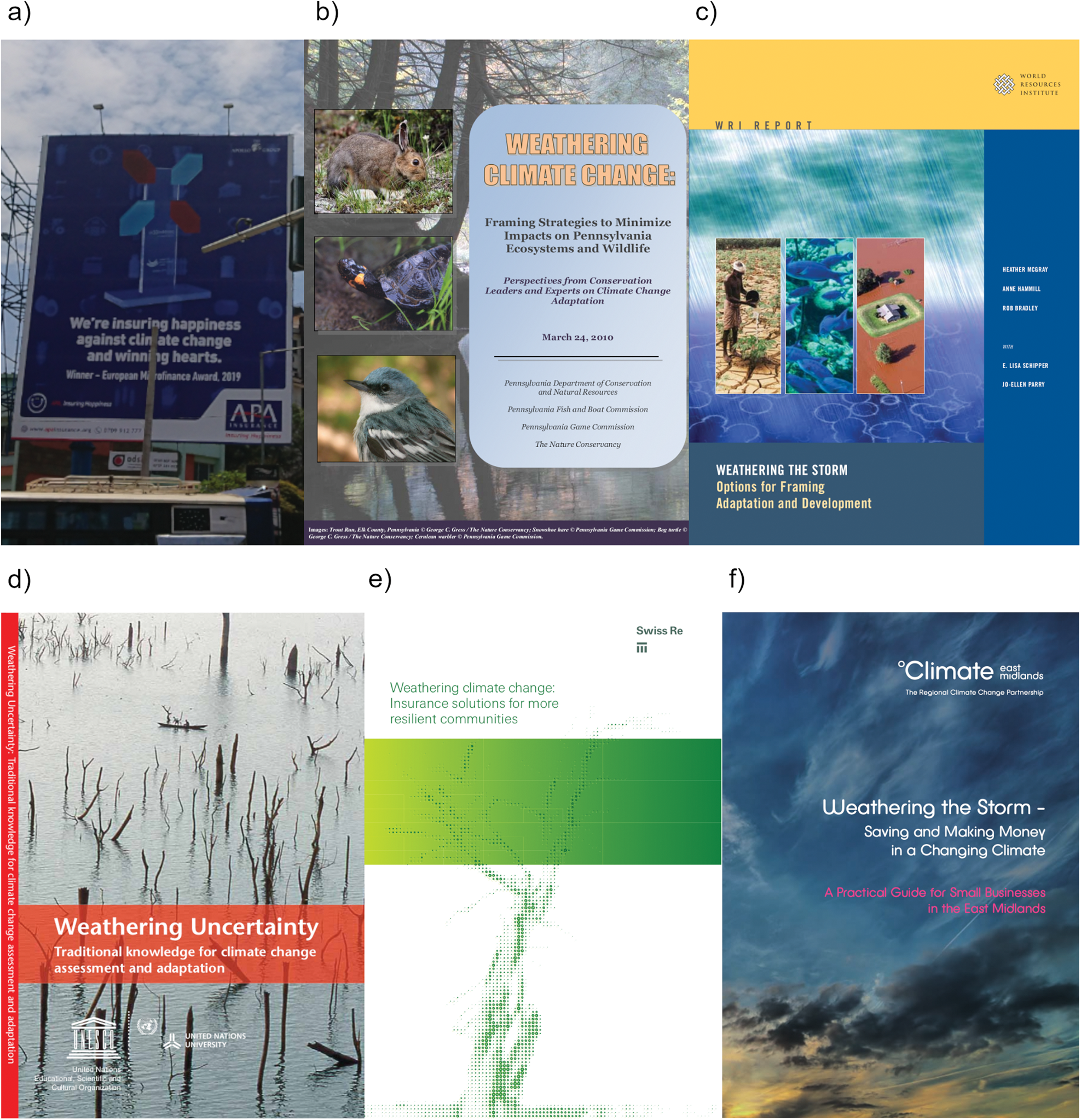
More intriguing, however, is the rise in the discussion on the need to ‘weather’ climate change (Fig. 1). ‘To weather’ in this context is used to convey the need to create contingencies for a rough climate future, commonly portrayed through adverse weather. The expression (acknowledging that ‘to weather’ something is an English expression and might not work in other language contexts) interlocks climate and weather. The social and cultural aspects of this relationship and the potential to communicate about climate change in new ways through weather have been explored by environmental humanists and others. One of the goals is to bring climate change closer through embodied encounters with related, but conceptually and experientially different, emerging weather patterns, and to overcome the epistemic distancing that can occur when non-specialists are presented with complex data (Hulme Reference Hulme2007). As Rooney (Reference Rooney2019, 177) has observed, although ‘graphs and charts might illustrate the significance of climate change over time, they do not always convey the myriad of pulses, pauses, circulations and ebbs and flows that are generated in and across time and place’. Unfortunately, archaeology is noticeably absent from most of these discussions, even though researchers recognize the need for long-term studies of the implications and understandings of climate change (e.g. Hulme Reference Hulme2015). Additionally, the discipline currently has only a marginal presence in the environmental humanities, even though it combines knowledge and skills from geology and the environmental, social and economic sciences (Riede Reference Riede2018).
Publications warning of weather uncertainty and the need to weather climate change. (a) Advertisement by APA Insurance Limited in Nairobi in March 2020; (b) Weathering climate change report by the Pennsylvania Department of Conservation and Natural Resources from 2010; (c) Weathering the Storm report by McGray et al. (Reference McGray, Hammill, Bradley, Schipper and Parry2007) on climate change vulnerabilities; (d) Nakashima et al.'s (Reference Nakashima, Galloway McLean, Thulstrup, Ramos Castillo and Rubis2012) volume Weathering Uncertainty supported by UNESCO; (e) Weathering Climate Change report from 2010 by insurance company Swiss RE (Reichenmiller et al. Reference Reichenmiller, Spiegel, Bresch and Schnarwile2010); (f) East Midlands county climate change guide Weathering the Storm for small businesses (CLASP 2016).
Our goal in this paper is thus to explore the potential of building archaeologies of weather and how these can contribute to new ways of approaching climate change and what it means to ‘weather’ climate change. With its insights into the material outcomes and expressions of human experiences, and associated landscape and environmental changes, archaeology should strive to become more integral to environmental humanities and provide longer-term data when approaching environmental issues. Using a mix (material, oral, written, ecological) of historical sources on East African communities, with a particular focus on the Ilchamus community in Kenya, we revisit the data on how communities lived through the end of the Little Ice Age (LIA) and subsequent periods. We especially highlight the subtleties of community responses to climate change and past weather experiences. Before doing so, however, some additional conceptual framing of the study is called for.
Relating to climate through weather
The North American Space Agency (NASA) states that the difference between climate and weather is ‘a measure of time’ (Gutro Reference Gutro2017) and the characteristics of a particular climate are determined by ‘averaging’ weather, usually across a period of 30 years (IPCC 2014, 120). The temporal scale, however, is a critical stumbling-block in the general conceptualization of climate change. Extreme weather events and their manifestation in forms such as widespread flooding or prolonged water shortages are very effective in presencing climate change, making its effects immediately experiential (Kahan Reference Kahan, Crow and Boykoff2014; Pillatt Reference Pillatt2012), yet they also help to obscure the longer-term processes that have given rise to an increased frequency of such events and which make ongoing climate change a ‘long threat’ (Dickinson Reference Dickinson2009) akin to other ‘slower emergencies’ (Anderson et al. Reference Anderson, Grove, Rickards and Kearnes2019).
Expressions such as ‘weathering climate change’ and ‘climate change is now’ poignantly point to a wider conceptual problem created by the juxtaposition of the immediate experience of weather and the long-term patterns of a climate to which people and communities are currently adapting and around which they endeavour to build their social, economic and food-production systems (Hastrup Reference Hastrup2009; Pas Reference Pas2018; Turner & Clifton Reference Turner and Clifton2009). For example, the latter expression implies that ‘climate change’ will be finished at some point in the future and/or that it will become ‘normal’, while it can also falsely equate freak weather events with climate. Both expressions succeed in bringing climate change into the immediate present. On the other hand, the spatial and temporal distance between the actions that need to be taken to mitigate climate change and the lack of an immediate result creates a challenge for understanding human experiences of climate change (see below). Time, as Brace and Geoghegan (Reference Brace and Geoghegan2011, 290) observe, ‘is a sine qua non in the study of climate change’, not simply in terms of measuring moments of past, present and predicted future change, or even the duration and temporality of events and the differential tempos of different processes as explored by Bailey (Reference Bailey2007), but also in more metaphysical and semiotic ways that address the intersection of past, present and future in acts of habitation and the tasks of ‘weathering’.
Weather, like climate, has histories and possible futures, and current weather events all have their origins in the cumulative emissions of the past and present (Endfield & Veale Reference Endfield and Veale2018; Malm Reference Malm2016; McKibben Reference McKibben1989). The Intergovernmental Panel on Climate Change's (IPCC) Fifth Assessment Report (2014), for instance, had already identified recent extreme weather changes as a consequence of longer-term anthropogenic climate change. These histories are important also for understanding attempts to discipline the weather. The current understanding of weather in the Western world, for example, as a morally neutral geophysical phenomenon that can be understood and measured through quantifiable elements such as precipitation and temperature has its origins in the eighteenth century. Then, new observational protocols, measurements and instruments were developed with which weather-watchers tried to discern patterns (Golinski Reference Golinski2007; Janković Reference Janković2000; for the Victorian era, see Anderson Reference Anderson2005). This numerical, empirical understanding of weather now also forms part of the IPCC's definition and use of weather in its reports (IPCC 2014, 119 & 138), which generally obscures the direct and immediate impact humans can have on the weather and limits the types of inquiries it facilitates mostly to biophysical issues (Vanek Reference Vanek2018). Yet that quantitative records and qualitative human experiences are intimately connected is inescapable, as tellingly indicated by the example of the riots on 30 April 1992 following the non-guilty verdict in the Rodney King police brutality trials which caused a thermal anomaly across 85 sq. km of Los Angeles, USA, resulting in local weather-making: a social weather event caught by satellite measurements that is otherwise obscured by numbers (Arike Reference Arike2006, cited in Vanek Reference Vanek2018, 2).
The human predisposition to relate to climate through weather (Demski et al. Reference Demski, Capstick, Pidgeon, Sposato and Spence2017; Kahan Reference Kahan, Crow and Boykoff2014) provides an opportunity to make climate change more immediate and interactive, and to embed us spatially and temporally in it. Weather is the lens through which human relationships with climate are most easily mediated (Hulme Reference Hulme2008). This contrasts with the general perception of climate change as separate and distant from everyday lives (Slocum Reference Slocum2004). Academics from various disciplines have argued that Western understanding of weather as well as climate needs to be re-cultured (Hulme Reference Hulme2015). The environmental humanities, particularly, have promoted the need to reframe environmental and climatic issues as fundamentally social and human challenges (Neimanis et al. Reference Neimanis, Åsberg and Hedrén2015). As in the climate communication field, where soft factors such as values and motivation have been found to be central to climate action (Moser Reference Moser2016; Pearce et al. Reference Pearce, Grundmann, Hulme, Raman, Hadley Kershaw and Tsouvalis2017), their importance is also stressed by environmental humanists. The ‘imaginary’—an explorative, sense-making space wherein individuals negotiate and cultivate relations to the material world, others and competing worldviews, while also creating their identity and defining their values across space and time (Appadurai Reference Appadurai1996)—already includes values and attitudes towards nature. These sense-making imaginaries shape individuals’ interactions and everyday worlding practices and create nodes of interaction with the non-human, including nature and weather. Exploring and addressing imaginaries can enhance responsiveness to environmental issues and willingness to take mitigative action, not only locally but at a larger spatio-temporal scale.
Weathering history
Historians and geographers have largely focused on the origins and development of the western scientific imaginary of climate and weather in the past few centuries in different spatio-temporal contexts (Barboza Reference Barboza, Janković and Barboza2009; Offen Reference Offen2014). Analysing the ‘domestication’ of weather through new measurements and new technologies (e.g. Rayner Reference Rayner, Janković and Barboza2009; Readfern Reference Readfern2020; Janković Reference Janković2000), the long-term social, economic and ecological consequences of extreme weather events (Brönnimann et al. Reference Brönnimann, Rohr and Stucki2018; Endfield & Veale Reference Endfield and Veale2018 and chapters therein; Rohr Reference Rohr, Janković and Barboza2009) and the ‘localization’ of past and present weather through local cultural meanings comprise some of the more dominant lines of research. Central also to much of this work have been discussions around the attachment of memories to specific places and the memorialization of place during weather events. These help create local imaginaries of weather and climate (De Vet Reference De Vet2013; Endfield & Naylor Reference Endfield, Naylor, Harvey and Perry2015; Hall & Endfield Reference Hall and Endfield2016; Hulme Reference Hulme2012), where climate is an idea that stabilises the unpredictable weather (Hulme Reference Hulme2015).
Despite the richness of these insights, some scholars clearly feel that past experiences of weather are only accessible when textual sources are available, severely limiting the temporal and spatial range of analyses, and also the nature of the particular ‘voices’ that are heard. Writing about the challenges of reconstructing perceptions of weather events and responses to climate change in Africa, the Americas and Australia during the seventeenth century, Parker (Reference Parker2013, 445), for example, states that ‘historians can reconstruct the experience of their inhabitants in the seventeenth century only for those areas where literate residents or travellers from other regions—most of them Europeans—compiled written records that have survived’. Such views are far from uncommon, and while they may reflect a widespread and more general bias against the value of material evidence as opposed to textual sources for reconstructing the past, such attitudes may also derive in part from the relative lack of engagement by archaeologists with how people in the past ‘weathered’ climate change.
While there has been a strong focus among historians and geographers on climate and weather as analysed (although see e.g. Waites Reference Waites, Endfield and Veale2018), there has been a growing focus among anthropologists and others on weather and climate as lived. The feminist philosophers Neimanis and Loewen Walker (Reference Neimanis and Loewen Walker2014), for example, have argued for a re-framing of current Western abstracted experience of climate change and weather. To address the epistemological distancing of climate change narratives and associated weather events and to raise awareness of humans as weather-makers (e.g. through their carbon emissions, the release of silver iodide crystals to make rain, or through concrete buildings that trap heat), Neimanis and Loewen Walker appeal to human senses of responsibility and responsivity. They describe our relationship with climate as one of ‘weathering’ and ‘weather worlding’. While playing on the meaning of ‘weathering’ (being exposed and/or going through something resulting in an altered state), they imagine our bodies as entangled with other forces, as ‘worlding’ by experiencing the intensity of weather and climate change and giving them meaning. Our bodies then become archives (as do architecture, social inequalities, etc.), contracting time between the past, present and possible futures, thus ‘thickening time’ and re-thinking the temporal narrative of something distant, bringing it spatially and temporally closer (Neimanis & Hamilton Reference Neimanis and Hamilton2018).
Rooney (Reference Rooney2018), building on Neimanis and Loewen Walker's theoretical frames, has advocated for shaping public imaginaries through environmental pedagogies and engaging children's relations to weather as part of a learning experience about human–environment entanglement. By attending to the sensory experiences of weather, she argues, there is an opportunity to draw attention to climate vulnerabilities, make climate change easier to comprehend and make distant futures more immediate. Similarly, Vanek (Reference Vanek2018) draws on the papers by Neimanis and Loewen Walker (Reference Neimanis and Loewen Walker2014) and Neimanis and Hamilton (Reference Neimanis and Hamilton2018) to find examples of ‘weathering’ in past literature (see e.g. Chiari Reference Chiari2019; Harris Reference Harris2015; Tyler Reference Tyler2017) and how weather, bodies and the material have been used to portray differential experiences of weather and how personal conditions can exacerbate even ‘normal’ weather.
Ingold (Reference Ingold2007; Reference Ingold2011), in his phenomenological explorations of how and in what people and non-human things relate and become entangled, identifies weather, or ‘the weather-world’ to use his concept, as the medium that we inhabit, perceive in and relate to the material world. The medium, which is a part of the landscape, is in a constant state of generative flux, transforming the landscape (through rain, mist, facilitating erosion, etc.), giving people experiences through which they can know the land, and therefore allowing it to come into ‘being’ (Ingold Reference Ingold2008). Through weather ‘we do not see different things, but we see things differently’ (Ingold Reference Ingold2011, 130). Ingold (Reference Ingold2005; Reference Ingold2011) has also lamented the absence of research on weather in anthropology and archaeology, even though weather is commonly talked about in the field (Crate & Nuttall Reference Crate, Nuttall, Crate and Nuttall2016a). Despite the fact that weather or weather-related understandings of the world have a long history in anthropology (see e.g. Colson Reference Colson1948; Solway Reference Solway1994), this neglect is largely because weather and climate were typically treated until recently only as a backdrop to social practice and belief, even when understanding the weather is accorded great cultural and social significance, as among the Ihanzu of Tanzania, who built their economy around rain-making and granted the rains (or their failure) the capacity either to bring down regents or keep them in power (Sanders Reference Sanders and Dove2014).
The publication of several volumes on the anthropology of climate change in the last two decades, however, suggests there is a new interest in weather's place in society. Whereas contributors to Strauss and Orlove (Reference Strauss and Orlove2003 and chapters therein) focused on how weather and climate are experienced in different time frames and how responses to them are reflected in language, the contributions to other edited collections have discussed the growth of climate change anthropology, how climate change is present among ‘frontline’ communities and how to translate those accounts for scientists, as well as defining the role of the anthropologist in tackling and communicating contemporary climate change (Baer & Singer Reference Baer and Singer2014; Crate & Nuttall Reference Crate and Nuttall2016b; de Wit et al. Reference de Wit, Pascht and Haug2018; Dove Reference Dove2014). There has also been a growing concern among anthropologists with encountering climate change in the field and how it prevents reading the weather and landscape (Crate & Nuttall Reference Crate, Nuttall, Crate and Nuttall2016c; Dodds & Nuttall Reference Dodds and Nuttall2019; Järpe Reference Järpe2007; Turner & Clifton Reference Turner and Clifton2009), for example. There is concern too that terms like ‘climate change’ do not capture people's experience of (unusual) weather or accommodate broader socio-cultural dimensions and beliefs, or how to approach the space between weather and climate (Baer & Singer Reference Baer and Singer2014; de Wit Reference de Wit2018; de Wit et al. Reference de Wit, Pascht and Haug2018; Jerstad Reference Jerstad2016; Sherratt et al. Reference Sherratt, Griffiths and Robin2005). People's observations of weather can be seen as only valuable for what they can tell us about climate change (e.g. Savo et al. Reference Savo, Lepofsky, Benner, Kohfeld, Bailey and Lertzman2016), rather than what it means to experience unusual weather, and anthropological data are often thought of as anecdotal to climate change (Crate & Nuttall Reference Crate, Nuttall, Crate and Nuttall2016a).
Many of the current discussions, interestingly, contain traces of concerns that were raised during the rise of meteorology as a science, which included the significance of the experiential in measurements of the weather and anxieties over the loss of ‘humanity’ (Golinski Reference Golinski2007; Janković Reference Janković2000). However, what has been lacking from these recent discussions, even though many case studies engage with materials-related weather expressions, has been any real engagement with archaeological data or with how specific efforts at ‘weathering climate change’ might be inferred from material traces available for archaeological study.
Climate and weather in archaeology
As both a historical and an anthropological discipline, archaeology should be well qualified to discuss measures of climate change through time, as well as how people might respond to and experience novel climatic conditions. Archaeology has certainly become enmeshed in climate change and Anthropocene research and considers both as among the main targets for future work (Armstrong et al. Reference Armstrong, Shoemaker and McKechnie2017; Kintigh et al. Reference Kintigh, Altschul and Beaudry2014). The discipline is certainly making valuable contributions to understanding past sequences of changes and responses to climatic events (Marchant et al. Reference Marchant, Richer and Boles2018; Rockman Reference Rockman, Rockman and Flatman2012; Van de Noort Reference Van de Noort2013), and archaeology has become an essential discipline in holistic studies of landscape historical ecologies (Crumley et al. Reference Crumley, Kolen, de Kleijn and van Manen2017; Plieninger et al. Reference Plieninger, Kizos and Bieling2015; Szabó Reference Szabó2015). But archaeology has, perhaps, also become too enamoured with scientific views and approaches to climate and environmental change and science modes of communicating results. Although intensely researching past adaptations that could contribute to sustainable development solutions, there is little concrete evidence of archaeological results being implemented as viable and applied solutions in modern contexts (Lane Reference Lane2015), with a few notable exceptions (e.g. Kendall & Drew Reference Kendall, Drew, Isendahl and Stump2016; Logan Reference Logan2020; Spriggs Reference Spriggs, Isendahl and Stump2015). Additionally, archaeology's marginal role in environmental humanities and climate change communication indicates that the discipline needs new ways of interpreting and writing about climate change (Riede Reference Riede2018; Roddick Reference Roddick2018).
To be clear, discussing and analysing the experience of going through climate change has certainly not been neglected in archaeology, as recent studies amply illustrate (e.g. Nelson et al. Reference Nelson, Kintigh, Abbott and Anderies2010; Price & Gräslund Reference Price, Gräslund and Riede2015; Shoemaker Reference Shoemaker2018; Wright et al. Reference Wright, Forman, Kiura, Bloszies and Beyin2015). In marked contrast, however, weather, the medium through which climate is experienced, helps form quotidian experiences and in many cases determines daily activities, has rarely featured in archaeological research. Weather, like climate change, is historical as it is part of individual and community memories and certain kinds of weather in a particular place are typically expected based on past experiences and form the basis of most types of lay weather forecasting (Janković Reference Janković2000; Orlove et al. Reference Orlove, Roncoli, Kabugo and Majugu2010). We might therefore need to rethink the material record to better understand how people ‘weathered’ climate change, adapted to it and made it ‘normal’. An archaeology of weather can consider the seasonal and daily changes to people's life and if the change in climate was perceptible, for example. Research might also explore the material dimensions of weather-control institutions and practices, when, where and why they emerged, how they were sustained and why such practices might have been abandoned, a potential for such archaeological investigation perhaps being the weather-control dimensions of the Pueblo katsina cult (Adams Reference Adams1991). Highlighting everyday experiences can also create powerful new narratives and subtler images of what it means to live through climate change. Our aim should be to reduce epistemic distancing occurring between scientific explanations of the ongoing climate crisis and our present selves and our actions (Hulme Reference Hulme2007; Rooney Reference Rooney2019), and to contribute actionable cultural information.
The potential of including weather in archaeological analyses is especially high in regions where weather has a strong impact on seasonal activities, where climate change is particularly strongly felt (e.g. the Arctic circle (Dodds & Nuttall Reference Dodds and Nuttall2019; Hastrup Reference Hastrup2009; Turner & Clifton Reference Turner and Clifton2009)), or in areas and periods where writing diaries was popular and necessary, as in Early Modern Europe (Adamson Reference Adamson2015; Pillatt Reference Pillatt2016), or when routinely recorded, as in ship logbooks (e.g. García-Herrera et al. Reference García-Herrera, Barriopedro, Gallego, Mellado-Cano, Wheeler and Wilkinson2018; Nash et al. Reference Nash, Pribyl, Klein, Endfield, Kniveton and Adamson2015; Wheeler & García-Herrera Reference Wheeler and García-Herrera2008) and at European mission stations (e.g. Nash & Endfield Reference Nash and Endfield2002). The potential is also high where oral histories have strong traditions of documenting cultural responses to climate stress (e.g. Webster Reference Webster1980) and indigenous perceptions of climate change and approaches to weather forecasting are available (Radeny et al. Reference Radeny, Desalegn and Mubiru2019). However, while both the latter categories are commonly available for many parts of Africa, unlike some other continents and regions, an archaeology of weather remains largely unexplored on the continent. A notable exception to this is the research on archaeological expressions of rainmaking and cultural responses to periodic drought in southern Africa, among both farming (e.g. Aukema Reference Aukema1989; Huffman Reference Huffman2009; Murimbika Reference Murimbika2006; Schoeman Reference Schoeman2006; Reference Schoeman2009) and hunter-gatherer populations (e.g. Challis et al. Reference Challis, Mitchell and Orton2008; Kinahan Reference Kinahan, Ucko and Layton1999; Prins Reference Prins1990).
Weathering change around Lake Baringo, Kenya
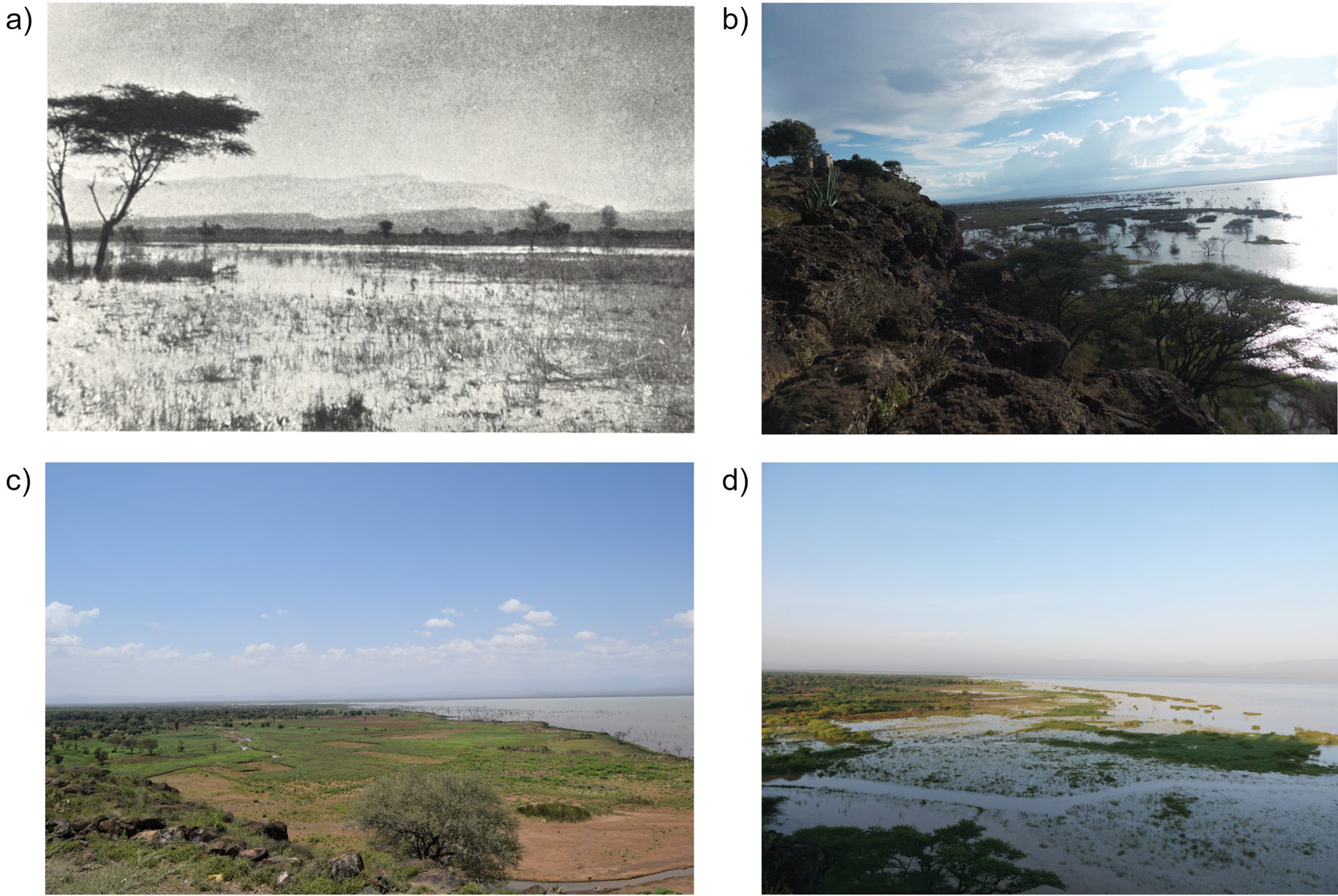
A useful example of where longer-term climatic changes require weather-centred approaches is provided by Kenya's Lake Baringo lowlands. Located in the Central Rift Valley, the Lake Baringo area is a fast-changing woodland–bushland savanna where vegetation responds rapidly to increases in either precipitation or aridity. Much of the area is characterized today by relatively bare grounds and unstable and erodible soils, typical for non-equilibrium ecosystems where vegetation production is unpredictable and inconsistent (Boles et al. Reference Boles, Shoemaker, Courtney Mustaphi, Petek, Ekblom and Lane2019; Kiage & Liu Reference Kiage and Liu2009; Vehrs Reference Vehrs2016). Although the lake and the surrounding lowlands have a semi-arid climate receiving c. 600 mm of rain per year, the lake's 6200 sq. km catchment includes semi- and sub-humid mountain ranges where its two perennial rivers, the Molo and Perkerra rivers, originate. As a shallow amplifier lake, Baringo is highly susceptible to changes in rainfall and river discharge, as evidenced by the floods experienced here during recent high-rainfall years in 2013, 2019 and 2020 (Degefa et al. Reference Degefa, Bessems, Tjallingii, Cumming and Verschurenn.d.; Johansson & Svensson Reference Johansson and Svensson2002; Nation Team 2020; Republic of Kenya 1984) (Fig. 2). Moreover, the lowlands experience below-average rainfall every 3–4 years with severe droughts occurring on a decadal cycle. The averages, however, disguise the reality that due to the very localized and inconsistent nature of rainfall each year, there are always one or more localities experiencing drought in any single year (Kipkorir Reference Kipkorir2002; Rowntree Reference Rowntree1989; Sutherland et al. Reference Sutherland, Bryan and Oostwoud Wijendes1991).
Flooding at Lake Baringo in (a) 1900 (as seen in Johnston Reference Johnston1904, 17, looking east); and from Loiminange Fort looking west (b) in September 2014; (c) in February 2016 showing a receded lake shore; and (d) in March 2020 (© Nik Petek-Sargeant). All pictures taken at the southeast corner of the lake.
Between the end of the eighteenth and the beginning of the nineteenth century, East Africa experienced a multi-decadal sub-continental drought marking the end of the Little Ice Age (LIA) in the region. This mega-drought is widely recorded in the region's limnological and palaeoecological records, with multiple proxies indicating lake-level drops or complete desiccation (Bessems et al. Reference Bessems, Verschuren, Russell, Hus, Mees and Cumming2008; De Cort et al. Reference De Cort, Bessems, Keppens, Mees, Cumming and Verschuren2013; Halfman et al. Reference Halfman, Johnson and Finney1994; Stager et al. Reference Stager, Ryves, Cumming, Meeker and Beer2005; Verschuren et al. Reference Verschuren, Laird and Cumming2000). It is also recorded in many of the oral histories of different ethnic groups across the wider region, some of which also recall widespread social collapse and reconfiguration (Bollig Reference Bollig2016; Lamphear Reference Lamphear1972; Simpson, Jr. & Waweru Reference Simpson and Waweru2012; Tiki et al. Reference Tiki, Oba and Tvedt2013), prompting the historian David Anderson (Reference Anderson2016) to refer to this period as the ‘Great Catastrophe’. Lake Baringo and the nearby Loboi swamp, for example, dried up, while neighbouring Lake Bogoria turned shallow (Ashley et al. Reference Ashley, Maitima Mworia and Muasya2004; De Cort et al. Reference De Cort, Bessems, Keppens, Mees, Cumming and Verschuren2013; Reference De Cort, Verschuren and Ryken2018; Kiage & Liu Reference Kiage and Liu2009). Based on fungal spore evidence from lake cores, the area around these lakes experienced a depopulation of ungulates (wild and domesticates) and people, and as herding and agriculture likely became unviable the remaining population turned to hunting and gathering (Kiage & Liu Reference Kiage and Liu2009; Petek Reference Petek2018; van der Plas et al. Reference van der Plas, De Cort, Petek-Sargeant, Wuytack, Colombaroli, Lane and Verschuren2019). The desiccation of Lake Baringo is also indicative of the rains failing throughout the catchment, while in view of the general fragility of the environment, changes would have been quick and especially severe in the lowlands.
By around the 1830s, the drought was ending and conditions began to ameliorate. It was around that time that small groups from the surrounding hills joined an established community on the southern lowlands, eventually forming the Ilchamus ethnic community (Petek & Lane Reference Petek and Lane2017). Other groups continued to immigrate to Ilchamus throughout the nineteenth century, the majority of whom settled in two villages known as Ilchamus Leabori and Ilchamus Lekeper. Their origin stories are intimately related to the Great Catastrophe. The oldest generation of settlers in these oral histories are referred to as ‘the naked people/people with nothing’ (Ilmeichopo), while the establishment of the villages is linked to finding and eating dead animals and accounts of the origins of individual clans tell of destitution.Footnote 1 The major socio-ecological disruption caused by the Great Catastrophe created an environment of anti-structure where new social and economic relationships could be formulated, eventually promoting a sense of communitas (sensu Turner Reference Turner1969), and which among the Ilchamus also converged around an irrigation system (Petek & Lane Reference Petek and Lane2017).
The irrigation system at the older settlement of Ilchamus Leabori was probably established around 1840, diverting water from the Perkerra River; aerial photographs from 1950, by which time it had been abandoned for over 30 years, show that it stretched across c. 643 ha (Petek Reference Petek2018). The system consisted of furrows and canals that dissected the land into small fields that were further divided into squares each of 10 sq. m with ridges and basins that could be ‘flooded’. Millet and sorghum were the main crops, although cowpea, various greens and gourds were also grown as indicated by textual, oral historical and archaeobotanical data (Anderson Reference Anderson1989; Petek Reference Petek2018). The irrigation system's agricultural cycle was divided into different periods that were determined by seasonality. The periods were sufficiently flexible to accommodate the variable duration of dry and rainy seasons. The timing of rituals associated with planting and irrigation also depended on reading the weather. If drought was indicated by persistent hot weather, rain-making rituals were undertaken by women offering prayers aimed at cleansing the land, while elders ensured fertility by spreading sheep blood, dung and fat at dams and on the edges of the irrigation system (Anderson Reference Anderson1989; Lenachuru Reference Lenachuru2016).
The nineteenth-century irrigation system and villages stand in contrast to the period preceding the Great Catastrophe. The duration of occupation and the scale of investment into the irrigation system left rich archaeological records and facilitated the establishment of vegetation features that made furrows and settlements visible on remote-sensing imagery. On the other hand, systematic archaeological surveys undertaken in the lowlands have only recorded a few scatters that can be linked to the so-called Pastoral Iron Age (PIA) of the early and mid second millennium (Barthelme et al. Reference Barthelme, LaPann and Werbitsky1983; Merrick Reference Merrick1982; Petek Reference Petek2018). Additionally, none of the kinds of glades or groves (vegetation features indicating human occupation due to the accumulation and subsequent decomposition of dung from continued livestock corralling) that have been shown to mark former PIA settlements on the neighbouring Laikipia Plateau (Boles & Lane Reference Boles and Lane2016; Causey Reference Causey2010) occur here either, even though these features can survive for centuries and even millennia, including in Baringo (Lane Reference Lane2011; Marshall et al. Reference Marshall, Reid and Goldstein2018; Petek Reference Petek2018). This discrepancy might indicate that PIA communities in the Baringo lowlands were more mobile while occupying smaller and less permanent settlements.Footnote 2
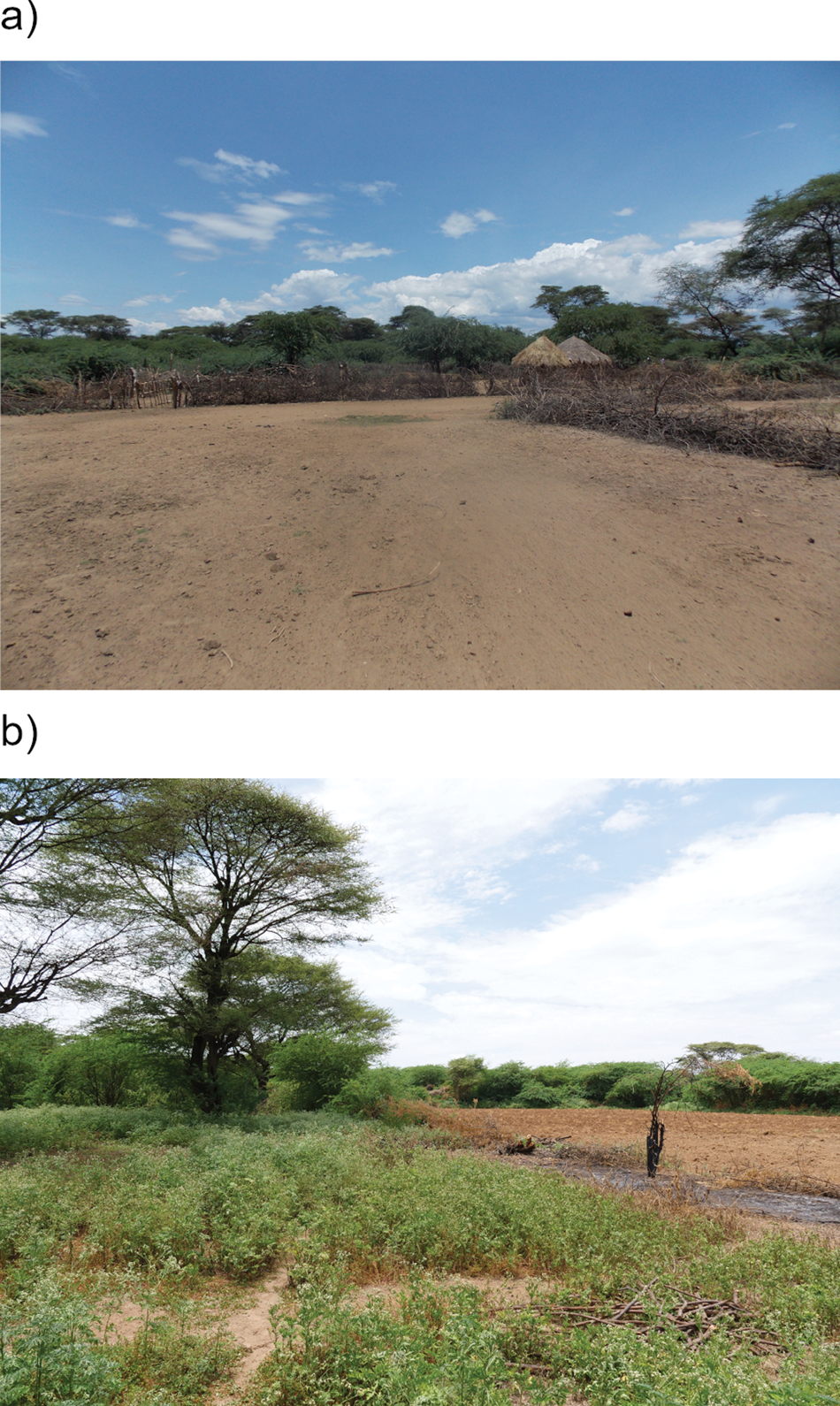
The Little Ice Age's more humid climate likely contributed to more evenly distributed rainfall and therefore grazing land, as well as allowing rain-fed agriculture as suggested by the increase in the proportions of very large grass pollen of 60–85 μm (considered a possible proxy for crop cultivation) in the available pollen cores between 1500 and 1800 (van der Plas et al. Reference van der Plas, De Cort, Petek-Sargeant, Wuytack, Colombaroli, Lane and Verschuren2019, 97). This is mirrored in early twentieth-century developments when the Ilchamus abandoned the villages of Ilchamus Lekeper and Ilchamus Leabori for dispersed and short-lived single-family homesteads (Petek Reference Petek2018). At that time, several years of reliable rain allowed them to take advantage of rain-fed agriculture and the more widely available pasture. A more humid climate could also hide erratic and extreme weather conditions, as at present when unusually wet years frequently cause floods and landslides (Chepkwony Reference Chepkwony2019; Koech Reference Koech2018; Nation Team 2020) (Fig. 3). Moreover, over the second half of the twentieth century, while average rainfall has remained stable, the number of wet days has decreased, indicating that storms are becoming stronger (Kipkorir Reference Kipkorir2002). Although one could presume that the more humid final centuries of the LIA could have been advantageous for irrigation agriculture in the lowlands, the lack of archaeological records for longer-term settlements could indicate unsuitable weather conditions or the ability to pursue a mobile, pastoral lifestyle that might have been preferred.
The site of Ilchamus Lekeper as seen from the central cattle pen in (a) September 2014 and (b) March 2020 (looking northwest). The ground, almost completely barren between 2014 and 2017, has now been densely covered by shrubs and forbs due to increased rainfall in 2019 and 2020. (© Nik Petek-Sargeant.)
The irrigation system that emerged at the southern end of Lake Baringo is an expression of what Driessen (Reference Driessen1995) terms ‘crisis architecture’. It was built as a response to the severe drought in a period of climatic amelioration and expanded over decades, but it also required heavy labour investment into a production system based around a single river in a landscape subject to environmental vagaries. Importantly, its location did not guarantee consistent weather as rain is geographically localized and precipitation is inconsistent. It did, however, equalize weather outcomes across the broader landscape. If the cultivated fields did not receive any rain, it is likely that rains in other areas filled the Perkerra river that was relied on for irrigation, while the neighbouring Tugen community, occupying the more humid highlands, could also be depended on for grains. Although it is unlikely that the entire extent of the irrigation system was under cultivation at the same time, it has been calculated that under ideal conditions (and based on the yields of modern cultivars) the Ilchamus had the capacity to produce over 300 tonnes of surplus grains each year (Petek & Lane Reference Petek and Lane2017). The oral histories certainly record each family having several grain stores,Footnote 3 and dense concentrations of granaries and houses are evident in the few available photographs taken at the end of the nineteenth century (Petek Reference Petek2018, figs. 4.5–4.7). This overproduction served as a buffer against multi-year droughts and was used to establish inter-community relationships through exchange and to exchange with passing trade caravans, often on favourable terms. For example, at the time of Count Teleki's visit in the late 1880s, according to von Höhnel (Reference von Höhnel1894, 5), the inhabitants of the two villages were ‘quite spoiled by the constant and long visits they receive from caravans’ and had become ‘very exacting about what they will take in payment for their wares … [having] nothing to do with glass beads’. Instead, trade goods had to be used to obtain even ‘the very smallest quantity of grain’ and Ilchamus exchanged ivory only for cattle, while also demanding ‘a considerable tribute’ on top of these payments.
The milder climatic conditions of the nineteenth century contributed to the prosperity and growth of the community, but irrigation agriculture at the time is likely to have been as precarious as it is today. Even the climate of the nineteenth century hides significant variability. Ilchamus elders recall stories of people walking to the island of Ol Kokwa at the centre of Lake Baringo, as well as the lake filling up due to intense rains during the Ilpeles (c. 1865–1877) and the Ilkileko age sets (1901–1913).Footnote 4 European travellers stopping at Ilchamus settlements in 1883, 1887–88 and 1893 described famines and droughts (Gregory Reference Gregory1896; Thomson Reference Thomson1885; von Höhnel Reference von Höhnel1894), and sediment records from Lake Bogoria and other nearby lakes indicate drought conditions around 1870 with a short highstand at the start of the twentieth century (De Cort et al. Reference De Cort, Bessems, Keppens, Mees, Cumming and Verschuren2013; Driese et al. Reference Driese, Ashley, Li, Hover and Owen2004; van der Plas et al. Reference van der Plas, De Cort, Petek-Sargeant, Wuytack, Colombaroli, Lane and Verschuren2019). Wakefield and Johnston (Reference Wakefield and Johnston1870), on the other hand, report that the Ilchamus villages and the southern Baringo shore were stopping points for large caravans looking to restock, and photographs taken around 1900 show submerged trees in Lakes Baringo and Bogoria, indicative of heightened lake levels (Johnston Reference Johnston1904, 13, 17).
Against this background, the irrigation system at Ilchamus Leabori can be understood not just as an expression of the social, economic and political situation at the time, but also an archive of the weather-world, its possibilities, and how a community reacted to longer-term climatic changes. The lasting effect of the archive imbued in the landscape, the memories passed on to the next generation and even the myth of the Baringo lowlands being a ‘granary’ are all also apparent in the various colonial efforts from the 1930s to reintroduce large-scale irrigation agriculture after a series of droughts, culminating in the establishment of the Perkerra Irrigation Scheme in 1952 (Anderson Reference Anderson2002, 283). The densely settled late nineteenth-century Ilchamus villages equally tell a story of different weather conditions when compared to the dispersed settlement taking advantage of the more widely available pasture in the early twentieth century, which persisted at least until around the 1980s, as documented in ethnoarchaeological studies by Hivernel (Reference Hivernel1979) and Hodder (Reference Hodder1977; Reference Hodder1982).
The Ilchamus, to use Neimanis and Loewen Walker's term, are weather-makers. While they do not alter the meteorological weather, they ascribe meaning to it based on how well they coped and the outcomes of these coping strategies. Rains are deemed good or bad according to the harvest, and droughts are classified based on hardship caused, often talked about in terms of dead livestock. Ilchamus, like other communities that rely on the land for their livelihood, are also acutely aware of changing weather patterns and draw on their observations and experiential knowledge of changes in wind direction, cloud formations and average temperature, alongside biological phenomena (such as the movement of large mammals, birdsong, vegetation changes and the behaviour of bees) to infer climate change (Lenachuru Reference Lenachuru2016, 93). Droughts and famines that cause significant hardship are named and linked with the warrior age-set of the time, and the affected locations are recalled in oral histories.Footnote 5 The current warrior age-set was renamed Lmeingati Footnote 6 partially because increased rainfall caused worse flooding than anybody could remember and the lake depth increased from 1.5 m in the early 2000s to 10.6 m in July 2013 (Degefa et al. Reference Degefa, Bessems, Tjallingii, Cumming and Verschurenn.d.). Whole villages were displaced, people's fields submerged and the southern lake shore moved by approximately 5 km. Yet it is important to recognize that weather events do not necessarily always gain meaning and importance from catastrophic meteorological occurrences or the statistics associated with them. The heavy rains in 1917 caused the Perkerra river to change course, flooding some fields and leaving others without access to water, causing the abandonment of the large irrigation system at Ilchamus Leabori (Anderson Reference Anderson2002, 74). However, this event is given little importance in oral histories as many Ilchamus by then had shifted to a pastoral lifeway and had moved away from the area, even if this particular weather event was the final metaphorical nail in the coffin for their venture into irrigated agriculture.
Ilchamus, like many of the neighbouring communities, have to reinterpret the landscape (almost) annually based on prevailing conditions. Although some locations are more likely to produce the resources they require in abundance, such as grasses for livestock, these can be widely distributed and might require ‘following the rains’ to pastures in between the arid patches. Over the years and generations, individuals and communities learn to interpret the signs of the weather-world and create an archive which helps them manage the vicissitudes of the climate, which in turn leave more or less permanent archaeological traces.
Conclusion
Using the example of Lake Baringo and the Ilchamus, we have shown how people there ‘weathered’ climate even under stable conditions, as well as how communities reacted to short-term climatic fluctuations and the associated unpredictable weather. Weather histories here are recorded in personal memories, oral histories, archival and palaeoecological records, as well as archaeology. As discussed, these registers are typically fine-grained and potentially ephemeral leaving elusive material traces—in other contexts, we might imagine such expressions taking the form of re-plastering of house walls, the addition of cladding, changes to the pitch of a roof or even roofing materials, for example, at the level of individual dwellings. Increased frequency of adverse weather might trigger a host of other ‘small-scale’ changes to daily life, impacting everything from clothing to settlement layout and location. Yet, as the Ilchamus example makes clear, larger collective projects may also be initiated or appear as crisis architecture. Such material interventions cannot simply be glossed as ‘adaptations’. They are always more than this, informed by bodily understandings of changing conditions and their impacts on individual and collective senses of well-being and place. Moreover, as the Ilchamus’ response to the Great Catastrophe makes clear, rapid climate change triggered by increased intensity of bad weather does not necessarily create the kind of dystopian society often imagined in western literature and film as the inevitable outcome of climate-induced crises, but instead can foster the formation of new communities for whom collaboration was paramount.
Just as climate and nature are historical (including our discourses around them), so is weather, creating historically specific social configurations that organize our interactions and investments in the landscape (Castree & Braun Reference Castree, Braun, Braun and Castree1998, 5). Archaeology, alongside other environmental humanities, can render an inhabited weather-world visible and histories of climate change can also be histories of weather and vice versa. Climate change is ‘not only a mutation of this climate (warming, depleting, becoming more volatile) but an alteration of what we take climate to be’ (Colebrook Reference Colebrook2012, 36). Visible and experienced alterations start with the weather, pointing to the different timescales that humans and weather, and society and climate, operate (Cooper Reference Cooper2012; Pillatt Reference Pillatt2012).
Unfortunately, to be able to contrast the different timescales, we need multiple datable sources through which higher-resolution responses to change can be reconstructed. This limits archaeologies of weather to areas with well-preserved datasets which have been extensively studied, allowing for comparison between periods and across different land-use systems. While results might only produce a low-resolution image of weathering, the possibility to include generational histories and tightly dated records of activity using varves and/or dendrochronology with a focus on weather events has the potential to generate finer-grained perspectives than climate-centred approaches. Scrutinizing sequences, correlation and causality between climate and societal change (or rupture) is equally essential. This line of questioning, however, needs to be complemented by asking how, why and when (in the then ongoing climate change) societies mediated new or unusual weather or climate manifestations locally (Haldon et al. Reference Haldon, Mordechai and Newfield2018), and how we can elaborate on the materiality of weathering climate change.
Archaeologies of the weather may thus be critical for helping us review how and what communities in the past thought about climate and how the weather is an embedded part of a landscape and society. Moreover, it can change our perspectives of what the Anthropocene is or should be, how societies perceived their control and impact on the environment, and the social and material expressions of slow emergencies. These novel perspectives should be used to portray and communicate past and present weather imaginariesFootnote 7 and need to be included in discussions of future-making strategies and in policies on adaptation and sustainable development (cf. CHIESA project 2013; Courtney Mustaphi et al. Reference Courtney Mustaphi, Capitani and Boles2019). Ultimately, through their foci on the historical and the tangible, archaeologies of weather could also significantly enrich the environmental humanities, act as a bridge between the humanities and sciences, and leverage the discipline's popularity to communicate and minimize the epistemic distancing of climate change.
Acknowledgements
Earlier versions of this paper were presented by PL at the Royal Anthropological Institute's ‘Anthropology, weather and climate change’ conference at the British Museum (May 2016) and at the 23rd Society of Africanist Archaeologists Biennial Conference, University of Toulouse (June 2016). NPS also presented a parallel paper at the XVIIIe congrès Mondial Union Internationale des Sciences Préhistoriques et Protohistoriques in Paris (June 2018). We would like to thank the conference and session organizers, especially Dr Sandrine Robert, for the opportunity to present at these meeting and our audiences for their comments and constructive feedback. NPS's research on Ilchamus formed the focus of his doctoral research at the Department of Archaeology & Ancient History, Uppsala University, as an Early Stage Researcher on the Marie Curie Skłodowska Innovative Training Networks Resilience in East African Landscapes (REAL) project, funded by a grant from the European Commission's 7th Framework Programme (Grant no. 606879) awarded to PL. NPS would also like to thank Prof. David Anderson for sharing his interview transcripts. Additional thanks are due to the two anonymous reviewers and the editor John Robb, for their generous and extraordinarily helpful comments and suggestions on an earlier draft of the paper.


 Open access

