


Relying upon the ekphrases of Pliny and Vitruvius, the most complete surviving textual accounts from Antiquity, studies of the afterlife of the Mausoleum have often focused upon practices of antiquarian reconstruction and imaginative re-invention.Footnote 1 Tracing changes and continuities in the image of the Mausoleum as they have developed over time, these analyses have centred upon exchanges between production and reception across different media and the shifts in meaning they entail. In this respect one might speak of a productive cross-fertilisation between text, image and architecture in the Nachleben of the Mausoleum. Historical and thematic investigation of this process will enable us to trace a series of transformations of the image of the ancient tomb, along with the methods of antiquarian inquiry used to visualise its form and understand its meanings from the late seventeenth to the mid-eighteenth centuries.
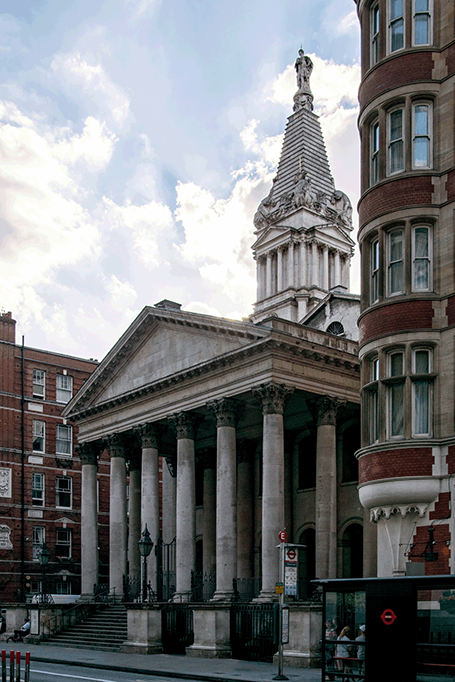
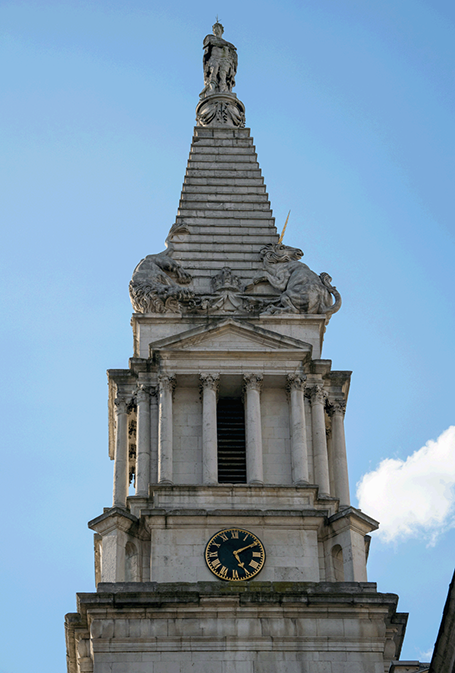
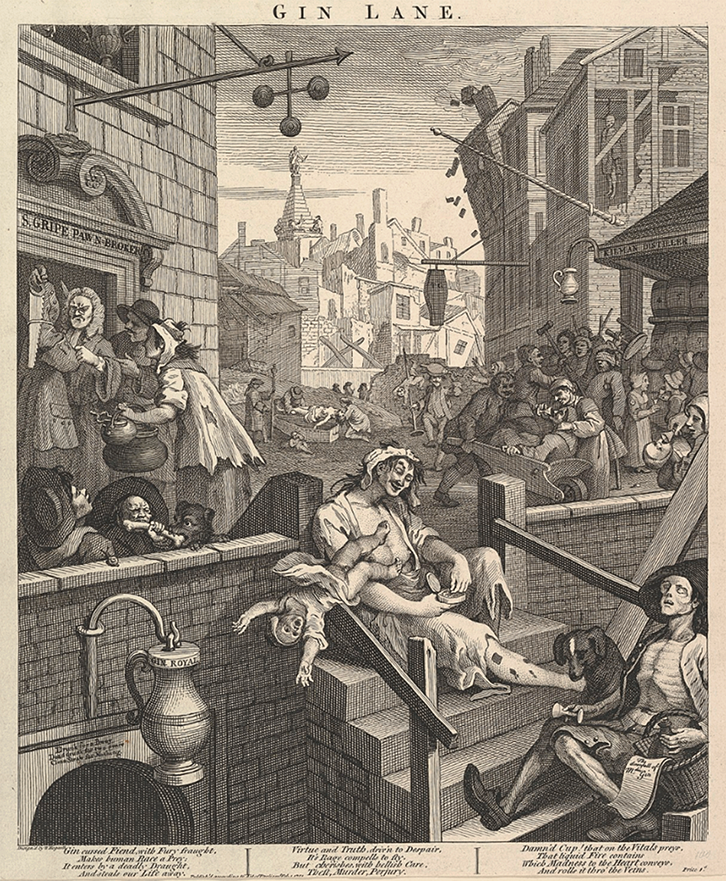
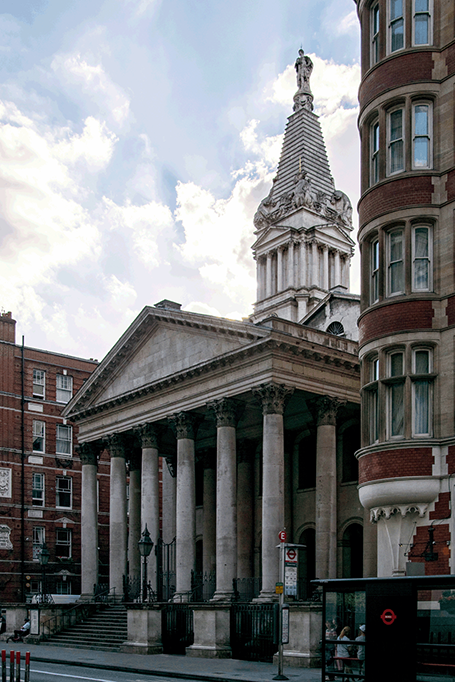
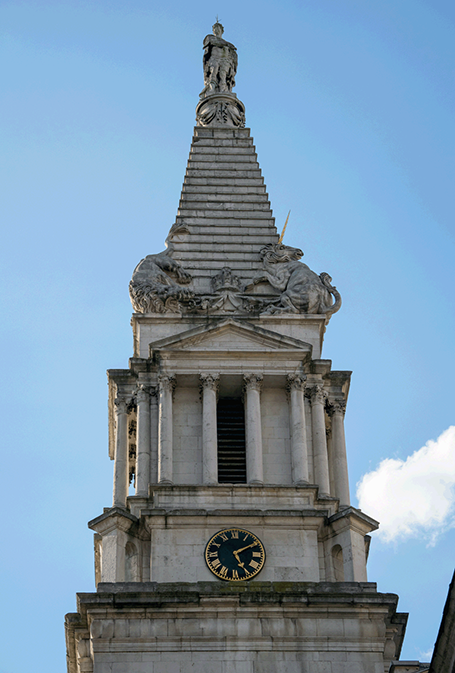
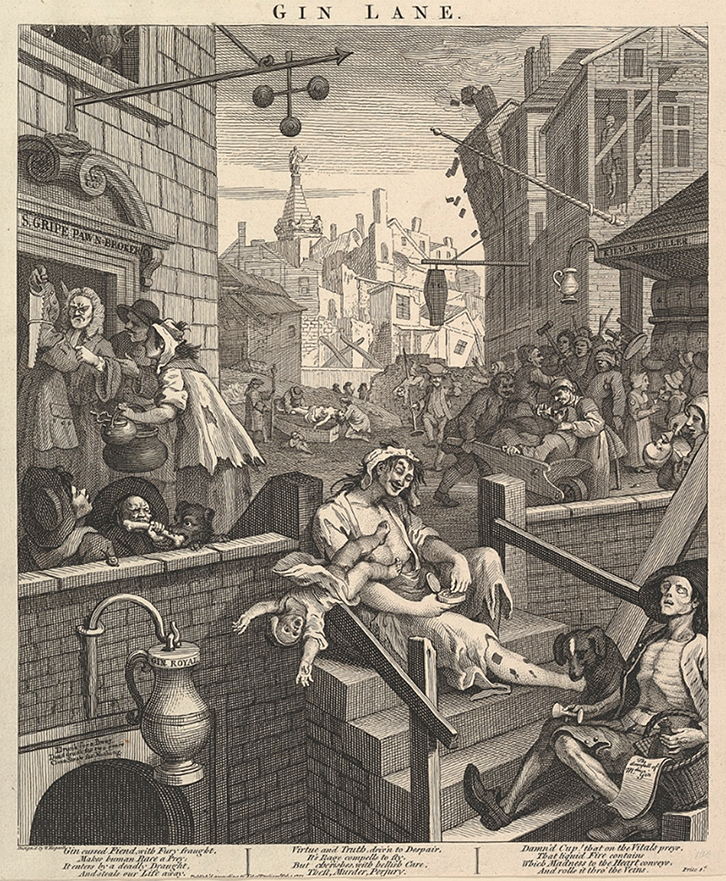
When dealing with the most prominent architectural interpretation of the Mausoleum in early-eighteenth-century Britain, the steeple of St George’s Bloomsbury by Nicholas Hawksmoor (1716–1731, Figs. 9.1 and 9.2), this way of proceeding has shown itself to be essential.Footnote 2 To be sure, a heightened sensitivity to the relationship between architecture and a specific medium, that of print, is also necessary in this particular case, as this part of the church is represented in an engraving by William Hogarth, Gin Lane (1751, Fig. 9.3), where it makes a crucial contribution to this artist’s vision of Georgian London. If Hawksmoor, when designing his spire at St George’s Bloomsbury, deployed simultaneous strategies of miniaturisation and attenuation of the stepped pyramidal summit of the Mausoleum, Hogarth, in Gin Lane, includes a conspicuous visual reference to the church steeple in the background of this print as an element of its satirical depiction of the British capital. Its foreground, replete with violent upheavals and drunken excess, offers a clear antithesis to the Baroque splendour of Hawksmoor’s church, undermining its triumphalist message. The contrast could not be sharper: if Hawksmoor used the reference to the Mausoleum as a means of shoring up the idea of British monarchy under the Hanoverian dynasty, Hogarth took this aspect of the monument’s afterlife for granted as part of the London cityscape, repositioning it as fair game for satiric subversion.
Nicholas Hawksmoor (1716–1731). St George’s Bloomsbury, London.
Nicholas Hawksmoor and Edward Strong Jr. (1716–1731). Steeple of St George’s Bloomsbury with Heroised Statue of George I as Mausolus, London.
William Hogarth (1751). Gin Lane, print, 38.3 x 31.7 cm (1’3” x 1’).
It comes as no surprise that Hawksmoor and Hogarth approached the image of the Mausoleum in very different, even antithetical ways, mobilising disparate senses of how to evoke, and to radically transform, the cultural and political memories associated with the ancient monument. This complex story of reception requires further elucidation with an eye to how it fits into (and how it deviates from) larger patterns of continuity and change. With this aim in mind, in what follows I try to establish the historical circumstances and site constraints surrounding the commission of St George’s before offering a detailed analysis of Hawksmoor’s response to the challenge of reconstruction. The chapter concludes with some observations on the ways in which the afterlife of the Mausoleum became intertwined with the satiric purposes of Hogarth’s prints.
Continuity and Rupture in the Reception of the Mausoleum: Wren and Hawksmoor as Readers of Pliny and Vitruvius
In his capacity as Sir Christopher Wren’s most famous disciple, and on the basis of his powerful and highly original designs, Hawksmoor was given the commission of St George’s Bloomsbury, the last of the parish churches to be built for the Commissioners of the Fifty New Churches Act of 1711.Footnote 3 Bounded to the south-east by Bloomsbury Way (formerly Hart Street), to the south-west by Museum Street (formerly Peter Street and Queen Street), to the north-west by Little Russell Street and to the north-east by Bury Place, St George’s is inserted ingeniously into the urban fabric. Construction began in 1716 and the church was consecrated in January 1730 although it was only fully completed in 1731.Footnote 4 As the highly detailed maps by Rocque (Reference Rocque1746) and Horwood (Reference Horwood1792–1799) show, the site of the church was marked by considerable urban density, as it was hemmed in by houses when the building was originally constructed.Footnote 5 Hawksmoor’s design was therefore partly dictated by the constraints of the surrounding urban space. Just how dense the area was in the early eighteenth century can be inferred from key functional and circulatory features of the design itself, namely that the imposing portico faces south onto Bloomsbury Way although the main entrances to the building are to the west side, on the north and south faces of St George’s tower.Footnote 6
The tight urban site also had a discernible impact on the asymmetrical placement of the tower, which vies for attention from the far view alongside the portico that is more fully legible from a closer vantage. This last part of the project can perhaps be interpreted as a critique of Wren’s attempt to harmonise Vitruvius’s conception of the orders with Pliny’s ekphrasis of the Mausoleum, elaborated in a well-known passage in Parentaliawhich presents the latter as a prototype of the Doric order, even if the monument itself was located near Ionia, homeland of the Ionic.Footnote 7 In this respect one cannot regard Wren as a strict Vitruvian, but rather as an unorthodox, highly imaginative reader of the Roman theorist. This is a plausible reading because Wren attempts to reconcile Vitruvius’s normative doctrine of the orders with Pliny’s fine-grained account of the Mausoleum, which, despite the great detail it offers about statuary, numbers of columns and their measurements, does not identify the order that was used.
If Wren’s interest in Pliny is well known, Hawksmoor’s reliance upon this author is somewhat less so. A recently discovered primary source offers valuable evidence in this respect. I am referring to the list of Hawksmoor’s books published c. 1740 in a catalogue for an auction, held in London, of the architect’s belongings, that includes the contents of his library, along with paintings and other art objects. What is most striking about this inventory (which, to the best of my knowledge, has never been discussed previously) is that it proves that the architect owned more editions of Pliny’s Naturalis historia than of any other ancient author. In the list, five separate editions of Pliny the Elder are enumerated (along with one of Pliny the Younger’s letters), as opposed to two different ones of Vitruvius.Footnote 8 The fact that Hawksmoor owned different editions of Pliny strongly suggests that he compared their scholarly annotations and possibly the images they contained of ancient monuments. Among the latter, of course, the Mausoleum figured prominently as one of the Seven Wonders of the Ancient World.Footnote 9
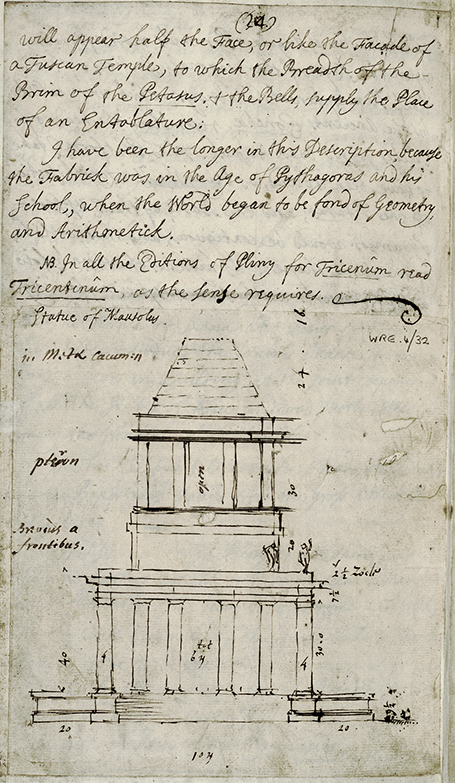
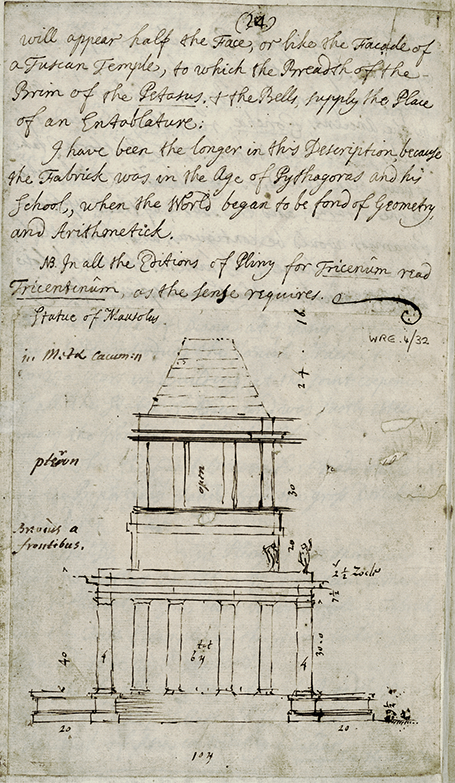
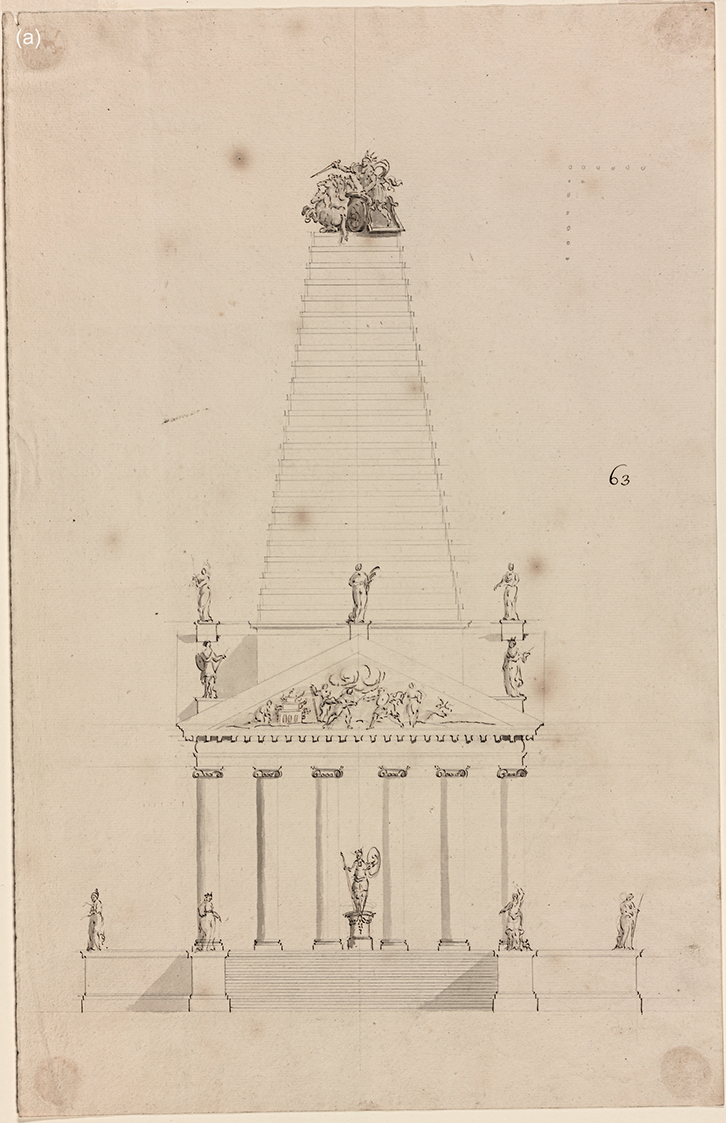
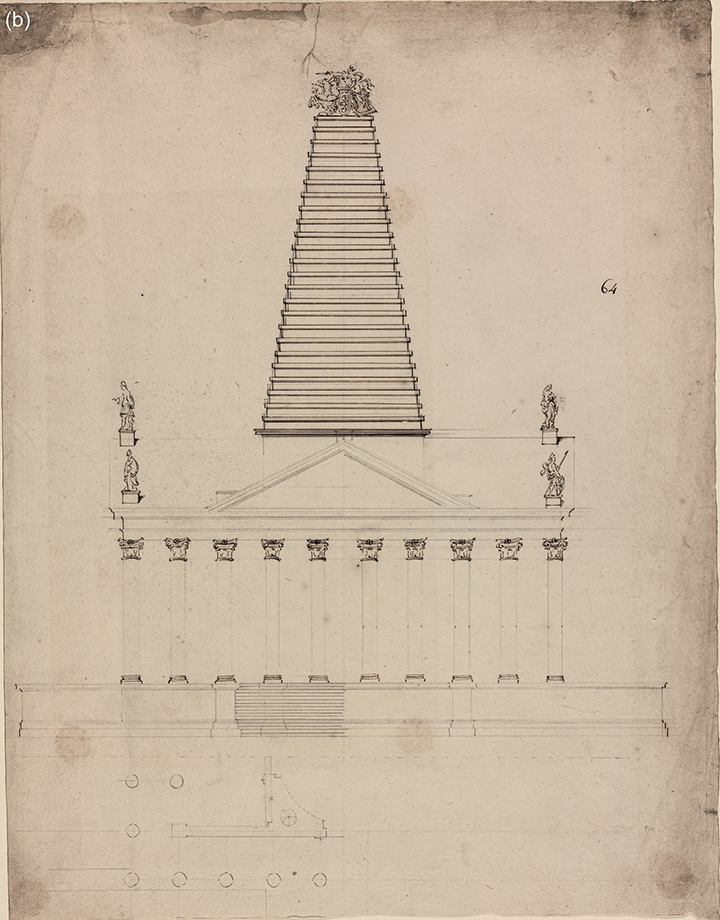
Even if he did not use this comparative method, Hawksmoor’s study of the Natural History, rather than inhibiting what was innovative in his approach, only ended up enhancing it. The character of St George’s design, tempering imaginative extrapolation with rigorous formal control, shows that he freely interpreted the Plinian ekphrasis. In so doing he also indirectly emphasised the inventiveness of the ancient architects of the Mausoleum, Satyrus and Pytheos, in light of his newly actualised potential to modify its constituent elements. This much can be inferred both from his designs for the steeple and the portico of the church. As far as the portico is concerned, the formal arrangement Hawksmoor ended up adopting seems to have very little to do with Pliny, and only in the most general way with Vitruvius, as he favours a specific ancient model for the orders, the Corinthian based on the Temple of Bacchus at Baalbek.Footnote 10 This choice shows that, as for many architects from the Renaissance onwards, Hawksmoor combined an extensive knowledge of ancient monuments derived from his familiarity with antiquarian books and accounts of travellers with purely theoretical concerns.Footnote 11 As for the steeple design, the Composite was selected: a decision which flies in the face of Wren’s own reading of Pliny,Footnote 12 which interpolated the Doric into his restitution proposal, citing his own theory that the Ionic is a refined derivation of the Doric.Footnote 13 From the only drawing that appears to survive of the Mausoleum by Hawksmoor (in the library of the Royal Institute of British Architects, 1750, from the heirloom copy of Wren’s Parentalia), it would seem that he hesitated before making this decision critical of his mentor’s view. This drawing (Fig. 9.5) shows columns without the orders specified, and refrains from any representation of the quadriga of Mausolus and his figure, as if the architect had not yet made up his mind about how to reconstruct the building on paper in accordance with the description of Pliny and its discussion by Wren. Two further drawings from the archives of the All Souls College, Oxford,Footnote 14 testify to Hawksmoor’s continuing interest in the Mausoleum and underpin his decision to utilise it as a point of reference for the spire at St George’s, consonant with the iconographic and formal innovations unleashed by his own invention (Fig. 9.6).Footnote 15
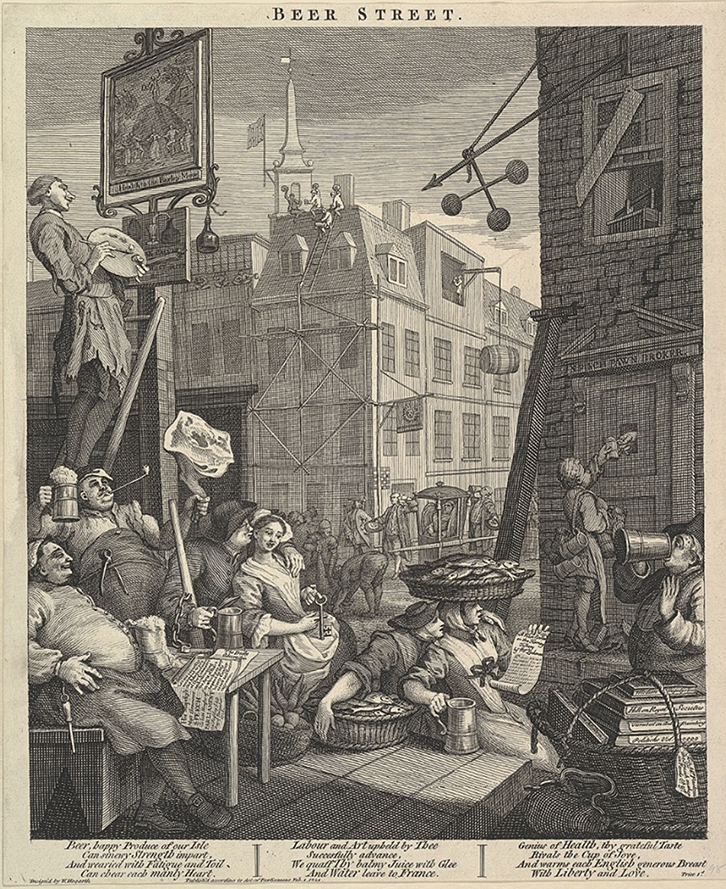
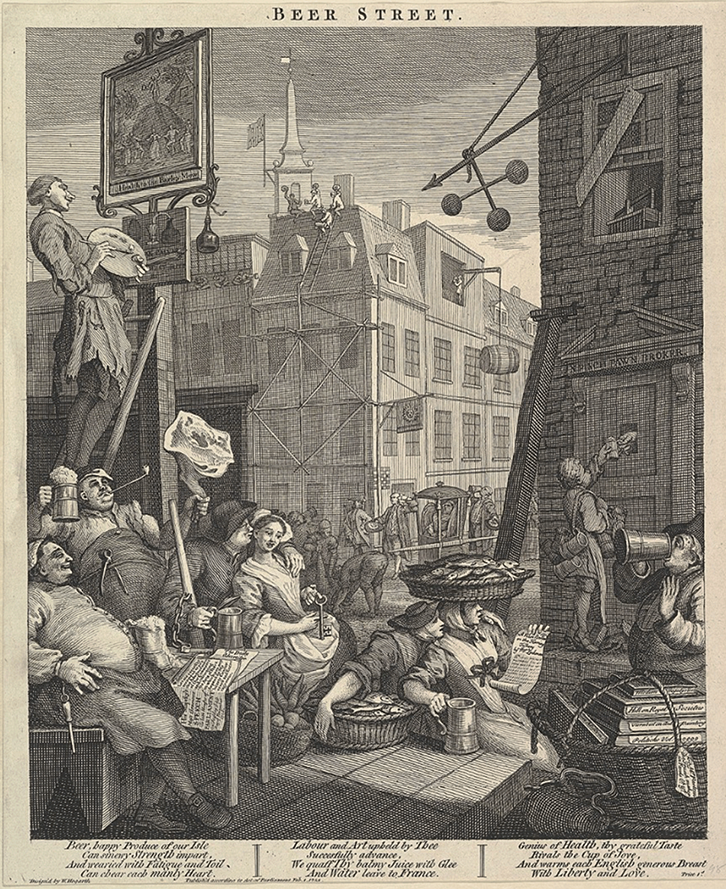
William Hogarth (1751). Beer Street, print, 42 x 34.4 cm (1’5” x 1’2”).
Nicholas Hawksmoor (late seventeenth century). [Reconstruction of the Mausoleum of Halicarnassus after Sir Christopher Wren’s Discussion of Pliny’s Ekphrasis], ink on paper.
Nicholas Hawksmoor or Workshop of Sir Christopher Wren (1661–1726). [Reconstruction Drawings of the Mausoleum of Halicarnassus], graphite and ink on paper, 18.7 x 24.1 cm / 14.35 x 22.8 cm (7” x 9” / 6” x 9”).
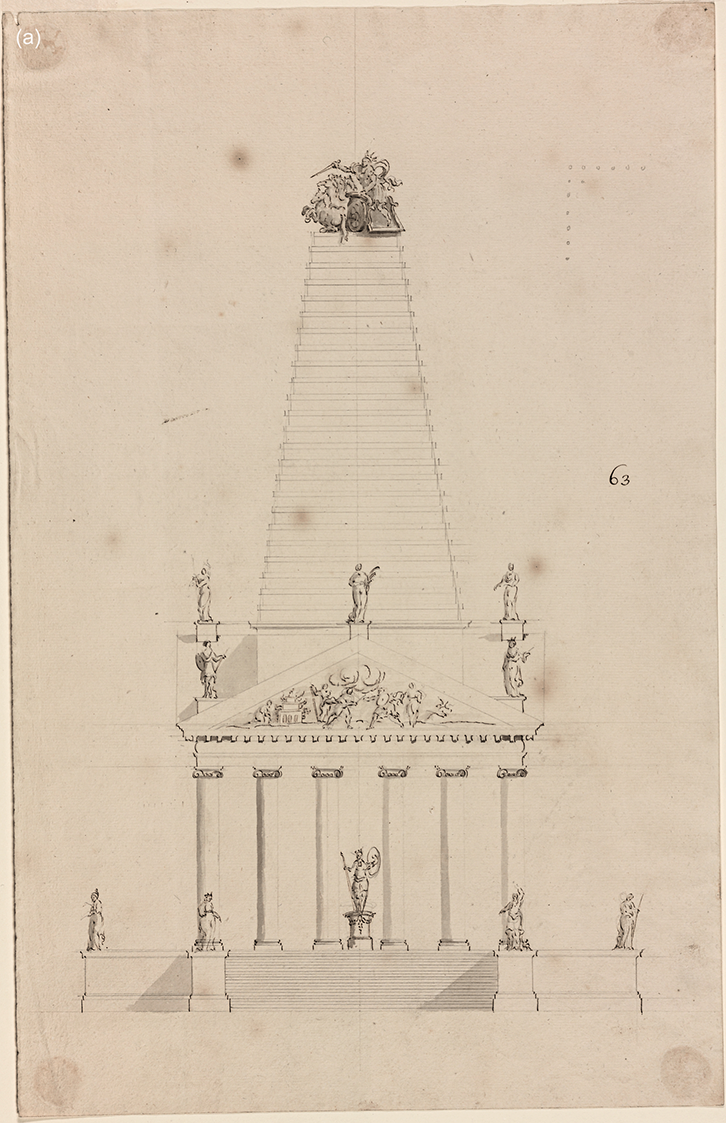
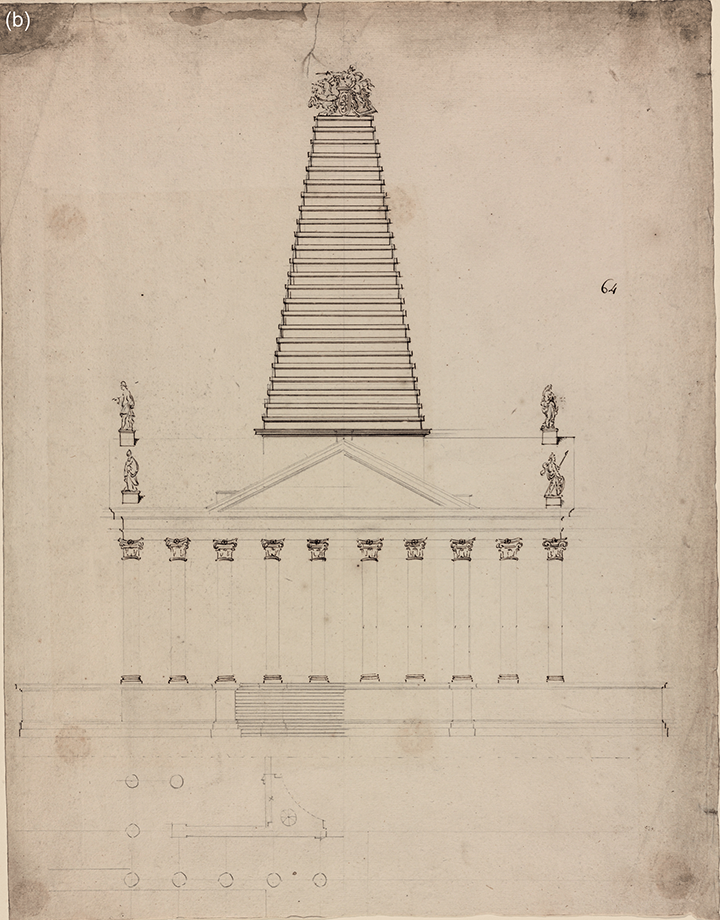
The character and historical roots of this mode of invention are clear enough. For in the case of Hawksmoor – arguably the most powerfully inventive British architect of his era – an awareness of tradition (which comprised both the classical as well as the Gothic languages, not to mention a profound knowledge of Norman churches) only served to increase his appetite for radical experiment.Footnote 16 In this context experiment meant, as Sir John Summerson has shown, an approach to the classical language that freely inserted the constitutive elements of its syntax within a Gothic framework. This complex procedure can be seen in the placement and articulation of the steeple of St George’s Bloomsbury, lending it an unaccustomed visual force and symbolic scope.Footnote 17 Indeed, his first encounter with the Gothic, which occurred very early on, had a liberating effect: it helped bring about the renewal of the syntax and symbolic connotations of the classical language by transposing it to an unexpected key.
The steeple of St George’s, with its classical reference and heroised royal portrait, conveys a specifically British triumphalist image, a key aspect of Hawksmoor’s approach to formal and stylistic conventions derived from classical and Baroque traditions (Fig. 9.2). Sculpture, in the form of Edward Strong Jr.’s statue of King George I, assumes a figurative importance that is greater than in other churches by Hawksmoor.Footnote 18 The analogy is clear: George takes on the role of a new Mausolus, acting as a classicising symbol of British monarchy much as the quadriga driven by the satrap conveyed a triumphal image of his rule. This strategy is in keeping with nationalist narratives emerging in the early eighteenth century. To some extent, therefore, just as charged political symbolism was a characteristic feature of the sculptural programme of the ancient Mausoleum, one can speak, in the case of St George’s, of a transhistorical comparison typical of the practice of heroised portraiture in eighteenth-century Britain.Footnote 19 In a more specific sense this political utilisation of Antiquity and of classical architecture is congruent with Wren’s observation maintaining that ‘Architecture has its political Use … it establishes a Nation’, and which was defined implicitly by an awareness of the political content of ancient exempla.Footnote 20 In light of the political symbolism of St George’s, it is not unreasonable to suggest that this maxim made a deep impression upon the young Hawksmoor.
King George stands upright, clad in some form of classical dress, flanked at his base by heraldic animals in robust, three-dimensional form, on axis with a crown, a proud symbol of the Hanoverian victory over the Jacobite rebellion of 1715 (Fig. 9.2).Footnote 21 The asymmetrical placement of the steeple with respect to the main body of the church, recalling Gothic antecedents of church profiles within the urban skyline, also resonates in emblematic fashion within the emerging national consciousness of Britain. This national character of the image of George I, and his association with his saintly namesake, has specific implications for Hogarth’s representation of St George’s Bloomsbury, which performs a precise allegorical as well as ‘contrapuntal’ role in Gin Lane.
By Hogarth’s time the spire of St George’s had assumed a rather different, more neighbourhood-specific implication: it had become a familiar urban landmark and an integral part of the parish organisation of London. It is no accident that this novel connotation emerged when the threat to Hanoverian legitimacy posed by the first and second Jacobite Risings (1715 and 1745) was beginning to recede, giving way to more local concerns. The memory of this disruption was still very much alive, however, and left a visible imprint on the sculptural programme, which occupies an uncertain territory between the ludic and the heraldic. Indeed, the English lion seems to be chasing the Scottish unicorn around the base of the steeple, in what appears to be a thinly veiled reference to the Hanoverian victory. Further evidence for this hypothesis is provided by the fact that these heraldic animals symbolised England and Scotland respectively from 1603 onwards, with the accession of James VI of Scotland to the throne of England as James I; the notion that the two beasts were locked in battle over the crown may have been intensified in 1707 by the Acts of Union signed in that year.Footnote 22
Hogarth’s Satirical Appropriation of Hawksmoor’s Steeple: An Unexpected Episode in the Afterlife of the Mausoleum
In contrast to these nationalist iconographies and their affirmation of the political unity of Great Britain, the local concerns just mentioned centred on the threat of social instability. Hogarth’s print, in fact, engages two of the most important themes that preoccupied those writers and artists in eighteenth-century London who were conscious of the growth and vicissitudes of their city: the dangers of alcoholism and the spread of crimes of various kinds ranging from robbery to prostitution. Henry Fielding, the novelist and magistrate who was a close friend of Hogarth, wrote An Enquiry into the Causes of the Late Increase of Robbers in 1751, the same year that Hogarth published the pendant prints Gin Lane and Beer Street.Footnote 23 In this text Fielding lamented, ‘Should the drinking of this poison be continued in its present height during the next twenty years, there will, by that time, be very few of the common people left to drink it.’Footnote 24 The dangers to the body politic signalled by both Fielding and Hogarth were closely associated with the ill-repute of a slum area of London – St Giles, near the present-day parish of Bloomsbury – known in the early to mid-eighteenth century for gin-soaked revelry, rampant prostitution and random violence.Footnote 25
In portraying this barely controlled chaos, which extends from the foreground to the background of the print, Hogarth was clearly in his element (Fig. 9.3). At the same time, when representing the steeple of St George’s as part of the skyline, Hogarth recast the dynastic imagery of the parish church, rewriting its political significance. He did this by subsuming Hawksmoor’s appropriation of the image of the Mausoleum under a new visual logic, one that pitted the foreground disorder against the symbolism in the background derived from the formal echoes of the ancient monument. Slightly left of centre in the print one sees St George’s looming spire, whose stepped profile is visible in its main outlines, and even in its tiniest sculptural details, which the viewer is invited to pick out; but its original meaning is inflected in a manifestly parodic direction by the unsettling social context in which it is placed.
This strategy is part of the visual counterpoint with the close-up of the pawnbroker’s sign in Gin Lane, whose diagonal orientation effectively underscores, in an allegorical complement to the steeple, the deeply ingrained, well-nigh ineradicable corruption of modern urban life. This imagery and formal treatment is opposed to the more frontal and orthogonal visual organisation of the pendant, Beer Street, whose subject is the virtuous effects of healthy native British ale as opposed to the foreign gin coming from Europe (Fig. 9.4).Footnote 26 This allegorical contrast ends up being reinforced by the respective architectural foci of the spire shown in Beer Street (reminiscent in certain respects of the steeple of St Martin in the Fields by James Gibbs, though vague enough to suggest many other London churches) and the spire that appears in Gin Lane (far more accurately rendered, as we have seen, making the identification with Hawksmoor’s St George’s Bloomsbury the only one possible).
The steeple stands out for another reason: situated in the deep background, it is at once the farthest and the tallest building depicted in the print, locked in a position within the perspectival organisation of the image that seems to be the most remote from the picture plane. Key to Hogarth’s integration of the spire into the visual texture of Gin Lane is this contrast between foreground and background: a contrast that is not only striking but also paradoxical, both in visual and symbolic terms. This is due to a curious feature of the print: the position of the steeple shown in deep perspective in the far background of the image is not reducible to a straightforward opposition between the actions of the human figures and the depicted architecture. In fact, multiple architectural foregrounds and backgrounds can be seen in Gin Lane (one can count at least four separate planes of representation, each opening onto a view with distinct human figures or small groups of figures shown at different scales). The same ‘telescoping’ of space also affects the narrative implications of the tiny dramas that the society of represented figures, working together, end up producing. Both the architectural and human dramatisations contribute equally to the overall emblematic scenario which stands at the heart of Hogarth’s approach.Footnote 27
The sense of disparity between the image of St George’s steeple and the frenzied excess of the London populace has a precise political implication, insofar as this strategy of representation exposes the emptiness of the claims advanced by the newly minted Hanoverian dynasty (George I had just ascended to the throne in 1714). The claims are hollow because they concern an authority which is incapable of enforcing them. At the same time it is clear that Hogarth has a larger historical point to make. This comes out in his emphasis on the symbolic role of the steeple and its distinctive memories of the Mausoleum. For in doing so he highlights the gap between the greatness of ancient civilisation and the corruption into which the modern British capital had sunk due to the dual impact of a weak foreign dynasty and strong foreign drink.Footnote 28 Hogarth radically recast Hawksmoor’s vision of the Mausoleum: rather than acting as a sign of the return of ancient glory under the Hanoverians, the Bloomsbury spire, along with its antique referent, becomes an unwilling witness to a dramatic lapse in mores.
Hogarth’s accentuation of the violent, the grotesque and the grossly comic effected a profound formal and semantic reorientation of the parameters of reading, visual as well as textual, usually associated with this classical exemplum. Consider, for instance, the salient visual placement of a naked unburied corpse, possibly of a prostitute, in an ad hoc burial ground on axis with the stepped pyramid of the steeple, which seems to provide a grim parallel and a parodic counterpoint in Hogarth’s time with the royal ashes of the satrap contained within the Mausoleum in ancient Caria. Unlike Mausolus, far from being able to construct a costly tomb, she can barely even afford a proper burial. Here the satirical meaning indicated by the deft illusionism of visual proximity parallels that of the aforementioned close perspectival relationship between the steeple and the pawnbroker’s sign, with its three balls forming an adventitious cross: this moralises the entire scene as much as the episodes of imminent danger and actual loss of life, including instances of infanticide, starvation, madness and suicide which permeate the space of the print. A house, structurally unsound, falls to pieces, as its roof and wall collapse, endangering the pedestrians below: this offers a clear contrast with Hawksmoor’s steeple rising in the distance and with the industrious workmen finishing the roof of a new house in the pendant print, Beer Street. Words as well as images (in particular the image of architecture) drive the moral home. The gin cellar below, Gin Royal, advertises its wares with the slogan: ‘Drunk for a penny / Dead drunk for twopence / Clean straw for nothing.’ Since Hogarth’s is fundamentally an emblematic art, the crucial factor in all of this is not simply the distillation of a spectacle made up of the denizens, upheavals and crises of urban existence in mid-eighteenth-century London, but the reciprocal engagement of allegorical representation and satirical type-casting that is deployed to represent it. This reciprocity joins Gin Lane and Beer Street into a single whole, a diptych whose combination of dramatic overstatement and fine-grained composition makes it one of the exemplary works of Georgian sensibility.
Earlier I observed that the figure of George I – an unprepossessing monarch, often ridiculed by his subjects, during whose reign the power of the crown diminished – had an unintended comic effect when he was represented as the ‘successor’ of Mausolus.Footnote 29 Hogarth harnessed and amplified this effect when he integrated the sculpted royal figure into the visual and social texture of the print. The message of the latter can be summed up in the following words: though drunken and violent due to the effects of gin, the people of London are not wrong to mock the weakness of their ruler, whose pretension to match ancient glory rings hollow. The fact that gin is imported from the Continent resonates satirically and politically with the fact that the Hanoverians too were imports: the gin is as strong as they are weak. Since George I struck not only the artist but many of his contemporaries as ludicrous, the suggestion – implicit in Hawksmoor’s church – that Mausolus could serve as a plausible precursor for George I seemed equally, if not more patently, absurd.
Defined by a sharp antithesis between the deleterious effect of imported alcohol and a monumental vision of British gravitas, Hogarth’s détournement of the spire marks a point of departure that is as radical as any in the afterlife of the ancient monument. This is the case not simply because the English artist’s dismantling of the pretensions of the Hanoverians, an act of pointed satire achieved through the print medium, reached a wider audience than Hawksmoor’s architecture ever could, but also because Gin Lane marked the first time since Antiquity when the image of the Mausoleum (represented here at a second remove) was deliberately put to comic use.
*****
Wren’s unorthodox use of Vitruvius as a theoretical framework – our initial point of departure – discloses an inverted parallel when compared to another textual reception, that of Hogarth himself, whose visual appropriation of Hawksmoor’s church, and of the London cityscape more generally, was mediated by his equally inventive reading of another classical source. This was the ancient satirist Lucian, in whose Dialogues of the Dead Hogarth had taken a clear interest already by the mid-1720s, three decades before the production of the print itself. This author (in Dialogues of the Dead, 29; Appendix i.vii) criticised the grandiose ambition and unbridled hybris of Mausolus, just as Hogarth poked fun at the image of King George, in pompous classical garb, that Hawksmoor placed at the summit of his Mausoleum-inspired steeple.Footnote 30
In the preceding pages I have argued that Hogarth, by alluding to Hawksmoor’s church, mutatis mutandis also reworked the image of the Mausoleum. Reception being like translation, one can suggest that the process of resignification of the ancient monument began with Wren’s reading of Pliny’s text, then moved to Hawksmoor’s building (with Edward Strong’s sculpture) and finally culminated in Hogarth’s print. Were period audiences aware of this double reception and the meanings that were lost, added and transformed along the way?Footnote 31 And was it necessary for these viewers to be familiar with Lucian’s parody of Mausolus to understand, either in full or in part, the wider implications of Hogarth’s ‘serious comedy’?Footnote 32 At first glance, it would seem to be impossible to wholly accept either of these scenarios. And yet, at the same time, a familiarity with Lucian would have led to a more solid grasp of the satirical exposure of Hanoverian royal pomp implicit in the reference to Mausolus, who was reputed to have been the most extravagant of ancient rulers, and who was harshly and hilariously criticised by Lucian precisely for his mania for building and his funerary vanity.Footnote 33 It would also have shown how ridiculous George I appeared to be when compared with a figure as powerful and influential as Mausolus was in his time, despite the latter’s flaws, whether these were real, perceived or simply the exaggerated results of ancient polemic, delivered in the context of the satirical genre epitomised by Lucian.Footnote 34
We can therefore understand Hogarth’s undertaking better if we see it as drawing on a deeper tradition of receptions of the Mausoleum – Lucian’s included – which it adapted to its own satiric purposes. But what did it mean to evoke ancient satire in Georgian London? In this context it meant turning against the antiquarian assumptions of Wren and Hawksmoor, in line with the uses of satire more generally in that period. As is often the case with the Nachleben of significant works of art and architecture, long- and short-term temporal frameworks intersect in the historical trajectory of appropriations of the Mausoleum. Gin Lane follows this pattern, but in a paradoxical sense, since within its figurative space antiquarian memory and satiric commentary converge in ways that reveal the specific tensions of its era. The memory of the Mausoleum, then, does not function as a straightforward antiquarian reference, but is deployed to show the obsolescence of the heroic mode that was taken for granted in the previous generation.Footnote 35 One could say that this all’antica mode had itself become antiquated by Hogarth’s time, due precisely to the efficacy of his visual wit. As such its deployment underscores the inability of the Baroque, as exemplified by Hawksmoor, to overcome the gap between the glorious past that this style was habitually utilised to invoke and the proliferating miseries of the present.

 Open access