

Introduction
Although the world is three-dimensional, archaeological artefacts and their properties such as colour, texture and geometry, which are crucial for understanding and interpretation, are turned into flat, static, two-dimensional productions by conventional recording techniques. Field notes, drawings and multiple types of photography, we often assume, attempt to record the information gained from the material traces in the field and preserve a ‘record’ which will act as a mnemonic reference of the process of fieldwork. But in fact, these recording processes and devices do something else. They produce a new field assemblage (cf. Hamilakis Reference Hamilakis, Boyd and Doonanin press), a material assemblage that does not represent faithfully and accurately the material realities encountered in the field, but rather brings into existence new material realities which evoke (rather than record), more or less, the field processes and the material traces encountered there. Moreover, these recording devices more often than not operate within a mentalist, Cartesian framework, and as such they do not do justice to the material and sensorial dimensions of things; they thus translate features that have form, texture and colour, and are experienced by all our bodily senses, into a flat surrogate, a sensorially impoverished assemblage. The flattening of archaeological evidence can be observed not only in the outputs of recording, e.g. a rendering of a structural feature, or an artefact, but also in the ways that interpretations are crafted in conventional research and publication media. The process of recording, however, has a profound sensorial character, for example when rubbing or even tasting the soil to identify its composition, positioning the body at awkward angles to photograph a context, and handling an object to identify its subtle surface details. Nevertheless, this sensoriality is absent in most conventional outputs of the recording process.
Clay figurines have, until recently, been treated as images (e.g. Lesure Reference Lesure2011; cf. recent studies discussed below), as artistic depictions whose meaning needs to be deciphered through various iconological methods. As such, they were—and in many cases are still—rendered and represented as two-dimensional, finished and static entities. Their formal qualities, e.g. size, decoration, bodily features and proportions, and so on, took priority over, say, material processes, technologies of making and unmaking, post-production modification, circulation, deposition and discard.
Yet, as recent studies have shown, clay figurines were continuously made and unmade: they were intentionally fragmented, burnt, reshaped and re-introduced into circulation (see e.g. Chapman Reference Chapman2000; Chapman & Gaydarska Reference Chapman and Gaydarska2007; Meskell Reference Meskell and Insoll2017; also see below). For past people, these were three-dimensional clay objects (or subjects), in constant flux, meant to be engaged with multi-sensorially: handled, interfered with, interacting with human bodies, and with other entities, such as architectural features (buildings, walls, post-holes, etc.), other portable objects, such as house models, water, fire, and so on (cf. Farbstein Reference Farbstein2013 on Palaeolithic portable art). Although this dominant, image-based discourse has been challenged by several studies in the last decade (see below), it has largely shaped the way they are depicted in archaeological iterations and publications, and it is this corpus of images that has in turn shaped further thinking and discussion on figurines, especially since very few people are able to handle the original, three-dimensional, physical objects.
Considering the changing framework in figurine studies, from one that treats them as images to another that considers them as multidimensional entities, this paper discusses the application of computational imaging to the Neolithic figurines from the site of Koutroulou Magoula in Greece. It argues that such methodologies not only provide new means of understanding, interpretation and dissemination, but, most importantly, enable us to study artefacts as three-dimensional material objects that possess dynamic biographies, have undergone a series of transformations, and carry affective import and significance, in the past as well as in the present.
However, in order to achieve such a potential, these methodologies need to be deployed within an experiential, multi-sensorial framework. In the first part of the paper, we will problematize and critique figurine studies that emphasize purely visual, static, two-dimensional aspects of the artefacts, while highlighting recent work that considers their multi-sensory, embodied and evocative nature. In this context we will discuss the potential of computational frameworks which foreground the synaesthetic and multi-sensorial character of vision, to explore the sensorial affordances of digital, three-dimensional objects. Finally, we will discuss our case studies that exemplify the under-explored sensorial dimension of the methods, and propose a novel way of experiencing material culture sensorially and affectively through the lenses of the digital. This article is not meant to be a presentation of the corpus of clay figurines from Koutroulou Magoula, material which is still under study.
Towards sensorial digital archaeologies
This paper is situated within a recent call for a shift away from the ocularcentrism of archaeological practice (Day Reference Day2013; Hamilakis Reference Hamilakis, Hamilakis, Pluciennik and Tarlow2002; Reference Hamilakis2013; Reference Hamilakis2017; Hamilakis et al. Reference Hamilakis, Pluciennik and Tarlow2002; Thomas Reference Thomas, Thomas and Jorge2008), and the emphasis on an abstract, isolated and disembodied sense of vision, which has largely shaped the way that archaeological traces and objects have been treated and the associated narratives constructed, in older and more recent studies. In the case of figurines, such ocularcentrism has rendered figurines mostly as flat images and acorporeal artistic depictions. Within this stylistic schema, the presence or absence of certain formal features, such as sexual organs, for example, has led to decontextualized, cross-cultural interpretations and universal underlying rules (e.g. female goddess, fertility cults, male/female duality, etc.; see e.g. the work of Gimbutas Reference Gimbutas1974; Reference Gimbutas1991). This is also evidenced in the way the techniques used for their representation, mainly photography and drawing, have been deployed.
More often than not, in these Cartesian renderings, geometries, shapes, textures and colours are transformed into flattened and conventionalized versions ruled by a static, two-dimensional perspective. It is well known that photography, rather than being an objective mode of representation that relies on automation and chemistry, reflects what cameras are technically capable of capturing as well as the operators’ choices and intentions; it materializes a certain historically and socially situated gaze. For example, skimming through Orfanidi's (Reference Orfanidi2015) e-publication Interpretation of Neolithic Figurine Art (in Greek), it is noticeable that figurines are mainly treated as artistic productions that present certain typological features. The images, although abundant and in colour, only capture the viewpoint that highlights the formal features under discussion (e.g. hair, noses, breasts, etc.), and as a result, they only have a secondary, illustrative role, failing to foreground the figurines’ material and sensorial qualities, the dynamic processes that resulted in their formation, and their affective impact.
Similarly to the fetishization of objectifying, documentary photography, drawings have also been treated as a ‘valuable social currency’ (Bateman Reference Bateman and Edgeworth2006, 80) in archaeology. This notion was supported by early English archaeological practice, where both Petrie (Reference Petrie1904, 114–15) and Pitt Rivers (Piggott Reference Piggott1965, 174) were arguing that a site can best be described by illustrations, and secondarily by text, to let the readers make their own decisions and use text only to coordinate their thoughts. Although drawings are considered objective sources of information, probably because of the analogue media used in their production, they constitute interpretations, they depend on individual skills and decisions about what to capture and how (Morgan & Wright Reference Morgan and Wright2018). Leibhammer (Reference Leibhammer, Papadopoulos and Moyes2018) discusses the ‘birthing mother goddess’ found in Çatalhöyük, and the way that James Mellaart used ‘“the objective” graphic conventions of science to convince viewers of what was not really there’. Apart from elements related to reconstructed features of the figurine, e.g. the head, Leibhammer particularly examines the ways that light and shadow have been manipulated in the published drawings to reinforce Mellaart's interpretation of the figurine as a Mother Goddess who gives birth to a son. For example, despite her posture not resembling a birthing position, and although the clay lump does not have the features of a baby coming out of a womb, shading in the drawings makes a rather amorphous piece of clay look like a rounded head with facial features, such as eyes and nose.
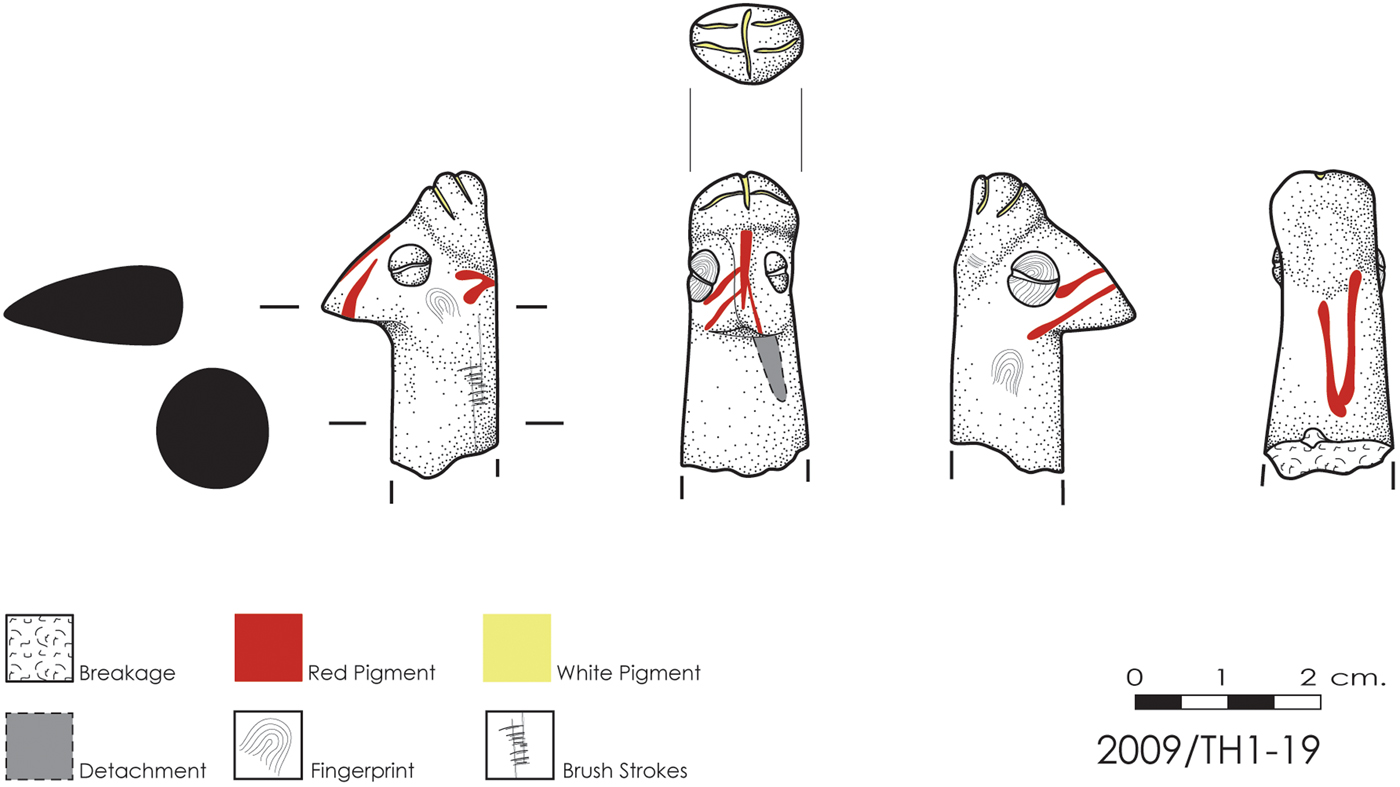
It becomes apparent that the three-dimensional qualities of figurines which enable corporeal, multisensorial, and kinaesthetic experiences are mostly obscured by conventional, mentalist representational renderings. As a result, the performative and interactive processes of making, using, breaking, burning, discarding and depositing figurines are reduced to an abstract and disembodied aesthetic: appreciation of two-dimensional artistic forms (for further critique, see Bailey Reference Bailey, Russell and Cochrane2014a; Meskell Reference Meskell2015). Photographs and drawings can, of course, evoke three-dimensionality and sensoriality, so it is not the medium per se which is the problem, but the framework within which it is used, and the ways that such mimetic technologies are deployed (cf. Morgan & Wright Reference Morgan and Wright2018). A common practice in drawings of small finds is to depict only the facets that exemplify typological features and manufacturing processes, such as incisions and pigments, thus depriving viewers of the ability to experience the original object as well as the new object-drawing as tactile, three-dimensional entities which are constituted relationally within certain sensorial fields shaped by human and non-human actors, by light and by labour and skill. In the case of the Koutroulou Magoula figurines, the drawing process takes place at the same time and alongside all other recording processes and is in constant interaction with them. The outcome is the result of a constant interpretative dialogue involving the whole study team. The original pencil drawings and the digital illustrations were refined when our digital methods revealed features that were not identified in an earlier stage. In addition to emphasizing the figurines’ multiple facets and subtle details, we have attempted to provide a sense of three-dimensionality, tactility, depth and interaction with the light, by using, for example, a combination of shading and varying line strokes (Fig. 1). Although in this paper we focus on the power of three-dimensionality, texture and colour to provide a framework for discussing the sensorial and evocative qualities of artefacts, we believe that three-dimensional methods should be considered in combination with established two-dimensional ones, as they open up the perceptual and conceptual potential of visualization.
Figurine 2009/TH1-19. Multi-faceted digital illustration (after a pencil drawing) showing subtle surface details, such as fingerprints and brush strokes. (Illustration: Kalliope Theodoropoulou.)
In this paper, we explore digital archaeology as a physical prosthetic that provides ‘strands of research, knowledge and perception’ (Chrysanthi et al. Reference Chrysanthi, Murrieta-Flores, Papadopoulos, Chrysanthi, Murrieta- Flores and Papadopoulos2012, 9) and focus on applications that, despite their vision-centred basis, have the potential to advance the discussion on sensoriality by foregrounding three-dimensional properties and evoking corporeal, multisensorial and kinaesthetic, affective experiences (for a recent discussion on sensory engagements in archaeological/artistic practice, see Gant & Reilly Reference Gant and Reilly2017). However, we do not intend to refer to prosthetics that attempt to simulate isolated senses, such as the virtual cocoon (Chalmers & Zányi Reference Chalmers and Zányi2009), a virtual-reality helmet that stimulated senses by using devices that could generate sound, smell, taste, various temperatures and so on, or the Dead Man's Nose (Eve Reference Eve, Henshaw, McLean, Medway, Perkins and Warnaby2017a), a prototype that emits different smells according to the location of the user. Although some of these, and especially Eve's embodied GIS approach within a Mixed Reality framework (Eve Reference Eve2017b; Reference Eve2018), provide a basis for integrating sensorial flows into a dynamic whole, we believe that such approaches do not do justice to the complex processes of experience and perception, and as noted above, treat sensoriality as a matter of bodily organs and isolated interaction devoid of affectivity, within a model of exterior stimuli and interior cognitive processing (see Hamilakis Reference Hamilakis2013, 106–8, for a critique).
A significant amount of work has focused on 3D simulations and quantitative analyses of ancient environments to explore social, cultural and symbolic dimensions of the past by assuming vision to be the principal modality that shaped past experiences (see e.g. Opitz Reference Opitz2017; Paliou et al. Reference Paliou, Wheatley and Earl2011; Papadopoulos & Earl Reference Papadopoulos, Earl, Paliou, Lieberwirth and Polla2014). Experiments with sound modelling (see e.g. Díaz-Andreu & García Benito Reference Díaz-Andreu and García Benito2015; Murphy et al. Reference Murphy, Shelley, Foteinou, Brereton and Daffern2017) or a combination of vision and sound (e.g. Paliou & Knight Reference Paliou, Knight, Contreras, Farjas and Melero2013) have also been conducted. Despite the obvious interpretative value of such approaches, we ought to emphasize that in the theoretical framework proposed here, the response of a present-day user to a 3D (re)construction mediated via a computer monitor (or any other image generating device) and the translation of spatial experience into pixels cannot account for the synaesthetic, kinaesthetic, corporeal and affective experience that the dwellers of those spaces had in the past. As we have noted elsewhere (Papadopoulos et al. Reference Papadopoulos, Hamilakis and Kyparissi-Apostolika2015), such approaches are open-ended and speculative experiments which are inherently limited by their implied, often Cartesian, modernist theoretical assumptions and their reliance on the western sensorium.
Advances in tools and methods for 3D digitization, including the affordability of hardware and the accuracy of computational algorithms for image-based reconstructions, have democratized the process of recording archaeological artefacts. In recent years, large institutions, including the British Museum and the Smithsonian, have not only developed a robust 3D digitization programme of their collections, but have also made available (and in many cases downloadable, and thus 3D printable) many of their scans, using online publishing platforms such as Sketchfab (https://sketchfab.com/) or the bespoke Smithsonian X 3D (https://3d.si.edu/). Such broad implementation of 3D artefact modelling has already started transforming archaeological practice, posing a series of epistemological and ethical issues, such as social value in relation to the democratization of production (Jeffrey Reference Jeffrey2015), transparency and authenticity (Rabinowitz Reference Rabinowitz, Olson and Caraher2015), biases and subjectivities (Garstki Reference Garstki2017), as well as paperless archaeology (Morgan & Wright Reference Morgan and Wright2018).
Many 3D recording projects have also implemented scanning and imaging methods to capture detailed morphological aspects of artefacts of various sizes and materials and use these for further analysis, from fingerprint identification and extraction in clay oil-lamps (Lapp & Nicoli Reference Lapp and Nicoli2014) and cuneiform tablets (Mara et al. Reference Mara, Krömker, Jakob, Breuckmann, Artusi, Joly-Parvex, Lucet, Ribes and Pitzalis2010) to the identification of processes of making, including erasure and reworking in rock art (Díaz-Guardamino et al. Reference Díaz-Guardamino, Garcia-Sanjuán, Wheatley and Rodríguez Zamora2015; Pitts et al. Reference Pitts, Miles, Pagi and Earl2014) and portable art (Jones & Díaz-Guardamino Reference Jones and Díaz-Guardamino2019; Jones et al. Reference Jones, Cochrane, Carter, Dawson, Díaz-Guardamino, Kotoula and Minkin2015; Milner et al. Reference Milner, Bamforth and Beale2016). These methods have also enabled the detailed recording of previously inaccessible artefacts, for example those in underwater environments (Selmo et al. Reference Selmo, Sturt and Miles2017), or dispersed in different labs and archaeological collections (Katz Reference Katz2017). More advanced (but less affordable) methods, such as Computed Tomography that enables 3D densitometric analysis of structures, have also been applied to various artefacts, including coins (Miles et al. Reference Miles, Mavrogordato, Sinclair, Hinton, Boardman and Earl2016), portable Palaeolithic art (Bello et al. Reference Bello, De Groote and Delbarre2013) and clay figurines (Applbaum & Applbaum Reference Applbaum, Applbaum, Garfinkel and Miller2002; Farbstein & Davies Reference Farbstein and Davies2017). Apart from archaeological interpretations, these methods have also enhanced conventional conservation strategies, for example by identifying decay, previous repairs and reconstructions, and taking preventive conservation measures (Kotoula Reference Kotoula2015; Reference Kotoula, Papadopoulos and Moyes2017).
The ease of producing 3D models and the affordability of consumer-level 3D printers and 3D printing bureaus have created the necessary conditions for the adoption of additive manufacturing in archaeological research, museum exhibition, restoration and outreach (Balletti et al. Reference Balletti, Ballarin and Guerra2017), moving from the analogue to the digital and back again (Jeffrey Reference Jeffrey2015; Sloan Reference Sloan2012; cf. ‘phygital nexus’ in Gant & Reilly Reference Gant and Reilly2017). This aligns with a recent call in museum studies to place emphasis on handling and multisensory experiences (see e.g. Dudley Reference Dudley2012; Howes Reference Howes2014; Levent & Pascual-Leone Reference Levent and Pascual-Leone2014; Pye Reference Pye2007) and falls within the recent Maker Movement that stresses the importance of making as a form of critical thinking, problem-solving and reflection (Halverson & Sheridan Reference Halverson and Sheridan2014; Hsu et al. Reference Hsu, Baldwin and Ching2017; Resch et al. Reference Resch, Southwick, Record, Ratto and Sayers2018). 3D-printing applications have focused on issues of accessibility in museum contexts (see e.g. Wilson Reference Wilson, Stott, Warnett, Attridge, Smith and Williams2018), as well as teaching and outreach (Katz Reference Katz2017; Pollalis et al. Reference Pollalis, Minor, Westendorf, Fahnbulleh, Virgilio, Kun and Shaer2018). On the other hand, experimental studies and studies of proofs-of-concept have primarily addressed issues similar to those discussed in the context of traditional replicas; for example, how handling and manipulation of 3D printouts affect our perceptive experiences in relation to conventional ways of seeing objects in a display case, on a computer monitor, or by using stereoscopic and haptic devices (see e.g. Di Giuseppantonio Di Franco et al. Reference Di Giuseppantonio Di Franco, Camporesi, Galeazzi and Kallmann2015; Reference Di Giuseppantonio Di Franco, Matthews and Matlock2016; Williams Reference Williams2017). Although 3D printing is still at its early stages, especially in heritage contexts, theorization has started moving beyond the concept of replica making, addressing the key question of authenticity (Jones et al. Reference Jones, Jeffrey, Maxwell, Hale and Jones2017) and posing grand challenges for archaeological practice, including the rematerialization of archaeological features unearthed in the field (Beale & Reilly Reference Beale and Reilly2017; see also Reilly et al. Reference Reilly, Todd and Walter2016).
In the context of virtual reality and digital (re)construction approaches to archaeology, Frieman and Gillings (Reference Frieman and Gillings2007) have aptly argued that the ‘methodological tail has been firmly wagging the dog’, with critical discussion and evaluation taking place after the applications, resulting in a methodologically advanced but under-theorized field. This technological fetishism (Huggett Reference Huggett2004), dictated by the affordability of the methods (especially in the last few years, where everybody can create a 3D model and print at home a replica of a cultural heritage artefact), has set the agenda in digital archaeology, therefore, establishing a view that methods precede theory and that theorization comes after the mastering of methods (but see Díaz-Guardamino & Morgan Reference Díaz-Guardamino and Morgan2019). This is also the case with the majority of the projects mentioned above, which may provide novel interpretative means of analysing material culture, but the emphasis is placed on the integration of digital tools in conventional archaeological reasoning, the development of the methods and the visual enhancement of geometries, textures and colours. As a consequence, the sensorial and affective processes and entanglements that shaped, transformed and animated such material culture, and the ones that are engendered by it, remain neglected. In this paper, we establish an exploratory theoretical framework aimed at evoking past sensoriality rather than (re)constructing, simulating, or visually enhancing it. In so doing, we also encourage an exploration of the sensorial affordances of the digital in the present.
Figurine studies and sensoriality
Bailey, in his pioneering work on prehistoric figurines (Reference Bailey2005), suggested that emphasis should be placed on their physical properties, i.e. anthropomorphism, miniaturism and three-dimensionality, to explore how they may have shaped the ways that makers and users integrated them into their everyday lives. Especially in relation to three-dimensionality, Bailey identified a paradox (Reference Bailey2005, 39–41): that is, people holding a figurine can never comprehend the object in its entirety, since they are not able to see two sides at the same time. Although one could easily argue that this is also true for the static representations of figurines in conventional catalogue-type publications, it seems that in this early attempt to consider figurines’ three-dimensional properties, Bailey prioritized the visual qualities of objects: ‘spectator’; ‘entire view’; ‘be viewed’, thus neglecting the ‘cheirotic apprehension’ as he called it 10 years later (Bailey Reference Bailey and Dent2014a). More specifically, in that article titled ‘Touch and the cheirotic apprehension of prehistoric figurines’, Bailey argues in an apologetic tone:
I realise now that my work has remained within the limitations of a visual approach … I have become less convinced that I had provided any real insight into the mechanics of how the emergence and dominance of the body within European senses of identity and community had happened in the daily, lived experiences of Neolithic people … I had neglected considering the significance and powerful consequences of knowing through touch. (Bailey Reference Bailey, Russell and Cochrane2014a, 32)
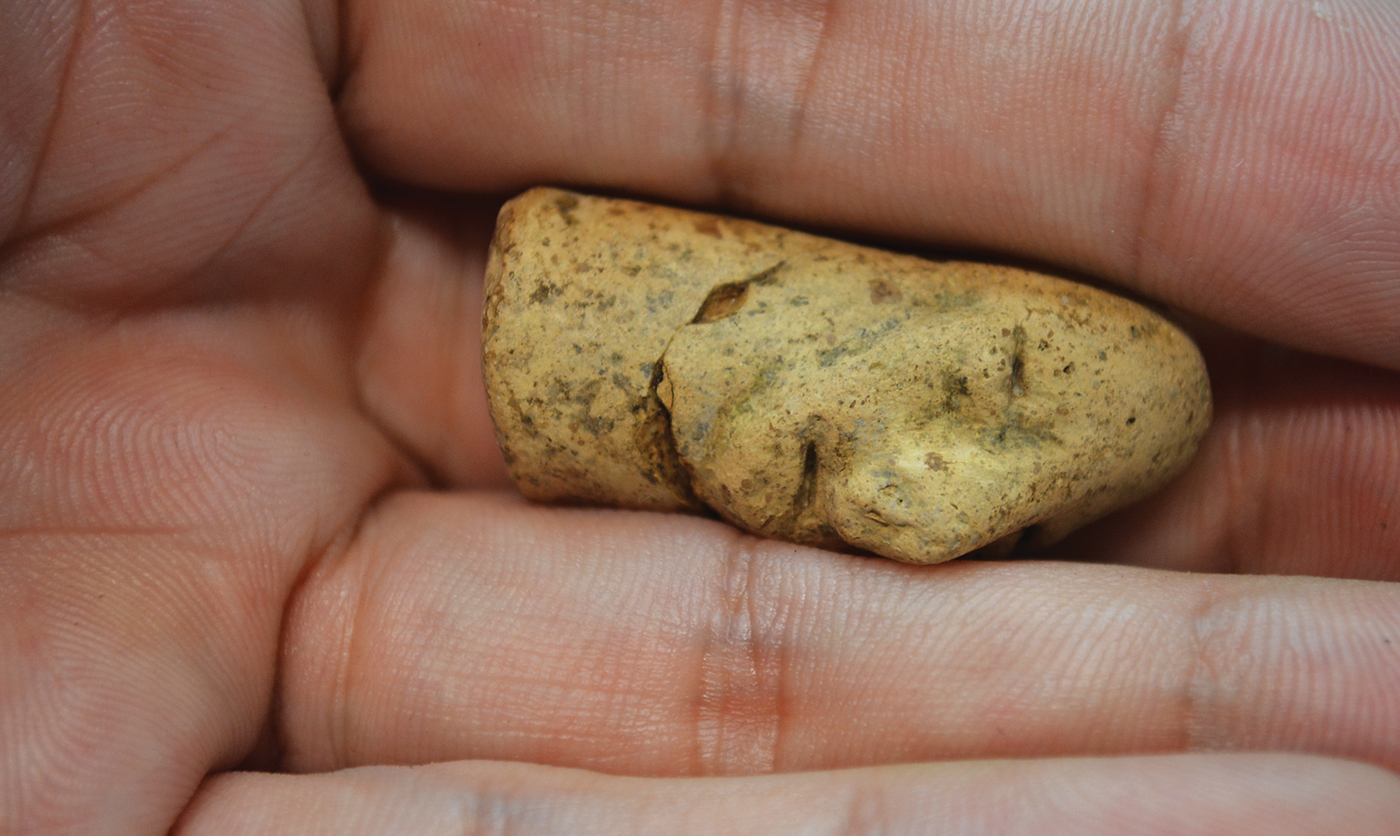
Although Bailey acknowledges certain limitations in his approach, he was actually one of the first scholars within figurine studies who encouraged an appreciation of the tactile affordances of figurines. Although this may not be clear in his written work, Bailey proposed a powerful way of sensing figurines by including in his publications images that shifted away from the conventional illustrations that dominate academic scholarship to the present day. For example, images in the front matter of Prehistoric Figurines (Bailey Reference Bailey2005) significantly depart from the conventional photographic representations that isolate the objects from their makers and (past and present) users. They depict, for example, a muddy hand grasping a figurine, a palm holding figurine fragments and a close-up of a figurine in which it seems that equal emphasis is placed on the head of the figurine and the contour lines of the fingers holding it, as we did with the figurines from Koutroulou Magoula and the photography of Fotis Ifantidis (Fig. 2) (for further experimentations with the tactility of the figurines, see Bailey Reference Bailey, Robb and Borić2008). These are situated within Bailey's early attempts to address the need for incorporating non-standard practices in the study of figurines as a means to break free from conventional archaeological reasoning and interpretations. In the book Unearthed (Bailey et al. Reference Bailey, Cochrane and Zambelli2010) that accompanied the exhibition at the Sainsbury Centre for Visual Arts at the University of East Anglia (UK), Bailey further exemplified the need for creative, artistic and art/archaeology practices by inviting artists, photographers and philosophers to use figurines to generate unexpected, sometimes disturbing for conventional archaeological practices, responses, that in turn can provide not only atypical ways for understanding the role and function of figurines in the past, but also novel tools and frameworks for studying and engaging with them in the present, beyond scientific interpretations and explanations (Bailey Reference Bailey and Dent2014b; Reference Bailey and Insoll2017).
Head of figurine ΑΜΕ230 (Trench Θ, Reference Bailey and Dent2006) resting on the fingers of the photographer. (Photograph: F. Ifantidis.)
Beyond Bailey's thought-provoking attempts to consider figurines as artefacts and not ‘as images or as texts’ (Weismantel & Meskell Reference Weismantel and Meskell2014, 234), there is a substantial corpus that explores the materiality of figurines and suggests new ways of experiencing their physical and social dimensions. For example, Joyce (Reference Joyce1998) has explored bodily practices and their representation in Pre-Hispanic Central American figurines, as well as in a corpus of ‘Playa de los Muertos’-style figurines from Honduras (Reference Joyce2003) to discuss social acts and their relation to theories of the body. Meskell and Nakamura (Reference Meskell and Nakamura2005) have experimented with video documentation of figurines to capture the artefacts’ three-dimensionality and the experience of seeing and manipulating them from multiple perspectives. Mina (Reference Mina2008) has discussed gender construction and social identity—in both the Neolithic and the Bronze Age—challenging established notions of social organisation in Aegean prehistory. Her work has also highlighted asexual figurines (Mina Reference Mina, Hamilton, Whitehouse and Wright2007) as a distinct category that, although lacking the anatomy of female and male figurines, embodies gender identity. Nanoglou's work (e.g. Reference Nanoglou2005; Reference Nanoglou2008; Reference Nanoglou2009) has problematized the materiality of representation, particularly exploring the affordances of clay and stone in the Neolithic figurines from central and northern Greece. Similarly, Weismantel and Meskell (Reference Weismantel and Meskell2014) have focused on figurines from Çatalhöyük, Turkey, and human effigies from Moche, Peru, to discuss the material substances they were made of/for and their affordances and meanings as bodies. Nakamura and Meskell (Reference Nakamura and Meskell2009) examined figurine making as performance (see also Meskell Reference Meskell, Renfrew and Morley2007), while Gheorghiu (Reference Gheorghiu, Gheorghiu and Cyphers2010) employed the methodological framework of experimental archaeology to explore figurine making as an embodied ritual. Sofaer (Reference Sofaer2015, 21–39) examined the role of hands in the creative process of modelling Bronze Age clay figurines from the Carpathian Basin, discussing how different ways of modelling are expressions of embodied thought. Cochrane and Russell (Reference Cochrane, Russell, Russell and Cochrane2014) used a series of artistic interventions as part of the Theoretical Archaeology Group conference (TAG 2007) in York and the World Art Forum 2008 in London by placing replicas of Cycladic figurines throughout the places where the events were held. Their intention was to explore people's responses to objects, e.g. by moving, stealing, or destroying them, and reflect on the (un)intentional character of figurine making and using. Halperin (Reference Halperin2014), on the other hand, studied the life-cycle of Late Classic Maya figurines (c. 600–900 ad) to explore how the ideological apparatus of the Maya ‘states’ influenced household practices and, in turn, how states used domestic practices to formulate and disseminate their ideologies.
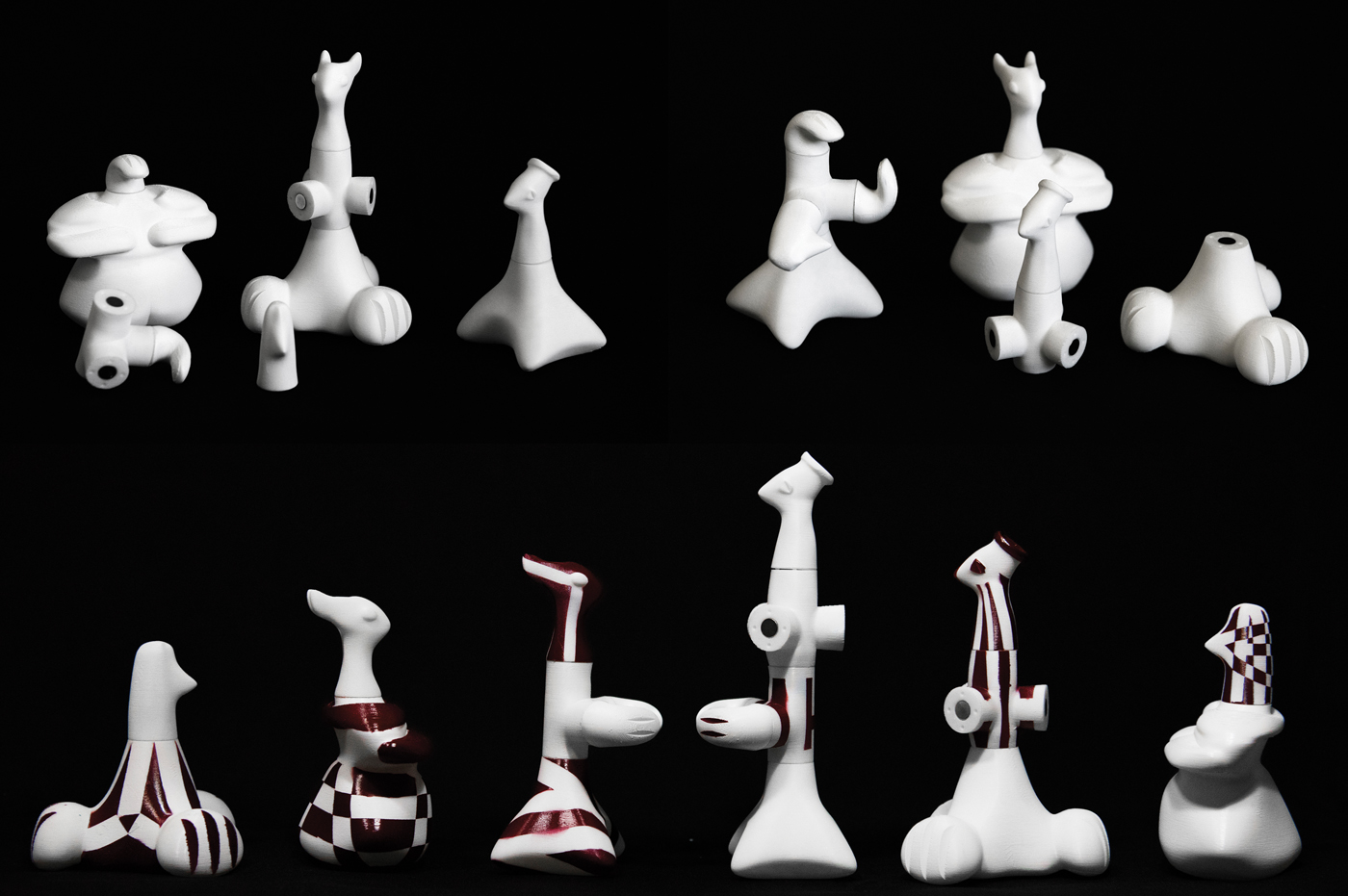
The Oxford Handbook of Figurines (Insoll Reference Insoll2017) also includes chapters from a wide range of spatial and temporal contexts that elaborate on figurines as processes (e.g. Meskell Reference Meskell and Insoll2017), on figurine making as material testimonies (Kuijt Reference Kuijt and Insoll2017) and on the role of the corporeality of the human body and somatic experience in figurine making (Antczak & Antczak Reference Antczak, Antczak and Insoll2017; Stevenson Reference Stevenson and Insoll2017). Several chapters also deal with the performative dimension of figurines, especially in relation to their use in/for activities with strong sensorial elements (Blomster Reference Blomster and Insoll2017; Overholtzer Reference Overholtzer and Insoll2017; Sears Reference Sears and Insoll2017; Stevenson Reference Stevenson and Insoll2017; Vella Gregory Reference Vella Gregory and Insoll2017). More recently, Jiaju Ma (Reference Ma2017) created an ‘embodiment of my [his] artistic interpretations of the Koutroulou Magoula figurines’ by 3D modelling and printing figurine parts that can be assembled in random combinations, to demonstrate their puzzling nature and ambiguous meaning (Fig. 3).
Koutroulou Magoula figurine sculpture project by Jiaju Ma. Heads, bodies and connectors have been modelled and 3D printed. Pieces are held together by magnets and in place by protruding spheres and sockets. (Image courtesy of Jiaju Ma.)
Such approaches fall within the paradigm of sensory, embodied and evocative archaeologies, which are still in the process of being developed (e.g. Day Reference Day2013; Hamilakis Reference Hamilakis, Hamilakis, Pluciennik and Tarlow2002; Reference Hamilakis2013; Reference Hamilakis2017; Skeates Reference Skeates2010). This is not a homogeneous body of work, nor is there a unified approach being advocated in the literature. Sensoriality can be seen purely as the investigation of the sensorial affordances of matter, as the mechanics through which the materiality of the past generates specific sensorial stimuli, which can then be processed by the human body or mind and result in specific experiences, but also knowledges and cultural understandings. MacGregor (Reference MacGregor1999), for example, in an early, important article, has discussed the sensoriality of Scottish carved stone balls, emphasizing that the understanding of the artefacts is ‘dependent on the changing inter-play of the senses as they moved from context to context of experience’ (1999, 268). In his work, MacGregor used sight and touch combined with motion to assess the knowledge obtained from the artefacts (e.g. decoration, texture) and consequently hypothesize on how they could have been experienced in their ancient and after-recovery lives. This is an example of what can be called the exteriority-interiority model, one which sees sensoriality as a matter of single sensorial modalities, specific organs, and material as well as mental processes.
The alternative perspective on sensoriality, and one which we advocate here, considers sensoriality as a synaesthetic, experiential and affective process which takes place within relational fields, fields of sensoriality (Hamilakis Reference Hamilakis2013; in press), spaces in between which are structured by many and heterogeneous entities: humans, other non-human sentient and living beings, things, spaces and landscapes, atmospheric elements, but also memories, and affective bonds and connections. The notion of ‘spaces-in-between’ denotes a shift from dualisms and rigid categories such as mind and body, inside and outside, or the person and the world. It rejects the idea that sensoriality is about the internal processing of external stimuli, received by specific sensory organs. At the same time, these spaces-in-between constitute ‘sensorial fields’ not as topological, but as relational entities. They are not locality-specific, but are instead multi-local, since the relational field they engender can extend to many places, can bring up connections and associations through memory and other relationships. The sensorial field does not entail the activation of one, isolated sensorial modality, but rather is synaesthetic.
Affect and affectivity are central to the field of sensoriality and to our approach here. Affect is a Spinozean and Deleuzian concept which has been reworked today by a number of cultural theorists (e.g. Massumi Reference Massumi1995), anthropologists (e.g. Stewart Reference Stewart2007) and some archaeologists. The clearest definition, and the one closest to our perspective here, is offered by Seigworth and Gregg (Reference Seigworth, Gregg, Gregg and Seigworth2010, 1):
Affect arises in the midst of in-between-ness: in the capacities to act and to be acted upon … Affect … is the name we give to those forces—visceral forces beneath, alongside, or generally other than conscious knowing, vital forces insisting beyond emotion—that can serve to drive us toward movement, toward thought and extension.
Affect, as a noun and as verb, bypasses the subject-object dichotomy and at the same time brings forth a field of sensoriality, a generalized atmosphere structured by sensorial flows and life forces, an atmosphere that cannot be captured by the individualiszed connotations of the concept of emotion (cf. Massumi Reference Massumi1995).
Affect and the sensorial field are linked to the concept of assemblages, as defined by Deleuzian thinking: entities made of heterogeneous, co-functioning and co-present elements are brought deliberately together and cohere to give rise to new becomings. This definition goes beyond the conventional sense of the assemblage as aggregation of homogeneous entities. Archaeologists have recently started engaging with the concept of the assemblage (e.g. Hamilakis & Jones Reference Hamilakis and Jones2017; Jervis Reference Jervis2018), and while there is a lively and on-going discussion on their nature and properties, we advocate here for sensorial assemblages (Hamilakis Reference Hamilakis2017). It is the sensorial assemblages in each context and their mnemonic, affective, multi-temporal and inevitably political nature which enable sensoriality to be activated in a synaesthetic and kinaesthetic manner, not an isolated bodily organ and a distinctive mechanical process (Hamilakis Reference Hamilakis2017). Within this understanding, affect becomes central in sensoriality; this is not about individuated emotional reactions and feelings, either on the part of the present-day researcher or on the part of people in the past. It is rather about a dispersed felt impact, an atmosphere that envelops humans and non-human beings, including things. Affectivity is engendered when sensoriality can ‘touch’ us, when the intensity of experience becomes such that it disrupts the normal flow of life and the established structure of temporality. This sensorial framework cannot be accommodated within an objectivist, distant and universalizing as well as naturalizing approach. It does not aim at representing or recreating past senses, but at evoking some of the affective energy and power of sensoriality, which is neither past nor present, but multi-temporal. The body and the sensorial and affective constitution of the researcher become, inevitably, part of this endeavour; as such, reflexivity and an investigation of the researcher's own sensorial archaeology is a starting point of any investigation on the senses (Hamilakis Reference Hamilakis2013). As for digital archaeology, we view it as yet another material realm (Garstki Reference Garstki2017), another domain which is structured by materiality, sensoriality, memory and affectivity, rather than as immaterial and ethereal. As with all material and technological devices, it can expand the sensorial capabilities of humans and produce new sensorial, affective fields and new sensorial assemblages, assuming that it avoids the technological determinism, instrumentalism and Cartesianism which often structure its operation.
Computational imaging, 3D scanning technologies and non-destructive analytical methods have also been applied to figurine assemblages from different spatial and temporal contexts to create 3D models for research and teaching (Morris et al. Reference Morris, Peatfield and O'Neill2018), examine manufacturing and production processes (Applbaum & Applbaum Reference Applbaum, Applbaum, Garfinkel and Miller2002; Delvaux et al. Reference Delvaux, Hameeuw and Van der Perre2017; Farbstein & Davies Reference Farbstein and Davies2017; Kreiter et al. Reference Kreiter, Riebe, Parkinson, Pető, Tóth, Pánczél and Bánffy2014; Pavel et al. Reference Pavel, Suciu, Constantin and Bugoi2013), explore figurines (and carved stone balls) as artefacts-in-process (Jones & Díaz-Guardamino Reference Jones and Díaz-Guardamino2019), analyse their chemical composition (Forouzan et al. Reference Forouzan, Glover, Williams and Deocampo2012; Kantarelou et al. Reference Kantarelou, Karydas and Sokaras2015), as well as experiment with computational algorithms that would enable fragment matching (Kaimaris et al. Reference Kaimaris, Hourmouziadis and Patias2011), hypothetical reconstructions (Papantoniou et al. Reference Papantoniou, Loizides, Lanitis, Michaelides, Ioannides, Fritsch, Leissner, Davies, Remondino and Caffo2012) and the identification, extraction and classification of surface characteristics (Counts et al. Reference Counts, Averett and Garstki2016; Vassallo Reference Vassallo, Campana, Scopigno, Carpentiero and Cirillo2016). In most cases, digital research has focused on 3D documentation and technological features of figurine making, with little or no discussion about the potential of the methods to enhance the sensory dimension of the artefacts in comparison to conventional modes of representation. However, recent research has implemented computational tools that reveal figurine manufacturing methods and thus contribute to discussions on multi-sensorial and embodied archaeology as they allow us to rethink the performative manipulation and formation of clay, and the creation of synaesthetic and kinaesthetic experiences in the process of making and using figurines.
For example, Pizzeghello et al. (Reference Pizzeghello, Vidale, Salemi, Tinè and Di Pilato2015) used computed tomography on a sixth-millennium bc Chalcolithic clay female figurine from the Lakes region of Turkey to identify the sequence of modelling with clay ‘lump by lump’ and approach figurine making from the perspective of cognitive decisions that follow a mental map of the female body. In this case, the figurine maker takes a small piece of clay and starts moulding it with her/his hands. More small pieces, one at a time, are added, rubbed and smoothed on top of each other, gradually transforming the wet and cold clay into a miniature female body. Insoll et al. (Reference Insoll, Kankpeyeng and Fraser2016) applied the same method to Koma figurines from Ghana to explore deliberately made cavities and their possible meaning beyond technical reasons, including the insertion of substances and organic materials and/or the offering of libations as a way to enhance their healing or apotropaic properties.
In both cases, despite the potential of the method and the richness of the material to generate new lines of inquiry in the context of sensorial flows and synaesthetic and corporeal expressions and performances, the authors still work within a mentalist-cognitivist framework and interpret the results purely in the context of figurine structure and technical characteristics.
Computational imaging in a sensorial framework
Most of the digital imaging methods discussed earlier, as well as those applied to the figurines of Koutroulou Magoula, deploy photography as the capturing mechanism. Within a conventional, objectivist technological framework, photography is seen primarily as a matter of light which gives substance to objects and helps the ‘brain’ to encode real-world information and enhance perception (Tarr et al. Reference Tarr, Kersten and Bülthoff1998). We read that we can see a particular object because particles of light bounce on it, and then reach our eyes, which in turn send this information to be deciphered in the brain, in order to identify its location, movement, form, colour and texture. Light affects the perception of texture, since materials and geometries behave according to their reflectance properties and produce lighting patterns that help observers understand the texture properties of objects (see e.g. Chantler Reference Chantler1994; Dong & Chantler Reference Dong and Chantler2004). Further, the effects produced by differing illumination, such as inter-reflections, occlusion, shadowing and shading, influence the perception of texture. It is argued that shading, for example, is primarily based on the fact that light comes from a particular angle and is reflected off surfaces in a particular way. Therefore, the way that light points to objects’ surfaces, or is reflected off them because features of their surface obstruct the light falling on them, produces patterns of shading which can give valuable information about three-dimensional surface shapes. For example, the texture of an excavated wall would look different in three photographs taken early in the morning when there is only ambient light, at midday when sunlight is vertical, and in early evening, when the sun is at a low angle.
While this technological and objectivist information makes sense in some ways, and has its practical uses in ‘capturing’ things photographically, it is inherently limited as it relies on the mechanical, exteriority-interiority model of sensoriality, discussed and critiqued above. Yet light is only one component of the photographic process, albeit an important one. Both the etymology of photography, as the writing of light, and early photographic discourses, exemplified, for example, by the title of the book The Pencil of Nature by one of its inventors, Fox Talbot (Reference Talbot1844), imagine a neutral technological process that happens by natural forces alone, thanks to scientific advances. Yet we know all too well that this is not the case. Light is an atmospheric condition, and one of the components that shapes a sensorial field. It is not a matter of a single source, as ambient light is as important as the direct, natural or artificial light. Moreover, the photographic process is structured by the sensorial photographic assemblage (cf. Carabott et al. Reference Carabott, Hamilakis and Papargyriou2015), which includes the things to be photographed and their specific affordances, the photographers, the various technological apparatuses, direct and ambient light, photographic memories and the photographic canon, the affectivity of the surroundings and the desire to produce specific renderings of an object or thing. The inter- and intra-actions amongst the various agents partaking of the relational, sensorial field of photography, including the human actors, shape the photographic outcomes. The application of these photography-based digital processes at Koutroulou Magoula has been a collective endeavour, and tightly integrated with all other practices of handling, recording, drawing and studying these objects. The corporeal and sensorial experience of handling such objects, and the affective import that it had on us, informed and even shaped the digital processes. All members of this study group, including the archaeologist/illustrator Kalliope Theodoropoulou and the archaeologist/photographer Fotis Ifantidis, worked together and conveyed to each other the affective power elicited in the process.
In applying a series of digital methods here, which are further extensions of the basic photographic principle, we reject the idea of photography as an objective procedure that produces afterimages in a realistic and neutral manner. We opt instead for a framework which sees photographing as the bringing together of a specific sensorial assemblage (Hamilakis Reference Hamilakis2017) in which we ourselves as photographers form a significant component. Our desire to activate the multi-sensorial affordances of the figurines from the site of Koutroulou Magoula, and to enable them to affect us as well as broader audiences, has been a key principle that guided our efforts.
Multi-sensoriality has been central in this collective process. The word texture is often associated with how objects in the world feel when touched. This is the so-called tactile texture and is only linked to the tangible feeling of a surface. However, another type of texture exists, which is not related to its tactile feedback to the observer. This is the visual texture, which relies on how observers perceive the surface of objects based on factors such as their variation in colour and intensity of light (see e.g. Heller Reference Heller1989; Landy & Graham Reference Landy, Graham, Chalupa and Werner2004; cf. the term haptic visuality in the history of art), and the observer's own sensorial memories and perceptive backgrounds. Colour is also linked to light, and thus its perception changes under different illumination. For example, artefacts in museum displays often appear discoloured due to the choices of light that prioritize preservation over exhibition and visitor experience. Work in medieval settings (Devlin et al. Reference Devlin, Chalmers and Brown2003) has demonstrated that decorated and glazed vessels look different in terms of colour (as well as shape) when illuminated from different directions and different light sources. Zányi et al. (Reference Zányi, Schroer, Mudge, Chalmers, Bowen, Keene and MacDonald2007) have also made use of Polynomial Texture Mapping to observe how the direction of lighting affects the perception of glass mosaics in Byzantine churches. As noted above, our own, non-representational, affective experience and understanding of the figurines shaped our desire to activate multi-sensoriality and allow texture, size, colour, geometry, technological processes, human traces and modifications upon the surface, and post-production modifications to be rendered and evoked in the depictions and models we produced: in other words, to enable broader audiences to be sensorially affected by the affordances that touched us as researchers.
The figurines from Koutroulou Magoula, Fthiotida, Greece
Koutroulou Magoula (KM) is located in Fthiotida, central Greece, and its main occupation phase dates to the first two centuries of the sixth millennium bc. This proved to be an extremely well preserved, architecturally elaborate site, the inhabitants of which shaped its space of habitation through a range of substantial, probably communal works, such as terraces and perimeter ditches. The excavation on this site was started by the Ephorate of Fthiotida under the direction of Kyparissi-Apostolika in 2001, and informally since 2009 and formally since 2010 continues under the direction of Kyparissi and Hamilakis (from 2018, under the direction of Kyparissi, Hamilakis and Tsamis). Two rectangular buildings have been unearthed in their entirety while others are only partially preserved. Spaces between buildings seemed to have been intensively used and included paved courtyards which may have been partially covered, as suggested by a series of post-holes. There were also some elaborate hearths, with a concentration of figurines and quern-stones around them, and several pits. The open areas were extremely rich in finds, including pottery, faunal remains and other feasting paraphernalia (cf. Hamilakis & Kyparissi-Apostolika Reference Hamilakis, Kyparissi-Apostolika, Loughlin, Tsamis, Cole, Papadopoulos and Zorzin2012; Hamilakis et al. Reference Hamilakis, Kyparissi-Apostolika, Loughlin, Sarris, Kalogiropoulou, Kalayci and Karimali2017; Kyparissi-Apostolika Reference Kyparissi-Apostolika2003). Various categories of data are currently under analysis and study, including a large and diverse collection of clay figurines, numbering more than 400, found in diverse contexts and locations across the site.
The figurines of KM constitute the largest single assemblage of Neolithic figurines in Greece and one of the largest in southeastern Europe. One of the main issues with figurine assemblages is that they usually lack adequate contextual data and have rarely been examined with analytical and computational methods, while most of them are only accessible to researchers and the public through printed publications (i.e. as 2D images and text narratives). In our case, the contexts of the KM figurines were meticulously recorded, providing a unique opportunity to study these objects thoroughly and answer questions about their sensorial biographies, their agency, and entanglement with humans. Clay figurines are found in a diversity of indoor and outdoor contexts, and no caches or very large, deliberate concentrations have been noted to date. While a detailed analysis of spatial distribution and patterning is currently being conducted, there seem to be some concentrations of figurines around features such as hearths (although in numbers less than 10), whereas clay figurines have been found in the stone foundations of building walls or inside post-holes.
Our petrographic study indicates that they were made using local clay (cf. Hamilakis et al. Reference Hamilakis2017), although circulation within the same densely populated region cannot be excluded. In addition to several well-known forms, there are many forms that seem to depict hybrid, human–animal (especially bird-like) entities, as well as imaginary beings, rendering a generic and commonly found description of such objects as anthropomorphic (as opposed to conventionally zoomorphic ones) problematic. Many house models were also found (included here with the clay figurines). Most of the figurines are found fragmented (exhibiting mostly old breaks as opposed to recent excavation damage) and in many cases fragmentation seems to have been deliberate, since the figurines have been broken at a rather robust point, along the vertical axis, or by multiple percussion or snapping actions (see Chapman & Gaydarska Reference Chapman and Gaydarska2007; see also below). Many preserve incised and painted decoration. Most, especially the smallest ones, were made using the single core technique with one cylindrical part at the centre around which the rest of the figurine parts were built. Larger ones were made using the composite technique: body parts were made separately, most probably using separate cores, and then assembled together. There are c. 40 cases where human fingerprints have been preserved. It is also interesting that some of the fingerprints seem intentionally erased. A separate study of the fingerprints is ongoing.
It is the first time that such a rich assemblage has been recorded and analysed using a combination of conventional recording methods, such as multifaceted archaeological drawing and photography, as well as ceramic petrography, Structure from Motion, 3D scanning, Reflectance Transformation Imaging and Multispectral Photography. Digital methods allowed us not only to document the figurines in three dimensions, but also to analyse further subtle surface details, including fingerprints, colour, decoration and other surface characteristics that are not always apparent or clear to the naked eye. Most importantly, they gave us the opportunity to explore the sensorial dimension of figurine making and using, in the past and the present.
Case studies
Three-dimensionality: from the physical to the digital and back
Structure from Motion (SfM) is a method for producing very detailed 3D models which correspond to the properties of the real objects, i.e. geometry, texture/colour and accurate measurements, by taking digital photographs from multiple positions and angles (for best practice, see Sapirstein & Murray Reference Sapirstein and Murray2017). It has been applied to a wide range of datasets, including archaeological trenches (Dellepiane et al. Reference Dellepiane, Dell'Unto, Callieri, Lindgren and Scopigno2013), buildings and landscapes (Green et al. Reference Green, Bevan and Shapland2014) and objects (Kersten & Lindstaedt Reference Kersten, Lindstaedt, Ioannides, Fritsch, Leissner, Davies, Remondino and Caffo2012; Porter et al. Reference Porter, Roussel and Soressi2016). More than 100 figurines, including a few house models, have been modelled so far by means of SfM. These models have been uploaded to Sketchfab (https://sketchfab.com/figurines_koutrouloumagoula), an online repository and 3D interactive viewer.Footnote 1 We are currently in the process of adding annotations to the objects, thus allowing users to learn specific information about the figurines. As our research progresses, these will be enhanced with further information, images and links to parallels and other resources. We envisage this channel as a 3D scholarly edition (cf. Schreibman & Papadopoulos Reference Schreibman and Papadopoulos2019) that will move away from conventional two-dimensional and often monochrome finds catalogue publications.
The 3D models enable a rotating view and allow interactive close-up views, by exposing the minute details of the fabric of figurines, their texture, technological processes and post-production treatment, including clay composition and inclusions, firing treatment and firing-induced colour, incisions and other surface modifications. The three-dimensional rendering of figurine 2010/104-21, which depicts a sitting female (Fig. 4: https://skfb.ly/6yWCO), has fine incisions above the waistline as well as on the legs to denote body fat. Although the left arm is missing, a fragment of the hand still attached to the pubic triangle indicates that both arms were resting on that part of the body, accentuating the vagina that is prominently exhibited. Attention to this area is also directed by the vertical and oblique linear bands of white pigment. On both arms, the figurine preserves small circular depressions, possibly indicating some form of body decoration, perhaps tattooing or scarification.
Figurine 2010/104-21 depicting a sitting female, probably part of a composite artefact (max. height 6.8 cm/max. width 3.95 cm/max. length 3.65cm). (Photographs and processing: F. Ifantidis. Post-processing/assembling: C. Papadopoulos.)
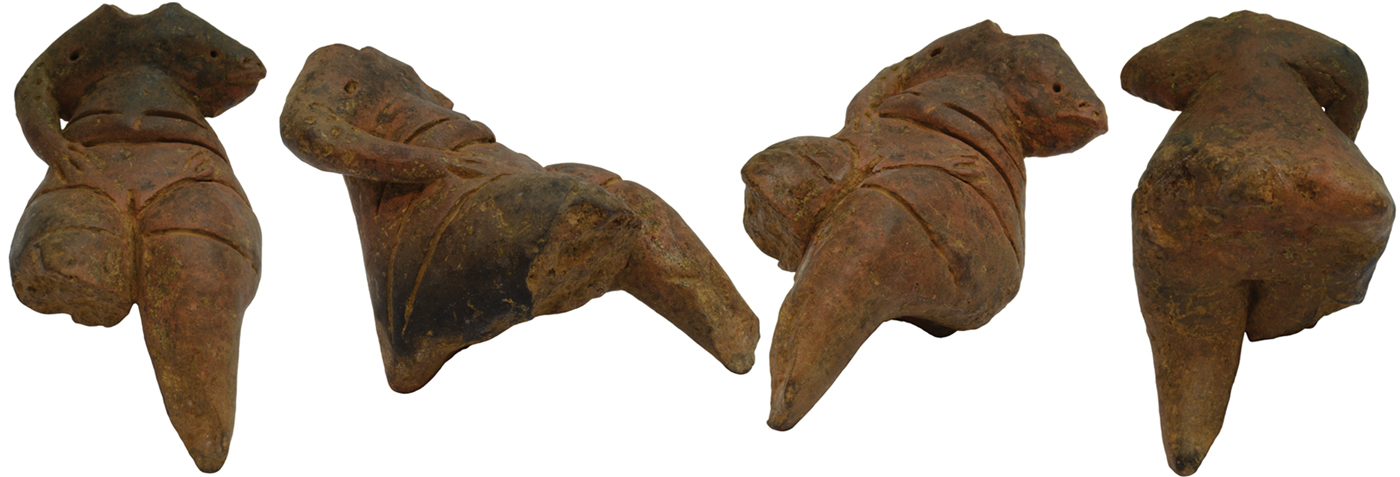
The interactive 3D model activates and engenders the sense of tactile visuality, a rich, synaesthetic experience that is not recognized by our conventional modernist western sensorium. The surface of the object becomes a landscape in relief, whereby its contours can be traced through tactile vision, but also kinaesthetically, through movement: not only the movement of the object on the screen, but also the movement of the whole human body through this terrain. By zooming in the upper part of the figurine's right arm, we can feel the small cavities that the maker created with a small tool, possibly a straw, to denote body decoration. It is probably the same tool that was used to create the two round shallow holes to denote the breasts, and to remove thin strips of clay from the belly, the glutes and the legs to denote the waistline, the pubic triangle and skin folds. Cavities, such as the ones denoting breasts particularly, acquire depth through this three-dimensional rendering. There may be the case that such holes were meant to accommodate inlaid, perhaps perishable features (cf. Insoll et al. Reference Insoll, Kankpeyeng and Fraser2016).
By rotating the figurine, it is clear that some parts of the body were meant to be visible and some not. The figurine was probably part of a composite artefact. This is suggested by the fact that it is only the front and the sides which are incised and painted and not the back (which is smoothed and polished but otherwise undecorated), as well as the fact that the figure does not sit on the floor, as is often the case, especially with female figurines, but on an elevated surface with the legs hanging. This could not have been a chair or stool, since in these cases the furniture is part of the whole clay composition and not a separate artefact.
The fragmentation pattern is of particular interest. The right leg has been broken off just below the knee, in an area which is particularly robust, making accidental breakage unlikely. The left arm is also broken from high up, and part of the left lower leg is also missing, but it is perhaps the missing head, which gives the clearest indication that we deal with deliberate fragmentation: the head has been carefully snapped from the base of the neck, leaving a concave depression on the torso. The texture of this negative imprint and the care and attention applied to this fragmentation process can be best appreciated through rotation and close-ups, and the viewing from many and oblique angles that this 3D model can offer (Fig. 5: https://skfb.ly/6yWCO).
Close-ups of figurine 2010/104-21 emphasizing surface details, such as bodily decoration, skins folds and intentional fragmentation. (3D model and images: C. Papadopoulos.)

The bottom has been pushed inwards, possibly against the surface that it was attached to or with the maker's hand, to create the cavity to make it fit on the missing surface. When observing the figurine from above (see top right image in Fig. 5), it is striking how well the maker gives the sense that the arms hold or rest on the belly, whereas the breasts seem intentionally absent. By gaining the opportunity to observe the artefact from viewpoints that would not be normally depicted in conventional modes of rendering, both archaeologists/analysts and the lay public can gain a sensorial and embodied knowledge of the object which is not possible through static monochromatic renderings, not even by pure textual descriptions. The handling of 3D prints of the models enhances such sensorial knowledge.
We have 3D printed 42 figurines and a house model (Fig. 6) and have already started using them in undergraduate and postgraduate teaching at Brown University (USA) and Maynooth University (Ireland) and in discussions with PhD candidates about topics such as figurines and 3D printing, but also about the aura of the digital and its physical transformation, materiality and physical interaction, and even Human–Computer Interaction. They were also used in a Masterclass organised in Maynooth University in September 2016 as a means to prompt participants to think about the creation of user-friendly and intuitive web interfaces for figurine collections, as well as to form the basis for creating smart replicas with sensors that would enable digitally enhanced tangible interactions.
3D prints of figurines found at Koutroulou Magoula, Greece. (Photograph: Darcy Hackley. 3D modelling and image processing: C. Papadopoulos. 3D printing: i.materialise.com)

While several—but not all—of the features and processes discussed above can be detected by archaeological analysis when handling the actual artefacts and performing a sensorial analysis on them, such direct and sustained engagement with the material is constrained by time and by logistic and bureaucratic procedures. Moreover, such sensorial appreciation is limited to the privileged researcher with direct access to the material. 3D modelling and printing enable the researcher to extend such handling in space and time, transfer it to the classroom and open it up to many others, including students and various sectors of the public.
Texture: from fingerprints and brush strokes to touch
Evoking, via a digital interface, the experience of the texture and feel of the clay when modelling is a great challenge, even today. Voxel 3D sculpting and modelling software packages are flourishing in the market; some even include haptic styluses with tactile feedback. But when it comes to evoking the experience of touching, processing, tempering and modelling clay, archaeologists have resorted to experiential processes capable of revealing the affordances of such intimate encounters between the substance of clay and the human hand (e.g. Sofaer Reference Sofaer2015, 38–9). Touching the surface texture of an ancient figurine is, most of the time, an impossible task. The public is usually confronted with glass boxes and figurines are to be contemplated at a distance; 3D prints, as we have argued here, have the capacity to evoke three-dimensionality and some sense of touch, but fall short in evoking the tactile texture of a fired clay object, primarily because they are made of materials that feel quite different to clay. This could be overcome with replicas made of clay but, of course, these would not retain the same qualities as the ‘originals’, as each is a unique creative instance in its own right. For researchers, it is usually during the very moment of recovery when the figurine may be handled, its surface texture examined and felt through touch; beyond the moment of recovery, once figurines are passed on for conservation and museum accession, the researchers’ experience of figurines is most commonly mediated by latex gloves. In this process, tactile texture gets lost, not only depriving the public and the researcher alike of the tactile experience of Neolithic figurines, but also preventing them from evoking the tactile affordances of figurines as they were made, transformed and touched by past human hands.
In this context, the role of visual texture (see above), which we redefine here as a synaesthetic experience involving both tactility, motion/kinaesthesia and tactile visuality, becomes seminal when studying and recording figurines with conventional methods. In the case of the KM figurines, this entailed careful and prolonged handling and examination of their surfaces with magnifying glass and raking light, leading to the identification (by Hamilakis) of several human fingerprints. Because of their subtlety, these fingerprints, as well as other very fine marks associated with the creation of the figurines’ surfaces, were difficult to visualize or record.
The study of fingerprints on archaeological objects has gained traction in the last few years (e.g. Branigan et al. Reference Branigan, Papadatos and Wynn2002; Hruby Reference Hruby and Walberg2007; Sanders Reference Sanders2015; see also the Journal on Ancient Fingerprints). Stinson (Reference Stinson2004), for example, analysed fingerprints from a large corpus of Hohokam clay figurines in an attempt to identify the sex of the individuals who used them. Different digital methods, primarily laser scanning that produces measurable 3D models, have been applied for the recording and visualization of fingerprints (see e.g. Lapp & Nicoli Reference Lapp and Nicoli2014, who extracted and identified a left-hand thumbprint from a Classic Nabatean lamp sherd, or Mara et al. Reference Mara, Krömker, Jakob, Breuckmann, Artusi, Joly-Parvex, Lucet, Ribes and Pitzalis2010, who recorded a series of fingerprints by means of structured light scanning). Despite the potential of fingerprint marks and ridge breadth measurements to provide information about the age (and possibly sex) of those who participated in the making of the figurines (Kamp et al. Reference Kamp, Timmerman, Lind, Graybill and Natowsky1999), this has not yet been pursued from this kind of digital recording. While it is clear that 3D scanning technologies are capable of producing outputs of micron resolution, which have great potential for the study of fingerprints, and more generally for the visualization of very faint surface marks, these techniques are still quite expensive, require specialist knowledge, and produce very large, difficult to manage files.
How to convey the intimate, affective experience of the researcher as s/he explores in detail the surface of a figurine with a magnifying glass and raking light? How to evoke the sensorial experience of past makers and handlers of clay and figurines-in-the-making? Are there techniques that excel in the rendering of visual texture, and that are at the same time affordable, that could aid us in this pursuit? Here is where we believe RTI (Reflectance Transformation Imaging) has enormous potential, as it is an affordable, easy-to-implement digital imaging method that is capable of creating very high resolution photorealistic visualizations of texture detail, using 2.5D information extracted from the 3D reflectance properties of objects (Mudge et al. Reference Mudge, Voutaz, Schroer, Lum, Mudge, Ryan and Scopigno2005). RTI has been used in a wide range of cultural ‘heritage’ objects where this level of detail is required, especially in conservation, but also in archaeology, such as palimpsests, coins, paintings, modern graffiti, prehistoric art, to analyse making and reworking surface marks, to document conditions, or identify conservation needs (Díaz-Guardamino et al. Reference Díaz-Guardamino, Garcia-Sanjuán, Wheatley and Rodríguez Zamora2015; Earl et al. Reference Earl, Martinez and Malzbender2010; Jones et al. Reference Jones, Díaz-Guardamino and Crellin2016; Kotoula Reference Kotoula2015; Kotoula & Kyranoudi Reference Kotoula and Kyranoudi2013).
RTI enhances the perception of subtle surface details related to the process of (re)making, the interaction between clay and maker(s)/handler(s), bringing to the forefront the sensorial and especially tactile dimension of making. RTI, in this case through the RTI Viewer, also affords experiences akin to those of the researcher when s/he explores the surface/skin of the figurine and in that process discovers innumerable marks: the interactive play with light and shadows reveals partial fingerprints, very faint brush strokes, soft and rough surfaces, etc. These sensorial experiences, based on visual texture and the interplay with light, can be reached by researchers and the public remotely. If sensorial archaeology is about presences, and not representations (cf. Hamilakis Reference Hamilakis2013, 12), then the detailed interactive visualization of fingerprints and other marks of figurine-making through RTI make the presencing of specific past peoples more palpable, and more affective. Features and affinities of their skin, the largest bodily organ, and the interface between the body and the world become sensorially prominent, enabling affective, skin-to-skin connections amongst contemporary researchers, lay people and past social actors.
Although we tend to assign prints on clay objects to their makers, we should consider the possibility of figurine making as a collaborative or even communal act, during which there were many creators, helpers, people who handled the wet object to observe it, fix it, or reshape it, the person who put it in the kiln, and other people who might have been involved intentionally or by coincidence in the manufacturing process (Králík & Nejman Reference Králík and Nejman2007). The partial fingerprints we identified are direct testimonies of people involved in figurine making. Also, the intersection between fingerprints and marks of brush strokes indicates another stage in their making: figurine finish in some cases entailed smoothing, including erasing visible fingerprints, and brushing the surface as part of the making process.
A sample of 35 figurines was selected to be recorded by means of Highlight RTI (H-RTI), a cost-effective and flexible method for RTI capture (for a detailed description, see Díaz-Guardamino & Wheatley Reference Díaz-Guardamino and Wheatley2013). After the dataset was processed with the free and open-source RTIBuilder developed by Cultural Heritage Imaging (http://culturalheritageimaging.org/), the resulting files were viewed via the free RTI Viewer, which enables the interactive visualization and exploration of RTI files by changing zoom levels, manipulating the lighting direction and applying a broad range of per-pixel transformations to enhance the visualization of texture details.Footnote 2
RTI was capable of capturing very subtle surface marks, including fingerprints, in great detail. The fingerprints seem to be ‘chance prints’ (Cummins Reference Cummins1941) that were unintentionally created in the process of handling the clay and moulding the figurine, although we cannot reject the possibility of having identifying prints (or, as Cummins calls them, ‘token finger marks’) that were intentionally left to mark the relationship of the maker or handler with the object. Most of the fingerprint areas seem to have been intentionally erased as part of the smoothing of the figurine surface, which in some instances was done with a brush, as indicated by the marks of very fine brush strokes identified (see Fig. 1, 10, 11, and Videos 2 https://doi.org/10.26300/kdf1-vz75 and 3 https://doi.org/10.26300/b7rk-bn47 in the online supplementary material). In one case, brush strokes seem to be in the process of erasing the trace of a fingerprint (Fig. 11). This may indicate that chance prints were erased during the treatment of the whole figurine surface before firing and/or that they were especially targeted so as to remove any traces of their handlers.
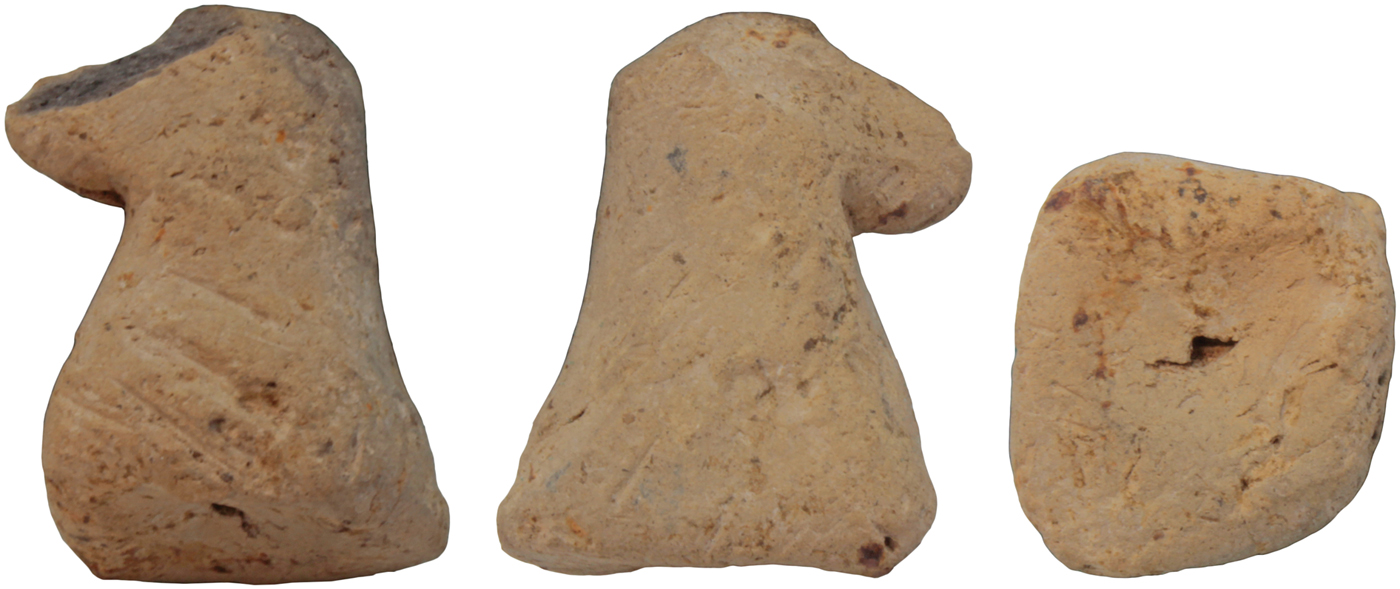
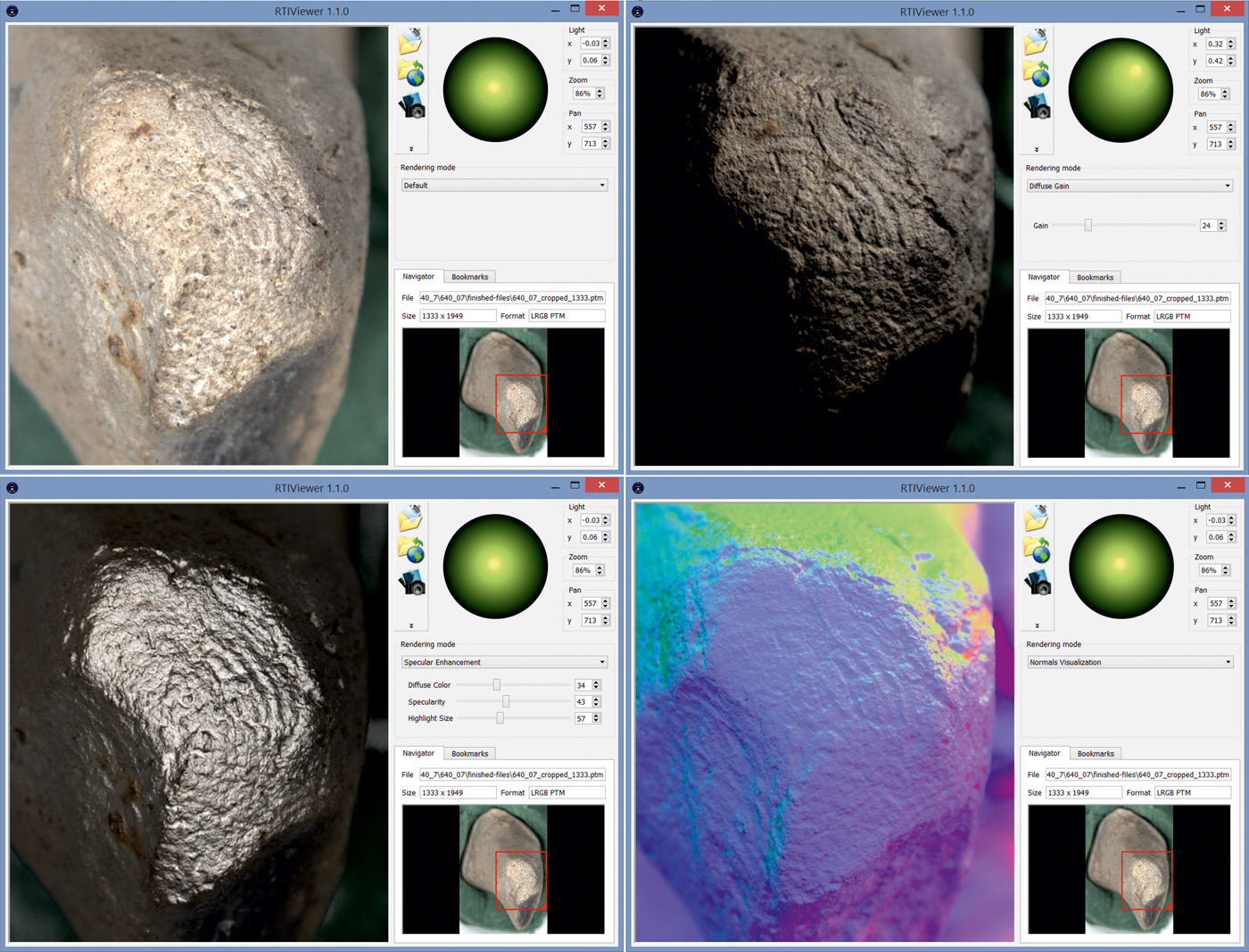
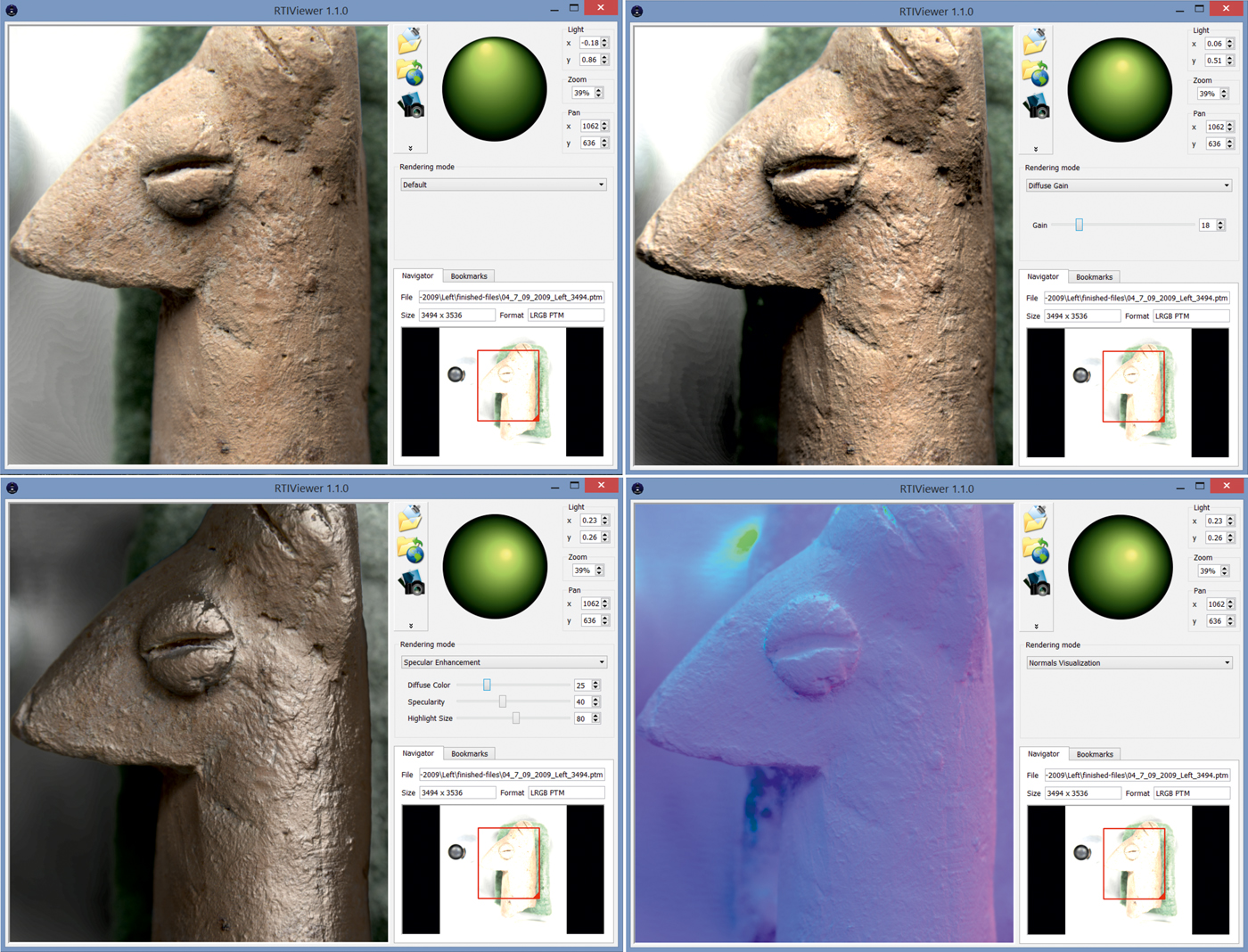
For the bird-shaped figurine 2012/640-07 (Fig. 7; https://skfb.ly/6yWXL; RTI file https://doi.org/10.26300/0b9t-rd39), RTI enhanced the identification of a fingerprint on its head (Fig. 8). This is one of the few cases where an almost intact fingerprint has been preserved, possibly indicating intentionality in its making, especially given that coarse clay makes it more difficult to create an identifiable fingerprint (Cummins Reference Cummins1941). On the other hand, given that this figurine is only partially smoothed and badly fired and that the shape of the head is rather rough and approximate, we may be dealing with the outcome of experimentation or learning. Although we are not in the position to know if this is the fingerprint of the maker or of a curious individual that intervened in the process, there is a possibility that it was made not only by lightly touching the figurine when observing it or moving it to a place to dry or to get fired, but after applying some pressure so as to leave a ‘token finger mark’. Exploring this surface with the RTI Viewer through the movement of light and changing filters gives a more complete sense to what we are trying to convey and communicates the affective experience of the researcher when exploring this surface. The fingerprint is readily visible in the Default mode (see Video 1 https://doi.org/10.26300/xh2h-7t62). If we apply the Diffuse Gain filter, the fingerprint is more clearly visible, especially when moving the light, while the Specular Enhancement reveals the depth of the marks (Fig. 8), indicative of the pressure exerted to create the print. If we zoom in and apply the filter Normal Unsharp Masking, an even more detailed visualization of the texture is revealed. Here, colour and minute details of the clay and how they relate to the fingerprint become apparent. Finally, the Luminance Unsharp Masking filter lets us discover even more minute texture details continuing a process of affective discovery akin to that of the researcher when using a magnifying glass and raking light from different directions.
Bird-shaped figurine 2012/640-07 that preserves a fingerprint on its head (max. height 2.5 cm/max. width 2.15 cm/max. length 1.85 cm). (Photographs and processing: F. Ifantidis. Post-processing/assembling: C. Papadopoulos.)
Figurine 2012/640-07. Snapshot of the visualization through the RTI Viewer of the fingerprint identified on the head of the figurine. Enhancement with computational algorithms in the following modes (from upper left to bottom right): Default, Diffuse Gain, Specular Enhancement, and Normals Visualization. Also see RTI file: https://doi.org/10.26300/0b9t-rd39 (by M. Diaz-Guardamino).
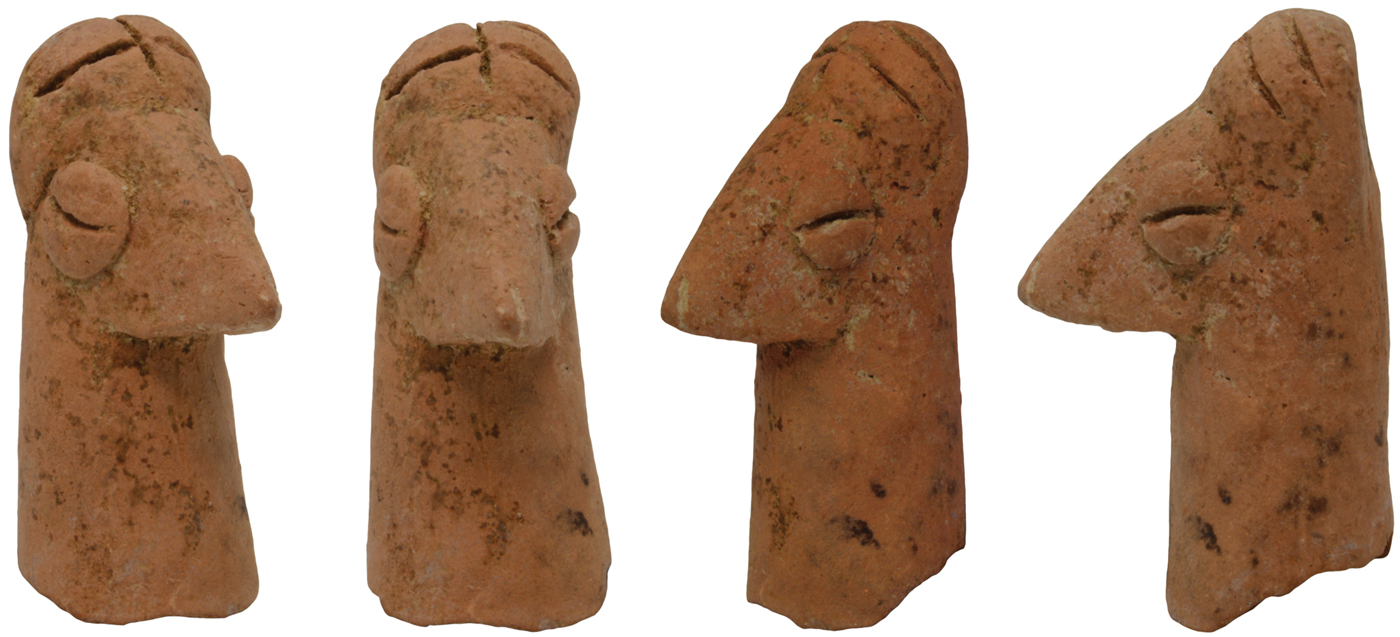
On the other hand, in the case of figurine 2009/TH1-19 (Fig. 9; https://skfb.ly/6yXxK; also see Figure 1; RTI files: https://doi.org/10.26300/w6te-wk41; https://doi.org/10.26300/9c29-7b15), the identified partial fingerprint on its right eye (Fig. 10; Video 2 https://doi.org/10.26300/kdf1-vz75) speaks of the manufacturing process during which a small lump of clay is formed separately from the figurine body. We should imagine that the maker holds with the fingers of his/her one hand the figurine head, while with the other hand s/he uses the tips of the fingers to put in place the plastic eye. The visualization of the RTI file in the RTI Viewer is akin to a process of affective discovery by which we visualize more and more details of the surface of the figurine by changing the direction of the light and the filters, zooming in and out. When we apply the Specular Enhancement and the Normal Unsharp Masking filters, we can readily see the microtopography of the partial fingerprint (Video 2 https://doi.org/10.26300/kdf1-vz75). The maker exerted pressure with his/her fingers to attach it securely to the body and more specifically to the beak/nose. The Luminance Unsharp Masking filter reveals, again, an increasing number of details on the surface of this figurine: subtle marks of brushing, small lumps of clay and the roughness of the surface. A landscape full of traces speaks to the viewer of how human hands shaped, smoothed, worked the clay before firing. On the other side of the figurine (see Figure 12 and Video 3 https://doi.org/10.26300/b7rk-bn47), more details such as fine brush strokes are revealed, including, on the Specular Enhancement mode, another possible partial fingerprint just below the left eye.
Figurine 2009/TH1-19 (max. height 3.3 cm/max. width 1.35 cm/max. length 2 cm). (Photographs and processing: F. Ifantidis. Post-processing/assembling: C. Papadopoulos.)
Figurine 2009/TH1-19. Snapshot of the visualization through the RTI Viewer of the partial fingerprint identified on the right eye of the figurine and brush strokes on the hairdo, to the left of the eye. Enhancement with computational algorithms in the following modes (from upper left to bottom right): Default, Diffuse Gain, Specular Enhancement, and Normals Visualization. Also see RTI files: https://doi.org/10.26300/w6te-wk41; https://doi.org/10.26300/9c29-7b15 (by M. Diaz-Guardamino).

Figurine 2009/TH1-19. Snapshot of the visualization through the RTI Viewer of the fine vertical and horizontal brush strokes identified on the neck of the figurine. Enhancement with computational algorithms in the following modes (from upper left to bottom right): Default, Diffuse Gain, Specular Enhancement, and Normals Visualization (by M. Diaz-Guardamino).
Figurine 2011/703-07 of a sitting female of the squatting type (max. height 6.3 cm/max. width 5.7 cm/max. length 5.3 cm). (Photographs and processing: F. Ifantidis. Post-processing/assembling: C. Papadopoulos.)

Colour: painting the body
The detection and visualization of pigment-based colour is seminal to the study of figurines. For a start, it results in a different, richer sensorial appreciation of the objects, adding further layers of cultural meaning to them, given the multi-faceted significance of colour (cf. Jones & MacGregor Reference Jones and MacGregor2002). Colour effects can be and were achieved through the selection, preparation and firing of clay, and the inhabitants of Koutroulou Magoula were particularly keen to achieve a variety of colour shades, carefully manipulating the clay preparation and mostly the firing process. But the use of pigments does not only allow us to understand an additional technological process and another stage in the crafting of these objects; it also provides information on decorative details that would have been otherwise missed, or not clearly understood.
Multispectral Photography (MP) was applied to a selection of figurines in order to identify and further enhance faded colour traces. MP captures the spectral signature of materials over different regions of the electromagnetic spectrum ranging from visible (390–700 nm) to ultraviolet and infrared. The latter has great potential for the study and conservation of artefacts that include layers of information or multiple modifications (e.g. Bendada et al. Reference Bendada, Sfarra, Ibarra-Castanedo, Akhloufi, Caumes, Pradere and Maldague2015; Easton et al. Reference Easton, Christens-Barry and Knox2011; Fischer & Kakoulli Reference Fischer and Kakoulli2006). A modified DSLR camera (Nikon D700) along with special filters that isolate particular regions of the spectrum (daylight, infrared and ultraviolet) were used to photograph 16 figurines with degraded remains of painting. The aim was to enhance the perception of the pigments preserved on their surfaces. Decorrelation stretch (http://www.dstretch.com/) was applied to near-ultraviolet and near-infrared images to stretch colour differences and enhance the visualization of very faint, or barely visible to the naked eye, preserved pigments.
In the case of the sitting female figurine of the squatting type (Fig. 13; https://skfb.ly/DXZJ), MP photography allowed us to detect and illustrate decorative patterns that were not visible, or not clearly visible, on the 3D model produced through the SfM technique (compare the model on Sketchfab with the image shown in Figure 13). While at the lower back of this figurine a pattern of red vertical bands is visible even with the naked eye, other decorative details, such as the belt, the vertical bands on the upper part of the body and the collar around the neck, were clearly detected and illustrated only with this technique.
Figurine 2011/703-07. The back of the figurine under the visible spectrum (top), near-infrared captures (bottom). Decorrelation stretch in colorspace LDS (bottom left), and decorrelation stretch in colorspace YRE (bottom right). Enhancement brings out red pigment remains. (MSI capture and processing: M. Diaz-Guardamino. Post-processing/assembling: C. Papadopoulos.)

The decorative details detected via MPI allow us to hypothesize that the intention of the craftsperson here was perhaps to depict elements of a dress through these fine traces. If so, however, the intention had not been to cover the body: fine incisions on the clay above the waistline are meant to denote body fat, and a frontal view indicates that body parts such as the breasts, the pregnant belly and the belly button, and the vagina were prominently exhibited, and accentuated by details such as the position of hands: the right hand is shown touching the right breast, whereas the left hand is shown touching the belly (Fig. 12). At the same time, the upper legs are also decorated by bands made of red pigment. An alternative scenario thus is that these painted features are not intended to denote elements of dress, but consist merely of bodily decoration destined perhaps to direct attention to specific anatomical features such as the neck, the wide back, the waistline, or the robust upper legs. Moreover, the use of red pigment to denote specific facets of identity such as gender, age, or status, cannot be excluded (cf. Petru Reference Petru2006).
The very act of painting this body with fine lines of red pigment would have established specific sensorial and homological/mnemonic connections with other components of material culture, such as pottery and architecture. Among the decorated pottery from the site, the red-on-white scheme predominates, featuring abstract and geometric decorative elements made of red pigment on a white background, whereas in several of the buildings unearthed, the lower parts of the walls were made of soft white limestone with bright red (oxidized) clay as bonding material, likely to have come from the burnt buildings belonging to earlier building phases. If exposed, such red-white combination would have evoked the decorated vessels, as well as other components of material culture, such as the figurines with red pigment decoration. A sensorial assemblage would thus have been created (Hamilakis Reference Hamilakis2017), a co-presence (in physical space or in memory) of heterogeneous components connected by the colour red and the attempt of craftspersons to produce the effect of red colour using pigments as well as oxidized building material; this burnt material would have provided an additional mnemonic connection with the ancestral buildings and their making and unmaking.
Conclusion
Digital archaeology has increasingly attempted to respond to the recent call for multi-sensorial engagements with the past, mainly by developing prosthetic devices that trigger isolated sensory interactions; in so doing, it uses ocularcentric paradigms to approach experience and perception. Given their Cartesianism and the emphasis on abstract, isolated and disembodied vision, such attempts have severely limited the potential of digital tools to provide new ways of approaching past sensoriality. However, it is not the medium itself that limits the potential of the digital, but the framework within which it has been deployed. Abandoning the Cartesianist, instrumentalist and deterministic approaches to the digital, we have advocated here a framework grounded on materiality, multi-sensoriality and affectivity which can enable researchers to explore the sensorial affordances and affect potential of things, in this case clay figurines, both in the past and in the present.
The application of a wide range of analytical methods for the recording, examination and presentation of the figurines from Koutroulou Magoula has opened new interpretative horizons and also ensured that study and access to the material will continue beyond the physical boundaries of its current location. Most importantly, both the specialist and the non-specialist can appreciate more thoroughly and in all their richness and detail the successive stages of human labour and craftsmanship that went to each object, labour and skill that often go unnoticed in the conventional renderings that present a synoptic view of the whole process. This layering process of skill and effort has been at times deliberately masked by the maker of the object, when, for example, surface treatment is made to hide fingerprints or the seams between different body parts or between the clay core and the rest of the figurine. Although the gender and age identity of the figurine makers cannot be defined without further analysis of the fingerprints (subject to the development of a robust methodology), the RTI renderings have provided a sensorial enhancement of clay texture and of the making process, enabling us to appreciate figurines beyond the common discussions on representation, function and meaning. They have engendered a tangible, affective understanding of the embodied and performative process of figurine making in which touch enabled the moulding of the body of clay, but also left the traces of the people involved. They also mark the affective process of discovery, the sensorial impact that these object have upon the researcher.
3D, RTI, and multispectral renderings are not meant to replace multi-sensorial and embodied interaction with the physical objects themselves, but rather to enhance it. In other words, these technologies are not doing something different from what material things and technologies have been doing since humans started using objects: producing a range of complex synaesthetic experiences, engendering affective sensorial moments which cannot be contained in and described by the western sensorium, with its limited, individuating and enumerating properties. The technological apparatus used here, rather than producing dematerialized, ‘virtual’ realities, extends the sensorial affordances of the human body. It results in new material artefacts which exist in the real world and which can be engaged and entangled with humans and with other sentient and non-sentient beings. They are not replicas of the ‘authentic’ object, nor digital surrogates, but rather creative renderings of their own, that cite performatively the initial departure point, the excavated artefact. Together with it, they partake of a sensorial assemblage which also includes the researcher and her memories, desires and aspirations, the site and the context in general, and the previous assumptions and interpretations of clay figurines, amongst others. They also help structure, and are structured by, a distinct, relational sensorial field within which sensorial and affective experiences, knowledges and memories are generated. In other words, a sensorial approach to digitality, beyond the benefits it can accrue regarding the interpretative and affective possibilities of the artefacts for the researchers and the public alike, can also engender an exploration of the ontology and epistemology of the material world and of the archaeological process.
Acknowledgements
The authors would like to thank the Ephorate of Palaeoanthropology and Speleology and the Ephorate of Fthiotida and Evrytania for granting access to work on the assemblage. We would also like to thank all staff members and students for their work in the Koutroulou Magoula Archaeology and Archaeological Ethnography project, and particularly Fotis Ifantidis and Kalliope Theodoropoulou for their photography and illustration work on the figurines, respectively. We are also grateful to Despina Catapoti, Jeremy Huggett and Paul Reilly for their comments and suggestions on drafts of this paper.
Funding
We are indebted to The British Academy which provided funding for this work through its Small Research Grants scheme (project ‘Corporeal Engagements with Clay: the figurines from Koutroulou Magoula’, BA/Leverhulme grant awarded to Hamilakis). Funding for the Koutroulou Magoula Archaeology and Archaeological Ethnography Project in general has been provided by the Institute for Aegean Prehistory, the University of Southampton, Brown University, the British School at Athens and the Greek Archaeological Service.
This paper has been published Open Access thanks to a grant by the Scholars’ Association of the Alexander S. Onassis Public Benefit Foundation awarded to Papadopoulos.


 Open access

