

From sites such as Lascaux, Chauvet and Cosquer in the south of France (Perigord, Ardèche and Bouches-du-Rhône) and Altamira in Spain (Cantabria), cave art in the south of Europe is very well-known. But for a long time, cave art has been far less commonly encountered in the North. This situation is changing with a series of recent discoveries in England (Bahn et al. 2003), in France (Baffier & Girard 1996) and in Germany (Conard & Uermann 2000). It has strengthened the group of the seven decorated caves already discovered in Normandy, Central France and in Mayenne (Pigeaud 2004), to which we can include the fragments of rock painting from the cave of Geissenklösterle, in Germany (Reference HahnHahn 1986). In this paper, we are presenting the discovery in July 2005 of Palaeolithic engravings and paintings in the Margot cave (Mayenne). This is the first decorated cave identified in Western France since 1967 and the thirteenth known in Northern Europe. The radiocarbon dating from some of these sites and the stylistic attributions of others authorize us to define a cultural group at the end of the Upper Palaeolithic. The period (around 12 000 BP) corresponds to a time when climatic conditions facilitated the progression of prehistoric humans to the North (Reference PlumetPlumet 2004).
Context
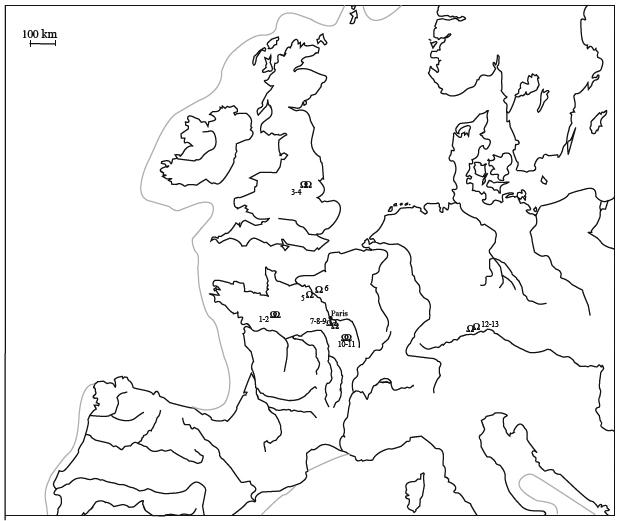
The Margot cave is located in the canyon of Saulges (Mayenne, France), 250km to the south-west of Paris (Figure 1). This valley is a karstic formation of 1.5km in length, through which flows the Erve, a tributary of the Sarthe River. Until now, speleologists have checked out and explored 30 caves in this valley. Previous archaeological excavations in the Erve valley revealed that this area has been occupied by some Neanderthals and in particular by Homo sapiens. The Upper Palaeolithic is mostly represented by the Aurignacian (36 000 - 30 000 BP) and the Solutrean (21 000 - 18 000 BP). Some Magdalenian artefacts (17 000 - 9000 BP) have also been found. Apparently, the area was not occupied during the Gravettian period (29 000 - 22 000 BP) (Reference AllardAllard 1983).
Since 1999, a research project called Les occupations paléolithiques de la vallée de l'Erve, directed by Jean-Laurent Monnier, has been conducted by the UMR 6566 CNRS, University of Rennes-1. Recent research in this programme, led by Stéphan Hinguant (INRAP/UMR 6566 CNRS) in the Rochefort Cave, is at last giving us a reliable stratigraphic context for the Upper Palaeolithic period in the valley. Pigments from paintings in the cave of Mayenne-Sciences were analysed by radiocarbon dating and yielded a date of about 25 000 years BP (the Gravettian period) (Pigeaud et al. 2003). This parietal art is associated with a poor portable art, mostly without any cultural attribution (Monnier et al.2005; Reference PigeaudPigeaud 2003). It was in this context that we decided to go back and explore the Margot cave.
The Margot Cave
The Margot Cave is 285m in length, oriented NW-SE and SW-NE. It was mentioned for the first time in 1706, but its tourist exploitation began only in 1861 (Reference Davy DE VirvilleDavy de Virville 1924). The site was excavated by many archaeologists between 1870 and 1936. Unfortunately, the paucity of the publications and scientific analyses restricts our knowledge of the archaeological context of the cave. All the cultures of the Upper Palaeolithic are represented, but the best documented are the Solutrean and the Magdalenian (Reference AllardAllard 1983).
Geographical location of the decorated caves mentioned in this paper. The grey line shows the position of the coastline at the time of the Late Glacial Maximal. 1. Margot Cave. 2. Mayenne-Sciences. 3. Church Hole. 4. Robin Hood. 5. Orival. 6. Gouy. 7. Boutigny. 8. Croc-Marin. 9. Trois Pignons. 10. Grande Grotte. 11. Grotte du Cheval. 12. Geissenklösterle. 13. Hohle Fels. Map R. Pigeaud.

The cave was also converted for tourism. The ground was actually dug out and, consequently, the stalagmitic floor was broken up around 1879. Today exploring the cave is rather easy but before the breaking of the natural ground and the installation of lighting, the Margot cave was dangerous. The visitor (modern and Palaeolithic) had to progress in narrow galleries (less than 1m in height) before arriving in a comfortable chamber, the 'Palais de Margot'. Oral tradition and letters tell us about tragic accidents; and this was confirmed by the discovery of modern skeletons (Reference Davy DE VirvilleDavy de Virville 1924).
Methodology
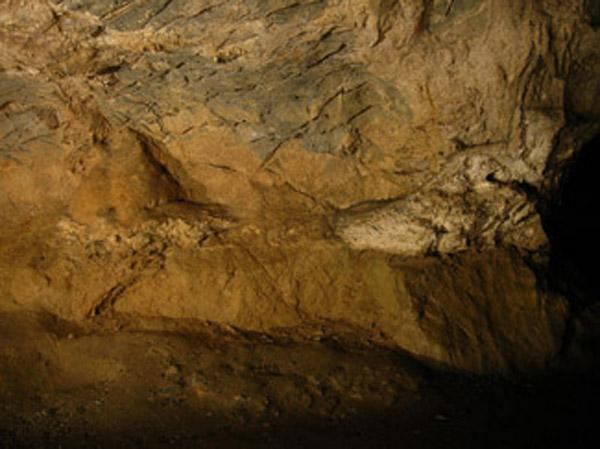
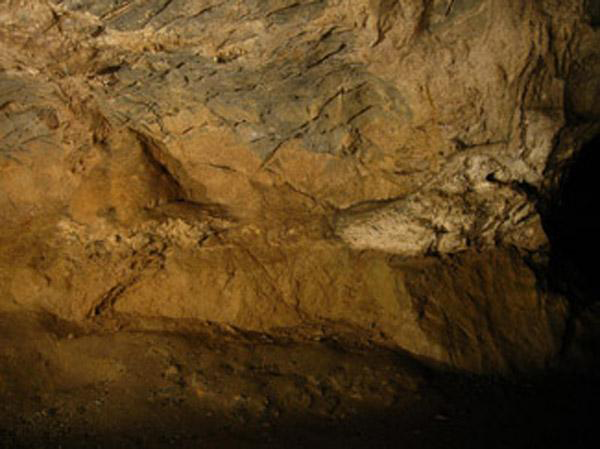
The walls of the cave are mostly covered by modern graffiti. This complicated our prospecting in the cave. Nevertheless, we used this drawback in the finding of Prehistoric art as the height of those graffiti allowed to evaluate the height of the natural ground before the improvement for tourism. For instance, a graffito dated from 1816 is today situated at 2.5m in height, but at just 1.5m above the old flowstone, the stalagmitic ground. Fragments of this old flowstone are, indeed, still visible between 50cm and 1m above the present ground (Figure 2). We assumed that this natural floor corresponded to the Prehistoric floor (12). Therefore, we prospected above this level. This methodology was successful as we identified 45 paintings and engravings at around 1.5m above the stalagmitic ground, which is the level a human being can naturally reach.
Consequently, at present most of the paintings and engravings are located on walls inaccessible to visitors and thus are preserved from their contact. However, in the main sector, where the most beautiful figures are found, the actual ground still corresponds to the natural floor. In this part there has been no improvement for tourist visits. Consequently, tourists can put their hands on the engravings and the paintings. Our task consisted therefore in identifying the position of the Palaeolithic engravings and paintings, in making precise tracings of them, and in proposing solutions for their conservation.
Results and discussions
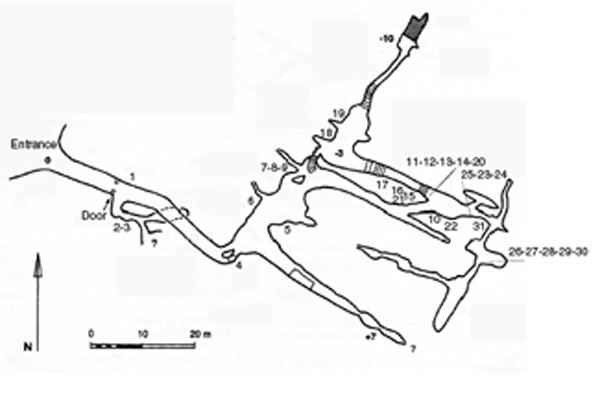
We divided the cave in nine sectors (Figure 3). The first sector corresponds to the gallery where the circulation was difficult because of its narrowness. It could explain that Prehistoric drawings in this sector are very schematic. We identified two engravings and one red painting: respectively the body of a headless herbivore, the head of a bison and probably an aurochs. This painting is more visible with UV lighting. The first part of the second sector is a wide chamber, where Prehistoric people could stand up. At least two negative black hand stencils were identified. From this chamber, crawling permits entry into a very small chamber. In this gap, on the left wall, we identified the brown painting of a possible Megaceros. Apparently, the artist used the concretions on the wall in order to figure the animal's horns.
Piece of the flowstone broken at the time of the improvement of the cave for tourism. Photo R. Pigeaud, T. Devièse.
The Margot Cave. Topographical map with the position of the principal Palaeolithic representations. 23, 24 and 25: wooly rhinoceros. 11, 12, 16, 26, 27: horses. 16: feminine representation. 19: anthropomorph. After Paul Marchais.

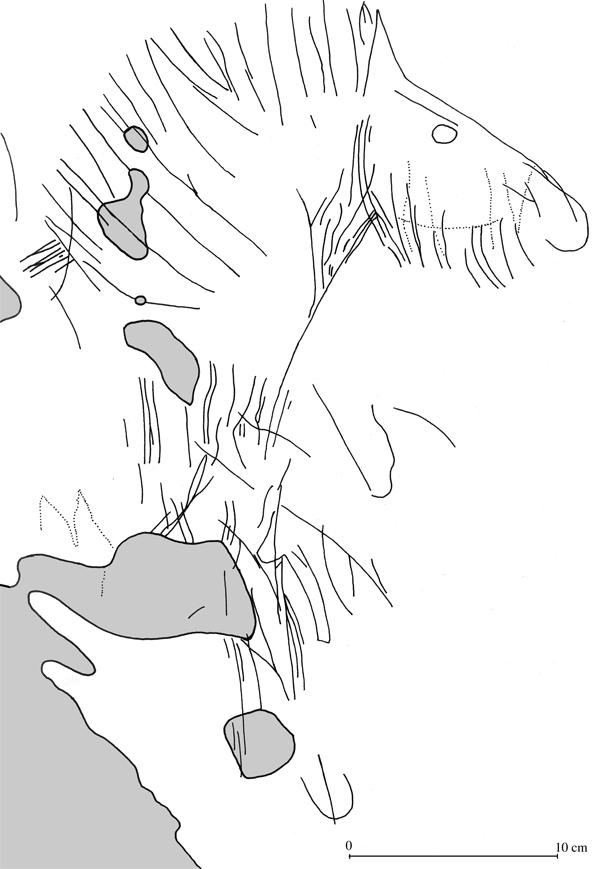
b. The Margot Cave. Horse engraved partly on the calcite, partly on the bare rock. Drawing T. Devièse, R. Pigeaud. The dots indicate modern graffiti. The shaded zone indicates the bare rock area.

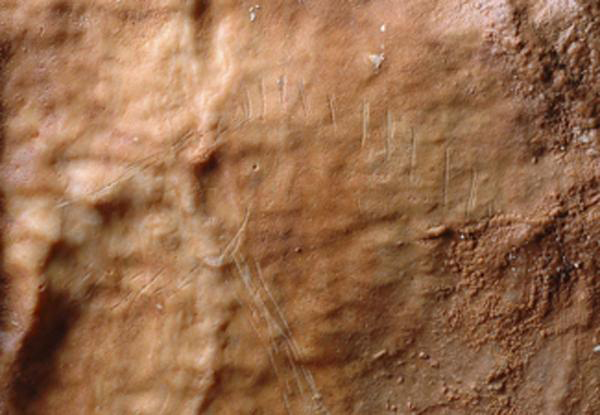
Next to this Megaceros, we discovered other brown and red paintings of two unidentified animals. They are situated below two positive brown handprints. The third sector is a small gallery where the Prehistoric people had to crawl again. At the end of it, we observed a negative black hand stencil, with mutilated fingers, similar to those discovered in the Gargas cave (Hautes-Pyrénées) and the Cosquer cave (Bouches-du-Rhône) and widely attributed to the Gravettian period. The fourth sector is a gallery measuring 2m in width and 15m in length. Its walls, left and right, are covered with Palaeolithic engravings and fragments of red paintings. Up to now, we have identified a schematic female figure, three horses and two mammoths (see Figures 4a & 4b).
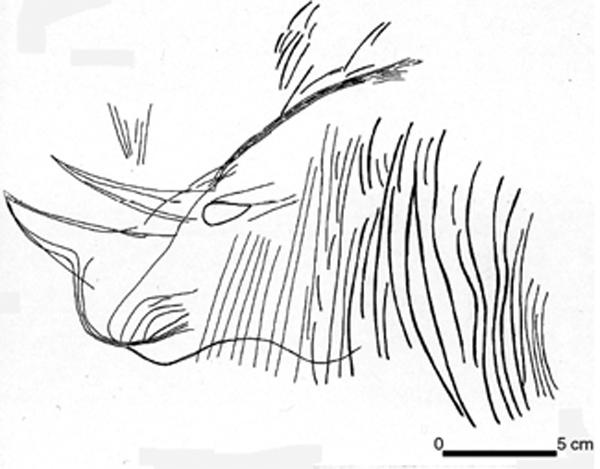
This summer, two extraordinary discoveries enriched the corpus. Exploring a narrow gallery we identified three engraved wooly rhinoceroses, and in a small hall we found two engraved stallions. One of them seems to tense his neck and to neigh. The other one, face to it, seems to be represented in an attitude of submission. This probable scene of ethology is treated with great realism in the purest Magdalenian style. (see Figures 5a, 5b, 6a & 6b)
b. Engraved wooly rhinoceros. Drawing C. Dufayet.

The positive and negative hands are traditionally attributed to the Aurignacian and the Gravettian period, in spite of their presence in decorated caves precisely dated of the Magdalenian period, such as in the cave of Combarelles 1 (Perigord). Therefore, they can not be used as a good chronological marker. On the contrary, the schematic female figure (a headless human body) presents a torsion of the pelvis similar to the figures of Gönnersdorf-Lalinde. The context of this type of figures is clearly delimited between the end of the Magdalenian period and the Epipaleolithic (Reference BosinskiBosinski 1991; Reference SentisSentis 2005), in other words between 13 000 and 9000 years BP. This estimate of the date is in accordance with the style of the animal figures discovered in the same sector of the cave. Horses and rhinoceroses actually present mostly naturalistic details: eyes, ears, nose, hairs and extremities of the limbs, and they are correctly proportioned. We can therefore propose that the paintings and engravings were made 12 000 years ago.
b. Engraved stallion. View of the head. Photo H. Paitier.

Conclusions
The Margot cave, reasonably attributed to the end of the Magdalenian period, can be correlated with some of the 12 caves known in Northern Europe, and firstly with the caves of Gouy and Orival, in Normandy. In these caves, we find similar schematic females of the type of Gönnersdorf-Lalinde (Reference MartinMartin 2001). Furthermore, the dating of a bone excavated in Gouy yielded a radiocarbon date of 12 050 + 30 years BP (Gif A-92346). Flints discovered at the entrance of the cave are attributed, according to different specialists, to the Magdalenian, Azilian or the Federmesser culture (Reference FosseFosse 1997). In England, according to recent dating and to the archaeological context (Pike, Gilmour, Pettit, Jacobi, Ripoll, Bahn, Muñoz 2005), the art of the Church Hole and Robin Hood caves can be attributed to a similar chronological period, between 15 000 and 12 000 years ago. However, the culture there is identified as the Creswellian, a regional culture found at the end of the Upper Palaeolithic. In the Swabian Jura (Germany), the painted fragment of the cave of Hohle Fels was discovered in a level dated from 13 000 years ago, and attributed to the Magdalenian culture (Conard, Uermann 2000). Finally, in central France, in the Essonne department, rock shelters exist with paintings and engravings attributed to the same chronological period and estimated as being Magdalenian in style (Wagneur 1992).
On the basis of dating and stylistic comparisons, this forms a group of eight caves, which share a 'symbolic territory'. How may we interpret the apparent melting-pot of the Madgalenian, Creswellian, Azilian and Federmesser cultures? Might the populations of the territory have the same symbolic background? In the absence of archaeological context based on modern excavations, we cannot answer these questions.
Today we are seeing the emergence of a symbolic group of Palaeolithic art, over a large territory (from England to Germany). In this group, we can also include the sites with portable art, (Pincevent, Etiolles in France, Trou Magrite in Belgium, Gönnersdorf and Andernach in Germany). We have still to define precisely the relationships between these elements and with the other cultural regions (Aquitaine, Dordogne, Eastern Europe). This is a fascinating perspective for research, which is just beginning.
Acknowledgements
We are grateful to Philippe Auphan, mayor of the Saulges village, the mayors of Saint-Pierre-sur-Erve and Thorigné-en-Charnie, Bernard Mandy, director of the Service régional de l'Archéologie des Pays de la Loire, and Nelly Le Meur, in charge of the Mayenne Department in the same service, for the authorization to study the Margot cave. We would like to thank also for his kind assistance in providing access into the caves at the Erve valley, Loïc Pouvreau, the cave's manager. A friendly greeting to Jean-Pierre Griveau, for his generous hospitality, and to Hervé Paitier for his beautiful photographs. And many thanks to Estelle Bougard, who kindly corrected this text.