





Introduction
Peaceful, non-violent competition between political rivals is a crucial principle in democracies. Even when one’s preferred party loses, voters should accept the election result and reject political violence. During periods of heightened partisan polarisation across many democracies, partisans may become less committed to these fundamental norms (McCoy, Rahman and Somer Reference McCoy, Rahman and Somer2018; Kalmoe and Mason Reference Kalmoe and Mason2022). Previous research has linked this to the affective, expressive nature of partisan competition: losing an election can make partisans experience strong negative emotions, such as anger, worry, or even disgust (Huddy, Mason and Aaroe Reference Huddy, Mason and Aaroe2015; Huddy, Bankert and Davies Reference Huddy, Bankert and Davies2018). To defend their team, partisans may be willing to endorse even extreme anti-democratic attitudes.
In this article, we examine what effects priming negative feelings about a real, salient electoral loss has on support for political violence and democratic norms. We do this in the context of the US midterm elections in 2022 and the US Presidential election in 2024. In two pre-registered survey experiments, we randomly assign election losers to either a placebo condition or to what we call an ‘emotive electoral loss’ prime – a reminder about the lost election, which also contains either angry or worried reactions from other citizens about the election result. We then assess how exposure to these emotive electoral loss primes affects support for political violence and democratic norms.
Contrary to our pre-registered expectations, we find that priming negative feelings about electoral loss does not increase support for political violence or democratic norm-breaking. Manipulation checks show that the emotive electoral loss reminders heightened feelings of worry and anger at the election outcome. While a visceral reminder about a recent electoral loss may turn up the heat of political competition, these temporary upticks in negative feelings are not enough to spur partisans into adopting more extreme anti-democratic attitudes.
This article seeks to make several contributions. Firstly, this article contributes to the literature on polarisation and democratic norms. While affective polarisation seems to go hand in hand with democratic norm erosion (Kalmoe and Mason Reference Kalmoe and Mason2022; Orhan Reference Orhan2022), other research has not found any causal relationship between these two phenomena (Broockman, Kalla and Westwood Reference Broockman, Kalla and Westwood2022; Kacholia and Neuner Reference Kacholia and Guy Neuner2022). Despite the implicit assumption that negative feelings underlie many of the harmful consequences of polarisation, the causal effects of negative emotion primes remain poorly understood. Our study thus adds a novel and understudied angle to the literature on democratic norms. This article also makes a methodological contribution by using realistic treatment stimuli to prime negative feelings around actual, salient electoral losses.
Secondly, we contribute to the literature on emotions and political attitudes. Existing work has mostly primed emotions as either generalised, apolitical feelings (Tilley and Hobolt Reference Tilley and Hobolt2023), or generalised political emotions, such as feeling angry at the out-party overall (Webster, Connors and Sinclair Reference Webster, Connors and Sinclair2023) or at their campaign (Valentino, Hutchings, Banks et al. Reference Valentino, Hutchings, Banks and Davis2008). However, partisans may often experience emotions in relation to specific political events, which could have different effects on political behaviour than generalised emotions. By designing realistic and domain-specific political emotion primes, our work expands on research studying the causal effects of priming emotions in politics (Webster, Connors and Sinclair Reference Webster, Connors and Sinclair2023).
Lastly, this study contributes to the literature on winner-loser gaps in democracies. While the most common variables of interest in the winner-loser gap literature are satisfaction with democracy (Anderson, Blais and Bowler et al. Reference Anderson, Blais and Bowler2005; Blais and Gélineau Reference Blais and Gélineau2007; Plescia, Daoust and Blais Reference Plescia, Daoust and Blais2021), and related concepts like trust or perceived legitimacy (Kern, Marien and Muradova Reference Kern, Marien and Muradova2024), democratic norm erosion is clearly related to these concepts. By studying how electoral loss reminders affect support for democratic norms, this article adds to the understudied flipside of the winner-loser gap literature.
Winner-loser dynamics, negative emotions, and anti-democratic attitudes
Experiencing defeat in elections is a fundamental aspect of political dynamics in democratic systems. It is a well-established empirical finding that supporters of the election winner are more satisfied with democracy after the election than those on the losing side (Anderson, Blais and Bowler et al. Reference Anderson, Blais and Bowler2005; Blais and Gélineau Reference Blais and Gélineau2007; Curini, Jou and Memoli Reference Curini, Jou and Memoli2012; Daoust, Ridge and Mongrain Reference Daoust, Ridge and Mongrain2023).
One explanation for the winner-loser gap in satisfaction with democracy is how citizens respond emotionally towards victory and loss. Election losers often report decreased positive feelings and heightened negative feelings, such as sadness and frustration, compared to election winners (Pierce, Rogers and Snyder Reference Pierce, Rogers and Snyder2016; Toshkov and Mazepus Reference Toshkov and Mazepus2023; Kern, Marien and Muradova Reference Kern, Marien and Muradova2024). In turn, these affective responses trigger individuals to adjust their support towards the political system. Another explanation for the winner-loser gap is rooted in utilitarian considerations of the political power asymmetry following an election. Election winners are more likely to see their interests reflected in policy outcomes, fostering greater satisfaction with political institutions (Curini, Jou and Memoli Reference Curini, Jou and Memoli2012). Satisfaction with democracy is thus unsurprisingly highest when one’s political party controls multiple levels of government (VanDusky-Allen and Utych Reference VanDusky-Allen and Utych2021). Even though winning at the local level can cushion the negative effects of national defeat, this does little to strengthen broader democratic support (Ridge Reference Ridge2022a).
In a polarised political climate, politics becomes an ‘us versus them’ game where voters may feel more compelled to place partisan loyalties over fundamental democratic principles (Graham and Svolik Reference Graham and Svolik2020). The growing tendency of partisans to like their in-group and dislike partisan out-groups has been linked to worrisome implications for democratic functioning, such as out-group dehumanisation (Martherus, Martinez, Piff et al. Reference Martherus, Martinez, Piff and Theodoridis2021), support for political violence (Kalmoe and Mason Reference Kalmoe and Mason2022), and reduced support for democratic norms (Kingzette, Druckman, Klar et al. Reference Kingzette, Druckman, Klar, Krupnikov, Levendusky and Ryan2021). This is concerning because research shows that feelings of dislike towards political out-groups are prevalent in many democracies (Gidron, Adams and Horne Reference Gidron, Adams and Horne2020; Reiljan Reference Reiljan2020; Wagner Reference Wagner2021).
Amid the backdrop of rising affective polarisation, election losses can feel like threatening events to partisans that may warrant extreme protective actions on behalf of the in-group. In line with social identity theory, once partisanship becomes expressive and presents as an emotional attachment to a party in-group, election losses become personally felt losses (Huddy, Mason and Aaroe Reference Huddy, Mason and Aaroe2015; Bankert Reference Bankert2021). A high-profile election loss can act as a symbolic and realistic threat to members of the losing side, resulting in the perceived deterioration of material and physical well-being (Krupenkin, Rothschild, Hill et al. Reference Krupenkin, Rothschild, Hill and Yom-Tov2019; Krupenkin, Hill and Rothschild Reference Krupenkin, Hill and Rothschild2024). The negative emotions catalysed by threat can then lead to confrontational and aggressive behavioural intentions towards the out-group (Shepherd, Fasoli, Pereira et al. Reference Shepherd, Fasoli, Pereira and Branscombe2018), including support for political violence (Kalmoe and Mason Reference Kalmoe and Mason2022).
At the same time, actual acts of violence against political out-group members are fortunately still a rare occurrence, and support for concrete acts of violence against out-group members is low (Westwood, Grimmer, Tyler et al. Reference Westwood, Grimmer, Tyler and Nall2022). Furthermore, more recent work has called into question whether affective polarisation causes the erosion of democratic norms. Experimental evidence from the US shows that externally induced increases in affective polarisation do not lead to reduced support for democratic norms or bipartisanship (Broockman, Kalla and Westwood Reference Broockman, Kalla and Westwood2022). Similarly, inter-group contact, despite leading to a decrease in affective polarisation, does not improve democratic accountability, such as recognising the importance of cross-party dialogue (Santoro and Broockman Reference Santoro and Broockman2022). Priming partisans with expressive partisanship does not lead to an increase in support for political violence (Kacholia and Neuner Reference Kacholia and Guy Neuner2022).
Against the backdrop of these divergent empirical findings, our study sets out to investigate the causal effects of activating negative feelings in the aftermath of an election loss on support for democratic norms and political violence.
We focus on the role of two negative political emotions in this study: anger and anxiety. A wealth of research from psychology and neuroscience shows that negative emotions, particularly anger and anxiety, can be powerful drivers of behaviour. Politically related anger seems to have increased in recent years, both voters’ expressed anger at politicians (Webster Reference Webster2020), as well as politicians’ use of angry political rhetoric (Webster, Connors and Sinclair Reference Webster, Connors and Sinclair2023). While anger can encourage collective action and facilitate social change (Zomeren, Martijn, Fischer et al. Reference Zomeren, Martijn, Fischer and Wayne Leach2004), it may also lead to punitive behaviours and vengeful policy attitudes (Lerner, Gonzalez, Small et al. Reference Lerner, Gonzalez, Small and Fischhoff2003; Clifford Reference Clifford2019). This is consistent with previous research showing that anger is a common response to political crises (Smith, Rasinski and Toce Reference Smith, Rasinski and Toce2001; Wagner Reference Wagner2014; Rico, Guinjoan and Anduiza Reference Rico, Guinjoan and Anduiza2017) and is associated with support for confrontational, aggressive responses, eg support for expanding a war (Lerner, Gonzalez, Small et al. Reference Lerner, Gonzalez, Small and Fischhoff2003; Skitka, Bauman, Aramovich et al. Reference Skitka, Bauman, Aramovich and Scott Morgan2006; Parker and Isbell Reference Parker and Isbell2010; Mackie and Smith Reference Mackie and Smith2015; Vasilopoulos, Marcus, Valentino et al. Reference Vasilopoulos, Marcus, Valentino and Foucault2019). Because of the empirical evidence from psychology and political science that anger is a key emotion underpinning political behaviour and preferences for aggressive, dominant, or violent politics, anger is one of the negative political emotions we focus on in this study.
In contrast to anger, anxiety and fear have traditionally been theorised to motivate people to retreat, seek out new information and reconsider their existing beliefs (Marcus, Neuman and MacKuen Reference Marcus, Neuman and MacKuen2000; MacKuen et al. Reference MacKuen, Wolak, Keele and Marcus2010; Vasilopoulos, Marcus, Valentino et al. Reference Vasilopoulos, Marcus, Valentino and Foucault2019). In this line of thought, anxiety should dampen support for political violence because it should lead to more rational processing. However, more recent work calls this link into question. When politically violent and risk-inducing behaviours are framed as ‘protective’ by political elites, research has found that anxious citizens are prone to adopt aggressive and extreme behaviours (Lupia and Menning Reference Lupia and Menning2009). Another recent study (Anastasio, Perliger and Shortland Reference Anastasio, Perliger and Shortland2023) suggested that both anger and anxiety are positively associated with support for political violence. Individuals who are higher in generalised anxiety are also more likely to be supportive of political violence (Armaly and Enders Reference Armaly and Enders2024).
Building on this more recent work, we expect that activating both anger and anxiety as key negative feelings in relation to losing an election should increase extreme or aggressive political attitudes like support for political violence. Our pre-registered hypotheses are:
H1: Negative feelings about electoral loss increase support for political violence.
H2: Negative feelings about electoral loss reduce support for democratic norms.
Not all voters experience electoral loss in the same way. Individuals higher in expressive partisanship are more likely to experience anger, anxiety, and other strong emotions in response to political losses, particularly when those losses are framed as threatening or unjust (Ward and Tavits Reference Ward and Tavits2012; Huddy, Mason and Aaroe Reference Huddy, Mason and Aaroe2015). Even though positive affect towards a party is associated with greater satisfaction with democracy, especially in institutionalised party systems (Ridge Reference Ridge2023), strongly attached partisans also experience the defeat of their team more acutely. Negative partisanship heightens the perceived stakes of elections and the negative implications of losing (Ridge Reference Ridge2022b). Individuals who are higher in partisanship importance also report lower levels of satisfaction with democracy when faced with a hypothetical election defeat of their in-party (VanDusky-Allen and Utych Reference VanDusky-Allen and Utych2021). Finally, support for political violence tends to be higher in individuals who are stronger partisans or have a higher dislike for their political out-group (Kalmoe and Mason Reference Kalmoe and Mason2022; Kacholia and Neuner Reference Kacholia and Guy Neuner2022).
Emotionally charged reminders of electoral defeat may thus resonate more deeply with individuals who are already strong partisan identifiers:
H1A + H2A: This effect is stronger for individuals higher in negative partisanship, partisanship importance, and positive partisanship.
Methods
To test whether activating negative feelings about electoral loss affects anti-democratic attitudes, we conducted two pre-registeredFootnote 1 survey experiments. In both studies, we primed partisans with negative feelings about a real electoral loss and then measured their support for political violence and democratic norm violations. Study 1 was conducted around the 2022 US midterm elections; Study 2 followed the 2024 US presidential election.
Our approach offers several methodological strengths. First, both studies were fielded shortly after real, high-salience elections, allowing us to capture how partisans respond to emotive reminders about actual election losses. This enhances external validity compared to prior work that relies on hypothetical loss scenarios (VanDusky-Allen and Utych Reference VanDusky-Allen and Utych2021; Kalmoe and Mason Reference Kalmoe and Mason2022). The treatment stimuli were designed to resemble real news articles, including partisan commentary on the election outcome, mirroring the kind of content citizens might encounter in the post-election media environment.
Second, we test our hypotheses across two electoral contexts. This allows us to assess whether the effects of emotive electoral loss reminders generalise across different types of elections and partisan configurations. Study 1 includes both Republican and Democratic participants, enabling a symmetrical test of treatment effects across partisan groups.
Third, we deliberately varied the experimental design across the two studies to probe the robustness of our findings. Study 1 adopts a conservative, low-intensity design: it uses subtle cues and includes a filler task between treatment and outcome measures to simulate real-world exposure. In contrast, Study 2 employs a high-intensity, efficacy-oriented design, maximising treatment salience to test the upper bound of potential effects.
Context and data
We selected the United States as the context for our studies. The U.S. exhibits high levels of affective polarisation, with negative out-party feelings increasingly outpacing positive in-party attachments (Iyengar, Lelkes, Levendusky et al. Reference Iyengar, Lelkes, Levendusky, Malhotra and Westwood2019; Garzia, da Silva and Maye Reference Garzia, da Silva and Maye2023). In this environment, negative emotive electoral loss primes are likely to resonate strongly, as they tap into emotions that are already salient and accessible to respondents.
In both studies, we restricted participation to partisans whose preferred party had recently lost an election. The 2022 midterms produced a split result: Democrats retained control of the Senate, while Republicans gained control of the House of Representatives. This outcome provides an ideal setting for testing the effects of electoral loss primes symmetrically across partisan groups. Study 1, therefore, includes both Republican and Democratic partisans. In contrast, the 2024 presidential election was won by the Republican candidate Donald Trump, and Study 2 was fielded exclusively to Democratic partisans.
We conducted our studies on Prolific, an online participant recruitment platform (Peer, Brandimarte, Samat et al. Reference Peer, Brandimarte, Samat and Acquisti2017; Palan and Schitter Reference Palan and Schitter2018). There are a total of N = 705 observations in Study 1, and N = 1077 in Study 2. Sample sizes were determined through power calculations. To detect treatment effects of 0.2 standard deviations with 80% power, we set a target sample size of N = 700 in Study 1 (a pre-post design), and N = 1000 in Study 2 (a one-shot survey) (see Appendix Section A.12). We also implemented custom quotas on Prolific to ensure that both samples are within range of other high quality samples of partisans in terms of gender and age. Still, our sample is slightly younger and more educated, which is a common constraint of online convenience samples. Further details on sample characteristics are provided in Appendix Section 6.4.1.
Experimental design
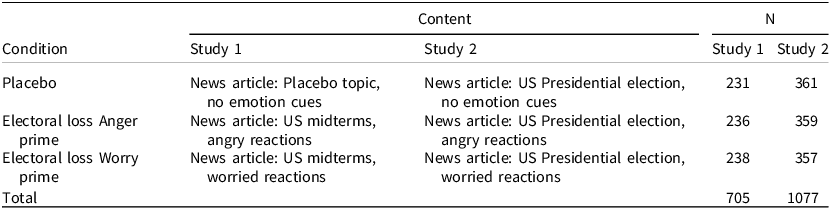
We conducted two pre-registered survey vignette experiments in which participants were randomly exposed to an emotive reminder about a recent election their party had lost. In both Study 1 and Study 2, participants were assigned, with equal probability, to one of three conditions: an electoral loss prime referencing anger, an electoral loss prime referencing worry, or a placebo condition (see Table 1). As we would expect under random assignment, the experimental groups are balanced on most pre-treatment covariates (see Appendix Section A.1).
Overview of experimental conditions

The placebo conditions differ in informational content: Study 1 uses a neutral, unrelated article, while Study 2 presents the same election news as the treatment but without emotional reactions. This design allows Study 1 to capture the combined effects of salience, information, and emotion, whereas Study 2 isolates the unique impact of emotional cues. We discuss design differences between the two studies in more detail in Appendix A.5 and Appendix A.8.
Participants assigned to the treatment conditions received a negative electoral loss prime composed of three elements: (1) a short news article reporting the election outcome, (2) emotional reactions from other citizens expressing anger or anxiety about the result, and (3) an open-ended writing prompt asking participants to describe their own feelings about the election. The news article was designed to resemble a real media report. An example headline and image of the news article from Study 2 can be seen in Figure 1, and full treatment materials are available in Appendix Section A.4.3.
Example newspaper article and headline from Study 2.

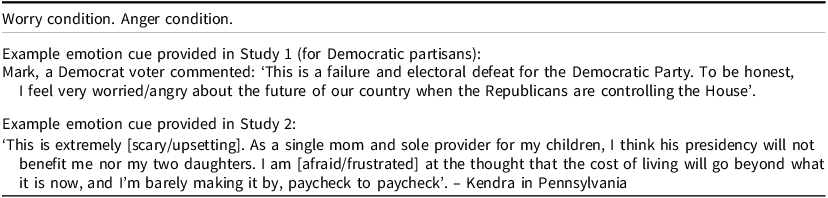
The core mechanism of the treatment lies in the embedded emotional cues. Even brief experimental political stimuli eliciting emotions can evoke emotional reactions and lead to lasting effects on political attitudes (Clifford Reference Clifford2019), even on principled issues, such as inter-group conflict (Cohen-Chen, van Kleef, Crisp et al. Reference Cohen-Chen, van Kleef, Crisp and Halperin2019). Emotions can spread through social contagion (Kramer, Guillory and Hancock Reference Kramer, Guillory and Hancock2014; Goldenberg and Gross Reference Goldenberg and Gross2020). When individuals are exposed to others expressing anger, they are more likely to start feeling angry themselves. We leverage this mechanism by embedding others’ emotional reactions within the treatment. This passive exposure is then reinforced through an active writing task, which encourages participants to write about their own emotional response to the election outcome. Examples of the emotion cues included in the studies can be seen in Table 2. For the full treatment texts and emotion cues, please consult the Appendix Section A.4.3. We deliberately decided to use more light-touch emotion cues in Study 1, and more heavy-handed and detailed emotion cues in Study 2. The rationale behind using highly realistic and detailed emotion cues in Study 2 was to aim for maximum treatment intensity, to stack the odds against finding null effects.
Example emotion cues embedded in the treatment texts

Treatments were tailored to participants’ self-reported party identification. In Study 1, Democratic partisans read about their party’s loss in the House of Representatives, while Republican partisans were shown a news article highlighting the Republican loss in the Senate. In Study 2, only Democratic partisans were included, and they were primed with their party’s loss in the presidential election.
Outcome measures
To measure support for political violence, we use a validated four-item scale developed by Kalmoe and Mason (Reference Kalmoe and Mason2022). This includes items such as: ‘When, if ever, is it OK for [in-partisans] to send threatening and intimidating messages to [opposing party] leaders?’ (Response options: Never, Occasionally, Frequently, and Always).
Support for democratic norms is measured using an eight-item scale adapted by Broockman, Kalla and Westwood (Reference Broockman, Kalla and Westwood2022), including items such as: ‘When determining the boundaries for Congressional districts, [in-party] politicians should try to maximize the number of [in-party]s elected’. Full wording for both outcome measures can be found in the Appendix 6.4.5.
Pre-treatment covariates
In Study 1, we measure positive partisanship, negative partisanship, and partisanship importance in a separate pre-treatment wave conducted before the election. In Study 2, a one-shot survey, we measured pre-treatment covariates directly before our experiment. We thus limit our pre-treatment measures to partisanship importance to avoid priming effects.Footnote 2
Positive partisanship is captured using the expressive partisan identity scale (eg ‘When people criticize the [Democratic/Republican] party, it feels like a personal insult’) (Huddy, Mason and Aaroe Reference Huddy, Mason and Aaroe2015; Bankert, Huddy and Rosema Reference Bankert, Huddy and Rosema2017). Negative partisanship is measured using the scale developed by Bankert (Reference Bankert2020) (eg ‘When people criticize the [Democratic/Republican] party, it makes me feel good’). We also measure partisanship importance using a standard 1–5 scale: ‘How important is being a [Democrat/Republican] to you?’ (Not at all – Extremely important), which is closer to traditional partisanship strength measures (Huddy, Davies and Sandor Reference Huddy, Davies and Sandor2020). Full wording can be found in Appendix A.4.2.
Manipulation checks
In this section, we show that the treatments worked as intended: the treatments increased negative feelings about the election outcome, across both an open-text response and a closed-ended question.
Participants who were exposed to an emotive electoral loss reminder (vs the placebo) used significantly more negative language, as well as more words related to fear and anger when describing their feelings in an open text response (see Figure 2). We note that the smaller effects in Study 2 are likely due to the different placebo designs. In Study 1, participants in the placebo condition were asked to write about a neutral placebo topic (stadium licensing) while in Study 2, participants in the placebo condition also wrote about the election outcome, leading to a higher baseline use of negative emotive language (see Appendix A.9). Even in this more conservative comparison in Study 2, partisans exposed to the anger treatment use significantly more angry words when describing their feelings about the election, and partisans exposed to the worry treatment use significantly more fearful language when describing their feelings about the election (vis-a-vis the placebo).
Marginal effect of treatments (vs Placebo) on participants’ use of affective and emotive words in the open text responses. More information about these measures can be found in the Appendix, Section A.9.

Next, we assess whether the treatments affected participants’ self-reported feelings about the election. We asked respondents to rate to what extent they are experiencing a range of emotions towards the election outcome, on a five-point scale from ‘Not at all’ to ‘Extremely’. For ease of interpretation, we show the mean proportion of respondents who feel intensely angry or worried at the election outcome in Figures 3 and 4. Full regression results can be found in the Appendix, Tables A.19 and A.20. We can see that baseline anger levels are lower after the US midterms in 2022 than after the Presidential election in 2024. Four in ten Democrats in the Placebo condition report feeling ‘very’ or ‘extremely’ angry at the election result in 2024, compared to closer to one in ten in 2022. In both studies, we see a significant increase in intense anger reported among participants who were randomly exposed to angry reactions at the election loss, compared to the placebo. In Study 1, there is a 10 percentage point jump in intense anger from 14% to 24% among Democrats, and in Study 2, a jump of 10 percentage points from 44% to 54% feeling intense anger. Reading others’ angry reactions at the election outcome made partisans significantly more likely to say that they are feeling angry themselves (Table A.19).
Self-reported anger at the election outcome by treatment condition and study. Across both studies, partisans in the Anger condition report feeling significantly more anger than those in the Placebo condition.

Self-reported worry at the election outcome by treatment condition and study. Does the Worry treatment make participants feel more worried about the election outcome? Yes in Study 1, but not in Study 2.

The treatment effects on feeling worried are more nuanced. While there is a significant effect of the worry treatment on self-reported feelings of worry in Study 1, there is not in Study 2. Feelings of worry are generally more common than those of anger: already, around 1 in four Republicans in the placebo condition report feeling worried after the US midterms, and four in ten Democrats say they are intensely worried in 2022. In 2024, 70% of Democrats say that the election outcome worries them intensely. In this climate of extreme anxiety, the Worry treatment does not push feelings of worry up any further in Study 2.
As pre-registered for Study 2, we also report the effects of the treatments on emotion dimensions: anxiety, anger, disgust, and enthusiasm. These dimensions are calculated by taking the mean of relevant sub-items from our emotion batteryFootnote 3 . The results are reported in Figure 5. Results for individual sub-items can be found in the Appendix, Fig A.11. We can see that in Study 1, the treatments also increased disgust and decreased enthusiasm, alongside increasing anxiety. In contrast, in Study 2, the only significant and strong positive effect of any treatment on emotions is the effect of the Anger treatment on feelings of anger. The treatments in Study 2, compared to the placebo, do not move anxiety or disgust, and only slightly decrease enthusiasm.
Treatment effects on emotion dimensions.

It is perhaps not unsurprising that the treatments also dampen positive feelings about the election outcome and heighten some other associated negative feelings. Individuals rarely experience just one emotion in isolation (Moeller, Ivcevic, Brackett et al. Reference Moeller, Ivcevic, Brackett and White2018; Lange and Zickfeld Reference Lange and Zickfeld2023), and experimental stimuli often move multiple emotions at once (Clifford Reference Clifford2019). The key takeaway is that the treatments overall increase negative feelings about the election results compared to the placebo – whether measured as self-reports or through open text responses – and that in Study 2, in particular, the anger treatment significantly and distinctly increases anger at the election outcome (vis-a-vis the placebo).
Results
The results of the main pre-registered analyses are summarised in Figures 6 and 7. We use heteroscedasticity-consistent standard errors (HC2) and two-tailed hypothesis tests throughout the analyses.
Marginal (null) effect of the treatment primes on support for political violence. Priming partisans’ negative feelings about electoral loss does not increase support for political violence.

Marginal (null) effect of the electoral loss treatments (vs placebo) on democratic norms. Negative electoral loss primes do not decrease support for democratic norms.

Figure 6 visualises the treatment effects on the first outcome, support for political violence. Full regression model results for the political violence outcome can be found in the Appendix, Tables A.3, A.4, A.5, and A.6.
Figure 6 shows the marginal effects of the electoral loss treatments (vs the placebo) in Study 1 and Study 2. It is clear that neither the anger nor the worry about the electoral loss treatment has a significant effect on support for political violence. It does not matter whether we prime partisans with negative feelings around electoral loss after the 2022 US midterms (Study 1), or after the 2024 US Presidential election (Study 2) – exposing partisans to emotive reminders about the election they have lost does not increase their support for political violence. This goes against our pre-registered hypothesis 1.
These null effects on support for political violence are consistent across different operationalisations of the outcome and model specifications and there are also no heterogeneous treatment effects by positive partisanship, negative partisanship, or party importance on support for political violence (for Study 1, see Models 3–5, Table A.3 and A.4 in the Appendix, for Study 2, see Models 3–4, Table A.5, A.6).
In regard to the second pre-registered outcome, support for democratic norms, there is also no evidence that priming negative feelings about electoral loss diminishes support for democratic norms (see Figure 7). Again, these null findings are consistent across the two studies. The only outlier here is a small negative effect on the first sub-item of the democratic norms scale in Study 2, but the overall pattern is clear: exposure to emotive electoral loss primes does not decrease support for democratic norms. There are no heterogeneous treatment effects by positive or negative partisanship or partisanship importance on support for democratic norms (for Study 1, see Models 3–5, Table A.7 in the Appendix; for Study 2, see Models 3–4, Table A.8). We also explore if the electoral loss treatments heighten affective polarisation. We think of affective polarisation as an exploratory outcome that could also be moved by exposure to emotional stimuli. In Study 1, exploratory analyses suggest that affective polarisation goes up after partisans were exposed to the emotive electoral loss reminder, and that this is driven both by increases in in-party warmth and out-party coldness (see Appendix A.10). However, we do not find this exploratory relationship between the electoral loss treatments and affective polarisation in Study 2.
Conclusion
In this article, we examined whether priming negative feelings about losing an election increases anti-democratic attitudes among partisans. In two pre-registered survey experiments fielded in the US, we randomly assigned partisans to either a placebo or an emotive electoral loss prime designed to evoke anger or anxiety at the election outcome. Contrary to our expectations, we do not find evidence that emotive reminders about an election loss increase support for political violence or democratic norm-breaking.
While we do find that emotive electoral loss reminders turn up the heat of politics for partisans, these heightened negative feelings do not translate into greater support for anti-democratic attitudes. In Study 1, conducted after the US midterms in 2022 among a sample of both Republican and Democratic partisans, we find that negative electoral loss primes, compared to a placebo, significantly increase feelings of anxiety and disgust at the election outcome. In Study 2, conducted after the US Presidential election in 2024 among Democratic partisans, we find that anger-evoking electoral loss primes, compared to a placebo, significantly increase feelings of anger at the election outcome. Anger is already running high among Democrats at this point in time (around 4 in 10 partisans assigned to the Placebo describe feeling very or extremely angry at the election result). Even in this already quite negative emotional setting, the anger electoral loss prime leads to a 10 percentage point increase in feelings of extreme anger. This shows that emotive electoral loss reminders can spur congruent negative emotional reactions among partisans.
However, our results also imply that even when exposed to a specific negative emotion prime (eg anger), citizens may often react with a range of heightened negative emotions (eg anger, anxiety and disgust). If specific negative emotions are associated with divergent behaviours or attitudes, then future work should consider developing stronger targeted emotion primes to disentangle the potentially divergent effects that distinct evoked emotions have on political attitudes.
In Study 2, the outcome questions on support for political violence and democratic norms were directly asked after the treatment manipulation. It therefore seems unlikely that the null effects are simply due to a washing out of the treatment primes. We also run some exploratory analyses that suggest affective polarisation goes up after partisans were exposed to the emotive electoral loss reminder in Study 1. However, we do not find this exploratory relationship in Study 2. Future research could further probe the relationship between partisan emotion priming and affective polarisation.
Our results imply that emotive reminders about lost elections can momentarily increase intense negative feelings among partisans but are not enough to move more principled attitudes, such as support for political violence and democratic norms. This finding speaks to recent research which has called into question the causal link between affective polarisation and support for political violence (Voelkel, Chu, Stagnaro et al. Reference Voelkel, Chu and Stagnaro2023). It also resonates with the idea that it is perhaps not winning per se, but the inclusion in government and the power that comes with it, which affects democratic satisfaction and other related outcomes (Daoust, Plescia and Blais Reference Daoust, Plescia and Blais2023). While negative news in the aftermath of the election may affect more proximate outcomes, like confidence in electoral integrity, this may not translate into shifts in overall support for democratic norms (Berlinski, Doyle, Guess et al. Reference Berlinski, Doyle and Guess2023).
Taken together, the findings from this study have implications for our understanding of negative emotions in politics and democratic norms. The results from this article spell at least some cautiously good news: partisans are perhaps not as easily swayed as assumed into completely abandoning fundamental democratic principles. This points to a degree of attitudinal stability in the face of emotive reminders about electoral loss. We cannot, however, exclude the possibility that repeated, highly emotive electoral losses (see eg Kern, Marien and Muradova (Reference Kern, Marien and Muradova2024)) do breed support for democratic norm erosion. The present study was powered to detect small- to medium-sized effects of the negative emotive electoral loss reminder on anti-democratic attitudes, but it remains possible that even smaller, yet meaningful, effects went undetected. Future research should delve further into the mechanisms that can lead to these extreme anti-democratic attitudes, including the potential long-term consequences of repeated intense negative feelings after salient political events like election losses.
Supplementary material
The supplementary material for this article can be found at https://doi.org/10.1017/S1475676525100601.
Data availability statement
Replication files are available on the Harvard Dataverse: https://doi.org/10.7910/DVN/PCLBAK.
Acknowledgements
We acknowledge the use of Microsoft Copilot (based on GPT-4) for assistance with manuscript editing and coding support. The authors are grateful for feedback on earlier versions of this paper to members of the Centre for the Politics of Feelings, the LSE Political Behaviour workshop, and EPSA 2024.
Funding statement
This research was supported by the NOMIS Foundation grant to MT for the Centre for the Politics of Feelings.
Competing interests
The authors declare none.



 Open access

