




Today, we are pleased to present these men, graduating with a fully accredited Bachelor of Arts in pastoral ministry, all of whom will soon be deployed on field ministry teams to other facilities throughout the state of North Carolina to serve the incarcerated population. They will join the other graduated classes of field ministers already serving all over the state.
—Richard Wright, Director, Southeastern Baptist Theological Seminary, North Carolina Field Ministry Program. Commencement Address, 2024 Graduation Ceremony, Nash Correctional Institution. May 14, 2024.Footnote 1
After graduation, I am going to another facility in the Department of Corrections system, and I’m going to raise a church and tell people about Jesus - discipleship. I want to share Him with other people because I know what He did in my life. He saved me, He changed me. I want to go and give hope to others. That’s what OBU equipped me to do and that’s exactly what I’m going to do.
—Inmate Graduate, Prison Divinity Program, Oklahoma Baptist University, Lexington Correctional Center. June 22, 2025.Footnote 2Religious Penal Governance and the New Carceral Church
Driven in part by the growing staffing crisis inside US prisons, inmate field ministry programs have spread rapidly across the United States.Footnote 3 As mapped by the Prison Seminaries Foundation, these evangelizing units, widely called “God pods” across prison communities, exist or are being implemented in over half the states, with the stated goal of establishing inmate field ministry programs “in every state.”Footnote 4 At present, twenty states deploy inmate field ministers in 124 prison facilities nationwide, with approved implementation of 17 additional units currently pending.Footnote 5 While enrollment is nominally open to prisoners of all faiths or no faith, appointment to the position of inmate field minister is granted exclusively through credentialing in Christian doctrine.Footnote 6
This growing influence of evangelical Christianity in public institutions, specifically US prisons,Footnote 7 where evangelical stakeholders increasingly shape organizational governance and define institutional norms, is blurring the boundaries between church and state.Footnote 8 This rise of privately financed Christian units is an evolved form of faith-based programming in public prisons, funded through private philanthropic efforts to employ Christian doctrine as a mechanism of state offender rehabilitation. Categorized as volunteers and unregulated by government oversight, Christian educators dramatically influence the experience of incarceration for many thousands of US prisoners.Footnote 9 While previous such units were declared unconstitutional for use of government funding by proselytizing Christianity, newer programs combine private philanthropy with in-kind government support for Christian evangelism undertaken by inmate graduates of private programs.Footnote 10 My on-site and archival research of these programs explores the constitutionality of an emergent shift in prison-based religious education from providing collegiate course work about religion to credentialing prisoners for state-sanctioned inmate field ministry. The author explores constitutional implications of this shift, especially regarding key elements of church-state jurisprudence and a resurgence of Christian stakeholders directly operating state prison programs.Footnote 11 A decline in funding for public chaplaincy has created a correctional programming vacuum, increasingly filled by a new regime of Christian penal governance led by privately financed religious entrepreneurs.Footnote 12
Methods and Data
The ecclesiastical units I studied are denominationally Protestant, offer prisoners tuition-free collegiate-level credentialing for Christian ministry, and institutionalize the primacy of Christian doctrine in prison programming for what sponsors call “moral rehabilitation.”Footnote 13 Over the space of eleven years (2013–2024), I completed site visits to ten of twenty active units, conducting extensive ethnographic and empirical research in the largest three (Angola, Parchman, and Darrington-Memorial), following all appropriate IRB protocols.Footnote 14 While research has not kept pace with the rapid growth of the inmate field ministry programs, the three tables in the appendix document the prevalence of programs and graduates based on available data and archival research.
The Angola Model: Addition by Subtraction
Among the earliest inmate field ministry programs operating in a US prison is the Christian seminary at Angola (Louisiana State Penitentiary), established in 1995 after congressional revocation of Pell Grant eligibility for convicted felons in 1994.Footnote 15 Sponsored by the New Orleans Baptist Theological Seminary, the program provides a baccalaureate degree in Christian ministry at no cost to prisoners.Footnote 16 Ethnographic research inside Angola shows the program to have evolved over time, with growing emphasis on utilizing the labor of graduates of the seminary for process counseling and religious education amid budget cuts reducing staff and chaplaincy.Footnote 17 While the seminary first aspired merely to supplant the collegiate education courses eliminated by the revocation of Pell Grants, assignment of inmates to the seminary as fulltime students was administratively processed as inmate labor. Enrollees assigned to seminary coursework listed their prison labor assignment as “seminary student,” with graduates eventually achieving the status of “Offender Minister.”Footnote 18
Ethnographic research at Angola highlights Inmate Ministers characterizing their labor as a personal “ministry of presence,” emphasizing private religious witness over one of carrying state endorsement. Offender ministers at Angola expressed suspicion of state religion and feared being perceived as government “snitches” by fellow prisoners, eschewing and never advancing a unified theological platform.Footnote 19 A modest religious pluralism at the prison is further reinforced by a long period of prisoners’ rights litigation involving Eighth Amendment violations and a severe lack of staffing. Approval for inmate-led religious worship was the result of a consent decree won by prisoners amid concerns from black inmates over the Angola’s all-white chaplaincy.Footnote 20 “Inmate pastors” became nominated by “inmate churches” (inmate religious clubs) as representatives, in part to remedy this imbalance and long before the New Orleans Baptist Theological Seminary’s program.Footnote 21 Ethnographic research documented Angola’s inmate ministers articulating diverse perspectives on faith, reinforced through multiple pathways of achieving the status of offender minister—either through graduation from the seminary or via separate nomination from autonomous inmate churches. Three out of five of the largest inmate churches at Angola were in fact led by non-seminary graduates in 2015.Footnote 22 In short, a modest Christian ecumenism exists at Angola, albeit one that my colleagues and I also documented is openly suppressive of Islam.Footnote 23
Dean of the seminary, Dr. Jimmy Dukes explained being approached by Angola warden Burl Cain after the revocation of Pell Grants.Footnote 24 After learning of great interest on behalf of prisoners, seminary administrators visited the prison. As the administrator responsible for implementing the program, Dukes expressed a desire for more diverse religious programming, articulating direct concern over the free exercise rights of prisoners and what he believed was Louisiana’s overly punitive sentencing structure:
Well, we pay for this program out of our own pocket as an offering. We’re proud to do it. We certainly don’t force it on anyone. Other programs would be welcome. Where are they? I would say that the best thing that could happen would be where it becomes the norm that people of all faiths—whatever—get to tell their story. That would be the best thing. Perhaps then we can begin to discuss genuine rehabilitation and giving people a second chance, and begin to look at non-violent people in prison. Is their sentence fair? That’s what I would hope.Footnote 25
The work that my colleagues and I did at Angola and beyond documents a legal scenario increasingly commonplace in US prisons: philanthropic religious stakeholders work to improve human rights conditions due to a lack of education resources, only to later have those same religious stakeholders become so entrenched inside prisons as to crowd out and infringe upon inmates’ civil liberties in matters religious. In God’s Law and Order: The Politics of Punishment in Evangelical America, Aaron Griffith highlights much the same. Noting prison evangelist Herbert Ellingwood’s reference to inmates’ status as “a captive audience” that should be “exploited,” Griffith suggests the ethos of many prison evangelists: “forced confinement was not incidental to prison ministry, but welcome.”Footnote 26
While both civil libertarians and legal scholars openly questioned the constitutionality of Angola’s inmate ministry program, the relative poverty and isolation of the prison left outside litigants such as the ACLU of Louisiana reluctant to take legal action.Footnote 27 Determining that litigation against the seminary on First Amendment grounds would result in abolition of the program, ACLU leadership opted to leave it alone. According to the director of the Louisiana chapter of the ACLU, the revocation of Pell Grant eligibility in 1994 left Angola so structurally dependent upon the religious charity of the seminary for access to higher education that her organization ultimately decided that litigating the constitutionality of Angola’s Christian seminary would render its prisoners only more destitute. This faith-based model of addition by subtraction reframes structural dependency as programmatic necessity, embedding and legitimizing religious entrepreneurs in prisons after secular and other resources have been systematically withdrawn. As Marjorie Esman, executive director of the ACLU in Louisiana, recently stated: “I think that what warden Burl Cain calls moral rehabilitation is, in his mind, religious doctrine, but a lot of good has come of it … . I think it’s unfortunate that the only college available is a Christian one, but the fact that a college is there at all is important.”Footnote 28
InnerChange Freedom Initiative—Iowa
The InnerChange Freedom Initiative established by Prison Fellowship at Iowa’s Newton Correctional Facility in 1999, created a program wherein selected volunteer prisoners, funded by taxpayers, were moved into an “honor dorm” for intensive religious instruction.Footnote 29 In 2003, a group of Catholic inmates, state chaplains, and other nontraditional religionists at the prison successfully challenged the constitutionality of the initiative, arguing that taxpayer-funded religious programming unfairly privileged evangelical Christian inmates, thereby discriminating against others and violating the Establishment Clause.Footnote 30 Catholic inmates enrolled in the program testified they were denied the use of Catholic Bibles, while state chaplains were openly marginalized by the program’s staff.Footnote 31 Litigants, moreover, argued that the state chaplaincy, which operates through a mandate of religious neutrality, was openly marginalized by the program’s theological dogmatism, thereby entangling the prison in religious matters and facilitating what became the program’s ecclesial dominance over the prison. Prisoners in the program testified that enrollment was perceived to favorably affect parole decisions, with program staff members attending hearings on behalf of enrolled inmates. Catholic participants testified that the InnerChange Freedom Initiative was “anti-Catholic” and openly disparaged their beliefs and sacred texts, with others remaining silent out of fear of expulsion.Footnote 32 In order to facilitate the unit, nonreligious inmates were displaced from the prison’s secular education honor dorm by administrators to accommodate the program, imposing a religious test for a public benefit.
In June 2006, the InnerChange Freedom Initiative at Newton was ruled unconstitutional.Footnote 33 The judge found that the state of Iowa’s funding of Prison Fellowship’s honor dorm created a coercive religious dynamic at the prison, violating the Establishment Clause and entangling prison officials with sectarian Christianity.Footnote 34 Inmates lacked meaningful alternative choices to the program’s evangelical Christian activities and the prison discriminated on the basis of religious affiliation.Footnote 35 Moreover, the program used taxpayer funding both to promote and to enforce a narrow religious doctrine inside the prison, coercing inmates into doctrinal compliance and thereby establishing a seamless ecclesial-state authority structure using delegated state power.Footnote 36 While token neutrality was espoused by opening enrollment to inmates of any faith or no faith, all matriculation was achieved only by way of instruction in Prison Fellowship’s particular Christian doctrine.
Lawtey Correctional Institution
Florida’s faith-based prison program at Lawtey Correctional Institution, established in 2003, initiated “America’s first fully faith-based prison.” The program featured religious dormitories set up for delivery of Christian programming and was funded entirely through private donations.Footnote 37 While nondenominational in character, all curricula and staff were charismatic Christian who donated their time as instructors.Footnote 38 Operational design of the program was modeled on the Prison Fellowship InnerChange Freedom Initiative, albeit without state funding.Footnote 39 After initial complaints regarding a lack of religious diversity, the program was expanded. In an effort to implement a broader ecumenism, Lawtey’s agenda was modified to include programming for thirty-one faith traditions, including secular and non-Christian offerings and the recruitment of additional diverse religious volunteers.Footnote 40 Following ongoing complaints of religious favoritism, however, the program was modified further to include certifications in secular life-skills training alongside religious programming. This shift created an “open marketplace of ideas” model, where inmates could choose between religious or secular coursework.Footnote 41 The Florida Department of Corrections emphasized that all religious instruction remained privately funded and inmate participation was voluntary.Footnote 42 Critics, however, like ACLU of Florida president Howard Simon, argued that the very concept of a “faith-based prison” violated the constitution without simultaneously improving conditions for all prisoners across the entire state, and rejecting all pretextual invitations for religious involvement as a precondition of prison programming.Footnote 43
Heart of Texas Foundation College of Ministry’s Inmate Field Ministry Program
The Heart of Texas Foundation College of Ministry, founded in 2009, operates the largest inmate field ministry program in the nation.Footnote 44 Funded privately, the college trains and certifies inmate field ministers to evangelize inmates across the entire Texas prison system. The program offers a Bachelor of Arts in Applied Ministry, with graduates placed in inmate field ministry teams in both men’s and women’s prisons.Footnote 45 While enrollment is not restricted by religion, all inmate field ministry credentialing is achieved exclusively through study of Christian doctrine via The Heart of Texas Foundation College of Ministry.Footnote 46 The Heart of Texas program, which has placed more than two hundred inmate field ministers throughout Texas prisons, highlights the intention to “spread the Gospel of Jesus Christ” as the inspirational mandate for its work and promotes the inerrancy of Christian scripture as central to its doctrine.Footnote 47
Public Chaplains versus Inmate Field Ministers: The Abandonment of Religious Neutrality
Unlike clergy who serve congregations of co-religionists, public chaplains operate in secular, pluralistic environments—such as hospitals, prisons, and the military—where they serve individuals from a wide range of faith traditions, including those with no religious affiliation. In these public institutions, a chaplain’s role is not to promote a particular religious doctrine, but to facilitate access to spiritual care for those who request it. A defining feature of professional chaplaincy, distinguishing it from ordained ministry, is its commitment to religious neutrality. Chaplains ensure that spiritual participation is voluntary and noncoercive, respecting each individual’s freedom of belief. As Winnifred Sullivan notes, public chaplains serve in spaces where people gather for nonreligious reasons—such as war, illness, incarceration, or disaster—and their role is to make religious programming available while upholding the right of non-participation.Footnote 48 In prisons, this requires that chaplains avoid pressuring inmates to adopt particular beliefs, instead fostering an environment that honors religious diversity. Most of a prison chaplain’s work centers on enabling access to a range of religious and spiritual services. Chaplains are not missionaries but professionals who safeguard religious liberty in state institutions. As Sullivan explains, “[p]rison chaplains are not legally understood to be there in order to effect conversion, that is, to engage in overt proselytization.”Footnote 49 Chaplains’ work remains constitutionally valid only to the extent that it avoids coercion. Research shows, moreover, that protecting religious diversity in prisons expands the capacity of religious volunteers to serve prisoners.Footnote 50
In contrast to this model of religious neutrality, however, inmate field ministers engage in overt proselytization of fundamentalist Christianity with the explicit support of state officials. Located disproportionately in Southern states, the inmate field ministry programs espouse a theologically narrow Christian ecclesiology. Token inclusion of inmates from other faiths in the programs masks a system whereby certification in only fundamentalist Christianity confers access to collegiate education, credentialing, and recognition by state authorities. Though touted as evidence of religious neutrality, inmate field ministry programs embody a functional religious test for state-assigned positions. Inmate field ministry programs do not merely permit religious exercise, but endorse and implement religious practice. At a recent public graduation ceremony for the Heart of Texas program, Texas Lt. Governor Dan Patrick declared, “Maybe the next great revival is starting in our prisons. The only way we can change the hearts of men is through the power of Jesus Christ.”Footnote 51 Similarly, at a North Carolina graduation for inmate field ministers, the program’s assistant director articulated the program’s goal as fostering conversion: “The hope is to one day have a team of field ministers in every prison in North Carolina so that they can help those who are incarcerated move in the direction of rehabilitation and find new life in Christ.”Footnote 52
Inmate field ministry represents an important departure from the principle of religious neutrality that has historically governed prison religion, a fundamental transformation of what Jason Sexton calls the ecclesia incarcerate—the church behind bars.Footnote 53 Inmate field ministers are inmates trained within correctional facilities by privately funded Christian organizations. The case Zellman v. Simmons-Harris, for example, requires that state entanglements with religion must protect the genuine and independent religious choices of private individuals, not influence such choices by state endorsement or inducement.Footnote 54 Under conditions of diminished alternative programming and reduced staffing, however, inmate field ministry programs by definition fail to provide a true free choice. Unlike public chaplains, inmate field ministers are not bound by professional strictures of religious neutrality.Footnote 55 Upon graduation from their ecclesial training—and with institutional approval—inmate field ministers actively promote Christian teachings to fellow inmates in fulfillment of their compulsory inmate labor assignment.
David Golemboski has described this sort of religious endorsement as an example of the “expressive dimension of free exercise,” whereby official declarations of the right to free exercise mask narrowed religious liberty.Footnote 56 A striking example comes from the director of the Texas Department of Criminal Justice, who recently equated the mission of inmate field ministries with that of the department itself: “As you walk the path, I want you to hear this from me directly: I absolutely fully support your mission. At TDCJ, we fully support what you’re doing, our wardens fully support what you’re doing, and we are on the same team. We’re excited about the changes that your work is going to bring.”Footnote 57
In sum, inmate field ministry represents an important shift away from the longstanding expectation of religious neutrality by correctional authorities, with dramatic implications for prison religion. Inmate field ministers are themselves prisoners, trained within custodial settings by privately funded religious groups in prisons that lack programmatic equivalents offering diverse faith or secular alternatives. In the context of diminished opportunities for programming overall, the coercive incentives for fealty to prison-sponsored religion become easily recognized.Footnote 58 As noted, credentialing for inmate ministry programs is given without the traditional expectations of religious neutrality by public chaplains, and upon graduation and with the permission of prison officials, inmate field ministers actively promote Christian doctrine to fellow prisoners. This proselytizing expectation, combined with private financial support and the increasingly deregulated prison system, raises novel concerns about religious coercion in the setting of prisons.Footnote 59
Religion, Coercion, and State Neutrality in Public Institutions
The federal court’s decision striking down Iowa’s InnerChange Freedom Initiative relied on long-standing constitutional limits against government entanglement with and endorsement of religion—especially as defined in school prayer and public education cases. As are public school teachers, prison chaplains act as state agents and must remain religiously neutral, ensuring participation in religious activities remains truly voluntary and free from coercion. Foundational Supreme Court decisions provide this framework. In Everson v. Board of Education (1947), the court upheld public funding for student transportation to religious schools but firmly stated that the government cannot aid or oppose any religion.Footnote 60 In Engel v. Vitale (1962), even a voluntary, state-written, nondenominational prayer in public schools was ruled unconstitutional due to the inherent pressure it placed on students.Footnote 61 Abington School District v. Schempp (1963) struck down mandatory Bible readings in schools, holding that even opt-out provisions failed to eliminate coercive religious endorsement.Footnote 62 Santa Fe Independent School District v. Doe (2000) invalidated student-led prayers at school football games, reinforcing that religious speech in state-sponsored contexts can still constitute unconstitutional government endorsement.Footnote 63
More recent rulings—Kennedy v. Bremerton School District (2022), Trinity Lutheran Church v. Comer (2017), and Carson v. Makin (2022)—have expanded protections for private religious expression and equal access to public funds.Footnote 64 However, these decisions consistently stop well short of allowing the government itself to operate or endorse religious programs directly. The common thread is that religious activity must result from private choice, not state sponsorship or favoritism. In the prison context, Cruz v. Beto (1972) held that inmates of minority faiths must be given reasonable opportunities to practice their religion, establishing a baseline of religious accommodation.Footnote 65 In Cruz, a Buddhist inmate sued Texas prison officials for denying him the right to practice his religion. Cruz alleged that he was prohibited from using the prison chapel, from accessing religious literature, and from conducting Buddhist services while Christian inmates received all these privileges.Footnote 66 The ruling emphasized that inmates of all faiths must be treated equally in terms of their opportunities for worship. Denying Cruz the same opportunities as Christian inmates violated the Free Exercise Clause.Footnote 67 In a similar way, Cutter v. Wilkinson (2005) upheld the constitutionality of the Religious Land Use and Institutionalized Persons Act (RLUIPA), while warning that accommodations cannot amount to religious favoritism.Footnote 68 In Americans United for Separation of Church and State v. Prison Fellowship Ministries (2007), discussed above, the Eighth Circuit found that Iowa’s InnerChange Freedom Initiative—funded by the state and steeped in evangelical Christian doctrine—violated the Establishment Clause by effectively establishing a state-supported religious orthodoxy in a public prison.Footnote 69
In sum, the Supreme Court has repeatedly drawn a firm distinction between teaching about religion in public settings and teaching religion as truth, the latter being treated as private speech. When religion is used in public settings, it must be the result of a true private choice. In compulsory school settings and certainly in prisons, true private choice standards still apply. In Engel, for example, coercion was found even in a brief, non-mandatory prayer.Footnote 70 In Abington, required Bible readings were ruled unconstitutional, even with opt-out options, because public school attendance is effectively compulsory.Footnote 71 Lee v. Weisman (1992) struck down clergy-led prayer at public school graduations, noting the coercive impact of social expectations.Footnote 72 Santa Fe emphasized that even student-led prayers can carry unconstitutional pressure when endorsed or facilitated by the school.Footnote 73
Delegated State Evangelism: Inmate Field Ministry Programs, Government Speech, and the Erosion of Establishment Protections
Southeastern is also thankful for the partnership of those who have made this ministry possible and who have shared this vision for equipping incarcerated students for Great Commission ministry.
—Danny Aiken, President, Southeastern Baptist Theological Seminary. Commencement Address to Bachelor of Arts in Pastoral Ministry Graduates. Nash Correctional Institution, North Carolina Field Ministry Program Graduation. May 14, 2024.Footnote 74In Garcetti v. Ceballos (2006), the Supreme Court held that when public employees speak pursuant to their official duties, their speech is attributable to the state and is not protected private religious expression.Footnote 75 When applied to inmate field ministry programs, this principle raises serious constitutional concerns. Inmates credentialed through state-facilitated, Christian-only programs, then assigned to minister to fellow prisoners, are not simply expressing private faith: they are performing duties that carry the imprimatur of the state. Their proselytizing activities, often in religiously-marked uniforms and with institutional sanction, arguably represent government speech under Garcetti. Footnote 76
Until recently, such entanglement between the state and religion would have been evaluated under the Lemon v. Kurtzman (1971) test, which required that government actions (1) serve a secular purpose, (2) neither advance nor inhibit religion, and (3) avoid excessive entanglement between government and religion.Footnote 77 However, in Kennedy v. Bremerton School District (2022), the court formally abandoned Lemon, replacing it with a “history and tradition” test that emphasizes the original meaning of the Establishment Clause.Footnote 78 While Kennedy signals a significant shift in jurisprudence, it does not resolve the kinds of complex structural entanglements raised by programs like inmate field ministries. Although Lemon is no longer binding precedent, its categories—purpose, effect, and entanglement—remain analytically useful in assessing contemporary Establishment Clause risks, especially in constrained environments like prisons. Opt-out mechanisms in carceral and educational settings often fail to mitigate coercion when access to resources and benefits hinges on conformity with institutional norms. In the case of inmate field ministry programs, participation in evangelical education is effectively a precondition for higher-status work assignments, material privileges, and tremendous symbolic capital—creating a system of coercive religious orthodoxy. As stated in Kennedy: “To be sure, this Court has long held that government may not, consistent with a historically sensitive understanding of the Establishment Clause, ‘make a religious observance compulsory.’ Government may not coerce anyone to attend church, nor may it force citizens to engage in a formal religious exercise. No doubt, too, coercion along these lines was among the foremost hallmarks of religious establishments the framers sought to prohibit when they adopted the First Amendment.”Footnote 79
The new, evangelism-focused inmate field ministry programs present an even more constitutionally troubling picture than that found previously in Americans United v. Prison Fellowship Ministries (2007), where the Eighth Circuit invalidated Iowa’s InnerChange Freedom Initiative as an impermissible state-sponsored vehicle for Christian indoctrination.Footnote 80 In today’s inmate field ministry models, private religious actors operate Christian seminaries inside public prisons using state logistical and financial support not merely to accommodate religion but to establish it. The programs credential field ministers who, once certified, carry out explicitly Christian evangelism—leading Bible studies, baptisms, worship services, and pastoring inmate housing units—often while wearing uniforms that denote their official status as inmate field ministers. The theological framework is exclusively evangelical, and while enrollment is open to prisoners of all backgrounds, the credentialing itself is accessible only through Christian formation.
Finally, while Kennedy abolished the Lemon test, it also conspicuously did not grant carte blanche permission for public officials to utter religious speech in their government roles―quite the contrary.Footnote 81 While the football coach in Kennedy was deemed free to utter his prayers on the fifty-yard line after games, these prayers were emphasized to be his alone and not uttered on behalf of his school.Footnote 82 Thus, Kennedy reasserted the importance of the distinction between private prayer and government speech.Footnote 83
Managing Souls, Governing Bodies: Religious Governmentality and the Constitutional Boundaries of Ecclesial Authority
This shifting jurisprudential terrain around free exercise is further complicated by Fulton v. City of Philadelphia (2021), where the court ruled that Philadelphia’s exclusion of Catholic Social Services from its foster care system—based on the agency’s refusal to certify same-sex couples—violated the Free Exercise Clause.Footnote 84 Though the decision turned on Philadelphia’s failure to apply its nondiscrimination policy uniformly, critics like Andrew Loucks have argued that Fulton reflects a broader doctrinal drift: a willingness to prioritize Free Exercise claims even when they implicate concerns about government delegation of authority to religious entities. In his article, “Reinforcing a Crumbling Wall,” Loucks warns that Fulton sidestepped the deeper issue of whether the state may delegate public responsibilities to religious actors whose policies conflict with constitutional guarantees of neutrality and equality.Footnote 85 This critique is particularly salient in the context of inmate field ministry programs. Unlike the narrow contract dispute in Fulton, inmate field ministry programs integrate religious credentialing into the core operations of the state correctional system.Footnote 86 These are not incidental partnerships—they are institutionalized arrangements through which prisons outsource rehabilitative functions to ecclesial actors as providers of an exclusive kind of redemption. The result is a new religious test put to state prisoners: inmates who submit to a specific process of theological formation gain unique access to status, benefits, and authority associated with inmate field ministry. In practice, inmate field ministries instantiate a particular religious orthodoxy sanctioned by authorities while marginalizing prisoners who adhere to other faiths or none at all.
In this context, a delegated state evangelism takes root in prisons, enabling and legitimizing a specific faith tradition as part of the state’s operational framework. In the addition-by-subtraction model that now dominates faith-based programming, where the withdrawal of public resources creates a vacuum aggressively filled by sectarian actors, institutional governance is remade via dependency upon philanthropic charity. As secular rehabilitation programming dwindles, especially in the context of prisons, participation in evangelical programs becomes one of the diminishing viable pathways for advancement, cultivating both symbolic and material coercion. Even in a post-Lemon legal landscape, the structural entanglements lead to a new kind of religious governmentality.Footnote 87 Arguably, however, the court has yet to square its recent Free Exercise decisions with the core Establishment Clause principle that government-financed or government-sponsored indoctrination is categorically impermissible—a principle affirmed in Americans United, and central to preserving religious neutrality within public institutions.Footnote 88 Inmate field ministry programs may well present the next major test of the court’s willingness to confront the constitutional limits of faith-based governance. As states increasingly rely upon religious partners to deliver essential services, the line between accommodation and establishment continues to erode—raising urgent questions about whether the constitution can still safeguard religious liberty in environments where the only available path forward is achieved through religious conformity. The inmate field ministry model exemplifies this problem. Christian foundations finance and administer the programs in close collaboration with state prison officials, using public space, security staff, and logistical support. The units are framed as volunteer-based service initiatives, thereby avoiding the legal scrutiny applied to formal privatization contracts.
Conclusion: From Neutrality to Establishment—The Growing Theocracy of Ecclesial Governance in Faith-based Programs
What inmate field ministry programs reveal is not simply a constitutional anomaly, but a slow, systemic recalibration of the First Amendment itself. In the absence of robust public investment, evangelical stakeholders are aggressively stepping into the carceral vacuum—not merely as volunteers or service providers, but as de facto arms of the state. Inmate field ministry programs operate under the color of the state, functionally blending state power with ecclesial authority.Footnote 89 In Garcetti, the Supreme Court affirmed that speech made by government agents in the course of their official duties defines government speech. In Americans United v. Prison Fellowship Ministries, the Eighth Circuit made clear that government-funded evangelism is unconstitutional.Footnote 90 The current, dominant model of inmate field ministry violates both strictures and disregards the notion that religious speech made by state-assigned inmates might establish religion. Though Kennedy v. Bremerton formally overruled the Lemon test, its analytical categories—secular purpose, neutrality, and entanglement—still offer essential insights. Inmate field ministry programs fail each prong. Their purpose is overtly sectarian; their effect is to reward religious conformity; and their entanglement is comprehensive—embedding theological instruction into the heart of public operations. In a setting where autonomy is already compromised, this is not accommodation; it is coercion in slow motion. Fulton v. City of Philadelphia reveals a judicial trajectory that arguably prioritizes Free Exercise at the expense of Establishment Clause protections. As Loucks warns, the court’s willingness to permit religious actors to manage public functions—while sidestepping the dangers of theological delegation—opens the door to state theocracy cloaked in free exercise. Inmate field ministry programs walk through this door without hesitation, in part on the conceit that open enrollment comprises religious neutrality and private funding negates concerns about religious establishment. They do not. As prisons become new testing grounds for an expanding regime of ecclesial governance, the constitutional stakes extend far beyond prison walls. The central question is not whether the state may accommodate religion, but whether it can delegate its core functions to religion under the conceit of free exercise. If left unchallenged, inmate field ministry programs will not just reshape religious liberty in prisons—they will help reshape the parameters of religious neutrality in American public life. By credentialing and deploying inmate field ministers as workers in state prisons—with distinguishing uniforms, assigned duties, and institutional sanction—states have effectively interposed religion into government speech. At issue is the core Establishment Clause principle that government may neither advance religion nor delegate its functions to sectarian actors.
Acknowledgment and Citation Guide
The author has no competing interests to declare. This article is cited following the Chicago Manual of Style, 18th edition.
Appendix. Inmate Field Ministry Programs
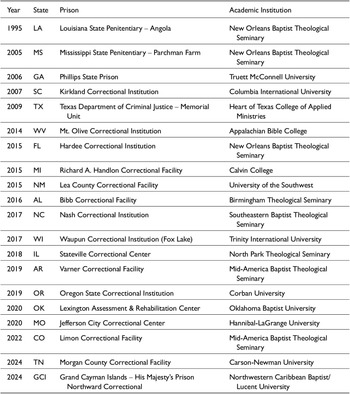
Inmate Field Ministry Programs for Men (20)

Inmate Field Ministry Programs for Women Inmates (7)

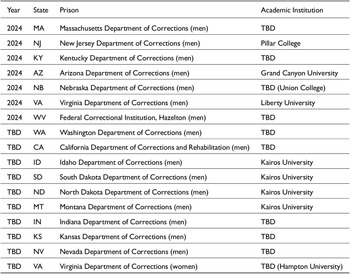
Inmate Field Ministry Programs in Development (17: 16 for men; 1 for women)
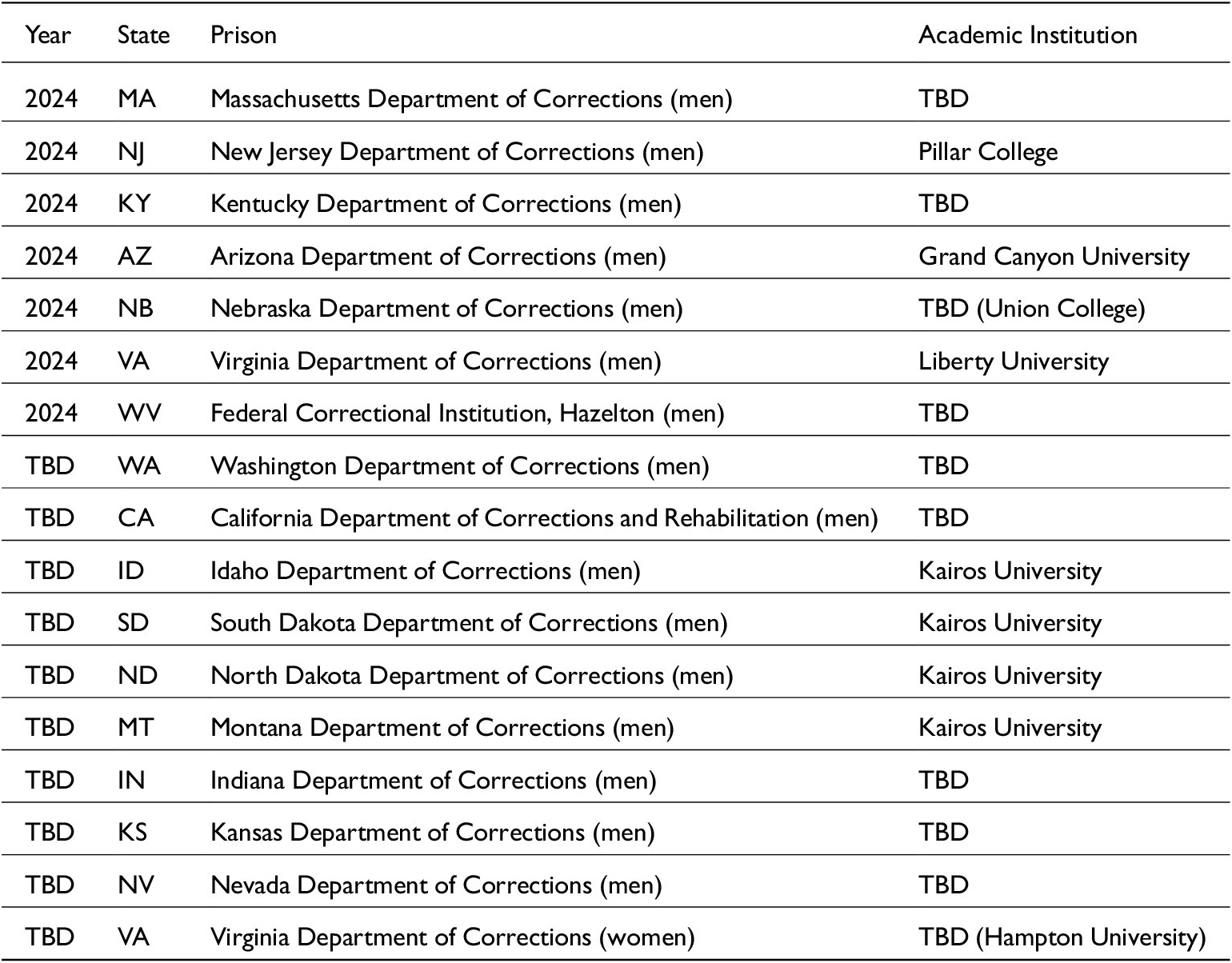
Source, all tables: Prison Seminaries Foundation, accessed October 14, 2025, https://www.prisonseminaries.org/find-a-prison-ministry; see also the journalistic sources cited throughout the article.


 Open access

