




For decades, the Kurdish identity question in Turkey has been a contested political site shaped by assimilationist policies, cultural denial, and conflict. KurdishnessFootnote 1 is entangled in societal prejudices, media stereotypes, and political sensitivities. Amid these macro-political tensions, humor, particularly stand-up comedy, emerges as a subtle yet powerful space for performing, negotiating, and subverting identities. How can a space of conflict give rise to comedy? What does it mean when entertainment arises from the wounds of social pain? More fundamentally, what is the purpose of comedy, and for whom is it performed? Although “Hello, I am Kurdish” may seem like a simple line, for Kurdish stand-up comedians, it encapsulates complex historical and social contexts embedded in their first encounter with the audience. The laughter that follows, though seemingly spontaneous, reveals deep insights into societal perceptions of Kurdish identity and its historical, political, and cultural roots.
This study explores the representation of Kurdish identity, laden with political and historical baggage, within Turkey’s increasingly popular stand-up comedy scene. A comedian in Kadıköy jokes, “It seems like it’s forbidden to perform stand-up without mentioning Kurds,” illustrating how Kurdishness has become part of popular humor, especially on social media. Aware of this visibility, the study analyzes comedians‘ performances, the relationship between language and identity, and humor’s potential to transform and/or reproduce prejudice. The transition from a period where speaking Kurdish was banned to one where saying “Hello, I am Kurdish” earns laughter or applause suggests cultural transformation. Yet, this shift has not created an egalitarian space; it is shaped by new stereotypes and prejudices. On stage, Kurdish identity may reproduce tropes like the “rough Kurdish man with an accent” or attempt to challenge them.
The contradictory nature of humor is well-documented. Lockyer (Reference Lockyer2011) argues that humor both critiques and reproduces social norms, while Pauwels (Reference Pauwels2021) shows that racial stereotypes can either reinforce or challenge hegemonic power structures. These dynamics are particularly salient in the Kurdish case, where humor functions both as a mirror and a mask for deep-seated social tensions. Examining Kurdish stand-up comedy thus offers insight into identity performance and the challenge to social prejudices. The reappropriation of derogatory terms by African-American comedians (Athali and Munandar Reference Athali and Munandar2022) and the caste critiques by Dalit comedians (Shivaprasad Reference Shivaprasad2020) show humor’s transformative capacity. However, as Perez (Reference Perez2013) notes, humor also risks reproducing what it seeks to subvert. In this vein, Adetunji (Reference Adetunji2013) shows how comedian-audience interaction shapes identity. Kurdish comedians who declare “Hello, I am Kurdish” are not merely introducing themselves but asserting visibility for a marginalized identity. These performances challenge or reproduce long-standing caricatures of Kurdishness in Turkey.
This discussion is rooted in the broader context of Turkey’s nation-state formation, which constructs a collective identity around Turkishness. As Foucault (1995) explains, modern power operates through regulation from individual bodies to the population, using racism as a tool in national identity formation. Canefe (2007) and Keleş (2015) similarly argue that exclusion of the “other” is foundational to nationalist politics. Thus, Kurdish identity, systematically cast as the “other,” has faced persistent political and cultural oppression.Footnote 2 Over the Republic’s 100-year history, Kurdish identity, as the largest ethnic minority, has appeared in political discourse and cultural productions. In the early years of the Republic, journalists and caricaturists reproduced existing forms of power by depicting “others” through racist and sexist stereotypes (İnce Reference İnce2015). Kurds were introduced in cartoons as uncivilized internal others among Turkish hosts. Through provocative racial classification, Kurds were portrayed in the minds of the Turkish people as demonized, belittled, irrational, and ignorant (Okyar Reference Okyar2020). In literature, Kurds have been portrayed as backward, ignorant, or criminalized (Rohat Reference Rohat1991; Yücel Reference Yücel2011), with Kurdish women stereotyped as obedient, traditional, or suffering (Salmanoğlu Reference Salmanoğlu2014). Similarly, Turkish cinema has restricted Kurdish women to play typical roles within family structures as wife, sister, or mother (Rehbein et al., Reference Rehbein, Beck, Desoutter, Rosner-Merker and Spencer2023). The historical fight of Kurdish women extended beyond their societal boundaries because they faced both state oppression and gender discrimination and male-run political systems (Göksel Reference Göksel2019). The Kurdish women’s movement gained strength since the 1980s, which enabled Kurdish women to develop their identity through their ethnic and gendered life experiences (Yüksel Reference Yüksel2006). The Kurdish identity’s dual positioning shows that its understanding requires both ethnic marginalization and gender power relations exploration. The 1980s onward saw Kurdish identity transform into a securitized political threat, which intensified public awareness and representation of Kurdish women within racialized gendered discursive environments.Footnote 3
Turkish cinema reflects similar trends. In the 1970s, Kurdish characters were associated with feuds, smuggling, or rural labor (Yücel Reference Yücel2008). Especially, Yeşilçam portrayed Kurdish characters ineffectively by depicting them as Turkish-speaking and one-dimensional (Koçer and Göztepe Reference Koçer and Göztepe2017). By the 1990s, they were depicted as exotic, underdeveloped, and linguistically backward (Yaşartürk Reference Yaşartürk2010; Şen, Reference Şen2019). The Kurdish issue was portrayed through symbols and codes, and the region was portrayed as poor and violent (Kıran Reference Kıran2020). Mainstream media has had a significant impact on the negative and exclusionary portrayal of Kurdish identity. In the record-breaking series Kurtlar Vadisi (Valley of the Wolves), Kurds were portrayed through characters associated with terrorism and drugs, while in another popular series, Sıla, they were represented through tribal culture, backwardness, and victimhood (Çeliker Reference Çeliker2009).
Contribution to the literature
In contrast to literature and cinema, this study focuses on stand-up comedy, asking whether it reproduces past stereotypes or offers alternative discourses that challenge prejudice. Whereas Kurdish representation is examined in Turkish cinema (Yücel Reference Yücel2008; Şen Reference Şen2019), literature (Rohat Reference Rohat1991), or media (Çeliker Reference Çeliker2009), stand-up comedy has been an understudied site for an ethnic identity performance and negotiation. Previous scholarship has almost exclusively focused on dominant discourses and mainstream cultural productions and how they represent Kurds; our research foregrounds the perspective of Kurdish comedians, thereby taking a bottom-up approach that prioritizes the voices and lived experience of the performers themselves. Independent stand-up comedy provides a quite autonomous space of ethnic expression: Here, the comedians have far more say in how they wish to portray themselves relative to state-sponsored media or commercial cinema. While international research is recording ethnic humor in several contexts (Kuipers and Van der Ent Reference Kuipers and Van der Ent2016; Surahmat et al. Reference Surahmat, Wijana and Suryo2024), our findings find a unique relevance in Turkey, where the highly authoritarian political environment makes the Kurdish identity the subject of stigmatization and remains a very politically sensitive issue. This study fills two gaps: empirically, by giving space to Kurdish comedians’ experiences and interpretations of the craft, and contextually, by examining how humor operates within political repression and across ethnic conflict.
Theoretical approach
Why do people laugh? This age-old question has intrigued philosophers, psychologists, and sociologists alike. In this study, laughter is explored not as a simple reaction but as a complex social and psychological act, especially in the context of ethnic humor and the representation of Kurdish identity in stand-up comedy. To understand whether such performances reinforce old stereotypes or challenge them, we draw on two foundational theories of humor: the superiority theory and the relief theory. Additionally, we engage with contemporary scholarship on racialization and colorblind ideology to situate our analysis within the specific socio-political context of Turkey.
The superiority theory, rooted in the writings of Plato and Hobbes, suggests that laughter emerges from a feeling of dominance over others. Hobbes described it as a “sudden glory” felt when we see ourselves as superior to another’s weaknesses, including our own (Critchley Reference Critchley and Sam2020; Morreall Reference Morreall2012). This theory helps explain how ethnic jokes can reflect and even reinforce social hierarchies. In Turkey, where Kurdish identity has long been positioned as subordinate to Turkishness, the laughter generated on stage can reflect deeper power imbalances encoded in everyday life. However, the relief theory, most famously articulated by Freud in Jokes and Their Relation to the Unconscious, views humor as a release of suppressed psychological energy (Critchley Reference Critchley and Sam2020, 19; Freud Reference Freud and Yıldırım2021, 198). According to Freud, jokes function like safety valves, letting out tensions created by societal repression, which he called the “economy of laughter.” Humor allows repressed emotions, fears, or desires to surface in a way that feels both pleasurable and socially acceptable (Eagleton Reference Eagleton and Pekdemir2019; Morreall Reference Morreall2009). In this sense, laughter becomes a tool not of dominance, but of survival. For Freud, the act of laughing at a joke conserves mental energy otherwise spent on censorship and inhibition (Freud Reference Freud and Yıldırım2021, 295). This makes humor especially meaningful for marginalized groups: it provides a safe way to voice the unspeakable. For Kurdish comedians, then, stand-up becomes a space where historical trauma and everyday discrimination can be transformed into shared, even healing, laughter (Green and Linders Reference Green and Linders2016; Double Reference Double2017). Both theories are relevant: superiority theory reveals how humor can reproduce existing hierarchies, while relief theory shows how it can challenge them. In analyzing Kurdish stand-up comedy, we ask: does the laughter reinforce the superiority of dominant identity structures, or does it offer a moment of resistance, where the silenced can speak back?
While ethnic humor is an analytical category we will keep, we recognize that the dynamics at play also reach beyond ethnicity and encroach upon the racialization aspect. Racialization is the process by which certain groups are socially constructed under the racial distinction and hierarchy, usually without reference to either biological or phenotypic differences (López Reference López2007; Omi and Winant Reference Omi and Winant2015; Mundy and Whit Reference Mundy and White2017). In this construction, Kurdish identity in the Turkish context has undergone racialization through historical processes that include the inferiority associated, backwardness, and incompatibility with modernity, which have become naturalized through cultural stereotypes and state discourse (Yeğen Reference Yeğen2006). This ideology further aligns Turkey with what scholars have categorized as the “colorblind” ideologies in the sense that it sustains a framework without recognizing the presence of racial hierarchies, much as it maintains them (Perez Reference Perez2013; Ekobo Reference Ekobo and MacLeod2025). These colorblind societies would not openly claim that race-based discrimination exists, and the systematic inequalities would then become invisible and unaddressed (Bonilla-Silva Reference Bonilla-Silva2006). Those common refrains in this ideology include statements like “we don’t see ethnic differences” or “we are all citizens of Turkey,” which silence criticisms on Kurdish marginalization while endorsing the dominance of Turks over others (López Reference López2007). Colorblindness, as Rossing (Reference Rossing and Lind2019) asserts, does not mark the end of racial discrimination but rather secures the status of privileged groups by hiding those benefits.
In the same way, in Turkish stand-up comedy, the argument goes that Kurdish jokes should not be considered political or racist but merely as “just jokes,” which are the best critique against colorblind ideology. To uphold this rhetorical shield is to allow racist humor that denies the damage it inflicts upon people (Weaver Reference Weaver2011). The caricaturization of Kurds on stage and repetitions of stereotypes establish what Burdsey (Reference Burdsey2011) refers to as a “tolerance zone,” wherein deep-seated patterns of racial hierarchy are preserved and validated under the mantle of humor. Therefore, one of the analytical frames that would understand how stand-up comedy subverts and, at times, reinforces the racialized nature of Kurdish identity in Turkey is through this colorblind frame.
These theories, superiority theory, relief theory, and critical race scholarship on racialization and colorblindness, provide the analytical framework through which to view Kurdish stand-up comedy as a site of both domination and resistance, where laughter may simultaneously wound and heal.
Methodology
This study employs qualitative research methods to investigate how professional stand-up comedians perceive, experience, and negotiate Kurdish identity in their performances. We examine both their subjective narratives and broader patterns of ethnic representation through in-depth interviews (Denzin and Lincoln Reference Denzin and Lincoln2018; Kvale and Brinkmann Reference Kvale and Brinkmann2015).
Research questions
We carried out semi-structured interviews with 15 professional stand-up comedians through online platforms from February to September 2024. Purposive sampling (Patton Reference Patton2015) was applied to recruit participants who (1) perform professionally, (2) have performed works that relate to Kurdish identity, and (3) have at least one year of performing experience. Snowball sampling through social media and professional networks was conducted to reach both Kurdish and Turkish comedians. Sample sizes were determined based on thematic saturation (Guest, Bunce, and Johnson Reference Guest, Bunce and Johnson2006); no new themes had emerged after the twelfth interview, and the three additional interviews confirmed saturation. The study included professional stand-up comedians who lived in major Turkish cities, with most participants coming from Istanbul, Ankara, and Batman, which serve as the core locations for stand-up comedy in Turkey. The stand-up comedy industry remains in its early development stage, which explains the scarcity of professional comedians who openly perform with Kurdish content. The research used purposive sampling to select comedians who had public recognition through their social media activity and who performed Kurdish-themed material during their shows. The sample base contains most of the recognized comedians who perform Kurdish identity content during their shows.
Each interview lasted 60–75 minutes and was digitally recorded. Among participants, 12 identified as Kurdish and 3 as Turkish, all male. Despite outreach efforts, no female comedians participated, reflecting both the limited number of women engaging with Kurdish identity on stage and the non-response to invitations, a significant limitation given gendered dynamics in ethnic representation and comedy (See table 1).
Participants
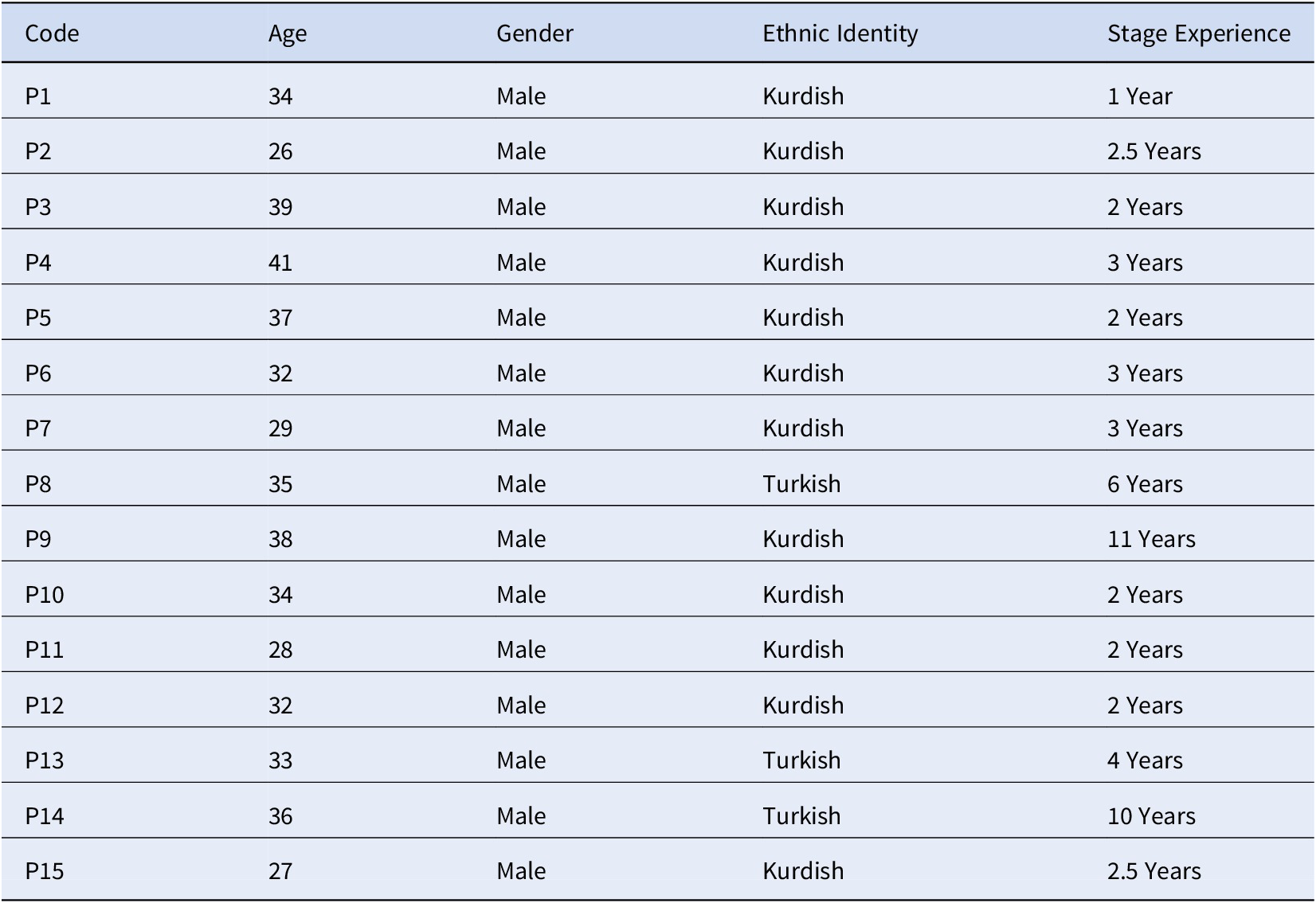
Table 1. Long description
The table contains five columns: Code, Age, Gender, Ethnic Identity, and Stage Experience. All 15 participants are Male.
* P 1: 34 years old, Kurdish, 1 Year experience.
* P 2: 26 years old, Kurdish, 2.5 Years experience.
* P 3: 39 years old, Kurdish, 2 Years experience.
* P 4: 41 years old, Kurdish, 3 Years experience.
* P 5: 37 years old, Kurdish, 2 Years experience.
* P 6: 32 years old, Kurdish, 3 Years experience.
* P 7: 29 years old, Kurdish, 3 Years experience.
* P 8: 35 years old, Turkish, 6 Years experience.
* P 9: 38 years old, Kurdish, 11 Years experience.
* P 10: 34 years old, Kurdish, 2 Years experience.
* P 11: 28 years old, Kurdish, 2 Years experience.
* P 12: 32 years old, Kurdish, 2 Years experience.
* P 13: 33 years old, Turkish, 4 Years experience.
* P 14: 36 years old, Turkish, 10 Years experience.
* P 15: 27 years old, Kurdish, 2.5 Years experience.
The interviews examined the comedians’ career trajectories, motivations, strategies for representing identity, audience responses, and professional dynamics. In addition, we analyzed 12 Kurdish identity-oriented YouTube Shorts with over one million views. The videos were chosen because they had the highest distribution and public exposure on social media channels. We targeted the most popular videos that contained explicit mentions of Kurdish identity or used the term “Kurd” in their comedy stories. The public impact of the content was assessed using view counts and circulation metrics, which served as direct measures. The visual materials functioned as analysis tools, which the researchers used to establish connections between the interview stories and the prevailing themes from the interviews that appeared in popular performances. While the videos were instrumental in contextualizing interview data and observing patterns of actual performance in the field, interviews remained our primary data source. More specifically, the YouTube Shorts were treated as supplementary visual data and were coded deductively according to the same thematic framework derived from the interviews, allowing us to triangulate recurring patterns between publicly circulated performances and participants’ narrative accounts.
Thematic analysis followed Braun and Clarke’s (Reference Braun and Clarke2006) six phases: (1) familiarization through multiple readings of the transcripts; (2) open-line coding; (3) combining codes into candidate themes; (4) reviewing themes in the light of raw data; (5) defining final themes; and (6) selecting exemplary quotes. Four major themes emerged: comedic subjectivity and personal narratives; Kurdish identity and professional identity; audience reception and validation; and socio-political implications. Critical discourse analysis (Fairclough Reference Fairclough2013) provided an avenue for interpreting the ideologies and power relationships that underlie the language choices of the participants. The purpose of the study was to obtain verbal informed consent from all participants who were informed about their rights and privacy measures. Some participants agreed to be identified by their real names, but in order to protect all participants from unforeseen risks in Turkey’s politically sensitive context regarding Kurdish identity, we chose to anonymize them using the codes P1–P15. In sum, the study strictly followed core ethical research principles for research with potentially vulnerable groups. Informed consent was obtained from all participants prior to the interviews, audio recordings were made only with explicit permission, and all data were anonymized to minimize potential risks in a politically sensitive context. The collected data were stored in encrypted and password-protected digital environments, and no identifiable personal information was disclosed at any stage of the research process. Both authors self-identify as Kurdish, which likely facilitated rapport with the 12 Kurdish participants; however, it required careful reflexivity. We recognized how our backgrounds might have affected our interpretation of racist stereotypes. We maintained a nonjudgmental openness during interviews, sharing no personal opinions about stereotype reproduction and thereby encouraging genuine responses from participants. We acknowledge that being Kurdish may sensitize our analysis to ethnic marginalization issues, which we believe to be a merit of qualitative research and not a limitation.
Stand-up, subjectivity, and representation: “My personal story”
All the stand-up comedians we interviewed stated that most of the jokes and stories in their performances were primarily based on their personal experiences. Stand-up comedians present their own experiences, observations, and perspectives in a humorous way. In some cases, the context and framework of the performance stem from a source familiar to the audience and naturally accepted. In other words, the comedian’s subjective experiences and personal journey include a cultural background that the audience can understand. Therefore, audience demographics, cultural background knowledge, and situational contexts are important. For example, P1 expressed the subjectivity of stand-up performance as follows: “My journey, my experiences, what I couldn’t achieve, what I wanted to do, unfinished things, states of not being able to hold on…. I coded the whole show like my personal story. I tell you my life story, starting from my childhood up to this point.” This situation, conceptualized by Keisalo as “comedic subjectivity,” is both a result and a tool of being a comedian. Particularly, the two aspects of subjectivity, inner experience and socially defined personality, are significant. According to Keisalo, the comedian sees the world as material to be crafted and learns to offer a highly suitable source and background for that material. The primary goal here is for the audience to understand this on-stage personality, to learn to view things from their perspective in order to grasp the jokes, and to navigate between the perspectives of this persona (2018). Through laughter, the audience validates the stand-up comedian’s identity (verification). The comedian’s identity is the stage manifestation of individuals’ social identities and is either validated or rejected within a continuous feedback loop. Validation evokes positive emotions in the comedian and strengthens identity (Moore Reference Moore2025). The comedian’s reality and stage persona thus become both a sign and a producer of signs. For instance, P12, who performs Kurdish language stand-up in Diyarbakır, one of the largest Kurdish cities, describes this as: “I narrate events that happened in Kurdish society, especially in Diyarbakır, through myself and my own stories. I cannot talk about another society or something else. I don’t step outside my own domain.”
Undoubtedly, in addition to P12’s subjective experiences, the cultural background knowledge, shared cultural references, and experiences of the audience are used as material (Calhoun Reference Calhoun2019). The transformation of cultural and ethnic awareness into codes that signify intergroup interaction and belonging (Vigouroux Reference Vigouroux2015) creates important references for the performance. Therefore, especially for those performing stand-up in Kurdish, self-presentation performances reveal a practice consistent with symbolic (personal) experiences, insights, and individual character. Stand-up subjectivity makes the narrative structure and codes more recognizable and understandable for those who share the same cultural, linguistic, and identity background. The comedians’ personal experiences bring forth both sincerity and a state of ethnic, religious, and cultural representation. This is because ethnic humor, by its very nature, inevitably involves self-reference and is therefore also autobiographical (Aidi Reference Aidi2021).
The comedian is not only an individual but also, through their ethnic, religious, and cultural identity on stage, a representative of their community. Even though stand-up comedians often claim individuality, they also represent the perspective of a specific group defined by race, gender, class, or sexual orientation (Gillota Reference Gillota2015). The stand-up movement developed by African Americans in the United States has also influenced Kurdish comediansFootnote 4 performing in Turkish. Comedians noted that just as Black comedians reflect a form of representation, they too strive to construct this, emphasizing that making jokes about a particular community is only possible when one belongs to that community. For example, P14, who identifies as Turkish, explains this as follows: “To make jokes about Kurdishness, you need to be Kurdish. To joke about Alevism, you need to be Alevi. If I joke about them without being Alevi or Kurdish, it might come across as unsympathetic. People from within that culture can joke about it more comfortably.” Conversely, P3, who believes that being Kurdish grants him the right to perform Kurdish humor, emphasizes the importance of ethnic identity in performing ethnic humor by stating, “In America, Black people do Black humor, so in Turkey, Kurds can do Kurdish humor. I say this is my birthright.”
Both P14 and P3 expressed that making jokes about a culture or identity creates a sense of belonging. Similarly, P8 and P15 noted that ethnic, racial, and religious belonging lead to bolder jokes: “People can be more radical and bolder when joking about their own community. When you are a subject of that community, you can joke more freely. I think this applies to Alevis and Kurds” (P8). “If you joke about your own ethnic identity, you can be a more sincere comedian. It adds authenticity to humor. Black stand-up comedians in America do this, too. When they joke about themselves, like Dave Chappelle, it looks great” (P15).
Joking about their own community presents both an advantage and a disadvantage for comedians. The advantage lies in being able to make more comfortable and bold jokes through personal experiences and content. On the other hand, this can lead to issues of representation regarding the communities to which they belong and to the uncritical acceptance of realities that may be distorted along with the comedian. Bravo (Reference Bravo2025) notes that this situation can lead to certain generalizations based on political stereotypes, beliefs, affiliations, and ideologies. As a result, making jokes about one’s own ethnic and racial identity creates a form of connection with the audience and significantly influences the performance and presentation of ethnic identity.
Stand-up and ethnic identity
Ethnic humor is a recurring theme in stand-up comedy. In recent years, Kurdishness has become a central topic, especially as Kurds, Turkey’s largest ethnic minority, have grown more visible due to forced migration from the 1990s conflict between the Turkish state and the PKK.Footnote 5 This migration increased daily interactions between Turks and Kurds, inevitably influencing the content of comedians.
P1, who performs in Kurdish, observes: “We are not a small ethnic group they can close their eyes to. We are everywhere… from politics to art. A Turk cannot live their entire life interacting only with Turks. … We’ve blended together.” Kurdish imagery is now common in Turkish stand-up, including the phrase “Hello, I am Kurdish,” which often receives instant laughter from audiences.
P2 remarks: “I say ‘Hello, I am Kurdish,’ and they start laughing. … I guess it’s because they see something different.” P14 recounts: “No one laughed at my jokes, but when I said, ‘Guys, I’m Kurdish,’ they laughed. I went crazy.” For P11, this reaction is unsettling: “When I say I’m Kurdish or say my name, they laugh. It bothers me. … My father was proud of my name.” This phrase functions as a canned joke, scripted and expected (Rutter, Reference Rutter1997). It sets the tone, cues laughter, and signals a shift into comedic territory. Yet Kurdish comedians question the seemingly automatic response. P1 explains: “There’s always this political conflict … it might seem funny to people because they can’t reconcile it with the image in their heads. I don’t think laughing at ‘Hello, I am Kurdish’ is innocent.” P5 adds: “People laugh immediately, but I don’t derive humor from saying it.”
According to Keisalo (Reference Keisalo2018), such phrases help comedians present their worldview, tailored to their audience. Therefore, this phrase also becomes a self-performance of Kurdish identity. Identities express a specific position within identity hierarchies. Particularly, the salience of an identity causes individuals to use that identity in certain situations (Stets and Burke Reference Stets and Burke2000). The phrase “Hello, I am Kurdish” leads to others validating this identity and comedians bringing the salient identity more to the forefront (Burke Reference Burke2023). Audiences’ search for authenticity forces comedians to conform to specific narratives about their identities (Rappaport and Quilty-Dunn Reference Rappaport and Quilty-Dunn2020). However, repeated use leads to self-deprecation, serving as a strategy to gain audience acceptance. Yet given the historical marginalization of Kurdish identity, this dynamic may reinforce social hierarchies. As Critchley (Reference Critchley and Sam2020, 28) and DeCamp (Reference DeCamp2017) note, laughter directed at out-groups reveals social tensions. The recurring laughter at “Hello, I am Kurdish” thus becomes a release of repressed social discomfort. As Goffman (Reference Goffman and Ünsaldı2014, 85) explains, stigmatized individuals often internalize dominant narratives. In this light, the phrase is both a reflection of stigma and a coping mechanism, making visible the complexities of Kurdish representation in Turkey’s comedy scene.
Self-deprecation, stereotypes, and the politics of representation
Groups under domination often resort to self-deprecation in stand-up comedy. Hence, stereotypes about minorities have become a norm in stand-up and are considered natural (Constantinescu Reference Constantinescu2023). However, sociocultural categories like race and ethnicity are both reinforced and stereotyped through stand-up (Vigouroux Reference Vigouroux2015). For example, some disabled comedians use linguistic and identity tools like self-deprecation to make themselves visible. By reversing negative experiences and presenting them in a positive context, they both amuse the audience and suppress feelings of pity (Tan, Wijaya, and Setyaningsih Reference Tan, Mike and Setyaningsih2022). However, the Kurdish image and representation in the Turkish language stand-up rely heavily on historically produced stereotypes about Kurds. Jokes often adopt a tone that seeks approval from the dominant group and aspires to be acceptable. P1, P5, and P10 express that the Kurdish image in Turkish stand-up is distorted and a product of an inferiority complex:
It’s somewhat degrading. There’s a group that frames Kurdishness as rough and uncivilized. It’s a style that mocks and perhaps exploits, beyond humor. Ethnically, it’s like saying to Turks, ‘Look, Kurds are like this, but I’ve risen above it.’ These jokes stem from an inferiority complex, and I don’t like it (P1). I have criticized this. They often portray the Kurd that Turks want to see. I don’t think they do it consciously, they can’t see from the outside. Once they’re in that environment, it feels normal to them. They approach it from a very low level. It’s not just the Turk’s desired view but also from the perspective where the Turk wants to humiliate… Unfortunately, what hurts more is that it’s done by a Kurd (P5). The Kurd that Turks want to laugh at… Unfortunately, they try to make themselves likable to Turks, to the people here. I do it too. It’s something we can’t help. It’s like trying to make ourselves liked by the people here (P10).
Therefore, as P1, P5, and P10 highlight, jokes about Kurdishness often reveal truths that individuals may not be aware of or may not want to acknowledge (Critchley Reference Critchley and Sam2020, 90).
The performance of Kurdish imagery and representation through stand-up may reinforce negative images. For this reason, ethnic jokes can also serve to resurface socially repressed issues. Because ethnic jokes reveal more about those who tell them than about the groups they target (Kuipers and Van der Ent, Reference Kuipers and Van der Ent2016). A comedian’s jokes, especially those caricaturing Kurds, lead to a broader representation problem, where the humor extends beyond the individual to encompass the entire Kurdish nation. P7 explains this as: “There’s a bit of self-caricature. The Kurd doing this doesn’t love himself. Sure, joke about yourself. But that ‘self’ isn’t just you, it becomes Kurdish.” Many Kurdish comedians caricaturize their own Kurdishness within a dominant narrative. For example, comedian Berk Karan, who states he discovered his Kurdish identity after age 30, reproduces the caricatured Kurd through violence and large family stereotypes in his performance: “The guy is beating us. While beating, he says we’re from Diyarbakır. Get this into your head, blah blah, stuff like that. His pregnant wife is there too, [in a] tense atmosphere. Are they expecting the 8th or 9th, is it 12 or 13?”Footnote 6
However, self-deprecation can also be seen as a tool that facilitates acceptance of the comedian. Female comedians, in particular, frequently resort to this method (Lockyer Reference Lockyer2011). While it can be a liberating tool for women to bring their experiences to the stage, it can also reinforce patriarchal norms (Tomsett Reference Tomsett2018). Therefore, self-deprecation is both a pitiful state and a feeble attempt against superiority. For example, Cüneyt Nergiz, who always takes the stage by announcing he is Kurdish, narrates through his own family the themes of accent, ignorance, and early marriage amidst audience laughter: “My speech is a bit broken, friends. I learned Turkish at school. My mother really supported my education. She couldn’t study much herself, but she went up to 5th grade in primary school. She quit in [the] 5th. I said, ‘why did you quit in [the] 5th?’ She said school and marriage couldn’t go together.”Footnote 7
The statements of P2 and P3, that Turks enjoy when Kurds are mocked because Kurds are seen as the “other,” reflect both an acceptance of a hegemonic perspective and a tool for reinforcing superiority:
They like it when we mock Kurds, whom they see as the other. We do it to make them happy. It’s like we compromise our integrity for our careers. When you belittle yourself, you evoke pity. They feel the need to be on your side (P2). The audience sees themselves above the stand-up comedian. They belittle the comedian. You talk about your misfortunes. You’re the other, you’re Kurdish. The audience thinks, ‘This person is beneath me.’ I see this in Kurdish comedians. What bothers me most is that they take the easy way out. They place themselves below the audience. They say, ‘I’m Kurdish,’ and the audience places themselves above, and they try to run humor from that position (P3).
Bergson notes that superiority theory aims at ridicule, where people laugh at those who are rigid, stuck, or unable to adapt (Eagleton Reference Eagleton and Pekdemir2019, 48). The lowering of Kurdish identity stems from the political and historical positioning of Turkish identity as a higher identity and Kurdish identity as a lower identity in Turkey’s stand-up comedy (Tan, Wijaya, and Setyaningsih Reference Tan, Mike and Setyaningsih2022). In other words, ethnic jokes become controversial when they reflect ethnic hierarchies. Jokes made about ethnic groups tend to be harsher in style and content (Kuipers and Van der Ent, Reference Kuipers and Van der Ent2016).
Mocking others’ discomfort has both sadistic and masochistic aspects. Seeing someone humiliated is both distressing and satisfying (Eagleton Reference Eagleton and Pekdemir2019, 63–86). Ultimately, using a stigmatized Kurdish identity in stand-up may serve as a means to gain secondary benefits and to excuse other things. In mixed social settings, when predictable aspects of one’s identity emerge, the stigmatized individual may try to protect themselves by withdrawing (Goffman Reference Goffman and Ünsaldı2014, 38–46). As P1, P5, and P10 noted, the figure of the Kurd that Turks want to see not only seeks secondary gains but also attempts to excuse other identity-related determinants through self-deprecation. Returning to Goffman, the stigmatized individual tends to believe what others believe about their identity, thus not only presenting themselves but also seeking acceptance (Goffman, Reference Goffman and Ünsaldı2014, 34–60). In conclusion, ethnic humor serves multiple functions. Therefore, ethnic humor can both reinforce stereotypes about a particular group and challenge them.
Ethnic humor operates within mechanisms of inclusion and exclusion, shaped by historical, cultural, and political contexts (Nieuwenhuis and Zijp Reference Nieuwenhuis and Zijp2022). It often mirrors social hierarchies and reproduces stereotypes. For instance, in Indonesian stand-up, the Chinese are depicted as greedy and atheist, while the Madurese are portrayed as ignorant (Surahmat, Wijana, and Baskoro Reference Surahmat, Wijana and Suryo2024). Similarly, in Turkish stand-up, Kurdish identity is frequently framed through stereotypes: the “rough Kurd,” the “Kurd with many children,” or the “Kurd who steals electricity.” These portrayals often reinforce longstanding prejudices. As P2 observes, “What you tell on stage always feeds off some deficiency… focusing on Kurdish people’s shortcomings can increase prejudice.” Turkish comedians also rely on these tropes. P14 notes: “They still joke about electricity theft, Sharia, [and] cousin marriage. … It deepens negative perceptions.” For instance, Özgür Turhan, whose wife is Kurdish, frequently employs Kurdish stereotypes in his stand-up performances. Turhan’s jokes center on separatism, violence, and weapons: “At the wedding, my family wasn’t in the halay (traditional Kurdish dance) dance. The Kurds were dancing halay. My folks got scared. They can’t see this content either. They said, damn, these are separatists. Hope they’re not in an action. My wife says don’t make jokes backstage. I went backstage, and she ambushed me. It’s genetic, I guess. Like I walked into the backstage and she’s there with a Kalashnikov. Dude, where did that Kalashnikov come from?”Footnote 8
Such humor aligns with nationalist narratives that cast Kurds as incompatible with “modern society.” As P12 states, “These ongoing prejudices, when used in comedy, reinforce discrimination.” P8 adds that even Kurdish comedians may reproduce this marginalization through self-deprecating jokes. However, not all ethnic humor operates this way. P13 points out that comedians like Deniz Göktaş use political humor to reveal and critique prejudice: “At least it opens a path to expose certain things.” P7 also sees potential in voicing stereotypes to dismantle them, invoking the oppressor-oppressed dynamic: “Caricatures get reinforced, but expressing them, positively or negatively, can challenge domination. Like the Algerian Arab and the French.” Deniz Göktaş uses the state violence that Kurds experienced in the 1990s in his stand-up show as a striking political exposure. When his Kurdish friend romanticized the music culture of the 1990s, Göktaş humorously narrated that while he, as a Turk, could have lived during that period, it would have been difficult for his Kurdish friend to survive: “This friend of mine said: Deniz, music was so great in Turkey in the ‘90s. I wish we had lived then, well, I would have lived, but …”Footnote 9
Nonetheless, repeated use of stereotypes risks normalizing discrimination (Bravo, Reference Bravo2025). Ethnic humor, if unchecked, contributes to symbolic or realistic threats between groups, fueling further bias (Surahmat, Wijana, and Baskoro Reference Surahmat, Wijana and Suryo2024). Global examples, from Black criminality tropes (Setyaningsih Reference Setyaningsih2013), caste-based jokes in India (Shivaprasad Reference Shivaprasad2020), to Islamophobic representations in the West (Aidi Reference Aidi2021), show how humor can entrench systemic prejudice. In sum, while ethnic humor can reveal power asymmetries, its dominant function in Turkish language stand-up has largely been to sustain stereotypes about Kurds, an outcome also echoed by most participants in this study.
Stand-up and racism: Just a joke
Stand-up comedy has long been a space where boundaries are pushed, often using racism as a tool disguised under the notion of “just a joke” (Surahmat, Wijana, and Baskoro Reference Surahmat, Wijana and Suryo2024). This rhetorical shield reinforces the idea that racism is harmless (Weaver Reference Weaver2011), allowing prejudices to flourish. In Turkey, racist undertones targeting Kurds are evident both in performances and audience reactions. As P2 observes: “A comedian comes on stage, mocks Kurds, makes racist jokes, and suddenly the audience starts laughing.” Comedian Akın Aslan has made a striking statement about racism in jokes about Kurds. Aslan, who is half Kurdish and half Turkish, notes in his stand-up show that the Kurdish region has become a center of attraction for comedy, with everyone on stage having something to say about Kurds. He states that even saying “Kurd” is taboo, and comedians exploit this tension. Regarding the increase in Kurdish jokes, he uses the concept of “carrier racism”: “Most Kurdish jokes are othering. I don’t think anyone has bad intentions, by the way. Everyone laughing and joking is just looking for entertainment. None of us [is] racist. But I think we’re all [career] racists. If jokes are being made in your environment about illegal electricity, burning tires (says these with an accent; the audience laughs at this too), if you’re smiling and letting it pass, don’t think you’re not racist. You’re a [career] racist. Racism may never become active in your life, but it will flourish beautifully in the environment you’re in.”Footnote 10 Similarly, Kurdish comedian Yusuf Bilal Altıntaş responded in a program to criticisms that he always talks about Kurds because he uses the word “Kurd”: “They say I always talk about Kurds because I use the word Kurd. I’ve never heard this from Kurds. I’ve never heard Kurds say I’m always talking about Kurds. Society is really not ready for that word. Yes, we’re brothers, yes, we’re together, yes, we’re also citizens of this country. But I think when a certain group hears this word, they become very uncomfortable.”Footnote 11
Turkish cinema and media have historically reinforced these stereotypes, turning them into comedic material. P12 notes: “Turkish TV series and cinema have played a big role in racism… they turned it into comedy.” The dominance of Turkish identity sustains this perspective, positioning Kurds as the perpetual “other.” P4 highlights this dynamic: “You are their subordinate identity. … They laugh not because it’s funny, but because of their racism.” The dominance of Turkish identity and Kurdish otherness has also been reflected in joke-writing processes in stand-up shows. Female comedian Özge Özel brought to the stage her mother’s fierce defense that they were not Kurdish, despite her grandmother and grandfather speaking Kurdish: “Mom, I’m going to ask you something. Are we Kurdish or not? No, my dear Özge, we’re not Kurdish, we’re Alevi, we’re Beşiktaş fans, we’re lactose intolerant, and we’re Gemini. She panicked and couldn’t figure out how to close the topic before my eyes. Why such a strong reaction? It’s a simple question: are we Kurdish or not? Even if we are Kurdish, we’re Kurdish, why such a reaction? My mother had a minor nervous breakdown because I brought up this topic.”Footnote 12
Audience interventions further expose this mindset. P15 recounts: “For some people, it’s not that Kurdish jokes are being made, but rather, a Kurd is making jokes.” Similarly, P6 faced a nationalist remark mid-performance: “No, you Kurds, your brains work once a year.” These incidents reveal how political and ethnic hierarchies shape what is deemed humorous (Healy Reference Healy2016; Pauwels Reference Pauwels2021).
Kurdish comedians also encounter boundaries when referencing Turkish national symbols. As P10 shares: “I had a joke about the Turkish flag…. If a Turk had made that joke, they would have laughed, but because I’m Kurdish, it backfired.” Even among comedians, Kurdish visibility can cause discomfort. P11 explains: “Some think, ‘What am I going to talk about? I’m not Kurdish,’ and this creates frustration.” This reflects how Turkish stand-up subtly reproduces racial discourses under a “colorblind” ideology (Perez Reference Perez2013, Reference Perez2016). The caricaturization of Kurds, rooted in cinema, literature, and politics, continues on stage. P1 remarks: “They depict feudalism as the root of all evil, and then an enlightened district governor arrives to save the region.” P14 lists recurring stereotypes: “Too many siblings, domestic violence, stealing electricity … and PKK jokes.” In colorblind societies, systematic inequalities go unrecognized because race-based discrimination is not acknowledged (Ekobo Reference Ekobo and MacLeod2025). Therefore, the caricaturization of Kurds and repeated stereotypes create a tolerance zone (Burdsey Reference Burdsey2011). The jokes preserve and validate deep-rooted racial hierarchy patterns. Colorblindness sometimes defines this as ‘not racism’ (López Reference López2007). However, this points to the unstated rationale for colorblindness: not the end of racial discrimination, but the maintenance of privileged superiors’ status (Rossing Reference Rossing and Lind2019).
Such portrayals reinforce discriminatory perceptions. P3 illustrates this with a stark example: “In Turks’ minds, we’re people who throw Molotov cocktails and have sex under illegal electricity… I can clearly see the racism beneath such words.” Despite stand-up’s potential to challenge stereotypes (Green and Linders Reference Green and Linders2016), Kurdish imagery often sustains hegemonic humor (Calhoun Reference Calhoun2019). Moreover, Kurdish comedians themselves may unintentionally perpetuate these stereotypes. P2 admits: “I usually use ignorant characters from my own family … I basically speak from reality.” Yet, this self-representation risks becoming caricature when performed before predominantly Turkish audiences (Goffman Reference Goffman and Ünsaldı2014). P15 criticizes this trend: “I really wish Kurdish comedians wouldn’t make those classic caricature jokes … We need to make jokes closer to reality.” As Constantinescu (Reference Constantinescu2023) and Setyaningsih (Reference Setyaningsih2013) note, internalized stereotypes can be absorbed by external audiences, reinforcing prejudices rather than dismantling them. As DeCamp (Reference DeCamp2017) suggests, instead of challenging biases, stand-up often becomes a space where expressing stereotypes feels socially acceptable.
The stand-up stage as a political arena
Is there no positive aspect to the use of Kurdish imagery in stand-up performances? This is a crucial question because, as Sharon Lockyer (Reference Lockyer2011) emphasizes, humor is a tool that simultaneously questions and reinforces social norms. The statements and performances of Kurdish stand-up comedians reveal this contradiction, showing that humor can serve both the reproduction and the deconstruction of prejudices against Kurds. In our interviews with Kurdish comedians, we frequently encountered concrete examples of this paradox, particularly regarding the awareness of how racial prejudices, rooted in over a century of history, are reproduced and/or perpetuated through humor. However, it was also clear that humor carries the potential to deconstruct these prejudices and create awareness through laughter. For example, P1 expressed the role of humor in articulating Kurdish identity with the following words: “Kurds can express their identity openly and clearly through stand-up.” This highlights the importance of making a historically suppressed identity visible on stage and demonstrates how humor has become a vehicle for expressing Kurdish identity. Indeed, as emphasized in the opening sentences of this article, beyond the negative connotations behind the audience’s laughter in response to the phrase “Hello, I am Kurdish,” it is also necessary to recognize that this expression carries historical and political weight far beyond a simple greeting. For example, Kurdish comedian Cüneyt Nergiz articulated on stage the issue of education in the mother tongue and speaking Kurdish in public spaces, one of the Kurds’ foremost political demands: “A robot joined [an] open mic, did you watch it? Sophia. Someone asked if she wanted to be human. She started shaking her head at people. And she even said she wanted to speak English to speak better and be myself. She spoke in her mother tongue, and they didn’t cut the broadcast. I found it a bit strange as a Kurd. Even a robot can speak.”Footnote 13
As the largest ethnic minority in Turkey, Kurds have been subjected to systematic discrimination and oppression by the Turkish state. These pressures have manifested in various forms, such as restrictions on expressing Kurdish identity in public, denial of cultural rights, bans on the Kurdish language, and the criminalization of political expression (Şahin and Akboğa Reference Şahin and Akboğa2018, 985–1000). The consequences of expressing Kurdish identity have been particularly severe for politicians. Those who openly identified as Kurdish or advocated for Kurdish rights often faced imprisonment and political exclusion. In this context, the story of Şerafettin Elçi serves as a significant example of the historical challenges associated with expressing Kurdish identity. Serving as Minister of Public Works in Bülent Ecevit’s coalition government between 1977 and 1978, Elçi is known as one of the first politicians in Turkish history to openly declare his Kurdish identity. In a 1979 interview, he stated, “I am Kurdish. There are Kurds in Turkey, and I am one of their representatives.” These words were seen as a direct challenge to the nation-state ideology’s demand for homogeneity and sharply contrasted with the official discourse of the time. His bold declaration sparked widespread debate in both political and social spheres, once again exposing the state’s stance toward Kurdish identity. However, such expressions were equated with separatism and led to punishment. Elçi was prosecuted under Article 142 of the Turkish Penal Code (propaganda for separatism and communism) and, following the 1980 military coup, was sentenced to 2 years and 3 months in prison and banned from politics for 10 years.Footnote 14 This punitive approach aimed not only to silence dissent but also to reinforce a monolithic Turkish identity that excluded ethnic diversity (Kalaycı Reference Kalaycı2022, 734–750).
Elçi’s story was only the beginning. Around the same period, Mehdi Zana, mayor of Diyarbakır, was sentenced to long years in prison and subjected to torture for openly defending Kurdish identity. Another figure emphasizing Kurdish visibility, journalist Musa Anter, was assassinated in the early 1990s for similar reasons. Politicians like Orhan Doğan, Hatip Dicle, and Selim Sadak, who were active in Kurdish legal political movements during the 1990s, were imprisoned for extended periods due to expressing Kurdish identity. Additionally, Leyla Zana, who declared during her parliamentary oath that she was reading it for the brotherhood of Kurdish and Turkish peoples, faced significant repression and long-term imprisonment. In the 2000s, repression continued, with politicians like Selahattin Demirtaş and Figen Yüksekdağ, along with hundreds of others, punished for advocating collective rights related to Kurdish identity.Footnote 15
The ability to express Kurdishness has thus become a significant political stance in a historical context. In this regard, P4’s statement, “On stage, I systematically portray the oppressed Kurd, the one excluded from jobs because of their identity,” demonstrates how humor can make everyday prejudices against Kurds visible. As Lockyer (Reference Lockyer2011) points out, humor’s dual function can both raise awareness and inadvertently reproduce entrenched discriminatory norms. Similarly, P9 noted: “When I talked about the White Toros, young people started researching and said, ‘Oh, they killed Kurds’.” This refers to the “White Toros,” a symbolic representation of enforced disappearances and extrajudicial killings in the 1990s.Footnote 16 According to Freud’s relief theory, humor allows for the release of suppressed tensions (Freud Reference Freud and Yıldırım2021). Thus, P9’s joke both raises awareness about past atrocities and provides a form of relief by lightening the emotional weight of the tragedy.
However, as Pauwels (Reference Pauwels2021) highlights with his concept of subversive play, the critical potential of such humor depends on the audience’s ability to interpret the context correctly. Humor may appear to challenge dominant ideologies, but when misunderstood or stripped of context, it can also contribute to the reinforcement of oppressive structures. Similarly, P3’s statement, “In the 1990s, you couldn’t say you were Kurdish; it was impossible. But now, with humor, we’re bringing the struggle for existence to wider audiences,” reminds us how dangerous it once was to express Kurdish identity. According to Goffman’s stigma theory, making a stigmatized identity visible allows not only individuals but also society to confront these stigmatized perceptions (Goffman Reference Goffman and Ünsaldı2014). P3’s words clearly articulate humor’s role in making this stigma visible and challenging it. His performance contributes to both remembering the difficulties of expressing a forbidden identity and making that identity visible on stage. Yet, as Lockyer (Reference Lockyer2011) and Pauwels (Reference Pauwels2021) emphasize, the contradictory nature of humor requires balancing its potential to transform prejudices with the risk of reinforcing them. Kurdish stand-up comedians, aware of this balance, use humor both to keep social memory alive and to create a space where the historical weight of Kurdish identity is lightened.
Easing social divisions through humor
One of the key contributions of humor is the effort by Kurdish stand-up comedians to ease social divisions and build bridges between different groups. P1’s statement, “From bars in Kadıköy to YouTube, Kurdish identity has become more visible. Millions of people who cannot access Kurdish politics are becoming familiar with the existence of Kurds through comedy,” clearly highlights the role of humor in raising social awareness. Humor functions as a mechanism that brings visibility to Kurdish identity, removing it from the historical processes of denial and marginalization. As Goffman points out, for stigmatized individuals to gain social acceptance, the stigma itself must be redefined (Goffman Reference Goffman and Ünsaldı2014). By representing their identities on stage, Kurdish comedians accelerate this redefinition process both individually and socially.
P4’s remark, “When someone from Diyarbakır takes the stage and performs comedy, audiences start questioning their false prejudices about Kurds,” demonstrates that humor can serve as a tool to promote mutual understanding. Critchley’s (Reference Critchley and Sam2020) observations on humor’s capacity to both reaffirm and question the world within an ideological framework are significant in this context. By sharing their personal stories on stage, Kurdish comedians foster empathy with the audience, allowing for the dismantling of false prejudices. Thus, while humor carries the risk of reproducing biases, it equally holds the potential to challenge them.
Critiques of superiority theory, which suggest that humor can reinforce hierarchical relationships, offer critical insight here. According to Hobbes’ theory, laughter arises when a person feels superior to another (Critchley Reference Critchley and Sam2020). However, the performances of Kurdish comedians often transcend this theory by challenging existing hierarchies. As seen in P4’s example, when audiences begin to question their own prejudices through the representation of Kurdish identity on stage, it reveals humor’s transformative power. P8’s comment, “Humor can prevent the spread of hatred. It may not create a more democratic environment, but it certainly doesn’t fuel conflict,” clearly emphasizes humor’s role in softening social tensions. Viewed through Freud’s relief theory, humor functions as a means to reduce tension between individuals and groups, providing an outlet for suppressed emotions. Kurdish stand-up comedians, by making social issues visible through humor, also create a space where these issues can be discussed in a lighter, more approachable manner.
The critical and resistant nature of humor extends beyond merely exposing the historical stigmatization and criminalization of Kurdish identity; it also holds the potential to redefine and transform these stigmas. When considering the concept of linguistic reappropriation, comedians on stage are not only performing humor but also reclaiming words, identities, and representations that were once objects of oppression and prejudice. For example, Athali and Munandar (Reference Athali and Munandar2022) examine how Black comedians use the N-word in stand-up performances, suggesting that reconfiguring this word is part of an effort to diminish its power. Similarly, Kurdish comedians, by repeatedly using words and narratives coded as racist within jokes, possess the potential to deconstruct these meanings through linguistic reappropriation.
P9’s statement, “I talk about the White Toros, I talk about the Madımak massacre,” shows how humor can serve both as a critique of historical traumas and as a means of confronting them. Through stand-up, individuals confront their fears, develop coping strategies, and gain greater emotional clarity (Turner Reference Turner2024). Likewise, P3 noted: “I talked about police oppression in Kurdish regions. The audience laughs, but at the same time, they become aware of these realities.” This highlights humor’s dual role as both an informative and a critical-thinking tool. Similarly, when performing in Konya, a city known for intense Turkish nationalism, P10 increased awareness of a significant social issue by joking: “I was really surprised to learn that here in Konya, you elect your mayor for five years, why didn’t you tell me? In Van, we elect ours for three months each time.” In this context, the performances of Kurdish stand-up comedians go beyond mere entertainment, creating a space for the social acceptance and visibility of Kurdish identity. This process offers a concrete example of how humor can function as an antihegemonic tool.
Is social change possible?
Stand-up comedians offer diverse perspectives on the role of humor in addressing political issues and triggering social change. These viewpoints highlight humor’s potential to raise awareness and spark discussion, while also acknowledging that it may remain constrained within the limits of societal and political transformation.
P11’s statement, “There are mechanisms that produce polarization in Turkey. Humor can ease these dynamics but cannot completely eliminate them,” reflects an approach that evaluates humor’s impact within a limited context. Humor can temporarily alleviate tensions and provide relief (Freud Reference Freud and Yıldırım2021), but it is insufficient for resolving systemic problems. This critical stance suggests that humor’s influence may be confined to raising awareness. However, P7 emphasized humor’s modest yet meaningful role by stating, “The Kurdish issue is a major problem. It should be discussed not only in stand-up but in every field. However, humor can contribute to access to basic rights for Kurds.” The impact of humor on existing prejudices and taboos in society positions it as a potential starting point for addressing deep-rooted political issues like the Kurdish question. Humor has the capacity to bring normally unspoken or undiscussed matters into public discourse. P8’s observation, “There’s a sense of entrapment because political discussion is restricted. Stand-up relieves this tension, both for the performer and the audience,” demonstrates that humor creates a space not only for individual expression but also for the collective release of suppressed thoughts. In this sense, humor offers a platform to ease societal tensions and provides audiences with a new perspective to confront political and social issues (Eagleton Reference Eagleton and Pekdemir2019).
Kurdish stand-up comedians are transforming this art form into a tool for social change by highlighting humor’s ability to ease tensions and open discussions on political matters. While humor holds the potential to create dialogue around chronic issues like the Kurdish question, realizing this potential is subject to various limitations. The findings of this research suggest that participants perceived humor’s role in fostering awareness as having a limited impact on broader social transformation, constrained by structural factors and the limited reach of independent stand-up performances. Specifically, stand-up culture representing Kurdish identity tends to appeal primarily to upper-middle-class, urban audiences, falling short of reaching wider segments of society. Another limitation arises when audiences lack the cultural capital or literacy to grasp the intended satire of a comedic piece (Friedman 2011; Weaver Reference Weaver2010). Additionally, when audiences are unfamiliar with the broader historical context and cultural diversity surrounding stereotypes, the risk of reinforcing those stereotypes increases (DeCamp Reference DeCamp2017). Similarly, Pauwels (Reference Pauwels2021) emphasizes that while humor addressing racial stereotypes can serve anti-racist purposes, it remains inherently risky and prone to misinterpretation. He argues that using humor to dismantle social prejudices requires careful consideration of factors such as the comedian’s intent, audience reactions, and performance strategies.
In Turkey, the potential for mainstream humor to raise awareness about the Kurdish issue is notably limited. For instance, Turkey’s most famous stand-up comedian, Cem Yılmaz, avoids any reference to the Kurdish issue or even mentioning the word “Kurd” in his widely viewed shows. Likewise, considering that television remains one of the primary entertainment mediums in Turkey, mainstream comedy programs like Güldür Güldür (Laugh Out Loud) and Çok Güzel Hareketler Bunlar (These Are Very Funny Performances) either ignore the Kurdish issue entirely or present caricatured and stereotype-reinforcing images of Kurdish identity. Although occasional critical approaches appear in these programs, they are typically weak and confined to superficial jokes that are difficult for the majority of society to interpret meaningfully. This is directly linked to the continued criminalization of Kurdish identity and the deliberate restriction of its representation in mainstream media. Independent stand-up performances, increasingly reaching wider audiences via social media, play a significant role in unlocking humor’s potential to raise awareness and challenge societal prejudices. However, for humor to become a transformative tool capable of influencing broader societal segments amid ongoing conflicts and political marginalization, it is clear that more time and larger platforms are needed. In conclusion, the humor presented by Kurdish stand-up comedians serves a dual function: while it carries the risk of reproducing racist stereotypes about Kurds, it simultaneously fosters social awareness and challenges discrimination.
Conclusion
This article demonstrates that humor does not merely produce entertainment but also reconstructs complex and contradictory social processes related to the representation of ethnic identities. Particularly for historically stigmatized and marginalized identities, becoming visible through humor, when considered alongside Goffman’s stigma theory and Freud’s relief theory, enables the exposure of suppressed social tensions and offers the potential for transformation. However, this transformation does not always evolve in a progressive or egalitarian direction; on the contrary, it can also become a stage where hegemonic power relations are reproduced. Thus, from a sociological perspective, humor represents a hybrid space where normative frameworks are both questioned and re-established.
It has been observed that comedians who use Kurdish imagery often rely on references that reinforce stereotypes and increase prejudice against Kurds. This creates a contemporary stage for the manifestation of racism. The racism present in stand-up comedy stems from the positioning of Turkishness as a superior identity. Racism directed at Kurdish comedians emerges aggressively when topics that challenge the boundaries of this dominant identity are addressed. In Turkish-language stand-up, racist discourse is reproduced both implicitly and explicitly. All interviewees expressed that the hegemonically constructed image of Kurds carries a high potential for reproducing social inequalities and stereotypes. However, humor also holds the potential to raise awareness against the racial prejudices developed over a century-long Republican history toward Kurds. The stand-up stage serves as a significant platform for a historically denied identity. The visibility of prejudiced and exclusionary discourses and practices targeting Kurdish identity through humor prompts a questioning of social norms.
The findings presented in this article reveal that cultural representation and identity performance are caught between individual subjectivity and collective belonging. The stand-up stage transforms personal stories into representations of an entire ethnic group, positioning the comedian not only as an individual but also as an ethno-political actor. In this context, the article exposes the tensions between individual expression and social representation in identity performance. The research also sheds light on how humor’s class, ethnic, and linguistic boundaries are shaped through audience reception. The understanding of comedy is directly linked not only to the comedian’s intent but also to the audience’s cultural capital, prejudices, and interpretive capacity. This demonstrates that humor’s “anti-hegemonic” potential is limited and highly context-dependent. As sociologists like Friedman (2011) and Weaver (Reference Weaver2010) have noted, a lack of the necessary “literacy” to recognize satire can lead humor to reinforce existing inequalities rather than transform social norms. This indicates that humor can serve both as a “tool of visibility” and a “tool of re-stigmatization” from a sociological standpoint.
Finally, this study offers strong empirical evidence that ethnic humor is not an ideologically neutral space but is intrinsically tied to existing social hierarchies. While humor can create a comfort zone for dominant identities, it may also become a space of expression for marginalized identities; however, this space is not free from asymmetric power relations. In this regard, the article highlights humor’s dual nature, as both a “language of resistance” and a “language of conformity.” As demonstrated by the findings, stand-up comedy simultaneously reinforces racial discourses and prejudices about Kurds while also providing a significant platform for the acceptance and visibility of Kurdish identity. This dual nature of humor underscores the critical importance of contextual readings in sociological analyses, alongside normative evaluations. These insights also contribute to broader debates on minority humor in authoritarian or semi-authoritarian contexts, where visibility and stigma are continuously negotiated within unequal power structures.
Acknowledgements
We would like to thank the anonymous reviewers for their valuable comments and constructive suggestions, which helped us improve this manuscript. We also extend our sincere gratitude to all professional stand-up comedians who agreed to participate in this study and generously shared their experiences and insights with us.
Disclosure
We declare that we have no competing interests and no conflict of interest.

 Open access

