


Although the murder of George Floyd by four Minneapolis police officers occurred near the corner of East 38th Street and Chicago Avenue in Minneapolis, MN, the reactions did not remain local. Video footage of Floyd’s murder, widely shared on social media, sparked protests against police violence that quickly spread and became one of the largest episodes of social protest in the United States in recent history (Mitchell et al. Reference Mitchell, Jurkowitz, Oliphant and Shearer2020).Footnote 1 Although such focusing events appear to draw public attention and shift public attitudes (see, for example, Birkhead Reference Birkhead1998; Kingdon Reference Kingdon1995; Reny and Newman Reference Reny and Newman2021; Wasow Reference Wasow2020), whether social movements engage citizens is also critical, as it speaks to their ability to systematically mobilize and engage bystanders who would not otherwise participate and potentially change the balance of power.
In particular, writing about the forces and events that shape political outcomes over a half century ago, Schattschneider (Reference Schattschneider1960) highlighted both the importance these events have on both public opinion (‘every change in the direction and location of the line of cleavage [that is, issue salience] produces … a new allocation of power’ (60)) and the extent to which individuals are engaged (and who is engaged) in the political political process (‘the outcome of all conflict is determined by the scope of its contagion … every increase or reduction in the number of participants affects the results’ (2, emphasis in the original)). Importantly, Schattschneider (Reference Schattschneider1960, 102) argued (and other work has similarly indicated) that it is the suppression or inclusion of options and issues that non-participants care about that affects the scope of conflict (Apollonio et al. Reference Apollonio, Lopipero and Bero2007; Grimmer and Hersh Reference Grimmer and Hersh2024; Solt Reference Solt2010). Thus, we might expect focusing events, which drastically increase the salience of certain issues, not only to change opinions, but also to potentially affect participation.
However, previous work on mobilization (mostly voter turnout) in the aftermath of traumatic events does not provide clear expectations for how the events surrounding George Floyd’s death might change the scope of conflict. Work on similar salient traumatic events comes to the full gamut of conclusions, finding mobilizing effects (Ang and Tebes Reference Ang and Tebes2024; Enos et al. Reference Enos, Kaufman and Sands2019; Morris and Shoub Reference Morris and Shoub2024; Reny et al. Reference Reny, Newman, Holbein and Hassell2023), demobilizing effects (Markarian Reference Markarian2023; Marsh Reference Marsh2023), and null effects (Engist and Schafmeister Reference Engist and Schafmeister2022).Footnote 2
Moreover, among those studies that do find effects, sometimes these effects are lopsided, disproportionately mobilizing (or demobilizing) one particular subgroup (Ang and Tebes Reference Ang and Tebes2024; Enos, et al. Reference Enos, Kaufman and Sands2019; Markarian Reference Markarian2023; Morris and Shoub Reference Morris and Shoub2024), while other work on salient traumatic events (such as mass shootings) suggests both mobilization and counter-mobilization (Reny et al. Reference Reny, Newman, Holbein and Hassell2023; Roemer Reference Roemer2023).
In this work, we use national voter files covering approximately 200 million citizens nationwide and regression discontinuity in time (RDiT) methods to examine whether the murder of George Floyd changed the scope of conflict, or specifically increased voter registration. We find George Floyd’s murder sparked thousands of Americans to register to vote. These effects are substantively meaningful in size, on the order of a change equal to 30 per cent of a standard deviation, with the total number of people who registered to vote nationwide in the days following George Floyd’s murder numbering approximately 60,000 above normal levels in the immediate aftermath. This mobilization is unique relative to other recent killings of unarmed black people. In addition, we find effects among subgroups that are indicative of both mobilization and counter-mobilization.Footnote 3 Lastly, we provide some evidence that these effects may be moderated by protest activity.
While these effects may seem relatively modest, they represent the equivalent of a sizable monetary investment in voter registration and stand in sharp contrast to other similar events – such as school shootings (and even high-profile school shootings such as Sandy Hook or Parkland or rampage school shootings) – which generate no change in voter registration (Hassell et al. Reference Hassell, Holbein and Baldwin2020; Hassell and Holbein Reference Hassell and Holbein2025). Importantly, our evidence also suggests that these were not merely individuals who were motivated to register earlier than they otherwise would have, as we find no subsequent slowdown in voter registration relative to previous years following the sharp increase in the immediate aftermath of Floyd’s death.
Overall, our results show the effect that a large, high-profile traumatic event, in our case the murder of George Floyd and the protests that occurred in the aftermath of that event, has on mobilization and counter-mobilization, thus increasing the scope of conflict by causing individuals to register to vote.
Data
To analyze the effects of George Floyd’s death on voter registration, we use voter file data from the data and analytics firm L2.Footnote 4 The snapshot we use was delivered in May 2021 and consists of the full set of state voter files updated through the 2020 election, thus omitting decay/purging in the voter files as potential confounders.Footnote 5 Extant research notes a high degree of fidelity between historical and contemporary measures found in voter files and validates data quality (Fraga and Holbein Reference Fraga and Holbein2020; Igielnik et al. Reference Igielnik, Keeter, Kennedy and Spahn2018).
From L2’s voter registration list, we extract daily indicators of how many Americans across the United States registered to vote.Footnote 6 Because voter registration lists do not include unregistered Americans, we collapse validated voter registration data to the county-date level as the outcome of interest.Footnote 7 This approach is justified given that counties are the level at which most elections are administered in the United States; however, our results are robust to aggregating up to higher levels.
In addition, we not only look for changes in the registration patterns of the overall public, but also by a host of individual and contextual baseline variables. These include the age of the registrant, the sex of the registrant, the race/ethnicity of the registrant, the income level of the registrant (derived from L2’s linkage of their voter records with data from the large-scale credit bureaus), the political party of the registrant, and the individual state in which the registrant resides. Because some states are more likely to see large registration counts, we standardize counts within states in addition to providing registration counts. Ultimately, both give us the same answer.
In addition, we use data from 2017–20 collected by the Crowd Counting Consortium (CCC), which allows us to explore whether any effects on voter registration are moderated by a propensity for protest in the surrounding community. Approximately 52 per cent of our county-level observations occur in areas that had a protest in the pre-treatment time period. As we show below, our effects are also robust to looking for treatment effect heterogeneity by pre-treatment exposure to a Black Lives Matter (BLM) protest, which occurred in only approximately 6 per cent of counties.
Methods
To identify the causal effect of George Floyd’s murder on patterns of voter registration, we use an RDiT design (see, for example, Calonico et al. Reference Calonico, Cattaneo and Titiunik2014; De la Cuesta and Imai Reference De la Cuesta and Imai2016; Hausman and Rapson Reference Hausman and Rapson2018), which is similar to other applications that use exogenous variation in the precise timing of unanticipated events (De la Cuesta and Imai Reference De la Cuesta and Imai2016; Hausman and Rapson Reference Hausman and Rapson2018).Footnote 8
 $$ Y_{it} = \alpha + \tau \cdot {\rm Post}_{t} + f(t - c) + \varepsilon _{it} $$
Equation (1) presents a formal specification of the RDiT model used in our analysis. The outcome variable Y it represents the voter registrations in county i on day t. The key variable of interest, Post t , is a binary indicator equal to 1 for dates after the treatment threshold c – in this case, the date George Floyd’s murder became widely publicized – and 0 otherwise. The function f(t−c) captures a flexible time trend centered at the cut-off date, typically modeled as a linear or higher-order local polynomial function of time relative to the threshold.Footnote 9 The parameter of interest is τ, which estimates the discontinuous jump in Yit at the cut-off and captures the causal effect of treatment under standard RDiT assumptions. ϵ it is the error term.
Our identification strategy relies on standard RDiT assumptions (Hausman and Rapson Reference Hausman and Rapson2018). First, we assume that in the absence of treatment, the conditional expectation of the outcome evolves smoothly over time. This allows any discontinuous jump at the treatment date to be interpreted as causal. Secondly, we assume no simultaneous shocks – that is, that no other interventions or events occurred precisely at the cut-off. Thirdly, we assume no strategic behavior or anticipation effects that might bias the estimate of the treatment effect. This is a key assumption of the RDiT; that is, the precise day of George Floyd’s murder is arbitrarily defined and exogenous to voter registration patterns near this arbitrary cut-off. Given that the exact timing of George Floyd’s murder was not ex-ante anticipated by the public (and is orthogonal to other observable characteristics, see Ang et al. (Reference Ang, Bencsik, Bruhn and Derenoncourt2025); Reny and Newman (Reference Reny and Newman2021)), this is a reasonable assumption. Finally, we adjust for day-of-week, holiday, and time-trending factors that might otherwise violate the smoothness assumption, and we account for time-series dependence through lagged dependent variables and various adjustments to our standard errors.Footnote 10
Results
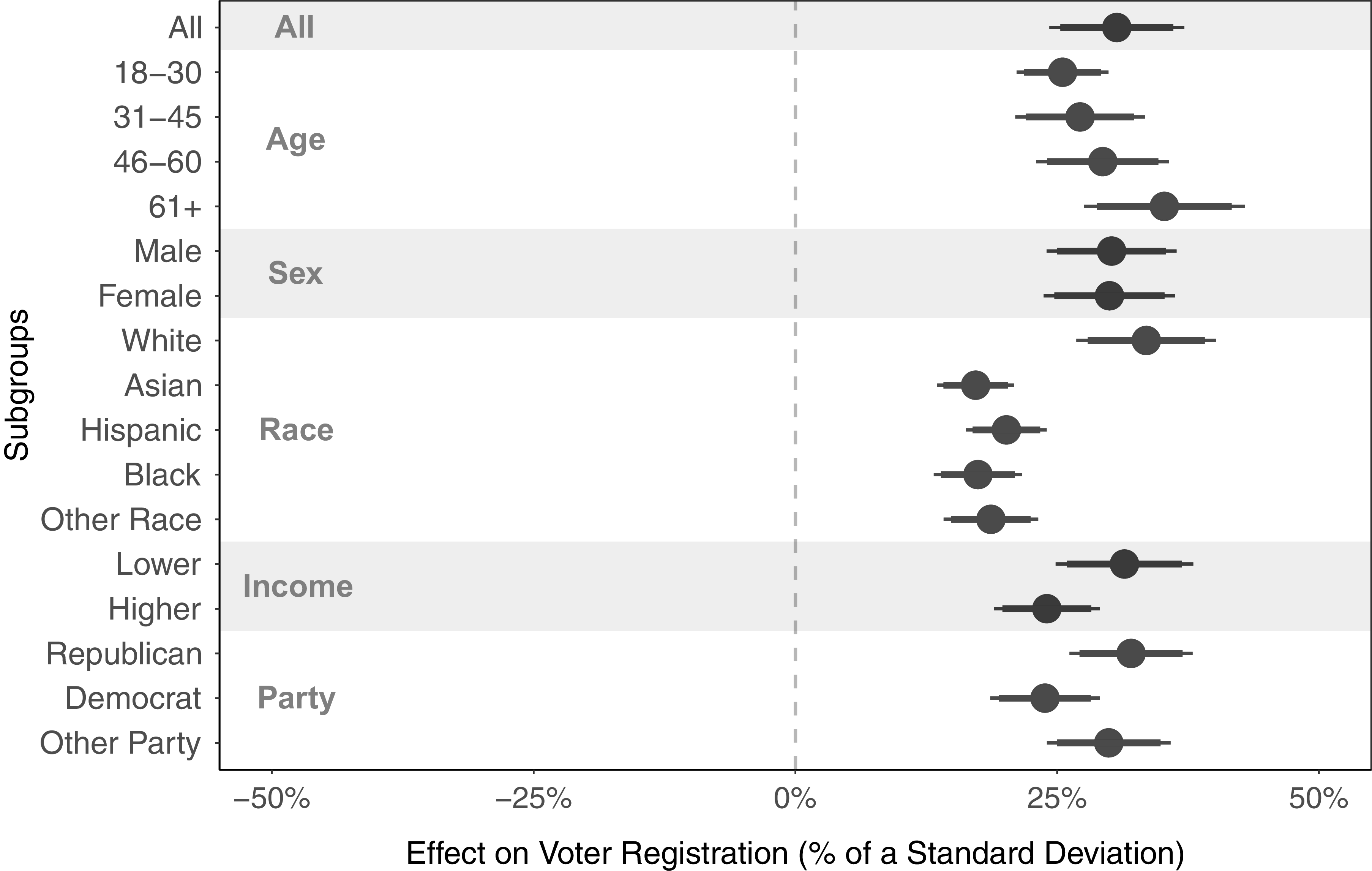
Data from the CCC indicates George Floyd’s death increased the number of protests occurring nationwide by about 350 and the number of protesters attending protests by just under 145,000 people (see Figure S1). However, as indicated previously, we are most interested in whether this event changed the political scope of conflict by encouraging individuals to engage by registering to vote. Figure 1 shows our top-line results. (We choose to show a coefficient plot for Figure 1 because this format allows us to put more information into a smaller area than showing the individual cut-offs. However, those interested in seeing the regression discontinuity plot can reference Figures S28 and S35 in the Online Appendix.)
Effect of George Floyd’s murder on voter registration.
Note: coefficient plots for the effect of Floyd’s murder on registration counts broken by various individual subgroups. Points are coefficient estimates; bars are 90 per cent and 95 per cent confidence intervals. Voter registration counts drawn from L2 data. Results from RDiT models using a polynomial of order 1, employing a triangular kernel that gives additional weight to observations near the cut-off, and leveraging the mean-squared-error (MSE) optimal bandwidth.

In the aggregate, in the days immediately following Floyd’s murder, there was, on average, a 30.7 per cent increase in voter registration nationwide.Footnote 11 , Footnote 12 This is equivalent to approximately eleven additional registrations on average in counties in the United States, or about 60,000 new registrations nationwide in the immediate aftermath.Footnote 13
Are these effects substantively meaningful? On the one hand, the addition of roughly 60,000 new registered voters is unlikely to swing election outcomes (especially, as we show below, because the increased scope does not disproportionately favor one side). On the flip side, they stand in sharp contrast to other similar events – such as mass shootings (and prominent shootings at that) – which generate no change in voter registration (Hassell et al. Reference Hassell, Holbein and Baldwin2020). Any significant effect on voter registration for a singular event suggests Floyd’s murder is different from other similar traumatic events. Moreover, using estimates from Nickerson (Reference Nickerson2015), our estimate of approximately 60,000 new registrants, and a back-of-the-envelope calculation, indicates Floyd’s murder organically registered about the same number of voters as a $1.4M door-to-door registration drive, equivalent to approximately 93,600 hours of door-knocking by paid canvassers.Footnote 14 , Footnote 15 In addition, we note explicitly that our results are robust to a host of specification checks and are not the result of one particular modeling choice, as we detail in the Online Appendix (see the Robustness Checks section therein).
Heterogeneous Treatment Effects
Does this increase in voter registration disproportionately favor one side in the political conflict? Figure 1 indicates the mobilizing effect of Floyd’s murder appears across a range of groups which vary somewhat. Specifically, Figure 1 highlights effects by age, sex, race, income, and party because these are the main cleavages in American politics and where we might expect differences in responsiveness to events surrounding the murder of George Floyd; to be thorough, we examine them all.Footnote 16
While some might suspect that Democrats would have been more mobilized given their outrage at the death of George Floyd at the hands of police officers and the increase in protests against that action, this does not appear to be the case. It appears that Republicans (32 per cent of a standard deviation; 3.7 additional registrations per county) were slightly more mobilized than Democrats (24 per cent of a standard deviation; 2.8 additional registrations per county). Similarly, while we find mobilizing effects for minorities (20.2 per cent of a standard deviation; 0.6 additional registrations per county for blacks and 17.4 per cent of a standard deviation; 0.7 additional registrations per county for Hispanics), the effects are slightly larger for whites (33.5 per cent of a standard deviation (7.4 additional registrations per county)).Footnote 17 Finally, when it comes to age, we see effects across all groups; however, individuals over sixty-one years of age are those who have the largest standardized increase in response to the event.
Geographic Variation and Net Partisan Gains
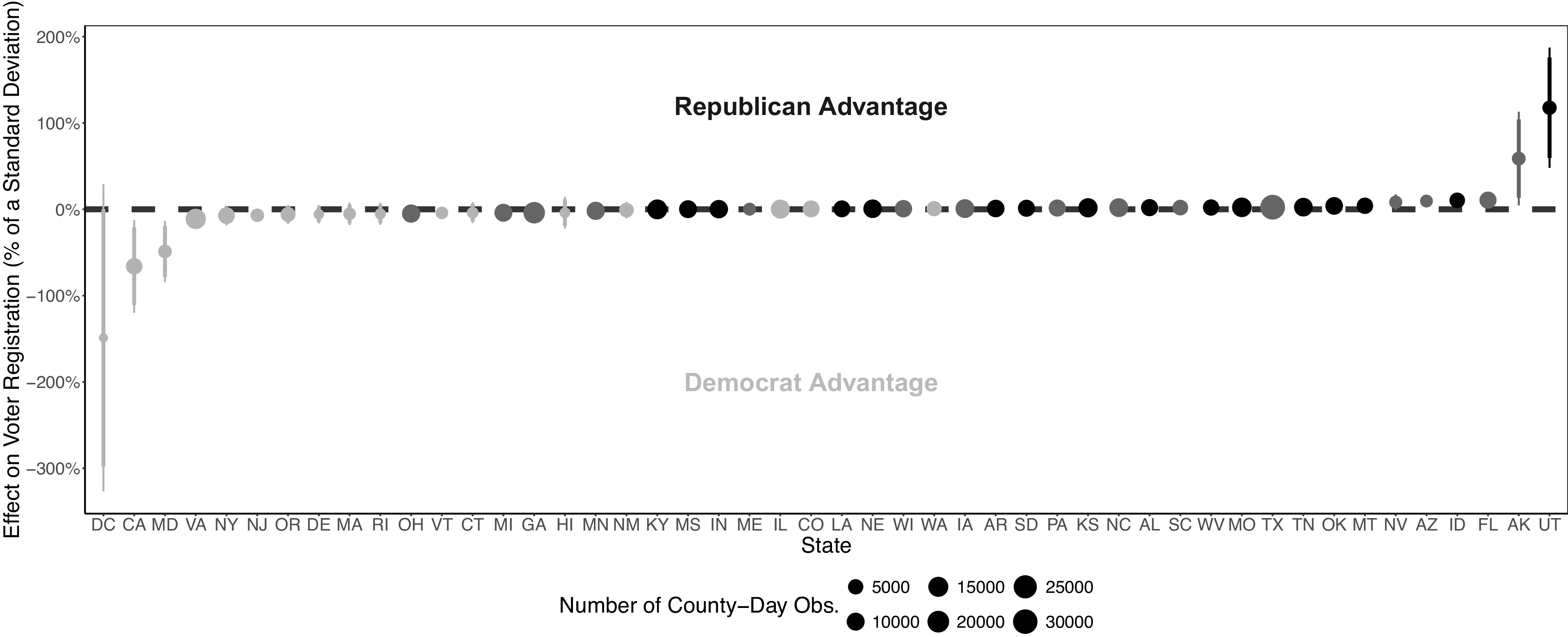
Did George Floyd’s murder have differential effects by party and place? The effects observed did vary somewhat across these dimensions. Figure 2 and Figure S17 in the Online Appendix show these patterns visually. These figures show that the registration gains we observe are not constrained to the state in which Floyd was killed. In most states, there was a positive and statistically meaningful effect. Interestingly, the mobilizing effects of Floyd’s murder were present in red, blue, and purple states. In fact, the correlation coefficient between vote share and our coefficient estimates is r= 0.14 in the case of Republican registrations and r = 0.25 in the case of Democratic registrations. Moreover, it appears that in most places the registration spike that we observe did not overwhelmingly benefit one party over the other. While there are exceptions (for example, Utah – a state where many people register as Republicans given the uncompetitive nature of most elections), the general pattern is one of partisan balance – consistent with Floyd’s murder not changing the scope of conflict.
Effect of George Floyd’s murder on the net balance of partisan voter registration.
Note: coefficient plots for the effect of Floyd’s murder on registration counts broken down by state. Points are coefficient estimates; bars are 90 and 95 per cent confidence intervals. Voter registration counts drawn from L2 data. Results from RDiT models using a polynomial of order 1, employing a triangular kernel that gives additional weight to observations near the cut-off, and leveraging the mean-squared-error (MSE) optimal bandwidth. Points are sized by the number of county-day observations and are shaded by the presidential vote share in the county – black = Most Republican tercile, Light gray = Most Democratic tercile.

The Moderating Role of Protests
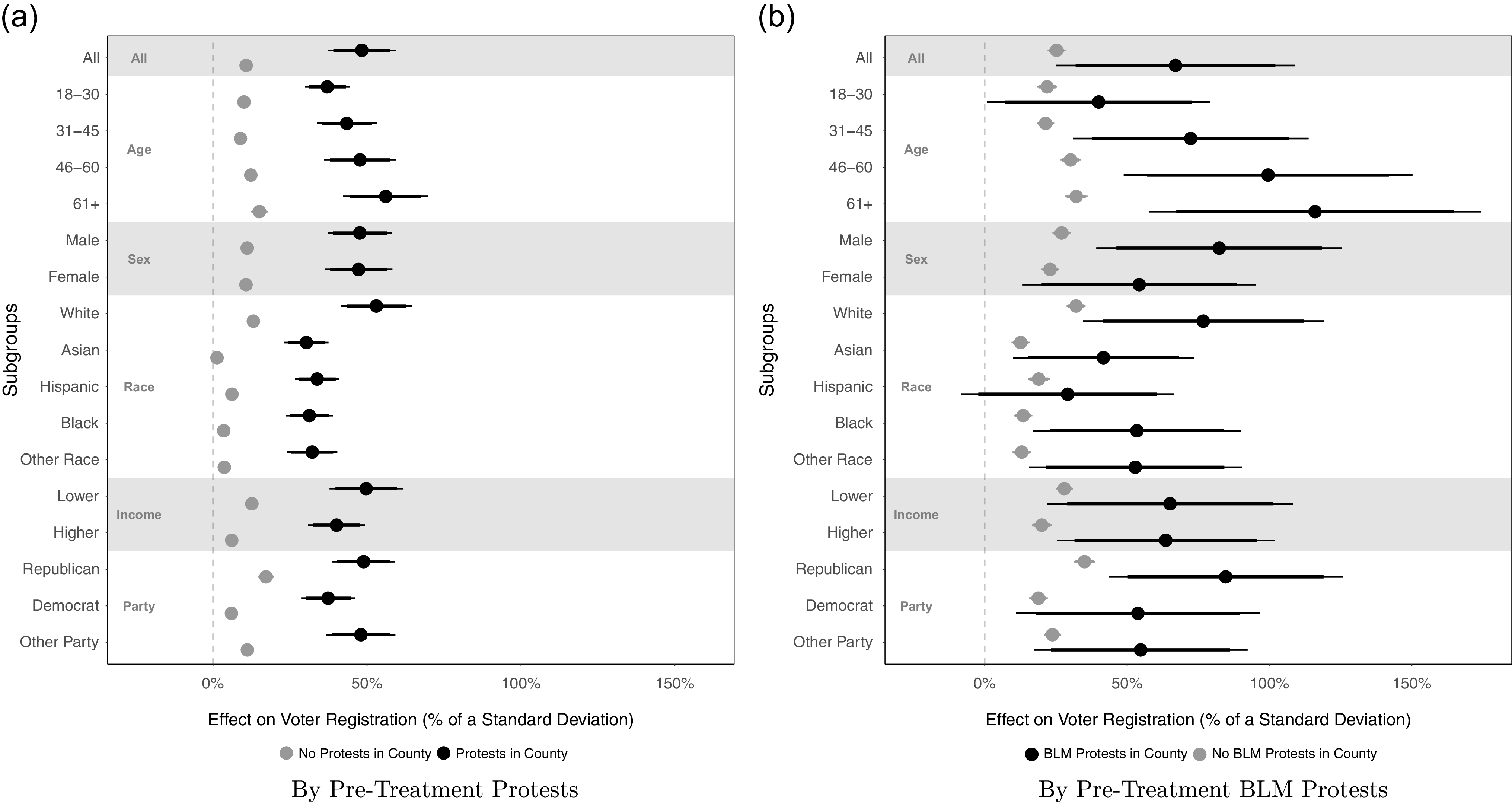
We also want to get a sense of the mechanism behind the link between Floyd’s death and increased voter registration. One possible mechanism is that local protest activity (and local infrastructure and community support for protest) was a key component in facilitating individual mobilization and voter registration. Figure 3 shows the effects are considerably larger in areas where there were previously protests.Footnote 18 On the left, we show the effects for all protests; on the right, we show the effects for just Black Lives Matter Protests.Footnote 19 In areas where protests previously occurred, the effects are typically around 40 per cent of a standard deviation.Footnote 20 However, in places that did not have a protest, the effects are typically closer to 9 per cent of a standard deviation. This suggests George Floyd’s death is the key motivator for the spike that we observe, given that the effects are largest in areas that we might expect to be most influenced by such an event given their propensity to protest such an event, rather than some other event occurring in the same time period. Given that the effects we find are larger in areas in close proximity to protest activity, these results provide some suggestive evidence (albeit not entirely conclusive given the presence or absence of protest activity not randomly assigned and that may likely be endogenous) that protest activity may play a moderating role in driving the results we see.
The effect of George Floyd’s murder on voter registration was larger in areas with high protest incidence.
Note: coefficient plots for the effect of Floyd’s murder on registration counts broken by whether a protest was present in the county prior to Floyd’s murder (on the left) and whether a BLM protest was present in the county prior to Floyd’s murder (on the right). Points are coefficient estimates; bars are 90 and 95 per cent confidence intervals. Voter registration counts drawn from L2 data. Protests data drawn from the Crowd Counting Consortium (CCC). Results from RDiT models using a polynomial of order 1, employing a triangular kernel that gives additional weight to observations near the cut-off, and leveraging the mean-squared-error (MSE) optimal bandwidth. As we note in the Online Appendix, these effects are robust to slight variations in treatment date, including the day after the event when news of the murder spread on social media. The BLM coefficients on the right have wider error bars because there are fewer pre-treatment BLM protests than overall protests.

Would They Have Registered Anyway?
The identification strategy utilized above does not indicate whether people who were motivated to register because of Floyd’s murder were individuals who would otherwise not have registered or if they were individuals who merely shifted their registration to earlier in the election cycle in response to the events of that day. While there is no perfect way to answer this question, we can examine this possibility by looking for changes in trends compared to previous elections.
The best evidence we can provide suggests that the influx of registrants in response to George Floyd’s murder did not reduce voter registrations at future points in the election cycle. Figure S34 shows the difference in overall registration counts between 2016 and 2020. This figure indicates that the difference in voter registration totals between 2016 and 2020 that opens up as a result of George Floyd’s murder does not decrease, and if anything continues to get larger. As best we can tell, it does not seem that voters who registered when George Floyd was murdered were merely individuals who would have registered to vote at another time.
Was George Floyd’s Murder Unique?
Some may wonder whether the voter registration response observed after George Floyd’s murder was unique, or whether it reflected a broader pattern following other high-profile killings of unarmed black individuals. There are theoretical reasons to believe Floyd’s case stood out – his murder was widely circulated on video, sparked international protests, and received sustained media attention in a politically salient moment.
Figure 4 presents a direct comparison using differences-in-discontinuities (RDiT) estimates across ten such incidents that occurred at other times in 2020.Footnote 21 For each case, we estimate the effect on voter registration using a consistent bandwidth and model specification to ensure comparability. Among the events analyzed, George Floyd’s murder generated a strikingly larger spike in registrations – substantially outpacing other cases.Footnote 22
Effect of George Floyd’s murder relative to other murders of unarmed black people.
Note: the figure above shows the differences-in-discontinuities estimates between 2016 and 2020 of Floyd’s murder and the murders of other unarmed black people. Points are coefficient estimates; bars are 90 and 95 per cent confidence intervals. Points are sorted by coefficient size. Voter registration counts drawn from L2 data. To ensure equivalent power across model, h = 5 and b = 10. As can be seen, Floyd’s murder appears unique in terms of the voter registration boost that we document.

This result suggests that while multiple incidents of police violence occurred during this period, not all had the same mobilizing effect. The data support the interpretation that George Floyd’s murder served as a catalytic event, producing an outsized and distinctive political response.
Discussion
Scholars have long noted that political outcomes are the result of both the lines of political cleavage in society (the issues that are salient and the factional alignments of political groups as a result of those cleavages) and the scope of conflict (the individuals who actively participate in the political process) (Schattschneider Reference Schattschneider1960). In this paper, we have examined the role that George Floyd’s murder, and the subsequent protests that followed, played in changing the scope of conflict, or specifically, sparking individuals to register to vote.
We show that the death of George Floyd widened the scope of conflict, bringing new combatants into the political battlefield. Our work also provides some suggestive evidence that protest activity surrounding the death of George Floyd was the impetus for such mobilizing effects.
Moreover, we show that these effects are not limited to political sympathizers. Rather, we find that such high-profile events have both mobilizing and counter-mobilizing effects. George Floyd’s death and the events surrounding it mobilized individuals from individuals in communities that are both advantaged and disadvantaged politically and individuals on both sides of the political spectrum.
Our work also may provide some insight into why previous work has found both that police killings both increase voter turnout (Ang and Tebes Reference Ang and Tebes2024; Morris and Shoub Reference Morris and Shoub2024) and decrease voter turnout (Markarian Reference Markarian2023). Specifically, while Ang and Tebes (Reference Ang and Tebes2024) and Morris and Shoub (Reference Morris and Shoub2024) account for new voters, Markarian (Reference Markarian2023, Footnote #10) recognizes his findings ‘may not account for changes in … turnout due to differential levels of voter registration’. It could be that while police violence does not mobilize (or even discourages turnout) among those already engaged with the political process, it expands political conflict by engaging new registrants who are motivated to turn out to vote.
At the same time, our work also focuses on an episode of police violence which mobilized local, national, and international protests. In contrast, most previous work has focused on the local effects of police killings which rarely generate the media coverage and protest seen in the murder of George Floyd. Likewise, although we do not find major differences across states, when estimating the effects of focusing events, the proximity to (or localness of) the event may affect how individuals process and respond.Footnote 23 In that vein, ours should not be the last work in this space. While our examination of other killings of unarmed black individuals does not suggest a national response, future work should examine the effect of other police killings to see if our results are indicative of a broader (albeit perhaps a more local rather than more nationalized) pattern. More work on similar events will better help us understand the conditions under which events such as these are effective at expanding political conflict and bringing new combatants into the political arena.
Moreover, while our results align with Schattschneider’s (Reference Schattschneider1960) proposition that these sorts of high-profile salient events can serve as as catalysts for expanding the scope of conflict, our work does not outline how such change ‘makes possible a new pattern of competition … and a new result but … also makes impossible a lot of other things’ (Schattschneider Reference Schattschneider1960, 17, emphasis in the original). Additional work is essential in understanding not just whether this mobilizing effect is replicated elsewhere, but also how such changes influence future patterns of competition, internal group dynamics, and political outcomes, and how these new patterns of participation change (or fail to change) political strategy and engagement.
Still, this empirical case is vitally important as it shows that unlike other forms of violence – such as mass shootings or even mass shootings which generate a national response (such as Parkland and Sandy Hook), which do not generate such a response (Hassell et al. Reference Hassell, Holbein and Baldwin2020; Hassell and Holbein Reference Hassell and Holbein2025) – police killings can sometimes generate sufficient interest and energy to spark a political reaction outside of the political protests that we have seen in recent years and expand the scope of conflict, but that this expansion of conflict does not uniformly benefit a particular political side as it increases engagement among all groups.
Supplementary material
The supplementary material for this article can be found at https://doi.org/10.1017/S0007123426101410.
Data availability statement
Replication data for this article can be found in Harvard Dataverse at: https://doi.org/10.7910/DVN/BOCGOQ.
Acknowledgements
We thank Jerusha Conner, Kei Kawashima-Ginsberg, Johnnie Lotesta, Alberto Medina, and Tova Wang for their feedback, Nicholas Flanagan for data collection help, and L2 for providing the voter file data. We acknowledge funding from NEO Philanthropy, New Venture Fund for this project.
Author contributions
Both authors contributed equally.
Financial support
This project was funded by NEO Philanthropy, New Venture Fund.
Competing interests
None to disclose.
Ethical standards
Given that this manuscript analyzes secondary data that can be compiled with publicly available information, our institutions did not require us to obtain IRB approval.


 Open access

