


Introduction
Traditional leadership models are based on static relationships, whereas Complexity Leadership Theory (CLT) reconceptualizes leadership as an emergent process. Leadership exists within a complex adaptive system in which the people and context generate adaptive solutions (Lichtenstein & Plowman, Reference Lichtenstein and Plowman2009; Uhl-Bien, Marion & McKelvey, Reference Uhl-Bien, Marion and McKelvey2007). Within these complex systems, generative, administrative, and community-building leadership modes occur as a result of nonlinear feedback loops and through adaptive co-creation. Organizations can respond dynamically through this process of sensing and evolving with the challenges (Hazy & Uhl-Bien, Reference Hazy and Uhl-Bien2015).
Servant leadership was first defined as a philosophy by Greenleaf (1977/Reference Greenleaf2013) that makes the followers’ growth, empowerment, and well-being top priorities. It gained traction within organizations because of its positive impacts on employees’ engagement, performance, and organizational citizenship behaviors (Liden, Wayne, Zhao & Henderson, Reference Liden, Wayne, Zhao and Henderson2008). Most extant research treats servant leadership as a stable style rather than a context-sensitive process that responds to changes in work conditions.
The job demands–resources (JD–R) model defines job demands as aspects of work that require sustained effort and therefore generate strain, and job resources as aspects that support goal attainment and growth. Job demands may cause employee burnout while job resources can generate engagement (Bakker & Demerouti, Reference Bakker and Demerouti2017; Demerouti, Bakker, Nachreiner & Schaufeli, Reference Demerouti, Bakker, Nachreiner and Schaufeli2001). According to Regulatory Focus Theory (RFT; Higgins, Reference Higgins1997, Reference Higgins1998), people adopt either a promotion focus (aimed at gains and aspirations) or a prevention focus (aimed at loss avoidance and obligation fulfillment). This distinction plays a critical role in shaping their motivational drives, decision-making patterns, and emotional experiences.
Taken jointly, servant leadership, the JD–R model, and RFT capture complementary dimensions of a unified adaptive system by specifying, in turn, the leadership process, the stress–resource ecology, and the motivational self-regulatory system through which adaptation unfolds. The JD–R perspective specifies the dynamic energetic and developmental conditions that give rise to experiences of strain and opportunity in work settings. Servant leadership represents the ethical and relational process through which leaders respond to these conditions by reallocating support, generating meaning, and ensuring protection. RFT details the self-regulatory processes through which employees construe these leadership actions and contextual cues as either promotion-oriented growth motivation or prevention-oriented security motivation. CLT brings these elements together by explaining how they co-evolve through emergence, interdependence, and nonlinear feedback. Examining any one of these approaches alone therefore conceals the adaptive cycle through which context, leadership, and motivation co-shape one another across time. In this sense, servant leadership functions as an adaptive converter within the system, translating shifting job demands and resources into employees’ promotion and prevention regulatory foci, thereby influencing person-job fit, satisfaction, intrinsic motivation, personal initiative, and experienced responsibility.
Drawing on the established foundations, we begin by outlining the core principles of CLT and juxtaposing them against conventional leadership assumptions. Then, we critically review servant leadership, JD-R, and RFT – drawing out the additional insights that a complexity lens provides. Subsequently, these three streams are integrated into a four-path process model, from which we derive structural equation modeling (SEM) hypotheses. Finally, we advance a cross-lagged panel model (CLPM) hypothesis to empirically test the reciprocal and time-ordered feedback dynamics that are fundamental to Complexity Leadership Theory. By estimating both autoregressive stability paths and cross-lagged directional effects among constructs across waves, a CLPM allows us to examine whether job demands and resources affect servant leadership and regulatory focus over time, and whether these motivational states subsequently feedback to alter contextual conditions.
Literature review
Complexity leadership theory as an integrative framework
CLT conceptualizes leadership as a dynamic, system-level process arising in complex adaptive systems, in which patterns of influence, coordination, and adaptation emerge from ongoing interactions among multiple actors and contextual conditions rather than from discrete sets of actions or stable traits residing in single individuals (Bunjak, Lord & Acton, Reference Bunjak, Lord and Acton2024; Rosenhead, Franco, Grint & Friedland, Reference Rosenhead, Franco, Grint and Friedland2019; Schneider & Somers, Reference Schneider and Somers2006; Tourish, Reference Tourish2019). According to CLT, semi-autonomous actors and environmental influences interact continually, generating patterns of behavior and organizing processes that diffuse within their organizations (Holland, Reference Holland1992; Uhl-Bien et al., Reference Uhl-Bien, Marion and McKelvey2007). The drivers of CLT are emergence, interdependence, nonlinear feedback, and adaptive co-creation.
Emergence. In the study of complex adaptive systems, emergence denotes the spontaneous appearance of higher-order patterns that cannot be reduced to the intentions or actions of any single agent (Holland, Reference Holland1992; Lichtenstein & Plowman, Reference Lichtenstein and Plowman2009). From a CLT viewpoint, leadership is therefore not regarded as a stable individual attribute but as a system-level phenomenon that is produced through ongoing interactions among actors and contextual constraints (Uhl-Bien et al., Reference Uhl-Bien, Marion and McKelvey2007). Within the present framework, servant leadership is conceptualized as an emergent pattern that takes form through the collective responses of leaders and followers to shifting job demands and resources, rather than as a fixed behavioral style applied in the same manner across situations.
Interdependence. Interdependence denotes the reciprocal linkage of actors and structures such that variation in one component alters the behavior of others (Schneider & Somers, Reference Schneider and Somers2006). In organizational settings, leaders, followers, and task environments form a closely integrated network in which motivational states, flows of resources, and role expectations develop together. This pattern of interdependence suggests that regulatory focus cannot be viewed solely as an individual attribute, nor leadership solely as a contextual feature, because each persistently influences and is influenced by the other.
Nonlinear feedback. Nonlinear feedback processes indicate that small perturbations in a system can be amplified, attenuated, or redirected through recursive loops of interaction (Hazy & Uhl-Bien, Reference Hazy and Uhl-Bien2015). Applied to leadership phenomena, this implies that limited changes in servant behaviors or in the distribution of resources may produce large shifts in employee regulatory focus, which subsequently feed back to shape later leadership actions and perceptions of job characteristics. These dynamics provide a strong justification for employing longitudinal cross-lagged modeling to capture reciprocal causal processes rather than assuming one-way causal effects.
Adaptive co-creation. Adaptive co-creation represents a continuous interactive process in which leaders, followers, and organizational structures work together to form shared understandings, align priorities, and coordinate actions in response to changing demands and resource conditions (Lichtenstein & Plowman, Reference Lichtenstein and Plowman2009; Uhl-Bien et al., Reference Uhl-Bien, Marion and McKelvey2007). Rather than treating adaptation as a top-down adjustment initiated by leaders or as a passive response by employees, CLT defines it as an interactive process in which interpretations of goals, risks, and opportunities are continually negotiated and recalibrated through social exchange. Within this dynamic, leadership behaviors, employee motivational orientations, and the allocation of job resources mutually influence one another, such that changes in one component generate compensatory or amplifying adjustments in the others. In the present framework, adaptive co-creation explains how servant leadership and employees’ promotion and prevention regulatory foci are jointly enacted and progressively refined as organizational members collectively respond to shifting job demands and resource conditions. From this perspective, regulatory focus is understood not simply as an internal psychological state but as part of an emergent and socially embedded self-regulatory system that evolves through repeated leader–follower interaction and contextual sensemaking.
Leadership modes. According to CLT, leadership can be categorized into administrative leadership focused on structuring and control, adaptive or generative leadership focused on innovation and the activation of tension, and enabling or community building leadership focused on relational integration and coordination (Hazy & Uhl-Bien, Reference Hazy and Uhl-Bien2015; Uhl-Bien et al., Reference Uhl-Bien, Marion and McKelvey2007). Within this study, Hazy and Uhl-Bien (Reference Hazy and Uhl-Bien2015) argue that administrative leadership establishes stable policies and frameworks that are needed for stability. Community-building leadership generates trust, shared identity, and cohesion. Trust in management is considered a vital job resource strongly related to servant leadership (Jaiswal & Dhar, Reference Jaiswal and Dhar2017; Seto & Sarros, Reference Seto and Sarros2016).
Servant leadership. Servant leadership is conceptualized here as an enabling and adaptive pattern that promotes trust, psychological safety, and resource mobilization, which in turn allows regulatory focus changes and job crafting dynamics to arise and become stabilized through feedback processes. Instead of thinking of servant leadership as having static antecedents and a linear-causality framework, CLT frames it as a dynamic process. Here, servant leadership becomes a generative mode that materializes when job demands and resources evolve.
Taken together, these principles of complexity and forms of leadership indicate a system of reciprocal and temporally ordered influence in which leadership patterns, contextual conditions, and employee motivational states co-evolve through emergence, interdependence, nonlinear feedback, and adaptive co-creation. Capturing these co-evolutionary processes requires longitudinal models that can estimate bidirectional relationships and temporal ordering, thereby providing the conceptual rationale for the cross-lagged panel approach used in the present study. The following sections introduce the JD–Resources model and Regulatory Focus Theory as the contextual and motivational mechanisms through which these complexity dynamics are specified and empirically examined.
Foundations of servant leadership
From its inception in Robert K. Greenleaf’s 1970 essay ‘The Servant as Leader’ to its fuller treatment in Servant Leadership: A Journey into the Nature of Legitimate Power and Greatness (Reference Greenleaf2013), servant leadership has been shaped by Greenleaf’s foundational writings. In his view, leadership derives its legitimacy not from formal authority or control but from moral responsibility, stewardship, and the primacy of follower growth and community well-being, such that the true test of leadership lies in whether ‘the least privileged in society’ are helped to grow (Greenleaf, 1977/Reference Greenleaf2013). Leadership is thus understood as a moral, relationship-based endeavor grounded in service first, the ethical use of power, and the cultivation of trust and community. These principles were subsequently institutionalized and extended by the Greenleaf Center for Servant Leadership, which articulated service, trust, listening, and stewardship as the normative foundations of effective leadership in complex social systems and advanced their application through education, practice, and research across organizational contexts.
This orientation challenged power-centric paradigms and, through the influence of the Greenleaf Center and subsequent scholarly development, was translated into systematic operationalizations of servant leadership as a multidimensional construct reflecting empowerment, humility, ethical stewardship, and developmental support (Eva, Robin, Sendjaya, Van Dierendonck & Liden, Reference Eva, Robin, Sendjaya, Van Dierendonck and Liden2019; Liden et al., Reference Liden, Wayne, Zhao and Henderson2008; van Dierendonck, Reference van Dierendonck2011). Researchers have found that servant-minded actions (e.g., actively listening, providing effective stewardship, demonstrating empathy, and offering personalized support) are predictors of elevated engagement, workplace thriving, commitment to the organization, and discretionary citizenship actions (Usman et al., Reference Usman, Liu, Li, Zhang, Ghani and Gul2021). It nurtures constructive voice (Duan, Kwan & Ling, Reference Duan, Kwan and Ling2014). Servant leadership can positively enhance subordinate attitudes and behaviors, as well as the psychological climate, encouraging trust, fairness, and affective commitment that leads to citizenship behaviors and satisfaction (Ozyilmaz & Cicek, Reference Ozyilmaz and Cicek2015).
While early investigations portrayed servant leadership as a consistent approach, contemporary scholarship emphasizes its emergent, situationally adaptive qualities. Viewed through Complexity Leadership Theory, servant leadership functions as a generative phenomenon that is activated by fluctuations in job demands and the availability of resources (Lichtenstein & Plowman, Reference Lichtenstein and Plowman2009; Uhl-Bien et al., Reference Uhl-Bien, Marion and McKelvey2007). Osborn, Hunt, and Jauch (Reference Osborn, Hunt and Jauch2002) posited that effective leadership requires leaders’ behaviors be congruent with the situational contingencies. This aligns with the CLT idea that servant leaders must continually adjust their own supportive, empowering, and stewardship behaviors by being attentive to the feedback they are receiving from their subordinates. In practice, servant leadership does not involve a static set of one-size-fits-all actions. Rather, leaders dynamically adjust their responses to align with the continually changing demands of their subordinates while working within the constraints imposed by available resources.
Gardner et al. (Reference Gardner, Karam, Noghani, Cogliser, Gullifor, Mhatre and Dahunsi2024) found that contextual factors are important for authentic leadership and argued for a greater contextual focus in leadership research, a point that can be extended to servant leadership as well. Previous studies support servant leadership as an inherently adaptive approach. Chiniara and Bentein (Reference Chiniara and Bentein2016) found that a servant leader’s actions will change dynamically in reaction to the fluctuating needs of their subordinates as well as the demands placed upon them. Chaudhry, Cao, Liden, Point, and Vidyarthi (Reference Chaudhry, Cao, Liden, Point and Vidyarthi2021) corroborated this dynamic pattern, showing within their study that the enhancement of well-being through servant leadership is stronger under substantial job demands, indicating that it is likely a responsive amplification. Studies by Lemoine, Hartnell, and Leroy (Reference Lemoine, Hartnell and Leroy2019), as well as Owens and Hekman (Reference Owens and Hekman2016), provide support for the argument that servant leaders fine-tune the degree to which they serve or empower, adapting their personal approach based on task complexity and their subordinates’ level of maturity. Servant leadership positively impacts team safety and resource availability by way of open channels of communication, personalized feedback, and proactive acquisition of material or social resources (Haq, Raja, Alam, De Clercq & Saleem, Reference Haq, Raja, Alam, De Clercq and Saleem2022; Lord, Brown & Freiberg, Reference Lord, Brown and Freiberg1999). This can be conceptualized as a self-reinforcing cycle in which leaders use subordinates’ responses as real-time feedback to determine when and how to bolster support or resources. This serves as an adaptive loop, which embodies the co-creative dynamics central to CLT (Uhl-Bien et al., Reference Uhl-Bien, Marion and McKelvey2007). Thus, servant leadership can be framed as an adaptive, feedback-based phenomenon.
Although servant leadership theory explains how leaders provide ethical, relational, and developmental support to followers, it does not by itself specify the contextual conditions that give rise to these behaviors or the motivational processes through which they shape effort, vigilance, initiative, and responsibility. The JD–R model supplies this missing contextual structure by identifying the energetic strains and developmental opportunities that create the need for buffering, empowerment, and the mobilization of resources. RFT, in turn, specifies the self-regulatory mechanisms through which these leadership and contextual cues are internalized by employees as promotion- or prevention-oriented motivational states. Together, JD–R and RFT provide the contextual and motivational micro-foundations required to model servant leadership as an emergent, feedback-driven process within a complex adaptive system.
Job demands–resources model
To explain why and when servant leadership emerges within complex adaptive systems, the JD–R model specifies the energetic and developmental conditions that create the need for buffering, empowerment, and adaptive resource mobilization. Job resources and demands shape both promotion and prevention regulatory foci from a distance (Kauppila et al., Reference Kauppila, Ehrnrooth, Mäkelä, Smale, Sumelius and Vuorenmaa2022). According to Demerouti et al. (Reference Demerouti, Bakker, Nachreiner and Schaufeli2001), the JD-R model asserts that job demands encompass physical, psychological, social, and organizational work aspects that require sustained effort. Central to the JD-R model is the idea that job demands, defined as the physical, psychological, social, or organizational facets of work that require prolonged effort, may exhaust an employee’s energy and eventually cause strain or burnout when they become too great (Bakker & Demerouti, Reference Bakker and Demerouti2017; Bakker, Demerouti & Sanz-Vergel, Reference Bakker, Demerouti and Sanz-Vergel2023; Demerouti et al., Reference Demerouti, Bakker, Nachreiner and Schaufeli2001). This can potentially extend to physical stress in dealing with those demands (Petrou & Demerouti, Reference Petrou and Demerouti2010; Yin, Huang & Lv, Reference Yin, Huang and Lv2018). Job demands encompass quantitative overload, the challenges of emotional labor, unclear roles, and contradictory expectations. In contrast, job resources – such as autonomy, social support, feedback, and task significance – support goal attainment, mitigate demand-related strain and stimulate personal development (Bakker & Demerouti, Reference Bakker and Demerouti2017). Job resources can foster motivation and personal growth in the workplace (Lu, Siu, Chen & Wang, Reference Lu, Siu, Chen and Wang2011). The model thus outlines two linked processes. The dual-pathway model comprises a health impairment route – where excessive demands result in burnout – and a motivational route – where sufficient resources bolster engagement and initiative (Bakker, Demerouti & Sanz-Vergel, Reference Bakker, Demerouti and Sanz‐Vergel2014; Christian, Garza & Slaughter, Reference Christian, Garza and Slaughter2011; Halbesleben, Reference Halbesleben2010; Maslach, Schaufeli & Leiter, Reference Maslach, Schaufeli and Leiter2001). Equally important, resources cushion the strain induced by high demands, underscoring their indispensable role in preserving well-being.
Recent JD-R developments reveal how the framework adjusts to dynamic work settings. They also draw attention to employees’ agency in configuring their own work environments. In their 2023 work, Demerouti and Bakker recommend adjustments for contexts marked by crisis and uncertainty. They argue that the usual challenge versus hindrance dichotomy might transform, and new resources such as digital readiness gain importance during swift change. Job crafting research, which examines how employees actively reshape tasks, relationships or mindsets, finds a clear division: promotion-oriented individuals engage in approach crafting by seeking new challenges and developmental resources, whereas prevention-oriented individuals rely on avoidance crafting to minimize hindrances and uncertainties (Nong, Ye & Hong, Reference Nong, Ye and Hong2022; Petrou, Demerouti & Schaufeli, Reference Petrou, Demerouti and Schaufeli2015). At the same time, virtual social support has become essential for buffering and coping (Molino et al., Reference Molino, Ingusci, Signore, Manuti, Giancaspro, Russo and Cortese2020; Salanova, Llorens & Schaufeli, Reference Salanova, Llorens and Schaufeli2011). By introducing novel demands and resources, these changes validate JD-R’s dynamic nature and its resonance with CLT. Demands and resources signal when servant leadership should emerge. Employees’ proactive crafting and their promotion versus prevention focus then inform how leadership adjusts. However, excessive job demands may impede a leader’s ability to support and develop subordinates (Li, Fu, Chadwick & Harney, Reference Li, Fu, Chadwick and Harney2024). On the basis of this framework, we next consider RFT. It supplies the motivational perspective employees employ to decode and respond to the contextual conditions identified by JD-R.
Regulatory Focus Theory
To explain how employees translate servant leadership and contextual conditions into patterns of effort, vigilance, initiative, and responsibility, RFT specifies the motivational self-regulatory mechanisms through which these contextual cues are internalized. Having shown that demands and resources act as contextual cues in the JD–R framework, our attention shifts to RFT. This framework shows how employees’ motivational orientations both shape and are shaped by those contextual elements. Higgins (Reference Higgins1997, Reference Higgins1998) first proposed RFT. It differentiates a promotion focus – steering individuals toward gains, aspirations, and personal growth – from a prevention focus, which directs attention to safety, duty, and loss avoidance (Johnson, Smith, Wallace, Hill, & Baron, Reference Johnson, Smith, Wallace, Hill and Baron2015). These foci significantly influence how people interpret information, regulate emotions, make decisions, and pursue goals (Brockner & Higgins, Reference Brockner and Higgins2001; Gamache, McNamara, Mannor & Johnson, Reference Gamache, McNamara, Mannor and Johnson2014).
Traditional frameworks view promotion and prevention as enduring personality traits. In contrast, CLT sees these orientations as fluid, emerging and adapting alongside changing leadership actions, and resource distributions, much like servant leadership itself. This approach holds that employees’ promotion versus prevention orientations come into being through dynamic feedback loops. Leaders’ adaptive support and decisions about resource allocation guide subordinates toward either seeking gains or avoiding losses.
Behavioral and organizational correlates
When employees adopt a promotion orientation, they become eager and creative, treating positive feedback as fuel and setbacks as learning opportunities (Higgins, Reference Higgins1997). In contrast, a prevention orientation induces vigilance and a strong aversion to error; such individuals gain relief from meeting obligations but feel anxious if they anticipate failures (Brockner & Higgins, Reference Brockner and Higgins2001; Förster, Higgins & Idson, Reference Förster, Higgins and Idson1998).
In many organizations, a promotion focus correlates with higher levels of innovation and engagement (Christian et al., Reference Christian, Garza and Slaughter2011; Halbesleben, Reference Halbesleben2010), positive emotional responses (Han, Park & Rhee, Reference Han, Park and Rhee2021), and job satisfaction (Ferris et al., Reference Ferris, Johnson, Rosen, Djurdjevic, Chang and Tan2013), especially when leaders offer strong support (Baas, De Dreu & Nijstad, Reference Baas, De Dreu and Nijstad2011; Geng, Li, Bi, Zheng & Yang, Reference Geng, Li, Bi, Zheng and Yang2018). In contrast, prevention focus promotes strict adherence to protocols and enhances safety compliance in high risk contexts (Brockner & Higgins, Reference Brockner and Higgins2001). In essence, RFT shapes how the JD-R processes operate. When employees adopt a promotion focus, they magnify the model’s motivational pathway and make better use of available resources. When they adopt a prevention focus, they provide a buffer against the health impairment pathway by monitoring resource use and staving off exhaustion (Petrou & Demerouti, Reference Petrou and Demerouti2010).
Our framework combines RFT with Complexity Leadership to reveal that servant leadership’s adaptive strategies can set in motion promotion-oriented or prevention-oriented processes, which together give rise to emergent states of engagement, safety, and well-being. With RFT framing our analysis, we are prepared to merge insights from all three literatures and to derive the hypotheses that follow.
Conceptual model
From CLT’s holistic lens, this framework integrates the JD–R model, RFT, and servant leadership into a unified process in which job demands (energy draining factors) and job resources (growth-supporting factors) trigger servant leadership behaviors. These behaviors then influence whether employees adopt a promotion or a prevention focus. The result is improved fit, satisfaction, motivation, initiative, and responsibility (Demerouti et al., Reference Demerouti, Bakker, Nachreiner and Schaufeli2001; Higgins, Reference Higgins1997; Uhl-Bien et al., Reference Uhl-Bien, Marion and McKelvey2007). Three CLT principles serve as the theoretical glue: emergence (servant leadership arises unpredictably from leader–follower–context interactions); nonlinear feedback (small leadership or resource shifts cascade through mediation chains), and adaptive co-creation (subordinates’ evolving regulatory foci inform subsequent leadership adjustments) (Lichtenstein & Plowman, Reference Lichtenstein and Plowman2009; Uhl-Bien et al., Reference Uhl-Bien, Marion and McKelvey2007).
Empirical findings show that by furnishing support, sharing information, and creating development opportunities, servant leaders reduce strain, enhance engagement, and may foster prevention orientation in high-stress environments (Haq et al., Reference Haq, Raja, Alam, De Clercq and Saleem2022). When servant leaders help cushion their subordinates’ stress by providing the right support, this heightened prevention focus predicts greater experienced responsibility (Chaudhry et al., Reference Chaudhry, Cao, Liden, Point and Vidyarthi2021). Servant leaders build trust, grant autonomy, and provide social support, which may amplify subordinates’ promotion focus. These leaders provide information, a psychologically safe environment, and other resources (Haq et al., Reference Haq, Raja, Alam, De Clercq and Saleem2022; Lord et al., Reference Lord, Brown and Freiberg1999; Marinan & Brown, Reference Marinan and Brown2019). By serving ethically, they establish an environment founded on trust, fairness, prosocial actions, service, and organizational commitment (Newman, Schwarz, Cooper & Sendjaya, Reference Newman, Schwarz, Cooper and Sendjaya2017; Walumbwa, Hartnell & Oke, Reference Walumbwa, Hartnell and Oke2010). This strengthened focus manifests in the subordinates’ own approach in crafting their roles. This causes them to actively seek out challenges and learning opportunities, as well as improve their person–job fit and boost their intrinsic motivation (Petrou et al., Reference Petrou, Demerouti and Schaufeli2015; Tims, Bakker, Derks & van Rhenen, Reference Tims, Bakker, Derks and van Rhenen2013). Leaders model self-regulation by framing tasks in promotion- or prevention-oriented terms, shaping subordinates’ mindsets and reducing the impact of job demands (Kark & Shamir, Reference Kark and Shamir2002; Lockwood, Jordan & Kunda, Reference Lockwood, Jordan and Kunda2002; Yang, Ming, Ma & Huo, Reference Yang, Ming, Ma and Huo2017).
These dynamics form a four-path process model: (1) Job Demands → Servant Leadership → Promotion Focus → Positive Outcomes; (2) Job Demands → Servant Leadership → Prevention Focus → Responsibility; (3) Job Resources → Servant Leadership → Promotion Focus → Positive Outcomes; and (4) Job Resources → Servant Leadership → Lower Prevention Focus → Lower Vigilance-Based Responsibility. In the next section, we translate this integrative framework into testable hypotheses via SEM, followed by a CLPM hypothesis to capture the feedback-driven emergence at the heart of CLT.
Synthesis and theoretical integration
Having reviewed the JD–R model, RFT, and servant leadership, we integrate them under CLT, which frames job demands (e.g., workload, ambiguity) and job resources (e.g., autonomy, social support) as triggers for servant leadership that shape followers’ regulatory orientations and drive outcomes.
Empirical data reveal that context activates servant leadership behaviors, which shifts subordinates’ regulatory foci and predicts outcomes in a sequential chain (X → M₁ → M₂ → Y). Supporting and defending subordinates in high-demand situations converts prevention orientation into greater experienced responsibility (Chaudhry et al., Reference Chaudhry, Cao, Liden, Point and Vidyarthi2021). Bolstered job resources ignite promotion focus, prompting approach-oriented role crafting, resulting in gains in fit, satisfaction, motivation, and initiative (Petrou et al., Reference Petrou, Demerouti and Schaufeli2015; Tims et al., Reference Tims, Bakker, Derks and van Rhenen2013). Within adaptive co-creation, dynamic sensemaking by servant leaders encourages promotion or prevention mindsets. Resulting subordinate adaptation in their regulatory focus orientations provides feedback to the leaders helping them decide how to behave next (Kark & Shamir, Reference Kark and Shamir2002). Improved PJ-fit and satisfaction bolster retention and morale, while motivation and initiative drive innovation.
Figure 1 illustrates these four intertwined pathways as CLT’s feedback-driven emergence. The signs included in the figure indicate whether prior research suggests a positive or negative association for each path. They do not represent the formal hypotheses.
Hypothesized process model.
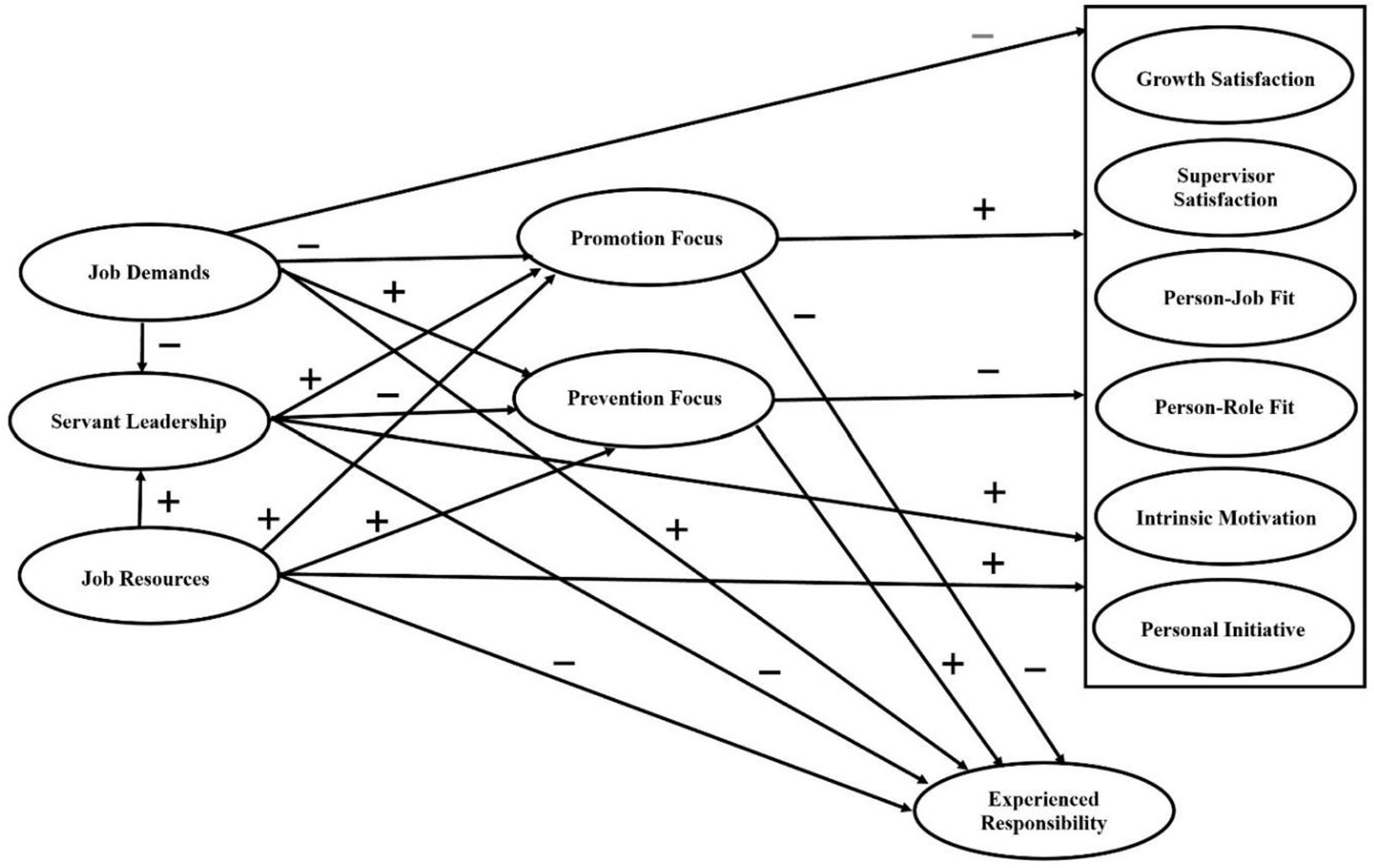
Figure 1 Long description
The diagram illustrates various pathways connecting job-related factors to focus types and outcomes, with signs indicating positive or negative associations. On the left, three oval shapes labeled 'Job Demands,' 'Servant Leadership,' and 'Job Resources' are positioned vertically. Lines extend from these ovals to two central ovals labeled 'Promotion Focus' and 'Prevention Focus.' 'Job Demands' connects with a minus sign to 'Promotion Focus' and a plus sign to 'Prevention Focus.' 'Servant Leadership' connects with a plus sign to both 'Promotion Focus' and 'Prevention Focus.' 'Job Resources' connects with a plus sign to 'Promotion Focus' and a minus sign to 'Prevention Focus.' From 'Promotion Focus' and 'Prevention Focus,' lines extend to an oval labeled 'Experienced Responsibility' at the bottom, with plus signs indicating positive associations. On the right, a vertical series of ovals labeled 'Growth Satisfaction,' 'Supervisor Satisfaction,' 'Person-Job Fit,' 'Person-Role Fit,' 'Intrinsic Motivation,' and 'Personal Initiative' are connected to 'Experienced Responsibility' with lines, all marked with plus signs, indicating positive associations. The diagram visually represents the hypothesized relationships between these elements, with the signs suggesting the nature of the associations.
We next test these pathways via SEM. Separately, we review the direct and conditional effects of JD–R, RFT, and servant leadership on the same outcomes.
Finally, we employ a CLPM to capture the temporal feedback loops at the heart of CLT. This is displayed in Figure 2, in which we can see the impact of servant leadership on regulatory foci, feedback loop that occurs through feedback from subordinates to their servant leaders, and the changes in the reality or perceptions of demands and resources as a result of subordinates’ regulatory foci-related activities.
Feedback-driven, co-creative process model.
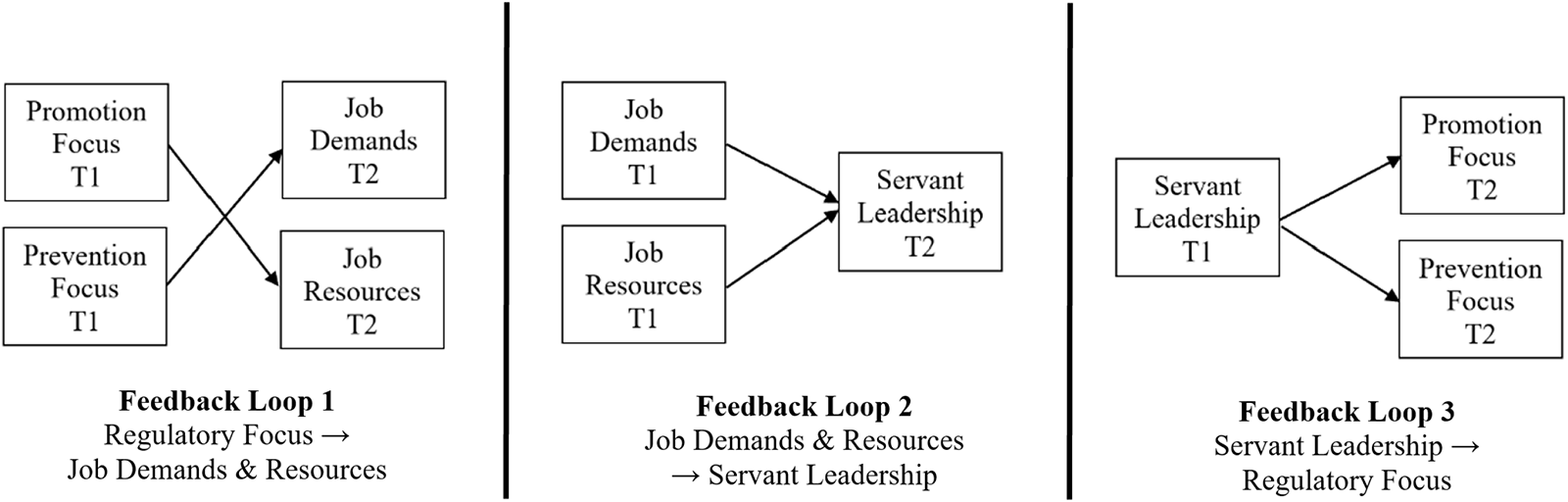
Figure 2 Long description
The image consists of three distinct diagrams illustrating feedback loops. The first diagram on the left shows Feedback Loop 1, where Promotion Focus and Prevention Focus at Time 1 connect to Job Demands and Job Resources at Time 2. The text below reads 'Feedback Loop 1 Regulatory Focus arrow Job Demands and Resources.' The middle diagram represents Feedback Loop 2, with Job Demands and Job Resources at Time 1 leading to Servant Leadership at Time 2. The text below states 'Feedback Loop 2 Job Demands and Resources arrow Servant Leadership.' The third diagram on the right illustrates Feedback Loop 3, where Servant Leadership at Time 1 connects to Promotion Focus and Prevention Focus at Time 2. The text below reads 'Feedback Loop 3 Servant Leadership arrow Regulatory Focus.' Each diagram visually represents the temporal feedback loops between servant leadership, regulatory focus, job demands and resources.
Direct and conditional effects on outcomes
To establish the baseline for our four-path process model, we review how job demands, resources, regulatory focus, and servant leadership directly and conditionally influence key outcomes through CLT’s emergence and feedback principles. Figure 1 presents the model.
Job demands and resources
Heavy workloads, unclear roles, or emotional labor increase burnout, reduce fit and lower satisfaction via the health impairment pathway. Conversely, when autonomy, social support, feedback, and task significance are abundant, employees enjoy higher growth satisfaction, intrinsic motivation, and initiative via the motivational pathway (Bakker & Demerouti, Reference Bakker and Demerouti2017; Demerouti et al., Reference Demerouti, Bakker, Nachreiner and Schaufeli2001). Resources ease demands and preserve well-being by mitigating strain (Maslach et al., Reference Maslach, Schaufeli and Leiter2001). CLT interprets these JD–R interactions as the contextual stimuli that trigger emergent leadership.
Regulatory focus
Promotion focus correlates with higher motivation, initiative, and growth satisfaction, driven by an eagerness for gains and sensitivity to positive feedback (Crowe & Higgins, Reference Crowe and Higgins1997; Higgins, Reference Higgins1997). Prevention-focused employees in high-risk settings report greater responsibility and supervisor satisfaction due to vigilance and rule compliance (Brockner & Higgins, Reference Brockner and Higgins2001; Förster et al., Reference Förster, Higgins and Idson1998). Promotion orientation amplifies the motivational pathway by strengthening the link between resources and engagement outcomes. In parallel, prevention orientation lessens the harmful health impairment pathway by buffering the effect of demands (Petrou & Demerouti, Reference Petrou and Demerouti2010). In CLT’s nonlinear feedback view, regulatory orientations signal and co-evolve with leadership actions.
Servant Leadership. Independently of JD–R and RFT, servant leadership delivers direct positive outcomes across two clusters. Servant leaders enhance person–job and role fit, supervisor satisfaction, and growth satisfaction by prioritizing follower development, fairness, and trust (Liden et al., Reference Liden, Wayne, Zhao and Henderson2008; van Dierendonck, Stam, Boersma, De Windt & Alkema, Reference van Dierendonck, Stam, Boersma, De Windt and Alkema2014). They also elevate subordinates’ motivation, initiative, and sense of responsibility. This is done through cultivating an environment of psychological safety, empowerment, ethical stewardship, and meaningful recognition (Chaudhry et al., Reference Chaudhry, Cao, Liden, Point and Vidyarthi2021; Newman et al., Reference Newman, Schwarz, Cooper and Sendjaya2017). This pattern demonstrates how servant leadership emerges from and modifies contextual factors, consistent with the idea of adaptive co-creation in CLT.
Hypotheses
Having examined the dynamic process model within the CLT framework, we now present the hypotheses.
Demand-driven adaptive servant leadership and promotion focus (H1)
When job demands become particularly intense, employees are subjected to significant time pressure, pronounced cognitive load, and the erosion of available resources, which the JD–R model regards as activation of the health-impairment pathway that threatens both well-being and goal accomplishment. From a Complexity Leadership Theory perspective, such strain conditions are expected to elicit adaptive leadership responses aimed at stabilizing the system by restoring meaning, support, and access to resources. Servant leadership represents an enabling and generative pattern of response that can arise in demanding environments by restoring resources and psychological safety, thereby alleviating strain and orienting attention toward future possibilities. These leader behaviors are theorized to buffer threat and, after first stabilizing the system and reducing perceived loss, reframe high demands as manageable challenges, thereby activating a promotion regulatory focus in followers, defined by growth, advancement, and sensitivity to gains (Brockner & Higgins, Reference Brockner and Higgins2001; Higgins, Reference Higgins1997). A promotion focus subsequently promotes engagement, proactive behavior, and positive alignment between the self and work, thereby strengthening person–job fit, person–role fit, satisfaction with supervisors, satisfaction with growth, intrinsic motivation, and personal initiative. Accordingly, job demands are expected to influence positive outcomes primarily through an adaptive leadership–motivation pathway linking servant leadership and promotion focus, rather than primarily exerting direct positive effects.
H1 (Demand-Driven Positive Outcomes Pathway). In high-demand contexts, servant leadership will emerge as an adaptive, enabling response that fosters employees’ promotion regulatory focus, which will in turn enhance positive work outcomes, such that servant leadership and promotion focus serially transmit the effects of job demands on person–job fit, person–role fit, supervisor satisfaction, growth satisfaction, intrinsic motivation, and personal initiative.
Demand-driven adaptive servant leadership and prevention focus (H2)
When job demands are elevated, employees face increased risks of error, role overload, and potential loss. The JD–R health-impairment pathway indicates that such environments elevate strain while also making issues of safety, obligation, and error avoidance more prominent. Within the CLT framework, these conditions are expected to elicit adaptive servant leadership behaviors aimed at buffering demands, safeguarding employees, and clarifying roles and expectations. These leader behaviors are theorized to elicit a prevention regulatory focus in followers, characterized by vigilance, a strong sense of duty, and sensitivity to possible negative outcomes (Brockner & Higgins, Reference Brockner and Higgins2001; Higgins, Reference Higgins1997). This motivational state should heighten perceived responsibility as employees become increasingly attentive to their obligations and more strongly motivated to avoid mistakes and failures.
H2 (Demand-Driven Responsibility Pathway). In high-demand contexts, servant leadership will emerge as an adaptive buffering response that fosters employees’ prevention regulatory focus, which will, in turn, increase their experienced responsibility, such that servant leadership and prevention focus serially transmit the effects of job demands on responsibility.
Resource-driven generative servant leadership and promotion focus (H3)
In resource-rich work settings, employees experience higher levels of autonomy, support, feedback, and opportunities for development, which the JD–R motivational pathway associates with energy, learning, and sustained goal striving. From a CLT perspective, such abundance creates fertile ground for generative leadership to emerge as leaders and followers co-construct meaning, experiment with new ways of working, and orient themselves toward growth rather than protection. Servant leadership in these contexts acts as an enabling and amplifying influence that activates available resources, empowers employees, and reinforces a forward-looking orientation. These leader behaviors are theorized to activate a promotion regulatory focus in followers, characterized by aspirations for growth, advancement, and the pursuit of gains (Brockner & Higgins, Reference Brockner and Higgins2001; Higgins, Reference Higgins1997). These conditions are expected to stimulate exploration, intrinsic motivation, and proactive involvement. Through this motivational mechanism, resource-rich contexts should enhance perceptions of fit, satisfaction, and personal initiative.
H3 (Resource-Driven Positive Outcomes Pathway). In resource-rich contexts, servant leadership will emerge as a generative, enabling response that fosters employees’ promotion regulatory focus, which will in turn enhance positive work outcomes, such that servant leadership and promotion focus serially transmit the effects of job resources on person–job fit, person–role fit, supervisor satisfaction, growth satisfaction, intrinsic motivation, and personal initiative.
Resource-driven adaptive regulation and prevention focus (h4)
Although the availability of job resources typically supports engagement and growth, it can also reduce perceptions of threat, uncertainty, and potential loss, thereby weakening activation of the prevention regulatory system, which is oriented toward vigilance and obligation-based self-regulation. RFT holds that prevention focus is most strongly activated in situations characterized by threat, obligation, and the possibility of loss rather than in resource-abundant conditions (Brockner & Higgins, Reference Brockner and Higgins2001; Higgins, Reference Higgins1997). From the standpoint of CLT, servant leadership operating in contexts of low strain and high resources may thus signal environmental safety and stability, orienting followers away from protective self-regulation and toward learning- and growth-oriented modes of functioning. Accordingly, prevention focus and the associated vigilance-based, loss-avoidance form of responsibility may be reduced when resources are plentiful and servant leadership highlights empowerment rather than safeguarding.
H4 (Resource-Driven Responsibility Pathway). In resource-rich contexts, servant leadership will be associated with lower activation of employees’ prevention regulatory focus and, consequently, lower experienced responsibility in the sense of vigilance- and obligation-based monitoring, reflecting reduced vigilance- and duty-based self-regulation in low-threat conditions, such that servant leadership and prevention focus serially transmit the effects of job resources on responsibility in a negative direction.
Feedback-driven emergence and co-evolution (H5)
CLT asserts that leadership, motivation, and context mutually develop through nonlinear feedback processes instead of through simple unidirectional causation. Job demands and resources influence the emergence of leadership behavior, leadership behavior shapes followers’ regulatory orientations, and these motivational states then feed back to modify how work characteristics are experienced, organized, and enacted over time. This cycle of reciprocal influence represents adaptive co-creation and system-level emergence, in which micro-level interactions generate macro-level patterns that later constrain and enable further interaction. Accordingly, leadership, regulatory focus, and job characteristics should exhibit bidirectional and temporally ordered effects that reflect feedback-driven adaptation.
H5 (Feedback-Driven Emergence). Job demands and resources, servant leadership, and employees’ promotion and prevention regulatory focus will exhibit reciprocal cross-lagged relationships over time, such that servant leadership and regulatory focus not only emerge from job demands and resources but also feed back to shape subsequent levels of those same demands and resources, demonstrating feedback-driven co-evolution consistent with CLT.
Method
Procedures and participants
Data were collected using an online survey with Likert-type items on self-report measures and perceptions of their immediate supervisors. A total sample of 423 working professionals was obtained, and the 95% figure reflects the completion rate employed in varied organizations, industries, and roles, recruited by students as part of a graduate-level business course with research training. The top industries included the military (20%), manufacturing (12%), healthcare (9%), professional services (8%), food and beverage (8%), and finance and insurance (7%). Participants averaged 28 years old, with 288 males and 135 females, and an average tenure slightly over 6 years.
An online survey served as the primary data collection method and was administered within this graduate-level business course. Students completed the survey themselves and also forwarded the survey link to working adults in their professional networks. The 95% completion rate reflects the proportion of individuals who accessed the link and completed the survey, rather than a response rate based on a known denominator, since the total number of individuals contacted by student recruiters was not documented. Accordingly, the resulting dataset represents a non-probability convenience sample of full-time employees drawn from diverse industries and organizational settings across multiple U.S. regions.
This study was reviewed and approved by the university’s Institutional Review Board, and all participants provided informed consent prior to participation.
Measures
All items were measured on a 7-point Likert-type scale (1 = strongly disagree, 7 = strongly agree). Cronbach’s α coefficients are reported in Table 1.
Measurement scales, sources, and reliabilities
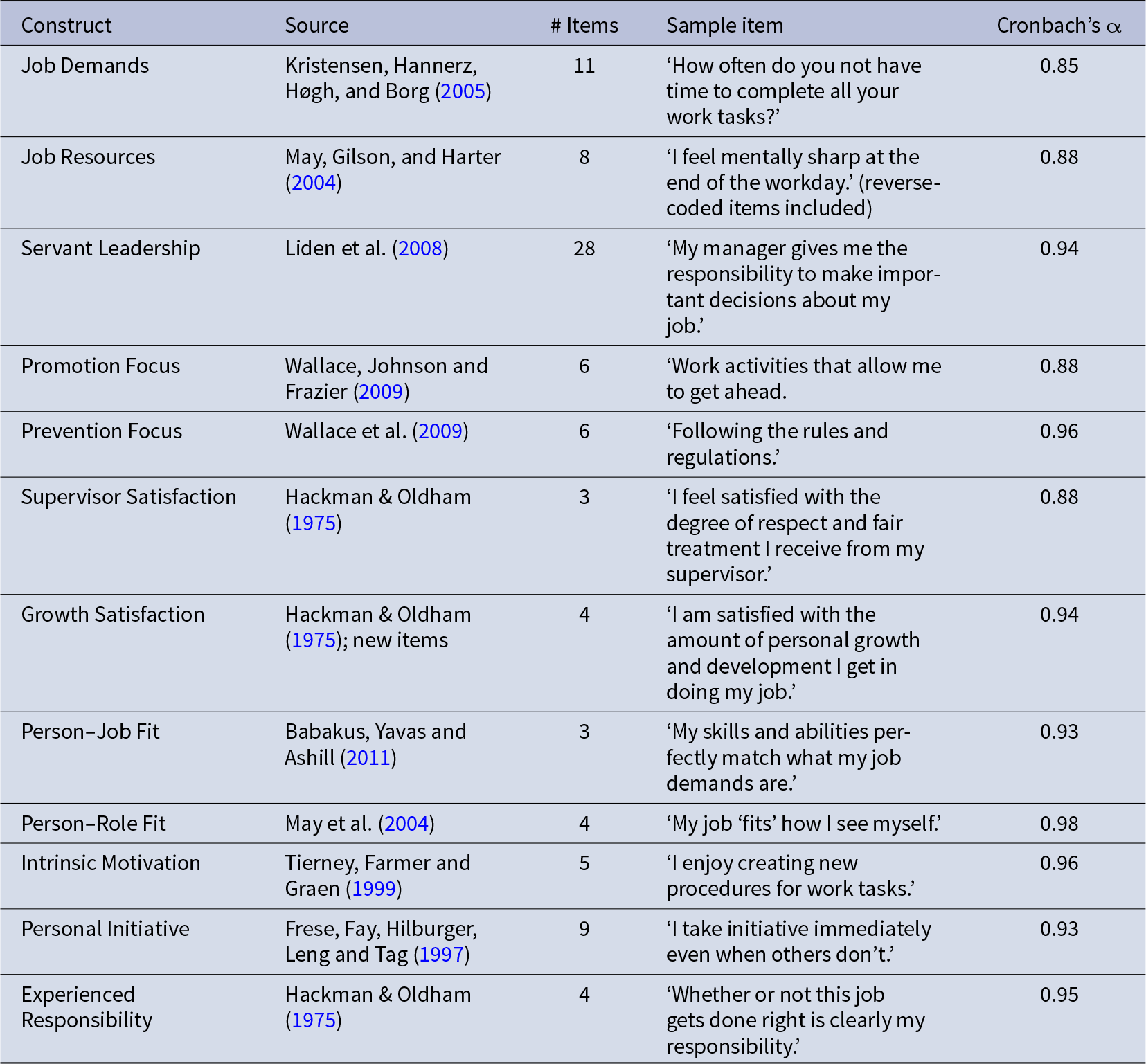
Table 1 Long description
The table lists 12 survey constructs, their literature sources, number of items, a sample item, and internal consistency reliability. Item counts range from 3 items for Supervisor Satisfaction and Person–Job Fit to 28 items for Servant Leadership. Cronbach’s alpha values are consistently high, spanning 0.85 to 0.98, suggesting strong internal consistency across measures. The highest reliability is for Person–Role Fit at 0.98, followed by Prevention Focus at 0.96 and Intrinsic Motivation at 0.96. The lowest reliability is Job Demands at 0.85, though it remains acceptable. Several constructs cluster around the low to mid 0.90s, including Servant Leadership at 0.94, Growth Satisfaction at 0.94, Personal Initiative at 0.93, Person–Job Fit at 0.93, and Experienced Responsibility at 0.95. One scale notes that reverse-coded items were included for Job Resources, which can affect how respondents interpret items and should be handled carefully in scoring.
Note. All items were measured on a 7-point Likert-type scale (1 = strongly disagree, 7 = strongly agree). Growth Satisfaction items were subjected to exploratory factor analysis (principal axis factoring with varimax rotation), yielding loadings of 0.92, 0.89, 0.86, and 0.88.
Data screening
Data were examined for missing cases and for participants whose responses were missing less than 5% of the data, missing values were imputed using the MCMC method with twenty imputed data sets (Rubin, Reference Rubin1987). Box plots were examined for outliers and no kurtosis values greater than ±2.00 were found, and no items were removed from the model.
Confirmatory factor analysis
A confirmatory factor analysis (CFA) was performed in Amos 29.0. Multiple disturbance terms for items were covaried. Goodness-of-fit indices showed good model fit (χ2 = 4089.43; df = 2982; χ2/df = 1.37; CFI = 0.96; TLI = 0.96; RMSEA = 0.03; NFI = 0.87, and SRMR = 0.04) based on accepted thresholds (Hair, Black, Babin & Anderson, Reference Hair, Black, Babin and Anderson2010). The hypothesized model demonstrated significant improvement in fit compared to the independence model, evidenced by a lower chi-square value (CMIN = 4089.43, df = 2982, χ 2/df = 1.37) relative to the independence model (CMIN = 32,190.82, df = 3321, χ 2/df = 9.69), indicating a better representation of the observed data. The hypothesized 20-factor model was compared with five alternative models, each one examining variations of latent variables. The alternative models offered greater parsimony but the hypothesized model best fit the data as shown in Table 1.
Means, standard deviations, AVE, MSV, and MaxR(H), and correlations are included in Table 2.
CFA model comparison
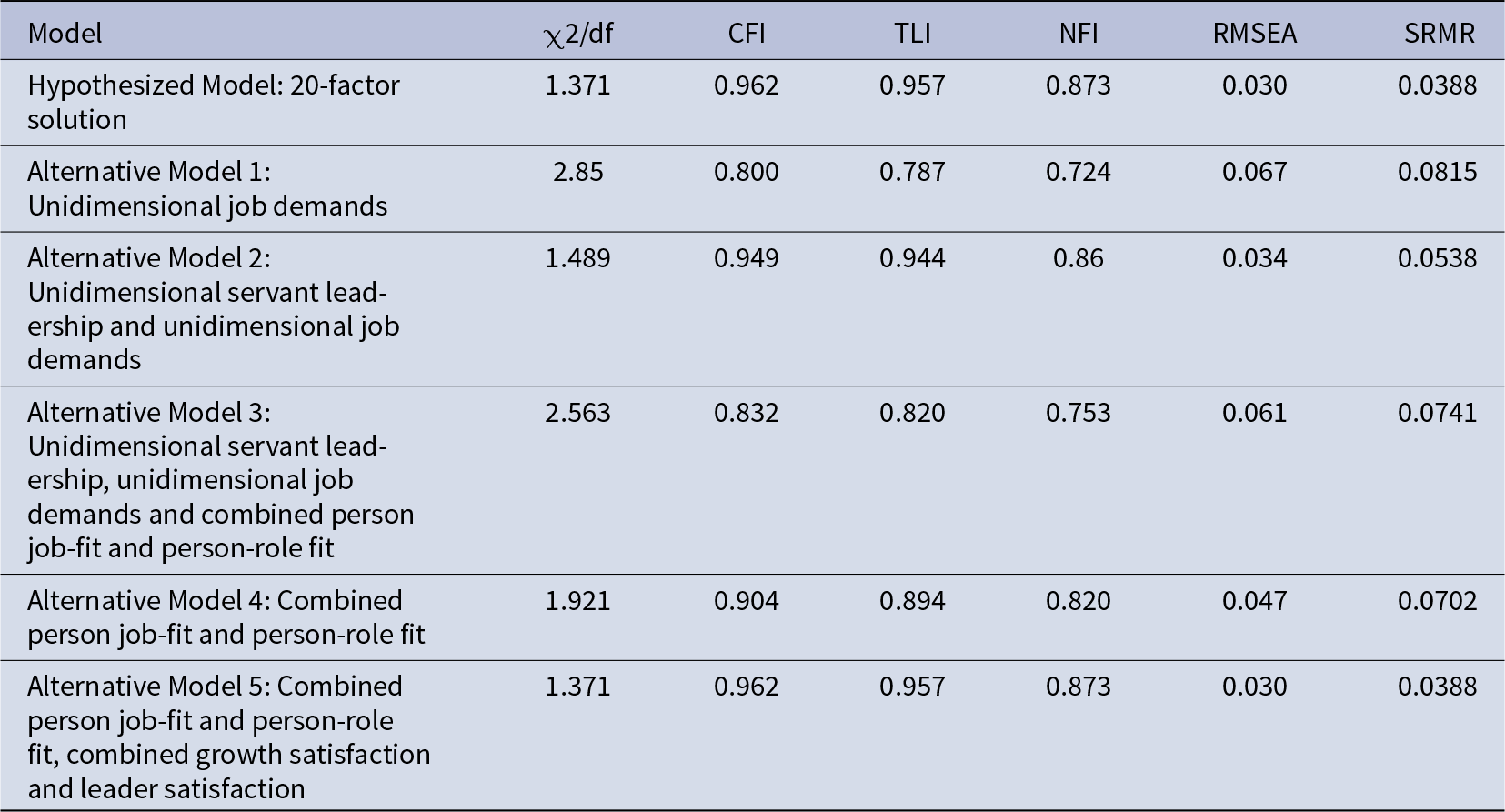
Table 2 Long description
The table compares confirmatory factor analysis fit indices across six competing measurement models. Fit is summarized using chi-square divided by degrees of freedom, CFI, TLI, NFI, RMSEA, and SRMR. The hypothesized 20-factor solution shows strong fit: chi-square per degree of freedom 1.371, CFI 0.962, TLI 0.957, NFI 0.873, RMSEA 0.030, and SRMR 0.0388. Alternative Model 5 reports identical values to the hypothesized model, indicating the same level of fit. The weakest fit is Alternative Model 1 (unidimensional job demands), with chi-square per degree of freedom 2.85, CFI 0.800, TLI 0.787, NFI 0.724, RMSEA 0.067, and SRMR 0.0815. Alternative Model 2 performs relatively well but not as well as the best-fitting models, with CFI 0.949 and RMSEA 0.034. Alternatives 3 and 4 show intermediate fit, with higher RMSEA and SRMR than the best models and lower CFI and TLI. These indices support the multi-factor structure over more collapsed, unidimensional alternatives, though fit statistics alone do not confirm theoretical validity.
Note. N = 423.
Common method bias. Common method bias was assessed using Harman’s single-factor test (Podsakoff, MacKenzie, Lee & Podsakoff, Reference Podsakoff, MacKenzie, Lee and Podsakoff2003; Podsakoff & Organ, Reference Podsakoff and Organ1986) with results indicating that the single-factor solution accounted for 23.56% of variance explained, below the 25.00% cutoff (Williams, Cote & Buckley, Reference Williams, Cote and Buckley1989). This suggested that common method bias did not present major concerns. For assurance, common latent factor (CLF) analysis recommended by Podsakoff et al. (Reference Podsakoff, MacKenzie, Lee and Podsakoff2003) was also performed with results suggesting minimal common method bias given standardized regression weights ranging from 0.084 to 0.369, with over 90% below 0.30.
Analytical strategy
Phase 1: cross-sectional SEM (H1–H4)
In the first phase, we tested Hypotheses 1–4 using SEM on the full Time 1 sample (n = 423). In this cross-sectional SEM, job demands and resources were specified as exogenous predictors, with servant leadership and promotion/prevention focus modeled as serial mediators, and the six positive outcomes plus experienced responsibility treated as endogenous variables. Indirect effects corresponding to our serial mediation chains were evaluated using bias-corrected bootstrap confidence intervals with 5,000 resamples. Model fit was assessed against conventional benchmarks – CFI ≥ 0.95, RMSEA ≤ 0.06, and SRMR ≤ 0.08 (Hu & Bentler, Reference Hu and Bentler1999) – to ensure a robust representation of the proposed relationships.
Justification of cross-lagged panel modeling
To examine the reciprocal and feedback-driven processes proposed by CLT, we utilized a CLPM. CLPMs estimate both autoregressive stability and cross-lagged directional effects, which makes it possible to determine whether earlier levels of one construct predict changes in another construct over time, while also testing whether the second construct subsequently feeds back to influence the first (Selig & Little, Reference Selig, Little, Laursen, Little and Card2012). This modeling structure corresponds directly to CLT assumptions regarding interdependence, nonlinear feedback, and co-evolution among leaders, followers, and contextual conditions (Hazy & Uhl-Bien, Reference Hazy and Uhl-Bien2015; Uhl-Bien et al., Reference Uhl-Bien, Marion and McKelvey2007).
We also evaluated other longitudinal modeling options. The Random Intercept Cross-Lagged Panel Model, referred to as the RI-CLPM, separates enduring between-person differences from short-term within-person fluctuations. However, CLT views leadership emergence and regulatory focus as system-level states that arise from relatively stable relational and structural configurations, not simply from transient intra-individual changes. Removing between-person variance would thus eliminate substantively meaningful system-level structure that CLT treats as theoretically central to emergence and adaptive coordination, making RI-CLPM less well aligned with the present research aims.
Dynamic SEM, or DSEM, is especially well-suited for intensive longitudinal designs that involve many measurement occasions and capture micro-temporal dynamics (e.g., day-to-day or moment-to-moment adaptation). In contrast, the present two-wave panel design is intended to examine meso-level organizational feedback loops that unfold across longer adaptive cycles, for which the cross-lagged panel model is the established analytic framework for testing such meso-level reciprocal dynamics.
Cross-lagged analytical approaches have a well established history of use in examining reciprocal patterns of influence between leaders and followers (e.g., Kark, Van Dijk, & Vashdi, Reference Kark, Van Dijk and Vashdi2018), in modeling motivational feedback processes within adaptive and relational systems (Chen, Ployhart, Thomas, Anderson, & Bliese, Reference Chen, Ployhart, Thomas, Anderson and Bliese2011), and in capturing adaptive dynamics within organizational systems (Lichtenstein & Plowman, Reference Lichtenstein and Plowman2009), thereby offering strong methodological precedent for applying these techniques to models grounded in Complexity Leadership Theory.
Phase 2: longitudinal CLPM (H5)
In the second phase, Hypothesis 5 was examined via a cross-lagged panel model on the subset of participants (n = 232) who completed both waves. Each Time 2 construct was regressed on its Time 1 counterpart (autoregressive paths) and on the preceding constructs in the proposed process chain (cross-lagged paths from demands/resources → servant leadership → regulatory focus → outcomes). All Time 1 residuals were allowed to covary, and indirect cross-lagged effects were again evaluated using bootstrapping. We applied the same estimation methods and fit criteria as in Phase 1 to maintain consistency across analyses.
This two-phase strategy enables us first to establish the serial mediation pathways of H1–H4 in a cross-sectional context and then to demonstrate the feedback-driven emergence central to CLT in a longitudinal framework, controlling for prior levels of each construct.
Results
Phase 1 model fit and comparison
To test Hypotheses 1–4, we first estimated our structural model using cross-sectional SEM on the Time 1 sample (N = 423). This model specified job demands and resources as predictors, servant leadership and promotion/prevention focus as serial mediators, and the six positive outcomes plus experienced responsibility as endogenous variables. We assessed model fit and examined direct, indirect, and total effects to evaluate the proposed serial mediation pathways.
The hypothesized model best represented the comprehensive theoretical framework and extant literature and fit better than six alternative models. Results are presented in Table 3.
Means, standard deviations, AVE, MSV, reliabilities, and correlations
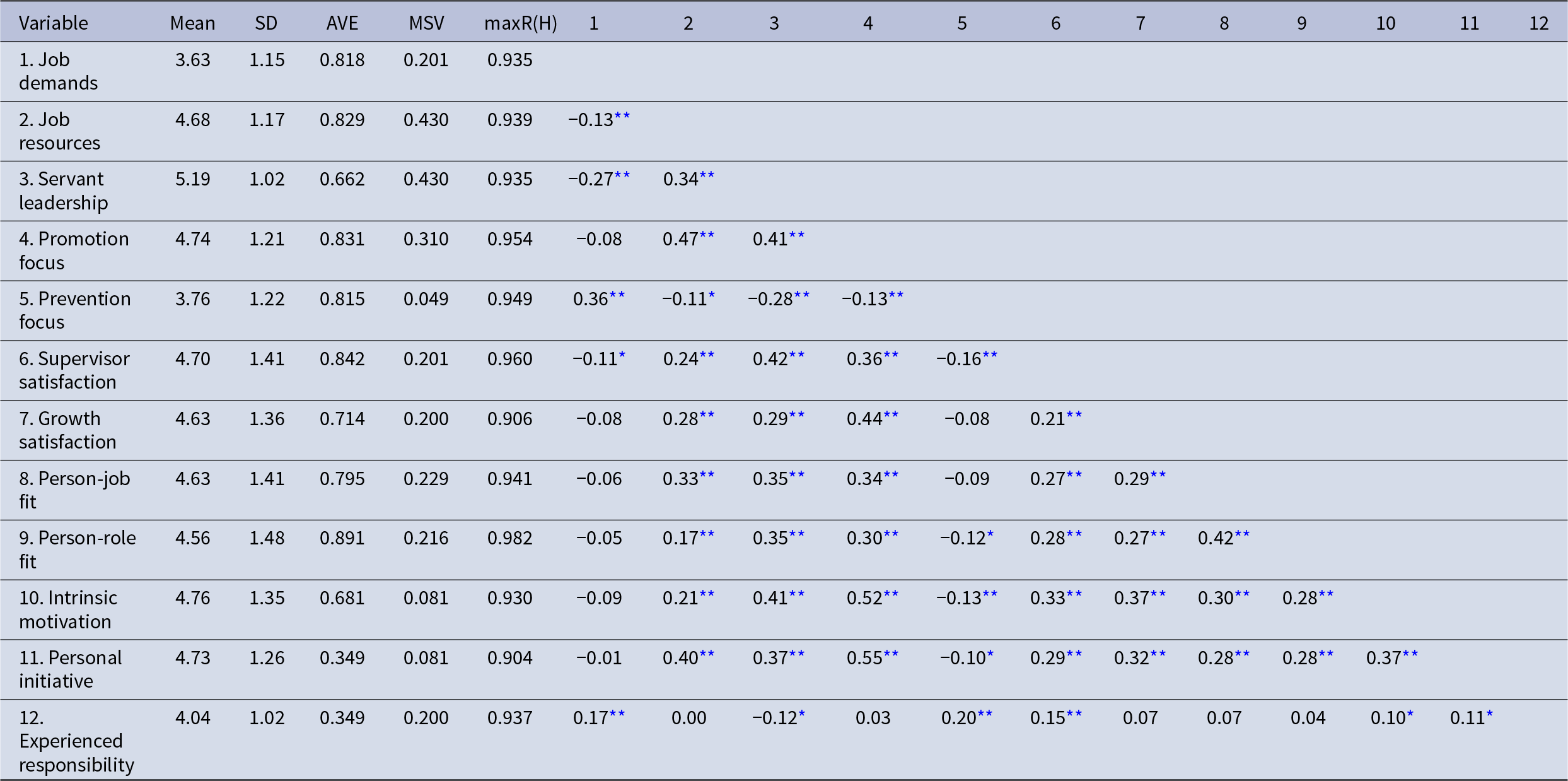
Table 3 Long description
The table reports descriptive statistics and measurement quality indicators for 12 work-related constructs, plus their pairwise correlations in a sample of 423. Means range from 3.63 for job demands to 5.19 for servant leadership, with standard deviations about 1.02 to 1.48. Promotion focus has the largest positive correlations in the matrix, most notably with personal initiative at 0.55 and intrinsic motivation at 0.52, and it is also moderately related to job resources at 0.47 and growth satisfaction at 0.44. Servant leadership is positively associated with supervisor satisfaction at 0.42, intrinsic motivation at 0.41, and promotion focus at 0.41, and it is negatively related to job demands at minus 0.27 and prevention focus at minus 0.28. Job demands show small negative relationships with several favorable variables, including job resources at minus 0.13 and supervisor satisfaction at minus 0.11, but a positive relationship with prevention focus at 0.36 and experienced responsibility at 0.17. Person-job fit and person-role fit are strongly related to each other at 0.42 and show positive links with servant leadership and satisfaction measures. Most constructs show acceptable convergent validity and reliability indicators, but personal initiative and experienced responsibility have notably low average variance extracted values at 0.349, so correlations involving these two should be interpreted with extra caution.
Note. N = 423.
* Correlation is significant at the 0.05 level (two-tailed). ** Correlation is significant at the 0.01 level (two-tailed).
The hypothesized model was the best fitting based on goodness-of-fit (χ 2/df = 1.329, CFI = 0.96, TLI = 0.96, RMSEA = 0.03, SRMR = 0.048; Hair et al., Reference Hair, Black, Babin and Anderson2010; Hu & Bentler, Reference Hu and Bentler1999). The hypothesized model exhibited better fit than the best alternative model (SRMR = 0.0483 vs. 0.0502), as indicated by the chi-square difference test (Δχ 2 = 26.784, Δdf = 13). Direct effects are presented in Table 4 and the indirect effects are presented in Table 5.
Structural model comparison
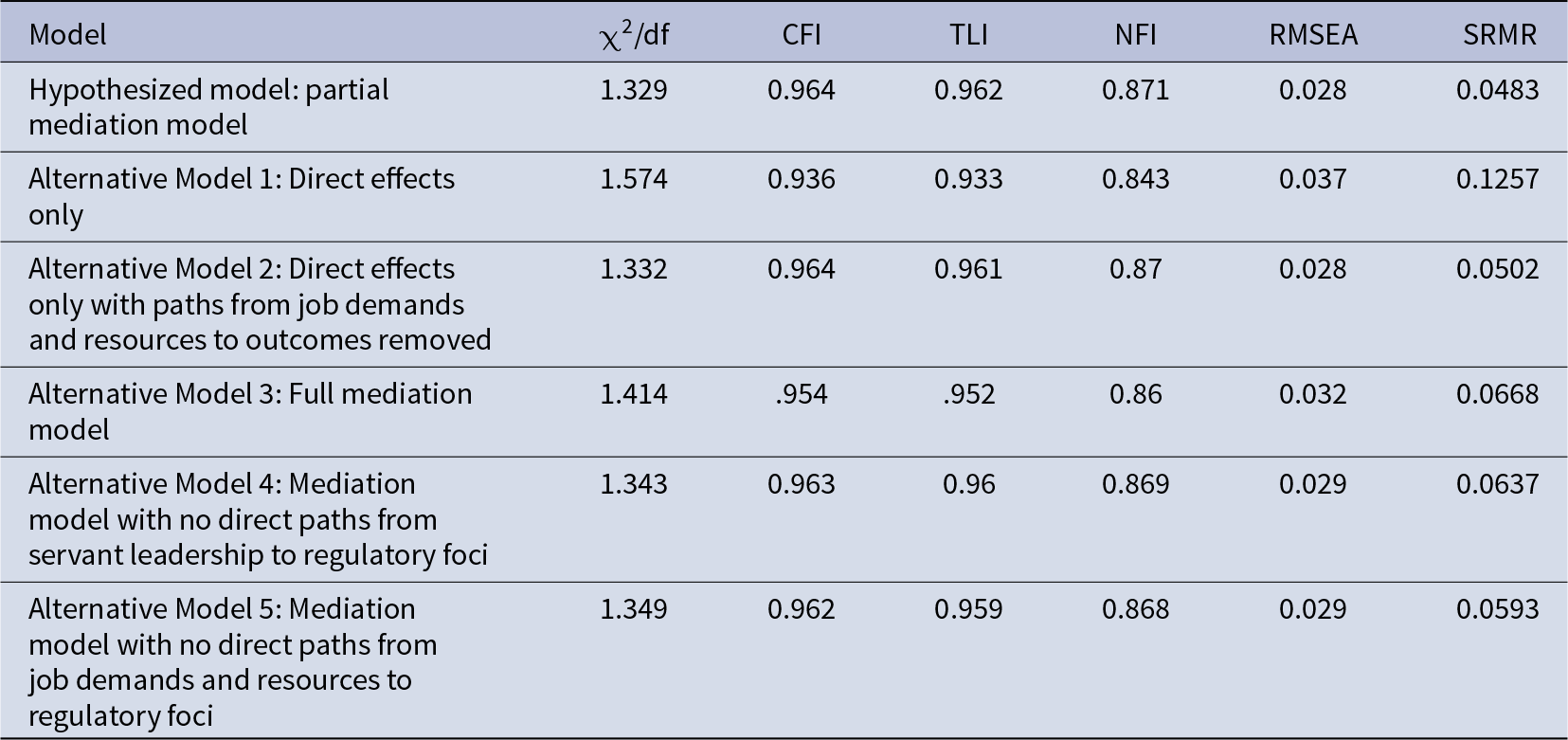
Table 4 Long description
The table compares overall fit statistics for six structural equation models using chi-square divided by degrees of freedom, CFI, TLI, NFI, RMSEA, and SRMR. The hypothesized partial mediation model and Alternative Model 2 show the strongest fit: both have CFI 0.964, RMSEA 0.028, and low SRMR (0.0483 and 0.0502). Alternative Model 4 and Alternative Model 5 are close behind, with CFI around 0.962 to 0.963 and RMSEA 0.029, but slightly higher SRMR (0.0637 and 0.0593). Alternative Model 3 (full mediation) is weaker, with CFI 0.954, RMSEA 0.032, and SRMR 0.0668. Alternative Model 1 performs worst overall, with the lowest CFI (0.936), highest RMSEA (0.037), and the largest SRMR (0.1257). Across models, lower RMSEA and SRMR and higher CFI and TLI generally align with better fit, but differences are modest among the top-performing models. Results are based on a sample size of 423, and fit indices alone do not determine which model is theoretically preferable.
Note. N = 423.
Direct path unstandardized and standardized regression weights, confidence intervals, partial eta-squared, and hypothesis support

Table 5 Long description
The table reports direct regression paths for four hypothesis groups, listing standardized and unstandardized weights, standard errors, confidence intervals, and p values. The clearest pattern is that promotion focus is a strong, positive predictor of every positive outcome measured, including growth satisfaction, supervisor satisfaction, person job fit, person role fit, intrinsic motivation, and personal initiative, with all effects statistically significant. Job demands show a strong negative association with servant leadership, but most direct links from job demands to the positive outcomes are not statistically significant; the exception is a small positive link to personal initiative. For prevention focus, job demands and servant leadership both show significant positive links to prevention focus, and prevention focus shows a modest positive link to experienced responsibility, while prevention focus does not significantly relate to the positive outcomes. Job resources are positively related to servant leadership and promotion focus, and they show mixed direct links to outcomes: positive for person job fit and personal initiative, negative for intrinsic motivation, and not significant for growth satisfaction, supervisor satisfaction, or person role fit. Servant leadership is positively related to all positive outcomes but is negatively related to promotion focus. In the final hypothesis block, job resources and servant leadership show no statistically significant direct links to prevention focus or experienced responsibility. Interpret results as direct associations from a regression model; statistical significance is indicated by the p values and confidence intervals crossing or not crossing zero.
Notes: H1 (Demand→Promotion→Positive Outcomes): All job demands → promotion focus and promotion focus → positive outcomes chains, plus the direct ‘job demands → … positive outcome’ rows.
H2 (Demand→Prevention→Responsibility): All job demands → prevention focus and prevention focus → experienced responsibility chains, plus the direct ‘job demands → experienced responsibility’ and ‘promotion focus → experienced responsibility’ rows.
H3 (Resource→Promotion→Positive Outcomes): All job resources → promotion focus and promotion focus → positive outcomes chains, plus the direct ‘job resources → … positive outcome’ rows.
H4 (Resource→Prevention→Responsibility): All job resources → prevention focus and prevention focus → experienced responsibility chains, plus the direct ‘job resources → experienced responsibility’ and ‘servant leadership → experienced responsibility’ rows.
* p<.05, **p<.01, ***p<.001
Phase 1 (process model) results
We evaluated the four-path process model via SEM on our full Time 1 sample (N = 423), testing H1–H4. Overall, the demand-driven positive-outcomes pathway (H1) was largely supported (5 of 6 outcomes), the demand-driven responsibility pathway (H2) was supported, and the resource-driven positive-outcomes pathway (H3) was fully supported, whereas the resource-driven responsibility pathway (H4) did not emerge.
Hypothesis 1. Demand-driven positive outcomes
Consistent with H1, job demands negatively predicted servant leadership (β = –0.342, P < 0.001), which in turn predicted higher promotion focus (β = 0.354, P < 0.001). Promotion focus was positively related to all six positive outcomes (all P’s < 0.01). In the serial mediation tests (Table 6, Table 7), the indirect effect of job demands on five of the six outcomes – supervisor satisfaction (ind β = –0.156, P = 0.004), person–role fit (ind β = –0.138, P = 0.005), person–job fit (ind β = –0.108, P = 0.010), intrinsic motivation (ind β = –0.142, P = 0.012), and personal initiative (ind β = –0.111, P = 0.026) – was significant. The pathway to growth satisfaction did not reach significance (ind β = –0.065, P = 0.144). Thus, H1 is largely supported: servant leadership and promotion focus serially mediate the (negative) influence of job demands on most positive employee outcomes, though the chain to growth satisfaction was not significant.
Single mediator unstandardized and standardized indirect effects, confidence intervals, partial eta-squared, and hypothesis support
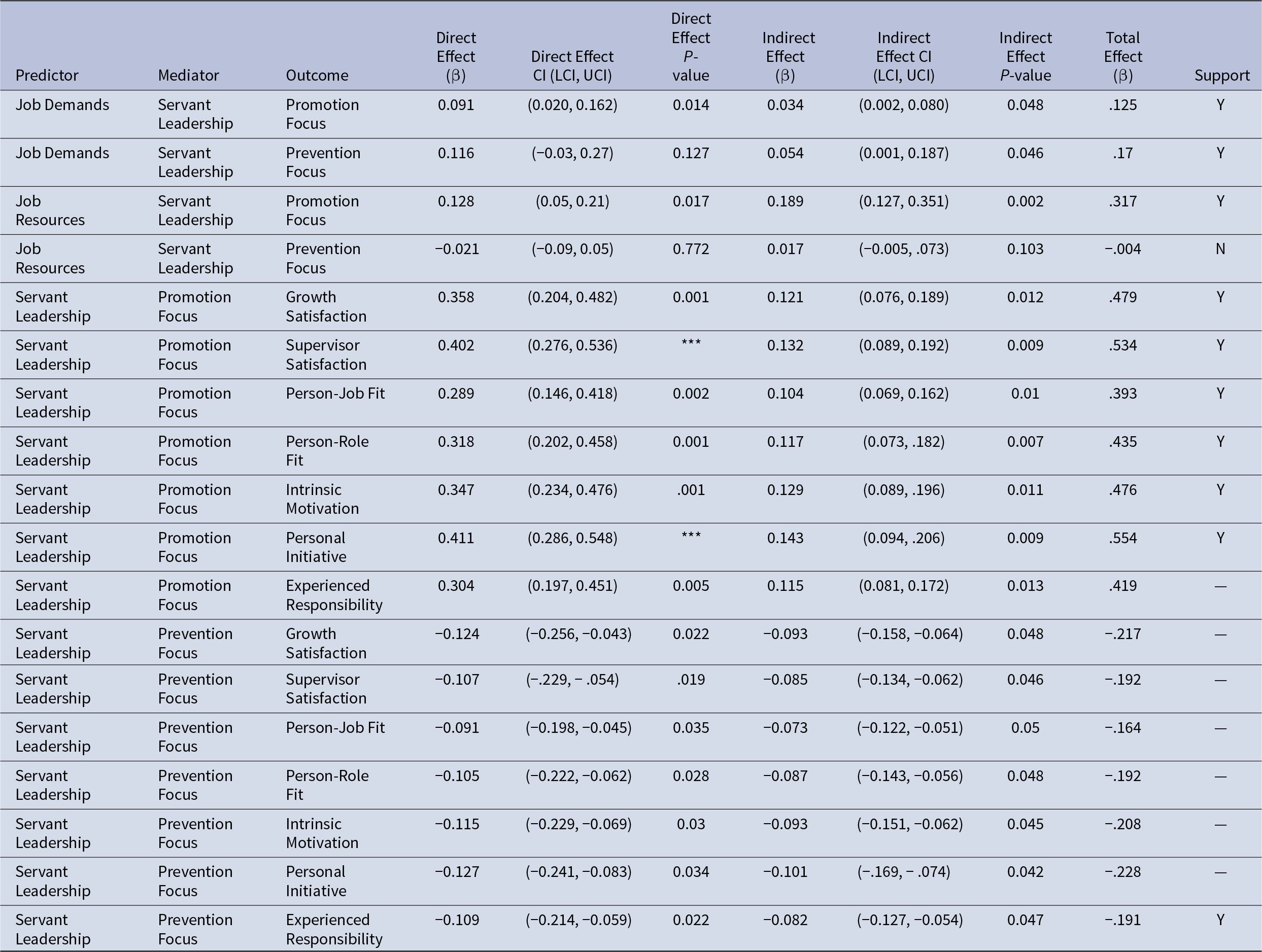
Table 6 Long description
The table reports direct, indirect, and total effects for single-mediator links involving job demands or job resources, servant leadership, and either promotion focus or prevention focus, with confidence intervals, p-values, and a support flag. For job demands, the indirect effects through servant leadership are positive and statistically significant for both promotion focus and prevention focus, even though the direct effect to prevention focus is not significant. For job resources, the indirect effect through servant leadership is positive and significant for promotion focus, but the pathway to prevention focus is not supported because both direct and indirect effects are not significant. When servant leadership predicts outcomes through promotion focus, indirect effects are consistently positive and significant across growth satisfaction, supervisor satisfaction, person–job fit, person–role fit, intrinsic motivation, personal initiative, and experienced responsibility. When servant leadership predicts outcomes through prevention focus, indirect effects are consistently negative and statistically significant across the same outcomes. Total effects mirror these patterns, with positive totals for promotion-focus links and negative totals for prevention-focus links. Confidence intervals generally exclude zero for supported indirect effects, but some direct effects are non-significant, indicating mediation can occur even when the direct path is weak. The support column applies to specific hypothesized links, and some rows are marked with a dash to indicate they are not evaluated as hypothesis tests in this table.
Note: This table reports single mediator indirect effects that are components of the serial mediation chains tested in Table 6 for hypotheses H1–H4.
H1: Job Demands → Servant Leadership → Promotion Focus → Positive Outcomes (person–job fit, person–role fit, supervisor satisfaction, growth satisfaction, intrinsic motivation, personal initiative).
H2: Job Demands → Servant Leadership → Prevention Focus → Experienced Responsibility.
H3: Job Resources → Servant Leadership → Promotion Focus → Positive Outcomes (same six outcomes as H1).
H4: Job Resources → Servant Leadership → Prevention Focus → Experienced Responsibility.
Rows 1–4 test the first mediator links (Job Demands/Resources → Servant Leadership → Promotion/Prevention Focus). Rows 5–10 test the second mediator links for H1 and H3 (Servant Leadership → Promotion Focus → Positive Outcomes). Row 11 tests the second mediator link for H2 and H4 (Servant Leadership → Prevention Focus → Experienced Responsibility).
Serial mediation unstandardized and standardized indirect effects, confidence intervals, partial eta-squared, and hypothesis support
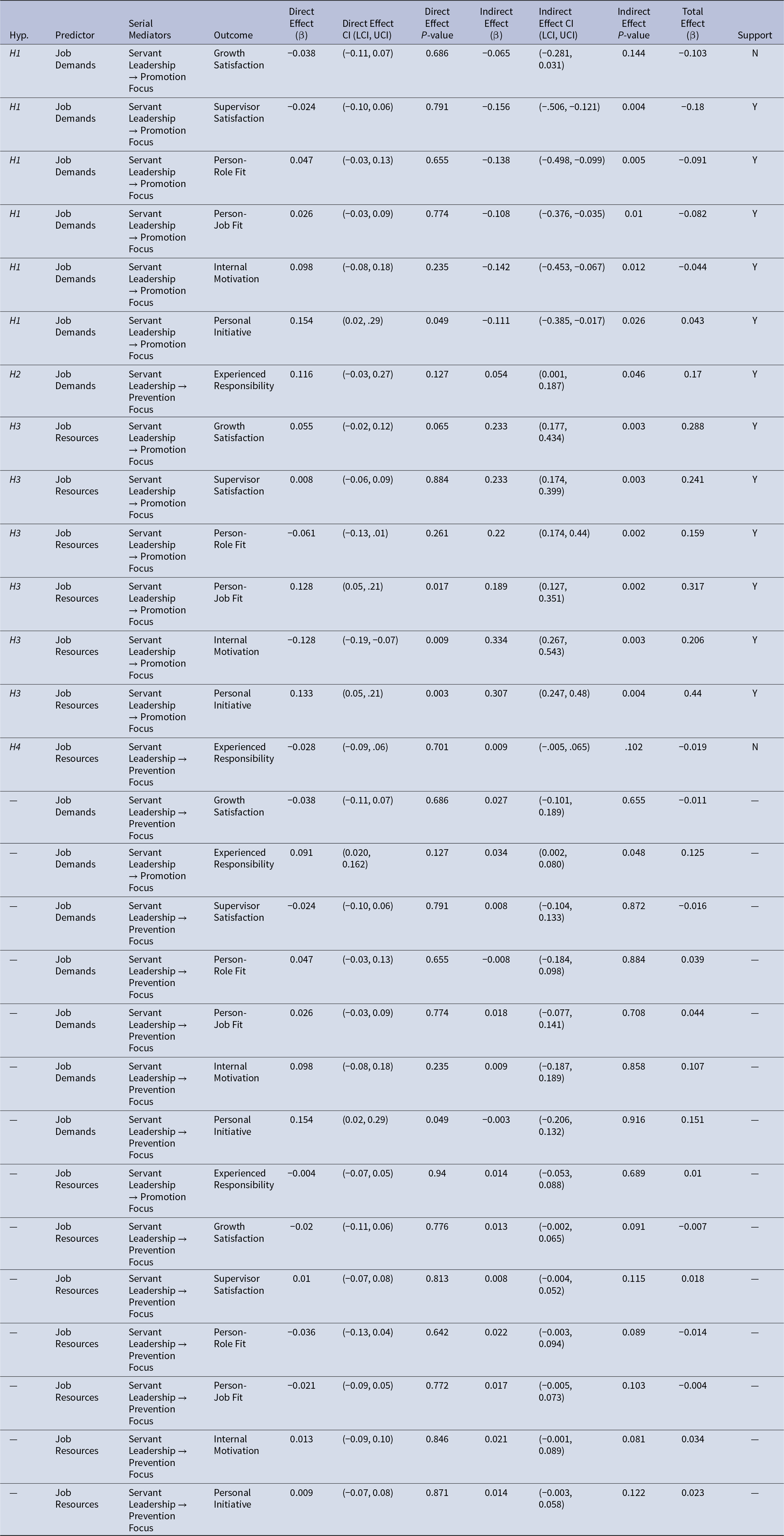
Table 7 Long description
The table reports serial mediation results, listing direct, indirect, and total effects with confidence intervals and p-values for paths from job demands or job resources through servant leadership and either promotion focus or prevention focus to multiple outcomes. For the hypothesized job resources pathway through servant leadership and promotion focus, indirect effects are positive and statistically significant for growth satisfaction, supervisor satisfaction, person-role fit, person-job fit, intrinsic motivation, and personal initiative, and all corresponding hypotheses are supported. In this same resources pathway, direct effects are often small or inconsistent, including a negative direct effect for intrinsic motivation, suggesting the mediated pathway accounts for much of the positive association. For the hypothesized job demands pathway through servant leadership and promotion focus to positive outcomes, indirect effects are negative and statistically significant for supervisor satisfaction, person-role fit, person-job fit, intrinsic motivation, and personal initiative, but not for growth satisfaction; most of these hypotheses are supported despite generally non-significant direct effects. For experienced responsibility, job demands through servant leadership and prevention focus shows a small positive indirect effect that is statistically significant and supported, whereas job resources through servant leadership and prevention focus shows a small, non-significant indirect effect and is not supported. Several additional non-hypothesized paths are included and are mostly non-significant, reinforcing that the strongest and most consistent pattern is the positive mediated effect of job resources through promotion focus. Statistical significance is based on p-values below 0.05, and confidence intervals indicate uncertainty around each estimate.
Notes: This table presents indirect effects from serial mediation analyses testing the hypothesized relationships, where significance is determined by P < 0.05 (marked “Y” for supported, “N” for not supported). Only paths corresponding to the following hypotheses are included, with non-hypothesized paths omitted.
H1 (Demand-Driven Positive Outcomes): The serial mediation of job demands through servant leadership and promotion focus to a composite of positive outcomes (growth satisfaction, supervisor satisfaction, person-role fit, person-job fit, intrinsic motivation, and personal initiative).
H2 (Demand-Driven Responsibility): The serial mediation of job demands through servant leadership and prevention focus to experienced responsibility.
H3 (Resource-Driven Positive Outcomes): The serial mediation of job resources through servant leadership and promotion focus to a composite of positive outcomes (growth satisfaction, supervisor satisfaction, person-role fit, person-job fit, intrinsic motivation, and personal initiative).
H4 (Resource-Driven Responsibility): The serial mediation of job resources through servant leadership and prevention focus to experienced responsibility.
Hypothesis 2. Demand-driven responsibility
Hypothesis 2 posited that servant leadership and prevention focus would serially mediate the positive relationship between job demands and experienced responsibility. In support of H2, higher job demands predicted greater servant leadership (β = –0.342, P < 0.001) and, in turn, greater prevention focus (β = 0.356, P < 0.001). Prevention focus then predicted experienced responsibility (β = 0.162, P = 0.004). The serial indirect effect of job demands on responsibility via servant leadership and prevention focus was significant (ind β = 0.054, 95% CI [0.001, 0.187], P = 0.046), even though the direct effect of job demands on responsibility was non-significant (β = 0.116, P = 0.127). The total effect was positive (β = 0.170), indicating that job demands ultimately translate into a stronger sense of responsibility through this adaptive leadership–motivation pathway. Thus, H2 is supported.
Hypothesis 3. Resource-driven positive outcomes
Hypothesis 3 proposed that servant leadership and promotion focus would serially mediate the positive relationship between job resources and our composite of positive outcomes. Consistent with H3, job resources positively predicted servant leadership (β = 0.339, P < 0.001), which in turn predicted promotion focus (β = 0.354, P < 0.001). In the serial mediation analyses (Table 6, Table 7), the indirect effects of job resources on all six outcomes via servant leadership and promotion focus were significant: growth satisfaction (ind β = 0.233, 95% CI [0.177, 0.434], P = 0.003), supervisor satisfaction (ind β = 0.233, 95% CI [0.174, 0.399], P = 0.003), person–role fit (ind β = 0.220, 95% CI [0.174, 0.440], P = 0.002), person–job fit (ind β = 0.189, 95% CI [0.127, 0.351], P = 0.002), intrinsic motivation (ind β = 0.334, 95% CI [0.267, 0.543], P = 0.003), and personal initiative (ind β = 0.307, 95% CI [0.247, 0.480], P = 0.004). Direct effects of resources on outcomes were generally non-significant or weaker, underscoring that job resources operate primarily through the adaptive servant leadership → promotion focus pathway. Thus, H3 is fully supported.
Hypothesis 4. Resource-driven responsibility
Hypothesis 4 held that servant leadership and prevention focus would serially mediate the negative relationship between job resources and experienced responsibility. In the SEM, job resources did not significantly predict prevention focus via servant leadership (direct β for resources → servant leadership → prevention focus path: –0.005, P = 0.928), nor did servant leadership and prevention focus jointly carry resources into responsibility. The serial indirect effect was non-significant (ind β = 0.009, 95% CI [–0.005, 0.065], P = 0.102), and the total effect of job resources on experienced responsibility was essentially zero (β = –0.019). Thus, H4 is not supported: the adaptive buffering pathway via servant leadership and prevention focus did not emerge for experienced responsibility.
Phase 2 (longitudinal CLPM) results
We evaluated Hypothesis 5 using a cross-lagged panel model (CLPM) in AMOS 29.0. Composite scores for each construct at Time 1 (T1) and Time 2 (T2) were specified to preserve power in the reduced sample (n = 232). T2 variables were regressed on their T1 counterparts (autoregressive paths) and on the preceding construct in the process chain (cross-lagged paths), with all T1 residuals allowed to covary. Model fit was assessed against conventional benchmarks (CFI ≥ 0.95; RMSEA ≤ 0.06; SRMR ≤ 0.08).
Hypothesis 5
The CLPM (Table 8) exhibited excellent fit to the data (χ 2/df = 1.479; CFI = 0.992; TLI = 0.985; NFI = 0.976; RMSEA = 0.046; SRMR = 0.031). Consistent with H5, all specified cross-lagged paths were significant. Time 1 job demands (β = 0.164, P = 0.006) and job resources (β = 0.328, P < 0.001) each predicted higher servant leadership three months later, even controlling for prior leadership (β = 0.428, P < 0.001). In turn, Time 1 servant leadership forecasted increases in both promotion focus (β = 0.363, P < 0.001) and prevention focus (β = 0.247, P < 0.001) at Time 2. Finally, these motivational states fed back into the work context: Time 1 prevention focus predicted higher Time 2 job demands (β = 0.409, P < 0.001), while Time 1 promotion focus predicted greater Time 2 job resources (β = 0.556, P < 0.001). Together, these findings demonstrate the reciprocal, feedback-driven emergence processes postulated by CLT.
Cross-lagged panel model path coefficients
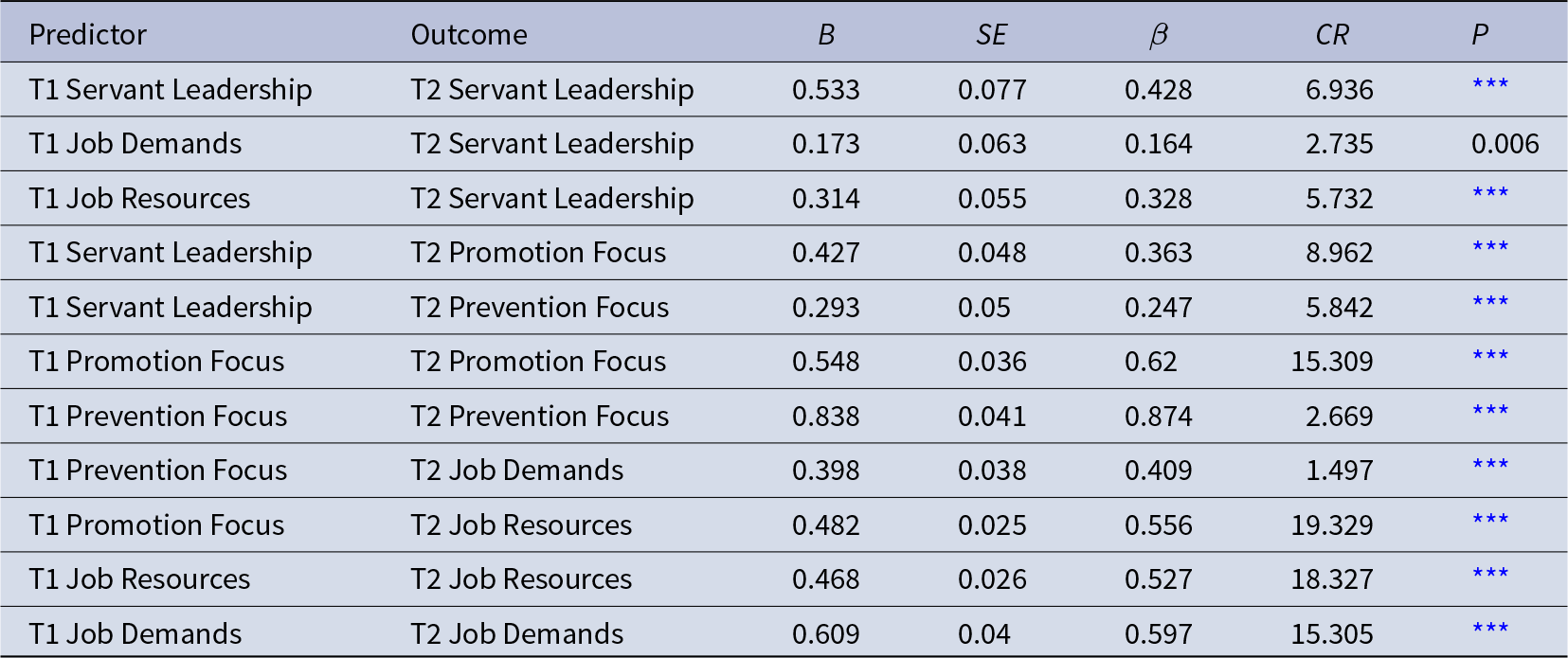
Table 8 Long description
The table reports cross-lagged panel path coefficients linking time 1 predictors to time 2 outcomes, with unstandardized and standardized effects, standard errors, critical ratios, and p values. The largest carryover effect is from time 1 prevention focus to time 2 prevention focus, showing a very strong positive association. Other strong stability paths include time 1 promotion focus to time 2 promotion focus and time 1 job demands to time 2 job demands, all positive and statistically significant. Time 1 servant leadership positively predicts time 2 servant leadership and also positively predicts both time 2 promotion focus and time 2 prevention focus. Time 1 job resources and time 1 job demands each positively predict time 2 servant leadership, with job resources showing the larger standardized effect of the two. Additional cross-lagged paths show time 1 promotion focus positively predicting time 2 job resources and time 1 prevention focus positively predicting time 2 job demands. Most effects are reported as highly statistically significant, while the job demands to later servant leadership path is significant at a conventional level but less strong than the highly significant paths. Coefficients indicate associations within the modeled panel design and should not be interpreted as definitive causal effects without considering model assumptions and study design.
Note.
*** =P < 0.001.
Discussion
The present findings demonstrate that servant leadership operates as an adaptive, feedback-driven system rather than a static leadership style, as evidenced by the serial mediation paths and reciprocal cross-lagged effects observed in both the SEM and CLPM analyses. The findings support our view that servant leadership is an adaptive system, better understood, based on CLT, as a joint emergent process between leaders and subordinates within an environment. Leadership arises through feedback loops, with leaders and followers constantly co-authoring cognitive orientations and contextual conditions rather than following fixed routines.
Consistent with the observed bidirectional effects between job demands, job resources, servant leadership, and regulatory focus, these results extend prior servant leadership research by positioning leadership as a co-evolving process rather than a unidirectional influence. These findings further our theoretical understanding of servant leadership as an emergent, co-creative process. CLT explains how leaders and subordinates co-construct perspectives and approaches through continual feedback loops. Organizations can apply these CLT-related insights within their leadership development programs to help their managers be more aware and reactive to shifting demands and resource configurations. These programs could train managers when to buffer the work strain or focus on goals and growth, reinforcing natural cycles of support and adaptation that sustain performance and well-being.
A practical implication of the promotion- and prevention-focused mediation patterns is that leaders must learn to dynamically shift between buffering and enabling roles rather than relying on uniform behavioral scripts. Translating these findings into practice, organizations can train leaders to remain alert to changeable demands and resources. Leadership training might cover strategies for deciding when and how to ease burdens versus when to empower and motivate subordinates. Policies and frameworks should support ongoing cycles of mutual support and adaptation.
Theoretical implications
The first theoretical implication of this study is that servant leadership should be reconceptualized as an emergent, context-sensitive process rather than a stable individual style, as demonstrated by the serial mediation and reciprocal effects linking job demands, job resources, regulatory focus, and leadership behavior. Across three theoretical fronts, these results enrich leadership research by illustrating how servant leadership moves beyond a static label to become an evolving process that both springs from and redefines its organizational setting.
First, the observed cross-lagged and mediation patterns provide direct empirical support for applying CLT to servant leadership. Instead of exhibiting unchanging trait-based actions, leaders shift support and resources in line with changing demands, which stimulates followers’ motivation. Our emergent model directly challenges traditional trait and behavior approaches (Liden et al., Reference Liden, Wayne, Zhao and Henderson2008; van Dierendonck, Reference van Dierendonck2011) and draws attention to the critical role of local engagement and feedback cycles in fostering leadership effectiveness (Uhl-Bien & Arena, Reference Uhl-Bien and Arena2018; Uhl-Bien et al., Reference Uhl-Bien, Marion and McKelvey2007). In day-to-day operations, servant leaders become aware of either increased pressures or plentiful resources and then adapt their behavior – sometimes empowering, sometimes stewarding, sometimes reallocating – to match the situation, illustrating CLT’s core proposition that leadership emerges from ongoing interaction rather than from fixed role prescriptions.
Second, the findings extend RFT by demonstrating that promotion and prevention orientations operate as contextually activated, leadership-shaped motivational states rather than fixed individual differences. Promotion focus emerged as the critical conduit linking both high resources and buffered demands to enhanced person–job fit, satisfaction, intrinsic motivation, and initiative. Conversely, prevention focus – activated primarily under elevated demands – served to heighten employees’ sense of responsibility rather than merely reflecting risk aversion. This bifurcation extends RFT’s application in organizational settings by showing that promotion and prevention foci are not interchangeable but are differentially mobilized by leadership and context to yield distinct downstream effects (Higgins, Reference Higgins1997; Petrou & Demerouti, Reference Petrou and Demerouti2010), providing direct theoretical grounding for the differential mediation pathways tested in the SEM and CLPM models rather than treating regulatory focus as a static individual trait.
Third, embedding the JD–R model within a complexity lens clarifies how demands and resources act not only as predictors of strain and motivation but also as dynamic contextual triggers that shape the emergence and evolution of servant leadership itself. Our cross-sectional SEM and longitudinal CLPM evidence shows that servant leaders buffer the deleterious effects of demands and amplify the motivational power of resources, driving nonlinear feedback cycles that conventional JD–R applications often model as primarily unidirectional (Bakker & Demerouti, Reference Bakker and Demerouti2017; Demerouti et al., Reference Demerouti, Bakker, Nachreiner and Schaufeli2001). In doing so, we demonstrate how demands can paradoxically foster responsibility when mediated through adaptive leadership and prevention focus, and how resources translate into growth-oriented outcomes via promotion focus, thereby empirically substantiating the dual-pathway logic of JD–R (health impairment versus motivational gain) as part of a feedback-driven leadership process rather than as parallel, static causal chains.
Fourth, the identification of serial mediation chains and reciprocal cross-lagged effects provides direct empirical support for CLT’s core propositions of nonlinear feedback, interdependence, and adaptive co-creation. When leaders modulate their approach, they enhance followers’ regulatory focus, which then circles back to shape the design of demands, the distribution of resources, and the leaders’ subsequent actions. Emergence, interdependence, nonlinear feedback, and adaptive co-creation together embody core principles of complexity theory (Hazy & Uhl-Bien, Reference Hazy and Uhl-Bien2015; Lichtenstein & Plowman, Reference Lichtenstein and Plowman2009). By empirically modeling these bidirectional, time-ordered effects, the present study moves beyond static or one-way leadership models and demonstrates that servant leadership, motivational regulation, and work characteristics co-evolve as mutually conditioning system elements rather than as isolated causal variables, thereby answering recent calls to operationalize CLT with longitudinal process evidence rather than cross-sectional trait-based proxies.
Altogether, this work recasts servant leadership as central to a dynamic systems view of organizations. It reveals that context, leadership, and follower mindsets co-develop over time in ways that support enduring positive performance, as evidenced by the serial mediation of job demands and resources through servant leadership and regulatory focus, and by the reciprocal cross-lagged effects observed in the CLPM analyses, thereby positioning servant leadership as a core adaptive mechanism within complex work systems rather than a stable behavioral style.
Practical implications
Building directly on the four-path process model and the SEM and CLPM findings, we now outline four practical implications that follow from the observed mediation and feedback dynamics.
Practical Implication 1. Servant leadership should be developed and managed as a dynamic, context-responsive process rather than as a stable individual style.
These findings demonstrate that viewing servant leadership purely as an individual attribute or discrete style is insufficient, as the SEM and CLPM results show that servant leadership both emerges from and reshapes job demands, job resources, and regulatory focus over time. Organizations should therefore embed servant leadership as a continuous, adaptive process across work design, resource flows, and talent system infrastructures, rather than treating it solely as a set of trainable interpersonal behaviors. According to Conservation of Resources (COR) theory (Hobfoll, Reference Hobfoll2011), servant leaders spark upward spirals of resources. Capitalizing on this dynamic demands that front-line managers have decision rights and practical tools to reassign time, data, and social backing swiftly (Hutchison-Krupat & Kavadias, Reference Hutchison-Krupat and Kavadias2015; Maritan & Lee, Reference Maritan and Lee2017). The creation of formal processes – such as short resource sprints or hubs for peer networks that allow swift workload and expertise redistribution – helps uphold a promotion-oriented environment marked by strong engagement and growth, even under intense pressure (Demerouti & Bakker, Reference Demerouti and Bakker2023; Kluger & Itzchakov, Reference Kluger and Itzchakov2022), thereby operationalizing the promotion-focus mediation pathway observed in the SEM and CLPM analyses.
Practical Implication 2. In high-risk and compliance-intensive contexts, servant leadership can be deliberately leveraged to cultivate prevention focus and experienced responsibility rather than merely suppressing risk.
In industries governed by strict safety or compliance requirements, servant leadership can shift prevention focus – from its usual alignment with risk aversion – to a robust commitment to quality and safety standards. Consistent with the demand → servant leadership → prevention focus → responsibility pathway identified in the SEM and CLPM analyses, leaders who buffer strain and clarify obligations can channel vigilance into heightened ownership rather than disengagement. Static leadership workshops are less effective; programs can shift to focusing on meeting new demands. It is standard for generic workshops to focus on consistent leadership behavior while bypassing the subtle contextual factors that are highlighted within our model. A better strategy involves investing in hands-on learning rotations, teams drawn from different departments, and immediate feedback loops. A servant leadership approach, which emphasizes leader humility, can help encourage this feedback from subordinates and positively impact their adaptation (Li, Zhang, Xia, & Liu, Reference Li, Zhang, Xia and Liu2019). Such investments allow leaders to sense evolving demands and resource availability and to modify their support as needed (Jackson, Reference Jackson2000; McCauley & van Velsor, Reference McCauley and Van Velsor2004). Curriculum design for leadership coaching should combine promotion-oriented skills – including framing a compelling vision and identifying opportunities – with prevention-oriented competencies, such as assessing risks and establishing guardrails, so that leaders can intentionally activate the dual regulatory pathways identified in the four-path model and thereby sustain growth while reinforcing responsibility in safety-critical conditions.
Practical Implication 3. Servant leadership can be used to intentionally activate promotion focus and proactive job crafting in resource-rich and growth-oriented contexts.
It is also important that leaders support personnel in reshaping their own positions to align with whether they adopt a promotion or a prevention focus (Bakker et al., Reference Bakker, Demerouti and Sanz-Vergel2023; Wrzesniewski & Dutton, Reference Wrzesniewski and Dutton2001). Consistent with the resource → servant leadership → promotion focus → positive outcomes pathway, servant leaders who emphasize autonomy, development, and psychological safety can stimulate approach-oriented self-regulation and proactive role expansion. To accelerate job crafting, servant leaders could introduce brief micro-innovation workshops for incremental role redesigns and set up peer-mentoring forums that bring individual strengths and group-level resource needs to light. By focusing on better employee fit and intrinsic motivation, these leadership programs could ensure that when demands intensify, employees are more likely to perceive them as opportunities rather than stressors, mirroring the serial mediation pattern in which promotion regulatory focus transmits the effects of job resources and buffered demands on fit, satisfaction, motivation, and personal initiative observed in both the SEM and longitudinal analyses.
Practical Implication 4. Organizations should institutionalize feedback infrastructures that allow servant leadership, regulatory focus, and work design to co-evolve over time.
Lastly, organizations need policy frameworks that nurture, rather than constrain, the feedback loops driving complex processes. Embedding brief pulse surveys within performance conversations equips servant leaders with immediate alerts about changing demands or resource gaps (Salanova et al., Reference Salanova, Llorens and Schaufeli2011). Rotating leadership posts across departments simultaneously breaks down silos and strengthens group sense-making (Rosenhead et al., Reference Rosenhead, Franco, Grint and Friedland2019). As part of their recruitment and onboarding, organizations can use situational judgment tests that evaluate candidates’ decisions regarding models of variable demands to evaluate empathy and adaptability. Offering peer-nominated accolades like ‘resource champion’ can also help with the development of promotion focus while signaling what is important, thereby reinforcing the reciprocal, feedback-driven cycles identified in the CLPM analyses between leadership behavior, regulatory focus, and subsequent contextual conditions.
By reframing servant leadership as a co-creative and continuous feedback process, servant leaders in organizations can shield employees from the strains of high demands while maximizing the advantages of resource abundance. Through promotion regulatory focus, employees may not only engage in positive proactive behaviors, but those proactive behaviors can further enhance the leader–member exchange with their supervisors, thereby serving as a relational resource (Shih & Nguyen, Reference Shih and Nguyen2025). Consistent with the observed reciprocal cross-lagged effects, these employee regulatory states and proactive behaviors also feed back to shape subsequent leadership responses and the configuration of job demands and resources over time, demonstrating in practice the feedback-driven emergence proposed by CLT. By adopting this systemic approach, organizations can improve immediate results and employee well-being and simultaneously build the resilient adaptability essential for future challenges.
Future research
From our combined CLT–JD–R–RFT perspective, one can pursue a variety of promising research trajectories. A first implication for future research, grounded in the observed reciprocal CLPM effects and serial mediation pathways, is the need to examine these adaptive processes at finer temporal resolutions. As a starting point, one could conduct diary-based or experience-sampling research to capture the immediate effects of shifting resource allocation on followers’ regulatory states. Such work would also uncover the tipping point at which a prevention focus becomes authentic stewardship instead of simple risk avoidance (van Knippenberg, van Knippenberg, De Cremer & Hogg, Reference van Knippenberg, van Knippenberg, De Cremer and Hogg2004). In a second line of inquiry, scholars might use experimental or multi-sample designs – comparing contexts such as healthcare and creative industries – to identify moderators. Acute crisis conditions versus enduring overload and the contrast of financial to social resources may either bolster or weaken the servant leadership-regulatory focus linkage.
Daily or weekly longitudinal designs offer the temporal precision needed to spot nonlinear tipping points in feedback loops. Such designs would directly extend the present two-wave CLPM by allowing scholars to model the emergence, strengthening, and decay of regulatory focus and servant leadership responses across multiple time scales, consistent with CLT’s emphasis on dynamic co-evolution. Identifying these moments allows practitioners to intervene effectively, for example by deploying extra resources or scheduling coaching sessions. An inquiry into digital and blended work formats will show whether virtual servant leadership and algorithmic resource signals can successfully launch emergent dynamics, or whether personal, on-site engagement is required.
The third research path is to conduct action research that instructs leaders in complexity-informed, regulatory‐focus‐responsive techniques, for instance rapid sense making paired with reflective coaching. Such interventions would allow direct testing of the causal mechanisms implied by the serial mediation and cross-lagged paths observed in the present study, linking adaptive servant leadership behaviors to shifts in promotion and prevention focus and subsequent changes in fit, motivation, and responsibility. These trials would examine whether such adaptive routines intensify feedback loops and generate sustained gains across both motivational orientations. In combination, these extensions will hone the model’s applicability, expand its temporal dimensions, and transform complexity theory into validated organizational and leadership development practices.
Study limitations
There are certain limitations that should be addressed. First and foremost, every variable in our study – demands, resources, leadership behavior, regulatory focus, and outcomes – depended on self-report measures. Such reliance could lead to common method bias, social-desirability distortion, and flawed recall, even with our CFA checks and time-lagged controls. This limitation is particularly relevant given the serial mediation and reciprocal paths tested in the SEM and CLPM, as shared method variance may inflate associations among leadership, regulatory focus, and perceived job characteristics. Future studies ought to gather data from multiple sources – such as subordinate, peer, and supervisor ratings – and include objective metrics like performance records to triangulate self-reported perceptions.
The second limitation concerns attrition: the CLPM analysis at Time 2 retained only 232 of the original 423 participants, necessitating composite indicators rather than complete scales; this reduction may undermine the robustness and external validity of our longitudinal findings. Because the feedback-driven hypotheses rely on detecting reciprocal change over time, sample loss may have reduced statistical power to capture weaker cross-lagged effects and nonlinear dynamics predicted by CLT. Future replications that employ expanded, diverse panels and shorter data‐collection intervals (for example daily diaries) could pinpoint the onset and speed of feedback cycles.
Our third limitation is that our sample exclusively involved organizations based in the southeastern United States. Consequently, differences in cultural practices, sector characteristics, or national resource arrangements might alter the pathways we observed. Because regulatory focus activation and servant leadership enactment are known to vary across cultural value systems and institutional regimes, the generalizability of the CLT–JD–R–RFT feedback model may be bounded by national context. Cross‐cultural and multi‐industry investigations would help establish boundary conditions for the CLT–JD–R–RFT process model.
Lastly, while our emphasis on positive results and personal responsibility addresses critical aspects of fit and well-being, we did not explore variables like innovation behaviors, retention patterns, or group performance. These outcomes are central in both JD–R and complexity-based leadership research, where adaptive cycles are expected to scale from individual motivation to collective learning, coordination, and sustained performance. Broadening which outcomes we measure, along with testing moderators such as personal regulatory orientation or climate, will allow us to refine and scale up this dynamic approach to leadership.
Conclusion
We advance leadership understanding by uncovering that servant leadership is not a fixed repertoire of behaviors. Instead, it evolves adaptively, arising from job demands and resources and reshaping them to drive employee regulatory focus and performance. Combining Complexity Leadership with the JD–R and Regulatory Focus perspectives, we show how lowering demands and increasing resources by leaders catalyzes promotion mindsets linked to better fit, satisfaction, and initiative. In parallel, demand-induced prevention focus supports deeper responsibility. The combined SEM and CLPM findings illustrate the centrality of feedback loops and co-creative cycles in ensuring that positive outcomes persist over the long term by demonstrating that servant leadership, regulatory focus, and job characteristics mutually influence one another over time rather than operating through one-way causal paths.
For those implementing these insights, the mandate is clear: weave servant leadership into organizational design by giving front‐line teams authority over resources, fostering mechanisms for immediate feedback, and designing leadership development that teaches both how to seize possibilities and how to guard against risks. Over time, adopting this dynamic process model organizations can provide helpful guidance to make the whole organization more capable of handling uncertainty while remaining committed to continuous learning by aligning leadership development with the adaptive buffering and enabling functions identified in the four-path process model.
As research progresses, broadening this model to cover different cultures and industries, integrating multiple data streams and objective records, and tracking further variables like innovation, staff retention, and team success can sharpen our comprehension of servant leadership’s interplay with complex environments and further test the boundary conditions and temporal dynamics implied by the reciprocal pathways identified in this study.
Conflict of interest
The authors have no known conflict of interest to disclose.
AI use disclosure
AI-assisted tools were used for language editing and clarity in the preparation of this manuscript and the response to reviewers. All theoretical development, data analysis, interpretation, and substantive intellectual contributions are the authors’ own. The authors take full responsibility for the accuracy, originality, and integrity of the work.
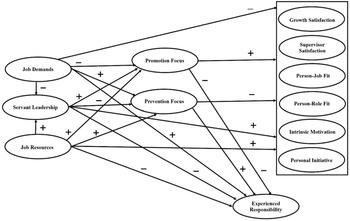
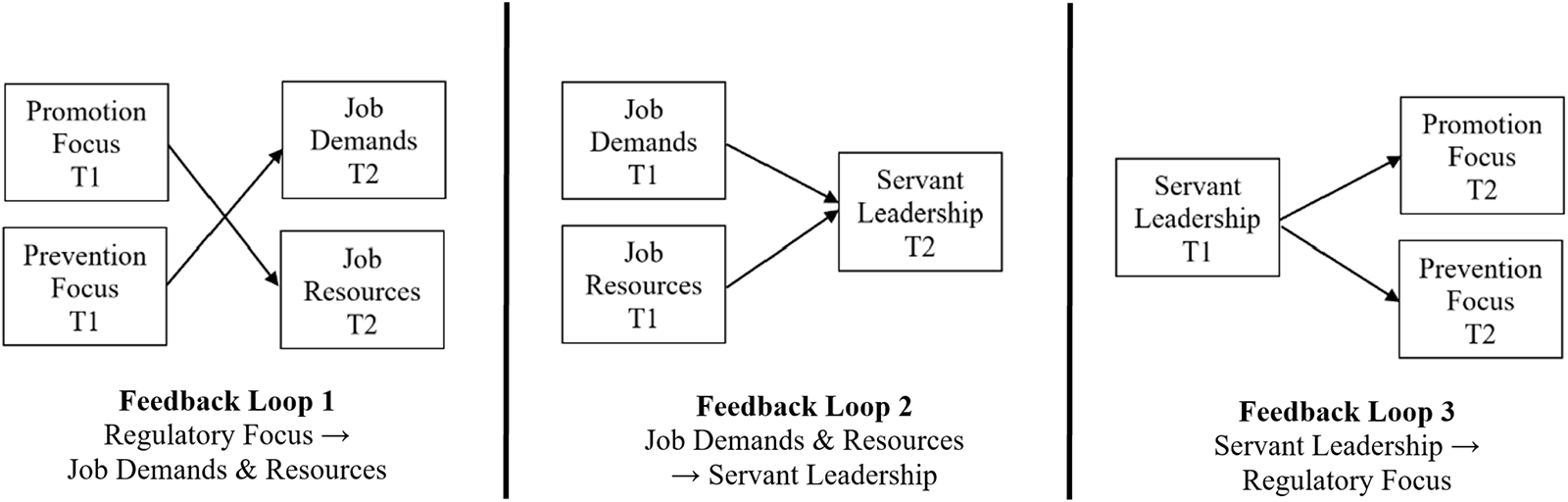
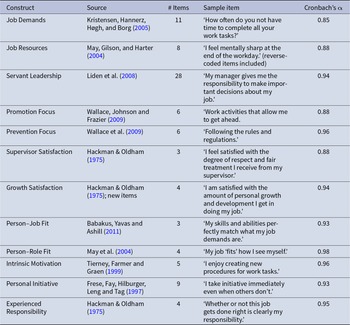
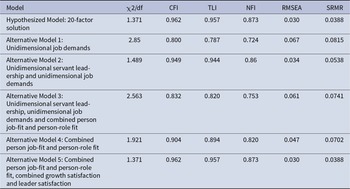
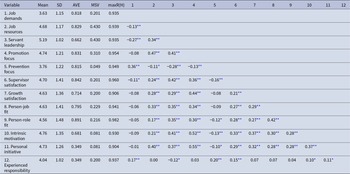
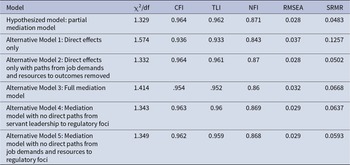

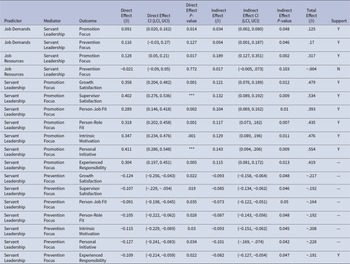
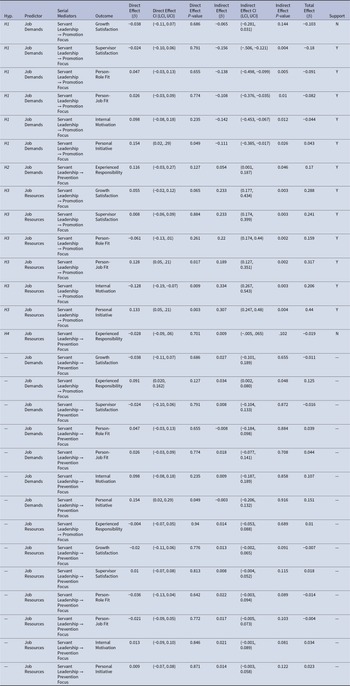
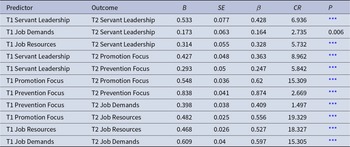

 Open access

