





1 Introduction
This paper develops a logic of essence (HLE) in the framework of higher-order logic. The theory aims to provide a general framework for theorizing about the essences of objects, properties, propositions, and logical operations like conjunction, negation, etc. A Hilbert-style axiom system of HLE was first presented in Ditter [Reference Ditter15]. The present paper complements the presentation in Ditter [Reference Ditter15] in two key respects: first, by proving some theorems of HLE and discussing their philosophical ramifications; and second, by developing a sound model-theoretic semantics for HLE.
The notion of essence HLE is concerned with is the notion that Fine [Reference Fine20] influentially argued to be not definable in terms of metaphysical necessity. Fine’s counterexamples to the definability of essence in terms of metaphysical necessity have convinced many philosophers that the right approach to take in theorizing about essence is to work with a primitive notion of essence not explained in terms of metaphysical modality or anything else. This conceptually basic notion has since been used and discussed in a variety of different theoretical contexts.Footnote 1 Yet the logic of this notion remains relatively little explored. Notably, Fine’s logic of essence (LE) [Reference Fine21, Reference Fine22], the most fully developed logic of essence in the literature, is not concerned with the basic notion of essence, but with what Fine calls the ‘constrained consequential notion’ of essence—an idealized notion that, roughly speaking, results from the basic notion by closure under (a restricted form of) logical consequence.Footnote 2 It therefore leaves open what the correct logic of the basic notion might be.
Perhaps the most central logical difference between the constrained consequential and the basic notion of essence that LE and HLE are, respectively, concerned with is the question of logical closure. For the constrained consequential notion formalized in LE, the propositions true in virtue of the nature of given objects are closed under logical consequence, subject to the constraint that the consequences in question are not about objects that are not involved in the nature of the given objects. Thus given that Socrates is essentially human, it will also be true that Socrates is essentially human or a set. Moreover, any “purely qualitative” logical truth, such as ‘Everything is self-identical’ or ‘Everything is either red or not red’, will be true in virtue of Socrates’ nature, and indeed true in virtue of the nature of any given objects. By contrast, if Socrates’ nature does not involve his singleton set, then it won’t be true in virtue of the nature of Socrates that his singleton set is self-identical, since the proposition that his singleton set is self-identical is about the singleton.
All of the positive instances of closure mentioned in the previous paragraph are highly controversial for the basic notion of essence. For the basic notion formalized in HLE, it is plausible to deny, for example, that Socrates is essentially human or a set, even if he is essentially human, on the grounds that, intuitively, his nature does not involve, or “knows nothing about,” sethood. Likewise, it is natural to deny that it lies in the nature of Socrates that everything is either red or not red, since intuitively, redness has no part in Socrates’ nature. Unlike the consequential notion, the basic notion is not only sensitive to the “objectual content” of propositions, but also to the content expressed by predicates like ‘set’ or ‘red’, and terms of other grammatical categories. In order to capture the above failures of logical closure we therefore need to generalize the notion of essential involvement from a relation restricted to objects to a relation whose relata may be entities expressed by all kinds of grammatical categories. This is achieved in HLE by the adoption of a higher-order language. The higher-order regimentation of essentialist statements employed here is a generalization of the first-order regimentation of LE. It enables us to represent not only talk about the essences of objects, such as Socrates or his singleton set, but also talk about the essences of properties, propositions, and logical operations—or more generally, the essences of what is expressed by terms of arbitrary grammatical categories—in a natural and uniform way.Footnote 3 The language of HLE allows us to provide a simple formalization of claims like ‘It lies in the nature of being red that all red things are colored’ or ‘It lies in the collective nature of identity and universality that everything is self-identical’,Footnote 4 whereas it is difficult to express such claims in the first-order setting of LE.Footnote 5
The expressive generality of the higher-order framework of HLE is key to the solution of the problem of logical closure for the basic notion of essence. Apart from allowing for a consistent denial of the problematic instances of closure mentioned above, HLE also allows us to account for the plausible positive instances of closure. It is plausible to assume that the essences of at least some entities manifest some logical closure. For example, while we might think that it is not true in virtue of Socrates’ nature that everything is self-identical, it is very natural to assume that it is true in virtue of the nature of identity and universality that everything is self-identical. More generally, it is natural to think that any logical truth that is expressed by purely logical vocabulary is true in virtue of the collective nature of the logical operations expressed by this vocabulary. HLE predicts just that. In general, according to HLE, any type of logical closure manifested by the essence of a collection of entities derives from the logical operations involved in the essence of that collection. So, for example, the essence of a collection of entities will be closed under conjunction elimination and introduction just in case the essence of the collection involves conjunction, and it will be closed under modus ponens just in case it involves the conditional. This leads to a natural and systematic account of the closure of essences under logical consequence on which the way in which the essence of a given collection is closed under logical consequence derives from the natures of the logical operations which are naturally regarded as the source of the closure in question, while at the same time ensuring that no “extraneous entities”—i.e., entities not involved in the nature of the given entities—are introduced into the essence of the collection via logical closure.
The resulting picture requires a very fine-grained individuation of propositions; in particular, it requires propositions to be individuated more finely than by metaphysically necessary equivalence. However, it is worth stressing that it does not require propositions to be structured in anything like the way in which sentences are structured—a view that is known to lead to inconsistency given some natural background assumptions, due to the Russell–Myhill paradox.Footnote 6 This is demonstrated by the semantics for HLE developed here, which shows how we can model a wide range of fine-grained essentialist distinctions in a semantic framework that is in many respects similar to the possible worlds frameworks employed in discussions of higher-order modal logic.
The differences between LE and HLE mentioned above notwithstanding, it is worth noting that there are some important continuities between the systems and their general approach to the logic of essence. As mentioned above, the higher-order language of HLE is essentially a higher-order generalization of the language of LE. Furthermore some, but not all, of the axioms and rules of LE are not specific to the notion of essence LE deals with and remain correct for the basic notion of essence which forms the subject matter of HLE. Finally, the semantics developed here shares some important structural features with the first-order semantics for LE in Fine [Reference Fine22]. For example, just as in Fine’s semantics for LE, the condition for a statement to be true in virtue of the nature of certain entities is that it should be true in all those worlds that contain those entities.Footnote 7
The paper is structured as follows. §2 introduces the language of HLE. The next three sections are concerned with the development of the logic. After presenting the proof system of HLE (§3), some important theorems of the system are proved (§4) and it is shown how to develop the logic of metaphysical necessity within the setting of HLE (§5). The next four sections deal with the semantics of HLE. §6 develops a model-theoretic semantics for HLE and §7 provides example models that show the consistency of some simple essentialist theories. §8 proves the soundness of HLE with respect to this semantics. §9 ties up some loose ends from §5 by giving model-theoretic proofs of some results announced there. Finally, §10 concludes with some directions for future research.
2 Language
The formal language of HLE is a higher-order generalization of the first-order language developed in Fine’s LE [Reference Fine21]. In LE, essentialist statements are regimented by means of operators subscripted with a one-place predicate, written $\square _{F}$
. On its intended meaning, a sentence of the form
$\square _{F}$
. On its intended meaning, a sentence of the form $\square _{F}\phi $
says that it lies in the nature of the things which F that
$\square _{F}\phi $
says that it lies in the nature of the things which F that $\phi $
.Footnote
8
Thus the subject of the essentialist attribution is the collection of objects which F. However, Fine’s formalization only allows us to pick out (collections of) objects as the subjects of essentialist attributions: LE uses a first-order language in which predicates can only combine with terms in name position to form sentences. But as pointed out in §1, some essentialist statements, such as ‘It lies in the collective nature of identity and universality that everything is self-identical’ cannot be straightforwardly expressed in such a language. We therefore need to extend our expressive resources. The basic idea is to formalize such sentences by picking out what is expressed by words and phrases of different grammatical categories—such as the categories of predicates, sentences or operators—as the subjects of essentialist attributions. The most straightforward way to achieve this is to use a higher-order language in which predicates can combine with terms of different grammatical categories to form sentences. For example, if we have at our disposal a predicate that is satisfied by conjunction in the same way in which ‘is identical to Socrates’ is satisfied by Socrates, we could state what lies in the nature of conjunction in the same way as we can state what lies in the nature of Socrates.
$\phi $
.Footnote
8
Thus the subject of the essentialist attribution is the collection of objects which F. However, Fine’s formalization only allows us to pick out (collections of) objects as the subjects of essentialist attributions: LE uses a first-order language in which predicates can only combine with terms in name position to form sentences. But as pointed out in §1, some essentialist statements, such as ‘It lies in the collective nature of identity and universality that everything is self-identical’ cannot be straightforwardly expressed in such a language. We therefore need to extend our expressive resources. The basic idea is to formalize such sentences by picking out what is expressed by words and phrases of different grammatical categories—such as the categories of predicates, sentences or operators—as the subjects of essentialist attributions. The most straightforward way to achieve this is to use a higher-order language in which predicates can combine with terms of different grammatical categories to form sentences. For example, if we have at our disposal a predicate that is satisfied by conjunction in the same way in which ‘is identical to Socrates’ is satisfied by Socrates, we could state what lies in the nature of conjunction in the same way as we can state what lies in the nature of Socrates.
Let me make this a bit more precise. The language we will be working with is a relationally typed language with lambda abstraction.
Definition 1. The set $\mathcal {T}$
of types is the smallest set such that:
$\mathcal {T}$
of types is the smallest set such that:
-
(i) $e\in \mathcal {T;}$
-
(ii) if
$\tau _{1},\ldots ,\tau _{n}\in \mathcal {T}$
,
$n\geq 0$
, then
$\langle \tau _{1},\ldots ,\tau _{n}\rangle \in \mathcal {T;}$
-
(iii) if
$\tau \in \mathcal {T}$
, then
$[\tau ]\in \mathcal {T.}$






Clauses (i) and (ii) are the usual clauses for relational types: e is the type of objects (individuals), $\langle \tau _{1},\ldots ,\tau _{n}\rangle $
is the type of ordinary relations between entities of type
$\langle \tau _{1},\ldots ,\tau _{n}\rangle $
is the type of ordinary relations between entities of type $\tau _{1},\ldots ,\tau _{n}$
with the special case
$\tau _{1},\ldots ,\tau _{n}$
with the special case $\langle \rangle $
being the type of propositions, and clause (iii) concerns the type of rigid properties. Intuitively, a rigid property is a property of being one of
$\langle \rangle $
being the type of propositions, and clause (iii) concerns the type of rigid properties. Intuitively, a rigid property is a property of being one of $x_{1},x_{2},\ldots $
, for certain specific entities
$x_{1},x_{2},\ldots $
, for certain specific entities $x_{1},x_{2},\ldots $
. We can thus think of rigid properties as predicative analogs of pluralities.
$x_{1},x_{2},\ldots $
. We can thus think of rigid properties as predicative analogs of pluralities.
Definition 2. Let $\mathcal {T}$
be the set of all types. A typed family is a set
$\mathcal {T}$
be the set of all types. A typed family is a set $\mathcal {D}=\lbrace \mathcal {D}_{\tau }:\tau \in \mathcal {T}\rbrace $
of pairwise disjoint non-empty sets.
$\mathcal {D}=\lbrace \mathcal {D}_{\tau }:\tau \in \mathcal {T}\rbrace $
of pairwise disjoint non-empty sets.
We assume given, for each $\tau \in \mathcal {T}$
, a denumerably infinite set
$\tau \in \mathcal {T}$
, a denumerably infinite set $\mathcal {V}_{\tau }$
of variables with unique type
$\mathcal {V}_{\tau }$
of variables with unique type $\tau $
. The set of all variables is
$\tau $
. The set of all variables is $\mathcal {V}=\bigcup _{\tau \in \mathcal {T}}\mathcal {V}_{\tau }$
. A signature is a set of uniquely typed constants. If
$\mathcal {V}=\bigcup _{\tau \in \mathcal {T}}\mathcal {V}_{\tau }$
. A signature is a set of uniquely typed constants. If $\Sigma $
is a signature, we write
$\Sigma $
is a signature, we write $\Sigma _{\tau }$
for the set of constants from
$\Sigma _{\tau }$
for the set of constants from $\Sigma $
that have type
$\Sigma $
that have type $\tau $
. We will generally assume that
$\tau $
. We will generally assume that $\Sigma $
is disjoint from
$\Sigma $
is disjoint from $\mathcal {V}$
. Note that
$\mathcal {V}$
. Note that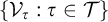 $\lbrace \mathcal {V}_{\tau }:\tau \in \mathcal {T}\rbrace $
is a typed family. To define our language, we first define a more general kind of language, a
$\lbrace \mathcal {V}_{\tau }:\tau \in \mathcal {T}\rbrace $
is a typed family. To define our language, we first define a more general kind of language, a $\lambda K$
-language, in which vacuous
$\lambda K$
-language, in which vacuous $\lambda $
-abstracts are allowed.
$\lambda $
-abstracts are allowed.
Definition 3. For any signature $\Sigma $
, we define sets of
$\Sigma $
, we define sets of $\Sigma $
K-terms
$\Sigma $
K-terms $\mathcal {L}K^{\Sigma }_{\tau }$
of type
$\mathcal {L}K^{\Sigma }_{\tau }$
of type $\tau $
, for each
$\tau $
, for each $\tau \in \mathcal {T}$
, to be the smallest sets satisfying the following conditions:
$\tau \in \mathcal {T}$
, to be the smallest sets satisfying the following conditions:
-
(i)
$\mathcal {V}_{\tau }\subseteq \mathcal {L}K^{\Sigma }_{\tau }$
and
$\Sigma _{\tau }\subseteq \mathcal {L}K^{\Sigma }_{\tau }$
, for each
$\tau \in \mathcal {T;}$
-
(ii) if
$A\in \mathcal {L}K^{\Sigma }_{\langle \tau _{1},\ldots ,\tau _{n}\rangle }$
and
$B_{1}\in \mathcal {L}K^{\Sigma }_{\tau _{1}},\ldots ,B_{n}\in \mathcal {L}K^{\Sigma }_{\tau _{n}}$
,
$n\geq 1$
, then
$A(B_{1},\ldots ,B_{n})\in \mathcal {L}K^{\Sigma }_{\langle \rangle }$
; -
(iii) if
$A\in \mathcal {L}K^{\Sigma }_{[\tau ]}$
and
$B\in \mathcal {L}K^{\Sigma }_{\tau }$
, then
$A(B)\in \mathcal {L}K^{\Sigma }_{\langle \rangle }$
; -
(iv) if
$\phi \in \mathcal {L}K^{\Sigma }_{\langle \rangle }$
and
$x_{1}\in \mathcal {V}_{\tau _{1}},\ldots ,x_{n}\in \mathcal {V}_{\tau _{n}}$
are pairwise distinct variables,
$n\geq 1$
, then
$(\lambda x_{1}\ldots x_{n}.\phi )\in \mathcal {L}K^{\Sigma }_{\langle \tau _{1},\ldots ,\tau _{n}\rangle }$
.


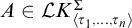





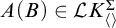




The notions of free and bound occurrences of a variable are defined in the standard way. The definition of the sets of $\Sigma $
-terms
$\Sigma $
-terms $\mathcal {L}^{\Sigma }_{\tau }$
of type
$\mathcal {L}^{\Sigma }_{\tau }$
of type $\tau $
, for each type
$\tau $
, for each type $\tau $
, is the same as the definition of
$\tau $
, is the same as the definition of $\mathcal {L}K^{\Sigma }_{\tau }$
, except that clause (iv) is replaced by the following clause:
$\mathcal {L}K^{\Sigma }_{\tau }$
, except that clause (iv) is replaced by the following clause:
-
(iv′) if
$\phi \in \mathcal {L}^{\Sigma }_{\langle \rangle }$
and
$x_{1}\in \mathcal {V}_{\tau _{1}},\ldots ,x_{n}\in \mathcal {V}_{\tau _{n}}$
are pairwise distinct variables all of which are free in
$\phi $
,
$n\geq 1$
, then
$(\lambda x_{1}\ldots x_{n}.\phi )\in \mathcal {L}^{\Sigma }_{\langle \tau _{1},\ldots ,\tau _{n}\rangle }$
.





The set of all ${\Sigma }$
-terms
${\Sigma }$
-terms $\bigcup _{\tau \in \mathcal {T}}\mathcal {L}^{\Sigma }_{\tau }$
is denoted by
$\bigcup _{\tau \in \mathcal {T}}\mathcal {L}^{\Sigma }_{\tau }$
is denoted by $\mathcal {L}^{\Sigma }$
and constitutes the
$\mathcal {L}^{\Sigma }$
and constitutes the $\lambda I$
-language of
$\lambda I$
-language of $\Sigma $
. Note that
$\Sigma $
. Note that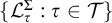 $\lbrace \mathcal {L}_{\tau }^{\Sigma }:\tau \in \mathcal {T}\rbrace $
is a typed family. In what follows, we will be exclusively concerned with such
$\lbrace \mathcal {L}_{\tau }^{\Sigma }:\tau \in \mathcal {T}\rbrace $
is a typed family. In what follows, we will be exclusively concerned with such $\lambda $
I-languages in which vacuous
$\lambda $
I-languages in which vacuous $\lambda $
-abstracts are not well-formed. A justification for this choice of language is provided in §4. We call terms of type
$\lambda $
-abstracts are not well-formed. A justification for this choice of language is provided in §4. We call terms of type $\langle \rangle $
formulas (or sentences if they don’t contain free variables), terms of type
$\langle \rangle $
formulas (or sentences if they don’t contain free variables), terms of type $\langle \tau _{1},\ldots ,\tau _{n}\rangle $
(ordinary) predicates, and terms of type
$\langle \tau _{1},\ldots ,\tau _{n}\rangle $
(ordinary) predicates, and terms of type $[\tau ]$
rigid predicates. Our use of rigid predicates is a higher-order generalization of the category of rigid predicates in LE.Footnote
9
We call types of the form
$[\tau ]$
rigid predicates. Our use of rigid predicates is a higher-order generalization of the category of rigid predicates in LE.Footnote
9
We call types of the form $\langle \sigma \rangle $
or
$\langle \sigma \rangle $
or $[\sigma ]$
one-place predicate types and terms of this type one-place predicate terms. A combinator is a term without free variables or constants, such as
$[\sigma ]$
one-place predicate types and terms of this type one-place predicate terms. A combinator is a term without free variables or constants, such as $\lambda p.p$
. If not otherwise specified, we assume that each signature
$\lambda p.p$
. If not otherwise specified, we assume that each signature $\Sigma $
contains the following logical constants:
$\Sigma $
contains the following logical constants:
-
$\neg \in \Sigma _{\langle \langle \rangle \rangle }$
;
-
$\wedge ,\vee $
,
$\rightarrow ,\leftrightarrow \;\in \Sigma _{\langle \langle \rangle ,\langle \rangle \rangle }$
;
-
$\forall _{\sigma },\exists _{\sigma }\in \Sigma _{\langle \langle \sigma \rangle \rangle }$
for all
$\sigma \in \mathcal {T}$
;
-
$=_{\sigma }\in \Sigma _{\langle \sigma ,\sigma \rangle }$
for all
$\sigma \in \Sigma $
;
-
$\square _{\tau _{1},\tau _{2},\ldots ,\tau _{k}}\in \Sigma _{\langle \tau _{1},\ldots ,\tau _{k},\langle \rangle \rangle }$
for any
$k\geq 0$
and any one-place predicate types
$\tau _{i}\in \mathcal {T.}$









Constants of this last kind are essentialist operators. The case where $k=0$
is written
$k=0$
is written $\square _{\varnothing }$
. When
$\square _{\varnothing }$
. When $F_{1}, F_{2},\ldots ,F_{n}$
are one-place predicate terms and
$F_{1}, F_{2},\ldots ,F_{n}$
are one-place predicate terms and $\phi $
is a formula, we write
$\phi $
is a formula, we write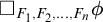 $\square _{F_{1}, F_{2},\ldots ,F_{n}}\phi $
for
$\square _{F_{1}, F_{2},\ldots ,F_{n}}\phi $
for $\square _{\tau _{1},\ldots ,\tau _{n}}(F_{1},\ldots ,F_{n},\phi )$
. We also write
$\square _{\tau _{1},\ldots ,\tau _{n}}(F_{1},\ldots ,F_{n},\phi )$
. We also write $\forall x^{\tau }(\phi )$
for
$\forall x^{\tau }(\phi )$
for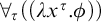 $\forall _{\tau }((\lambda x^{\tau }.\phi ))$
, and
$\forall _{\tau }((\lambda x^{\tau }.\phi ))$
, and $\phi \wedge \psi $
for
$\phi \wedge \psi $
for $\wedge (\phi ,\psi )$
, and similarly for other logical constants. Note that in this setting, quantifiers don’t bind variables, and they combine with predicates to make sentences. For instance, if F is a predicate of type
$\wedge (\phi ,\psi )$
, and similarly for other logical constants. Note that in this setting, quantifiers don’t bind variables, and they combine with predicates to make sentences. For instance, if F is a predicate of type $\langle \sigma \rangle $
, then
$\langle \sigma \rangle $
, then $\forall _{\sigma }(F)$
states that F applies to every entity of type
$\forall _{\sigma }(F)$
states that F applies to every entity of type $\sigma $
(or, equivalently, that F is universal). Thus, to express that everything of type e is self-identical, we can write
$\sigma $
(or, equivalently, that F is universal). Thus, to express that everything of type e is self-identical, we can write $\forall _{e}((\lambda x.x=_{e}x))$
, which our convention above allows us to abbreviate to the more usual
$\forall _{e}((\lambda x.x=_{e}x))$
, which our convention above allows us to abbreviate to the more usual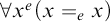 $\forall x^{e}(x=_{e}x)$
. I will generally omit parentheses and type annotations whenever no confusion is likely to arise and follow other standard conventions. For example, we may write
$\forall x^{e}(x=_{e}x)$
. I will generally omit parentheses and type annotations whenever no confusion is likely to arise and follow other standard conventions. For example, we may write $\forall x(x= x)$
instead of
$\forall x(x= x)$
instead of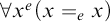 $\forall x^{e}(x=_{e}x)$
whenever it is clear from the context or it doesn’t matter what the appropriate types are.
$\forall x^{e}(x=_{e}x)$
whenever it is clear from the context or it doesn’t matter what the appropriate types are.
When A is a term, $x_{1},\ldots ,x_{n}$
are pairwise distinct variables, and
$x_{1},\ldots ,x_{n}$
are pairwise distinct variables, and $B_{1},\ldots ,B_{n}$
are terms, we write
$B_{1},\ldots ,B_{n}$
are terms, we write $A[B_{i}/x_{i}]$
for the term that results from replacing each free occurrence of
$A[B_{i}/x_{i}]$
for the term that results from replacing each free occurrence of $x_{1}$
in A with
$x_{1}$
in A with $B_{1}$
, and each free occurrence of
$B_{1}$
, and each free occurrence of $x_{2}$
with
$x_{2}$
with $B_{2}$
, and so on, replacing bound variables in such a way that no free variables in any
$B_{2}$
, and so on, replacing bound variables in such a way that no free variables in any $B_{i}$
become bound. We also adopt the following abbreviations:
$B_{i}$
become bound. We also adopt the following abbreviations:
-
(i)
$F\subseteq G$
for
$\forall x(F(x)\rightarrow G(x))$
, where x is the first variable of the relevant type not free in either F or
$G;$
-
(ii)
$F\approx G$
for
$(F\subseteq G\wedge G\subseteq F);$
-
(iii)
$[A]$
for
$\lambda x.x= A$
, where x is the first variable of the same type as A not free in
$A;$
-
(iv)
$(F_{1},\ldots ,F_{n})\succeq _{\sigma _{1},\ldots ,\sigma _{n},\tau } A$
for
$\exists X^{\langle \tau \rangle }\square _{F_{1},\ldots ,F_{n}}X(A)$
, where
$X^{\langle \tau \rangle }$
is the first variable not free in
$F_{1},\ldots ,F_{n},A;$
-
(v)
$c_{\tau }(F_{1},\ldots ,F_{n})$
for
$\lambda x^{\tau }.(F_{1},\ldots ,F_{n})\succeq _{\sigma _{1},\ldots ,\sigma _{n},\tau } x^{\tau }$
, where
$x^{\tau }$
is the first variable not free in
$F_{1},\ldots ,F_{n}$
; -
(vi)
$A\geq _{\sigma ,\tau } B$
for
$([A])\succeq _{\langle \sigma \rangle ,\tau }B.$















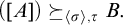
The predicate $\succeq _{\sigma _{1},\ldots ,\sigma _{n},\tau }$
expresses the relation of essential involvement between a collection of entities and a single entity. We can pronounce a statement of the form
$\succeq _{\sigma _{1},\ldots ,\sigma _{n},\tau }$
expresses the relation of essential involvement between a collection of entities and a single entity. We can pronounce a statement of the form $(F_{1},\ldots ,F_{n})\succeq _{\sigma _{1},\ldots ,\sigma _{n},\tau } A$
as ‘the nature of the collection of entities picked out by
$(F_{1},\ldots ,F_{n})\succeq _{\sigma _{1},\ldots ,\sigma _{n},\tau } A$
as ‘the nature of the collection of entities picked out by $F_{1},\ldots ,F_{n}$
involves A’, where the collection of entities picked out by
$F_{1},\ldots ,F_{n}$
involves A’, where the collection of entities picked out by $F_{1},\ldots ,F_{n}$
consists of all the entities in the extensions of
$F_{1},\ldots ,F_{n}$
consists of all the entities in the extensions of $F_{1},\ldots ,F_{n}$
. By (iv) this means that there is some property
$F_{1},\ldots ,F_{n}$
. By (iv) this means that there is some property $X^{\langle \tau \rangle }$
such that it lies in the nature of the collection picked out by
$X^{\langle \tau \rangle }$
such that it lies in the nature of the collection picked out by $F_{1},\ldots ,F_{n}$
that A has X. We will sometimes suppress the types of the predicates on the left-hand side and simply write
$F_{1},\ldots ,F_{n}$
that A has X. We will sometimes suppress the types of the predicates on the left-hand side and simply write $\succeq _{\tau }$
for
$\succeq _{\tau }$
for $\succeq _{\tau _{1},\ldots ,\tau _{n},\tau }$
. The predicate
$\succeq _{\tau _{1},\ldots ,\tau _{n},\tau }$
. The predicate $c_{\tau }(F_{1},\ldots ,F_{n})$
applies to all and only those entities of type
$c_{\tau }(F_{1},\ldots ,F_{n})$
applies to all and only those entities of type $\tau $
that are involved in the nature of the collection of entities picked out by
$\tau $
that are involved in the nature of the collection of entities picked out by $F_{1},\ldots ,F_{n}$
. For example,
$F_{1},\ldots ,F_{n}$
. For example, $c_{e}([s])$
applies to all and only the objects involved in Socrates’ nature and
$c_{e}([s])$
applies to all and only the objects involved in Socrates’ nature and $c_{\langle \rangle }([\neg ])$
applies to all and only the propositions involved in the nature of negation. The predicate
$c_{\langle \rangle }([\neg ])$
applies to all and only the propositions involved in the nature of negation. The predicate $\geq _{\sigma ,\tau }$
expresses the relation of essential involvement between a single entity of type
$\geq _{\sigma ,\tau }$
expresses the relation of essential involvement between a single entity of type $\sigma $
and a single entity of type
$\sigma $
and a single entity of type $\tau $
. Thus a statement of the form
$\tau $
. Thus a statement of the form $A\geq _{\sigma ,\tau }B$
expresses that the nature of A involves B. We will sometimes omit type subscripts and write
$A\geq _{\sigma ,\tau }B$
expresses that the nature of A involves B. We will sometimes omit type subscripts and write $\geq $
instead of
$\geq $
instead of $\geq _{\sigma ,\tau }$
.
$\geq _{\sigma ,\tau }$
.
Here are some examples of formalized essentialist statements:
-
1.
-
(a)
$\square _{[s]}H(s).$
(It is essential to Socrates that he is human.)
-
(b)
$\neg \square _{[H]}H(s).$
(It is not in the nature of being human that Socrates is human.)
-
(c)
$\square _{N} \forall x(N(x)\rightarrow (E(x)\vee O(x)).$
(It lies in the collective nature of the natural numbers that every natural number is either even or odd.)
-
(d)
$\square _{[\forall ],[=]}\forall x(x= x).$
(It lies in the nature of identity and universality taken together that everything is self-identical.)
-
(e)
$\square _{\lambda p^{\langle \rangle }.p= p}\exists p\;p.$
(It is true in virtue of the collective nature of all propositions that there is a true proposition.)
-

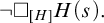



Note the difference between $\square _{[F]}$
and
$\square _{[F]}$
and $\square _{F}$
: The former expresses truth in virtue of the nature of being F, so the property of being F is the subject of the essentialist attribution, whereas the latter expresses truth in virtue of the nature of the entities which instantiate F, so the entities in the extension of F are the (collective) subject of the essentialist attribution.
$\square _{F}$
: The former expresses truth in virtue of the nature of being F, so the property of being F is the subject of the essentialist attribution, whereas the latter expresses truth in virtue of the nature of the entities which instantiate F, so the entities in the extension of F are the (collective) subject of the essentialist attribution.
3 The system
In this section, we present the proof system of HLE. The system HLE is constituted by the following axioms and rules.
-
(i) Background logic:
-
(PC)
$\phi $
, whenever
$\phi $
is a tautology. -
(UI)
$\forall _{\tau }(F)\rightarrow F(A).$
-
(EG)
$F(A)\rightarrow \exists _{\tau }(F).$
-
(MP) If
$\vdash \phi $
and
$\vdash \phi \rightarrow \psi $
, then
$\vdash \psi .$
-
(GEN) If
$\vdash \phi \rightarrow \psi $
and x is free in
$\psi $
but not
$\phi $
, then
$\vdash \phi \rightarrow \forall _{\tau }x(\psi ).$
-
(INST) If
$\vdash \phi \rightarrow \psi $
and x is free in
$\phi $
but not
$\psi $
, then
$\vdash \exists _{\tau }x(\phi )\rightarrow \psi .$
-
(Ref)
$F=_{\sigma }F.$
-
(LL)
$F=_{\sigma }G\rightarrow (\phi [G/x]\rightarrow \phi [F/x]).$
-
(β-conversion)
$\phi \leftrightarrow \phi ^{*}$
, where
$\phi ^{*}$
results from
$\phi $
by replacing some constituent of the form
$(\lambda x_{1}\ldots x_{n}.\psi )(t_{1},\ldots ,t_{n})$
with
$\psi [t_{i}/x_{i}].$
-
(η-conversion)
$\phi \leftrightarrow \phi ^{*}$
, where
$\phi ^{*}$
results from
$\phi $
by replacing some constituent of the form
$(\lambda x_{1}\ldots x_{k}.F(x_{1},\ldots ,x_{k}))$
, where none of
$x_{1},\ldots ,x_{k}$
is free in F, with
$F.$
-
-
(ii) Background essentialist axioms
-
(Permutation)
$\square _{F_{1},\ldots ,F_{n}}\phi \rightarrow \square _{F_{\pi (1)},\ldots ,F_{\pi (n)}}\phi $
, where
$\pi $
is a permutation of
$1,\ldots ,n.$
-
(Idempotence)
$\square _{F_{1},\ldots ,F_{n}}\phi \rightarrow \square _{F_{1},\ldots ,F_{n-1}}\phi $
, if
$F_{n}=F_{i}$
, for some
$i=1,\ldots ,n-1.$
-
(Separation)
$\square _{F_{1},\ldots ,F_{n},\lambda x.(G(x)\vee H(x))}\phi \rightarrow \square _{F_{1},\ldots ,F_{n},G,H}\phi .$
-
(Subtraction)
$\forall x^{\sigma }\neg F_{n+1}(x)\rightarrow (\square _{F_{1},\ldots ,F_{n+1}}\phi \leftrightarrow \square _{F_{1},\ldots ,F_{n}}\phi ).$
-
(MON)
$\forall x^{\sigma }(F_{1}(x)\rightarrow G(x))\rightarrow (\square _{F_{1},\ldots F_{k}}\phi \rightarrow \square _{G,F_{2},\ldots ,F_{k}}\phi )$
,
$1\leq k.$
-
(Decomposition)
$\square _{F_{1},\ldots ,F_{k},[B]}\phi \rightarrow \square _{F_{1},\ldots ,F_{k},[A_{1}],\ldots ,[A_{n}]}\phi $
, where
$A_{1},\ldots ,A_{n}$
are all the constants and free variables of
$B.$
-
-
(iii) Axioms for rigidity
-
(R-Comp)
$\forall X^{\langle \sigma \rangle }\exists Y^{[\sigma ]}\forall x^{\sigma }(X(x)\leftrightarrow Y(x)).$
-
(R-Ext)
$\forall X^{[\sigma ]}\forall Y^{[\sigma ]}(\forall x^{\sigma }(X(x)\leftrightarrow Y(x))\rightarrow X=_{[\sigma ]}Y).$
-
(Rigidity)
$R^{[\sigma ]}(x)\rightarrow \square _{R}R(x).$
-
(R-Equiv)
$\square _{R,F_{1},\ldots ,F_{n}}\phi \leftrightarrow \square _{[R],F_{1},\ldots ,F_{n}}\phi $
, where R is a rigid predicate.
-
-
(iv) Core essentialist axioms and rules
-
(CH)
$\square _{G_{1},\ldots ,G_{n},c_{\sigma }(F_{1},\ldots ,F_{k})}\phi \rightarrow \square _{G_{1},\ldots ,G_{n},F_{1},\ldots ,F_{k}}\phi .$
-
(RC) If
$\vdash \phi _{1}\wedge \cdots \wedge \phi _{n}\rightarrow \psi $
, then
$\vdash \square _{F_{1},\ldots ,F_{k}}\phi _{1}\wedge \cdots \wedge \square _{F_{1},\ldots ,F_{k}}\phi _{n}\rightarrow \square _{F_{1},\ldots ,F_{k},[A_{1}],\ldots ,[A_{m}]}\psi $
, where
$A_{1},\ldots ,A_{m}$
are all the constants and free variables occurring in
$\psi $
but not any of
$\phi _{1},\ldots ,\phi _{n.}$
-
(T)
$\square _{F_{1},\ldots ,F_{n}}\phi \rightarrow \phi .$
-
(4)
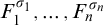
$\square _{F_{1},\ldots ,F_{n}}\phi \rightarrow \square _{F_{1},\ldots ,F_{n},[\square _{\sigma _{1},\ldots ,\sigma _{n}}]}\square _{F_{1},\ldots ,F_{n}}\phi $
, whenever
$F^{\sigma _{1}}_{1},\ldots ,F^{\sigma _{n}}_{n}$
are rigid predicates. -
(5)
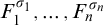
$\neg \square _{F_{1},\ldots ,F_{n}}\phi \rightarrow \square _{F_{1},\ldots ,F_{n},[\neg ],[\square _{\sigma _{1},\ldots ,\sigma _{n}}],[\phi ]}\neg \square _{F_{1},\ldots ,F_{n}}\phi $
, whenever
$F^{\sigma _{1}}_{1},\ldots ,F^{\sigma _{n}}_{n}$
are rigid predicates.
-













































I will only briefly comment on the rationale for the different axioms and rules. For a more detailed justification, the reader is referred to Ditter [Reference Ditter15]. The background logic consists of the principles of classical higher-order logic with identity together with the standard principles of $\beta $
- and
$\beta $
- and $\eta $
-conversion. The first five axioms in group (ii) capture the principle of Monotonicity: If X is a subcollection of Y, then if it lies in the nature of X that
$\eta $
-conversion. The first five axioms in group (ii) capture the principle of Monotonicity: If X is a subcollection of Y, then if it lies in the nature of X that $\phi $
then it lies in the nature of Y that
$\phi $
then it lies in the nature of Y that $\phi $
. They do so by making sure that if the predicates
$\phi $
. They do so by making sure that if the predicates $F_{1},\ldots ,F_{n}$
pick out some entities that form a (proper or improper) subcollection of the entities picked out by
$F_{1},\ldots ,F_{n}$
pick out some entities that form a (proper or improper) subcollection of the entities picked out by $G_{1},\ldots , G_{m}$
, then
$G_{1},\ldots , G_{m}$
, then $\square _{F_{1},\ldots ,F_{n}}\phi $
materially implies
$\square _{F_{1},\ldots ,F_{n}}\phi $
materially implies $\square _{G_{1},\ldots ,G_{m}}\phi $
.Footnote
10
In writing formal proofs, I will often refer to one or more of these axioms simply by ‘Monotonicity’.
$\square _{G_{1},\ldots ,G_{m}}\phi $
.Footnote
10
In writing formal proofs, I will often refer to one or more of these axioms simply by ‘Monotonicity’.
The principle of Decomposition says that whatever lies in the nature of an entity expressed by a term B also lies in the collective nature of the entities denoted by the free variables and constants occurring in B. For instance, Decomposition allows us to infer $\square _{[\forall ],[=]}\forall x(x= x)$
from
$\square _{[\forall ],[=]}\forall x(x= x)$
from $\square _{[\forall x(x= x)]}\forall x(x= x)$
.Footnote
11
Model-theoretically, Decomposition corresponds to the condition that the denotation of a term exists at a world if the denotations of all of its constants and free variables exist at that world. This condition is crucial not only for the validity of Decomposition but for virtually every principle of the system, as the proof of the Soundness Theorem (Theorem 1) will illustrate.
$\square _{[\forall x(x= x)]}\forall x(x= x)$
.Footnote
11
Model-theoretically, Decomposition corresponds to the condition that the denotation of a term exists at a world if the denotations of all of its constants and free variables exist at that world. This condition is crucial not only for the validity of Decomposition but for virtually every principle of the system, as the proof of the Soundness Theorem (Theorem 1) will illustrate.
The axioms in group (iii) state characteristic principles for rigid properties. R-Comp says that for any property of any type there is a rigid property coextensive with it.Footnote 12 R-Ext is an extensionality principle for rigid properties. It says that coextensiveness suffices for the identity of rigid properties. This is in line with our thinking of rigid properties as predicative analogs of pluralities. The axiom of Rigidity says that if x is one of some entities, then it lies in the nature of those entities that x is one of them. This axiom is a higher-order generalization of Fine’s axiom of Rigidity in LE. R-Equiv concerns the relation between a rigid property and its extension. It says that whatever lies in the nature of a rigid property lies in the collective nature of the entities in its extension, and vice versa. The nature of a rigid property is thus exhausted by the collective nature of the entities that it applies to. R-Equiv and Rigidity together entail that if x is one of some entities, then it lies in the nature of the property of being one of those entities that x is one of them. This is analogous to the essentialist principle about sets and pluralities that says that sets and pluralities have their members essentially.
The last three axiom schemas in group (iv) are essentialist analogs of the modal T-, 4- and 5-schemas. The T-schema says that whatever is true in virtue of the nature of a collection of entities is true. The 4-principle says that if $\phi $
is true in virtue of the nature of a collection X, then it is true in virtue of the nature of X together with the nature of essentiality (i.e., what is expressed by the essentialist operator) that it is true in virtue of the nature of X that
$\phi $
is true in virtue of the nature of a collection X, then it is true in virtue of the nature of X together with the nature of essentiality (i.e., what is expressed by the essentialist operator) that it is true in virtue of the nature of X that $\phi $
. In conjunction with the widely accepted principle that essence implies necessity (i.e., if
$\phi $
. In conjunction with the widely accepted principle that essence implies necessity (i.e., if $\phi $
is true in virtue of the nature of some entities then
$\phi $
is true in virtue of the nature of some entities then $\phi $
is necessary), the 4-principle entails the plausible claim that whatever is true in virtue of the nature of a collection X is necessarily true in virtue of the nature of X—entities have their essence necessarily.
$\phi $
is necessary), the 4-principle entails the plausible claim that whatever is true in virtue of the nature of a collection X is necessarily true in virtue of the nature of X—entities have their essence necessarily.
In stating the essentialist 4-schema in our formal language it is crucial that the predicates $F_{1},\ldots ,F_{n}$
be rigid, since the inner essentialist operator in the consequent should have the same subject as the operator in the antecedent. The schema does not in general hold for non-rigid predicates. For example, suppose that Mary is wearing a hat and that it is essential to the hat wearers that Mary is human. Then it may be false that it is essential to the hat wearers, taken together with essentiality, that it is essential to the hat wearers that Mary is human, since it may not be the case that it is essential to Mary to be wearing a hat, and so it may not be essential to whoever is wearing a hat that Mary is human. Such a case is averted if the predicates in (4) rigidly pick out Mary.
$F_{1},\ldots ,F_{n}$
be rigid, since the inner essentialist operator in the consequent should have the same subject as the operator in the antecedent. The schema does not in general hold for non-rigid predicates. For example, suppose that Mary is wearing a hat and that it is essential to the hat wearers that Mary is human. Then it may be false that it is essential to the hat wearers, taken together with essentiality, that it is essential to the hat wearers that Mary is human, since it may not be the case that it is essential to Mary to be wearing a hat, and so it may not be essential to whoever is wearing a hat that Mary is human. Such a case is averted if the predicates in (4) rigidly pick out Mary.
The same restriction to rigid predicates is required in the statement of the essentialist 5-principle. This principle says that if it is not true in virtue of the nature of a collection X that $\phi $
, then it is true in virtue of the nature of X together with negation, essentiality and
$\phi $
, then it is true in virtue of the nature of X together with negation, essentiality and $\phi $
that it is not true in virtue of the nature of X that
$\phi $
that it is not true in virtue of the nature of X that $\phi $
. Together with the principle that essence implies necessity, (5) entails that if
$\phi $
. Together with the principle that essence implies necessity, (5) entails that if $\phi $
is not true in virtue of the nature of X, then this is necessarily so—the nature of X could not have been richer.Footnote
13
$\phi $
is not true in virtue of the nature of X, then this is necessarily so—the nature of X could not have been richer.Footnote
13
The first two principles in group (iv) are the key components of the account of logical closure provided by HLE. The principle CH is a generalization of the ‘chaining axiom’ from LE to our higher-order framework. Recall that $c_{\sigma }(F_{1},\ldots ,F_{k})$
picks out the collection of entities of type
$c_{\sigma }(F_{1},\ldots ,F_{k})$
picks out the collection of entities of type $\sigma $
involved in the nature of the entities picked out by
$\sigma $
involved in the nature of the entities picked out by $F_{1},\ldots ,F_{k}$
. Let p be some proposition true in virtue of the collective nature of the entities in
$F_{1},\ldots ,F_{k}$
. Let p be some proposition true in virtue of the collective nature of the entities in $c_{\sigma }(F_{1},\ldots ,F_{k})$
. Then CH says that p is also true in virtue of the collective nature of the entities picked out by
$c_{\sigma }(F_{1},\ldots ,F_{k})$
. Then CH says that p is also true in virtue of the collective nature of the entities picked out by $F_{1},\ldots ,F_{k}$
. Thus every collection of entities inherits the collective natures of the entities involved in its nature. RC is a closure principle for essences. In HLE, any type of logical closure manifested by the essence of a collection of entities derives from the logical operations involved in the essence of the collection. So, for example, the essence of a collection of entities will be closed under conjunction elimination and introduction just in case the essence of the collection involves conjunction, and it will be closed under modus ponens just in case it involves the conditional. For a concrete example, suppose it lies in the nature of the number two that it is a number and even (
$F_{1},\ldots ,F_{k}$
. Thus every collection of entities inherits the collective natures of the entities involved in its nature. RC is a closure principle for essences. In HLE, any type of logical closure manifested by the essence of a collection of entities derives from the logical operations involved in the essence of the collection. So, for example, the essence of a collection of entities will be closed under conjunction elimination and introduction just in case the essence of the collection involves conjunction, and it will be closed under modus ponens just in case it involves the conditional. For a concrete example, suppose it lies in the nature of the number two that it is a number and even ( $\square _{[2]}(N(2)\wedge E(2))$
). RC then immediately implies that it lies in the nature of the number two that it is a number (
$\square _{[2]}(N(2)\wedge E(2))$
). RC then immediately implies that it lies in the nature of the number two that it is a number ( $\square _{[2]}N(2)$
). The rationale for closure under conjunction elimination is that the hypothesis implies that the nature of the number two involves conjunction (in the sense of involvement defined above), since
$\square _{[2]}N(2)$
). The rationale for closure under conjunction elimination is that the hypothesis implies that the nature of the number two involves conjunction (in the sense of involvement defined above), since $\square _{[2]}(N(2)\wedge E(2))$
implies
$\square _{[2]}(N(2)\wedge E(2))$
implies $\square _{[2]}\lambda X.(X(N(2),E(2))(\wedge )$
by
$\square _{[2]}\lambda X.(X(N(2),E(2))(\wedge )$
by $\beta $
-conversion, which implies
$\beta $
-conversion, which implies $2\geq \wedge $
by
$2\geq \wedge $
by $\beta $
-conversion and EG. The converse implication is only valid under the additional assumption that the number two involves conjunction. By RC alone we have that
$\beta $
-conversion and EG. The converse implication is only valid under the additional assumption that the number two involves conjunction. By RC alone we have that $\square _{[2]}N(2)$
and
$\square _{[2]}N(2)$
and $\square _{[2]}E(2)$
together imply (*)
$\square _{[2]}E(2)$
together imply (*) $\square _{[2],[\wedge ]}(N(2)\wedge E(2))$
; if we further assume
$\square _{[2],[\wedge ]}(N(2)\wedge E(2))$
; if we further assume $2\geq \wedge $
, then
$2\geq \wedge $
, then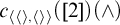 $c_{\langle \langle \rangle ,\langle \rangle \rangle }([2])(\wedge )$
and thus
$c_{\langle \langle \rangle ,\langle \rangle \rangle }([2])(\wedge )$
and thus $\square _{[2],c_{\langle \langle \rangle ,\langle \rangle \rangle }([2])}(N(2)\wedge E(2))$
by Monotonicity and (*), whence
$\square _{[2],c_{\langle \langle \rangle ,\langle \rangle \rangle }([2])}(N(2)\wedge E(2))$
by Monotonicity and (*), whence $\square _{[2]}(N(2)\wedge E(2))$
follows by CH and Monotonicity. RC and CH together imply that the nature of a collection of entities is closed under precisely those consequences that are stated solely in terms of vocabulary expressing entities that are involved in the nature of the collection.
$\square _{[2]}(N(2)\wedge E(2))$
follows by CH and Monotonicity. RC and CH together imply that the nature of a collection of entities is closed under precisely those consequences that are stated solely in terms of vocabulary expressing entities that are involved in the nature of the collection.
The special case of RC where $n=0$
gives us the following essentialist “necessitation-rule”:
$n=0$
gives us the following essentialist “necessitation-rule”:
-
(RC0) If
$\vdash \psi $
, then
$\vdash \square _{[A_{1}],\ldots ,[A_{m}]}\psi $
, where
$A_{1},\ldots ,A_{m}$
are all the constants and free variables occurring in
$\psi .$




RC $^{0}$
implies that every logical truth whose only constants are logical constants is true in virtue of the nature of the logical operations expressed by these constants. So, for example, since
$^{0}$
implies that every logical truth whose only constants are logical constants is true in virtue of the nature of the logical operations expressed by these constants. So, for example, since $\forall x(x= x)$
is a logical truth whose only constants are
$\forall x(x= x)$
is a logical truth whose only constants are $\forall $
and
$\forall $
and $=$
, RC
$=$
, RC $^{0}$
implies
$^{0}$
implies $\square _{[\forall ],[=]}\forall x(x= x)$
. Note, however, that RC
$\square _{[\forall ],[=]}\forall x(x= x)$
. Note, however, that RC $^{0}$
does not imply that every logical truth is true solely in virtue of some logical operations. This would have the implausible consequence that the collective nature of the logical operations involves absolutely every entity of any type, but plausibly the nature of identity does not involve Socrates, for example.
$^{0}$
does not imply that every logical truth is true solely in virtue of some logical operations. This would have the implausible consequence that the collective nature of the logical operations involves absolutely every entity of any type, but plausibly the nature of identity does not involve Socrates, for example.
Correia [Reference Correia8, Reference Correia and Dumitru9] has proposed an account of the way in which essences are closed under logical consequence which differs in important ways from the account proposed here. A brief comparison between HLE and Correia’s account will be instructive. Correia’s target notion of essence, which he calls the ‘Finean notion of essence’, is characterized in terms of a primitive notion of a proposition being basically essential to a plurality (the logic of which is not specified), and a relation of relative logical consequence, defined as follows:Footnote 14
Given any proposition $\alpha $
, plurality of propositions
$\alpha $
, plurality of propositions $\Delta $
, and set of logical concepts S, say that
$\Delta $
, and set of logical concepts S, say that $\alpha $
is a logical consequence of
$\alpha $
is a logical consequence of $\Delta $
relative to S iff there is a proof of
$\Delta $
relative to S iff there is a proof of $\alpha $
from
$\alpha $
from $\Delta $
, such that given any rule concerning a logical concept which appears in that proof, that concept is a member of S. (See Correia [Reference Correia8, p. 647])
$\Delta $
, such that given any rule concerning a logical concept which appears in that proof, that concept is a member of S. (See Correia [Reference Correia8, p. 647])
After providing some general structural principles guiding the relation of relative logical consequence (the details of which don’t matter for present purposes), Correia goes on to define what he calls the ‘Finean notion of essence’, thus:
[A proposition] $\alpha $
is true in virtue of the nature of [a plurality] X just in case
$\alpha $
is true in virtue of the nature of [a plurality] X just in case $\alpha $
is a logical consequence, relative to the logical concepts in X, of the basic nature of X.Footnote
15
(Ibid., p. 648)
$\alpha $
is a logical consequence, relative to the logical concepts in X, of the basic nature of X.Footnote
15
(Ibid., p. 648)
I will refer to the propositions that are true in virtue of the nature of X so defined as just the essence or nature of X. According to Correia, this notion of essence differs importantly from Fine’s consequential notion, since, e.g., ‘the propositions which are true in virtue of the nature of Socrates are, on the proposed account, just the propositions which belong to his basic nature.’ (ibid.) More generally, he maintains, ‘in case X comprises no logical concepts, the propositions which are true in virtue of the nature of X are just those which belong to the basic nature of X.’ (ibid.) Thus, in contrast to HLE, the logical closure of the essence of X does not depend on which logical concepts are involved in the nature of X, but only on whether X comprises any logical concepts. The notion of essential involvement plays no role in Correia’s account.
This leads to some interestingly different predictions about the logical closure properties of essences. It is consistent with both accounts that, say, Socrates’ nature is “logically simple” in the sense of not being closed under logical consequence at all. However, if it is essential to Socrates that he is human and mortal ( $\square _{[s]}(H(s)\wedge M(s))$
), then HLE entails that he is essentially human (
$\square _{[s]}(H(s)\wedge M(s))$
), then HLE entails that he is essentially human ( $\square _{[s}H(s)$
) and essentially mortal (
$\square _{[s}H(s)$
) and essentially mortal ( $\square _{[s]}M(s)$
), whereas this doesn’t follow on Correia’s account. Furthermore, Correia’s account predicts that it lies in the nature of identity alone that Socrates is self-identical, because the proposition that Socrates is self-identical can be proved using only an instance of (Ref), whereas in HLE this can be consistently denied, because we can consistently deny that the nature of identity involves Socrates.
$\square _{[s]}M(s)$
), whereas this doesn’t follow on Correia’s account. Furthermore, Correia’s account predicts that it lies in the nature of identity alone that Socrates is self-identical, because the proposition that Socrates is self-identical can be proved using only an instance of (Ref), whereas in HLE this can be consistently denied, because we can consistently deny that the nature of identity involves Socrates.
However, there are some important details about Correia’s account that need to be spelled out before we can offer a more systematic comparison between it and HLE. As we have seen above, and as Correia himself stresses, his proposal crucially rests on taking the relation of relative logical consequence, as well as the notions of proof and rule of inference in terms of which it is defined, not to be relations between sentences (as logical consequence is usually defined) but to be relations between propositions (ibid. p. 647 fn. 10). (Otherwise the account would be problematically meta-linguistic.) But the usual characterizations of the notions of proof and rule of inference crucially presuppose various syntactic notions which do not obviously have propositional analogs. For example, in order to state an inference rule governing a given connective, we need to be able to identify the occurrence of the connective in a certain syntactic position of a formula. But unless propositions are structured in something like the way sentences are structured—an assumption that we have reason to question, given the Russell–Myhill paradoxFootnote 16 —it is not obvious that there are propositional analogs of these notions which work in the intended way. Without further details, it thus remains an open question how Correia’s central notion of relative logical consequence as well as the corresponding notion of essence are to be understood, and whether they can ultimately be developed in a consistent way.
4 Some theorems
This section establishes a number of theorems of HLE and discusses their philosophical ramifications. Principles of classical logic will be referred to by the label ‘CL’. Theoremhood is defined in the usual way. We begin with a useful consequence of the Monotonicity axioms.
Proposition 1.
-
(i)
$\vdash \square _{F_{1},\ldots ,F_{n}}\phi \rightarrow \square _{G,F_{1},\ldots ,F_{n}}\phi .$
-
(ii)
$\vdash \square _{F_{1},\ldots ,F_{k}}\phi \rightarrow \square _{F_{1},\ldots ,F_{n}}\phi $
,
$k\leq n.$



Proof. (i) By Subtraction, Permutation and CL, $\vdash \square _{F_{1},\ldots ,F_{n}}\phi \rightarrow \square _{\lambda x.\neg (x=_{\sigma }x),F_{1},\ldots ,F_{n}}\phi $
. This yields
$\vdash \square _{F_{1},\ldots ,F_{n}}\phi \rightarrow \square _{\lambda x.\neg (x=_{\sigma }x),F_{1},\ldots ,F_{n}}\phi $
. This yields $\vdash \square _{F_{1},\ldots ,F_{n}}\phi \rightarrow \square _{G,F_{1},\ldots ,F_{n}}\phi $
by MON and CL.
$\vdash \square _{F_{1},\ldots ,F_{n}}\phi \rightarrow \square _{G,F_{1},\ldots ,F_{n}}\phi $
by MON and CL.
(ii) From (i).
From now on, I will normally use the label ‘Monotonicity’ to refer to either Proposition 1 or one or more of the Monotonicity axioms. The following result concerns some important properties of the relation $\geq $
of essential involvement between particular entities.
$\geq $
of essential involvement between particular entities.
Proposition 2.
-
(i)
$\vdash A\geq _{\sigma ,\sigma }A.$
-
(ii)
$\vdash A\geq _{\tau ,\sigma }B\wedge B\geq _{\sigma ,\rho }C\rightarrow A\geq _{\tau ,\rho }C.$
-
(iii)
$\vdash B[A/x]\geq _{\sigma ,\tau } A$
, provided x is free in
$B.$
-
(iv)
$\vdash \forall x^{\sigma }\exists p^{\langle \rangle }(p\geq x\wedge x\geq p).$





Proof. (i) By Monotonicity, (1) $\vdash \forall y(X^{[\sigma ]}(y)\leftrightarrow (\lambda z.z=_{\sigma }A)(y))\rightarrow ((\square _{X}\phi \leftrightarrow \square _{[A]}\phi )$
. By CL, (2)
$\vdash \forall y(X^{[\sigma ]}(y)\leftrightarrow (\lambda z.z=_{\sigma }A)(y))\rightarrow ((\square _{X}\phi \leftrightarrow \square _{[A]}\phi )$
. By CL, (2) $\vdash \forall y(X^{[\sigma ]}(y)\leftrightarrow (\lambda z.z=_{\sigma }A)(y))\rightarrow X(A)$
. From this, (3)
$\vdash \forall y(X^{[\sigma ]}(y)\leftrightarrow (\lambda z.z=_{\sigma }A)(y))\rightarrow X(A)$
. From this, (3) $\vdash \forall y(X^{[\sigma ]}(y)\leftrightarrow (\lambda z.z=_{\sigma }A)(y))\rightarrow \square _{X}X(A)$
by the instance
$\vdash \forall y(X^{[\sigma ]}(y)\leftrightarrow (\lambda z.z=_{\sigma }A)(y))\rightarrow \square _{X}X(A)$
by the instance $X^{[\sigma ]}(A)\rightarrow \square _{X}X(A)$
of Rigidity. Combining (1) and (3) we obtain (4)
$X^{[\sigma ]}(A)\rightarrow \square _{X}X(A)$
of Rigidity. Combining (1) and (3) we obtain (4) $\vdash \forall y(X^{[\sigma ]}(y)\leftrightarrow (\lambda z.z=_{\sigma }A)(y))\rightarrow \exists X^{[\sigma ]}\square _{[A]}X(A)$
. Hence, by CL, (5)
$\vdash \forall y(X^{[\sigma ]}(y)\leftrightarrow (\lambda z.z=_{\sigma }A)(y))\rightarrow \exists X^{[\sigma ]}\square _{[A]}X(A)$
. Hence, by CL, (5) $\vdash \exists X^{[\sigma ]}\forall y(X^{[\sigma ]}(y)\leftrightarrow (\lambda z.z=_{\sigma }A)(y))\rightarrow \exists X^{[\sigma ]}\square _{[A]}X(A)$
. But the antecedent of (5) is an instance of R-Comp, so (6)
$\vdash \exists X^{[\sigma ]}\forall y(X^{[\sigma ]}(y)\leftrightarrow (\lambda z.z=_{\sigma }A)(y))\rightarrow \exists X^{[\sigma ]}\square _{[A]}X(A)$
. But the antecedent of (5) is an instance of R-Comp, so (6) $\vdash \exists X^{[\sigma ]}\square _{[A]}X(A)$
. By
$\vdash \exists X^{[\sigma ]}\square _{[A]}X(A)$
. By $\beta $
-conversion, (7)
$\beta $
-conversion, (7) $\vdash \square _{[A]}X(A)\leftrightarrow \square _{[A]}(\lambda x.X(x))(A)$
. From this,
$\vdash \square _{[A]}X(A)\leftrightarrow \square _{[A]}(\lambda x.X(x))(A)$
. From this, $A\geq _{\sigma ,\sigma }A$
follows by (6) and CL.
$A\geq _{\sigma ,\sigma }A$
follows by (6) and CL.
(ii) By $\beta $
-conversion, (1)
$\beta $
-conversion, (1) $\vdash A\geq _{\tau ,\sigma }B\rightarrow c_{\sigma }([A])(B)$
. By Monotonicity, (2)
$\vdash A\geq _{\tau ,\sigma }B\rightarrow c_{\sigma }([A])(B)$
. By Monotonicity, (2) $\vdash \forall z^{\sigma }(\lambda x.(x= B)(z)\rightarrow c_{\sigma }([A])(z))\rightarrow (\square _{[B]}\phi \rightarrow \square _{c_{\sigma }([A])}\phi )$
. By CH, (3)
$\vdash \forall z^{\sigma }(\lambda x.(x= B)(z)\rightarrow c_{\sigma }([A])(z))\rightarrow (\square _{[B]}\phi \rightarrow \square _{c_{\sigma }([A])}\phi )$
. By CH, (3) $\vdash \square _{c_{\sigma }([A])}\phi \rightarrow \square _{[A]}\phi $
. From (1), (2), (3) and CL, (4)
$\vdash \square _{c_{\sigma }([A])}\phi \rightarrow \square _{[A]}\phi $
. From (1), (2), (3) and CL, (4) $\vdash A\geq _{\tau ,\sigma }B\wedge \square _{[B]}X(C)\rightarrow \exists Y\square _{[A]}Y(C)$
. From this, the claim follows by CL and the definition of
$\vdash A\geq _{\tau ,\sigma }B\wedge \square _{[B]}X(C)\rightarrow \exists Y\square _{[A]}Y(C)$
. From this, the claim follows by CL and the definition of $\geq $
.
$\geq $
.
(iii) By $\beta $
-conversion, (1)
$\beta $
-conversion, (1) $\vdash \square _{[B[A/x]]}Y(B[A/x])\rightarrow \square _{[B[A/x]]}(\lambda x.Y(B))(A)$
, where Y is a variable distinct from x not free in B or A. From (1), we obtain (2)
$\vdash \square _{[B[A/x]]}Y(B[A/x])\rightarrow \square _{[B[A/x]]}(\lambda x.Y(B))(A)$
, where Y is a variable distinct from x not free in B or A. From (1), we obtain (2) $\vdash \square _{[B[A/x]]}Y(B[A/x])\rightarrow \exists X\square _{[B[A/x]]}X(A)$
by CL. By item (i) we have (3)
$\vdash \square _{[B[A/x]]}Y(B[A/x])\rightarrow \exists X\square _{[B[A/x]]}X(A)$
by CL. By item (i) we have (3) $\vdash \exists Y\square _{[B[A/x]]}Y(B[A/x])$
, which together with (2) entails
$\vdash \exists Y\square _{[B[A/x]]}Y(B[A/x])$
, which together with (2) entails $\vdash B[A/x]\geq A$
by CL.
$\vdash B[A/x]\geq A$
by CL.
(iv) The claim immediately follows from R-Comp, $\beta $
-conversion and
$\beta $
-conversion and $\vdash \forall y(X^{[\sigma ]}(y)\leftrightarrow (\lambda z.z=_{\sigma }x)(y))\rightarrow (\square _{[x]}X(x)\wedge (X(x)\geq X(x)))$
, which follows from Rigidity, Monotonicity and part (i).
$\vdash \forall y(X^{[\sigma ]}(y)\leftrightarrow (\lambda z.z=_{\sigma }x)(y))\rightarrow (\square _{[x]}X(x)\wedge (X(x)\geq X(x)))$
, which follows from Rigidity, Monotonicity and part (i).
Proposition 2(i) and (ii) concern the reflexivity and transitivity of $\geq $
, respectively. Part (iv) shows that the relation
$\geq $
, respectively. Part (iv) shows that the relation $\geq $
is not asymmetric across types: For every entity of any type, there is a proposition such that the nature of the entity involves the proposition and the nature of the proposition involves the entity. Let us call the rigid property that applies to x and only x the haecceity of x. (Uniqueness is justified by R-Ext.) When F is the haecceity of x, we say that
$\geq $
is not asymmetric across types: For every entity of any type, there is a proposition such that the nature of the entity involves the proposition and the nature of the proposition involves the entity. Let us call the rigid property that applies to x and only x the haecceity of x. (Uniqueness is justified by R-Ext.) When F is the haecceity of x, we say that $F(x)$
is the haecceity proposition of x. For any x, the haecceity proposition of x is a canonical example of a proposition whose nature involves x and which is involved in the nature of x. Although Proposition 2(iv) crucially relies on Rigidity, it is worth noting that the same result would follow without Rigidity if we posited that for any entity x, there is a proposition true in virtue of the nature of x that predicates something of x.
$F(x)$
is the haecceity proposition of x. For any x, the haecceity proposition of x is a canonical example of a proposition whose nature involves x and which is involved in the nature of x. Although Proposition 2(iv) crucially relies on Rigidity, it is worth noting that the same result would follow without Rigidity if we posited that for any entity x, there is a proposition true in virtue of the nature of x that predicates something of x.
We now turn to some important consequences of CH.
Proposition 3.
-
(i)
$\vdash (F_{1},\ldots ,F_{n})\succeq _{\sigma }A\wedge \square _{G_{1},\ldots ,G_{k},[A]}\phi \rightarrow \square _{G_{1},\ldots ,G_{k},F_{1},\ldots ,F_{n}}\phi $
; -
(ii)
$\vdash \square _{F_{1},\ldots ,F_{n}}\phi \wedge \square _{[\phi ]}\psi \rightarrow \square _{F_{1},\ldots ,F_{n}}\psi ;$
-
(iii)
$\vdash \square _{F_{1},\ldots ,F_{n}}\phi \wedge \phi \geq _{\langle \rangle , \sigma }A\rightarrow (F_{1},\ldots ,F_{n})\succeq _{\sigma }A;$
-
(iv)
$\vdash \square _{F_{1},\ldots ,F_{k},[A_{1}],\ldots ,[A_{n}]}\phi \rightarrow \square _{F_{1},\ldots ,F_{k},[B]}\phi $
, where
$A_{1},\ldots ,A_{n}$
are all the constants and free variables of
$B.$






Proof. (i) By $\beta $
-conversion,
$\beta $
-conversion, $\vdash (F_{1},\ldots ,F_{n})\succeq _{\sigma }A\rightarrow c_{\sigma }(F_{1},\ldots ,F_{n})(A)$
. By Monotonicity,
$\vdash (F_{1},\ldots ,F_{n})\succeq _{\sigma }A\rightarrow c_{\sigma }(F_{1},\ldots ,F_{n})(A)$
. By Monotonicity, $\vdash \forall z^{\sigma }(\lambda x.(x= A)(z)\rightarrow c_{\sigma }(F_{1},\ldots ,F_{n})(z))\rightarrow (\square _{G_{1},\ldots ,G_{k},[A]}\phi \rightarrow \square _{G_{1},\ldots ,G_{k},c_{\sigma } (F_{1},\ldots ,F_{n})}\phi )$
. By CH and CL we obtain
$\vdash \forall z^{\sigma }(\lambda x.(x= A)(z)\rightarrow c_{\sigma }(F_{1},\ldots ,F_{n})(z))\rightarrow (\square _{G_{1},\ldots ,G_{k},[A]}\phi \rightarrow \square _{G_{1},\ldots ,G_{k},c_{\sigma } (F_{1},\ldots ,F_{n})}\phi )$
. By CH and CL we obtain $\vdash (F_{1},\ldots ,F_{n})\succeq _{\sigma }A\wedge \square _{G_{1},\ldots ,G_{k},[A]}\phi \rightarrow \square _{G_{1},\ldots ,G_{k},F_{1},\ldots ,F_{n}}\phi $
.
$\vdash (F_{1},\ldots ,F_{n})\succeq _{\sigma }A\wedge \square _{G_{1},\ldots ,G_{k},[A]}\phi \rightarrow \square _{G_{1},\ldots ,G_{k},F_{1},\ldots ,F_{n}}\phi $
.
(ii) From (i).
(iii) From (ii).
(iv) Suppose $A_{1},\ldots ,A_{n}$
are all the constants and free variables of B. By Proposition 2(iii),
$A_{1},\ldots ,A_{n}$
are all the constants and free variables of B. By Proposition 2(iii), $\vdash B\geq A_{i}$
for
$\vdash B\geq A_{i}$
for $1\geq i\geq n$
. The claim then follows by n applications of part (i) and Monotonicity.
$1\geq i\geq n$
. The claim then follows by n applications of part (i) and Monotonicity.
Note that Proposition 3(iv) is the converse of Decomposition. Proposition 3(iii) bears resemblance to, but is importantly different from, the axiom of Localization in LE. The latter says that if $\phi $
is true in virtue of the nature of a collection of objects, then any object x which ‘occurs in’
$\phi $
is true in virtue of the nature of a collection of objects, then any object x which ‘occurs in’ $\phi $
is such that the nature of one of the members of the collection must involve x. Formally (in the language of HLE):Footnote
17
$\phi $
is such that the nature of one of the members of the collection must involve x. Formally (in the language of HLE):Footnote
17
-
(Localization)
$\square _{F}\phi \wedge x\eta \phi \rightarrow \exists y^{e}(F(y)\wedge y\geq _{e,e} x).$

We can state a higher-order generalization of Localization as follows, replacing $x\eta \phi $
with
$x\eta \phi $
with $\phi \geq _{\langle \rangle ,\sigma }x$
:Footnote
18
$\phi \geq _{\langle \rangle ,\sigma }x$
:Footnote
18
-
(Localization*)
$\square _{F_{1},F_{2},\ldots ,F_{n}}\phi \wedge \phi \geq x^{\sigma }\rightarrow (\exists x_{1}^{\sigma _{1}}(F_{1}(x_{1})\wedge x_{1}\geq x)\vee \cdots \vee \exists x_{n}^{\sigma _{n}} (F_{n}(x_{n})\wedge x_{n}\geq x)).$

Localization $^{*}$
says that if
$^{*}$
says that if $\phi $
is true in virtue of the nature of some collection of entities and the nature of
$\phi $
is true in virtue of the nature of some collection of entities and the nature of $\phi $
involves some entity x, then the nature of some member of the collection involves x.Footnote
19
The difference between Localization
$\phi $
involves some entity x, then the nature of some member of the collection involves x.Footnote
19
The difference between Localization $^{*}$
and Proposition 3(iii) is that the former requires the nature of a particular member of the collection to involve x, whereas the latter only requires the nature of the collection to involve x. Localization
$^{*}$
and Proposition 3(iii) is that the former requires the nature of a particular member of the collection to involve x, whereas the latter only requires the nature of the collection to involve x. Localization $^{*}$
immediately yields problematic results in HLE. For example, since both
$^{*}$
immediately yields problematic results in HLE. For example, since both $\square _{[\forall ],[\neg ],[\vee ]}\forall p(p\vee \neg p)$
and
$\square _{[\forall ],[\neg ],[\vee ]}\forall p(p\vee \neg p)$
and $\forall p(p\vee \neg p)\geq \forall p(p\vee \neg p)$
are theorems of HLE (by RC
$\forall p(p\vee \neg p)\geq \forall p(p\vee \neg p)$
are theorems of HLE (by RC $^{0}$
and Proposition 2(i), respectively), Localization
$^{0}$
and Proposition 2(i), respectively), Localization $^{*}$
implies that the nature of one of
$^{*}$
implies that the nature of one of $\forall $
,
$\forall $
, $\neg $
or
$\neg $
or $\vee $
involves
$\vee $
involves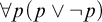 $\forall p(p\vee \neg p)$
, and therefore each of
$\forall p(p\vee \neg p)$
, and therefore each of $\forall $
,
$\forall $
, $\neg $
and
$\neg $
and $\vee $
since the nature of
$\vee $
since the nature of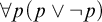 $\forall p(p\vee \neg p)$
involves each of them (by Proposition 2(ii) and (iii). Similarly, if it is true in virtue of the nature of x and y that they are distinct, then it follows from Localization
$\forall p(p\vee \neg p)$
involves each of them (by Proposition 2(ii) and (iii). Similarly, if it is true in virtue of the nature of x and y that they are distinct, then it follows from Localization $^{*}$
and the theoremhood of
$^{*}$
and the theoremhood of $\neg (x= y)\geq \neg (x= y)$
that either x or y involves the proposition
$\neg (x= y)\geq \neg (x= y)$
that either x or y involves the proposition $\neg (x= y)$
; hence, it follows that either x involves y or vice versa, since the nature of the proposition
$\neg (x= y)$
; hence, it follows that either x involves y or vice versa, since the nature of the proposition $\neg (x= y)$
involves both x and y.Footnote
20
$\neg (x= y)$
involves both x and y.Footnote
20
Although the failure of the higher-order generalization already presents at least a prima facie reason to reject Localization, the above problems for Localization $^{*}$
make crucial use of higher-order resources and therefore do not directly challenge Fine’s first-order principle of Localization. However, potential counterexamples to Localization are not hard to come by. Fine [Reference Fine21, p. 249 f.] himself notes that potential counterexamples to Localization arise from cases ‘in which the nature of several objects is simultaneously understood in terms of one another.’ He discusses the following kind of case.Footnote
21
Suppose it lies in the nature of a mind and body taken together to comprise a given person. Localization then entails that either the nature of the mind or the nature of the body involves the person. But it is natural to think that the person is not involved in the nature of either of them, taken individually.Footnote
22
However, Fine does not take this case to be a counterexample to Localization. But the reason is not that he argues that such a case is impossible; rather, he holds that
$^{*}$
make crucial use of higher-order resources and therefore do not directly challenge Fine’s first-order principle of Localization. However, potential counterexamples to Localization are not hard to come by. Fine [Reference Fine21, p. 249 f.] himself notes that potential counterexamples to Localization arise from cases ‘in which the nature of several objects is simultaneously understood in terms of one another.’ He discusses the following kind of case.Footnote
21
Suppose it lies in the nature of a mind and body taken together to comprise a given person. Localization then entails that either the nature of the mind or the nature of the body involves the person. But it is natural to think that the person is not involved in the nature of either of them, taken individually.Footnote
22
However, Fine does not take this case to be a counterexample to Localization. But the reason is not that he argues that such a case is impossible; rather, he holds that
a decision needs to be made concerning objects whose nature is understood in terms of one another (this is the objectual counterpart of simultaneous definition). Perhaps it lies in the nature of all the points of Euclidean space to enter into certain geometric relationships with one another. What then do we say of the individual points? Does every other point pertain to its nature, or do none? We can go either way on this question, but my preference, at least for the purpose of the present paper, is to allow each point to pertain to the nature of every other point. Thus every collectively understood nature will resolve into a network of individually understood natures. [Reference Fine21, p. 242 f.]
Fine resolves the potential counterexample above in accordance with this decision: just as each point of Euclidean space is involved in the nature of every other point, so too do the nature of the mind and that of the body individually involve the person as well as each other (ibid., p. 249 f.).Footnote 23
In my view, the question of whether Localization is true is a substantive question that cannot be resolved in the way Fine suggests. I also think that the potential counterexample to Localization discussed above is an actual counterexample. Indeed, the case of a body and a mind essentially comprising a person is in an important way analogous to the problems I have pointed out for Localization $^{*}$
but disanalogous to the case of points of Euclidean space. Both the problems for Localization
$^{*}$
but disanalogous to the case of points of Euclidean space. Both the problems for Localization $^{*}$
and the case of the body and the mind essentially comprising a person represent cases where some entity that is not involved in the nature of any individual member of a given collection is involved in the nature of the collection. By contrast, the case of the points of Euclidean space Fine describes is not of this sort: since each of the points is involved in its own nature, there will be, for any point, a point whose nature involves it. Therefore, the case of the points of Euclidean space essentially entering into certain geometric relationships with one another does not pose a threat to Localization.Footnote
24
But this disanalogy between the case of the mind and the body on the one hand and the points of Euclidean space on the other further calls into question Fine’s response to the potential counterexample concerning a person being comprised by a mind and body.
$^{*}$
and the case of the body and the mind essentially comprising a person represent cases where some entity that is not involved in the nature of any individual member of a given collection is involved in the nature of the collection. By contrast, the case of the points of Euclidean space Fine describes is not of this sort: since each of the points is involved in its own nature, there will be, for any point, a point whose nature involves it. Therefore, the case of the points of Euclidean space essentially entering into certain geometric relationships with one another does not pose a threat to Localization.Footnote
24
But this disanalogy between the case of the mind and the body on the one hand and the points of Euclidean space on the other further calls into question Fine’s response to the potential counterexample concerning a person being comprised by a mind and body.
As mentioned above, counterexamples to Localization $^{*}$
(and Localization) arise whenever the nature of a collection involves new entities, in the sense that those entities are not involved in the nature of any individual members of the collection. The proposition
$^{*}$
(and Localization) arise whenever the nature of a collection involves new entities, in the sense that those entities are not involved in the nature of any individual members of the collection. The proposition $\forall p(p\vee \neg p)$
, for example, is involved in the collective nature of
$\forall p(p\vee \neg p)$
, for example, is involved in the collective nature of $\forall $
,
$\forall $
, $\vee $
and
$\vee $
and $\neg $
, but arguably not in the nature of any of them individually. The following consequence of Localization
$\neg $
, but arguably not in the nature of any of them individually. The following consequence of Localization $^{*}$
is therefore subject to counterexamples:
$^{*}$
is therefore subject to counterexamples:
-
(F-Collective)
$(F_{1},\ldots ,F_{n})\succeq _\sigma x\rightarrow (\exists x_{1}^{\sigma _{1}}(F_{1}(x_{1})\wedge x_{1}\geq x)\vee \cdots \vee \exists x_{n}^{\sigma _{n}}(F_{n}(x_{n})\wedge x_{n}\geq x)).$

F-Collective says that whenever the nature of some collection involves some x, then the nature of some member of the collection involves x. The failure of F-Collective entails that we cannot define collective essential involvement in terms of individual essential involvement, as Fine does in LE. Individual essential involvement ( $\geq $
) is a special case of collective essential involvement
$\geq $
) is a special case of collective essential involvement $(\succeq )$
, and not vice versa. As we will see later, the failure of Localization
$(\succeq )$
, and not vice versa. As we will see later, the failure of Localization $^{*}$
requires a modification (which turns out to be a simplification) of Fine’s semantic clause for the essentialist operator.
$^{*}$
requires a modification (which turns out to be a simplification) of Fine’s semantic clause for the essentialist operator.
Our next result concerns some consequences of RC.
Proposition 4.
-
(i) If
$\vdash \phi _{1}\wedge \cdots \wedge \phi _{n}\rightarrow \psi $
, then
$\vdash \square _{F_{1},\ldots ,F_{k}}\phi _{1}\wedge \cdots \wedge \square _{F_{1},\ldots ,F_{k}}\phi _{n}\rightarrow \square _{F_{1},\ldots ,F_{k},[\psi ]}\psi $
. -
(ii)
$\vdash \phi _{1}\wedge \cdots \wedge \phi _{n}\rightarrow \psi $
, then
$\vdash \square _{F_{1},\ldots ,F_{k}}\phi _{1}\wedge \cdots \wedge \square _{F_{1},\ldots ,F_{k}}\phi _{n}\wedge (F_{1},\ldots ,F_{k})\succeq _{\langle \rangle }\psi \rightarrow \square _{F_{1},\ldots ,F_{k}}\psi $
. -
(iii) If
$\vdash \phi _{1}\wedge \cdots \wedge \phi _{n}\rightarrow \psi $
, then
$\vdash \square _{F_{1},\ldots ,F_{k}}\phi _{1}\wedge \cdots \wedge \square _{F_{1},\ldots ,F_{k}}\phi _{n}\rightarrow \square _{F_{1},\ldots ,F_{k}}\psi $
, if every constant or free variable occurring in
$\psi $
occurs in some of
$\phi _{1},\ldots ,\phi _{n}$
. -
(iv) If
$\vdash \phi \leftrightarrow \psi $
, then
$\vdash \square _{F_1,\ldots ,F_n}\phi \leftrightarrow \square _{F_1,\ldots ,F_n}\psi $
, provided
$\phi $
and
$\psi $
contain the same constants and free variables. -
(v) If
$\vdash \psi $
, then
$\vdash \square _{[\psi ]}\psi $
. -
(vi) If
$\vdash \psi $
, then
$\vdash (F_{1},\ldots ,F_{n})\succeq _{\langle \rangle }\psi \rightarrow \square _{F_{1},\ldots ,F_{n}}\psi $
.












Proof. (i) From RC and Proposition 3(iv).
(ii) From part (i) and Proposition 3(i).
(iii) and (iv) are immediate consequences of (RC).
(v) and (vi) are the special cases of parts (i) and (ii) in which $n=0$
.
$n=0$
.
By Decomposition, part (i) of Proposition 4 is in fact equivalent to RC. Note that part (ii) immediately implies that the essence of any collection of entities whose nature involves every proposition is closed under unrestricted consequence.
Next we state some consequences of Decomposition.
Proposition 5.
-
(i)
$\vdash ([A_{1}],\ldots ,[A_{n}])\succeq B$
, where
$A_{1},\ldots ,A_{n}$
are all the constants and free variables of
$B.$
-
(ii)
$\vdash \square _{F_{1},\ldots ,F_{n},[B]}\phi \rightarrow \square _{F_{1},\ldots ,F_{n}}\phi $
, if B is a combinator. -
(iii)
$\vdash (F_{1},\ldots ,F_{n})\succeq B$
, if B is a combinator.




Proof. (i) We have $\vdash \exists X\square _{[B]}X(B)$
by Proposition 2(i). Thus, by Decomposition and CL,
$\vdash \exists X\square _{[B]}X(B)$
by Proposition 2(i). Thus, by Decomposition and CL, $\vdash \exists X\square _{[A_{1}],\ldots ,[A_{n}]}X(B)$
.
$\vdash \exists X\square _{[A_{1}],\ldots ,[A_{n}]}X(B)$
.
(ii) is an instance of Decomposition.
(iii) By Proposition 2(i), $\vdash \exists X\square _{[B]}X(B)$
. So by Monotonicity and CL,
$\vdash \exists X\square _{[B]}X(B)$
. So by Monotonicity and CL, $\vdash \exists X\square _{F_{1},\ldots ,F_{n},[B]}X(B)$
. It follows by part (ii) that
$\vdash \exists X\square _{F_{1},\ldots ,F_{n},[B]}X(B)$
. It follows by part (ii) that $\vdash \exists X\square _{F_{1},\ldots ,F_{n}}X(B)$
.
$\vdash \exists X\square _{F_{1},\ldots ,F_{n}}X(B)$
.
Part (iii) of the above result illustrates the special status of the combinators in HLE: The nature of the operations expressed by the combinators is involved in the nature of any collection of entities. The combinators are naturally regarded as expressing broadly “grammatical” operations presupposed by the nature of any entity. Part (i) is equivalent to Decomposition given the other principles of HLE. It is a kind of non-linguistic counterpart of the idea that for any linguistic expressions of a given grammar, the complex expressions that can be formed from them by the grammatical operations are part of the collective nature of the linguistic expressions. For example, it is natural to think that it lies in the nature of the name ‘Socrates’ and the predicate ‘is human’ to form such sentences as ‘Socrates is human’. And just as it lies in the collective nature of the name ‘Socrates’ and the predicate ‘is human’ to form the sentence ‘Socrates is human’, so too is it natural to think that it lies in the nature of Socrates and being human to form the proposition that Socrates is human. More generally, the entities that are formed from Socrates and being human by broadly “grammatical” operations like predication and (the metaphysical counterpart of) predicate abstraction are involved in the collective nature of Socrates and being human.Footnote 25
Decomposition also implies that whatever is true in virtue of the nature of the converse of a relation is true in virtue of the relation itself. For let L stand for the relation loves, for example. Then its converse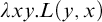 $\lambda xy.L(y,x)$
stands for being loved by. By Decomposition, we can infer
$\lambda xy.L(y,x)$
stands for being loved by. By Decomposition, we can infer $\square _{[L]}\phi $
from
$\square _{[L]}\phi $
from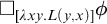 $\square _{[\lambda xy.L(y,x)]}\phi $
. The same is true for the “reflexivization” of L,
$\square _{[\lambda xy.L(y,x)]}\phi $
. The same is true for the “reflexivization” of L, $\lambda x.L(x,x)$
, which represents the relation of loving oneself.
$\lambda x.L(x,x)$
, which represents the relation of loving oneself.
The previous results allow us to illustrate why we are working in a $\lambda $
I-language in which vacuous abstraction is not allowed. Suppose that we allowed for vacuous abstraction, so that we can form lambda-abstracts like
$\lambda $
I-language in which vacuous abstraction is not allowed. Suppose that we allowed for vacuous abstraction, so that we can form lambda-abstracts like $\lambda x.\phi $
, where x is not free in
$\lambda x.\phi $
, where x is not free in $\phi $
. Let A and B be any terms of arbitrary type. By Proposition 2(i),
$\phi $
. Let A and B be any terms of arbitrary type. By Proposition 2(i), $\vdash \exists X\square _{[A]}X(A)$
. Now let z be a variable not free in
$\vdash \exists X\square _{[A]}X(A)$
. Now let z be a variable not free in $X(A)$
. Then
$X(A)$
. Then $\vdash X(A)=(\lambda z.X(A))(B)$
by a vacuous instance of
$\vdash X(A)=(\lambda z.X(A))(B)$
by a vacuous instance of $\beta $
-conversion. By CL and LL, this implies
$\beta $
-conversion. By CL and LL, this implies $\vdash \exists Y\square _{[A]}Y(B)$
, and thus
$\vdash \exists Y\square _{[A]}Y(B)$
, and thus $\vdash A\geq B$
for arbitrary A and B. It follows that all subscripted essentialist operators are logically coextensive:
$\vdash A\geq B$
for arbitrary A and B. It follows that all subscripted essentialist operators are logically coextensive: $\vdash \square _{F_{1},\ldots ,F_{n}}\phi \leftrightarrow \square _{G_{1},\ldots ,G_{k}}\phi $
. Instead of avoiding this result as we do here by working with a language in which vacuous instances of
$\vdash \square _{F_{1},\ldots ,F_{n}}\phi \leftrightarrow \square _{G_{1},\ldots ,G_{k}}\phi $
. Instead of avoiding this result as we do here by working with a language in which vacuous instances of $\beta $
-conversion are not well-formed we could instead work with a
$\beta $
-conversion are not well-formed we could instead work with a $\lambda $
K-language and restrict the principle of
$\lambda $
K-language and restrict the principle of $\beta $
-conversion to its non-vacuous instances. The present choice of language is primarily a matter of convenience, although there is something to be said for taking the
$\beta $
-conversion to its non-vacuous instances. The present choice of language is primarily a matter of convenience, although there is something to be said for taking the $\lambda $
I-language to be metaphysically more perspicuous than the
$\lambda $
I-language to be metaphysically more perspicuous than the $\lambda $
K-language in a context in which vacuous
$\lambda $
K-language in a context in which vacuous $\beta $
-conversion is rejected.Footnote
26
$\beta $
-conversion is rejected.Footnote
26
We now turn to some important results about identity and distinctness.
Proposition 6.
-
(i)
$\vdash x= _\sigma y\rightarrow \square_{[x], \lbrace = _\sigma \rbrace }x= _\sigma y$
; -
(ii)
$\vdash \neg (x=_{\sigma }y)\rightarrow \square _{[x],[y],\lbrace =_{\sigma }\rbrace ,[\neg ],[\square _{[\sigma ],[\sigma ],[\langle \sigma ,\sigma \rangle ]}]}\neg (x=_{\sigma }y)$
; -
(iii)
$\vdash \neg R^{[\sigma ]}(x)\rightarrow \square _{R,[x],[\neg ],[\square _{[\sigma ],\langle \sigma \rangle ]}]}\neg R(x)$
.



Proof. (i) By RC $^{0}$
,
$^{0}$
, $\vdash \square _{[x],[=]}x= x$
. Hence, by CL and LL,
$\vdash \square _{[x],[=]}x= x$
. Hence, by CL and LL, $\vdash x= y\rightarrow \square _{[x],[=]}x= y$
.
$\vdash x= y\rightarrow \square _{[x],[=]}x= y$
.
(ii) Let $X,Y,Z$
be variables of types
$X,Y,Z$
be variables of types $[\sigma ]$
,
$[\sigma ]$
, $[\sigma ]$
and
$[\sigma ]$
and $[\langle \sigma ,\sigma \rangle ]$
, respectively. By part (i) and Monotonicity, we have
$[\langle \sigma ,\sigma \rangle ]$
, respectively. By part (i) and Monotonicity, we have
 $$ \begin{align} \vdash X(x)\wedge Y(y)\wedge Z(=)\rightarrow (x= y\rightarrow\square_{X,Y,Z}x= y). \end{align} $$
Hence, by CL,
 $$ \begin{align} \vdash X(x)\wedge Y(y)\wedge Z(=)\rightarrow (\neg\square_{X,Y,Z}x= y\rightarrow\neg(x= y)). \end{align} $$
In what follows, we sometimes abbreviate $\square _{X,Y,Z,[\neg ],[=],[\square _{[\sigma ],[\sigma ],[\langle \sigma ,\sigma \rangle ]}]}$
by
$\square _{X,Y,Z,[\neg ],[=],[\square _{[\sigma ],[\sigma ],[\langle \sigma ,\sigma \rangle ]}]}$
by $\square _{*}$
and use
$\square _{*}$
and use $\square $
to abbreviate
$\square $
to abbreviate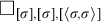 $\square _{[\sigma ],[\sigma ],[\langle \sigma ,\sigma \rangle ]}$
in subscript position. From (2), it follows by RC that
$\square _{[\sigma ],[\sigma ],[\langle \sigma ,\sigma \rangle ]}$
in subscript position. From (2), it follows by RC that
 $$ \begin{align} \vdash\square_{*}X(x)\wedge\square_{*}Y(y)\wedge\square_{*}Z(=)\rightarrow(\square_{*}\neg\square_{X,Y,Z}x= y\rightarrow\square_{*}\neg(x= y)). \end{align} $$
From (3) by CL,
 $$ \begin{align} \vdash\square_{*}X(x)\wedge\square_{*}Y(y)\wedge\square_{*}Z(=)\rightarrow(\neg\square_{*}\neg(x= y)\rightarrow\neg\square_{*}\neg\square_{X,Y,Z}x= y). \end{align} $$
By Monotonicity, the essentialist 5-schema, and Decomposition:
 $$ \begin{align} \vdash [x]\approx X\wedge [y]\approx Y\rightarrow(\neg\square_{X,Y,Z,[\neg],[=],[\square]}\neg\square_{X,Y,Z}x= y\rightarrow\square_{X,Y,Z}x= y). \end{align} $$
By Rigidity and Monotonicity:
 $$ \begin{align} \vdash [x]\approx X\wedge [y]\approx Y\wedge [=]\approx Z\rightarrow( \square_{*}X(x)\wedge\square_{*}Y(y)\wedge\square_{*}Z(=)). \end{align} $$
So by (4)–(6), (T), and CL:
 $$ \begin{align} \vdash [x]\approx X\wedge [y]\approx Y\wedge [=]\approx Z\rightarrow(\neg\square_{X,Y,Z,[\neg],[=],[\square]}\neg(x= y)\rightarrow x= y)). \end{align} $$
Monotonicity then yields:
 $$ \begin{align} \vdash [x]\approx X\wedge [y]\approx Y\wedge [=]\approx Z\rightarrow(\neg\square_{[x],[y],[=],[\neg],[\square]}\neg(x= y)\rightarrow x= y)). \end{align} $$
By R-Comp and CL, we then obtain
 $$ \begin{align} \vdash\neg (x= y)\rightarrow\square_{[x],[y],[=],[\neg],[\square]}\neg(x= y). \end{align} $$
(iii) Similar to the proof of part (ii), using Rigidity in place of part (i) in the first step.
Parts (i) and (ii) are essentialist analogs of the necessity of identity and distinctness. A stronger form of (i) to the effect that if x and y are identical, then it lies in the nature of x (or y) that they are identical is not derivable in HLE, as can be shown by the semantic methods developed in §6. The strengthenings of parts (ii) and (iii) where the essentialist operator is deleted from the subject of the essentialist operator in the consequent do not seem to be provable in HLE, although they are valid in the models developed in later sections. These strengthenings do strike me as very plausible, at least if the essentialist 5-schema is adopted. However, I have preferred not to take them as axioms here, in part because it is instructive to see that the weaker principles are already theorems of HLE. We could in principle have adopted a similar attitude with regard to the essentialist 4-schema, a weaker version of which is also derivable from the other principles of the system.Footnote 27 But it seems preferable to adopt (4) as an axiom, both because there is a direct and compelling justification for it and because it is more evident than the 5-schema which is needed for the derivation of the weaker version.
Our next result states that every essentialist statement is equivalent to an essentialist statement whose subject is a collection of propositions. To state the result, we introduce the following abbreviation. Let $F_{1},\ldots ,F_{n}$
be one-place predicates. Then,
$F_{1},\ldots ,F_{n}$
be one-place predicates. Then,
 $$ \begin{align*} \mathfrak{h}(F_{1},\ldots,F_{n}) &=_{\text{df}}\lambda p^{\langle\rangle}.(\exists x(F_{1}(x)\wedge\exists X^{[\sigma_{1}]}(\forall z(X(z)\leftrightarrow x=_{\sigma_{1}}z)\wedge p= X(x))) \vee\dots\vee\\ &\quad (\exists x(F_{n}(x)\wedge\exists X^{[\sigma_{n}]}(\forall z(X(z)\leftrightarrow x=_{\sigma_{n}}z)\wedge p= X(x))). \end{align*} $$
The predicate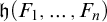 $\mathfrak {h}(F_{1},\ldots ,F_{n})$
picks out the haecceity propositions of the entities picked out by
$\mathfrak {h}(F_{1},\ldots ,F_{n})$
picks out the haecceity propositions of the entities picked out by $F_{1},\ldots ,F_{n}$
.
$F_{1},\ldots ,F_{n}$
.
Proposition 7 (Haec). $\vdash \square _{F_{1},\ldots ,F_{n}}\phi \leftrightarrow \square _{\mathfrak {h}(F_{1},\ldots ,F_{n})}\phi $
.
$\vdash \square _{F_{1},\ldots ,F_{n}}\phi \leftrightarrow \square _{\mathfrak {h}(F_{1},\ldots ,F_{n})}\phi $
.
Proof. Left-to-right direction: it follows at once from Proposition 2(i), the definition of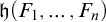 $\mathfrak {h}(F_{1},\ldots ,F_{n})$
and Monotonicity that for every
$\mathfrak {h}(F_{1},\ldots ,F_{n})$
and Monotonicity that for every $F_{i}$
,
$F_{i}$
, $\vdash \forall x(F_{i}(x)\rightarrow (\mathfrak {h}(F_{1},\ldots ,F_{n})\geq _{\sigma _{i}}x))$
. Thus by Monotonicity,
$\vdash \forall x(F_{i}(x)\rightarrow (\mathfrak {h}(F_{1},\ldots ,F_{n})\geq _{\sigma _{i}}x))$
. Thus by Monotonicity, $\vdash \square _{F_{1},\ldots ,F_{n}}\phi \rightarrow \square _{c_{\sigma _{i}}(\mathfrak {h}(F_{1},\ldots ,F_{n})),\ldots ,c_{\sigma _{n}}(\mathfrak {h}(F_{1},\ldots ,F_{n}))}\phi $
. From this, by CH and Monotonicity,
$\vdash \square _{F_{1},\ldots ,F_{n}}\phi \rightarrow \square _{c_{\sigma _{i}}(\mathfrak {h}(F_{1},\ldots ,F_{n})),\ldots ,c_{\sigma _{n}}(\mathfrak {h}(F_{1},\ldots ,F_{n}))}\phi $
. From this, by CH and Monotonicity, $\vdash \square _{F_{1},\ldots ,F_{n}}\phi \rightarrow \square _{\mathfrak {h}(F_{1},\ldots ,F_{n})}\phi $
. For the right-to-left direction, we have
$\vdash \square _{F_{1},\ldots ,F_{n}}\phi \rightarrow \square _{\mathfrak {h}(F_{1},\ldots ,F_{n})}\phi $
. For the right-to-left direction, we have $\vdash \forall y(X^{[\sigma ]}(y)\leftrightarrow (\lambda z.z=_{\sigma }x)(y))\wedge (X(x)=_{\langle \rangle }p)\rightarrow \square _{[x]}p$
by Rigidity, Monotonicity and LL. From this, we get
$\vdash \forall y(X^{[\sigma ]}(y)\leftrightarrow (\lambda z.z=_{\sigma }x)(y))\wedge (X(x)=_{\langle \rangle }p)\rightarrow \square _{[x]}p$
by Rigidity, Monotonicity and LL. From this, we get $\vdash \forall p(\mathfrak {h}(F_{1},\ldots ,F_{n})(p)\rightarrow c_{\langle \rangle }(F_{1},\ldots ,F_{n})(p))$
, whence by Monotonicity, CL and CH,
$\vdash \forall p(\mathfrak {h}(F_{1},\ldots ,F_{n})(p)\rightarrow c_{\langle \rangle }(F_{1},\ldots ,F_{n})(p))$
, whence by Monotonicity, CL and CH, $\vdash \square _{\mathfrak {h}(F_{1},\ldots ,F_{n})}\rightarrow \square _{F_{1},\ldots ,F_{n}}\phi $
.
$\vdash \square _{\mathfrak {h}(F_{1},\ldots ,F_{n})}\rightarrow \square _{F_{1},\ldots ,F_{n}}\phi $
.
The following are immediate consequences of Proposition 7.
Proposition 8.
-
(i)
$\vdash \forall p(c_{\langle \rangle }(F_{1},\ldots ,F_{n})(p)\leftrightarrow c_{\langle \rangle }(G_{1},\ldots ,G_{m})(p))\rightarrow (\square _{F_{1},\ldots ,F_{n}}\phi \leftrightarrow \square _{G_{1},\ldots ,G_{m}}\phi ).$
-
(ii)
$\vdash \forall p(c_{\langle \rangle }(F_{1},\ldots ,F_{n})(p)\leftrightarrow c_{\langle \rangle }(G_{1},\ldots ,G_{m})(p))\rightarrow \forall x(c_{\sigma }(F_{1},\ldots ,F_{n})(x)\leftrightarrow c_{\sigma }(G_{1},\ldots ,G_{m})(x)).$


Proof. (i) By Proposition 7, CH and Monotonicity, $\vdash \square _{F_{1},\ldots ,F_{n}}\phi \leftrightarrow \square _{c_{\langle \rangle }(F_{1},\ldots ,F_{n})}\phi $
. Thus, by CH and Monotonicity,
$\vdash \square _{F_{1},\ldots ,F_{n}}\phi \leftrightarrow \square _{c_{\langle \rangle }(F_{1},\ldots ,F_{n})}\phi $
. Thus, by CH and Monotonicity, $\vdash \forall p(c_{\langle \rangle }(F_{1},\ldots ,F_{n})(p)\leftrightarrow c_{\langle \rangle }(G_{1},\ldots ,G_{m})(p))\rightarrow (\square _{F_{1},\ldots ,F_{n}}\phi \leftrightarrow \square _{G_{1},\ldots ,G_{m}}\phi )$
.
$\vdash \forall p(c_{\langle \rangle }(F_{1},\ldots ,F_{n})(p)\leftrightarrow c_{\langle \rangle }(G_{1},\ldots ,G_{m})(p))\rightarrow (\square _{F_{1},\ldots ,F_{n}}\phi \leftrightarrow \square _{G_{1},\ldots ,G_{m}}\phi )$
.
(ii) From (i).
Proposition 8(i) says that for the essences of two collections of entities to be the same, it suffices that their collective natures involve the same propositions. Proposition 8(ii) says that if the natures of two collections involve the same propositions, then for any type $\sigma $
, they involve the same entities of that type; or more briefly, for the natures of two collections to involve exactly the same entities (of any type), it is sufficient that they involve the same propositions. It is worth noting that the converse of Proposition 8(ii) is not provable for every type
$\sigma $
, they involve the same entities of that type; or more briefly, for the natures of two collections to involve exactly the same entities (of any type), it is sufficient that they involve the same propositions. It is worth noting that the converse of Proposition 8(ii) is not provable for every type $\sigma $
. For example, the nature of the collection of all objects and the nature of the collection of all propositions each involve all objects but may fail to involve the same propositions, because there may be no objects whose nature involves negation, for instance. (The consistency of this can be easily demonstrated using the semantics developed in §6.) This counterexample to the converse of Proposition 8(ii) is specific to the case where
$\sigma $
. For example, the nature of the collection of all objects and the nature of the collection of all propositions each involve all objects but may fail to involve the same propositions, because there may be no objects whose nature involves negation, for instance. (The consistency of this can be easily demonstrated using the semantics developed in §6.) This counterexample to the converse of Proposition 8(ii) is specific to the case where $\sigma $
is e, however. It is less clear whether there are counterexamples to the instances of the converse of Proposition 8(ii) in which
$\sigma $
is e, however. It is less clear whether there are counterexamples to the instances of the converse of Proposition 8(ii) in which $\sigma $
is not e or
$\sigma $
is not e or $\langle \rangle $
. These instances do not seem to be provable either, although they are valid on the semantics developed in §6.
$\langle \rangle $
. These instances do not seem to be provable either, although they are valid on the semantics developed in §6.
5 The logic of necessity—Part I
This section shows how we can develop the logic of metaphysical necessity within HLE. Fine [Reference Fine20] proposed that metaphysical necessity is a special case of essence. His proposal is that for a proposition to be metaphysically necessary is for it to be true in virtue of the nature of all objects. We can use the operator $\square _{\lambda x^{e}.x=_{e}x}$
to formally express truth in virtue of the nature of all objects. In the system E5 of Fine’s LE, the propositional logic of this operator (more precisely, its analog in the language of LE) is exactly S4.Footnote
28
Fine also shows how to extend the system E5 in such a way that the logic of
$\square _{\lambda x^{e}.x=_{e}x}$
to formally express truth in virtue of the nature of all objects. In the system E5 of Fine’s LE, the propositional logic of this operator (more precisely, its analog in the language of LE) is exactly S4.Footnote
28
Fine also shows how to extend the system E5 in such a way that the logic of $\square _{\lambda x^{e}.x=_{e}x}$
is S5.Footnote
29
By contrast, in HLE the operator does not even obey S4 without adding further principles. The reason is that HLE does not require the collective nature of all objects to involve any of the logical operations, or any other entities expressed by constants of type
$\square _{\lambda x^{e}.x=_{e}x}$
is S5.Footnote
29
By contrast, in HLE the operator does not even obey S4 without adding further principles. The reason is that HLE does not require the collective nature of all objects to involve any of the logical operations, or any other entities expressed by constants of type $\neq e$
. This implies that in HLE,
$\neq e$
. This implies that in HLE, $\square _{\lambda x^{e}.x=_{e}x}$
is not even closed under unrestricted consequence. However, there is another way of reducing metaphysical necessity to essence that suggests itself in our higher-order setting. Instead of taking metaphysical necessity to be truth in virtue of the nature of all objects, we may identify it with truth in virtue of the nature of all propositions. We can use the operator
$\square _{\lambda x^{e}.x=_{e}x}$
is not even closed under unrestricted consequence. However, there is another way of reducing metaphysical necessity to essence that suggests itself in our higher-order setting. Instead of taking metaphysical necessity to be truth in virtue of the nature of all objects, we may identify it with truth in virtue of the nature of all propositions. We can use the operator $\square _{\lambda p^{\langle \rangle }.p=_{\langle \rangle }p}$
to formally express truth in virtue of the nature of all propositions. It turns out that this operator does obey exactly the principles of S4 already in HLE. This section first demonstrates this fact and then goes on to show how the system can be extended so that
$\square _{\lambda p^{\langle \rangle }.p=_{\langle \rangle }p}$
to formally express truth in virtue of the nature of all propositions. It turns out that this operator does obey exactly the principles of S4 already in HLE. This section first demonstrates this fact and then goes on to show how the system can be extended so that $\square _{\lambda p^{\langle \rangle }.p=_{\langle \rangle }p}$
obeys exactly S5. After that, we will consider ways of extending HLE so as to make
$\square _{\lambda p^{\langle \rangle }.p=_{\langle \rangle }p}$
obeys exactly S5. After that, we will consider ways of extending HLE so as to make $\square _{\lambda x^{e}.x=_{e}x}$
obey S4 and S5, respectively. A detailed discussion of the philosophical ramifications of the results in this section can be found in Ditter [Reference Ditter15].
$\square _{\lambda x^{e}.x=_{e}x}$
obey S4 and S5, respectively. A detailed discussion of the philosophical ramifications of the results in this section can be found in Ditter [Reference Ditter15].
In what follows, we will use the following abbreviations: $\Omega :=\lambda x^{e}.x=_{e} x$
;
$\Omega :=\lambda x^{e}.x=_{e} x$
; $\Pi :=\lambda p^{\langle \rangle }.p=_{\langle \rangle } p$
. We start by observing that the following essentialist analog of the K-principle from modal logic is an immediate consequence of RC.
$\Pi :=\lambda p^{\langle \rangle }.p=_{\langle \rangle } p$
. We start by observing that the following essentialist analog of the K-principle from modal logic is an immediate consequence of RC.
Proposition 9. (K) $\vdash \square _{F_{1},\ldots ,F_{n}}(\phi \rightarrow \psi )\rightarrow (\square _{F_{1},\ldots ,F_{n}}\phi \rightarrow \square _{F_{1},\ldots ,F_{n}}\psi )$
.
$\vdash \square _{F_{1},\ldots ,F_{n}}(\phi \rightarrow \psi )\rightarrow (\square _{F_{1},\ldots ,F_{n}}\phi \rightarrow \square _{F_{1},\ldots ,F_{n}}\psi )$
.
Proof. Immediate from RC.
Next we show that the propositional logic of $\square _{\Pi }$
is at least S4 in
$\square _{\Pi }$
is at least S4 in $\mathsf {HLE}$
. We first note that if
$\mathsf {HLE}$
. We first note that if $\square _{\Pi }$
is taken to express metaphysical necessity, then the principle that essence implies necessity is a theorem of HLE.
$\square _{\Pi }$
is taken to express metaphysical necessity, then the principle that essence implies necessity is a theorem of HLE.
Proposition 10 (EN
$^{\square _{\Pi }}$
).
 $\vdash \square _{F_{1},\ldots ,F_{n}}\phi \rightarrow \square _{\Pi }\phi $
.
$\vdash \square _{F_{1},\ldots ,F_{n}}\phi \rightarrow \square _{\Pi }\phi $
.
Proof. Immediate from Proposition 7 and Monotonicity.
Proposition 11 (RN
$^{\square _{\Pi }}$
).

If $\vdash \phi $
then
$\vdash \phi $
then $\vdash \square _{\Pi }\phi $
.
$\vdash \square _{\Pi }\phi $
.
Proof. From RC $^{0}$
and Proposition 10.
$^{0}$
and Proposition 10.
Proposition 12 (4
$^{\square _{\Pi }}$
).
 $\vdash \square _{\Pi }\phi \rightarrow \square _{\Pi }\square _{\Pi }\phi $
.
$\vdash \square _{\Pi }\phi \rightarrow \square _{\Pi }\square _{\Pi }\phi $
.
Proof. Let $X^{[\langle \rangle ]}$
be a variable of rigid type that does not occur in
$X^{[\langle \rangle ]}$
be a variable of rigid type that does not occur in $\phi $
. By Monotonicity, the essentialist 4-schema, (T), and CL, (1)
$\phi $
. By Monotonicity, the essentialist 4-schema, (T), and CL, (1) $\vdash X\approx \Pi \rightarrow (\square _{\Pi }\phi \leftrightarrow \square _{X,[\square _{[\langle \rangle ]}]}\square _{X}\phi )$
. From this, (2)
$\vdash X\approx \Pi \rightarrow (\square _{\Pi }\phi \leftrightarrow \square _{X,[\square _{[\langle \rangle ]}]}\square _{X}\phi )$
. From this, (2) $\vdash \square _{\Pi }\phi \wedge X\approx \Pi \rightarrow \square _{X,[\square _{[\langle \rangle ],\langle \rangle }]}\square _{X}\phi $
follows by CL. By EN
$\vdash \square _{\Pi }\phi \wedge X\approx \Pi \rightarrow \square _{X,[\square _{[\langle \rangle ],\langle \rangle }]}\square _{X}\phi $
follows by CL. By EN $^{\square _{\Pi }}$
, (3)
$^{\square _{\Pi }}$
, (3) $\vdash \square _{\Pi }\phi \wedge X\approx \Pi \rightarrow \square _{\Pi }\square _{X}\phi $
. By CL and RN
$\vdash \square _{\Pi }\phi \wedge X\approx \Pi \rightarrow \square _{\Pi }\square _{X}\phi $
. By CL and RN $^{\square _{\Pi }}$
we have (4)
$^{\square _{\Pi }}$
we have (4) $\vdash \square _{\Pi }(X\subseteq \Pi )$
and by Monotonicity and RN
$\vdash \square _{\Pi }(X\subseteq \Pi )$
and by Monotonicity and RN $^{\square _{\Pi }}$
, (5)
$^{\square _{\Pi }}$
, (5) $\vdash \square _{\Pi }(X\subseteq \Pi \rightarrow (\square _{X}\phi \rightarrow \square _{\Pi }\phi ))$
. From (4), (5) and (K) we get (6)
$\vdash \square _{\Pi }(X\subseteq \Pi \rightarrow (\square _{X}\phi \rightarrow \square _{\Pi }\phi ))$
. From (4), (5) and (K) we get (6) $\vdash \square _{\Pi }\square _{X}\phi \rightarrow \square _{\Pi }\square _{\Pi }\phi $
. So by (3), (6) and CL, (7)
$\vdash \square _{\Pi }\square _{X}\phi \rightarrow \square _{\Pi }\square _{\Pi }\phi $
. So by (3), (6) and CL, (7) $\vdash X\approx \Pi \rightarrow (\square _{\Pi }\phi \rightarrow \square _{\Pi }\square _{\Pi }\phi )$
. But X is not free in
$\vdash X\approx \Pi \rightarrow (\square _{\Pi }\phi \rightarrow \square _{\Pi }\square _{\Pi }\phi )$
. But X is not free in $\phi $
, so (8)
$\phi $
, so (8) $\vdash \exists X(X\approx \Pi )\rightarrow (\square _{\Pi }\phi \rightarrow \square _{\Pi }\square _{\Pi }\phi )$
. But
$\vdash \exists X(X\approx \Pi )\rightarrow (\square _{\Pi }\phi \rightarrow \square _{\Pi }\square _{\Pi }\phi )$
. But $\exists X(X\approx \Pi )$
is an instance of R-Comp, therefore (9)
$\exists X(X\approx \Pi )$
is an instance of R-Comp, therefore (9) $\vdash \square _{\Pi }\phi \rightarrow \square _{\Pi }\square _{\Pi }\phi $
.
$\vdash \square _{\Pi }\phi \rightarrow \square _{\Pi }\square _{\Pi }\phi $
.
Corollary 1. In $\mathsf {HLE}$
, the logic of
$\mathsf {HLE}$
, the logic of $\square _{\Pi }$
is at least
$\square _{\Pi }$
is at least $\mathsf {S4}$
.
$\mathsf {S4}$
.
The principles of S5 become provable once we add an axiom to the effect that it is true in virtue of the nature of all propositions that they are all the propositions:
-
(DOM⟨⟩)
$\forall pX^{[\langle \rangle ]}(p)\rightarrow \square _{X}\forall pX(p).$

The same principle restricted to objects (entities of type e) is invoked by Fine [Reference Fine21] in LE to show that the operator that expresses truth in virtue of the nature of all objects satisfies all the principles of S5 in his system E5+
(see Theorem 4 in Fine [Reference Fine21]). We write $\vdash _{+}$
to indicate theoremhood in the system
$\vdash _{+}$
to indicate theoremhood in the system $\mathsf {HLE+DOM^{\langle \rangle }}$
.
$\mathsf {HLE+DOM^{\langle \rangle }}$
.
Proposition 13 (B
$^{\square _{\Pi }}$
).
 $\vdash _{+}\neg \phi \rightarrow \square _{\Pi }\neg \square _{\Pi }\phi $
.
$\vdash _{+}\neg \phi \rightarrow \square _{\Pi }\neg \square _{\Pi }\phi $
.
Proof. Let $X^{[\langle \rangle ]}$
be a variable of rigid type that does not occur in
$X^{[\langle \rangle ]}$
be a variable of rigid type that does not occur in $\phi $
. By DOM
$\phi $
. By DOM $^{\langle \rangle }$
we have (1)
$^{\langle \rangle }$
we have (1) $\vdash _{+}\forall pX(p)\rightarrow \square _{X}\forall pX(p)$
. By the essentialist 5-schema, (2)
$\vdash _{+}\forall pX(p)\rightarrow \square _{X}\forall pX(p)$
. By the essentialist 5-schema, (2) $\vdash _{+}\neg \square _{X}\phi \rightarrow \square _{X,[\neg ],[\square _{[\langle \rangle ]}],[\phi ]}\neg \square _{X}\phi $
. From (2), Monotonicity and EN
$\vdash _{+}\neg \square _{X}\phi \rightarrow \square _{X,[\neg ],[\square _{[\langle \rangle ]}],[\phi ]}\neg \square _{X}\phi $
. From (2), Monotonicity and EN $^{\square _{\Pi }}$
, (3)
$^{\square _{\Pi }}$
, (3) $\vdash _{+}\neg \square _{\Pi }\phi \wedge \forall pX(p)\rightarrow \square _{\Pi }\neg \square _{X}\phi $
. By Monotonicity and RN
$\vdash _{+}\neg \square _{\Pi }\phi \wedge \forall pX(p)\rightarrow \square _{\Pi }\neg \square _{X}\phi $
. By Monotonicity and RN $^{\square _{\Pi }}$
, (4)
$^{\square _{\Pi }}$
, (4) $\vdash _{+}\square _{\Pi }(\forall pX(p)\rightarrow (\neg \square _{\Pi }\phi \leftrightarrow \neg \square _{X}\phi ))$
. From (4), (1) and (K), we can infer (5)
$\vdash _{+}\square _{\Pi }(\forall pX(p)\rightarrow (\neg \square _{\Pi }\phi \leftrightarrow \neg \square _{X}\phi ))$
. From (4), (1) and (K), we can infer (5) $\vdash _{+}\forall pX(p)\rightarrow (\square _{\Pi }\neg \square _{\Pi }\phi \leftrightarrow \square _{\Pi }\neg \square _{X}\phi )$
. From (3) and (5), we obtain (6)
$\vdash _{+}\forall pX(p)\rightarrow (\square _{\Pi }\neg \square _{\Pi }\phi \leftrightarrow \square _{\Pi }\neg \square _{X}\phi )$
. From (3) and (5), we obtain (6) $\vdash _{+}\neg \square _{\Pi }\phi \wedge \forall pX(p)\rightarrow \square _{\Pi }\neg \square _{\Pi }\phi $
. So by CL, (7)
$\vdash _{+}\neg \square _{\Pi }\phi \wedge \forall pX(p)\rightarrow \square _{\Pi }\neg \square _{\Pi }\phi $
. So by CL, (7) $\vdash _{+}\exists X\forall pX(p)\rightarrow (\neg \square _{\Pi }\phi \rightarrow \square _{\Pi }\neg \square _{\Pi }\phi )$
, because X is not free in
$\vdash _{+}\exists X\forall pX(p)\rightarrow (\neg \square _{\Pi }\phi \rightarrow \square _{\Pi }\neg \square _{\Pi }\phi )$
, because X is not free in $\phi $
. But the antecedent of (7) is equivalent to an instance of R-Comp, which gives us (8)
$\phi $
. But the antecedent of (7) is equivalent to an instance of R-Comp, which gives us (8) $\vdash _{+}\neg \square _{\Pi }\phi \rightarrow \square _{\Pi }\neg \square _{\Pi }\phi $
. By the contrapositive of (T), (8) implies
$\vdash _{+}\neg \square _{\Pi }\phi \rightarrow \square _{\Pi }\neg \square _{\Pi }\phi $
. By the contrapositive of (T), (8) implies $\vdash _{+}\neg \phi \rightarrow \square _{\Pi }\neg \square _{\Pi }\phi $
.
$\vdash _{+}\neg \phi \rightarrow \square _{\Pi }\neg \square _{\Pi }\phi $
.
Corollary 2. In $\mathsf {HLE+DOM^{\langle \rangle }}$
, the logic of
$\mathsf {HLE+DOM^{\langle \rangle }}$
, the logic of $\square _{\Pi }$
is at least
$\square _{\Pi }$
is at least $\mathsf {S5}$
.
$\mathsf {S5}$
.
In §9.1 we will show by semantic techniques that the propositional logic of $\square _{\Pi }$
is exactly S4 (S5) in
$\square _{\Pi }$
is exactly S4 (S5) in $\mathsf {HLE}$
(
$\mathsf {HLE}$
( $\mathsf {HLE+DOM^{\langle \rangle }}$
).
$\mathsf {HLE+DOM^{\langle \rangle }}$
).
We now turn to the logic of $\square _{\Omega }$
. As mentioned above,
$\square _{\Omega }$
. As mentioned above, $\square _{\Omega }$
does not obey S4 in HLE, since it is not even closed under unrestricted logical consequence. One way to ensure that
$\square _{\Omega }$
does not obey S4 in HLE, since it is not even closed under unrestricted logical consequence. One way to ensure that $\square _{\Omega }$
obeys S4 is to add a principle to HLE to the effect that every entity of type
$\square _{\Omega }$
obeys S4 is to add a principle to HLE to the effect that every entity of type $\neq e$
is involved in the nature of some objects (entities of type e). There are several ways to motivate such a principle, though perhaps the most obvious option is to endorse some form of Platonism, positing for every entity of type
$\neq e$
is involved in the nature of some objects (entities of type e). There are several ways to motivate such a principle, though perhaps the most obvious option is to endorse some form of Platonism, positing for every entity of type $\neq e$
some objectual surrogate or Form of type e that stands in a specific relation to the higher-order entity. Here I will focus on a fairly minimalist, “Propositional Platonist” theory that posits objectual surrogates for propositions:
$\neq e$
some objectual surrogate or Form of type e that stands in a specific relation to the higher-order entity. Here I will focus on a fairly minimalist, “Propositional Platonist” theory that posits objectual surrogates for propositions:
-
(P-Truth)
$\forall p^{\langle \rangle }\exists x^{e}\square _{[x]}(true(x)=_{\langle \rangle }p).$

It turns out that this suffices for the purpose at hand. Supplementing HLE with P-Truth allows us to infer EN $^{\square _{\Omega }}$
. Once we have EN
$^{\square _{\Omega }}$
. Once we have EN $^{\square _{\Omega }}$
, the analogs for
$^{\square _{\Omega }}$
, the analogs for $\square _{\Omega }$
of the preceeding results are proved exactly like those for
$\square _{\Omega }$
of the preceeding results are proved exactly like those for $\square _{\Pi }$
, except that we use EN
$\square _{\Pi }$
, except that we use EN $^{\square _{\Omega }}$
and RN
$^{\square _{\Omega }}$
and RN $^{\square _{\Omega }}$
instead of EN
$^{\square _{\Omega }}$
instead of EN $^{\square _{\Pi }}$
and RN
$^{\square _{\Pi }}$
and RN $^{\square _{\Pi }}$
in the relevant places. We write
$^{\square _{\Pi }}$
in the relevant places. We write $\vdash _{*}$
for provability in HLE+P-Truth.
$\vdash _{*}$
for provability in HLE+P-Truth.
Proposition 14 (EN
$^{\square _{\Omega }}$
).
 $\vdash _{*}\square _{F_{1},\ldots ,F_{n}}\phi \rightarrow \square _{\Omega }\phi $
.
$\vdash _{*}\square _{F_{1},\ldots ,F_{n}}\phi \rightarrow \square _{\Omega }\phi $
.
Proof. By P-Truth, (1) $\vdash _{*}\exists y^{e}\square _{[y]}(true(y)=_{\langle \rangle }(x=_{\tau }x))$
, whence by
$\vdash _{*}\exists y^{e}\square _{[y]}(true(y)=_{\langle \rangle }(x=_{\tau }x))$
, whence by $\beta $
-conversion, (2)
$\beta $
-conversion, (2) $\vdash _{*}\exists y^{e}(y\geq x \wedge y\geq \;=_{\tau })$
. By RC
$\vdash _{*}\exists y^{e}(y\geq x \wedge y\geq \;=_{\tau })$
. By RC $^{0}$
, (3)
$^{0}$
, (3) $\vdash _{*}\square _{[x],\lbrace =_{\tau }\rbrace }x=_{\tau }x$
, and so by (2), Proposition 3(i), and Monotonicity, (4)
$\vdash _{*}\square _{[x],\lbrace =_{\tau }\rbrace }x=_{\tau }x$
, and so by (2), Proposition 3(i), and Monotonicity, (4) $\vdash _{*}\exists y^{e}\square _{[y]}x=_{\tau }x$
. Thus, (5)
$\vdash _{*}\exists y^{e}\square _{[y]}x=_{\tau }x$
. Thus, (5) $\vdash _{*}\exists X^{\langle e\rangle }\square _{X}x=_{\tau }x$
and (6)
$\vdash _{*}\exists X^{\langle e\rangle }\square _{X}x=_{\tau }x$
and (6) $\vdash _{*}\forall x^{\tau }\exists X^{\langle e\rangle }\square _{X}x=_{\tau }x$
by CL. From (6) and CL, (7)
$\vdash _{*}\forall x^{\tau }\exists X^{\langle e\rangle }\square _{X}x=_{\tau }x$
by CL. From (6) and CL, (7) $\vdash _{*}\forall x^{\sigma _{i}}(F(x)\rightarrow \exists X^{\langle e\rangle }\square _{X}x=_{\sigma _{i}} x)$
. From (7) we get (8)
$\vdash _{*}\forall x^{\sigma _{i}}(F(x)\rightarrow \exists X^{\langle e\rangle }\square _{X}x=_{\sigma _{i}} x)$
. From (7) we get (8) $\vdash _{*}\forall x^{\sigma _{i}}(F(x)\rightarrow \square _{\Omega }x=_{\sigma _{i}} x)$
by Monotonicity and CL. Hence, (9)
$\vdash _{*}\forall x^{\sigma _{i}}(F(x)\rightarrow \square _{\Omega }x=_{\sigma _{i}} x)$
by Monotonicity and CL. Hence, (9) $\vdash _{*}\forall x^{\sigma _{i}}(F(x)\rightarrow c_{\sigma _{i}}(\Omega )(x))$
, whence (10)
$\vdash _{*}\forall x^{\sigma _{i}}(F(x)\rightarrow c_{\sigma _{i}}(\Omega )(x))$
, whence (10) $\vdash _{*}\square _{F_{1},\ldots ,F_{n}}\phi \rightarrow \square _{c_{\sigma _{1}}(\Omega ),\ldots c_{\sigma _{n}}(\Omega )}\phi $
follows by Monotonicity. From (10), CH, and Monotonicity, we finally obtain
$\vdash _{*}\square _{F_{1},\ldots ,F_{n}}\phi \rightarrow \square _{c_{\sigma _{1}}(\Omega ),\ldots c_{\sigma _{n}}(\Omega )}\phi $
follows by Monotonicity. From (10), CH, and Monotonicity, we finally obtain $\vdash _{*}\square _{F_{1},\ldots ,F_{n}}\phi \rightarrow \square _{\Omega }\phi $
.
$\vdash _{*}\square _{F_{1},\ldots ,F_{n}}\phi \rightarrow \square _{\Omega }\phi $
.
Proposition 15 (RN
$^{\square _{\Omega }}$
).

If $\vdash _{*}\phi $
then
$\vdash _{*}\phi $
then $\vdash _{*}\square _{\Omega }\phi .$
Proposition 16 (4
$^{\square _{\Omega }}$
).
 $\vdash _{*}\square _{\Omega }\phi \rightarrow \square _{\Omega }\square _{\Omega }\phi $
.
$\vdash _{*}\square _{\Omega }\phi \rightarrow \square _{\Omega }\square _{\Omega }\phi $
.
Corollary 3. In
HLE+P-Truth
, the logic of $\square _{\Omega }$
is at least
$\square _{\Omega }$
is at least $\mathsf {S4}$
.
$\mathsf {S4}$
.
As in the case of $\square _{\Pi }$
, we obtain S5 for
$\square _{\Pi }$
, we obtain S5 for $\square _{\Omega }$
if we add an axiom to the effect that it is true in virtue of the nature of all objects that they are all the objects:
$\square _{\Omega }$
if we add an axiom to the effect that it is true in virtue of the nature of all objects that they are all the objects:
-
(DOM)
$\forall xX^{[e]}(x)\rightarrow \square _{X}\forall xX(x).$

We write $\vdash _{*+}$
for provability in HLE+P-Truth+DOM.
$\vdash _{*+}$
for provability in HLE+P-Truth+DOM.
Proposition 17 (B
$^{\square _{\Omega }}$
).
 $\vdash _{*+}\neg \phi \rightarrow \square _{\Omega }\neg \square _{\Omega }\phi $
.
$\vdash _{*+}\neg \phi \rightarrow \square _{\Omega }\neg \square _{\Omega }\phi $
.
Corollary 4. In
HLE+P-Truth+DOM
, the logic of $\square _{\Omega }$
is at least
$\square _{\Omega }$
is at least $\mathsf {S5}$
.
$\mathsf {S5}$
.
We will show in §9.2 that the propositional logic of $\square _{\Omega }$
is exactly S4 (S5) in HLE+P-Truth (HLE+P-Truth+DOM).
$\square _{\Omega }$
is exactly S4 (S5) in HLE+P-Truth (HLE+P-Truth+DOM).
6 Semantics
We now proceed to the development of a sound model-theoretic semantics for HLE. The basic structure of the model theory bears some similarity to the structure of the model theory of intensional type theory with varying domains developed in Fine [Reference Fine19] and Fritz and Goodman [Reference Fritz and Goodman24]. We start with a frame, an ordered pair $\langle W,D\rangle $
consisting of a non-empty set W and a domain function D taking each member w of W and
$\langle W,D\rangle $
consisting of a non-empty set W and a domain function D taking each member w of W and $\tau $
of the set of types
$\tau $
of the set of types $\mathcal {T}$
into some non-empty set
$\mathcal {T}$
into some non-empty set $D^{w}_{\tau }$
. The set W can informally be thought of as the set of worlds, and the sets
$D^{w}_{\tau }$
. The set W can informally be thought of as the set of worlds, and the sets $D^{w}_{\tau }$
as the domains of entities of type
$D^{w}_{\tau }$
as the domains of entities of type $\tau $
in w. A characteristic feature of the model theory developed here concerns the structure of the elements of the domains
$\tau $
in w. A characteristic feature of the model theory developed here concerns the structure of the elements of the domains $D^{w}_{\tau }$
. The frames we are interested in are ones in which every element of a domain is an ordered pair whose first component can be informally thought of as the “worldly” content and whose second component as the “intensional” content of the entity. In the case of entities of type
$D^{w}_{\tau }$
. The frames we are interested in are ones in which every element of a domain is an ordered pair whose first component can be informally thought of as the “worldly” content and whose second component as the “intensional” content of the entity. In the case of entities of type $\langle \rangle $
the second component is just a subset of W, whereas for entities of type
$\langle \rangle $
the second component is just a subset of W, whereas for entities of type $\langle \tau \rangle $
it is a function from entities of type
$\langle \tau \rangle $
it is a function from entities of type $\tau $
to subsets of W; there are no constraints on what the second component is for entities of type e. The worldly content of each ordered pair in the domain is provided by a complete lattice, allowing the worldly content of each entity of any type to freely combine with the worldly content of any entity of arbitrary type. For example, the worldly content of the denotation of the sentence ‘Socrates is human’ will consist of the (lattice-theoretic) join of the worldly contents of the denotations of ‘Socrates’ and ‘human’.
$\tau $
to subsets of W; there are no constraints on what the second component is for entities of type e. The worldly content of each ordered pair in the domain is provided by a complete lattice, allowing the worldly content of each entity of any type to freely combine with the worldly content of any entity of arbitrary type. For example, the worldly content of the denotation of the sentence ‘Socrates is human’ will consist of the (lattice-theoretic) join of the worldly contents of the denotations of ‘Socrates’ and ‘human’.
An essentialist statement $\square _{F_{1},\ldots ,F_{n}}\phi $
is true at a world w just in case
$\square _{F_{1},\ldots ,F_{n}}\phi $
is true at a world w just in case $\phi $
is true at every world whose domain contains the union of the extensions of
$\phi $
is true at every world whose domain contains the union of the extensions of $F_{1},\ldots ,F_{n}$
at w. For example, the sentence
$F_{1},\ldots ,F_{n}$
at w. For example, the sentence $\square _{[s], [\wedge ]}\forall x(x=_{e}x)$
(‘It is essential to Socrates and conjunction that everything is self-identical’) is true at w just in case
$\square _{[s], [\wedge ]}\forall x(x=_{e}x)$
(‘It is essential to Socrates and conjunction that everything is self-identical’) is true at w just in case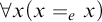 $\forall x(x=_{e}x)$
is true at every world whose domain contains the denotations of s and
$\forall x(x=_{e}x)$
is true at every world whose domain contains the denotations of s and $\wedge $
. Crucially, the models allow that the denotation of a constant of any type can in principle fail to exist at any world. Thus, for example, the denotations of s and
$\wedge $
. Crucially, the models allow that the denotation of a constant of any type can in principle fail to exist at any world. Thus, for example, the denotations of s and $\wedge $
need not exist in the same worlds. The denotation of a syntactically complex term A is in the domain of a world just in case all of the denotations of its constants and free variables (relative to an assignment) are in the domain of that world. Thus, the denotation of
$\wedge $
need not exist in the same worlds. The denotation of a syntactically complex term A is in the domain of a world just in case all of the denotations of its constants and free variables (relative to an assignment) are in the domain of that world. Thus, the denotation of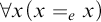 $\forall x(x=_{e}x)$
exists in exactly those worlds in which both the denotations of
$\forall x(x=_{e}x)$
exists in exactly those worlds in which both the denotations of $\forall _{e}$
and
$\forall _{e}$
and $ = _e $
exist, though it fails to exist in a world in which only one of them exists.
$ = _e $
exist, though it fails to exist in a world in which only one of them exists.
An important consequence of the semantics is that a collection of entities $\mathbf {x}_1,\mathbf {x}_2,\ldots $
essentially involves an entity
$\mathbf {x}_1,\mathbf {x}_2,\ldots $
essentially involves an entity $\mathbf {y}$
if and only if
$\mathbf {y}$
if and only if $\mathbf {y}$
exists in every world in which all of
$\mathbf {y}$
exists in every world in which all of $\mathbf {x}_1,\mathbf {x}_2,\ldots $
exist. Thus the relation of essential involvement expressed by the defined predicates
$\mathbf {x}_1,\mathbf {x}_2,\ldots $
exist. Thus the relation of essential involvement expressed by the defined predicates $\succeq _{\sigma _{1},\ldots ,\sigma _{n},\tau }$
is modeled by a relation between the existence sets of entities:
$\succeq _{\sigma _{1},\ldots ,\sigma _{n},\tau }$
is modeled by a relation between the existence sets of entities: $(F_1,\ldots ,F_n)\succeq _{\sigma _1,\ldots ,\sigma _n,\tau }x$
is true at w just in case the denotation of x exists in every world whose domain contains the union of the extensions of
$(F_1,\ldots ,F_n)\succeq _{\sigma _1,\ldots ,\sigma _n,\tau }x$
is true at w just in case the denotation of x exists in every world whose domain contains the union of the extensions of $F_{1},\ldots ,F_{n}$
at w. So, for example,
$F_{1},\ldots ,F_{n}$
at w. So, for example, $([s])\succeq \neg $
(or, equivalently,
$([s])\succeq \neg $
(or, equivalently, $s\geq \neg $
) is true at w just in case the denotation of
$s\geq \neg $
) is true at w just in case the denotation of $\neg $
exists in every world in which the denotation of s exists.
$\neg $
exists in every world in which the denotation of s exists.
Another distinctive feature of the semantics is that formulas are only evaluated at those worlds at which their denotations exist. This is compatible with classical logic given the notion of validity adopted here, according to which a formula $\phi $
is valid if and only if for every model,
$\phi $
is valid if and only if for every model, $\phi $
is true at every world at which its denotation exists.Footnote
30
The present semantics is similar in this respect to the first-order semantics for LE in Fine [Reference Fine22], in which a formula is evaluated only at those worlds at which the objectual content of the formula exists, where the objectual content of a formula consists, intuitively, of the objects that the formula is about. Our notion of worldly content is a generalization of the notion of objectual content within a higher-order setting. One consequence of Fine’s semantics is that a sentence like
$\phi $
is true at every world at which its denotation exists.Footnote
30
The present semantics is similar in this respect to the first-order semantics for LE in Fine [Reference Fine22], in which a formula is evaluated only at those worlds at which the objectual content of the formula exists, where the objectual content of a formula consists, intuitively, of the objects that the formula is about. Our notion of worldly content is a generalization of the notion of objectual content within a higher-order setting. One consequence of Fine’s semantics is that a sentence like $\forall x(\text {set}(x)\vee \neg \text {set}(x))$
, which has no objectual content on Fine’s semantics, is true at every world in every model, which, given Fine’s interpretation of the essentialist operator, entails that
$\forall x(\text {set}(x)\vee \neg \text {set}(x))$
, which has no objectual content on Fine’s semantics, is true at every world in every model, which, given Fine’s interpretation of the essentialist operator, entails that $\forall x(\text {set}(x)\vee \neg \text {set}(x))$
is true in virtue of the nature of any particular object. The present semantics, by contrast, allows us to avoid this, because the denotation of
$\forall x(\text {set}(x)\vee \neg \text {set}(x))$
is true in virtue of the nature of any particular object. The present semantics, by contrast, allows us to avoid this, because the denotation of $\forall x(\text {set}(x)\vee \neg \text {set}(x))$
may fail to be in the domain of some world, since all of the denotations of
$\forall x(\text {set}(x)\vee \neg \text {set}(x))$
may fail to be in the domain of some world, since all of the denotations of $\forall _{e}$
,
$\forall _{e}$
, $\text {set}$
,
$\text {set}$
, $\vee $
and
$\vee $
and $\neg $
may fail to be in the domain of some world, as explained above. I will now turn to the details.
$\neg $
may fail to be in the domain of some world, as explained above. I will now turn to the details.
Definition 4. When $\mathcal {C}$
and
$\mathcal {C}$
and $\mathcal {D}$
are typed families, we say that
$\mathcal {D}$
are typed families, we say that $f$
is a typed function from
$f$
is a typed function from $\bigcup _{\tau \in \mathcal {T}}\mathcal {C}_{\tau }$
to
$\bigcup _{\tau \in \mathcal {T}}\mathcal {C}_{\tau }$
to $\bigcup _{\tau \in \mathcal {T}}\mathcal {D}_{\tau }$
just in case for all
$\bigcup _{\tau \in \mathcal {T}}\mathcal {D}_{\tau }$
just in case for all $\tau \in \mathcal {T}$
, if
$\tau \in \mathcal {T}$
, if $x\in \mathcal {C}_{\tau }$
, then
$x\in \mathcal {C}_{\tau }$
, then $f(x)\in \mathcal {D}_{\tau }$
.
$f(x)\in \mathcal {D}_{\tau }$
.
Definition 5. A frame $\mathfrak {F}$
is a pair
$\mathfrak {F}$
is a pair $\langle W,D\rangle ,$
where W is a non-empty set and D is a function taking each
$\langle W,D\rangle ,$
where W is a non-empty set and D is a function taking each $w\in W$
and
$w\in W$
and $\tau \in \mathcal {T}$
into some non-empty set, written
$\tau \in \mathcal {T}$
into some non-empty set, written $D^{w}_{\tau }$
, such that
$D^{w}_{\tau }$
, such that $\lbrace \bigcup _{w\in W}D_{\tau }^{w}:\tau \in \mathcal {T}\rbrace $
is a typed family. We say that
$\lbrace \bigcup _{w\in W}D_{\tau }^{w}:\tau \in \mathcal {T}\rbrace $
is a typed family. We say that $D^{w}_{\tau }$
is the domain of entities of type
$D^{w}_{\tau }$
is the domain of entities of type $\tau $
at w. We further define
$\tau $
at w. We further define $D^{w}:=\bigcup _{\tau \in \mathcal {T}}D^{w}_{\tau }$
, the domain of w, and
$D^{w}:=\bigcup _{\tau \in \mathcal {T}}D^{w}_{\tau }$
, the domain of w, and $D_{\tau }:=\bigcup _{w\in W}D^{w}_{\tau }$
. We call
$D_{\tau }:=\bigcup _{w\in W}D^{w}_{\tau }$
. We call $\bigcup D:=\bigcup ^{w\in W}_{\tau \in \mathcal {T}} D_{\tau }^{w}$
the outer domain of the frame
$\bigcup D:=\bigcup ^{w\in W}_{\tau \in \mathcal {T}} D_{\tau }^{w}$
the outer domain of the frame $\mathfrak {F}$
.
$\mathfrak {F}$
.
Definition 6. Let $\langle W,D\rangle $
be a frame. If
$\langle W,D\rangle $
be a frame. If $G\subseteq \bigcup D$
, the existence set
$G\subseteq \bigcup D$
, the existence set $E(G)$
of G is
$E(G)$
of G is $\lbrace w: \forall a(a\in G\rightarrow a\in D^{w})\rbrace $
(
$\lbrace w: \forall a(a\in G\rightarrow a\in D^{w})\rbrace $
( $=\bigcap _{a\in G}E(\lbrace a\rbrace )$
). We say that a subset
$=\bigcap _{a\in G}E(\lbrace a\rbrace )$
). We say that a subset $G\subseteq \bigcup D$
depends on
$G\subseteq \bigcup D$
depends on $H\subseteq \bigcup D$
just in case
$H\subseteq \bigcup D$
just in case $E(G)\subseteq E(H)$
. In the case where H is a singleton set
$E(G)\subseteq E(H)$
. In the case where H is a singleton set $\lbrace a\rbrace $
,
$\lbrace a\rbrace $
, $a\in \bigcup D$
, we simply say that G depends on a.
$a\in \bigcup D$
, we simply say that G depends on a.
Definition 7. A partially ordered set $\langle N,\sqsubseteq \rangle $
is a complete lattice iff every subset of N has both a least upper bound (called the join) and a greatest lower bound (called the meet) relative to
$\langle N,\sqsubseteq \rangle $
is a complete lattice iff every subset of N has both a least upper bound (called the join) and a greatest lower bound (called the meet) relative to $\sqsubseteq $
. When
$\sqsubseteq $
. When $G\subseteq N$
, its join is denoted by
$G\subseteq N$
, its join is denoted by $\bigsqcup G$
and its meet by
$\bigsqcup G$
and its meet by  . The least element of N is denoted by $\bot $
(
$\bot $
( $=\bigsqcup \emptyset $
) and the greatest element by
$=\bigsqcup \emptyset $
) and the greatest element by $\top $
(
$\top $
( ). When G is a two-element set consisting of elements $m,n$
, we sometimes write
$m,n$
, we sometimes write $m\sqcup n$
instead of
$m\sqcup n$
instead of $\bigsqcup \{m,n\}$
, and
$\bigsqcup \{m,n\}$
, and $m\sqcap n$
instead of
$m\sqcap n$
instead of  .
.
When $\mathcal {N}=\langle N,\sqsubseteq \rangle $
is a complete lattice, we usually indicate membership in the lattice by simply writing
$\mathcal {N}=\langle N,\sqsubseteq \rangle $
is a complete lattice, we usually indicate membership in the lattice by simply writing $x\in \mathcal {N}$
instead of
$x\in \mathcal {N}$
instead of $x\in N$
. A canonical example of a complete lattice is the power set of a given set, ordered by inclusion, with the join and meet given by union and intersection of subsets, respectively. We will make use of such power set lattices in the construction of our example models in §7. We now define the “worldly content structures” that provide the basis of the worldly contents of the elements of the frames we are primarily interested in.
$x\in N$
. A canonical example of a complete lattice is the power set of a given set, ordered by inclusion, with the join and meet given by union and intersection of subsets, respectively. We will make use of such power set lattices in the construction of our example models in §7. We now define the “worldly content structures” that provide the basis of the worldly contents of the elements of the frames we are primarily interested in.
Definition 8. A worldly content structure is a quintuple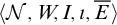 $\langle \mathcal {N},W,I,\iota ,\overline {E}\rangle $
, where:
$\langle \mathcal {N},W,I,\iota ,\overline {E}\rangle $
, where:
-
(i)
$\mathcal {N}=\langle N,\sqsubseteq \rangle $
is a complete lattice; -
(ii) W is a non-empty set;
-
(iii) I is a function taking each
$w\in W$
into a non-empty set
$I^{w}$
; -
(iv)
$\iota $
is a function from
$\bigcup _{w\in W} I^{w}$
to
$\mathcal {N;}$
-
(v)
$\overline {E}$
is a function from
$\mathcal {N}$
to
$\wp (W)$
such that
$\overline {E}(\bigsqcup G)=\bigcap _{n\in G}\overline {E}(n)$
,
$\overline {E}(\bot )=W$
, and for every
$o\in \bigcup _{w\in W} I^{w}: \overline {E}(\iota (o))=\{w\in W: o\in I^{w}\}.$
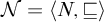



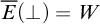

Elements of the set $\bigcup _{w\in W} I^{w}$
will serve as the second components of the members of the set of individuals in the frames defined below. The function
$\bigcup _{w\in W} I^{w}$
will serve as the second components of the members of the set of individuals in the frames defined below. The function $\overline {E}$
assigns every element of the lattice to a set of worlds which can be thought of as the “existence set” of the element. By the last part of clause (v), we have for every
$\overline {E}$
assigns every element of the lattice to a set of worlds which can be thought of as the “existence set” of the element. By the last part of clause (v), we have for every $o\in \bigcup _{w\in W} I^{w}: o\in I^{w}$
if and only if
$o\in \bigcup _{w\in W} I^{w}: o\in I^{w}$
if and only if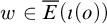 $w\in \overline {E}(\iota (o))$
. In the frames defined below, this means that the existence set of an individual
$w\in \overline {E}(\iota (o))$
. In the frames defined below, this means that the existence set of an individual $\langle \iota (o),o\rangle $
is just
$\langle \iota (o),o\rangle $
is just $\{w\in W: o\in I^w\}$
. If a lattice element n is below a lattice element m in the lattice ordering, then the existence set of n is a superset of the existence set of m. We record this useful fact in the following lemma.
$\{w\in W: o\in I^w\}$
. If a lattice element n is below a lattice element m in the lattice ordering, then the existence set of n is a superset of the existence set of m. We record this useful fact in the following lemma.
Lemma 1. Let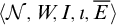 $\langle \mathcal {N},W,I,\iota ,\overline {E}\rangle $
be a worldly content structure. Then for all
$\langle \mathcal {N},W,I,\iota ,\overline {E}\rangle $
be a worldly content structure. Then for all $n,m\in \mathcal {N}$
: if
$n,m\in \mathcal {N}$
: if $n\sqsubseteq m$
, then
$n\sqsubseteq m$
, then $\overline {E}(m)\subseteq \overline {E}(n)$
.
$\overline {E}(m)\subseteq \overline {E}(n)$
.
Proof. Let $n,m\in \mathcal {N}$
and suppose
$n,m\in \mathcal {N}$
and suppose $n\sqsubseteq m$
. Since
$n\sqsubseteq m$
. Since $n\sqsubseteq m$
iff
$n\sqsubseteq m$
iff $m=n\sqcup m$
, we have
$m=n\sqcup m$
, we have $\overline {E}(m)=\overline {E}(\bigsqcup \{n,m\})=\overline {E}(n)\cap \overline {E}(m)$
and thus
$\overline {E}(m)=\overline {E}(\bigsqcup \{n,m\})=\overline {E}(n)\cap \overline {E}(m)$
and thus $\overline {E}(m)\subseteq \overline {E}(n)$
. The last equality holds by Definition 8.
$\overline {E}(m)\subseteq \overline {E}(n)$
. The last equality holds by Definition 8.
Here are two simple examples of worldly content structures. We will use variants of these structures in our model constructions in §7.
Example 1. Let $\langle \mathcal {N},W,I,\iota ,\overline {E}\rangle $
be the worldly content structure defined as follows:
$\langle \mathcal {N},W,I,\iota ,\overline {E}\rangle $
be the worldly content structure defined as follows: $W=\{w_1,w_2\}$
,
$W=\{w_1,w_2\}$
, $\mathcal {N}=\langle \wp (W),\supseteq \rangle $
, with join given by intersection of subsets and meet by union,
$\mathcal {N}=\langle \wp (W),\supseteq \rangle $
, with join given by intersection of subsets and meet by union, $I: w\mapsto \mathbb {N}$
,
$I: w\mapsto \mathbb {N}$
, $\iota : n\mapsto W$
, and
$\iota : n\mapsto W$
, and $\overline {E}$
is the identity function on
$\overline {E}$
is the identity function on $\wp (W)$
. (Note that
$\wp (W)$
. (Note that $\langle \wp (W),\supseteq \rangle $
is just the dual lattice of
$\langle \wp (W),\supseteq \rangle $
is just the dual lattice of $\langle \wp (W),\subseteq \rangle $
.) In this worldly content structure, the existence set of a lattice element is just the lattice element itself.
$\langle \wp (W),\subseteq \rangle $
.) In this worldly content structure, the existence set of a lattice element is just the lattice element itself.
Example 2. Let $\Sigma $
be a signature. We define a worldly content structure
$\Sigma $
be a signature. We define a worldly content structure $\mathfrak {N}=\langle \mathcal {N},W,I,\iota ,\overline {E}\rangle $
by letting
$\mathfrak {N}=\langle \mathcal {N},W,I,\iota ,\overline {E}\rangle $
by letting $\mathcal {N}=\langle \wp (\Sigma ),\subseteq \rangle $
, with join given by union and meet given by intersection of subsets,
$\mathcal {N}=\langle \wp (\Sigma ),\subseteq \rangle $
, with join given by union and meet given by intersection of subsets, $W=\wp (\Sigma )\setminus \{\emptyset \}$
,
$W=\wp (\Sigma )\setminus \{\emptyset \}$
, $I: w\mapsto \{c\in \Sigma : c\in w\}$
,
$I: w\mapsto \{c\in \Sigma : c\in w\}$
, $\iota : c\mapsto \{c\}$
, and
$\iota : c\mapsto \{c\}$
, and $\overline {E}: n\mapsto \{w\in W:n\subseteq w\}$
. In this worldly content structure, both the worlds and the lattice elements are sets of constants, and a lattice element exists at a world if and only if it is a subset of that world.
$\overline {E}: n\mapsto \{w\in W:n\subseteq w\}$
. In this worldly content structure, both the worlds and the lattice elements are sets of constants, and a lattice element exists at a world if and only if it is a subset of that world.
As mentioned above, the frames we are primarily interested in are ones in which the elements of domains of all types are ordered pairs. Where x is an ordered pair, we denote its first component by $\pi _{0}(x)$
and its second component by
$\pi _{0}(x)$
and its second component by $\pi _{1}(x)$
. In the frames we define below, every element of the outer domain is an ordered pair whose first component is an element of a complete lattice drawn from a worldly content structure underlying the frame. We will later show that the existence set of an element of the outer domain of a frame is just the value of
$\pi _{1}(x)$
. In the frames we define below, every element of the outer domain is an ordered pair whose first component is an element of a complete lattice drawn from a worldly content structure underlying the frame. We will later show that the existence set of an element of the outer domain of a frame is just the value of $\overline {E}$
applied to its first component.
$\overline {E}$
applied to its first component.
Definition 9. Let $\langle \mathcal {N},W,I,\iota ,\overline {E}\rangle $
be a worldly content structure. The dual-content frame induced by
$\langle \mathcal {N},W,I,\iota ,\overline {E}\rangle $
be a worldly content structure. The dual-content frame induced by $\langle \mathcal {N},W,I,\iota ,\overline {E}\rangle $
is the frame
$\langle \mathcal {N},W,I,\iota ,\overline {E}\rangle $
is the frame $\langle W,D\rangle $
such that for all
$\langle W,D\rangle $
such that for all $w\in W$
:
$w\in W$
:
-
(i)
$D_{e}^{w}=\lbrace \langle \iota (o),o\rangle : o\in I^{w}\rbrace .$
-
(ii)
$D_{\langle \rangle }^{w}=\lbrace \langle n,l\rangle : n\in \mathcal {N}, w\in \overline {E}(n)$
and
$l\subseteq \overline {E}(n)\rbrace .$
-
(iii)
$D_{\langle \tau _{1},\ldots ,\tau _{k}\rangle }^{w}=\lbrace \langle n,f\rangle : n\in \mathcal {N}, w\in \overline {E}(n)$
and
$f: D_{\tau _{1}}\times \dotsb \times D_{\tau _{k}}\rightarrow \wp (W)$
such that
$f(x_{1},\ldots , x_{k})\subseteq \overline {E}(\bigsqcup \lbrace \pi _{0}({x_{1}}),\ldots ,\pi _{0}(x_{k}),n\rbrace )\rbrace $
. -
(iv)
$D^{w}_{[\tau ]}=\lbrace \langle n,r\rangle : n\in \mathcal {N}, w\in \overline {E}(n)$
and
$r\subseteq D_{\tau }$
such that
$n=\bigsqcup \lbrace \pi _{0}(x):x\in r\rbrace \rbrace $
.









A frame $\langle W,D\rangle $
is a dual-content frame if it is induced by a worldly content structure. We define the extension of
$\langle W,D\rangle $
is a dual-content frame if it is induced by a worldly content structure. We define the extension of $\mathbf {X}\in D_{\sigma }$
at
$\mathbf {X}\in D_{\sigma }$
at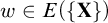 $w\in E(\lbrace \mathbf {X}\rbrace )$
to be
$w\in E(\lbrace \mathbf {X}\rbrace )$
to be $Ext^{w}(\mathbf {X})=\lbrace \mathbf {x}\in D^{w}_{\tau }: w\in \pi _{1}(\mathbf {X})(\mathbf {x})\rbrace $
, if
$Ext^{w}(\mathbf {X})=\lbrace \mathbf {x}\in D^{w}_{\tau }: w\in \pi _{1}(\mathbf {X})(\mathbf {x})\rbrace $
, if $\sigma =\langle \tau \rangle $
, and
$\sigma =\langle \tau \rangle $
, and $Ext^{w}(\mathbf {X})=\pi _{1}(\mathbf {X})$
, if
$Ext^{w}(\mathbf {X})=\pi _{1}(\mathbf {X})$
, if $\sigma =[\tau ]$
.
$\sigma =[\tau ]$
. $Ext^{w}(\mathbf {X})$
is only defined if
$Ext^{w}(\mathbf {X})$
is only defined if $\mathbf {X}\in D_{\sigma }$
for
$\mathbf {X}\in D_{\sigma }$
for $\sigma $
a one-place predicate type and
$\sigma $
a one-place predicate type and $w\in E(\lbrace \mathbf {X}\rbrace )$
.
$w\in E(\lbrace \mathbf {X}\rbrace )$
.
Conditions (iii) and (v) of Definition 8 jointly ensure that for any world w in a frame, the domain of individuals $D_{e}^{w}$
is non-empty. For entities of type
$D_{e}^{w}$
is non-empty. For entities of type $\neq e$
this is guaranteed by the condition that
$\neq e$
this is guaranteed by the condition that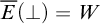 $\overline {E}(\bot )=W$
. As the next lemma shows, the existence set
$\overline {E}(\bot )=W$
. As the next lemma shows, the existence set $E(\{\mathbf {x}\})$
of an element of the outer domain of a frame is identical to the existence set
$E(\{\mathbf {x}\})$
of an element of the outer domain of a frame is identical to the existence set $\overline {E}(\pi _{0}(\mathbf {x}))$
of its first component; more generally, we have
$\overline {E}(\pi _{0}(\mathbf {x}))$
of its first component; more generally, we have $E(\{\mathbf {x}_{1},\ldots ,\mathbf {x}_{n}\}=\overline {E}(\bigsqcup \{\pi _{0}(\mathbf {x}_{1}),\ldots ,\pi _{0}(\mathbf {x}_{n})\})$
. Thus the existence set of an element of the outer domain of a frame is uniquely determined by the worldly content structure underlying the frame.
$E(\{\mathbf {x}_{1},\ldots ,\mathbf {x}_{n}\}=\overline {E}(\bigsqcup \{\pi _{0}(\mathbf {x}_{1}),\ldots ,\pi _{0}(\mathbf {x}_{n})\})$
. Thus the existence set of an element of the outer domain of a frame is uniquely determined by the worldly content structure underlying the frame.
An important feature of clause (ii) is that the intensional content $\pi _{1}(\mathbf {x})$
of an element of the domain of propositions
$\pi _{1}(\mathbf {x})$
of an element of the domain of propositions $D_{\langle \rangle }$
is a subset of its existence set
$D_{\langle \rangle }$
is a subset of its existence set $E(\{\mathbf {x}\})$
. We can think of the intensional content of a proposition as the set of worlds at which the proposition is true. The condition that the intensional content of a proposition should be a subset of its existence set therefore entails that a proposition can only be true at those worlds at which it exists. Similarly, we can think of the intensional content
$E(\{\mathbf {x}\})$
. We can think of the intensional content of a proposition as the set of worlds at which the proposition is true. The condition that the intensional content of a proposition should be a subset of its existence set therefore entails that a proposition can only be true at those worlds at which it exists. Similarly, we can think of the intensional content $\pi _{1}(\mathbf {X})$
of a non-rigid property or relation (i.e., an element of some
$\pi _{1}(\mathbf {X})$
of a non-rigid property or relation (i.e., an element of some $D_{\langle \tau _{1},\ldots ,\tau _{k}\rangle }$
) specified in clause (iii) as the function that takes entities of appropriate type to the set of worlds at which the entities have the property or relation in question. For example, if
$D_{\langle \tau _{1},\ldots ,\tau _{k}\rangle }$
) specified in clause (iii) as the function that takes entities of appropriate type to the set of worlds at which the entities have the property or relation in question. For example, if $\mathbf {X}\in D_{\langle \tau \rangle }$
and
$\mathbf {X}\in D_{\langle \tau \rangle }$
and $\mathbf {x}\in D_{\tau }$
, then
$\mathbf {x}\in D_{\tau }$
, then $\pi _{1}(\mathbf {X})(\mathbf {x})$
represents the set of worlds at which
$\pi _{1}(\mathbf {X})(\mathbf {x})$
represents the set of worlds at which $\mathbf {x}$
has property
$\mathbf {x}$
has property $\mathbf {X}$
, or in other words, the intensional content of the proposition that
$\mathbf {X}$
, or in other words, the intensional content of the proposition that $\mathbf {x}$
has
$\mathbf {x}$
has $\mathbf {X}$
. Clause (iii) guarantees that the set of worlds
$\mathbf {X}$
. Clause (iii) guarantees that the set of worlds $\pi _{1}(\mathbf {X})(\mathbf {x})$
is a subset of the set
$\pi _{1}(\mathbf {X})(\mathbf {x})$
is a subset of the set $E(\{\mathbf {X},\mathbf {x}\})$
, the set of worlds at which both
$E(\{\mathbf {X},\mathbf {x}\})$
, the set of worlds at which both $\mathbf {X}$
and
$\mathbf {X}$
and $\mathbf {x}$
exist. Thus an entity can only instantiate a property at those worlds at which both the entity and the property exist.
$\mathbf {x}$
exist. Thus an entity can only instantiate a property at those worlds at which both the entity and the property exist.
Unlike the intensional content $\pi _{1}(\mathbf {X})$
of a non-rigid property, the intensional content of a rigid property (i.e., an element of some
$\pi _{1}(\mathbf {X})$
of a non-rigid property, the intensional content of a rigid property (i.e., an element of some $D_{[\tau ]}$
) is simply its extension, i.e., a subset of the domain of entities of appropriate type. For example, if
$D_{[\tau ]}$
) is simply its extension, i.e., a subset of the domain of entities of appropriate type. For example, if $\mathbf {X}\in D_{[\tau ]}$
, then
$\mathbf {X}\in D_{[\tau ]}$
, then $\pi _{1}(\mathbf {X})$
is a subset of
$\pi _{1}(\mathbf {X})$
is a subset of $D_{\tau }$
, and an entity
$D_{\tau }$
, and an entity $\mathbf {x}\in D_{\tau }$
has
$\mathbf {x}\in D_{\tau }$
has $\mathbf {X}$
if and only if
$\mathbf {X}$
if and only if $\mathbf {x}\in \pi _{1}(\mathbf {X})$
. One difference between rigid and non-rigid properties is that the extension of a rigid property always remains fixed across worlds (see Lemma 4 (iv)), whereas the extension of a non-rigid property may vary across worlds. Another difference is that the worldly content
$\mathbf {x}\in \pi _{1}(\mathbf {X})$
. One difference between rigid and non-rigid properties is that the extension of a rigid property always remains fixed across worlds (see Lemma 4 (iv)), whereas the extension of a non-rigid property may vary across worlds. Another difference is that the worldly content $\pi _{0}(\mathbf {X})$
of a rigid property—but not that of a non-rigid property—is determined by its intensional content
$\pi _{0}(\mathbf {X})$
of a rigid property—but not that of a non-rigid property—is determined by its intensional content $\pi _{1}(\mathbf {X})$
, and thus by the entities in its extension. In fact, the worldly content
$\pi _{1}(\mathbf {X})$
, and thus by the entities in its extension. In fact, the worldly content $\pi _{0}(\mathbf {X})$
of a rigid property
$\pi _{0}(\mathbf {X})$
of a rigid property $\mathbf {X}$
is just the lattice join of the set of worldly contents of the entities in its extension. So a rigid property exists in exactly those worlds at which the entities in its extension exist (see Lemma 4 (i)).
$\mathbf {X}$
is just the lattice join of the set of worldly contents of the entities in its extension. So a rigid property exists in exactly those worlds at which the entities in its extension exist (see Lemma 4 (i)).
Lemma 2. Let $\langle W,D\rangle $
be a dual-content frame. Then for all
$\langle W,D\rangle $
be a dual-content frame. Then for all $\mathbf {x}\in \bigcup D$
:
$\mathbf {x}\in \bigcup D$
: $\overline {E}(\pi _{0}(\mathbf {x}))=E(\lbrace \mathbf {x}\rbrace )$
.
$\overline {E}(\pi _{0}(\mathbf {x}))=E(\lbrace \mathbf {x}\rbrace )$
.
Proof. Immediate from Definition 9.
Lemma 3. Let $\langle W,D\rangle $
be a dual-content frame. Then for all
$\langle W,D\rangle $
be a dual-content frame. Then for all $\mathbf {x,y}\in \bigcup D$
: if
$\mathbf {x,y}\in \bigcup D$
: if $\pi _{0}(\mathbf {x})\sqsubseteq \pi _{0}(\mathbf {y})$
then
$\pi _{0}(\mathbf {x})\sqsubseteq \pi _{0}(\mathbf {y})$
then $E(\{\mathbf {y}\})\subseteq E(\{\mathbf {x}\})$
.
$E(\{\mathbf {y}\})\subseteq E(\{\mathbf {x}\})$
.
Next we need to check that the rigid properties behave in the intended way.
Lemma 4. Let $\langle W,D\rangle $
be a dual-content frame. Then the following conditions hold:
$\langle W,D\rangle $
be a dual-content frame. Then the following conditions hold:
-
1. for every
$\mathbf {X}\in D_{[\sigma ]}$
,
$E(\lbrace \mathbf {X}\rbrace )=E(Ext^{w}(\mathbf {X}))$
for all
$w\in E(\lbrace \mathbf {X}\rbrace )$
; -
2. for every
$\mathbf {X}\in D_{\langle \sigma \rangle }^{w}$
there is a
$\mathbf {Y}\in D_{[\sigma ]}^{w}$
such that
$Ext^{w}(\mathbf {X})=Ext^{w}(\mathbf {Y})$
; -
3. for any
$\mathbf {X}, \mathbf {Y}\in D_{[\sigma ]}$
if
$Ext^{w}(\mathbf {X})=Ext^{w}(\mathbf {Y})$
for some
$w\in W$
, then
$\mathbf {X}=\mathbf {Y}$
; -
4. for every
$\mathbf {X}\in D_{[\sigma ]}$
,
$Ext^{w}(\mathbf {X})=Ext^{v}(\mathbf {X})$
for all
$w,v\in W.$


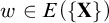









Proof. (i) Let $\mathbf {X}\in D_{[\sigma ]}$
. By Lemma 2 and Definition 9:
$\mathbf {X}\in D_{[\sigma ]}$
. By Lemma 2 and Definition 9: $E(\lbrace \mathbf {X}\rbrace )=\overline {E}(\pi _{0}(\mathbf {X}))=\overline {E}(\bigsqcup \lbrace \pi _{0}(\mathbf {Y}):\mathbf {Y}\in \pi _{1}(\mathbf {X})\rbrace )=\bigcap _{\mathbf {Y}\in \pi _{1}(\mathbf {X})}\overline {E}(\pi _{0}(\mathbf {Y}))\hspace{1pt}=\hspace{1pt}\bigcap _{\mathbf {Y}\in \pi _{1}(\mathbf {X})}E(\lbrace \mathbf {Y}\rbrace )\hspace{1pt}=\hspace{1pt}E(\pi _{1}(\mathbf {X}))\hspace{1pt}= E(Ext^{w}(\mathbf {X}))$
, for all
$E(\lbrace \mathbf {X}\rbrace )=\overline {E}(\pi _{0}(\mathbf {X}))=\overline {E}(\bigsqcup \lbrace \pi _{0}(\mathbf {Y}):\mathbf {Y}\in \pi _{1}(\mathbf {X})\rbrace )=\bigcap _{\mathbf {Y}\in \pi _{1}(\mathbf {X})}\overline {E}(\pi _{0}(\mathbf {Y}))\hspace{1pt}=\hspace{1pt}\bigcap _{\mathbf {Y}\in \pi _{1}(\mathbf {X})}E(\lbrace \mathbf {Y}\rbrace )\hspace{1pt}=\hspace{1pt}E(\pi _{1}(\mathbf {X}))\hspace{1pt}= E(Ext^{w}(\mathbf {X}))$
, for all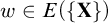 $w\in E(\lbrace \mathbf {X}\rbrace )$
. (ii) follows from the fact that for every
$w\in E(\lbrace \mathbf {X}\rbrace )$
. (ii) follows from the fact that for every $w\in W$
and
$w\in W$
and $\tau \in \mathcal {T}, \lbrace \pi _{1}(\mathbf {X}):\mathbf {X}\in D^{w}_{[\tau ]}\rbrace =\wp (D_{\tau }^{w})$
. (iii) Let
$\tau \in \mathcal {T}, \lbrace \pi _{1}(\mathbf {X}):\mathbf {X}\in D^{w}_{[\tau ]}\rbrace =\wp (D_{\tau }^{w})$
. (iii) Let $\mathbf {X},\mathbf {Y}\in D_{[\sigma ]}$
and suppose
$\mathbf {X},\mathbf {Y}\in D_{[\sigma ]}$
and suppose $Ext^{w}(\mathbf {X})=Ext^{w}(\mathbf {Y})$
for some
$Ext^{w}(\mathbf {X})=Ext^{w}(\mathbf {Y})$
for some $w\in W$
. Then
$w\in W$
. Then $\pi _{1}(\mathbf {X})=\pi _{1}(\mathbf {Y})$
and so
$\pi _{1}(\mathbf {X})=\pi _{1}(\mathbf {Y})$
and so $\pi _{0}(\mathbf {X})=\bigsqcup \lbrace \pi _{0}(\mathbf {Z}):\mathbf {Z}\in \pi _{1}(\mathbf {X})\rbrace =\bigsqcup \lbrace \pi _{0}(\mathbf {Z}):\mathbf {Z}\in \pi _{1}(\mathbf {Y})\rbrace =\pi _{0}(\mathbf {Y})$
. Hence,
$\pi _{0}(\mathbf {X})=\bigsqcup \lbrace \pi _{0}(\mathbf {Z}):\mathbf {Z}\in \pi _{1}(\mathbf {X})\rbrace =\bigsqcup \lbrace \pi _{0}(\mathbf {Z}):\mathbf {Z}\in \pi _{1}(\mathbf {Y})\rbrace =\pi _{0}(\mathbf {Y})$
. Hence, $\mathbf {X}=\mathbf {Y}$
. (iv) is an immediate consequence of Definition 9.
$\mathbf {X}=\mathbf {Y}$
. (iv) is an immediate consequence of Definition 9.
We now specify how terms of our formal language are interpreted in a dual-content frame.
Definition 10. When $\mathfrak {F}=\langle W,D\rangle $
is a frame, an assignment for
$\mathfrak {F}=\langle W,D\rangle $
is a frame, an assignment for $\mathfrak {F}$
is a typed function from
$\mathfrak {F}$
is a typed function from $\mathcal {V}$
to
$\mathcal {V}$
to $\bigcup D$
. Given an assignment g, pairwise distinct variables
$\bigcup D$
. Given an assignment g, pairwise distinct variables $x_{1},\ldots ,x_{k}$
and
$x_{1},\ldots ,x_{k}$
and $\mathbf {x}_{1},\ldots ,\mathbf {x}_{k}\in \bigcup D$
, we use
$\mathbf {x}_{1},\ldots ,\mathbf {x}_{k}\in \bigcup D$
, we use $g[x_{i}\mapsto \mathbf {x}_{i}]$
to denote the assignment with
$g[x_{i}\mapsto \mathbf {x}_{i}]$
to denote the assignment with $g[x_{i}\mapsto \mathbf {x}_{i}](x_{i})=\mathbf {x}_{i}$
for
$g[x_{i}\mapsto \mathbf {x}_{i}](x_{i})=\mathbf {x}_{i}$
for $1\leq i\leq k$
, and
$1\leq i\leq k$
, and $g[x_{i}\mapsto \mathbf {x}_{i}](y)=g(y)$
for variables y other than
$g[x_{i}\mapsto \mathbf {x}_{i}](y)=g(y)$
for variables y other than $x_{1},\ldots ,x_{k}$
.
$x_{1},\ldots ,x_{k}$
.
Definition 11. Let $\Sigma $
be a signature and
$\Sigma $
be a signature and $\mathfrak {N}=\langle \mathcal {N},W,I,\iota ,\overline {E}\rangle $
be a worldly content structure. A dual-content
$\mathfrak {N}=\langle \mathcal {N},W,I,\iota ,\overline {E}\rangle $
be a worldly content structure. A dual-content $\mathcal {L}^{\Sigma }$
-model based on
$\mathcal {L}^{\Sigma }$
-model based on $\mathfrak {N}$
is a triple
$\mathfrak {N}$
is a triple  , where $\langle W,D\rangle $
is the dual-content frame induced by
$\langle W,D\rangle $
is the dual-content frame induced by $\mathfrak {N}$
, and
$\mathfrak {N}$
, and  is a function which maps every assignment g for $\langle W,D\rangle $
to a typed partial function
$\langle W,D\rangle $
to a typed partial function  from
from $\mathcal {L}^{\Sigma }$
to
$\mathcal {L}^{\Sigma }$
to $\bigcup D$
, satisfying the following conditions:
$\bigcup D$
, satisfying the following conditions:
Compositional clauses:
-
1.
-
2. if
$c\in \Sigma $
, then is defined, and for all assignments
$g,h$
: ; -
3.
is defined iff , where
$A_{1},\ldots , A_{n}$
are all the free variables and constants occurring in
$A;$
-
4.
, where
$A_{1},\ldots , A_{n}$
are all the free variables and constants occurring in
$A;$
-
5. if A is of type
$\langle \sigma _{1},\ldots ,\sigma _{n}\rangle $
, then -
6. if A is of type
$[\sigma ]$
, then if , and otherwise; -
7.
if is defined; and
$\emptyset $
otherwise.
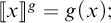

 is defined, and for all assignments
 ;
; is defined iff
  , where

 , where




 if
if  , and
, and  otherwise;
 if
if  is defined; and
Clauses for logical constants:Footnote 31
-
1.
-
2.
Footnote
32
-
3.
for some
$\mathbf {y}\in D_{\sigma }^{w}\rbrace ;$
-
4.
for all
$v\in W$
, if
$\bigcup _{i=1}^{n}Ext^{w}(\mathbf {X}_{i})\subseteq D^{v}$
then
$v\in \pi _{1}(\mathbf {p})\rbrace ;$
-
5.
if
$\mathbf {x}=\mathbf {y}$
; and
$\emptyset $
otherwise.


 for some
 for all


 if
if 

The clauses for $\vee ,\rightarrow ,\leftrightarrow $
and
$\vee ,\rightarrow ,\leftrightarrow $
and $\forall _{\sigma }$
with their classical interpretations are defined analogously.
$\forall _{\sigma }$
with their classical interpretations are defined analogously.
An easy induction on the complexity of terms shows that the function  is well-defined, such that whenever defined,
  is indeed in $\bigcup D$
. To construct a dual content model based on a given worldly content model we only have to assign appropriate worldly and intensional contents to every non-logical constant of our signature; in the case of logical constants we only have to assign a worldly content, because the intensional contents of the logical constants are fixed by the clauses for the logical constants. Example models will be given in §7. Note that by compositional clause 3, the denotation of a term A is defined if and only if the denotations of its free variables and constants all exist together at some world. Formulas are only evaluated at worlds at which their denotations exist. A formula
$\bigcup D$
. To construct a dual content model based on a given worldly content model we only have to assign appropriate worldly and intensional contents to every non-logical constant of our signature; in the case of logical constants we only have to assign a worldly content, because the intensional contents of the logical constants are fixed by the clauses for the logical constants. Example models will be given in §7. Note that by compositional clause 3, the denotation of a term A is defined if and only if the denotations of its free variables and constants all exist together at some world. Formulas are only evaluated at worlds at which their denotations exist. A formula $\phi $
is said to be true at
$\phi $
is said to be true at  relative to a model $\mathfrak {M}$
and assignment g just in case
$\mathfrak {M}$
and assignment g just in case  ; otherwise it is false at w. We sometimes abbreviate this by $\mathfrak {M},w,g\vDash \phi $
and
$\mathfrak {M},w,g\vDash \phi $
and $\mathfrak {M},w,g\nvDash \phi $
, respectively. A formula is neither true nor false at a world at which its denotation does not exist. In what follows, we generally omit the assignment and write
$\mathfrak {M},w,g\nvDash \phi $
, respectively. A formula is neither true nor false at a world at which its denotation does not exist. In what follows, we generally omit the assignment and write  instead of
  when A is a term without free variables. Using Definition 11, we can derive the familiar truth-clauses for the logical constants. For example, the clauses for negation, conjunction, existential quantification and the essentialist operator are as follows. Let
  be a dual-content model. Then:
-
For
iff
$\mathfrak {M},w,g\nvDash \phi .$
-
For
iff
$\mathfrak {M},w,g\vDash \phi $
and
$\mathfrak {M},w,g\vDash \psi .$
-
For
iff for some
$\mathbf {x}\in D^{w}_{\tau } :\mathbf {x}\in Ext^{w}$
-
For
iff for all
$v\in W$
: if , then
$\mathfrak {M},v,g\vDash \phi .$
 iff
iff 
 iff
iff 

 iff for some

 iff for all
 , then
In words: if 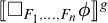 is in the domain of w, then $\square _{F_{1},\ldots ,F_{n}}\phi $
is true at w (relative to g) just in case
$\square _{F_{1},\ldots ,F_{n}}\phi $
is true at w (relative to g) just in case $\phi $
ist true at every world v (relative to g) whose domain contains the union of the extensions of
$\phi $
ist true at every world v (relative to g) whose domain contains the union of the extensions of $F_{1},\ldots ,F_{n}$
at w. For example,
$F_{1},\ldots ,F_{n}$
at w. For example,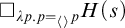 $\square _{\lambda p.p=_{\langle \rangle }p}H(s)$
(‘It is true in virtue of the collective nature of all propositions that Socrates is human’) is true at w just in case
$\square _{\lambda p.p=_{\langle \rangle }p}H(s)$
(‘It is true in virtue of the collective nature of all propositions that Socrates is human’) is true at w just in case $H(s)$
is true at every world that contains all the propositions in w, or in other words, at every world that contains
$H(s)$
is true at every world that contains all the propositions in w, or in other words, at every world that contains  . For another example, $\square _{[s]}H(s)$
(‘It is true in virtue of the nature of Socrates that Socrates is human’) is true at w just in case
$\square _{[s]}H(s)$
(‘It is true in virtue of the nature of Socrates that Socrates is human’) is true at w just in case $H(s)$
is true at every world at which
$H(s)$
is true at every world at which  exists.Footnote
33
So
exists.Footnote
33
So $\square _{[s]}H(s)$
is false at w just in case either
$\square _{[s]}H(s)$
is false at w just in case either  is not in the domain of every world whose domain contains
  , or
, or $H(s)$
is false at some world whose domain contains
$H(s)$
is false at some world whose domain contains  . It follows from Lemma 6 below that the denotation of a term (relative to an assignment g) is in the domain of a world w just in case the denotations (relative to g) of the constants and free variables occurring in it are in the domain of w. So, for example,
  is in the domain of w just in case both
  and
and  are in the domain of w. As we will see below, it is straightforward to construct models where the denotations of different constants have different existence sets, so that even, e.g.,
  and
and  may be in the domains of some, none, or all of the same worlds.
The following derived clause for $\square _{\Pi }$
deserves special mention:
$\square _{\Pi }$
deserves special mention:
-
For
iff for all
$v\in W$
: if
$D^{w}\subseteq D^{v}$
, then
$\mathfrak {M},v,g\vDash \phi $
 iff for all


If, as discussed in §5, $\square _{\Pi }$
expresses metaphysical necessity, then the clause says that
$\square _{\Pi }$
expresses metaphysical necessity, then the clause says that $\phi $
is metaphysically necessary at w if and only if it is true at every world that contains
$\phi $
is metaphysically necessary at w if and only if it is true at every world that contains $D^{w}$
, i.e., the domain of all entities that exist at w. A world v is thus metaphysically accessible from a world w if and only if
$D^{w}$
, i.e., the domain of all entities that exist at w. A world v is thus metaphysically accessible from a world w if and only if $D^w\subseteq D^v$
. But even if
$D^w\subseteq D^v$
. But even if $\square _{\Pi }$
does not express metaphysical necessity, any candidate metaphysical necessity operator would have to obey the same semantic clause, provided that essence implies necessity and the logic of metaphysical necessity is at least S4.
$\square _{\Pi }$
does not express metaphysical necessity, any candidate metaphysical necessity operator would have to obey the same semantic clause, provided that essence implies necessity and the logic of metaphysical necessity is at least S4.
Our semantic clause for the essentialist operator is a higher-order generalization of the clause for the essentialist operator in Fine [Reference Fine22] except for one small but crucial difference. On Fine’s semantics, $\square _{F}\phi $
is true at a world at which the formula is defined just in case (a) for every object x in the objectual content of
$\square _{F}\phi $
is true at a world at which the formula is defined just in case (a) for every object x in the objectual content of $\phi $
, there is some element y in the extension of F that depends on x,Footnote
34
and (b)
$\phi $
, there is some element y in the extension of F that depends on x,Footnote
34
and (b) $\phi $
is true at every world that contains the extension of F.Footnote
35
Part (a) of Fine’s clause ensures the validity of Localization, a principle that we have seen reason to reject. Dropping part (a) constitutes a welcome simplification of the semantic clause for the essentialist operator.Footnote
36
$\phi $
is true at every world that contains the extension of F.Footnote
35
Part (a) of Fine’s clause ensures the validity of Localization, a principle that we have seen reason to reject. Dropping part (a) constitutes a welcome simplification of the semantic clause for the essentialist operator.Footnote
36
As mentioned previously, we also have the following derived clause for the relation of essential involvement, the proof of which is supplied in Lemma 11:
-
For
iff depends on .
 iff
iff  depends on
  .
.The relation of essential involvement can thus be modeled as a relation between existence sets of entities. This is another important difference to Fine’s first-order semantics, in which essential involvement (Fine’s dependence relation) is interpreted by a primitive dependence relation in the structures which cannot be defined in terms of existence sets.Footnote 37
Before we move on to some example models, we supply the definition of validity.
Definition 12 (Validity).
A formula $\phi $
is valid in a class of dual-content models
$\phi $
is valid in a class of dual-content models $\mathfrak {S}$
iff for every dual-content model
$\mathfrak {S}$
iff for every dual-content model  and assignment g for which
  is defined:
  .
. $\phi $
is valid iff it is valid in the class of all dual-content models.
$\phi $
is valid iff it is valid in the class of all dual-content models.
Note that since we always have  , because a proposition can only be true at those worlds at which it exists,
  entails
  .
.
7 Example models
We will now construct some examples of models that show the consistency of some simple HLE-theories. The models constructed here illustrate some general methods for constructing models of more complicated theories.
Example 3. We construct a model that shows the joint consistency of the sentences $\square _{[s]}H(s)$
and
$\square _{[s]}H(s)$
and $\neg \square _{[H]}H(s)$
, which we may read ‘Socrates is essentially human’ and ‘It is not in the nature of being human that Socrates is human’, respectively.
$\neg \square _{[H]}H(s)$
, which we may read ‘Socrates is essentially human’ and ‘It is not in the nature of being human that Socrates is human’, respectively.
Let $\Sigma $
be a signature whose only non-logical constants are s (of type e) and H (of type
$\Sigma $
be a signature whose only non-logical constants are s (of type e) and H (of type $\langle e\rangle $
). We first define a worldly content structure
$\langle e\rangle $
). We first define a worldly content structure $\mathfrak {N}=\langle \mathcal {N},W,I,\iota ,\overline {E}\rangle $
similar to the one defined in Example 1. Let
$\mathfrak {N}=\langle \mathcal {N},W,I,\iota ,\overline {E}\rangle $
similar to the one defined in Example 1. Let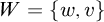 $W=\{w,v\}$
,
$W=\{w,v\}$
, $\mathcal {N}=\langle \wp (W),\supseteq \rangle $
, with join being given by intersection of subsets and meet by union,
$\mathcal {N}=\langle \wp (W),\supseteq \rangle $
, with join being given by intersection of subsets and meet by union, $I^{w}=\mathbb {N}\cup \{s\}$
,
$I^{w}=\mathbb {N}\cup \{s\}$
, $I^{v}=\mathbb {N}$
,
$I^{v}=\mathbb {N}$
, $\iota (s)=\{w\}$
, and
$\iota (s)=\{w\}$
, and $\iota (n)=W$
for all
$\iota (n)=W$
for all $n\in \mathbb {N}$
, and let
$n\in \mathbb {N}$
, and let $\overline {E}$
be the identity function on
$\overline {E}$
be the identity function on $\wp (W)$
. Thus the existence set of a lattice element is just the lattice element itself. We can now define a dual-content
$\wp (W)$
. Thus the existence set of a lattice element is just the lattice element itself. We can now define a dual-content $\mathcal {L}^{\Sigma }$
-model
$\mathcal {L}^{\Sigma }$
-model  based on $\mathfrak {N}$
. Let
$\mathfrak {N}$
. Let  ,
, 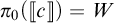 for all logical constants c,
  , and
, and  if
if  , and
, and $\emptyset $
otherwise. It is readily checked that
$\emptyset $
otherwise. It is readily checked that $\mathfrak {M},w,g\vDash \square _{[s]}H(s)$
and
$\mathfrak {M},w,g\vDash \square _{[s]}H(s)$
and $\mathfrak {M},w,g\vDash \neg \square _{[H]}H(s)$
.
$\mathfrak {M},w,g\vDash \neg \square _{[H]}H(s)$
.
In the model constructed in Example 3, neither world is metaphysically accessible from the other, because the domain of neither is a subset of the other (no element whose first component is $\{v\}$
is in
$\{v\}$
is in $D^w$
and no element whose first component is
$D^w$
and no element whose first component is $\{w\}$
is in
$\{w\}$
is in $D^v$
). We may sometimes want to construct models based on a particular metaphysical accessibility relation on the set of worlds. The next example provides a template for constructing dual-content frames given a particular metaphysical accessibility relation.
$D^v$
). We may sometimes want to construct models based on a particular metaphysical accessibility relation on the set of worlds. The next example provides a template for constructing dual-content frames given a particular metaphysical accessibility relation.
Example 4. Let W be a non-empty set and R be a reflexive and transitive relation on W. A subset $G \subseteq W$
is R-closed iff for all
$G \subseteq W$
is R-closed iff for all $w \in G$
and
$w \in G$
and $v \in W$
,
$v \in W$
, $wRv$
implies
$wRv$
implies $v \in G$
. Let
$v \in G$
. Let $\wp ^R(W) = \{ G \subseteq W \mid G \text { is} R\text {-closed} \}.$
Then
$\wp ^R(W) = \{ G \subseteq W \mid G \text { is} R\text {-closed} \}.$
Then $\mathcal {N}=\langle \wp ^R(W), \supseteq \rangle $
is a complete lattice, with join given by intersection and meet by union. Let
$\mathcal {N}=\langle \wp ^R(W), \supseteq \rangle $
is a complete lattice, with join given by intersection and meet by union. Let $\overline {E}$
be the identity function on
$\overline {E}$
be the identity function on $\wp ^R(W)$
, and I be a function mapping each
$\wp ^R(W)$
, and I be a function mapping each $w\in W$
to some non-empty set
$w\in W$
to some non-empty set $I^w$
such that for all
$I^w$
such that for all $w,v\in W$
,
$w,v\in W$
, $wRv$
implies
$wRv$
implies $I^w\subseteq I^v$
; and let
$I^w\subseteq I^v$
; and let $\iota : o\mapsto \{w: o\in I^w\}$
. Then
$\iota : o\mapsto \{w: o\in I^w\}$
. Then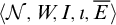 $\langle \mathcal {N},W,I,\iota ,\overline {E}\rangle $
is a worldly content structure. Let
$\langle \mathcal {N},W,I,\iota ,\overline {E}\rangle $
is a worldly content structure. Let $\langle W,D\rangle $
be the dual-content frame induced by
$\langle W,D\rangle $
be the dual-content frame induced by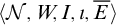 $\langle \mathcal {N},W,I,\iota ,\overline {E}\rangle $
. We then have for all
$\langle \mathcal {N},W,I,\iota ,\overline {E}\rangle $
. We then have for all $w, v \in W : wRv$
if and only if
$w, v \in W : wRv$
if and only if $D^w \subseteq D^v$
. Thus the accessibility relation R is indeed the metaphysical accessibility relation. If R is also symmetric, then
$D^w \subseteq D^v$
. Thus the accessibility relation R is indeed the metaphysical accessibility relation. If R is also symmetric, then $wRv$
if and only if
$wRv$
if and only if $D^w = D^v$
.
$D^w = D^v$
.
Our next example shows the consistency of the schema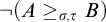 $\neg (A\geq _{\sigma ,\tau }B)$
, where A and B are distinct constants of a given signature. The consistency of this schema implies in particular that it is consistent to assume that the nature of no logical operation involves any other logical operation, where by ‘logical operation’ we mean ‘denotation of a logical constant’ of a given signature.
$\neg (A\geq _{\sigma ,\tau }B)$
, where A and B are distinct constants of a given signature. The consistency of this schema implies in particular that it is consistent to assume that the nature of no logical operation involves any other logical operation, where by ‘logical operation’ we mean ‘denotation of a logical constant’ of a given signature.
Example 5. Let $\Sigma $
be a signature. We define a worldly content structure
$\Sigma $
be a signature. We define a worldly content structure $\mathfrak {N}=\langle \mathcal {N},W,I,\iota ,\overline {E}\rangle $
as in Example 2:
$\mathfrak {N}=\langle \mathcal {N},W,I,\iota ,\overline {E}\rangle $
as in Example 2: $\mathcal {N}=\langle \wp (\Sigma ),\subseteq \rangle $
, with join given by union and meet by intersection of subsets,
$\mathcal {N}=\langle \wp (\Sigma ),\subseteq \rangle $
, with join given by union and meet by intersection of subsets, $W=\wp (\Sigma )\setminus \{\emptyset \}$
,
$W=\wp (\Sigma )\setminus \{\emptyset \}$
, $I^{w}=\{c\in \Sigma : c\in w\}$
for all
$I^{w}=\{c\in \Sigma : c\in w\}$
for all $w\in W$
,
$w\in W$
, $\iota $
is the function from
$\iota $
is the function from $\Sigma $
to
$\Sigma $
to $\wp (\Sigma )$
such that
$\wp (\Sigma )$
such that $\iota (x)=\{x\}$
, and
$\iota (x)=\{x\}$
, and $\overline {E}$
is the function from
$\overline {E}$
is the function from $\wp (\Sigma )$
to
$\wp (\Sigma )$
to $\wp (W)$
such that
$\wp (W)$
such that $\overline {E}: n\mapsto \{w\in W:n\subseteq w\}$
. Let
$\overline {E}: n\mapsto \{w\in W:n\subseteq w\}$
. Let  be a dual-content $\mathcal {L}^{\Sigma }$
-model based on
$\mathcal {L}^{\Sigma }$
-model based on $\mathfrak {N}$
, where
$\mathfrak {N}$
, where  for all $c\in \Sigma $
. For the purpose of demonstrating the consistency of the schema above, the intensional contents of the non-logical constants don’t matter, so we leave them unspecified; the intensional contents of the logical constants are determined by Definition 11. Note that in this model, the worlds are sets of constants and by construction, the denotation of a constant exists at a world if and only if it is an element of that world. Thus
$c\in \Sigma $
. For the purpose of demonstrating the consistency of the schema above, the intensional contents of the non-logical constants don’t matter, so we leave them unspecified; the intensional contents of the logical constants are determined by Definition 11. Note that in this model, the worlds are sets of constants and by construction, the denotation of a constant exists at a world if and only if it is an element of that world. Thus $w:=\Sigma $
is the only world in the model in which all denotations of the constants of
$w:=\Sigma $
is the only world in the model in which all denotations of the constants of $\Sigma $
exist together. It is readily checked that each instance of the schema
$\Sigma $
exist together. It is readily checked that each instance of the schema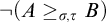 $\neg (A\geq _{\sigma ,\tau }B)$
in which A and B are distinct constants from
$\neg (A\geq _{\sigma ,\tau }B)$
in which A and B are distinct constants from $\Sigma $
, for any
$\Sigma $
, for any $\tau \in \mathcal {T}$
, is true at w. The reason is that for each constant c, there is some world, namely,
$\tau \in \mathcal {T}$
, is true at w. The reason is that for each constant c, there is some world, namely, $\lbrace c\rbrace $
, at which
$\lbrace c\rbrace $
, at which  but no other denotation of a constant exists.
The next examples illustrate that the denotations of logically equivalent formulas may fail to be identical in a model.
Example 6. Let $\Sigma $
be the signature that contains only logical constants. Let
$\Sigma $
be the signature that contains only logical constants. Let $\mathfrak {N}$
be defined as in the previous example except that
$\mathfrak {N}$
be defined as in the previous example except that $I^{w}=\Sigma $
for all
$I^{w}=\Sigma $
for all $w\in W$
and
$w\in W$
and $\overline {E}$
is the constant function that maps every element of
$\overline {E}$
is the constant function that maps every element of $\mathcal {N}$
to W. Let
$\mathcal {N}$
to W. Let  be the dual-content $\mathcal {L}^{\Sigma }$
-model based on
$\mathcal {L}^{\Sigma }$
-model based on $\mathfrak {N}$
. Now consider the formulas p and
$\mathfrak {N}$
. Now consider the formulas p and $\neg \neg p$
and let g be an assignment such that
$\neg \neg p$
and let g be an assignment such that $g(p)=\langle \emptyset ,W\rangle $
. The formulas p and
$g(p)=\langle \emptyset ,W\rangle $
. The formulas p and $\neg \neg p$
are logically equivalent and true in the same worlds, but their denotations are distinct:
$\neg \neg p$
are logically equivalent and true in the same worlds, but their denotations are distinct:  .
.
The model in the previous example is one in which the domain function D is such that for all $\sigma \in \mathcal {T}$
,
$\sigma \in \mathcal {T}$
, $D_{\sigma }^{w}=D_{\sigma }^{v}$
for all
$D_{\sigma }^{w}=D_{\sigma }^{v}$
for all $w,v\in W$
; the typed domains are constant across worlds. Let us call models of this kind constant domain models. Constant domain models validate the schema
$w,v\in W$
; the typed domains are constant across worlds. Let us call models of this kind constant domain models. Constant domain models validate the schema $A\geq _{\sigma ,\tau }B$
, which, as discussed in §4, leads to the consequence that all subscripted essentialist operators become logically coextensive. The example also shows that two formulas
$A\geq _{\sigma ,\tau }B$
, which, as discussed in §4, leads to the consequence that all subscripted essentialist operators become logically coextensive. The example also shows that two formulas $\phi $
and
$\phi $
and $\psi $
may be equivalent in the class of constant domain models without
$\psi $
may be equivalent in the class of constant domain models without $\phi =\psi $
being valid in that class. However, any constant domain model in which
$\phi =\psi $
being valid in that class. However, any constant domain model in which $\mathcal {N}$
is a trivial one-element lattice is such that if
$\mathcal {N}$
is a trivial one-element lattice is such that if  , then
 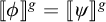 .
.
There is also a natural class of models without constant domain in which sameness of intensional content and existing at the same worlds does entail sameness of denotation. Call a dual-content model injective if it is based on a worldly content model in which the function $\overline {E}$
is injective. The models constructed in Examples 3 and 5 are examples of injective models. In an injective model, any elements of the domain that exist in the same worlds have the same worldly content.
$\overline {E}$
is injective. The models constructed in Examples 3 and 5 are examples of injective models. In an injective model, any elements of the domain that exist in the same worlds have the same worldly content.
Injective models validate some interesting interaction principles between essence and identity that are not valid in the class of all dual-content models. Among the injective dual-content models, those in which the denotations of $=$
and
$=$
and $\wedge $
exist at all worlds are of special interest because they validate an especially tight connection between essence and identity. For example, suppose
$\wedge $
exist at all worlds are of special interest because they validate an especially tight connection between essence and identity. For example, suppose $\square _{[x]}p$
is true at some world w for some assignment g in such a model. Then
$\square _{[x]}p$
is true at some world w for some assignment g in such a model. Then  , and so $(x= x)= ((x= x)\wedge p)$
is true on g at w as well. Conversely, if
$(x= x)= ((x= x)\wedge p)$
is true on g at w as well. Conversely, if $(x= x)= ((x= x)\wedge p)$
is true at w on some assignment g in such a model, then
$(x= x)= ((x= x)\wedge p)$
is true at w on some assignment g in such a model, then $\square _{[x]}p$
is true on g at w too, if the denotation of
$\square _{[x]}p$
is true on g at w too, if the denotation of $\square _{\sigma }$
exists at w. Thus, the formula
$\square _{\sigma }$
exists at w. Thus, the formula $\square _{[x]}p\leftrightarrow ((x= x)= (x= x)\wedge p)$
is valid in this class of models. The argument above can be easily generalized to show that
$\square _{[x]}p\leftrightarrow ((x= x)= (x= x)\wedge p)$
is valid in this class of models. The argument above can be easily generalized to show that $\square _{[x_{1}],\ldots ,[x_{n}]}p\leftrightarrow ((x_{1}= x_{1})\wedge \cdots \wedge (x_{n}= x_{n})= ((x_{1}= x_{1})\wedge \cdots \wedge (x_{n}= x_{n})\wedge p)$
is also valid in this class of models. Whether or not these connections are plausible is a question that deserves more careful investigation elsewhere.
$\square _{[x_{1}],\ldots ,[x_{n}]}p\leftrightarrow ((x_{1}= x_{1})\wedge \cdots \wedge (x_{n}= x_{n})= ((x_{1}= x_{1})\wedge \cdots \wedge (x_{n}= x_{n})\wedge p)$
is also valid in this class of models. Whether or not these connections are plausible is a question that deserves more careful investigation elsewhere.
8 Soundness
In this section, we prove the soundness of HLE with respect to the semantics developed in §6. We start with a few auxiliary lemmas.
Lemma 5. Let  be a dual-content $\mathcal {L}^{\Sigma }$
-model. Then
$\mathcal {L}^{\Sigma }$
-model. Then  , where $A_{1},\ldots , A_{n}$
are all the free variables and constants occurring in A.
$A_{1},\ldots , A_{n}$
are all the free variables and constants occurring in A.
Proof. Immediate from Definition 11 4.
Lemma 6. Let  be a dual-content $\mathcal {L}^{\Sigma }$
-model. Then
$\mathcal {L}^{\Sigma }$
-model. Then  , where $A_{1},\ldots ,A_{n}$
are all the constants and free variables occurring in A.
$A_{1},\ldots ,A_{n}$
are all the constants and free variables occurring in A.
Proof.
 . Equalities (1) and (4) hold by Lemma 2, equality (2) by Lemma 5. The other equalities hold by the definitions of $\overline {E}$
and E, respectively.
$\overline {E}$
and E, respectively.
Note that, by Lemmas 2, 5 and 6, a formula $\phi $
is defined in
$\phi $
is defined in $\mathfrak {M}$
just in case
$\mathfrak {M}$
just in case  exists at some world in $\mathfrak {M}$
, for some assignment g.
$\mathfrak {M}$
, for some assignment g.
Lemma 7 (Coincidence lemma).
Let $\langle W,D\rangle $
be a dual-content frame. If
$\langle W,D\rangle $
be a dual-content frame. If $A\in \mathcal {L}^{\Sigma }$
and
$A\in \mathcal {L}^{\Sigma }$
and  and
and $\langle W,D,[\cdot ]\rangle $
are dual-content
$\langle W,D,[\cdot ]\rangle $
are dual-content $\mathcal {L}^{\Sigma }$
-models such that for all constants c occurring in A,
$\mathcal {L}^{\Sigma }$
-models such that for all constants c occurring in A,  , then for all assignments $g,h$
that agree on all the free variables in A:
$g,h$
that agree on all the free variables in A:  .
.
Proof. By a straightforward induction on the complexity of A.
Lemma 8. Let  be a dual-content $\mathcal {L}^{\Sigma }$
-model. Then if
$\mathcal {L}^{\Sigma }$
-model. Then if 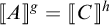 and
and 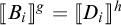 , for all $i, 1\leq i\leq n$
, then
$i, 1\leq i\leq n$
, then  .
.
Proof. Immediate from Definition 11.
Lemma 9 (Substitution lemma).
Let  be a dual-content $\mathcal {L}^{\Sigma }$
-model and g be an assignment for
$\mathcal {L}^{\Sigma }$
-model and g be an assignment for $\langle W,D\rangle $
. For all types
$\langle W,D\rangle $
. For all types $\sigma ,\tau $
, variables
$\sigma ,\tau $
, variables $x^{\tau }$
, and terms
$x^{\tau }$
, and terms $A^{\sigma }, B^{\tau }$
, we have
$A^{\sigma }, B^{\tau }$
, we have  .
.
Proof. By a straightforward induction on the complexity of A.
Definition 13.
A immediately $\beta \eta $
-reduces to B iff either A is a term of the form
$\beta \eta $
-reduces to B iff either A is a term of the form $(\lambda x_{1}\ldots x_{n}.\phi )(A_{1},\ldots ,A_{n})$
and B is
$(\lambda x_{1}\ldots x_{n}.\phi )(A_{1},\ldots ,A_{n})$
and B is $\phi [A_{i}/x_{i}]$
, or A is a term of the form
$\phi [A_{i}/x_{i}]$
, or A is a term of the form $(\lambda x_{1}\ldots x_{k}.F(x_{1},\ldots ,x_{k}))$
, where none of
$(\lambda x_{1}\ldots x_{k}.F(x_{1},\ldots ,x_{k}))$
, where none of $x_{1},\ldots ,x_{k}$
is free in F, B is F, and F is of non-rigid type.
$x_{1},\ldots ,x_{k}$
is free in F, B is F, and F is of non-rigid type.
A one-step $\beta \eta $
-reduces to B iff B results from A by replacing one constituent with something to which it immediately
$\beta \eta $
-reduces to B iff B results from A by replacing one constituent with something to which it immediately $\beta \eta $
-reduces; i.e., iff there are two finite sequences
$\beta \eta $
-reduces; i.e., iff there are two finite sequences $\langle A_{1},\ldots ,A_{n}\rangle $
,
$\langle A_{1},\ldots ,A_{n}\rangle $
, $\langle B_{1},\ldots ,B_{n}\rangle $
such that
$\langle B_{1},\ldots ,B_{n}\rangle $
such that $A_{1}$
immediately
$A_{1}$
immediately $\beta \eta $
-reduces to
$\beta \eta $
-reduces to $B_{1}$
,
$B_{1}$
, $A_{n}=A$
,
$A_{n}=A$
, $B_{n}=B$
, and either for some
$B_{n}=B$
, and either for some $C_{0},\ldots ,C_{m}$
,
$C_{0},\ldots ,C_{m}$
, $A_{i+1}$
is
$A_{i+1}$
is $A_{i}(C_{0},\ldots ,C_{m})$
and
$A_{i}(C_{0},\ldots ,C_{m})$
and $B_{i+1}$
is
$B_{i+1}$
is $B_{i}(C_{0},\ldots ,C_{m})$
, or for some
$B_{i}(C_{0},\ldots ,C_{m})$
, or for some $0\leq k\leq m$
,
$0\leq k\leq m$
, $A_{i+1}$
is
$A_{i+1}$
is $C_{0}(C_{1},\ldots ,C_{k},A_{i},C_{k+1},\dots ,C_{m})$
and
$C_{0}(C_{1},\ldots ,C_{k},A_{i},C_{k+1},\dots ,C_{m})$
and $B_{i+1}$
is
$B_{i+1}$
is $C_{0}(C_{1},\ldots ,C_{k},B_{i},C_{k+1},\dots ,C_{m})$
, or for some
$C_{0}(C_{1},\ldots ,C_{k},B_{i},C_{k+1},\dots ,C_{m})$
, or for some $x_{1},\ldots , x_{m}$
,
$x_{1},\ldots , x_{m}$
, $A_{i+1}$
is
$A_{i+1}$
is $\lambda x_{1}\ldots x_{m}.A_{i}$
and
$\lambda x_{1}\ldots x_{m}.A_{i}$
and $B_{i+1}$
is
$B_{i+1}$
is $\lambda x_{1}\ldots x_{m}.B_{i}$
.
$\lambda x_{1}\ldots x_{m}.B_{i}$
.
A is one-step $\beta \eta $
-equivalent to B iff either A one-step
$\beta \eta $
-equivalent to B iff either A one-step $\beta \eta $
-reduces to B or B one-step
$\beta \eta $
-reduces to B or B one-step $\beta \eta $
-reduces to A.
$\beta \eta $
-reduces to A.
A is $\beta \eta $
-equivalent to B iff there is a finite sequence of terms
$\beta \eta $
-equivalent to B iff there is a finite sequence of terms $\langle C_{1},\ldots ,C_{n}\rangle $
such that
$\langle C_{1},\ldots ,C_{n}\rangle $
such that $A=C_{1}$
,
$A=C_{1}$
, $B=C_{n}$
and whenever
$B=C_{n}$
and whenever $0<i<n$
,
$0<i<n$
, $C_{1}$
is one-step
$C_{1}$
is one-step $\beta \eta $
-equivalent to
$\beta \eta $
-equivalent to $C_{i+1}$
.
$C_{i+1}$
.
We will now prove that any two $\beta \eta $
-equivalent terms have the same denotation in a dual-content model.
$\beta \eta $
-equivalent terms have the same denotation in a dual-content model.
Lemma 10. Let  be a dual-content model. Then for all terms $A,B$
and assignments g for
$A,B$
and assignments g for $\langle W,I\rangle $
:
$\langle W,I\rangle $
: 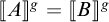 , if A and B are $\beta \eta $
-equivalent.
$\beta \eta $
-equivalent.
Proof. It suffices to show that 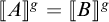 whenever A one-step $\beta \eta $
-reduces to B. The proof is by induction using the definition of one-step
$\beta \eta $
-reduces to B. The proof is by induction using the definition of one-step $\beta \eta $
-reduction. We only show
$\beta \eta $
-reduction. We only show  , the case of
  being an immediate consequence of Definition 114. Base case: A immediately $\beta \eta $
-reduces to B. (i) A is of the form
$\beta \eta $
-reduces to B. (i) A is of the form $\lambda x_{1}\ldots x_{n}.C(x_{1},\ldots ,x_{n})$
, where
$\lambda x_{1}\ldots x_{n}.C(x_{1},\ldots ,x_{n})$
, where $x_{1},\ldots ,x_{n}$
are not free in C, and B is C. Let g be an arbitrary assignment. Then,
$x_{1},\ldots ,x_{n}$
are not free in C, and B is C. Let g be an arbitrary assignment. Then,

The last equation holds by Lemma 7 because none of $x_{1},\ldots ,x_{n}$
is free in C. (ii) A is of the form
$x_{1},\ldots ,x_{n}$
is free in C. (ii) A is of the form $(\lambda x_{1}\ldots x_{n}.\phi )(A_{1},\ldots ,A_{n})$
and B is
$(\lambda x_{1}\ldots x_{n}.\phi )(A_{1},\ldots ,A_{n})$
and B is $\phi [A_{i}/x_{i}]$
. Let g be an arbitrary assignment. Then,
$\phi [A_{i}/x_{i}]$
. Let g be an arbitrary assignment. Then,

Induction step: Suppose that $A,B\in \mathcal {L}^{\Sigma }_{\sigma }$
are such that
$A,B\in \mathcal {L}^{\Sigma }_{\sigma }$
are such that 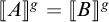 for all assignments g. Then if $\sigma $
is of the form
$\sigma $
is of the form $\langle \sigma _{0},\ldots ,\sigma _{m}\rangle $
(and similarly if
$\langle \sigma _{0},\ldots ,\sigma _{m}\rangle $
(and similarly if $\sigma $
is a rigid type) and
$\sigma $
is a rigid type) and $C_{0},\ldots ,C_{m}$
are of appropriate types,
$C_{0},\ldots ,C_{m}$
are of appropriate types,  , for any assignment h, by Lemma 8. Moreover, if $C_{0},\ldots ,C_{m}$
are of appropriate types, then
$C_{0},\ldots ,C_{m}$
are of appropriate types, then  ,
, $0\leq k\leq m$
by Lemma 8. Finally, if
$0\leq k\leq m$
by Lemma 8. Finally, if $\sigma $
is
$\sigma $
is $\langle \rangle $
and A and B contain all of
$\langle \rangle $
and A and B contain all of $x_{1},\ldots ,x_{n}$
free, then for all assignments g,
$x_{1},\ldots ,x_{n}$
free, then for all assignments g,

Lemma 11. Let  be a dual-content model. Then $\mathfrak {M},w,g\vDash (F_{1},\ldots ,F_{n})\succeq _{\sigma }A$
iff
$\mathfrak {M},w,g\vDash (F_{1},\ldots ,F_{n})\succeq _{\sigma }A$
iff  depends on
  .
.
Proof. The left-to-right direction is an immediate consequence of Lemma 6 and the semantic clauses in Definition 11. For the converse, observe that by Definition 9, for any $\mathbf {x}\in D_{\sigma }$
there is an
$\mathbf {x}\in D_{\sigma }$
there is an $\mathbf {X}\in D_{\langle \sigma \rangle }$
with
$\mathbf {X}\in D_{\langle \sigma \rangle }$
with $\pi _{0}(\mathbf {x})=\pi _{0}(\mathbf {X})$
and
$\pi _{0}(\mathbf {x})=\pi _{0}(\mathbf {X})$
and $Ext^{w}(\mathbf {X})=\{\mathbf {x}\}$
for all
$Ext^{w}(\mathbf {X})=\{\mathbf {x}\}$
for all $w\in E(\{\mathbf {X}\})(=E(\{\mathbf {x}\})$
. The claim then follows from Lemma 6 and the semantic clauses in Definition 11.
$w\in E(\{\mathbf {X}\})(=E(\{\mathbf {x}\})$
. The claim then follows from Lemma 6 and the semantic clauses in Definition 11.
Theorem 1 (Soundness).
Every theorem of HLE is valid in the class of dual-content models.
Proof. (i) Background logic: The validity of the tautologies and the quantificational axioms and rules is straightforward. But the case of modus ponens is instructive. To show that the rule of modus ponens preserves validity, assume that $\phi $
and
$\phi $
and $\phi \rightarrow \psi $
are valid, and suppose for reductio that
$\phi \rightarrow \psi $
are valid, and suppose for reductio that $\psi $
is not valid. Then there is a model
$\psi $
is not valid. Then there is a model  such that
  and
and $\mathfrak {M},w,g\nvDash \psi $
for some
$\mathfrak {M},w,g\nvDash \psi $
for some $w\in W$
and assignment g. Let
$w\in W$
and assignment g. Let  be a model that is such that for all constants c that occur in $\psi $
,
$\psi $
,  , and for all constants c not occurring in $\psi $
: (i) if c is a non-logical constant of type
$\psi $
: (i) if c is a non-logical constant of type $\sigma $
, then c is assigned to an arbitrary element of
$\sigma $
, then c is assigned to an arbitrary element of $D^{w}_{\sigma }$
(this is legitimate since
$D^{w}_{\sigma }$
(this is legitimate since $D^{w}_{\sigma }$
is non-empty for all
$D^{w}_{\sigma }$
is non-empty for all $w\in W$
and
$w\in W$
and $\sigma \in \mathcal {T}$
) and (ii) if c is a logical constant, then
$\sigma \in \mathcal {T}$
) and (ii) if c is a logical constant, then 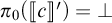 . Let h be an assignment that agrees with g on all free variables of $\psi $
and that assigns every free variable
$\psi $
and that assigns every free variable $v^{\sigma }$
of
$v^{\sigma }$
of $\phi $
to an element of
$\phi $
to an element of $D^{w}_{\sigma }$
. This guarantees that
$D^{w}_{\sigma }$
. This guarantees that  by Lemma 6. By the validity of $\phi $
and
$\phi $
and $\phi \rightarrow \psi $
, we have
$\phi \rightarrow \psi $
, we have $\mathfrak {M}',w,h\vDash \phi $
and
$\mathfrak {M}',w,h\vDash \phi $
and $\mathfrak {M}',w,h\vDash \phi \rightarrow \psi $
, and thus
$\mathfrak {M}',w,h\vDash \phi \rightarrow \psi $
, and thus $\mathfrak {M}',w,h\vDash \psi $
. But by Lemma 7,
$\mathfrak {M}',w,h\vDash \psi $
. But by Lemma 7, 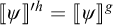 , and so, $\mathfrak {M},w,g\vDash \psi $
, in contradiction to the hypothesis.
$\mathfrak {M},w,g\vDash \psi $
, in contradiction to the hypothesis.
Ref is trivial and LL immediately follows from the semantic clause for $= _\sigma $
and Lemma 9.
$= _\sigma $
and Lemma 9. $\beta $
- and
$\beta $
- and $\eta $
-conversion follow from Lemma 10.
$\eta $
-conversion follow from Lemma 10.
(ii) Background essentialist axioms: Permutation, Idempotence, Separation, Subtraction and MON are straightforward.
(Decomposition) Suppose $\mathfrak {M},w,g\vDash \square _{F_{1},\ldots ,F_{k},[B]}\phi $
and let
$\mathfrak {M},w,g\vDash \square _{F_{1},\ldots ,F_{k},[B]}\phi $
and let $A_{1},\ldots ,A_{n}$
be all the constants and free variables of B. Let
$A_{1},\ldots ,A_{n}$
be all the constants and free variables of B. Let $v\in W$
be such that
$v\in W$
be such that  and
and  . Then by Lemma 6,
  , and thus $\mathfrak {M},v,g\vDash \phi $
by the hypothesis, whence
$\mathfrak {M},v,g\vDash \phi $
by the hypothesis, whence $\mathfrak {M},w,g\vDash \square _{F_{1},\ldots ,F_{k},[A_{1}],\ldots ,[A_{n}]}\phi $
.
$\mathfrak {M},w,g\vDash \square _{F_{1},\ldots ,F_{k},[A_{1}],\ldots ,[A_{n}]}\phi $
.
(iii) Axioms for Rigidity:
(R-Comp): From Lemma 4(ii).
(R-Ext): From Lemma 4(iii).
(Rigidity): Suppose $\mathfrak {M},w,g\vDash F^{[\sigma ]}(x)$
. Suppose
$\mathfrak {M},w,g\vDash F^{[\sigma ]}(x)$
. Suppose $v\in W$
is such that
$v\in W$
is such that  . Then by Lemma 4(i),
  . Moreover, since
  , it follows that
  Now since
  by Lemma 6, we have $\mathfrak {M},v,g\vDash F(x)$
.
$\mathfrak {M},v,g\vDash F(x)$
.
(R-Equiv): From Lemma 4(i).
(iv) Core essentialist axioms and rules:
(RC): We first show that the special case RC $^{0}$
preserves validity. Suppose that
$^{0}$
preserves validity. Suppose that $\phi $
is valid and suppose for reductio that there is a dual-content model
$\phi $
is valid and suppose for reductio that there is a dual-content model  such that for some $w\in W$
and assignment g:
$w\in W$
and assignment g: $\mathfrak {M},w,g\nvDash \square _{[A_{1}],\ldots ,[A_{n}]}\phi $
, where
$\mathfrak {M},w,g\nvDash \square _{[A_{1}],\ldots ,[A_{n}]}\phi $
, where $A_{1},\ldots ,A_{n}$
are all the free variables and constants in
$A_{1},\ldots ,A_{n}$
are all the free variables and constants in $\phi $
. By Lemma 6, there is a
$\phi $
. By Lemma 6, there is a $v\in W$
such that
$v\in W$
such that  and
and $\mathfrak {M},v,g\nvDash \phi $
, in contradiction to the assumption that
$\mathfrak {M},v,g\nvDash \phi $
, in contradiction to the assumption that $\phi $
is valid.
$\phi $
is valid.
Now let $n\geq 1$
. Suppose
$n\geq 1$
. Suppose $\phi _{1}\wedge \cdots \wedge \phi _{n}\rightarrow \psi $
is valid and suppose for reductio that there is a dual-content model
$\phi _{1}\wedge \cdots \wedge \phi _{n}\rightarrow \psi $
is valid and suppose for reductio that there is a dual-content model  such that for some $w\in W$
and assignment g: (*)
$w\in W$
and assignment g: (*) $\mathfrak {M},w,g\nvDash \square _{F_{1},\ldots ,F_{k}}\phi _{1}\wedge \cdots \wedge \square _{F_{1},\ldots ,F_{k}}\phi _{n}\rightarrow \square _{F_{1},\ldots ,F_{k},[A_{1}],\ldots ,[A_{l}]}\psi $
, where
$\mathfrak {M},w,g\nvDash \square _{F_{1},\ldots ,F_{k}}\phi _{1}\wedge \cdots \wedge \square _{F_{1},\ldots ,F_{k}}\phi _{n}\rightarrow \square _{F_{1},\ldots ,F_{k},[A_{1}],\ldots ,[A_{l}]}\psi $
, where $A_{1},\ldots ,A_{l}$
are all the free variables and constants in
$A_{1},\ldots ,A_{l}$
are all the free variables and constants in $\psi $
but not any of
$\psi $
but not any of $\phi _{1},\ldots ,\phi _{n}$
. Let
$\phi _{1},\ldots ,\phi _{n}$
. Let $B_{1},\ldots ,B_{m}$
be all of the constants and free variables occurring both in
$B_{1},\ldots ,B_{m}$
be all of the constants and free variables occurring both in $\psi $
and some
$\psi $
and some $\phi _{i}$
, so that
$\phi _{i}$
, so that $A_{1},\ldots ,A_{l},B_{1},\ldots ,B_{m}$
are all of the free variables and constants in
$A_{1},\ldots ,A_{l},B_{1},\ldots ,B_{m}$
are all of the free variables and constants in $\psi $
. It follows from (*) and Lemma 6 that
$\psi $
. It follows from (*) and Lemma 6 that  depends on
  . So by Lemma 6, for every $v\in W$
such that
$v\in W$
such that  , we have
  , since the denotations of all free variables and constants in $\psi $
are in
$\psi $
are in $D^{v}$
. It follows from this together with (*) that there is a
$D^{v}$
. It follows from this together with (*) that there is a $v\in W$
such that
$v\in W$
such that  and
and  , where (1) $\mathfrak {M},v,g\vDash \phi _{i}$
,
$\mathfrak {M},v,g\vDash \phi _{i}$
, $1\leq i\leq n$
and (2)
$1\leq i\leq n$
and (2) $\mathfrak {M},v,g\nvDash \psi $
. If
$\mathfrak {M},v,g\nvDash \psi $
. If $\wedge $
and
$\wedge $
and $\rightarrow $
occur in any of
$\rightarrow $
occur in any of $\phi _{1},\ldots ,\phi _{n},\psi $
, then
$\phi _{1},\ldots ,\phi _{n},\psi $
, then  and so, by Lemma 6,
  . The validity of $\phi _{1}\wedge \cdots \wedge \phi _{n}\rightarrow \psi $
together with (1) imply that
$\phi _{1}\wedge \cdots \wedge \phi _{n}\rightarrow \psi $
together with (1) imply that $\mathfrak {M},v,g\vDash \psi $
, which contradicts (2). Let us now suppose that neither
$\mathfrak {M},v,g\vDash \psi $
, which contradicts (2). Let us now suppose that neither $\wedge $
nor
$\wedge $
nor $\rightarrow $
occurs in any of
$\rightarrow $
occurs in any of $\phi _{1},\ldots ,\phi _{n},\psi $
(the cases where only one of them occurs in them are treated similarly). Let
$\phi _{1},\ldots ,\phi _{n},\psi $
(the cases where only one of them occurs in them are treated similarly). Let  be a dual-content model whose first two components are identical to the first two components of $\mathfrak {M}$
, and whose denotation function
$\mathfrak {M}$
, and whose denotation function  agrees with
  on all constants except for $\wedge $
and
$\wedge $
and $\rightarrow $
, whose denotations are defined as follows:
$\rightarrow $
, whose denotations are defined as follows:  . Since none of the formulas $\phi _{1},\ldots ,\phi _{n},\psi $
, contains any of
$\phi _{1},\ldots ,\phi _{n},\psi $
, contains any of $\wedge $
or
$\wedge $
or $\rightarrow $
, it follows from (1), (2), and Lemma 7 that (1’)
$\rightarrow $
, it follows from (1), (2), and Lemma 7 that (1’) $\mathfrak {M}',v,g\vDash \phi _{i}$
,
$\mathfrak {M}',v,g\vDash \phi _{i}$
, $1\leq i\leq n$
and (2’)
$1\leq i\leq n$
and (2’) $\mathfrak {M}',v,g\nvDash \psi $
. It follows from
$\mathfrak {M}',v,g\nvDash \psi $
. It follows from  , (1’), (2’) and Lemma 6 that
  . By (1’) and the validity of $\phi _{1}\wedge \cdots \wedge \phi _{n}\rightarrow \psi $
, this implies
$\phi _{1}\wedge \cdots \wedge \phi _{n}\rightarrow \psi $
, this implies $\mathfrak {M}',v,g\vDash \psi $
, in contradiction to (2’).
$\mathfrak {M}',v,g\vDash \psi $
, in contradiction to (2’).
(CH) Suppose $\mathfrak {M},w,g\vDash \square _{G_{1},\ldots ,G_{n},c_{\sigma }(F_{1},\ldots ,F_{k})}\phi $
. By Lemma 11, for any
$\mathfrak {M},w,g\vDash \square _{G_{1},\ldots ,G_{n},c_{\sigma }(F_{1},\ldots ,F_{k})}\phi $
. By Lemma 11, for any $\mathbf {x}\in D^{w}_{\sigma }$
,
$\mathbf {x}\in D^{w}_{\sigma }$
,  iff
iff  depends on $\mathbf {x}$
. Thus,
$\mathbf {x}$
. Thus,  depends on
  . So let $v\in W$
be such that
$v\in W$
be such that  . Then since
  depends on
  , the hypothesis entails that $\mathfrak {M},v,g\vDash \phi $
and thus
$\mathfrak {M},v,g\vDash \phi $
and thus $\mathfrak {M},w,g\vDash \square _{G_{1},\ldots ,G_{n},F_{1},\ldots ,F_{k}}\phi $
.
$\mathfrak {M},w,g\vDash \square _{G_{1},\ldots ,G_{n},F_{1},\ldots ,F_{k}}\phi $
.
(T): Suppose $\mathfrak {M},w,g\vDash \square _{F_{1},\ldots ,F_{n}}\phi $
. Then since
$\mathfrak {M},w,g\vDash \square _{F_{1},\ldots ,F_{n}}\phi $
. Then since  and
and  , we have $\mathfrak {M},w,g\vDash \phi $
.
$\mathfrak {M},w,g\vDash \phi $
.
(4): Suppose $\mathfrak {M},w,g\vDash \square _{F_{1},\ldots ,F_{n}}\phi $
, where
$\mathfrak {M},w,g\vDash \square _{F_{1},\ldots ,F_{n}}\phi $
, where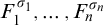 $F_{1}^{\sigma _{1}},\ldots ,F_{n}^{\sigma _{n}}$
are rigid predicates. Let
$F_{1}^{\sigma _{1}},\ldots ,F_{n}^{\sigma _{n}}$
are rigid predicates. Let $v\in W$
be such that
$v\in W$
be such that  and
and  . Then by the hypothesis and Lemma 4(i),
  , for each $i\leq n$
, and
$i\leq n$
, and  . So by Lemma 6,
  . Now let $z\in W$
be such that
$z\in W$
be such that  . Then since by the rigidity of the $F_{i}$
and Lemma 4(iv),
$F_{i}$
and Lemma 4(iv),  , for every $i\leq n$
, we get
$i\leq n$
, we get  . Hence, by the hypothesis, $\mathfrak {M},z,g\vDash \phi $
, and thus
$\mathfrak {M},z,g\vDash \phi $
, and thus $\mathfrak {M},v,g\vDash \square _{F_{1},\ldots ,F_{n}}\phi $
, from which it follows that
$\mathfrak {M},v,g\vDash \square _{F_{1},\ldots ,F_{n}}\phi $
, from which it follows that $\mathfrak {M},w,g\vDash \square _{F_{1},\ldots ,F_{n},[\square _{\sigma _{1},\ldots ,\sigma _{n}}]}\square _{F_{1},\ldots ,F_{n}}\phi $
.
$\mathfrak {M},w,g\vDash \square _{F_{1},\ldots ,F_{n},[\square _{\sigma _{1},\ldots ,\sigma _{n}}]}\square _{F_{1},\ldots ,F_{n}}\phi $
.
(5) Suppose $\mathfrak {M},w,g\vDash \neg \square _{F_{1},\ldots ,F_{n}}\phi $
, where
$\mathfrak {M},w,g\vDash \neg \square _{F_{1},\ldots ,F_{n}}\phi $
, where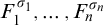 $F_{1}^{\sigma _{1}},\ldots ,F_{n}^{\sigma _{n}}$
are rigid predicates. Let
$F_{1}^{\sigma _{1}},\ldots ,F_{n}^{\sigma _{n}}$
are rigid predicates. Let $v\in W$
be such that
$v\in W$
be such that  ,
,  ,
,  and
and  . So by Lemma 6,
  . But
. But $\mathfrak {M},v,g\vDash \square _{F_{1},\ldots ,F_{n}}\phi $
would contradict our hypothesis, since by Lemma 4(iv),
$\mathfrak {M},v,g\vDash \square _{F_{1},\ldots ,F_{n}}\phi $
would contradict our hypothesis, since by Lemma 4(iv),  , for every $i\leq n$
. So,
$i\leq n$
. So, $\mathfrak {M},v,g\vDash \neg \square _{F_{1},\ldots ,F_{n}}\phi $
, and thus
$\mathfrak {M},v,g\vDash \neg \square _{F_{1},\ldots ,F_{n}}\phi $
, and thus $\mathfrak {M},w,g\vDash \square _{F_{1},\ldots ,F_{n},[\neg ],[\square _{\sigma _{1},\ldots ,\sigma _{n}}],[\phi ]}\neg \square _{F_{1},\ldots ,F_{n}}\phi $
.
$\mathfrak {M},w,g\vDash \square _{F_{1},\ldots ,F_{n},[\neg ],[\square _{\sigma _{1},\ldots ,\sigma _{n}}],[\phi ]}\neg \square _{F_{1},\ldots ,F_{n}}\phi $
.
It is evident that the formulas that are valid in the class of dual-content models do not coincide with the provable formulas of HLE, because among the validities are all validities of full second-order logic. So there cannot be a completeness result with respect to this class of models. For present purposes, the model theory primarily serves as a tool for checking the consistency of various essentialist theories. Still, it would be interesting to develop a model theory for HLE (or some extension of it) for which the theory is complete. It is quite clear that, at least if the model theory is to take a similar form as the one proposed here, the theory HLE would have to be strengthened in order to prove completeness. For example, we would plausibly have to adopt the strengthened version of Proposition 6(ii) and (iii) discussed above as axioms, since any class of models that validates the weaker versions would plausibly also validate the stronger versions of these principles.
Apart from the question of completeness, the class of dual-content models validates some principles that are not only plausibly unprovable in HLE but are also intuitively false on their intended interpretation. For example, the models validate the claim that the nature of any entity whatsoever involves, for any given property, some property that is necessarily coextensive with it. For instance, let $\langle n,f\rangle $
be the representation of the property of being human in some model. Then for any entity, the property
$\langle n,f\rangle $
be the representation of the property of being human in some model. Then for any entity, the property $\langle \bot ,f\rangle $
exists in every world in which the entity exists, because
$\langle \bot ,f\rangle $
exists in every world in which the entity exists, because $\overline {E}(\bot )=W$
. This seems undesirable. Since it is the “fullness” of the domains that is responsible for these validities, it would seem that they would be invalidated in appropriately generalized Henkin models, in which the typed domains of a model are subsets of the domains
$\overline {E}(\bot )=W$
. This seems undesirable. Since it is the “fullness” of the domains that is responsible for these validities, it would seem that they would be invalidated in appropriately generalized Henkin models, in which the typed domains of a model are subsets of the domains $D^{w}_{\sigma }$
, as defined in Definition 9, rich enough to validate R-Comp and to provide an interpretation
$D^{w}_{\sigma }$
, as defined in Definition 9, rich enough to validate R-Comp and to provide an interpretation  , relative to an assignment g, for every term A for which
  , where $A_{1},\ldots , A_{n}$
are all the free variables and constants occurring in A. Such generalized Henkin models remain to be further explored.
$A_{1},\ldots , A_{n}$
are all the free variables and constants occurring in A. Such generalized Henkin models remain to be further explored.
Among the most important extensions of HLE that remain to be explored are those which add further principles concerning the interaction between identity and other the logical constants. In HLE the only axioms that specifically concern identity ( $=$
) are Ref, LL and R-Ext. The system is deliberately neutral about more substantive principles concerning identity, such as, for example, the principle that conjunction is commutative (
$=$
) are Ref, LL and R-Ext. The system is deliberately neutral about more substantive principles concerning identity, such as, for example, the principle that conjunction is commutative ( $(p\wedge q)= (q\wedge p)$
) or more substantive interaction principles between essence and identity. While a fuller investigation of this matter is left for future work, it is interesting to observe that the following rule, which generates a number of interesting identities, preserves validity in the class of dual-content models:
$(p\wedge q)= (q\wedge p)$
) or more substantive interaction principles between essence and identity. While a fuller investigation of this matter is left for future work, it is interesting to observe that the following rule, which generates a number of interesting identities, preserves validity in the class of dual-content models:
-
(RI) If
$\vdash \forall x_{1}\ldots \forall x_{n}(R^{\langle \sigma _{1},\ldots ,\sigma _{n}\rangle }(x_{1},\ldots ,x_{n})\leftrightarrow S^{\langle \sigma _{1},\ldots ,\sigma _{n}\rangle }(x_{1},\ldots ,x_{n}) )$
and R and S contain exactly the same free variables and constants, then
$\vdash R= S.$


Theorem 2. RI preserves validity in the class of dual-content models.
Proof. Suppose first that $n=0$
. Suppose that
$n=0$
. Suppose that $\phi \leftrightarrow \psi $
is valid and
$\phi \leftrightarrow \psi $
is valid and $\phi $
and
$\phi $
and $\psi $
contain exactly the same constants and free variables. Suppose for reductio that there is a dual-content model
$\psi $
contain exactly the same constants and free variables. Suppose for reductio that there is a dual-content model  such that for some $w\in W$
and assignment g,
$w\in W$
and assignment g, $\mathfrak {M},w,g\nvDash \phi =_{\langle \rangle }\psi $
. Since
$\mathfrak {M},w,g\nvDash \phi =_{\langle \rangle }\psi $
. Since $\phi $
and
$\phi $
and $\psi $
contain exactly the same constants and free variables,
$\psi $
contain exactly the same constants and free variables,  by Definition 11 Item 4. So
  and thus for some $v\in W$
,
$v\in W$
, 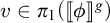 and
and 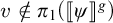 . By the validity of $\phi \leftrightarrow \psi $
we can infer that
$\phi \leftrightarrow \psi $
we can infer that  . Now let
  be a model that is just like $\mathfrak {M}$
but in which
$\mathfrak {M}$
but in which  . By Lemma 7, (*)
 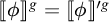 and
and  . But since
  , it follows from Lemma 6 and the validity of $\phi \leftrightarrow \psi $
that
$\phi \leftrightarrow \psi $
that  and thus, by (*),
 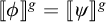 . Contradiction. The case where $n\geq 1$
is proved similarly.
$n\geq 1$
is proved similarly.
RI immediately delivers such principles as the commutativity of conjunction and disjunction. It is interesting to observe, however, that it does not imply idempotence (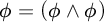 $\phi =(\phi \wedge \phi )$
) for conjunction or disjunction, and it does not imply involution (
$\phi =(\phi \wedge \phi )$
) for conjunction or disjunction, and it does not imply involution ( $\phi =\neg \neg \phi $
). However, we do get weakened versions of these: each of
$\phi =\neg \neg \phi $
). However, we do get weakened versions of these: each of $(\phi \wedge \phi )=(\phi \wedge (\phi \wedge \phi ))$
,
$(\phi \wedge \phi )=(\phi \wedge (\phi \wedge \phi ))$
, $(\phi \vee \phi )=(\phi \vee (\phi \vee \phi ))$
and
$(\phi \vee \phi )=(\phi \vee (\phi \vee \phi ))$
and $\neg \phi =\neg \neg \neg \phi $
are implied by RI given the other principles of HLE. The weakened versions of involution and the commutativity of conjunction and disjunction seem rather natural from an essentialist standpoint.
$\neg \phi =\neg \neg \neg \phi $
are implied by RI given the other principles of HLE. The weakened versions of involution and the commutativity of conjunction and disjunction seem rather natural from an essentialist standpoint.
9 The logic of necessity—Part II
This section provides model-theoretic proofs of some results announced in §5 regarding the logics of the operators $\square _{\Pi }$
and
$\square _{\Pi }$
and $\square _{\Omega }$
.
$\square _{\Omega }$
.
9.1 The logic of
$\square _{\Pi }$

We first show that the propositional logic of $\square _{\Pi }$
is at most S4 in HLE and at most S5 in HLE+DOM⟨⟩
. Together with Corollaries 1 and 2 from §5, this implies that its logic is exactly S4 and S5 in the respective systems.
$\square _{\Pi }$
is at most S4 in HLE and at most S5 in HLE+DOM⟨⟩
. Together with Corollaries 1 and 2 from §5, this implies that its logic is exactly S4 and S5 in the respective systems.
Definition 14. An
S4-frame is a pair $\langle W,R\rangle $
, where W is a non-empty set and R is reflexive and transitive relation on W. A propositional S4-model is a triple
$\langle W,R\rangle $
, where W is a non-empty set and R is reflexive and transitive relation on W. A propositional S4-model is a triple $\langle W,R,V\rangle $
, where
$\langle W,R,V\rangle $
, where $\langle W,R\rangle $
is an S4-frame, and V is a valuation function mapping each propositional variable into a subset of W.
$\langle W,R\rangle $
is an S4-frame, and V is a valuation function mapping each propositional variable into a subset of W.
Lemma 12. Every S4-frame $\langle W,R\rangle $
can be extended to a dual-content frame
$\langle W,R\rangle $
can be extended to a dual-content frame $\langle W,D\rangle $
in which for all
$\langle W,D\rangle $
in which for all $w,v\in W:wRv$
iff
$w,v\in W:wRv$
iff $D_{\langle \rangle }^{w}\subseteq D_{\langle \rangle }^{v}$
.
$D_{\langle \rangle }^{w}\subseteq D_{\langle \rangle }^{v}$
.
Proof. Let $\langle W,R\rangle $
be an S4-frame. We first construct a worldly content structure on which we base the frame to be constructed. Let
$\langle W,R\rangle $
be an S4-frame. We first construct a worldly content structure on which we base the frame to be constructed. Let $\mathfrak {N}=\langle \mathcal {N},W,I,\iota ,\overline {E}\rangle $
, where for all
$\mathfrak {N}=\langle \mathcal {N},W,I,\iota ,\overline {E}\rangle $
, where for all $w\in W: I^{w}=\{v\in W: vRw\}$
,
$w\in W: I^{w}=\{v\in W: vRw\}$
, $\mathcal {N}=\langle \wp (W),\subseteq \rangle $
, for all
$\mathcal {N}=\langle \wp (W),\subseteq \rangle $
, for all $w\in W: \iota (w)=\lbrace w\rbrace $
, and for all
$w\in W: \iota (w)=\lbrace w\rbrace $
, and for all $x\in \mathcal {N}: \overline {E}(x)=\lbrace w\in W: \forall v\in x: vRw\rbrace $
. Let
$x\in \mathcal {N}: \overline {E}(x)=\lbrace w\in W: \forall v\in x: vRw\rbrace $
. Let $\langle W,D\rangle $
be the dual-content frame induced by
$\langle W,D\rangle $
be the dual-content frame induced by $\mathfrak {N}$
. We show that for all
$\mathfrak {N}$
. We show that for all $w,v\in W:wRv$
iff
$w,v\in W:wRv$
iff $D_{\langle \rangle }^{w}\subseteq D_{\langle \rangle }^{v}$
. Let
$D_{\langle \rangle }^{w}\subseteq D_{\langle \rangle }^{v}$
. Let $w,v\in W$
be arbitrary. Left-to-right: Suppose
$w,v\in W$
be arbitrary. Left-to-right: Suppose $wRv$
and let
$wRv$
and let $\mathbf {p}\in D^{w}_{\langle \rangle }$
. Then
$\mathbf {p}\in D^{w}_{\langle \rangle }$
. Then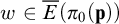 $w\in \overline {E}(\pi _{0}(\mathbf {p}))$
and so, by the definition of
$w\in \overline {E}(\pi _{0}(\mathbf {p}))$
and so, by the definition of $\overline {E}$
, for every
$\overline {E}$
, for every $z\in \pi _{0}(\mathbf {p})$
,
$z\in \pi _{0}(\mathbf {p})$
, $zRw$
and hence, by the transitivity of R,
$zRw$
and hence, by the transitivity of R, $zRv$
. Thus again by the definition of
$zRv$
. Thus again by the definition of $\overline {E}$
,
$\overline {E}$
,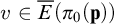 $v\in \overline {E}(\pi _{0}(\mathbf {p}))$
and thus
$v\in \overline {E}(\pi _{0}(\mathbf {p}))$
and thus $\mathbf {p}\in D_{\langle \rangle }^{v}$
. Right-to-left: Suppose
$\mathbf {p}\in D_{\langle \rangle }^{v}$
. Right-to-left: Suppose $D_{\langle \rangle }^{w}\subseteq D_{\langle \rangle }^{v}$
. By the reflexivity of R and the definition of
$D_{\langle \rangle }^{w}\subseteq D_{\langle \rangle }^{v}$
. By the reflexivity of R and the definition of $\overline {E}$
, there is a
$\overline {E}$
, there is a $\mathbf {p}\in D^{w}_{\langle \rangle }$
such that
$\mathbf {p}\in D^{w}_{\langle \rangle }$
such that $w\in \pi _{0}(\mathbf {p})$
. By the hypothesis, this entails that
$w\in \pi _{0}(\mathbf {p})$
. By the hypothesis, this entails that $\mathbf {p}\in D^{v}_{\langle \rangle }$
. So
$\mathbf {p}\in D^{v}_{\langle \rangle }$
. So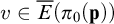 $v\in \overline {E}(\pi _{0}(\mathbf {p}))$
and hence, by the definition of
$v\in \overline {E}(\pi _{0}(\mathbf {p}))$
and hence, by the definition of $\overline {E}$
,
$\overline {E}$
, $wRv$
, because
$wRv$
, because $w\in \pi _{0}(\mathbf {p})$
.
$w\in \pi _{0}(\mathbf {p})$
.
We call the frame constructed in the proof above the corresponding dual-content frame for $\langle W,R\rangle $
. Next we define a mapping between a modal language
$\langle W,R\rangle $
. Next we define a mapping between a modal language $\mathcal {L}_{M}$
and
$\mathcal {L}_{M}$
and $\mathcal {L}^{\Sigma }$
, for any signature
$\mathcal {L}^{\Sigma }$
, for any signature $\Sigma $
. We assume that
$\Sigma $
. We assume that $\mathcal {L}_{M}$
and
$\mathcal {L}_{M}$
and $\mathcal {L}^{\Sigma }$
have a shared set of propositional variables
$\mathcal {L}^{\Sigma }$
have a shared set of propositional variables $\mathcal {V}_{\langle \rangle }$
. We recursively define a translation
$\mathcal {V}_{\langle \rangle }$
. We recursively define a translation $'$
from the formulas of
$'$
from the formulas of $\mathcal {L}_{M}$
to the formulas of
$\mathcal {L}_{M}$
to the formulas of $\mathcal {L}^{\Sigma }$
as follows:
$\mathcal {L}^{\Sigma }$
as follows:
-
(i)
$p'=p$
, for all
$p\in \mathcal {V}_{\langle \rangle }^{\Sigma }$
; -
(ii)
$(\neg \phi )'=\neg \phi '$
; -
(iii)
$(\phi \vee \psi )'=(\phi '\vee \psi ')$
; -
(iv)
$(\square \phi )'=\square _{\Pi }\phi '$
.


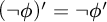


Lemma 13 Let $\langle W,R\rangle $
be an S4-frame and
$\langle W,R\rangle $
be an S4-frame and $\langle W,D\rangle $
its corresponding dual-content frame. If
$\langle W,D\rangle $
its corresponding dual-content frame. If $\mathfrak {M}=\langle W,R,V\rangle $
is an S4-model and
$\mathfrak {M}=\langle W,R,V\rangle $
is an S4-model and  is a dual-content $\mathcal {L}^{\Sigma }$
-model such that for all logical constants c,
$\mathcal {L}^{\Sigma }$
-model such that for all logical constants c, 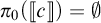 , then for any assignment g such that for all $p\in \mathcal {V}_{\langle \rangle }: g(p)=\langle \emptyset ,V(p)\rangle $
, for any formula
$p\in \mathcal {V}_{\langle \rangle }: g(p)=\langle \emptyset ,V(p)\rangle $
, for any formula $\phi \in \mathcal {L}_{M}$
, and
$\phi \in \mathcal {L}_{M}$
, and $w\in W$
:
$w\in W$
: $\mathfrak {M},w\vDash \phi $
iff
$\mathfrak {M},w\vDash \phi $
iff $\mathfrak {E},w,g\vDash \phi '$
.
$\mathfrak {E},w,g\vDash \phi '$
.
Proof. We first note that it is easily established by an induction on the complexity of $\phi \in \mathcal {L}_{M}$
that
$\phi \in \mathcal {L}_{M}$
that  and hence
  . This fact will be tacitly presupposed in the proof below.
The proof is by induction on the complexity of $\phi $
. Base case:
$\phi $
. Base case: $\phi $
is
$\phi $
is $p\in \mathcal {V}_{\langle \rangle }$
:
$p\in \mathcal {V}_{\langle \rangle }$
:
 $$ \begin{align*} \mathfrak{M},w\vDash p &\Leftrightarrow w\in V(p) \Leftrightarrow w\in\pi_{1}(g(p))\Leftrightarrow\mathfrak{E},w,g\vDash p. \end{align*} $$
Induction step: The only interesting case is where $\phi $
is of the form
$\phi $
is of the form $\square \psi $
:
$\square \psi $
:
 $$\begin{align} \mathfrak{M},w\vDash\square\psi \Leftrightarrow \forall v\in W: wRv\Rightarrow \mathfrak{M},v\vDash\psi & \nonumber\\ \Leftrightarrow^{IH}\forall v\in W: wRv\Rightarrow \mathfrak{E},v,g\vDash\psi' & \nonumber\\ \Leftrightarrow \forall v\in W: D^{w}_{\langle\rangle}\subseteq D^{v}_{\langle\rangle}\Rightarrow \mathfrak{E},v,g\vDash\psi' & &\\ \Leftrightarrow \mathfrak{E},w,g\vDash\square_{\Pi}\psi'. \nonumber\\[-32pt]\nonumber \end{align} $$
Theorem 3. Let $\phi $
be a propositional modal schema that is not an S4-schema. Then
$\phi $
be a propositional modal schema that is not an S4-schema. Then $\phi $
has an
$\phi $
has an $\mathcal {L}^{\Sigma }$
-instance that is not an HLE-theorem.
$\mathcal {L}^{\Sigma }$
-instance that is not an HLE-theorem.
Proof. Suppose that $\phi $
is an invalid schema of propositional S4. Then
$\phi $
is an invalid schema of propositional S4. Then $\phi $
has an
$\phi $
has an $\mathcal {L}_{M}$
-instance
$\mathcal {L}_{M}$
-instance $\psi $
that fails on some S4-frame
$\psi $
that fails on some S4-frame $\langle W,R\rangle $
. So there is an S4-model
$\langle W,R\rangle $
. So there is an S4-model $\mathcal {M}=\langle W,R,V\rangle $
and some
$\mathcal {M}=\langle W,R,V\rangle $
and some $w\in W$
such that
$w\in W$
such that $\mathcal {M},w\nvDash \psi $
. Let
$\mathcal {M},w\nvDash \psi $
. Let $\mathfrak {E}=\langle W,D\rangle $
be the corresponding dual-content frame,
$\mathfrak {E}=\langle W,D\rangle $
be the corresponding dual-content frame,  be a model satisfying the conditions of the previous lemma and g be an assignment as in the previous lemma. Then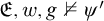 $\mathfrak {E},w,g\nvDash \psi '$
, by Lemma 13. But
$\mathfrak {E},w,g\nvDash \psi '$
, by Lemma 13. But $\psi '$
is an
$\psi '$
is an $\mathcal {L}^{\Sigma }$
-instance of
$\mathcal {L}^{\Sigma }$
-instance of $\phi $
. The claim then follows from Theorem 1.
$\phi $
. The claim then follows from Theorem 1.
Corollary 5. In HLE, the propositional logic of $\square _{\Pi }$
is exactly S4.
$\square _{\Pi }$
is exactly S4.
We can similarly show that the propositional logic of $\square _{\Pi }$
is at most S5 in HLE+DOM⟨⟩
. The proof for this is similar to, but simpler than, the above result and will be omitted here. We merely mention that the principles of HLE+DOM⟨⟩
are valid in the class of equivalence models, defined as follows.
$\square _{\Pi }$
is at most S5 in HLE+DOM⟨⟩
. The proof for this is similar to, but simpler than, the above result and will be omitted here. We merely mention that the principles of HLE+DOM⟨⟩
are valid in the class of equivalence models, defined as follows.
Definition 15. A dual-content model  is an equivalence model just in case $\forall w,v\in W$
: if
$\forall w,v\in W$
: if $D^{w}_{\langle \rangle }\subseteq D_{\langle \rangle }^{v}$
, then
$D^{w}_{\langle \rangle }\subseteq D_{\langle \rangle }^{v}$
, then $D^{w}_{\langle \rangle }=D^{v}_{\langle \rangle }$
.
$D^{w}_{\langle \rangle }=D^{v}_{\langle \rangle }$
.
Corollary 6. In HLE+DOM⟨⟩
, the propositional logic of $\square _{\Pi }$
is exactly S5.
$\square _{\Pi }$
is exactly S5.
9.2 Models for propositional platonism
This section shows how to construct models for the Propositional Platonist theory HLE+P-Truth from §5 and uses these models to demonstrate that the propositional logic of $\square _{\Omega }$
is at most S4 in HLE+P-Truth and at most S5 in HLE+P-Truth+DOM. Together with the results proved in §5, this implies that its logic is exactly S4 and S5 in the respective systems.
$\square _{\Omega }$
is at most S4 in HLE+P-Truth and at most S5 in HLE+P-Truth+DOM. Together with the results proved in §5, this implies that its logic is exactly S4 and S5 in the respective systems.
Definition 16. A Platonist worldly content structure is a worldly content structure $\mathfrak {N}=\langle \mathcal {N},W,I,\iota ,\overline {E}\rangle ,$
where for all
$\mathfrak {N}=\langle \mathcal {N},W,I,\iota ,\overline {E}\rangle ,$
where for all $w\in W$
:
$w\in W$
: $I^{w}\supseteq P^{w}_{e}:=\lbrace \langle n,l\rangle :n\in \mathcal {N},w\in \overline {E}(n)$
and
$I^{w}\supseteq P^{w}_{e}:=\lbrace \langle n,l\rangle :n\in \mathcal {N},w\in \overline {E}(n)$
and $l\subseteq \overline {E}(n)\rbrace $
and
$l\subseteq \overline {E}(n)\rbrace $
and $\iota \vert P^{w}_{e}:\langle n,l\rangle \mapsto n$
.
$\iota \vert P^{w}_{e}:\langle n,l\rangle \mapsto n$
.
Definition 17. A Platonist frame is a dual-content frame induced by a Platonist worldly content structure.
Definition 18. Let $\Sigma $
be a signature including the constant
$\Sigma $
be a signature including the constant $true$
of type
$true$
of type $\langle e\rangle $
. A Platonist worldly content
$\langle e\rangle $
. A Platonist worldly content $\mathcal {L}^{\Sigma }$
-model is a worldly content
$\mathcal {L}^{\Sigma }$
-model is a worldly content $\mathcal {L}^{\Sigma }$
-model based on a Platonist worldly content structure such that
$\mathcal {L}^{\Sigma }$
-model based on a Platonist worldly content structure such that  and for all $\sigma \in \mathcal {T}$
,
$\sigma \in \mathcal {T}$
,  .
.
Definition 19. A Platonist $\mathcal {L}^{\Sigma }$
-model is a model based on a Platonist worldly content
$\mathcal {L}^{\Sigma }$
-model is a model based on a Platonist worldly content $\mathcal {L}^{\Sigma }$
-model where for all
$\mathcal {L}^{\Sigma }$
-model where for all $\mathbf {x}\in D_{e}$
:
$\mathbf {x}\in D_{e}$
:

Theorem 4. P-Truth is valid in the class of Platonist models.
Proof. Let  be a Platonist $\mathcal {L}^{\Sigma }$
-model. Let
$\mathcal {L}^{\Sigma }$
-model. Let $w\in W$
be such that
$w\in W$
be such that  . We show that
  . Let
. Let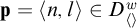 $\mathbf {p}=\langle n,l\rangle \in D^{w}_{\langle \rangle }$
. Then there is some
$\mathbf {p}=\langle n,l\rangle \in D^{w}_{\langle \rangle }$
. Then there is some $\mathbf {x}\in D^{w}_{e}$
such that
$\mathbf {x}\in D^{w}_{e}$
such that $\mathbf {x}=\langle n,\langle n,l\rangle \rangle $
, since
$\mathbf {x}=\langle n,\langle n,l\rangle \rangle $
, since $\langle n,l\rangle \in P^{w}_{e}\subseteq I^{w}$
. Now let
$\langle n,l\rangle \in P^{w}_{e}\subseteq I^{w}$
. Now let $v\in W$
be such that
$v\in W$
be such that $\mathbf {x}\in D_{e}^{v}$
. Then since
$\mathbf {x}\in D_{e}^{v}$
. Then since  and
and  , it follows that
  by Lemma 6. But
  . Hence,
  .
.
We will now use Theorem 4 to show that the logic of $\square _{\Omega }$
is at most S4 in HLE+P-Truth. We first show the analog of Lemma 12.
$\square _{\Omega }$
is at most S4 in HLE+P-Truth. We first show the analog of Lemma 12.
Lemma 14. Every S4-frame $\langle W,R\rangle $
can be extended to a Propositional dual-content frame
$\langle W,R\rangle $
can be extended to a Propositional dual-content frame $\langle W,I\rangle $
in which for all
$\langle W,I\rangle $
in which for all $w,v\in W:wRv$
iff
$w,v\in W:wRv$
iff $D_{e}^{w}\subseteq D_{e}^{v}$
.
$D_{e}^{w}\subseteq D_{e}^{v}$
.
Proof. Let $\langle W,R\rangle $
be an S4-frame. We first construct a Platonist worldly content structure as follows. Let
$\langle W,R\rangle $
be an S4-frame. We first construct a Platonist worldly content structure as follows. Let $\mathfrak {N}=\langle \mathcal {N},W,I,\iota ,\overline {E}\rangle $
, where
$\mathfrak {N}=\langle \mathcal {N},W,I,\iota ,\overline {E}\rangle $
, where $\mathcal {N}=\langle \wp (W),\subseteq \rangle $
, for all
$\mathcal {N}=\langle \wp (W),\subseteq \rangle $
, for all $x\in \mathcal {N}:\overline {E}(x)=\lbrace w\in W: \forall v\in x: vRw\rbrace $
, for all
$x\in \mathcal {N}:\overline {E}(x)=\lbrace w\in W: \forall v\in x: vRw\rbrace $
, for all $w\in W: I^{w}=\lbrace \langle n,l\rangle :n\in \mathcal {N},w\in \overline {E}(n)$
, and
$w\in W: I^{w}=\lbrace \langle n,l\rangle :n\in \mathcal {N},w\in \overline {E}(n)$
, and $l\subseteq \overline {E}(n)\rbrace $
, and for all
$l\subseteq \overline {E}(n)\rbrace $
, and for all $x\in \bigcup I^{w}: \iota (x)=\pi _{0}(x)$
. It is readily verified that
$x\in \bigcup I^{w}: \iota (x)=\pi _{0}(x)$
. It is readily verified that $\mathfrak {N}$
is indeed a Platonist worldly content structure. Let
$\mathfrak {N}$
is indeed a Platonist worldly content structure. Let $\langle W,D\rangle $
be the dual-content frame induced by
$\langle W,D\rangle $
be the dual-content frame induced by $\mathfrak {N}$
.
$\mathfrak {N}$
. $\langle W,D\rangle $
is a Platonist dual-content frame. The proof that for all
$\langle W,D\rangle $
is a Platonist dual-content frame. The proof that for all $w,v\in W: wRv$
iff
$w,v\in W: wRv$
iff $D^{w}_{e}\subseteq D^{v}_{e}$
is exactly analogous to the related proof in Lemma 12.
$D^{w}_{e}\subseteq D^{v}_{e}$
is exactly analogous to the related proof in Lemma 12.
We call the frame constructed in the proof of the previous lemma the corresponding Platonist frame for $\langle W,R\rangle $
. We now obtain the analogs of Lemma 13 and Theorem 3, with
$\langle W,R\rangle $
. We now obtain the analogs of Lemma 13 and Theorem 3, with $(\square \phi )'=\square _{\Omega }\phi '$
.
$(\square \phi )'=\square _{\Omega }\phi '$
.
Lemma 15. Let $\langle W,R\rangle $
be an S4-frame and
$\langle W,R\rangle $
be an S4-frame and $\langle W,D\rangle $
its corresponding Platonist frame and let
$\langle W,D\rangle $
its corresponding Platonist frame and let $\mathfrak {M}=\langle W,R,V\rangle $
be an S4-model and
$\mathfrak {M}=\langle W,R,V\rangle $
be an S4-model and  a Platonist $\mathcal {L}^{\Sigma }$
-model such that for all logical constants c,
$\mathcal {L}^{\Sigma }$
-model such that for all logical constants c,  . Then for any assignment g such that for all $p\in \mathcal {V}_{\langle \rangle }: g(p)=\langle \emptyset ,V(p)\rangle $
, for any formula
$p\in \mathcal {V}_{\langle \rangle }: g(p)=\langle \emptyset ,V(p)\rangle $
, for any formula $\phi \in \mathcal {L}_{M}$
, and
$\phi \in \mathcal {L}_{M}$
, and $w\in W$
:
$w\in W$
: $\mathfrak {M},w\vDash \phi $
iff
$\mathfrak {M},w\vDash \phi $
iff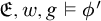 $\mathfrak {E},w,g\vDash \phi '$
.
$\mathfrak {E},w,g\vDash \phi '$
.
Proof. Similar to the proof of Lemma 13.
Theorem 5. Let $\phi $
be a propositional modal schema that is not an S4-schema. Then
$\phi $
be a propositional modal schema that is not an S4-schema. Then $\phi $
has an
$\phi $
has an $\mathcal {L}^{\Sigma }$
-instance that is not a theorem of HLE+Truth.
$\mathcal {L}^{\Sigma }$
-instance that is not a theorem of HLE+Truth.
Corollary 7. The logic of $\square _{\Omega }$
is exactly S4 in HLE+Truth.
$\square _{\Omega }$
is exactly S4 in HLE+Truth.
As in the case of HLE+DOM⟨⟩
we can show that there is a class of models with respect to which HLE+P-Truth+DOM is sound and that the logic of $\square _{\Omega }$
is exactly S5 in HLE+P-Truth+DOM. The details are again omitted here. We merely mention that HLE+P-Truth+DOM is valid in the following class of models.
$\square _{\Omega }$
is exactly S5 in HLE+P-Truth+DOM. The details are again omitted here. We merely mention that HLE+P-Truth+DOM is valid in the following class of models.
Definition 20. A Platonist model  is a Platonist type-e equivalence model iff $\forall w,v\in W$
: if
$\forall w,v\in W$
: if $D^{w}_{e}\subseteq D_{e}^{v}$
, then
$D^{w}_{e}\subseteq D_{e}^{v}$
, then $D^{w}_{e}=D^{v}_{e}$
.
$D^{w}_{e}=D^{v}_{e}$
.
Corollary 8. In HLE+Truth+DOM, the logic of $\square _{\Omega }$
is exactly S5.
$\square _{\Omega }$
is exactly S5.
10 Concluding remarks
I conclude with some questions for future research. The system HLE is based on a classical higher-order logic. The reductions of necessity to essence investigated in §5 therefore all validate necessitism, the view that necessarily everything is necessarily something. It would be interesting to develop versions of HLE that are based on a free logic. It is an open question whether we can understand necessity in terms of essence in such a free version of HLE.Footnote 38 Moreover, it would be desirable to find a semantics for which HLE is complete. There are also various extensions of HLE that would be worth investigating. One important type of extension concerns the interaction between essence and ground;Footnote 39 another one concerns the addition of interaction principles for essence and identity, such as those discussed in §7 and §8.Footnote 40 Finally, it is worth noting that variants of the model theory developed here may have applications that do not concern essence. For example, it is straightforward to interpret a higher-order language containing no essentialist operators but a primitive necessity operator in a suitably modified class of dual-content models. One could, for example, take the class of dual-content constant domain frames and interpret a necessity operator as ranging over all worlds in the model. This generates a version of classical higher-order modal logic where properties and propositions are not individuated by necessary coextensiveness and equivalence, respectively.
It is also possible to use dual-content frames to model various kinds of free higher-order modal logics. For example, one could model a positive free higher-order modal logic by letting all formulas be defined at every world in a model, letting the quantifiers be restricted to the relevant domains $D^{w}_{\sigma }$
—interpreted as the inner domains of a world—and allowing the extensions of predicates and propositions to be subsets of the outer domain of the frame.
$D^{w}_{\sigma }$
—interpreted as the inner domains of a world—and allowing the extensions of predicates and propositions to be subsets of the outer domain of the frame. $D^{w}_{\langle \rangle }$
would be
$D^{w}_{\langle \rangle }$
would be $\lbrace \langle n,l\rangle :n\in \mathcal {N},w\in \overline {E}(n)$
and
$\lbrace \langle n,l\rangle :n\in \mathcal {N},w\in \overline {E}(n)$
and $l\subseteq W\rbrace $
, for example. So a proposition that doesn’t exist in the inner domain of a world may still be true at that world. The denotation of a term then exists in the inner domain of a world just in case the denotations of all of its constants and free variables exist in the inner domain of that world. This allows us to model a version of higher-order contingentism on which (a) properties and propositions are not individuated by necessary coextensiveness or equivalence and (b) even such qualitative properties as being red can fail to have necessary existence. Whether or not such a view is philosophically motivated and defensible remains to be investigated.
$l\subseteq W\rbrace $
, for example. So a proposition that doesn’t exist in the inner domain of a world may still be true at that world. The denotation of a term then exists in the inner domain of a world just in case the denotations of all of its constants and free variables exist in the inner domain of that world. This allows us to model a version of higher-order contingentism on which (a) properties and propositions are not individuated by necessary coextensiveness or equivalence and (b) even such qualitative properties as being red can fail to have necessary existence. Whether or not such a view is philosophically motivated and defensible remains to be investigated.
Acknowledgments
Special thanks are due to Cian Dorr, Kit Fine, and Marko Malink for invaluable feedback on earlier drafts and many helpful discussions of this material. Thanks also to Andrew Bacon, Alex Roberts, Timothy Williamson, audiences at the Oxford Philosophy of Mathematics Seminar and the GAP.11 Congress in Berlin, as well as three anonymous referees and the editors for this journal for very helpful feedback and discussion.
















 instead
  when c is a constant.


 Open access

