

Introduction
Asking why ‘there is so little gender archaeology for the European Neolithic’, Robb and Harris (Reference Harris2017, 128) issued a call to arms for archaeologists to rethink gender in this period. They conclude that gender was not the expected binary form, found, for example, in the Bronze Age from the third millennium bc (Robb & Harris Reference Robb and Harris2017). Rather than operating as a cultural elaboration of biological sex which permeated all of social life, they argued that Neolithic gender was contextual to particular objects and practices (Robb & Harris Reference Robb and Harris2017, 141, table 1). The early Neolithic culture of the Linearbandkeramik (LBK, c. 5500–5000 cal. bc: Bickle & Whittle Reference Bickle and Whittle2013; Gronenborn Reference Gronenborn1999; Modderman Reference Modderman1988; Fig. 1) was considered an exception, particularly its burial evidence, which appeared to show more distinct binary gender patterning than elsewhere in the European Neolithic (Robb & Harris Reference Robb and Harris2017, 138, 140). Separate to the issues identified by Robb and Harris (Reference Harris2017), there also continues to be a tendency to treat gender as a niche, or special interest, area of study. This is problematic because many of the models for prehistoric social organization, which form the context in which issues of culture change are examined, are underpinned by an assumption of binary gender, which is itself open to interrogation. For example, recent aDNA and isotope studies (e.g. Bentley et al. Reference Bentley, Bickle and Fibiger2012; Brandt et al. Reference Brandt, Haak and Adler2013) have confirmed earlier suggestions of patrilocal and patrilineal practices for the LBK (Eisenhauer Reference Eisenhauer2003) but the implications of patrilocality for LBK identity (and vice versa) have yet to be fully addressed. Inspired by Robb and Harris (Reference Harris2017), this paper examines the evidence from the funerary record and bioarchaeological analysis of diet, mobility and health, asking what LBK gender was like; was it rooted in sex differences?
Map of the LBK, with sites mentioned in text. The darker shading indicates phase one (c. 5500–5300 cal. bc), and the lighter shading, phase two (c. 5300–5000 cal. bc). (1) Cuiry-lès-Chaudardes; (2) Karsdorf; (3) Kleinhadersdorf; (4) Nitra; (5) Schöneck-Kilianstädten; (6) Schwetzingen; (7) Stuttgart-Mühlhausen; (8) Talheim; (9) Vedrovice. (Base map after Jeunesse Reference Jeunesse1997, 10, fig. 1.)

A significant challenge has been made to identity conceived of as a fixed means of categorizing, and thereby defining, a person (Joyce Reference Joyce2000; Reference Joyce2008; Meskell & Joyce Reference Meskell and Joyce2003; Milledge Nelson Reference Nelson2006). Rather, it is figured as the myriad ways of participating in and creating social life, a definition developed in part from feminist philosophy (e.g. Butler Reference Butler1990; Reference Butler1993; Grosz Reference Grosz1994; Reference Grosz2011). In the specific case of gender, this means recognizing that the division between sex as a biologically fixed category and gender as its cultural elaboration developed from the particular historical circumstances of the Enlightenment (Meskell Reference Meskell1996; Robb & Harris Reference Robb and Harris2013; Reference Robb and Harris2017; Thomas Reference Thomas2004). Therefore, rather than judging the archaeological evidence against a list of what are assumed a priori to be facets of identity, alternative ways to capture the creation and performance of identity are required. Instead archaeology has turned to conceptions of embodiment and personhood, leaving gender and biological sex in an uneasy relationship with our interpretations of identity, to the extent that they have sometimes been overlooked (Robb & Harris Reference Robb and Harris2017). Most importantly, however, I contend here that it has meant that that difference in identity has been under theorized.
If gender is considered a fixed category, rooted in the body, then difference can clearly be found in biological sex. However, if identity is characterized as contextual, arising in daily practice, and fluid, differences between identities become more challenging to define (Moore Reference Moore1994a, 37). An alternative approach to identity difference is proposed here based on the philosophy of Deleuze (Reference Deleuze2009; Deleuze & Guattari Reference Deleuze and Guattari2013a, Reference Deleuze and Guattarib). I also draw on feminist reactions to Deleuze's concept of difference (e.g. Braidotti Reference Braidotti2011; Reference Braidotti2013; Moore Reference Moore and del Valle1993; Stark 2013) and archaeological borrowings from these scholars (Crellin Reference Crellin2017; Fowler Reference Fowler2013; Harris Reference Harris2017; Reference Harris2018): what is now loosely called the ‘New Materialist’ school (Harris & Cipolla Reference Harris and Cipolla2017). Deleuze's philosophy sought to reject Freudian definitions of difference (called here Freudian for the sake of clarity, following Braidotti Reference Braidotti2011 and Stark 2013, who use the term ‘psychoanalysis’). Freud's account of sexed difference characterizes many of the post-Enlightenment approaches to difference: that in order for two things to be different they must lack what the other possess and are thus a priori defined by each other (Butler Reference Butler1993; Moore Reference Moore and del Valle1993; Reference Moore1994a). For example, in the classic Freudian approach to sexed identity, the female lacks what makes the male ‘man’, and thus women participate in their social relationships by virtue of not being male (Butler Reference Butler1993; Grosz Reference Grosz1994). In contrast, the Deleuzian approach to difference is defined as ‘difference-within-itself’ (Deleuze Reference Deleuze2009; Deleuze & Guattari Reference Deleuze and Guattari2013a), that is, difference as a productive and energized space, out of which things, people, identity are created (or ‘become’, in the terms of Deleuze and Guattari). While the former approach encourages attention to normative definitions (whereby things are categorized by the presence of something or by lacking it), a Deleuzian approach pays greater attention to the diversity, or difference defined-within-itself; the range of possibilities rather than the average.
Theorizing difference positively: towards an analytical framework
There are two key concepts, assemblages and becoming, which have been the focus for most archaeological interpretations of Deleuze (Crellin Reference Crellin2017; Harris Reference Harris2017). Although both terms can only briefly be considered here, it is useful to outline how they reframe approaches to archaeological evidence. Assemblages are what the world consists of, the myriad of interacting and animated elements (material, linguistic, symbols, representations) that form complexes, encompassing everything from molecules to whole-world systems and, importantly, expressions of those complexes (Crellin Reference Crellin2017; Delanda Reference Delanda2006; Deleuze Reference Deleuze2009; Harris Reference Harris2017; Reference Harris2018). They are thus multiscalar and can be both managed or managing (or in Deleuzian terms, territorialized or deterritorialized: Deleuze & Guattarri Reference Deleuze and Guattari2013a). Harris (Reference Harris2018, 8) explains assemblages through the concept of a house: the house is an assemblage of materials (such as the bricks, mortar and furniture), linguistic concepts (bedroom, kitchen, domesticity), symbols (privacy, social class, wealth) and representative (ownership, capitalism). The assemblage of the ‘house’ is constantly produced through the interaction of these difference elements, in other words, becoming (see below), and subject to change in multiscalar ways, from knocking down walls as open-plan living becomes desirable to developing notions of overcrowding, as political situations allow slum landlords to thrive.
In the example above, thinking of the house as an assemblage asks us to attend to how concepts of ownership of space, privacy and divisions between domestic life and work dovetail with material properties and their variation in time and space. It also shapes the questions to ask: no longer is it useful to ask what is a house? or what does a house mean? Or, even, what does a house do? It forces us to ask how does the house participate in the world or, importantly, how does a house become an outcome of actions in the world? We can extend this to gender. The question is no longer what is gender? But rather how does gender allow ‘people’ to participate in the world as active? How is gender produced, or an outcome of actions in the world? Assemblages are thus gaining traction as productive approaches to archaeological evidence, particularly around challenging categories of evidence previously thought of as exclusive. This has important implications for detailing how change may have occurred from within assemblages rather than being enforced from outside (e.g. Crellin Reference Crellin2017).
The concept of assemblages as constantly becoming has mostly been used in archaeology to encourage a flattening of existing interpretative hierarchies, in which materials, objects and animals participate as much as humans in the ongoing creation of particular historical phenomena (e.g. Crellin Reference Crellin2017; Fowler Reference Fowler2013; Harris Reference Harris2017; Reference Harris2018). Deleuze and Guattari (Reference Deleuze and Guattari2013a, Reference Deleuze and Guattarib) figure becoming as more a complex process than a constant state of emergence. For Deleuze and Guattari (Reference Deleuze and Guattari2013a), becoming is the means by which difference is produced in new, positive ways; their aim was to find ways of reconfiguring identity to escape political hierarchies. Of particular importance to the concept of ‘becoming’ is the rhizome, a term borrowed from biology. A rhizome is a plant root which grows from nodes sent outward horizontally, from which new shoots can grow (Deleuze & Guattari Reference Deleuze and Guattari2013a). They contrast rhizomic becoming to other philosophical approaches to knowledge, which they cast as linear and hierarchical (Deleuze & Guattari Reference Deleuze and Guattari2013b). Knowledge as linear, with difference defined-by-lack (difference defined in the Freudian sense outlined above), Deleuze and Guattari (Reference Deleuze and Guattari2013b) argue leads to hierarchical arrangements in assemblages because one element of the assemblage takes primacy in the definition of the others. For example, in Freudian thought, where the female desire is defined by what females lack physically, this supports the primacy of male in the definition of gender (man can be neutral, but never female), hence propping up Enlightenment binaries (Braidotti Reference Braidotti2011; Butler Reference Butler1993; Moore Reference Moore and del Valle1993; Reference Moore1994a; Stark Reference Stark2016).
To move from difference defined-by-lack and towards difference defined-within-itself, Deleuze and Guattari (Reference Deleuze and Guattari2013b) argue that one must move through multiple specific becomings, such as becoming-women, becoming-girl, becoming-animal and becoming-molecular (see discussion in Stark Reference Stark2016). Contra all sense of a concrete, substantive world being lost in endless fluid assemblages, assemblages constantly become so that particular and specific views are made possible, or crucially, re-enforced; ‘the condition in which an eventful subject apprehends a variation … or [that] something = x’ (Deleuze Reference Deleuze2009, 21). Therefore, to examine an assemblage without considering whose ‘views’ or the ‘something = x’ is to miss a critical element of Deleuze's argument. For feminist philosophers inspired by Deleuzian thought, such as Rosi Braidotti (Reference Braidotti2011), it is the concept of occupying simultaneous multiple becomings, rather than becoming as a constant, which allows new identities to emerge which challenge the dominant mode of thought, with male as subject and female as other. Braidotti (Reference Braidotti2011; Reference Braidotti2013) argues that collapsing difference between men and women (or regarding them as a continuum) will not bring about an end to the impacts of sexism, but rather it is necessary radically to rethink how difference between people is conceived and understood. To disrupt the unequal hierarchy between masculinity and femininity thus involves challenging the view of the sexes as mutually constituting (Busby Reference Busby1999). Of course, and as experienced, gender is fluid and highly varied, but rarely represented as such, creating a ‘noticeable gap’ between how we live and how we represent lived experience (Braidotti Reference Braidotti2013). This results in sexual difference being reinforced (as ‘something = x’), as the responsibility for the mismatch between experience and ideal is placed in the hands of the individual, rather than the failure of the concept of binary sexual difference to account adequately for human experience. Braidotti (Reference Braidotti2011, 4) uses nomadic subjects to move beyond this. She charges her nomads to move rhizome-like between multiple embodied voices that encompass the feminist movement, denying othering through action—to be more concerned with the variation within (Braidotti Reference Braidotti2011, 161–5). Following Braidotti (Reference Braidotti2011), this can be achieved through greater attention to diversity and variation, to difference-within-itself. We can apply this to archaeology by considering the diversity within the assemblages considered of value to understanding the past.
To summarize this discussion, three important elements of Deleuzian thought have the potential to impact on how we define difference, each of which suggests a route forward to alternative archaeologies of identity:
(1) The concept of assemblages encourages us to explore how materials, objects, people, animals, architecture and so on, operated together to create particular, multiple and specific ways of participating in and of the world.
(2) Being alert to where the differences recognized as important in the past are defined-by-lack. Are Enlightenment binary hierarchies of subject/other being recreated or re-enforced through particular narratives of the past?
(3) Attempting to recognize difference defined-within-itself by seeking diversity within multiple ways of participating in identity in the past.
For the discussion here, this means first exploring how sex and gender differences have been defined for the LBK, and the impact of those differences on interpretations of LBK social worlds. Whether concepts such as biological sex, gender and differences based on sexual reproduction might have facilitated particular participations in LBK society, and how gendered identities might have been produced, are then considered through considering diversity within assemblages first of burials, and then of bodies.
Gender in the early Neolithic: the case of the LBK
The early Neolithic LBK culture (5500–5000 cal. bc) originates in the region of modern Hungary and brings the Neolithic to central Europe, stretching from the Paris basin to Ukraine (Bickle & Whittle Reference Bickle and Whittle2013). This geographical scale frames the analysis presented here, though it would be a mistake to suggest that this distribution did not also include regional differences, and that more refined study may lead to regional nuances in gendered experiences. There are few explicit considerations of sex- or gender-based identities in the published literature on the LBK, which, as Robb and Harris (Reference Harris2017) note, is common for the European Neolithic. This does not mean, however, that LBK scholars have ignored gender, or rather the categories of man and woman (e.g. Jeunesse Reference Jeunesse1997; Moddermann Reference Modderman1988; Nieszery Reference Nieszery1995; Pavúk Reference Pavúk1972; Röder Reference Röder, Auffermann and Weniger1998; van de Velde Reference van de Velde1979a, Reference van de Veldeb; Veit Reference Veit1993; Reference Veit1996). A review of how LBK gender has been interpreted is instructive of how difference defined-by-lack has led to the reproduction of modern binary gendered hierarchies. Sex and gender appear within two broad themes of LBK social organization. The first theme is kinship, including lineage, post-marital residential rules and status, which is mostly drawn from the burial evidence. The second is the sexual division of labour, often assumed in material culture production. Such normative characterizations of men and women have been challenged through considering the impacts of age and other forms of embodiment (Hofmann Reference Hofmann, Hofmann and Bickle2009, 224; Reference Hofmann and Watts2013).
LBK gender in death
Statements about sex or gender in the LBK are mostly limited to the burial evidence, and hence connected to sexed skeletal remains. That women and children were of lower status to men is a prevalent suggestion in the literature (Häusler Reference Häusler1994; Jeunesse Reference Jeunesse1997; Moddermann Reference Modderman1988; Nieszery Reference Nieszery1995; Pavúk Reference Pavúk1972; Röder Reference Röder, Auffermann and Weniger1998; Veit Reference Veit1996; Fig. 2). Sometimes this is explicitly stated (e.g. Dohrn-Ihmig Reference Dohrn-Ihmig1983; Jeunesse Reference Jeunesse1997, 95–9; Röder Reference Röder, Auffermann and Weniger1998, 257), other times implied by absence and a focus on how male status operated (e.g. Moddermann Reference Modderman1988, 119; Pavúk Reference Pavúk1972). Their implied lower status rests on two characteristics of the burial evidence: first, that women and children receive fewer grave goods than men, and secondly, that they are more frequently buried at settlement sites (Hofmann Reference Hofmann, Hofmann and Bickle2009, 224–7). Reviewing the impact of sex on the rate of furnished graves and burial locations (cemetery or settlement) from a database of c. 3000 LBK inhumation burials, Hedges et al. (Reference Hedges, Bentley, Bickle, Bickle and Whittle2013, 373–4) found no statistically significant differences between men and women. Female sexed skeletons are under-represented at cemeteries, but not drastically so, though they are less likely to have grave goods. Importantly, men and women were equally likely to be buried at settlements, where burials are less likely to be furnished (50 per cent furnished graves at settlements, compared with 70 per cent at cemeteries: Hedges et al. Reference Hedges, Bentley, Bickle, Bickle and Whittle2013, 374). The evidence does not confirm that women and children had lower status. Rather, such notions appear to develop from selected reading of the evidence, built on assumed differences in how cemeteries and settlements, and specific grave goods, are thought to have been valued by LBK communities (Hofmann Reference Hofmann, Hofmann and Bickle2009).
The ‘standard’ burial rite of the LBK, left-crouched, oriented east–west and with a set of grave goods. Burial 60, from Aiterhofen-Ödmühle (Bavaria, Germany; adult female, 40–50 years). (Photograph: Bayer. Reproduced with the kind permission of the Landesamt für Denkmalpflege, Regensburg.)
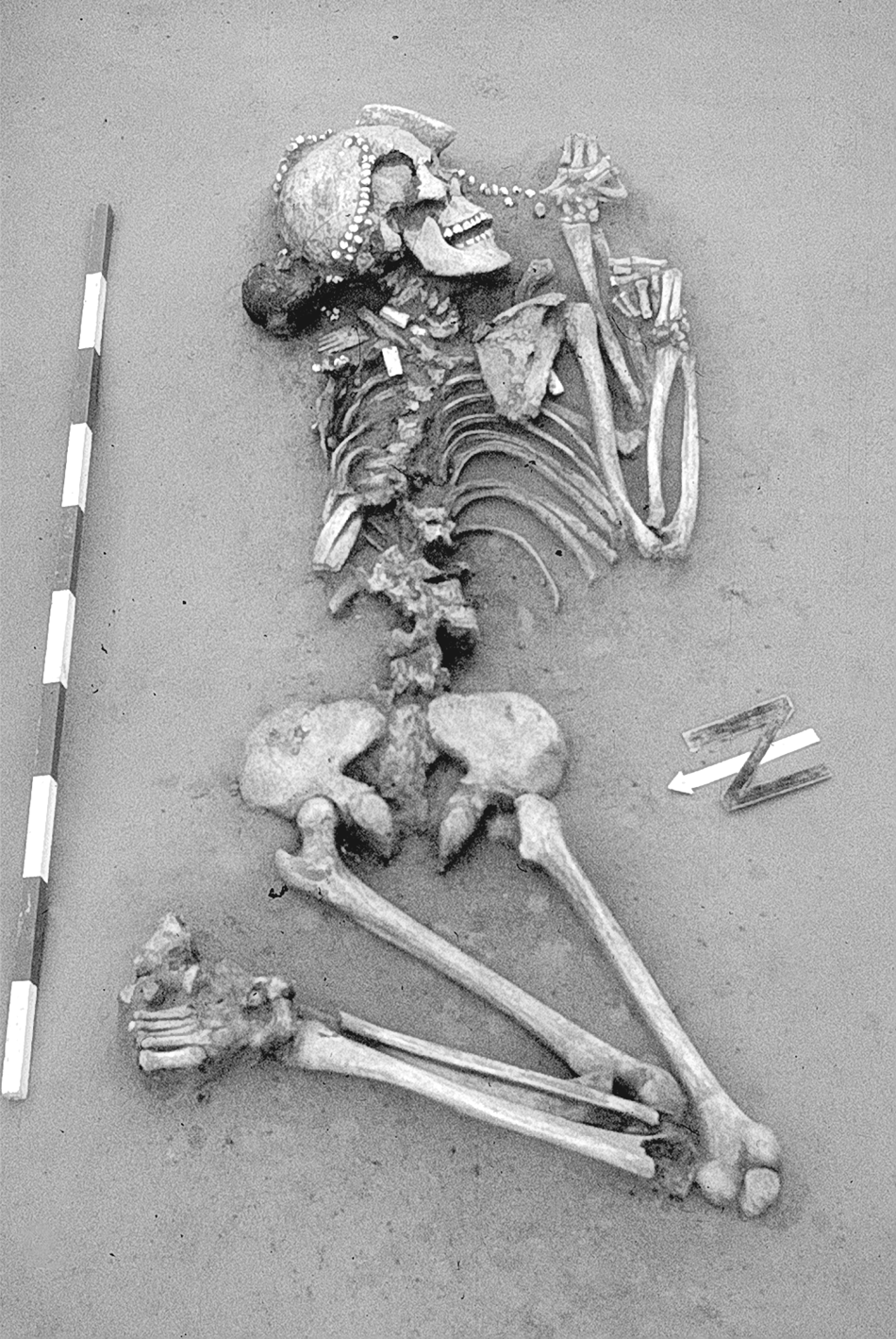
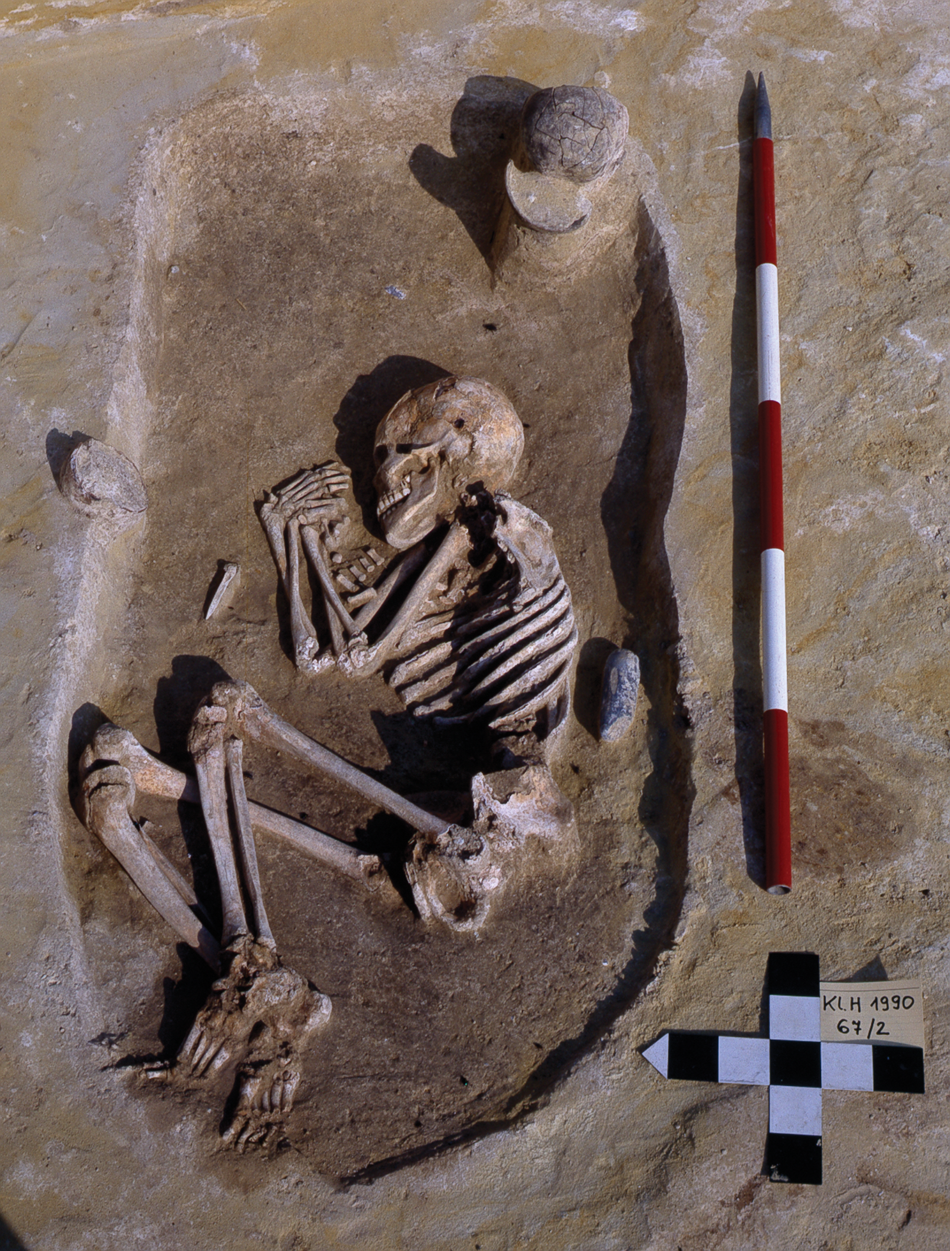
One particular grave good, polished stone tools, stand out as the ‘male’ grave good by virtue of being found in male graves (e.g. Moddermann Reference Modderman1988, 119; polished stone tools appear in 34 per cent of all male graves and 5 per cent of female: Hedges et al. Reference Hedges, Bentley, Bickle, Bickle and Whittle2013, 378; Fig. 3). There is no easily identifiable ‘female’ grave good counterpart, though some grave goods have been proposed. One such example is grinding stones (e.g. van de Velde Reference van de Velde1979a, Reference van de Veldeb; Zvelebil & Pettitt Reference Zvelebil and Pettitt2008, 202), but this is, again, cannot be established by the analysis of both settlement and cemetery burials, with grinding stones in 5% of burials, irrespective of sex (Hedges et al. Reference Hedges, Bentley, Bickle, Bickle and Whittle2013, 379). This patterning therefore suggests that stone tools do not operate to mark maleness as opposed to femaleness. Following on from this, we can question whether grave goods tell us much about gender construction, and whether sex had a role in conferring higher or lower status on particular individuals in the LBK at all (a point returned to below). In summary, the supposed status of LBK males is largely developed from what others lack.
Burial 67/2 from Kleinhadersdorf (Austria; young adult male). Note the polished stone adze placed behind the spine of this right-crouched individual. (Photograph: J.-W. Neugebauer, BDA.)
LBK gender in life
The characterization of LBK gender from the burial evidence is often repeated in the consideration of daily activities and tasks. Women are the potters, while men are the knappers (e.g. Strien Reference Strien2000). This classification is derived in part from how these two classes of material culture operate. Smaller decorative pot motifs (called ‘secondary’ motifs) are thought to represent the individual potter, with some in use for up to 250 years (Krahn Reference Krahn, Eckert, Eisenhauer and Zimmermann2003). Women are thought to have brought these secondary motifs from the place where they learnt to make pottery to the settlement of their ‘husbands’ (Claßen Reference Claßen, Hofmann and Bickle2009, 101). Lithic traditions, in contrast, appear to stay more stable, following similar networks across the duration of the LBK (Claßen Reference Claßen, Hofmann and Bickle2009; Strien Reference Strien2000). For Sommer (Reference Sommer2001, 260), the forms of variation accepted in ceramics and lithics were part of an LBK ideology of cohesion, carefully monitored in the material culture which expressed it. This ideology, Sommer argues, had a gender basis, which is worth quoting here in full:
Traditionally, ceramics are seen as a female product and lithics as a male product. This would mean that the cultural unity was guaranteed by the products of the women, while the products of men could safely be ignored, as they bore much less of a cultural message. A patrilocal marriage system would lead to a constant inter-settlement and perhaps interregional exchange of both personnel and information—and might place the young potteress under the close supervision of a tradition-abiding mother-in-law. (Sommer Reference Sommer2001, 260)
Given the diversity of pot decorations, locally and regionally, we could counter-argue that pottery is subject to more and faster change, and cultural variability, than lithics.
Prioritizing pottery and lithics as representations in gender relations creates two separate spheres of activity, one for each item of material culture. This contrasts with how pots and lithics are usually found, mixed together and fragmented, often dispersed across a settlement. Specific task locales are sometimes identifiable, such as lithic-processing areas (Hachem Reference Hachem2000, 308; Lanchon et al. Reference Lanchon, Bostyn, Hachem and Bocquet1997, 328; Last Reference Last and Pavlů1998; Wolfram Reference Wolfram, Hamon, Allard and Ilett2013), but for the most part distinct activity areas do not appear at settlements. The division between pot making and lithic production also betrays a particular view of these activities, again one in which an idealized norm is prioritized. The focus is thus on the final form of the object, and often just one feature of it (pots = decoration, lithics = raw material source), rather than the assemblage of materials, people, landscapes and time that went into production, for example, in the case of a pot: the sourcing of clay and temper, the mixing, decorating, forming, and firing, the repeated usage and possible repair, before eventual deposition (Gomart Reference Gomart2014). The point stressed here is that assuming a priori men and women as valid categories of analysis is not neutral and will lead to other binaries in our interpretations. This is because gender is an assemblage: it carries with it not just ‘maleness’ and ‘femaleness’, but also its structuring role in creating binary oppositions and hierarchies, which spread rhizome-like through the data.
Alternative views of LBK identity
Using ‘men’, ‘women’ and ‘children’ as normative categories in the LBK has been successfully challenged (e.g. Hofmann Reference Hofmann, Hofmann and Bickle2009; Reference Hofmann and Watts2013; Hofmann & Whittle Reference Hofmann, Whittle and Jones2008; Jones Reference Jones2005; Whittle Reference Whittle, Jones, Pollard, Allen and Gardiner2012). One good example of this is Hofmann (Reference Hofmann, Hofmann and Bickle2009; see also Hofmann & Whittle Reference Hofmann, Whittle and Jones2008), who explores how grave good assemblages vary with the age of the deceased, with more overlap between men and women as they aged. This elaboration of age in the funerary sphere suggests identity was not stable across the life course, and may indicate that ageing was an important process for shaping identity in the LBK (Bickle & Fibiger Reference Bickle and Fibiger2014). Household membership is also considered as a distinct identity category (Hofmann Reference Hofmann and Watts2013; Jones Reference Jones2005; Whittle Reference Whittle, Jones, Pollard, Allen and Gardiner2012). Exploring the diversity of longhouses in form, temporality and relationships to other houses does much to challenge the house, and by extension, the household as an exclusive category of social organization (Whittle Reference Whittle, Jones, Pollard, Allen and Gardiner2012, 195–6). Hofmann (Reference Hofmann and Watts2013) points to recurrent and regular concern with the decay and dissolution of both the body and the house. For the body, this took place through the funerary sphere, whether through cremation, disarticulation or revisiting/viewing the body, evidenced through the deliberate moving of bones out of anatomical connection (Boës Reference Boës2000; Hofmann Reference Hofmann and Watts2013; Thévenet Reference Thévenet and Zeeb-Lanz2009): for the house, through engagement with repair, open and flexible internal spaces and dissolution at the end of its life (Hofmann Reference Hofmann and Watts2013, 161–2). This fits Whittle and Bickle's (Reference Whittle, Bickle, Bickle and Whittle2013, 390–91) suggestion of a strong concern with descent and lineage in the LBK, evidenced across multiple categories of evidence, mostly patrilineal, but also flexible. Rather than distinct categories persisting across all spheres of life, Hofmann (Reference Hofmann and Watts2013, 166) argues that both possession and flow were present, with lineage maintained through both ‘connection’ and ‘categorization’.
Multivariate analysis of LBK grave goods
To understand how such as ‘connections’ and ‘categories’ (Hofmann Reference Hofmann and Watts2013) may have facilitated particular ways of participating in LBK life, I turn to explore the assemblages of burials. However, it is first necessary to consider the interpretive bias provided by the sexing of skeletons. Methods used in the 1960s and ’70s produced a systematic bias in which skeletons were 12 per cent more likely to be sexed as male, particularly in older age categories (Weiss Reference Weiss1972). Male and female skeletal morphology is a continuum, rather than two absolute categories (Chamberlain Reference Chamberlain2006). Individuals who cannot be sexed are usually excluded from further analysis, particularly with regard to grave goods (Stratton Reference Stratton2016, 859). Geller (Reference Geller2008, 128–9) suggests the way forward is to attempt to ‘distinguish difference in terms of variability and continuum’. For Stratton (Reference Stratton2016, 863), this meant carrying out multivariate statistical analysis to examine connectivity between artefact types. Using correspondence analysis on the Bulgarian late Neolithic site of Durankulak, few patterns were found, with grave goods types found evenly distributed across male, female and unsexed adult graves, suggesting gender was not ‘fixed’ through the funerary rites (Stratton Reference Stratton2016, 866).
Following the methods of Stratton (Reference Stratton2016) as a means of determining difference defined-within-itself, a simple correspondence analysis was carried out on the data collected for Bickle and Whittle (Reference Bickle and Whittle2013). Correspondence analysis uses chi-squared tests to define the relationships between variables, which are expressed graphically, with the axes describing the variation in the dataset (Baxter Reference Baxter1994). The analysis was confined to furnished adult burials (2342 burials: 545 females, 539 males and 1258 indeterminate adults), divided into seven categories of sex (f, f?, f??, indeterminate, m, m?, m??) and seven categories of grave good (stone tools, pottery, shell, flint, ochre/colour, bone, miscellaneous). This analysis is based on burials sexed using different osteological techniques, including older or unknown methods (Grauer Reference Grauer2012). Categories of grave good were decided on prevalence, with any grave good with a frequency of less than 10 per cent included in the miscellaneous category (including unworked animal bone, grinding stones and boar tusks). These categories are somewhat problematic, as they contain distinct variation within each of them; for example, bone can be found as both tools and personal ornamentation. Some animal bone objects appear in low numbers, but almost exclusively alongside male skeletons. Bone or antler pendants appear in 29 male graves, and 3 female (Haack Reference Haack, Falkenstein, Schade-Lindig and Zeeb-Lanz2008, 124–5), while, in yet lower numbers still, similar ratios are seen with wild boar tusks, fox mandibles and antler products. However, the categories chosen allow for some observations (Fig. 4). Confidently sexed male skeletons appear to have a strong association with polished stone and flint tools, whereas females are associated with pottery and shell, but more weakly. Bone and ochre were not associated with any sex. Indeterminately sexed skeletons were not associated with either group, but were more closely linked to ochre. F?? burials appeared closer to m and m?? than did m? burials. Overall, the results do suggest that biological sex was impacting on grave good assemblages to some extent, and certainly more in comparison to Durankulak (Stratton Reference Stratton2016).
Biplot of the correspondence analysis results from the grave goods and sex of burials in the LBK.

Given that the polished stone tools appear to have such a strong impact on the results, they were then removed from the analysis with the result that the patterns outlined above broke down (Fig. 5). There are some weak associations between pots, worked bone objects and shells co-occurring in graves, but as these are the most frequently present grave goods by number it is not surprising. What the second plot does reveal, however, is that the view of ‘women’ and ‘children’ as having less status than males, on the basis of the burial evidence at least, is probably an artefact of the presence of polished stone in male graves. This analysis, in contrast, provides a compelling case for viewing polished stone tools as having more impact on the rest of the grave good assemblage than the sex of the individual in the grave, the implication being that sex was a secondary factor to other concerns when grave good assemblages were compiled. These results echo the findings of the univariate analysis in Hedges et al. (Reference Hedges, Bentley, Bickle, Bickle and Whittle2013, 372–84). In this analysis, grave goods were analysed for how ‘strongly’ sexed they were based on their frequency in sexed burials (Hedges et al. Reference Hedges, Bentley, Bickle, Bickle and Whittle2013, 378, table 9.10). Female-sexed skeletons, for the most part, could receive a wider and less sex-determined range of grave goods, while for some male-sexed skeletons the presence of a polished stone tool led to a more restricted burial rite in terms of grave good. There was no statistical difference in the orientation or body position between the sexed skeletons, or in association with stone tools (Hedges et al. Reference Whittle, Bickle, Bickle and Whittle2013, 376–7). In sum, grave goods were in a minor way being influenced by the biological sex of the individual in the grave, but body position and grave orientation were not (in comparison to late Copper and Bronze Age burials: Sofaer Derevenski Reference Derevenski1997). In the LBK, age of the deceased also correlates with increasing or decreasing frequency of grave goods (Hedges et al. Reference Whittle, Bickle, Bickle and Whittle2013, 379; Hofmann Reference Hofmann, Hofmann and Bickle2009) and body position (Bickle & Fibiger Reference Bickle and Fibiger2014). Rather than defining the whole set of funerary rites, sex thus appears in a small part of the funerary sphere, related to selection of a limited range of grave goods.
Biplot of the correspondence analysis results from the grave goods and sex of burials in the LBK, this time with polished stone tools excluded from the analysis.

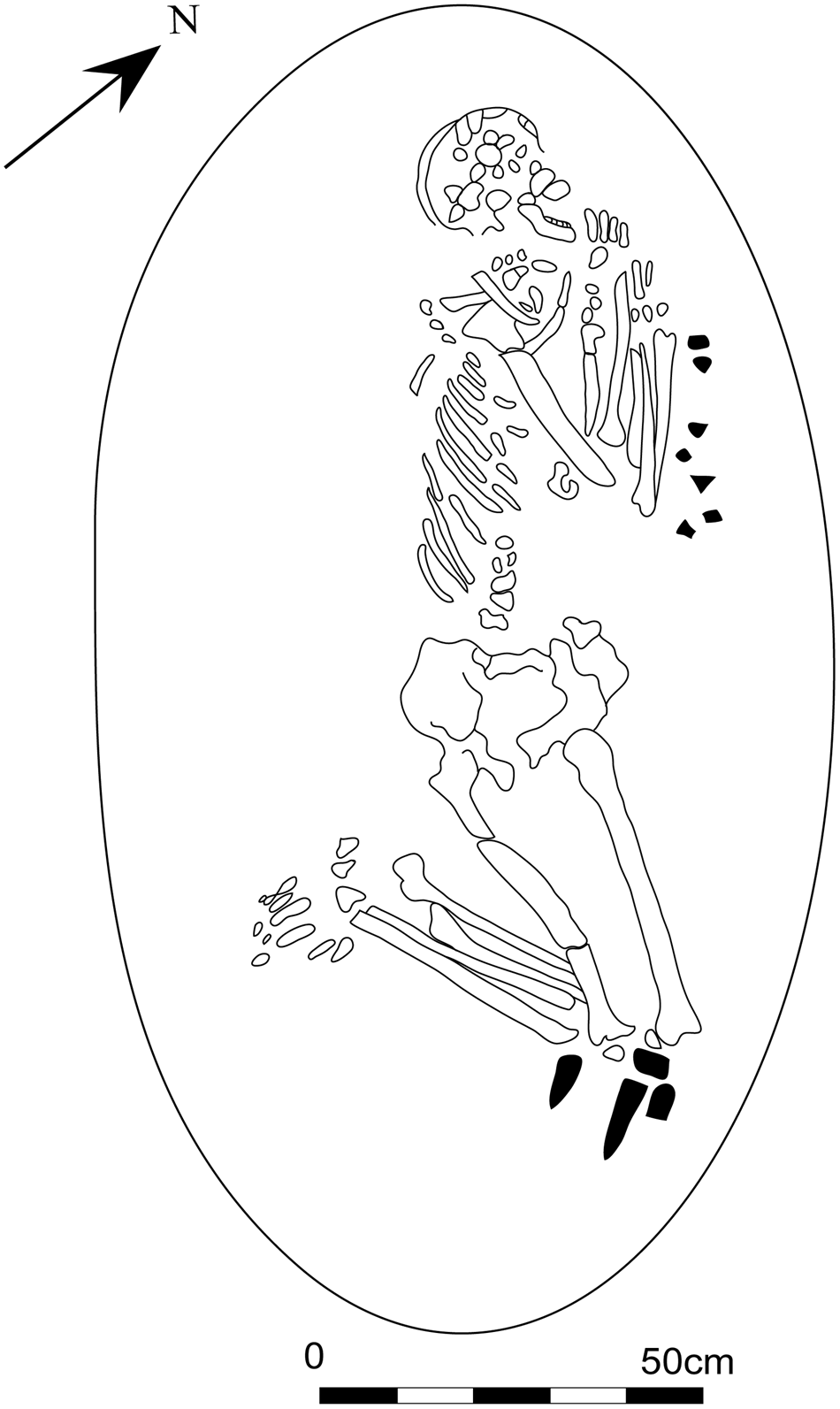
The polished stone tools found in graves range from heavily worked to pristine, and include flakes and fragments (Röder Reference Röder, Auffermann and Weniger1998, 252). Some of the tools were in use for up to 15 years (Ramminger Reference Ramminger2007, 264) and were probably used for working wood (Modderman Reference Modderman1988, 113; Ramminger Reference Ramminger2007). Other polished stone tools were not used and were possibly made for the grave, never intended to be put to work (Ramminger Reference Ramminger2007). Tools were made of stone from outside the local area, sometimes having travelled significant distances (Ramminger Reference Ramminger2007; Strien Reference Strien, Gronenborn and Petrasch2010). Some were placed whole, others were deliberately broken. For example, at the cemetery of Vedrovice (Czech Republic), two broken adzes were placed at the knees of an adult male (Fig. 6). Polished stone tools are also found in myriad locations in the grave, both on and off the deceased, which might also have been used to make particular statements. At the Kleinhadersdorf cemetery (Austria), polished stone tools are sometimes found placed along the back or front of the individual, and sometimes on top of the body, and sometimes on the edges of the grave cut at some distance from the body, whereas ochre is almost always found spread beneath or around the head (Neugebauer-Maresch & Lenneis Reference Neugebauer-Maresch and Lenneis2015; Fig. 3). In sum, this potential variation in object biographies before burial, and in the grave itself, suggests that although adzes were overwhelmingly placed in male graves, and brought with them increased likelihood of other objects being placed in the grave, they were themselves not adhering to strict rules or normative practices. Whether the personal object of the deceased, or a gift from a mourner, the adze would have carried with it these wide-ranging associations. Bringing these elements together, we can consider the adze assemblage. Perhaps responsible for constructing longhouses and clearing the forest before crops were grown, they may have been involved in the reproduction of the community or household, and through their origins signalled connections beyond the immediate social sphere.
Burial of an adult male (Vedrovice, Czech Republic, grave 57/78). The two broken adzes located by the knees are depicted in black. (After Whittle et al. Reference Bickle and Whittle2013, 117, fig. 4.5.)
Given the patterning in grave goods outlined above, it is perhaps not surprising that the only correlation between grave goods and isotopic data was with polished stone tools; adzes were found in the graves of men with a restricted range of strontium isotope values (Bentley et al. Reference Bentley, Bickle and Fibiger2012). As the strontium isotope value comes from tooth enamel, which forms in childhood, and adzes were received on death, in adulthood, this suggests a particular lifeway for some LBK males, possibly associated with the inheritance of land (Bentley et al. Reference Bentley, Bickle and Fibiger2012). For Hedges et al. (Reference Whittle, Bickle, Bickle and Whittle2013, 381), this connection, combined with the analysis of funerary practices, suggests that ‘masculine identities were presented in more closely regularized, perhaps formalized ways’, with male graves the focus for concern with male lineages. On balance, the funerary sphere probably does tell us more about concern with these (for want of a better term) lineages than how and whether sex was elaborative basis for gender construction in the LBK. Burial practices hint at concern with connections and links, rather than repetition of idealized identities (Hofmann Reference Hofmann, Hofmann and Bickle2009). On the one hand, this leads to the variation seen across all regions and elements of burial (Hedges et al. Reference Hofmann and Watts2013, 382): on the other hand, it leads to clustering around certain funerary practices (particular body positions, tendencies towards an east–west grave orientation, the objects selected to be placed alongside the deceased), in which identities relating to biological sex only appear if we look at the data in particular ways. For example, how might using microwear analysis on bone and stone tools to determine the activities represented in the grave, or perhaps comparing where objects were placed in the grave, change this analysis?
Sexual division of labour in LBK lifeways
If, in death, we glimpse some minor but meaningful differences suggesting the participation of biological sex in identity formation, might it also be present in other areas of evidence as well? Strong sexual division of labour is often assumed for non-industrial societies, such as early farmers, with variation considered to occur across different age groups (Macintosh et al. Reference Macintosh, Pinhasi and Stock2017; Moore Reference Moore and Ingold1994b), and the LBK is thought to be no exception. As we saw above, lithics are often strongly associated with men, pots with women. This section will consider whether particular genders or gendered experiences were produced in labour and everyday tasks. To explore this, we can turn to the available bioarchaeological data, again considering variation as a means of investigating the difference defined-within-itself. Two sources of evidence are drawn on here: isotopic data and osteological studies of pathologies and stress markers where available. Issues discussed above pertaining to how biologically sexed skeletons are used to inform the analysis are important here. For the most part, bioarchaeological studies report only on the differences between male and female skeletons, and often without recording the basis on which skeletons have been sexed and confidence in the assignment of sex. This is a challenging problem, and it is proposed here that greater attention to the variability of the data is required, that is, aiming to consider the variation within the dataset, rather than the average.
Limited studies of how repeated activities may have been recorded in LBK skeletons have been carried out, but the number is growing. Villotte and Knüsel (Reference Villotte and Knüsel2013) analysed the prevalence of stress markers on the elbows of the adult population from the LBK cemetery of Stuttgart-Mühlhausen (Baden-Württemberg, Germany), and found a prevalence of right medial epicondylosis among the adult males only found in modern baseball pitchers. This leads Villotte and Knüsel (Reference Villotte and Knüsel2013, 172) to argue that males, more than females, were engaging with repeated overhead throwing activities, which may have been related to hunting through the use of projectiles or throwing stones. While the stress marker occurs on one-third of male skeletons, it is challenging to determine the extent of this activity within the population. Post-cranial trauma was found in higher frequencies among male skeletons at five LBK settlement and cemetery sites, which was interpreted as males more likely than females to undertake activities with a higher risk of injury (Hedges et al. Reference Whittle, Bickle, Bickle and Whittle2013, 371). Judd and Roberts (Reference Judd and Roberts1999, 240) suggest that high rates of fracture in medieval farming populations were due to handling animals (e.g. kicks) and falls (e.g. ladders), which may explain some differences in how farming tasks were distributed across the community.
Sládek et al. (Reference Sládek, Ruff, Berner, Holt, Niskanen, Schuplerová and Hora2016, 43) found that sexual dimorphism in upper limb bone bilateral asymmetry rose from the Mesolithic to the Neolithic among the populations they studied, drawn from across Europe. Crucially this was because of changes in female activity patterns, rather than male, which they relate to the repeated use of saddle querns (Sládek et al. Reference Sládek, Ruff, Berner, Holt, Niskanen, Schuplerová and Hora2016). Upper limb loading, which indicates strength and extent of limb use, indicates that LBK women were participating in very high levels of manual labour, possibly explained by spending hours a day grinding using a saddle quern, but also through activities related to growing crops, such as tilling, hoeing and so on (Macintosh et al. Reference Macintosh, Pinhasi and Stock2017). This data is characterized by lower variability than the lower limb loading, in which Macintosh et al. (Reference Macintosh, Pinhasi and Stock2017, 2, 6) found ‘notably high’ variation in the tibias of LBK female skeletons, encompassing almost the entire known range from living populations, including athletes. Values from male tibias were for the most part less varied, though regional trends could be identified (Macintosh et al. Reference Macintosh, Pinhasi and Stock2014, 384). At the eastern-LBK Nitra (Slovakia) and Vedrovice (Czech Republic) cemeteries, the ranges in tibia midshaft variables were more restricted than they were in the western-LBK cemeteries of Schwetzingen and Stuttgart-Mühlhausen (Baden-Württemberg, Germany: Macintosh et al. Reference Macintosh, Pinhasi and Stock2014, 384).
This activity pattern matches the strontium isotope data from individuals at these sites, with the exception of Stuttgart-Mühlhausen, which sees similar strontium isotope ranges between men and women (Fig. 7). Bulk strontium analyses give an indication of lifetime mobility, rather than repeated movements. Given the variability in the lower limb loading, it seems more likely, however, that a diversity of movements is indicated, but it was mostly more varied for females than males. The strontium isotope data is regarded as evidence for patrilocality (including by the author, e.g. Bickle et al. Reference Bickle, Hofmann and Bentley2011; Bentley et al. Reference Bentley, Bickle and Fibiger2012), but here this is suggested as one of a myriad of possible lifeways. It may, however, have been one of the most likely. At Karsdorf (Saxony-Anhalt, Germany), mtDNA haplotypes suggested only limited continuity in maternal lineages across the site's three-century occupation and are thus interpreted as arising from patrilocal practices (Brandt et al. Reference Brandt, Knipper, Nicklish, Ganslmeier, Klamm, Alt, Whittle and Bickle2014, 100). In sum, the data discussed here strongly suggest some distinct sex-based activities, but also variability, with a greater range of possible mobility for females than for males.
Box and whisker plots of the Strontium isotope ratios for males and females from Nitra (Slovakia), Vedrovice (Czech Republic), Schwetzingen and Stuttgart-Mühlhausen (Baden-Württemberg, Germany). (Based on data from Bickle & Whittle Reference Bickle and Whittle2013, Price et al. Reference Price, Wahl, Knipper, Burger-Heinrich, Kurtz and Bentley2003 and Richards et al. Reference Richards, Montgomery, Nehlich and Grimes2008.)

In contrast, the dietary isotopes of carbon and nitrogen suggest greater homogeneity between the sexes in diet and range of food stuffs consumed, though this is variable and not consistent across all LBK sites (Hedges et al. Reference Whittle, Bickle, Bickle and Whittle2013, 355). At the sites where differences do occur, males consistently have high average δ15N values, suggesting greater consumption of meat (Hedges et al. Reference Whittle, Bickle, Bickle and Whittle2013, 355; Zvelebil & Pettitt Reference Zvelebil and Pettitt2008). Other dietary differences may be represented by caries rates, which are higher for females than for males (Hedges et al. Reference Whittle, Bickle, Bickle and Whittle2013, 371). Although genetic differences are thought to account for an increased caries risk for women (Ferraro & Vieira Reference Ferraro and Vieira2010), toothache and loss would have impacted more frequently on female than male lifeways. In turn, this may have then led to particular dietary choices among those women. Overall, however, the variability in dietary-based evidence is less than for the data discussed above, and at the sites where average δ15N values varied between the sexes, the variation was over the same range (Hedges et al. Reference Whittle, Bickle, Bickle and Whittle2013, table 9.6). These data will not encompass all of the possible variations for LBK lifeways (more could be said about ageing here: Bickle & Fibiger Reference Bickle and Fibiger2014; Hofmann Reference Hofmann, Hofmann and Bickle2009), but it does suggest that, unlike for daily tasks and activities, diet was more a communal sphere rather than a place for social differentiation. Across these different categories, we see places of more and less variation, in which the differences within sexes can be greater than between them, as well as instances of shared practice.
LBK kinship and gender hierarchy
I now turn to consider whether the image of how difference may have framed the experience of male- and female-sexed bodies and their participation in different tasks impacts on broader models of LBK social organization. For the most part, the LBK is regarded as a non-centralized network formed of kin groups, with the degree of hierarchy debated. Several cases have been made for inherited status, particularly towards the end of the LBK, in which ‘rich’ female and child graves are attributed to the status of their male relatives (e.g. Jeunesse Reference Jeunesse1997). For others, social differentiation between households, rather than sex/gender, takes precedence, with larger houses having more economic assets and thus being capable of exerting more influence (e.g. van de Velde Reference van de Velde1990). In contrast, houses and households have been regarded as evidence for an egalitarian social structure (Gomart et al. Reference Gomart, Hachem, Hamon, Giligny and Ilett2015; Hachem Reference Hachem2018). At the site of Cuiry-lès-Chaudardes (Paris basin, France), households were largely self-sufficient but also participated in reciprocity, with incoming groups, for example, using pottery produced in other households as they became established in the village (Gomart et al. Reference Gomart, Hachem, Hamon, Giligny and Ilett2015, 245). Short houses at the site are associated with wild boar in their pit fills, longer houses with domestic cattle and caprines (Hachem Reference Hachem2018). Rather than interpreting this difference as short houses lacking the resources or capital to access cattle, Hachem (Reference Hachem2018) proposes these structures as the home to young couples as they became established in the village and thus argues against strong hierarchical differentiation. What separates this model of egalitarian diversity from those of hierarchy is how difference in used in the analysis of the data. In hierarchical models, difference as defined-by-lack, what someone has will mean someone else does not have it. As men ‘have’ polished stone tools, woman do not ‘have’ them, and thus lack them. As some houses ‘have’ length, other houses do not ‘have’ it, and thus are short, so the salient character of shortness is not ‘having’ length. In the models of Gomart et al. (Reference Gomart, Hachem, Hamon, Giligny and Ilett2015) and Hachem (Reference Hachem2018), difference is defined-within-itself, and as their analysis demonstrates, this leads to making other interpretations possible.
Funerary evidence does not provide a faithful replica of identity or gender as experienced in life and may present certain idealized or manipulated images, yet these ‘images’ will also act to structure participation in life, and cannot be seen in isolation from other areas of expression (Brück Reference Brück2004; Nilsson Stutz Reference Stutz2003; Stratton Reference Stratton2016). While ‘male’ and ‘female’ do not appear as strong ideals in the burial evidence, there is plenty of evidence that biological sex led to people participating in society in different ways in the LBK. Repeated daily tasks resulted in biological differences in the body, leading to the building of particular strengths, or aches and pains, and perhaps rooted in particular physical or reproductive capacities, and were significant enough to leave a trace in the archaeological evidence. Such differences between the sexes could have been acknowledged, though whether they were used to define or enforce strict categories of identity upon people is debatable. What does tie the burial evidence, osteological and isotopic data together is the degree of variability. The possibilities for males were more restricted, producing tighter clustering of the data, and less variability, in comparison to females. This may or may not have been understood and elaborated in ways that we would understand as gender, but the evidence presented here counsels against regarding ‘male’ and ‘female’ as unequal mirrors of each other, or as a constraining structuring force in the LBK. If binary gender naturalizes hierarchical power asymmetries between men and women (Van Vleet Reference Van Vleet2008, 7), then I would argue that for the LBK, participation in performing and maintaining descent naturalized and hence limited elaboration of the male sex into particular identities, while providing a greater range of possibilities for the female sex.
Does rejection of a hierarchical binary gender system mean rejecting wholesale a patrilineal descent system? Not necessarily. Diemberger (Reference Diemberger and del Valle1993, 91) illustrates how among the Khumbo (Nepal), an agricultural society with mostly patrilineal descent, male and female sexes are conceived of as bone and flesh respectively, brought together in the human body. For the Khumbo there are ‘no distinct female and male worlds’ as they operate together, with the division of labour understood as social roles, such as mother or father, rather than as result of the capacity of sex (Diemberger Reference Diemberger and del Valle1993, 100). In a very real way for the Khumbo, flesh and bone are productive forces in the world, brought into action by coming together, and both required in ensuring descent (Diemberger Reference Diemberger and del Valle1993). Among the Sullk'ata (Bolivia), again in a patrilocal and patrilineal society, violence erupts as a means of control because the power hierarchies between men and women, but also between the in-laws of both sexes, are ambiguous (Van Vleet Reference Van Vleet2008, 177). Van Vleet (Reference Van Vleet2008, 181) argues this is because kinship is in constant and fluid negotiation despite broad patrilineal descent patterns. These examples are raised here not to explain the patterns seen in the LBK data, but rather to show that patrilineal descent can arise across varied conceptions of sex, gender and embodiment. In the case of the Khumbo, patrilineal descent does not arise out of a gender hierarchy (Diemberger Reference Diemberger and del Valle1993), while for the Sullk'ata, gender's inherent ambiguity leaves hierarchies open to negotiation and challenge (Van Vleet Reference Van Vleet2008).
Neither of these examples will exactly match the LBK, arising as they do from the particular historical circumstances of each case. However, they do show that patrilocality covers a range of different understandings of bodies, identities and power systems. As envisioned for the LBK to date, patrilocality has mostly operated in archaeological narratives to place male actors as the central driving force for the society, controlling resources and amassing prestige through material culture, architecture, or social ties, targeted at maintaining descent through the male line (e.g. Moddermann Reference Modderman1988; van der Velde Reference van de Velde1979a, Reference van de Veldeb; Reference van de Velde1990). In other words, it has naturalized binary gender hierarchies, in which power and status, achieved through amassing critical resources, are ultimately to be found in male control of biological reproduction. This distinct understanding of patrilocality is challenged here, and in contrast, it is argued that LBK social life facilitated variability in experiences and lifeways that cannot be so neatly encapsulated into one model of gender of descent patterns. Certainly, there are instances of shared practice along gender lines. For example, grinding cereals, mainly performed by female-sexed bodies, was a unifying experience in which possibly nearly all women participated (Macintosh et al. Reference Macintosh, Pinhasi and Stock2017; Sládek et al. Reference Sládek, Ruff, Berner, Holt, Niskanen, Schuplerová and Hora2016). However, querns, often treated as a mainly functional object by archaeologists, did not operate to display femaleness in graves as adzes did for men. With many showing evidence for recycling and reuse (Hamon Reference Hamon2008), perhaps querns were passed on, bringing with them a sense of belonging, cooperation and distribution of food not appropriate to the funerary sphere. However, this instance seems to be against a much wider field of variation in tasks and lifeways for women in which there were greater extremes of differentiation than for men. Female mobility may have been one such area, in which freedom to experience and display diverse, multiple or even ambiguous identities may have been signalled in ceramic decoration and production (the ‘secondary’ motifs). Analysis of the pot-forming techniques by Gomart (Reference Gomart2014) found both a mix of major traditions passed on and numerous rarer methods which seem to have reflected the choices of individual potters, as well as instances of flexibility in clay and temper use, rather than pottery being made with strictly monitored or rule-bound methods (cf. Sommer Reference Sommer2001). In rural China, where patrilocal exogamy is widely practised, Judd (Reference Judd, Brandtstädter and Santos2009) has shown that, rather than reducing women to passive exchange objects, such mobility afforded them the freedom to be the active creators of kinship, providing their families with greater flexibility in times of need. Rather than being reduced to symbolic representations of political allegiances made for convenience or for self-aggrandisement, such kinship affiliations are dynamic and sustaining (Judd Reference Judd2010), diverse and ever opening up—they are constantly becoming, in Deleuzian terms. Such freedoms may have permeated LBK social life, but also tempered by ambiguous social relations. For example, female and juvenile skeletons in the LBK display more evidence for having suffered from violent traumas than males (Hedges et al. Reference Whittle, Bickle, Bickle and Whittle2013, 371), perhaps hinting that women and children could occupy such ambiguous social spaces and identities, permeated with less control naturalized through social norms.
LBK social networks were not static. In the Rhineland, towards the last century of the LBK, long-distance exchange networks as well as regional inter-settlement ties are reconfigured, with previously closely associated settlements now seeming to break ties (Claßen Reference Claßen, Hofmann and Bickle2009; Frirdich Reference Frirdich, Lüning and Stehli1994). Claßen (Reference Claßen, Hofmann and Bickle2009, 106) found that settlements that had previously shared secondary motifs now have none in common. This occurs at the same time that several mass graves representing single violent episodes appear, such as Talheim and Schöneck-Kilianstädten (Germany: Meyer et al. Reference Meyer, Lohr, Gronenborn and Alt2015). While both internal political change (Claßen Reference Claßen, Hofmann and Bickle2009) and external factors such as climate change (e.g. Gronenborn et al. Reference Gronenborn, Strien, Dietrich and Sirocko2014) have been cited as the cause, these sites are thought to represent the decline of the LBK, sometimes envisaged as a crisis (Farruggia Reference Farruggia2002). However, others have shown that despite its speed, such transformations to the regionally more distinct Middle Neolithic culture that followed the LBK may find their origins with earlier tendencies to regionality from 5300 cal. bc, with different trajectories in different regions (Hofmann Reference Hofmann2015; Link Reference Link2015). Pottery was intimately involved in materially signalling these changes, perhaps an active part of innovation and forming new identities (Hofmann Reference Hofmann2015, 468). In Saxony (Germany) and Bohemia, a more gradual transition from the LBK to the succeeding Stichbandkeramik (SBK) culture has been suggested, based in part on the co-occurrence of LBK linear designs and the alternating double strokes of the SBK ceramic styles in the same features and interpreted as a continuation of LBK-specific styles of innovation in pot design (Vondrovský et al. Reference Vondrovský, Beněs, Divišová, Kovačiková and Šida2016). Perhaps the assemblage of mobility, pottery, women and ambiguity meant that ceramic styles and techniques were spheres that could readily adapt and flow into new points of view on self-identification, and were ready to open up to negotiating differences-within-itself.
Conclusion
In the LBK, gender is certainly not consistently expressed across all forms of evidence, as noted for Neolithic gender more widely by Robb and Harris (Reference Harris2017). While biological sex may not have defined gender during the LBK, it is argued here that sexed bodies did matter. This pattern is played out across the spheres examined here: funerary, diet, mobility and daily tasks. In the funerary sphere, burials were not subject to defined and policed social norms, nor were they places of endless variation, but rather more creative elaboration of the familiar things, bodies and exchanges that tied social, possibly kin, groups together (Frirdich Reference Frirdich, Eckert, Eisenhauer and Zimmermann2003). Thus the differences seen across the grave good assemblages and treatments suggest that people were more free to be creative with the creation of female-sexed individuals’ graves than for male. While everyday activities and tasks may have divided by biological sex, this did not prevent diverse lifeways from developing, again with female bodies showing greater diversity than males. We cannot be certain that the body was the only or chief source of identity (e.g. Moore Reference Moore1994a; Strathern Reference Strathern1988), but we can argue that sexed bodies opened up particular ways of participating in the LBK society, rather than providing a pervasive and all-encompassing hegemony for gendered ideology. While I favour descent as a specific form of ‘connection’ that was of concern in the formation of LBK identities, others may yet come to the fore.
The purpose of this paper has been to consider how difference and variation, rather than focusing on identifying major patterns or norms, might change the ways we interpret sex and gender in Neolithic contexts. In order to do so, it has been necessary to consider how differences were being theorized in the LBK context and in archaeology more generally. It is through attempting to throw off difference as excluding, as defined-by-lack, and moving towards difference defined-within-itself, that I propose Deleuzian thought has exploratory power for archaeology. Following Stark (Reference Stark2016, 80), Deleuze's ({1994} Reference Deleuze2009) Difference and Repetition is where his philosophical position emerges as a deliberate attempt to unpick the prevailing conceptions of identity as developed in psychoanalytical or Freudian thought. Rejecting identity as cast by this approach becomes one of the political aims of his later works. As archaeologists we have been reluctant to engage with the legacy of psychoanalysis (with some exceptions, e.g. Thomas Reference Thomas2004, 161–9), and while it may not be a productive route for analysing past societies, we have not been vigilant of the ways it shapes approaches to interpreting differences in archaeological data. Attending to difference (here inspired by the Deleuzian approach) has permitted a new consideration of sex, identity and kinship in the LBK to emerge, with consequences for how social change across the Neolithic is envisaged. Above all, narratives of prehistory need to be alert to where binary genders are uncritically used to form the foundation for social forms—on which larger models of social change are then built.
Acknowledgements
Many of the data discussed here are drawn from the LBK Lifeways project (2008–12), and I express my profound thanks to the project's collaborators, particularly R. Alex Bentley, Linda Fibiger, Julie Hamilton, Robert Hedges, Daniela Hofmann and Alasdair Whittle (for a full list of collaborators and data, see Bickle & Whittle Reference Bickle and Whittle2013). This project was funded by the Arts and Humanities Research Council, UK (AH/F018126/1). The paper was prepared through funding for the project Counter Culture: Investigating Neolithic Social Diversity, funded by the Arts and Humanities Research Council, UK (AH/R002622/1). Many thanks to Colleen Morgan, Oliver Harris, Daniela Hofmann, Alasdair Whittle and Stephanie Wynne-Jones, who read and commented on draft versions of this text. I also owe a debt of gratitude to the two anonymous reviewers for their encouraging comments, which improved the text.


 Open access

