


The year 1968 brought great turmoil and demands for social, cultural, and political change. Protests around the globe signified the escalation of social conflicts. People, mostly students, took to the streets to voice their dissent for wars, repression of civil liberties, the political, military, and bureaucratic elites, dictatorial and authoritarian systems, colonization, and the clashes between the mainstream and counterculture, among other issues. In the US, the protesters opposed the draft and the country’s involvement in the Vietnam War, then well into its second decade. The assassinations of Martin Luther King, Jr. and Robert F. Kennedy and the founding of the Black Panther Party, all leading toward a turning point in the Civil Rights Movement, also marked the year. The women’s liberation and African independence movements had begun, the Cultural Revolution in China had reached its peak, and the Palestinian–Israeli conflict was in full swing, as were many other political upheavals and insurgencies in Europe, Asia, Africa, and South America. In Eastern European countries under communist rule, there was also growing opposition to the violation of civil rights, including freedom of speech.
Yugoslavia was no exception. The student demonstrations in Belgrade in the summer of 1968 (starting on June 2) were the first mass protests in the country since the Second World War. Demonstrations in other major cities – namely the capitals of other republics, including Sarajevo (Bosnia and Herzegovina), Zagreb (Croatia), and Ljubljana (Slovenia) – soon followed. The protesters, comprising mostly students, demanded solutions to several social and civil rights issues, such as the lack of employment in the country, the repression of societal inequalities, federally endorsed violence, and limited press freedom.Footnote 1 Most of these problems were offshoots of Yugoslavia’s unsuccessful economic reform program of 1964, which sought to economically balance the nation between Soviet-dominated Eastern Europe and the US-dominated West. The newly introduced system of self-management – the devolution of power from the federal center of Serbia to the republicsFootnote 2 – instead of boosting the Yugoslav economy, resulted in growing unemployment and wage disparity.
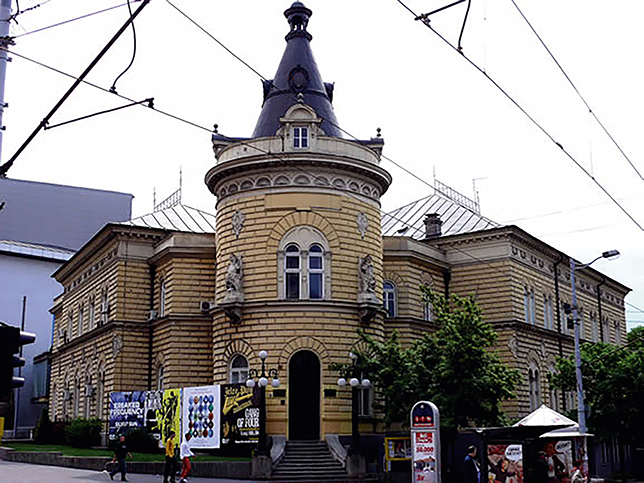
During this period, students in Yugoslavia were engaged with major international issues and thus saw their demonstration as part of a global movement. In solidarity with student protests in other countries, students in Belgrade, and later in Sarajevo, organized sit-ins to protest “the genocide by American imperialists” in Vietnam.Footnote 3 The demonstrations in Belgrade escalated when the police violently stormed the University of Belgrade Faculty of Philosophy building, where students and professors were barricaded. Following the intense week of protests, on June 9, 1968, President Tito announced in a televised address that the students were right in demanding a more equitable society and that he would agree to the students’ demands. Although Tito never followed through on his promise, as an act of compromise, the League of Communists of Yugoslavia gifted the students a building in the center of Belgrade – a student-managed safe space where they could freely express their views and creativity. This was the birth of the iconic Student Cultural Center (Studentski kulturni centar, henceforth SKC), which officially opened on April 4, 1971, to coincide with the celebration of Students’ Day in Belgrade (Figure 7.1).Footnote 4
The Student Cultural Center in Belgrade (SKC Archive).
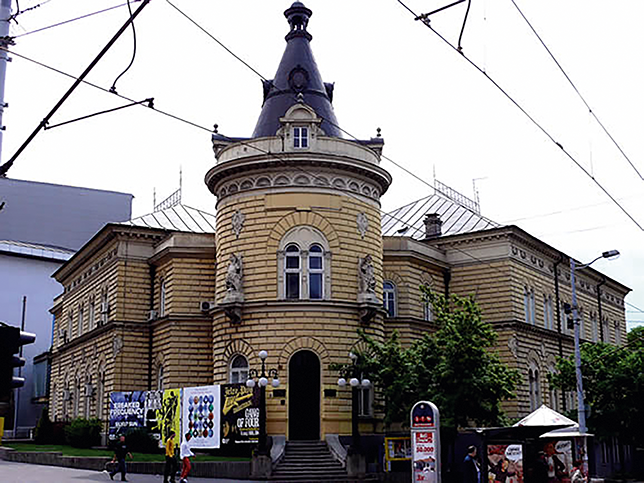
Figure 7.1 Long description
It is a brick building in a mixed architectural style. It was initially constructed as an Officer’s Club in the late nineteenth century in 1895, designed to resemble a medieval castle, incorporating elements of Romanticism with a corner tower and martial symbols on the façade. Located in the center of Belgrade, this building stands in sharp contrast with the brutalist and socialist modernism styles prevalent in the surrounding buildings.
Envisioned as the first multipurpose space for students to explore their artistic vision in all spheres, the center featured a movie theater and concert halls, smaller concert stages, a dance hall, art galleries, libraries and reading rooms, a club restaurant, and a summer garden. The scope of innovation and the originality of artistic activity surpassed anyone’s imagination. The center became a hotspot for the avant-garde scene not only in Belgrade but for all of Yugoslavia, and a magnet for international collaborations through groundbreaking event programming. It gave rise to the New Art Practice, a term coined by art critic Ješa Denegri,Footnote 5 referring to the work produced by the generation of Yugoslav artists coming of age in the 1960s and 1970s, who were practicing their art in student cultural centers and other alternative spaces.Footnote 6 Other significant centers were the University of Zagreb Student Center, founded in 1957, and the Student Cultural Center in Ljubljana, Slovenia [Društvo Študentski kulturni center, ŠKUC], founded in 1972.
The first fifteen years of operation of the SKC represent the center’s “Golden Era.” With events and exhibitions showcasing the newest trends – from conceptualism, performance art, happenings, minimalism, and Fluxus to the emergence of new wave [novi talas] in Yugoslav popular music – a wide range of activity blossomed at the SKC. Musicologist Ivana Miladinović Prica notes that the SKC represented an integral part of the cultural legacy of socialism.Footnote 7 The first currents of New Art Practice emerged in SKC’s visual arts programs and events with pioneering work by the emerging “Belgrade Six” art students at the Faculty of Fine Arts in Belgrade: Marina Abramović (b. 1946), Slobodan Era Milivojević (1944–2021), Neša Paripović (b. 1942), Zoran Popović (b. 1944), Raša Todosijević (1945–2024), and Gergelj Gera Urkom (b. 1940).
By the late 1970s, experimental and alternative programming expanded to the music division at the hands of the rebellious young composers from the conservative Music Academy in Belgrade (now renamed the Faculty of Music): the Opus 4 collective comprising Milimir Drašković (1952–2014), Miodrag Lazarov Pashu (1949–2025), Miroslav Savić (b. 1954), and Vladimir Tošić (b. 1949) and Ansambl za drugu novu muziku [Ensemble for Different New Music], cofounded by Miloš Raičković (b. 1956), and including some of the earliest and most daring performers of avant-garde music, such as pianist Nada Kolundžija (b. 1952). Opus 4 and Ensemble for Different New Music (henceforth ADNM), together with the music editorial board of the SKC, with Miroslav Savić at the helm, helped shape a new avant-garde music trajectory in Yugoslavia, initiated unprecedented international collaborations with experimental music festivals, and, as Miladinović Prica notes, played an essential role in forming SKC’s overall avant-garde artistic profile for more than a decade.Footnote 8
Art critic and scholar Jelena Vesić argues that while Yugoslavia in the 1970s was characterized by processes that aimed to liberate society, New Art practices that evolved in the context of new liberal institutions such as the SKC were influenced by Western, neo-Marxist, post-1968 criticism.Footnote 9 This chapter examines the experimental artistic activity at the Student Cultural Center in Belgrade during its “Golden Era” of the 1970s and 1980s, the unique sociocultural events that led to the formation of such an incredibly significant, innovative, and influential avant-garde scene in Yugoslavia, and its impact on the European art scene on both sides of the Iron Curtain.
The Golden Era of the Student Cultural Center
The Student Cultural Center in Belgrade made enormous strides in all realms of artistic expression during its Golden Era – in fine arts, photography, conceptual art, performance art, theater, film, and music – and played a crucial role in developing the country’s experimental art scene. In the first years of its operation, the SKC Art Gallery had greater international visibility than the Center’s other scenes. The trailblazers in the art scene, the “Belgrade Six,” were already internationally recognized figures. Their encounters and collaborations abroad with the leading artists in new practices, including conceptual art, performance art, happenings, and Fluxus, enabled them to bring the newest trends to Yugoslavia and attract notable critics and artists from Western Europe and the US.
As Amy Bryzgel aptly notes, Fluxus, founded in the 1960s by George Maciunas (1931–1978), was a “significant point of contact between East and West” as it brought together a community of artists dedicated to experimental art and synthesis of different media, including visual arts, music, poetry, and design.Footnote 10 These artists emphasized the artistic process over the finished product of an art piece.Footnote 11 The first international exhibition of conceptual art in Yugoslavia took place in Zagreb on April 23, 1971, at the entrance hallway of a residential building, a “haustor.” The exhibition, titled “At the Moment,” was organized by Braco (b. 1948) and Nena (b. 1950) Dimitrijević, following their travels across Europe where they met conceptual artists. The process of organizing “At the Moment” involved sending letters of invitation to the participants and then exhibiting those responses. The participants were artists from Europe and the US,Footnote 12 as well as Yugoslav artists including Bosnian conceptual artist Braco Dimitrijević, Croatian cinematographer and photographer Goran Trbuljak (b. 1948), a Slovenian OHO Group, and Group KôD from Novi Sad – the first artistic collective in Serbia whose activities involved happenings and performances, actions and interventions in public space, concrete poetry, and land art.Footnote 13 Scholar Ivana Bago notes that the fact that the exhibition was organized independently of any institutional affiliation and took place in such an informal space was interpreted by some critics – most notably Denegri – to “embody the subversive noncommercial and anti-institutional character of conceptual art itself.”Footnote 14 The exhibition was restaged (with both Braco and Nena Dimitrijević) five months later at the SKC in Belgrade under the title, “In Another Moment” [U drugom trenutku], where Catherine Millet also gave a lecture on conceptual art.Footnote 15
The first conceptual art event held at the SKC Art Gallery, June 22–30, 1971, barely two months after the opening of the Center, was “Drangularijum” [Trinketarium], attended by 600 spectators.Footnote 16 The event changed the art trajectory in Yugoslavia as it abandoned the traditional conventions of art exhibitions. It featured young artists – students at the Faculty of Fine Arts in Belgrade – who were invited to present to an audience of artists, art critics, and art historians not their artworks but their extra-artistic objects.Footnote 17 The concept of Drangularijum – “a ready-made exhibition” of preexisting objects that were significant to artists’ lives – was by no means new or original, but it was the first such presentation in Belgrade. Critic and curator Bojana Pejić explained the event’s purpose and significance in the exhibition catalog: “Drangularijum does not want to be new and original …. It is an attempt to introduce uneasiness or provocation in the static atmosphere of Belgrade gallery life.”Footnote 18 Marina Abramović further remarked that the exhibit that featured what the critics described as “torn boxes, ladders, and smashed walls” was an allegorical statement, arguing that traditional (i.e., classical) works already had their place – at the museums, where they ought to remain – so that experimental art could be exhibited at the SKC.Footnote 19
Both the “Drangularijum” and “Generation 71” exhibitions (the latter took place on September 10–25, 1971, and featured the Belgrade Six artists and Evgenija Demnievska [b. 1946]) were momentous events that drastically changed people’s attitude toward art in Yugoslavia. This new generation of young artists took a large step into the realm of free expression, emancipated from the prejudices of having to cultivate only one form of artistic expression. They were seeking new “principles of plastic language” in their lives, experiences, and direct understanding of reality.Footnote 20 The SKC annual summary report from 1971 tells a story of the movement’s success: The Art Gallery exhibitions alone drew around 2,500 visitors and were regularly reviewed and discussed on the radio, TV, and in newspapers. The newly formed Filmforum, dedicated to the presentation of “nonconventional” films, became one of the most significant festivals in the country. The following year (1972), the SKC organized 285 events with 609 participants, not counting 7 choral ensembles, 10 orchestras, 18 chamber ensembles, and 16 theater groups, which altogether boasted 81,282 visitors.Footnote 21 The art department of the SKC opened the Small Gallery, which featured works by new artists from around Yugoslavia, and the theater department found its voice with “expanded theater” production of new, daring pieces. The SKC Library continued to acquire notable literature in arts and humanities from abroad and expand its print publications – the divisions published three issues of Filmforum, seven catalogs on art exhibits, and a collection of poems by Dragan Stojanović (b. 1945), in addition to numerous posters, flyers, invitations, and program notes. The student-led SKC was running like a well-oiled machine.
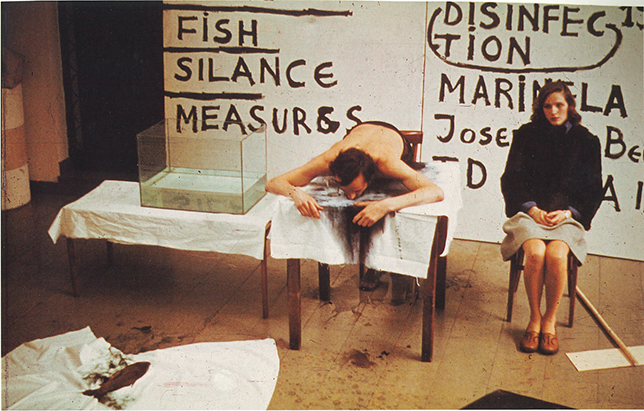
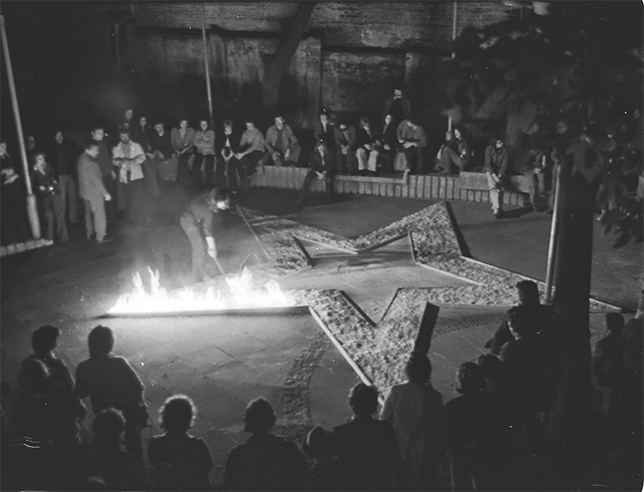
The most significant and successful international event, “Aprilski susreti” – April Encounters: Festival of Expanded Media – was founded on April 4, 1972, (again, to coincide with the Students’ Day celebrations in Belgrade) and conceived as an interdisciplinary artistic program that would transcend the boundaries between art forms. Joseph Beuys, whom Abramović met in Edinburgh, performed at the April Encounters in SKC in 1974, the same year Abramović presented her notorious Rhythm 5 (Figure 7.2).
Activities in the early years of the Student Cultural Center in Belgrade. Photos by Nebojša Čanković.
Raša Todosijević with his partner Marinela Koželj performing Drinking Water – Inversions, Imitations, and Contrasts at the Fourth April Encounters, April 19, 1975. During this thirty-five-minute performance, Todosijević drank twenty-six glasses of water, synchronizing his rhythm of swallowing to the breathing of a fish that he threw on the floor in front of the audience.
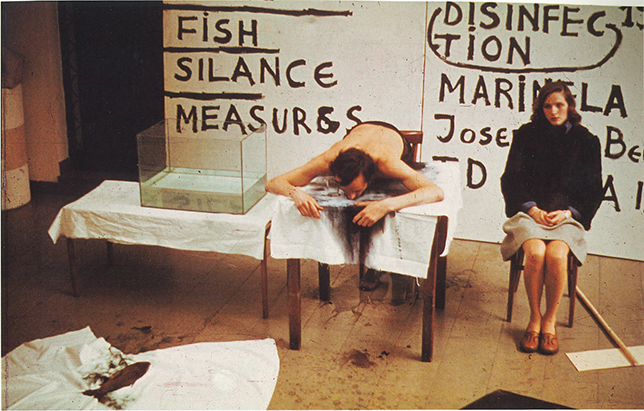
Figure 7.2a Long description
During this 35-minute performance, Todosijević drank twenty-six glasses of water, synchronizing his rhythm of swallowing to the breathing of a fish that he threw on the floor in front of the audience. This disturbing photograph shows a shirtless Todosijević leaning over a small table, almost lying on top of it with his upper torso, his face pressed against the stained white tablecloth, his arms holding on to the top brim of the table. To his right is a larger table, also covered with a white tablecloth, on top of which is an aquarium, filled quarter-way with water. To his right is a woman seated on a chair, with her hands crossed on her lap, staring into a fish, which is in front of them, on a white cloth stained with blood. The floor is stained with water and blood. Behind them is a white wall panel with words in large letters written on it. On the left, three words separated by lines are featured: fish, silence, measures.
Marina Abramović performs Rhythm 5 in 1974. Abramović provides the following instructions for the performance of this work: “I construct a five-pointed star (the construction is made in wood shavings soaked in 100 liters of petrol). I light the star. I walk around the star. I cut my hair and throw it into each point of the star. I pare my fingernails and throw them into each point of the star. I cut my toenails and throw them into each point of the star. I enter the empty space in the star and lie down. Duration: 1 ½ hours.” During this performance, Abramović passed out due to the lack of oxygen and had to be rescued by onlookers.
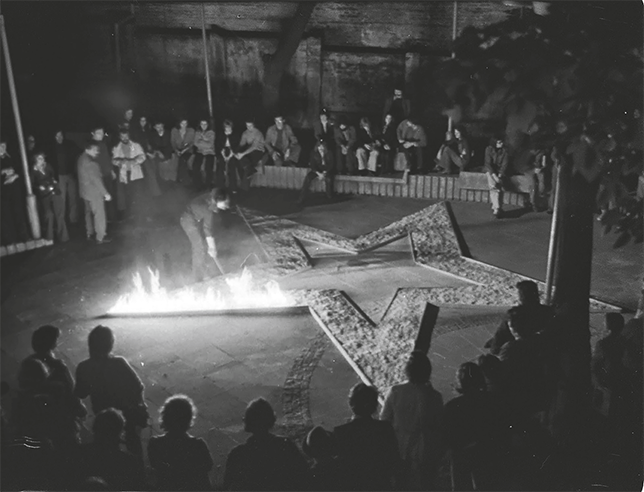
Figure 7.2b Long description
On the sidewalk, in front of the Student Cultural Center, at nighttime, is the outline of a large star, made out of wood. Marina Abramović is holding a stick, lighting the wood outlining the star. One side of the star is already lit in flames. A large group of onlookers is standing around it, some seated on the low wall.
The SKC received some early criticism in the press. Only a month after its opening, an article in Večernje Novosti [Evening News] featured a piece titled, “A Library with No Books,” noting how in a rush to open its doors on the Students’ Day, many attributes of the Center were incomplete, due to the lack of government funding.Footnote 22 The library had no books, reading rooms, or desks, and the movie theater had no movie screen or projector installed (making the Filmforum’s enormous success only more remarkable). But by September 1971, major newspapers were starting to recognize the important role the SKC played – both as an institution that highlighted the most talented Yugoslav artistic, intellectual, and creative student life, and as a model of how Yugoslavia should be perceived internationally.
However, this attraction toward the SKC within Belgrade’s elite and intellectuals prompted critics to question the purpose of the Center and whom it was serving. A newspaper article from May 26, 1971 (Večernje Novosti) pointed out that SKC was skewing away from its initial purpose, which was to serve the student body, and was no longer a “club for students” but a “club for snobs.” Magazine Duga similarly criticized the Center and its biggest event – April Encounters – referring to the SKC in its heading as the “Student Aristocratic Center,” insinuating that students constituted barely any of the participants, or even observers, in an event whose sole purpose was to showcase artworks created by students. Critic M. Gorda singled out Gina Pane’s “art,” which featured the artist kneeling on the floor and vomiting, Todosijević’s exhibition of two chairs over which the words “or” [ili] and “but” [ali] were inscribed, and Milivojević’s performance, in which the author, dressed in a carboard carton, trimmed his mustache.Footnote 23 However, Gorda clarified that it was not the rationale for this type of art or exhibit that was being questioned, but the generational divide, which points to the fact that the SKC no longer seemed to provide space for students. Critic Dušan Sabo raised the same questions in his review, titled “Elitism of the young” (“Mladih elitizam ili aprildžije”) in Indeks.Footnote 24 Despite criticism by those who did not understand the purpose of forming national and international connections and the significance of presenting the newest avant-garde trends on their home turf, the SKC had by 1974 become not only an artistic scene for students but a cultural phenomenon.Footnote 25
Music at the Student Cultural Center
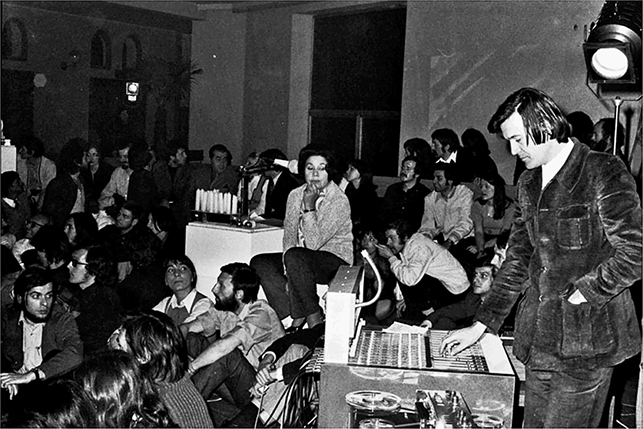
Unlike the New Art movement, musical activities at the SKC did not find a footing in the avant-garde scene during its initial year. The first music concert at the Center was held on May 20, 1971. As described in press clippings, it was an intimate concert of Baroque chamber music without much, if any, advertisement and publicity, featuring the most celebrated Yugoslav flutist at the time, Miodrag Azanjac. Already by the following year, music concerts produced at the SKC were moving toward experimentalism, and numerous notable music ensembles, competitions, festivals, and concert series were formed soon after. On April 6, 1972, at the First April Encounters, SKC programmed its first experimental music concert, featuring a highly acclaimed Acezantez, a Croatian avant-garde chamber group founded by Dubravko Detoni.Footnote 26 The four performers (piano, organ, drums, and clarinet) played to an audience of 250 guests, filling the SKC’s Grand Hall to capacity (Figure 7.3). The concert, which kept the audience captivated past midnight, received mixed reviews in the papers. One critic noted that the ensemble performed several “compositions” that completely broke away from all tradition, which even the most “extreme” student would have perceived as an absolute extravagance that left no room for establishing any kind of dialogue.Footnote 27 Another critic described the music as “moaning,”Footnote 28 and other headings bore titles of “tired” and “lonely” avant-garde.Footnote 29
Acezantez performs at the April Encounters at the Student Cultural Center in Belgrade, April 6, 1972.
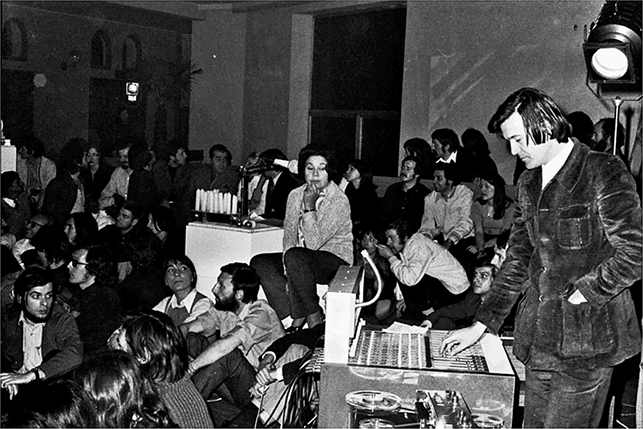
Figure 7.3 Long description
Dubravko Detoni is standing on the right side of the photograph, wearing a plush jacket and jeans. His left hand is in his jacket pocket, while he is operating the electronics panel with his right hand. The audience in a packed hall is young people, some seated on chairs, some on tables, looking either in front of them or turning to the side to watch Detoni.
The music division at the SKC quickly caught up with other departments of the Center and started modernizing its programming. The Center produced many concerts in collaboration with other recently established institutions and festivals, such as the Belgrade International Theater Festival, founded in 1967, and the Belgrade Music Festival, founded in 1969. Perhaps, the most significant was the “Muzička moderna” [Musical Modernism] concert series produced in collaboration with the Third Program of Radio Belgrade – a program dedicated to the presentation and promotion of avant-garde and experimental music. These concerts, which were also broadcast on the Third Program radio, featured Yugoslav composers programmed alongside European and American avant-gardists, such as Luigi Dallapiccola and Krzysztof Penderecki. Some concerts aimed to highlight music by Yugoslav composers from a particular region, for instance, the “An Evening of Croatian Music” series, highlighting the works of individual composers, such as Kelemen or Detoni, who were regularly featured at the Music Biennale Zagreb. The concert series also allowed notable national and international ensembles and soloists, such as the Zagreb String Quartet, pianist Fred Došek (1925–2008), and experimental ensemble Saeta and the Percussion Studio from Ljubljana, to participate. As such, Muzička moderna played a crucial role in the modernization and proliferation of Yugoslav art music.
In the 1970s, especially the first part of the decade, the young generation of Yugoslav composers was still catching up to Western modernist trends and fighting the traditionalists who controlled institutions of higher education. By necessity, the SKC became a crucial space for progressive artists to familiarize themselves with Western avant-garde compositional techniques and practices. They effectively promoted their own works and music across Yugoslavia. Likewise, they introduced Yugoslav audiences to trends from abroad by holding listening sessions for newly acquired albums (such as music by John Cage, Philip Glass, and Steve Reich), organizing guest lectures (notably, Mauricio Kagel led a workshop on May 31, 1974), and programming music by composers from abroad. Furthermore, the composers of the SKC Music Division created opportunities for students from music academies in Zagreb, Ljubljana, Skopje, and Belgrade to meet, collaborate, and engage with like-minded artists from around the country.
By 1974, concerts featuring music by Cage, Mauricio Kagel, Goffredo Petrassi, Włodzimierz Kotoński, Charlemagne Palestine, and Karlheinz Stockhausen were becoming common, and Yugoslav musicians were performing and recording contemporary music repertoire.Footnote 30 Among them, performances by Nada Kolundžija, one of the foremost pianists in Yugoslavia to specialize in contemporary music by Yugoslav and foreign composers, are significant. In the words of a notable Yugoslav scholar of aesthetics, Miško Šuvaković, “Kolundžija is a pianist of new music – or, to be precise, a performer of the truly contemporaneous piano music as a contemporary art,” who chose to be “an accomplice of the contemporaneity,” which Šuvaković concludes was “firstly a choice and, then, a practice.”Footnote 31 Kolundžija’s 1979 concerts of the entire opus of Arnold Schoenberg’s piano works and her 1980 performances of Cage’s Sonatas and Interludes for prepared piano stand out as the first performances of these works in the country.Footnote 32
One of the principal objectives of the SKC, in addition to the promotion of new music and national and international collaborations, was to establish the Center as a genuine space for students since the rigidly conservative curriculum at the Faculty of Music in Belgrade (FMU) was not supportive of modern and experimental music. Young composers at FMU who were implementing newer musical trends like minimalism and experimentalism were barred from passing their final exams. Despite minimal support from their professors (notably, Vasilije Mokranjac [1923–1984]), who were sympathetic to their young students’ curiosity, the staunch gatekeepers of traditionalism, namely, Stanojlo Rajičić, Aleksandar Obradović, Rajko Maksimović, and Petar Ozgijan, flunked any student attempting to write music in avant-garde styles, especially minimalism. As a consequence, several students were expelled from the institution, while others defected from the composition program or FMU on their own. (As discussed in the previous chapters, many of these students went on to study with Vladan Radovanović at the Electronic Studio of Radio Belgrade.) For these students, the SKC (located conveniently adjacent to the Faculty of Music) was the primary venue to explore and develop their artistic needs. Thus, the conservative Faculty of Music unintentionally played a crucial role in establishing the SKC as a center of experimental music in Yugoslavia. The most rebellious composers of this generation were Milimir Drašković, Miodrag Lazarov Pashu, Miroslav Savić, Vladimir Tošić, and Miloš Raičković [Milos Raickovich], who were students of composition at the FMU between 1972 and 1981. The first four formed an influential composers’ group, Opus 4, and the latter initiated the formation of the Ensemble for Different New Music. Together, these young composers, and especially the Opus 4 collective, reshaped the music programming at the SKC, published books, articles, and records of new music, founded festivals of new music that made the Center a magnet for experimental music across both Blocs, and changed the trajectory of Yugoslav music.
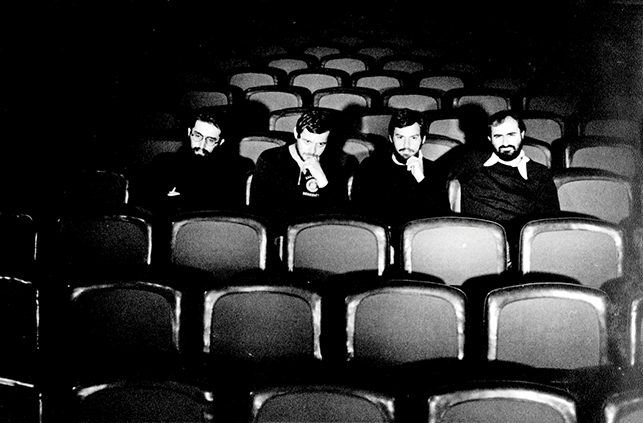
Members of Opus 4 (Figure 7.4), each with a distinct voice but united in their exploration of new approaches to music, were primarily composers but also performance and multimedia artists who deployed texts, film, photography, video, and other media during their concerts. The collective was a unique phenomenon in the music life of Yugoslavia at that time. Tošić suggests that the formation of such a composers’ collective was an avant-garde act in itself. He further elaborates that, from today’s perspective, it is difficult to speculate what exactly led to the formation of the collective, whose mission, concept, and purpose – both for the composers and their art – the society did not understand at the time.Footnote 33 Tošić specifies four principal needs that contributed to the formation of Opus 4: (1) to explore without restriction each member’s individual artistic concerns; (2) to learn about contemporary music and techniques; (3) to change the attitudes of traditional thinking about music in the country; and (4) to present their art to the public.Footnote 34 In other words, the young composers took it upon themselves to learn about contemporary music, to create, experiment, and promote their musical innovations, which they could not achieve at their academic institution, and to change the mindset of the audience.
Opus 4: (from left to right) Miroslav Savić, Milimir Drašković, Vladimir Tošić, Miodrag Lazarov Pashu. The Student Cultural Center, Belgrade, ca. 1980.
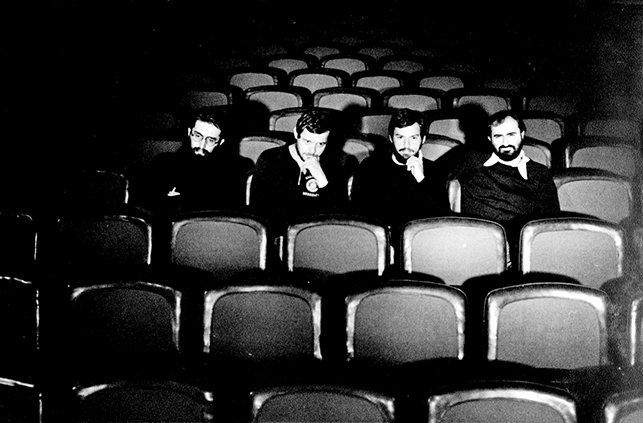
Figure 7.4 Long description
From left to right are Miroslav Savić, Milimir Drašković, Vladimir Tošić, and Miodrag Lazarov Pashu. They are seated in the middle row of an empty hall at the Student Cultural Center in Belgrade. The spotlight illuminates the four composers in a dim hall and empty seats in front of them and behind them.
The first performance by the members of Opus 4 (although not yet formally operating under that name) took place on May 20, 1976, at the Grand Hall of the SKC. The program featured works by only two composers – several arrangements of 10 by Savić (for solo piano; for piano four hands; and for tam-tam) and Fragments for piano and Mélange for piatto, gong, timpani, and piano by Tošić. Lazarov Pashu’s Dvanaesttonske varijacije [Twelve-tone variations] was not performed due to technical issues. Drašković participated as a conductor and a performer, alongside three other members of Opus 4 and pianists Kolundžija and Ksenija Zečević. The concert was the first official demonstration of collaboration and interaction, both creatively and organizationally, among the four composers.
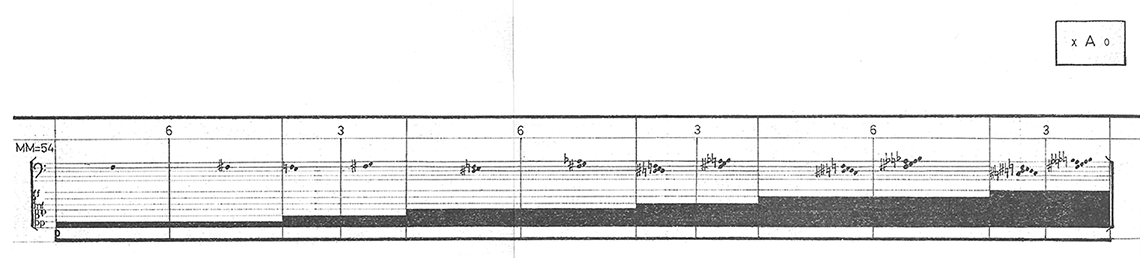
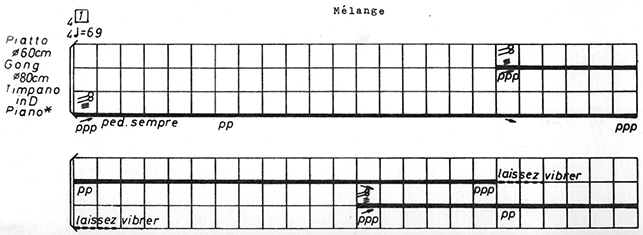
The works performed at this concert were the first presentation of minimalist/reductionist music by Yugoslav composers.Footnote 35 Savić’s 10 – a reference to the binary numbers “1” and “0,” which represent sound and silence, respectively – is a student work from 1974 (Example 7.1). It was a significant achievement for the composer, demonstrating a “break from Messiaen” and a “connection to serial and minimalist/reductionist principles.”Footnote 36 In this work, Savić maintains specific relations between pitch, dynamics, and durational series so that a particular element in the pitch series corresponds to a specific element in other series. In that the young composers did not know much about minimalism formally, and were not allowed to pursue it at the FMU, 10 represented Savić’s creative independence, one of the foremost principles of Opus 4. Tošić’s Mélange (1975) is one of the earliest examples of minimalist/reductionist work in Yugoslavia. In addition to the new compositional style, which was hardly known in Yugoslavia at this time, the graphic notation of the score (Example 7.2) was jarringly new for the traditional academic circles in Belgrade.Footnote 37
Miroslav Savić, 10 for piano (1974), page 1 of the score.
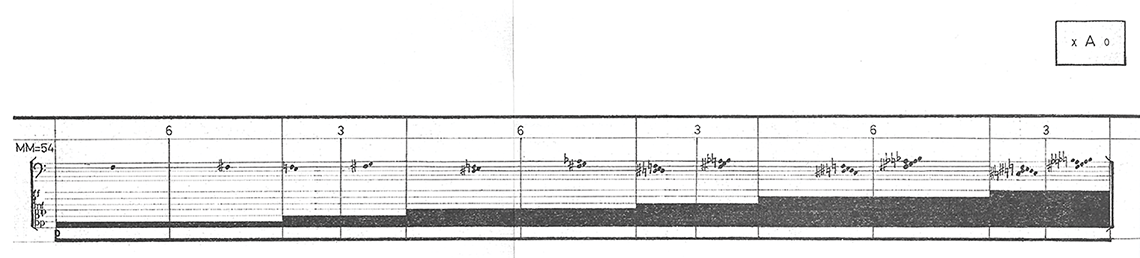
Example 7.1 Long description
Featuring a single grand staff system, the top staff has arhythmic pitches divided into twelve segments. The first filled-in notehead is F, the next one is F sharp, and then from the next segment on, Savić systematically adds a new pitch, creating clusters of two and then up to six notes. The bottom staff has seven lines, and the spaces in between designate dynamics levels, from bottom to top, pianissimo, piano, mezzo piano, mezzo forte, forte, and fortissimo. The first two segments fill the entire space across of the pianissimo dynamics, the next two of the piano, and Savić continues to gradually increase the dynamics levels every other segment. As such, the black colored space across the page is systematically thickening as the piece progresses.
Vladimir Tošić, Mélange (1975) for piatto, gong, timpani, and piano, the first page of the score.
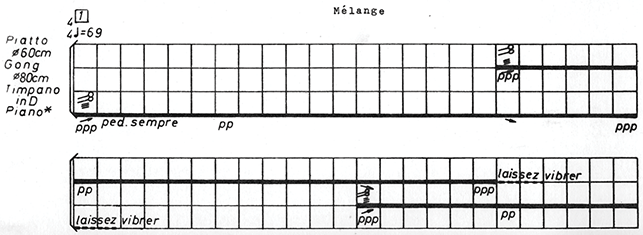
Example 7.2 Long description
Each system contains a grid of three rows of squares. On the left, Tošić indicates that the top line of the grid is for piatto, the one below for gong, the next one for timpani in D, and the bottom line for piano. Above the system, Tošić indicates 4/4 meter and tempo of quarter note = 69. On the bottom, he indicates the dynamics level, starting with triple piano and pedal sempre. Rather than using music notation, the score features pictures of timpani sticks, dynamics markings, and text, such as, laissez vibrer in French.
A review of the concert, published in the magazine Student, effectively captures the energy and excitement of the performance, which was conceptually choreographed in detail:
The audience is seated
The lights are turned off except for one beam dimly reflecting the piano on the stage
A young woman [Kolundžija] appears on the stage, wearing a colorful tunic and jeans, and sits at the piano; the concert officially begins
Unusual music is heard [10 for piano], which sounds very suggestive, owing to the performer’s concentration
After her performance, another young woman [Zečević] appears on the stage and, with an exaggerated expressivity, plays Vladimir Tošić’s Fragments for piano
As the concert continues, young men, clad in jeans, enter and exit the stage, and, in all seriousness, perform their colleagues’ works.Footnote 38
Already with their first public performance, the young composers made quite an impression and a statement. Just as Marina Abramović and the Belgrade Six had destroyed the perception of what an art exhibit ought to be with Drangularijum five years earlier, the composers, too, by their manner of personal attire and their musical style, pushed the boundaries of the classical music concert. Tošić confirms, noting that the inaugural performance announced the type of music the group would continue to develop – music based on the principle of reductionism, repetition, and atypical instrumentation.Footnote 39 Concert critic Mirmar agreed:
The pieces performed occupy everyone’s full attention and elicit countless emotions and an unusual thought process: one especially feels the process of time … While by the manner of their dress, the composers and performers appeared somewhat nonchalant, their performance and attitude proved everyone wrong. First of all, they were much more professional than some of their colleagues who, on the stage, during pauses, tell jokes or chew gum. Clearly, they did not want to place an emphasis on themselves, which was most obvious during the performance of Tošić’s Mélange, during which the performers (now dressed in black, so as not to draw any attention to themselves), moved to the darkly lit part of the stage. As intended, the audience’s interest was piqued by music only.Footnote 40
The activity of Opus 4 lasted through 1982, with their last public concert held on June 10, 1982, at the Twelfth International Festival of Experimental Music in Bourges, France. Despite their relatively short existence, Opus 4 had become a phenomenon, as will be discussed in more detail in the following chapter. Influenced by American minimalism and Cage-style experimentalism, the works of Opus 4 merged music with performance, Fluxus, and audiovisual media. Opus 4, together with the Ensemble for Different New Music, which was working under the auspices of the music editorial board of the SKC and continued to perform their music and those of other minimalists, not only shaped the music program at the SKC but entirely reshaped new art in 1970s Yugoslavia. Miladinović Prica views the groups’ practice as an “authentic local practice that pursues radical modernism”; that is, while the composers of Opus 4 worked on the “European cultural periphery,” away from any leading European cultural centers, “[they] received stimuli from various sources, which they processed and developed into independent, autochthonous, and experimental artistic practice.”Footnote 41 Opus 4 became synonymous with the concept of the neo-avant-garde in the late 1970s and early 1980s in Belgrade, Serbia, and Yugoslavia.
International Collaborations at the Student Cultural Center
A student-run music editorial board was initiated at the SKC in 1978 by Opus 4, Raičković, and Miloš Petrović, with Savić appointed as editor-in-chief. During his tenure, the music division of the SKC founded the festival Druga nova muzika [Different New Music], which ran annually from 1984 through 1986. These festivals were the culmination of music experimentation in Serbia (and Yugoslavia), cultural exchange between both Blocs during the Cold War, and international visibility for Yugoslav composers and ensembles. As Miladinović Prica argues, “[they] put Belgrade onto the map of the artistic network, becoming a European center for minimalist and experimental music.”Footnote 42 But perhaps even more importantly, the festivals put a spotlight on musical minimalism – a style that was little understood or valued at the time in Yugoslavia.
The 1984 Festival was organized by Savić and Drašković in collaboration with Michael Fahres (b. 1951), a German-born composer based in Utrecht.Footnote 43 It was also supported by Radio Television Belgrade, the German Cultural Center in Belgrade, the French Cultural Center in Belgrade, and the Gaudeamus Foundation in Amsterdam. The five-day inaugural event (May 16–20) was the young composers’ largest undertaking, with the primary aim to “reaffirm the work of composers and also ensembles specializing in the performance of ‘different new music.’”Footnote 44 By “different new music,” they meant any style of music that stood in opposition to conventions and explored innovative techniques, such as reduction, repetitiveness, and process. They also used new forms of realization, like media expansion, ambience, and time-space limitation, and created novel experiences, such as conceptualism and meta-approach.Footnote 45
The festival organizers programmed the works by leading experimental and minimalist composers, juxtaposing artists from the US (Reich, Robert Moran, and Frank Zappa) with others from across both European Blocs and Yugoslavia (Savić, Drašković, Tošić, Aleš Gasparič, Milan Graovac, Boštjan Perovšek, and Miloš Petrović).Footnote 46 Luc Ferrari and Hans Otte, among others, were in attendance. The Hungarian experimental group 180-as Csoport, the Slovenian ensemble Saeta, and Ensemble for Different New Music were the featured performers.Footnote 47 In their annual SKC activity report, Savić and Drašković wrote that the festival not only gathered a representative group of European minimalist composers but that, for the first time in Yugoslavia, it also presented a comprehensive picture (in terms of the variety of styles and different generations) of minimalist music.Footnote 48 Lazarov Pashu’s essay on the festival notes that the event “radically expanded the canon of contemporary music in Yugoslavia”Footnote 49 but that, unlike their counterparts from abroad, Yugoslav composers were not “constrained” within the “single medium” of minimalism but operated within a wider range of expanded media by including music, video, and performance art in their works.Footnote 50
The festival also screened a forty-minute experimental film, Prašina u Beogradu [Dust in Belgrade], directed by Zoran Solomun.Footnote 51 The film, produced by SKC Filmforum, was recorded during Fahres’s artistic residency in Belgrade. Set to the music of Arvo Pärt, Karel Goeyvaerts, Fahres, Louis Andriessen, and Carlos Santos, it shows Fahres walking and driving around Belgrade on a gloomy, rainy day. The stream of music is interrupted as Fahres narrates his thoughts on minimalism. One segment of the film takes place inside the SKC – in Fahres’s words, the center of minimalism in Yugoslavia – and features experimental videos of “three of the most active minimalist composers” in the country: Savić, Lazarov Pashu, and Drašković. The videos effectively capture each composer’s personality and individuality, but also the level of their artistry and daring innovation. Savić’s video, M for piano, features the composer appearing and disappearing from view by ducking behind the piano and outlining the shape of the letter M with his motion, while a hamster is moving around atop the lid of the piano, eating pellets. In Lazarov Pashu’s Istorija funkcionalne tonalnosti [The history of functional tonality], the composer is seated on a chair inside a phone booth, singing various do-mi-sol patterns in major and minor keys. Drummer Borivoje Pavićević, with a cigarette in his mouth, is performing Drašković’s Drummer /s/ for the drum set.
The SKC Filmforum captured the first two festivals on film,Footnote 52 which, in addition to providing a historical record of the event, also featured interviews with composers and performers around the city – in an abandoned building, in a busy underground passageway, on the street, at a park, on a boat. The performances inside the SKC Grand Hall drew a packed audience, clad in comfortable clothing, just like the performers and composers. They grooved to the music, immersing themselves in the new sound experience, some with their eyes closed, others chatting and laughing, and a few smoking cigarettes. The films truly encapsulate the zeitgeist of the SKC and Belgrade of the 1980s and demonstrate why SKC and Belgrade became a magnet for experimental artists from both Blocs. Belgrade, the capital of a liberal communist Yugoslavia, with the support of the Communist Party, allowed (and funded) students and artists free rein to experiment in all modes of creative expression.
Even though the second festival, held on May 10–12, 1985, was smaller in terms of participants and performances, it demonstrated an even greater authenticity and creative freedom for Yugoslav composers.Footnote 53 The Ensemble for Different New Music performed minimalist works by five Yugoslav composers commissioned for the event: Savić (ABC Bossa Nova), Lazarov Pashu (Time 3), Ognjen Bogdanović (Fade), Marjan Šijanec (The Shedding of Leaves Makes the Trees Invisible), and Veljko Nikolić (Tlan [Soil]). The opening piece of the festival (and the 1985 film) was Savić’s ABC Bossa Nova. It was conducted by Šijanec and featured the Music School “Vučković” Girls Choir singing solfege syllables in a layered, repetitive manner. Members of the ADNM played bossa nova rhythmic patterns on a wide range of percussive instruments (including the conga, bongos, whistles, maracas, and different drums and tubes). This performance was nothing short of spectacular. It encapsulated the organizers’ vision of presenting “different” music, not only highlighting the stark contrast with the traditional mode of expression at the Faculty of Music (and generally, everywhere outside the SKC) but also presenting a different type of minimalist music – minimalism with a greater variety of style and individuality, as Savić stated in his closing remarks. Victor Ekimovsky, one of the featured composers at the festival, summarizes the daring creativity he saw at the SKC quite effectively when recollecting his experience: “At that time in Yugoslavia, a group of interesting young composers were active; their experiments were performed in genres that seemed to us strange as hell: happenings, actions, performance art, texts, graphics, silent music, and even dispensing with generic labels altogether.”Footnote 54
Due to insufficient funding,Footnote 55 the third (and last) rendition of the festival, held May 18–22, 1986, featured only Yugoslav composers. Among the returnees were Drašković, Lazarov Pashu, Savić, Tošić, Raičković, and Šijanec. Works by Dušan Bogdanović, Nataša Bogojević, Brina Jež, Boris Kovač, Stevan Kovač Tikmajer, and Vlastimir Trajković were also programmed. Unlike the previous two editions of the festival, which only presented the newest works by all participants, the 1986 festival was envisioned as a “retrospective” of Yugoslav minimalist music.Footnote 56 The festival included some of the earliest Yugoslav minimalist pieces (such as Raičković’s Permutations [1976–1978] and Flying Trio [1979]), alongside those composed in the 1980s and commissioned by and premiered at the festival. The festival illustrated the Yugoslav composers’ relentless quest for new heights of expression and experimentation, using a wide range of media. For instance, Tošić’s Four In/Dependent Events is written for four different ensembles – string quartet; wind quintet; piano and electric piano; and vibraphone and marimbaphone – and the four groups can simultaneously perform in different spaces or even different cities. In the first part of its premiere performance at the University Student Center in Zagreb in 1985, all four groups performed in separate halls without listening to one another while the synthesis of their performance was transmitted over the radio in real time. In the second half of the concert, all four groups played in the same hall, while the radio broadcast the performance by only one ensemble (i.e., one “in/dependent event”).Footnote 57 Dušan Bogdanović and Raša Todosijević had their sound and multimedia installations displayed at the SKC Art Gallery, while Milimir Drašković presented his films Opera and Orgelwerke.
Unlike any other music festivals in Serbia (and hardly anywhere in Yugoslavia), these were envisioned fully as festivals of experimental and minimalist music – “minimalist” as understood, adapted, and practiced by Yugoslav self-taught, curious, and authentic composers. Renditions of the Different New Music events fully displayed the various “cultural impulses” that were unfolding in Yugoslavia at the time. As Miladinović Prica concludes, “[the festival] attested to the existence of parallel systems of culture in Yugoslavia, the neo-avant-garde that operated outside the boundaries of its dominant (mainstream) culture.”Footnote 58 Just like Abramović and the Belgrade Six, who profoundly changed the direction of new art in the early 1970s, the minimalist composers’ achievements served as a prime example of the newest avant-garde tendencies in the country, unapologetically resisting and dissenting against “the establishment.”
The Student Cultural Center: A Cultural Phenomenon
It is astonishing that Belgrade’s Student Cultural Center – a student-run institution with insufficient government funding – became such a cultural phenomenon in an incredibly short period. Only two months after its opening, Abramović and the Belgrade Six shocked the audiences and set the stage for what was to come. The impact was immediate. It attested to the nation’s hunger for change – for freedom of expression – following the country’s postwar adoption of socialist realism and the ensuing cultural isolation within a communist ideology. It was also a testament to the young students’ unparalleled self-governance, resourcefulness, talent for organization, and collaborative spirit. Above all, the new generation craved exploration and experimentation.
The first ten years of activity and progress at the SKC were spectacular. It would be hard to imagine that the Center could get any bigger, yet it did, spurred on by two notable developments: first, the death of President Tito in 1980, and second, the country’s subsequent interest and immersion in Western culture that led to the birth of Yugoslavia’s distinct and world-renowned new wave and punk music scene. With the music division’s expansion to produce alternative concerts of some of the most popular national and international bands, Belgrade and the SKC reached epic popularity, becoming the epicenter of all modes of alternative music and experimentation.
The SKC became the central gathering place for Belgrade’s youth in the 1980s, representing the apex of cultural “cool”; everyone wanted to be a “SKC kid.” Inside the Center, students attended concerts (pop, rock, new wave, punk, jazz, and experimental art music), caught free showings of cult-classic movies, viewed exhibitions in one of its five galleries,Footnote 59 and saw cutting-edge theater productions. The SKC’s courtyard café and the indoor SKC Club were the most popular meeting places for students. The curbside outside the SKC was known as a makeshift and unregulated flea market for comic books and the largest collection of albums in Belgrade, especially bootleg and pirated LPs.
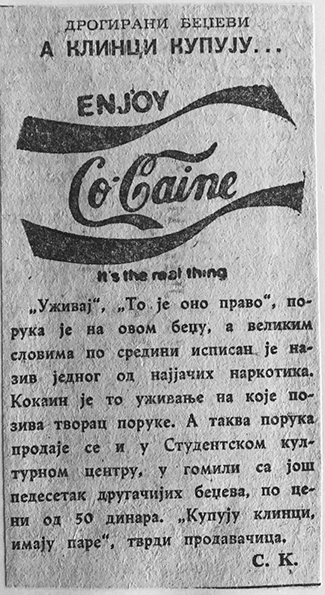
The SKC reflected the youth-cultural absorption of all modes of cultural trends from the West and indulged in all types of decadence. One concerned citizen shared their disbelief at learning that one could buy a pin button that featured a logo of Coca-Cola with altered spelling alluding to a popular narcotic drug – “Co-Caine” (Figure 7.5). “Kids are buying pin buttons with a message that says, ‘Enjoy,’ ‘It’s the real thing,’” the author writes, “while in big letters across the button is inscribed the name of one of the most potent narcotics.” To clarify the obvious, the author elucidates, “Cocaine is the enjoyment that they are referring to. This message is being sold at the SKC.”
“Дрогирани беџеви, а клинци купују …” [Drug buttons, yet kids are buying them …], Politika, February 2, 1982 (SKC Archive).
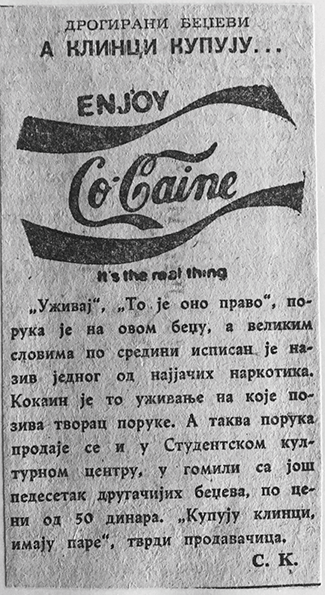
Figure 7.5 Long description
It shows the design of the pin button being sold at the Student Cultural Center, with a letter by a concerned citizen printed below it. The design of the button copies the Coca-Cola logo, but with the words, Enjoy Cocaine, It’s the real thing.
In another article glamorizing indulgence and decadence, a celebrated Yugoslav artist, Milovan “DeStil” Marković, pens a piece titled “Water sex u SKC-u” [Water sex at SKC], in which he not only offers an illustrative portrait of Belgrade’s night culture but accurately captures the spirit of the 1980s Belgrade youth, and SKC as its epitome. In the subheading he writes, “All you need to do is stop and watch, and you can see everything; you can talk to anyone interesting because everyone seems communicative, harmless, and always ready for some action. The SKC goers are the bearers of Belgrade’s new night culture.” The article opens with a narration of Marković’s telephone conversation with a friend earlier that day, using the Belgrade slang du jour in the manner of stream-of-consciousness, that vividly sets the stage for a description of a wild, yet very typical night out at the SKC:
Hey, where are we going tonight? Seriously – we’re going to the SKC, it’s such a cool vibe. Everyone will be there, all late-night owls go there. Wear the outfit you bought in Rome, it will be chic, and don’t forget your Walkman – it’s a trip to listen to it in a crowd of crazy people …. It will be insane, the whole town will be there, all jet-setters and new-wavers … It will be amazing. I love chaos, crowds, colors, madness. I love to hang out at SKC, we always have a crazy good time, such a cool crowd. ‘SKC I love you too much …’.”Footnote 60
Perhaps it came as no surprise when the SKC Grand Hall caught on fire (spreading to the attic, roof, and balcony) around midnight on December 28, 1983, following a concert by a rock/new-wave band from Belgrade, U Škripcu. The investigation was never completed, and what caused the fire was never revealed, although one report speculated that it was caused by cigarettes. This was the third fire at the SKC in two weeks – the first two were caught in time and extinguished immediately; the third caused significant damage to the building.
No one could have envisioned the meteoric rise of the SKC and the scope of its wide international appeal and reach. Certainly not the Communist Party of Yugoslavia, which had gifted the building as a “playground” for students but fully enjoyed its spectacular success – the Center aligned with the Party’s message of self-managed socialism. That is, as Nemanja Sovtić discerns, instead of imposing on society an abstract subject of the working class, the political system of self-management socialism spurred the emergence of a concrete structure of interests arising from social life.Footnote 61 Hence, progress in Yugoslavia’s cultural sphere reflected the progress of the country’s political system.
The SKC phenomenon was the result of a perfect storm – a combination of political and sociocultural events in Cold War Yugoslavia. Weary of the status quo and economic reforms but energized by waves of progress and change, the students in Belgrade demanded to be heard. Seeking to break away from the bonds of repression, control, and conservatism, they dismantled traditional cultural institutions and expanded the limits of innovation, technology, and artistic expression. The young experimentalists, including Marina Abramović, the Belgrade Six, Opus 4, and the Ensemble for Different New Music, were unstoppable. Yugoslavia’s unique cultural and geopolitical positioning as a socialist and nonaligned state in a world divided by different political ideologies worked to the artists’ advantage. Their “playground” was accessible to all like-minded artists from both sides of the Iron Curtain. They managed to transform the Student Cultural Center, and in turn Belgrade, into a magnet for experimental artists from both Blocs, an international center for artistic collaboration and cultural exchange, and a national model for the promotion of arts, culture, and freedom of expression in Yugoslavia.

 Open access