




Introduction
The home literacy environment (HLE) has been extensively documented as a critical factor influencing children’s language, literacy, and cognitive development (e.g., Burgess et al., Reference Burgess, Hecht and Lonigan2002; Griffin & Morrison, Reference Griffin and Morrison1997; Hutton et al., Reference Hutton, Dudley, Horowitz-Kraus, DeWitt and Holland2020; Li et al., Reference Li, Zhen, Gunderson and Lin2025c). For families engaging in two or more languages, HLE is as important as it is in monolingual families and, in some respects, even more critical (e.g., Bratlie et al., Reference Bratlie, Grøver, Lekhal, Chen and Rydland2025; O’Brien et al., Reference O’Brien, Arshad and Ng2024; Sun et al., Reference Sun, O’Brien, Arshad and Sun2024). The presence of additional languages further increases its complexity. This distinction has positioned research on HLE in bilingual families as a critical and expanding area of inquiry, offering new insights and critical reflections on the extent to which findings and theories derived primarily from monolingual contexts can be applied to multilingual homes (Hammer et al., Reference Hammer, Miccio and Wagstaff2003; Li et al., Reference Li, Zhen and Gunderson2025a; Peets et al., Reference Peets, Yim and Bialystok2022).
Most studies on bilingual HLE examine associations between HLE and literacy development within each language separately (e.g., L1 HLE predicting L1 literacy and L2 HLE predicting L2 literacy), empirically treating bilingual HLE as two distinct systems of each language. However, for bilingual children, their bilingual development is widely recognized as an integrated process rather than two parallel monolingual processes (Grosjean, Reference Grosjean1989). Some cognitive and metalinguistic skills, which are more language-general, often transfer across languages, whereas language-specific features, such as vocabulary knowledge, might constrain the cross-linguistic transfer and are mediated by orthographic distance between L1 and L2 (Koda, Reference Koda2005). Furthermore, as Gottardo et al. (Reference Gottardo, Chen and Huo2021) argued, the cross-linguistic effects of bilingual development extend far beyond linguistic and cognitive dimensions and are closely related to contextual conditions.
Building on these insights, in this study, we seek to investigate the HLE of bilingual children and map the cross-language relations in the bilingual HLE context. Accordingly, this study examines the HLE of 104 first-grade Chinese-Canadian children in both Chinese and English and examines how their bilingual HLE relates to early English literacy development, including reading comprehension, letter and word recognition, and receptive vocabulary, with particular attention to the extent to which Chinese HLE facilitates or constrains L2 development.
Literature review
HLE for early literacy development
The HLE, as a broad conceptual framework encapsulating a set of literacy-related resources, activities, and interactions at home, has been consistently identified as a critical predictor of early language and literacy development across contexts (Burgess et al., Reference Burgess, Hecht and Lonigan2002; Carroll et al., Reference Carroll, Holliman, Weir and Baroody2019; Georgiou & Zhang, Reference Georgiou and Zhang2024; Griffin & Morrison, Reference Griffin and Morrison1997; Li et al., Reference Li, Zhen, Gunderson and Lin2025c). Research demonstrates that a rich HLE could support children’s vocabulary growth (Li et al., Reference Li, Zhen, Gunderson and Lin2025c; Sénéchal & LeFevre, Reference Sénéchal and LeFevre2014), decoding skills (van Bergen et al., Reference van Bergen, van Zuijen, Bishop and de Jong2017), and emergent literacy (Carroll et al., Reference Carroll, Holliman, Weir and Baroody2019; Hart & Risley, Reference Hart and Risley1995). It can also mediate socioeconomic disparities in literacy development and remediate disadvantage when enriched (Niklas & Schneider, Reference Niklas and Schneider2017; Singh et al., Reference Singh, Yeung, Cheng and Heng2023). Although the constructs of HLE vary across studies, there are some major variables or dimensions repeatedly measured or collected, such as the number of printed materials (e.g., Park, Reference Park2008; van Bergen et al., Reference van Bergen, van Zuijen, Bishop and de Jong2017), parent-child literacy-related interactions (e.g., Burgess et al., Reference Burgess, Hecht and Lonigan2002; Li et al., Reference Li, Zhen and Gunderson2025a), and, now increasingly, digital literacy resources (e.g., Li et al., Reference Li, Zhen and Mei2025b; Yuan et al., Reference Yuan, Kleemans and Segers2024).
In conceptualizing HLE, one of the major frameworks is the Home Literacy Model proposed by Sénéchal and LeFevre (Reference Sénéchal and LeFevre2002, Reference Sénéchal and LeFevre2014), which distinguishes the informal and formal literacy activities in the home. Informal meaning-focused activities, such as shared storybook reading, expose children to rich oral language input and foster vocabulary and comprehension skills. In contrast, formal literacy activities involve explicit teaching of literacy, focusing on alphabetic skills. It directly promotes code-related skills such as phonological awareness and decoding skills. Empirical evidence consistently supports this distinction across diverse linguistic and cultural contexts, highlighting the importance of balanced literacy practices in early childhood (Manolitsis et al., Reference Manolitsis, Georgiou and Parrila2011; Sénéchal & LeFevre, Reference Sénéchal and LeFevre2014).
Although this model remains foundational for contemporary HLE research, emerging research findings have extended this model to include other dimensions in HLE. Georgiou et al. (Reference Georgiou, Inoue and Parrila2021), for example, argue that the home literacy resources should be considered as an independent factor other than formal and informal literacy activities involving parents, as the enriched home literacy resources, such as access to printed materials, could facilitate children’s individual literacy activities. In their longitudinal analysis of 172 Canadian children’s HLE from grades 1 to 3, it was found that access to literacy resources is significantly associated with emergent literacy skills from grade 1 to grade 2. Similarly, in an analysis using a large-scale secondary data involving more than 14,000 first and second grade children in 14 countries from the global south, Zuilkowski et al. (Reference Zuilkowski, McCoy, Jonason and Dowd2019) revealed that literacy materials, including school textbooks, religious books, newspapers, and children’s books at home, had a significant correlation with early reading, highlighting the critical role of home literacy resources in early literacy development.
In addition to traditional print materials such as books and magazines, increasing attention has been directed toward digital devices and online tools as components of the HLE. Although the effectiveness of digital device use remains contested, the rapid expansion of technology has led to an unprecedented increase in the availability of online and virtual literacy resources in the home. As such, digital devices can be viewed as a double-edged sword requiring careful and intentional use (Li et al., Reference Li, Zhen and Mei2025b; McDougall et al., Reference McDougall, Readman and Wilkinson2018). Empirical findings on the role of digital devices in the HLE are mixed. Some studies have reported no significant associations between digital device use and early literacy skills (e.g., Altamura et al., Reference Altamura, Vargas and Salmerón2025; Segers & Kleemans, Reference Segers and Kleemans2020; Turco et al., Reference Turco, Lesaux and Jones2023), whereas others have identified positive relationships with early literacy development (Li et al., Reference Li, Mei and Zhen2024; Moon, Reference Moon2025; Yuan et al., Reference Yuan, Kleemans and Segers2024). A closer examination suggests that these inconsistencies may stem from differences in how digital device use is conceptualized and measured. Studies reporting positive effects typically focus on literacy-related or language-learning uses of digital devices (e.g., Yuan et al., Reference Yuan, Kleemans and Segers2024), emphasize active parental engagement (Moon, Reference Moon2025), or highlight connections to school-related practices (Li et al., Reference Li, Zhen, Lin and Gunderson2023). Together, these findings indicate that the impact of digital device use is contingent on the nature of the content and the degree of parental or school involvement, pointing to substantial variation in the quality of digital experiences. Building on this perspective, Li et al. (Reference Li, Zhen and Mei2025b), in their study of Chinese–Canadian kindergarten and Grade 1 children, argue for expanding the HLE framework to include a distinct dimension of home literacy resources, within which print materials and digital devices are explicitly differentiated.
Bilingual HLE and early biliteracy development
In research on the HLE in bilingual families, numerous studies have found that bilingual children typically score lower than their monolingual peers on vocabulary measures in each individual language (Bialystok et al., Reference Bialystok, Luk, Peets and Yang2010; Hoff et al., Reference Hoff, Rumiche, Burridge, Ribot and Welsh2014; Vettori et al., Reference Vettori, Mercugliano, Bigozzi and Incognito2025), although bilingual children’s lexical development is comparable to that of monolinguals when considering their bilingual vocabulary as a combined repertoire (Byers-Heinlein et al., Reference Byers-Heinlein, Gonzalez-Barrero, Schott and Killam2024). In contrast, some studies revealed that bilingual children stand out in some metalinguistic abilities, such as decoding skills (e.g., Li et al., Reference Li, Zhen and Mei2025b; Papastefanou et al., Reference Papastefanou, Marinis and Powell2021) and cognitive abilities, such as selective attention (Chamorro Galán & Janke, Reference Chamorro Galán and Janke2020). The differences in early development are also found to be highly related to their HLE (Bialystok et al., Reference Bialystok, Luk, Peets and Yang2010; Li et al., Reference Li, Zhen and Gunderson2025a).
For families that use more than one language at home, the HLE plays a critical role in early literacy development and may be particularly influential in certain respects (Dolean, Reference Dolean2022; Li et al., Reference Li, Zhen and Gunderson2025a; Peets et al., Reference Peets, Yim and Bialystok2022). Research indicates that the HLE is associated with children’s literacy development in both languages, though associations with the first language (L1) are typically stronger (Li et al., Reference Li, Zhen and Gunderson2025a; Ryan, Reference Ryan2021). This pattern is largely attributed to the extensive exposure to the second language (L2) in school and community contexts, whereas L1 development relies primarily on home-based input (Curdt-Christiansen, Reference Curdt-Christiansen2018; Duursma et al., Reference Duursma, Romero-Contreras, Szuber, Proctor, Snow, August and Calderón2007; Hammer et al., Reference Hammer, Miccio and Wagstaff2003). Another contributing factor is that parents are often non-native speakers of the societal language, which may limit the quantity and quality of L2 input they can provide (Hammer et al., Reference Hammer, Burchinal, Hong, LaForett, Páez, Buysse, Espinosa, Castro and López2020; Hoff, Reference Hoff2018). Consequently, bilingual children’s self-initiated engagement with L2—such as independent reading or digital literacy practices—becomes an important driver of L2 development (Sénéchal & Young, Reference Sénéchal and Young2008; Silinskas et al., Reference Silinskas, Sénéchal, Torppa and Lerkkanen2020; Sparks et al., Reference Sparks, Patton and Murdoch2014), highlighting the need for high-quality home literacy resources. In a study comparing 82 Canadian bilingual (n = 50) and monolingual (n = 32) third graders’ early literacy development and home literacy practices, Peets et al. (Reference Peets, Yim and Bialystok2022) found that bilingual children scored lower in vocabulary and grammar tests but not in word identification and reading comprehension. Furthermore, parents from bilingual families engage in more home literacy practices with their children (shared reading), although there were fewer books at home compared with monolingual families. The HLE of bilingual children was more positively associated with their early literacy skills.
In another study of bilingual families (English and diverse Asian languages) in Singapore, O’Brien et al. (Reference O’Brien, Arshad and Ng2024) found that HLE is not uniform across languages and that distinct factors differentially predict outcomes. For English, the mainstream language, children’s independent engagement, such as looking at books, writing, and asking about print, was the strongest predictor of reading and spelling performance, surpassing parent-dependent practices. Therefore, the authors suggested an enriched HLE for bilingual children to nurture their self-initiated literacy practices.
Cross-language associations in home literacy environment
It is widely acknowledged that bilingual children do not develop two linguistic systems separately; rather, they possess an integrated bilingual repertoire, with some of the foundational literacy skills that could be transferred across languages (Cummins, Reference Cummins1979; Koda, Reference Koda2005). Several influential frameworks explain why and how cross-linguistic transfer occurs in bilingual literacy development. Cummins’ (Reference Cummins1979) Linguistic Interdependence Hypothesis posits a common underlying proficiency (CUP) across languages, allowing skills in one language to support development in another. Building on this, Koda (Reference Koda2005) emphasizes that L1 metalinguistic skills, such as phonological and morphological awareness, directly facilitate L2 reading acquisition. Kuo and Anderson (Reference Kuo and Anderson2010) further elaborate that cross-linguistic transfer is related to the interaction of linguistic structures and learning experiences, highlighting variability across language pairs. Similarly, Ziegler and Goswami’s (Reference Ziegler and Goswami2005) Psycholinguistic Grain Size Theory argues that the size and accessibility of phonological units in different scripts influence the ease of transfer. Collectively, these frameworks suggest that cross-linguistic effects are mediated by language distance and literacy experiences across language pairs.
A review of the literature indicates that phonological awareness and decoding skills are among the most robust cross-linguistic competencies, even in bilingual children with typologically distant language pairs, such as Chinese and English (Gottardo et al., Reference Gottardo, Chen and Huo2021). In contrast, vocabulary-related skills are more likely to be language-specific, consistent with numerous studies reporting that bilingual children often exhibit smaller vocabulary sizes or underperformance in lexical tasks (De Houwer et al., Reference De Houwer, Bornstein and Putnick2014; Li et al., Reference Li, Zhen, Gunderson and Lin2025c; Siow et al., Reference Siow, Gillen, Lepădatu and Plunkett2023). For example, Goodrich and Lonigan (Reference Goodrich and Lonigan2017) directly tested Cummins’ CUP model using confirmatory factor analysis in a sample of 858 Spanish-speaking language-minority preschoolers. They found that phonological awareness and print knowledge exhibited both shared cross-language and language-specific components, whereas oral language ability was largely language-specific. These findings suggest that code-related early literacy skills draw more consistently on a common underlying base across languages than vocabulary-related skills do.
As Gottardo et al. (2021) emphasize in their synthesis of research on within-and cross-linguistic effects among bilingual children, cross-language transfer processes cannot be fully understood without considering societal and contextual factors, including the HLE during early childhood. However, most HLE studies have examined only a single language, and the limited research on bilingual HLE has yet to fully explore how it may operate as a shared literacy ecology—specifically, how literacy experiences in one language might influence literacy development in the other.
One of the few studies to investigate cross-linguistic effects in the HLE of bilingual families was conducted by Kim and Yim (Reference Kim and Yim2024). Using parental questionnaires and video analyses of parent-child shared reading with 36 Korean-English bilingual children aged 4–5 years in Australia, the researchers found that print and media exposure (PME) in one language negatively predicted vocabulary development in the other language. Conversely, the number of Korean books in the home had a significant positive effect on children’s English vocabulary. The authors attributed this positive association to three factors: (a) cross-linguistic transfer of metalinguistic skills fostered by Korean book reading, (b) the enriched literacy environment reflected by the availability of Korean books, and (c) cognitive benefits associated with heritage-language reading. These findings highlight the need for further research with larger samples and more diverse language pairs to examine bilingual HLE from the perspective of a shared literacy ecology, rather than as two separate language-specific systems.
In the present study, we examine the relationship between bilingual HLE and early English literacy skills—including reading comprehension, letter-word recognition, and receptive vocabulary—among 104 Chinese-Canadian first graders. Our analyses draw on data capturing home literacy practices in both English (mainstream language) and Chinese (heritage language). Three research questions guided this study:
-
1. What are the characteristics of the home biliteracy environment among Chinese-Canadian first graders?
-
2. How do Chinese-Canadian first graders perform in early English literacy skills?
-
3. How is the home biliteracy environment related to English literacy development among Chinese-Canadian first graders?
Method
Derived from a large longitudinal research project investigating Canadian, Chinese-English bilingual children’s HLE and early biliteracy development, this study was conducted in a large metropolitan area in Western Canada, which is recognized as one of the most culturally and linguistically diverse areas in North America. According to Statistics Canada (2022), as of 2021, there were more than 277,000 people in the area speaking a language other than English or French, the two official languages of Canada, most frequently at home, taking 42.3% of the total population. Chinese is one of the most widely spoken languages, with more than 124,000 people using it predominantly at home, taking approximately 19% of the total population in this area.
By using the snowball sampling, we promoted our research projects among Chinese-Canadian communities and in local schools. Participants were recruited via online Chinese community chat groups, as well as through flyers and posters distributed in local elementary schools. Families with a Chinese-English HLE were invited with consent. We have collected their HLE information via online surveys and assessed children’s English literacy skills individually by standardized tests.
Participants
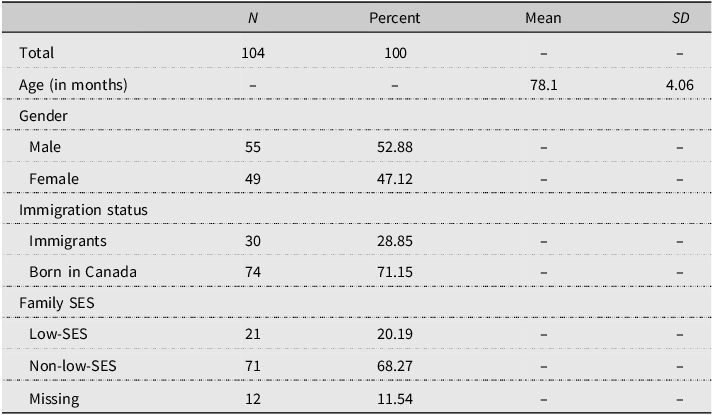
In this study, 104 first-grade Chinese-Canadian bilingual children and their parents (Table 1) participated in the study in the school year 2021–2022. The average age of children at the time of data collection was 78.10 months. Among the 104 children, 55 were boys, and 49 were girls. Most (n = 74, 71.15%) were born in Canada, and 30 immigrated with their parents. Children’s family SES backgrounds were calculated by their family’s annual household income and their parents’ educational backgrounds. Based on the index of social status by Hollingshead (Reference Hollingshead2011), the parents’ educational levels were categorized into six scales from elementary or lower to graduate degree or higher level. Those families with annual household income lower than the low-income cut-offs by Statistics Canada (2023) and the highest parental educational level lower than a college degree were categorized as low-SES. Among the 92 children with complete family background information, 21 (20.19%) were from low-SES families.
Demographic information of children

Table 1. Long description
The table presents demographic information of 104 first-grade Chinese-Canadian bilingual children. It includes data on age, gender, immigration status, and family socioeconomic status (SES). The table has 10 rows and 4 columns. The columns are labeled N, Percent, Mean, and SD. The rows are labeled Total, Age (in months), Gender (Male and Female), Immigration status (Immigrants and Born in Canada), and Family SES (Low-SES, Non-low-SES, and Missing). The average age of the children is 78.1 months with a standard deviation of 4.06. There are 55 males (52.88%) and 49 females (47.12%). Among the children, 30 are immigrants (28.85%) and 74 are born in Canada (71.15%). Regarding family SES, 21 children are from low-SES families (20.19%), 71 are from non-low-SES families (68.27%), and 12 have missing information (11.54%).
Data collection
Data were collected between October and May of the 2021–2022 school year. Children’s demographic and HLE information was obtained through parent surveys administered via an online platform. Children’s English reading-related skills were assessed using standardized instruments in accordance with the respective administration manuals. Assessments were conducted either online or in person at participants’ homes or local libraries, depending on family preference.
Home literacy environment
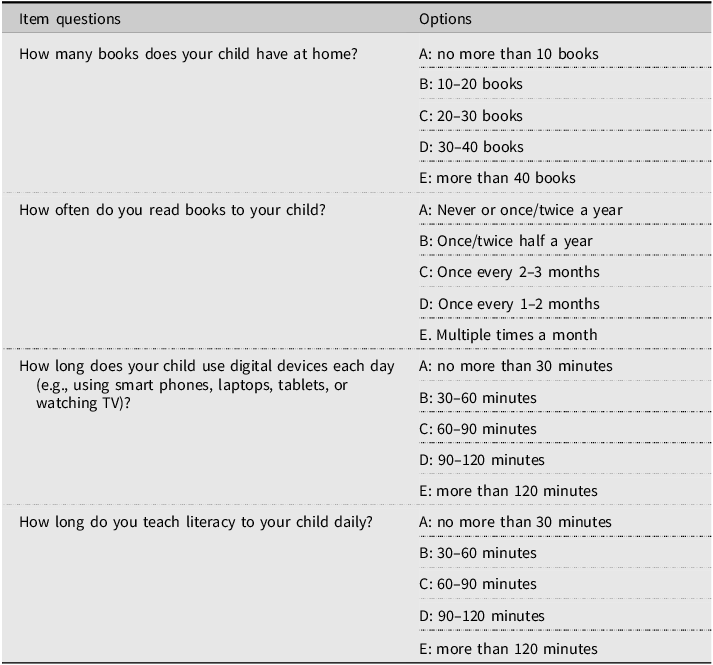
The HLE questionnaire was designed based on previous research (Dore et al., Reference Dore, Logan, Lin, Purtell and Justice2020; Paradis, Reference Paradis2011; Paradis et al., Reference Paradis, Soto-Corominas, Chen and Gottardo2020; Sénéchal & LeFevre, Reference Sénéchal and LeFevre2002, Reference Sénéchal and LeFevre2014). It included both the demographic information and HLE sections, taking parents approximately 10 minutes to respond. In the demographic information section, we collected the information of children’s age, gender, and immigration status, as well as the socioeconomic status (SES) information including household income and parents’ education background. In the HLE section, four five-point scale questions about HLE activities in English and Chinese were asked, respectively, by focusing on the four different HLE dimensions: the number of books at home, the frequency of parent-child shared reading, the length of daily digital device usage, and the daily length of parents’ direct literacy teaching. Detailed information is shown in Table 2.
Home literacy environment questionnaire
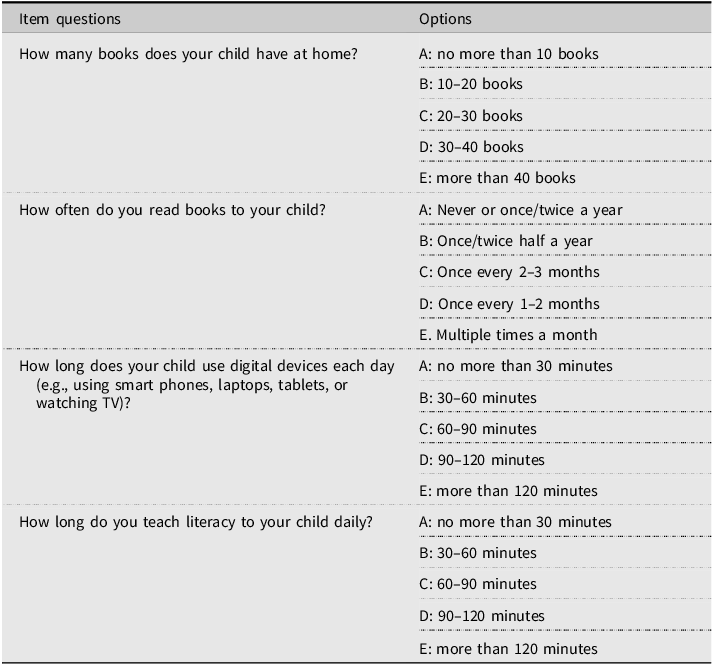
Table 2. Long description
The table presents a home literacy environment questionnaire consisting of four questions. Each question has five options. The first question asks about the number of books a child has at home, with options ranging from no more than 10 books to more than 40 books. The second question inquires about the frequency of reading books to the child, with options ranging from never or once/twice a year to multiple times a month. The third question focuses on the daily duration of digital device usage by the child, with options ranging from no more than 30 minutes to more than 120 minutes. The fourth question asks about the daily duration of teaching literacy to the child, with options ranging from no more than 30 minutes to more than 120 minutes.
Receptive vocabulary
English receptive vocabulary was assessed using the Peabody Picture Vocabulary Test–Fifth Edition (PPVT-5; Dunn, Reference Dunn2019). The PPVT-5 consists of 240 items and is standardized for individuals aged 2.5 to 90+ years, with high internal consistency (α =.97). The measure has also been validated with Chinese-English bilingual populations (Ji et al., Reference Ji, Li and Gunderson2022). Each child was tested individually by trained bilingual researchers following standardized procedures. Administration began at the age-appropriate basal set, and for each item, the examiner pronounced a target word while presenting a plate with four pictures; the child was asked to point to the picture that best represented the word’s meaning. Testing continued until the ceiling criterion (six consecutive errors) was reached. There was no time limit. Raw scores were converted to age-normed standard scores (M = 100, SD = 15) for analysis.
Letter and word recognition
Children’s English decoding skills were assessed using the Letter and Word Recognition subtest of the Kaufman Test of Educational Achievement, Third Edition (KTEA-3; Kaufman & Kaufman, Reference Kaufman and Kaufman2014). This subtest measures the ability to recognize letters and age-appropriate words. Each child was presented with letters and words in order of difficulty and asked to identify or pronounce them. Raw scores were converted to age-normed standard scores (M = 100, SD = 15) for analysis.
Reading comprehension
Reading comprehension was assessed using the Reading Comprehension subtest of the KTEA-3 (Kaufman & Kaufman, Reference Kaufman and Kaufman2014). Children began by matching printed words to corresponding pictures and then progressed to reading simple sentences and short passages, followed by comprehension questions. In addition to the comprehension subtest score, an overall reading composite score was calculated by combining performance on the Letter and Word Recognition and Reading Comprehension subtests. Standard scores (M = 100, SD = 15) were used in the final analysis.
Data analysis
Descriptive statistics were first computed for all HLE variables and literacy assessment outcomes to address the first two research questions. To examine associations between children’s bilingual HLE and English literacy development (Research Question 3), Spearman’s rank correlations were conducted among all variables. Hierarchical linear regression analyses were then performed, with overall reading ability, reading comprehension, letter–word recognition, and receptive vocabulary as dependent variables. Demographic covariates—age, gender, socioeconomic status (SES), and immigration status—were entered in Step 1, followed by HLE predictors in Step 2. Gender, SES, and immigration status were dummy coded as follows: 0 = male, 1 = female; 0 = low SES, 1 = non-low SES; 0 = immigrant, 1 = Canadian-born.
HLE dimensions in each language included the number of books, shared reading, digital device use, and direct teaching. To examine the potentially distinct and joint contributions of bilingual HLE, three sets of models were estimated: (a) models including only English HLE variables, (b) models including only Chinese HLE variables, and (c) models including both English and Chinese HLE variables. All analyses were conducted using SPSS version 28.0.
Results
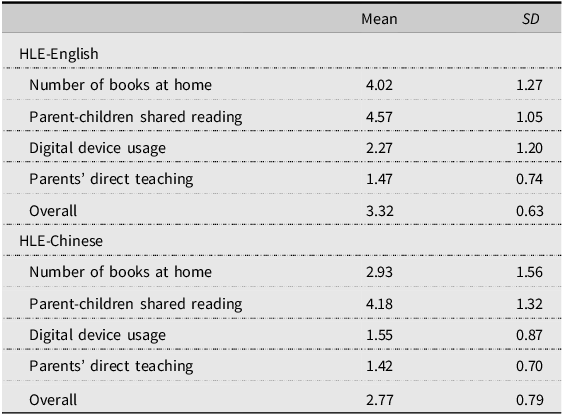
Based on the descriptive analysis of the HLE questionnaire (Table 3), children experienced a richer HLE in English than in Chinese. Parents reported an average overall HLE score of 3.32 for English and 2.77 for Chinese. Across all four dimensions, on average, English HLE scores were higher than Chinese HLE scores. Specifically, families reported having more English books (M = 4.02) than Chinese books (M = 2.93). Parent-child shared reading occurred frequently in both languages, with slightly higher frequency in English (M = 4.57) compared to Chinese (M = 4.18). Children also used digital devices more often for English than for Chinese activities, whereas parents’ direct literacy teaching was relatively comparable across the two languages.
Descriptive statistics of the home literacy environment questionnaire

Table 3. Long description
The table presents descriptive statistics of the home literacy environment questionnaire, comparing English and Chinese. It includes mean scores and standard deviations for four dimensions: number of books at home, parent-children shared reading, digital device usage, and parents’ direct teaching. The table has two main sections, HLE-English and HLE-Chinese, each with five rows for the dimensions and overall scores. For English, the mean scores are 4.02 for number of books, 4.57 for shared reading, 2.27 for digital device usage, 1.47 for direct teaching, and 3.32 overall. For Chinese, the mean scores are 2.93 for number of books, 4.18 for shared reading, 1.55 for digital device usage, 1.42 for direct teaching, and 2.77 overall. The standard deviations are also provided for each dimension.
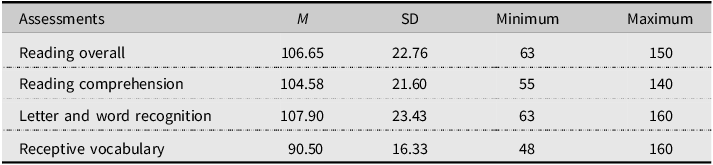
Based on the literacy assessment results (Table 4), children scored above the normative age-group mean (M = 100, SD = 15) on reading comprehension (M = 104.58, SD = 21.60), letter and word recognition (M = 107.97, SD = 23.43), and overall reading ability (M = 106.65, SD = 22.79). In contrast, their receptive vocabulary scores were below the normative mean (M = 90.50, SD = 16.33). These results suggest that while bilingual children demonstrated stronger performance in reading-related skills compared to the normative monolingual group, they underperformed in receptive vocabulary.
Descriptive statistics of the literacy assessment results

Table 4. Long description
The table presents descriptive statistics of literacy assessment results for children, focusing on reading overall, reading comprehension, letter and word recognition, and receptive vocabulary. It includes four rows and five columns, with column headers labeled Assessments, M, SD, Minimum, and Maximum. The row labels are Reading overall, Reading comprehension, Letter and word recognition, and Receptive vocabulary. The mean scores (M) for reading overall, reading comprehension, letter and word recognition, and receptive vocabulary are 106.65, 104.58, 107.97, and 90.50, respectively. The standard deviations (SD) are 22.76, 21.60, 23.43, and 16.33. The minimum scores range from 48 to 63, and the maximum scores range from 140 to 160. Notably, children scored above the normative mean in reading-related skills but below in receptive vocabulary.
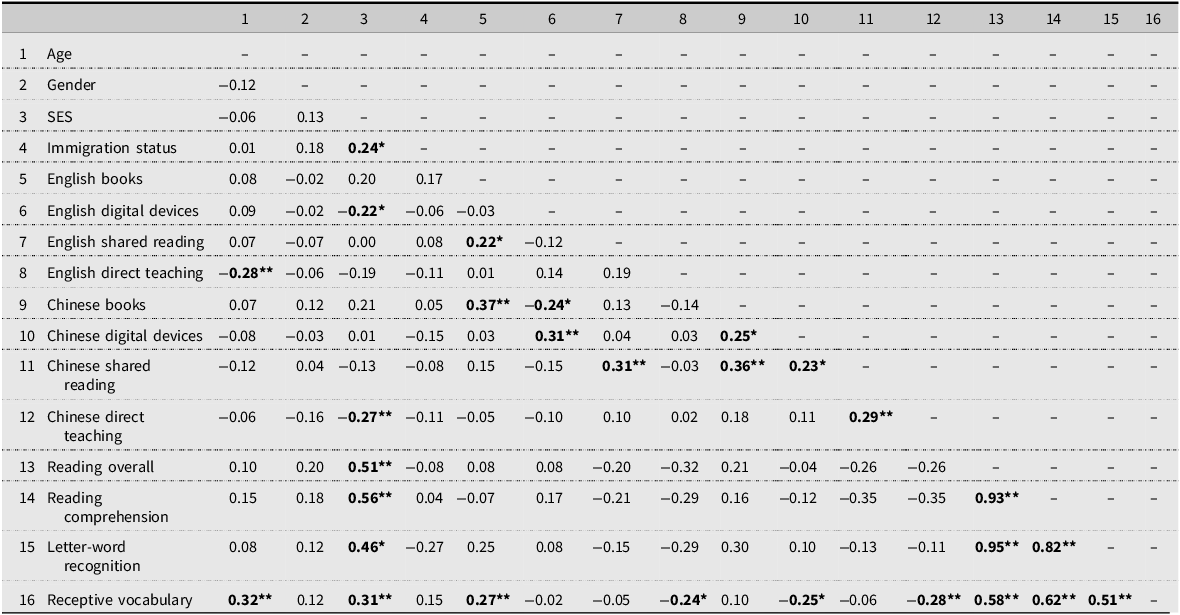
To examine the relationships between bilingual HLE variables and children’s English literacy outcomes, Spearman rank correlations were conducted (Table 5). Overall, several HLE variables demonstrated small to moderate associations with literacy outcomes. Within the English HLE, the number of books was positively associated with receptive vocabulary (ρ =.27, p <.01), whereas English direct teaching was negatively associated with receptive vocabulary (ρ = −.24, p <.05). English shared reading and digital device use were not significantly correlated with any literacy outcomes.
Spearman’s rank correlations among all variables

Table 5. Long description
The table presents Spearman’s rank correlations among multiple variables, focusing on the relationships between bilingual home learning environment (HLE) factors and children’s English literacy outcomes. The table consists of 16 rows and 16 columns, with each cell displaying a correlation coefficient. Key variables include age, gender, socioeconomic status (SES), immigration status, English books, English digital devices, English shared reading, English direct teaching, Chinese books, Chinese digital devices, Chinese shared reading, Chinese direct teaching, reading overall, reading comprehension, letter-word recognition, and receptive vocabulary. Notable trends include positive correlations between English books and receptive vocabulary, and negative correlations between English direct teaching and receptive vocabulary. Additionally, Chinese books, digital devices, shared reading, and direct teaching show varying degrees of correlation with different literacy outcomes.
Note: Two-tailed; Bold values indicate statistical significance: *p <.05, **p <.01.
Within the Chinese HLE, digital device use was negatively associated with receptive vocabulary (ρ = −.25, p <.05), and Chinese direct teaching was also negatively associated with receptive vocabulary (ρ = −.28, p <.01). In contrast, Chinese shared reading and the number of Chinese books were not significantly correlated with any English literacy outcomes. Correlations among HLE variables were generally small to moderate, indicating some overlap among predictors and supporting the use of regression analyses to examine their unique contributions to literacy outcomes.
Building on the correlation findings, hierarchical regression analyses were conducted to examine the associations between HLE variables and children’s English literacy outcomes while controlling for demographic factors. In each set of models, demographic variables were entered in Step 1. Overall, demographic factors explained a moderate proportion of variance, with socioeconomic status (SES) emerging as a consistently significant predictor across outcomes.
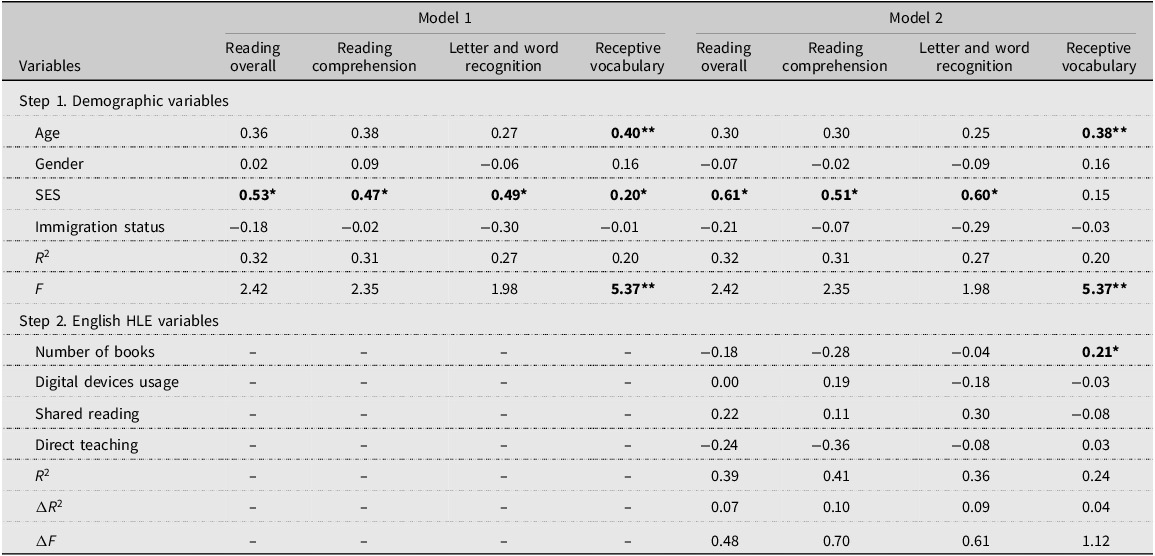
In the first set of models, which included demographic variables and English HLE predictors (Table 6), English HLE variables demonstrated limited associations with literacy outcomes. Specifically, the number of English books was positively associated with receptive vocabulary (β =.21, p <.05), whereas other English HLE variables, including shared reading and digital device use, were not significantly associated with any literacy outcome.
Hierarchical regression analyses predicting literacy outcomes from English HLE variables

Table 6. Long description
The table presents hierarchical regression analyses predicting literacy outcomes from English home literacy environment (HLE) variables. It includes two models with various predictors such as age, gender, socioeconomic status (SES), immigration status, number of books, digital device usage, shared reading, and direct teaching. The table is divided into two main steps: demographic variables and English HLE variables. Each model assesses different literacy outcomes: reading overall, reading comprehension, letter and word recognition, and receptive vocabulary. Notable trends include significant positive associations between SES and various literacy outcomes, as well as between the number of English books and receptive vocabulary. The table highlights the limited associations of English HLE variables with literacy outcomes, with specific significant findings noted for the number of books and receptive vocabulary.
Note: Standardized beta coefficients are exhibited. Bold values indicate statistical significance: *p <.05, **p <.01.
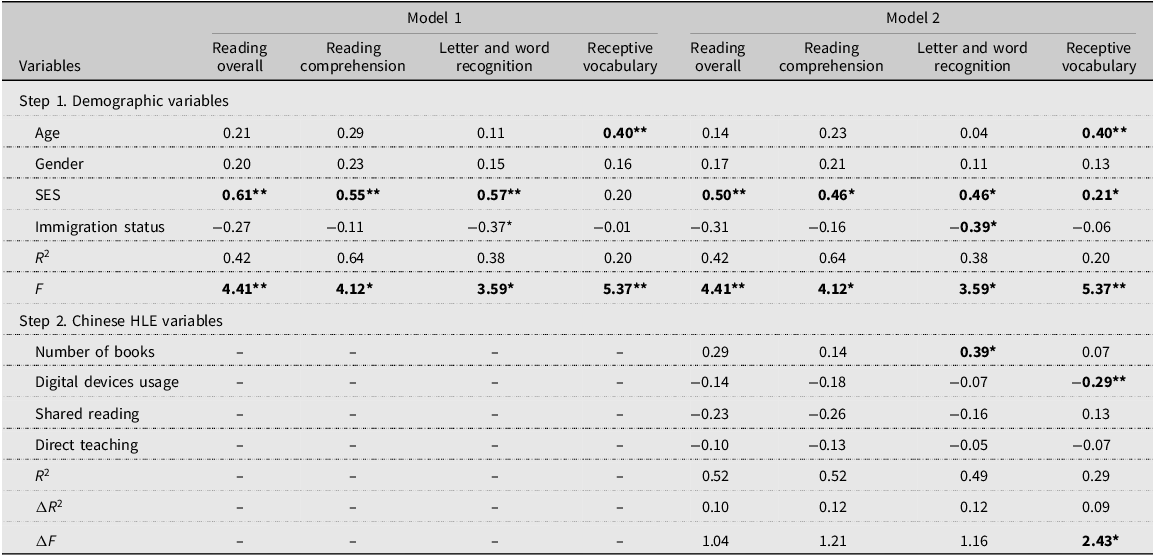
In the second set of models, which included demographic variables and Chinese HLE predictors (Table 7), the number of Chinese books was positively associated with English letter–word recognition (β =.39, p <.05), whereas Chinese digital device use was negatively associated with English receptive vocabulary (β = −.29, p <.01). Other Chinese HLE variables—including shared reading and direct teaching—were not significantly related to any literacy outcomes.
Hierarchical regression analyses predicting literacy outcomes from Chinese HLE variables

Table 7. Long description
The table presents hierarchical regression analyses predicting literacy outcomes from Chinese home literacy environment (HLE) variables. It includes two models with various predictors such as age, gender, socioeconomic status (SES), immigration status, number of books, digital device usage, shared reading, and direct teaching. The table is divided into two main sections: Step 1, which includes demographic variables, and Step 2, which includes Chinese HLE variables. Each section lists the variables and their respective coefficients for different literacy outcomes: reading overall, reading comprehension, letter and word recognition, and receptive vocabulary. Notable trends include significant positive associations between SES and various literacy outcomes, and a significant negative association between immigration status and letter and word recognition. In the second set of models, the number of Chinese books is positively associated with English letter-word recognition, while Chinese digital device use is negatively associated with English receptive vocabulary.
Note: Standardized beta coefficients are exhibited. Bold values indicate statistical significance: *p <.05, **p <.01.
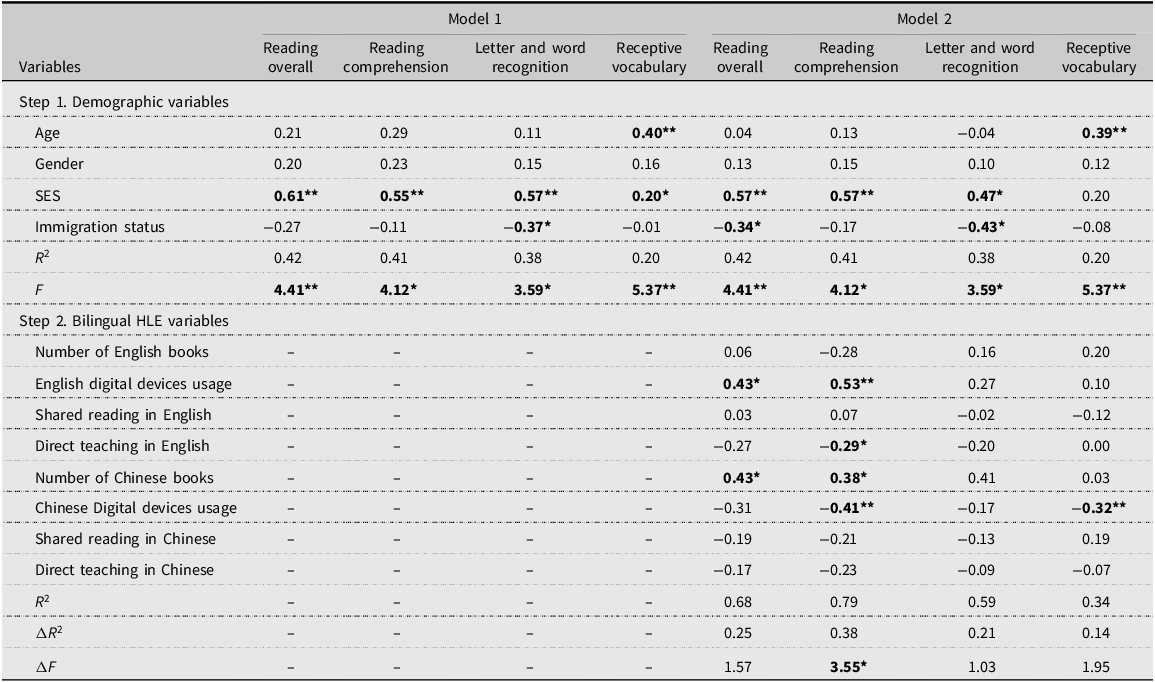
Results from the final set of models, which integrated both English and Chinese HLE variables (Table 8), revealed a more differentiated pattern of associations. Including HLE variables from both languages increased the explained variance across outcomes, particularly for reading comprehension (ΔR 2 =.38, p <.05). Among the predictors, English digital device use was positively associated with overall reading (β =.43, p <.05) and reading comprehension (β =.53, p <.01). In contrast, Chinese digital device use was negatively associated with reading comprehension (β = −.41, p <.01) and receptive vocabulary (β = −.32, p <.01).
Hierarchical regression analyses predicting literacy outcomes from bilingual HLE variables

Table 8. Long description
The table presents hierarchical regression analyses predicting literacy outcomes from bilingual home literacy environment variables. It includes two models with demographic variables and bilingual HLE variables. The table has 20 rows and 12 columns, with variables such as age, gender, SES, immigration status, number of English and Chinese books, digital device usage, shared reading, and direct teaching. The columns represent different literacy outcomes: reading overall, reading comprehension, letter and word recognition, and receptive vocabulary. Notable trends include positive associations between English digital device use and reading outcomes, and negative associations between Chinese digital device use and reading comprehension and receptive vocabulary. The R-squared values and F-statistics indicate the model fit and significance levels.
Note: Standardized beta coefficients are exhibited. Bold values indicate statistical significance: *p <.05, **p <.01.
Additionally, the number of Chinese books was positively associated with overall reading (β =.43, p <.05) and reading comprehension (β =.38, p <.05), whereas English direct teaching was negatively associated with reading comprehension (β = −.29, p <.05). Other HLE variables—including shared reading in both languages and the number of English books—were not significantly associated with literacy outcomes after controlling for demographic factors.
Discussion
This study examined the bilingual HLEs of 104 Chinese–English bilingual first graders and their associations with children’s English literacy skills. Descriptive analyses indicated that children experienced a richer HLE in English than in Chinese, characterized by a greater number of English books, slightly more frequent shared reading, and more extensive use of digital resources in English. Literacy assessments showed that children scored above the normative age-group mean in reading-related skills but below the mean in receptive vocabulary. Spearman’s rank correlations revealed generally small and selective associations between bilingual HLE variables and literacy outcomes, with only a few relationships reaching significance, suggesting a complex pattern warranting further examination through regression analyses.
Hierarchical regression analyses revealed distinct patterns across models. In the English-only models, the number of English books was positively associated with receptive vocabulary. In the Chinese-only models, the number of Chinese books was positively associated with letter–word recognition, whereas Chinese digital device use was negatively associated with receptive vocabulary. In the integrated models, English digital device use was positively associated with reading comprehension, whereas English direct teaching was negatively associated with reading comprehension. Chinese digital device use was negatively associated with both reading comprehension and receptive vocabulary, while the number of Chinese books was positively associated with overall reading and reading comprehension. A detailed discussion of these findings follows.
Bilingual home literacy environment and early literacy development
Based on the descriptive statistics, first-grade children had a more enriched English HLE than Chinese HLE, as reflected by higher average scores across all four English HLE dimensions, particularly the number of books at home. However, parent-child shared reading and parental direct teaching were comparable across the two languages, suggesting that although children had greater literacy resources in English, parents actively engaged in literacy activities in both languages. This engagement pattern reflects the multilingual awareness widely documented in immigrant bilingual families’ HLE across contexts (Antony-Newman, Reference Antony-Newman2024; King & Fogle, Reference King and Fogle2013; Piller & Gerber, Reference Piller and Gerber2021). Rather than focusing exclusively on the mainstream language, these parents value heritage language maintenance and aim to foster multilingual and multicultural competencies through active participation in literacy practices in both languages.
Regarding English early literacy skills, the bilingual children scored above the normative age-group mean in reading-related assessments but below the mean in receptive vocabulary. These findings align with prior research showing that bilingual children often lag behind monolingual peers in vocabulary development (Bialystok et al., Reference Bialystok, Luk, Peets and Yang2010; Hoff et al., Reference Hoff, Rumiche, Burridge, Ribot and Welsh2014; Vettori et al., Reference Vettori, Mercugliano, Bigozzi and Incognito2025) while outperforming them in reading-related skills such as decoding (Li et al., Reference Li, Zhen, Lin and Gunderson2023; Papastefanou et al., Reference Papastefanou, Marinis and Powell2021; Spätgens & Schoonen, Reference Spätgens and Schoonen2018). The observed performance differences are consistent with Koda’s (Reference Koda2005) cross-linguistic framework, which posits that underlying literacy-related processing skills, such as phonological awareness and decoding, are relatively language-universal and thus more likely to transfer across languages when well developed. In contrast, vocabulary knowledge is highly language-specific and depends heavily on the quantity and quality of input in that language; it is not readily transferable across languages unless there is direct cognate overlap.
Bilingual home literacy environment as a shared literacy ecology
The findings of this study highlight the importance of conceptualizing bilingual HLE as a shared literacy ecology rather than two separate language-specific systems. In the integrated regression models, where English and Chinese HLE variables were included simultaneously, a different pattern of associations emerged compared with the single-language models. Some associations weakened, whereas others strengthened, suggesting that the effects of bilingual HLE are not simply additive but are redistributed across languages within a shared literacy ecology. Notably, the integrated model explained substantially more variance than either single-language model, particularly for reading comprehension (ΔR 2 =.38), indicating that bilingual HLE contains predictive power not evident when each language is examined in isolation.
These results provide preliminary empirical support for extending the logic of Cummins’ (Reference Cummins1979) CUP model from child-level skills to environmental inputs. As noted by Goodrich and Lonigan (Reference Goodrich and Lonigan2017), phonological awareness and print knowledge include a language-independent component, whereas oral language skills are largely language-specific. The present findings mirror this distinction at the level of the home environment: the number of Chinese books predicted English letter–word recognition and reading comprehension—outcomes that primarily reflect code-related skills and higher-order literacy processes that can draw on cross-language knowledge—but did not predict receptive vocabulary, which is strongly language-specific. This pattern aligns with prior research showing that bilingual children’s lexical knowledge is largely developed within each language and is often smaller in each language than that of monolingual peers (De Houwer et al., Reference De Houwer, Bornstein and Putnick2014; Li et al., Reference Li, Zhen, Gunderson and Lin2025c; Siow et al., Reference Siow, Gillen, Lepădatu and Plunkett2023). Taken together, these findings suggest that certain aspects of the bilingual HLE may support cross-language transfer in ways analogous to CUP, while other aspects remain language-specific.
The results also highlight the critical role of home literacy resources. In the English-only models, the number of English books was positively associated with receptive vocabulary, suggesting that access to English print materials supports vocabulary growth. However, in the integrated model, this effect was no longer significant, whereas the number of Chinese books emerged as a significant positive predictor of overall reading (β =.43, p <.05) and reading comprehension (β =.38, p <.05). These findings extend conceptualizations of HLE beyond parent-involved activities and align with recent calls to recognize literacy resources as an independent and critical dimension of HLE (Georgiou et al., Reference Georgiou, Inoue and Parrila2021; Li et al., Reference Li, Zhen and Gunderson2025a). The stable positive effects of Chinese books suggest that heritage language print resources may function not merely as language-specific supports but as part of a broader literacy foundation facilitating cross-language development. This pattern is consistent with Kim and Yim’s (Reference Kim and Yim2024) finding that Korean literacy resources at home positively impacted both Korean and English conceptual vocabulary skills of bilingual children in Australia.
At the same time, the findings on digital device use highlight the complex, double-edged nature of technology in bilingual HLE. In the Chinese-only model, Chinese digital device use was negatively associated with English receptive vocabulary, and in the integrated model, this negative pattern was more pronounced: Chinese digital device use was negatively associated with both reading comprehension (β = −.41, p <.01) and receptive vocabulary (β = −.32, p <.01). By contrast, English digital device use was positively associated with overall reading (β =.43, p <.05) and reading comprehension (β =.53, p <.01). These opposing patterns suggest that digital resources do not function uniformly within bilingual HLE; rather, their effects depend on the language of use and the extent to which they support literacy-related engagement. Consistent with prior literature, the effectiveness of digital device usage depends on content and parental or school engagement (Li et al., Reference Li, Zhen, Lin and Gunderson2023, Reference Li, Zhen and Gunderson2025a; Moon, Reference Moon2025; Yuan et al., Reference Yuan, Kleemans and Segers2024). These results reinforce Li et al.’s (Reference Li, Zhen, Gunderson and Lin2025c) recommendation that home literacy models distinguish between printed materials and digital devices as separate dimensions, given their distinct roles in supporting literacy development.
Another notable finding is that English direct teaching was negatively associated with reading comprehension (β = −.29, p <.05) in the integrated model. This pattern may reflect the responsive nature of parent-involved literacy practices. Sénéchal and LeFevre (Reference Sénéchal and LeFevre2014) found that although parent teaching initially supports early literacy, the association can later become negative, as parents of weaker readers tend to increase teaching efforts while parents of stronger readers reduce them. In this context, direct teaching may function as a compensatory practice rather than a consistent predictor of literacy growth, highlighting the need for longitudinal research to disentangle these bidirectional effects in bilingual contexts.
Finally, the null effects of shared reading across all models warrant discussion. This finding is unexpected given the extensive literature documenting the benefits of shared reading for bilingual children’s emergent literacy (Bitetti & Hammer, Reference Bitetti and Hammer2016; O’Brien et al., Reference O’Brien, Arshad and Ng2024). Several factors may explain this discrepancy. First, the present sample comprised first graders transitioning to independent reading, a stage when the influence of shared reading may be less pronounced than in preschool. Second, school-based exposure and instruction in English may exert a stronger influence on English literacy development, potentially attenuating the effects of home-based interactions. These interpretations align with O’Brien et al. (Reference O’Brien, Arshad and Ng2024) finding that independent engagement in the mainstream language is a stronger predictor of literacy performance than parent-dependent practices. Third, the frequency-based measure of shared reading used in this study may not capture interaction quality. Finally, with multiple HLE dimensions included in the same regression models, variance attributable to shared reading may have been absorbed by correlated predictors.
Implications and limitations
Based on the findings, the present study offers several implications for practices and future research on the HLE of bilingual families. First, the results demonstrate that an enriched bilingual HLE can facilitate the overall literacy development of bilingual children (Kim & Yim, Reference Kim and Yim2024; Li et al., Reference Li, Zhen and Gunderson2025a). Rather than viewing heritage-language and mainstream-language literacy practices as separate dimensions, our findings suggest that the HLE in two languages functions as a complementary resource within a unified literacy environment. The HLE of bilingual families can be conceptualized as a shared ecology of literacy resources and experiences that supports children’s biliteracy development. Therefore, with proper support, children from bilingual families would benefit from an enriched bilingual HLE, rather than viewing HLE in one language would overshadow the other.
Second, the number of books available in the home emerged as a unique and independent predictor of children’s literacy skills, highlighting the value of print-rich environments. For bilingual children from immigrant backgrounds, access to a range of age-appropriate printed materials can provide high-quality literacy input (Georgiou & Zhang, Reference Georgiou and Zhang2024), encourage reading engagement, and create opportunities for children to practice and apply literacy skills. Furthermore, the observed association between the number of Chinese books and children’s English decoding skills revealed the cross-linguistic transfer in bilingual HLEs. Heritage-language print resources may facilitate the transfer of foundational literacy skills, such as decoding, to the other language. Future research could examine additional language-general skills—such as orthographic processing or morphological awareness—to further elucidate how cross-linguistic transfer is supported by bilingual HLE.
Third, unlike printed materials, the role of digital devices in the home depends critically on content and purpose. When children primarily engage in entertainment-oriented activities on digital devices, heritage-language usage may not provide high-quality literacy input and could even detract from the development of language-specific skills in the other language. To maximize potential benefits, parents and educators should guide children toward literacy-related and cognitively demanding digital activities that complement, rather than compete with, skill development in both languages. Future research should therefore examine the content and quality of digital device use to better understand its role within the bilingual HLE.
Finally, several limitations should be considered. First, this study examined first graders with similar language backgrounds at a single time point. Longitudinal research with more diverse samples is needed to track changes in bilingual HLE and literacy skills over time and to determine whether the observed associations reflect lasting transfer effects. Second, all HLE measures relied on parental self-report, which may be subject to recall bias or social desirability effects. Future studies could incorporate direct observations, video recordings, or in-depth interviews to triangulate self-reported data and capture the quality of literacy interactions. Third, the HLE questionnaire focused on frequency and quantity of resources but did not assess qualitative aspects, such as the interactivity of shared reading or the content and purpose of digital device use—factors likely to influence cross-linguistic transfer. Finally, although English literacy outcomes were assessed with standardized measures, no parallel assessments were conducted for Chinese literacy skills. Including assessments in both languages would enable a more direct test of bidirectional cross-linguistic transfer.
Conclusion
This study examined the HLE of bilingual first graders and investigated how language-specific practices within the bilingual HLE were associated with early English literacy development. The findings highlight the value of conceptualizing bilingual HLE as a shared literacy ecology. Different types of home literacy resources were found to play distinct roles: access to a greater number of printed materials in either language was positively associated with literacy outcomes (Clinton, Reference Clinton2019; Delgado et al., Reference Delgado, Vargas, Ackerman and Salmerón2018), whereas more frequent use of digital devices did not always support literacy development, consistent with prior research on the mixed effects of digital media (Li et al., Reference Li, Zhen and Mei2025b; Reich et al., Reference Reich, Yau and Warschauer2016). These contrasting patterns highlight the importance of considering the quality, content, and purpose of literacy resources, particularly digital and online tools, in supporting bilingual children’s literacy development.
In conclusion, these findings broaden the conceptualization of bilingual HLE by highlighting its cross-linguistic associations and framing it as an integrated environment, rather than two separate language-specific dimensions. For practice, parents and educators should support immigrant families in maintaining enriched, content-appropriate bilingual HLEs and in guiding children’s purposeful, literacy-focused use of digital media.
Replication package
Replication data and materials for this article can be found at https://osf.io/e9ykn/. Standardized assessments (PPVT-5 and KTEA-3) cannot be publicly shared because these materials are copyrighted by the publisher. The PPVT-5 and KTEA-3 can be purchased through the Pearson official website at https://www.pearsonassessments.com/.

 Open access

