1 Introduction
1.1 Introduction
A perennial debate in economic development concerns the relative importance of international macroeconomic and financial conditions versus domestic policy in determining economic outcomes in developing and emerging countries (DECs). For decades, the World Bank and the International Monetary Fund (IMF) have argued that the greater the degree of international economic and financial integration (i.e., the larger the share of cross-border flows to GDP), the greater the development prospects. Yet, critical development scholars have long shown that deeper integration into global markets constrains rather than expands DECs’ space for economic development.
Traditionally, these constraints have been analysed in the context of hierarchic productive relations, where DECs’ specialisation in low-value-added commodities and manufacturing makes them dependent on technologies from advanced economies, vulnerable to international price fluctuations, and ultimately a locus of value transfer through lower wages and labour exploitation. However, these structural imbalances extend beyond production into the global monetary and financial architecture. A long-standing body of empirical research shows that international financial integration creates substantial risks and complications for DECs, fundamentally constraining their development space. This is most visible in the disproportionate impact of international financial market conditions on DECs, which generate large and often unpredictable swings in cross-border capital flows (Rey Reference Rey2015). Financing conditions on international financial markets are systemically biased against DECs with respect to both maturity and currency. The Global South faces structurally higher interest rates than rich countries on its debt, often well above measurable risk premia. Compounding this, DECs’ currency risk has historically forced them to issue a large share of debt in foreign currency – a phenomenon known as original sin, or the inability to issue debt in domestic currencies (Eichengreen et al. Reference Eichengreen, Hausmann and Panizza2003). Though rooted in finance, these phenomena reach deep into DECs’ productive structures. In particular, the uncertainty created by volatile financial flows and macro-financial prices – chiefly exchange rates – weighs heavily on the willingness and ability of domestic firms to engage in innovative capital expenditures needed to move the economy up the value-added ladder. In parallel, high interest rates and financial returns act as a conduit of structural value transfer from DEC production to financial actors – many of whom are located offshore.
Over the recent decades, the integration of DECs into global financial markets has seen fundamental changes, with important implications for the nature of their structural subordination. Most notably, many DEC governments now issue debt in their domestic (local) currency. In Chile, Colombia, Indonesia, Malaysia, Poland, and South Africa, the share of external public debt denominated in local currency as a proportion of total external debt has made it into the double digits (Arslanalp and Tsuda Reference Arslanalp and Tsuda2014b). Beyond sovereigns, DECs’ corporate borrowing has also increased significantly following the 2008 global financial crisis (GFC; Hardie and Rethel Reference Hardie and Rethel2019, Aldasoro, Hardy, and Tarashev Reference Aldasoro, Hardy and Tarashev2021, FSB 2022), although most of it remains in foreign currency. More broadly, DECs’ external liabilities have become characterised by new financial instruments (such as derivatives), institutions (such as large asset managers, at the expense of banks and specialised funds), and underpinning infrastructures (such as traded exchanges replacing banking networks).
Potentially a more significant game changer for DECs’ structural position in the international monetary and financial system is that some have begun to accumulate external assets – a dynamic whose implications for subordination we develop systematically in this Element. Importantly, this process is not confined to capital flight by residents or reserve accumulation by central banks, but also extends to direct lending to non-residents (Avdjiev et al. Reference Avdjiev, Hardy, Kalemli-Ozcan and Servén2022). Indeed, several DECs’ banking and portfolio investment outflows (e.g., Brazil, Chile, India, Indonesia, Malaysia, Mexico) have increased significantly in recent years, contributing to improvements in their net investment position. Some of these countries have established sovereign wealth funds (Saudi Arabia, Kazakhstan, Malaysia, Indonesia, Chile, among others) that invest abroad, in both advanced and emerging economies. Many DECs (e.g., Brazil, Chile, Mexico, Indonesia) now have significant investment and pension funds that administer substantial amounts of money relative to their economies and invest them abroad in the form of portfolio and other debt flows.
These transformations would have been almost unthinkable in the twentieth century. At the time, many DECs could access external credit only in foreign currency – usually US dollars – and predominantly through foreign banks. Their ‘external assets’ were largely the deposits of wealthy residents in tax havens, supplemented occasionally by foreign exchange (FX) reserves, which fluctuated wildly and were often depleted. On the whole, DECs share a history of volatile exchange rates, sudden reversals in cross-border capital movements, and fully-fledged currency and balance-of-payments crises, culminating in periodic calls to the IMF for emergency funding. For many DECs (Pakistan, Sri Lanka, Egypt, Ghana, among others), these dynamics remain present. However, the aforementioned changes in the structure of DECs’ external assets and liabilities may indicate that countries that experienced these transformations have been able to integrate more sustainably into global financial markets, develop greater autonomous power, and expand their policy space to pursue and finance independent development strategies. Aldasoro et al. (Reference Aldasoro, Avdjiev, Borio and Disyatat2023) show that during capital inflow-phases, several DECs have increasingly disentangled themselves from global financial cycles, with credit growth and interest rates responding more to domestic conditions. In a similar vein, borrowing in domestic currency may have made many DECs less vulnerable to exchange rate fluctuations and increased their macroeconomic policy space. During the Covid-19 pandemic, central banks across DECs were able to lower interest rates rather than raise them, as had been the case whenever previous global financial shocks occurred. During periods of market turmoil, countries like Malaysia and Chile even managed to repatriate some of the external assets built up in previous decades, thereby easing liquidity pressures.
But difficulties and structural constraints have not disappeared. They have, as we argue in this Element, rather changed form. The links between DECs and the global economic and financial system have become more complex, varied, and unexpected, making them increasingly difficult to predict and manage. The transmission of external shocks now spreads through a wider range of instruments, markets, and actors, which has increased the interconnections of cross-border balance sheets and made contagion more complex and harder to anticipate. The phenomenon of ‘original sin redux’ (Carsten and Shin Reference Carsten and Shin2019) exemplifies the new forms of vulnerability that arise following these transformations, illustrating that the holding of local currency debt by non-resident investors shifts the currency risk to them, which makes their behaviour more sensitive to (expected) exchange rate movements (Kaltenbrunner and Painceira Reference Kaltenbrunner and Painceira2015, De Paula et al. Reference De Paula, Fritz and Prates2025). On the asset side, there are signs that DECs-international lending remains dependent on liquidity conditions in advanced financial markets, calling into question the autonomy of this asset accumulation and new potential vulnerabilities (CGFS 2026).
Equally problematic, we observe, is the fact that this move towards more complex global financial linkages did not come with a fundamental transformation of the ‘macroeconomic consensus’ amid International Financial Institutions (IFIs), which reproduces constraints on DECs’ policy space to regulate and manage domestic monetary and financial conditions. In order to deal with the latest developments in global finance, IFIs typically invite DECs to adopt an inflation-targeting monetary regime under floating exchange rates, pursue FX reserve accumulation, and implement macroprudential regulatory policies in the financial sector. When advising DECs, the IMF adheres to a framework that is grounded in these premises and often entails fiscal austerity. The BIS follows a similar approach, though it appears mildly more receptive to alternative macroeconomic approaches than the IMF. It is hard to see how these market-conforming, ‘defensive’ policies could fundamentally alter DECs’ position within the international monetary and financial system and more structurally expand their policy space. Achieving this, we discuss, might require a more autonomous accumulation of external assets.
To analyse the evolving nature of DECs’ financial integration and the potential implications for their position within a hierarchical international monetary and financial system, this Element builds on the expanding literature on international financial subordination (IFS) (Alami et al. Reference Alami, Alves and Bonizzi2023). The concept and research agenda on IFS are grounded in the structural and systemic subordination of DECs in international money and finance, which unevenly penalises actors in these economies disproportionally. We develop this literature in several ways. First, on the theoretical level, in Section 2, we develop the post-Keynesian aspect of IFS. In particular, we emphasise the importance of a monetary production economy (Keynes Reference Keynes and Moggridge1933) from a post-Keynesian perspective, thus highlighting the Monetary element in DECs’ IFS and reconceptualising it as international monetary and financial subordination (IMFS). To do so, we work within the post-Keynesian tradition of currency hierarchy scholarship while also extending it by providing a distinct and novel Minskyan analytical framework to conceptualise and analyse the recent changes in DECs’ financial integration. Second, in Section 3, we provide a comprehensive empirical overview of the recent changes in DECs’ financial integration and their potential implications for IFS. By examining the transformations on the external asset side of DECs’ balance sheets more closely, we are able to address a gap in both the financial subordination literature and the currency hierarchy approach: their near-exclusive focus on the liability side of international balance sheets. Finally, in Section 4, we explicitly engage with existing policy frameworks and strategies to deal with IMFS. Before we move on to these aspects in the remainder of the Element, it is important to elaborate on IMFS, which we conceive as a concept that identifies a structure of the world economy that contains but does not foreclose action, considering its various elements in turn.
1.2 Why International
Textbook treatments typically consider the nation-state with its domestic currency as the representative unit of analysis when dealing with questions of economic development. Traditionally, such treatments have focused on currencies issued by nation-states, and the potential constraints these encounter in corresponding monetary, macroeconomic, and financial policies (see Cohen Reference Cohen1998, Reference Cohen2015, for instance). As Avdjiev, McCauley, and Shin (Reference Avdjiev, McCauley and Shin2016) note, this approach may be referred to as the ‘island view’ in that it assumes that the relationship of a nation with the rest of the world can be captured through a representative agent with a currency that is used only within the tight economic borders of that nation. This view assumes a ‘triple coincidence’ of territory, decision-making unit, and currency (Avdjiev, McCauley, and Shin Reference Avdjiev, McCauley and Shin2016: 412). In practice, this means that net flows within a country’s balance of payments, which records cross-border transactions between residents and non-residents, are an accurate description of its international economic relations. However, in international financial analysis, the ‘island model’ does not hold because financial institutions with multiple branches operate across several countries in multiple currencies, on both the lending and the borrowing sides of the balance sheet. The networks that connect them are of a global character, with certain countries exercising disproportionate power (Murau and van ‘t Klooster Reference Murau and van ‘t Klooster2023).
The ‘island view’, also known as the Westphalian approach (Murau and van’t Klooster, 2022), falls short when evaluated against the transformations experienced by the international monetary and financial system. During the Bretton Woods period (1944–1971), banks started to operate across various financial centres – most notably, New York and London (see Schenk Reference Schenk1998, Tooze Reference Tooze2018). Following the demise of the Bretton Woods system and the onset of financial globalisation, global – primarily American – banks began expanding abroad, opening branches and lending to other countries, including DECs. This tendency accelerated through the 1980s and 1990s, facilitated by widespread financial liberalisation in DECs, often spurred by structural adjustment programs overseen by the IMF in the context of debt and financial crisis resolutions. Today, as discussed in greater detail later in this Element, in addition to global banks, new actors – including money managers, index-investing providers, multinational corporations, and public bodies and funds – play an increasingly important role in international finance. In the real world, financial institutions operate across multiple countries and currencies, simultaneously acting as cross-border lenders and borrowers. This means that national borders – represented in balance of payments statistics and net capital flows – are no longer the appropriate unit of analysis underpinning IMFS. As Avdjiev et al. (Reference Avdjiev, McCauley and Shin2016) acknowledge, ‘in international finance analyses, it is wrong to think of a country as a representative agent, within tight economic borders, and with a currency that is used only within those tight borders’ (p. 414). Instead, attention should be directed towards the agents – and their balance sheets – that straddle national borders. Concretely, this requires a focus on gross rather than net capital flows, as well as a detailed analysis of systemically important balance sheets.
That said, the critique of the focus on territorial borders as the main indicator of hierarchical cross-border relations does not imply a neglect of the importance of the nation-state. While they highlight the shortcomings of the ‘island view’, Avdjiev et al. (Reference Avdjiev, McCauley and Shin2016) recognise the importance of accounting for the nationality of the institution in the place of its residence when assessing the nature of cross-border relations and the potential risks emerging from them (see also Avdjiev et al. Reference Avdjiev, Everett, Lane and Shin2018). They observe how, in the context of global banks’ activities, ‘the main decision-making unit (i.e., the bank head office) exercises control over agents (i.e., affiliated banking units abroad) that are located well beyond the border of the economic area associated with the decision-maker (i.e., the country in which its head office is located)’ (Avdjiev et al. Reference Avdjiev, McCauley and Shin2016: 431). Similarly, while Murau and van ’t Klooster reject the ‘Westphalian approach’, they nonetheless recognise a range of roles for the state. While contested, these roles include the provision of ‘monetary jurisdiction’ (i.e., ‘a legal space within which different institutions create different types of money, denominated in the state’s unit of account’ (Murau and van ’t Klooster Reference Murau and van ‘t Klooster2023: 4)), as well as some degree of discretion over its openness. Further to this, the institutional infrastructure that enables and enforces financial subordination has a national character. Laws, bankruptcy codes, and the legal jurisdiction governing contracts all depend on nation-based institutional arrangements (Pistor Reference Pistor2019). Finally, the national remit of the central bank is both a major determinant and a byproduct of IMFS. Whenever a bank faces disruptions in cross-border lending and/or borrowing, the state in its home jurisdiction is ultimately liable through its central bank.
At its core, the fundamental unit of analysis for IMFS remains the individual country. Institutions, regulations, political-economic structures, and dynamics that underpin IMFS all remain deeply rooted in national contexts. At the same time, this must be complemented by an examination of the global interconnections linking actors operating across multiple countries – though we acknowledge that obtaining such data poses significant challenges. IMFS unfolds in the space between the international and the national: some actors span borders, while others barely survive within their own national borders; gains are generated globally, yet losses are allocated nationally; currencies are traded internationally, while banks are regulated domestically. We find it useful to think in terms of porous borders. While heterogeneous reporting standards, confidentiality constraints, and the opacity of many cross-border financial operations remain a problem, institutions such as the BIS seem to increasingly converge towards a notion of global interconnectedness in the evolution of their data collection practices. For DEC governments, the art lies in securing borders and controlling the national territory while also building channels that propel their vectors globally, creating space to manage the potentially adverse implications of IMFS. Evidently, this is no easy task: very few have mastered this art, and even those who have must remain constantly alert to ongoing developments, innovations, and systemic shifts.
1.3 Why Monetary and Financial
While international economic asymmetry has many dimensions, this Element focuses specifically on monetary and financial relations, which imply autonomous mechanisms of subordination, independent from the ‘real economy’. At the same time, as acknowledged by Alami et al. (Reference Alami, Alves and Bonizzi2023), monetary and financial subordination is intrinsically and symbiotically linked to DECs’ subordination in production, technology, and trade. Most notably, relations of monetary and financial subordination might exacerbate hierarchies in trade and production. For example, as Kaltenbrunner et al. (Reference Bonizzi, Kaltenbrunner, Powell, Reinert and Kvangraven2024) show, the differential ability of Brazilian firms to access international financial markets – and the terms on which they do so – fundamentally cements productive structures concentrated in traditional comparative advantage and commodity-related sectors. Trade credit, a major factor behind trade relations, is equally shaped by IMFS. At the same time, these monetary and financial relations remain considerably underexplored compared to their productive counterparts.
Relations between countries and the world economy are analysed in this Element, first, by drawing emphasis on ‘monetary’ – that is, through the lens of a monetary theory of production as defined by Keynes (Reference Keynes and Moggridge1933). In this framework, ‘money plays a part of its own and affects motives and decisions … so that the source of events cannot be predicted, either in the long period or in the short, without a knowledge of the behaviour of money between the first state and the last’ (CW XIII: 408). This view places money at the core of its analytical endeavour and represents the core tenet of post-Keynesian analyses of the hierarchic nature of the international monetary system, as the theory of currency hierarchy exemplifies (Andrade and Prates Reference Andrade and Prates2013, Kaltenbrunner Reference Kaltenbrunner2015). For currency hierarchy scholars, international monetary hierarchies are shaped by the ability of domestic money to perform international money functions. In the open economy, one currency acts as the currency of the system – the Pound Sterling in Keynes’ time, the US dollar today – fulfilling all international money functions, while other currencies are subordinate to it depending on their ability to fulfil those functions internationally, and at times even domestically.
As we shall see in greater detail later in this section, this hierarchy manifests in concrete ways. In times of crisis, DEC currencies are typically among the first casualties, depreciating against core-economy currencies precisely when a reliable store of value is most needed. Meanwhile, almost half of global trade is invoiced in US dollars, despite the US accounting for only around 10 per cent of total trade. As a consequence, several currencies – predominantly those from DECs – are effectively excluded from international means of payment. Perhaps most concerning, IMFS also shapes the functions of money at the domestic level. From debt denomination and housing prices to the cost of imported inputs, the reliability of domestic currencies as units of account directly conditions economic activity, policy space, and distributional outcomes. The monetary channel is thus a key vector through which international subordination is reproduced.
Having clarified why we look at monetary subordination, we now turn to the word ‘financial’, which foregrounds the institutions that create money and the interlocking balance sheet relations between different agents. From a Minskyan perspective, as discussed in greater detail in Section 2, understanding countries’ subordinate position in the international monetary and financial system not only requires an examination of the properties of money and its ability to perform international functions, but also an appreciation of the interlocking balance sheets of the institutions that produce it.
Over recent decades, the scale and complexity of actors engaged in cross-border transactions have increased dramatically. These evolving financial actors and relations have created new transmission channels for global shocks – from balance sheet contagion to interconnectedness exposure – that extend beyond traditional relations of international money as reflected in exchange rates. These new financial relations have also created new forms of hierarchy and subordination that fundamentally affect capital accumulation in national economies through their impacts on the balance sheets of different agents.
Overall, the monetary and financial dimensions of subordination are analytically distinct but mutually constitutive and thus require holistic treatment. At the same time, monetary and financial subordination is not merely the counterpart of hierarchic productive relations and cannot be reduced to ‘economic’ or ‘commercial’ dependency. IMFS interacts with, shapes, and amplifies other forms of subordination, and – we contend – deserves investigation in its own right.
1.4 Why Subordination
As discussed in more detail in Section 2, different and long-standing theoretical traditions have addressed the relationship between ‘centre’ and ‘peripheral’ economies from varying perspectives: dependency theory (Prebisch Reference Prebisch1950), Marxist theories of world money (Brunhoff Reference Brunhoff and Moseley2005), imperialism (Baran and Sweezy Reference Baran and Sweezy1966), unequal exchange (Amin Reference Amin1974), and post-Keynesian theories of currency hierarchy (De Paula, Fritz, and Prates Reference De Paula, Fritz and Prates2017). These strands have recently been brought together in the research agenda on IFS (Alami et al. Reference Alami, Alves and Bonizzi2023), which defines IFS as ‘ a relation of domination, inferiority, and subjugation between different spaces across the world market, expressed in and through money and finance, which penalises actors in DEEs disproportionally’ (p. 1363). Though manifest through different empirical phenomena – heightened external vulnerability, exchange rate volatility, structurally higher interest rates, and the need to accumulate low-yielding reserves – two dimensions are key to IFS. Firstly, that it is both structural and systemic to the global economy, rather than a byproduct of domestic policy failures; and secondly, that it creates constraints on agency alongside a persistent transfer of value from the periphery to the core.
Having said that, our use of the term ‘subordination’ warrants qualification. In contrast to Alami et al. (Reference Alami, Alves and Bonizzi2023), who adopt a broader usage, we align with the post-Keynesian currency hierarchy tradition in interpreting ‘subordination’ as ‘a constraint on the behaviour of an agent by an outside force’. This constraint binds and shapes the behaviour of the agent subject to it. We say ‘shapes’ and not determines deliberately, to leave open a degree of agency. Some agents may adapt their behaviour and even profit from the constraint; others may seek ways to expand their room for manoeuvre while operating within it; still others may fail in precisely those attempts. But the point we want to emphasise is that, even within a subordinate relationship, the subordinated actor retains some capacity for agency – agency foreclosed in more deterministic theories of dependency and imperialism.
1.5 IMFS at Work
Regarding its manifestations, we identify two key features of IMFS, which are deeply intertwined with each other as well as with other dimensions of subordination. The first is the dependence of domestic monetary and financial conditions on international markets – what the literature calls ‘push’ factors (Calvo, Leiderman, and Reinhart Reference Calvo, Leiderman and Reinhart1996). These reflect financial conditions in global financial centres, which in turn determine the liquidity of the global currency available to the rest of the world, as indicated by risk perceptions, spreads, and credit growth. As a result, IMFS manifests with a limited degree of autonomy among DECs in determining their own monetary and financial relations.
These dynamics typically culminate in cycles of indebtedness, capital inflows to the periphery, retrenchment, and, eventually, default. Risk conditions in the financial centre ‘rule the roost’ with respect to the direction of capital flows, which in turn influences domestic finance and related economic outcomes. This results in a heightened sensitivity to international assets and liabilities, which evolve largely independently of domestic economic conditions and primarily follow international funding conditions, in line with the global financial cycle (Borio Reference Borio2019). We call this the cyclical element of IMFS.
The second manifestation concerns the uneven distribution of risks and returns in debtor–creditor relations. This encompasses the types of instruments chosen, their maturity, and – particularly important in the cross-border context – who bears the currency risk. Under IFS, this risk unevenly shifted to the subordinate unit. Any reduction in that risk must be compensated by higher returns, which produces a persistent transfer of value from subordinate units to the subordinating agents, enabled by evolving institutional infrastructures and power relations. We call this the structural element of IMFS.
A Brief History of IMFS Manifestations
Before setting out the relevant theoretical approaches and our own Minskyan interpretation in the next section, a brief overview of the historical developments of IMFS is in order. A thorough treatment goes well beyond the remit of this Element – and there are many excellent references (see Helleiner Reference Helleiner2023, Alami et al. Reference Alami, Alves and Bonizzi2023) – but we nonetheless believe it remains important to delineate the contours of such historical developments in order to contextualise recent changes in the nature of financial integration and their implications for IMFS. A review of this kind is also instrumental in highlighting the key characteristics that underpin IMFS across its various manifestations: the dominance of global ‘push’ factors, and the unfavourable distribution of risks and returns.
The Nineteenth Century
While relations of monetary and financial subordination have existed for centuries and predate global capitalism (see Gelpi and Labruyere Reference Gelpi and Julien-Labruyere2000, among many others), our analysis begins with the first major episode of financial globalisation: the export of private capital from the Global North to the Global South. This initial phase was tightly linked to the agglomeration of colonial wealth in the City of London, followed by a second wave of financial globalisation characterised by the consolidation of New York as the World’s main financial centre, particularly after the breakdown of the Bretton Woods system.
London asserted its unchallenged global financial dominance after the Napoleonic Wars and throughout the first half of the nineteenth century, only beginning to see it contested after the 1850s and, ultimately, overtaken after World War I (Cassis Reference Cassis2006). This dominance was characterised by repeated cycles of financial inflows and outflows, largely driven by liquidity conditions in London (Marichal Reference Marichal1989) and, to a lesser extent, other financial centres. Data from Stone (Reference Stone1999) on British capital exports between 1865 and 1914 reveal successive ‘waves’ of surges of inflows into countries and colonies, followed by sudden stops. Each wave – in the 1860s, the early 1870s, the late 1880s, and up to 1913 – was driven by conditions in the City of London, such as rapid credit growth and low-interest rate spreads.
Yet IMFS is about more than the ebb and flow of investors into and out of DECs in response to conditions in the financial centre. As noted previously, the structural dimension of IMFS either requires the debtor to bear the majority of the risk or to compensate the creditor with excessive returns for doing so. One manifestation of this asymmetric nature of creditor–debtor relations under IMFS is the inability of DECs to issue debt and borrow from international investors in domestic currency at scale. In the nineteenth and twentieth centuries, borrowing in foreign currency (gold, sterling pounds, or US dollars) was often a prerequisite for major projects – such as infrastructure, railways, energy – that required inputs and technical expertise unavailable domestically. Available external credit, in turn, did not prioritise the possibilities of industrialisation in the subordinate economies of the periphery, but instead favoured projects compatible with an international division of labour structured around the centre economies. For instance, as shown by Stone (Reference Stone1999), the main destinations of British capital exports between 1865 and 1914 were government borrowing, railways, and raw materials, which contributed to the integration of the recipient economies into a world trade system shaped by British interests. Notably, these features were not confined to British credit or to British colonies: similar episodes are documented across other colonial and subordinate relationships (see Bhambra Reference Bhambra2021, Koddenbrock, Kvangraven, and Sylla Reference Koddenbrock, Kvangraven and Sylla2022, among others).
After Bretton Woods
The second key phase, which we focus on here, is the now largely US-dominated period of financial globalisation, which became more pronounced after the demise of the Bretton Woods system in 1971 and the oil crisis of 1973. The end of tightly regulated global financial markets, combined with large dollar liquidity in the hands of oil exporters, meant that substantial financial flows were channelled to newly industrialising countries by global banks through major financial centres.
The international expansion of US banks that followed the Bretton Woods collapse unravelled through the establishment of branches and subsidiaries (Roussakis Reference Riese1997: 50–51) and required the deployment of supporting financial infrastructure. Generally looser forms of financial regulation, new international payment systems such as SWIFT (see Scott and Zachariadis Reference Schenk2014), and legal reforms in recipient economies (Bonizzi and Kaltenbrunner Reference Bonizzi and Kaltenbrunner2024) – alongside global regulatory initiatives like the Basel framework (see Goodhart Reference Goodhart2011) and national policy changes such as the lifting of controls in the US (see Kregel Reference Kregel2008) – facilitated this process. Though this phase saw New York becoming the most important global financial centre of the world, other significant financial markets – such as London, Tokyo, Zurich, Frankfurt, Singapore, and Hong Kong – also played important roles, alongside other countries that sought to establish themselves as financial centres with different degrees of success (Cassis Reference Cassis2018).
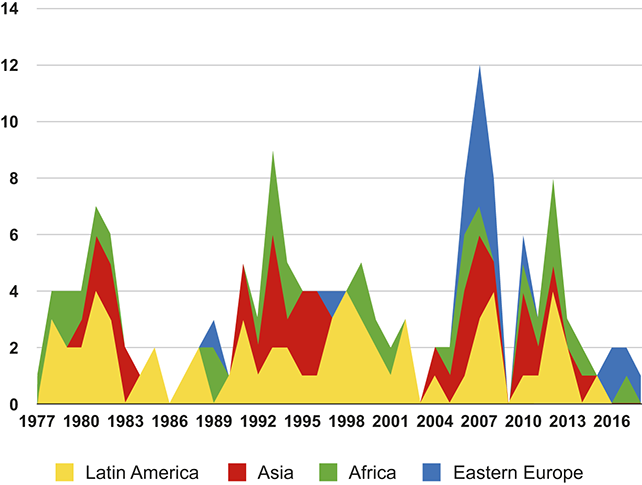
The cyclical financial fluctuations that characterised this period can be appreciated in Figure 1, based on an analysis by Manubens Paz and Bortz (Reference Manubens Paz and Bortz2022), who examine balance of payments data for forty-eight developing countries between 1977 and 2018. Their analysis identifies 111 surges of capital inflows – episodes in which inflows are substantially large both relative to the size of the economy and to its own historical trajectory. Figure 1 shows the distribution of these surges, revealing four distinct periods of strong capital inflows, each ending with an abrupt contraction.
Episodes of surges of capital inflows in EMEs
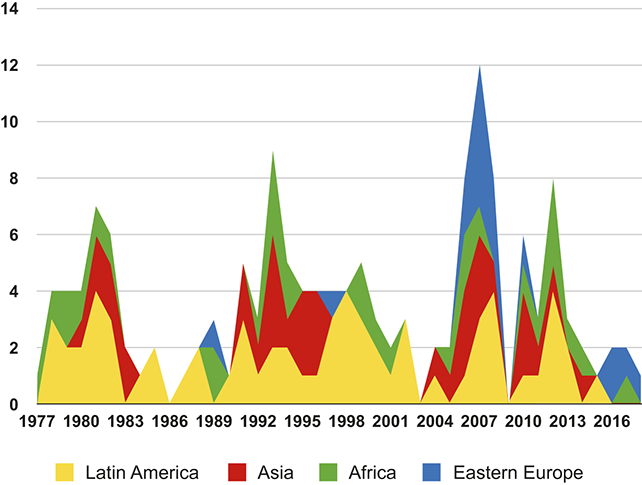
The first period coincides with the developing world debt crisis of the early 1980s, which occurred against the backdrop of massive petro-dollars recycling through the American banking system into catching-up DECs, principally though not exclusively in the Western Hemisphere (Taylor Reference Tavasci and Toporowski1989). The common explanation for the debt crises of the 1980s – the so-called ‘profligacy’ narrative – attributes them to reckless governments that allegedly borrowed beyond their means and eventually faced a financial reckoning. However, despite the common emphasis on public sector indiscipline, external private borrowing played an equally significant role in these crises (Diaz-Alejandro Reference Diaz Alejandro1985). Domestic financial deregulation, combined with extensive foreign-currency borrowing by both public and private sectors from international lenders – mainly banks – shifted the currency risk entirely on vulnerable borrowers, leaving local governments exposed to shifts in global financial conditions. This vulnerability was laid bare in 1982, when the US sharply raised interest rates to combat inflation, triggering a wave of defaults and financial crises across developing countries and economies from the Eastern Bloc. With US banks – major creditors – facing collapse, the response was a patchwork of IMF-led bailouts tied to austerity measures (Taylor Reference Tavasci and Toporowski1989). The outcome was a prolonged period of sluggish growth, heavy debt burdens, and high inflation, rendering the 1980s a ‘lost decade’ for many of these nations.
The crises of the 1990s followed a different pattern, driven mainly by short-term external debt held by the private sector. The 1997 East Asian crisis is emblematic, having occurred even in the absence of current account deficits (Kregel Reference Kregel1998a, Palma Reference Painceira2001). These crises arose from private sector borrowing characterised by significant FX mismatches, often under fixed or managed exchange rate regimes (Kregel Reference Kregel and Jomo1998b, Dymski and Crotty Reference Crotty, Dymski, Arestis and Sawyer2001). Foreign capital inflows, channelled through domestic banks, were frequently invested in non-productive sectors like housing and finance, with currency and maturity mismatches. When US interest rates rose, early repayment difficulties emerged, triggering capital outflows followed by the depreciation of the Thai baht. This in turn sparked regional panic, mass financial outflows, currency crashes, and a wave of defaults and bankruptcies.
Another cycle unfolded in the early 2000s, ending abruptly with the GFC of 2008. This period was marked by increased inflows to DECs in the form of portfolio investment (Akyuz Reference Akyuz2011), driven by high risk appetite among investors from global financial centres (IMF 2004). Commercial banks remained the dominant source of these flows (Akyuz Reference Akyuz2011: 10), though non-bank lenders also began to expand their footprint. This was also a period of rising commodity prices. Many DECs took advantage of these inflows to build reserves, with some – such as Colombia – even adopting capital control measures to curb speculative inflows (Ocampo and Malagon Reference Ocampo and Malagon2015). The cycle that followed the crisis, along with the transformations it ushered in, will be the subject of Section 3.
1.6 Structure of the Element
Following this introduction, the Element is divided into four additional sections. Section 2 provides a brief review of the existing literature on IMFS within the historical context of the financial cycles discussed previously. In line with Alami et al. (Reference Alami, Alves and Bonizzi2023), we focus exclusively on the three main macro-structural economic theories that have underpinned the IMFS agenda: dependency theory, post-Keynesian currency hierarchy scholarship, and Marxist approaches to imperialism and world money. Particular emphasis falls on work analysing the most recent changes in DECs’ financial integration and informing our own empirical analysis. After a more detailed discussion of existing Minskyan analyses of hierarchic cross-border financial relations of DECs, Section 2 sets out our own Minskyan analytical framework to conceptualise and empirically analyse recent changes in DECs’ financial integration and their implications for IMFS.
Section 3 provides a detailed and systematic analysis of those recent changes, with attention to both the liability and the asset side of DECs’ international balance sheets. It does so first at the aggregate level, using comparable data for a wide range of countries, and then through more detailed case study analyses of four variegated country experiences: Argentina, Brazil, Malaysia, and Turkey. We demonstrate that, while in general many DECs have undergone important changes in the nature of their financial integration, substantial variation persists. We also show that, although some countries have made significant progress in mitigating the most adverse implications of IMFS, very few structural alterations to its key characteristics have materialised, particularly with respect to their dependence on international market conditions and the uneven distribution of risk and returns.
In Section 4, we analyse existing IFI policy frameworks – and country deviations from them – designed to manage the implications of IMFS. In particular, we examine the Integrated Policy Framework of the IMF and the Macro-Financial Stability Framework of the BIS. We begin the Section by examining the implications of IMFS for the conduct of macroeconomic policy, before turning to a presentation, analysis and critique of the mentioned frameworks in light of recent transformations in IMFS and their limited recognition of the balance sheet interactions that underpin it. The section concludes by examining varied country experiences in dealing with IMFS and in trying to alter their position within it.
Section 5 offers concluding policy recommendations at both the national and international levels, aimed at expanding policy space to pursue development strategies in financially subordinated DECs.
2 A Minskyan Theorisation of International Monetary and Financial Subordination
2.1 Introduction
In the previous section, we discussed constitutive questions around the concept of IMFS, identified its key characteristics, and provided a brief historical overview of how IMFS manifested in the nineteenth and twentieth centuries. We also presented some of the key features of the most recent phase of IMFS, which we located in the period starting from the GFC. In this section, we set out the theoretical framework underpinning our analysis of past – but particularly most recent – changes in the nature of IMFS. Most important among these are the rise of non-banks as key players in cross-border financial flows, the consequent expansion of portfolio flows as the main type of cross-border flow, and – perhaps the most novel phenomenon that requires an expanded form of theorisation – the expansion of external assets by DECs themselves.
To substantiate this theorisation, we first present a brief overview of how IMFS has been conceptualised across different macro-structural frameworks as the different stages identified in Section 1 unfolded. As discussed by Alami et al. (Reference Alami, Alves and Bonizzi2023), these include Latin American Structuralism/dependency theory (e.g., Tavares Reference Tavares1985), Marxist theories of money and imperialism (e.g., Lapavitsas Reference Lapavitsas2009, Painceira Reference Painceira2011), and post-Keynesian theory of currency hierarchy (e.g., Herr Reference Herr1992, Andrade and Prates Reference Andrade and Prates2013). We then present a more detailed review of existing Minskyan approaches to IMFS in order to locate our own Minskyan framework and its contributions to that literature.
2.2 Theorising IMFS: A Brief Historical Overview
We would love to provide a thorough and exhaustive review of the multiple theoretical approaches that across social sciences, countries, and over time, have analysed the subordinate integration of DECs in the global economy. Two reasons keep us from doing so. The first is the word limit. The second – and fortunately for us – is that this exercise has already been carried out with remarkable scholarly rigour by Alami et al. (Reference Alami, Alves and Bonizzi2023) and Helleiner (Reference Helleiner2023). The present theoretical review accordingly concentrates on the macro-structural economic theories identified by Alami et al. (Reference Alami, Alves and Bonizzi2023), periodised according to the liquidity cycles identified in Section 1: the demise of the Bretton Woods system in the 1970s; the first wave of debt crises in the 1980s; the emerging market crises of the 90s; and the new forms of IMFS since the turn of the millennium.
Economic analyses of the detrimental implications of DECs’ integration into global monetary and financial markets emerged in the 1980s in response to the rise of financial globalisation and the first wave of sovereign debt crises across Latin America, Eastern Europe, and the MENA countries (Diaz-Alejandro Reference Diaz Alejandro1984, Reference Diaz Alejandro1985, James Reference James1987). As discussed in Section 1, these crises were spurred by the recycling of petro-dollars through international banks and the large-scale issuance of foreign currency debt by newly industrialising governments, leading to the coining of the term ‘original sin’. Whereas mainstream authors (e.g., Eichengreen, Hausmann, and Panizza Reference Eichengreen, Hausmann and Panizza2003) attribute ‘original sin’ largely to a history of defaults and repayment failures, critical political economists see it as rooted in the structure of the international monetary system.
Following the financial liberalisation of the 1970s, dependency theorists and Latin American structuralists incorporated external financial constraints more explicitly into their analysis, highlighting the limits imposed by the inability to borrow in domestic currency and the vulnerability to global liquidity conditions. For Tavares (Reference Tavares1985) – one of the few dependency theorists to explicitly engage with the financial mechanism of subordination – DECs’ inability to borrow in domestic currency represents the key constraint on autonomous economic development, rather than productive dependencies (Vernengo Reference Vasudevan2006). On this view, the Volcker shock that precipitated the 1980s Global Debt Crisis is understood as an explicit strategy of the US government to maintain its global hegemony (Tavares Reference Tavares1985).
A second wave of research on DECs’ vulnerable position in global monetary and financial markets emerged with the DEC financial crises of the late 1990s (East Asia, Russia, Brazil, Colombia) and early 2000s (Argentina and Turkey). Here, critical economists highlighted a combination of unsustainably fixed exchange rate regimes, yield-driven portfolio flows that led to real exchange rate appreciation, and the inability of the private sector to borrow in local currency (Frenkel Reference Frenkel2003). As discussed in more detail next, several authors in the heterodox economic tradition have contributed to this line of analysis by explaining these crises in terms of the endogenous and inherent fragility of global financial markets, drawing on Hyman Minsky’s work (e.g., Wolfson Reference Vasudevan2002, Kregel Reference Kregel2004, Tavasci and Toporowski Reference Tavasci and Toporowski2010).
A parallel theoretical strand that arose during this period was that of the international currency hierarchy, largely based on post-Keynesian monetary thought. Drawing on seminal work by Dow (Reference Dow, Deprez and Harvey1999), Riese (Reference Riese2001), and Belluzzo (Reference Belluzzo, Tavares and Fiori1997), this literature further developed the analysis of international monetary asymmetries by applying Keynes’ liquidity preference theory and the ‘own rate of interest’ framework to the open economy (Keynes Reference Keynes and Moggridge1936). As discussed in Section 1, currency hierarchy scholars argue that the international monetary system is fundamentally hierarchic, anchored in currencies’ ability to perform international money functions. At the top of the hierarchy sits the money of the system. All other currencies are assessed against this top currency and must, depending on the current state of liquidity preference, offer higher returns to compensate for their lower liquidity premium. In this view, the empirical phenomena of IMFS discussed in the previous section are outcomes of the structural features of the international monetary system, rather than misaligned fundamentals or past misbehaviour (Prates Reference Prates2002, Herr and Huebner Reference Herr and Huebner2005).
Marxist scholars, by contrast, view processes of IFS as underpinned by class-based processes and productive relations which find their variegated expressions shaped by historically and geographically specific patterns of capital accumulation (McNally Reference McNally1998, Alami et al. Reference Alami, Alves and Bonizzi2023). Saad-Filho and Mollo (Reference Riese2002), for example, highlight the distributional conflict underpinning inflation and the fragmentation of the Brazilian currency in their analysis of the crisis of the exchange-rate-based stabilisation program Plano Real in the late 1990s. According to Alami et al. (Reference Alami, Alves and Bonizzi2023), the analysis of capitalism as a global class-based process also necessitates recognising the centrality of imperialism, which ‘results in monetary and financial phenomena in EMEs taking a subordinate character, with implications for the formation of crises, the enforcement of class discipline, and value transfers across the world capitalist economy’ (p. 1369).
Another strand of Marxist literature, drawing particularly on Marx’s monetary thought, emphasises the role of world money in shaping DECs’ subordinate position in the global economy (Marx Reference Marx1867, Lapavitsas Reference Lapavitsas2003, McNally Reference McNally2009, Vasudevan Reference Vasudevan2009, Painceira Reference Painceira2011, Powell Reference Powell2013). World money serves as the universal means of payment and purchase, as well as the absolute materialisation of wealth; access to and accumulation of world money is therefore a precondition for participation in the world market. Those who do not have access to world money find their participation in the world economy severely constrained (Kaltenbrunner and Painceira, Reference Kaltenbrunner and Painceira2018).
Extending this line of analysis, Marxist-inflected perspectives on dependency theory highlight the increasing role finance assumes to facilitate the transfer of value from the periphery to the core. For example, drawing on Amin’s concept of imperialist rent (Amin Reference Amin2019), Musthaq (Reference Murau and van ‘t Klooster2021a, Reference Musthaq2021b) argues that, under financialised capitalism, rent is no longer restricted to labour arbitrage but extends to financial arbitrage, enabled by the higher returns offered in the periphery, including capital gains facilitated by the development of indices and benchmarks in addition to traditional interest rate gains. In a similar vein, Becker et al. (Reference Becker, Jäger, Leubolt and Weissenbacher2010), working within a regulation theory framework itself influenced by dependency theory, argue that recent changes in financial markets in DECs are shaped by their extraverted accumulation regimes, dependent on foreign capital inflows and often exacerbated by internal euroisation/dollarisation processes. This dynamic, they observe, is enabled by structurally higher interest rates and frequently results in currency account deficits and high external debt. A similar, systemic approach is also adopted by Bonizzi et al. (Reference Bonizzi, Kaltenbrunner, Powell, Reinert and Kvangraven2023) to characterise subordinate financialised capitalism from a Marxist perspective. In addition to the value transfer through financial means, these authors also highlight the increasingly important role of finance to facilitate the creation, transfer, and realisation of value generated in and transferred through global value chains. From a Marxist world money perspective, Painceira (Reference Painceira2022) analyses the phenomenon of reserve accumulation. He shows that after the currency crises of the late 1990s/early 2000s, DECs have held increased stocks of quasi-world money (primarily US dollars) to protect against financial uncertainty and maintain access to the world market. This reserve accumulation, in turn, has had fundamental implications for the structure of domestic financial systems in the form of rising public debt levels and an expansion of household consumption credit.
These diverse theoretical approaches have also been deployed and extended to analyse recent changes in DECs’ financial integration, and their interaction with IMFS. On the one hand, Latin American Structuralists and dependency scholars continue to foreground core-periphery dynamics. For example, Carneiro and de Conti (Reference Carneiro and De Conti2022) argue that the ‘financialisation’ of the global economy – and the changing nature of cross-border capital flows which has come with it – has entrenched the hierarchy of the international monetary system, increasing the importance of money’s role as a reserve asset – a function exercised at the international level by the key currency. Within the Eurozone, Pataccini (Reference Pataccini2022) applies the asymmetric and co-dependent conceptualisation of centre-periphery to analyse dependent financialisation between core European economies and peripheral Baltic countries. The latter are dependent on capital inflows from the core, with the core in turn being dependent upon the financial profits originating in the periphery.
From a post-Keynesian currency hierarchy perspective, several contributions have likewise analysed recent structural developments in the international monetary and financial system and their implications for IMFS. Among these, the work of Prates, de Paula, and Fritz stands out for examining how the deepening of financial globalisation has heightened external vulnerability in peripheral economies, constrained domestic policy space, and reinforced structural monetary asymmetries (Andrade and Prates Reference Andrade and Prates2013, de Paula, Fritz, and Prates Reference De Paula, Fritz and Prates2017, Reference Fritz, de Paula and Prates2018, Prates Reference Prates2020). Earlier contributions by Brazilian scholars such as de Conti and Biancarelli had also reached similar conclusions by bringing to light the role of global liquidity cycles driven by expectations of international agents in shaping macro-financial developments within IMFS contexts (Biancarelli Reference Biancarelli2009; De Conti, Biancarelli, and Rossi Reference De Conti, Biancarelli and Rossi2013). More recently, de Paula, Fritz, and Prates (Reference De Paula, Fritz and Prates2025) have specifically looked at the latest changes in global financial markets, identifying relevant shifts in international capital flows and cross-border stocks, which they argue have created additional channels of vulnerability – what they label ‘original sin redux’ following the Bank for International Settlements (Carsten and Shin Reference Carsten and Shin2019).
2.3 Minskyan Approaches to IMFS
Notwithstanding notable exceptions (see, in particular, Minsky Reference Minsky1984), Minsky did not make open-economy issues and matters concerning EMEs the centre of his analysis – a limitation acknowledged by his own disciples (Wray Reference Wray2006) and noted by so perceptive a scholar as Kindleberger (Mehrling Reference Mehrling2022: 194; see also Mehrling Reference Mehrling2023). Notwithstanding, an active tradition has since developed that applies Minskyan theory to open-economy issues and matters of IMFS.
A first group of Minskyan-inspired accounts of cross-border financial fragility in DECs focused on the boom-bust experiences that followed financial liberalisation, predominantly analysing the financial crisis episodes that began with Latin America (Palma Reference Painceira2001, Cruz, Amann, and Walters Reference Cruz, Amann and Walters2006) and continued with East Asia (Kregel Reference Kregel1998a, Taylor Reference Taylor1998, Palma Reference Painceira2001, Arestis and Glickman Reference Arestis and Glickman2002, Schroeder Reference Schenk2002). Although these crises began in the 1980s, the vast part of contributions that explicitly adopted a Minskyan framework started emerging around the turn of the century. While all these episodes had different triggers, this literature generally identifies the following stylised facts, effectively synthesised in Frenkel and Rapetti (Reference Frenkel and Rapetti2009). Capital flows were said to cause an internal boom that stimulated domestic demand and weakened the trade balance, driven by rising imports and a loss of international competitiveness due to real exchange rate appreciation. This, in turn, led to widening current account deficits and growing levels of external debt. Once domestic fundamentals were considered excessively fragile, economic actors began to unwind their positions, triggering the bust phase of the cycle. While explicitly bringing a Minskyan analysis into the international context, this strand of literature thus emphasised domestic macroeconomic conditions as key determinants of the expectations that result in capital flow reversals and, ultimately, financial instability.
Macroeconomic fundamentals were less important in the context of the East Asian financial crises. As Arestis and Glickman (Reference Arestis and Glickman2002) describe in their seminal paper, here, a boom period stimulated by capital account liberalisation led to excessive borrowing in the private sector, which created widespread currency mismatches on the back of speculative exchange rate expectations and gave rise to super-speculative units that could not meet their payment obligations as exchange rates depreciated. Similarly, Kregel (Reference Kregel2004) analysed the Asian financial crisis in terms of the FX requirements – hedge, speculative, and Ponzi – of domestic private actors, a tradition later continued by Medici (Reference Medici2020).
Several authors have also used a Minskyan perspective to analyse the changes in DECs’ financial integration and new manifestations of IMFS since the aftermath of the GFC. Significantly, a growing body of literature began to emphasise institutional and financial pressures that shape external-side conditions of cross-border financial transactions in their accounts of financial fragility. In this vein, Biancarelli (Reference Biancarelli2009) argued that expectations (and gross capital flows) follow ‘international liquidity cycles’ that unfold with no necessary relation to domestic economic conditions. Kaltenbrunner and Painceira (Reference Kaltenbrunner and Painceira2015) highlight in particular the self-feeding and fragilising dynamics between international investors’ speculative exchange rate expectations and their rising exposure to local currency assets. The authors show that, while reducing traditional vulnerabilities associated with DECs’ original sin, non-resident investors’ increasing exposure to short-term domestic-currency-denominated assets creates new external vulnerabilities in the form of potentially sudden and large exchange rate depreciations largely independent of domestic economic conditions – the ‘original sin redux’ phenomenon noted earlier. From a Minskyan perspective, they particularly highlight the interlocking balance sheets of non-resident investors that remain funded on international financial markets – largely in US dollars. This exposes them to changes in international funding conditions and creates a currency mismatch in their balance sheets. Ramos (Reference Pistor2019) complements these Minskyan accounts of sharp depreciations with an explicit analysis of the sustained appreciation periods fuelled by positive exchange rate expectations preceding these busts, in the context of thin financial markets relative to the size of large money managers. Based on a similar Minskyan theoretical framework, Bonizzi and Kaltenbrunner (Reference Bonizzi and Kaltenbrunner2019, Reference Bonizzi, Kaltenbrunner, Bonizzi, Kaltenbrunner and Ramos2021) show that this also remains the case for supposedly long-term investors such as pension funds whose liabilities remain firmly denominated in core currencies (see also Bonizzi Reference Bonizzi2017), and is further exacerbated by the rise of global asset managers (Bonizzi and Kaltenbrunner Reference Bonizzi and Kaltenbrunner2024).
Theoretically, to locate DECs’ IMFS, several of these scholars draw on a distinct Minskyan interpretation of currency hierarchy scholarship, which – rather than emphasising the asset side of cross-border balance sheets and currencies’ international ability to store value – focuses on currencies’ ability to settle international financial obligations to determine their position in the international monetary hierarchy (Kaltenbrunner Reference Kaltenbrunner2015, Bonizzi and Kaltenbrunner Reference Bonizzi, Kaltenbrunner, Bonizzi, Kaltenbrunner and Ramos2021). This reinterpretation of the global monetary hierarchy, drawing on Minsky’s ideas, redirects attention away from general macroeconomic indicators and the actions of central banks. Instead, it focuses on the detailed balance sheet profiles of private actors – both domestic and global – to better grasp the dynamics of monetary dependence. The analysis centres not only on assets, but also on how these assets are entangled with distinct, spatially and institutionally diverse liability arrangements. As a result, understanding monetary subordination in DECs requires looking beyond national economic management to examine their roles within global creditor–debtor networks, the geographically uneven configuration of the financial system, and the underlying power structures that sustain it (Alami et al. Reference Alami, Alves and Bonizzi2023).
This Element continues in this Minskyan tradition and extends it on two accounts. First, though highlighting the interlocking balance sheets and importance of liability structures to analyse IMFS, the above accounts remain focused on the liquidity of assets (international currencies) rather than the issuing institutions. Following in the footsteps of Mehrling’s important work and the money view (Mehrling Reference Mehrling2011), in this Element, we shift the analysis further to these institutions that issue international assets and liabilities. Second, so far, all existing accounts focus on the liability side of DEC actors – either in the form of foreign currency public debt, as in the 1980s debt crisis, private external debt in the 1990s, or local currency liabilities (both debt and portfolio flows) in the early 2000s. Spurred by recent empirical developments, in this Element, we also explicitly consider the nascent issuance of external assets by DEC actors in our theorisation of IMFS. This is what the next section sets out to do.
2.4 Three Minskyan Pillars
Before presenting our extended Minskyan definition of IMFS, it is important to specify the key elements of Minsky’s intellectual legacy we draw on (see Wray Reference Wray2016 and Neilson Reference Neilson2019 for a detailed review of the contributions of Minsky). Specifically, we identify three pillars for our analysis of IMFS: the hierarchical interrelationship of balance sheets, uncertainty and the structural demand for liquidity, and the continuous drive for financial innovation.
First, Minsky analysed a capitalist, profit-seeking economy with a ‘sophisticated, complex, convoluted and evolving financial system’ (Minsky Reference Minsky1986: 78). One way to conceptualise agents in this financial system is through their portfolio or balance sheet: their assets (financial or tangible) and their liabilities (debts and other commitments) (Minsky Reference Minsky1975: 68, Reference Minsky1980: 506). Asset ownership has to be financed by its liabilities (debt), which have to be accepted and have to be paid with cash. As Keynes (Reference Keynes1930: 151) put it: ‘The nominal owners of these assets, however, have not infrequently borrowed money in order to become possessed of them. To a corresponding extent, the actual owners of wealth have claims, not on real assets, but on money.’ In this sense, the whole economy can be viewed as an interrelationship of balance sheets, claims, and commitments between different units (Minsky Reference Minsky1975: 116). The interrelationship of balance sheets defines who owes what to whom, and characterises the types of ‘financial structures’ of the different actors. Moreover, for Minsky these financial interrelationships are hierarchical in nature, as he writes: ‘in principle every unit can “create” money – the only problem for the creator being to get it “accepted”’ (Minsky Reference Minsky1986: 79). In this view, the acceptance of ‘money’ thus depends not only on the properties of the instrument itself, but fundamentally on the institution creating it, and specifically on the infrastructure that enables its creation, holding, and the expectation of eventual redemption or sale to somebody else without major losses (Mehrling Reference Mehrling2011, Kregel Reference Kregel2014).
Moving on to our second pillar, liabilities must first be accepted and then serviced – either through income cash flow, through the selling of assets (what Minsky called ‘making position’), or through new liabilities, that is, fresh debt. As Minsky noted, ‘the financing relations can be characterized as juggling acts in which normal functioning depends upon the belief – and the reinforcement of belief by performance – that refinancing of short-term debt will be available’ (Minsky Reference Minsky1986: 243). The capacity cost to convert an asset into cash, and its cost, is conventionally referred to as ‘liquidity’. As a result, in a Minskyan framework, instruments created by different institutions carry different liquidity premia, defined by their ability to settle outstanding obligations at par. A liability that is not accepted by any counterparty as an asset has, at best, limited liquidity. Minsky’s observation about acceptance contains an important insight: liquidity is not a property of the instrument itself, but of the institution behind it – the one for which said instrument is a liability. The capacity to issue liabilities that are accepted is the essence of ‘funding’, and Minsky put a lot of emphasis on the liability structures that enable asset acquisition. The more the liabilities are accepted – that is, the more stable the funding – the more liquid that liability is. Liquidity is thus hierarchical depending on the institution’s ability to secure acceptance of its liabilities and, as we shall see, assets. Those who do not enjoy that acceptance must pay a premium.
Liquidity premia and the resulting liability acceptance are not written in stone, however. Minsky stressed the evolving and changing character of acceptable financial practices and liability structures, which brings another fundamental element into the analysis: the pervasive presence of uncertainty. Whereas commitments are known and established in contracts, the cash flows that should settle them are only expected. The evolving instruments, forms of debt, and money that emerge to meet existing commitments are thus built on expectations – such as those concerning future profits, wages, asset prices – rather than certainty. The inescapable degree of uncertainty associated with these processes bears on both private behaviour and economic policy, shaping the ways agents seek to accommodate it through insurances, ‘margins of safety’, and the institutional arrangements that shift the burden of risk to one or another party. Such institutional arrangements include legal, settlement, and bankruptcy procedures; clearing systems; types of agents; and norms and conventions for financial structures such as acceptable leverage levels, assets, and liability maturities (Strange Reference Stone1988, Bonizzi and Kaltenbrunner Reference Bonizzi and Kaltenbrunner2024). These hard (established by contract and law) and soft (established by conventions and accepted behaviour) institutions influence the interrelationship and hierarchical structure of balance sheets, embedding patterns of subordination and risk burdens.
The third pillar is related to the inherent and inescapable profit-seeking motive of capitalism, which manifests in the need to innovate. As Minsky noted, capitalism is highly effective at financial innovation – that is, at inventing new forms of financial instruments, debt, and money, as well as deploying old instruments in new ways (Minsky Reference Minsky1986: 199). Underlying institutional arrangements are also subject to innovation. This innovative, changing character of financialised capitalism is our third pillar, and reflects the historical and institutional character of Minsky’s analysis. Taken together with the previous pillars, what we have is an evolving hierarchical interrelationship between different economic units’ balance sheets, resulting in changing financial structures that support the financing of asset acquisition.
2.5 A Minskyan Definition of IMFS
Based on the mentioned pillars, we propose the following definition of IMFS.
International Monetary and Financial Subordination is an external constraint on the autonomous capacity of national actors to create internationally accepted financial assets and liabilities, which in turn influences the creation of domestically accepted financial assets and liabilities.
We understand this is a rather technical definition. Our first task is thus to unpack it before turning to its operationalisation in the remainder of the Element.
Financial assets and liabilities. The starting point of the definition is the creation and international acceptance of financial assets and liabilities, or claims and debts of somebody on somebody. Reiterating Minsky’s quote from above, ‘in principle every unit can “create” money – the only problem for the creator being to get it “accepted”’ (Minsky Reference Minsky1986: 79). IMFS puts the creation and acceptance of these financial assets and liabilities at the centre of the subordinated relationship. As discussed previously, there is inherent uncertainty about the future prospects of financial instruments, which may impinge upon the capacity to create them and on their acceptability. In a Minskyan–Keynesian world, uncertainty results in the creation of institutions to reduce it, such as laws, infrastructures, and conventions. Yet those institutions – often created by those required to ‘accept’ an asset – themselves reproduce inherent hierarchies. Most international debt issuance is, for example, governed by American or English law. Similarly, many countries are dependent on global infrastructures, such as SWIFT. Exclusion from such infrastructures can fundamentally impair the acceptability of assets and liabilities. Thus, in this Keynesian–Minskyan framing, acceptability is therefore not merely a matter of an asset’s intrinsic properties, but of the institutions governing the balance sheets of the actors emitting it.
In contrast to existing Minskyan literature, which largely focuses on the ability of money/assets to settle international financial obligations (e.g., Kaltenbrunner Reference Kaltenbrunner2015, Bonizzi Reference Bonizzi2017), we explicitly incorporate external assets into our definition. The important changes in DECs’ international balance sheets noted earlier – particularly the increased cross-border lending of DEC banks and institutional investors – call for explicit consideration of external assets. Following Strange (Reference Stone1988: 90), we argue that the capacity to lend abroad on a large scale is key in consolidating a position at the apex of the monetary and financial hierarchy, as historical experiences of hegemonic rise attest. As much as the Industrial Revolution, the development of the City of London was central to the expansion of British imperialism (Cain and Hopkins Reference Cain and Hopkins2016). More recently, the role of the US as creditor in the First World War (Tooze Reference Thirlwall2011), and then as the major financier of Europe and Japan after World War II, was fundamental to the establishment of the dollar as a global currency (Costigan, Cottle, and Keys Reference Costigan, Cottle and Keys2017).
DECs have traditionally been excluded from the role of lenders – that is, they have lacked the capacity to create internationally accepted assets. Where they did accumulate creditor positions in their international investment accounts, these predominantly took the ‘subordinate’ form of FX reserve accumulation against the pernicious implications of IMFS, particularly capital flight by domestic elites transferring their savings to overseas tax havens. As discussed in Section 1 and elaborated in much greater detail in the next Section, this has begun to change in the twenty-first century.
National actors and the importance of nationality. Our focus on the creation and acceptance of international assets and liabilities brings the actors which are issuing them – rather than the assets themselves – to the core of the analytical endeavour. Building on such a premise, it is possible to reconstruct a hierarchy of actors according to their capacity to provide liquidity (Bell Reference Bell2001, Mehrling Reference Mehrling, Taylor, Rezai and Michl2013) and to issue international assets and liabilities. According to our Minskyan framework, this institutional hierarchy interacts with – and potentially even underpins – the monetary hierarchies emphasised in traditional post-Keynesian analyses of IMFS. For centuries, financial institutions have created financial assets and liabilities, with banks at the top of the hierarchy as the primary originators of monetary instruments (Lavoie Reference Lavoie, Rochon and Rossi2003, Sissoko Reference Sgambati2024). However, while only banks’ money is generally and widely accepted, capitalism continuously innovates new forms of ‘moneyness’ through evolving debt relations. In financialised capitalism, this process has increasingly assumed the form of market-based finance, which during ‘normal’ times is able to grant generally accepted assets and liabilities (Gabor Reference Gabor2020: 50–51, Bonizzi and Kaltenbrunner Reference Bonizzi and Kaltenbrunner2020: 81–82).
A lower position in the hierarchy is occupied by the government and government-linked institutions, thanks to the backing of the central bank. A broader set of institutions – including asset managers, pension funds, sovereign wealth funds – also play a role in credit creation through the issuance of international assets and liabilities. Non-financial corporations (NFCs) can also issue liabilities, although their international acceptance has traditionally been significantly more limited. Historical evidence shows that only when national governments have been able to create internationally accepted assets and liabilities, has the private sector been able to do so to some extent (Das, Papaioannou, and Trebesch Reference Das, Papaioannou and Trebesch2010). This uneven access to international markets by NFCs conditions investment, productive structure, macroeconomic volatility, and ultimately class power (Sgambati Reference Sgambati2022).
On that note, our focus on nationality rather than residency demands clarification. As observed in Section 1, the expansion and growing complexity of cross-border financial operations have led banking and non-banking institutions to increasingly set up branches across different countries. As a result, many ‘foreign banks’ operating in a given country are, in legal and accounting terms, ‘residents’ of the host country. Nevertheless, this does not imply that they are ‘nationals’ of those economies (Avdjiev, Shin, and McCauley Reference Avdjiev, McCauley and Shin2016). This distinction is important because the entity that underpins and supports the complex interrelations of balance sheets is ultimately the nation-state with its fiscal and monetary power (Mehrling Reference Mehrling2023). For example, in the 2008 GFC, financial institutions were rescued by their ‘home’ governments, irrespective of where these losses were incurred. It should be noted, however, that the relevance of this distinction varies considerably across DECs, depending on the extent of foreign financial presence domestically and the degree to which domestic corporations operate across borders.
Yet not all governments are able to provide the same degree of financial support, being constrained by their position within IMFS and the associated monetary and institutional characteristics of the assets they issue and hold. The FED can act as lender of last resort largely because of the dominance of dollar-denominated assets and liabilities, underpinned by the dollar’s dual role as national and international money (Minsky Reference Minsky1978) – a privilege that DECs central banks do not share; instead, they are forced to rely on scarce FX reserves or bilateral swap lines. This asymmetry is part of a broader and contested distribution of returns, risks, and losses across countries, as illustrated by the debt crises in the 1980s and, more recently, by the Eurozone crisis (Tooze Reference Tooze2018, Bortz Reference Bortz2019 for the case of Greece). In response to such episodes, IMF programs have traditionally put the burden of debt repayment and adjustment on DECs and their populations. Within this context, the power to bail out national institutions and potentially shift those costs onto other nations is itself one of the implications of the hierarchical nature of IMFS. The ability and willingness of nation-states to support their domestic actors are therefore a function of those institutions’ hierarchical capacity to create internationally accepted assets and liabilities.
Autonomous capacity to create financial assets and liabilities. We place the autonomous capacity of national financial and non-financial institutions to create internationally accepted assets and liabilities at the core of our definition of IMFS. This capacity is reflected in the autonomous ability to issue internationally accepted assets and liabilities at will and to set the terms – currency maturity, returns, collateral – on which they are offered. This element of our definition aligns with the two key underlying characteristics of IMFS highlighted in Section 1: dependence on international market conditions (‘push’ factors) and the uneven distribution of risks and returns.
With respect to the first characteristic, IMFS reflects a lack of autonomy in deciding when and to what extent domestic agents can issue their international assets and liabilities. There are times when DECs are reasonably successful in doing so, yet those periods depend largely on liquidity conditions in international financial markets. As Section 1 documents, this capacity can evaporate as rapidly as it materialised, largely irrespective of the financing needs of domestic economic agents. Furthermore, lending abroad and creating external assets (other than reserves) is also contingent on the international financial context as well as the characteristics of the lender (country of origin, funding conditions, etcetera).
As for the second crucial element – the terms on which DEC actors can create assets and liabilities – as we have seen, the inability to borrow in their own currencies – DECs’ ‘original sin’ – has long been an inescapable condition of their financial integration. Foreign currency debt shifts exchange rate risk onto debtors, leaving them exposed to any currency fluctuations. Where DEC actors have been able to issue domestic currency debt, this has typically come with very high returns (to compensate investors for taking on the exchange rate risk) or very short maturities (to minimise the refinancing risk). High financial returns, in turn, have entrenched a persistent value transfer from DECs to core capitalist economies (Bonizzi, Kaltenbrunner, and Powell Reference Bonizzi, Kaltenbrunner and Powell2022). The terms on which international assets and liabilities are created – and the distribution of associated risks and returns between lenders and borrowers– thus represent a key element in assessing the evolution of IMFS.
Importantly, our definition speaks of constraints and capacity, not determination. While states and institutions operate within structural limits, transformations are possible, and policy measures can affect the character of IMFS. Although it remains unlikely that the Brazilian Real may become a major reserve currency, the odds may be more favourable for the Chinese RMB. Even within subordinate positions, DECs can improve their standing and, to some extent, reduce their structural external vulnerabilities. Conversely, new vulnerabilities may also emerge as a result of their misguided policies and actions, potentially reinforcing their constraints. IMFS conditions, but does not deterministically dictate outcomes: DEC actors still retain some degree of agency – a point we develop in Section 4.
The interaction between external and domestic asset and liability creation. IMFS is not confined to, nor solely reflected in, external vulnerabilities. It also conditions the domestic creation of financial assets and liabilities – that is, the capacity and terms under which lending and borrowing occur between nationals. Among other things, this is manifested in the foreign denomination of domestic credit, assets, and prices; foreign currency exposure of domestic banks and the resulting threats to financial stability; and exchange rate volatility, inflation, and shortages of deposits in domestic currency. The flip side of these IMFS manifestations is that countries experiencing greater domestic credit and assets denominated in their own currency, and a higher share of domestic investors in key markets, tend to enjoy higher resilience to external shocks. Overall, feedback dynamics emerge between the constraints imposed by the international financial system, the ways DECs navigate them, and domestic macro-financial developments. Section 3 provides a comprehensive empirical overview of the recent trends in DEC asset and liability creation and reflects on their implications for IMFS. However, before we turn to that, two points remain to be addressed.
The first question concerns what determines the ability to create internationally accepted assets and liabilities. The answer, however, is not straightforward as it arguably depends on a confluence of different factors. From an institutional, Minskyan perspective, the key driver lies in the historically contingent – and state-enabled – size and sophistication of national financial institutions. Their resulting global dominance, in particular, is what allows for the creation of both internationally accepted liabilities and assets. Being historically contingent, the underlying infrastructures, laws, and conventions that underpin this institutional strength are not set in stone, but subject to change depending on strategic state action and geopolitical developments, though they remain, to a considerable extent, an expression of structural power and country size.
The second question that demands clarification is why this matters. This time, the answer is more straightforward. It matters because IMFS is not only shaped by, but also fundamentally shapes, countries’ productive structures and class relations. Who is able to borrow internationally and/or protect themselves against macroeconomic uncertainty domestically is central to the dynamics and patterns of domestic capital accumulation. In DECs, this capacity is largely centralised within a few big companies, typically linked to key strategic sectors. As highlighted by Alami et al. (Reference Alami, Alves and Bonizzi2023), further empirical investigations into how IMFS interacts with and perpetuates domestic accumulation regimes remain a crucial area for future research, although it falls beyond the scope of this Elements.
3 The Transformations in International Monetary and Financial Subordination in the Twenty-First Century
3.1 Introduction
The previous section developed the conceptual framework with which to analyse the transformations of IMFS. It defined IMFS as a constraint on the autonomous capacity to create internationally accepted assets and liabilities, that in turn influences the creation of domestically accepted assets and liabilities. Conceptually this definition reflects the importance of analysing the heterogenous actors that issue those assets and liabilities and the institutional and legal conditions they are embedded in, incorporates the increasing importance of DEC assets into the analysis of IMFS, and motivates the two key empirical characteristics of IMFS which underpin this Element: the cyclical dependence on international market conditions and the unfair distribution of the risk-return trade-off, which requires DEC agents to either disproportionally assume the risks associated to (cross-border) financial operations, or compensate their international counterparties with higher returns.
The question we ask in this section is whether and how the transformations in DECs’ financial integration in the twenty-first century have altered these cyclical and structural dimensions of IMFS. We first present a discussion of the transformations in the external liabilities and assets of DECs since the 2000s, seeking to highlight major changes in the cross-border interrelationships of balance sheets.
Specifically, we highlight the following changes: On the liability side,
L1: An increasing role of portfolio liability flows to both domestic bond and equity markets, at the relative expense of bank liability flows.
L2: A growing involvement of foreign investors in domestic capital markets in DECs, notably local-currency bond markets (LCBM).
L3: Access to international debt markets by private DEC agents (banks, other financial institutions, and NFCs) – a possibility traditionally restricted to (and used by) the public sector.
L4: The international trading of ‘new’ financial assets such as currencies, financial derivatives, exchange-traded funds and index-related assets.
L5: The increased importance of international non-bank financial actors, in particular large global asset managers (e.g., BlackRock, State Street, and Vanguard).
L6: The increased availability of currency swap lines both with developed countries (such as the US), China and even other developing countries.
The changes on the asset side of the financial account of the balance of payments have been equally impressive. We mention the following transformations:
A1: The increase in foreign-exchange reserve accumulation far exceeding traditional rules, such as coverage of a few months of imports, or the ‘Greenspan-Guidotti’ rule (by which reserve accumulation should cover short-term external debt).
A2: An increase in portfolio and other investment asset outflows from DECs. In part, this increase reflects the newly outward expansion of banks from (some) DECs.
A3: The increase in portfolio asset flows (as well as FDI) from DECs also reflects the increasing international footprint of new institutions from DECs, notably pension funds and sovereign wealth funds.
Thus, DECs have increased their capacity to create international liabilities and assets. Yet, according to our definition, these changes led to an improvement in IMFS (i.e., a reduced constraint) only if these new assets and liabilities have been created autonomously – that is, independent of international market conditions – and have managed to shift some of the risks onto the non-resident investors. This is what we reflect on next based on some stylised facts and considerations. At the end of this section, we acknowledge the heterogeneous experience of DECs. Some countries went through almost all of the financial transformations, while others barely experienced them with potentially different implications for their IMFS. We review some of these cases, looking at the recent experiences of Brazil, Malaysia, Turkey, and Argentina.
3.2 Identifying the Transformations
Liabilities
The first three transformations in the liability side of the balance of payments of DECs have been studied in numerous contributions. We will provide a very brief review here. The first transformation (L1) is the rise of portfolio liabilities of DECs, which – according to recent studies (Chui, Fender, and Sushko Reference Chui, Fender and Sushko2014, Avdjiev et al. Reference Avdjiev, Everett, Lane and Shin2018, FSB 2022) – are now at par with other investment liabilities (mainly bank loans and deposits). This tendency reflects the global spread of ‘market-based’ finance (McCauley, McGuire, and Sushko Reference McCauley, McGuire and Sushko2015, CGFS 2021, Gabor Reference Gabor2020). Portfolio flows show a cyclical pattern, with dips in 2008 (the Global Financial Crisis), 2015 (the ‘China scare’), 2018 (stress in US financial markets), and 2022 (the ‘normalisation of US interest rates’).
The literature on ‘original sin redux’ (Carsten and Shin Reference Carsten and Shin2019, Bertaut, Bruno, and Shin Reference Bertaut, Bruno and Shin2024, De Paula, Fritz, and Prates Reference De Paula, Fritz and Prates2025) and ‘new forms of external vulnerability’ (Kaltenbrunner and Painceira Reference Kaltenbrunner and Painceira2015), identified an increased share of these portfolio investments also going into local currency assets (L2), particularly domestic bond markets (Bonizzi and Kaltenbrunner Reference Bonizzi and Kaltenbrunner2024). The rise and decline in foreign ownership of local-currency sovereign debt across countries is relatively synchronised over time, largely reflecting the cyclicality of international portfolio flows (Arslanalp and Tsuda Reference Arslanalp and Tsuda2014).
Regarding the nature of the borrowers (L3), alongside the public sector, there has been a significant increase in bond borrowing by private actors from DECs. In particular, NFCs became major issuers of US dollar-denominated debt in bond markets (Aldasoro, Hardy, and Tarashev Reference Aldasoro, Hardy and Tarashev2021, Abraham, Cortina, and Schmukler Reference Abraham, Cortina and Schmukler2021, FSB 2022). Private banks were also heavy borrowers in Asia and the Pacific. There is evidence that the firms that borrowed more abroad were linked to the primary and financial sector in DECs, and that these firms borrowed for speculative and precautionary, rather than for investment purposes (Bruno and Shin Reference Bruno and Shin2017, Alfaro et al. Reference Alfaro, Azis, Chari and Panizza2019, Camino, Perez Caldentey, and Vera Reference Camino, Pérez Caldentey, Vera and Gevorkyan2023, Kaltenbrunner, Karacimen, and Rabinovich Reference Kaltenbrunner, Karacimen and Rabinovich2024). These bonds were mostly denominated in US dollars, and most of the borrowing was carried out by large firms, ‘systemically important non-financial institutions’ (so to speak), whose actions have significant spillovers over their domestic economy (Alfaro et al. Reference Alfaro, Azis, Chari and Panizza2019, Shim, Kalemli-Ozcan, and Liu Reference Sgambati2021).
The fourth transformation (L4) is the increase in international trading of a larger set of DECs financial instruments. These include more traditional instruments such as swaps and currencies, and new ones such as exchange trade funds or indices. For example, when it comes to international currency trading, although still not in the top-10 traded currencies (in terms of spot trading volume), DECs currencies have gained volume and share in international currency markets (Bortz and Kaltenbrunner Reference Bortz and Kaltenbrunner2018: 381). Some DECs have also seen a rise in exchange-traded funds that include liabilities from these countries, and new asset classes such as ESG or ‘passive investment’ instruments such as indices (Fitchner, Heemskerk, and Petry 2022, Bonizzi and Kaltenbrunner Reference Bonizzi and Kaltenbrunner2024).
These changes have been spurred by the presence of new financial actors in DEC markets, in particular, large global asset managers, whose footprint rose globally throughout this period (Miyajima and Shim Reference Miyajima and Shin2014, Gibadullina Reference Gibadullina2024) (L5). For example, Bonizzi and Kaltenbrunner (Reference Bonizzi and Kaltenbrunner2024: 608) show that in 2022, asset managers accounted for around half of all portfolio inflows to equity markets in DECs, and around a quarter of all inflows into bond markets. The authors show that this increase has been particularly pronounced in bond markets. Figure 2 shows the evolution of asset management investment in sixteen selected DECs (Argentina, Brazil, Chile, Colombia, Egypt, India, Indonesia, Korea, Malaysia, Mexico, Pakistan, Peru, Philippines, South Africa, Thailand, and Türkiye) for the period 2006−2021.Footnote 1 Volatility in investment by asset managers was similar to that of portfolio and bank inflows. Whereas equity markets prevailed in the 2000s, investment in bond markets increased their importance after the 2008 GFC.
Investments by asset managers in selected DECs
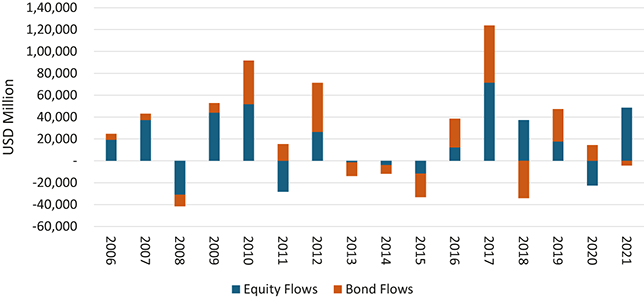
The final major transformation, which we would like to highlight on the liability side, is the increased availability of swap lines for DECs, both from the two major economies (the US and China) and/or other DECs (particularly India and the Gulf states) (L6). Currency swaps originated in the 1960s as a tool for the US Federal Reserve to manage global dollar liquidity in coordination with other major central banks (Bordo, Humpage, and Schwartz Reference Bordo, Humpage and Schwartz2015, Pape Reference Pape2022). Their use expanded in the 2000s, especially after the 2008 GFC. Swaps involving the Fed serve various purposes: alleviating FX liquidity pressures by providing US dollars (Goldberg, Kennedy, and Miu Reference Goldberg, Kennedy and Miu2011), particularly in countries where US banks are heavily exposed (Aizenman and Pasricha Reference Aizenman and Pasricha2010); supporting countries with open capital accounts; and advancing economic and diplomatic objectives (Sahasrabuddhe Reference Sahasrabuddhe2019). For China, swaps primarily aim to increase trade and investment relations and promote the internationalisation of the Renminbi (Destais Reference Destais2016). Currency swaps benefit not only the ‘major’ central bank but also provide critical liquidity and policy space to the ‘minor’ or recipient central bank. However, as will be shown in the following, such arrangements also reinforce the dominant role of the US dollar in the international monetary system.
In sum, while some of the traditional manifestations of IMFS still hold in many DECs (including substantial central government indebtedness in foreign currency), their liability side – that is, the way they access external financing – has become more varied in terms of actors, instruments, behaviour, and underpinning infrastructures.
Assets
The transformations on the international asset side of DECs are equally important, and show that several DECs have managed to create new kinds of externally accepted assets.
The built-up of reserve stocks after the East Asian crisis is already well documented, mainly as a ‘self-insurance’ policy (Aizenman and Lee Reference Aizenman and Lee2007, Alberola, Erce, and Serena Reference Alberola, Erce and Serena2016, Arce, Bengui, and Bianchi Reference Arce, Bengui and Bianchi2019). The average reserves-to-GDP ratio in DECs increased from 8 per cent in 1980 to 21 per cent in 2020 (Benigno, Fornaro, and Wolf Reference Benigno, Fornaro and Wolf2022: 1).
So far, less explored changes on the international asset side of DECs– in particular from an IMFS perspective – happened in the portfolio and other investment assets flows. Figure 3 presents the evolution of bank and portfolio asset outflows from DECs. The countries that we include in this graph are those labelled as ‘Emerging and Developing Economies’ by the IMF. The graph shows that, on the one hand, bank asset outflows have generally dominated portfolio asset outflows, but with greater volatility. However, portfolio asset outflows have observed a steady upward trend throughout the twenty-first century, and in 2022 even surpassed bank asset outflows. After 2008, portfolio asset flows were mostly invested in equity markets (Akyuz Reference Akyuz2021).
DECs external assets
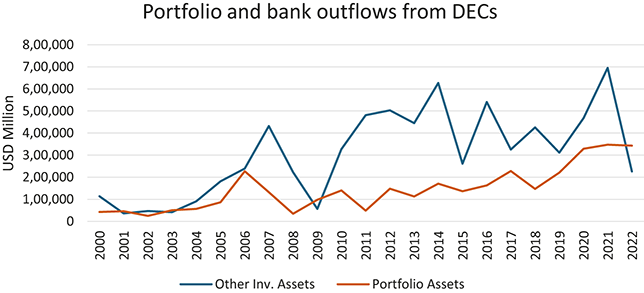
It is interesting to observe that banking and portfolio asset flows show a significant correlation with similar liability flows (Broner et al. Reference Broner, Didier, Erce and Schmukler2013, Davis and Van Wincoop Reference Davis and Van Wincoop2018, Avdjiev et al. Reference Avdjiev, Hardy, Kalemli-Ozcan and Servén2022). This correlation might be partly explained by ‘double-bookkeeping entry’ – a bank that sits on the other side of the investment, and takes the FX-deposit, now has an FX asset (see Kohler (Reference Kohler2022) for an explanation of the accounting records) –, but more broadly, the mentioned correlation implies that investors from DECs are at least as active as investors from developed countries, and may even behave differently. In particular, when developed countries’ investors flow into DECs, investors from DECs may flow out. This correlation is in fact consistent with the importance of global financial conditions in driving financial conditions in DECs. That is because DECs’ investors can invest abroad (i.e., outflows) only when global conditions ease and funding (i.e., inflows) is available.
Turning to the rise of investors from DECs, we look first at what banks have been doing, and then explore the rise of institutional investors from DECs and other actors. We rely on data from the Bank for International Settlements (BIS), which are the most widely available data at hand. The Locational Banking Statistics (LBS) and the Consolidated Banking Statistics (CBS) of the BIS show the foreign activities of resident (LBS) and national banks (CBS) of a selected number of DECs, respectively. LBS data, presented in Figure 4, shows an increase in the cross-border claims (assets) of resident banks in significant DECs (A2), including Brazil, Chile, India, Indonesia, South Korea, Malaysia, Mexico, South Africa, and Türkiyë. The residency criteria in LBS data includes in these numbers branches of foreign banks settled in DECs.
Cross-border claims of resident banks of selected DECs
Notes: South Korean numbers are scaled on the right-hand side vertical axis, because they dwarf the other countries.
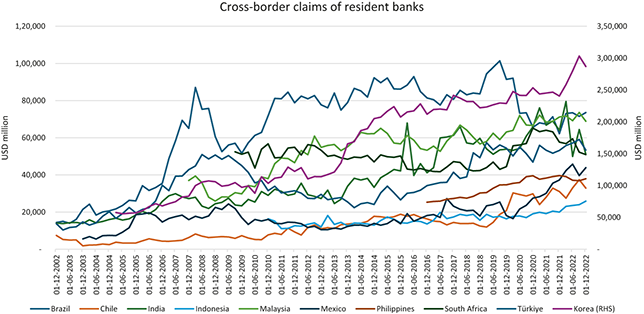
Furthermore, CBS data, which records data by nationality of the investing bank and which is even scarcer for DECs, show that for those countries which have data (Brazil, Korea, India, Türkiye, and Chile), banks not only increased their direct claims against other countries, but also their own branches and affiliates abroad. As a result, they hold significant foreign assets in the domestic currencies of their host affiliates and branches. It can be said that for these DECs, their banks managed to create financial assets and liabilities that were accepted internationally. Mizes and Donovan (Reference Mizes and Donovan2022) and Appel (Reference Appel2023) report that this development has also been true for Moroccan, Nigerian, and South African banks, which have expanded their lending activities throughout the African continent.
It is not only DEC banks that have started to expand abroad, but also institutional investors such as pension funds and – particularly important for DEC economies – sovereign wealth funds have become crucial players in global financial markets (A3) (Debarsy, Gnabo, and Kerkour Reference Debarsy, Gnabo and Kerkour2017, Cuervo-Cazurra, Grosman, and Megginson Reference Cuervo-Cazurra, Grosman and Megginson2023). Pension funds are generally private institutions, but also very often – peculiar to DECs – financial investors related to the State, a phenomenon summarised in the recent ‘state capitalism literature’ (see e.g., Alami and Dixon Reference Alami and Dixon2024 for an overview). For illustration purposes, counting five Asian economies (China Taipei, Korea, Malaysia, Philippines, and Thailand), in 2020 these portfolio investments reached 40 per cent of their GDP (McGuire et al. Reference McGuire, Shim, Shin and Sushko2021: 55–56). As an example of public outflows, as of 2024, sovereign wealth funds had USD 12.9 trillion in assets (Megginson, Malik, and Zhou Reference Megginson, Malik and Zhou2023, see as well https://globalswf.com/). There are several DECs that hold SWF in excess of USD 10 bn, including Türkiyë, Malaysia, Ethiopia, Uzbekistan, Chile, and Indonesia. If we are talking about public pension funds (PPFs), the list of DECs with major PPFs includes South Korea, Malaysia, India, South Africa, Thailand, Brazil, and Indonesia, all with PPFs in excess of USD 60bn, and with assets of USD 2 trillion, just counting the PPFs from these seven countries.
In sum, in addition to more ‘passive’ reserve accumulation, we presented evidence that some financial systems from DECs (through banks, pension funds, SWFs, and other investors) managed to create externally accepted financial assets and liabilities, changing the interrelationship of balance sheets between units in their countries and abroad. Next, we will provide some brief reflections on the potential implications these changes might have had for their IMFS.
3.3 Implications for IMFS
It is important to understand why we can still talk about IMFS amidst these changes. Based on our definition of IMFS and our theoretical framework, it follows that IMFS manifests itself as a hierarchical and evolving interrelationship of balance sheets between different units of different countries, many of which operate in multiple jurisdictions. It expresses itself both as a cyclical vulnerability to financial flows largely determined by international financial markets, and a risk-return distribution which disproportionally rolls over the risk to DECs. It is time to analyse whether and how the transformations in DECs financial integration discussed earlier, have altered these two key characteristics of IMFS.
Regarding the first characteristic, that is the disproportionate importance of ‘push’ factors that determine DECs actors ability to create internationally accepted assets and liabilities, this cyclical dependence of externally determined financial flows has not changed. While creating some more freedom for domestic policy, the rise of non-resident investors in local currency markets has increased the sensitivity of these flows to international financial markets. As discussed in Section 2, this is so because unhedged local currency investments – funded in foreign currencies – shift the currency mismatch to the international investors making them more sensitive to expected exchange rate changes and international funding conditions (Kaltenbrunner and Painceira Reference Kaltenbrunner and Painceira2015, Carsten and Shin Reference Carsten and Shin2019, Hofmann, Patel, and Wu Reference Hofmann, Patel and Wu2022, de Paula, Fritz, and Prates Reference De Paula, Fritz and Prates2025).
This pro-cyclicality and sensitivity to international market conditions have potentially further deepened with the rise of new financial investors. For example, Bonizzi and Kaltenbrunner (Reference Bonizzi and Kaltenbrunner2024) show that the increased exposure of large asset managers to DEC assets can increase their sensitivity to international market conditions due to phenomena such as index trading, global portfolio allocation, and the role DEC assets play in asset manager clients’ trading strategies (as growth assets to generate return). Asset managers are more sensitive to global conditions because they are more leveraged in US dollars, independently of the funds’ headquarters or investing country. In a similar vein, there is evidence that the rise of institutional investors can increase DECs’ external vulnerability. First, the investment flows of these different investors from DECs are correlated and amplify each other, interacting with asset prices (McGuire et al. Reference McGuire, Shim, Shin and Sushko2021: 63). Second, some of these investments are hedged against FX risk, but FX hedging supply (by international lenders and domestic institutions as well) can dry out (as it did during the beginning of the Covid pandemic), triggering increased FX demand (Vissing-Jorgensen Reference Vasudevan2021).
At the same time, in contrast to global banks, asset managers have no direct access to the FED as global lender of last resort, which further increases their sensitivity to international (dollar) funding conditions. In a similar vein, the rise of short-term domestic currency assets, such as derivatives and currencies, has increased DECs’ vulnerability to international market conditions as non-resident investors do not need to roll over their holdings (Bortz and Kaltenbrunner, Reference Bortz and Kaltenbrunner2018). Arguably, the currency swap lines used in 2008 and in 2020, did little to change these dynamics. Instead, they further strengthened the global hegemony of the US dollar and the Federal Reserve, because they established new and reliable channels for supplying, in times of need, the means to meet FX commitments denominated in US dollars (Tooze Reference Tooze2018, Pape Reference Pape2022).
Regarding the second dimension of IMFS, the distribution of risks and returns, DECs have managed to issue new externally accepted liabilities, which changes the way that value is transferred or risks are carried. For instance, it was previously unimaginable that DEC governments were able to issue external debt in their domestic currency, with investors bearing currency risks. However, these issuances have come at higher returns; that is, DECs had to compensate non-resident investors for the higher currency risk they are taking (Gadanecz, Miyajima, and Shu Reference Gadanecz, Miyajima and Shu2014). Evidence shows that whatever funding pressure or stress there is in global markets, investors will withdraw and transfer the costs to borrowers, if they keep lending at all (Onen, Shin, and von Peter Reference Ocampo and Malagon2023, Bertaut, Bruno, and Shin Reference Bertaut, Bruno and Shin2024, De Paula, Fritz, and Prates Reference De Paula, Fritz and Prates2025). The Covid pandemic provided a clear example of these dangers (Bortz, Michelena, and Toledo Reference Bortz, Michelena and Toledo2020). The increase in borrowing costs for DECs (even in domestic currency) at the outset of the crisis was significantly greater in countries that had a larger presence of foreign investors in LCBM (Hofmann, Shim and Shin Reference Hofmann, Shim and Shin2020, Hördahl and Shim Reference Hördahl and Shim2020).
The changes on the asset side imply that some DECs have managed to create externally accepted financial assets, that is, to lend abroad (Pape and Petry Reference Pape2024). As discussed in Section 2, this capacity to create internationally accepted assets could reduce IMFS for two reasons: First, it puts DECs on the receiving end of value transfer and could create the possibility to determine the terms and conditions (i.e., the risk-return trade-off) of these operations. Second, they could be used during periods of financial turmoil to meet external obligations. This is most obvious in the context of FX reserves, which are thought to act as a liquidity cushion, but could also apply to relatively liquid private external asset holdings.
Though much more research is needed in this area, there is growing evidence that DECs’ recent creation of international assets has not yet fundamentally altered global structures of IMFS. Regarding the distribution of risk and returns, at least on the macroeconomic level, many of the external assets accumulated by DECs continue to generate lower returns than what they pay on their external liabilities (Akyuz Reference Akyuz2021). They might also be differently positioned in the distribution of risks: As discussed previously, whereas DECs liabilities have been increasingly dominated by bond issuances, their assets have been more located in equities. However, whereas bonds promise a steady payment of interest, equities are dependent on the economic conditions in the recipient economy, both regarding currency movements and economic activity more generally.
Moreover, the internationalisation of DEC banking systems and other financial institutions is mediated by the US dollar, losing degrees of autonomy – that is, independence of the global financial cycle. In other words, there is evidence that DECs financial actors invest abroad (in dollars or in the domestic currency of the recipient economy) when affordable US dollar funding is available, rather than when domestic (or international) demand conditions call for it (Aldasoro and Ehlers Reference Aldasoro and Ehlers2018, Mizes and Donovan Reference Mizes and Donovan2022, Appel Reference Appel2023). Thus, while increasing the returns they can generate on their financial assets (in contrast to FX reserves), there is the danger that US dollar funding may disappear, or investments may fail. For instance, the largest jump in the international expansion of cross-border claims by DEC’ banks happened at times of substantial global liquidity (in the early 2010s), and oscillated with international liquidity conditions. A dry-out of US dollar funding for hedging in 2020 created a dollar demand by DECs institutional investors that had expanded and lent abroad (McGuire et al. Reference McGuire, Shim, Shin and Sushko2021). In turn, this heightened dollar demand put pressure on their central banks, and ultimately on the world’s safe asset, the US Treasury bills, forcing the Federal Reserve to intervene in the market through sales of US dollars and swap lines, among other instruments (Visssing-Jorgensen Reference Vasudevan2021). The lesson is clear: Even if institutions from DECs manage to lend and invest abroad (potentially, a good thing), this depends on the international availability of US dollars. Furthermore, the way they acquire these dollars or the way they hedge from FX risks is of great concern for these institutions, but also for authorities.
This borrowing and lending abroad ultimately influences lending and borrowing domestically. For instance, Hardy and Saffie (Reference Hardy and Saffie2024) external borrowing by NFCs was linked to these firms providing domestic, trade credit, denominated in domestic currency (therefore, taking FX risk). When global conditions tighten, this borrowing creates another channel for adverse impact on economic activity and investment. In turn, volatility in the participation of foreign investors in LCBM has impacted domestic interest rates for domestic credit (BIS 2022). Finally, these changes have crucial implications for the structure of domestic capital accumulation. The entity that can access international markets has an advantage over those who cannot. Who borrows and for what reasons has an influence on domestic economic activity and on public policy, on the productive profile, on power, and on inequality. As mentioned earlier, major borrowers are typically large companies (usually, commodity exporters) and banks, who can generally hedge against (FX) risk. However, when they face financial pressures, they cut on investment and employment. Given their importance, they may even pressure the State to rescue them and nationalise their debt during recessions and global financial retrenchments.
In sum, the two key characteristics of IMFS highlighted in this Element, – the dependence on international market conditions and the disproportionate risk of cross-border operations for DECs actors – still seem to be firmly in place. Developing and emerging countries still remain in a subordinated position, because of the higher yields they pay, because their exposure to global financial conditions is still significant, and because their fate is still tied to the US dollar. Many DECs even retain the traditional manifestations of IMFS (such as substantial central government indebtedness in foreign currency). However, the important transformations in the financial integration of DECs have the potential to improve their position in the IMFS, and in some cases, they already did. Next, we provide some heterogeneous examples.
3.4 A Variety of Country Cases
We have shown above that DECs have undergone structural changes in the nature of their financial integration. However, not all DECs experienced these transformations to the same extent. Below we review some selected country case studies with a variety of experiences, which one could consider a spectrum of the IMFS. Argentina is an example of a country that has had numerous crises and barely witnessed these transformations at all. Brazil, Argentina’s neighbour, experienced numerous crises, but had a much better external profile and displayed many of the transformations mentioned above. Malaysia also went through favourable changes in its position in the IMFS in recent decades, building resilience to external shocks, and improving its external balance sheet. Türkiye, in turn, experienced periods of expansion and periods of significant stress on its domestic and external performance. Table 1 sums up how the list of transformations mentioned in the introduction manifested (or not) in each of these countries.
| Malaysia | Brazil | Turkey | Argentina | |
|---|---|---|---|---|
| L1: Increase of portfolio flows | Yes, during 2003−2012. Afterwards, close to zero. | Yes, during 2005−2014. Afterwards, close to zero | Yes, during 2005−2014. Later, close to zero. OI inflows grow 2019−2023 | Yes, only during 2006−2007 and 2016−2018. Otherwise, no inflows. |
| L2: Non-resident investors in LCBM | Yes, in line with the Global Financial Cycle | Yes, in line with the Global Financial Cycle | Yes, until 2013. Then falling, and negligible | Only during 2017−2018. |
| L3: External debt of NFCs | Yes, along with public sector and banking sector | Yes, mainly through off-shore affiliates | Yes, until 2014. | Yes, but limited, only during 2017−2018. |
| L4: Asset managers & new instruments | Yes, until 2013 | Yes, until 2014 | Yes, until 2014 | Yes, but limited, only during 2017−2018 |
| L5: Swap lines | Yes, with China, Korea, Japan, and CMIM | Yes, with the US (in 2008 and 2020) and with China | Yes, with China and Qatar | Yes, with China |
| A1: FX reserves | Yes | Yes | Yes, until 2018. | Yes, until 2011. |
| A2: Outflows by banks | Yes, through cross-border claims | Yes, until 2016 | Yes, until 2010. | No |
| A3: Outflows by other institutions | Yes, by SWF, pension funds and insurance companies | Yes, by its National Development Bank. Not significant by the private sector | No | No |
Regarding L1, in the Malaysian, Brazilian, and Turkish cases, they experienced important inflows right before and years after the GFC in 2008, of around 8, 5, and 6 per cent of GDP, respectively. In the Malaysian and Brazilian cases, there was a predominance of portfolio inflows, while in the Turkish case, the leadership between other investment (bank) and portfolio flows shifted from year to year. Around 2014, inflows stopped, in line with changes in the global financial cycle (Aldasoro et al. Reference Aldasoro, Avdjiev, Borio and Disyatat2023). In the case of Türkiye, however, the country received significant inflows between 2021 and 2023 (over 4% of GDP per year) in the form of bank loans, mainly from Gulf countries like Qatar.
Argentina, in turn, had portfolio inflows in 2006 and 2007, never above 4 per cent of GDP. Afterwards, it had zero portfolio inflows and low other investment inflows (mainly because of loans by multilateral institutions). The explanation is that it was cut out of international markets due to the long-lasting conflict with ‘vulture funds’, that is, bondholders who did not accept the debt restructuring proposals from the 2001 debt default (Guzman Reference Guzmán2020). Argentina had only one brief and acute period of active external borrowing, from 2016 to 2018 (over 6% of GDP in those years), both through the public and the private sector, which culminated in a severe crisis in 2018 (Bortz, Toftum, and Zeolla Reference Bortz, Toftum and Zeolla2021). Therefore, it can be said that Argentina missed almost completely the L1 transformation.
Regarding L2, in the Malaysian and Brazilian cases, both the public, and the private financial and non-financial sectors were involved as bond debtors. In the case of the public sector of these two countries, foreign participation in LCBM increased after the 2008 GFC and decreased in the late 2010s in line with the global financial cycle (Arslanalp and Tsuda Reference Arslanalp and Tsuda2014b). Türkiye also experienced a larger participation of foreigners in LCBM, but these investors were completely gone at the end of the 2010s. Argentina saw them briefly during 2016–2018: the sudden flight from these investors is one of the factors responsible for triggering the mentioned 2018 crisis.
In terms of L3, NFCs from Malaysia, Brazil, and Türkiye were heavily involved as borrowers in international bond markets in the early 2010s. In the Brazilian case, however, some of that borrowing is not reflected in portfolio flows, but in foreign direct investment debt flows, because it was obtained through offshore affiliates of Brazilian companies (Biancarelli, Rosa, and Vergnhanini Reference Biancarelli, Rosa, Vergnhanini, Arestis, Baltar and Prates2017), a reflection of the inadequacy of the ‘island view’ or the ‘Westphalian approach’ to international finance. In fact, intercompany loans grew from USD 20 billion in 2006 to USD 100 billion in 2010 and USD 200 billion in 2015 (Biancarelli, Rosa, and Vergnhanini Reference Biancarelli, Rosa, Vergnhanini, Arestis, Baltar and Prates2017: 119). The share of external debt owed by NFCs in Brazil increased from 20 to 25 per cent in just five years, between 2010 and 2015 (Gottschalk and Torrija-Zane Reference Gottschalk, Torija-Zane, Arestis, Baltar and Prates2017: 180). In the case of Türkiye, it experienced the second-largest increase in total NFCs’ debt of all DECs between 2007 and 2014, as per the IMF (2015). It is important to mention as well the behaviour of its banking sector. During the early 2010s, the banking system increased its cross-border borrowing through loans, deposits, and repos to the tune of an accumulated amount of USD 141 billion in 2014 (Alper et al. Reference Alper, Altunok, Çapacıoğlu and Ongena2020, Sümer and Özyildirim Reference Sümer and Özyildirim2021). Banks were also active borrowers in the Malaysian case, as was characteristic of the whole region. As with the previous transformations, Argentina’s external borrowing by NFCs in this period was small and short-lived, between 2016 and 2018.
The involvement of asset managers (L4) shows the same temporal pattern: EPFR data shows that it was significant until 2014, and then it waned away, both in Malaysia and Brazil, but not in Türkiye. In the case of Argentina, they only came in 2016, and by mid-2018, they were already gone.
Finally, in terms of central bank swap lines (L5), Malaysia has standing agreements with regional partners through the Chiang Mai Initiative Multilateralization – CMIM (Hoffner Reference Hoffner2023), though that line was never executed because it requires IMF or IMF-style programme as a condition for substantial borrowing. Instead, Malaysia drew on its independent swap lines with China during the Covid shock. Brazil, in turn, obtained a currency swap line with the Federal Reserve in 2008 and 2020, and signed a swap agreement with China in 2013. The swap lines with the Fed, in particular, helped to stop exchange rate depreciations and improved borrowing terms right in the middle of the GFC in 2008 and the Covid shock in 2020. In 2018, Türkiye signed a swap agreement with Qatar. The Central Bank of the Republic of Türkiye initiated a series of currency swap agreements with other central banks, such as Korea (signed in 2021) and the United Arab Emirates (signed in 2022) (Orhangazi and Yeldan Reference Orhangazi and Yeldan2023). Argentina has had a swap line with China since 2009 and obtained a swap line with the US Treasury in 2025.
When reviewing the transformations in the asset side of the balance of payments, one first notices that all four countries managed to build substantial FX reserves, up until the mid 2010s (A1). However, while Malaysia and Brazil managed to maintain high levels of FX reserves, Türkiye consumed its reserves particularly in 2019–2020, when around $128bn were sold to stabilise the lira against the dollar (Afanasieva Reference Afanasieva2021), making use of the mentioned currency swap arrangements as well as the banking sectors’ required reserves of foreign currency to finance its market interventions in 2021 and 2022. Argentina, in turn, lost FX reserves in the early 2010s, because it experienced a worsening performance in the current account while being excluded from international debt markets due to the mentioned dispute with vulture funds. Argentina did accumulate FX reserves during 2016 and 2017 because of external borrowing, but it was a short-lived experience.
In terms of transformation A2, one can quickly say that it did not happen in Argentina: its banks did not expand internationally. The opposite is the case in Malaysia. Cross-border claims of Malaysian banks kept on increasing through this period, as shown in Figure 4. The outward internationalisation of the Brazilian banking system was significant until the mid 2010s, but then it came to a halt, matching a tightening in international financial conditions. In the case of Turkish banks, they experienced a substantial increase in cross-border claims in the late 2000s. However, this expansion came to a halt in 2014, and their claims were greatly reduced, which coincided with a phase of political instability that culminated in Turkey’s 2016 coup attempt. In the period from 2018 to 2022, activity in the bank and corporate sectors diminished compared to the previous period, reflecting more challenging external conditions and growing domestic turbulence, reflected for instance, in high inflation rates (see Orhangazi and Yeldan, Reference Orhangazi and Yeldan2023).
Transformation A3 was only recorded for Malaysia and (partly) Brazil. Like other DECs, Malaysia profited from improved terms of trade and rents from commodity sectors during the period 2003–2008 (O’Sullivan and Rethel Reference Nguyen, Casto and Wood2023), and established Khazanah Nasional, its sovereign wealth fund (SWF). In 2023 it had a net asset value of USD 18 billion, having only recorded one year in which this indicator diminished (2022). Relevant to this work is that its share of investment by this SWF outside Malaysia had a steady increase in the last few years, from 25 per cent in 2018 to 40 per cent in 2023 (data taken from the website). Some of these outward investments qualify as foreign direct investment, but others are investments in financial markets. Pension funds, insurance companies, and other financial institutions also increased their foreign operations (McGuire et al. Reference McGuire, Shim, Shin and Sushko2021).
In the case of Brazil, we will mention in the next section the international expansion of its national development bank (BNDES). There have been growing volumes managed by Brazilian pension funds, but these have not materialised significantly into external investment (FundPro 2024). Finally, it is interesting to mention the experience of Brazil’s sovereign wealth fund, the Fundo Soberano do Brasil (FSB). Established in 2008, the FSB aimed to promote domestic and foreign investments and mitigate economic crises (Peaucelle Reference Pataccini2010). However, the fund was gradually depleted to balance public accounts, and by 2018, it had no resources left, leading to its closure in 2019 (CFI 2023).
In 2016, Turkey set up an SWF, but it was primarily aimed at attracting foreign investors on the liability side rather than encouraging cross-border activity on the asset side (cf. Orhangazi and Yeldan Reference Orhangazi and Yeldan2023). Its pension system did not actively engage in cross-border activities (Bonizzi and Guevara Reference Bonizzi, Guevara, Rochon and Monvoisin2019). Finally, Argentina missed entirely on this transformation.
All four economies considered remain exposed to the cyclical dynamics of global financial conditions, although their distinct trajectories reveal different levels of vulnerability to the pro-cyclicality of IMFS. Argentina and Turkey display the starkest and most traditional forms of IMFS in relation to push factors: both experienced sharp capital outflows during periods of tightening global liquidity, forcing them to draw down reserves and impose FX controls or seek bilateral support. Malaysia and Brazil, by contrast, made better use of favourable international conditions to build buffers, accumulating FX reserves and extending their debt maturities, which helped them avoid the severe haemorrhaging seen elsewhere. Yet even in these cases, integration into global markets was not entirely autonomous: Brazil’s exposure to commodity cycles and Malaysia’s reliance on continued investor confidence meant that external conditions still dictated the direction and intensity of capital flows. Across all four cases, the dominance of the US dollar – both as a funding and invoicing currency – meant that external conditions, rather than domestic fundamentals, largely set the rhythm of capital flows.
Regarding the distribution of risks and returns, the contrasting country experiences reveal that diversification of external assets and liabilities, and sectoral shifts in creditor-debtor positions, can improve the position in the IMFS, even if these countries still remain subordinated. Malaysia and Brazil made some progress in shifting parts of the risk onto international investors, notably by increasing local-currency debt issuance and creating external assets through public and semi-public institutions, such as sovereign wealth funds and state-linked banks. While still requiring a risk premium, these measures allowed for a modest repositioning in the international hierarchy. However, these transformations went unnoticed in Argentina, and were only temporarily secured in Turkey. In the former, external liabilities remained largely dollar-denominated and were concentrated in the public sector, while the accumulation of external assets was confined to elite households investing abroad, leaving the sovereign exposed to recurring crises. Turkey, for a time, appeared to diversify its creditor base and sustain inflows, along with expanding its LCBM and domestic banks’ cross-border footprint. However, much of the country’s financial integration remained reliant on short-term, foreign-currency funding, leaving both the sovereign and banking sectors exposed to rollover and currency risks that re-emerged during episodes of global tightening, with the public sector bearing the brunt of adjustment.
While country-specific factors – such as political cycles, geopolitical alignments, or domestic policy decisions – shaped how these dynamics played out, common driving factors in these experiences can be isolated. A key element in the more successful cases was the implementation of policies that reinforced investor confidence in the state’s capacity to meet short-term external commitments – whether through refinancing or repayment on reasonable terms. This credibility proved partially self-fulfilling: where investors believed the country could honour its obligations, they continued to lend on more favourable terms. Ultimately, sectoral differentiation was also key. Where external assets were held by domestic public institutions, as in Malaysia or Brazil, some risks were socialised and value retained, improving the country’s position in the international monetary and financial hierarchy. Where liabilities were concentrated in the public sector and assets in private offshore portfolios, as in Argentina and increasingly Turkey, the public borne the costs while private agents insulated themselves, reinforcing the subordinated character of these economies. Therefore, there are feedbacks between the position in the IMFS and the policy space to implement autonomous macroeconomic policies. Governments in DECs are constrained by the IMFS, but at the same time, policies can have an influence on the position in the IMFS. The analysis of these constraints and interactions is the topic of Section 4.
4 IMFS and Macroeconomic Policies
4.1 Introduction
As discussed in the previous sections, DECs’ subordinated position in the international monetary and financial hierarchy requires them to offer attractive risk–reward combinations and leaves them exposed to external vulnerabilities, both of which fundamentally impact their macroeconomic policy space. This impact operates through different channels and varies according to countries’ hierarchical positions. For example, the extent to which DECs can fully float their exchange rates – and thus prioritise domestic monetary policy objectives – fundamentally depends on their vulnerability to volatile international financial flows.
To deal with the specific macroeconomic policy challenges imposed by the IMFS, international organisations such as the IMF and the BIS have promoted standard macroeconomic policy frameworks intended to guide policymaking in DECs. Though increasingly cognisant of the risks posed by financial integration itself, these frameworks largely maintain the view that the benefits of private cross‑border capital flows outweigh the costs, which should be mitigated through credible inflation‑targeting regimes, managed exchange rates, and a combination of reserve accumulation and macroprudential regulation.
According to Armijo and Katada’s work on financial statecraft (e.g., Reference Armijo and Katada2015), these measures are largely ‘reactive’ and ‘bilateral’, seeking mainly to limit the negative implications of IMFS. These are measures by which a country tries to ‘influence or defend against the choices’ of another state or even global conditions (Armijo and Katada Reference Armijo and Katada2015: 47). Exchange‑rate management and capital‑account regulations are examples of such measures. When successful, they can reduce the negative implications of IMFS and create some policy space to adopt more ‘assertive’ – potentially even ‘systemic’ – policies aimed at altering the structure of the international monetary and financial system and DECs’ position within it. Among these latter measures, one can highlight the accumulation of external assets, highlighted in this Element.
Indeed, country experiences show that the policies promoted by the frameworks of the IMF and the BIS do not always provide the macroeconomic conditions needed for sustained structural change reflective of genuine development. As a result, and with varying degrees of autonomy and success, DECs have diverged from the dominant macroeconomic policy frameworks to confront the constraints imposed by the IMFS through more ‘offensive’ policy measures. Analysing the policy constraints imposed by IMFS, the dominant international policy frameworks designed to address these constraints, and DECs’ experience and variations of these frameworks, is the topic of this section.
In line with this remit, we first review the channels of influence and constraint that the IMFS imposes on DECs’ macroeconomic policymaking. We then present the two dominant macroeconomic policy frameworks promoted by the IMF and BIS, followed by a Minskyan‑informed critique. Afterwards, we contrast these frameworks with the actual policies implemented by selected DECs, which have had very different IMFS experiences over the past few decades. The objective is not only to contrast experiences but also to reflect on the appropriateness of mainstream policy frameworks in dealing with the empirical manifestations of IMFS, such as external shocks and vulnerabilities, and in promoting sustainable development.
4.2 IMFS and the Constraints on Macroeconomic Policies in DECs
In line with our characterisation of IMFS, the constraints on macroeconomic policies can have a cyclical nature – depending on international financial market conditions – and a structural character arising from how risks and rewards are distributed. Moreover, these constraints are fundamentally intertwined and feed into each other. For example, the way a government reacts to a crisis may condition its response to subsequent ones, gradually shaping structural constraints that, in turn, affect its capacity to manage future external shocks. Similarly, agents may retain the memory of crisis experiences and adapt their behaviour accordingly, developing new conventions, rules, and institutions that give rise to more structural constraints. For instance, prices may begin to be denominated in foreign currency, and savings in foreign currency (and abroad) may increase. While completely ‘rational’ from an individual or national standpoint, these responses may further reduce a country’s resilience to external shocks.
Given our focus on monetary and financial dynamics, we start our analysis by examining the constraints IMFS imposes on monetary policy making, that is, the setting of interest rates. Regarding the cyclical dimension of IMFS, historical evidence shows that, whereas governments in developed countries can manage their interest rates counter‑cyclically, DECs do not have that luxury. When international financial conditions are loose, developed countries raise interest rates to avoid excessive credit expansion, and vice versa under tighter liquidity conditions. By contrast, DECs have traditionally been forced to raise their interest rates during periods of tightening liquidity or actual financial crisis in order to attract foreign capital or discourage capital flight. More generally, interest‑rate decisions in DECs are fundamentally influenced by monetary policy decisions in developed economies, particularly the US. For example, when developed countries raise interest rates, DECs often feel compelled to do the same for fear of losing capital.
Recent evidence suggests a shift in monetary‑policy dynamics, though with important nuances across countries and between types of interest rates. De Leo, Gopinath, and Kalemli‑Ozcan (Reference De Leo, Gopinath and Kalemli-Ozcan2024) show that DECs have become increasingly willing to lower policy rates during economic slowdowns, even when these slowdowns stem from US monetary tightening. However, this countercyclical flexibility applies primarily to policy rates. In practice, market rates often rise at the very same time, particularly when slowdowns coincide with capital outflows and exchange‑rate depreciation. Because banks in many DECs rely heavily on foreign funding, their funding costs increase when global conditions tighten, causing lending rates to move in the opposite direction from the policy stance. Hoffmann, Shim and Shin (Reference Hofmann, Shim and Shin2020) further emphasise that the growing weight of foreign investors in domestic debt markets amplifies this divergence. During periods of large capital outflows, depreciating exchange rates and widening bond spreads push market borrowing costs upward, thereby weakening – and at times severing – the transmission from policy rates to market rates.
Regarding the structural dimension of IMFS, there is evidence that DECs must offer structurally higher interest rates to compensate for perceived higher risks (De Conti, Prates, and Plihon Reference De Conti, Prates and Plihon2014, Almeida Oliveira and De Conti Reference Almeida Olivera and De Conti2025). For example, Almeida Oliveira and De Conti (Reference Almeida Olivera and De Conti2025) show that, across the 2000–2023 period, peripheral economies had to offer significantly higher yields on external liabilities due to the illiquidity and subordinate status of their currencies. This results in a persistent transfer of wealth to financial centres, reinforcing patterns of dependency and financial subordination. Although policy rates declined in DECs during the Covid shock, they still remained significantly above those offered by developed countries, thus maintaining an attractive risk-return profile for foreign investors (Dafe et al. Reference Dafe, Kaltenbrunner, Kvangraven and Weigandi2023).
The second key element of macroeconomic policymaking in DECs is exchange‑rate management. Whereas developed countries have the luxury of floating their exchange rates, this is not the case for DECs. These countries need to manage their exchange rates to avoid excessive volatility – the so‑called ‘fear of floating’ (Calvo and Reinhart Reference Calvo and Reinhart2002) – and often need to do so particularly in the context of tightening international liquidity or crises. Moreover, to avoid excessive exchange‑rate volatility, many DECs – where possible – have accumulated a war‑chest of foreign‑exchange reserves to protect themselves against sudden capital outflows (Benigno, Fornaro, and Wolf Reference Benigno, Fornaro and Wolf2022). Regarding the structural dimension of IMFS, as discussed in previous sections, a key characteristic is the rolling over of exchange‑rate risk onto DEC agents through foreign‑currency debt and significant currency mismatches on domestic balance sheets. This makes the exchange rate a crucial determinant of financial stability in DECs. Evidence also shows that exchange‑rate volatility negatively affects debt maturity (Bussière, Fratzscher, and Koeniger 2004), credit supply, and macroeconomic variables such as exports (Lin, Shi, and Ye Reference Lin, Shi and Ye2018). Thus, exchange‑rate management is a necessity for both cyclical and structural reasons in previous and new forms of IMFS.
Besides adjusting interest rates, managing exchange rates, and building up FX reserves, countries resort to macroprudential policies and capital‑control measures to manage the destabilising implications of IMFS. On the cyclical side, macroprudential policies seek to prevent the build‑up of domestic credit booms in times of large foreign inflows, while capital controls aim to mitigate surges of inflows and outflows. Macroprudential policies and capital controls – nowadays referred to as ‘capital‑flow management measures’ – also aim to improve the resilience of the domestic financial sector, and thus reduce the dependence on volatile external financing. For example, both capital controls and macroprudential tools can prevent or mitigate the emergence of FX vulnerabilities in the domestic financial system, thereby strengthening its resilience to global financial shocks and maintaining its ability to provide stable, local financing. Banking regulation for home and international activities of domestic banks is necessary to attenuate the impact of potential setbacks in their international expansion.
However, IMFS and the unstable nature of international financing also fundamentally undermine the ability of DECs’ to implement industrial policies aimed at structural transformation. Given depreciation pressures and the structural need for foreign exchange, there is pressure to promote existing exporting sectors (such as commodities or tourism) and less patience for diversifying the export basket and industrialising. The difficulty of diversifying the economy is further constrained by the high cost and lack of domestic financing. Yet this pressure for export specialisation makes the economy more vulnerable to external price shocks and global recessions (Prebisch Reference Prebisch1950, Thirlwall Reference Thirlwall2013), thus further exacerbating IMFS. And although commodity exporters may find it easier to hedge against risk and secure financing – given that they often represent major, ‘systemic’ firms in DECs – their difficulties significantly affect domestic investment, activity, and employment.
The above discussion illustrates how IMFS constrains macroeconomic policymaking in DECs and how these countries devise policy measures to manage the potentially devastating implications of their international subordination, such as structurally higher interest rates, reserve accumulation, and a wide range of capital‑account management tools. These policies can be usefully assessed through the framework of ‘financial statecraft’ developed by Armijo and Katada (Reference Armijo and Katada2015: 47), which distinguishes between assertive and reactive strategies in character, and bilateral and systemic strategies in scope – providing a relevant parallel for analysing how states employ cross‑border financial tools to pursue strategic objectives. From this perspective, many of the measures adopted by DECs exhibit reactive and bilateral traits, largely aimed at dealing with the most pernicious implications of IMFS, particularly with regard to FX shortages.
However, some countries also adopt strategies with more assertive and potentially systemic features, aiming not merely to manage but to recalibrate their position within the international monetary hierarchy. These include outward financial engagements such as lending abroad, building sovereign wealth funds, and other external‑asset management strategies that may provide positive inducements for recipient economies. As discussed in Section 3, the accumulation of external assets – assets that can generate returns and be sold during periods of financial stress to meet external obligations – can not only help defensively address the negative implications of IMFS but also potentially alter the structure of the international monetary and financial system and DECs’ position within it. Yet, as also shown in Section 3, these processes of external‑asset accumulation can create new vulnerabilities if funded externally.
4.3 The IMF and the Bank for International Settlements: Similar Toolkits, Different Visions
We showed above that DEC policymakers are simultaneously constrained by IMFS and compelled to adopt a range of policies to mitigate – and potentially even reshape – the effects of hierarchical international monetary and financial structures. These policy responses, in turn, are influenced by the macroeconomic frameworks advanced by influential international organisations such as the IMF and the BIS. The IMF, in particular, has served as the international lender of last resort since the post-war period and attaches conditionalities to its lending programmes. It is therefore essential to analyse these institutions’ perspectives on how macroeconomic policies should be implemented, especially in the context of external vulnerabilities – the defining feature of the IMFS. The IMF’s current thinking is encapsulated in its Integrated Policy Framework, a new analytical approach designed to help ‘countries respond to fluctuations in international capital flows’ (IMF website).
The second framework we discuss is that developed by the BIS. Although it does not wield the same formal authority as the IMF, the BIS – acting as the main international forum for central banks – is highly influential in shaping debates on international finance. It has historically extended credit lines to several countries (Giovanoli Reference Giovanoli and Effros1992) and plays a central role in issuing global guidelines and standards for financial regulation (e.g., BCBS 2024). While formally voluntary, these standards are widely regarded as ‘best practice’ and are eventually adopted by central banks and regulatory authorities across the world. The Bank for International Settlements also produces highly regarded research on international finance, shaping intellectual frameworks around macroeconomic management. In 2022, it introduced its Macro-Financial Stability Framework, designed not only to address short-term financial fluctuations but also to confront structural external vulnerabilities.
Given the influence of these two organisations in international finance, we take the IMF’s Integrated Policy Framework and the BIS’s Macro-Financial Stability Framework as representative of the mainstream approach to macroeconomic policy in DECs, especially with regard to monetary and exchange-rate policy and international financial regulation. These frameworks illustrate the extent to which mainstream thinking has evolved in response to transformations in the international financial landscape. Both frameworks rely on a similar policy toolkit, including FX intervention and reserve accumulation, macroprudential regulations, and capital-flow management measures. However, important differences remain in their recommendations, revealing underlying disagreements about the nature of the international financial environment confronting DECs.
The IMF Framework
In 1997, the IMF amended its Articles of Agreement to encourage all member states to move toward full capital‑account liberalisation. Capital controls were, as Dornbusch (Reference Dornbusch1998) put it, ‘an idea whose time is past’. Yet that same year the East Asian crisis erupted, plunging several economies into deep recession. Some countries, such as Korea, were affected largely by contagion, and even the substantial foreign‑exchange reserves they had accumulated proved insufficient to counter the massive outflows of foreign capital that followed (Kregel Reference Kregel and Jomo1998b). In 2012, the IMF introduced a revised Institutional View on the management of capital flows (Grabel Reference Grabel, Gallagher, Griffith-Jones and Ocampo2012, Rafferty Reference Pistor2017), concluding that ‘financial liberalization is not for everybody’ (IMF 2012) and that successful liberalisation requires a certain degree of financial development. The Fund acknowledged that liberalisation must be carefully timed, planned, and sequenced, adding that ‘there is, however, no presumption that full liberalization is an appropriate goal for all countries at all times’ (IMF 2012: 1).
In October 2020, following extensive Executive Board discussions, the IMF published its new analytical framework for capital‑account regulation: the Integrated Policy Framework (IMF 2020). Within the Integrated Policy Framework, the IMF maintains that for countries with well‑developed foreign exchange and capital markets and continuous access to global debt markets, the preferred policy mix consists of a fully flexible exchange rate that absorbs shocks, no foreign exchange‑market intervention, and no use of capital‑flow management measures. With respect to monetary policy, it continues to endorse inflation‑targeting regimes, with monetary policy responsible for ‘fine‑tuning’ the economy – managing inflation and stabilising employment – rather than relying on more active fiscal policy, for instance.
At the same time, the Fund recognises that most DECs cannot meet these standards because of frictions and structural constraints. For such cases, the Integrated Policy Framework proposes a policy toolkit comprising three categories of instruments: Foreign Exchange Intervention, Macroprudential Measures, and Capital Flow Management measures, without assigning a hierarchy among them. Each category contains a wide range of instruments (Valdecantos Reference Tooze2023). The framework also assumes the presence of ‘sound fiscal policy’ and ‘fiscal sustainability’, as well as inflation targeting and central‑bank independence. These preconditions are highlighted to ensure that Integrated Policy Framework instruments are not ‘abused’. According to the IMF (2020: 30), the danger is that such tools could be used to maintain exchange‑rate undervaluation, substitute for ‘warranted fiscal consolidation or monetary tightening’, or obstruct competition and price discovery.
Foreign exchange interventions encompass measures to counter depreciation pressures through spot sales of foreign currency, use of derivatives, and other instruments, as well as the accumulation of reserves for precautionary rather than competitiveness purposes. Macroprudential measures include regulations affecting lenders and/or borrowers, such as bank‑capital requirements, limits on FX exposure, controls on credit growth, and other indicators (Alam et al. Reference Alam, Alter and Eiseman2019). Capital flow management measures are equally diverse (see updated CFM databases by Fernández et al. Reference Fernández, Klein, Rebucci, Schindler and Uribe2016; Chinn and Ito Reference Chinn and Ito2006; IMF 2024; and the KOF Globalisation Index by Dreher Reference Dreher2006; Gygli et al. Reference Gygli, Haelg, Potrafke and Sturm2019). The recommended deployment of these instruments varies depending on country characteristics and the nature of the shock, as discussed in the following.
In normal times, the Integrated Policy Framework views macroprudential and capital flow measures on inflows favourably, as tools to reduce external vulnerabilities, influence the composition of capital flows (residents vs. non–residents, long‑term vs. short‑term investment), and assist countries facing deteriorating external conditions (IMF 2020: 15–16). Foreign exchange interventions play an important role in counteracting short‑run depreciation or appreciation pressures, although their desirability depends on the type of shock – for example, whether the shock is temporary or permanent, and whether it originates from financial or trade conditions. They are considered to be especially relevant during episodes of sudden tightening in global financial conditions (‘risk‑off’ shocks).
The Bank for International Settlements Framework
The second main framework against which we assess macroeconomic policies in the context of IMFS is the Bank for International Settlements’ Macro‑Financial Stability Framework. The Macro‑Financial Stability Framework toolkit is broadly similar to that of the IMF’s Integrated Policy Framework, and there is some shared ground in their conceptualisation of the role of economic policies. For example, both frameworks endorse inflation‑targeting regimes and central bank independence. However, there are also significant differences in their analyses – particularly regarding exchange‑rate management – which warrant emphasis. The BIS has spent many years developing holistic approaches to financial regulation and macro‑financial policy. For the purposes of this Elements, we focus on its report Macro‑financial stability frameworks and external financial conditions (BIS 2022), an institutional document submitted to the G20 Finance Ministers and Central Bank Governors that can be taken as an expression of the BIS’s official stance.
The report begins with several stylised facts that characterise the post‑2008 global financial environment (BIS 2022: 2–3), many of which were also discussed in Section 3. One central insight is that amplified swings in global financial conditions negatively affect both exchange rates and bond spreads. As a result, exchange‑rate depreciations tend to have markedly adverse consequences. Although a depreciation may support the trade balance, its effects through the ‘financial channel’ are predominantly harmful, as it worsens financial conditions and restricts credit availability. The Bank for International Settlements reports a negative correlation between the value of the US dollar and economic growth in DECs (BIS 2022: 4): the more the dollar appreciates – and thus the more DEC currencies depreciate – the lower the growth rates in these economies. This view stands in stark contrast to the IMF’s position, which traditionally presents the exchange rate as a ‘shock absorber’, as noted earlier.
Like the Integrated Policy Framework, the Macro‑Financial Stability Framework includes foreign exchange interventions, and macroprudential and capital flow measures as core policy instruments. Yet important differences remain. The Bank for International Settlements focuses explicitly on how swings in global financial conditions shape the conduct of monetary policy, particularly interest‑rate management. It emphasises that the link between exchange rates and spreads can turn conventional monetary‑policy transmission ‘on its head’. In theory – especially within the inflation‑targeting framework – interest‑rate hikes are intended to cool the economy, restrain credit growth, and lower inflation. But if monetary policy operates ‘in reverse’ (BIS 2022: 5), higher interest rates may instead attract capital inflows, ease financial conditions, and stimulate economic activity (with the opposite dynamics also possible). Consequently, all instruments in the Macro‑Financial Stability Framework have a role to play in macroeconomic management and should not be used only in the presence of financial frictions. Notably, the Macro‑Financial Stability Framework also recognises a role for countercyclical fiscal policy.
The Bank for International Settlements argues that these measures are generally complementary and that each carries benefits and costs requiring careful evaluation. Macroprudential measures help achieve domestic financial stability objectives by improving financial‑sector resilience and mitigating the build‑up of vulnerabilities (BIS 2022: 9). Their major limitation, however, is that they apply primarily to banks and do not cover non‑bank financial institutions, thereby necessitating additional tools. Foreign exchange intervention is one such tool, as it helps to dampen large exchange‑rate swings and thus mitigate the adverse effects transmitted through the financial channel. Foreign exchange intervention and reserve accumulation are not costless, however (BIS 2022: 11–12). One cost is the quasi‑fiscal burden associated with sterilisation instruments, which often carry interest rates higher than the returns on foreign‑exchange reserves (Kaltenbrunner and Painceira Reference Kaltenbrunner and Painceira2018) – a cost ultimately linked to DECs’ IMFS. Another cost is the possibility that FX interventions stimulate additional capital inflows and exacerbates currency mismatches by reducing spreads and creating expectations of a public ‘rescuer of last resort’ (Dutt Reference Dutt and Epstein2018). Concerns about excessive inflows can be addressed through capital flow measures, although their effects are often temporary and prone to leakages. Some DECs have also implemented policy measures historically associated with advanced economies – for example, interventions in local‑currency bond markets (Arslan, Drehmann, and Hofmann Reference Arslan, Drehmann and Hofmann2020).
According to the Bank for International Settlements (2022), the suitability of each instrument depends on country‑specific characteristics. Market microstructure plays a crucial role in shaping the design and effectiveness of different tools. From a Minskyan perspective, the BIS’s emphasis on macro‑financial linkages and on the centrality of risk – particularly risks arising from changes in global financial conditions – is highly relevant. The Bank for International Settlements also underscores the importance of time (Borio and Disyatat Reference Borio and Disyatat2021), as it shapes how policies interact and affect macro‑financial outcomes. Finally, it stresses the need for strong coordination across government agencies and regulatory bodies, as well as the importance of a coherent and credible communication strategy.
A Comparison and Minskyan Inspired Assessment
Both the IMF and BIS frameworks offer similar policy toolkits and share a common orientation toward inflation-targeting monetary regimes and fiscal sustainability. Yet they diverge in their overall vision and in the nuances of their proposed macroeconomic frameworks.
The IMF shows partial recognition of the transformations in DECs’ financial integration, especially on the liability side of the balance of payments. It acknowledges increasingly complex balance-sheet interactions, which pose challenges for policy design. There is recognition that, in some cases, exchange rate flexibility may do more harm than good when agents – not only the public sector but also the private sector – are indebted in foreign currency, or when export prices are largely denominated in US dollars. IMF authors have increasingly cited work emphasising the role of global risk factors in driving capital flows. They also recognise their shift away from past approaches applied in IMF programs (although it is debatable whether this evolution has actually materialised in current IMF operations – see Gabor Reference Gabor2010).
The BIS is significantly ahead of the IMF on this point, having produced key studies identifying these changes (see Avdjiev, McCauley and Shin Reference Avdjiev, McCauley and Shin2016; Aldasoro and Ehlers Reference Aldasoro and Ehlers2018; Aldasoro et al. Reference Aldasoro, Avdjiev, Borio and Disyatat2023). A central difference lies in the emphasis the BIS places on exchange rate behaviour. Unlike the IMF, the BIS does not view the exchange rate as a shock absorber: exchange rate fluctuations amplify swings in global financial conditions and accentuate boom–bust cycles due to balance-sheet interconnections and shifts in risk perceptions and liquidity premia (Aldasoro et al. Reference Aldasoro, Avdjiev, Borio and Disyatat2023 elaborate on this point). The BIS also acknowledges a more active role for countercyclical fiscal policy, though it continues to stress the need for ‘fiscal sustainability’ and warns against ‘fiscal dominance’.
Nevertheless, both the IMF and BIS analyses contain important gaps, and our theoretical framework can complement or replace these missing elements. It is therefore useful to recall the three pillars of our Minskyan analysis: (i) the hierarchical interrelationship of balance sheets; (ii) the liquidity premia of financial assets, determined not only by the properties of the instrument itself, but also by the ability of the holding institution to settle its liabilities with it; and (iii) the importance of financial innovation in instruments, institutional arrangements, and public policies.
From this Minskyan perspective, one major omission in both mainstream policy frameworks is the lack of attention to the role of non-bank financial institutions in domestic policymaking. The Bank for International Settlements states that macroprudential measures are ‘bank-based’ and do not apply to non-bank financial institutions. However, in Latin America, for instance, macroprudential measures often cover non-bank financial institutions such as pension funds and insurance companies (Bortz Reference Bortz and Perez2023). Stock exchange regulators also impose restrictions on financial instruments, affecting NBFIs.
More fundamentally, both frameworks fail to consider sufficiently recent changes on the asset side of DECs’ international balance sheets (aside from reserve accumulation). As discussed in Section 3, banks, pension funds, sovereign wealth funds, and other institutions from DECs have significantly expanded their international footprint and lending activities. These outward flows matter not only reactively – for policy implementation – but also proactively, as potential tools to improve a country’s hierarchical position internationally. As explained in Section 2, assets generate claims rather than commitments, allowing particular domestic actors (governments, banks, financial institutions) to ‘sit on the other side of the table’ and face a different configuration of returns and risks. This shifts their balance sheets into a less subordinated position. Pension funds and banks from DECs arguably still place their home economies at the centre of their strategic considerations – for example, whether to repatriate funds in moments of stress or generate foreign-currency income streams. Sovereign wealth funds can also function as instruments of financial stability and credit expansion.
On the other hand, though, if outward expansion is financed through US dollar funding, central banks in DECs may face additional demand for foreign currency. When external asset accumulation merely reflects the international recycling of funds under favourable liquidity conditions in advanced economies, it does little to alter the structural features of the global monetary and financial system. Indeed, in March 2020, central banks in DECs had to provide dollar liquidity to domestic institutional investors who faced a collapse of US dollar hedging typically supplied by global banks (McGuire et al. Reference McGuire, Shim, Shin and Sushko2021; Vissing-Jorgensen Reference Vasudevan2021).
At a more theoretical level, although both the IMF and BIS acknowledge the importance of interlocking balance sheets in financial fragility and external vulnerability, their frameworks – especially the IMF’s, and to a lesser extent the Bank for International Settlements’ – remain grounded in a neoclassical framing that falls short in fully incorporating the role of uncertainty and liquidity. The BIS recognises the implications of international investor participation in domestic debt markets – the ‘original sin redux’ problem (BIS 2022: 4) – while the IMF entirely overlooks it. Instead, the IMF has encouraged the involvement of external investors as a means to develop domestic debt markets (Hashimoto et al. Reference Hashimoto, Mooi and Pedras2021). This position fails to consider the ramifications of fluctuations not only in exchange rates but also in sovereign spreads, that is the heightened external vulnerability and uncertainty, on perpetuating DECs’ subordinate position in international money and financial markets (a factor acknowledged by the BIS (Hofmann, Shim, and Shin 2020)).
Regarding the implications for liquidity, foreign investor participation in domestic debt markets heightens exposure to global financial conditions (as the BIS recognises). The implications, however, go further. Even if the public sector is hedged against currency risk, it may still be forced to intervene in FX markets because of private-sector foreign currency indebtedness. Such intervention requires foreign currency – that is, reserves. Capital flow measures may mitigate these vulnerabilities, but cannot fully eliminate them. Governments may also confront sudden increases in demand for domestic currency as liquidity shortages transmit across sectors. Rising borrowing costs for the public sector (on top of exchange rate depreciation) ripple through the economy due to heightened liquidity pressures (in both FX and domestic currency) on the central bank and greater uncertainty about liquidity provision. Unsurprisingly, as De Leo, Gopinath, and Kalemli-Ozcan (Reference De Leo, Gopinath and Kalemli-Ozcan2024) show, central banks may lose control of market interest rates during such episodes: this reflects the interaction of international and national financial subordination.
Finally, although both the IMF and BIS now recognise some room for macroeconomic policies to maintain stability, neither provides space for macroeconomic policy aimed at domestic structural transformation – and thus at altering a country’s position within the IMFS. Consistent with its emphasis on market-oriented structural reforms, the IMF framework explicitly upholds ‘policy neutrality for long-term development’. For example, it rejects exchange rate management as a tool for growth and opposes policies that ‘prevent price discovery and competition’, a stance that leans clearly against measures typically grouped under ‘industrial policy’. The IMF’s attempt to incorporate industrial policy into its surveillance framework – using theoretical tools from a ‘market failures’ perspective that are inadequate for analysing policies that create markets (see Lebdioui Reference Lebdioui2024) – illustrates this limitation. The Bank for International Settlements does not explicitly comment on such matters in its framework.
In sum, the Macro-Financial Stability Framework proposed by the Bank for International Settlements offers a more coherent understanding of the dangers posed by the cyclical characteristic of IMFS, and of the resulting implications for macroeconomic policy, than the IMF’s Integrated Policy Framework. The Bank for International Settlements has identified many of the key transformations IMFS and examined their consequences more thoroughly than the IMF. However, both frameworks contain significant omissions and blind spots, which we address in our policy discussion in Section 5. Before that, we present a brief comparative analysis of the actual policies adopted in our four case study countries – Argentina, Brazil, Malaysia and Turkey – assessing their alignment with the two policy frameworks and drawing insights into their relative performance.
4.4 IMFS and Policies in Practice: Some Country Experiences
In Table 2, we describe the implementation (or lack thereof) of macrofinancial frameworks in the countries reviewed before. We follow the same categories used in the IMF and Bank for International Settlements frameworks. First, we list the official monetary regimes – both institutions implicitly assume inflation targeting – as well as the exchange rate regimes, with the IMF generally favouring freely floating arrangements and the BIS being more open to various forms of managed or ‘dirty’ floating. We then examine each country’s actual policies along the three key axes of the frameworks discussed above: FX intervention, capital flow management, and macroprudential policies. A final row on ‘other related policies’ highlights more assertive and potentially systemic measures adopted by these countries, following the classification of Armijo and Katada (Reference Armijo and Katada2015). Our analysis shows that countries deviated to varying degrees from both the IMF and BIS frameworks, with differing levels of success and failure. The most successful cases pursued initiatives that went beyond these frameworks, particularly through measures on the external asset side.
| Malaysia | Brazil | Turkey | Argentina | |
|---|---|---|---|---|
| Monetary regime | No formal regime | Inflation targeting | Inflation targeting | No formal regime, except IT for 2016–2018 |
| Exchange rate regime | Flexible exchange rate de jure | Flexible exchange rate de jure | Flexible exchange rate de jure | Different regimes (flexible, crawling peg and bands) |
| Foreign exchange intervention | Yes, through spot and derivatives market. | Yes, through spot and derivatives market | Yes, mostly through spot market, but also derivatives in 2018−2022 | Yes, mostly through spot market, but also derivatives in 2015 |
| Capital flow management measures | Yes, on inflows and mostly on outflows, with variations before and after 2014 | Yes, with countercyclical variations on inflows controls | Yes, countercyclical variations on inflows, and increasingly tightened on outflows | Yes, with abrupt changes in tightness on outflows |
| Macroprudential policies | Yes, mostly on domestic variables | Yes, including on FX variables | Yes, including on FX variables | Yes, mostly on FX variables |
| Other related policies | International expansion of sovereign wealth funds and government-linked financial institutions | International expansion of private and public banks, ended in 2015 | International expansions of banking institutions until 2014, and again after 2022 | – |
Both Brazil and Türkiye have formal inflation-targeting regimes, although the principle of central bank independence has been particularly challenged in Türkiye, where the government has pressured the central bank to set interest rates below inflation. Malaysia, by contrast, has no formal IT regime, although the central bank states that its objective is to ‘preserve the value of money, which is naturally eroded by inflation, while encouraging economic activity through adjusting interest rates’ (BNM 2025). Argentina has undergone several shifts in its monetary regime, experimenting at different points with inflation targeting (for only two years), monetary aggregate targeting (in the 2000s, in 2019, and from 2024 onward – often inconsistently applied), and periods with no clear regime at all.
A similar distinction between de jure and de facto holds for exchange rate policy. Formally, Malaysia, Brazil, and Türkiye all declare flexible exchange rate regimes. While their exchange rates do fluctuate, all three countries have repeatedly intervened in FX markets and accumulated substantial FX reserves, as discussed in Section 3 and shown below. Argentina, in turn, has experimented with a wide range of exchange rate arrangements – fully flexible regimes, variants of crawling pegs, exchange rate bands, and others – but none proved durable. They were frequently undermined by external and domestic shocks (e.g., wars and droughts), unsustainable dynamics involving inflation, exchange rates, and reserves, as well as political and social pressures.
As shown in Table 2, despite their officially floating regimes, all countries intervened actively in the FX market. Malaysia intervened in both spot and derivative markets to smooth exchange rate movements during periods of pressure and heightened uncertainty. Although it experienced some reserve losses – most notably in 2014 – it generally maintained a substantial reserve buffer. Compared with the IMF and BIS frameworks, Malaysia placed far greater emphasis on exchange rate stability and did so without strictly adhering to conventional monetary frameworks. Brazil likewise accumulated significant FX reserves through various intervention mechanisms, with some cyclical fluctuations. Between 2018 and 2022, Brazil’s FX market faced considerable turmoil, culminating in its largest reserve loss in 2022 – although reserves remained relatively high and recovered the following year. In broad terms, Brazil’s policies mirrored the Bank for International Settlements’ approach to monetary and exchange rate management.
Türkiye’s experience differed markedly. From 2005 to 2014, interventions were largely aimed at preventing appreciation and building reserves. But as inflows receded in the late 2010s, the central bank intervened heavily on the sell side, even amid sharp and persistent depreciation. In 2020 alone, it sold nearly USD 50 billion in spot markets and conducted around USD 40 billion in derivatives-market interventions. Some reserve losses were offset by support from Gulf countries such as Qatar, helping Türkiye rebuild its stock of reserves (Orhangazi and Yeldan Reference Orhangazi and Yeldan2023). Persistent political interference in interest rate decisions, coupled with volatile exchange rate and reserve management, placed Türkiye well outside both the IMF and BIS frameworks.
Argentina accumulated reserves during the 2000s but suffered large losses throughout the 2010s and 2020s due to repeated interventions in spot and derivative markets. These losses occurred even under stringent capital controls – which, in turn, fostered the emergence of parallel FX markets. While the central bank retained some control over the official exchange rate, reserve shortages occasionally forced abrupt devaluations. Argentina’s very tight controls and heavy FX management clearly diverge from the recommendations of international institutions.
Turning to capital account management, Malaysia’s integration into global financial markets has long been moderately regulated. Following the Asian Financial Crisis, Malaysia implemented unconventional controls on outflows while maintaining incentives for greenfield FDI inflows (Jomo Reference Jomo2005). The Fernández et al. (Reference Fernández, Klein, Rebucci, Schindler and Uribe2016) capital flow management database shows that Malaysia persistently maintained tougher restrictions on outflows than on inflows across equity, bond, money, and derivatives markets. Controls eased somewhat before the 2008 crisis, tightened afterwards (including on inflows), and loosened again after 2014 as the global financial cycle turned and inflows declined. These cyclical adjustments align with IMF and BIS guidance.
Brazil liberalised many inflow restrictions in the early 2000s, but became highly active and innovative in regulating inflows after 2007. Measures included taxes on non-resident bond purchases, taxes on external borrowing, and unremunerated reserve requirements (see Alami Reference Alami2019, Bortz Reference Bortz and Perez2023). Outflow controls remained mostly stable though measures such as a 2018 tax on outflows to foreign bank accounts were introduced. Some of these policies were macroprudential in nature and will be discussed further. Overall, Brazil’s capital flow measures adjustments fall within the scope of international recommendations.
Türkiye liberalised its external sector substantially in the early 2000s, attracting large inflows (Orhangazi and Yeldan Reference Orhangazi and Yeldan2021). However, rising financial stability concerns prompted a reintroduction of capital controls in the late 2000s and 2010s. These included restrictions on residents’ FX transactions and bank swaps – measures that went beyond IMF and BIS recommendations. Argentina’s capital account regulations also fluctuated dramatically. The Chinn–Ito (Reference Chinn and Ito2006) index indicates robust inflow controls during the 2000s. In 2012, strict exchange and capital controls were introduced, lifted in 2016, followed by near-complete deregulation in early 2017 – only to be reversed again in 2019 after a failed IMF programme and a domestic debt default. These cycles of extreme liberalisation and extreme control diverge sharply from IMF guidance.
With respect to macroprudential regulation, Malaysia and Türkiye adopted extensive measures after the 2008 crisis (OECD Reference Ocampo and Malagon2021: 37), with a clear emphasis on external vulnerability (Kara Reference Kara2016). Brazil had long-standing foreign exchange-based macroprudential tools, such as limits on banks’ foreign exchange exposure (Alami Reference Alami2019), but these policies also followed the tightening–loosening pattern observed in its capital flow management. In Argentina, macroprudential measures were more stable but focused heavily on foreign exchange exposure management in the context of a shallow financial system. Overall, all four countries implemented tight macroprudential frameworks, consistent with – and in some cases exceeding – Bank for International Settlements recommendations and going beyond the IMF approach.
The relative success of these policies (high in Malaysia, very limited in Argentina, stronger in Brazil than in Türkiye) largely reflects each country’s degree of IMFS and is more aligned with BIS guidance – particularly regarding exchange rate management and macroprudential policies – than with the IMF framework. Countries with a higher degree of IMFS, such as Argentina and Türkiye, had to adopt tight capital flow measures that exceeded those recommended by both institutions, primarily due to concerns about the destabilising effects of floating exchange rates amid significant outflows by residents and non-residents (Calvo and Reinhart Reference Calvo and Reinhart2002). These measures helped mitigate some of the IMFS’s cyclical pressures, though to varying degrees.
However, the most meaningful structural improvements – especially in Malaysia – occurred in the domain of assertive, systemic policies related to external asset accumulation. Malaysia pursued a deliberate strategy to develop domestic public and corporate debt markets (O’Sullivan and Rethel Reference Nguyen, Casto and Wood2023), prioritising domestic currency financing and relying heavily on domestic institutional investors (pension funds, social security institutions, and other state-linked entities), while limiting the influence of international capital. Internationally, Malaysia’s sovereign wealth funds and Malaysian banks (again, with strong state-linked ownership) expanded into neighbouring countries such as Indonesia and beyond (Dafe and Rethel Reference Dafe and Rethel2022). These carefully managed expansions proved valuable in crises: as Rethel (Reference Pistor2021: 37) notes, ‘Malaysian institutions have a track record of stepping in as investors of last resort at times of crisis’. This provides a clear example of how strategic management of the asset side of the balance of payments can shift the burden of risk for DECs.
Brazil’s experience is more inconsistent. Brazilian banks expanded internationally, but this slowed after the mid-2010s as global conditions tightened. Brazil’s development bank (the BNDES) played a major role in financing outward foreign direct investment – especially in infrastructure projects by Brazilian firms in other DECs (Masiero et al. Reference Masiero, Ogasavara, Caseiro, Ferreira and Nölke2014, Hochstetler Reference Hochstetler2014) – but these operations contracted after 2015. Brazil’s sovereign wealth fund (FSB), created in 2008, was intended to support investment and crisis mitigation but was depleted by 2018 and dismantled in 2019. These cases illustrate the challenges DECs face in maintaining externally oriented asset strategies amid fluctuating global conditions.
Türkiye’s asset-side policies, aside from reserve accumulation, remained closely tied to its liability position. Its sovereign wealth fund, discussed in Section 3, was established largely to attract foreign investors rather than to improve the country’s asset profile. Consequently, Türkiye struggled to tilt its external risk–return position in its favour. Argentina, finally, experienced a severe deterioration in its external position, sharply constraining policy space – arguably more so than any country in the region except Venezuela. Its scarcity of reserves and heavy exchange controls left virtually no room to implement the IMF or BIS frameworks, except for a few FX-related macroprudential measures. Policy choices during ‘hard times’ often further entrenched the country’s subordinate external position.
In sum, country-specific implementations of macrofinancial policies deviated to varying degrees from the frameworks of international institutions. These divergences reflected domestic characteristics, policy orientations, and external profiles. While all four countries exhibited clear concerns about external vulnerabilities, the most successful cases were those that adopted long-term strategies on the external asset side – strategies that helped reshape their position in the international financial hierarchy, as described in Section 2.
5 Policy Recommendations and Epilogue
5.1 Policy Recommendations
This Element aims to provide conceptual contributions and to be relevant for policy design and implementation in DECs. Our advice and opinion will be primarily directed towards individual countries, with the purpose of carving out policy space for development by financially subordinated economies. We will also provide some elements for a global financial architecture, with the same goal of expanding policy space.
There are two key principles that underpin and guide our recommendations, and we repeat them here for convenience. The first principle is that liquidity is not a character of the asset or instrument, but of the institution behind it, the one for which said instrument is a liability (Minsky Reference Minsky1986: 79). The second principle, also in Minsky’s words, is: ‘the financing relations can be characterized as juggling acts in which normal functioning depends upon the belief – and the reinforcement of belief by performance – that refinancing of short-term debt will be available’ (Reference Minsky1986: 243).
In Section 3, we presented warnings about the involvement of foreign investors in DECs’ domestic debt markets. One key strategy to reduce IMFS is strengthening domestic sources of financing and reducing non-resident investor participation in domestic financial markets. That is, there should be controls in place to prevent the influx of non-resident investors into LCBM. We emphasise the need to strengthen a domestic debt market, with three dimensions for the word ‘domestic’: domestic legal jurisdiction, domestic currency, and domestic investors. This will reduce exposure to global financial conditions and provide stable sources of funding. With a larger domestic debt market, the State can take upon itself to use these possibilities to finance a development strategy, through several channels. If successful, this development strategy may even reinforce positive expectations because of its effect on the balance of payments and on the productive structure.
In Sections 2 and 3, we noticed as well that several DECs had managed to accumulate substantial FX reserves through intervention in exchange markets. Reserves help to reinforce expectations about the capacity to face short-term commitments. However, the role of reserve accumulation in stabilising expectations and reinforcing domestic debt markets remains a subject of debate. On one hand, large reserve stocks can provide a ready source of liquidity and serve as a buffer against external shocks, backing up the expectation that short-term commitments will be met. Reinforcing these expectations through reserve accumulation, or through steady access to sources of FX funding, has a second positive role: it helps to build and strengthen a domestic debt market in domestic currency. If refinancing in FX is expected to be available at reasonable terms, then the risks of holding domestic currency debt are reduced, because expectations are that, in case of need, the convertibility into the externally-accepted means of payment ‘in reasonable terms’ will be assured. As a consequence, debt denominated in domestic currency makes a larger share of total debt, reducing ‘original sin’, as found by Amstad, Packer y Shek (Reference Amstad, Packer and Shek2020).
On the other hand, the effectiveness of reserve accumulation in anchoring expectations is far from guaranteed. When pursued through contractionary policies that may undermine growth, or when reserves are rapidly depleted under stress, this strategy may become a double-edged sword – potentially eroding, rather than reinforcing, confidence among economic actors. Even more perversely, reserve accumulation might contribute to attracting more flows during boom times as investors are assured that their FX demands can be met, thus contributing to the size of the negative adjustment when international liquidity conditions change (Kaltenbrunner and Painceira Reference Kaltenbrunner and Painceira2018). Moreover, Interest rate differentials make reserve accumulation expensive (Bibow Reference Bibow2011, Kaltenbrunner and Painceira Reference Kaltenbrunner and Painceira2015, Dutt Reference Dutt and Epstein2018), because the asset (reserves) has a lower yield of return than liabilities (debt from developing countries, in different currencies). Authorities in developing countries are aware of that. The Bank for International Settlements has devoted a whole book to the matter, analysing the strategies for diversification in reserve management in DECs (BIS 2019b).
Given these challenges, it may be more fruitful to see reserve accumulation as one element within a wider, more assertive and systemic policy mix (in the words of Armijo and Katada (Reference Armijo and Katada2015)), centred on the diversification of external assets. This can include the creation and strengthening of sovereign wealth funds and development banks, the internationalisation of major (public) domestic firms, and the pursuit (in a regulated and conscious manner) of international investments that offer higher returns and that can be repatriated in times of need, always within a careful and long-term-oriented strategy. The case of Malaysia, reviewed in Sections 3 and 4, provides a great example in that sense. This diversification will allow countries to ‘sit on the other side of the table’ and turn the transfer of value and risk burden in their favour.
It goes without saying that any ultimate policy strategy to address IMFS must necessarily involve a reform of the international financial architecture. The alternatives to the current US dollar – centred international monetary and financial system must assure that short-term commitment refinancing or payment will be available, either by reducing those commitments, or by creating new forms of finance.
One option we favour is a structural systemic transformation of the international monetary and financial system along the lines of Keynes’ proposal for an international clearing union (Keynes Reference Keynes and Moggridge1973), taking into account the different development stages of developing countries, as argued by Kalecki and Prebisch, for instance (Faudot Reference Faudot2021, Perez Caldentey and Vernengo Reference Pataccini2021). Concretely, this could entail the establishment of an international money-clearing unit issued by an international clearing agency. Individual central banks may hold reserves at the agency, which they acquire by selling domestic Treasuries (D’Arista Reference D’Arista2000, Reference D’Arista2004). Alternatively, the agency may directly act as a clearing house in which countries with current account surpluses would accumulate credits while countries with deficits would build up overdrafts (Davidson Reference Davidson1992). Either way, the double-entry bookkeeping associated with this institution would keep track of the reciprocal payment scores, while at the same time guaranteeing generalised liquidity within the international system (cf. Terzi Reference Terzi, Rochon and Rossi2006). The stabilising effects that similar institutional arrangements would attain are demonstrated within various frameworks (e.g., Valdecantos and Zezza Reference Valdecantos and Zezza2015, Mazier and Valdecantos Reference Mazier and Valdecantos2019).
5.2 Epilogue
The first quarter of the twenty-first century witnessed transformations in the international finance arena that were once thought of as unimaginable. And yet, DECs still face severe external vulnerabilities, exposure to global conditions, bearing disproportionate burdens and risks. There are a few cases, however, that saw an improvement in their position, though they still face dangers.
The debate in international finance often revolves around a ‘US versus the rest of the world’ framework. However, within ‘the rest’, and even within DECs, there is a large diversity and heterogeneity of experiences. That diversity is the topic of specific country studies, contexts, and crises. This Element tried to provide a general conceptualization, and to set these transformations in the light of a longer, hierarchical relationship that spanned across centuries. We leave too many questions open, and we welcome interested readers who want to delve deeper into the notion of international monetary and financial subordination, a topic that will not fade from the limelight.
Acknowledgements
The first and most important acknowledgement goes to Servaas Storm, who charged us with the pleasure of writing this Element. Whatever the reader may think about the Element, it is certainly better because of Servaas.
We would also like to particularly thank Jordan Manubens Paz for his assistance in data collection. We are grateful for the comments from Ilias Alami, Gustavo Burachik, Gary Dymski, Jan Kregel, Perry Mehrling, Esteban Pérez Caldentey, Nicole Toftum, and Ivan Weigandi. We are also grateful for the comments of two anonymous referees. None of them bears any responsibility for the mistakes made in this Element.
Pablo would like to acknowledge his wife, Vicky, and his daughter, Anya. Thank you for all the patience, and apologies for the missing time. He dedicates this Element to Silvia and Julio.
Peter Ho
Zhejiang University
Peter Ho is Distinguished Professor at Zhejiang University and high-level National Expert of China. He has held or holds the position of, amongst others, Research Professor at the London School of Economics and Political Science and the School of Oriental and African Studies, Full Professor at Leiden University and Director of the Modern East Asia Research Centre, Full Professor at Groningen University and Director of the Centre for Development Studies. Ho is well-cited and published in leading journals of development, planning and area studies. He published numerous books, including with Cambridge University Press, Oxford University Press, and Wiley-Blackwell. Ho achieved the William Kapp Prize, China Rural Development Award, and European Research Council Consolidator Grant. He chairs the International Conference on Agriculture and Rural Development (www.icardc.org) and sits on the boards of Land Use Policy, Conservation and Society, China Rural Economics, Journal of Peasant Studies, and other journals.
Servaas Storm
Delft University of Technology
Servaas Storm is a Dutch economist who has published widely on issues of macroeconomics, development, income distribution & economic growth, finance, and climate change. He is a Senior Lecturer at Delft University of Technology. He obtained a PhD in Economics (in 1992) from Erasmus University Rotterdam and worked as consultant for the ILO and UNCTAD. His latest book, co-authored with C.W.M. Naastepad, is Macroeconomics Beyond the NAIRU (Harvard University Press, 2012) and was awarded with the 2013 Myrdal Prize of the European Association for Evolutionary Political Economy. Servaas Storm is one of the editors of Development and Change (2006-now) and a member of the Institute for New Economic Thinking’s Working Group on the Political Economy of Distribution.
Advisory Board
Arun Agrawal, University of Michigan
Jun Borras, International Institute of Social Studies
Daniel Bromley, University of Wisconsin-Madison
Jane Carruthers, University of South Africa
You-tien Hsing, University of California, Berkeley
Tamara Jacka, Australian National University
About the Series
The Cambridge Elements on Global Development Studies publishes ground-breaking, novel works that move beyond existing theories and methodologies of development in order to consider social change in real times and real spaces.