





1. Introduction
Researchers in economics and adjacent fields have taken an interest in the curious properties of free pricing, since Shampanier et al. (Reference Shampanier, Mazar and Ariely2007) presented evidence for a zero price effect (ZPE), where demand increases discontinuously when price falls to zero from a positive level arbitrarily close to it. In everyday life, free giveaways have gained prevalence as a marketing tool because of their potential to increase purchase intentions and market demand (Beltramini, Reference Beltramini2000; Sun et al., Reference Sun, Nazlan, Leung and Bai2020). However, this conceptualization of the ZPE as a positive jump in the demand curve at the price of zero has been challenged by mixed results in the existing literature. In some cases, providing products for free has no significant influence on demand (Ching et al., Reference Ching, Granlund and Sundström2022; Driouchi et al., Reference Driouchi, Chetioui and Baddou2011), while in other contexts zero pricing has even been found to adversely affect demand (Ariely et al., Reference Ariely, Gneezy and Haruvy2018; Cai et al., Reference Cai, Fan and Bodenhausen2018), raising the possibility that the ZPE may in fact consist of a negative discontinuity in demand at the price of zero. Overall, evidence on the direction and extent of the ZPE is inconsistent and appears context-dependent (Ching et al., Reference Ching, Granlund and Sundström2022; Hossain & Saini, Reference Hossain and Saini2015). The mixed findings call for systematic comparisons across product contexts and for research into explanations for the existence and possible directions of the ZPE.
A possible explanation for some of this inconsistency involves social norms, the unwritten rules generally accepted and followed by members of a society (Bicchieri, Reference Bicchieri2006). It is well established that human actions are guided by social norms: evidence found across a range of disciplines suggests they indeed influence behaviors across a multitude of domains, including, for instance, alcohol consumption (Dempsey et al., Reference Dempsey, McAlaney and Bewick2018), division of surplus (Burke & Young, Reference Burke and Young2011), and recycling (Anderson & Dunning, Reference Anderson and Dunning2014).
An early investigation of the relationship between social norms and the price of zero was provided by Ariely et al. (Reference Ariely, Gneezy and Haruvy2018) (hereafter, AGH). Their key insight is that zero pricing, in interaction with social norms (injunctive norms, i.e., the social appropriateness of certain actions), may affect not only the probability of consumption, but also the amount each consumer takes. In their experiments, they observed that when truffles or candies were offered for free, rather than for 1 cent or in exchange for an effort-based non-monetary cost, there was an overall decrease in total demand because, while there were more takers under free pricing, these takers mostly consumed a relatively low amount, usually one unit. This second effect represents an important discovery in the zero price effect literature, and could not have been identified by many of the earlier studies, which by design limited consumption to a maximum of one unit.
AGH proposed that when there is no price, the social norms that govern social relationships (e.g., fairness and reciprocity) dominate the decision-making process. Zero pricing expands consumers’ perceived self-interest to include communal welfare through the ‘extended self’ and leads them to disapprove of violation of fairness (depleting resources for others) or exploitation of generosity. In contrast, when a price exists, the ‘extended self’ shrinks and the concerns about being accused of greed are alleviated. In that case, social norms that govern market transactions legitimize maximizing material payoffs, making norms of fairness less relevant and high consumption socially acceptable. The idea that the presence of a monetary transaction shifts the type of norms governing an interaction would be consistent with seminal findings (e.g., Ellingsen & Johannesson, Reference Ellingsen and Johannesson2007; Gneezy & Rustichini, Reference Gneezy and Rustichini2000) where the introduction of monetary incentives has produced effects opposite to those predicted by standard economic theory.
To test their proposal, AGH used a priming method. They separately primed these two types of social norms, using verbal information or descrambling tasks, and observed subsequent consumption behavior. They found that, consistent with their argument, the zero price effect on the amount taken by takers was more negative with social priming than with no priming or monetary priming.
This paper examines the role of social norms in influencing consumption choices when the price of a product is reduced from 1 cent to zero, and how these effects vary across different product contexts. Building upon AGH’s work, we aim to fill two research gaps. First, while AGH proposed social norms as a potential mechanism driving the ZPE, they indirectly inferred norms from behavior. To provide more solid evidence, we directly quantify social norms using a norm-elicitation method (Krupka & Weber, Reference Krupka and Weber2013), presenting subjects with scenarios in which goods were sold either at the price of zero or at a marginally positive price, and tasking them with assessing, in an incentive-compatible mechanism, the social appropriateness of different levels of consumption in these scenarios. Then, we conducted a natural field experiment which put the scenarios in the norm-elicitation task into reality, and observed actual consumption behavior. These experiments allow us to directly estimate zero price effects on social norms of consumption and on consumption behavior itself, and to explore whether changes in consumption across price conditions can be explained by the changes in social norms. Second, AGH’s experiment involved chocolates/candies only, leaving the context-dependence of the ZPE an open question. We furthermore examine how these effects vary across different product contexts: low-value versus high-value goods, abundant versus scarce goods, and non-socially beneficial versus socially beneficial goods. We do this because, as we will outline in Section 2, there are conceptual reasons to hypothesize these contexts may trigger different ZPEs on social norms (and therefore behavior). When norms governing social relationships are salient under zero pricing, high consumption may seem particularly exploitative of the seller’s kindness when the product is higher value, while it may trigger more concerns about depriving others of consumption opportunities under greater scarcity. However, norms against the overconsumption of free goods may be weakened when the goods also serve a socially beneficial function.
Our findings generally concur with AGH’s ideas. The norm-elicitation task shows that zero pricing does significantly reduce the social appropriateness of high levels of consumption. As consumption increases, social appropriateness declines faster when the good is free than when it is priced at 1 cent. The sensitivity that social norms show to the tiniest of possible increases in the cost of purchasing is quite remarkable, supporting the idea that zero is a unique price with special characteristics (Shampanier et al., Reference Shampanier, Mazar and Ariely2007). However, in contrast to our hypotheses, there is little evidence that these effects on norms differ due to the value, scarcity, or social benefit of the products being traded.
The natural field experiment yields effects of zero pricing that are consistent with AGH’s findings, and with the effects we observe on social norms. While statistical significance varies across product contexts, the ZPE increases the percentage of takers but decreases the amount these takers consume, and the combined effect on total demand is negative. These results reflect our findings on social norms, suggesting high consumption under zero pricing is indeed constrained by its social inappropriateness. Indeed, our results do not merely suggest norms prevent people from overconsuming free resources, but that they constrain overconsumption of free goods to a greater extent than they would constrain overconsumption of the same goods offered at even minimal positive prices. While we find some variation in the behavioral effects between different product contexts, these differences are mostly not significant; this is also consistent with the lack of strong evidence for different zero price effects on the norms regulating consumption in different product contexts.
The study contributes to the literature by exploring one mechanism, social norms, through which zero pricing affects demand, improving our understanding of a phenomenon for which existing studies have produced results in opposing directions. We complement and extend the work of AGH, in particular through our use of a direct norm-measurement technique, which has recently been gaining popularity in many areas of research (Gächter et al., Reference Gächter, Nosenzo and Sefton2013; Kimbrough & Vostroknutov, Reference Kimbrough and Vostroknutov2016; Lane et al., Reference Lane, Nosenzo and Silvia2023), but has not been applied to zero price effects prior to the current study. Another advantage is that we investigate whether different product characteristics make a difference to the results.
Understanding the directions of and reasons behind ZPEs is also essential for effective pricing and distribution strategies. In digital markets, app developers provide free trial versions with restricted features with the aim of increasing users’ intentions to purchase the paid premium version with full features (Hüttel et al., Reference Hüttel, Schumann, Mende, Scott and Wagner2018; Niemand et al., Reference Niemand, Mai and Kraus2019; Rietveld, Reference Rietveld2018). Understanding how zero pricing and social norms influence consumer engagement in these settings can help firms optimize pricing and conversion strategies. In the public sector, governments distribute free nicotine patches (Cummings et al., Reference Cummings, Hyland, Fix, Bauer, Celestino, Carlin-Menter, Miller and Frieden2006), free books (de Bondt et al., Reference de Bondt, Willenberg and Bus2020), and free vaccines in response to Covid-19. Since free access often relies on voluntary restraint for optimal uptake, knowing when social norms promote responsible consumption can inform better resource allocation.
The rest of the paper has the following structure. The next section outlines concepts based on related works and proposes our hypotheses. Section 3 introduces how we study the effects of zero pricing on social appropriateness and actual behaviors under different situations through two experiments. Section 4 describes the results in each experiment in detail. Section 5 introduces an extension we ran, exploring the role of transaction costs. Finally, Section 6 summarizes and discusses the findings.
2. Concepts and hypotheses
In studying the relationship between social norms and zero price effects, AGH suggest that pricing a product at zero changes the social norms regulating its consumption, which in turn influence actual consumption decisions. In accordance with this explanation, under zero pricing, social norms governing social relationships take precedence and steer away people’s behavior from the selfishness of homo economicus. Critically, such social norms emerge uniquely at zero prices because free items are perceived as gifts or acts of generosity, invoking obligations tied to social relationships. In contrast, paying any positive amount of money would dissolve the social expectations tied to gifts or kind acts, and activate social norms governing market exchanges.Footnote 1
Following Krupka and Weber (Reference Krupka and Weber2013), the individual  $i'$s utility function of demand ${q_i}{\text{ }}$can be written as:
 \begin{equation}
{U_i}\left( {{q_i}} \right) = \left\{ \begin{array}{*{20}{c}}
{\beta _i}\left( {WT{P_{it}}\left( {{q_i}} \right) - p \times {q_i}} \right) + {\gamma _i}{A_t}\left( {{q_i}} \right) + {\alpha _i}\left( {free = 1} \right) - TC,{q_i} \gt 0 \\
{\gamma _i}{A_t}\left( 0 \right),{\text{ }}{q_i} = 0
\end{array} \right.
\end{equation}
\begin{equation}
{U_i}\left( {{q_i}} \right) = \left\{ \begin{array}{*{20}{c}}
{\beta _i}\left( {WT{P_{it}}\left( {{q_i}} \right) - p \times {q_i}} \right) + {\gamma _i}{A_t}\left( {{q_i}} \right) + {\alpha _i}\left( {free = 1} \right) - TC,{q_i} \gt 0 \\
{\gamma _i}{A_t}\left( 0 \right),{\text{ }}{q_i} = 0
\end{array} \right.
\end{equation}where  $WT{P_{it}}\left( {{q_i}} \right) - p \times {q_i}$ is the individual’s material benefit, as a function of quantity ${q_i},$ in treatment ${\text{ }}t$. That is, it is the consumer surplus gained from consumption, which is equal to the difference between the total willingness to pay (WTP) for ${q_i}$ units of products and the amount of money they pay for them at the price of $p$ per unit. ${A_t}\left( {{q_i}} \right)$ is the appropriateness of taking ${q_i}$ in treatment $t$. This is based upon the collective agreement of society, with more appropriate actions taking higher values for ${A_t}\left( {{q_i}} \right)$. ${\beta _i}$ and ${\gamma _i}$ are the weights of the two components, representing the desire for material benefits and for complying with social norms. Consistent with the neoclassical assumption that people prefer more material consumption to less, and the theory that people derive utility from following social norms (Krupka & Weber, Reference Krupka and Weber2013), both parameters are expected to be positive, though we assume they vary based on individual preferences. According to Shampanier et al. (Reference Shampanier, Mazar and Ariely2007), one proposed channel for positive effects of zero pricing on demand is the affect heuristic (Slovic et al., Reference Slovic, Finucane, Peters and MacGregor2007). Neuroscientific evidence demonstrates the presence of free options triggers a significant increase in positive affect (Ma et al., Reference Ma, Mo, Zhang, Wang and Fu2018; Votinov et al., Reference Votinov, Aso, Fukuyama and Mima2016). To account for this, we extend the function under zero price with an additional parameter ${{{\alpha }}_{\text{i}}}$, which captures the psychological positive effect that the ZPE has traditionally been thought of. ${{{\alpha }}_i}$ is also assumed to be heterogeneous across individuals. TC represents the transaction cost of getting the product (i.e., the time and effort required to obtain it), which is assumed to take a constant value for non-zero consumption levels, independent of the number of units consumed.
We assume an individual chooses the consumption level  ${q^*}$ to maximize his/her utility, within the constraints ${q_i} \in \left[ {0,{q_{max}}} \right]$. Based on the equation (1), the utility-maximizing problem, for a price $p = 0.01$ and $p = 0$, respectively, can be specified as:
 \begin{equation}
\begin{array}{*{20}{c}}
maxU_i^1\left( {{q_i}} \right) = \left\{ \begin{array}{*{20}{c}}
{\beta _i}\left( {WT{P_{it}}\left( {{q_i}} \right) - 0.01{q_i}} \right) + {\gamma _i}{A^1}\left( {{q_i}} \right) - TC,{\text{ }}{q_i} \gt 0{\text{ }} \\
{\gamma _i}{A^1}\left( 0 \right),{\text{ }}{q_i} = 0
\end{array}{\text{ }} \right.
\end{array}
\end{equation}
\begin{equation}
\begin{array}{*{20}{c}}
maxU_i^1\left( {{q_i}} \right) = \left\{ \begin{array}{*{20}{c}}
{\beta _i}\left( {WT{P_{it}}\left( {{q_i}} \right) - 0.01{q_i}} \right) + {\gamma _i}{A^1}\left( {{q_i}} \right) - TC,{\text{ }}{q_i} \gt 0{\text{ }} \\
{\gamma _i}{A^1}\left( 0 \right),{\text{ }}{q_i} = 0
\end{array}{\text{ }} \right.
\end{array}
\end{equation} \begin{equation}
maxU_i^0\left( {{q_i}} \right) = \left\{ \begin{array}{*{20}{c}}
{\beta _i}WT{P_{it}}\left( {{q_i}} \right) + {\gamma _i}{A^0}\left( {{q_i}} \right) + {\alpha _i} - TC,{\text{ }}{q_i} \gt 0 \\
{\gamma _i}{A^0}\left( 0 \right),{\text{ }}{q_i} = 0
\end{array}{\text{ }} \right.
\end{equation}
\begin{equation}
maxU_i^0\left( {{q_i}} \right) = \left\{ \begin{array}{*{20}{c}}
{\beta _i}WT{P_{it}}\left( {{q_i}} \right) + {\gamma _i}{A^0}\left( {{q_i}} \right) + {\alpha _i} - TC,{\text{ }}{q_i} \gt 0 \\
{\gamma _i}{A^0}\left( 0 \right),{\text{ }}{q_i} = 0
\end{array}{\text{ }} \right.
\end{equation} At the individual level, switching from the price of 1 cent to zero, the change in the material payoff is arbitrarily small and TC should be the same. In our model, any effects of zero pricing on the utility maximizing choice should therefore derive from its effects on the utility gained from complying with social norms and/or the positive feeling triggered by receiving free things.Footnote 2 At the aggregate level, the market demand is the sum of  ${q_i}$ taken by each individual, $\mathop \sum \limits_{i = 1}^M {q_i}$, where $M$ is the total number of individuals in the market; or, equivalently, the sum of ${q_i}$ among all takers, $\mathop \sum \limits_{i = 1}^m {q_i}\,|\,{{q_i}} $> 0, where $m$ refers to the number of individuals who take at least one unit.
Therefore, one can decompose the overall effect of zero pricing into the effect on the percentage of takers,  $n = m/M*100\% $, and the effect on the amount taken by takers, $q\,|\,q \gt 0$. The two types of effects together determine the direction and extent of the change in total demand when price is reduced from marginally positive to zero. One possible explanation for some of the mixed findings in the literature is that reducing price to zero increases $n$ but decreases the average amount taken by takers, $\bar q\,|\,q \gt 0$, making the sign of the overall effect ambiguous (especially since in some contexts consumers are limited to taking one item, such that only the effect on $n$ is relevant). Below, we are able to derive hypotheses relating to the effects of zero pricing at the extensive margin (on $n$) and at the intensive margin (on $q\,|\,q \gt 0$) by making broad predictions about how the model’s parameters will differ across price conditions, leading to different distributions for the utility maximizing choices of consumers in the market.
2.1. Hypotheses for the benchmark
According to AGH, only when items are offered for the price of zero, the norms of social activities (social norms of fairness and reciprocity) are evoked. Consuming a high quantity (i.e., more than one unit) of zero-priced items may be considered less socially appropriate for at least two reasons. For one thing, it may reduce other people’s chance of getting the zero-priced items (perhaps indirectly, in the case where there is no immediate scarcity of the good); for another, it may be perceived as exploiting the provider’s offer of generosity, even if the provider offering the good is for-profit. When items are sold at a low but positive price, consumers may perceive it as a bargain. Though buying excessively in this circumstance may also appear to be greedy, we hypothesize that the norms of the market (norms prioritizing rational self-interest, often associated with ‘greed’) will take precedence over the norms of social activity, making taking any amount exceeding one unit more acceptable than the same action under the zero price condition. We predict that, under the influence of norms of social activity, social appropriateness will drop as quantity consumed increases when the price is zero, whereas norms of market activity will prescribe that all consumption behaviors are roughly equally socially appropriate when the price is positive.
H1: (negative zero price effect on social appropriateness) Taking any quantity  ${q_i} \gt 1$ for the price of zero is less appropriate than taking the same quantity at the price of 1 cent per unit.
For low consumption levels such as zero or one unit, the social appropriateness may not be generally expected to differ between the zero price and 1-cent condition. Due to the heterogeneity in preferences for any given product, and the transaction cost of obtaining the product, the net material benefit of consumption (i.e., consumer surplus minus transaction cost) can be negative for some people, thereby making zero a possible consumption level. The probability of taking nothing is then expected to be lower under the zero price condition because marginal consumers can switch from this action to consume one unit and gain the emotional benefit from  ${{\alpha }},$ which does not exist under the 1-cent condition, to offset the negative net material benefit, with no cost in terms of social inappropriateness. Therefore, consistent with existing empirical evidence of a positive zero price effect on the number of takers of a product (Baumbach, Reference Baumbach2016; Hossain & Saini, Reference Hossain and Saini2015; Shampanier et al., Reference Shampanier, Mazar and Ariely2007), we hypothesize:
H2: (positive zero price effect on  $n$) The price change from 1 cent to zero causes an increase in the percentage of takers, for all types of good.
We predict that, on average, a lower quantity will be taken by those who do take something when the price is reduced from 1 cent to zero. With the material benefit increasing in consumption at almost exactly the same rate under the two different price conditions, the maximum utility is hypothesized to be reached sooner, on average, in the zero price condition because we believe social appropriateness decreases in consumption more sharply under such a condition than under the 1-cent condition. For instance, there may be many individuals whose utility maximizing consumption level is 1 unit under zero pricing, because they do not consider it worthwhile to incur the social disapproval of taking any more. Therefore, the utility-maximizing  ${q^*}\,|\,q \gt 0{\text{ }}$should be greater, on average, when the price is 1 cent instead of zero.
H3: (negative zero price effect on  $q\,|\,q \gt 0$) The price change from 1 cent to zero causes a decrease in the quantity taken by takers, for all types of goods.
The opposite directions of effects in H2 and H3 imply that the direction of the overall effect on market demand is ambiguous. As mentioned earlier, most existing literature has looked at zero price effects only on the frequency of taking behavior. AGH observed a decrease in overall demand when switching from 1 cent to zero. However, since empirical evidence about the overall effect is scarce, we do not make a formal hypothesis about its direction in our study.
2.2. Hypotheses for the high-value context
We hypothesize that the rate at which appropriateness decreases in quantity may vary across item contexts. Based on Fiske’s social relations theory (Fiske, Reference Fiske1992), offering zero-priced goods starts reciprocal relationships in which receivers take note of the kindness and pay back or pass on equal kindness (Ariely et al., Reference Ariely, Gneezy and Haruvy2018). When zero-priced goods are of higher value, this may be interpreted as greater kindness and negatively influence the social appropriateness of excessive consumption. Meanwhile, such changes in kindness are not very relevant when the social norms of the market are dominant, under the 1-cent condition, because reciprocity has not been triggered and thus we expect changes in the value of the product to hardly have an impact on the norm function in this case. Consequently, we hypothesize that higher product value further increases the difference in appropriateness of taking behavior between the zero price and the 1-cent conditions.
H4: (more negative zero price effect on social appropriateness in high-value context) For consumption of any quantity  ${q_i} \gt 1$, the price change from 1 cent to zero causes a greater decline in social appropriateness when the items are of higher value.
However, a high-value product also provides a stronger material incentive for individuals to increase demand. We expect  $q\,|\,q \gt 0$ becomes larger in both price conditions when the items offered are of higher value. We expect that the difference in material benefit between the two price conditions remains trivial while the difference in the social appropriateness term becomes larger in the high-value context. We hypothesize that this will result in norms constraining the consumption of free goods more strongly when they are of higher value, entailing a greater disparity in $q\,|\,q \gt 0$ between the zero price and 1-cent conditions in the high-value than the low-value context.
H5: (more negative zero price effect on  $q\,|\,q \gt 0$ in high-value context) The price change from 1 cent to zero causes a greater decrease in $q\,|\,q \gt 0$ when the items are of higher value.
2.3. Hypotheses for the scarce context
The situation where the available quantity of the zero-priced goods is limited is analogous to a common pool resource dilemma (Farrow et al., Reference Farrow, Grolleau and Ibanez2017; Kimbrough & Vostroknutov, Reference Kimbrough and Vostroknutov2015). Scarcity may influence norms and consumption behavior in both price conditions, but we hypothesize the effect of scarcity will differ due to the different norms activated by zero versus positive pricing. Under zero pricing where social-exchange norms dominate, scarcity would increase the awareness of resource finiteness and enhance disapproval of overconsumption, as overconsumption of scarce resources may result in negative externalities by reducing others’ access. Under the 1-cent condition where the social norms of the market are in play, we expect that people care less about these negative externalities (Falk & Szech, Reference Falk and Szech2013) and greed is relatively tolerated. With the appropriateness of high consumption lowered by scarcity under the zero price condition but less affected by it under the 1-cent condition, the effect of zero pricing on social appropriateness is hypothesized to become more negative in a scarce context.
H6: (more negative zero price effect on social appropriateness in scarce context) For consumption of any quantity  ${q_i} \gt 1$, the price change from 1 cent to zero causes a greater decline in social appropriateness when the items are scarcer.
The hypothesis H6 implies that, at a given consumption level, the appropriateness gap between the 1-cent and zero price conditions would be wider in a scarce than in an abundant context. Following analogous logic to that for H5, we therefore hypothesize that the utility-maximizing quantity  ${q^*}|q \gt 0{\text{ }}$of free products is smaller when they are scarcer, entailing a stronger zero price effect on consumption under this context. Note that we do not, however, hypothesize any effect of scarcity on $n$, as we expect taking one unit to remain very appropriate under this context.
H7: (more negative zero price effect on  $q\,|\,q \gt 0$ in scarce context) The price change from 1 cent to zero causes a greater decrease in $q\,|\,q \gt 0$ when the items are scarcer.
2.4. Hypotheses for the socially beneficial context
The public sector often provides socially beneficial goods to increase social welfare. For example, free condoms are distributed to prevent sexually transmitted diseases (Renaud et al., Reference Renaud, Bocour, Irvine, Bernstein, Begier, Sepkowitz, Kellerman and Weglein2009); residents periodically receive free garbage bags that help for recycling (Volschenk et al., Reference Volschenk, Viljoen and Schenck2021). A sense of social responsibility may arise from receiving socially beneficial goods for free because the price of zero signals to the public that underconsumption is socially inappropriate, while this kind of signaling may not work in a non-socially beneficial context. For example, during the Covid-19 pandemic, people may have perceived that taking a free PCR test would potentially benefit their whole society while skipping one could put it at risk. This would suggest that taking nothing is regarded as more inappropriate than taking one unit of a socially beneficial free product. Though overconsumption of these zero-priced goods may also be undesirable, the society’s wish to avoid their underconsumption may mean that an individual taking a large quantity of socially beneficial items is considered more acceptable than if they consumed excessively for selfish purposes only. With a positive price, however, social norms of the market may reduce considerations about social responsibility, leaving the norm function under the 1-cent condition unaffected by the item being socially beneficial or not. Taking this into account, we hypothesize that the negative effect of zero pricing on social appropriateness will soften for socially beneficial products.
H8: (less negative zero price effect on social appropriateness in socially-beneficial context) For any quantity  ${q_i} \gt 1$, the price change from 1 cent to zero causes a lesser decline in social appropriateness when the items are more socially beneficial.
People are expected to be more willing to take at least one unit in the socially beneficial than in the non-socially beneficial context, because it is likely that they realize that the society wishes to avoid underconsumption of socially beneficial goods. From this perspective, based on the expected context difference in the zero price effect on the appropriateness of taking zero or one unit, the number of takers is expected to increase when the products become socially beneficial and the price is zero.
H9: (more positive zero price effect on  $n$ in socially beneficial context) The price change from 1 cent to zero causes a greater increase in $n$ when the items are more socially beneficial.
The hypothesized less negative zero price effect on the social appropriateness of high levels of consumption (H8) would entail weaker normative constraints on taking large quantities of a good when it is socially beneficial. We hypothesize this translating into a weaker zero price effect on the consumption of takers for more socially beneficial goods.
H10: (less negative zero price effect on  $q\,|\,q \gt 0$ in socially beneficial context) The price change from 1 cent to zero causes a lesser decrease in $q\,|\,q \gt 0$ when the items are more socially beneficial.
As a note of caution, we acknowledge that all our hypotheses about cross-context differences in zero price effects (H4–H10) rely on individuals paying sufficient attention to the product’s characteristics and reasoning in the relatively sophisticated ways that we have laid out when deducing the social appropriateness of actions. If these product characteristics are insufficiently salient, or if individuals reason in different ways to those we expect, such cross-context differences may not emerge. Ultimately, therefore, whether these effects appear are empirical questions, to which we turn in the next section.
3. Experimental design and procedure
The hypotheses are tested through two experiments: an online experiment to measure how norms change, and a natural field experiment to observe how actual behavior changes, when price is changed from 1 cent to zero. First, to identify the social appropriateness associated with possible taking behaviors (including taking nothing) under different price conditions and different product contexts, we carry out a norm-elicitation experiment using the method developed by (Krupka & Weber, Reference Krupka and Weber2013). This approach is essentially a coordination game in which subjects rate the social appropriateness of an array of behaviors and are incentivized to coordinate with other subjects’ answers. Through such a task, we are able to use shared perceptions of appropriateness to identify the social norms relating to different levels of consumption of free or positively priced goods, taking into account variation in the goods’ value, scarcity, and social benefit. Secondly, the natural field experiment puts the scenarios described in the norm-eliciting experiment into reality. Both studies were carried out in China.
3.1. Study 1: norm-elicitation task
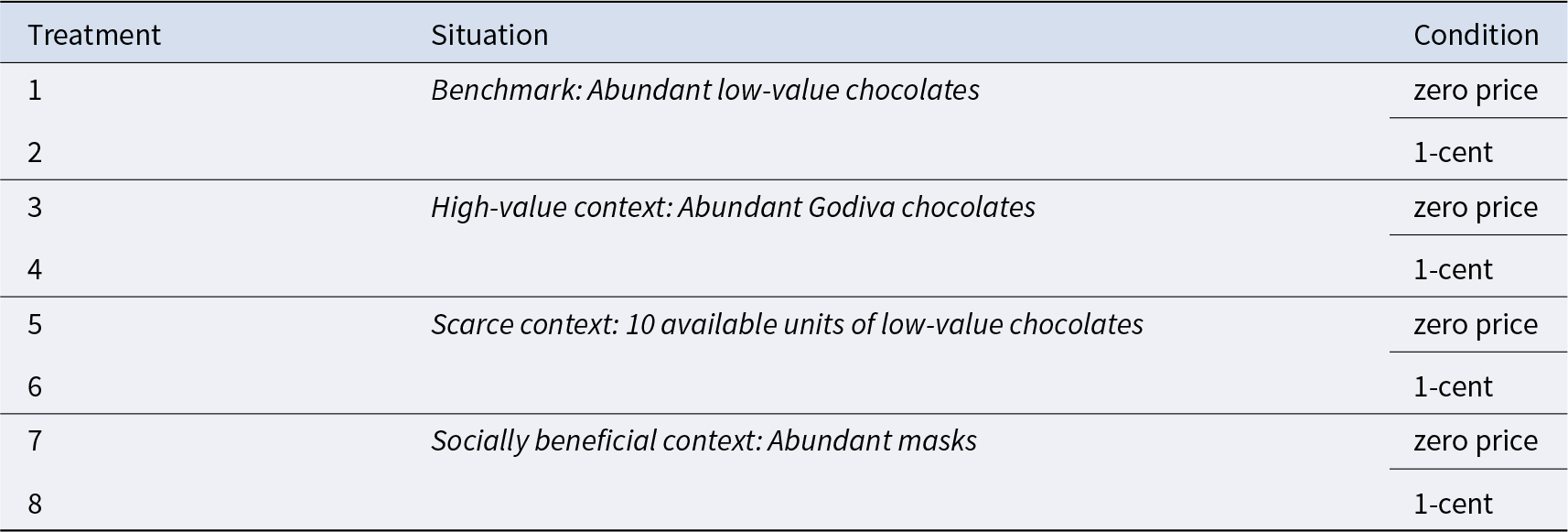
To measure the zero price effect on social appropriateness and explore how it differs when the type of good (non-socially beneficial versus socially beneficial), scarcity (abundant versus scarce) and value (low-value versus high-value) change, a full factorial design would involve 16 treatments. However, our interest lies in the effects of each of these three factors under fixed conditions, thus reducing the required number of treatments. We implemented benchmark treatments with abundant, low-value, non-socially beneficial items (chocolates), sold for either 1 cent or free, and compared the benchmark difference between these two price conditions in the elicited norms against the corresponding difference measured in each of three other contexts. Specifically, we compare the zero price effect on the social appropriateness of consumption for (1) low- versus high-value products (benchmark versus abundant Godiva chocolates), (2) abundant versus scarce contexts (benchmark versus 10 available units of low-value chocolates), and (3) non-socially beneficial versus socially beneficial products (benchmark versus abundant medical masksFootnote 3). Therefore, 8 treatments are employed in a 2 (zero price, 1 cent) $ \times $ 4 (abundant, low-value, non-socially beneficial items; abundant, high-value, non-socially beneficial items; scarce, low-value, non-socially beneficial items; abundant, low-value, socially beneficial items) between-subject design (Table 1).
Experimental design

Table 1 Long description
The table presents an experimental design measuring the impact of pricing on consumer behavior across various contexts. It includes treatments with zero and 1-cent pricing for low-value chocolates, Godiva chocolates, and masks. In abundant contexts, both low-value and Godiva chocolates are offered at zero and 1-cent prices, while scarce contexts feature limited availability of low-value chocolates. Additionally, masks are provided in a socially beneficial context with similar pricing. The data allows for comparison of consumer choices under different situational conditions, emphasizing the influence of price and availability on decision-making.
In this study, we elicit norms of consumption at the price of zero and 1 cent using coordination games, as introduced by Krupka & Weber (Reference Krupka and Weber2013).Footnote 4 In September 2021, we built the coordination game into an online survey (see the instructions in Online Appendix A) and recruited subjects all over China using the panel service provided by wjx.cnFootnote 5 to include people from all demographics. After giving informed consent, subjects first read through the instructions and completed the practice rating exercise used in Krupka & Weber (Reference Krupka and Weber2013), to ensure that they fully understood the rules before moving on to the main task.
Each subject was told that there was the chance to win a bonus if their own response in the main task matched the responses of others. In the task, subjects were presented with a vignette describing a situation in which a person in a public setting is offered items of a good and has to choose a consumption amount. The version of the vignette each subject read depended on which of the eight treatments listed in Table 1 they were randomly assigned to. To ensure that we were measuring the social appropriateness of behavior in the contexts relevant to our study, the scenarios described were the same as those we would actually implement in the natural field experiment. For example, we described the zero-priced, abundant, low-value chocolates scenario as following:
Mr. A is at a coffee shop near Ningbo Library. While there, Mr. A notices that there is a big sign saying ‘Chocolates for free.’ When approaching, Mr. A finds that it’s a marketing campaign for a university and there are abundant chocolates on the table. The chocolates are of low value.
The task was to rate the social appropriateness of each of 11 possible actions that Mr. A could take in this situation – that is, taking nothing or any positive integer between 1 and 10 units. We set the highest consumption level for evaluation at 10 units to reduce respondent tiredness and boredom, and to match the available choices in the natural field experiment, in which any consumer who attempted to take more than 10 units would be told 10 was the limit. Responses were made by selecting one option on a 4-point Likert Scale (very socially inappropriate, somewhat socially inappropriate, somewhat socially appropriate, very socially appropriate).
After finishing data collection, we randomly selected 1/3 of the subjects as eligible to receive bonus payment. For every eligible subject, we selected one of the possible actions and compared his/her answer to others subjects’ in the same treatment. If this answer was chosen by more subjects than any other for the selected action, he/she received an additional 50 RMB (7.8 USD) a few days after the experiment.Footnote 6
3.2. Study 2: natural field experiment
Study 2 implemented in reality the vignettes from Study 1. The low-value chocolates we used in this natural field experiment were from Le conté, a local brand in China. The retail price per piece was 0.7 RMB (0.14 USD), while the Godiva chocolate used in the high-value treatments retails at 12.81 RMB per piece, with the same flavor (milk) and roughly the same weight in each case (Le conté is 5 g per piece and Godiva 4.7 g per piece). The socially beneficial product we used was an individually packed mask,Footnote 7 whose per unit price was very similar to the Le conté chocolates’ (Fig. 1).
Chocolates and masks used in the experiment

Fig. 1 Long description
The image shows two chocolates and a packaged mask. The top chocolate is a square Godiva piece with visible branding. Below it is a Le conté chocolate in a rectangular wrapper with branding. To the right is a packaged mask, appearing flat and sealed.
Our natural field experiment was implemented in two waves, first in a café at the entrance of the City Library in Ningbo, Zhejiang Province, China, from September 22 to November 20, 2021, and second in the foyer of a shopping mall on February 5 and 6, 2022. According to the café owner, only 10% of customers approximately repeatedly visited the café.Footnote 8 Because many of the customers stayed in the café for quite a while, we only conducted one treatment on a given day. All treatments were repeated four times in the same café, three times on weekdays in the afternoon and once on Saturday in the afternoon. Each session lasted for 4 hours. In the second wave, we ran each treatment once for one hour, with all sessions between 10 AM and 6 PM on a weekend, and a 10-minute break between sessions.
During the experiment, the experimenters were seated at a table with a tray, ready to provide items (chocolates or masks) to passersby. A large sign was placed in front of the table. It was alternated between ‘Chocolates (Masks) for free’ in the zero price condition and ‘Chocolates (Masks) for 1 cent each’ in the 1-cent condition (Fig. 2). In the abundant treatments, every subject was faced with 100 pieces of the good. The chocolates (masks) were replenished after each time any were taken, to keep the units on display constant throughout each session. In contrast, only 10 units were on display in the scarce treatments. The experimenters were not always able to replenish the goods between individuals in the scarce treatments, particularly when subjects arrived in groups or in quick succession. In such cases, the perceived scarcity might have been even stronger for these participants than intended.
Signs for different treatments

Fig. 2 Long description
The image consists of four panels. The top left panel displays a sign with the text 'Chocolates for free!' alongside an image of chocolate pieces. The top right panel shows a sign with 'Chocolates for 1 cent each!' and similar chocolate imagery. The bottom left panel features a sign stating 'Masks for free!' with illustrations of people wearing masks. The bottom right panel presents a sign with 'Masks for 1 cent each!' and the same group of masked individuals. Each sign includes text in both English and another language, set against a background of a cityscape and greenery.
The experimenters passively waited for subjects rather than actively approaching them. When someone approached, the experimenters invited them to take as much as they wanted from the tray and secretly noted down the quantity taken. In the abundant treatments, only when anyone wanted to take more than 10 units, the experimenters explained that we had a quantity limit of 10. Subjects did not know that they were participating in an experiment. The experimenters explained that the giveaway was ‘a marketing campaign for our university.’ All sessions were recorded by a hidden camera so that we could rely on the video to double-check the data (Fig. 3).Footnote 9
Screenshots of the video recorded during the two waves

Fig. 3 Long description
The image A shows two men and one woman seated at a table in a dining area. The woman is seated, while the men are standing nearby. The setting includes tables, chairs and a counter in the background. The image B shows a person standing near a tray filled with items in a shopping area. The person is holding something in their hand and the background includes shops and people walking around.
At the same time, we measured the pedestrian traffic by counting people who appeared in the café or the foyer. In the first wave, Saturdays were busier, but we balanced treatments across weekdays and Saturdays. In the second wave, there was no obvious peak or trough in busyness. Consistently in both waves, we counted our sample as only including those who stopped in front of our table to read the sign or asked questions, and who passed by but obviously noticed the sign. In other words, people who clearly made a deliberate decision not to take were marked as consuming zero units. It made sense to exclude others – for example, in wave 1, there was no chance for people who faced at the cashier all the time or who took the way behind us to notice our sign (Fig. 3, Panel a). The research assistants who recorded passersby were blind to the specific experimental hypotheses.
Subjects were asked to scan the pay code (either with Wechat Pay or AlipayFootnote 10) provided by the café (first wave) or a student club of our university (second wave) to pay the price in the 1-cent condition (Fig. 4).
Paying 1 cent via Wechat (left) or Alipay (right)Footnote 11

Fig. 4 Long description
The image shows two mobile payment interfaces side by side. The left interface displays the text 'Pay to' at the top, with the amount '0.01 yuan' prominently shown in the center. A green button labeled 'Pay' is at the bottom. The right interface also shows 'Pay to' at the top, with '0.01 yuan' displayed in the center. Below, a numeric keypad is visible and a blue button labeled 'Pay' is positioned at the bottom right. Both interfaces are designed for making payments of 0.01 yuan.
4. Results
Study 1 obtained valid data from 577 subjects. The subjects were well balanced across treatments and diverse (Table B-1, Online Appendix B). To quantitatively measure the norms, we adopt the standard approach in the literature following Krupka and Weber (Reference Krupka and Weber2013) to transform the responses into numerical values. The values − 1, − 1/3, 1/3 and 1 correspond to ‘very socially inappropriate,’ ‘somewhat socially inappropriate,’ ‘somewhat socially appropriate’ and ‘very socially appropriate’ respectively. In Table B-2 of Online Appendix B, we present the full distributions of responses in each treatment, highlighting the modal response for each consumption level.
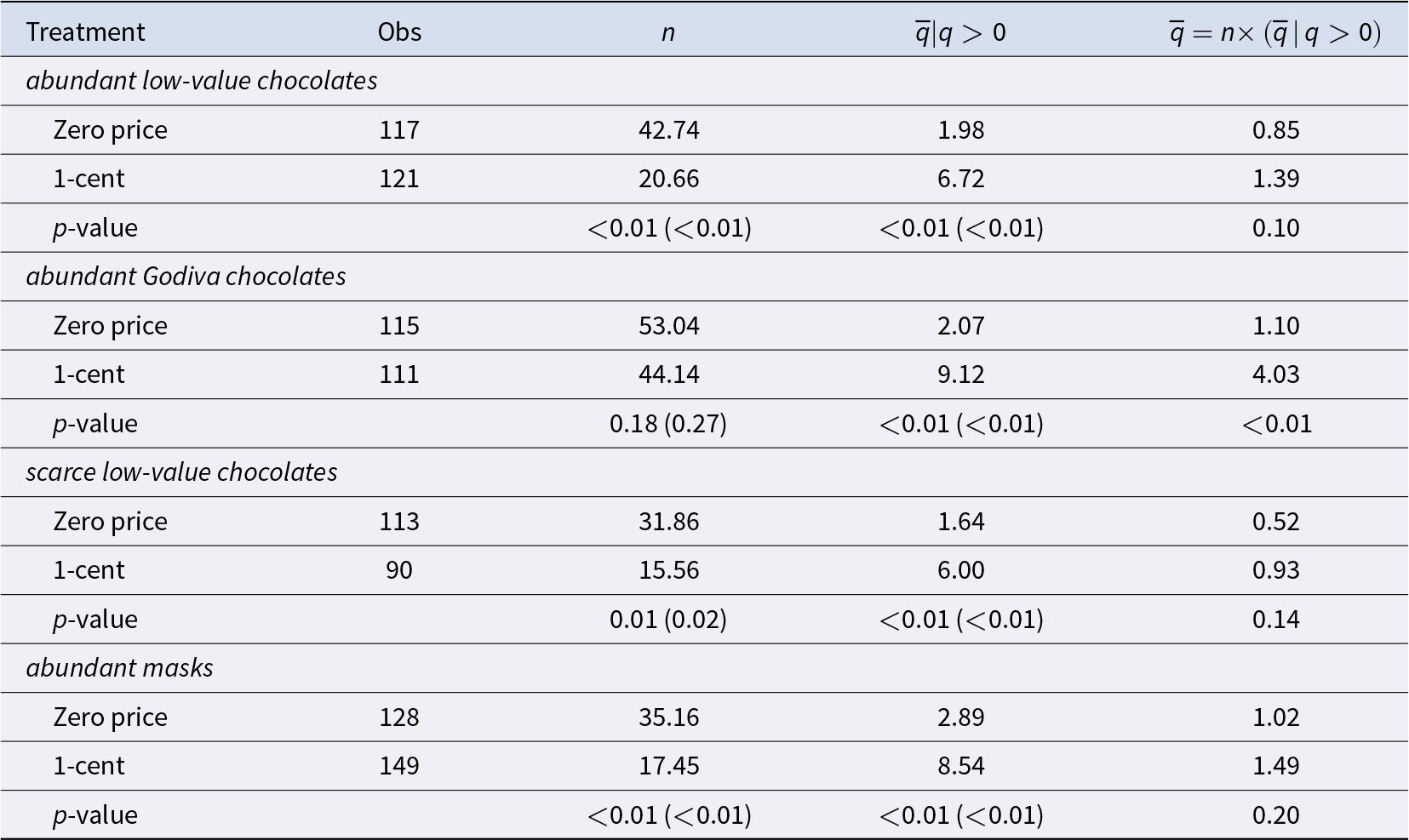
Study 2 consisted of 418 observations in Wave 1 and 526 in Wave 2. Since Study 2 is a field experiment, we are unable to report the demographic distribution of the subjects. Table 2 displays the percentage of takers ( $n$), average quantity taken by takers ( $\bar q\,|\,q \gt 0$), and total demand ( $\bar q$) by treatment, along with $p$-values (raw and adjustedFootnote 12) .
Summary of percentage of takers ( $n$) and average amount taken by takers ( $\overline q\,|\,q \gt 0$)

Table 2 Long description
The table compares the percentage of takers and average amount taken by takers between zero price and 1-cent conditions for various products. For abundant low-value chocolates, zero price results in 42.74% takers with an average of 1.98 units taken, while 1-cent results in 20.66% takers with 6.72 units taken. Abundant Godiva chocolates show a similar trend, with zero price yielding 53.04% takers and 2.07 units, compared to 44.14% takers and 9.12 units for 1-cent. Scarce low-value chocolates and abundant masks also follow this pattern, with zero price leading to higher taker percentages and lower average amounts taken. Statistical tests indicate significant differences in most comparisons, suggesting price impacts consumer behavior.
a  $p$-values are from chi-squared tests (for $n)$ and two-tailed $t$-tests (for $\bar q\,|\,q \gt 0)$ comparing the zero price and 1-cent conditions. The FDR-adjusted $p$-values are in parentheses.
4.1. Benchmark
Figure 5 demonstrates that, under the zero price condition, the mean appropriateness  $A$ initially increases with consumption quantity, peaking at one unit, after which it declines sharply. In contrast, the norm curve for the 1-cent condition is much flatter. The appropriateness rating under the 1-cent condition is not always significantly greater than the rating under the zero price condition. The two curves intersect between $q = 2$ and $q = 3$. For quantities $q \geqslant 4$, zero pricing triggers stronger social disapproval for consumption than 1-cent pricing (see two-tailed $t$-test results in Table B-3, Online Appendix B). This generally supports H1 by providing evidence for the detrimental effect of zero pricing on the social appropriateness of consumption at high levels.
Mean of elicited social appropriateness (A) for each consumption level (q) in different contexts

Fig. 5 Long description
The image contains three line graphs labeled a, b and c. Graph a compares low value versus high value items under zero and one-cent pricing. The x-axis is labeled q, ranging from 0 to 10 and the y-axis is labeled A, ranging from negative 1 over 3 to 1. Four curves are shown: low value, zero price; low value, 1 cent; high value, zero price; and high value, 1 cent. Graph b compares abundant versus scarce items under zero and one-cent pricing. The x-axis is labeled q, ranging from 0 to 10 and the y-axis is labeled A, ranging from negative 1 over 3 to 1. Four curves are shown: abundant, zero price; abundant, 1 cent; scarce, zero price; and scarce, 1 cent. Graph c compares chocolates versus masks under zero and one-cent pricing. The x-axis is labeled q, ranging from 0 to 10 and the y-axis is labeled A, ranging from negative 1 over 3 to 1. Four curves are shown: chocolates, zero price; chocolates, 1 cent; masks, zero price; and masks, 1 cent. Note at the bottom states that 95 percent confidence intervals are displayed in matching colors.
Notably, the most socially appropriate response towards free and 1-cent offerings is to take one unit. Under both conditions, taking one unit is significantly more socially appropriate than taking nothing (two-tailed paired  $t$-tests, p-value < 0.01).
Consistent with H2, the zero price effect on the percentage of takers,  $n$, is positive (Table 2). 42.74% of subjects took zero-priced low-value chocolates from the abundant pile versus 20.66% under the 1-cent condition (Chi-squared test, FDR adjusted p-value $ \lt $0.01). Excluding the non-takers (Fig. 6, Panel a), 84% under the zero price condition took 1–2 units, whereas the 1-cent pricing encouraged subjects to take 10 units, making this maximal level a secondary spike following 1 unit.
Percentage of takers at each amount in different contexts (excluding non-takers)

Fig. 6 Long description
Four bar graphs labeled a, b, c and d show the percentage of takers for zero price and 1 cent conditions across different contexts. Graph a, labeled 'Benchmark', shows varying percentages with a notable spike at 10 items for 1 cent. Graph b, 'High value', also shows a spike at 10 items for 1 cent. Graph c, 'Scarce', displays a more even distribution with a slight increase at 10 items for 1 cent. Graph d, 'Socially-beneficial', shows a similar pattern with a spike at 10 items for 1 cent. The x-axis is labeled 'Number of items taken' ranging from 1 to 10 and the y-axis is labeled 'Percentage of takers' ranging from 0 to 100. Blue bars represent zero price and red bars represent 1 cent.
As shown in Table 2, zero pricing significantly reduced  $q\,|\,q \gt 0$ (1.98–6.72 = − 4.74, two-tailed $t$-test, $t$= − 7.41, FDR-adjusted p-value < 0.01, see Table C-4 in Online Appendix C), supporting H3. People seemed willing to take more when they had paid something, even though the payment was trivial. The negative zero price effect on $q\,|\,q \gt 0$ outweighed the positive effect on $n$, resulting in a negative but insignificant overall effect (0.85–1.39 = − 0.54, two-tailed $t$-test, t = − 1.66, p-value = 0.10, see Table C-7, Online Appendix C).
4.2. High-value context
When faced with high-value instead of low-value products, taking one unit remains the most socially appropriate action under the zero price condition, whereas under 1-cent pricing taking two units has slightly higher social appropriateness (Fig. 5, Panel a). Similar to the benchmark, the two norm curves in the high-value context intersect between  $q = 2$ and $q = 3$, after which the norm curve for the zero price condition lies below the norm curve for the 1-cent condition. This indicates a negative zero price effect on $A$ in the high-value context (H1). The decline in $A$ is significant when $q \geqslant 3$ (see two-tailed $t$-test results in Table B-3). Compared to the benchmark, the social appropriateness of large consumption ( $q \gt 1$) under zero pricing is lower, significantly so for $q = 5$ and $q = 6$ (Table B-4). However, there is a lack of evidence for H4 about the difference in the zero price effect on $A$ between the high-value and benchmark contexts, as relevant treatment interaction terms in Table B-6 are not significant.
The percentage of takers  $n$ of high-value products increased from 44.14% to 53.04% when the price was reduced from 1 cent to zero (Table 2). This change was relatively small compared to the benchmark context (20.66% to 42.74%) and insignificant (Chi-squared test, FDR adjusted $p$-value = 0.27). A difference-in-differences (DID) test using a binary logit model produces a negative interaction coefficient (coef. = − 0.70), with the p-value = 0.08 indicating that the difference in zero price effect on $n$ between low-value and high-value products is not significant (Table C-2).
On average, takers in the high-value context took 2.07 units of Godiva chocolates when the price was zero, compared to 9.12 units when the price was 1 cent. Supporting H3, the zero price effect on  $q\,|\,q \gt 0$ is negative and significant (two-tailed $t$-test, $t$= − 17.54, FDR-adjusted $p$-value $ \lt $0.01, see Table C-4). It is graphically evident (Fig. 6, Panel b) that the majority of takers took the maximum allowed quantity of 10 units at a price of 1 cent, while the most frequent action at zero price was to take one unit only. Since taking one unit of Godiva chocolate is perceived as the most socially appropriate action when it is free, the actual behavior reflected this norm. The decrease in $q\,|\,q \gt 0$ was greater in the high-value (2.07–9.12 = − 7.05) compared to the benchmark (1.98–6.72 = − 4.74). But the difference is insignificant (coef. = − 0.26, FDR-adjusted $p$-value = 0.18, see Table C-5), providing no evidence for H5. This is not surprising, given that this hypothesis was predicated on observing the cross-context difference in the ZPE on norms hypothesized in H4 but not empirically supported.
Similar to the benchmark, the aggregated zero price effect is negative (1.10–4.03 = − 2.93) and significant in the high-value context (two-tailed  $t$ test, $p$-value $ \lt $0.01, see Table C-7). The aggregated effect is significantly more negative in the high-value than in the low-value (benchmark) context (coef. = − 0.81, $p$-value $ \lt $0.01, see Table C-8).
4.3. Scarce context
When the available goods become scarce, the most socially appropriate action is to take one unit under both price conditions (Fig. 5, Panel b). Consumption of more than two units is less appropriate under the zero price than under the 1-cent condition. This implies a negative zero price effect on  $A$ (H1), significant when $q \geqslant 3$ (see two-tailed $t$-test results in Table B-3). In most cases, there is no significant difference in the appropriateness of consumption between the benchmark and the scarce context (see Table B-4). The negative zero price effect on $A$ in the scarce context does not significantly differ from that in the benchmark (Table B-6), failing to support H6.
There is a significant positive zero price effect on  $n$ in the scarce context (H2). The percentage of takers $n$ increased from 15.56% to 31.86% when the price was reduced from 1 cent to zero (Chi-squared test, FDR adjusted $p$-value = 0.02). This effect is relatively small compared to that in the benchmark (42.74%–20.66% = 22.08%), but the difference is insignificant (DID test, coef. = − 0.12, $p$-value = 0.78, see Table C-2).
On average, takers in the scarce context took 1.64 units of chocolates at the price of zero, compared to 6 units when the price was 1 cent. This finding supports H3, as the zero price effect on  $q\,|\,q \gt 0$ is negative and significant (two-tailed $t$-test, $t$= − 5.67, FDR-adjusted $p$-value $ \lt $0.01, see Table C-4). Specifically, taking one or two units of the scarce chocolates at the price of zero accounts for 91.67% of the subjects in the treatment. Conversely, when 1 cent was charged for each chocolate, the most common action was to take all the available ones ( $q$=10), followed by taking one (Fig. 6, Panel c). Contrary to H7, the decrease in $q\,|\,q \gt 0$ was slightly smaller in the scarce (1.64–6.00 = − 4.36) compared to the benchmark (1.98–6.72 = − 4.74), but the difference is insignificant (coef. = − 0.08, FDR-adjusted $p$-value = 0.81, see Table C-5). Again, that this hypothesis is not supported is unsurprising in light of the absence of the hypothesized cross-context difference in the ZPE on norms (H6) that it was predicated upon.
The aggregated demand in the scarce context was the lowest among all contexts. Though the aggregated ZPE is still negative in this context (0.52–0.93 = − 0.41), it is not significant (two-tailed  $t$ test, $p$-value = 0.14, see Table C-7). Furthermore, the aggregated effect is more negative in the scarce than in the abundant (benchmark) context, but not significantly so (coef. = − 0.09, $p$-value = 0.69, see Table C-8).
4.4. Socially beneficial context
When offered masks instead of benchmark chocolates, the most socially appropriate action is again to take one unit under both price conditions (Fig. 5, Panel c). The intersection of the two norm curves appears earlier than in other contexts. Consumption over one unit is less appropriate under the zero price than under the 1-cent condition. This implies a negative zero price effect on  $A$ (H1), significant when $q \geqslant 3$ (see two-tailed $t$-test results in Table B-3). For consumption levels 3 and 4, the socially beneficial context witnesses a significantly more negative zero price effect on social appropriateness than the benchmark (Table B-6), in opposition to H8.
As shown in Table 2, a higher percentage of subjects took masks in the zero price (35.16%) than in the 1-cent condition (17.45%). A Chi-squared test confirms that the change is significant (FDR adjusted  $p$-value $ \lt $0.01). $n$ became lower when chocolates were replaced by masks, under both price conditions. In contrast to H9, the zero price effect on $n$ is less positive in the socially beneficial context than in the benchmark (42.74%–20.66% = 22.08%) though insignificantly so (DID test, coef. = − 0.11, FDR-adjusted $p$-value = 0.85, see Table C-2).
If excluding the non-takers (Fig. 6, Panel d), when the items were offered for free, taking one unit is the modal choice, whereas taking the maximum dominated all choices under the 1-cent condition. The hypothesis about the negative zero price effect on  $q\,|\,q \gt 0$ (H3) holds true in the socially beneficial context. Specifically, takers in this context took 2.89 units of masks at the price of zero, compared to 8.54 units when the price was 1 cent. This detrimental effect on demand at the individual level was significant (two-tailed $t$-test, $t$= − 7.10, FDR-adjusted $p$-value $ \lt $0.01, see Table C-4). However, the findings fail to support H10, as the decrease in $q\,|\,q \gt 0$ was greater in the socially beneficial context (2.89–8.54 = − 5.65) compared to the benchmark (1.98–6.72 = − 4.74), though insignificantly (coef. = 0.14, FDR-adjusted $p$-value = 0.55, see Table C-5). However, this is consistent with the lack of support noted above for H8, upon which H10 was predicated.
The average amount taken by all subjects within the socially beneficial context was slightly less in the zero price than in the 1-cent condition (1.02–1.49 = − 0.47). However, this decrease was insignificant (two-tailed  $t$ test, $p$-value = 0.20, see Table C-7). The overall zero price effect does not differ between the benchmark and the socially beneficial context (DID test, coef. = 0.11, $p$-value = 0.51, see Table C-8).
4.5. Summary of results
To summarize, we find strong and consistent support for H1, that zero pricing reduces the social appropriateness of high consumption levels. Regarding H2, the hypothesized positive ZPE on n, we find that this is strongly supported in all cases except for the high-value context. Regarding H3, the hypothesized negative ZPE on  $q\,|\,q \gt 0$, we find that this is strongly supported in all cases. However, our findings fail to support all hypotheses of cross-context differences, for both norms and behavior (H4–H10).
We note that the zero price effects on social appropriateness and  $q\,|\,q \gt 0$ are directionally consistent. Our natural field experiment observes this effect on $q\,|\,q \gt 0$ to be negative in all cases. Consistently, taking a given number of items is significantly less appropriate under the zero price than the 1-cent condition for $q \geqslant 4$ in the benchmark context and $q \geqslant 3$ in the other contexts (Table B-3).
More generally, it appears that consumption behavior is often closely related to social appropriateness. People often take the most socially appropriate action. In all four contexts, taking one unit is the most common positive consumption level under the zero price condition, and this was also shown in the norms graphs to be the most socially appropriate level under zero pricing. In the 1-cent condition the percentage of maximal takers is higher, reflecting that the social appropriateness of taking 10 units at this price is much higher than at the price of zero. The norm curves for the 1-cent treatments are relatively flat, indicating that all actions are roughly equally appropriate. Therefore, people are free to maximize their utility by taking any amount of the items.
To further explore the relationship between social appropriateness and consumption decisions, we conduct conditional logit regressions, following the methodology of Krupka and Weber (Reference Krupka and Weber2013). This analysis suggests that such a relationship is indeed present (see full details in Online Appendix D).
5. Extension: pay and refund treatment
As discussed earlier, transaction costs may play a role in the decision to consume or not. So far, for simplicity, in our modelling we have assumed these costs, TC, to take the same value under all circumstances for any positive level of consumption. However, in our experiment, these costs differ slightly between our 1-cent and zero price treatments. When the goods are free, they are simply handed over, whereas when 1 cent is charged per unit, the consumer is required to exert the effort of scanning a QR code and transferring money. While this reduction in transaction costs is an authentic feature of zero pricing that may contribute to its real-world effects, scholars in the ZPE literature have sometimes attempted to exclude this experimentally to focus on the components of the ZPE which are purely non-rational from a homo economicus perspective (which we label the ceteris paribus ZPE).
In our natural field experiment, we therefore introduced a further condition, the pay & refund (hereafter, p & r) treatment. This was an alternative version of the zero price condition, where the goods were free, but consumers were required to transfer money to the experimenters, which would be immediately refunded; hence, this eliminated the difference from the 1-cent condition in transaction costs. However, an inevitable issue here was that this process might create an additional treatment difference that would further reduce demand relative to the main zero price condition, if it triggered consumer suspicion about the reason behind this seemingly unnecessary action.
We conceptually viewed the p & r treatment as an attempt to estimate a lower bound on the ceteris paribus ZPE on overall demand. That is, this treatment should identify a less positive (or more negative) ZPE than the zero price condition, although it might overestimate how negative the ceteris paribus effects of zero pricing are if it triggered suspicion. As it turned out, however, the p & r treatment induced a more positive ZPE than the zero price condition. Since this cannot be explained by either the introduction of transaction costs or suspicion, it appears that this treatment introduced a further confound. Most likely, the p & r process changed the norms around consumption, legitimizing individuals to take more units. Since this treatment failed in its primary objective, we report it in full only in Online Appendix E.
6. Conclusion
This study has examined social appropriateness as a possible channel for zero price effects on consumption choices, in terms of both whether and how much to consume. We tested this empirically in three steps. First, we quantitatively measured the social appropriateness of taking 0–10 units of goods under the 1-cent and the zero price conditions in different contexts, testing for a zero price effect on norms of consumption. Second, we recorded behavior when items were offered, in the corresponding contexts, at these prices. Finally, we studied the relationship between the measured social norms and consumption choices.
Our findings are consistent with our core idea that social norms mediate zero price effects. We have found that zero pricing has a clear and significantly negative effect on the social appropriateness of high levels of consumption. However, the ZPE on norms rarely differs significantly across contexts, providing a lack of evidence for our hypothesized cross-context differences. Product characteristics of value, scarcity and social benefit may not be salient enough to influence the social appropriateness of consumption.
Regarding actual behavior, reducing the price from 1 cent to zero always increases the percentage of takers. This effect is significant in all contexts except for the high-value context. Meanwhile, the quantity demanded per taker always fell. These findings replicate the insights of AGH. The differences in these effects across contexts are mostly insignificant, which aligns with the lack of cross-context differences in the ZPE on norms. The zero price effect on total consumption is negative, significantly in the high-value context.
Overall, the patterns we identify are consistent with the arguments introduced by AGH that zero pricing changes social norms, which act as a constraint on the excessive consumption of free goods. In contrast to our hypotheses, however, we do not find a lot of evidence that the effects we study differ according to the value, scarcity or social benefit of products.
Some limitations to our research are noted. First, the necessary delay in replenishing the goods in the scarce context when multiple subjects arrived simultaneously means that some subjects were faced with fewer goods than initially intended, which likely reinforced the perception of scarcity. While this aligns with our goal to study consumption behavior under scarce conditions, it also introduces variability in the scarcity perception that was not fully controlled. Second, in our socially beneficial context, medical masks also confer private utility (e.g., health protection), so observed consumption may reflect these dual motives. Future research could explore the zero price effect for goods that are purely socially beneficial, with minimal or no direct private gains.
One major contribution of this paper comes from the quantitative measurement of social norms. Through this step, the paper provides more evidence to support the key ideas in AGH. We find that, in all zero price treatments and in all but one 1-cent treatments, the most socially appropriate consumption choice is to take one unit. However, as consumption levels increase, the social appropriateness drops more abruptly under zero pricing. This appears to limit overconsumption at the individual level. There are interesting applications of this result, as discussed in AGH. For instance, attempts to limit environmentally unfriendly consumption – such as wasteful use of energy-intensive amenities by hotel guests – might find they are less successful if they impose a small price on consumption rather than allowing it for free.
Beyond those which are the focus of this paper, there may be alternative explanations for zero price effects. Loss aversion suggests that consumers are more likely to consume a product when it is free to avoid possible losses from paying for something not worthwhile (Koo & Suk, Reference Koo and Suk2020). This may be particularly the case in the presence of uncertainty about one’s own preference, which may deter paying for unfamiliar products. Conversely, a zero price might signal lower quality (Fan et al., Reference Fan, Cai and Bodenhausen2022), causing those who do try the product to take only small amounts. Testing for these alternative explanations is a potential avenue for future research. Contextual factors in our experimental design may have influenced the magnitude of the effects of social norms. Though subjects whose behavior we observe did not know they were being experimented on, the public setting might amplify the influence of social norms (Lapinski & Rimal, Reference Lapinski and Rimal2005). Boshi et al. (Reference Boshi, Lavie and Weiss2016) measured the demand for free goods, showing that removing consumption limits led to reduced consumption, but that this effect was weakened when behavior was unobservable. It would be interesting to explore whether this extends to a difference in the strength of zero price effects on consumption behavior between observable and non-observable contexts. Additionally, the personal attributes of consumers, which we could not practically collect data on in our natural field experiment, could also shape sensitivity to zero pricing. Future studies are suggested to consider the role of personal attributes in moderating the zero price effects.
Supplementary material
The supplementary material for this article can be found at https://doi.org/10.1017/eec.2026.10045.
1. Online Appendices (includes Appendix A: Instructions of Norm-eliciting task; Appendix B: Complementary results for Study 1; Appendix C: Complementary results for Study 2; Appendix D: Conditional Logit Regressions; Appendix E: Controlling for transaction cost using p & r treatment).
2. Data and Code File.
Replication packages
The replication material for the study is available at https://data.mendeley.com/datasets/rff3zpbcbx/5.
Acknowledgements
This study is sponsored by CeDEx (Centre for Decision Research and Experimental Economics) China and it received ethical approval from University of Nottingham, Ningbo. The authors thank Yujie Fan, Xinyu Liu, Siyi Liu, Chen Ouyang, and Yulong Tang for research assistance, the café owner and shopping mall manager for facilitating our field experiment, and Saileshsingh Gunessee and Gergely Horvath for their useful advice. We also received valuable comments from audience members at the 2023 CeDEx China Workshop. We appreciate the insightful comments and suggestions from the anonymous reviewers and the editor Arno Riedl.
Statements and Declarations
The authors declare that they have no known competing interests or personal relationships that could have appeared to influence the work reported in this paper.




 Open access

