

1. Introduction
Since 2017, the 10 New Insights in Climate Science (hereafter 10NICS) annually summarize scientific advancements and recently emerging scientific consensus, embedding them in their respective disciplinary context, for a set of the most critical aspects of Earth's complex climate system – including physical, biogeochemical and socio-economic/socio-cultural dimensions.
We are hitting limits to adaptation and adaptation is projected to become less and less effective at higher global warming levels. Rapid mitigation is more urgent than ever when some climate hazards become so existential that even human (let alone nature's) adaptation options get exhausted. However, our actual performance in total global emission reduction to bend the curve is not on track (IPCC AR6 WGI, Reference Masson-Delmotte, Zhai, Pirani, Connors, Péan, Berger and Zhou2021; IPCC AR6 WGIII, Reference Shukla, Skea, Slade, Al Khourdajie, van Diemen, McCollum and Malley2022). Current projections with existing climate policies still place us at a temperature increase of 2.7°C (2.0–3.6°C (CAT, 2021)). The scientific insights presented here, based on literature published since January 2021, describe these limits to adaptation (limited adaptation capacities have been vividly demonstrated for a number of unprecedented extremes in 2022, but we particularly focus on those limits expected in a warmer world), highlight selected aspects of vulnerabilities, systems approaches and social implications and discuss barriers to effective and rapid mitigation.
The 10NICS topics are not intended to be a comprehensive scientific assessment. Intentionally limited to 10, each insight is succinct, highlighting a selection of relevant scientific updates within a brief, more general topical review and does not try to cover entire disciplinary fields. The 10NICS are presented in (a) an academic article for a scholarly audience (this publication) and (b) a policy report for policymakers and the general public.
Here we detail the methods used for the selection of the 10 insight topics, as well as for the writing process of the respective chapters. We then give a concise summary of each insight, briefly setting the background, elaborating on some recent developments in the field and putting each of the new research insights into context. In the concluding section, we develop and discuss a wider-scope scientific synthesis of the 10 insights.
2. Methodology
Each year the three partners of the 10NICS – Future Earth, the Earth League and the World Climate Research Programme – select an editorial board, which oversees the overall scientific quality and coherence of the output (academic article and policy report).
Meanwhile the partners put out an open call, inviting the science community to submit their proposals for new climate science insights. The 2022 call for topics was broadly distributed via different channels (such as websites, social media accounts or mailing lists associated with the partners and connected institutions, as well as via individual invitations), reaching at least 5000 people directly. A caveat to this approach, however, is that in spite of our efforts to attain global reach, significant groups may not have been reached, or decided not to respond.
To qualify as a candidate topic, the proposals were required to be based on at least two to three peer-reviewed publications since January 2021. In total, 69 people responded to the call – with room for improvement in terms of total number and in terms of global distribution (Figure 1(a)). The 99 proposals (underpinned by over 200 references) were sorted by subject and, where relevant, merged, while proposals with a strong overlap with an insight from previous years were removed. This selection process led to 31 candidate topics (more details in the Supplementary material of this paper).
Classification of (a) call respondents and (b) authors (including invited experts, coordinating authors and editorial-board members) in terms of scientific discipline and geography (affiliation based, for details about the geography definitions, see the Supplementary material). Gender composition among call respondents was 30/37/2 (female/male/prefer not to say); among authors it was 33/32/0. The call respondents' classification was made based on their responses; the authors' classification was individually confirmed.
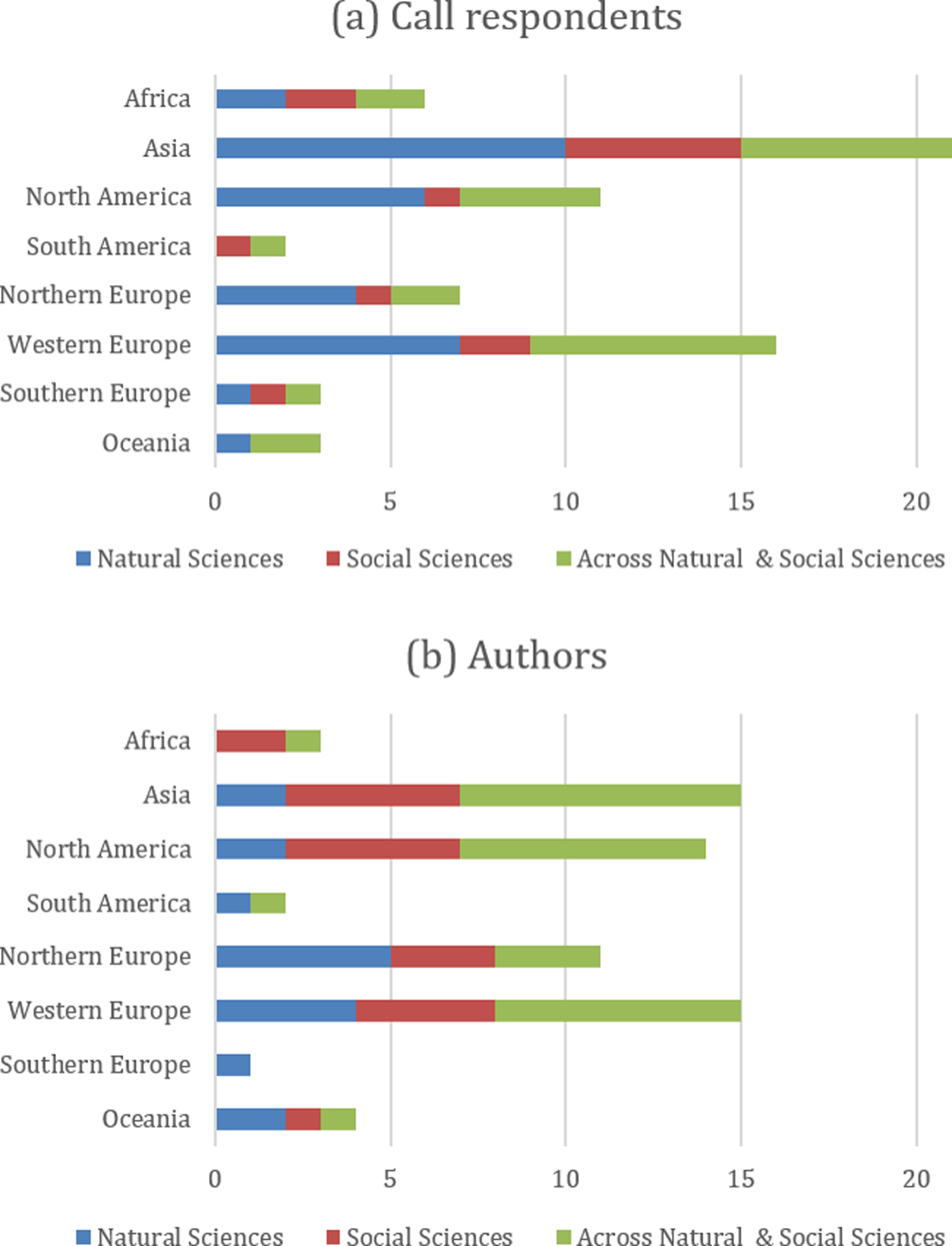
Based on these 31 candidates, the editorial board crafted the final list of 10 NICS, based on perceived scientific progress, relevance to policymakers and timeliness. Each insight was written by a team of three to five experts and one coordinating author. The coordinating authors were staff appointed by the partners. The experts were selected for each insight according to their discipline and scientific reputation (including a scan of their recent academic publications), with the additional goal of promoting diversity in terms of gender, geography and scientific discipline (Figure 1(b)). Even though the objective has been to promote a balanced presentation, for instance by either excluding contested statements or making on-going scientific debate transparent, we cannot exclude that the relatively small number of expert authors per insight has covered only a subset of what is relevant.
In order to cope with limited space and numbers of references, an extended bibliography (see the Supplementary material) provides a more comprehensive, but by construction not all encompassing set of the most recent relevant references for each of the insights, complementing the reference list at the end of this paper. This was built by means of (1) a quick literature scan with Web of Science, based on keywords selected during the writing process and covering publication dates between January 2021 and July 2022; and (2) individual input from expert and coordinating authors.
Based on this publication (the academic article), a policy report is being produced by the coordinating authors, and approved by all co-authors (invited experts and editorial-board members).
3. Ten new insights
3.1 Insight 1: Questioning the myth of endless adaptation: mitigation is critical to avoid breaching adaptation limits
Adaptation limits mark thresholds beyond which adaptive action cannot secure people or systems from intolerable risks (IPCC AR5 WGII, Chapter 16, Reference Field, Barros, Dokken, Mach, Mastrandrea, Bilir and White2014). Soft limits arise when acceptable adaptation options are not available but may become available with social, institutional or technological innovations and transformation. Hard limits denote contexts where further adaptation cannot avoid intolerable risks, such as extreme heat, challenging human survivability (Thomas et al., Reference Thomas, Theokritoff, Lesnikowski, Reckien, Jagannathan, Cremades, Campbell, Joe, Sitati, Singh, Segnon, Pentz, Musah-Surugu, Mullin, Mach, Gichuki, Galappaththi, Chalastani, Ajibade and Bowen2021). Adaptation limits are deeply contextual, shaped by three key aspects: (1) place-specific climate risks, (2) the resilience of socio-ecological systems, itself greatly shaped by sociocultural and economic structures that result in uneven patterns of capacity within and across places, and (3) the nature and distribution of existing adaptive efforts. Crossing limits can create system changes as communities define new goals and values in the context of the experienced losses and damages and the remaining options to adapt. These new system states may present deep and immediate challenges or create opportunities for progress. Simultaneously they may no longer be susceptible to the same or similar limits but be confronted with fundamentally new ones. Exceeding adaptation limits may lead to irreversible losses and damages (see insight 8).
Existing adaptation efforts are insufficient to adequately reduce risks associated with current and future climate impacts, with unevenly distributed efforts leaving the most vulnerable particularly exposed to impacts, while even the well-documented limits to adaptation are not being sufficiently acknowledged and addressed (Berrang-Ford et al., Reference Berrang-Ford, Siders, Lesnikowski, Fischer, Callaghan, Haddaway, Mach, Araos, Shah, Wannewitz, Doshi, Leiter, Matavel, Musah-Surugu, Wong-Parodi, Antwi-Agyei, Ajibade, Chauhan, Kakenmaster and Abu2021; IPCC AR6 WGII, Chapters 4 and 16, Reference Pörtner, Roberts, Tignor, Poloczanska, Mintenbeck, Alegría and Rama2022). Contextual factors underlying vulnerabilities, and access to resources, all shaped by socio-political structures and power relations with long histories critically determine the constraints and opportunities which shape the extent to which adaptation can be planned and implemented effectively (Bezner Kerr et al., Reference Bezner Kerr, Naess, Allen-O'Neil, Totin, Nyantakyi-Frimpong, Risvoll, Rivera Ferre, López-i-Gelats and Eriksen2022; Gajjar et al., Reference Gajjar, Singh and Deshpande2019; Leal Filho et al., Reference Leal Filho, Luetz and Ayal2021b; Williams et al., Reference Williams, Simpson, Totin, North and Trisos2021).
Soft limits can be driven by insufficient access to and availability of finance, exclusive governance structures, institutional inertia and path dependency, and social and political structures that shape the willingness of people and countries to act. As a consequence, limits to adaptation have been reached in specific places, with limits most frequently reported for vulnerable groups in developing regions, and are especially pronounced for low-lying coastal regions and ecosystems, often through a combination of interacting constraints and systemic vulnerabilities (Leal Filho et al., Reference Leal Filho, Krishnapillai, Sidsaph, Nagy, Luetz, Dyer, Ha'Apio, Havea, Raj, Singh, Rogers, Li, Boodhan, Wolf, Ayal and Azadi2021a; Magnan et al., Reference Magnan, Oppenheimer, Garschagen, Buchanan, Duvat, Forbes, Ford, Lambert, Petzold, Renaud, Sebesvari, van de Wal, Hinkel and Pörtner2022; Thomas et al., Reference Thomas, Theokritoff, Lesnikowski, Reckien, Jagannathan, Cremades, Campbell, Joe, Sitati, Singh, Segnon, Pentz, Musah-Surugu, Mullin, Mach, Gichuki, Galappaththi, Chalastani, Ajibade and Bowen2021).
With increasing warming, several, often interacting, factors can further limit a system's or actors' ability to adapt. Increasing losses and damages erode resilience and thus aggravate existing soft adaptation limits (Martyr-Koller et al., Reference Martyr-Koller, Thomas, Schleussner, Nauels and Lissner2021; Mechler et al., Reference Mechler, Singh, Ebi, Djalante, Thomas, James, Tschakert, Wewerinke-Singh, Schinko, Ley, Nalau, Bouwer, Huggel, Huq, Linnerooth- Bayer, Surminski, Pinho, Jones, Boyd and Revi2020; Thomas et al., Reference Thomas, Theokritoff, Lesnikowski, Reckien, Jagannathan, Cremades, Campbell, Joe, Sitati, Singh, Segnon, Pentz, Musah-Surugu, Mullin, Mach, Gichuki, Galappaththi, Chalastani, Ajibade and Bowen2021; see insight 8). Increasingly catastrophic impacts require transformational approaches (such as abandoning livelihood systems and areas to live), given that the effectiveness of available adaptation measures to reduce risks continues to decline (IPCC AR6 WGII, Chapter 4, Reference Pörtner, Roberts, Tignor, Poloczanska, Mintenbeck, Alegría and Rama2022).
Our ability to adapt is limited by uncertainty: about climate risks and future actions, and about the complex systems in which we live. What is effective now may lose efficacy due to complex system dynamics that are difficult to foresee (Simpson et al., Reference Simpson, Mach, Constable, Hess, Hogarth, Howden, Lawrence, Lempert, Muccione, Mackey, New, O'Neill, Otto, Pörtner, Reisinger, Roberts, Schmidt, Seneviratne, Strongin and Trisos2021). Climate change is one among many stressors and interacts with other risk drivers, such as conflicts, pandemics and pre-existing development challenges, resulting in system effects such as food shortages and rising poverty and inequality, which may in turn create new limits to adaptation (Bouwer, Reference Bouwer2022; Carr, Reference Carr2020). At the community level, climate impacts can be compounded by the ways they stress social orders and individual roles and responsibilities, producing maladaptive decisions that render communities – and the ecosystems they depend on – more inflexible and fragile (Carr, Reference Carr2020). Given the nature of complex systems, and especially the source of uncertainty stemming from people and society which is generally under-addressed in systems approaches, some of these maladaptive outcomes emerge in unpredictable ways.
Research and policy literature converges on a need for deep, radical and fundamental changes, as opposed to minor, marginal or incremental changes, in how we pursue climate adaptation and deal with adaptation limits. There is a diversity of views on what features – depth, breadth, form, spatial and temporal scales, levers, outcomes, evolution and permanence – make a change transformative or transformational (Barnes et al., Reference Barnes, Wang, Cinner, Graham, Guerrero, Jasny, Lau, Sutcliffe and Zamborain-Mason2020; Berrang-Ford et al., Reference Berrang-Ford, Siders, Lesnikowski, Fischer, Callaghan, Haddaway, Mach, Araos, Shah, Wannewitz, Doshi, Leiter, Matavel, Musah-Surugu, Wong-Parodi, Antwi-Agyei, Ajibade, Chauhan, Kakenmaster and Abu2021; Leal Filho et al., Reference Leal Filho, Wolf, Moncada, Salvia, Balogun, Skanavis, Kounani and Nunn2022). However, as warming progresses and we approach limits to adaptation, the required changes will become more radical, creating social stresses and opportunities for more mistakes and for further elevating existing risks or creating new risks (IPCC AR6 WGII, Chapter 18, Reference Pörtner, Roberts, Tignor, Poloczanska, Mintenbeck, Alegría and Rama2022). In this light, it is critical to actively include the affected communities in the defining of their futures and related transformations. Changes in social structures and power relations, norms and institutions that shape the behaviour of people and organizations and structural reforms that reduce peoples' and systems' exposure to shocks, can help to overcome soft limits to adaptation, prevent them from becoming hard limits and even create opportunities to further climate-resilient development and transformative changes (Carr, Reference Carr2020; Colloff et al., Reference Colloff, Gorddard, Abel, Locatelli, Wyborn, Butler, Lavorel, van Kerkhoff, Meharg, Múnera-Roldán, Bruley, Fedele, Wise and Dunlop2021; Sachs et al., Reference Sachs, Schmidt-Traub, Mazzucato, Messner, Nakicenovic and Rockström2019; see insights 9 and 10).
In conclusion, to sustain a liveable future for all, adaptation is not an alternative to mitigation efforts. Even effective adaptation will not avoid all losses and damages. Limiting warming is essential, as we are already facing adaptation limits today, and adaptation will become increasingly difficult as we approach 1.5°C or even 2°C of mean global warming.
3.2 Insight 2: Climate-driven impacts and human vulnerability increase the emergence of vulnerable regions
Many regions of the Earth show accelerated climate-related changes. In regions most vulnerable to climate change, physical, ecological and socioeconomic systems are losing resilience against further change. Consequently, large numbers of people and their livelihoods are affected due to the close interconnection of human and natural vulnerabilities.
Although there exist several frameworks for performing a vulnerability assessment, here we classify levels of vulnerability by qualitatively combining the sensitivity, adaptive capacity and degree of exposure of different regions of the planet to multiple climate hazards. Accordingly, socioeconomically vulnerable regions emerge on a global scale (Figure 2). Regional hotspots cluster in Central America, Asia, the Middle East and several regions of Africa: the Sahel, Central and East Africa, where socioeconomic factors significantly contribute to human vulnerability.
Schematic diagram illustrating systematic human vulnerability on a scale of seven vulnerability categories (adapted from Birkmann et al., Reference Birkmann, Feldmeyer, McMillan, Solecki, Totin, Roberts, Trisos, Jamshed, Boyd and Wrathall2021) and global climate system components and ecosystems evident to lose resilience to climate change from direct (e.g. deforestation) and indirect (e.g. global warming due to GHG emissions) anthropogenic impacts. Their impact is assessed qualitatively based on their temporal proximity, and strength of their impacts on human vulnerability (adapted from Schellnhuber et al., Reference Schellnhuber, Rahmstorf and Winkelmann2016). Their timescales are categorized into near-term, mid-term and long-term transitions following the notation of IPCC AR6 WGI, SPM, p. 12 (Reference Masson-Delmotte, Zhai, Pirani, Connors, Péan, Berger and Zhou2021). Some of the presented components (e.g. mountain regions, coastal regions or tropical rainforests) are symbolic for similar ecosystems around the globe. Note that the text discussed only a fraction of the components presented here, without any classification of their importance.

Each hotspot has its unique economic, ecological and political conditions. Parts of South Asia, for example, have been associated with high social vulnerability due to limited social well-being, health and education, usually associated with high levels of poverty (Das et al., Reference Das, Hazra, Haque, Rahman, Nicholls, Ghosh, Ghosh, Salehin and Safra de Campos2021). Meanwhile, parts of Central Africa, the Middle East and South America are associated with high state fragility, food and water insecurity and compromised access to basic infrastructure. Gender inequality exacerbates vulnerability to large climate-driven impacts such as high-tide flooding caused by sea-level rise and storm surges from intensified extreme events across the tropics (Prakash et al., Reference Prakash, McGlade, Roxy, Roy, Some and Rao2022; Robinson et al., Reference Robinson, Lehmann, Barriopedro, Rahmstorf and Coumou2021). An estimated 1.6 billion people live in regions of the highest category of vulnerability, whose populations are also predicted to double by 2050 (Birkmann et al., Reference Birkmann, Feldmeyer, McMillan, Solecki, Totin, Roberts, Trisos, Jamshed, Boyd and Wrathall2021).
Changes in climate dynamics due to global warming could lead to significant disturbances in regions characterized by human vulnerability (Figure 2). For example, the slowdown of the Atlantic Meridional Overturning Circulation in recent decades (Caesar et al., Reference Caesar, McCarthy, Thornalley, Cahill and Rahmstorf2021), which is very likely to continue to weaken under all emission scenarios (IPCC AR6 WGI, TS Chapter 2.4, Reference Masson-Delmotte, Zhai, Pirani, Connors, Péan, Berger and Zhou2021), as well as the ongoing decline in summer sea ice extent in the Arctic, could influence the patterns of tropical monsoon systems in South America, India and South-East Asia (Chatterjee et al., Reference Chatterjee, Ravichandran, Murukesh, Raj and Johannessen2021). These dynamic changes could lead to shocks that increase human vulnerability in susceptible regions, such as densely populated coastal regions.
Furthermore, anthropogenic interference puts many ecosystems at high risk of structural and dynamic change, decreasing ecosystem services and resource availability for communities as well as reducing their climate mitigation capability. Tropical rainforests in South America, for example, have experienced a large-scale loss of resilience since the early 2000s, and could already be close to a critical threshold of dieback (Boulton et al., Reference Boulton, Lenton and Boers2022). Driven by climate change and deforestation as combined indirect and direct drivers, ecosystem productivity in tropical rainforests has declined and part of the Amazon region has become a net source of carbon (Gatti et al., Reference Gatti, Basso, Miller, Gloor, Gatti Domingues, Cassol, Tejada, Aragão, Nobre, Peters, Marani, Arai, Sanches, Corrêa, Anderson, Von Randow, Correia, Crispim and Neves2021). Localized fire feedbacks and changing precipitation patterns amplify drought intensity as well as forest and carbon loss (Xu et al., Reference Xu, Zhang, Riley, Xue, Nobre, Lovejoy and Jia2022), which increases vegetation-climate feedbacks and decreases resource availability for the livelihoods of local communities (Nobre et al., Reference Nobre, Encalada, Anderson, Roca Alcazar, Bustamante, Mena, Peña-Claros, Poveda, Rodriguez, Saleska, Trumbore, Val, Villa Nova, Abramovay, Alencar, Rodriguez Alzza, Armenteras, Artaxo, Athayde and Zapata-Ríos2021).
Vulnerability hotspots are also related to the loss of habitats and biodiversity decline. A widespread climate-induced loss of biodiversity is expected in Central and South Americas including the Andes, one of the most biodiverse regions in the world (Manes & Vale, Reference Manes and Vale2022). Many hotspots of biodiversity across tropical regions are expected to further decline, but their high ecosystem complexity and local topographic heterogeneity which influences local climate variability, potentially help delay the impacts of future climatic change (Trew & Maclean, Reference Trew and Maclean2021).
The close connection between socioeconomic drivers of vulnerability and human livelihoods is determined by access to resources and basic needs, such as food and water supplies (Din et al., Reference Din, Mubeen, Hussain, Ahmad, Hussain, Ali, Sabagh, Elsabagh, Shah, Qaisrani, Tahir, Javeed, Anwar-ul-Haq, Ali, Nasim, Jatoi, Mubeen, Ahmad, Cheema, Lin and Hashmi2022). For example, livelihoods in South Asia are most sensitive to impacts relating to health and agricultural productivity (Venus et al., Reference Venus, Bilgram, Sauer and Khatri-Chettri2022), with the latter increasingly dependent on meltwater and groundwater (Lutz et al., Reference Lutz, Immerzeel, Siderius, Wijngaard, Nepal, Shrestha, Wester and Biemans2022). However, glacier retreat in mountainous regions such as the Himalayas, threatens the supply of water, particularly under drought conditions. The Himalayas provide water for 1.3 billion people living in the vicinity of 10 major river basins in Asia (Kattel, Reference Kattel2022). Lack of water resources increases agricultural vulnerability to the changing climate, which influences the health of large populations (Mahapatra et al., Reference Mahapatra, Walia, Rao, Raju and Saggurti2021). Similar effects are observed in Africa and South America, where agricultural production is highly sensitive to climate change, even in a 1.5°C world (Blackmore et al., Reference Blackmore, Rivera, Waters, Iannotti and Lesorogol2021; Zhai et al., Reference Zhai, Tao, Lall and Elliott2021).
3.3 Insight 3: New threats on the horizon from climate–health interactions
Compounding and cascading risks due to climate change are adversely impacting human, animal and environmental health. These risks have the potential to slow advances made in population health over the last few decades and disrupt otherwise functioning health systems as we know them (IPCC AR6 WGII, Chapter 7, Reference Pörtner, Roberts, Tignor, Poloczanska, Mintenbeck, Alegría and Rama2022).
Climate change is already responsible for 37% of heat-related deaths and every inhabited continent is experiencing increased heat-related mortality (Vicedo-Cabrera et al., Reference Vicedo-Cabrera, Scovronick, Sera, Royé, Schneider, Tobias, Astrom, Guo, Honda, Hondula, Abrutzky, Tong, Coelho, Saldiva, Lavigne, Correa, Ortega, Kan, Osorio and Gasparrini2021). Some regions, such as mountain regions, are newly experiencing heatwaves, with dire implications for their populations. The observed increase in ‘tropical nights’ exposes more people to heat stress because of the reduction in cooling respite (e.g. Kendon et al., Reference Kendon, McCarthy, Jevrejeva, Matthews, Sparks and Garforth2021). Heat exposure also results in adverse reproductive outcomes such as preterm birth, low birthweight, stillbirth (Dalugoda et al., Reference Dalugoda, Kuppa, Phung, Rutherford and Phung2022; McElroy et al., Reference McElroy, Ilango, Dimitrova, Gershunov and Benmarhnia2022; Sexton et al., Reference Sexton, Andrews, Carruthers, Kumar, Flenady and Lieske2021) and lower sperm production (Tong et al., Reference Tong, Witherspoon, Dunne and Flannigan2022).
The combination of higher temperatures and drought is increasing the number of wildfires (Jones et al., Reference Jones, Abatzoglou, Veraverbeke, Andela, Lasslop, Forkel, Smith, Burton, Betts, van der Werf, Sitch, Canadell, Santín, Kolden, Doerr and Le Quéré2022) with short- and long-term, physical and mental health impacts (Blando et al., Reference Blando, Allen, Galadima, Tolson, Akpinar-Elci and Szklo-Coxe2022; Rodney et al., Reference Rodney, Swaminathan, Calear, Christensen, Lal, Lane, Leviston, Reynolds, Trevenar, Vardoulakis and Walker2021). Wildfires contain ambient air pollution that has greater toxicity than measured fine particulate matter (PM2.5) values suggest, with greater health impacts than exposure to comparable concentrations of other conventional air pollution (Yang et al., Reference Yang, Fu, Liu, Dong and Liu2022).
Infectious diseases are likely to increase due to climate change, especially water-borne diseases, with increased childhood diarrhoeal disease in some regions during extreme weather events (Adams et al., Reference Adams, Dhimal, Mathews, Iyer, Murtugudde, Liang, Haider, Cruz-Cano, Thu, Hashim, Gao, Wang and Sapkota2022). Changes in the geographic range and survival of mosquitoes and ticks that can transmit a wide range of pathogens that cause vector-borne diseases have also been observed. Weather and climate events, population movement, land-use changes, urbanization, global trade and other drivers can catalyse a succession of secondary events that can lead to a range of health impacts, including infectious disease outbreaks (Semenza et al., Reference Semenza, Rocklov and Ebi2022). These cascading pathways can result in large-scale outbreaks and affect society at large.
Increasing impacts are also evident among plants and animals, with attribution of climate change effects at national and local levels. For example, wildfires, extreme heat, drought and flooding events impact livestock health and production (Thornton et al., Reference Thornton, Nelson, Mayberry and Herrero2021), fisheries (Cheung et al., Reference Cheung, Frölicher, Lam, Oyinlola, Reygondeau, Rashid Sumaila, Tai, Teh and Wabnitz2021), as well as populations of wild animals (Riddell et al., Reference Riddell, Iknayan, Hargrove, Tremor, Patton, Ramirez, Wolf and Beissinger2021). Increases in the spread and exacerbation of animal and plant diseases can affect food security (Ristaino et al., Reference Ristaino, Anderson, Bebber, Brauman, Cunniffe, Fedoroff V, Finegold, Garrett, Gilligan, Jones, Martin, MacDonald, Neenan, Records, Schmale, Tateosian and Wei2021). This risk has resulted in the increased use of pesticides and antimicrobials (Burnham, Reference Burnham2021). An increase in cross-species viral transmission risk as well as zoonotic virus spillover and spread in humans are more likely with climate change, especially at high elevations, in biodiversity hotspots and in areas of high human population density in Asia and Africa (Carlson et al., Reference Carlson, Albery, Merow, Trisos, Zipfel, Eskew, Olival, Ross and Bansal2022).
Significant numbers of lives can be protected by investing in early warning systems (Adams et al., Reference Adams, Dhimal, Mathews, Iyer, Murtugudde, Liang, Haider, Cruz-Cano, Thu, Hashim, Gao, Wang and Sapkota2022) (relevant for extreme weather events and microbial and disease outbreaks), which should include monitoring and evaluation (UNSD, 2022). Population health and health system resilience linked to climate change need to be increased, addressing inequities, to better manage complex and compounding hazards in a systems-based manner (Zhang et al., Reference Zhang, Tang, Liu, Visbeck, Guo, Murray, Mcgillycuddy, Ke, Kalonji, Zhai, Shi, Lu, Zhou, Kan, Han, Ye, Luo, Chen, Cai and Zhou2022a, Reference Zhang, Zhang and Lu2022b).
3.4 Insight 4: Climate (im)mobility: from evidence to anticipatory action
The term ‘climate mobilities’ acknowledges the multifaceted nature of human mobility in the context of a changing climate (Boas et al., Reference Boas, Farbotko, Adams, Sterly, Bush, van der Geest, Hanne, Ashraf, Baldwin, Bettini, Blondin, de Bruijn, David, Fröhlich, Gioli, Guaita, Hut, Jarawura, Lamers and Hulme2019, Reference Boas, Wiegel, Farbotko, Warner and Sheller2022; Cundill et al., Reference Cundill, Singh, Adger, de Campos, Vincent, Mark and Maharjan2021). It includes different types of movements: within or across borders, permanent, temporary or circular, voluntary or involuntary, as well as the lack of capacity or willingness to move. Climate change impacts are already affecting human mobility patterns in different regions of the world, including migration and displacement. This was stated unambiguously and with ‘high confidence’ in the latest IPCC AR6 WGII report (IPCC AR6 WGII, Chapters 7, 8, 10 and 16, Reference Pörtner, Roberts, Tignor, Poloczanska, Mintenbeck, Alegría and Rama2022). Also, the most important international bodies addressing human mobility have prominently featured climate change in recently published reports, recognizing its increasing influence (Chazalnoël & Randall, Reference Chazalnoël, Randall, McAuliffe and Triandafyllidou2021; IDMC, 2021).
These dynamics are expected to be reinforced as climate change progresses. For example, the recent World Bank Groundswell report (Clement et al., Reference Clement, Rigaud, de Sherbinin, Jones, Adamo, Schewe, Sadiq and Shabahat2021) provides a set of spatially explicit projections under different scenarios and identifies ‘hotspots’ of internal in- and out-migration in six world regions. It concludes that, in the absence of effective climate and development action, flows will accelerate between now and 2050. This is expected especially in the poorest and most climate-vulnerable regions, particularly concentrated in sub-Saharan Africa. The report estimates total internal migration to be between 78.4 and 170.3 million by 2050 (ensemble averages for ‘low’ and ‘high’ emission scenarios, peaking at 0.4–1.6 and 1.4–2.6°C warming above baseline levels by 2050, respectively). Other studies confirm this general trend. For example, a simulation analysis by Smirnov et al. (Reference Smirnov, Lahav, Orbell, Zhang and Xiao2022) suggests a five-fold increase in drought-induced migration, under a scenario of failing international cooperation and unrestricted greenhouse gas (GHG) emissions. Kam et al. (Reference Kam, Aznar-Siguan, Schewe, Milano, Ginnetti, Willner, McCaughey and Bresch2021) estimate an increase of ~50% in the ‘global displacement risk’ for every degree of global warming, and even more if the projected increase in population is factored in.
Climate change impacts, both slow- and rapid-onset, adversely affect habitability and climate-dependent livelihoods, changing the patterns of human mobility. In particular, they accelerate rural–urban migration internally and to neighbouring countries, as well as displacement (Cattaneo et al., Reference Cattaneo, Beine, Fröhlich, Kniveton, Martinez-Zarzoso, Mastrorillo, Millock, Piguet and Schraven2019; Hoffmann et al., Reference Hoffmann, Dimitrova, Muttarak, Crespo Cuaresma and Peisker2020; Šedová et al., Reference Šedová, Čizmaziová and Cook2021). It has long been understood that displacement is more often internal, rather than cross-boundary, and temporary, as people tend to return to their places of origin (Foresight Project, 2011). However, climate-related effects on human mobility are diverse, varying due to the specific characteristics of different climatic hazards and the socio-economic and political factors shaping vulnerability and the particularities of the decision-making context (Cundill et al., Reference Cundill, Singh, Adger, de Campos, Vincent, Mark and Maharjan2021; Zickgraf et al., Reference Zickgraf, Ali, Clifford, Djalante, Kniveton, Brown and Ayeb-Karlsson2022). For example, evidence from India shows that populations dependent on agriculture are more likely to move in response to climatic shocks compared with groups less dependent on it (Dallmann & Millock, Reference Dallmann and Millock2017; Sedova & Kalkuhl, Reference Sedova and Kalkuhl2020). However, a crucial yet often ignored aspect is that adverse climate impacts can also render socio-economically vulnerable groups immobile, hindering their ability to manage climate-related risks (Cundill et al., Reference Cundill, Singh, Adger, de Campos, Vincent, Mark and Maharjan2021; Zickgraf et al., Reference Zickgraf, Ali, Clifford, Djalante, Kniveton, Brown and Ayeb-Karlsson2022). For instance, adverse climate impacts can diminish peoples' resources and thus their ability to move (Ludolph & Šedová, Reference Ludolph and Šedová2021). This is illustrated by recent multi-country evidence from Cambodia, Nicaragua, Peru, Uganda and Vietnam showing that low levels of education and income are generally related to lower likelihood of out-migrating after exposure to sudden-onset climate events (Koubi et al., Reference Koubi, Schaffer, Spilker and Böhmelt2022). On the other hand, voluntary immobility, the decision to remain in place despite the rising climate risks, is another potential outcome, as illustrated by cases from Chilean Patagonia (Wiegel et al., Reference Wiegel, Warner, Boas and Lamers2021) as well as Fiji and Tuvalu (McMichael et al., Reference McMichael, Farbotko, Piggott-McKellar, Powell and Kitara2021).
Overall, the effects of climate on mobility are notoriously difficult to tease out due to its multi-causal nature, and quantitative attribution of human mobility patterns to climate change remains elusive (IPCC AR6 WGII, Chapter 16, Reference Pörtner, Roberts, Tignor, Poloczanska, Mintenbeck, Alegría and Rama2022; Thalheimer et al., Reference Thalheimer, Otto and Abele2021). The improvements in data availability and research methods, and the resulting accumulated evidence related to the historical effects, now makes it possible to discern the climate–mobility relationship more clearly (Hoffmann et al., Reference Hoffmann, Šedová and Vinke2021; Šedová et al., Reference Šedová, Čizmaziová and Cook2021). Nevertheless, many uncertainties remain and we still have only limited understanding of the contextual, compounding and cascading climate–mobility links. Given these challenges, the use of novel data and mixed-methods approaches for triangulation can be a valuable strategy for supporting more robust yet nuanced conclusions, especially as it is crucial to understand local specificities when it comes to policies and programmes. For example, while quantitative studies can identify larger patterns of climate mobility, a qualitative context analysis is necessary to elucidate local nuances (Boas et al., Reference Boas, Dahm and Wrathall2020; Lu et al., Reference Lu, Wrathall, Sundsøy, Nadiruzzaman, Wetter, Iqbal, Qureshi, Tatem, Canright, Engø-Monsen and Bengtsson2016; Vinke et al., Reference Vinke, Rottmann, Gornott, Zabre, Nayna Schwerdtle and Sauerborn2022).
Having recognized the climate mobility trends and linkages, it is essential to shift from a reactive (ex-post response) to an anticipatory approach, which entails ex-ante longer-term planning to manage climate-related (im)mobility (Thalheimer et al., Reference Thalheimer, Simperingham and Jjemba2022b). Anticipatory interventions (e.g. forecast-based financing, planned relocation) have already gained prominence in the climate, development and humanitarian communities. Anticipatory action can contribute to preventing or reducing involuntary (im)mobility among vulnerable communities, as well as facilitating safe and orderly migration, including circular migration, as an adaptive strategy to climatic pressures (Dun et al., Reference Dun, McMichael, McNamara and Farbotko2022; Wiederkehr et al., Reference Wiederkehr, Beckmann and Hermans2018). Preparing the receiving areas to better absorb the inflow of climate mobile people (regarding e.g. labour and housing), as well as supporting cultural integration are important areas of action, to ensure that mobility can be a successful risk management strategy increasing resilience of all affected communities (McLeman, Reference McLeman2020; Sedova & Kalkuhl, Reference Sedova and Kalkuhl2020).
During severe winters in Mongolia, forecast-based financing mechanisms have been designed, including the distribution of livestock nutrition kits and unconditional cash transfers, to reduce livestock mortality and protect vulnerable pastoralists (Thalheimer et al., Reference Thalheimer, Jjemba and Simperingham2022a). In drought-affected Somalia, pilot anticipatory actions specifically target food insecurity in the light of worsening drought conditions (OCHA, 2021). In the context of extreme weather events, anticipatory actions implemented ahead of the hazard include strengthening shelters, the early harvesting of crops and evacuation, which in turn facilitate peoples' return in a structured and time-efficient manner, reducing the likelihood of prolonged displacement (Thalheimer et al., Reference Thalheimer, Jjemba and Simperingham2022a, Reference Thalheimer, Simperingham and Jjemba2022b).
In the context of slow-onset climate change impacts, such as sea-level rise and desertification, planned and voluntary relocation of whole communities will necessarily gain importance as an adaptation measure (Boston et al., Reference Boston, Panda and Surminski2021), when in situ adaptation strategies fail or are not feasible (insight 1). Planned relocation is a contentious strategy, and its justice implications require deep scrutiny (Siders & Ajibade, Reference Siders and Ajibade2021). Highly consultative processes with strong participation from the affected communities are absolutely essential to minimize further negative effects for the affected communities. Planned relocations in Fiji have been carried out in the past decade in this manner, and are generally considered successful (McMichael et al., Reference McMichael, Katonivualiku and Powell2019; see also insight 8). Guidelines have been drawn from these experiences so that other states can also benefit from their experience (Moore, Reference Moore2022). We also point the reader to Paprocki (Reference Paprocki2022) and Farbotko (Reference Farbotko2022) as recent examples of literature offering a critical perspective on planned relocation, in particular, and anticipatory approaches more generally.
3.5 Insight 5: Human security requires climate security
Human security and climate change (short- and long-term action and impacts) can interact in insidious ‘vicious circles’ (Buhaug & von Uexkull, Reference Buhaug and von Uexkull2021), and in some contexts this can exacerbate tensions, or violent conflict even. A variety of global governance institutions, including the United Nations Security Council (Maertens, Reference Maertens2021), have recognized that climate and security are linked in complex ways, and that the impacts of this interaction vary widely within and among countries (Busby, Reference Busby2021; Findlay, Reference Findlay2022).
Climate change can undermine fundamental aspects of human security, such as access to food, water and energy (IPCC AR6 WGII, Chapter 16, Reference Pörtner, Roberts, Tignor, Poloczanska, Mintenbeck, Alegría and Rama2022), as well as non-material aspects of culture such as traditional knowledge and practices, which are key to successful adaptation and resilience building (Rüttinger et al., Reference Rüttinger, Munayer, van Ackern and Titze2022). The origins of climate change as well as the distribution of climate change impacts on human security (such as water scarcity, famine, displacement) are functions of governance, structural inequalities, socio-economic conditions and human activities including colonial legacies, albeit still with uncertainties (Broek & Hodder, Reference Broek and Hodder2022; Busby, Reference Busby2022; Daoudy, Reference Daoudy2021; Daoust & Selby, Reference Daoust and Selby2021; Smith et al., Reference Smith, Olosky and Fernandez2021). As we have emphasized throughout the 10 New Insights series, the disproportionate impact of the climate crisis is born by communities in low-to-middle income countries, who bear the least responsibility for GHG emissions.
The latest IPCC report stated that ‘at higher global warming levels, impacts of weather and climate extremes, particularly drought, by increasing vulnerability will increasingly affect violent intrastate conflict’ (IPCC AR6 WGII, SPM, p. 17, Reference Pörtner, Roberts, Tignor, Poloczanska, Mintenbeck, Alegría and Rama2022). Human insecurity, propelled by resource scarcity and decreased productivity of agricultural lands, can lead to increased tensions within and across communities, in some instances contributing to violent conflict. These impacts are especially pronounced for women and other marginalized groups. UNEP recently reported that ‘since the mid-twentieth century, at least 40% of all intrastate conflicts have been linked to the exploitation of natural resources’ (‘Making Peace with Nature’, 2021, p. 96).
In addition, insecurity can contribute to climate change (Brock et al., Reference Brock, Barrett, Birkman, Dick, Emanual, Goodman and Tasse2021; Daoudy, Reference Daoudy2021). For instance, scarcity of water, food or fuel may lead to additional and predatory exploitation of natural resources for survival or short-term monetary gain including environmental crimes (such as illegal deforestation, illegal logging, illegal fishing and illegal mining) (Making Peace with Nature, 2021; Smith et al., Reference Smith, Olosky and Fernandez2021). These activities precipitate environmental destruction, both directly and indirectly yielding GHG emissions (the latter through land-use changes, see insight 6).
Parsing the implications of climate change for human security in many parts of the world also requires understanding how climate factors interact with socio-economic vulnerabilities, structural inequality and gendered drivers of insecurity that are magnified when water, energy and/or social systems are decimated by armed conflicts (Broek & Hodder, Reference Broek and Hodder2022), as witnessed, for example, in the recent wars in Ethiopia, Gaza, Sudan, Syria and Yemen, as well as the military invasions of Iraq and Afghanistan. Parties to the conflicts have targeted crops, farms, roads, fishing vessels, irrigation and agricultural infrastructure and services that are essential to civilian life (CEOBS, 2022; Daoudy, Reference Daoudy2022; Daoudy et al., Reference Daoudy, Sowers and Weinthal2022; SIPRI, 2021; Sowers & Weinthal, Reference Sowers and Weinthal2021). The cumulative impact of these incidents over time damages human security, increases vulnerability and limits adaptation to a changing climate.
In addition to the widely known use of dams and environmental resources as military tools and targets by state and non-state actors in armed conflicts, the recent war in Ukraine has demonstrated the reverberating effects of a regional war on the global food (wheat, cooking oil) and energy (gas, oil) supply chains (Shams Esfandabadi et al., Reference Shams Esfandabadi, Ranjbari and Scagnelli2022). Some countries resorted to ramping up the use of coal to replace natural gas, initiating new fossil fuel extraction projects previously sidelined by climate goals or increasing subsidies on oil to compensate for surging oil prices (Prisecaru, Reference Prisecaru2022). Although a few countries accelerated their renewable energy share, the trend in the first few months of this conflict indicated a regression of decarbonization efforts. These short-term responses to human security crises caused by violent-armed conflict will have deleterious long-term ramifications for climate change.
Targeted interventions to mitigate and adapt to climate change are vital for building community resilience, addressing intersecting drivers of insecurity, and, essentially, disrupting the ‘vicious circles’ outlined in this insight. These must be based on an intersectional analysis formulated to ensure a diversity of needs and experiences are accounted for and informed by community-identified needs and priorities by local and national governments, and also to be implemented by regional and international institutions and external assistance. But, if not paired with concerted and inclusive efforts to provide for human security, such action will be insufficient to bolster community resilience and reduce the risk of violent conflict in climate-impacted contexts (Black et al., Reference Black, Busby, Dabelko, de Coning, Maalim, McAllister, Ndiloseh, Smith, Alvarado, Barnhoorn, Bell, Bell-Moran, Broek, Eberlein, Eklöw, Faller, Gadnert, Hegazi, Kim and Staudenmann2022; von Uexkull & Buhaug, Reference von Uexkull and Buhaug2021).
3.6 Insight 6: Sustainable land use can make a difference in meeting climate targets
Land use accounts for approximately 22% of the total net anthropogenic GHG emissions (as in 2019 – related to agriculture, forestry and other land use, totalling 13 Gt CO2-eq, IPCC AR6 WGIII, SPM, B.2.1), and a radical shift is required to meet the 2050 goal of net-zero carbon emissions (Lal et al., Reference Lal, Bouma, Brevik, Dawson, Field, Glaser, Hatano, Hartemink, Kosaki, Lascelles, Monger, Muggler, Ndzana, Norra, Pan, Paradelo, Reyes-Sánchez, Sandén, Singh and J., Zhang2021a; Reisinger et al., Reference Reisinger, Clark, Cowie, Emmet-Booth, Gonzalez Fischer, Herrero, Howden and Leahy2021). Two critical declarations of COP26 – the Forests and Land Use Declaration and the Global Methane Pledge – involve the land system (for weblinks see FLUD; GMP in reference list). Meanwhile, the impacts of climate change such as extreme weather and related impacts, such as droughts, wildfires, floods, are already having an influence on land systems, resulting in a disruption and loss of ecosystem and societal resilience, especially the livelihoods of the most vulnerable (Queiroz et al., Reference Queiroz, Norström, Downing, Harmáčková, De Coning, Adams, Bakarr, Baedeker, Chitate, Gaffney, Gordon, Hainzelin, Howlett, Krampe, Loboguerrero, Nel, Okollet, Rebermark, Rockström and Matthews2021).
Supply chains and trade are inextricably linked to land-use decisions and pressures; as a result, global geopolitical shocks, such as the war in Ukraine, exacerbate food insecurity and price increase (prices were already on the rise related to high energy prices and implications for mineral fertilizer production), with repercussions for land systems. Climate change mitigation and adaptation are dual challenges that require an integrated approach combined with landscape-scale strategies to support land systems that benefit people and the planet in the present and the future.
An effective land-based solution to climate change will prioritize reducing gross emissions from land-based activities, with carbon sequestration on land coming in second. Key challenges to reduce land-use-related emissions are (1) halting natural ecosystems conversion, particularly tropical deforestation and reversing degradation; and (2) reducing methane emissions, particularly from livestock and nitrous oxide emissions from the entire agricultural system.
There is strong evidence from around the world showing how forests and tree-based ecosystems, grasslands, peatlands and agricultural lands can be managed to improve soil productivity, clean air and water and biodiversity conservation, with the added benefit of being natural climate solutions while also strengthening those systems against climate extremes (Mori et al., Reference Mori, Dee, Gonzalez, Ohashi, Cowles, Wright, Loreau, Hautier, Newbold, Reich, Matsui, Takeuchi, Okada, Seidl and Isbell2021).
For example, in the United States, improved forest, cropland and rangeland management could provide ~45.8 (16.4–88.1) Gt CO2-eq of mitigation by 2100 (Robertson et al., Reference Robertson, Hamilton, Paustian and Smith2022). In Canada, land use related to the conservation, management and restoration of natural systems could provide an emission reduction potential of ~78.2 (41.0–115.1) Tg CO2-eq/year by 2030, equivalent to the emissions of all heavy industry in 2018 (Drever et al., Reference Drever, Cook-Patton, Akhter, Badiou, Chmura, Davidson, Desjardins, Dyk, Fargione, Fellows, Filewod, Hessing-Lewis, Jayasundara, Keeton, Kroeger, Lark, Le, Leavitt, LeClerc and Kurz2021).
Preventing conversion of natural forests and maintaining healthy forests allow established forests to capture and store more carbon and provide the full range of habitats for biodiversity conservation and environmental services (e.g. Cuni-Sanchez et al., Reference Cuni-Sanchez, Sullivan, Platts, Lewis, Marchant, Imani, Hubau, Abiem, Adhikari, Albrecht, Altman, Amani, Aneseyee, Avitabile, Banin, Batumike, Bauters, Beeckman, Begne and Zibera2021). However, there is uncertainty about the uptake capacity of trees in high-emission futures – it could be limited by adverse climatic conditions (Alkama et al., Reference Alkama, Forzieri, Duveiller, Grassi, Liang and Cescatti2022; Shi et al., Reference Shi, Tian, Lange, Yang, Pan, Fu and Reyer2021). Also, poorly planned and executed tree planting could actually increase CO2 emissions and have long-term, deleterious impacts on biodiversity, landscapes and livelihoods (Di Sacco et al., Reference Di Sacco, Hardwick, Blakesley, Brancalion, Breman, Cecilio Rebola, Chomba, Dixon, Elliott, Ruyonga, Shaw, Smith, Smith and Antonelli2021).
In the field of agriculture, a key priority lies in stopping the expansion of agricultural land into intact natural ecosystems (Pendrill et al., Reference Pendrill, Gardner, Meyfroidt, Persson, Adams, Azevedo, Lima, Baumann, Curtis, De Sy, Garrett, Godar, Goldman, Hansen, Heilmayr, Herold, Kuemmerle, Lathuillière, Ribeiro and West2022). For agricultural systems already in place, soil integrity and water availability are critical to food security, especially in the face of drought and water scarcity resulting from weather extremes and management. Conservation/regenerative farming practices such as no-till systems, use of cover crops and leaving plant residue on the field, can improve soil quality and soil organic carbon stocks (as reported by Schulte et al., Reference Schulte, Eggers, Nielsen and Fuss2022) and reduce surface runoff and soil erosion (e.g. Du et al., Reference Du, Jian, Du and Stewart2022). Healthy soils have higher levels of water-holding capacity and are less susceptible to erosion, which helps preserve soil productivity for future generations. Therefore, the establishment of climate-resilient soils through these measures can produce synergistic mitigation benefits (Lal et al., Reference Lal, Monger, Nave and Smith2021b).
Owing in part to the different methodological approaches and definitions of natural and managed areas, uncertainty about emissions associated with land-use change, land cover and forests has increased the difficulties in assessing emission trends over the last few decades (McGlynn et al., Reference McGlynn, Li, F. Berger, Amend and Harper2022; Perugini et al., Reference Perugini, Pellis, Grassi, Ciais, Dolman, House, Peters, Smith, Günther and Peylin2021), and implies that tracking actual mitigation progress, the role of ecosystems in carbon uptake and the loss of their resilience is not yet sufficient (IPCC AR6 WGIII, Reference Shukla, Skea, Slade, Al Khourdajie, van Diemen, McCollum and Malley2022). Moreover, considering the broad inclusion of land-use activities in the Nationally Determined Contributions will require clear, transparent and scientifically robust accounting.
Managing land sustainably to provide food, livelihoods, nature and a sense of place and identity may yield the most substantial climate co-benefits. As we consider land systems as potential solutions, it is critical to recognize that the functions of land are so diverse and crucial to humanity that land-based carbon sinks should be seen as a co-benefit of sustainable land management, rather than the other way around (Meyfroidt et al., Reference Meyfroidt, De Bremond, Ryan, Archer, Aspinall and Erb2022).
3.7 Insight 7: Sustainable finance practices by private sector actors: the need to broaden impact and strengthen public policy
The financial sector is key to implementing change in response to the climate crisis. Global initiatives such as the Task Force on Climate-related Financial Disclosures (TCFD, 2022), the Network for Greening the Financial System (NGFS, 2022) and the EU taxonomy (EU Commission, n.d.) in response to climate change risks are affecting the direction of business activities in the financial industry. Financial markets are crucial to transitioning to net-zero and raising sustainability for economic sectors with heavy climate impacts. Climate finance, green bonds and socially responsible investment (collectively sustainable finance and investment, or SFI) are all on the rise.
The Glasgow Climate Pact (COP26, 2021), agreed at COP26, provides entry points for public and private financiers to make good on their climate pledges. Further, the private finance sector acknowledges this increased responsibility to help realize a decarbonized economy aligned with the sustainable development goals (UNCTAD, 2021) and has responded accordingly, such as with initiatives like the Glasgow Financial Alliance for Net Zero, which manages US$130 trillion of assets, and the Green Finance Platform. Eccles and Klimenko (Reference Eccles and Klimenko2019) noted a jump in investment company signatories to the Principles for Responsible Investment from 63 in 2006 to 1715 in 2018 (from US$6.5 to US$81.7 trillion in assets held). Climate finance is growing, averaging US$632 billion in 2019–2020 (Buchner et al., Reference Buchner, Naran, Fernandes, Padmanabhi, Rosane, Solomon, Stout, Strinati, Tolentino, Wakaba, Zhu, Meattle and Guzmán2021), as is sustainable debt, at US$1.6 trillion in 2021 (International Monetary Fund, 2022).
However, recent research shows that private sector sustainable finance practices are not influencing/affecting the real economy to the point that they catalyse the deep and rapid transitional changes needed to meet climate targets, and that also, in some cases, they can actually encourage environmentally damaging practices that erode resilience for humans and the planet. De Cunha et al. (Reference de Cunha, Meira and Orsato2021) underscore the lack of evidence for SFI's claims on sustainable practices, which ‘fail to clarify the real impact…on people and ecosystems’. Ahlström and Monciardini (Reference Ahlström and Monciardini2022) mention sustainable finance's limited sustainability outcomes in the EU. Similarly, Kölbel et al. (Reference Kölbel, Heeb, Paetzold and Busch2020) attribute SFI to only modest impacts, and as complementing but not replacing strong policy measures such as emissions taxes and minimum standards. These views directly feed into the general impact MRV (measurement, reporting and verification) of SFI, underpinned by the discussion around whether sustainability MRV should align with either the double-materiality or single-materiality approach. Double materiality, or impact materiality, pertains to considering at sustainability impacts more broadly, including how business activities affect the environment and society, not only the risks that would impact a business's financial value, as is the case under single materiality, also known as financial materiality (Chiu, Reference Chiu2022).
However, one area of promise is the global financial services and capital markets' potential to drive climate action via sustainable finance (Crona et al., Reference Crona, Folke and Galaz2021). Azar et al. (Reference Azar, Duro, Kadach and Ormazabal2021) positively correlated active engagement by large investors with reduced emissions of chief emitters, stating that institutional investors can improve environmental, social and governance (ESG) performance via engagement (Kordsachia et al., Reference Kordsachia, Focke and Velte2022). Rohleder et al. (Reference Rohleder, Wilkens and Zink2022) find that divested firms experienced declines in stock prices and subsequently reduced their carbon emissions, while comparable carbon-intensive firms not subject to non-divestment pressures increased their emissions.
The financial sector is thus in an early stage of reckoning with the multifaceted challenges presented by climate change. It also suffers from critical constraints such as data gaps in climate disclosure and metrics as well as analytical tools (In & Schumacher, Reference In, Schumacher, Heller and Seiger2021; OECD, 2021) hindering an orderly transition to low-carbon economies, as evidenced by its lateness in recognizing corporate greenwashing and the related risks for global finance (Baldi & Pandimiglio, Reference Baldi and Pandimiglio2022; Zhang et al., Reference Zhang, Tang, Liu, Visbeck, Guo, Murray, Mcgillycuddy, Ke, Kalonji, Zhai, Shi, Lu, Zhou, Kan, Han, Ye, Luo, Chen, Cai and Zhou2022a, Reference Zhang, Zhang and Lu2022b). One study found no difference in the environmental performance of ESG and non-ESG mutual fund companies (Raghunandan & Rajgopal, Reference Raghunandan and Rajgopal2022), with voluntary ESG disclosure being the only differentiator. Sustainable finance is justifiably being stained by the greenwashing endemic in sustainability reports (Bofinger et al., Reference Bofinger, Heyden, Rock and Bannier2022). Consequently, the financial sector needs to build capacity towards assessing and managing the flaws evident in sustainable investment practices.
Reforms in the governance of climate metrics and disclosure are therefore needed to ensure that claims of capital allocation to climate-friendly investments actually lead to low-carbon development and climate resilience in real economies (Kim Schumacher, 2020). A widely endorsed solution by finance scientists and professionals is to develop decision support tools such as metrics, rankings, ratings and standards (Quatrini, Reference Quatrini2021). Inconsistencies in international standards and government involvement in green bonds need resolving through harmonization to overcome differences in markets, governments, institutions and environmental focus areas (Chen & Zhao, Reference Chen and Zhao2021). Through the concerted efforts of governments and intermediary actors together with progressive financial institutions, a one-size-fits-all green finance standard may be possible by combining different models tailorable to local circumstances (Nedopil et al., Reference Nedopil, Dordi and Weber2021). In addition, to achieve the shifts in private capital needed to achieve climate targets, stronger public action and policy will be crucial, including direct public financing, public risk mitigation, national regulations, including of the financial sector itself, and carbon taxes and pricing (Nykvist & Maltais, Reference Nykvist and Maltais2022).
3.8 Insight 8: Losses and damages: the urgent planetary imperative for climate mitigation and adaptation
Harms from climate change impacts that are difficult or impossible to avoid through mitigation and adaptation action are known as losses and damages (L&D) (McNamara & Jackson, Reference McNamara and Jackson2019). The IPCC's 6th Assessment Report states with high confidence that ‘with increasing global warming, losses and damages will increase and additional human and natural systems will reach adaptation limits’ (IPCC AR6 WGII, SPM, Reference Pörtner, Roberts, Tignor, Poloczanska, Mintenbeck, Alegría and Rama2022). L&D can manifest in many different ways (Tschakert et al., Reference Tschakert, Ellis, Anderson, Kelly and Obeng2019) and current approaches to ‘avert, minimise, and address’ them span four broad strategies: risk reduction, risk transfer, risk retention and transformational approaches (Executive Committee of the Warsaw International Mechanism for Loss and Damage, 2019). Loss and damage (L&D) refers to the political and policy response to address L&D but lacks a consensus definition, with at least four distinct perspectives observed: adaptation and mitigation, risk management, limits to adaptation and existential (Boyd et al., Reference Boyd, James, Jones, Young and Otto2017).
L&D from climate change are not just a future risk, but already a present reality (Boyd et al., Reference Boyd, Chaffin, Dorkenoo, Jackson, Harrington, N'Guetta, Johansson, Nordlander, Paolo De Rosa, Raju, Scown, Soo and Stuart-Smith2021), as a result of slow-onset climatic changes (Singh et al., Reference Singh, Jain, Sukhwani and Shaw2021; van der Geest & van den Berg, Reference van der Geest and van den Berg2021) and extreme weather events that can increasingly be attributed to anthropogenic global warming (van Oldenborgh et al., Reference van Oldenborgh, van der Wiel, Kew, Philip, Otto, Vautard, King, Lott, Arrighi, Singh and van Aalst2021). For example, low-lying coastal areas face a higher risk of L&D from flooding (Nicholls et al., Reference Nicholls, Lincke, Hinkel, Brown, Vafeidis, Meyssignac, Hanson, Merkens and Fang2021) and heat-stressed places face more life-threatening heatwaves (Tuholske et al., Reference Tuholske, Caylor, Funk, Verdin, Sweeney, Grace, Peterson and Evans2021) as the magnitude of climate change impacts in these places breaches what can be adapted to (see insight 1). Current trends are expected to cause L&D to increase significantly, with places such as the lowest-lying island nations being at risk of becoming uninhabitable (van der Geest et al., Reference van der Geest, Burkett, Fitzpatrick, Stege and Wheeler2020).
Research into L&D has insufficiently ascertained the full extent of climate change impacts (Boyd et al., Reference Boyd, Chaffin, Dorkenoo, Jackson, Harrington, N'Guetta, Johansson, Nordlander, Paolo De Rosa, Raju, Scown, Soo and Stuart-Smith2021), particularly for the highest-exposure regions (Scown et al., Reference Scown, Chaffin, Triyanti and Boyd2022) and slow-onset events (Adamo et al., Reference Adamo, Djalante, Chakrabarti, Renaud, Yalew, Stabinsky, Zommers and Warnero2021). This is a problem exacerbated by a focus to date on L&D that can be easily identified, quantified and even monetized. However, not all L&D types are reducible to economic terms. For example, L&D to life, health, territory, place, identity, social cohesion, cultural heritage, Indigenous knowledge, biodiversity and ecosystem services are already being experienced in communities. Research into what these non-economic losses and damages (NELD) are, how they manifest and what the solutions might be is only newly emerging. Failing to consider NELD in research, policy and practice efforts will distort understandings of climate change impacts, discounts peoples' experiences (e.g. destruction of sacred places or cemeteries (McNamara et al., Reference McNamara, Westoby, Clissold and Chandra2021)) and skews future decision making (e.g. towards capital and away from capabilities (Boda et al., Reference Boda, Faran, Scown, Dorkenoo, Chaffin, Nastar and Boyd2021)).
As a policy response, L&D has yet to emerge as distinct from adaptation, whether at the national (Calliari & Vanhala, Reference Calliari and Vanhala2022) or international level, suggesting that the policy focus remains on avoidance (i.e. adaptation to reduce risk). Climate litigation to establish liability for causing climate harm is one way to address L&D, but this legal approach is still at an early stage (Toussaint, Reference Toussaint2021), and with major obstacles remaining, future success is uncertain and must be seen as critical for climate justice (Otto et al., Reference Otto, Minnerop, Raju, Harrington, Stuart-Smith, Boyd, James, Jones and Lauta2022). Meanwhile, political divergences around the role of historical responsibility and compensation have slowed progress on L&D policy at the UNFCCC level (Calliari et al., Reference Calliari, Serdeczny and Vanhala2020). Climate financing for L&D remains a major barrier in the negotiations (Pill, Reference Pill2022). Insurance plays a large role in addressing L&D that have not been (or could not be) avoided (Mechler & Deubelli, Reference Mechler and Deubelli2021). However, insurance is only possible for L&D that can be monetized and, thus, cannot address NELD.
3.9 Insight 9: Inclusive and empowering societal choices for climate-resilient development
Societal choices and actions about climate change take place in diverse arenas of engagement, from town halls and voting booths to corporate boardrooms, government offices, private homes, community meetings and on the streets. Recent research recognizes pervasive injustices in climate decision making that perpetuate exclusionary practices in these arenas of engagement – across sectors and contexts in both mitigation and adaptation (Falzon, Reference Falzon2021). These dynamics exacerbate the maldistribution of climate risks, entrench historical injustices and compound prevailing vulnerabilities of disadvantaged communities and groups (Sultana, Reference Sultana2022). Recent work reveals why inclusive and enabling climate change decision making and action are rare (Andreucci & Zografos, Reference Andreucci and Zografos2022; Fisher, Reference Fisher2022) as well as their manifold benefits, including advancing climate-resilient development (Rarai et al., Reference Rarai, Parsons, Nursey-Bray and Crease2022). Inclusive and empowering climate governance is critical in enabling climate-resilient development – mitigation and adaptation actions that advance sustainable development from local to global levels – identified as a foundational concept in the Working Group II AR6 report to the IPCC (IPCC AR6 WGII, Reference Pörtner, Roberts, Tignor, Poloczanska, Mintenbeck, Alegría and Rama2022).
Inclusion and participation in public decision making is a commonplace policy provision. However, procedural inclusion is often reduced to a technocratic checklist exercise (usually ‘counting people in’ with little consideration of who, how and why different voices are accounted for) demanded by funders or regulators, and can restrict opportunities for meaningful involvement and inhibit local agency and recognition of institutional and cultural specificities and dynamics. Such processes can entrench socio-economic inequalities, exclusion and political injustices, while also assuming uniform voice, knowledge and ability to access decision-making opportunities. Moreover, inclusion alone does not ensure that divergent worldviews, ideologies, values, interests and needs necessarily inform societal choices about climate change (Eriksen et al., Reference Eriksen, Grøndahl and Sæbønes2021).
Cumulative decisions and emergent societal choices and actions in response to climate change have and will continue to lead to unjust and inequitable outcomes unless broad-based, inclusive and empowering processes are institutionalized and embedded within and between sectors, scales and domains of both private and public decision making (Bussu et al., Reference Bussu, Bua, Dean and Smith2022). A radical reimagination towards inclusive and empowering climate decision making – in both formal and informal institutional settings that together reflect the cumulative and emergent decisions by individuals, communities and society – enables better understanding of divergent views, needs and experiences of climate change and helps prevent generalized one-size-fits-all solutions (Benjaminsen et al., Reference Benjaminsen and Svarstad2021; Chao & Enari, Reference Chao and Enari2021).
Many such approaches are being explored and tested alongside long-standing efforts to challenge exclusionary practices. For example, lands managed by Indigenous-led conservation methods – when replacing top-down, simplistic approaches that downplay traditional methods – significantly reduce deforestation rates compared to lands managed by government or private actors, while also preventing human rights abuses and widespread evictions of local communities. A recent study led by Indigenous and local community organizations in Asia clearly demonstrates the effectiveness of human rights-based Indigenous land governance, promoting inclusive methods regardless of ethnicity, gender or generation (Asia Indigenous Peoples Pact et al., 2022). In South Africa, efforts to engage diverse knowledge systems and capacities are emerging to confront racial and economic inequalities while planning for climate resilience (Ziervogel et al., Reference Ziervogel, Enqvist, Metelerkamp and van Breda2022). Elsewhere, eco-villages and other community-led initiatives offer an alternative form of living based on local knowledge, sustainability values, circular economy and political participation. These are, so far, of small scale, but have the potential to increase participation in local politics, and to foster partnerships between society and government (Schwab & Roysen, Reference Schwab and Roysen2022).
These and other integrative and community-led initiatives can help decentre historical foci of power to better recognize and ‘open up’ knowledge-action opportunities, spaces or arenas of engagement for inclusion and empowerment of Indigenous peoples, vulnerable communities, youth, marginalized ethnic/racial groups, gender/sexual minorities, migrants and displaced peoples (Chakraborty & Sherpa, Reference Chakraborty and Sherpa2021). This decentring is central to emerging policy discussions around GHG mitigation, maladaptation, climate action trade-offs, relocation, limits to adaptation and other vexatious topics. But all these efforts need to be rapidly and dramatically mobilized in the face of observed climate impacts and projected climate risk. Too many inclusive initiatives are either too far from the wider public sphere (Bussu et al., Reference Bussu, Bua, Dean and Smith2022) or not entwined with formal decision making and other existing initiatives (Jordan et al., Reference Jordan, Lorenzoni, Tosun, i Saus, Geese, Kenny, Saad, Moore and Schaub2022). In particular, the positive impact of Indigenous-led land governance, as cited above, remains severely limited by prevailing colonial power dynamics, such as racism, sexism, or capitalism, deepening inequalities and entrenching exclusion of marginalized groups (Asia Indigenous Peoples Pact et al., 2022).
Inclusive and empowering societal choices for climate-resilient development confront prevailing unsustainable practices and the underlying ideologies, structures and interests that drive them, invoking transformative change. The pursuit of climate-resilient development must be mindful of historical decisions and actions – for example, colonization and contemporary inequitable and unjust geopolitics, policies and practices – as well as benchmark progress towards socially equitable and just futures. Even in the global North, in countries praising themselves for their inclusive societies, the intersecting threats of climate crises, socioeconomic inequalities and poverty continue to push racialized communities further into marginalization, their voices excluded from climate activism discourses. Supportive scientific work (much of it locally led) has emerged on intersectional analysis of climate marginality, differential vulnerability and the tools for social empowerment (Williams et al., Reference Williams, Kuntsman, Nwankwo and Campbell2022). The strategic and operational implications are profoundly important for all actors, especially governments but also for the private sector and civil society, Indigenous peoples, media, science and other actors, from the local to global levels across both adaptation and mitigation domains.
3.10 Insight 10: Structural barriers and unsustainable lock-ins must be removed to enable effective mitigation
Currently, only 18 countries have shown sustained reductions in production-based and consumption-based GHG emissions for longer than 10 years (IPCC AR6 WGIII, SPM, Reference Shukla, Skea, Slade, Al Khourdajie, van Diemen, McCollum and Malley2022). As the emission gap continues to grow, urgency to scale and accelerate mitigation (Boehm et al., Reference Boehm, Lebling, Levin, Fekete, Jaeger, Waite, Nilsson, Thwaites, Wilson, Geiges, Schumer, Dennis, Ross, Castellanos, Shrestha, Singh, Weisse, Lazer, Jeffery, Freehafer and Galvin2021; Stoddard et al., Reference Stoddard, Anderson, Capstick, Carton, Depledge, Facer, Gough, Hache, Hoolohan, Hultman, Hällström, Kartha, Klinsky, Kuchler, Lövbrand, Nasiritousi, Newell, Peters, Sokona and Williams2021) is gaining momentum. However, multidimensional structural barriers inhibit mitigation, causing global actions to trail far behind targets.
Currently, societies are structured around ever-increasing production and consumption and affluence measured by gross domestic product (GDP). Simultaneously, there is inadequate attention to resource adequacy, rebound effects, justice, and basic needs for human well-being (IPCC AR6 WGIII, Chapters 2, 4, 5 and 17, Reference Shukla, Skea, Slade, Al Khourdajie, van Diemen, McCollum and Malley2022; Keyßer & Lenzen, Reference Keyßer and Lenzen2021). These commitments and omissions constitute an unsustainable political economy that is resource-consumption intensive and a significant barrier to mitigation (Gadgil et al., Reference Gadgil, Tomich, Agrawal, Allouche, Azevedo, Bakarr, Jannuzzi, Liverman, Malhi, Polasky, Roy, Ürge-Vorsatz and Wang2022; IPCC AR6 WGIII, Chapter 1, Reference Shukla, Skea, Slade, Al Khourdajie, van Diemen, McCollum and Malley2022). In other words, they constitute the ‘structures of power, production, and a commitment to economic growth and capital accumulation in relation to climate action’ (IPCC AR6 WGIII, Chapter 1, Reference Shukla, Skea, Slade, Al Khourdajie, van Diemen, McCollum and Malley2022). This dominant political economy entrenches unsustainable lock-ins in policy, industry, infrastructure, business models and socio-cultural norms that act as multidimensional barriers. They manifest in the almost universal commitment across national governments to open-ended GDP growth, brand-building strategies, lobbying and violence that advantages fossil fuel industries (Butt et al., Reference Butt, Lambrick, Menton and Renwick2019; Cory et al., Reference Cory, Lerner and Osgood2021; IPCC AR6 WGIII, Chapter 17, Reference Shukla, Skea, Slade, Al Khourdajie, van Diemen, McCollum and Malley2022; Stoddard et al., Reference Stoddard, Anderson, Capstick, Carton, Depledge, Facer, Gough, Hache, Hoolohan, Hultman, Hällström, Kartha, Klinsky, Kuchler, Lövbrand, Nasiritousi, Newell, Peters, Sokona and Williams2021).
These manifestations inhibit a range of climate actions such as designing pricing on carbon emissions with distributive justice, thus discouraging financial incentives to reduce emissions and evolve market- and price-based instruments (IPCC AR6 WGIII, Chapter 5, Reference Shukla, Skea, Slade, Al Khourdajie, van Diemen, McCollum and Malley2022; Stoddard et al., Reference Stoddard, Anderson, Capstick, Carton, Depledge, Facer, Gough, Hache, Hoolohan, Hultman, Hällström, Kartha, Klinsky, Kuchler, Lövbrand, Nasiritousi, Newell, Peters, Sokona and Williams2021). Similarly, they deflect responsibility for climate change to individuals' behaviours and contribute to pre-empting collective political will that is essential for a more sustainable political economy (IPCC AR6 WGIII, Chapter 5, Reference Shukla, Skea, Slade, Al Khourdajie, van Diemen, McCollum and Malley2022). These arrangements encourage the maintenance of status quo (IPCC AR6 WGIII, TS & Chapters 1 and 17, Reference Shukla, Skea, Slade, Al Khourdajie, van Diemen, McCollum and Malley2022). It delays climate action and creates a future scenario with over-reliance on measures such as carbon dioxide removal (CDR). Despite the important role CDR plays in achieving 2°C (IPCC AR6 WGIII, TS, Reference Shukla, Skea, Slade, Al Khourdajie, van Diemen, McCollum and Malley2022) delaying action now will increase future uncertainty from large-scale CDR measures, which already face severe political, financial and sustainability constraints (Galán-Martín et al., Reference Galán-Martín, Vázquez, Cobo, Mac Dowell, Caballero and Guillén-Gosálbez2021; IPCC AR6 WGIII, Chapter 3, Reference Shukla, Skea, Slade, Al Khourdajie, van Diemen, McCollum and Malley2022).
In addition, these structural barriers allow for continued funding of fossil fuel industries (IPCC AR6 WGIII, TS, Reference Shukla, Skea, Slade, Al Khourdajie, van Diemen, McCollum and Malley2022) while proven commercially viable renewable energy technology adoption remains insufficient. The latest report by the REN21 network shows that fossil fuels still dominate the total final energy consumption, with only negligible changes over the past 10 years: 80.7% in 2009 to 79.6% in 2019 and 78.5% in 2020 (REN21, 2022). This dominance is partly because the costs of the fossil fuel value chain and climate change are readily externalized onto communities without the collective agency to resist the imposition of these costs on them. In other words, entrenched inequity and injustice further enables unsustainability in production and consumption decisions (Mathai et al., Reference Mathai, Isenhour, Stevis, Vergragt, Bengtsson, Lorek, Mortensen, Coscieme, Scott, Waheed and Alfredsson2021).
The unsustainable lock-ins in socio-cultural norms act as structural barriers to climate mitigation because they reinforce behaviours that are geared to catch up with increasingly higher affluence and status consumption (Creutzig et al., Reference Creutzig, Niamir, Bai, Callaghan, Cullen, Díaz-José, Figueroa, Grubler, Lamb, Leip, Masanet, Mata, Mattauch, Minx, Mirasgedis, Mulugetta, Nugroho, Pathak, Perkins and Ürge-Vorsatz2022b; IPCC AR6 WGIII, Chapter 5, Reference Shukla, Skea, Slade, Al Khourdajie, van Diemen, McCollum and Malley2022; Wiedmann et al., Reference Wiedmann, Lenzen, Keyßer and Steinberger2020). Without addressing the well-being implication of these social norms-related lock-ins, new products and services to reduce consumer footprint can lead to unsustainable rebound effects. For example, digital tools are being leveraged by many to increase efficiencies in industry and service provisions. However, emission reductions made through these efficiency improvements in the absence of regulations and governance may be offset by increased consumption, leading to more energy use and resource extraction (Andersen et al., Reference Andersen, Frenken, Galaz, Kern, Klerkx, Mouthaan, Piscicelli, Schor and Vaskelainen2021; Creutzig et al., Reference Creutzig, Acemoglu, Bai, Edwards, Hintz, Kaack, Kilkis, Kunkel, Luers, Milojevic-Dupont, Rejeski, Renn, Rolnick, Rosol, Russ, Turnbull, Verdolini, Wagner, Wilson and Zumwald2022a).
It is essential to focus on a multidimensional indicator of progress of human well-being for all and establish a more progressive political economy that sets in place new sustainable lock-ins across policy, industry, infrastructure, business models and socio-cultural norms. This can be attained through bottom-up social movements that advance justice in resource appropriation and use decisions, de-risking and accelerating low-carbon investments and implementing governance that accounts for rebound effects of new technologies. In addition, these efforts must be complemented with the strengthening and broadening of technical and institutional capacity in order to build policy support for low-carbon development. Together, these actions and governance changes can help formulate and push systemic shifts towards alternative institutions and science-driven paradigms. These can shift development pathways to radically transform production–consumption systems and investment choices (IPCC AR6 WGIII, Chapter 4, Reference Shukla, Skea, Slade, Al Khourdajie, van Diemen, McCollum and Malley2022; Mathai et al., Reference Mathai, Isenhour, Stevis, Vergragt, Bengtsson, Lorek, Mortensen, Coscieme, Scott, Waheed and Alfredsson2021; Newell et al., Reference Newell, Twena and Daley2021; Stoddard et al., Reference Stoddard, Anderson, Capstick, Carton, Depledge, Facer, Gough, Hache, Hoolohan, Hultman, Hällström, Kartha, Klinsky, Kuchler, Lövbrand, Nasiritousi, Newell, Peters, Sokona and Williams2021; Thiri et al., Reference Thiri, Villamayor-Tomás, Scheidel and Demaria2022). This can help capture the mitigation potential available both in the supply and demand sides, potentially reducing GHG emissions in end-use sectors by 40–70% by 2050, compared with baseline scenarios (IPCC AR6 WGIII, SPM & Chapter 5, Reference Shukla, Skea, Slade, Al Khourdajie, van Diemen, McCollum and Malley2022).
4. Discussion and perspectives
The COVID-19 pandemic was the dominating global event in 2020 and 2021, and the hopes for ‘building back better’ or a green recovery have not been fulfilled (Friedlingstein et al., Reference Friedlingstein, Jones, Sullivan, Andrew, Bakker, Hauck, Quéré, Peters and Peters2022). This year, another event has disrupted the needed transformational process towards a safe and climate-friendly future: the invasion of Ukraine which has had shock-wave-like impacts, amplified by climate change, on prices and security of food, energy and traded goods, resulting in widespread and rapid rise in inflation threatening the global economy, social stability, and ability to mitigate and adapt to climate change.
This armed conflict, following on the heels of the first truly severe modern global pandemic, is a stress test – and a reminder of our mutual dependency and connected economies. The world is getting a taste of how difficult it is to handle (sometimes simultaneously) different kinds of high-impact, globally connected social/economic/political disruptions. Disruptions will arise more and more from directly climate-related events, such as heatwaves, droughts, storms and floods, as well as the subsequent impacts on basic nature-related goods and services such as food, energy, water and air (temperature and quality), directly undermining livelihoods, creating cascading and compounding risks.
There are limits to human adaptation in the light of climate change (see insight 1). These are not exclusively hard limits such as limits to human survival under the increasing occurrence of simultaneously humid and hot conditions, or the fact that we are land animals who have to ultimately back off from rising sea levels. There are also soft limits: such as the inability of a society to adapt, given currently available technology, institutions and social structures – in other words, the inability to deploy the adaptation options we theoretically have. A couple of extreme events we have witnessed in 2022 demonstrate the limits of current adaptation efforts. This is not to be confused with a simple lack of adaptation, maladaptation or deliberate non-adaptation due to trade-off considerations.
At the same time, it is often the most vulnerable that hit the adaptation ‘ceiling’ first, while richer citizens and societies, causing a larger share of the climate impacts, tend to have a higher capability to adapt, at least on the short term (decades) to the first wave of climate impacts at 1–2°C of global mean surface temperature rise. This highlights both the deep moral dimensions of adaptation (e.g. who can afford air conditioners when daily temperatures exceed 40°C as in New Delhi in the month of June 2022?), but also raises the question whether higher adaptive capacity among the richest actually contributes to slowing down action on climate mitigation.
There is evidence (Carr, Reference Carr2020) that the most vulnerable populations (e.g. low-income levels, the young and elderly, etc.) can especially get trapped by limits to adaptation, because problematic social structures and conventions get reinforced. Others, in more secure situations, can perceive these limits as opportunities for transformation. This is why climate justice is more than a moral question – it is a question of how we as societies can achieve adaptation at all.
Uncertainties that affect the levels of ambition for adaptation and mitigation include: (1) the uncertainty of when, where and under what conditions improved adaptation options might become feasible; (2) the uncertainty of where, when and what climate-related hazards, especially extremes, will hit a society; (3) the uncertainty of other relatively infrequent yet high-impact stressors such as war and pandemics and (4) the uncertainty of human behaviour: how will people react to approaching or crossing limits?
Therefore, given all these uncertainties, it is crucially important to carefully illuminate where, when and why limits to adaptation, as specified above and in insight 1, have already appeared, where further ones are expected to arise and how they are interconnected. Similarly, it is highly relevant that policymakers are informed about scientific insights on the measures that can effectively overcome barriers to rapid and deep mitigation – with the goal being to avoid dealing with situations where adaptation is no longer an option. In other words, the agendas for mitigation and adaptation need to be integrated in a more effective way.
These limits to adaptation apply to, among others, certain vulnerable regions (insight 2), human, animal and plant health (insight 3), human mobility (insight 4), security (insight 5) and land use (insight 6). The measures involve (also among others) all of the above aspects to a certain degree, but also, and in a more direct way, finance (insight 7), the quantification of what is lost and damaged (insight 8), inclusive decision making (insight 9) and, finally, the question of what the barriers to mitigation are and how they can be overcome (insight 10). In the following, we discuss them one by one.
Climate-driven hazards such as heatwaves, droughts and floods are increasing in frequency and intensity across the globe, and, combined with adverse socioeconomic conditions and unsustainable use of resources (due to deforestation, loss of biodiversity and pollution), are driving the emergence of hotspots of human vulnerability. Regional clusters of high vulnerability are found in the Sahel, Central and East Africa, Small Island Developing States, and parts of Asia, the Middle East and Central America. A key component of these regions is that high systemic human vulnerability is co-located with threats from habitat degradation, biodiversity loss and the risk of severe climate hazards, threatening the adaptive capacity of up to 1.6 billion people who live in regions in the most vulnerable category.
Social aspects of human vulnerability cross national boundaries, requiring transboundary cooperation in planning, investment, management and protection of resources to accelerate adaptation. Marginalized communities are the most vulnerable, particularly in the global South, where compounding inequalities mean people are less able to adapt to more extreme climate hazards. These communities need resources to help bolster their adaptive capacity, such as through strengthened institutional capacity and infrastructure to provide basic services, strengthened local and regional food systems and support for livelihood diversification. Dealing with limits to adaptation is therefore also a question of justice. Whose limits are addressed, and whose are not, is not necessarily a question of vulnerability – but one of power.
People are suffering and dying from climate change-related health impacts (e.g. over 200 deaths as part of the August 2021 intense rainfall and resulting floods in Germany, Luxembourg, the Netherlands and Belgium); heatwaves in various parts around the world with deaths and diseases attributed to them still under analysis and unprecedented floods in Pakistan with days after the extreme event, 3.4 million children in need of ‘immediate, lifesaving support’ and a total of 16 million children impacted according to UNICEF. WHO also warned about the next disaster with water-borne diseases that are expected to follow the floods, with risks projected to increase with additional warming. Animal and plant health also are at risk. More impacts are being constantly uncovered with additional research. From a health system perspective, mitigation must be delivered. It is also essential to increase resilience that reduces vulnerabilities, inequities, and increases the range of choices and opportunities for climate health adaptation (cooling, insulation, freshwater, access to health care, etc.). Critical adaptations include enhanced monitoring and surveillance; early warning and response systems, such as for heatwaves and for infectious diseases and coordinated action across sectors.
Climate-related (im)mobility requires anticipatory approaches. But it should be noted that planned relocation, one of the types of anticipatory interventions mentioned in insight 4, often has negative and inequitable outcomes, implying significant non-economic losses for those moving (Ajibade & Siders, Reference Ajibade and Siders2021; Mach & Siders, Reference Mach and Siders2021). Planned relocation should be the last resort, to be pursued only when adaptation in situ fails (insight 1), and with the recognition that many people may choose not to move (voluntary immobility) even in the face of rising climate risks (Farbotko et al., Reference Farbotko, Dun, Thornton, McNamara and McMichael2020).
The effect of climate change on human mobility is further compounded during international crises, such as COVID-19 or regional armed conflict (IDMC, 2021; Siddiqui, Reference Siddiqui2021). In an increasingly interconnected world, distant climate-related impacts may also cascade through international markets, for instance via food prices, and affect mobility locally (Ludolph & Šedová, Reference Ludolph and Šedová2021).
Relatedly, human insecurity – including precarious access to basic necessities – and risks of violent-armed conflict are the result of political decisions, power relations and socio-economic circumstances. Climate change is among the triple planetary threats outlined by the UN, amplifying existing vulnerabilities and challenges relating to food, water, energy security and human health and safety. Human insecurity and conflict, insidiously intertwined, exacerbate climate change in a variety of ways, including heightening fossil fuel emissions and energy use, denuding landscapes impeding carbon sink potential, directly causing carbon to be released, and increasing the scarcity of resources to support livelihoods. This is a vicious cycle, as climate extremes – exacerbated by human insecurity and conflict, is a conflict threat amplifier, which means that global warming caused by conflict, forms a climate feedback – contributing to further increased climate heating, amplifying social risks.
Political stability is also a prerequisite for sustainable land management to provide food, livelihoods and nature. Attending to this may yield the most substantial climate co-benefits – more than ‘using land’ for climate protection explicitly. In parallel, recommended policy priorities are reducing gross emissions from land-based activities by discouraging conversion of natural ecosystems through appropriate policies and incentives (pursuing ‘zero expansion’); and, reducing methane emissions from livestock and other agriculture; also restoring degraded ecosystems provides large mitigation potential.
Difficulties related to assessing trends in land-use emissions have increased from IPCC AR5 to AR6. There is the need to reconcile different approaches to monitor these emissions. This is particularly critical with the shortcomings of national inventories of GHG that are used in Nationally Determined Contributions as instruments in the Paris Agreement. An important aspect to consider is that all our knowledge about effective land-use practices (for climate, food, local populations and ecology alike) is strongly dependent on the climate regime we are in – the higher the warming, the less likely it is that our current assumptions on land-use provisions apply.
It is becoming apparent that the so-called sustainable practices in the financial private sector having no substantial impact on the real economy in terms of catalysing the deep and rapid transitional changes needed to meet the climate targets. Active engagement by large institutional investors, on the other hand, is one area promising relevant impacts. However, the financial sector faces multifaceted challenges presented by climate change as well as constraints such as data gaps in climate disclosure and metrics, and analytical tools, which in combination have hobbled sustainable financial practices, as evidenced by the sector's lateness in recognizing corporate greenwashing and the related risks for global finance. While building capacity to assess and manage the flaws evident in sustainable investment practices may benefit the sector, the concerted efforts of governments and intermediary actors to strengthen public policy and reform governance may be crucial in ensuring private capital flows into climate solutions at the scale and pace required.
We have already reached limits to adaptation in certain instances: some L&D are inevitable now. But large amounts of L&D are still avoidable via a combination of increased mitigation and proactive adaptation. How to assign responsibility, mechanisms for compensation, etc. are largely political rather than scientific questions. Critically, climate change-related L&D are exacerbated by ongoing crises such as the COVID-19 pandemic and military conflicts (O'Connor et al., Reference O'Connor, Eberle, Cotti, Hagenlocher, Hassel, Janzen, Narvaez, Newsom, Ortiz Vargas, Schütze, Sebesvari, Sett and Walz2021; Raju et al., Reference Raju, Boyd and Otto2022) as well as existing inequalities and vulnerabilities among people and social groups (Dorkenoo et al., Reference Dorkenoo, Scown and Boyd2022). With limited progress on L&D financing at COP26, it is now even more urgent that COP27 deliver and bring about a turning point for L&D.
How and to what extent to integrate inclusive decision making into climate-resilient development is a political decision – but recent research tells us that changes would likely lead to better outcomes and these new approaches need to happen urgently because of the path dependency of policy frameworks.
The 2020–2030 decade is critical for accelerating mitigation but our consumption and production patterns and GDP-linked development have led to a resource-intensive economy with vested interests that entrench unsustainable lock-ins across policies, industries and societies. These lock-ins maintain the status quo and act as underlying structural obstacles to effective mitigation. To help tackle our climate challenges and limit temperature increase to well below 2°C, governments, researchers and others must recognize and understand these underlying structural barriers and the ways in which they interact and mutually reinforce each other. With pressure and support from progressive social movements, and through various interventions (including capacity building, sustained low-carbon investments) across these sectors simultaneously, governments can facilitate a transition towards new political, societal and economic norms and development paradigms that are instead conducive with decarbonization. The biggest challenge is how to enable such global transformations in a situation where time is running out, as (next to increasing non-CO2 emission) the remaining global carbon budget providing any chance of holding the 1.5°C line, or even stay away from 2°C, is rapidly being consumed.
Supplementary material
The supplementary material for this article can be found at https://doi.org/10.1017/sus.2022.17.
Data
All potential additional resources such as data, materials, protocols and software code (if not referenced in the paper or provided in the Supplementary material) can be requested via email to the corresponding author.
Acknowledgements
Our thanks for advice and support go to Chia-Hsing Jeffrey Lee for his support during the early stages of the project and Nicola Ranger for her helpful advice and support to the insight on climate finance.
Author contributions
WB, MB, HC, SF, H-HH, SH, SL, CM, AM, CO, FO, JRoc, ELFS, PS, RS and DS constituted to the editorial board, conceiving and designing the study and providing editorial oversight. MAM led and coordinated the overall writing. CME, SRH, NK, GSL, DO, MAM, AR, GBS and SS performed investigations and writing, as well as coordinating the insight author teams. EAB, JGC, ERC, EKC, SC, MDa, AdB, MDh, KLE, MPG, BG, MH, KI, OMJ, YK, TL, CM, AM, MVM, KMcN, VM, JM, AP, JMP, ER, KKR, JRoy, KAS, KS, LS, MS, BŠ, TAS, CS, NJS, LT, MvA, KvdG and ZJZ performed investigations and writing of the insights.
Financial support
This work was supported by the ARC Future Fellowship (KMcN, grant number FT190100114); Agency for Development and Cooperation (SDC) (AdB, grant number 7F-01982.05); Australian National Environmental Science Program – Climate Systems Hub (JGC); Bundesministerium für Umwelt, Naturschutz, Bau und Reaktorsicherheit (TL); Bundesministerium für Bildung und Forschung (SF, CDRSynTra Project); Canadian Forest Service funds (MPG); Earth4All (LS); European Space Agency (SRH); European Union's Horizon 2020 Research and Innovation Programme (JM, grant number 820712); German Federal Foreign Office, Weathering Risk initiative (BS, grant number 404-468.40/6); IWMI (AM); Instituto Serrapilheira (MH, grant number Serra-1709-18983); JPMEERF20212002 (YK); Nansen Scientific Society (OMJ); Norges Forskningsråd (NJS, project IMPOSE, grant number 294930); Svenska Forskningsrådet Formas (EB, grant number 2018-01698) (MS, grant number 2018/0010) (WB, grant number 2021-00273); Swiss Academy of Sciences (SCNAT) (AdB, grant number FNW_003-2018-00); and the USDA National Institute of Food and Agriculture, Hatch Project (EKC, grant number 1023967).
Conflict of interest
No author has declared a conflict of interest.


 Open access

