




Introduction
Biodiversity conservation practitioners are facing unprecedented challenges as climate change impacts habitats and animal and plant species globally. The current rate of change and projected impacts into the future are beyond the coping capacity of many populations and ecological communities, as well as of some species, although there is still significant uncertainty regarding the tolerance limits for species across their entire range (Thurman et al. Reference Thurman, Stein, Beever, Foden, Geange and Green2020, Schou et al. Reference Schou, Engelbrecht, Brand, Svensson, Cloete and Cornwallis2022). Nevertheless, projections indicate risks of widespread losses of biodiversity and transitions of ecosystems due to climate change and its combined and often interacting effects with other direct human pressures such as habitat clearing, pollution and invasive/pest species (Westveer et al. Reference Westveer, Freeman, McRae, Marconi, Almond and Grooten2022).
Given these risks, there is an increasing need for conservation managers to actively intervene to reduce the vulnerability of species and habitats to climate change impacts (Mason et al. Reference Mason, Hobday, Alderman and Lea2021). Such interventions are needed in addition to existing approaches to increase resilience to climate change impacts by reducing other threats. Conservation practitioners who are actively intervening to help species and communities to adapt to climate change are, in many cases, in unchartered territory (e.g., Hobday et al. Reference Hobday, Whiting, Fossette, Cvitanovic, Dunlop and Thomas2025). They are responding to increasingly extreme weather events (which are often occurring in quick succession or simultaneously), managing rapidly changing populations and communities, and at the same time they are trialling novel approaches – or combinations of approaches – to assist adaptation.
Many are making assessments and developing plans for adaptation pathways into the future, across seasonal, multi-year, decadal and multi-decadal timeframes, often under the constraints of limited budgets. As a result, there is a strong and increasing need for access to information about past experiences in the conservation sector – successes and failures, potential constraints or opportunities related to the social acceptability of active intervention and the potential for co-benefits to other species, stakeholders and rightsholders. Other authors have helpfully considered changing decision contexts in adaptation (Gorddard et al. Reference Gorddard, Colloff, Wise, Ware and Dunlop2016, Colloff et al. Reference Colloff, Gorddard, Munera-Roldán, Locatelli, Lavorel and Allain2025), including the interactions between values, rules and knowledge and the need for institutional innovation and change to enable new decision contexts that can enable transformative adaptation (Lacey et al. Reference Lacey, Howden, Cvitanovic and Dowd2015). However, the form in which managers, practitioners and others in the biodiversity conservation sector are seeking information and examples to support their decision-making has received limited attention.
In this study, we particularly focus on the role of stories as a conduit, due to their accessibility and power as a communication tool. This is especially the case for imagining novel approaches and communicating lessons from these emerging approaches (e.g., Moezzi et al. Reference Moezzi, Janda and Rotmann2017, Baden et al. Reference Baden, Baker, Buermann, Dawson, Dbouk and Dearing2025). Stories represent a qualitative way to transfer information, and can be read or spoken, using text or images, and are seen as a natural way for communication by humans, compared to detailed technical analysis that has become the standard form in scientific communication.
The importance of stories in physical climate science has been highlighted, both in terms of Shared Socioeconomic Pathways (SSPs) and in the emerging use of storylines in physical climate science as well as to explore the cascading impacts of extreme events and to inform climate-resilient decision-making (Shepherd et al. Reference Shepherd, Boyd, Calel, Chapman, Dessai and Dima-West2018, Shepherd Reference Shepherd2019, Bloomfield & Manktelow Reference Bloomfield and Manktelow2021, Fiedler et al. Reference Fiedler, Wood, Grose and Pitman2025, Goulart et al. Reference Goulart, Athanasiou, van Ginkel, van der Wiel, Winter, Pinto and van den Hurk2025, Sun Reference Sun2025). In the context of climate change adaptation for biodiversity conservation, the sharing of stories fosters emotional connections, builds community and translates complex scientific information into accessible, locally relevant options (Wang & Coren Reference Wang, Coren, Coren and Wang2024, Pederick et al. Reference Pederick, Potter, Cooperrider, Icarus, Luckman and Dahl2025). Engaging diverse audiences through stories can create a shared sense of purpose and a greater willingness to participate in conservation and adaptation efforts (Goben et al. Reference Goben, Mychajliw, Olson and Dietl2025). Many cultures have storytelling traditions, and stories have particular importance in Indigenous cultures. Recent examples demonstrate how Traditional and Indigenous knowledge and stories can be interwoven with ‘Western’ climate science knowledge to enable climate change adaptation (Hill et al. Reference Hill, Walsh, Davies, Sparrow, Mooney, Wise and Tengö2020, Melbourne-Thomas et al. Reference Melbourne-Thomas, Lin, Hopkins, Hill, Dunlop and MacGregor2024).
In this paper, we explore the question of how stories can be tailored to effectively support decision-makers involved in adaptation planning and active intervention for biodiversity conservation. Stories might take different forms, but they could include short summaries of what/where/how/when climate change adaptation interventions have been undertaken (either successfully or unsuccessfully), either in written form or via other media (e.g., short videos). Such stories describe examples that conservation practitioners can learn from, in ways that then inform their own practice; as such, we use the terms ‘examples’ and ‘learning examples’ throughout this paper. We define adaptation interventions as conservation activities that specifically address climate change vulnerability and/or incorporate climate information.
We engaged with stakeholders in biodiversity conservation in Australia to explore three questions. (1) What makes a story useful, informative and accessible? (2) How do different ‘user groups’ engage with and use stories (e.g., funders versus managers versus practitioners)? (3) In what ways do stories enable adaptation for biodiversity conservation?
In exploring these questions, we sought both to improve our delivery of information in our projects and to provide recommendations on how stories and learning examples can be developed and shared to optimize their utility in supporting decision-making for climate change adaptation in biodiversity conservation in Australia and elsewhere. The goal in any communication is for the information to be transmitted efficiently and received clearly. This is paramount for innovative thinking and decision-making in times of rapid change and novel conditions.
Methods
An ad hoc review of different forms of stories used in climate conservation and research in general was conducted by the project team and informed by our experience in this area nationally and internationally (120 years of cumulative experience). These included approaches used in print and electronic media. We also documented the range of roles that were performed in biodiversity conservation through conversations with project advisors and an eight-member project (https://nesp2climate.com.au/research/land-and-terrestrial-ecosystems/climate-effective-management-for-threatened-species-and-protected-places/) steering committee representing a range of senior conservation positions. These roles were broadly defined and not mutually exclusive – manager (senior/programme management), manager (middle/team management), funder, researcher, volunteer, on-the-ground fieldworker, decision-maker, other (self-defined) – noting that decisions are made across many levels and roles.
We then developed a 12-question online survey (Appendix S1) that was piloted by the steering committee, before being opened to participants for a period of 18 months between mid-2023 and late 2024. The survey link was shared with participants via direct email invitation and through promotion at relevant conferences and workshops. We targeted participants active in biodiversity conservation in Australia, across management, policy, funding and on-the-ground biodiversity conservation activities employed by governments, universities, natural resources management agencies and non-governmental organizations. This wide sharing of the survey means that the number of potential respondents is unknown.
The survey elicited responses regarding (1) the kinds of stories about adaptation that are useful for informing conservation planning, (2) the preferred form and length of stories and (3) the information content that is most helpful. The survey used the terms ‘stories’ and ‘exemplars’, where ‘exemplar’ was defined as a typical example or a learning model. We have not used this term in our presentation and discussion of results because survey results indicated that respondents were interested in a broad range of examples, including both successes and failures, not necessarily examples that are good or appropriate models for planning and implementing adaptation interventions, but more examples that can be learnt from (noting that every context is different, particularly when it comes to active adaptation interventions where the local context is extremely important). Data were collected via Microsoft Forms and analysed in R version 4.4.1.
Results
We received 80 survey responses, with respondents working across a range of different aspects of biodiversity conservation (Fig. 1). A total of 40% of respondents self-reported as having more than one role (defined as a focal activity) in conservation, with the mean number of roles across all respondents equal to two and the maximum number of roles equal to five. Respondents had between 1 and 40 years of experience working in conservation, with a mean of 19 years of experience (Fig. 1).
Demographics of survey respondents: (a) number of roles held by respondents in biodiversity conservation (multiple options could be selected; Other = policy and strategy (4), project management and facilitation (3), project officer (3), knowledge-broker (2), landowner (1), undisclosed (1)); and (b) survey respondent years of experience working in conservation.

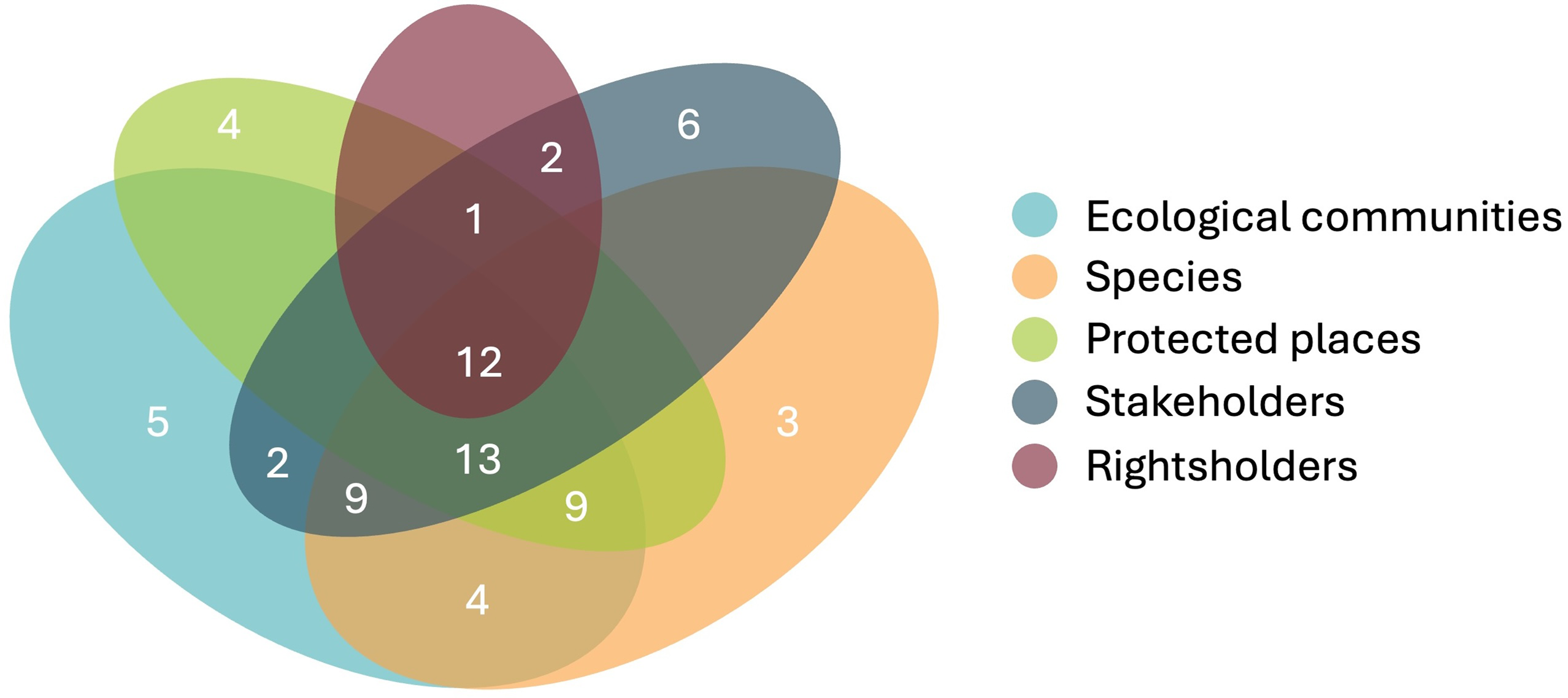
Respondents reported a range of focal areas for their work in conservation, with 74% of survey participants focusing on more than one of ecological communities, species, stakeholders, protected places or rightsholders (Fig. 2). The mean number of focus areas was three and the maximum was six. The most frequent combinations were ecological communities, species, protected places and stakeholders (13 respondents), closely followed by the same combination with the addition of rightsholders (12 respondents). Seven individuals also self-identified as focusing on adaptation and sustainability, First Nations, nature characterization, people and traditional knowledge, community, environmental management and integrated catchment management.
Self-identified focus areas of respondents (respondents could select more than one of the options provided). Numbers indicate the number of respondents who identified different combinations of focus areas (where no numbers are shown, no respondents identified that particular combination of focus areas).
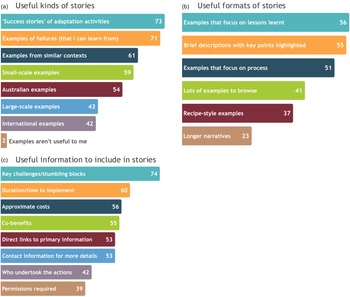
Survey participants identified multiple kinds of stories as being useful to them (Fig. 3), with more than 50% of respondents identifying all options provided as being useful. Examples of successes and failures in adaptation intervention for biodiversity were identified as useful by c. 90% of respondents, but examples from similar contexts, small-scale examples and Australian examples were also identified as useful by more than 60% of respondents.
Useful characteristics of stories about adaptation in biodiversity conservation identified by survey respondents (n = 80): (a) kinds of stories that survey respondents indicated that they find useful; (b) formats of stories that are useful; and (c) information that is useful to see included in stories. Respondents could select multiple options from those provided. Numbers on each bar represent the response count.

When asked what form of stories are useful, respondents also identified all options provided as being helpful (Fig. 3). There was a general preference for stories that focus on lessons (70% of respondents), are brief descriptions with key points highlighted (69%) and focus on process (64%). Similarly, when asked what information is useful to see included in stories, most respondents considered all of the options provided in the survey to be helpful (with the exception of permissions required to undertake particular actions for adaptation, which 49% of respondents considered useful). Interestingly, 93% of respondents considered that descriptions of key challenges/stumbling blocks were useful to include in stories. Furthermore, the duration of efforts/time to implement, approximate costs, co-benefits (e.g., engaging communities/raising awareness), direct links to primary information (e.g., publications/reports about the work) and contact information for more details were all considered very useful.
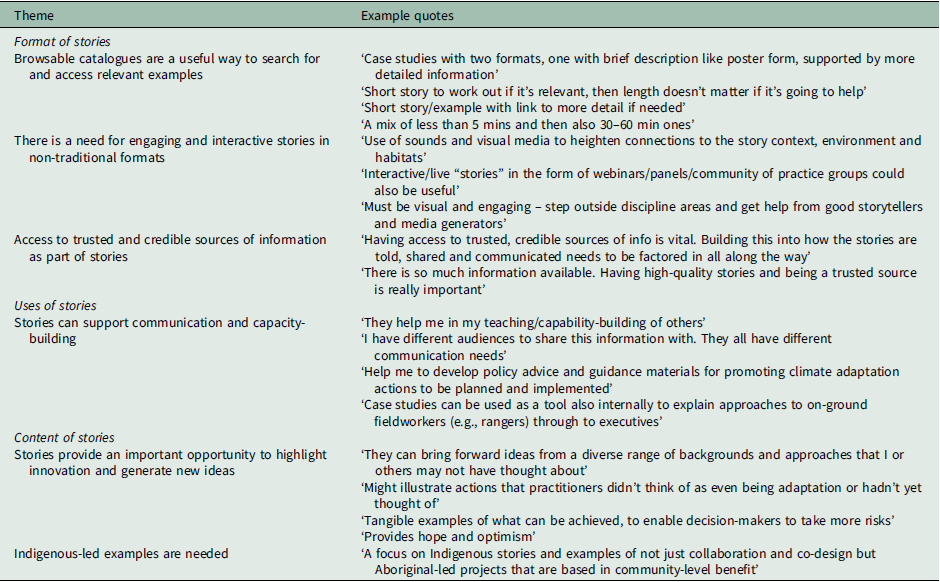
Participants provided a range of insights into the utility of stories in receiving information about climate adaptation in biodiversity conservation contexts through open responses to survey questions (Table 1). Participants particularly highlighted that being able to browse through high-level information to find relevant examples, which could then be delved into in more detail, was important (more than half of the survey respondents indicated that it is useful to have lots of examples to browse through, and seven individuals made comments that this two-step browse-and-delve model is useful). Respondents also highlighted that stories can help in communicating with communities and decision-makers (over 60% responded that stories help to connect with others and build support, and two individuals made comments on these points), and that having access to trusted and credible sources of information is very important in the context of adaptation interventions for biodiversity conservation (two individuals). Six participants specifically commented on the need for visual and engaging stories, including in non-written formats such as videos and podcasts. Some 54% of participants responded ‘yes’ when asked whether stories about how decision support tools for climate change adaptation are used help them to implement those tools (we provided a definition for decision support tools as ‘structured processes that help guide decision-making and might take the form of a workbook or handbook, online guidance or a computer model’), whereas 34% indicated that this depends on whether those stories have enough similarities to their own context.
Themes emerging from free-text responses to survey questions regarding stories about adaptation to support conservation planning.

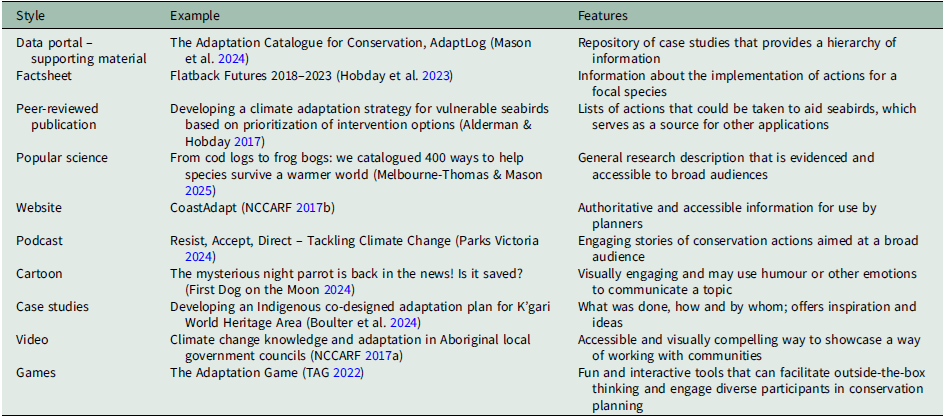
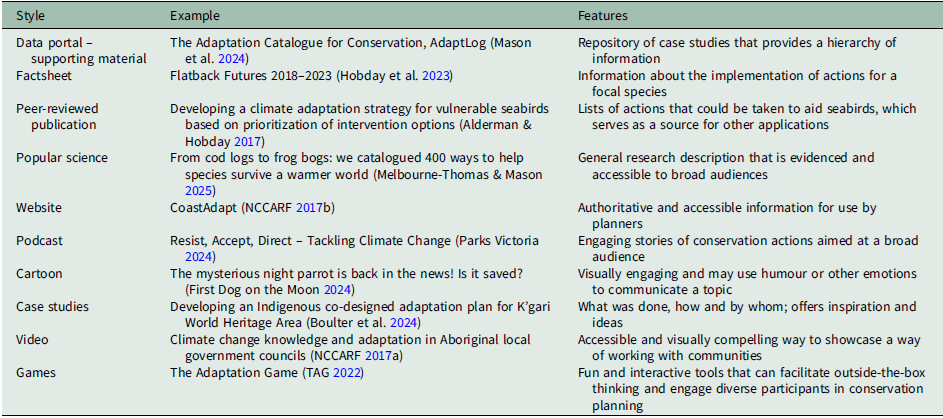
As part of our review of different formats of stories and from the survey feedback, we identified examples of different styles (Table 2). These (non-exhaustive) examples show the range of formats and media that currently exist for sharing information about climate adaptation in biodiversity conservation.
Examples of different styles of stories about adaptation in biodiversity conservation.
Discussion
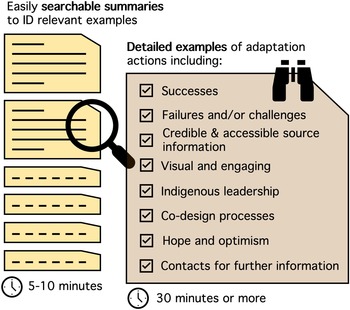
Our results highlight how important stories are, in all their forms, which is not surprising given that many (if not most) cultures have a tradition of communicating in stories – a tradition that has been somewhat lost from the Western scientific mode of communication and that there are opportunities to (re)learn from. The results from our survey indicate that, with respect to our first research question (‘What makes a story useful, informative and accessible?’), people working in biodiversity conservation in Australia who responded to our survey had no single preference for the format and key information content of stories. They indicated that information is needed in all forms, and it needs to be easy to navigate, so that relevant examples with further details can be found quickly, and the source of the information needs to be trusted, credible and accessible (Fig. 4).
Schematic format of a ‘catalogue’ for accessing stories about climate change adaptation in biodiversity conservation. In this model, easily searchable summaries provide relevant information to help users to quickly identify (ID) the examples that will be of most use for a particular purpose or question. Links are provided for further details. Important attributes of more detailed examples identified by survey participants are identified in the right-hand box.

In terms of the needs of different ‘user groups’ – our second research question – our results suggest that there were not distinct groups, as 40% of respondents self-identified as having more than one role or focal activity, working across aspects that involve giving attention to management, research, decision-making, on-the-ground fieldwork, funding and volunteering. Of the 47 participants who identified themselves as having one main role, 16 people identified as managers, seven as researchers, five as volunteers, five as decision-makers and two as fieldworkers (there were insufficient sample sizes across different roles to compare groups). We also found that 74% of survey participants indicated that the focus of their work was on more than one of ecological communities, species, stakeholders, protected places or rightsholders, further highlighting the diverse roles that are covered by individuals working in conservation. Given these diverse roles and focus areas, the need for diverse forms of information about examples of climate change adaptation is perhaps not surprising, and this highlights both the challenging and varied nature of the roles in the Australian conservation sector as well as the value of peer-to-peer sharing. The fact that survey respondents reported that they are engaging and communicating with diverse stakeholders and rightsholders is also consistent with a need for stories in diverse forms.
A total of 76% of survey respondents indicated that their work involves engagement with stakeholders and rightsholders. Several of these participants directly highlighted the value of stories about adaptation to aid in communication and knowledge-sharing with diverse audiences. This suggests that stories have a dual role in conversation: they help those in the sector learn about different options for adaptation interventions and approaches and they enable practitioners to better communicate (and seek support for) their work (e.g., Table 2). These enabling functions of stories help address our third research question: ‘In what ways do stories enable adaptation for biodiversity conservation?’
Other uses of stories about adaptation in biodiversity conservation identified by our survey included their value in inspiring hope and optimism in the face of climate change impacts and biodiversity loss, but also that learning from ‘failures’ is as important as learning from successes. Rossbach et al. (Reference Rossbach, Steckbauer, Klein, Arossa, Geraldi and Lim2023) highlighted that conservation failure often results from a failure in governance and implementation rather than being an outcome of a flawed design, scientific basis or failure of target ecosystems and species to respond. This emphasizes the importance of detailed examples regarding process and context so that the risks affecting success and failure can be better understood and learnt from.
Attributes of stories that were important to nearly all study participants were that they included evidence of outcomes and links to trusted sources. This was considered to be particularly important in terms of building a case to undertake various interventions for climate change adaptation in biodiversity conservation. Being able to identify credible sources for similar previous activities can help to set precedence for similar approaches in new locations or for different species or ecological communities. We suggest that future research could usefully explore what attributes of information sources make them more or less trusted and credible – our own conversations with people working in biodiversity conservation suggest that peer-reviewed sources are considered to be trusted and credible, and that evidenced reporting of outcomes of activities is important. Participants also identified a need for more examples highlighting Indigenous leadership in climate change adaptation. Several survey respondents expressed a desire for examples presented in formats that are engaging and interactive (Tables 1 & 2). Previous research has identified that images of conservation actions (as opposed to threats) are important for increasing feelings of hope as well as intentions to engage in pro-conservation behaviours (Ison et al. Reference Ison, Cvitanovic, Pecl, Hobday and van Putten2024).
Conclusions and recommendations
Stories about climate change adaptation in biodiversity conservation provide ‘tangible examples of what can be achieved, to enable decision-makers to take more risks’ (Table 1). In the field of climate adaptation, where the future is uncertain and past information is less reliable for informing action, taking risks can enable new opportunities and solutions to be found. Stories enable peer-to-peer sharing as well as communication and capacity-building for diverse audiences. To support these functions, our results indicate a need for ‘scalable hierarchies’ of information – browsable catalogues of different examples of activities that enable users to select those examples that are most relevant and then to seek further information. Individuals working in biodiversity conservation in Australia have diverse roles (e.g., a conservation manager might also have roles in sourcing funding, on-the-ground fieldwork and volunteering), and they also have diverse areas of focus – often working with species, ecological communities, protected areas, stakeholders and rightsholders. Accordingly, there are diverse needs and uses for stories about adaptation in biodiversity conservation, and there is a large appetite in the sector for accessible, relevant and credible information. Given the strong and growing appetite for mechanisms to share experiences in the field of climate change adaptation for biodiversity conservation, the results from our study can help inform the development of platforms to access and share stories (e.g., the Adapt Land&Sea platform (https://adaptlandandsea.org.au/), which is already implementing findings from our research) and thus support those involved in conservation on land and in the sea to plan and undertake adaptation in informed and effective ways.
Supplementary material
To view supplementary material for this article, please visit https://doi.org/10.1017/S0008423926101024.
Acknowledgements
We would like to thank the NESP Climate System’s Project 2.7 Steering Committee for their advice on survey design. Thanks are also given to the project participants who responded to our survey. Comments from three anonymous reviewers and the editor helped refine the content of the manuscript.
Financial support
This work was supported with funding from the Australian Government under the National Environmental Science Program (NESP).
Competing interests
The authors declare none.
Ethical standards
This study was approved by CSIRO’s Social Science Human Research Ethics Committee (approval number 203/22) in accordance with the National Statement on Ethical Conduct in Human Research 2007 (Updated 2018).



 Open access

