




Towards the end of Scene 5 in Sebastián Durón’s six-scene opera La guerra de los gigantes (The War of the Giants), the goddess Minerva triumphs over the leader of the giants, Palante, by stabbing him to death. In the next and final scene, she celebrates the victory of the deities over the giants with Jupiter and Hercules, and thus ends the opera. Intended as a nuptial celebration, the opera’s violent theme is curious, to say the least. Adding to its unusual plot is the fact that La guerra de los gigantes is the only opera by the renowned court composer Sebastián Durón (1660–1716), who is primarily known for his zarzuelas. La guerra de los gigantes is not only the sole Spanish opera of this period, but also the first ever work to be designated an ‘opera’ in a Spanish score. Durón’s intriguing music drama raises several questions. Why was a war chosen for the subject of this celebratory work? If local theatre traditionally linked heroism and valour with men and male characters, then why was Minerva made into the hero here? Why was La guerra de los gigantes devised as an entirely sung drama, rather than a partially sung staged work like the zarzuela, as was more common in late seventeenth-century Madrid? Finally, what did ‘opera’ mean in Durón’s time?
Opera as a political allegory
La guerra de los gigantes remains an enigmatic work despite the growing interest of Spanish musicologists and performers in reconstructing and disseminating this little-known opera.Footnote 1 This is due, at least in part, to two interconnected factors: first, there is an absence of surviving documents relating to it, as well as Spanish music dramas of this period in general; and second, critical research on Spanish opera from this period is still scarce when compared to French or Italian opera.Footnote 2 What we know about La guerra de los gigantes may be surmised from the opera’s only surviving document, a score held in the Biblioteca Nacional de España, which offers clues regarding the patron who commissioned the work and the identity of the bride.Footnote 3 Its title page indicates that this ópera escénica (‘staged’ or ‘scenic’ opera) was written for a nobleman, a certain ‘Count of Salvatierra’,Footnote 4 and its introducción (introduction) tells us it was intended to celebrate a wedding. In its opening musical number, ‘Cítaras dulces’ (‘Sweet Zithers’), one of the allegorical characters in the introduction, possibly Fame, gives us the name of the bride, ‘Melisa’, whose connection with a real-life figure of the time will be discussed below. This introduction is followed by six short scenes, described in Table 1, which retell the ancient myth of the war between the Giants and the Gods in Mount Olympus, with Minerva as the central character. In the opening scene Palante, leader of the giants, summons his fellow giants, and they declare war on the deities. In Scene 2, Minerva overhears the giants preparing for war and advises Jupiter to ready for battle and call on Hercules for assistance. In Scene 3, Minerva seeks Hercules’s assistance, and he agrees, captivated by her beauty. The war erupts in Scene 4. In Scene 5 Minerva kills Palante, ending the conflict. The opera concludes with the deities celebrating their victory in Scene 6. The opera is scored for four soloist voices notated in soprano clef (clave de do en primera), a four-part chorus (A 4), trumpet (clarín), violins and continuo.
Overview of La guerra de los gigantes

Since La guerra de los gigantes was written during the early stages of the War of the Spanish Succession (1701–14), scholars have turned their attention to the allegorical meaning of this work, proposing that its characters may stand in for real-life figures.Footnote 5 The origins of this war are well known: Charles II of Spain (1661–1700), the last member of the Spanish Habsburg branch, died childless, causing a twelve-year dispute over the succession to the throne of Spain, which resulted in the deaths of over 1.2 million people.Footnote 6 The king had two distant nephews, both of whom were equally entitled to inherit Spain’s possessions and dominions: one a French Bourbon and the other an Austrian Habsburg. On his deathbed, and following the council of his adviser Cardinal Luis Manuel Fernández de Portocarrero and others, Charles II elected, as his universal successor, Philippe, Duke of Anjou and grandson to Louis XIV of France, leaving out of the will the Archduke Charles of Austria, brother of Joseph I, Holy Roman Emperor. Soon after Philippe’s ascent to the Spanish throne, an anti-French coalition between the Archduchy of Austria, England and the Dutch Republic, known as the Grand Alliance, was formed. On 15 May 1702, they formally declared war on Louis XIV and his grandson, determined to overthrow the Bourbon king and install the Habsburg candidate (and with this, prevent Louis XIV from establishing a Bourbon hegemony in Europe).
Mirroring the political divisions in Europe, the Spaniards found themselves in a complex civil war both at a national level and within the Madrid court. Even before the war, there were ‘factional disputes and rivalry for power among ministers’, due to Charles II’s weakness and inability to rule, as historian Henry Kamen has argued.Footnote 7 Led by their own political interests, one faction supported a Bourbon heir, while the other favoured an Austrian one. This divide caused great turmoil in the court during the final years of Charles II and following his death. After Philippe ascended to the throne as Philip V of Spain, these previously established loyalties came under scrutiny and were sometimes broken. Members of the court who had declared their allegiance to the Bourbon king suddenly sided with the archduke. One of these was Pedro Portocarrero y Guzmán, Patriarch of West Indies and principal authority of the Royal Chapel between 1691 and 1708, who, notably, was the nephew of the aforementioned cardinal; another was Sebastián Durón himself. The composer, as Nicolás Morales has shown, tried to ‘promote a powerful anti-Bourbon network in Madrid’ and, after overtly expressing his support for the Archduke in 1706, was incarcerated and exiled.Footnote 8 In other cases, improper behaviour could place a loyal subject under suspicion. This was the case with some of Spain’s grandees, the highest aristocracy, including – most importantly for our purposes – Don Juan Manuel Diego López de Zúñiga Sotomayor Mendoza y Guzmán (1680–1747), the Duke of Béjar. In 1702 or 1703 the Duke of Béjar commissioned a laudatory play revolving around his devotion to the monarchs, which I will examine below. Yet only four years later he was asked to ‘refrain from coming to the [king’s] palace’ due to his questionable behaviour (his disloyalty was suspected but never proved).Footnote 9
What allegories can we read in La guerra de los gigantes? Two hypotheses have been proposed. The first, by Antonio Martín Moreno, suggests the ‘Count of Salvatierra’ commissioned this work for his own wedding in 1702 and proposes that ‘Hercules, the champion of the Gods, represents Philip V; Jupiter, the General of the Army of the Gods, the Count of Salvatierra; Minerva, the heroine of the story, María Leonor Dávila López de Zúñiga (1684–1749), Count of Salvatierra’s wife; and Palante, leader of the Giants, the Archduke Charles of Austria’.Footnote 10 In Moreno’s reading, the opera may be understood as a reflection of the tensions arising from the problem of succession. The second hypothesis, put forth by Raúl Angulo Díaz and Antoni Pons Seguí, suggests that the Count of Salvatierra commissioned the opera for Philip V’s wedding to his cousin, the Italian princess Maria Luisa Gabriela of Savoy, announced on 8 May 1701, and which took place by proxy a few months later, on 11 September 1701.Footnote 11 This opera addresses the issue of succession while honouring the newly established rulers of Spain. In this reading, Hercules still represents Philip V, while Jupiter and Minerva symbolise Louis XIV of France and his great-niece Maria Luisa Gabriela of Savoy. Additionally, Palante may be interpreted as the embodiment of the anti-Bourbon forces leading to the war declaration in 1702.Footnote 12 Also worth considering is that the Count of Salvatierra may have commissioned the opera sometime between 1701 and 1703 but only offered it to the new king and queen in 1703, when, for the first time, both monarchs were together in Madrid.Footnote 13 These hypotheses allow us to date the opera to the brief period between 1701 and 1703.
Moreno’s and Angulo Díaz/Pons Seguí’s readings of Hercules as the embodiment of the Spanish king become particularly convincing in the context of the vast literature on Hercules in early Spanish theatre and history. Son of Jupiter and famous for his supernatural strength, Hercules was claimed by national mythology and iconography, portrayed as a native hero and incorporated into the genealogies of Spanish kings, as Dian Fox and others have shown.Footnote 14 What is more, he was intimately associated with the Spanish Habsburg monarchy during the seventeenth century – as seen in numerous artistic works, including plays by the famous court dramatist Pedro Calderón de la Barca (1601–85).Footnote 15 That this association carried into the early eighteenth century with Philip V is not surprising: the new French-born king of Spain was of Spanish royal descent, as he was grandson of Louis XIV of France and his wife, Maria Theresa of Spain (1638–83), daughter of the Spanish King Philip IV. During the first few years of his reign, as José Máximo Leza Cruz has shown, Philip V was identified with Hercules in several plays produced in Madrid, including El Hércules ofendido, defendido y apaciguado (Hercules offended, defended and appeased, 1709), which specifically acknowledges in its plot that Hercules was an early ‘king of Spain’.Footnote 16
The French, for their part, also associated their ‘Philippe’ (i.e. Philip V of Spain) with Hercules in poems and engravings produced during the War of the Spanish Succession, as Margarita Torrione has demonstrated in her examination of French royal almanacs from the early eighteenth century. Moreover, the French connection between Hercules and ‘Philippe’ was not new, but rather the continuation of an iconographic and musical tradition that had begun with Louis XIV.Footnote 17 Two notable allegorical operas on the subject of Hercules are Ercole Amante by Venetian composer Francesco Cavalli (1662) and a later setting of the same libretto, under the same title, by Venetian composer Antonia Bembo in 1707 – both dedicated to Louis XIV.Footnote 18 Hence, the identification of Hercules with Philip V was established, at the time of La guerra de los gigantes, on both Spanish and French sides.
But what of Maria Luisa Gabriela of Savoy and Minerva? Angulo Díaz and Pons Seguí base their argument on their interpretation of Fame’s lines in the opening musical number in the introduction, ‘Cítaras dulces’ (‘Sweet Zithers’):
FAMA: De Melisa en alabanza
Cultos el viento respire,
Y Prónuba, junto a él,
Teas prenda y velos rize.
(Fame: In praise of Melisa / May the wind breathe adorations, / And with it [i.e. the wind] may Pronuba / Light torches and ripple veilsFootnote 19)
In this stanza, Fame asks the wind to praise Melisa and asks Pronuba (an epithet for the goddess of marriage, Juno) to help the wind celebrate the glories of the bride. The name ‘Melisa’, these two scholars argue, is a contraction or acronym of the name Maria Luisa.Footnote 20 Thus, the bride, as well as Minerva in the opera, can be no other than the future queen consort of Spain: the Italian princess Maria Luisa Gabriela of Savoy.
In this article I build upon these readings, arguing that La guerra de los gigantes is indeed an allegory of the war, and expanding on Angulo Díaz and Pons Seguí’s interpretation of the bride and Minerva. I argue that the character of Minerva was intended to symbolise Maria Luisa Gabriela of Savoy (1688–1714), depicting her not only as an ideal wife and woman but also as a formidable military and political ally to King Philip V. I explore Minerva’s cultural origins and meanings through a substantial number of primary sources, some previously unknown to musicology, including Tomás Genís’s little-known play Adquirir para reinar, triunfos de Felipe Quinto, y glorias de Gabriela (Acquire to Reign, Triumphs of Philip V and Glories of Gabriela), which shares striking similarities with the Count of Salvatierra’s opera. I propose that these two works form part of a broader ‘theatre of loyalty’ sponsored by Madrid’s elite, which emerged during the first few years of Philip V’s reign and the War of the Spanish Succession. I show the role of the Spanish nobility in shaping the public image of the young queen as the mighty warrior Pallas/Minerva to mirror her worth in times of war, to pay homage to the monarchs, publicise the Bourbon cause, show alliance with their king and enhance or consolidate their power. Finally, I touch upon the issue of genre, suggesting that La guerra de los gigantes represents one of several attempts by the Spanish high nobility to develop opera in Madrid, at a time when partly sung musical dramas such as the zarzuela were the dominant theatrical forms.
Minerva and the queen
In addition to the name ‘Melisa’ being a likely contraction of ‘Maria Luisa’, I would add two more hypotheses to support the claim that Minerva was intended to represent the future consort queen of Spain – and that, consequently, Salvatierra commissioned the work for the royal wedding. The first one is that Maria Luisa was most likely linked to this mythical figure because of an existing association between Minerva and female royal figures in early modern Europe. Pictorial examples include the coins and medals of Queen Anne of England issued in the early eighteenth century, and the portraits of Queen Christina of Sweden (1626–89).Footnote 21 More importantly for our purposes, we may find many images associating this deity with female relatives of Maria Luisa, including her great grandmother, the French princess Christine of France, Duchess of Savoy (1606–63), and aunt to the future king of France Louis XIVFootnote 22; her grandmother the English princess Henrietta of England (1644–70), and wife of Philip I, Duke of Orléans (1640–1701)Footnote 23; and finally, Anne Marie d’Orléans, Duchess of Montpensier (1627–93), who was first cousin to Maria Luisa’s grandfather, Philip I, Duke of Orléans, and to her great-uncle, Louis XIV.Footnote 24 This pattern of representation suggests that Maria Luisa may have also been associated with this goddess in the visual arts. Although I have yet to locate a visual depiction of this queen as Minerva,Footnote 25 she is explicitly identified with this deity in several Spanish texts from the early eighteenth century. The most significant one is the Duke of Béjar’s play Adquirir para reinar, written around the same time as Count of Salvatierra’s opera, and which I will discuss below.
The second hypothesis stems from observing the interaction between Minerva and Hercules and, particularly, Hercules’s great admiration for this goddess in the opera. This fictional dynamic may be read as the amorous relationship between Philip V and his bride, and not that between Philip V and another man’s future wife (i.e. the Count of Salvatierra’s bride) or with, say, another court figure, such as the French aristocrat Marie Anne de La Trémoille, princesse des Ursins, who held enormous power in the Madrid court during the queen’s lifetime. As we shall see, Hercules is the only character dazzled by this deity’s magnificent beauty. This mighty warrior surrenders to Minerva, who is cast as the embodiment of the ideal woman and the perfect wife – especially in times of war.
Minerva’s lineage and characteristics made her an excellent choice to personify royal women. Spanish mythographers, dramatists and audiences of the era knew Minerva under her various names of Pallas, Athena, Tritonia and Viragoflava. She was commonly understood to be the daughter of Jupiter, the king of gods; the goddess of wisdom, science and warfare; and a chaste deity. Additionally, she possessed the masculine characteristics of strength, power and courage.Footnote 26 In the opera, she is identified as the daughter of Jupiter and, by name, she is first referred to as Minerva and later Pallas, following the death of Palante. The anonymous libretto stresses three of her attributes: her virtue, beauty and manliness – all traits of the ideal wife in the early modern Spanish imagination.
Early Spanish intellectuals and theologians believed that female virtue and beauty were intrinsically linked, arguing that true beauty could be found in the virtuous soul and that physical beauty was nothing but an outward manifestation of inner moral values. These views are articulated in conduct books for women, all written by men, which discuss women’s nature and attributes. One of the most famous of these texts is Fray Luis de León’s La perfecta casada (The Perfect Wife, 1583), a bestseller that was reprinted on numerous occasions in the seventeenth and eighteenth centuries, and which has appeared in 94 different editions to date.Footnote 27 This influential work, often cited in later texts and frequently found in Spanish households, sheds considerable light on gender discourses of the era. Regarding virtue and beauty, Fray Luis de León explained that ‘[God] places the beauty of the good woman, not in the features of her face, but in the secret virtues of her soul’ (‘Pone la hermosura de la buena mujer, no en las figuras del rostro, sino en las virtudes secretas del alma’).Footnote 28 Of all virtues a woman could possess, León believed the greatest was that of chastity.
Minerva’s beauty does not seem to be solely physical (indeed, her appearance is never explicitly described in the libretto except for the reference to her beauty) but rather mirrors her moral excellence. Her most notable virtue, as one might expect, is that of chastity – which was one of particular importance in the context of the wedding being celebrated with this drama. Minerva was referenced in Spanish texts of the seventeenth century as a virgin goddess who represented chastity, and was paired with the dragon, one of the animals consecrated to her, who fiercely guarded her virginity.Footnote 29 One such text is Baltasar de Victoria’s widely read Teatro de los dioses de la gentilidad (Theatre of the Gods of the Pagan World, published in two parts in 1620 and 1623), in which the mythographer explained that, with its sharp eyes, the dragon could safeguard the most precious of treasures and for this reason it was consecrated to Minerva.Footnote 30 In the opera, her chastity is not referenced in a direct way but is rather alluded to through the symbolism of the dragon that appears in scene 2 – after all, the anonymous librettist deliberately chose to feature this animal and not the owl, also consecrated to this deity. Scene two begins with Jupiter descending from the sky and singing the strophic solo song or tonada ‘Aguila impaciente’ (‘Impatient Eagle’), in which he asks his eagle (consecrated to Jupiter) to stop flying and rest on the ground so that he can better hear the bellicose sounds coming from the earth. Minerva suddenly appears to tell him that the giants are preparing for war. While the manuscript does not indicate how she ‘enters’ in this scene, we may infer that she descends from the sky riding her dragon, because she meets Jupiter at the top of a mountain and because she later exits the scene flying on her dragon, as the final duet implies. The libretto thus suggests that machinery was used for these effects, something frequently found in opera and other forms of musical theatre of the era.Footnote 31 Minerva convinces Jupiter to call on the mighty Hercules for help (after discouraging him from calling on Cupid, Apollo or Mars, whom she viewed as weak), and then begins to prepare for the upcoming war. In their final duet in scene 2, father and daughter praise their respective companions (eagle and dragon) while expressing their desire to battle the giants. Upon Jupiter’s request, Minerva departs his realm on her dragon and flies to Hercules’s land. This is a critical moment in the opera because, symbolically speaking, the bride embodied by Minerva is seen departing from her father’s home (in this case, the home of her great-uncle, Louis XIV) and preparing to enter that of her future husband. What viewers may have noticed here is the affirmation of her virtue, reinforced by the presence of the guardian dragon. They may also have noted that her chastity is maintained during this transition from daughter to bride.
Hercules recognises Minerva’s virtuous beauty immediately upon meeting her in the following scene. This third scene is for Hercules and Minerva alone, and it is made up of four distinct musical numbers described in Table 2. Its central position in the opera serves to emphasise this most symbolic moment: when Hercules pays tribute to Minerva by acknowledging her virtues and becomes her ally. In the opening number we find Hercules by himself, reminiscing about his many past victories and eager to find new challenges. Embodying the new king, Philip V, and sharing his qualities, Hercules sings a fiery tonada in the key of D Major for voice, trumpet (clarín) and continuo, entitled ‘Animoso denuedo’ (‘Spirited boldness’), which celebrates his courage, strength and ‘manly toil’ (afán varonil) in battle.Footnote 32 The first of the five stanzas reads:
HERCULES: Animoso denuedo, guerrero
que en lides corona
mi afán varonil,
pues por mí solo alienta el cavado
famoso clarín.
(Hercules: Spirited boldness, warrior /who in battles crowns /my manly toil, / because for me alone sounds / the famous belled trumpet.)Musical numbers in Scene 3
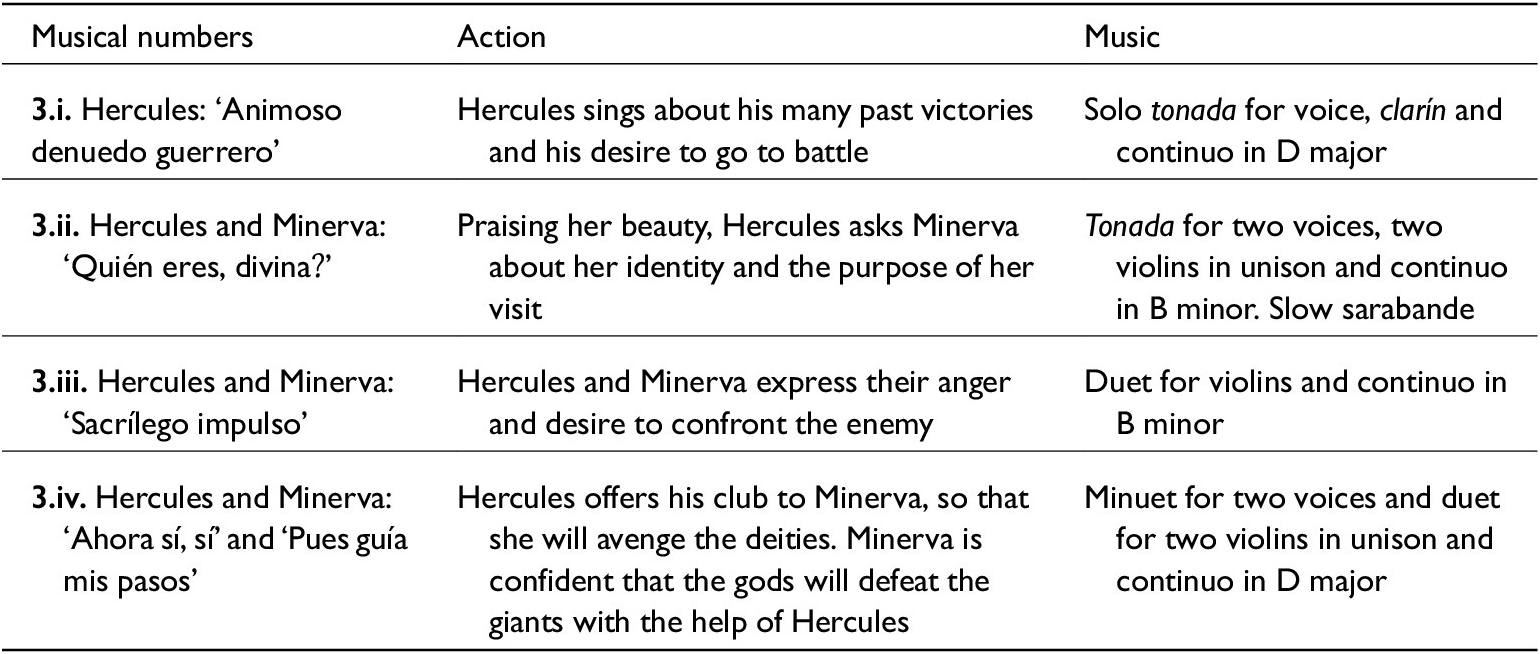
Hercules then goes on to enumerate his many victories in the next four stanzas, which list four out of his twelve famous labours – all retold in a series of myths that contemporary court audiences were well familiar with. These include labours number two (to slay the Lernaean Hydra), three (to capture the Ceryneian Hind), six (to slay the Stymphalian birds) and eleven (to steal three golden apples from Hesperides’s garden), in stanzas two, three, four and five, respectively. Each of the five stanzas ends with the same last line: ‘Where will I find something to conquer, if there is nothing left for me to defeat?’Footnote 33 Hercules’s eagerness to fight in battle is conveyed here using musical and textual repetition and, importantly, the presence of the clarín, and vocal coloratura, as shown in Example 1.
Clarín and coloratura in Hercules’s tonada ‘Animoso denuedo’ (bb. 1–26).

Minerva arrives towards the end of this tonada and surprises him by echoing the melody of his last line, but with the answer: ‘Where there is another greater danger to conquer’ (‘Donde hay otro riesgo mayor que rendir’). The demi-god is struck by her beauty. In awe, and rather abruptly, he begins a new, much slower and sweeter strophic tonada for two voices, two violins and continuo, in which he inquires the beautiful goddess about her identity and the purpose of her visit. Musically, this piece is divided into two halves, with the first half corresponding to Hercules’s strophes and the second to Minerva’s – perhaps hinting at the union and alliance of these two characters. In each of the three stanzas, Hercules asks one question to which Minerva responds, and so the music is repeated three times:
HERCULES: ¿Quién eres, divina
beldad peregrina,
cuya luz desaira
las luces del sol?
Dímelo pues, sépalo yo.
MINERVA: Minerva arrogante
que hija del Tonante
soy árbitro bello
de ciencia y valor.
Óyelo pues, oye mi voz.
HERCULES: Pues, ¿con qué motivo
de mi brazo altivo
buscas el triunfante
bélico furor?
Dímelo pues, sépalo yo.
MINERVA: Con que de la esfera
tu espada guerrera
logrando el amparo
deshaga el baldón
Óyelo pues, oye mi voz.
HERCULES: ¿Quién hay tan osado
que al globo estrellado
altere la inmensa
quietud superior?
Dímelo pues, sépalo yo.
MINERVA: La intrépida furia
que con nueva injuria
es en los Titanes motín y traición,
Óyelo pues, oye mi voz.Footnote 34
(Hercules: Who are you, divine / beautiful pilgrim, / whose light disrespects / the light of the sun? / Tell me so that I will know. / Minerva: Proud Minerva / daughter of the thunderous deity, / I am the beautiful arbitress/ of science and valour, / hear it then, hear my voice. / Hercules: Then, for what reason / of my haughty arm / do you seek the triumphant / warlike fury? / Tell me so that I will know. / Minerva: So that your warrior sword / will undo the insult / made upon Heaven / by granting it protection / hear it then, hear my voice. / Hercules: Who is there so audacious / that of the starry globe / alters the immense / superior quietude? / Tell me so that I will know. / Minerva: The intrepid fury / whose new insult / is in the Titans’ mutiny and treason, / hear it then, hear my voice.)This tonada for two voices, characterised by slow arch-shaped vocal lines, is a sarabande in 3/4 time in B minor – the relative minor of the D major key in the preceding song. Its musical characteristics provide great contrast with Hercules’s preceding war-like song. As shown in Example 2, the use of a minor key, different instrumentation – intimate violins, rather than a martial sounding trumpet – and the slower tempo indicated as ‘despacio’ (‘slow’) and purposely written twice in the manuscript (bars 1 and 7) tell us that Hercules’s mood has changed – from bellicose to peaceful, and love-struck. Two more musical numbers will follow: first, a contrasting and powerful duet in which the two now allied characters express their desire to confront the enemy, and second, a lively minuet in which Hercules expresses his full support to Minerva by offering his club to her, so that she will avenge the deities.
Violins, slow tempo and minor key in the tonada for two voices ‘¿Quién eres divina?’ (bb. 1–17).

Hercules will praise the deity’s beauty one last time towards the end of the opera. In the final musical number in the closing scene, Hercules, Minerva and Jupiter sing a minuet in which each character sings one stanza. This minuet is the second and last one in the opera – with the first appearing in the third scene, as we see in Table 2. Since the minuet is a dance form associated with the French court and is unusual in Durón’s musical dramas, it seems to be used here not only to differentiate in musical terms the deities from the Giants, but also to characterise the allegorical counterparts of the three royal figures connected to the French court: Philip V, Maria Luisa and Louis XIV. In his stanza, Hercules reveals that he – the most celebrated of all warriors – has yielded to Minerva’s beauty:
HERCULES: ¿Cómo hoy no ha de ser trofeo
cuanto la Fama divulga,
si el que es más aplauso,
cede a la que es más hermosura?Footnote 35
(Hercules: How can Fame report / no victory today, / if he who is the most celebrated / cedes to her who is the most beautiful?)In this way, the opera ends with Hercules/Philip’s submission to Minerva/Maria Luisa and with a striking laudatory allusion to the royal bride.
The manly ideal in women
Yet beauty and virtue are not the sole qualities found in Minerva/Maria Luisa, for the opera’s anonymous librettist also emphasised this deity’s manly traits – power, strength and courage – to portray Maria Luisa as the perfect wife, queen and war-time ally. After all, the Savoyard princess was chosen as a bride to the new king of Spain not only for her youth and virtues, but because the union of the House of Savoy and the House of Bourbon promised to strengthen Philip V’s political position on the European stage. This Bourbon–Savoyard strategic alliance was intended to provide Philip V with a military and political ally against his enemies. The strength of this deity in the opera, and her ability to defeat the enemy, may thus be viewed as emblematic of Maria Luisa’s military and political value.
To understand why manly attributes were required to depict the ideal real-life bride and her stand-in character, we must again turn to texts about women of the era, which drew together threads from ancient philosophy and more recent humanist thought. In them we read that women were seen as imperfect creatures that were inferior to men, and that perfection was understood as a male attribute. For this reason, it was believed that women could only achieve perfection or worthiness, if they possessed masculine traits.Footnote 36 Fray Luis de León, for example, explained in his famous conduct book that what he called ‘woman of valour/value’, he could also call ‘manly woman’:
A woman of worth we call her, and we could well call her a manly woman, as Socrates, according to Xenophon, calls perfect wives, so that what we describe masculine or of worth, is in the original a word of great significance and force, so much so that even with many of our own words we can hardly capture its full meaning. It means a virtuous spirit and a strong heart; industry and riches, power and advantage, and finally, perfection and completeness regarding these things in the person to whom this word is applied.Footnote 37 (my emphasis)
(Lo que aquí decimos mujer de valor, y pudiéramos decir mujer varonil como Sócrates acerca de Xenophon llama a las casadas perfectas, así que esto que decimos varonil, o valor en el original es una palabra de grande significación y fuerza, y tal que apenas con muchas muestras se alcanza todo lo que significa. Quiere decir virtud de ánimo, y fortaleza de corazón industria, y riquezas, y poder, y aventajamiento, y finalmente un ser perfecto y cabal en aquellas cosas a quien esta palabra se aplica: y todo esto atesora en sí la que es buena mujer, y no lo es si no lo atesora.Footnote 38)By describing the perfect wife as manly, León was adding to a long-established tradition ‘of using manly as an adjective of the highest praise for women’ that had begun, as Mary Elizabeth Perry explains, in the fourteenth century with Giovanni Boccaccio’s book Concerning Famous Women. Footnote 39 Of course, this quality of manliness was reserved for only a few extraordinary women, most often (but not always) royal, noble or aristocratic figures and saints. It was, nevertheless, a virtue that average women could aspire to, or, at least, admire in their exceptional peers.
In many texts, the manly attributes of power, strength and courage in women are also discussed in connection to stories of real-life women who fought in battle, as we find, for instance, in the influential multi-volume Teatro crítico universal (1726–39), written during the reign of Philip V by the famous scholar Benito Jerónimo Feijóo (1676–1764). An example Feijóo provides is that of María de Estrada, who fought with the troops of the conquistador Hernán Cortés in Mexico. A contemporary who saw her in battle reported that
she showed great valour in this dangerous conflict, taking a sword and shield in her hands she performed marvellous deeds, and opposed the enemy with courage and spirit, as if she were one of the most valiant men in the world, forgetting that she was a woman, and displaying a degree of valour which in such cases is usually seen only in the most noble of men… [She] fought on horseback with a lance in her hand with such virile courage that you would have thought her one of the most valiant men in the army…Footnote 40 (my emphasis)
(Mostróse muy valerosa en este aprieto y conflicto, María de Estrada, la cual con una espada, y una rodela en las manos hizo hechos maravillosos, y se entraba por los enemigos con tanto coraje, y ánimo, como si fuera uno de los más valientes hombres del mundo, olvidada de que era mujer, y revestida del valor, que en caso semejante suelen tener los hombres de valor, y honra… peleó a caballo, y con una lanza en la mano tan varonilmente, como si fuera uno de los más valientes hombres del Ejército…Footnote 41)As one may note from this account, the trait of valour is firmly linked to virility. Women in battle were irrevocably seen as masculine.
Given her unusual strength and valour in battle, Minerva was also viewed as ‘manly’. Several sources describe her masculine traits, including Baltasar de Victoria’s Theatre of the Gods of the Pagan World, introduced above. A slightly earlier, yet equally influential mythological manual, Philosophia Secreta (Secret Philosophy, 1585) by Juan Pérez de Moya, provides an in-depth examination of the goddess’s masculinity. Pérez de Moya explains that the name Viragoflava, one of Minerva’s many names, in fact means ‘varona morena’, which can be translated as ‘brunette manly woman’.Footnote 42. The mythographer goes on to explain that
she is seen as manly due to her strength because Minerva is the goddess of war, and poets always depict her armed, and because the exercise of arms suits hot men better. By giving her weapons and making her the goddess of war, they meant to say that she is not tender like a maiden but tough like a man, and so they called her manly, which means a woman who has the characteristics and strength of a man. (my emphasis)
(Llamase varona por su fortaleza, porque es Minerva diosa de la guerra y siempre los poetas la ponen armada y porque el ejercicio de las armas conviene más a los varones calientes y porque a Minerva dieron ser diosa de la guerra y armada, quisieron decir que no era tierna como doncella más era dura como varón y así la llamaron varona, que quiere decir mujer que tiene condición y fuerzas de varón.Footnote 43)The anonymous librettist emphasised Minerva’s manliness by exaggerating her strength and by increasing her participation in the war, slightly deviating from well-known historical accounts. To begin, the librettist did not draw his plot from Ovid’s Metamorphoses (as many Spanish musical dramas did), as Ovid’s account of the myth does not mention Minerva at all.Footnote 44 Rather, he somewhat relied on the discussions found in Pérez de Moya’s and Victoria’s mythological manuals. In their examination of this war, both Pérez de Moya and Victoria refer to Minerva as ‘Pallas’ – the name more commonly used for her in descriptions of wars and battles. Pérez de Moya tells us that Minerva’s presence during the war helped Jupiter defeat the Giants. As goddess of war and wisdom, she infused Jupiter with strength, perhaps stirring up in him the ‘wisdom and experience in martial art’ (‘sabiduría y experiencia del arte marcial’) required during the war.Footnote 45 Victoria, for his part, explains that because the deities felt they were losing the war, they turned to Pallas for advice, for she was goddess of wisdom. Pallas then suggested bringing the demi-god Hercules to the battleground. When Hercules appeared, his strength and valour re-awakened in the deities the desire to fight, and so the deities were able to defeat the giants.Footnote 46
In the opera, however, Minerva does not simply offer advice and encourage others to fight, as she does in Scenes 2, 3 and 4. Rather, it is she who takes up arms and defeats Palante, and with him, the giants. By turning Minerva into the hero, one bearing her own weapons in battle, the creators of La guerra de los gigantes depicted Maria Luisa as a formidable military and political ally. In Scene 5 we find Minerva alone with Palante. The two characters sing a tonada about fate, death and revenge, ‘Donde cielo divino’ (‘Where divine heavens’). Midway through the piece, Minerva fatally stabs Palante with her spear, declaring: ‘Pues, ¡muere a mi rencor!’ (‘Then die from my rancor!’). Significantly, she does not use Hercules’s club offered to her earlier in the opera but instead wields her own weapon – perhaps a symbolic assertion of her own strength and value. With the enemy now dead, the deities celebrate their victory in the sixth and last scene of the opera, in which Hercules surrenders to the goddess’s virtuous beauty. It is also here when Jupiter announces that Minerva will change her name to Pallas because ‘[ella] vengó en Palante del cielo injurias’ (‘through Palante she avenged the insults of the sky’).Footnote 47 Far from being arbitrary, this name change was based on well-known stories and overall knowledge about this goddess. Indeed, Spanish mythographers discuss this name change in their manuals. According to Victoria, some versions of the myth explain that Minerva adopted the name Pallas, a variation of the name Palante, after killing this giant.Footnote 48
Likewise, a few writers of the era use the name Pallas to refer to Maria Luisa Gabriela of Savoy in early eighteenth-century texts that commemorate the queen’s strength during the War of the Spanish Succession. The most important of these texts for the purpose of our discussion is the little-known three-act play by poet Don Tomás Genís, entitled Adquirir para reinar, triunfos de Felipe Quinto, y glorias de Gabriela (Acquire to Reign, Triumphs of Philip V and Glories of Gabriela) dedicated to their majesties by the Duke of Béjar and gentleman of the monarch’s bedchamber, held in the Biblioteca Nacional de España (E-Mn R/39629), and dated between 1701 and 1725.Footnote 49 Like La guerra de los gigantes, this play was commissioned by a nobleman, in this case, a Grandee of Spain, the Duke of Béjar,Footnote 50 and it was intended to entertain while paying homage to the king and queen of Spain. And like the opera, this three-act play contains allegories, describes a war, includes music (in the opening and sporadically throughout the play), and uses the same rhetoric of praising the virtues of Hercules (or Alcides) and Pallas (or Belona, ancient Roman goddess of war) – only this time, to deliberately and unequivocally equate them with the two monarchs. The main characters are King Philip V, Queen Maria Luisa Gabriela of Savoy, the Duke of Béjar himself and the two allegories: España (Spain) and Lealtad (Loyalty). The story is rather simple: it describes a time in which Philip V was away at war and the queen was in the Madrid court taking care of affairs during his absence. It retells the king’s dialogues with the two allegories regarding his new kingdom and the war, describes the queen’s successful regency, and highlights the loyalty of the Duke of Béjar – all while continually reiterating the many virtues of both monarchs and, particularly, Philip V’s burgeoning love for Spain.
While the play celebrates the queen’s beauty and virtues, as most other dramas of the period traditionally do, it pays special attention to her extraordinary fortitude and courage.Footnote 51 In the first act, we find her holding audiences with her subjects, and we learn about her many virtues, including those of justice and charity. Then, a court servant astonished by the capable and magnificent queen exclaims that she has indeed become ‘Pallas’, while España comments on how happy she has made her country and her people.Footnote 52 A soldier suddenly appears to report an incident. He informs the queen of an invasion, explaining that
SOLDADO: … el inglés arrogante y atrevido,
invadiendo furiosos Andalucía,
en Rota se entró ya, y Santa María.Footnote 53
(Soldado: … the arrogant and insolent English, furiously invading Andalusia, have entered Rota and Santa María.)The queen responds with disdain for the English and expresses her desire to punish them for their disrespect. She decides that she will communicate the news to the king but, if the king cannot castigate their arrogance because he is far away, she – ‘new Pallas’ – will punish them herself:
REINA: Yo con todas mis damas, nueva Palas,
vistiendo arnés trensado en vez de galas,
saldré a la campaña en donde sea
…
ruina universal del enemigo.Footnote 54
(Queen: I, with all my ladies, new Pallas, / wearing armour instead of dresses, / will go to war, where I will be … the universal ruin of the enemy.)The soldier expresses deep respect for the young queen whose vitality brings peace of mind to all amid the worries and concerns brought on by the war.Footnote 55 With great admiration, España announces that the queen’s heroic bravery will make her famous, and that ‘seeing the valour of this Belona’ (ancient Roman goddess of war), she has decided to accompany the queen. We later find out through the Duke of Béjar that the queen has managed to contain the situation. When the Duke reaches the king and communicates the news to Philip V, he tells the monarch that the English have retreated from the Andalusian beaches, crediting the triumph to ‘Gabriela, [his] wife, Spanish Pallas’.Footnote 56
A close reading of this text reveals that Tomás Genís wrote his play sometime between late 1702 and 1707. There are two important indications for this claim: the first comes from a couple of lines in the play that suggest the monarchs of Spain have not yet produced an heir, a fact that helps place the text before the birth of their first child in 1707. In the first act, the comical character Terliz expresses his wish for the king to live a long life while also begging the Heavens to grant a son to the king.Footnote 57 After all, an heir was needed to help legitimise the new Spanish Bourbon monarchy, and to give hope to a country that had anxiously been awaiting a royal child for decades.Footnote 58 In the third and final act, Terliz says to the queen:
TERLIZ: O reina,
la mayor que han conocido
los cielos y los planetas!
Vivas eternas edades,
y quiera el cielo que tengas,
(para consuelo de España)
un hijo como mil perlas.Footnote 59
(Terliz: Oh, Queen, / the best known / to the heavens and the planets / may you live for many long years, / and may Heaven grant you / (for Spain’s consolation) / a son like a thousand pearls.)The second indication is that the English attack described in the first act refers to a real invasion in the two ports of Andalusia – Rota and Santa María – that took place in September and October 1702, a few weeks after Philip’s first battle, in northern Italy, where he emerged triumphant, and while Maria Luisa Gabriela served as regent for her husband. The ports of Rota and Santa María were, indeed, sacked during such invasion.Footnote 60 Genís, of course, increases and somewhat idealises her participation in these events, as there are no accounts of the queen ever taking up arms against the enemy. What we find here is a significant parallel with Minerva’s reimagined role in Durón/Count of Salvatierra’s war and the depiction of Maria Luisa Gabriela of Savoy as a formidable woman, wife and military ally.
Theatre, opera and the grandees of Spain
I suggest that the Duke of Béjar likely commissioned this work after the events in Andalusia to celebrate the real-life ‘triumphs of Philip V and Glories of Gabriela’ and shortly after the king appointed him the queen’s gentilhombre de cámara con ejercicio (gentleman of the bedchamber) in January 1703.Footnote 61 The play was possibly meant both as a token of gratitude for the honour entailed in the new court position and to help promote the Bourbon position in Madrid during a time of great political uncertainty. As we know, throughout the early years of his reign many subjects who had sworn loyalty to Philip V betrayed him by siding with the archduke. Some of the reasons behind these defections, as historian Joaquim Albareda Salvadó and others have argued, arose from the tensions between the Spaniards and the newly arrived French ministers of the king, the frequent unwillingness of the French to adapt to Spanish customs and, especially, the court, political and financial reforms of Philip V.Footnote 62 In particular, one of the problems the new king faced in his court was the grandees’ resistance to any type of change that would have a negative effect on their status. The grandees, the highest rank of the Castilian aristocracy, were a new type of nobility created during the Habsburg period (1516–1700), one that formed part of the Spanish system, and which held enormous prestige as well as military and political power. The title of ‘grandeza’, in fact, was granted by the king and, under the Habsburgs, it had been a custom to employ grandees in the principal and most lucrative posts as government and military officials.
When Philip V proposed reforms that would strip them of their status and privileges, he encountered great resistance. One such example is the famous ‘asunto del banquillo’ (‘the banquillo affair’), the grandees’ greatest opposition to the new king’s reforms in 1705.Footnote 63 Another example occurred earlier, in September 1702, around the time of the events retold in Tomás Genís’s play, when a few members of the Spanish nobility, including a prominent member of the Spanish ‘grandeza’ – the Admiral of Castille – defected after swearing allegiance to their new monarch. The admiral, who after accepting the position of ambassador to Paris, left Madrid and fled to Portugal (which he managed to bring to the Habsburg side), was believed to be involved in the attacks in Andalusia mentioned in the play.Footnote 64 Suspicions of treason were therefore high during these years. It thus seems plausible that with this play, the Duke of Béjar intended to reassure the king of his own loyalty and that of other grandees mentioned in it (the Dukes of Gandía, Osuna and Alba), while convincing Spaniards who watched or read the play of the worthiness of both monarchs and of the love that Philip V and Maria Luisa felt for their Spanish subjects. In short, the play mixed reality with fiction and allegory, as a form of political discourse.
The Duke of Béjar’s play and the Count of Salvatierra’s opera are both key examples of what I term a ‘theatre of loyalty’. This type of theatre emerged during the first few years of Philip V’s reign, when Spanish noblemen – particularly grandees – sought creative ways to show allegiance to the king, gain his favour, promote the Bourbon cause, and either retain or increase their power. A brief overview of two other works by Tomás Genís, also held in the Biblioteca Nacional de España, may help to illustrate this argument. These are the comedia in three scenes Obrar con don de consejo (To Act with the Gift of Counsel, E-Mn Mss 14518/12) and the one-act play Teatro alegórico donde la lealtad representa el gran trofeo que la invencible España logra, con la deseada venida de N. Católico monarca, D. Felipe (Allegorical Theatre in which Loyalty Represents the Great Trophy that Invincible Spain Achieves with the Much-Desired Arrival of Our Catholic Monarch, King Philip, E-Mn R/39629[10]) – to my knowledge the only two other dramas attributed to this little-known author. All three texts by Genís concern real political events pertaining to Philip V; all were written between 1701 and 1703, as noted from the titles of the works or the events retold in them; all are allegories containing allegorical characters; and all mention the same group of grandees – the Dukes of Alba, Osuna and Béjar – who appear in the following capacities: as character, as sponsor, mentioned in the play, or a combination of any of these three. The Duke of Alba refers to Don Antonio Martín Álvarez de Toledo y Manrique de Guzmán (1669–1711), 9th Duke of Alba,Footnote 65 and the Duke of Osuna to Francisco María de Paula Téllez-Girón y Benavides (1678–1716), 6th Duke of OsunaFootnote 66; henceforth, Duke of Alba and Duke of Osuna, respectively. For quick reference and to highlight the similarities and links between Durón’s La guerra de los gigantes and Tomás Genís’s plays, I include Durón’s opera in Table 3.
Plays by Tomás Genís and Sebastián Durón’s opera La guerra de los gigantes

Genís’s three plays reveal that these grandees were all connected, that they all supported one another, and that they all used theatre as a political tool featuring the same type of rhetoric and panegyric texts. Concerning Maria Luisa, Genís’s and the Count of Salvatierra’s depiction of the queen as a Spanish Minerva/Pallas had a long-standing effect. I have found the same link between the queen and this deity in several texts prepared either for her obsequies or to honour her memory after she died of pneumonia on 14 February 1714, at the age of twenty-five – all held in the Biblioteca Nacional de España. For example, friar Francisco Antonio de Miranda thanked the ‘French Jupiter’ (Louis XIV, as in Salvatierra’s opera) for giving Spain such a ‘wise Minerva’ in his Oración fúnebre (E-Mn U/9897); a minister of the king, Pablo Montero van Compostella, referred to her as a ‘Catholic Belona, European Pallas and Spanish Minerva’ in his Real episedio [sic] español (E-Mn R/60361[68]), and the Jesuit Francisco Fernández Trebiño endowed her with both male valour and female beauty, stating she possessed ‘too much beauty to be Pallas, and too much courage to be Belona’ in his Duelos augustos del amor, y lealtad (E-MN BNE 2/7373[1]).Footnote 67 I have consulted over a dozen texts dedicated to her memory, and all place special emphasis on her virtuous beauty, with many of them also outlining her masculine attributes of valour and strength.Footnote 68 The priest and scholar Joseph Eugenio de Zayas y Godos, for example, observed that Maria Luisa faced adversity with ‘manly valour’ in La corona convertida en ceniza (E-Mn VC/764/28), and the aforementioned Jesuit Francisco Fernández Trebiño stated that, except for her beauty, the queen did not possess any female attributes, since she ‘was in everything manly, with such heroic courage, that even in the variable adversity of war, her victorious spirit was shown’.Footnote 69
Further, their connections may extend to the Count of Salvatierra and Sebastián Durón. For instance, like the Count of Salvatierra, the Duke of Osuna employed Durón, commissioning a staged drama for his own wedding to María Remigia Fernández de Velazco y Benavides just a few years earlier, in 1695. As Angulo Díaz and Pons Seguí have shown, this commission resulted in the zarzuela No hay con los celos más remedio que vengarlos o no tenerlos. Footnote 70 Given that he worked for the nobility, it may not be a stretch to suggest that Durón could have also written some or all of the (lost) music in Genís’s plays or that Tomás Genís, who also worked for the nobility, could have written the anonymous libretto for the Count of Salvatierra’s opera. After all, Genís knew how to write verses for music, as we see in the comedia Obrar con don de consejo with Fame’s opening song ‘Escuchad, escuchad, aplaudid, aplaudid’ (‘Listen, listen, applaud, applaud’) for voice, continuo and clarín, an instrument we also find in the opera La guerra de los gigantes. Footnote 71 And, like the opera, this particular comedia is written in three ‘scenes’ (‘scenas’ in the manuscript), something rarely found, if ever, in Spanish staged dramas of the period. Comedias and zarzuelas of the era are normally written in three or two jornadas (acts), respectively. Equally possible is Martín Moreno’s hypothesis that the libretto could have been written by any of Durón’s literary collaborators, or even by the Count of Salvatierra or Durón himself.Footnote 72 Yet when all four works are placed together, the dramatic similarities and the connections between artists and patrons are particularly striking.
What is not surprising, in contrast, is that Durón wrote a zarzuela for the Duke of Osuna’s wedding in 1695. The zarzuela, a genre combining spoken and sung text, was the most prominent music-theatrical form in seventeenth-century Madrid, and Durón was the leading composer in this genre. Opera had yet to be established in Madrid. So why did the Count of Salvatierra choose opera for La guerra de los gigantes? A possible and straightforward explanation is that the Count of Salvatierra opted for a fully sung drama to avoid the spoken dialogues in the zarzuela, which might have been tedious for the young foreign monarchs, as they had not yet entirely mastered the Spanish language and were not familiar with Spanish musical theatre. I would argue, however, that the Count of Salvatierra’s decision was driven by two main factors: first, it was part of a broader strategy to build upon an earlier aristocratic effort to cultivate opera in Madrid; second, it aligned with the growing interest among the grandees in promoting Italian and Italianate music and opera in the capital.
The Count of Salvatierra saw Philip V and Maria Luisa’s nuptials as an ideal opportunity to commission an opera, drawing inspiration from a notable historical precedent: the case of an aristocrat sponsoring operas for a much earlier Spanish royal wedding. This aristocrat was the Spanish grandee Gaspar de Haro y Guzmán (1629–87), Marquis de Heliche. This precedent dates to the 1660 nuptials of the Spanish Infanta, Maria Theresa – daughter of Philip IV (r. 1621–65) and half-sister of Charles II – and Louis XIV of France, who together would later become the grandparents of Philip V of Spain. This wedding was not only a dynastic alliance but also marked the end of the war between Spain and France, celebrated with the Peace of the Pyrenees. France, under the direction of Cardinal Mazarin (1602–61), planned to celebrate these events with an Italian opera, Francesco Cavalli’s Ercole amante (Hercules in Love), combined with a French ballet de cour by Jean-Baptise Lully, and referred to earlier in this article. To be on par with the French celebrations, the Spanish grandee Gaspar de Haro y Guzmán (1629–87), Marquis of Heliche, commissioned a pair of fully sung works to be performed in Madrid (referred to by various terms but ‘operas’), both of which have been extensively discussed by Louise Stein, María Asunción Flores, Álvaro Torrente and others.Footnote 73 These are the three-act Celos aun del aire matan and one-act La púrpura de la rosa (Jealousy, even of the air, can kill, and The Blood of the Rose), written by the court playwright Pedro Calderón de la Barca (1601–85) and the composer Juan Hidalgo (1614–85). Three similarities with La guerra de los gigantes are worth noting: that these fully sung works were written for a royal wedding in the context of a real war (one over and one about to begin); that they were organised by a high aristocrat interested in advancing a new local style of music drama; and that they seem to be ‘exercises’ in the new fully sung style – at least for the librettists. In the first of Calderón de la Barca’s operas, one character, Vulgo, ‘excuses’ the librettist for the novelty of the work if it fails to please the audiences, and in Count of Salvatierra’s anonymous libretto, Jupiter sings the final self-effacing verses in the opera: ‘and then for the reverent boldness of my pen, if the endeavour intimidates, obedience excuses it’.Footnote 74
Calderón de la Barca and Hidalgo’s two entirely sung works, or ‘operas’ as we call them today, constitute an anomaly within the emerging musical theatre tradition of the time, which (as noted above) favoured partially sung dramas. Spanish court theatre of the seventeenth century developed slowly in comparison to that in other courts in Europe. It began during the second decade of the century,Footnote 75 and in the 1650s it gained momentum with a sudden proliferation of ‘mythological comedias’ – spoken mythological dramas that included music – by Calderón de la Barca and other playwrights of his generation. Two distinct types of court mythological comedias emerged during this decade: a grand three-act courtly celebratory play with music, costumes, scenery and special effects intended to entertain, mark special occasions (such as royal birthdays and namesake days) and serve as a demonstration of the king’s wealth and power; and a humbler one- or two-act drama devised for a smaller cast and venue. As these new genres and their styles were still evolving, many different terms were and have been inconsistently used to designate these two types of works. For the sake of clarity, I have chosen two such terms and will refer to the former as ‘fiesta cantada’ and the latter as ‘zarzuela’.Footnote 76 Both genres were derived from the well-established Spanish comedia – a three-act spoken play that mimicked real life, combining comic and dramatic elements, and which had largely been systematised and defined by the famous dramatist Félix Lope de Vega (1562–1635) in his Arte nuevo de hacer comedias en este tiempo (The New Art of making Comedies in this Time, 1609). Like the comedia, for example, these two genres also featured stock comical and serious characters. Yet, inspired by Italian dramatic models, they also incorporated Italian operatic elements such as the spectacular visual effects (for which a series of Italian engineers brought to the Madrid court were responsible) and operatic musical techniques such as the stile recitativo and the lament. These fiestas cantadas and zarzuelas alternated spoken dialogues with sung sections and, according to theatre conventions developed in Calderón de la Barca’s day, mortals traditionally spoke their lines, while deities sang theirs to newly composed songs. This type of partly sung musical theatre became the dominant local tradition in Madrid until slightly after Calderón de la Barca’s death in 1681. Hence, the two operas written for the royal wedding in 1660, as Torrente argues, were not symptomatic of a ‘sudden passion for a new genre, but rather an exceptional circumstance that required exceptional modes of celebration’.Footnote 77 In other words, they represented an isolated instance of the operatic genre making its way to Spain.
Conversely, the Count of Salvatierra’s opera La guerra de los gigantes reflects the increasing interest among certain members of the Spanish high nobility in promoting Italian and Italianate music and opera in Madrid during the late seventeenth and early eighteenth centuries. As José María Domínguez’s research shows, this period saw a wave of musical innovation in Madrid, driven by the Spanish nobility’s support for opera in the Italian territories of the Spanish monarchy, that is, the viceroyalties in Lombardy, Sicily, Sardinia and Naples, and its artistic and cultural repercussions back in Madrid. This political and cultural exchange led by Spanish aristocratic elites in Italy was not new: it had begun with important individuals such as the grandee and Spanish viceroy of Naples, Iñigo Vélez de Guevara (1597–1655), 8th Count of Oñate, who was responsible for introducing Venetian opera in Naples, and the grandee Marquis of Heliche, producer of Calderón de la Barca and Hidalgo’s operas mentioned above, who as viceroy was later responsible for bringing Alessandro Scarlatti to Naples and for whom Scarlatti wrote three operas based on translations of plays by Calderón de la Barca.Footnote 78 During the late seventeenth century, two new figures helped promote Italian opera and music first in Italy and later in Madrid. Domínguez has found, for example, that Francisco de Benavides (1645–1716), 9th Count of Santisteban, viceroy of Naples between 1688 and 1696, had at his service some of the most famous Italian musicians of the day, including the castrato Matteo Sassano ‘Matteuccio’. When called back to Madrid in 1696, the year he received the title of ‘grandeza’, he brought with him a small group of Italian virtuosi, as well as a painting of Matteucio and three other Italians connected to opera: the composer Alessandro Scarlatti, the stage designer Filippo Schor and the lutenist Petruccio. His successor, Luis de la Cerda y Aragón, Duke of Medinaceli and viceroy of Naples between 1696–1702, for instance, commissioned operas in Italy and brought with him, upon his return to Madrid, Italian scores – one dedicated to the ‘Duchess of Osuna’ – in all probability the wife of the Duke of Osuna,Footnote 79 for whom Durón had written a zarzuela in 1695. This last example helps shed light on how Italian music circulated among the Spanish elites. This Duchess of Osuna, moreover, seems to have had an ‘opera hall’ built in one of their residences during the early eighteenth century, signalling her love for Italian music and theatre.Footnote 80
What should be noted now is that during the late seventeenth and early eighteenth centuries, as Domínguez rightfully argues, ‘musical theatre in Madrid was a field of experimentation that gave rise to a diversity of musical and dramaturgical forms that are difficult to classify’.Footnote 81 Among these were a handful of fully sung music dramas, each unique in their approach and their labels, suggesting an as yet absence of a distinct style of Spanish opera (one that would begin to emerge in the 1720s) and a lack of consensus on what constituted a Spanish ‘opera’ on Madrid soil. Like the Count of Salvatierra’s La guerra de los gigantes, these entirely sung musical dramas are connected to high aristocrats who commissioned them, such as Mariana Sinforosa de Guzmán y Guevara, 4th Duchess of Medina de las Torres (d. 1723) and her half-brother, Iñigo Vélez Ladrón de Guevara Tassis (1642–99), 10th Count of Oñate, both grandchildren of the viceroy of Naples who had promoted Cavalli’s operas in the 1650s, and from whom they probably acquired a taste for Italian entirely sung drama. For the Count of Oñate, Durón wrote an unusual musical drama entitled Selva encantada de amor (Enchanted Forest of Love, c. 1698–9) which, despite being entirely sung, is referred to as a ‘zarzuela’, as seen in the title page of its only surviving manuscript. It is possible that, with his patron’s encouragement, Durón was experimenting with the distinctly Spanish zarzuela, reimagined in the Italian style.Footnote 82 Likewise, for this duke’s half-sister, the Duchess of Medina de las Torres, who was married to one of the greatest promoters of Italian music, the Duke of Medina de las Torres, the composer Antonio Literes wrote in 1704–5 or 1710 a Spanish one-act ‘harmonic opera’ in the ‘Italian style’, which he entitled ‘Opera armónica al estilo italiano’ (‘Harmonic Opera in the Italian Style’), and which is known as ‘Los elementos’ (‘The Elements’). Antoni Pizà rightfully classifies this work as a cantata as it has no dramatic action, arguing that the word ‘opera’ ‘indicates more than anything else the will of the composer and the librettist to … satisfy the demands of their patrons’.Footnote 83 It is in between these two musical dramas, chronologically, that we find the Count of Salvatierra’s opera.
It is significant that the Count of Salvatierra was the first to commission an ‘opera’ and to formally apply the term to La guerra de los gigantes, thereby preceding all others in this distinction. I would argue that this decision reflects both his political and cultural ambitions. Given that La guerra de los gigantes revolved around Minerva/Maria Luisa, as I have shown, the term and genre may have been chosen specifically for the bride. In other words, the Count of Salvatierra may have deliberately selected an Italian word and genre for this Italian princess, hoping to win her favour, and that of the king. Furthermore, the Count of Salvatierra’s interest in advancing opera may have been driven by a desire to position himself within Madrid’s powerful and cultured elite. While we do not know much about his life and activities, we know thanks to Domínguez that the Count of Salvatierra was a sponsor of an academy in Madrid, and we know thanks to Angulo Díaz and Pons Seguí that he was a man of great ambition. In addition to his cultural agenda, his opera may have also formed part of larger political goals, including that of becoming a grandee: a status finally granted to the Count of Salvatierra upon his request in 1718.Footnote 84
Together with La guerra de los gigantes, these fully sung dramas created at the turn of the eighteenth century reflect a sustained effort on the part of composers and librettists to establish a new type of entirely sung theatre in the Italian style and supported by the Spanish high aristocracy. The role of the grandees in promoting musical theatre during this period may be seen as comparable to that of an earlier one, the Marquis of Heliche, who, as Stein argues, ‘forced open the way for the creation of a Spanish kind of opera’ in mid-seventeenth-century Madrid.Footnote 85 As for what the word ‘opera’ meant within Spain during Durón’s time, it did not denote a particular form, shape or style, but rather encompassed the intersection of politics, power, culture, patronage and an intention to create a new type of fully sung musical theatre inspired by Italian models.
Acknowledgements
Some of the research for this article was supported by the Social Sciences and Humanities Research Council of Canada (SSHRC). I would like to express my gratitude to the anonymous reviewer of an earlier draft for their insightful and constructive feedback. Their suggestions not only prompted me to move beyond gender-related concerns but also encouraged a deeper exploration of the broader political context surrounding the grandees of Spain, as well as the opera’s place within the history of early Spanish musical theatre. This version of the article would not have been possible without their generous input. I also extend my thanks to my friend and colleague Christine Wisch; my father, Marcelo Luis Acuña; and the journal’s reviewers for their valuable contributions to this work.


 Open access


