




INTRODUCTION
The images of gods in divinatory codices constitute a mosaic of diverse attributes. Far from being unanimous, these graphic features differ between representations of the same god and can be shared by distinct deities. Traditionally, scholars working on particular central Mesoamerican deities tend to see the features of the god under their analysis as characteristic of their particular numen and basically “borrowed” by others when the same graphic elements appear as part of another's attire. That is why some graphic features are commonly called “the eye of Mictlantecuhtli,” “the face paint of Tezcatlipoca,” “the pectoral of Xipe Totec,” and so on, even if they appear in the images of other deities. This attitude is understandable, as in many cases the particular name of this graphic feature—or its corresponding material element used during rituals—is not known. However, this article aims to argue that those particular graphic features entail particular characteristics or properties of a god which can be shared by different deities (Mikulska Reference Mikulska2008). I will argue that images of gods were seen, or rather were perceived by their native authors, as mosaics of distinct properties, as dynamic, since there was no single “prototypical” representation of any one god. Therefore, the graphic image of a deity is a form of his/her “materialization” or, as recently argued by Vauzelle (Reference Vauzelle2018:194–207, 845–848), his/her ixiptla, a Mesoamerican concept that we understand as the “embodiment” or a kind of “personification” of a god (Bassett Reference Bassett2015; Hvidtfeldt Reference Hvidtfeldt1958 inter alia). On the other hand, when incorporated into the representation of another god, the same graphic features form another combination with his/her other attributes (or signs, as they have semantic value), and the whole combination can form another personality in total. Moreover, as recently proposed (Dehouve Reference Dehouve2018a; Mikulska Reference Mikulska and Mikulska2020a:512–523), some graphic features seem to codify a god's particular names which were also applied to different gods, even if, when seen together with other names, they formed a distinct divine identity.
This article aims to verify the hypothesis by analyzing images of Xipe Totec, one of the better-studied deities and one of the most ancient in Mesoamerica. This god has been profoundly studied, first by Vié-Wohrer (Reference Vié-Wohrer1999), more recently by González González in his outstanding monograph (Reference González González2011a), and by other scholars who have authored shorter treatises (Broda Reference Broda1970; Dyckerhoff Reference Dyckerhoff, de Durand-Forest and Eisinger1993; Nicholson Reference Nicholson, King and Tejero1972; Noguera Reference Noguera and Vivó1946, among others), without forgetting the pioneering and still valid contributions of Seler (Reference Seler and Frenk1963:vol. 1, pp. 127–135, vol. 2, pp. 210–215; Reference Seler1990–1998:vol. 2, pp. 244–246). Nevertheless, the graphic representations of Xipe still display incomprehensible elements that hide part of his personality. Additionally, because of what has been said before, the collage of his “attributes” in a particular representation is important, as it reveals his functions or characteristics in a special moment. In this article I will connect the significant results of González González's study with the image analyses made by Vié-Wohrer, as well as by other scholars, but enriched with my research on the divinatory manuscripts from central Mesoamerica (this is understood as a wide region of Mixtec and Nahua cultures as the supposed authors of those manuscripts). Still, due to the length limitations of journal papers, a few graphic signs that compose the images of Xipe will be left for another occasion.
Therefore, my point of departure will always be the graphic representations from the pre-Hispanic codices, mainly Codex Borgia and Codex Vaticanus B. Additionally, I make use of the Aztec Codex Borbonicus and Tonalamatl de Aubin, which were very possibly still used as divinatory almanacs by the inhabitants of central Mexico in early colonial times (in the case of Borbonicus, only its first part, the one of the 13-day periods). As is customary in the study of graphic images, when indispensable I make use of documents from the second half of the sixteenth century as well, such as the Codex Telleriano-Remensis, already highly influenced by the European epigones of earlier divinatory codices, as well as the gods’ images listed in Sahagún's work. The latter documents can provide some alphabetical descriptions, or even names, for particular graphic features, which is the easiest way of identifying some of them, if sometimes misleading (cf. Batalla Reference Batalla Rosado1999). These sources, together with the colonial codices Tudela and Magliabechiano, will be used to analyze the images of Tlacaxipehualiztli, the second of the 20-days ceremonies (called veintenas) dedicated to Xipe Totec. All sources I refer to are the original manuscripts unless otherwise stated.
A pertinent observation is that I will be describing the images of Xipe Totec from parallel passages in the divinatory codices, as that is the best way of seeing a deity as represented in the same function. These basic parallel passages are: (1) 13-day periods or trecenas (present in codices: Borgia, plates 61–70; Vaticanus B, plates 49–68; Borbonicus, plates 3–20; Tonalamatl de Aubin, plates 3–20; Telleriano-Remensis, ff. 8r–24r); (2) cycles of 20 day-signs with corresponding patron gods (codices: Borgia, plates 9–13; Vaticanus B, plates 28–32, 87–94); and (3) series of the so-called “9 Lords of the Night” (Borgia, plate 14; Vaticanus B, plates 19–23; in the Aztec codices Borbonicus, Tonalamatl de Aubin, and Telleriano-Remensis, this series is included in every plate of the trecena count).
There are less-described parallel passages, such as the scenes of the Sky-Bearers and their companions (Borgia, plates 49–52; Vaticanus B, plates 19–22; Figures 1a and 1b), the so-called birth almanacs (Borgia, plates 14–16; Vaticanus B, plates 33–42; Figures 1c and 1d), or a series of four gods surrounding the date 10-ollin or movement (Borgia, plate 26; Vaticanus B, plate 70; Figures 1e and 1f), and others (Figures 1g and 1h).
Representations of Xipe Totec. As the companion of the East Sky Bearer: (a) Borgia, plate 49; (b) Vaticanus B, plate 19. As one of the patrons of the so-called birth almanac: (c) Borgia, plate 15; (d) Vaticanus B, plate 39. In the so-called almanac of the day 10-movement: (e) Borgia, plate 25; (f) Vaticanus B, plate 70. In the second series of the patrons of the 20 day-signs: (g) Borgia, plate 24; (h) Vaticanus B, plate 92. © 2019 Biblioteca Apostolica Vaticana; Codex Borg. Mess. 1 and Codex Vat.lat.3773, reproduced with permission of Biblioteca Apostolica Vaticana, with all rights reserved. In the Sahagún manuscripts: (i) Florentine Codex, f. 12r. Courtesy of Biblioteca Medicea Laurenziana, Firenze, Ms. Med. Palat, f. 12r. Su concessione del MiBACTL. E’ vietata ogni ulteriore riproduzione con qualsiasi mezzo; (j) Manuscrito de Real Palacio, f. 263r, reproduced with permission of Patrimonio Nacional, Palacio Real de Madrid, Manuscrito RB II/3280.

GENERAL CHARACTERISTICS OF XIPE TOTEC THROUGH HIS NAMES
Xipe Totec appears in the alphabetic sources under various names. One of them, obviously, is Xipe. The exact meaning of this word is still under debate (González González Reference González González2011a:13, n1), but it is evident that it is related to the verb xipehua. This word, apart from its most popular meaning “to flay” (desollar; Molina Reference Molina1571 and Olmos, Ms. 361 and Ms. 362 from National Library of France, both in Gran Diccionario Nahuatl 2005, from here on referenced as GDN 2005), also means “to strip the bark” (descortezar), “to peel off leaves” (deshollejar), “to shell,” or “to peel off fruits” (descascar tunas, descascar granadas; Olmos, Molina, in GDN 2005), so its semantic field also embraces vegetation. Moreover, other things that could be peeled seem to be named with derivatives from this verb, and such cases are the names of xipintli or “foreskin” (Molina Reference Molina1571, in GDN 2005:vol. 1:f. 24v, vol. 2:f. 159r) or contemporary xipin, “penis” (Diccionario Mecayapan 2002, in GDN 2005; see also Couvreur Reference Couvreur, Ragot, Peperstraete and Olivier2011:245; Graulich Reference Graulich1982:227). Sahagún's informants describe the penis using the verb xipehua (Sahagún Reference Sahagún, Anderson and Dibble1950–1982:bk. X, p. 123; cf. Couvreur Reference Couvreur, Ragot, Peperstraete and Olivier2011:245). Even if there is no direct translation of the name Xipe, Durán states that it means “flayed and mistreated man” (hombre desollado y maltratado; Durán Reference Durán1984:vol. 1, p. 95). This is confirmed with the designation xipeme (plural of xipe) given to the captives killed and flayed during Tlacaxipehualiztli ceremonies (Sahagún Reference Sahagún, Anderson and Dibble1950–1982:bk. II, pp. 47, 50). It is worth mentioning that, due to this permanent connection of Xipe with the skin, this god is responsible for the skin and eye diseases and is able to cure them (Sahagún Reference Sahagún, Anderson and Dibble1950–1982:bk. I, p. 73, bk. II, p. 71; for more discussion regarding eye diseases, see González González Reference González González2011a:278–280).
Although it is common to use the name pair Xipe Totec together, it seems that they were separated names, the latter meaning “Our Lord.” That is why another name for xipeme was tototecti (plural of lexicalized form totec; Gordon Whittaker, personal communication 2018), but it is even more clear in the descriptions of Xipe given by sixteenth-century friars, who include more of this god's names. According to Durán again, these names were “Totec, Xipe Tlatlauhqui Tezcatl” (Durán Reference Durán1984:vol. 1, p. 95). This last title means “Red Mirror,” which is part of the name of Red Tezcatlipoca, and as such, it was seen as counterbalancing Black Tezcatlipoca (González González Reference González González2011a:199–200). Both of them were committed to cheat the Toltec governor, Huemac (González González Reference González González2011a:199–200). This relation of opposition and complementarity is clearly seen in the Codex Borgia (plate 21), where both gods appear alternately as the main patron of the scene and his opponent.
In the thinking of the inhabitants of the Basin of Mexico, Red Tezcatlipoca was particularly related to the place of Tzapotlan, “community of Xalisco” (pueblo de Xalisco; Sahagún Reference Sahagún, Quintana and Austin1989:bk. I, p. 55). On the other hand, named as “Totec: Red Tezcatlipoca” (in inteouh, itoca catca totec: tlatlauhquj tezcatlipuca), he was also the patron deity of the inhabitants of Yopitzinco, the Yopi (Sahagún Reference Sahagún, Anderson and Dibble1950–1982:bk. X, p. 187; cf. González González Reference González González2011a:69; Graulich Reference Graulich1982:221; Seler Reference Seler1990–1998:vol. 2, p. 245). These people, who, according to Sahagún, were the Tlapanecs, used to paint and dress themselves with red (Sahagún Reference Sahagún, Anderson and Dibble1950–1982:bk. X, p. 187). The same was said of their god: “his clothes were of red ocher [iron oxide]” (yn jnechichioal tlavitl; Sahagún Reference Sahagún, Anderson and Dibble1950–1982:bk. X, p. 187; cf. González González Reference González González2011a:71, n37), and certainly being red is an important quality of Xipe, revealed either in his name or in his image. Even if it is still debatable whether the Tlapanecs from today's Guerrero were the same as the Yopi (González González Reference González González2011a:71, n37), what is relevant for the aim of this article is that Xipe was the patron of the district or calpulli of Yopico, situated in Tenochtitlan (Sahagún Reference Sahagún, Anderson and Dibble1950–1982:vol. 2, p. 188; González González Reference González González2011a:88, 112–115, 150–151). The main temple of this calpulli was called Yopicalco (“House of the Yopi”) or Ehuacalco (“House of the skin”), and it was the setting of the so-called “gladiator sacrifice,” one of the Tlacaxipehualiztli ceremonies (González González Reference González González2011a:149–151). The Yopico calpulli seems to be one of those foreign calpulli in Tenochtitlan, and the profession of its members was goldsmithing or, more broadly, working with precious metals (González González Reference González González2011a:112–115). Xipe was their patron (Sahagún Reference Sahagún, Anderson and Dibble1950–1982:bk. IX, pp. 69–71), and its goldsmiths used to dress the living ixiptla of Xipe for the ceremonies of Tlacaxipehualiztli.
In Sahagún's works another name of Xipe appears, Anaoatl iteouh (“God of Anahuatl”), and it is attested in the general description of this deity in Book I of the Florentine Codex accompanying his image (Figure 1i; Sahagún Reference Sahagún, Anderson and Dibble1950–1982:bk. I, p. 39, Reference Sahagún1979:f. 12r; cf. Seler Reference Seler1990–1998:vol. 2, p. 245) and in the mythical account of the creation of the Sun in Teotihuacan. According to the latter, among the gods awaiting the appearance of the Sun was “Totec, or god of Anahuatl, Tlatlahuic [Red] Tezcatlipoca” (yoa yn totec, anoço anavatl ytecu, yoan tlatlavic tezcatlipuca; Sahagún Reference Sahagún, Anderson and Dibble1950–1982:bk. VII, pp. 52–53; cf. González González Reference González González2011a:204). I will refer to the meaning of anahuatl later, but here I want to mention another, more puzzling title of Xipe, which is Yohuallahuan, “The one that drinks at night” (González González Reference González González2011a:209–211, 257). This appellation is used to name the priest who sacrificed the captives whose bodies were previously literally “scratched” (tlahuahua) to make them bleed (Sahagún Reference Sahagún, Anderson and Dibble1950–1982:bk. II, pp. 51, 53). This was done during one of the most characteristic ceremonies of Tlacaxipehualiztli, often referred to as “gladiator sacrifice,” which was the uneven battle between a captive with fake arms and a fully armed warrior (Sahagún Reference Sahagún, Anderson and Dibble1950–1982:bk. II, pp. 51–53; cf. González González Reference González González2011a:271–273).
After this general description, I will analyze the graphic features of Xipe and their meaning, starting always with the representations of this god in the divinatory codices. However, I will attempt to name his features, thanks to the most detailed alphabetical description accompanying the corresponding graphic image, which comes from Sahagún's Manuscrito de Real Palacio (Sahagún Reference Sahagún1993:f. 263r; Figure 1j), although it is clear that this depiction refers to only one of many graphic appearances of Xipe Totec.
THE REPRESENTATIONS OF XIPE TOTEC IN THE DIVINATORY CODICES FROM CENTRAL MESOAMERICA
Flayed Skin
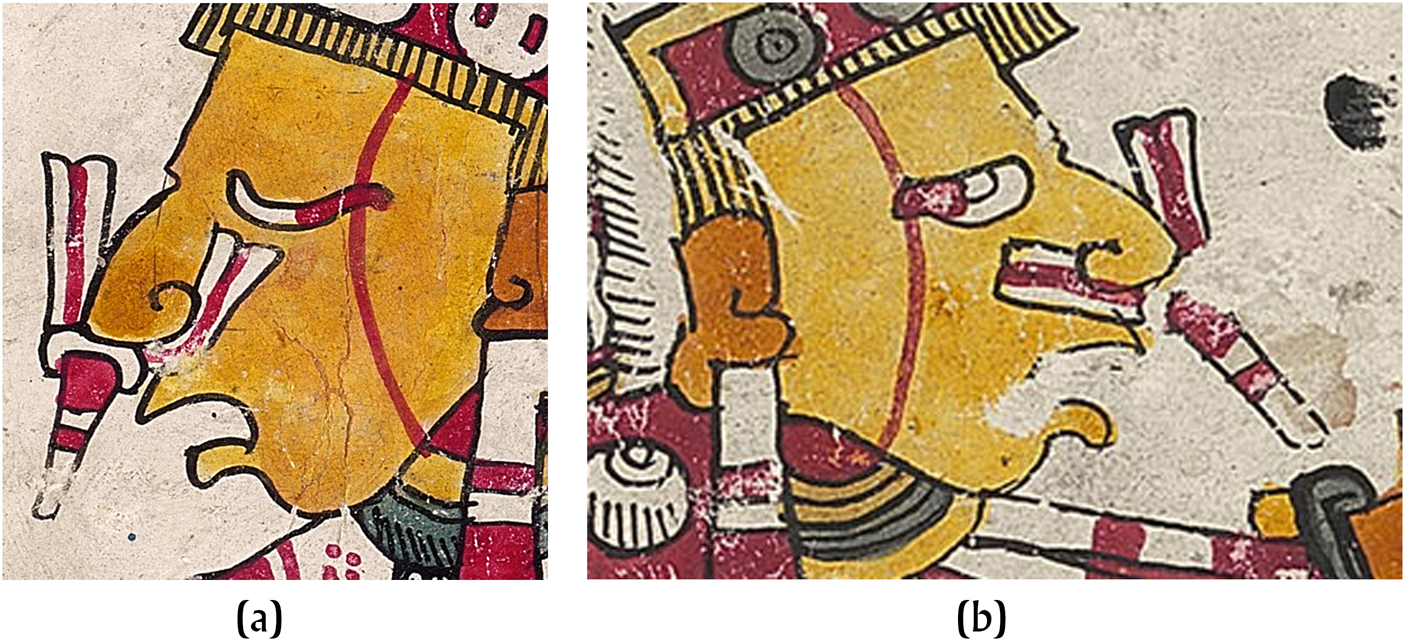
One of the most characteristic and best recognized graphic features of images of Xipe is the captive flayed skin with which the god is dressed. It is represented as a kind of furrowed covering over his figure, generally painted yellow with red points (Figures 2a and 2b), a pattern that codifies the smelly inner part of the body (Mikulska Reference Mikulska and Mikulska2020b:384–385). The captive skin is further recognizable thanks to the hands hanging from Xipe's wrists, as those parts of the sacrificed body were impossible to flay. The graphic way of representing the skin covering the god's face is to draw his eyes and his mount in a characteristic elongated and wavy manner (Figures 3a–3d). The captive skin worn by Xipe Totec is even more visible in some three-dimensional sculptures: on the back, and in some cases on the head, one can even see the cords that bind it. It is worth stressing that many of the sculptures of Xipe Totec come from earlier times than his representations in the preserved codices, as his cult seems to be one of the oldest in Mesoamerica, and already in the Classic period it was quite complex (González González Reference González González2011a:26–68).
The flayed skin and “hanging” hands in the images of Xipe Totec: (a) Borgia, plate 49; (b) Vaticanus B, plate 19. © 2019 Biblioteca Apostolica Vaticana; Codex Borg. Mess. 1 and Codex Vat.lat.3773, reproduced with permission of Biblioteca Apostolica Vaticana, with all rights reserved.

The presence of flayed skin visible as elongated “empty” mouth and eye: (a) Borgia, plate 15; (b) Borgia, plate 61; (c) Vaticanus B, plate 19; (d) Vaticanus B, plate 62. © 2019 Biblioteca Apostolica Vaticana; Codex Borg. Mess. 1 and Codex Vat.lat.3773, reproduced with permission of Biblioteca Apostolica Vaticana, with all rights reserved.

The presence of the flayed skin in which the god is dressed corresponds with Sahagún's description, which states: comaquitica ỹ evatl y yevayo tlacatl (“he has put on a skin, it is a human skin”), and motenmaxaloticac (“his lips are parted”; Sahagún Reference Sahagún1993:bk. 1, f. 263r; trans. Sullivan et al. in Sahagún Reference Sahagún, Sullivan, Nicholson, Anderson, Dibble, Keber and Ruwet1997:102; cf. Seler Reference Seler1990–1998:vol. 2, p. 245). It is obvious this feature corresponds directly with the rite of flaying captives after scratching them (called tlahuahuanaliztli; see below) during the ceremonies of Tlacaxipehualiztli. However, at the same time, this is an emblematic indication in the graphic medium of one of his names: Xipe. As stated above, this name comes from the verb xipehua, “to flay,” but its meaning was also heavily connected with any kind of “skinning” of the plants, including defoliating and shelling. Both kinds of “skinning” deserve more detailed comments.
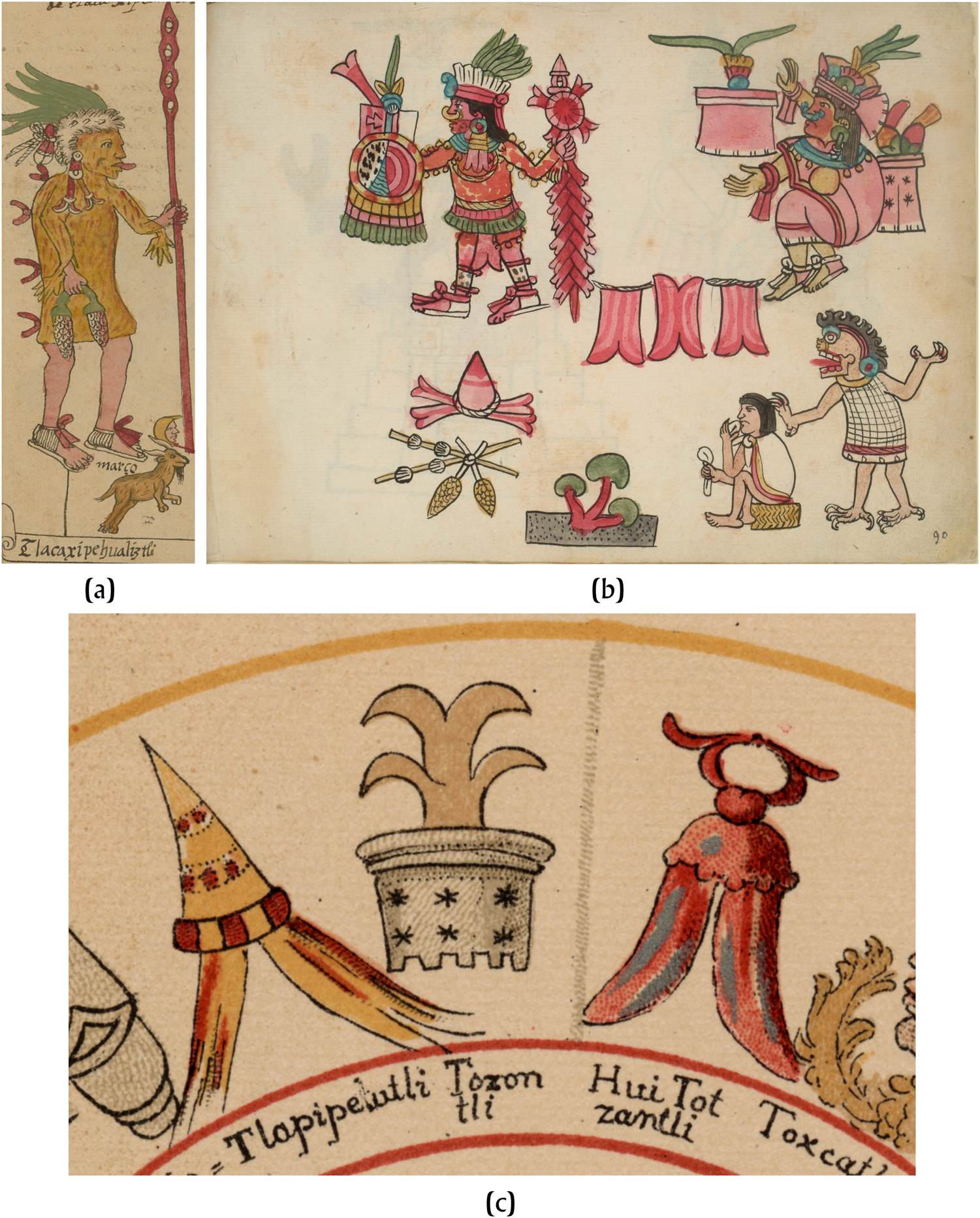
One of the most significant derivatives of xipehua is the word tlaxipehualli or tlaxipeuhtli, “defoliated cob” (Molina Reference Molina1571, in GDN 2005:vol. 1, f. 80r). Apart from being very close to the name of the Tlacaxipehualiztli festival, it is crucial to know that the xipeme, who were the ritual actors dressed up in the previously sacrificed captive skins, were offered bundles of corn ears, as can be seen in an image in the Florentine Codex (Sahagún Reference Sahagún1979:bk. IX, f. 49v) and read in a description by Durán (Reference Durán1984:vol. 1, p. 243). Bundles of two corncobs, called ocholli in Nahuatl, were hung from the roofs of the houses, and were intended for sowing, as explained by the Spanish friar (see also Broda Reference Broda2019:19–20; Danièle Dehouve, personal communication 2020; González González Reference González González2011a:286–287, Reference González González and González2016:125–126). This custom is still in use today among indigenous communities in Mexico (González González Reference González González and González2016:125, among others), and the act of husking the maize is still called xipehua (Diccionario de Mecayapan 2002, in GDN 2005; Danièle Dehouve, personal communication 2020). In ancient times, these selected ears were left under the protection of Xipe, who, starting from the Tlacaxipehualiztli festival, held in March according to the current calendar (Broda Reference Broda2019:14), was in charge of protecting the precious seeds until their germination and growth. According to the Spanish friar Durán's information, the xipeme or ritual actors, who dressed in the skins of captives killed in the uneven gladiator battle and then flayed, would walk from house to house, and the people offered them food, together with ocholli maize bundles (Durán Reference Durán1984:vol. 1, p. 243). That is why in some codices Xipe appears with the ocholli bundle, as in the Calendario Tovar (f. 1; Figure 4a) and in one more complex image from the Codex Magliabechiano (f. 90r; Figure 4b), to which I will refer later.
Xipe and his relationship with maize: (a) Carrying bundle of corncobs or ocholli in the Tlacaxipehualiztli veintena. Calendario Tovar 1, John Carter Brown Library (https://www.wdl.org/en/item/6735/#q=Tovar+Calendar&qla=en); (b) ceremony of maize with the presence of Xipe Totec and the maize goddess (together with ceremony of mushroom). Codex Magliabechiano, f. 90r, reproduced by permission and “su concessione del Ministero per i beni e le attività culturali e per il turismo” / Biblioteca Nazionale Centrale, Firenze, prohibited any further reproduction or duplication by any means; (c) a fragment of the Calendric Wheel No. 4 by Veytia (Reference Veytia1907).
The second notable meaning of xipehua is in reference to shelling the maize grains. This is one of the main conclusions of González González's study (Reference González González2011a:256–276), according to which the flayed skin symbolized skinned maize, the grains of which were cooked with lime (the nixtamalization process) so the skins could be easily peeled off.
González González analyzed the main festivity dedicated to Xipe Totec, Tlacaxipehualiztli, not in isolation, but in connection with the preceding ceremony, called Atl Cahualo, as well as with the following ones, Tozoztontli and Huei Tozoztli. Those data allowed him to establish the function of the Flayed God as a god of maize. González González has observed that during Atl Cahualo, a number of ceremonies similar to the Tlacaxipehualiztli rites were already performed, such as the encounter of the xixioti or persons with epidermis diseases (see section General Characteristics). Nevertheless, the sacrifice of the “scratched ones” (huahuantin) was made only as a simulacrum, as their hearts were “extracted” with “knives,” as González González (Reference González González2011a:256) calls them, made of yotlaxcalli o yopitlaxcalli or “tortillas de Yopi” (Sahagún Reference Sahagún, Anderson and Dibble1950–1982:bk. II, p. 45). Those were made of the maize that was not submitted to the process of nixtamalization, and this, as Mazzetto (Reference Mazzetto2015:156–160) demonstrated, was perceived as the killing of the corn. In fact, González González finds that different dishes were made of not nixtamalized (or “not killed”) maize. These were huilocpalli or “dove nests” (oval breads with a hole in the center; Brylak Reference Brylak, Barrio and Rosado2013:21; Sahagún Reference Sahagún, Anderson and Dibble1950–1982:bk. II, pp. 55, 161), the tlacatlaolli (“human dekerneled maize”) dish made of the flesh of the sacrificed victims with dekerneled maize (Sahagún Reference Sahagún, Anderson and Dibble1950–1982:bk. II, p. 49; González González Reference González González2011a:384–385), and tzocoyotl or maize-amaranthus bread rolls (Durán Reference Durán1984:vol. 1, p. 251). Together with yotlaxcalli, all those dishes were consumed from the last veintena of the previous year, Izcalli, until Huei Tozoztli (Sahagún Reference Sahagún, Anderson and Dibble1950–1982:bk. VIII, p. 85, bk. II, p. 61, bk. IX, pp. 70–71; González González Reference González González2011a:280–282). In that last veintena, the fourth of the solar year, which is when new plants of maize have sprouted, for the first time in the new agriculture cycle a dish of nixtamalized corn, namely aquetzalli or “water atolli,” was consumed (Sahagún Reference Sahagún, Anderson and Dibble1950–1982:bk. II, p. 61; González González Reference González González2011a:282). According to González González's interpretation (Reference González González2011a:280–286), the aim of this more than 80-day period of “not killing” the maize was to protect it during the delicate period between harvest and sowing. Only after the successful start of the plant's growth could its grains be “killed” again, that is, treated with lime and subsequently peeled off, a process described in Nahuatl with the verb xipehua, as previously stated. It is worth mentioning that mythical accounts indicate the connection between the acquiring of maize and the sacrifice, as shown by González González (Reference González González2011a:252–253). According to Leyenda de los Soles (Bierhorst Reference Bierhorst and Bierhorst1992c:95–96, Reference Bierhorst and Bierhorst1992a:157–158), the famine which devastated Tula was finished when Quetzalxoch, the daughter of Tozcuecuex, was sacrificed, and this act assured that the Mexicas obtained the maize—and the power (cf. Contel Reference Contel, Ragot, Peperstraete and Olivier2011:295).
Consequently, the meaning of the flayed skin worn by Xipe is not only to indicate his name (deriving from the verb xipehua) and his condition of a god responsible for flaying captives, but also as a god of maize, or rather as the protector of maize for sowing. Nevertheless, he is in charge of maize in this special moment of the year before its “flaying” (that is, killing with lime and shelling during the nixtamalization process), when the seeds are carefully chosen, dedicated to Xipe, and then planted (cf. González González Reference González González2011a:275–276). Only when the growth of the new plants is assured does the maize pass under the protection of maize gods such as Cinteotl, Xilonen, and Chicomecoatl (cf. González González Reference González González2011a:277).
Yopitzontli and Tlauhquecholtzontli
The next graphic sign frequently present on Xipe representations is a three-cornered, red and white adornment. In the Codex Borgia it appears mainly as a nose accessory (plates 15, 24, 25; Figures 3a, 3b, 5a, and 5b), but it is at the same time extremely similar to a glyph that forms the toponyms of Yopico and Chipetlan in the Codex Mendoza (ff. 20r and 9r, respectively; cf. González González Reference González González2011a:64; Figures 6a and 6b). Yopico, as noted earlier, was simultaneously the name of one of the calpulli in Tenochtitlan, and Xipe was considered to be the patron of both the Yopi people from Yopitzinco and the Yopico calpulli (Sahagún Reference Sahagún, Anderson and Dibble1950–1982:bk. X, p. 187; cf. González González Reference González González2011a:69, 88, 149–153). The toponym of Chipetlan is even more meaningful, as it indicates in the first place that this particular adornment could have been collocated on the head. Secondly, the name of Chipetlan is a corrupted name of Xipetlan, “Place of Xipe,” which, according to Joaquín Galarza, was also an area of the cult of this god (González González Reference González González2011a:70). Finally, another confirmation that this particular glyph in the Codex Mendoza gives reading related with Xipe is that it appears as a sign for Tlacaxipehualiztli veintena (f. 47r; Figure 6c), and as such would be used afterwards in the so-called calendric wheels by Gemelli Careri from 1721 or by Mariano Fernández de Echeverría y Veytia (see documents MS 1776 and MS 1755 from Yale University Library).
Representations of the three-cornered, red and white element (Yopi-like or tlauhquecholli-like) in the codices of the Borgia group: (a) Borgia, plate 25; (b) Vaticanus B, plate 67. © 2019 Biblioteca Apostolica Vaticana; Codex Borg. Mess. 1 and Codex Vat.lat.3773, reproduced with permission of Biblioteca Apostolica Vaticana, with all rights reserved.
Representations of the three-cornered, red and white element (Yopi or tlauhquecholli) in the codices of Aztec tradition in comparison with red spoonbill or tlauhquecholli, or as an adornment of Xipe: (a) as a toponym, Mendoza, f. 20r; (b) as a part of a toponym, Mendoza, f. 39r; (c) as a glyph for Tlacaxipehualiztli veintena, Mendoza, f. 47r: Bodleian Library MS. Arch. Selden. A. 1. Courtesy and copyright © Bodleian Libraries, University of Oxford (https://digital.bodleian.ox.ac.uk/collections/mesoamerican); (d) Florentine Codex, f. 12r. Courtesy of Biblioteca Medicea Laurenziana, Firenze, Ms. Med. Palat, f. 12r. Su concessione del MiBACTL. E’ vietata ogni ulteriore riproduzione con qualsiasi mezzo; (e) Manuscrito de Real Palacio, f. 263r, reproduced with permission of Patrimonio Nacional, Palacio Real de Madrid, Manuscrito RB II/3280. Red spoonbill (Platalea ajaja): (f) photograph by Riverbanks Outdoor Store (https://commons.wikimedia.org/wiki/File:Platalea_ajaja_5.jpg); (g) Photograph by Dominic Sherony (https://commons.wikimedia.org/wiki/File:Roseate_Spoonbill_741903422.jpg); reproduced with the Creative Commons Attribution 2.0 Generic; (h) as represented in pre-Hispanic Codex Laud 13; Bodleian Library MS. Laud Misc. 678. Courtesy and copyright © Bodleian Libraries, University of Oxford (https://digital.bodleian.ox.ac.uk/collections/mesoamerican).

The collocation of this element on the head, at least in colonial documents from the Basin of Mexico, is confirmed by the alphabetic description of Xipe in Sahagún's manuscripts: “He has placed his Yopi headdress on his head, it is bifurcated” (yyopitzon contlaliticac icpac, maxaliuhquj; Sahagún Reference Sahagún1993:f. 263r; trans. Sullivan et al. in Sahagún Reference Sahagún, Sullivan, Nicholson, Anderson, Dibble, Keber and Ruwet1997:102; cf. Sahagún Reference Sahagún, Anderson and Dibble1950–1982:bk. I, p. 40; Figures 6d and 6e), and as such, it is frequently named as “sparrow tail,” following Seler (Reference Seler and Frenk1963:vol. 1, p. 127, vol. 2, pp. 211, 214). Durán explains that yopitzontli was “a headdress of the god Yopi” (Reference Durán1984:vol. 2, p. 277; cf. González González Reference González González2011a:88). Indeed, in the accompanying images found in Sahagún's documents, Xipe wears red and white (or pink and white) bifurcated adornments on his head. As the so-called “swallowtails” parts (cf. González González Reference González González2011a:54, 57, 64; Graulich Reference Graulich1982:229) are both collocated upon Xipe's headdress and hanging down (Sahagún Reference Sahagún1993:f. 263r; Reference Sahagún1979:bk. I, f. 12r; Figures 6d and 6e), it is difficult to decide to which of them the alphabetical description of yopitzontli refers, but it is possible that it describes both of them, as the stem tzontli not only means “hair,” but determines anything collocated on the head (discussion at the Northeastern Nahuatl Conference, Yale 2018; Olko Reference Olko2014:198).
What is relevant, however, is that this garnish was made of red, pink, and white feathers of a bird called tlauhquecholli, as indicated in a more detailed description of the preparation of Xipe ixiptla for the Tlacaxipehualiztli ceremonies by the goldsmiths, the people whose patron deity was this particular god:

The tlauhquecholli bird, identified as a roseate spoonbill (Platalea ajaja; cf. Wimmer in GDN 2005; Olivier and López Luján Reference Olivier, Luján, Moctezuma and Ochoa2017), is an aquatic bird with characteristic red, pink, and white plumage, as described by Sahagún:

The headdress tlauhquecholtzontli, made of the colorful feathers of the roseate spoonbill (Figures 6f and 6g), was frequently worn by tlatoque in war costume, together with the cuirass called ehuatl, “skin,” covered with the same feathers (Sahagún Reference Sahagún, Anderson and Dibble1950–1982:bk. VIII, p. 33, in Olivier and López Luján Reference Olivier, Luján, Moctezuma and Ochoa2017:183). While the tlauhquecholtzontli is said to be worn by particular tlatoque, the sources further indicate that they disguised as Xipe (i.e., the image of governor in the Tlauhquechol Totec or war disguise in Codex Vaticanus A, f. 83v; cf. Seler Reference Seler1990–1998:vol. 2, p. 47; Olivier and López Luján Reference Olivier, Luján, Moctezuma and Ochoa2017:186), even if the latter is named with another of his titles. Such is the case of the attire of Axayacatl, Ahuitzotl, Moquihuix, and Motecuhzoma Xocoyotzin during their military campaigns (Alvarado Tezozomoc Reference Alvarado Tezozomoc, Mignolo and Chamorro2001:373; cf. González González Reference González González2011a:338–343; Olivier and López Luján Reference Olivier, Luján, Moctezuma and Ochoa2017:186; Olko Reference Olko2014:198–200; Szoblik Reference Szoblik2020), and in this apparel Ahuitzotl and Moctezuma Xocoyotzin had themselves portrayed in the Chapultepec slope (Alvarado Tezozomoc Reference Alvarado Tezozomoc, Mignolo and Chamorro2001:358, 450–452; Hajovsky Reference Hajovsky2015:118–132; Olko Reference Olko2014:200). As Alvarado Tezozomoc (Reference Alvarado Tezozomoc, Mignolo and Chamorro2001:243–244) states, the mortuary bundle of Axayacatl was decorated with “un plumaxe que llaman tlauquecholtzontli, plumaje de muy preciada y galana aue, questa abe llaman tlauhquechol,” and the chronicler specifies that it was the costume of Yohuallahuan (cf. Olivier and López Luján Reference Olivier, Luján, Moctezuma and Ochoa2017:186; Olko Reference Olko2014:199). Moteuczoma Xocoyotzin, during his famous (or infamous) attempt to escape to Cincalco from the approaching Spaniards, had to dress himself in Xipe Totec's costume, which consisted of tlauhquecholtzontli adornment, apart from the rattle called chicahuaztli (see below) and the human skin (Alvarado Tezozomoc Reference Alvarado Tezozomoc, Mignolo and Chamorro2001:461; Tomicki Reference Tomicki1990:287).
In this last case, it is evident that the tlatoani decorated the Xipe costume because he planned to enter the place governed by this god (or by his ixiptla, Huemac; cf. Tomicki Reference Tomicki1990:285–287, 290). In the case of Axayacatl, it is explicitly stated that the attire of his mortuary bundle was that of Yoahuallahuan, another of Xipe's names, as previously stated. Nevertheless, the question arises why the tlatoque, when heading to war, used to dress up with Xipe guise and not that of another god. Again, the warrior aspect of Xipe Totec is beyond any doubt (cf. González González Reference González González2011a:317–390, among others), as it can be perceived during all the ceremonies of Tlacaxipehualiztli related to warriors and war captives (Sahagún Reference Sahagún, Anderson and Dibble1950–1982:bk. II, pp. 48–56; Broda Reference Broda1970; Graulich Reference Graulich1982:228–236). Olko (Reference Olko2014:200–202) states that due to the ancestral cult of this god, the Mexica rulers chose his attire to form their royal badge. In graphic representations, Xipe is frequently depicted with signs that compose the metonymic series (in earlier works called diphrasisms) referring to war, that is to say, the shield, the war banner, arrows, and others (Borgia, plate 49; Vaticanus B, plate 19; Borbonicus, plate 14; Tonalamatl de Aubin, plate 14; Tudela, f. 12r; Magliabechiano, f. 30r). The metonymic series, as defined by Dehouve (Reference Dehouve and Peperstraete2009, Reference Dehouve2011, Reference Dehouve2014, Reference Dehouve, Mikulska and Offner2019a) is the very Mesoamerican way of defining a certain concept (an object, a person, or an action) through extension—that is to say, by enumerating words (in oral medium) or graphic signs (in graphic medium), or by maneuvering material objects or performative acts (in ritual). So, Xipe's pectoral, called anahuatl, is appropriate and used by other “warrior gods,” as will be explained later (González González Reference González González2011a:72; Vauzelle Reference Vauzelle2018:740). However, the use of tlauhquecholli bird feathers is also meaningful, as the material used for the elaboration of particular gods’ attributes contributes to the creation of its symbolism, as proved by Vauzelle (Reference Vauzelle2018).
In this aspect, the recent study of the roseate spoonbill realized by Olivier and López Luján (Reference Olivier, Luján, Moctezuma and Ochoa2017:181–187) provides an in-depth analysis of that bird's symbolism. This embraces strong solar connotations—in central Mesoamerica, red is the color of the rising sun—as well as of war and warriors. For the inhabitants of central Mexico, it was meaningful that this bird was considered a hunter (Olivier and López Luján Reference Olivier, Luján, Moctezuma and Ochoa2017:181; cf. Figure 10h), because even if it feeds by scooping various small aquatic animals and swishing its bill in the water, it can also catch fish by sight (Dumas Reference Dumas, Poole and Gill2000; Kaufman Reference Kaufman1996). At the same time, the image of this bird was used in the colonial period as the glyph of the veintena of hunters and their god, Quecholli (Serna Reference Serna1987:324–325; cf. Olivier and López Luján Reference Olivier, Luján, Moctezuma and Ochoa2017:164–165), because of the proximity of its name (Quecholli and tlauhquecholli) and because of its hunting aspect. One of the most convincing arguments is that tlauhquecholli forms part of a longer metonymic series, which is an extension of its basic diphrastic form, in cuauhtli in ocelotl, “eagle, jaguar,” that refers to the “warrior.” Thus, when a male child was born, in the huehuetlatolli speech pronounced by the midwife, he was consecrated to the office of war, and thus called: “you are an eagle, you are a jaguar, you are a roseate spoonbill, you are a troupial” (Ca tiquauhtli, ca tocelotl, ca tiquechol, ca tiçacuan; Sahagún Reference Sahagún, Anderson and Dibble1950–1982:bk. VI, p. 171; Olivier and López Luján Reference Olivier, Luján, Moctezuma and Ochoa2017:182).
Moreover, according to Olivier and López Luján, the tlauhquecholli was perceived as one of the animals “called tlatohque or ‘kings,’ that is, the ‘leaders’ not only of their species but of a wider animal category,” as the white deer was the “lord of the deer” and the pelican the “lord of the aquatic birds” (Olivier and López Luján Reference Olivier, Luján, Moctezuma and Ochoa2017:181). As indicated by Sahagún, “this bird was the prince of the white big egrets that accompany it wherever they see it” (Sahagún Reference Sahagún, Quintana and Austin1989:bk. XI, p. 691), a description that seems to explain why the roseate spoonbill was conceived as their “ruler.” Nevertheless, the reason could have been that the red spoonbill shares the habitat with egrets, herons, and ibises, and it can be distinguished from them because of its flamboyant plumage, ranging from white through pink to carmine red on its wings. If Garibay is right when commenting on its repetitive mentions in the songs, its color was the reason for its being highly appreciated, even if the name itself, in the songs, “does not refer to a specific bird, but to every fiery-colored bird, red as a flame, of light and pale rose” (Garibay K. 1964–1968 as cited in Olivier and López Luján Reference Olivier, Luján, Moctezuma and Ochoa2017:166).
The name of this bird, tlauhquecholli, which differentiates it from other “quecholli birds,” as xiuhquechol (Sahagún Reference Sahagún, Anderson and Dibble1950–1982:bk. XI, p. 20) and xioapalquechol (Sahagún Reference Sahagún, Anderson and Dibble1950–1982:bk. XI, p. 20), includes the term tlahuitl, “red ocher” (almagre; Molina Reference Molina1571 1 and 2, Rincón 1595, Carochi 1645, Wimmer 2004, all in GDN 2005). Red ocher is a variant of a clay earth pigment, ocher, which contains a large amount of hematite (Fe2O3) or dehydrated iron oxide. Its colors therefore embrace different reddish hues. Tlahuitl was the natural pigment that the Yopi (or Tlapanecs, as Sahagún states; see section General Characteristics) used to paint themselves to resemble their god Totec or Tlatlauhqui Tezcatlipoca (Sahagún Reference Sahagún, Anderson and Dibble1950–1982:bk. X, p. 187).
Moreover, both the name Tlatlauhqui and tlahuitl derive from the verb tlahuia, which means to “light” or “illuminate,” when talking about the rising sun or a torch (Molina Reference Molina1571; Olmos 1547, among others, in GDN 2005). As already mentioned, red was the color of the sun, as can be seen in the representations of the Tonatiuh with a red body in the codices (Figures 7a and 7b; Borgia, plates 7, 9, 15, 18, 23, 55, 71, 75; Vaticanus B, plates 7, 28, 94, 20, 38; Telleriano-Remensis, f. 12v; cf. Mikulska Reference Mikulska and Mikulska2020a:535–537). It is necessary to emphasize that red was especially the color of the rising sun, as Sahagún (Reference Sahagún, Anderson and Dibble1950–1982:bk. VII, p. 7) explicitly states. This is additionally confirmed by the word that means dawn, tlahuizcalli, also derived from tlahuia, “to light,” as well as the well-known name Tlahuizcalpantecuhtli, “Lord of the House of Dawn” (GDN 2005). The nature of the rising red sun is extremely dynamic, as it gets less and less red (Sahagún Reference Sahagún, Anderson and Dibble1950–1982:bk. VII, p. 7) until it loses its color; similarly, red ocher can extend from a strong red hue to reddish pink. Tlauhquecholli plumage, changing from red through pink to white, must have reflected this idea perfectly, and that is another reason for its solar symbolism. That is also why the costume of the sun ixiptla was made of tlauhquecholli feathers (Sahagún Reference Sahagún, Anderson and Dibble1950–1982:bk. II, p. 217). Still, there is one more behavioral characteristic of the red spoonbill that must have contributed to this perception of tlauhquecholli: “sky-gazing,” quite a unique behavior of these birds, which consists of sticking their bills and necks straight up to the sky when seeing another group of spoonbills flying (Dumas Reference Dumas, Poole and Gill2000).
Representations of the god Tonatiuh: (a) Telleriano-Remensis, f. 12v; Courtesy and copyrights © of Bibliothèque nationale de France; (b) Borgia, plate 25; © 2019 Biblioteca Apostolica Vaticana; Codex Borg. Mess. 1, reproduced with permission of Biblioteca Apostolica Vaticana, with all rights reserved.

The feathers of the red spoonbill were not only used as the material for decorating the yopitzontli or the tlauhquecholtzontli headdress of Xipe, but also to make the attire of Tonatiuh or the Sun god—that is to say, the round artifact that represented the solar disc attached to the costume of his ixiptla in rituals (Sahagún Reference Sahagún, Anderson and Dibble1950–1982:bk. II, p. 217). This can be seen perfectly in the image of the Tonatiuh represented in the Codex Telleriano-Remensis (f. 12v; Figure 7a), in which the exterior border of the sun disc seems to be made of pink-red feathers. Nanahuatl, during the process of converting into the Sun, is seated on a throne of quecholli feathers (Bierhorst Reference Bierhorst and Bierhorst1992c:148), and the same kind of seats are those on which the gods’ impersonators sat to present the so-called gladiator sacrifice during Tlacaxipehualiztli (Sahagún Reference Sahagún, Anderson and Dibble1950–1982:bk. II, p. 51).
Nevertheless, as in plenty of other gods’ attributes (cf. Dehouve Reference Dehouve2018b; Vauzelle Reference Vauzelle2018), the tlauhquechol feathers were polysemic, and the other meaning had to do with plant maturation. Apart from the general knowledge we have about this process, my argument is that during the Tlacaxipehualiztli and Huei Tozoztli veintenas, what appears at first glance to be a mysterious ceremony took place. During the first of them, the previously described ceremony of tlahuahuanaliztli or “scratching [of the captives]” (Sahagún Reference Sahagún, Anderson and Dibble1950–1982:bk. II, pp. 51–53; cf. González González Reference González González2011a:271–273) was performed. It consisted of literally “scratching” (huahuana; see below) the bodies of the captives, making them bleed, then sacrificing them during the uneven gladiator battle, and afterwards flaying them (Sahagún Reference Sahagún, Anderson and Dibble1950–1982:bk. II, p. 50). But the scratched ones (tlahuahuantin), just before their death, were made to appear in front of the public, alternately in red, white, red, white, and finally, red paper clothes (Sahagún Reference Sahagún, Anderson and Dibble1950–1982:bk. II, p. 45; cf. González González Reference González González2011a:256). In the same way, during the Huei Tozoztli ceremonies, when the maize had already grown, the ixiptla of the maize goddess was first dressed in white clothes, and later:
they trimmed the Indian woman as a man and they threw her hair into the fire in front of the devil and they put a red color on her face and also on her legs and arms and they took off her white clothes and dressed her in red (tresquilaban la yndia como onbre y los cabellos echavanlos e(n e)l fuego antel demonio y ponianle color colorada e(n e)l rostro a la yndia y ansi mesmo las piernas y los braços y quitabanle las ropas blancas y vestianla de colorado; Codex Tudela, f. 14v; paleography of Batalla Reference Batalla Rosado2009:93; my translation)
This alternating of red and white in two different ceremonies indicates the dynamics of both processes: the maize maturing (thus changing its color, starting from white; cf. Sahagún Reference Sahagún, Anderson and Dibble1950–1982:bk. XI, pp. 279–280), and the red sun becoming “white” as the day advances, and red again in the afternoon. Moreover, it could be the explanation of the connection of Xipe with Cincalco, the “House of Maize,” thought to be in the West: both spaces, the East and the West, become red at a particular time of the day. Thus it is possibly the reason why both these temporal spaces could be the domain of Xipe.
What seems to be relevant is that both rites described above took place in the particular period of the year during which the maize was protected from “killing,” meaning that it was not submitted to the process of nixtamalization, and during both of them the ritual actors, after being finally dressed in red, were killed, assuring, in this way, the rebirth of the maize.
I want to finish this part by indicating that in the codices Borgia and Vaticanus B, the white and red pieces of clothing—even if it is not possible to be certain that they were made of the roseate spoonbill feathers, they resemble closely the tlauhquecholtzontli from the Basin of Mexico codices—are placed literally everywhere on Xipe representation. They hang from his arms and wrists, he has them on his knees, his maxtlatl seems to be made of them, as well as his kilt (unless it is made of sapote leaves; see below), even his headband and ear pendants are extremely similar (Figures 1a–1c, 1e–1g). Only the nose-bar of Xipe in the Codex Vaticanus B seems different (Figures 3c and 3d), but it is likewise painted in alternating white and red. All other kinds of Xipe's objects, be it a rattle called chicahuaztli or banners that he carries on his back as his war attire, are made of or adorned with the same alternating white and red pattern (Figures 1a–1c, 1e, 1g, 8c), even if I cannot be sure that they are made of the same feathers as such.
Red garments with white down balls. (a) Borgia, plate 67; (b) Vaticanus B, plate 62; (c) Borgia, plate 15; (d) Borbonicus, plate 14; (e) Borgia, plate 11; (f) Vaticanus B, plate 30. (a–c, e, and f) © 2019 Biblioteca Apostolica Vaticana; Codex Borg. Mess. 1 and Codex Vat.lat. 3773, reproduced with permission of Biblioteca Apostolica Vaticana, with all rights reserved. (d) Courtesy and copyright of Library of the French National Assembly, Ms. 1515.

Red Garments
Another garment that has similar colors to those of the yopitzontli and the tlauhquecholli-style adornments is the red piece of cloth Xipe has on his back. It has a white fringe on its edge and is spotted with white down balls, these being well-known signs of a person to be sacrificed (Dehouve Reference Dehouve and Peperstraete2009:22–23; Dupey Reference Dupey García2010:vol. 2, pp. 390–391, 396; Mikulska Reference Mikulska2015:440–445; Montes de Oca Reference Montes de Oca Vega2013:36, 175–176; Olivier Reference Olivier, Olivier and Luján2010; Vauzelle Reference Vauzelle2018:499–510, among others). Sometimes this garment seems to be a kind of a cape called tilmatl (Borgia, plate 67; Vaticanus B, plate 62; Figures 8a and 8b), but in other cases it seems to form a kind of back device with a warrior banner placed upon it (Borgia, plates 49, 61; Borbonicus, plate 14; Figures 8c and 8d). It can also be used as a piece of cloth that covers the head, as can be seen in the images of the patron-god of the day-sign “eagle” in the codices Borgia (plate 11) and Vaticanus B (plate 30; Figures 8e and 8f). Particularly in the latter, the represented deity has a whole costume made of the same material. In both images of the patron of the day-sign “eagle,” the god has a characteristic face painting of three horizontal red stripes, which is without doubt the “red version,” so to speak, of the well-known Black Tezcatlipoca face painting. Thus, it seems that these particular clothes—red with white down balls—are very characteristic of Red Tezcatlipoca. Additionally, it can be confirmed by a comparison with the representation of both Tezcatlipocas from Codex Vaticanus B (plates 85–86), where the Red god is painted all red and has his red tilmatl with a white edge, whereas the Black one has a black cape with white down balls (Figures 9a and 9b). Both deities have the triple-line face painting, as is common in the majority of representations of both Tezcatlipocas (Borgia, plate 21; Figures 9c and 9d). Therefore, the patron of the day-sign “eagle” must be the Red Tezcatlipoca, the poorly known version of his famous black counterpart (cf. Olivier Reference Olivier2004:84–85, 107, 198; Vié-Wohrer Reference Vié-Wohrer1999:vol. 1, pp. 62, 77, 93). According to sources from the Basin of Mexico, in this region, Tlatlauhqui Tezcatlipoca was considered to be the same as Xipe. This is not necessarily the case of the codices Borgia and Vaticanus B, as in those manuscripts the patron of the day-sign “eagle” has practically no graphic sign indicating his identity as Xipe, apart from the tlauquechol-like adornments visible in the Vaticanus B (plate 30; Figure 8f). On the other hand, in the Codex Vaticanus B, in the second cycle of the patrons of the 20 day-signs (plate 92; Figure 1h), its patron is much more like Xipe than Red Tezcatlipoca, as he is dressed with the flayed skin and without the red clothes.
Representations of pairs of Red and Black Tezcatlipoca: (a and b) Vaticanus B, plate 86; (c and d) Borgia, plate 21. © 2019 Biblioteca Apostolica Vaticana; Codex Borg. Mess. 1 and Codex Vat.lat.3773, reproduced with permission of Biblioteca Apostolica Vaticana, with all rights reserved.

Apart from concluding that we face here slightly different regional traditions, it is evident that the Xipe and Red Tezcatlipoca identities are formed by some common properties. One is codified by the red garment. Its name was provided by the Sahagún informants, when describing precisely the Tlatlauhqui Tezcatlipoca or Totec, the god of the Yopi people:
in inteouh, itoca catca totec: tlatlauhquj tezcatlipuca, yn jnechichioal tlavitl: His god, his name was Totec: Red Tezcatlipoca; his clothes were of red ocher [iron oxide] (Sahagún Reference Sahagún, Anderson and Dibble1950–1982:bk. X, p. 187).
It can be assumed, then, that the most outstanding symbolism of the red garment was the same as of the red ocher or tlahuitl, leading to the idea of brightening or illuminating as the sun. Thus, wearing these clothes must have implicated this property, either of Xipe, either of Red Tezcatlipoca.
Shield and Banners
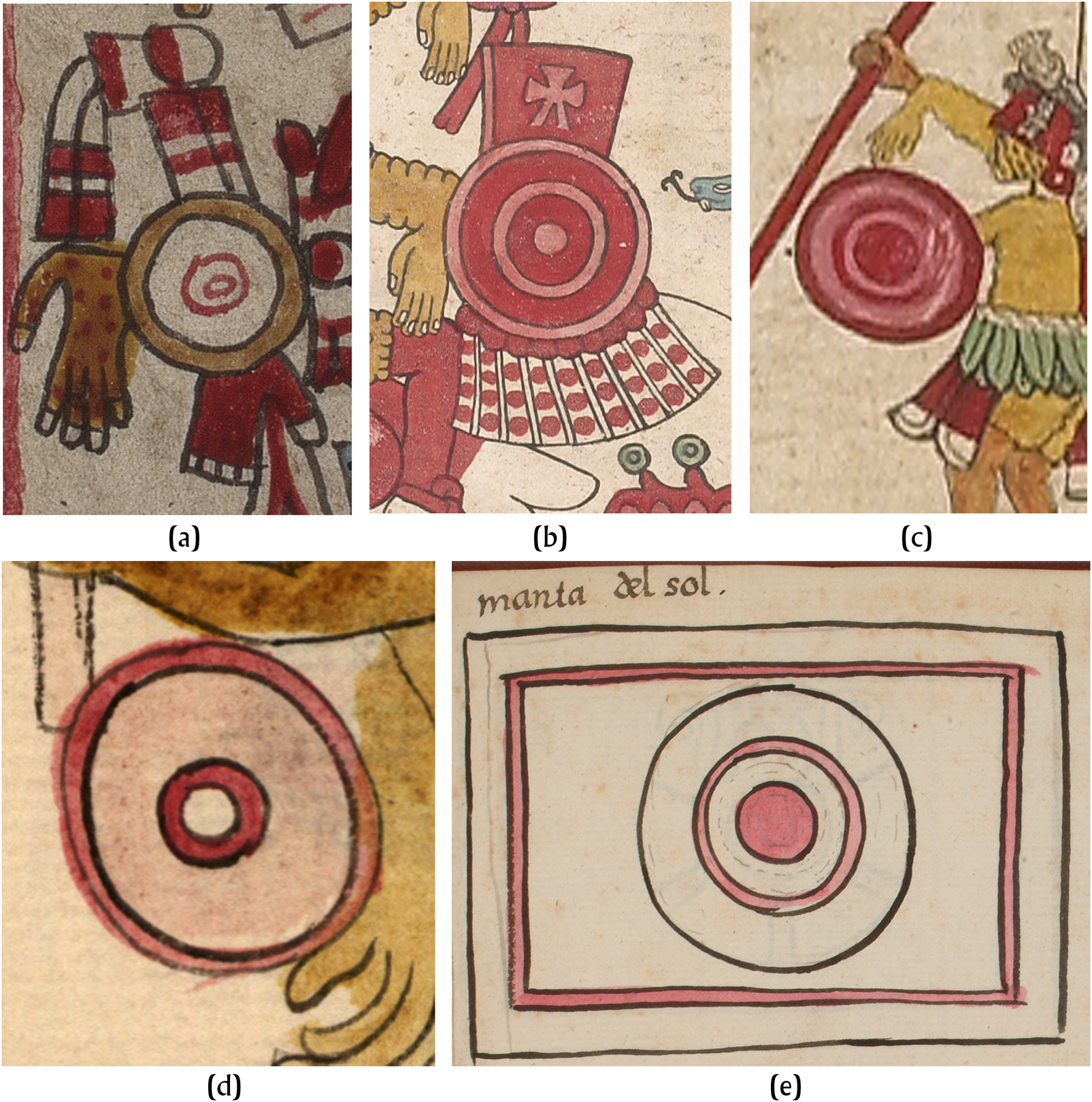
Other attributes that should be analyzed are the shield and banners. In the pre-Hispanic divinatory codices, Vaticanus B and Borgia, the banners that Xipe carries on his back or attached to his shield are painted in the same manner as the red-white tlauhquechol-like adornments he has on his body (Borgia, plates 15, 24, 25, 49; Vaticanus B, plate 19; Figures 1a–1c, 1e, 1g, 10a). In one of his representations in the Codex Vaticanus B (plate 19; Figure 10a), when he is the companion of the East Sky-Bearer, he has a shield with concentric red circles, similar to those that are much more frequent in the Xipe representations in the codices of the Basin of Mexico. Especially in the Codex Borbonicus, the Xipe incarnation is an important actor during different veintena ceremonies, not only during Tlacaxipehualiztli (Borbonicus, plate 24; Tudela, f. 12r), but also during Huei Tozoztli (Borbonicus, plate 27) and others. Both here and in the image of Xipe in the 14th trecena (Borbonicus, plate 14), as well as in Sahagún's manuscripts (Sahagún Reference Sahagún1979:bk. 1, f. 12r; Sahagún Reference Sahagún1993:f. 263r), apart from the red clothes, Xipe carries in his hand the same shield with the motif of concentric red and pink circles (Figures 10a–10d). In the Tlacaxipehualiztli scenes from codices Tudela (f. 12r; Figure 11) and Magliabechiano (f. 90r), where a sacrificio gladiatorio battle is represented, the Totec ixiptla is disguised with red and rosy attire and sustains the shield with the same motif. His opponent, Black Tezcatlipoca, who has the facial painting of three black lines and is disguised with a jaguar costume, sustains a shield composed of three different motifs: concentric red and rose circles, the water design, and the jaguar skin. In the Codex Magliabechiano (f. 30r) the jaguar skin triangle is additionally enriched with a chalchihuitl glyph. The clearest image of this shield is on a separated relief, today kept in the Museo Regional del INAH in Cuernavaca (see also González González Reference González González2011a:207–208). Dyckerhoff, based on Sahagún (Reference Sahagún, Anderson and Dibble1950–1982:bk. IX, p. 69), identified this shield as teocuitlaanahuacayo (GDN 2005). Wimmer translates its name as “the one which has golden circles” (GDN 2005). What is noteworthy, however, is that the same shield can be carried by Xipe, as this was the one that the goldsmiths were to give to the priest who represented Xipe during Tlacaxipehualiztli (González González Reference González González2011a:208–209; Figure 11), and the one seen in his hands in the Codex Magliabechiano (f. 90r). Taking into account that the costume of the first actor is that of a captive, and the Black Tezcatlipoca's attire is that of the Mexica warrior, it is clear that the battle is seen as a fight between these two opposite Tezcatlipocas, with the Red one predestined to die.
The shield with the design of the rising sun: (a) Vaticanus B, plate 19; © 2019 Biblioteca Apostolica Vaticana; Codex Vat.lat. 3773, reproduced with permission of Biblioteca Apostolica Vaticana, with all rights reserved; (b) Borbonicus, plate 14; (c) Borbonicus, plate 24, courtesy and copyright of Library of the French National Assembly, Ms. 1515; (d) Manuscrito de Real Palacio, f. 263r; reproduced with permission of Patrimonio Nacional, Palacio Real de Madrid, Manuscrito RB II/3280; (e) Magliabechiano, f. 8r; reproduced by permission and “su concessione del Ministero per i beni e le attività culturali e per il turismo” / Biblioteca Nazionale Centrale, Firenze, prohibited any further reproduction or duplication by any means.
Representation of the fight between Xipe/Red Tezcatlipoca and Black Tezcatlipoca during Tlacaxipehualiztli. Tudela, f. 10r. Courtesy and copyright of Museo de América, Madrid. Photography by Joaquín Otero.

As already mentioned, the shield with a motif of concentric red and pink (or pinkish) circles is present in the Xipe images from Sahagún's manuscripts (Reference Sahagún1993:f. 263r; Reference Sahagún1979:bk. II, f. 12r; Figures 10d, 1i, and 1j), and that is why its name can be tracked from there. It is ichimal tlauhtevilacachiuhqui (Sahagún Reference Sahagún1993:f. 263r) which is translated as “his shield has red circles” (trans. Sullivan et al. in Sahagún Reference Sahagún, Sullivan, Nicholson, Anderson, Dibble, Keber and Ruwet1997:102). However, a closer look at the components of this name—tlauh-tevilacachiuh-qui—reveals something else. The first incorporated word is again tlahuitl, the name of the red color and of the red ocher, derived from the verb tlahuia, to “light” or “illuminate” (see subsection Yopitzontli and Tlauhquecholtzontli). The second part, tevilacachiuh-qui, is the agentive of the verb tehuilacachihui, “to become round” (devenir, ętre rond; Wimmer in GDN 2005), and it was used to describe a round object such as a navel or skull (Sahagún Reference Sahagún, Anderson and Dibble1950–1982:bk. X, pp. 100, 121; Wimmer in GDN 2005), and the process of getting round by the moon (Sahagún Reference Sahagún, Anderson and Dibble1950–1982:bk. VII, p. 3; Wimmer in GDN 2005). Given that, I think it is clear that the Xipe's tlauhtevilacachiuhqui shield, with the motif of concentric red and rose circles, symbolized the rising sun with its changing colors, its name meaning “getting round, red and luminous [like something round]” sun shield. This hypothesis is further confirmed by one of the capes represented in the Codex Magliabechiano (f. 8r; Figure 10e; cf. Graulich Reference Graulich1982:244), made of concentric circles in similar colors, and named by the gloss in Magliabechiano as the manta del sol, “cape of the sun.”
It may therefore be supposed that the fight between Red and Black Tezcatlipoca warriors during the gladiator sacrifice rite represented a battle between the rising sun and the darkness, that is, the Black Tezcatlipoca domain. While this interpretation is very plausible, it should be taken with care.
As argued by Graulich (Reference Graulich1982, Reference Graulich1999:279–320), and later by González González (Reference González González2011a:186–187, 189–190, 203–216, Reference González González2011b:204), the Tlacaxipehualiztli festival was the commemoration of the mythical creation of the Fifth Sun. Apart from the extended analysis of myths made by Graulich (Reference Graulich1982, Reference Graulich1999) for this statement, another one has to do with the name of the Fifth Sun, 4-Movement. The same calendric name is attached to Xipe images in codices Tonalamatl de Aubin (plate 14) and Borbonicus (plate 14; Figure 20c); however, it must be added that other dates are also attached: 3-eagle and 1-dog, the latter being the calendric name of Red Tezcatlipoca, as Caso (Reference Caso1959:92) maintains on the basis of an image of this god in Codex Cospi (cf. González González Reference González González2011a:205–207, 328). Another argument is built on data from Anales de Cuauhtitlan (Bierhorst Reference Bierhorst and Bierhorst1992b). According to this source, the present Sun called 4-Movement was created in the year 13-Reed (Bierhorst Reference Bierhorst and Bierhorst1992b:5; cf. Bierhorst Reference Bierhorst1992a:26). But in the year of the same name, Yaotl or “Enemy”—one of the frequent names of Black Tezcatlipoca (Olivier Reference Olivier2004:61–64)—incited the Toltecs to make the first war and the first sacrifice of captives, and then the first flaying, called explicitly “tlacaxipehualiztli,” was realized (Bierhorst Reference Bierhorst and Bierhorst1992b:15). Subsequently, the Toltec named Xiuhcozcatl put on the skin of a flayed woman, and from them on “Totec” (who is the same as Xiuhcozcatl?) started to dress in human skin (Oncan tzintic yn totec ehuatl quimaquiayaya; Bierhorst Reference Bierhorst and Bierhorst1992b:15–16; see discussion in Olivier Reference Olivier2004:63–64). This is why both authors see the connection between the creation of the Fifth Sun, the origin of the sacred war, and the origin of the Tlacaxipehualiztli festival (González González Reference González González2011a:189–190; Graulich Reference Graulich1999:306–306). However, it must be taken into account for Graulich's theory that in the late Postclassic period, the whole veintenas calendar was for half of the year in discrepancy with the agricultural calendar, so for him, Tlacaxipehualiztli is the festivity of harvest, falling in September, and it is then when the emergence of the Sun should be situated (Graulich Reference Graulich1982:237, Reference Graulich1999:279, 309–312). For plenty of other authors, the harvest festival is the parallel veintena to Tlacaxipehualiztli, that is to say, Ochpaniztli (Broda Reference Broda1970, Reference Broda2019; Seler Reference Seler1990–1998:vol. 2, p. 244, among many others), as stated by the primary sources (Durán Reference Durán1984:vol. 1, p. 243; Sahagún Reference Sahagún, Quintana and Austin1989:bk. II, p. 82). During Ochpaniztli, another notable flaying took place, this time of a woman who represented the Earth goddess, and this rite corresponds better with the Anales de Cuauhtitlan story, as it was a woman (who had been, by the way, scratching agave leaves) who was first skinned. Moreover, the harvest period is the moment when the dry season, called tonalco (Molina Reference Molina1571:vol. 2, p. f. 149r, Wimmer in GDN 2005; cf. Graulich Reference Graulich1982:216), begins, that is to say, the domain of the sun.
Going back to the battle represented between Black and Red Tezcatlipoca in the codices Tudela (ff. 12r–12v) and Magliabechiano (f. 29v), there are alphabetic commentaries that give us more data. According to them, just after the predetermined death of the red-dressed warrior, the winner was to don his flayed skin and take his cut arm, and then:
He went about begging in the village from [house] to house and in the fairs and markets, and everyone gave him [what] they had. This feast lasted twenty days, and every day he put [the hand] of the dead man on his house [so that they would see it and know that he had been taken captive] (andaba pidiendo por el pu(ebl)o de [casa] en casa y por las ferias e mercados e todos le davan de [lo que] tenian duraba esta fiesta veynte dias y cada dia ponia [la mano] del muerto sobre su casa [para que la viesen y por ella conociesen aver el hecho el cativo]; Codex Tudela, f. 12r; paleography of Batalla Reference Batalla Rosado2009:92; my translation).
This comment seems to describe the same activity as that described by Durán (Reference Durán1984:vol. 1, p. 243) and Sahagún (Reference Sahagún1979:bk. IX, f. 49v), of the xipeme dressed in the captives’ skins, walking from house to house and receiving offerings together with ocholli corncobs. The new detail from the Codex Tudela is that they did it with previously cut arm of the captive, to call attention. This is another point that connects the xipeme with Red Tezcatlipoca, apart from the name and being dressed in flayed skin. In the codices Borgia (plate 11; Figure 8e) and Vaticanus B (plate 30; Figure 8f), Red Tezcatlipoca has in his hand a cut arm that grabs his nose. It seems to me that the ritual battle between Black and Red Tezcatlipoca finishes with the death of the second, but this is the death that reassures his rebirth, which occurs in the moment that another ritual actor, or the one who was previously the Black Tezcatlipoca, dons the flayed skin. From that moment, the Red one takes on his function of the protector of maize for sowing. This changing role between Black and Red Tezcatlipoca is a Mesoamerican constant, and the death of each of them leads to his subsequent rebirth. In my opinion, it is not Red Tezcatlipoca who wins in that battle now, because he dies and revives. As noted before, the Xipe Totec function was to symbolize the maize, that can be either “killed” with lime, flayed and eaten by humans, or maintained “alive” and sown (González González Reference González González2011a:280–286). In this second case, however, before the sowing, he as the Red Tezcatlipoca was submitted to the must-be-lost battle of a cosmic dimension with the Black Tezcatlipoca or the darkness, as this step assured his/its subsequent rebirth as maize or the rising sun. This changing role between Red and Black Tezcatlipoca is frequently expressed in the graphic medium, as the Red one can also carry the three-piece shield instead of the rising sun one (cf. Tonalamatl de Aubin, plate 14; Codex Magliabechiano, f. 90r; Figures 12c and 4b).
Tlauhquechol-style flags and clothes/papers in images of Xipe and maize ceremonies: (a) Borgia, plate 49. © 2019 Biblioteca Apostolica Vaticana. Codex Borg. Mess. 1 and Codex Vat.lat.3773, reproduced with permission of Biblioteca Apostolica Vaticana, with all rights reserved; (b) Tudela, f. 10r. Courtesy and copyright of Museo de América, Madrid. Photography by Joaquín Otero; (c) Tonalamatl de Aubin, plate 14. Courtesy and copyright of Bibliothèque nationale de France; (d) Tudela, f. 12r. Courtesy and copyright of Museo de América, Madrid. Photography by Joaquín Otero; (e) Magliabechiano, f. 32r. Reproduced by permission and “su concessione del Ministero per i beni e le attività culturali e per il turismo” / Biblioteca Nazionale Centrale, Firenze, prohibited any further reproduction or duplication by any means.
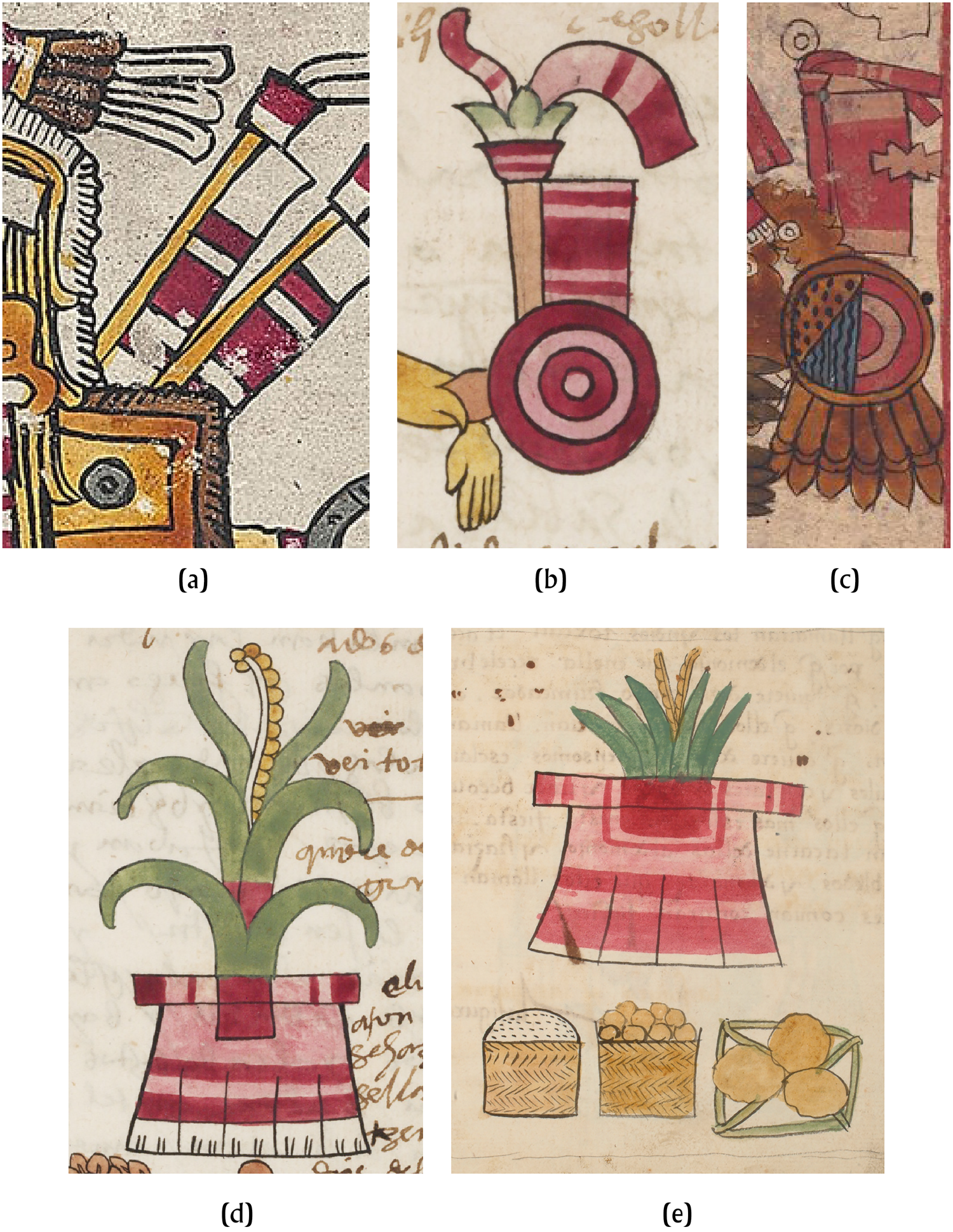
On the other hand, it is duly noted that the graphic pattern of the “rising sun” can be applied to other objects, adapting its appearance to their forms, and maintaining its meaning. This is the case of the banner, which is a part of the whole graphic war compound present between Xipe attires. In the pre-Hispanic divinatory codices the banner is generally white and red (Figures 8c, 10a, and 12a), perhaps made of tlauhquecholli feathers, but in the codices from the Basin of Mexico, it has a red and pink variant (Borbonicus, plates 14, 24; Tonalamatl de Aubin, plate 14; Tudela, f. 12r; Figures 10b, 12b, and 12c). A similar, but rectangular piece of cloth or paper, but with the design adapted to this new form, can be seen in the attires of some maize deities (Borbonicus, plates 27, 34, 36; Magliabechiano, f. 36r) and Xochipilli (Tudela, f. 27r; Magliabechiano, f. 47r), and as a separate element in the context of a ceremony of maize-growing (Tudela, f. 12r; Magliabechiano, f. 32r; Figures 12d and 12e). This last one is the festivity of Huei Tozoztli, the same one that finishes the 80-days cycle Cuahuitlehua–Tlacaxipehualiztli–Tozoztontli–Huei Tozotli of protecting the maize grains (González González Reference González González2011a:280–286; see subsection Flayed Skin). One of the best representations of at least part of this cycle of festivities (even if there is no gloss to identify the scene) is the one from Codex Magliabechiano (f. 90r; Figure 4b), in which Xipe carries the three-parted shield. Beneath him there is a yopitzontli headdress (judging by its conical element), and as such, it is a well-known glyph of Tlacaxipehualiztli that appears frequently in colonial era documents (see Figures 4c and 6c). Additionally, there is an ocholli corncob depicted, so vital in the Tlacaxipehualiztli festival. On the right side of the image there is a maize goddess and a rectangular piece of pink cloth with plant leaves, both parts similar to the images of the festivals of Tozoztontli and Huei Tozoztli in the same codex (Magliabechiano, ff. 31r, 32r). Additionally, the image is enriched with three separate, bifurcated yopitzontli adornments, which appear in the Veytia calendric wheels together with the one of a rectangular piece of cloth showing a plant, as glyphs for Tozoztontli and Huei Tozoztli festivals (Figure 4c). It is important to note that the red circles of the “rising sun” can be applied to these different forms of “sparrow tail” or rectangular cloth (which is why the lines are not circles anymore). Thus, in this case, it is not to emphasize the war connotations proper of the shield, but rather the close connection between the “rising sun” god and maize-growing.
Anahuatl Pectoral
A similar “cosmic” implication has another of Xipe's attributes: the circular red and white pectoral called anahuatl (Figure 13a). It is a quite frequent adornment of many deities, such as Tezcatlipoca, Tepeyollotl, Itztlacoliuhqui, Tlahuizcalpantecuhtli, Tecciztecatl, the macuiltonaleque gods, Quetzalcoatl, and Mictlantecuhtli (Vauzelle Reference Vauzelle2018:740), apart from Xipe. The name of this element appears in the description of Painal (Sahagún Reference Sahagún1993:f. 261r), but it is Xipe who is called Anahuatl iteouh, the “god of Anahuatl” (Sahagún Reference Sahagún, Anderson and Dibble1950–1982:bk. I, p. 39, bk. VII, p. 53; cf. González González Reference González González2011a:72, 195, 204), and Xippe anahualitec, “Inside of Xipe is anahuatl” (Sahagún Reference Sahagún1993:f. 263r; Vauzelle Reference Vauzelle2018:743; Figure 13b). As González González says (Reference González González2011a:72), possibly the first in the interpretation of this attribute was Seler (Reference Seler1990–1998:vol. 5, p. 3), who based it on Pomar's description: “a golden jewel that meant the world, at least until the ends of the earth where they ended with the sea, because, until here, they understood that it was the space and end of it” (un joyel de oro q[ue] significaba el mundo, a lo menos hasta los fines de la tierra donde terminaban con la mar, porq[ue], hasta aquí, entendían ellos q[ue] era el espacio y término dél; Pomar Reference Pomar and Acuña1986:54). According to a subsequent and much deeper study of anahuatl made by Vauzelle (Reference Vauzelle2018:740–749), it refers to the water that surrounds the world and the stars, the darkness, and the night. These meanings are coherent with each other because the sky and the ocean come together (as ilhuicaatl) to delimit the world (cemanahuatl), horizontally and vertically (Vauzelle Reference Vauzelle2018:745). In other words, this element can be understood in both temporal and spatial terms: it indicates night as part of the day, and the water and sky surrounding the human space called cemanahuac. Understood like this, the anahuatl connotes a real “cosmic dimension” (Vauzelle Reference Vauzelle2018:749).
The anahuatl chest ornament and the corresponding name of Xipe in a gloss. (a) Borbonicus, plate 14. Courtesy and copyright of Library of the French National Assembly, Ms. 1515; (b) Manuscrito de Real Palacio, f. 263r. Reproduced with permission of Patrimonio Nacional, Palacio Real de Madrid, Manuscrito RB II/3280.

Chicahuaztli Staff
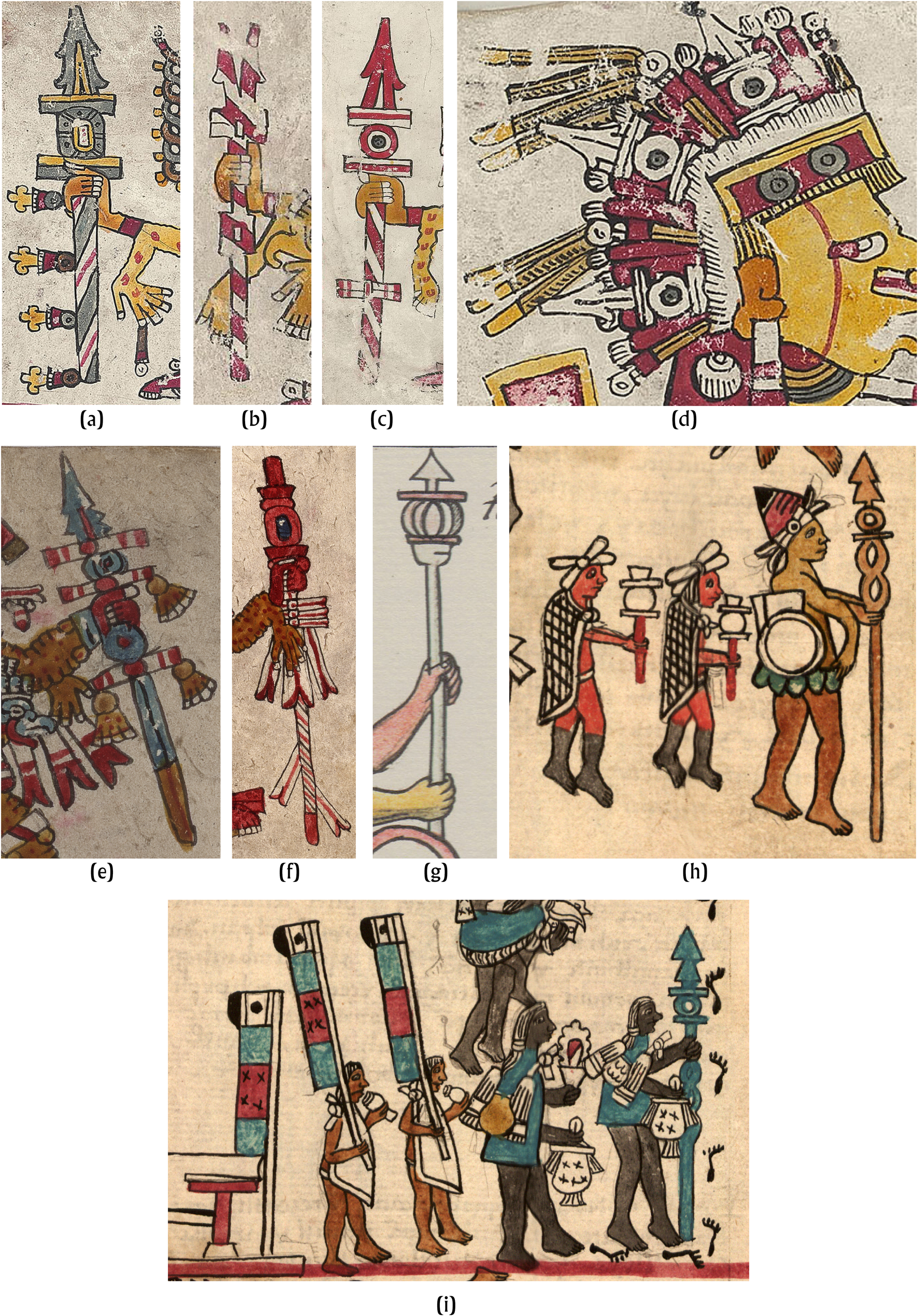
The strong relationship of the red-white adornments made of tlauhquecholli feathers with the process of death and rebirth of the maize, paralleled with the rebirth of the rising sun, can be further confirmed with another object carried by Xipe. It is the rattle called chicahuaztli, as Sahagún's informants explicitly name it (Sahagún Reference Sahagún1993:f. 263r), and as it is represented in this god's images from both Sahagunian manuscripts (Figures 14g, 1i, and 1j). This artifact is omnipresent in the images of the “Flayed God” in the codices Borgia (plates 24, 26, 49 and others; Figures 14a–14c) and Vaticanus B (plates 19, 68; Figures 14e and 14f). Interestingly, in a way characteristic of pre-Hispanic codices, in the Codex Borgia (plate 67) the same element can be drawn in a completely different place in the image of the god: when not in his hand, it appears as sharply-ended elements of the upper parts of the same staff on his headdress (Figure 19d). In the codices from the Basin of Mexico, the chicahuaztli is held by the priests heading processions realized during the ceremonies of Atemoztli, Tlacaxipehualiztli, and Huei Tozoztli (Sahagún Reference Sahagún1993:ff. 250r–250v; Figures 14h and 14i), that is to say, at the beginning of the agricultural year. It is held by other deities, such as Xilonen, Chalchihuitlicue, Tzapotlan Tenan, and Tlaloc (Sahagún Reference Sahagún1993:ff. 269r–269v; cf. Couvreur Reference Couvreur, Ragot, Peperstraete and Olivier2011:239; Seler Reference Seler and Frenk1963:vol. 2, p. 215, Reference Seler1990–1998:vol. 2, pp. 245–246), as well as Opochtli (f. 269r) and Yyauhqueme (f. 269v), who are all maize and rain/water deities. Chicahuaztli, translated as “The one with the strength” (El que tomará fuerza; Diccionario Sahagún/Máynez in GDN 2005), was a generic term for different percussion instruments that varied in form and color, and with one specific variant that was called ayauhchicahuaztli or “mist rattle.” The last one was blue and was used in the pluvial context in rites dedicated to Tlaloc and the rain gods (Couvreur Reference Couvreur, Ragot, Peperstraete and Olivier2011:239–240; Dehouve Reference Dehouve2019b:394). When it appears in the hands of Xipe and the maize goddess (Sahagún Reference Sahagún1993:ff. 263r–263v), it is usually red or white-red (Figures 14b–14f), but in one particular instance (in Xipe's image as the companion of the Sky-Bearer; Borgia, plate 49; Vaticanus B, plate 19), it is blue, red, and white (Figures 14a and 14e). In another (Sahagún Reference Sahagún1993:f. 250r; Figure 14h), it is yellow. Undoubtedly, these differences in color imply certain changes in meaning, at present unclear, but another key observation is that according to Couvreur, the chicahuaztli used in ceremonies dedicated to Xipe Totec was used in a very particular way: it was agitated and hit with strength towards the sun (Couvreur Reference Couvreur, Ragot, Peperstraete and Olivier2011:240). On the other hand, I have discussed elsewhere that the chicahuaztli has strong connotations with the act of (pro)creation, as it appears in the image of the primordial creative couple in a sexual act (Borgia, plate 9, Vaticanus B, plates 28, 87), which in turn has to do with plant reproduction (Mikulska Reference Mikulska2010:133–136). Years ago, Seler suggested that chicahuaztli evoked the sowing of maize with a coa or digging stick (Seler Reference Seler and Frenk1963:vol. 1, p. 132), an interpretation that was confirmed by Dehouve (Reference Dehouve, Dehouve, Mikulska and Vauzelle2021). In conclusion, the chicahuaztli in the image of Xipe Totec, especially when painted red or white and red, could well refer to the maize plant that will soon enter the process of reproduction.
Representations of the chicahuaztli staff: (a) Borgia, plate 49; (b) Borgia, plate 24; (c) Borgia, plate 26; (d) Borgia, plate 67; (e) Vaticanus B, plate 19; (f) Vaticanus B, plate 68. © 2019 Biblioteca Apostolica Vaticana; Codex Borg. Mess. 1 and Codex Vat.lat.3773, reproduced with permission of Biblioteca Apostolica Vaticana, with all rights reserved; (g) Florentine Codex, f. 12r. Courtesy of Biblioteca Medicea Laurenziana, Firenze, Ms. Med. Palat, f. 12r. Su concessione del MiBACTL. E’ vietata ogni ulteriore riproduzione con qualsiasi mezzo; (h) Manuscrito de Real Palacio, f. 263r; (i) Manuscrito de Real Palacio, f. 250v; reproduced with permission of Patrimonio Nacional, Palacio Real de Madrid, Manuscrito RB II/3280.
The Quail Pectoral, the Face Line, and the Sapote Kilt
In the codices Borgia (plates 25, 49, and others; Figures 15a and 15b) and Vaticanus B (plates 19, 70; Figures 15c and 15d), Xipe has yet another pectoral, different from the aforementioned anahuatl. This time it is a bird, hanging with its head down. Particularly in the Codex Borgia, one can distinguish that the bird is black, with white circles painted in the manner of the down balls on its trunk and smaller white circles on its wings.
The quail as a pectoral in the Xipe representation: (a) Borgia, plate 49; (b) Borgia, plate 25; (c) Vaticanus B, plate 19; (d) Vaticanus B, plate 70. As a sacrificed bird: (e) Codex Borgia, plate 71. As the fourth volatile: (f) Borgia, plate 71, © 2019 Biblioteca Apostolica Vaticana; Codex Borg. Mess. 1, reproduced with permission of Biblioteca Apostolica Vaticana, with all rights reserved. The quail as the fourth volatile with Xipe Totec head in its beak: (g) Tonalamatl de Aubin, plate 12 (detail), courtesy and copyright of Bibliothèque nationale de France. Real quail (Cyrtonyx montezumae) and detail of its head with the black line: (h) photograph by Dominic Sherony (https://commons.wikimedia.org/wiki/File:Montezuma_Quail_(Cyrtonyx_montezumae).jpg), published under Creative Commons Attribution-Share Alike 2.0 Generic. “Quail line” on the face of Xipe: (i) Florentine Codex, f. 12r. Courtesy of Biblioteca Medicea Laurenziana, Firenze, Ms. Med. Palat, f. 12r. Su concessione del MiBACTL. E’ vietata ogni ulteriore riproduzione con qualsiasi mezzo; (j) Manuscrito de Real Palacio, f. 263r, reproduced with permission of Patrimonio Nacional, Palacio Real de Madrid, Manuscrito RB II/3280.
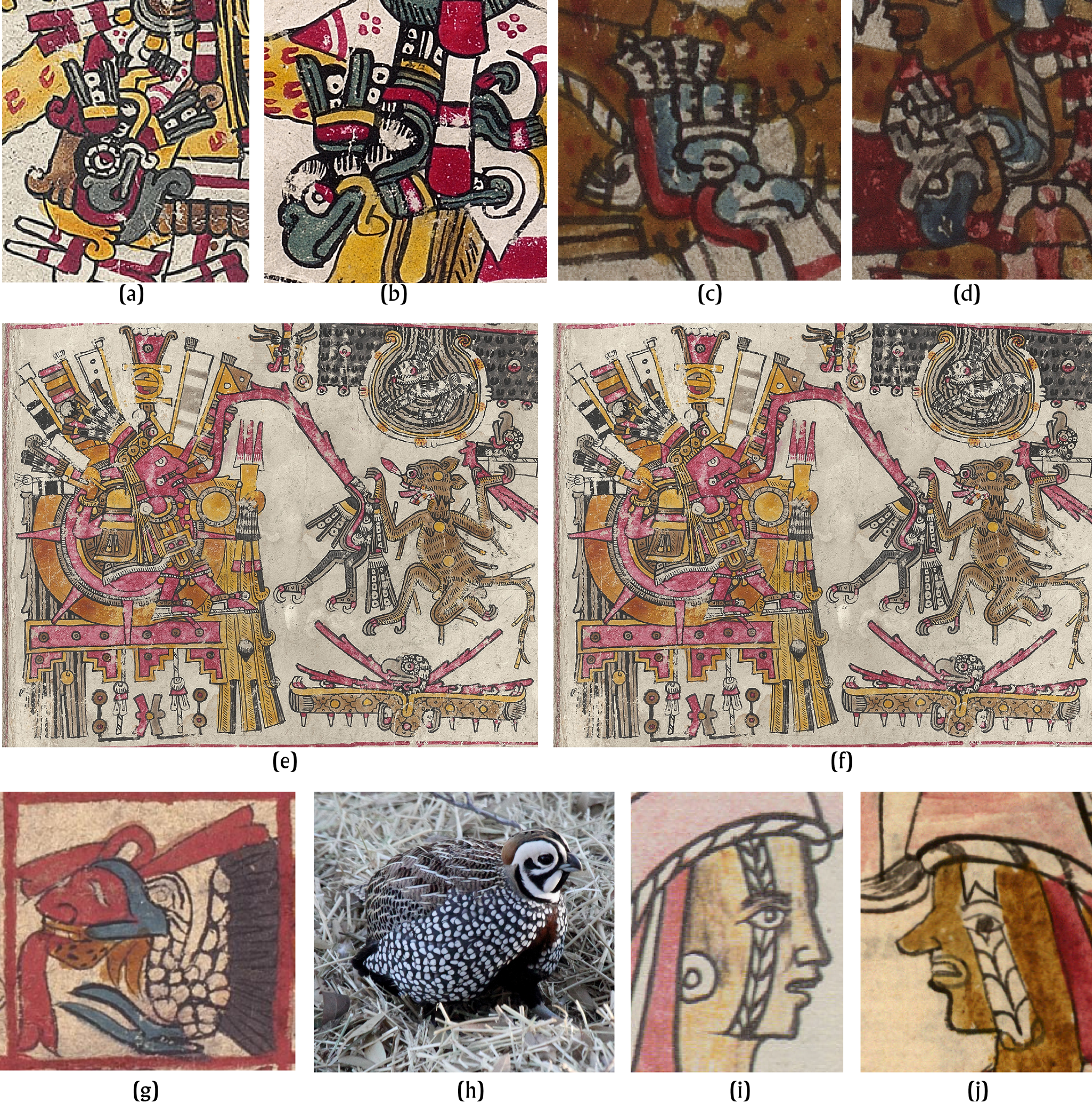
The simplest way to identify a bird in the codices is to look for it in the section of the so-called thirteen volatiles, in the Codex Borgia placed all together in plate 71. The fourth flying animal closely resembles the one from Xipe's pectoral (Figures 15a and 15b), but this identification is additionally confirmed by the central scene from the same plate (Borgia, plate 71; Figures 15e and 15f). It is a well-known representation of the decapitation of a quail and its offering to the Sun god (Batalla Rosado Reference Batalla Rosado2008:486–487; Sahagún Reference Sahagún, Anderson and Dibble1950–1982:bk. II, p. 216, among others). The bird here is represented with the same white “down balls” and white circles on its trunk and wings as in Xipe's pectoral. At the same time, it is the pattern which a real bird, Moctezuma quail (Cyrtonyx montezumae; Figure 15h) has on its body. The interpretation as a quail is further confirmed with the Codex Tudela, which functions as a kind of “Rosetta Stone” for the divinatory codices: in its tonalamatl section (ff. 96v–124r), the 13 volatiles are identified by their name, and the fourth one is tzulin or “quail” (f. 96v; cf. GDN 2005). Moreover, whereas it can be a coincidence that the fourth of the so-called “Thirteen Lords of the Days” is the Tonatiuh or Sun (cf. Borbonicus, 3–20), it does not seem so in the case of the Codex Tonalamatl de Aubin, in which all the volatiles have a head of a god in their beaks, and in the case of the quail, it is the head of Xipe Totec (plates 3–20; Figure 15g). This led Seler to say that the quail was the nahualli or “disguise” of Xipe (in Sahagún Reference Sahagún, Sullivan, Nicholson, Anderson, Dibble, Keber and Ruwet1997:102, n49).
As is widely known, quails were the sacrificial birds or victim's substitute par excellence, as is confirmed by the description of various veintena rites (i.e., during Tlacaxipehualiztli, Toxcatl, or Ochpaniztli; Sahagún Reference Sahagún, Anderson and Dibble1950–1982:bk. II, pp. 52, 73, 121) and ceremonies dedicated to particular gods, such as Painal (Sahagún Reference Sahagún, Anderson and Dibble1950–1982:bk. II, p. 176). They form part of the metonymic series that defines offerings as such, irrespective of medium. In the verbal medium it appears in the description of the offerings made to take a cihuatlamacazqui (“priest woman”) from the temple and marry her; before that could be done special offerings had to be made: “quail, and incense, flowers, tobacco, and an incense ladle. And food was bought” (in çolin, yoan in copalli, in suchitl, in jietl, yoan in tlamaitl, yoan mocohoaia tlaqualli; Sahagún Reference Sahagún, Anderson and Dibble1950–1982:bk. II, p. 246). The graphic form of this metonymic series is frequently represented in the Mixtec codices (Codex Nuttall, plates 5, 17, 18, 50, 52, 53, 70, 84; Codex Vindobonensis Mexicanus I 1992:Plates 20, 30, 47). Frequently, some components of one metonymic series can be part of another, due to their polysemic nature (Dehouve Reference Dehouve, Mikulska and Offner2019a). Flower and tobacco are components of other metonymic series, together with food, drink, different sorts of clothes, and a piece of land, and altogether meant the honors achieved during successful combat (Dehouve Reference Dehouve2014). Perhaps one of the clearest indications of the quail's symbolism as a sacrifice is Sahagún's description of everyday rites celebrated after the sunrise: “they wrung the necks of the quail; they raised them dedicating them to the sun” (Sahagún Reference Sahagún, Anderson and Dibble1950–1982:bk. II, p. 216). This description corresponds perfectly with the aforementioned scene from the Codex Borgia (plate 71; Figure 15e), even if in the latter the sun god receives just the blood of the quail, and its head is offered to the earth. The presence of the white sacrificial banner held by the sacrificing animal, together with the quail's head, confirms the function of this bird as a sacrificial victim. Further, Johansson indicates that quails are frequently spotted in the season of hot weather, and they fly just before the dawn, thus being perceived as “a light going out of the night or the underworld” (Johansson Reference Johansson and Guedea2004:121).
Moreover, it should be noted that some priests and goddesses, who appear dressed in human skin—as the Tlazolteotl of the 13th trecena (Borbonicus, plate 13) and the Chicomecoatl priest carrying the ceremonies in the Ochpaniztli veintena (Borbonicus, plates 29–30)—are also represented with a quail in their mouth. This seems to be similar, if not identical, to the rite described by Sahagún, during which the ixiptla of the goddess called Aticpaccalqui (aticpac calquj cihoatl), or the “woman whose house was Aticpac,” was killed. Afterwards: “they flayed her, and the fire priest put on her skin, and he went holding a [live] quail in his teeth; it went dangling from his mouth” (aun qujpehoaia in jiehoaio cõmaqujaia tlenamacac, yoan qujtlanquativja çolin icamac pilcatiuh; Sahagún Reference Sahagún, Anderson and Dibble1950–1982:bk. II, pp. 212–213). This rite sheds more light on the symbolism of the quail because of the connection of this bird with Tlazolteotl. The name of this goddess means literally “Waste deity,” as tlazolli is “waste they throw in dung heap” (vasura que echan enel muladar; Molina Reference Molina1571:vol. 2, f. 120r; cf. Giasson Reference Giasson2001:138; Torquemada Reference Torquemada and León-Portilla1986:vol. 2, p. 62). This implies her capacity of transforming the waste into fertilizer and, consequently, nurturing the rise of plants (Giasson Reference Giasson2001:155–157; Johansson Reference Johansson2012:88–89). On the other hand, Johansson (Reference Johansson2012:89) explains that the quail is not only a bird closely linked with Mictlan or the Place of the Dead, but also that its name in Nahuatl, zollin, is composed of the morpheme zol-, that indicates something old and deteriorate. He then says (Johansson Reference Johansson2012:89) that when Tlazolteotl ingests the quail hung on her mouth, as visible in the Codex Borbonicus (plate 13), she reproduces it into a new life, giving birth. Consequently, the quail symbolism must encompass the transformation into life of something dead, destroyed, and putrefied. This resounds additionally with the function performed by the quail during the creation of humans: according to the myth registered in the Leyenda de los Soles (Bieirhorst Reference Bierhorst and Bierhorst1992c:146), a quail bit and nibbled the bones taken from Mictlan by Quetzalcoatl, and only from these “dead and destroyed” human bones (additionally grounded by Quilaztli), new humans were created.
When the quail appears as Xipe's pectoral, it can therefore indicate his role as a victim and as the one who reassures re-creation. He is the one to be sacrificed, as he must be defeated by the Black Tezcatlipoca before his rebirth. At the same time, the other way round, he, as Red Tezcatlipoca or rising sun, receives the blood offering after the sunrise. These double interpretations seem to be a frequent result of concentrating on the opposite information in the divinatory codices (cf. Mikulska Reference Mikulska2010, Reference Mikulska2015:445–459). It is further confirmed by the fact that Xipe, or the sacrificed “flayed one,” is the one who protects the maize grains from being skinned/shelled—that is, of being permanently killed—in this way, assuring its rebirth after another act of skinning (defoliating). Therefore, the quail pectoral in the chest of Xipe can connote perfectly this double function of this god, as a sacrificed victim and as the victorious rising sun/growing maize, following the idea that the destruction is an essential phase in the process of creation or construction of something new.
A puzzling observation, however, is that in the codices made in the Basin of Mexico style, there is no single case of the substitution of the anahuatl pectoral by the quail. Nevertheless, the description of Xipe's image from the Manuscrito de Real Palacio (Sahagún Reference Sahagún1993:f. 263r) gives the name for his face painting, which is mixçolichiuhticac (m-ix-zoli-chiuh-ticac), “His face is painted with the quail design.” Indeed, Xipe's face is crossed with a vertical line (Sahagún Reference Sahagún1993:f. 263r, Reference Sahagún1979:bk. I, f. 12r; Figures 15i and 15j; cf. commentary by Sullivan et al. in Sahagún Reference Sahagún, Sullivan, Nicholson, Anderson, Dibble, Keber and Ruwet1997:102, n49), similar to the extremely frequent red line present in his image from the codices from the Borgia group (cf. Figures 3a–3d, 5a, 5b). This red line seems to be one of the diagnostic features of Xipe's representations since his early appearances in older Mesoamerican cultures (González González Reference González González2011a:34–58, see also 26–34). While I am not able to explain the meaning of this red line in the codices from the Borgia group—apart from mentioning that it is considered to be the mark of a mask worn by this god (Vié-Wohrer Reference Vié-Wohrer1999:vol. 1, p. 90; cf. González González Reference González González2011a:34–58)—I want to focus on the “broad stripe that runs through the eye” on Xipe's images from the Basin of Mexico, “which features a featherlike pattern,” as Sullivan at al. suggested (in Sahagún Reference Sahagún, Sullivan, Nicholson, Anderson, Dibble, Keber and Ruwet1997:102, n49). Indeed, the head of the Moctezuma quail (Cyrtonyx montezumae) is traversed by a black line. Thus, my understanding is that in the graphic convention of the codices from the Basin of Mexico, the quail element is incorporated in the line crossing Xipe's face, indicating in this way the parallelism of the Flayed God's functions with the one of a quail and its symbolism.
In accordance with the interpretation of the quail symbolism is the sapote kilt, another of Xipe's attributes. In the codices of the Borgia group this element is not particularly frequent, though it is extant (Borgia, plate 61; Figure 16a), but in the manuscripts from the Basin of Mexico it is omnipresent (Borbonicus, plate 14; Tonalamatl de Aubin, plate 14; Sahagún Reference Sahagún1993:f. 263r, Reference Sahagún1979:f. 12r; Figures 1i, 1j, and 16b–16d). The corresponding description by Sahagún's informants explicitly names this garment as the itzapocue or “his sapote skirt” (Sahagún Reference Sahagún, Anderson and Dibble1950–1982:bk. I, p. 40; cf. González González Reference González González2011a:75; Seler Reference Seler1990–1998:vol. 2, p. 245), indicating that it was made of the leaves of the sapote tree (Casimiroa edulis), even if in the real life it was made of green quetzal feathers. Both materials were synonymous on a symbolic level, as Vauzelle (Reference Vauzelle2018:169) demonstrated.
The sapote skirt of Xipe Totec and sapote tree: (a) Borgia, plate 49. © 2019 Biblioteca Apostolica Vaticana; Codex Borg. Mess. 1 and Codex Vat.lat.3773, reproduced with permission of Biblioteca Apostolica Vaticana, with all rights reserved; (b) Florentine Codex, f. 12r. Courtesy of Biblioteca Medicea Laurenziana, Firenze, Ms. Med. Palat, f. 12r. Su concessione del MiBACTL. E’ vietata ogni ulteriore riproduzione con qualsiasi mezzo; (c) Borbonicus, plate 14; (d) Tonalamatl de Aubin, plate 14. Courtesy and copyright of Bibliothèque nationale de France. (e) The sapote tree (Manilkara zapote). Photograph by Semarnat (https://www.portalambiental.com.mx/sustentabilidad/20200829/aprovechamiento-responsable-impulsara-una-recuperacion-de-ecosistemas).

On the other hand, it should be remembered that Red Tezcatlipoca was thought to come from Tzapotlan, “Place of sapote” (today's Jalisco state; González González Reference González González2011a:75, 77), just like the goddess Tzapotlatenan, whose name “Mother of Tzapotlan” seems to indicate it, and who shared with Xipe the faculty of curing skin diseases and the fact of holding a chicahuaztli (Muñoz Camargo Reference Muñoz Camargo and García1998:273; Sahagún Reference Sahagún, Anderson and Dibble1950–1982:bk. I, p. 17; cf. González González Reference González González2011a:76–77). Many elements of the Tlacaxipehualiztli veintena confirm the strong connection of the sapote with Xipe himself, and with maize. Both the ocholli corncobs and the xipeme—dressed in captive skins—were sited on sapote leaves, which possibly conformed the tzapoicpalli (“seat of sapote”), prepared by the goldsmiths for his patron god, Xipe (Durán Reference Durán1984:vol. 1, p. 244; cf. Seler Reference Seler1990–1998:vol. 2, p. 245; González González Reference González González2011a:140). Sapote leaves were used to decorate the future scene of the tlahuahuanaliztli, the rite of “scratching” (see subsection Yopitzontli and Tlauhquecholtzontli) the captives (Alvarado Tezozomoc Reference Alvarado Tezozomoc, Mignolo and Chamorro2001:147; González González Reference González González2011a:75). On the other hand, on the top of Xipe's temple, a construction called tzapocalli or “sapote house” was made (González González Reference González González2011a:75), and ten priests participating in this rite were staying there (Durán Reference Durán1984:vol. 2, p. 173; cf. González González Reference González González2011a:139). As previously mentioned, this rite consisted in literally scratching the bodies of the captives before their sacrifice, so the bloody stripes would appear along their legs and arms (Vauzelle Reference Vauzelle2018:169; Vié-Wohrer Reference Vié-Wohrer1999:vol. 1, p. 38), making them real representations of what is seen in the codices as a graphic sign in form of red lines that indicated the persons destined to be sacrificed (Graulich Reference Graulich1982:224; Olivier Reference Olivier2014:408–409, 548–549; Vauzelle Reference Vauzelle2018:403–405). In this context, the sapote symbolism can be better understood: this tree was used as the source of latex, and to collect it, the tree was literally scratched, uncovering its interior red bark (Figure 16e); in this way, it produced the resin or the “blood” (Vauzelle Reference Vauzelle2018:169). Together, then, with the quail element, placed either on the chest of Xipe as his pectoral, or on his face in form of “quail line,” these signs indicated Xipe's condition as the one to be sacrificed to be reborn as a new maize plant or the rising sun.
The Flint Knife and Gold Elements
The last element in Xipe's representations that I will refer to is the flint knife. Much more than an attribute, it embraces the god's face. Rather, it is an anthropomorphized knife. This representation, however, is uncommon, as it occurs only sometimes; for example, when he has the role of the companion of the patron of the 20th veintena (Borgia, plate 61; Vaticanus B, plate 68; Borbonicus, plate 20; Tonalamatl de Aubin, plate 20; Figures 17a–17d). Apart from being an anthropomorphized knife, the god carries one or two flint knives in his hands, which strengthens the importance of this element. The rest of his body is composed of signs that define Xipe Totec as such: the flayed skin, the “hanging” mouth, the elongated “empty” eye, tlauquechol-like adornments, and even the sapote skirt. It is remarkable, however, that in the corresponding image in the posterior Codex Telleriano-Remensis (f. 23v; Figure 17e), the alphabetical glosses name him explicitly as Iztapaltotec, pedernal o cuchillo (f. 23v). The first name can be translated as “Lord of the obsidian [paving] stone,” even if in the graphic image the knife is represented with the standard convention for the flint. Nevertheless, the word itztli is “knife” (Molina Reference Molina1571, Olmos 1547 in GDN 2005), and the word tecpatl was a general term used for different sacrificial cutting instruments (Mikulska Reference Mikulska2010:127–128; Olivier Reference Olivier2004:200–201). As a result, there was a conceptual pun between the flint and the obsidian knife (Mikulska Reference Mikulska2010:127–129). That is why the second of the so-called “Nine Lords of the Night,” named Itztli (Telleriano-Remensis, f. 8r) or Ytzteucyohua (Serna Reference Serna1987:345), can be represented either in the guise of an obsidian (Borbonicus, plates 3–20) or flint knife (Borbonicus, plate 12; Vaticanus B, plate 19; Figures 18a and 18b).
Companion of the 20th trecena: (a) Borgia, plate 61; (b) Vaticanus B, plate 68. © 2019 Biblioteca Apostolica Vaticana; Codex Borg. Mess. 1 and Codex Vat.lat.3773, reproduced with permission of Biblioteca Apostolica Vaticana, with all rights reserved; (c) Borbonicus, plate 20. Courtesy and copyright of Library of the French National Assembly, Ms. 1515; (d) Tonalamatl de Aubin, plate 20; (e) Telleriano-Remensis, plate 23v. Courtesy and copyright of Bibliothèque nationale de France.
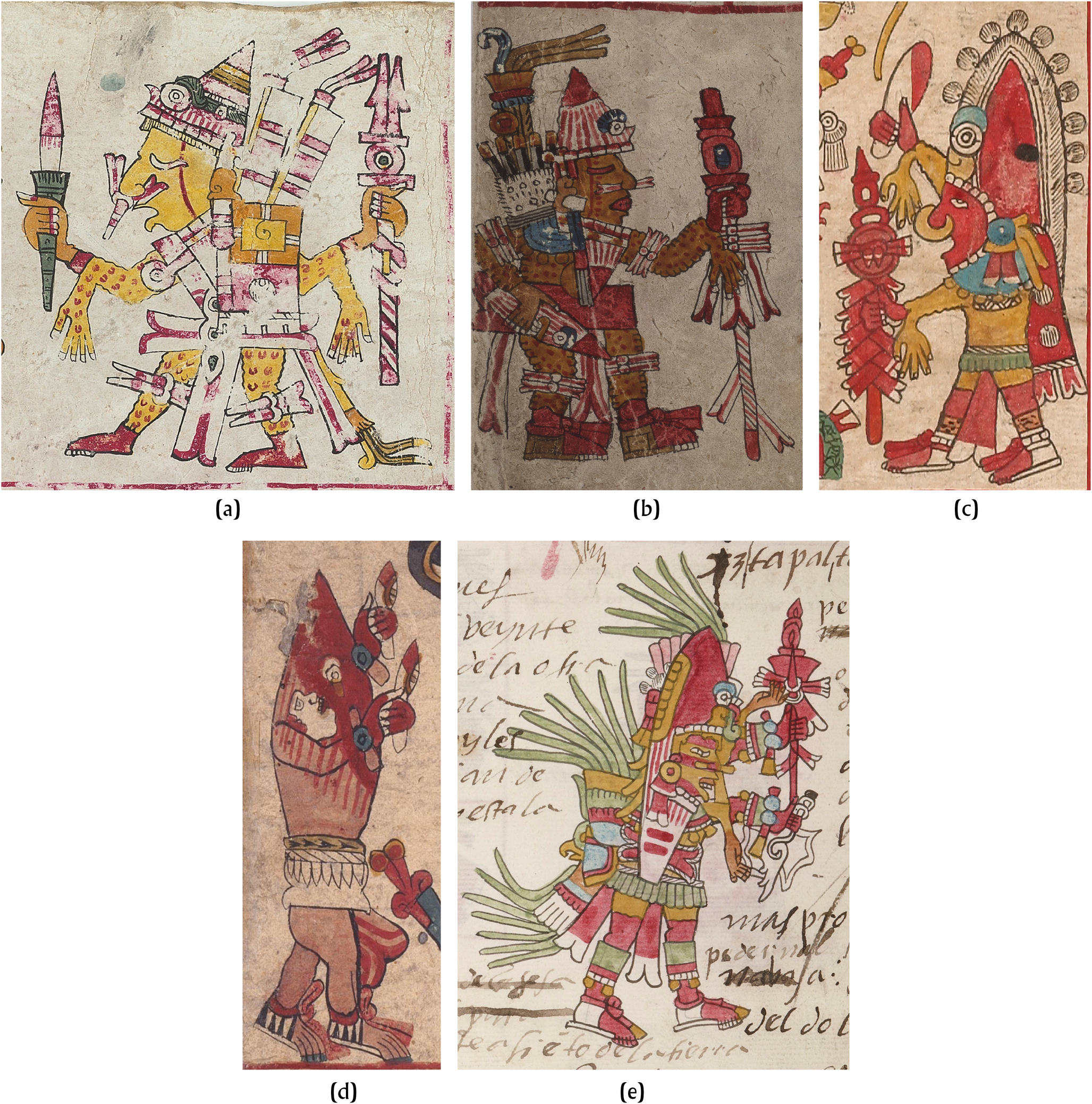
The second of the so-called “Nine Lords of the Night” in guise of obsidian and flint knife: (a) Borbonicus, plate 19; (b) Borbonicus, plate 12. Courtesy and copyright of Library of the French National Assembly, Ms. 1515.

As mentioned at the beginning of this article, another of the names or titles of Xipe was Yohuallahuan, “The one that drinks at night,” identified as such by González González (Reference González González2011a:209–211, 257) and earlier by Dyckerhoff (Reference Dyckerhoff, de Durand-Forest and Eisinger1993:362, in GDN 2005). These scholars aptly based their interpretation on the correspondence between the repetitively mentioned name of Yohuallahuan during Tlacaxipehualiztli ceremonies and in one of the seventeenth-century incantations gathered by Ruiz de Alarcón (Reference Ruiz de Alarcón, del Paso and Troncoso1953:154, treatise VI, chap. 16), pronounced before the medical treatment of bloodletting. To be exact, this name, as such, does not appear in the latter, but indeed the instrument for bloodletting is invoked with the words: Tlamacazqui ceocelotl, tla xihuallauh: yequene tiyohuallahuaniz, “Tlamacazqui, 1-jaguar, come, please, at last you will get drunk at night” (Ruiz de Alarcón Reference Ruiz de Alarcón, del Paso and Troncoso1953:154, treatise VI-16; my translation). In Tlacaxipehualiztli ceremonies, Yohuallahuan is the appellation of the priest who carried out the sacrifice of the “scratched ones” after the tlahuahuanaliztli rite (Sahagún Reference Sahagún, Anderson and Dibble1950–1982:bk. II, pp. 53, 51; cf. González González Reference González González2011a:271–273), and it is said that he performed this action “in the guise of Totec” (Iooallaoan, totec ipan quiztiuitz; Sahagún Reference Sahagún, Anderson and Dibble1950–1982:bk. II, p. 53). The attribution of the name Yohuallahuan to Xipe is further confirmed with another name: the building Yopico Calmecac, which was Yohuallahuan, where the captives were flayed (Sahagún Reference Sahagún, Anderson and Dibble1950–1982:bk. II, p. 188; González González Reference González González2011a:134, 211). At the same place, in the preceding veintena, Atl Cahualo, the previously mentioned simulacrum or trial sacrifice, realized with knives made of yopitlaxcalli (tortillas made of maize not cooked with lime), took place.
One more confirmation of the connection between “getting drunk at night” and Xipe is in the chant dedicated to this god (Sahagún Reference Sahagún, Anderson and Dibble1950–1982:bk. II, p. 240). It starts with the words Ioalli tlavana, “The night gets drunk here,” which, when nominalized, would sound like the name Yohuallahuan. Further on, the invocated god is explicitly named Noteuhoa centla, “my owner of the maize god” (Sahagún Reference Sahagún, Anderson and Dibble1950–1982:bk. II, p. 240). This coincides with Xipe Totec's function as the protector of the maize seeds to be sown. It resounds with the ceremony of placing the best selected corncobs for sowing on the sapote leaves, together with the hearts of the sacrificed god incarnations. All this was done in Yopico temple in front of the main priest that must have been Yohuallahuan (Durán Reference Durán1984:vol. 1, pp. 243–244; González González Reference González González2011a:272–275).
It is worth mentioning that in the chant to Xipe Totec, he is encouraged to get dressed in his “gold clothes” (teucujtlaquemjtl, xjcmoquentiquetl; Sahagún Reference Sahagún, Anderson and Dibble1950–1982:bk. II, p. 240). These could be the gold ear plugs (iteocuitlanacuch) mentioned in Xipe's description by Sahagún's informants (Reference Sahagún1993:f. 263r), or possibly the gold jewel attached to the red ribbon placed on his head (Durán Reference Durán1984:vol. 1, p. 96). These pieces of gold can be seen in the headdress of Xipe in the codices (Vaticanus B, plate 62; Borbonicus, plate 14; Tonalamatl de Aubin, plate 14; Figures 19a–19c). They are depicted in the same way as the metal axes and other metal elements from colonial codices (Figures 19e–19g), and as the gold sign in the Codex Borgia (plate 59; Figure 19d). Undoubtedly it is an indication of the connection between Xipe and the goldsmiths, as he was their patron deity.
The sign of gold in the head of Xipe Totec and in other representations: (a) Vaticanus B, plate 62; (b) Borbonicus, plate 14. Courtesy and copyright of Library of the French National Assembly, Ms. 1515; (c) Tonalamatl de Aubin, plate 14. Courtesy and copyright of Bibliothèque nationale de France; (d) Borgia, plate 59. (a and d) © 2019 Biblioteca Apostolica Vaticana; Codex Borg. Mess. 1 and Codex Vat.lat.3773, reproduced with permission of Biblioteca Apostolica Vaticana, with all rights reserved; (e) Magliabechiano, f. 74r, reproduced by permission and “su concessione del Ministero per i beni e le attività culturali e per il turismo” / Biblioteca Nazionale Centrale, Firenze, prohibited any further reproduction or duplication by any means; (f) Mendoza, f. 46r; (g) a copper sign in Mendoza, f. 40r. Bodleian Library MS. Arch. Selden. A. 1. Courtesy and copyright Bodleian Libraries, University of Oxford (https://digital.bodleian.ox.ac.uk/collections/mesoamerican).
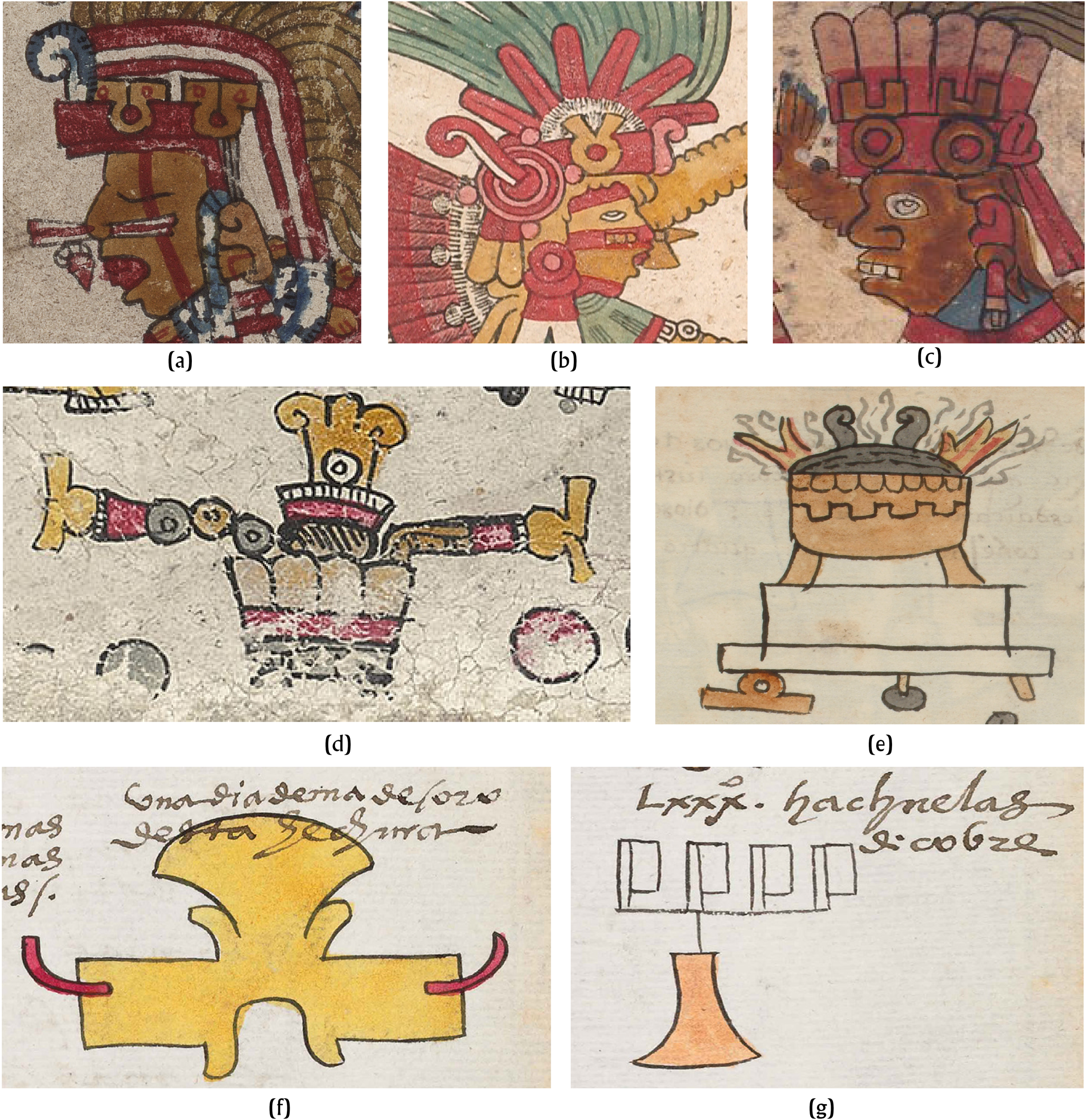
Going back to the flint knife, as it is the sacrificial instrument par excellence, it is obvious that this costume, together with the name Itztli/“Iztapaltotec, pedernal o cuchillo,” as well as the name Yohuallahuan, shared by Xipe priest and the knife used in the curing by bloodletting, codify the same function. While the sapote skirt indicated Xipe's property of being scratched to bleed, and the quail—being sacrificed, but with the potential of rebirth—the presence of the knife converts him into the agent of this action. In this way, these apparently contrary functions can be equally performed by Xipe and, what is more, even expressed together in his image, as is the case of his representation in the Codices Borbonicus (plate 20; Figure 17c) and Telleriano-Remensis (f. 23v; Figure 17e), where the anthropomorphized knife wears the sapote skirt. Moreover, it should be considered if something similar happens in the images of Xipe in Sahagún's manuscripts (Sahagún Reference Sahagún1993:f. 263r, 1979:bk. 1, f. 12r; Figures 6d and 6e): his pointed head attire, more than the hanging tlauhquecholtzontli bifurcated ornaments, resembles the upper part of a knife; and in both cases, he wears the sapote skirt.
CONCLUSIONS
As indicated in the introduction to this article, I have aimed to show, using the example of Xipe Totec, that the graphic images of the gods in the codices are composed as a mosaic of signs bearing different semantic values. All of them contribute to create the god's identity. This last one is extremely dynamic, so it is only through the combinations of different signs that change between one image and another that the momentum can be captured in the graphic medium.
Some of those composing signs seem to codify the god's names in an emblematic way (cf. Mikulska Reference Mikulska and Mikulska2020a:513–517, 522): this is the case of the flayed skin and the name of Xipe, the smoking mirror and the name of Tezcatlipoca, and the knife and the name of Itztli/Itztlapaltotec. Others codify epithets or properties of the gods rather than the names themselves, but it must be stressed that the signs of the skin, the smoking mirror, and the flint imply corresponding properties. What is more fundamental, all these signs are polysemic, as they can codify distinct epithets/properties at the same time, and they resound together with other features as a reference to the same property. In the case of Xipe Totec, these graphic signs could be grouped in the following way, referring to:
• sacrifice, Xipe being the agent and the object of it: flayed skin, sapote skirt, quail, and knife;
• rebirth of maize: flayed skin, chicahuaztli staff, quail;
• patronage over the goldsmiths: the gold objects in the headdress;
• the function of this god as the agent dealing on the metaphoric border between the time/space of darkness and dawn, being the rising sun and the protector of the growing maize: tlauhquechol adornments (or adornments in red and white colors), the sun shield and the pectoral anahuatl, the quail.
The identity of the god seems to be unique in every one of his representations, as practically every image is a different combination of those meaningful signs. Even if we compare the representation of the god in the same role—as the patron of the same fragment of the calendric cycle—there are still significant differences between them (most probably due to regional and/or temporal differences between those codices and their authors’ origin). That is to say, even if the sacrificial property of the Itztli/Itztapaltotec quality of Xipe is mostly highlighted when he appears in the 20th trecena, between particular codices there are still significant differences among images of this god in each section. It can even be said that there is no single prototypical representation of one deity.
Let us examine other images of Xipe, when he appears as the main patron of the 14th trecena, which has not yet been described in detail. The Codex Borgia image (plate 67; Figure 20a) defines him rather as a god with agricultural functions because of the presence of chicahuaztli points in his headdress and the flower necklace; the “protector” of the maize because of the flayed skin; the Red Tezcatlipoca warrior because of red cloth with white down balls and a bundle of arrows in his hand; and the rising sun because of the white-red adornments and the red cloth with white down balls. The corresponding image in the Codex Vaticanus B (plate 62; Figure 20b) puts more attention on his function as the patron of the goldsmiths, as there are gold elements in his headdress, as well as a gold disk on his chest. However, the last one, called teocuitlacomalli or “golden hotplate” is another polysemic element that can codify warming, shining, or propitiating the growing of the maize—that is to say, different functions of the sun (Vauzelle Reference Vauzelle2018:461–469). Moreover, in this particular codex Xipe is represented as a tlaquimilolli or a sacred bundle, but this is due to the characteristics of this manuscript: all the patrons of the trecenas, starting from the eleventh until the nineteenth, are represented like this, a fact that indicates possibly different authorship of this fragment of the codex.
Representations of Xipe Totec as the patron of the 14th trecena: (a) Borgia, plate 67; (b) Vaticanus B, plate 62. © 2019 Biblioteca Apostolica Vaticana; Codex Borg. Mess. 1 and Codex Vat.lat.3773, reproduced with permission of Biblioteca Apostolica Vaticana, with all rights reserved; (c) Borbonicus, plate 14. Courtesy and copyright of Library of the French National Assembly, Ms. 1515; (d) Tonalamatl de Aubin, plate 14. Courtesy and copyright of Bibliothèque nationale de France.
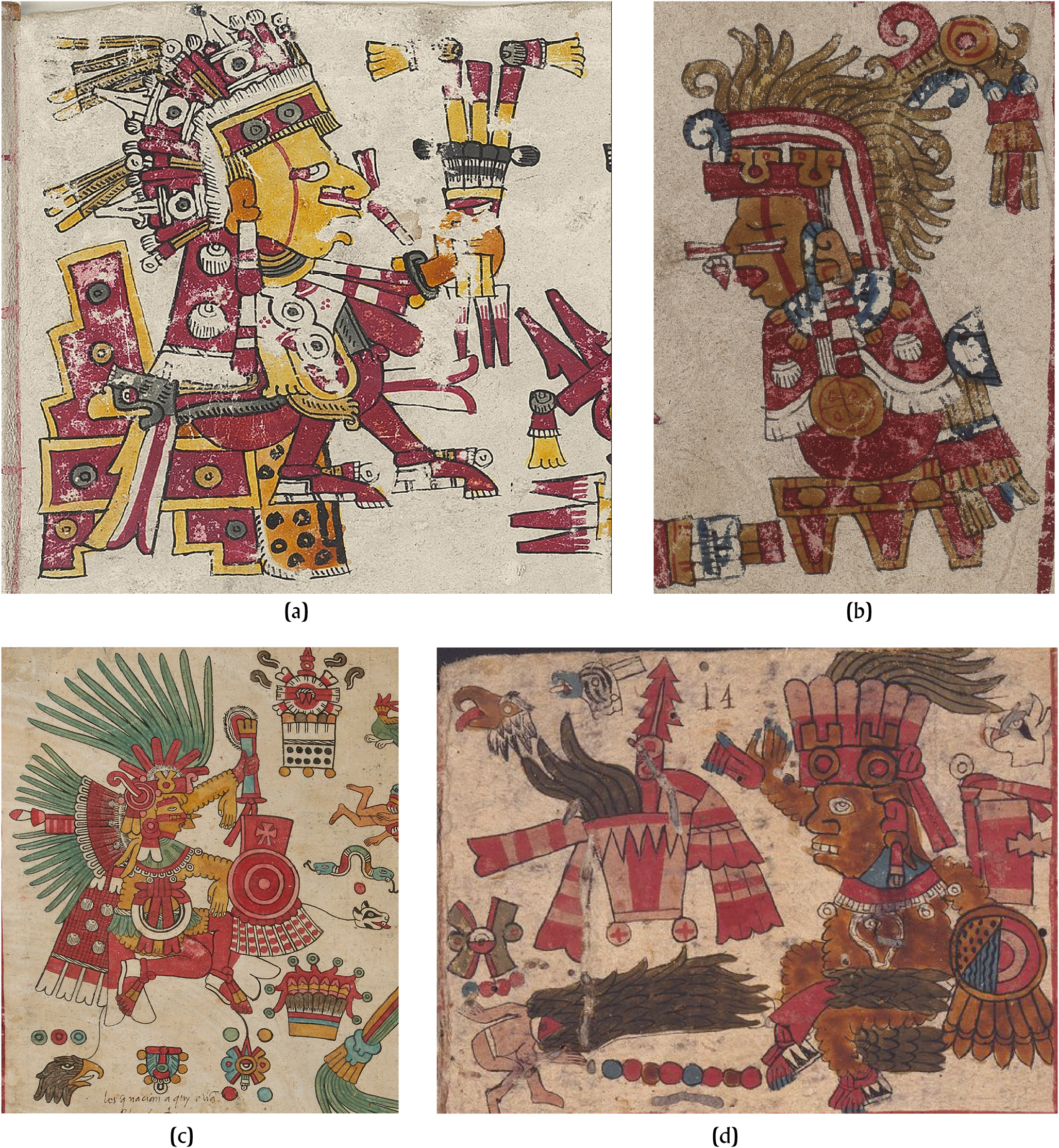
There are still other elements in this image of Xipe in the Codex Borgia (plate 67; Figure 20a) and in others (Borgia, plates 15, 24, 25, 26, 49; Figures 1a, 1c, 1e, and 1g) that I have not been able to identify until now. These are a kind of a white, three- or four-pointed quechquemitl(?), with a design of groups of three or four red points and signs that resemble fragments of red circles located in the corners, and the other is a kind of elongated pectoral(?) composed of two ovals with a dark center. There are at least two more elements.
The corresponding images of Xipe from the codices of the Basin of Mexico are more comprehensible, as thanks to the alphabetical sources, more of their constituent signs have been identified. Therefore, the representations of the 14th trecena are even more comprehensive for us than the images from the Borgia group codices. Thus, in the Codex Borbonicus (plate 14; Figure 20c), the name and properties of Red Tezcatlipoca are extremely explicit, because of the presence of the red(!) smoking mirror and the three red lines on the god's face. The function of dealing, as it were, on the metaphoric border between the darkness and the dawn is expressed by the presence of the anahuatl pectoral and the sun shield. Neither of these elements, such as the red cloth, the atlatl as the war instrument, the sapote skirt, or the gold sign, is missing. Notwithstanding how tempting it is to identify the god in this representation with only one name, either as Xipe (because of the flayed skin and the sapote skirt, the sun shield, and the gold sign) or Red Tezcatlipoca (because of the sign of the smoking mirror and his cloth and the three lines on his face), he should be identified with at least these two names at the same time.
Even so, it seems that it is still not enough information to say definitively. Particularly revealing is the image from the Codex Telleriano-Remensis (f. 23v; Figure 17e), in which still more names or properties seem to be represented: the god himself is Itztapalli/Flint knife, but also Xipe as codified by the flayed skin, Yopi or tlauhquechol elements, the chicahuaztli rattle and sapote skirt, as well as Red Tezcatlipoca, as codified by his facial painting. Again, whereas in the real-life or the ritual context, the function of the main sacrificer—and thus, the name of Yohuallahuan—was strictly connected with Xipe Totec, it is only in particular images of this god when this function is highlighted. Would it be legitimate for us, looking at these images, to decide which of these identities of the god is dominant? My point is that perhaps the identity of a god was defined in the very moment of creating his/her image with particular graphic signs, in this way crystallizing certain of his/her multiple properties, important at a very precise moment (or in the ritual, when it occurred in real life). Some of these signs correspond clearly to what we consider names of a god, but there is hardly ever just one of them, as the distinct qualities of a god could be expressed as different names. Perhaps we should see the Mesoamerican gods not as distinguishable identities, but rather as a temporarily crystalized mosaic of different properties sometimes expressed also as names.
RESUMEN
En este artículo se argumenta que las imágenes gráficas de los dioses en los códices divinatorios están compuestas de signos de diferentes valores semánticos, los cuales codifican particulares propiedades, y asimismo contribuyen a crear la identidad de cada dios. No obstante, estos elementos gráficos no sólo son compartidos por distintas deidades, sino incluso difieren entre las representaciones de un mismo dios, lo cual hace reflexionar sobre cómo se define la identidad de un dios. En este artículo, enfocado en las imágenes gráficas de Xipe Totec, una de las deidades mejor estudiadas y una de las más antiguas de Mesoamérica, se analizan con más detalle los rasgos gráficos tales como la piel del desollado, los adornos llamados yopitzontli y los elaborados de las plumas de espátula rosada, la vestimenta roja, la bandera y el escudo del sol, el pectoral anahuatl y la sonaja chicahuaztli, la codorniz, la falda de las hojas de zapote, el cuchillo de pedernal y los adornos de oro. Con base a ello, se elabora la hipótesis que las imágenes de los dioses en los códices adivinatorios fueron percibidas por sus autores como un mosaico de distintas propiedades, las cuales al mismo tiempo eran dinámicas. En consecuencia, ni siquiera existía una única representación “prototípica” de un solo dios, ya que posiblemente la identidad de un dios se definía justamente a la hora de componer su imagen con particulares signos gráficos, cristalizando de esta manera algunas de sus múltiples propiedades, importantes en este momento preciso.
ACKNOWLEDGMENTS
This article is part of the results of the project funded by the National Science Center of Poland (Narodowe Centrum Nauki, Project No. 2015/19/B/HS3/03742), and it was originally presented at the Northeastern Nahuatl Conference at Yale University. I would like to express my gratitude for the first critical reading of this article to Agnieszka Brylak, Katarzyna Szoblik, and Danièle Dehouve, as well as to the anonymous reviewers, for all the invaluable commentaries I have received to improve this text.


 Open access



.jpg)