




1.0 Introduction
Urban air mobility (UAM) is a subcategory of advanced air mobility (AAM) and the focus of this research. It was chosen for its established economic benefit [Reference Johnson and Silva1] and the significant resources being invested in it globally. South Africa has a limited scope of UAM, so UAM is not a new concept, and particularly not new in the United States (US), Mexico and Brazil. Blade provides helicopter services in the US, and Voom provides helicopter services in the US, Mexico and Brazil [Reference Cohen and Shaheen2]. It is anticipated by the National Aeronautics and Space Administration (NASA) that initial UAM flights will be conducted by human pilots on board the aircraft, and with air traffic control (ATC) providing services [Reference Thipphavong, Apaza, Barmore, Battiste, Burian, Dao, Feary, Go, Goodrich, Homola, Idris, Kopardekar, Lachter, Neogi, Ng, Oseguera-Lohr, Patterson and Verma3]. Such operations will be similar to current visual flight rules (VFR) operations, in which the pilot operates the aircraft in sufficiently clear weather conditions to allow the pilot to see where the aircraft is going. However, some organisations are developing vehicles that will not require a pilot on board, i.e. autonomous aircraft [Reference Thipphavong, Apaza, Barmore, Battiste, Burian, Dao, Feary, Go, Goodrich, Homola, Idris, Kopardekar, Lachter, Neogi, Ng, Oseguera-Lohr, Patterson and Verma3]. Uber envisages that a network of small electric vertical take-off and landing (VTOL) aircraft will enable rapid and reliable transportation between suburbs, cities and within cities [4]. A concept of operations for UAM within a South African context is, thus, critical to understanding the requirements of a regulatory framework for such operations wherein UAM operations have increased, and it is used as a mode of transportation commuting to and from work, school or for leisure in a metropolitan area.
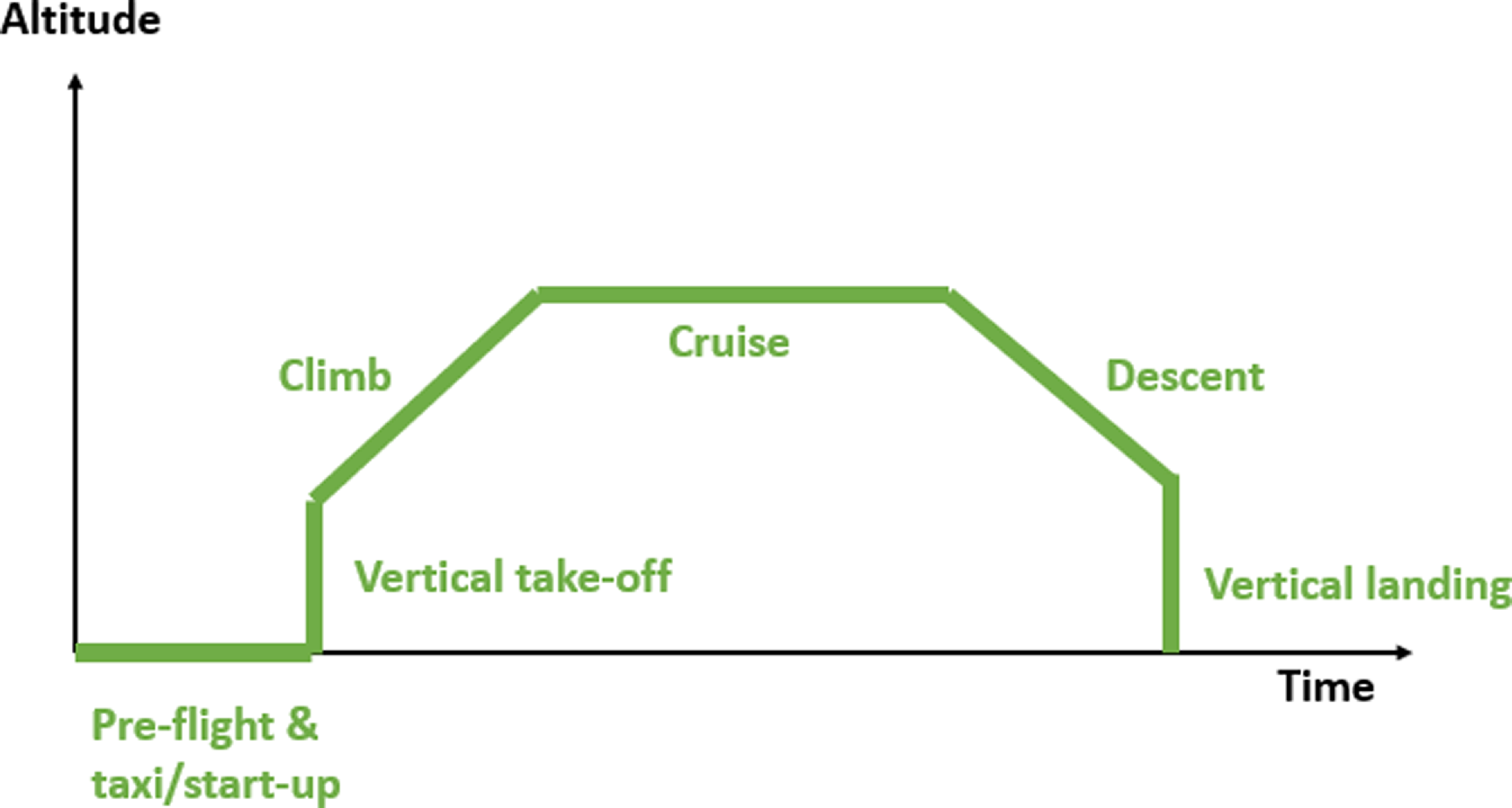
A general helicopter mission profile for transporting passengers and cargo consists of pre-flight, taxi/start-up, vertical take-off, climb, cruise, descent and vertical landing [Reference Vascik5], as shown in Fig. 1. However, such a mission profile may be repeated without refuelling or otherwise replenishing stored energy, and this mission may change for surveillance, policing or medical emergency operations. Within each phase of flight, there are key factors that make UAM possible. These key factors were determined through a systematic literature review (SLR) method and analysed and synthesised through thematic analysis. These key factors were used to develop a conceptual framework for the South African context. It should be emphasised that the challenges and risks identified through SLR are based on the current situation in South Africa. These will be used in further research to develop a suitable concept of operations for UAM operations within South Africa.
Mission profile [Reference Vascik5].

The method for developing the conceptual framework using SLR is explained in Section 2. The results of the review are described in Section 3, and the South African context is discussed in relation to the key factors in Section 4. The conclusion is in Section 5.
2.0 Method
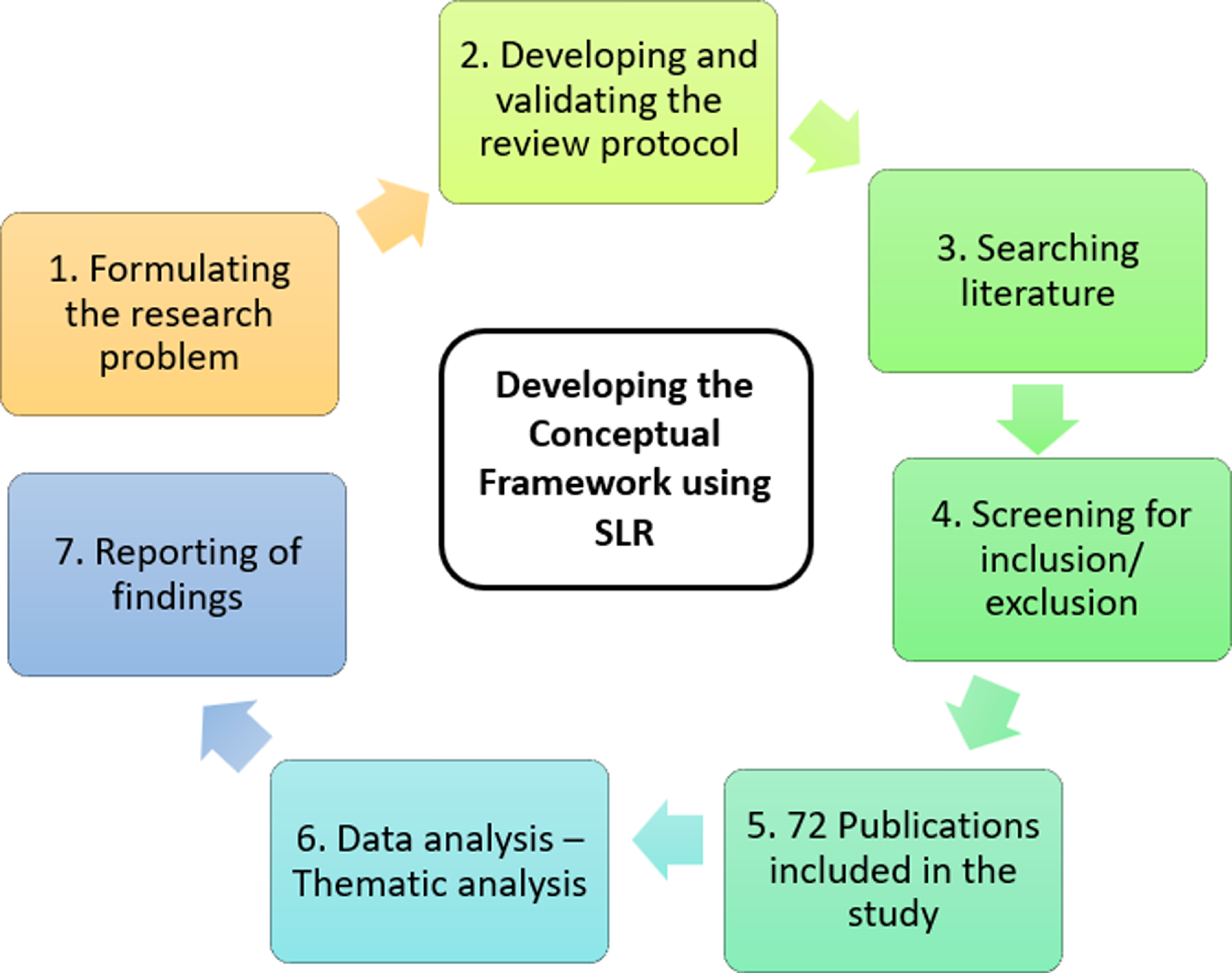
Figure 2 illustrates the SLR method carried out to develop a conceptual framework. Miles and Huberman [Reference Miles and Huberman6] described a conceptual framework as a graphical or narrative form of the main things to be studied, the key factors, constructs or variables and the presumed relationships among them. A conceptual framework is a visual representation of the main conceptual ideas about a study and the manner in which they interact and interplay with each other [Reference Miles, Huberman and Saldana7]. Through conducting an SLR, UAM key factors were explored, reviewed and examined. Step 1 entailed formulating a research problem, which for this study is developing a UAM concept of operations for South Africa. Electronic databases were searched for the relevant literature, which included Google and Google Scholar that led to Sage, SpringerLink and Science Direct to name a few. The keywords used were:
-
• Urban air mobility or UAM
-
• Urban air mobility legislation and regulations
-
• Concept of operations for urban air mobility
-
• Aircraft operations in a metropolis
-
• Aircraft operations in an urban environment
-
• Electric vertical take-off and landing (eVTOL) aircraft
-
• Air traffic management
-
• Unmanned aerial systems traffic management (UTM)
Developing the conceptual framework using SLR.

Figure 2 Long description
The flowchart outlines the process of developing a conceptual framework using systematic literature review. It begins with formulating the research problem, followed by developing and validating the review protocol. The next steps involve searching literature, screening for inclusion or exclusion, and including relevant publications in the study. Data analysis through thematic analysis follows, and the process concludes with reporting the findings. The flowchart visually represents these sequential stages to guide the development of a conceptual framework.
A significant sample of relevant articles and literature references was reviewed to identify more articles for the SLR. Only publications that were in English were reviewed, and the date range of publications was from 2011 to 2024. No restrictions were placed on the source of financial support for the published work to widen the sources of information gathered. When no new information was obtained from the identified articles, the search was ceased.
A criterion was set up to either include or exclude articles and publications. The criteria for inclusion were:
-
• Any publication that presented information on UAM
-
• Publications presenting information on concept of operations for UAM
-
• Publications describing the concept of UTM
-
• Current scale of UAM
-
• Preliminary concept of operations of aircraft being designed to operate in an urban environment or area
-
• Development of concept of operations for increased aircraft operation in an urban environment or area
-
• Airspace management concepts
-
• Legislation and regulations on urban air mobility
-
• Air safety and security concepts
Hot and high operations were typically not part of the articles and publications but may be an important consideration. Hot and high conditions refer to low density due to high ambient temperature and/or aerodrome altitude, which usually have an adverse effect on aircraft performance and reliability. When combined with the effect of atmospheric dust, these hot and high conditions can also affect visibility and UAM operations. This is an important aspect of the South African context because the prescribed flight visibility cannot be less than 5 km unless operating a helicopter outside controlled airspace, in which case visibility is permitted to be less than 1.5 km but the speed of the helicopter shall be such that it will be able to avoid collisions (CAR 91.06.21 (b), 2011). There are also special VFR provisions for operations in controlled airspace down to 1.5 km (CAR 91.06.22, 2011). South African Civil Aviation Authority (SACAA) conducts type acceptance or validation of the first type of an aircraft that enters the borders of South Africa to ensure that the design complies with the airworthiness standards [8], including ensuring that the aircraft will be able to operate in the country’s climatic conditions. Additionally, aircraft operators are required to demonstrate that they are capable of operating on a chosen flight route. The hot and high conditions in South Africa equate to a 20% reduction in air density across large parts of the country, and the dusty conditions have an impact on performance and reliability that is not typically accounted for by original equipment manufacturers (OEM). Commercial helicopter operators carrying passengers, cargo and/ or mail are required to comply with CAR 127, and an operator requiring an approval under CAR 127 may be required to conduct demonstration flights (CAR 127.06.8, 2011). In the case of commercial UAM, the operator is also required to comply with the requirements of CAR 127.
The exclusion criteria were as follows:
-
• Studies on the operation of large transport aircrafts
-
• Studies on long-haul operations of transport aircrafts
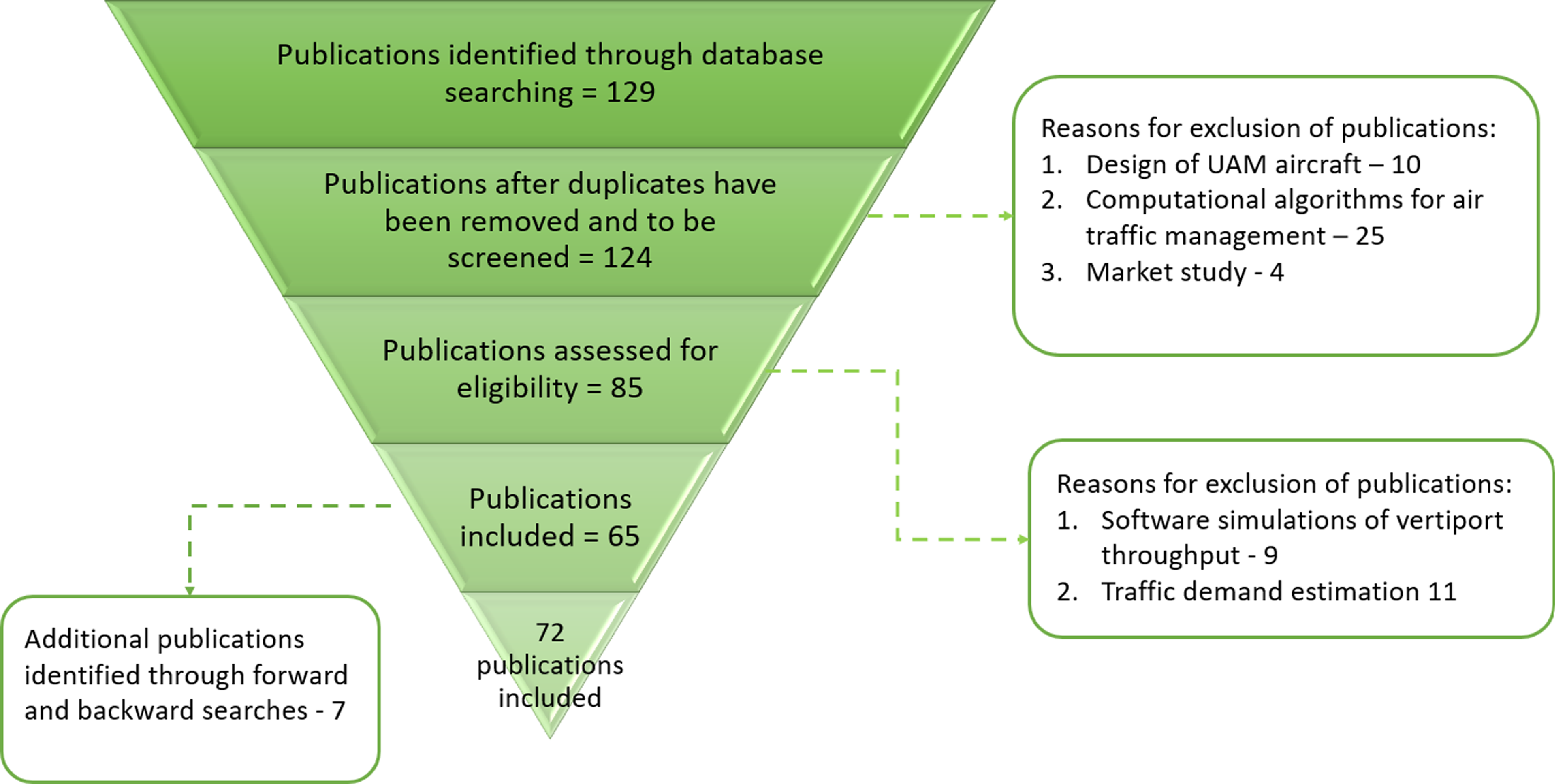
The last two steps entailed extracting, analysing and synthesising data using thematic analysis and reporting the findings. Thematic analysis is a systematic technique that analyses data to identify, interpret and report patterns and themes within data [Reference Braun and Clarke9, Reference Dawadi10]. Thematic analysis was used to analyse publications gathered in the SLR. The data were read and collated into themes and sub-themes, and this collation was done manually by the researcher. A theme encapsulates important data that relates to the research question and wherein a pattern is identified within the data set [Reference Braun and Clarke9]. The data analysis was reviewed by two research supervisors to minimise bias. Figure 3 illustrates the literature search and evaluation for inclusion. The 72 publications provided the data that resulted in the themes and sub-themes in Section 4.
SLR process.

Figure 3 Long description
The flowchart begins with 129 publications identified through database searching. After removing duplicates, 124 publications remain for screening. Reasons for exclusion include design of UAM aircraft, computational algorithms for air traffic management, and market studies. 85 publications are assessed for eligibility, with further exclusions for software simulations of vertiport throughput and traffic demand estimation, resulting in 65 publications included. An additional 7 publications are identified through forward and backward searches, leading to a total of 72 publications included in the review.
3.0 Results: findings of the review
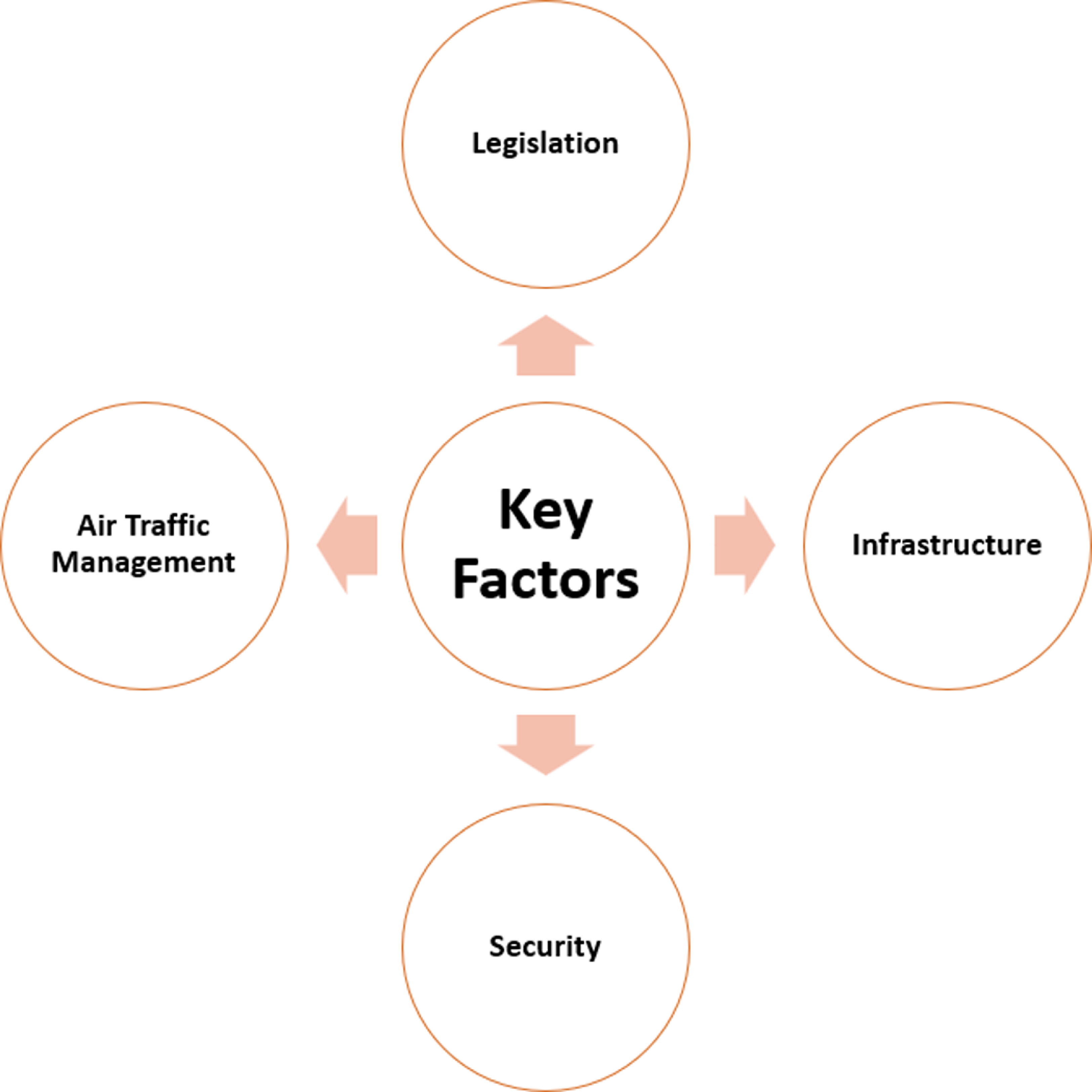
The key factors or themes identified through thematic analysis emerge in the different stages of the mission profile (Fig. 1). The key factors in pre-flight and taxi/start-up phase are infrastructure and air traffic management. From the vertical take-off phase to vertical landing phase, the key factors are air traffic management and infrastructure. UAM operations must comply with legislation for all the phases of flight, and the operations should be conducted such that the security risks are within an acceptable level and take into consideration the environmental impact. The key factors are illustrated in Fig. 4. These key factors were viewed through the lens of the South African context.
UAM key factors.

Figure 4 Long description
The image is a diagram that illustrates the key factors in urban air mobility (UAM). At the center of the diagram is a circle labeled 'Key Factors.' Surrounding this central circle are four additional circles, each connected to the central circle by arrows. These surrounding circles are labeled 'Air Traffic Management,' 'Legislation,' 'Infrastructure,' and 'Security.' The arrows indicate the interconnected nature of these factors in the context of UAM. The diagram suggests that these four elements are crucial components in the development and regulation of UAM systems.
3.1 Legislation
3.1.1 Policy
The policy of each country provides the strategy or direction to be adopted. It lays out whether it supports a certain technology or phenomenon. Policy development usually lags technology innovation, and this lag may pose a challenge for UAM vehicle development [11]. In the South African context, the laws required for UAM operations spread across the various spheres of government, namely national, provincial and local. Local government must address writing, updating and enforcing rules and regulations pertaining to land use, zoning and environmental impact [Reference Ravich12–Reference Patterson, Isaacson, Mendonca, Neogi, Goodrich, Metcalfe, Bastedo, Metts, Hill, DeCarme and Griffin14]. The aforementioned shows that UAM operations impact law makers and regulators outside the aviation industry. The National Civil Aviation Policy (NCAP) has a progressive outlook but may need to be amended for UAM operations.
3.1.2 Regulations
Existing regulations may provide requirements for the initial increase in UAM commercial operations, and these may be expected to operate VFR and instrument flight rules (IFR) with CAR 91 and CAR 135 approvals [Reference Lowry15, Reference Levitt, Phojanamongkolkij, Horn and Witzberger16]. These existing regulations may form the basis of transporting passengers in the UAM context with the assumption that a pilot would be on board [Reference Lowry15, Reference Straubinger, Rothfeld, Shamiyeh, Büchter, Kaiser and Plötner17]. These may be on-demand operations, which include passenger carrying and cargo operations.
Even though existing regulations provide guidance, they are still not adequate. Besides the unique aircraft design, the increased levels of automation and standards for all electric or hybrid UAM aircraft, the existing legal and regulatory framework needs to be evaluated to address gaps in the regulations and standards that govern certification of operations and the design standards for aircraft.
European Union countries have adopted the Special Operational Risk Assessment (SORA) tool for regulating UA. This is a risk-based tool to manage operations wherein operations are classified as either open, specific or certified, and the risk levels range from low, medium to high. Such a tool may be adapted to UAM operations, and each operation can be assessed and the assessment used to determine the level of risk and associated compliance that is required.
The International Civil Aviation Organization (ICAO) has decided to categorise unmanned aircraft (UA) operations into open, specific and certified [18, 19]. The certified category uses the same approach for regulating manned aviation, and ICAO has proposed Standards and Recommended Practices (SARPs) to regulate international operations in this category [18]. Although the SARPs do not apply to the open and specific category, ICAO encourages States to apply them for domestic Remotely Piloted Aircraft System (RPAS) operations as appropriate [18].
There should be clear lines of responsibility between national, provincial and local authorities with the lead regulatory authority clearly identified. The spheres of government need to decide who will manage the airspace for UAM operations, including vertiports, safety, security, privacy and trespassing [Reference Ravich12, Reference de Barros20]. However, in South Africa SACAA must control and regulate civil aviation safety and security, which includes UAM operations (Civil Aviation Act, No. 13 of 2009). Local government is a significant stakeholder as it may restrict where UAM aircraft take off and land through zoning and siting of verti-x [Reference Yedavalli and Cohen21]. The term verti-x is used in lieu of vertistop, vertiport and vertihub. A vertistop is a single-pad infrastructure in which UAM aircraft can pick up and/or drop off passengers [Reference Rajendran22]. A vertiport is described as a larger facility that can accommodate multiple UAM aircraft to pick up and/or drop off passengers and where these aircraft can get charged or refuelled and repaired [Reference Rajendran22, Reference Polunsky23]. A vertihub is described as the largest facility that can store aircraft overnight and can serve as a multimodal hub connecting passengers to public transport and private vehicles [13]. A vertihub will provide maintenance, repair and overhaul capabilities [13, Reference Vancoppernolle24, Reference Schweiger and Preis25].
3.2 Air traffic management (ATM)
Airspace class, volume, altitude, airspace design and air traffic control are important aspects of air traffic management (ATM) of UAM operations.
3.2.1 Altitude
UAM operations are not expected below 400 ft as there may be traffic congestion with the increase of small UA operations in urban areas. Moreover, the lowest altitude the UAM operations can occur is also dependent on the height of man-made objects. The South African Civil Aviation Regulations prescribe that aircraft fly at least 1000 ft above the highest obstacle in congested areas (CAR 91.06.32 (b), 2011). The tallest building in South Africa is 748 ft [26] and it is in a congested area, which means any flight taking place would be at a height of 1748 ft. It may be conceivable that UAM flights may take place at an altitude of 2000 ft above ground level; however, this does not take into consideration the effects of increase of average ambient temperature with high elevation, which will impact the performance of the aircraft due to the hot, high and dusty conditions of many of South Africa’s major metropolitan areas.
3.2.2 Airspace class and volume
There are mixed perspectives on whether UAM operations should be in controlled or uncontrolled airspace. Wherein Class A to E are controlled airspace and Class F and G are uncontrolled airspace [27]. Class A can be excluded because it is at high altitudes, as it is not suitable for UAM operations due to the constraints of UAM aircraft performance [Reference Pathiyil, Low, Soon and Mao28] and is not typical of the short-range operations of UAM. The main inhibiting factor of UAM operations in controlled airspace is that they will impose controller workload [Reference Vascik, Balakrishnan and Hansman29]. Additionally, should they be conducted in Class B or C, they would need to comply with existing air traffic requirements for voice communication, Automatic Dependent Surveillance – Broadcast (ADS-B) and IFR [Reference Stouffer, Cotton, DeAngelis, Devasirvatham, Irvine, Jennings, Lehmer, Nguyen, Shaver and Bakula30]. Another proposal is designating a volume of airspace within Class B, C and D, which would be geographically static over a long period but would be relatively dynamic based on traffic flows, weather [Reference Verma, Monheim, Moolchandani, Pradeep, Cheng, Thipphavong, Dulchinos, Arneson, Lauderdale, Bosson and Mueller31] and hot and high conditions that will adversely impact the performance of aircraft.
3.2.3 Airspace design
There are opposing perspectives on whether structured or free-flight airspace design would be suitable for UAM operations. There is a stance that the airspace must be structured to achieve high-density traffic, which can reduce airspace complexity and lessen ATC workload [Reference Tang, Zhang, Mohmoodian and Charkhgard32]. Structuring the airspace should be done in moderation because performance worsens with higher degrees of structure [Reference de Oliveira, Neto, Matsumoto and Yu33]. The degree of structure needs to consider the various UAM operations, i.e. emergency medical operations that may require a certain level of flexibility.
The airspace may be structured in layers, volumes and tubes, also known as air corridors [Reference Pongsakornsathien, Bijjahalli, Gardi, Sabatini and Kistan34–Reference He, He, Li, Zhang and Xiao36]. The stacked layers design consists of a multi-layered set of sky lanes that represent the extension of a ground transportation system used to create a road system with lanes in the air [Reference Pongsakornsathien, Bijjahalli, Gardi, Sabatini and Kistan34]. The rectangular-shaped sky lanes with a reference centre line in each lane represent nominal vehicle trajectories [Reference Pongsakornsathien, Bijjahalli, Gardi, Sabatini and Kistan34]. When structuring airspace into volumes, these volumes are split either by height, risk or performance (Tojal et al., 2021 [Reference Tojal, Hesselink, Fransoy, Ventas, Gordo and Xu35]). The tubes or air corridors are pre-planned routes suitable for high traffic demands [Reference He, He, Li, Zhang and Xiao36]. These routes can follow rivers, railway lines or other geographical areas to have a minimal impact on people on the ground [Reference He, He, Li, Zhang and Xiao36].
3.2.4 Separation
The purpose of aircraft separation standards is to prevent aircraft conflict with other aircraft or obstacles and prevent wake vortex encounters (Vascik, 2020). Wake vortex effects may have to be reassessed in terms of the mix and types of VTOL aircraft being operated as they may not be relevant or may have other consequences that are not typical of aircraft operations that resulted in current separation limit guidelines. Separation minima limit the density of UAM operations and constrain the scale of the system (Vascik, 2020). There are four basic separation minimums: lateral, longitudinal, vertical and temporal [Reference Ivashchuk and Ostroumov37]. In VFR operations, separation entails pilots collecting information through visual scanning and auxiliary sources such as radio announcements, navigational charts and proximity sensors. Conversely, IFR operations require large separation minima between aircraft in Class B and C airspace [Reference Vascik, Balakrishnan and Hansman29]. Separation minima are dependent on nominal and off-nominal (degraded) performance of communication, navigation and surveillance systems [Reference Levitt, Phojanamongkolkij, Horn and Witzberger16]. There are three proposed approaches of separation in UAM: fixed separation, dynamic separation and no standardised separation [Reference Bauranov and Rakas38]. Dynamic separation is pre-determined distance unique for each aircraft class and no standardised separation is separation maintained through ‘see and avoid’ or with the technological equivalent of ‘sense and avoid’. The suitability of current technologies will have to be assessed for UAM operations, and there may be a need to identify technology requirements for future UAM operations.
3.2.5 Flight rules
IFR provides a significant amount of access to airspace using aircraft and ground instruments, allowing the pilot to navigate and cooperate with ATC [Reference Wing and Levitt39]. VFR makes use of visual references through the pilot’s visual perception of the environment. New flight rules have been proposed and named digital flight rules (DFR) wherein VFR and IFR are augmented. DFR offers access to all airspace classes in both visual meteorological conditions (VMC) and instrument meteorological conditions (IMC) and hence, the flexibility of operations to meet various operational needs [Reference Wing and Levitt39]. DFR is achieved through cooperative practices and self-separation enabled by connected digital technologies and automated information exchange [Reference Wing, Lacher, Ryan, Cotton, Stilwell, Maris and Vajda40]. Some of these rules do not exist or are still being developed, while others need to be reassessed to consider the impact of the performance envelopes of UAM aircraft on flight safety as encompassed in the DFR and VFR.
3.2.6 Air traffic control
The purpose of ATC is to prevent collisions between aircraft or aircraft and obstructions and expedite and maintain an orderly flow of air traffic (CAR Part 1, 2011). Currently when aircraft operate without ATC, the ‘see and avoid’ and pass ‘well clear’ is the rule of operation [Reference Vascik, Balakrishnan and Hansman29]. These principles permit aircraft flying VFR to operate in much closer spacings than the standard radar separation minima applied by ATC [Reference Vascik, Balakrishnan and Hansman29].
A crucial challenge Airbus was facing in Sao Paulo with its aerial ride hailing service was ATC. It was identified that ATC is unable to [Reference Stouffer, Cotton, DeAngelis, Devasirvatham, Irvine, Jennings, Lehmer, Nguyen, Shaver and Bakula30]:
-
• Track low altitude aircraft with radar
-
• Communicate with a high number of low altitude urban aircraft using VHF
-
• Identify aircraft with ADS-B on 1,090 MHz
These methods were proposed to reduce controller workload per flight [Reference Vascik5]:
-
• Developing standard flow patterns
-
• Using data-link communications
-
• Enabling pilots to self-separate visually
It was determined through several studies that helicopter access to airports and flight in uncontrolled and congested airspace necessitated the development of an automated ATC system for airspace below 3000 ft above ground level (AGL) [Reference Vascik5].
3.2.7 Airspace integration
Several strategies and concepts have been proposed for airspace integration, and these include [Reference Vascik5, Reference Lascara, Spencer, DeGarmo, Lacher, Maroney and Guterres41, Reference Maia42]; Vascik, 2020:
-
• Detect and avoid systems compatible with VFR
-
• Traffic management compatible with free flight and dynamic corridor
-
• Exclusion of ATC – UAM aircraft operate only in uncontrolled airspace
-
• Full segregation – UAM aircraft operate in their designated airspace without interacting with other airspace users
-
• Statically integrated – UAM aircraft may operate in airspace that is not contained within an active or inactive procedure
-
• Dynamically integrated – UAM aircraft may not operate only using airport procedures that are actively for current airport configuration
It seems improbable to exclude ATC from UAM operations because this would mean that none of the UAM aircraft would operate from busy or medium-size airports, which would inhibit UAM operators from transporting passenger to airports. Additionally, should volumes of controlled airspace exist within an urban area, UAM aircraft would not be able to operate, unless the airspace is re-designed. Airspace integration plays a role in the success of UAM operations, and factors that need to be considered are airspace class, flight rules, separation and ATC. The aforementioned impact the airspace design and regulations. A dynamic approach to airspace integration may be advantageous to UAM operations because the limitations are more manageable within the UAM context. The above airspace integration strategies and concepts may either be beneficial for UAM operations or restrict UAM operations.
3.2.8 Unmanned aircraft systems and unmanned traffic management
The purpose of unmanned traffic management (UTM) is to provide traffic management services to unmanned aircraft systems (UAS), which may include flight approvals, flight monitoring and flight ban settings for a height of 500 ft and less [Reference Kim, Cho and Jeon43]. Although the purpose of UTM is to provide services to unmanned aircraft (UA), it should be considered if it can be adapted for UAM operations. Instead of developing a new traffic management system for UAM. Perhaps some benefits may be reaped from UTM.
3.2.9 UAM ATM proposals
It is envisaged that UAM aircraft operating in Class B, C or D airspace will not require traditional ATC services provided by air navigation service providers. Instead, such aircraft may use services provided by a third party [Reference Verma, Monheim, Moolchandani, Pradeep, Cheng, Thipphavong, Dulchinos, Arneson, Lauderdale, Bosson and Mueller31]. The advantage of segregating UAM operations from conventional flights is the relief of UAM scaling restrictions due to ATC [Reference Vascik5].
It is envisaged that UAM operations will have an urban airspace service provider (UASP) that will collaborate with ATM, UAS service suppliers (USSs) and unmanned air traffic management (UATM) stakeholders [Reference Campello44]. Other researchers refer to these UASPs as providers of services for UAM (PSU), and they provide flight planning and authorisation, demand capacity balancing, conflict detection, surveillance and separation services, to mention a few [Reference Patterson, Isaacson, Mendonca, Neogi, Goodrich, Metcalfe, Bastedo, Metts, Hill, DeCarme and Griffin14].
The common thread regarding the proposal for UAM traffic management is a dedicated service provider of UAM ATC and a continuous flow and exchange of information between stakeholders. However, it may be that the thinking in the literature is constrained by conventional operations and may not be completely compatible with future UAM operations. The purpose of the SACAA is to control and regulate civil aviation safety and security while air traffic and navigation services (ATNS) must acquire, establish, develop, provide, maintain, manage, control or operate air navigation infrastructure, air traffic services or air navigation services as mandated by ATNS Company Act 45 of 1993. However, the increase of UAM operations may provide an opportunity for private operators to offer air traffic services, and these private operators will be regulated by SACAA and the criteria for the provision of such services are prescribed in the Civil Aviation Regulations.
3.3 Infrastructure
3.3.1 CNS infrastructure
UAM requires a high-performance communication, navigation and surveillance (CNS) infrastructure to operate into unsegregated airspace [Reference Pongsakornsathien, Bijjahalli, Gardi, Sabatini and Kistan34]. However, should UAM operate at low height, the UAM aircraft may burden the ability of CNS [Reference Vascik, Balakrishnan and Hansman29]. Low altitude operations may face obstructions in mountainous areas and cities, and these may adversely affect the surveillance coverage due to the line-of-sight limitations of the systems [Reference Vascik, Balakrishnan and Hansman29]. UAM system architecture has been proposed in which communication would be via a datalink, navigation would be achieved by Global Navigation Satellite System (GNSS) or Inertial Navigation System (INS), and ADS-B would fulfil surveillance [Reference Pongsakornsathien, Bijjahalli, Gardi, Sabatini and Kistan34].
3.3.2 Communication
Commercial aircraft fly at altitudes in which transmission is over a very high frequency digital link (VDL), and VDL is primarily limited to line of sight [Reference Vascik, Balakrishnan and Hansman29]. However, UAM aircraft may not be able to fly at the same altitude as these commercial aircraft, so VDL may be affected if the UAM aircraft is flying at lower altitudes. Tests conducted on mobile networks have shown that 4G network provides coverage below 300 m (984 ft), 5G network can support UA flights up to heights of 1000 m (3280 ft) [Reference Bauranov and Rakas38]. However, identified challenges that may exist with using cell networks include the required high levels of availability; integrity for aviation systems from cell infrastructure; latency and the use of power and security issues [Reference Vascik, Balakrishnan and Hansman29, Reference Bauranov and Rakas38]. Even though disadvantages are evident in mobile network, Volocopter has demonstrated capabilities of its 5G enabled eVTOL to see around corners, avoid obstacles and download flight data rapidly in Dubai and Singapore [Reference Campello44].
3.3.3 Navigation
The ICAO has recognised GNSS as a key element of all CNS/ATM systems [Reference Pongsakornsathien, Bijjahalli, Gardi, Sabatini and Kistan34] even though it has vulnerabilities such as localised jamming, solar flare disruption and blocking structures [Reference Pathiyil, Low, Soon and Mao28, Reference Stouffer, Cotton, DeAngelis, Devasirvatham, Irvine, Jennings, Lehmer, Nguyen, Shaver and Bakula30, Reference Pongsakornsathien, Bijjahalli, Gardi, Sabatini and Kistan34]. Performance-based navigation (PBN) may be investigated in terms of UAM navigation as it increases structural airspace capacity by permitting closer route spacing, more direct routes and operations closer to obstacles [Reference Vascik, Balakrishnan and Hansman29, Reference Vascik and Hansman45] (Vascik and Hansman, 2018). Nevertheless, PBN aircraft equipment is costly including developing the required ground infrastructure [Reference Vascik, Balakrishnan and Hansman29].
3.3.4 Surveillance
ADS-B has been proposed for the surveillance of low altitude UAM operations because traditional radars are inadequate [Reference Bauranov and Rakas38]. The vulnerability of ADS-B to jamming, signal insertion or deletion increases during flight at low height and potential saturation limitations of ADS-B have been identified [Reference Vascik, Balakrishnan and Hansman29, Reference Bauranov and Rakas38]. Furthermore, ADS-B would be overburdened by additional UAM aircraft because it seems to be at capacity at high-density airports [Reference Stouffer, Cotton, DeAngelis, Devasirvatham, Irvine, Jennings, Lehmer, Nguyen, Shaver and Bakula30].
3.3.5 Aerodromes and heliports
Existing aerodromes and heliports could be used for UAM operation while new verti-x are built to accommodate the growth of UAM [13, Reference Yedavalli and Cohen21, Reference Koumoutsidi, Pagoni and Polydoropoulou46]. Furthermore, it is being proposed to repurpose existing rooftops helipads, floating barges, inside highway cloverleafs, unused and top levels of parking lots because they offer locational advantages for urban operations [Reference Straubinger, Rothfeld, Shamiyeh, Büchter, Kaiser and Plötner17, Reference Rajendran and Srinivas47–Reference Takacs and Haidegger50].
3.3.6 Verti-x
The Federal Aviation Administration (FAA) has developed an engineering brief (EB) to provide design guidance for vertiports and vertistops, including modifications of existing helicopter and aircraft landing facilities [51]. Heliports and helistops were designed based on helicopters with single, tandem (front and rear) or dual (side by side) rotors [51]. The EB design guidance is based on VTOL aircraft with electric motors and using distributed electric propulsion. Even though there are similarities between traditional helicopters and VTOL aircraft, the design differences are evident. Therefore, existing helistops and heliports may not be suitable to accommodate VTOL operations in their current state.
3.3.7 Verti-x location
There are several factors that influence the location of a verti-x, such as location near a controlled airport, no-fly zones, special-use airspace or sensitive flight areas (i.e. over schools and churches etc.) [Reference Mendonca, Murphy, Patterson, Alexander, Juarex and Harper52]. These airspace restrictions impact the size and/or location of approach paths, departure corridors or holding areas which may reduce the number of operations at a verti-x [Reference Mendonca, Murphy, Patterson, Alexander, Juarex and Harper52, Reference Schweiger, Knabe and Korn53].
The location of verti-x needs to be placed near demand areas and must support high throughput operations to provide a competitive service [Reference Yedavalli and Cohen21, Reference Vascik, Cho, Bulusu and Polishchuk54, Reference Sinha and Rajendran55]. Additionally, these vertiport locations must have unobstructed approaches and departure paths [Reference Vascik, Cho, Bulusu and Polishchuk54]. Zoning and land use designations will have a significant impact on the location of verti-x because specific zoning may be required to store fuel onsite, or a local land use plan may prioritise certain designations [Reference Mendonca, Murphy, Patterson, Alexander, Juarex and Harper52, Reference Mueller, Kopardekar and Goodrich56]. The local municipality will have to grant approval for a verti-x location.
3.3.8 Charging/refuelling stations
The location of the vertiport and vertihub is important in terms of charging stations for electric aircraft. These locations must have a consistent energy supply, and these locations will have a significant demand on the energy grid. It should be taken into consideration that energy is not equally distributed throughout cities [13]. Therefore, the energy demand of these electric aircraft must be known to determine the impact they will have on the power grid [13]. This may necessitate additional power generation and energy storage systems [Reference Patterson, Isaacson, Mendonca, Neogi, Goodrich, Metcalfe, Bastedo, Metts, Hill, DeCarme and Griffin14].
There are two proposals for energy replenishment of the aircraft, which are battery swapping and quick charging [13]. Battery swapping is removing the depleted battery and replacing it with a charged battery, and quick charging is rapidly charging the battery [13].
Most heliports do not support refuelling [13] and if heliports are converted to vertiports, additional space will be required for the refuelling and charging infrastructure.
3.4 Security
Part 1 of the South African Civil Aviation Regulations SACAR [57] defines security as ‘a combination of measures and human and material resources intended to safeguard international civil aviation against acts of unlawful interference’.
The ICAO describes acts of unlawful interference as: [58]
-
• Unlawful seizure of aircraft (flight/ground)
-
• Taking of hostages
-
• Forcible intrusion
-
• Introduction of weapon with criminal intent
-
• Communication of false information
The countermeasures ICAO has put in place for contracting states are legislative, technical and physical. One of the recommendations for contracting states includes establishing and implementing a written national civil aviation security programme to safeguard civil aviation operations against acts of unlawful interference. South Africa being one of the contracting states complies with the above.
The Department of Transport (DoT) is responsible for drawing up the National Aviation Security Program (NASP), which specifies the lines of responsibilities between the Department of Transport and SACAA. This programme outlines the method of communication between all bodies responsible for civil aviation security, preventative measures against occurrences jeopardising civil aviation safety and the involvement of airport management and air carriers in the application of comprehensive planning.
Participants are also required to have an Aviation Security Programme. These participants include the operator of a designated airport, ATNS, any air carrier and any other aviation participant designated by the Minister [59].
3.4.1 Cybersecurity
Cybersecurity has been identified as one of the most challenging security areas due to the limited expertise [Reference Mendonca, Murphy, Patterson, Alexander, Juarex and Harper52]. The cyber-related considerations requiring protection are ‘electronically stored data, sensors and networks that collect or create data and the software that runs these systems, provides access to the data, or verifies that security systems are functioning properly’ [Reference Mendonca, Murphy, Patterson, Alexander, Juarex and Harper52]. Weiland et al. [Reference Weiland, Law and Sunjka60] recommend the use of a whole-of-society model when looking at cybersecurity as its weak link is usually the human in the loop, but consideration of human factors can be used to work towards a more resilient system that can cope with security breaches.
The security principles used for UAM ATM networks should be taken from traditional ATM because they are robust, and the network is secure [Reference Campello44]. Some of these principles entail equipment redundancies Cohen et al. [Reference Cohen, Guan, Beamer, Dittoe and Mokhtarimousavi61] access control by authentication, authorisation and accounting (AAA) [Reference Campello44]. The National Institute of Standards and Technology (NIST) has guidelines for mitigating cybersecurity risks across organisations, which entail identify, detect, respond and recover [Reference Levitt, Phojanamongkolkij, Horn and Witzberger16].
3.4.2 Personal security
A proposal has been made for passenger security check and a payload inspection performed electronically for UAM operations [Reference Mathur, Panesar, Kim, Atkins and Sarter62] and to prevent access to certain parts of the vertiport [Reference Mendonca, Murphy, Patterson, Alexander, Juarex and Harper52]. Some of the strategies that could be implemented to improve personal security are advanced technologies such as biometrics, passenger rating systems and traveller programmes [Reference Cohen, Shaheen and Farrar63]. Personal security concerns include hijacking of the aircraft and violence against the passengers, particularly for remotely piloted aircraft [Reference Cohen, Shaheen and Farrar63] as this will jeopardise the safety of flight [Reference Mathur, Panesar, Kim, Atkins and Sarter62].
The SACAR only prescribe to airports to have a security programme and do not require helipads or heliports to have a security programme. Vertipads and vertiports might not be required to have a security programme and may not even have security checks or payload inspection. With the initial increase of UAM operations, the security risks may have to be assessed to determine a suitable approach to ensure that passengers are not exposed to security-associated risks.
3.4.3. Verti-x security
Vertiports and vertihubs may have repair and maintenance facilities. These maintenance facilities may introduce a security risk in that an attacker can corrupt the onboard data and code or install extra components to execute the actual attack later [Reference Maxa, Blaize and Longuy64]. Such an event can happen during maintenance, storage and operation [Reference Maxa, Blaize and Longuy64]. Vertiports and vertihubs must have adequate security to ensure that trespassers do not obtain access to unauthorised areas.
It has been proposed that should heliports be converted to vertiports, screening facilities would have to be installed [13].
4.0 The South African Context
White and Wade [Reference White and Wade65] referred to development states as countries that achieved late development. The United Nations [66] defines developmental states as ‘a state where the government is intimately involved in the macro and micro economic planning in order to grow the economy’ and ‘whilst attempting to deploy its resources in developing better lives for the people’. South Africa outlines it as a state that ‘brings about rapid and sustainable transformation in a country’s economic and/or social conditions through active, intensive and effective intervention in the structural causes of economic or social underdevelopment’ [67]. The basic idea of a developmental state is to grow the economy while improving social conditions. This is precisely what South Africa aims to achieve as it desires to eradicate the injustices of the past. However, failure to implement policies and absence of broad partnerships were some of the reasons for slow progress [67]. Some of the nine primary challenges faced by the country are the high unemployment rate, inadequate and poorly located infrastructure, spatial divides, the highly variable quality of education that primarily affects people from previously disadvantaged groups and the public health system [67]. As South Africa is a developing country, it has created the National Development Plan (NDP) to eradicate its primary challenges. Even though the NDP was drafted in 2012, many of the issues identified are still relevant. South Africa may have policies that support UAM, however, the primary challenges such as inadequate and poorly located infrastructure and spatial divides as well as failure to implement policies may impact the increase of UAM operations. The key factors above will be discussed within the South African context in the event UAM is adopted in South Africa.
4.1 Legislation
In terms of legislation, the white paper on National Civil Aviation Policy (NCAP) makes provision for an ATM system that is integrated and with operational system components that would benefit UAM. The concept in the white paper entails establishing an airspace that accommodates the different types of air activity, volume of traffic, and the levels of service and providing the required ground infrastructure.
The NCAP acknowledges that airports are not integrated into a meaningful airport network and into its environment. It identified that the authorities in control of the land-use developments, spatial planning and local economic planning close to the airport should assist to integrate the airport into its environment and support the airport’s development and effective operation [68]. The policy has a progressive outlook, and it indicates that the adoption of UAM will be supported. However, encroachment by residential and light industrial developments has become an issue in South Africa [Reference Robinson, Mearns and McKay69]. The land-use authorities, local municipalities, are accommodating businesses desiring easy access to airports and without consulting national government [Reference Robinson, Mearns and McKay69]. This lack of collaboration and coordination between the spheres of government and lack of implementation of policies may be a hinderance in developing and implementing an integrated verti-x network.
4.2 Air traffic management
South Africa is moving away from designating airspace as purely civil or military but rather considering airspace as a continuum and allocating to user requirements [70]. Any necessary airspace segregation is temporary, based on real-time usage within a specific period. This indicates that UAM operations may be integrated and not necessarily segregated from conventional aircraft operations and that a dynamic airspace management approach may be used in South Africa.
Flexible use of airspace (FUA) is the concept of using airspace for other aviation activities when there are no existing activities in a given airspace [71]. FUA allows the airspace to be allocated according to user requirements as airspace design is moving away from purely civil or military airspace [72]. FUA provides the potential to increase capacity and better airspace utilisation [72]. South African UA operators may apply for FUA, and if approved, they are allowed to conduct their operations in the requested airspace. When a UA is operating in controlled airspace, the UA operator must maintain radio contact with the ATC to acknowledge and execute their instructions at any given time.
4.3 UTM plans in South Africa
The white paper on NCAP issued by the DoT makes provision for an ATM system that is integrated and with operational system components that would benefit UAM. Even though the UA regulations were promulgated in 2015 in South Africa [Reference Msimango and Sher73] the airspace and ATM system do not make provision for them [71]. UA operations are accommodated below 400 ft as prescribed in SACAR Part 101 unless authorised by the director of Civil Aviation to operate above 400 ft. As provided in ICAO’s guidance, South Africa should develop UTM as a separate system to ATM but acknowledging that UTM should be complementary to ATM [71]. UTM should be interoperable with existing ATM systems, ATC framework, hardware and global harmonisation [71].
Although the NCAP supports innovation, there may be specific needs that may arise with regard to UAM operations, and these specific needs may require an amendment of the NCAP to stipulate such needs. Considering that policy and law-making process in South Africa takes a minimum of two years [Reference Msimango and Sher73], policy making may become an impediment to the implementation of new technology.
The initial increase in UAM operators in South Africa may operate under SACAR Part 135 because any aircraft authorised by the director of the Civil Aviation may operate under this part. It is not envisioned that non-type certified aircraft (NTCA) will be used for UAM operations because SACAR Part 96 prohibits NTCA from providing commercial air transport operation.
4.4 Infrastructure
South Africa has put in place air traffic services (ATS) and air navigation services (ANS) to ensure an orderly, efficient, safe and secure aircraft movements in the South African airspace. Wherein ATS is regarded as flight information service, alerting service, air traffic advisory service and/or ATC service [68], ANS is regarded as the provision and maintenance of air navigation infrastructure and facilities, namely radar, radio navigational beacons and telecommunication infrastructure [68]. South Africa has committed to the provision of sustainable and viable ATS and ANS. However, the cost of these services must be recovered from the users of these services. Considering that the Government is focused on policy and strategy formulation, the provisions of ATS and ANS for UAM could be provided by the current service providers or new service providers who would be regulated by the SACAA.
ATNS had to secure an agreement for the supply of data from the automatic dependent surveillance system to enhance the ability to monitor the airspace domestically and internationally [74]. ATNS had to partner with an American company to improve their air traffic management capabilities. This partnership makes South Africa vulnerable because it depends on another State’s surveillance infrastructure, which poses a risk to safety and security.
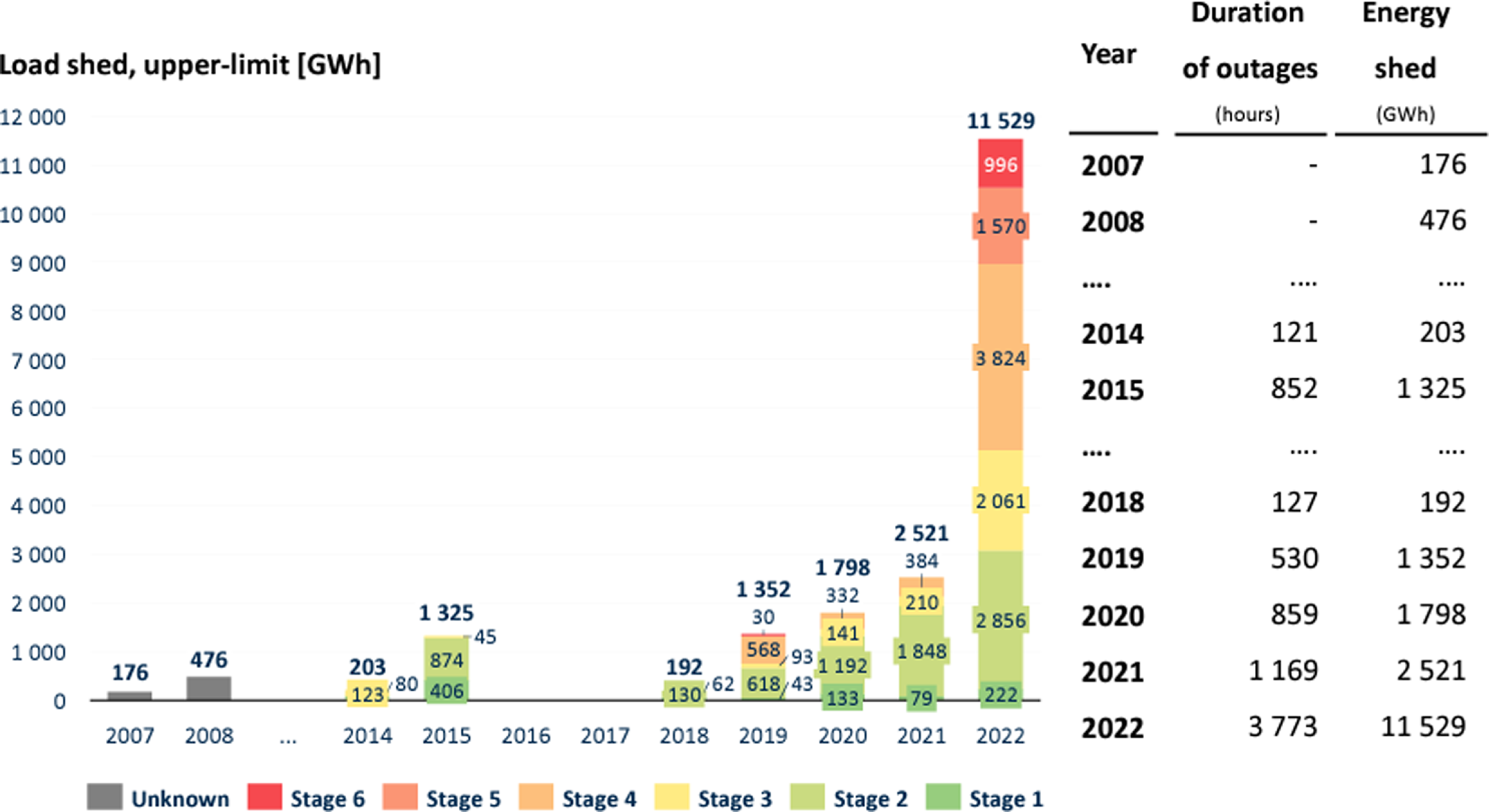
South Africa has an energy crisis due to the strained power grid, looming gas supply cliff and exposure to global carbon taxes [75]. The implementation of UAM may require above 50 MWh of additional power per day, and electric grid systems are not designed to manage a significant increase in charging demand [Reference Kopardekar76]. In a country like South Africa, which cannot provide power to their citizens for basic needs, adding electric aircraft would just add more pressure on the already strained power grid. Figure 5 illustrates the number of hours and the energy shed to prevent the system from collapsing, and by all indications, this situation is anticipated to persist over the short-to-medium term. South Africa therefore does not seem to be ready for electric VTOL as it needs to resolve the power crisis before such vehicles enter the South African airspace. This energy crisis further emphasises the inadequate infrastructure in the country. However, infrastructure plays a significant role in UAM operations [Reference Pons-Prats, Živojinović and Kuljanin77], and it is considered in the design mission [Reference Johnson and Silva1].
Loadshedding over the years.

Figure 5 Long description
The bar graph compares the duration of outages in hours and the energy shed in gigawatt-hours from 2007 to 2022. The x-axis represents the years, while the y-axis represents the load shed in gigawatt-hours. The graph features stacked bars, each segmented by different stages of load shedding, identified by distinct colors: Stage 1 in green, Stage 2 in light green, Stage 3 in yellow, Stage 4 in orange, Stage 5 in red-orange, Stage 6 in red, and Unknown in gray. The data shows a significant increase in load shedding over the years, with notable spikes in 2022 reaching 11,529 gigawatt-hours. The table on the right provides specific values for the duration of outages in hours and the energy shed in gigawatt-hours for selected years. All values are approximated.
Prons-Prats [Reference Pons-Prats, Živojinović and Kuljanin77] emphasised the importance of the position and size of take-off and landing areas and the coherence of UAM land infrastructure with existing transportation systems. During apartheid (before 1994), communities were removed from urban land to marginal areas. This removal has created social and spatial inequalities [Reference Todes and Turok78] that have caused a spatial divide and inadequate and poorly located infrastructure in South Africa.
4.5 Security
The South African Civil Aviation Regulations [57] require airports, operators, air traffic and navigation service providers to develop procedures for testing cybersecurity, cybersecurity response and cybersecurity incident analysis and reporting.
4.6 Socio-economic factors
Socio-economic factors are crucial because they play a significant role in the South African context. The increase of UAM operations needs to fit within the social complexity and competing interests. A soft systems approach is important to consider multiple perspectives and understanding the interrelationships and interdependencies [Reference Checkland and Poulter79]. Socio-economic factors such as the high unemployment rate, poverty, social inequality and inadequate public service access [80] will impact the increase of UAM operations because South Africa’s priorities are to drive inclusive growth and job creation; reduce poverty; and build a capable, ethical and developmental state [Reference Lukani81]. Even though South Africa supports UAM operations, the country may focus on resolving socio-economic issues rather than investing in the infrastructure requirements of UAM operations. Additionally, the looming gas supply cliff will have significant socio-economic and job-loss implications and threatens key industrial sectors [Reference Yelland82]. Therefore, the growth of UAM operations may be slow in South Africa or may be left to the private sector to develop. It is of utmost importance to ensure that a concept of operations for UAM is suitable for the South Africa context. The urban area that initially adopts the increase in UAM operations within South Africa would probably be an area with a high-income index.
Another issue to be considered is ‘Not In My Backyard’ (NIMBY) because residents may not like the invasion of privacy, or the sight and sound of UAM operations. However, this is an issue to be investigated in the future.
Conceptual framework for the development of a concept of operations for a South African context.

Figure 6 Long description
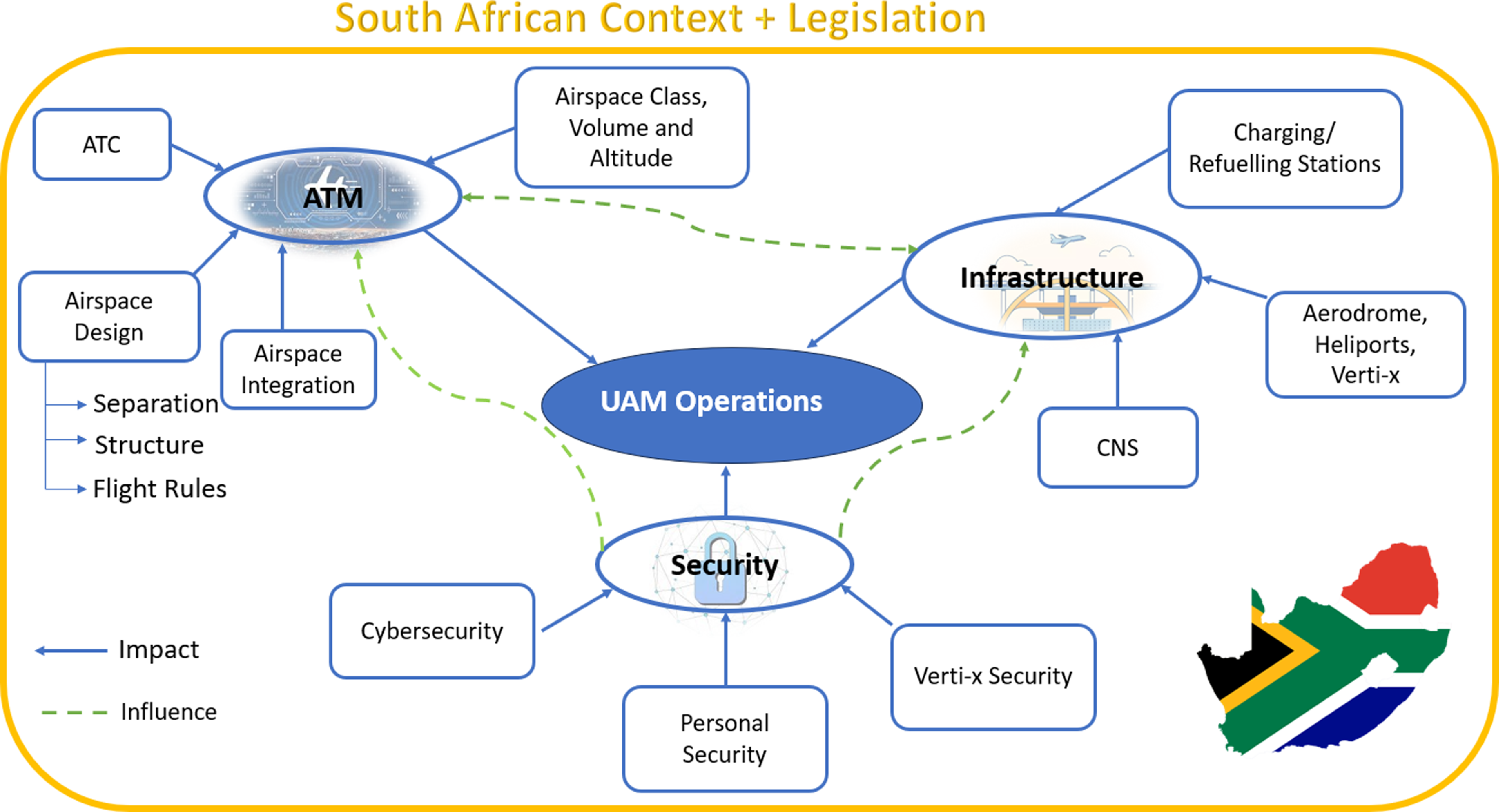
The diagram illustrates the South African context and legislation for UAM operations. It shows key factors such as airspace class, volume and altitude, airspace design, airspace integration, ATM, infrastructure, security, and UAM operations. The diagram highlights the impact and influence of these factors on each other. Airspace design includes separation, structure, and flight rules. Infrastructure includes charging or refuelling stations, aerodromes, heliports, verti-x, and CNS. Security includes cybersecurity, personal security, and verti-x security. The diagram also shows the influence of these factors on UAM operations.
4.7 Conceptual framework
The key factors identified above through conducting the SLR were used to develop a preliminary conceptual framework (refer to Fig. 6). This preliminary conceptual framework illustrates the key factors and concepts in UAM within the South African context. The main themes are the South African context, legislation, ATM, infrastructure and security. The UAM operations should be able to exist within the South African context and comply with legislation. The UAM operations traffic should be managed safely and efficiently with suitable infrastructure available to support these operations. The security risks should be mitigated to an acceptable level as the UAM operations increase. The themes are further broken into subthemes that were identified during the SLR, and the arrows in Fig. 6 show the interaction between the themes and subthemes. South Africa is a developmental state focused on growing the economy while improving social conditions. Even though the country has a policy that has a progressive outlook, this may not translate into legislation because it fails to implement policies. The limited scope of UAM operations is catered for in the current legislation but will have to be revised for in the increase of UAM operations. UAM operations should comply with national laws, regulations and by-laws. The NCAP seems to support innovation and regulations, and the by-laws may have to be amended to be suitable for the upcoming UAM phenomenon.
ATC, airspace design, airspace class and altitude have an impact on ATM as shown in Fig. 6. For UAM operations to be possible, the aircraft under development should be able to fly in an airspace that has been designed for efficient operations in an urban environment. This airspace could resemble the FUA concept because it provides the potential to increase capacity and better airspace utilisation [72]. The flight altitude, separation and air traffic control are some of the key concepts that should be established for the South African context. In addition to air traffic management, the infrastructure required consists of CNS infrastructure, verti-x, charging or refueling stations, which play a pivotal role in UAM operations, and has an influence on the ATM system as illustrated in Fig. 6. However, a developmental state like South Africa where the infrastructure is inadequate and poorly located may have a significant impact on UAM operations. The energy crisis is a point of concern because the country struggles to provide power to their citizens for basic needs; adding electric aircraft would just add more pressure on the already strained power grid. These operations need to remain secure from cyber-attacks and any other risks to air operations and personal security. Security is important in UAM operations as the ATM system, air operations and infrastructure risks must be at an acceptable level to ensure acts of unlawful interference are mitigated. Security has an influence on ATM and infrastructure as shown in Fig. 6.
A UAM concept of operations in the South African context cannot be overlooked because South Africa is a developmental state that has a power crisis and inadequate and poorly located infrastructure. The country’s priorities are to eradicate poverty and unemployment. This preliminary conceptual framework will be used in the next phase of the study for the drafting of semi-structured interview questions to be posed to stakeholders, to determine the current state and challenges faced within UAM operations in South Africa.
5.0 Conclusion
The SLR conducted identified key factors pertinent to UAM as legislation, ATM, infrastructure and security. These key factors were used to develop a conceptual framework. These key factors should be developed for UAM operations considering the South African context. The UAM operations traffic should be managed safely and efficiently with suitable infrastructure available to support these operations. The security risks should be mitigated to an acceptable level as the UAM operations increase. South Africa being a developmental state battles with socio-economic factors such as high unemployment, poverty, social inequality and inadequate public service access [80], which will impact the increase of UAM operations and therefore, cannot be disregarded in developing a concept of operations for UAM. Additionally, the energy crisis in South Africa is an impediment in the use of electric aircraft, which means suitable aircraft alternatives must be considered. However, the policy outlook of South Africa indicates that UAM operations would be a phenomenon that will be supported. This conceptual framework is pivotal in developing a suitable concept of operations that is fit for the South African context. This conceptual framework will be used in the next phase of the research to determine the current state of UAM operations in South Africa.
Competing interests
My PhD research is funded by the South African Civil Aviation Authority.

 Open access

