


Nearly everyone has secrets, which can bring about many undesirable outcomes related to social bonds. Slepian, Chun, and Mason (Reference Slepian, Chun and Mason2017) examined the validity of the Commons Secrets Questionnaire, which consists of 38 categories of secrets; the results suggested that 96% of participants currently had a secret in at least one of the 38 categories. Consequently, research in various domains has documented the psychological and behavioral consequences of hiding secrets. For instance, the tendency to keep secrets has been associated with mind-wandering (Slepian et al., Reference Slepian, Chun and Mason2017; Stawarczyk, Majerus, Maj, Van der Linden, & D’Argembeau, Reference Stawarczyk, Majerus, Maj, Van der Linden and D’Argembeau2011). In addition, secrecy could lead to interpersonal restraint and weaken social bonds because one must monitor one’s speech for specific content in order to inhibit or alter what one says in the presence of someone from whom one is keeping secrets (Critcher & Ferguson, Reference Critcher and Ferguson2014). Although a growing body of literature demonstrates the negative influence of concealment, previous research has found that these harmful effects only affect those holding secrets or interpersonal relationships. The influence of secrecy has typically been studied using this approach, and knowledge regarding whether secrecy has a more serious impact on a larger scale, such as welfare in society, is limited. The present research seeks to address this issue by examining the link between secrets and individuals’ charitable behaviors.
Charitable behavior, including donations of money or time, is socially and personally desirable (Winterich, Aquino, Mittal, & Swartz, Reference Winterich, Aquino, Mittal and Swartz2013). However, globally, donation amounts lag far behind economic development levels. For instance, the 2017 China Charity Donation Report showed that the annual donation amount accounted for only 0.18% of the national GDP in that year. In recent years, there has been tremendous interest in understanding the factors that promote charitable behaviors (Converse, Risen, & Carter, Reference Converse, Risen and Carter2012; Graziano, Habashi, Sheese, & Tobin, Reference Graziano, Habashi, Sheese and Tobin2007; Jiang, Yin, Mei, Zhu, & Zhou, Reference Jiang, Yin, Mei, Zhu and Zhou2018; Kulow & Kramer, Reference Kulow and Kramer2016; Piff, Dietze, Feinberg, Stancato, & Keltner, Reference Piff, Dietze, Feinberg, Stancato and Keltner2015; Zhou, Kim, & Wang, Reference Zhou, Kim and Wang2019; Zhou, Wildschut, Sedikides, Shi, & Feng, Reference Zhou, Wildschut, Sedikides, Shi and Feng2012). In contrast, the extent to which stimuli characteristics attenuate charitable behaviors has received relatively limited attention. Thus, the current work addresses this question by investigating whether charitable behaviors can be reduced by secrecy.
Although no previous research has directly examined the link between secrecy and charitable behavior, some research has provided empirical evidence suggesting that secrecy can be examined in charitable scenarios. Specifically, research indicates that pay secrecy may affect employees’ tendency to help coworkers, considering that compensation transparency makes it difficult for individuals to reduce the sense of relative deprivation (Bamberger & Belogolovsky, Reference Bamberger and Belogolovsky2017). For another, sometimes individuals have higher donation intentions and amounts when the donations are secret compared with the condition in which donors will receive public recognition (Simpson, White, & Laran, Reference Simpson, White and Laran2018). Collectively, these works suggest that a possible positive association exists between secrecy and charitable behaviors. However, the transparency of salary and privacy of donation are different from personal secrets to some extent. The question of how personal secrets may affect people’s charitable behavior remains open to speculation. We propose that secrecy reduces charitable behaviors. Specifically, we postulate that secrecy consumes cognitive resources and leads to fatigue, which hinders people’s ability to override their self-interested impulses (Slepian, Masicampo, Toosi, & Ambady, Reference Slepian, Masicampo, Toosi and Ambady2012). As a result, individuals holding secrets are less likely to perform charitable behaviors.
This article makes three main contributions to the psychology literature. First, while it is generally believed that keeping secrets has a negative effect on many aspects such as interpersonal relations and health (Finkenauer & Hazam, Reference Finkenauer and Hazam2000), we show that the secrecy not only affects the person who hides the secrets and his or her relationship with others but also exerts a negative effect on the welfare of society. In addition, the current work adopts a broader view of keeping secrets, as previous research has suggested that secrecy only predicts concealment and negative effects within social interactions. We argue that secrets bring about negative effects outside of those social interactions and that these effects can spill over into unrelated domains. Third, in contrast to most previous research concerning charitable behavior (e.g., Converse et al., Reference Converse, Risen and Carter2012; Zhou et al., Reference Zhou, Kim and Wang2019), which focused on factors stimulating charitable behaviors, the current research suggests that secrets existing in everyone’s life could have the opposite effect, that is, decreased actual charitable behaviors and intentions.
In the remainder of this article, we develop our conceptual framework based on the existing literature related to charitable acts and the close association between secrecy and fatigue. To test the predictions proposed in this framework, we then report two experiments involving hypothetical and actual behaviors. In the final discussion, we summarize our findings and suggest directions for further research.
Secrecy depletes cognitive resources
At the most general level, secrecy can be defined as any intention to conceal information from one or more individuals (Slepian et al., Reference Slepian, Chun and Mason2017). Often referred to as a “method of impression management”, secrecy is key when an individual fears the real or imagined repercussions that the exposure of hidden information would bring.
The influences of secrecy on cognition can be understood in terms of the links between secrecy and the suppression and intrusive recurrence of secret thoughts. When faced with threatening information about themselves, people tend to suppress thoughts about such information, leading to a belief that they do not have those traits (Newman, Duff, & Baumeister, Reference Newman, Duff and Baumeister1997). Lane and Wegner (Reference Lane and Wegner1995; see also Pennebaker, Reference Pennebaker1989; Smart & Wegner, Reference Smart and Wegner1999) introduced the preoccupation model of secrecy, which posited a set of cognitive processes activated by concealing secrets. The first step is thought suppression, which is a common strategy aimed at keeping secrets. Second, thought suppression leads to intrusive thoughts because the attempt to suppress the secret reinforces the accessibility of that thought. Following intrusive thoughts, the third step in the model is renewed effort at thought suppression; this process reflects the fact that suppression and intrusive thoughts respond to each other in a cyclical manner.
Substantial research has been conducted in psychology fields with respect to this phenomenon. For instance, Wegner, Schneider, Carter, and White (Reference Wegner, Schneider, Carter and White1987) provided the initial evidence that people who tried to suppress thoughts of a white bear failed and even showed a rebound of thoughts of the white bear. In a similar vein, Lane and Wegner (Reference Lane and Wegner1995) found that eliciting secrecy via concealing a target word caused participants to show slower reaction times in naming the color of the word and secret-related words (Study 1).
This preoccupation with the analysis of secrecy has prompted studies of how secrecy consumes individuals’ cognitive resources, given that keeping a secret implies that effort is required to avoid disclosure (DePaulo, Reference DePaulo1992; Pennebaker & Chew, Reference Pennebaker and Chew1985). More importantly, the consumption of cognitive resources will contribute to deteriorated performance in subsequent tasks. Research has found that concealed information or stigmatized identities can lead to deficits in intellectual acuity, interpersonal restraint, physical stamina, and executive function (Critcher & Ferguson, Reference Critcher and Ferguson2014) that reflect a lack of cognitive resources. For instance, researchers asked participants to conceal their sexual orientation while responding to the interviewer’s questions for 10 minutes, and the results indicated that participants showed depressed performance on a spatial ability measure. Additionally, hiding something during interactions results in lower interaction quality and increased anxiety (Newheiser & Barreto, Reference Newheiser and Barreto2014), which also reflects the consumption of cognitive resources by secrecy.
Cognitive resources affect charitable behaviors
Although people have selfless motivations, they also have motivational inclinations that favor not helping others because charitable behaviors involve costs to oneself. For instance, helping others sometimes entails sacrificing resources (time or money) that are beneficial to oneself (DeWall, Baumeister, & Vohs, Reference DeWall, Baumeister and Vohs2008). Given that behaviors that can bring direct benefits are more favored by natural selection, some research has indicated that selfishness is, to an extent, an innate disposition (Cialdini, Reference Cialdini1991). Several lines of research have lent credence to this theory, suggesting that helping behavior decreases as the cost of helping increases (Graziano et al., Reference Graziano, Habashi, Sheese and Tobin2007). According to this theoretical perspective, people must employ cognitive resources to override their natural selfishness when faced with another’s need.
Cognitive resources are supposed to be boosters of charitable behavior. However, accumulating research has indicated that cognitive resources are limited; thus, engaging in some activities that consume cognitive resources leads to worse performance in subsequent activities (Baumeister, Muraven, & Tice, Reference Baumeister, Muraven and Tice2000). This finding indicates that people cannot overcome their selfish impulses if certain activities consume too many cognitive resources.
These lines of research on secrecy, cognitive resources and charitable behaviors indicate that secrecy can significantly consume cognitive resources that are vital to overcoming the selfishness that prevents one from helping others. Guided by these results and our conceptual analysis, we sought to extend our understanding of secrecy to the domain of charitable behaviors. We propose that a potential manifestation of concealing secrets is a lower likelihood of engaging in a variety of charitable behaviors.
Hypothesis 1: Secrecy reduces actual charitable giving and charitable intentions.
Mediation of the secrecy-helping link: fatigue
Studies in many related fields have shown that there is a close relationship between secrets and fatigue. A growing body of work has proposed theories of embodied cognition, which posit that information processing is linked to bodily experiences (Lakoff & Johnson, Reference Lakoff and Johnson1980; Landau, Meier, & Keefer, Reference Landau, Meier and Keefer2010). Some research has provided empirical evidence for this theory. For instance, sensations of temperature influence interpersonal relationships and warmth judgements (Williams & Bargh, Reference Williams and Bargh2008), and sensations of hardness and softness are related to categorical judgements of gender (Slepian, Weisbuch, Rule, & Ambady, Reference Slepian, Weisbuch, Rule and Ambady2011). In addition, emerging evidence in cognitive linguistics (e.g., Lakoff & Johnson, Reference Lakoff and Johnson1980) has shown that conceptual metaphors form the typical way in which people construe the world, enabling them to understand abstract concepts using knowledge of superficially dissimilar concepts or things.
Based on this theory, some researchers have indicated that secrecy can also be described by metaphorical expressions such as “being weighed down” and “being burdened”. Slepian et al. (Reference Slepian, Masicampo, Toosi and Ambady2012) asked participants to indicate their physical sensations related to secrets and found that participants reported that they felt more burdened than certain other sensations. In addition to metaphorical language and perceived burden, research has also examined the influence of embodied metaphor on physical fatigue (Slepian et al., Reference Slepian, Masicampo, Toosi and Ambady2012). A growing body of literature has demonstrated that keeping a secret can increase judgements of hill slant because the cost of scaling hills increases when a person feels fatigued (Proffitt, Reference Proffitt2006; see also Schnall, Harber, Stefanucci, & Proffitt, Reference Schnall, Harber, Stefanucci and Proffitt2008). Given the consensus that suppressing thoughts of secrets actually consumes cognitive resources, which can result in cognitive burden, an associative link between secrecy and fatigue has been proposed (Slepian et al., Reference Slepian, Masicampo, Toosi and Ambady2012).
Apart from the embodied cognition, the relationship between keeping secrets and guilt can also provide evidence that recalling secrets can make people feel fatigued. Previous research has linked guilt with the sensation of carrying weight (Kouchaki, Gino, & Jami, Reference Kouchaki, Gino and Jami2014) and has also demonstrated that keeping secrets can elicit guilt (Frijns & Finkenauer, Reference Frijns and Finkenauer2009). Thus, keeping a secret alone is similar to carrying physical weight, which can increase perceived fatigue.
More importantly, fatigue is an important outcome of diminished cognitive resources. Research has proposed the theory of ego depletion, which demonstrates that the cognitive resources to perform higher order cognitive processing are limited (Baumeister, Bratslavsky, Muraven, & Tice, Reference Baumeister, Bratslavsky, Muraven and Tice1998). When people feel that they have diminished resources (e.g., cognitive, physiological, motivational), they feel more fatigued and that more effort is required to interact with the external environment (Cole, Balcetis, & Dunning, Reference Cole, Balcetis and Dunning2013). Thus, empirical studies can use fatigue to study the influence of cognitive resource deficit. For instance, Xu, Bègue, and Bushman (Reference Xu, Bègue and Bushman2012) found that after study participants watched a cruel movie but were told to express no emotions, they felt more fatigued, which in turn negatively predicted charitable behaviors. Moreover, some researchers have observed that insufficient sleep decreased the level of civic engagement, as shown by individuals’ willingness to vote, sign petitions and donate to charities (Holbein, Schafer, & Dickinson, Reference Holbein, Schafer and Dickinson2019).
Life is a natural process that consumes energy, as a consequence of which people cannot deploy cognitive resources to override their self-interested impulses if they feel fatigued (DeWall et al., Reference DeWall, Baumeister and Vohs2008). Accordingly, we hypothesize that secrecy will cause fatigue, which, in turn, diminishes charitable intentions.
Hypothesis 2: The relationship between secrecy and diminished charitable intentions is mediated by fatigue.
Alternative explanations
The role of negative affect
In addition to fatigue, participants also identified the generation of negative affect as a feature of secrecy. Some authors found that participants who tend to conceal negative events from others reported a greater range of negative affect than those who do not, such as depression (e.g., Kelly & Achter, Reference Kelly and Achter1995), anxiety (e.g., Larson & Chastain, Reference Larson and Chastain1990), and shyness and lower self-esteem (Ichiyama et al., Reference Ichiyama, Colbert, Laramore, Heim, Carone and Schmidt1993). Moreover, the concealment of secrets typically causes mental wandering (e.g., Carriere, Cheyne, & Smilek, Reference Carriere, Cheyne and Smilek2008; Cheyne, Carriere, & Smilek, Reference Cheyne, Carriere and Smilek2006; Slepian et al., Reference Slepian, Chun and Mason2017), and frequent mind-wandering is characterized by a blend of negative affects (Killingsworth & Gilbert, Reference Killingsworth and Gilbert2010; Mar, Mason, & Litvack, Reference Mar, Mason and Litvack2012). While prior research addressing the relationship between negative affect and helping behavior suggested that negative mood usually increases helpfulness (e.g., Cialdini, Darby, & Vincent, Reference Cialdini, Darby and Vincent1973; Donnerstein, Donnerstein, & Munger, Reference Donnerstein, Donnerstein and Munger1975), it is necessary to address the possibility that negative affect mediates the attenuated effect of secrecy on charitable behaviors in light of extensive evidence that people are less willing to help when they are in a negative mood (e.g., Underwood et al., Reference Underwood, Berenson, Berenson, Cheng, Wilson, Kulik and Wenzel1976; Underwood, Moore, & Rosenhan, Reference Underwood, Moore and Rosenhan1973).
The current research
We conducted two experiments to test the hypothesis that recalling secrets reduces helpfulness. In each study, participants first recalled either a secret or a routine event in their lives. Later, they either reported the amount of money they were willing to donate (Study 1) or their intention to donate and to serve as a volunteer (Study 2) in response to a charity appeal. More importantly, Study 2 tested the hypothesis that the relationship between secrecy and weakened charitable desire is mediated by fatigue.
Study 1: influence of secrecy on charitable behavior
In Study 1, we investigated the effect of recalling secrets on charitable giving. We hypothesized that secrets would mitigate participants’ donation to charity. More importantly, we assessed actual monetary donations rather than intentions to donate.
Participants
We recruited 172 students (107 females, 65 males), who participated in this study in exchange for a reward from a large public university in Hangzhou, China. They ranged in age from 18 to 28 years old (M age 22.02, SD age = 2.05).
Procedures
Participants were randomly assigned to one of two conditions (n secret = 85 vs. n control = 87). We asked participants to recall a secret, and participants read instructions as below (adapted from Slepian et al., Reference Slepian, Masicampo, Toosi and Ambady2012).
In the secret condition, participants read the following: “We ask you to think about a secret that you have, one that you are purposefully keeping secret. Without revealing specific details about your secret, we are curious what it pertains to. Please write two words about your secret in the provided box.”
In the control condition, participants read the following: “Bring to mind an ordinary event in your daily life. Without revealing specific details about the ordinary event, we are curious what it pertains to. Please write two words about the ordinary event in the provided box.”
Next, allegedly as part of an unrelated study, the participants were provided with a one-page description of a nonprofit organization, China Foundation for Disabled Persons. This description explained that the foundation’s mission was to help hearing-impaired children afford cochlear implants. Then, the participants were informed that they would receive ¥10 in 1 RMB notes for participating in the experiment and were asked to indicate how much of this ¥10 they would like to donate. More importantly, the participants were informed that their charitable decisions were real and that their donation would be deducted from their final compensation. To minimize concerns regarding self-presentation, all donations were anonymous.
As a manipulation check, the participants responded to the following question: “To what extent do you regard the experience you just recollected as a secret?” (1 = not at all; 7 = extremely). Finally, the participants reported their age and gender.
Results and discussion
Manipulation check
Consistent with the intended manipulation, a one-way analysis of variance (ANOVA) revealed a significant effect of secret condition, M secret = 4.95, SD secret = 1.33, 95% CI [4.65, 5.24], on the extent to which participants regarded the recalled experience as a secret, M control = 2.22, SD control =1.79, 95% CI [1.86, 2.59], t(170) = 11.35, p < .001, Cohen’s d = 1.74, 95% CI [1.39, 2.09].
Charitable giving
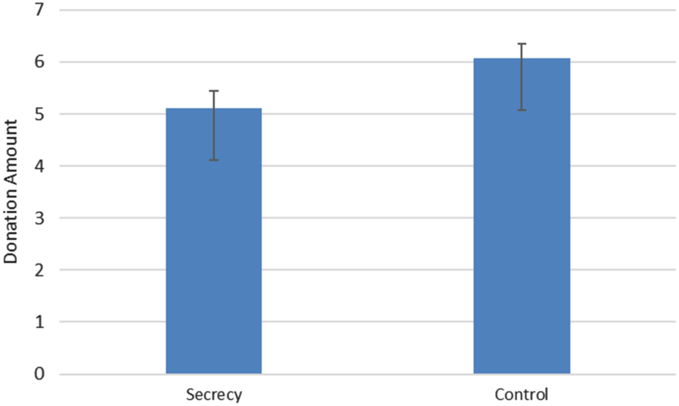
Figure 1 shows that consistent with the hypotheses, participants who recalled their secrets donated less money to the charity, M secret = 5.12, SD secret = 2.55, 95% CI [4.55, 5.69], than participants recalling ordinary events, M control = 6.07, SD control = 3.01, 95% CI [5.42, 6.66], t(170) = 2.22, p = .028, Cohen’s d = .34, 95% CI [.04, .64]. Participants recalling a secret donated less money to the charity than participants recalling an ordinary event.
Donation amount in Study 1.
Summary
Study 1 produced preliminary evidence of the effect of secrecy on charitable giving: participants recalling secrets donated less money than those recalling ordinary events. In all, Study 1 illustrated the negative influence of recalling secrets on charitable giving, a critical aspect of our lives that has been heretofore unexplored.
Study 2
Study 1 demonstrated the negative influence of secrecy on actual donations. The primary objective of Study 2 was to shed direct light on the mediating mechanism(s) underlying this effect. We hypothesized that the effect of secrecy on charitable intentions is mediated by fatigue (but not negative affect). Moreover, to test the robustness of Study 1, we sought to replicate the results of Study 1 and examine whether the same intention pattern would emerge when the participants were asked to serve as volunteers for charity. Hence, we utilized two different dependent measures, that is, the intention to donate and the intention to serve as a volunteer, to reflect the difference in charitable intentions between different conditions.
Participants
A total of 163 students participated in this study in exchange for a small monetary payment. The mean age of the sample was 22.02 (SD = 2.05; 54 males, 109 females).
Procedure
Participants were randomly assigned to one of two conditions (n secret = 81 vs. n control = 82). The experimental manipulation with respect to the secret was identical to that in Study 1, and we then invited participants to read an appeal from the China Foundation for Disabled Persons, the same organization collecting money for hearing-impaired children used in Study 1. Participants then reported their intention to donate to this charity and their degree of willingness to serve as a volunteer for a fund-raising activity for these children.
To measure their current perceived state of fatigue, they rated two items: (1) “Right now I have a lot of energy” (reverse scored) and (2) “Right now I am in high spirits” (reverse scored) (1 = totally disagree, 5 = totally agree; α = .91). Then, participants responded to the Negative Affect Schedule (PANAS; Watson, Clark, & Tellegen, Reference Watson, Clark and Tellegen1988), and they were asked to indicate to what extent they could feel these negative emotions (Scared; Afraid; Upset; Distressed; Jittery; Nervous; Ashamed; Guilty; Irritable; Hostile).
Next, the participants completed three manipulation check items: “I had a strong desire to share my feelings and opinions about the recollected experience”, “I would have liked my partner to share her/his feelings and opinions about the recollected experience”, and “I would like to spend time with my partner discussing our respective feelings and opinions about the recollected experience” (1 = totally disagree, 7 = totally agree; α = .93). Finally, the participants reported their age and gender.
Results and discussion
Manipulation check
We created a single index of sharing intention by averaging the three items (α = .93). Participants recalling secrets were less willing to share the recollected experience with others than those in the control condition, M secret = 2.87, SD secret = 1.57, 95% CI [2.54, 3.21]; M control = 4.37; SD control = 1.64, 95% CI [4, 4.71], t(161) = 5.93, p < .001, Cohen’s d = .93, 95% CI [.61, 1.26]. Thus, the secrecy manipulation was successful.
Donation intention
As expected, individuals who had been induced to recall a secret reported less intention to donate to the charity, M secret = 4.15, SD secret = 1.53, 95% CI [3.83, 4.49]; M control = 4.62, SD control = 1.38, 95% CI [4.33, 4.93], t(161) = 2.08, p = .039, Cohen’s d = .32, 95% CI [.014, .63], which aligns with the empirical results found in Study 1 that secrecy has a negative effect on charitable intentions.
Volunteering intention
Figure 2 shows that consistent with our predictions, participants recalling secrets were less willing to serve as a volunteer than participants recalling ordinary events, M secret = 4.25, SD secret = 1.71, 95% CI [3.87, 4.63]; M control = 4.84; SD control = 1.46, 95% CI [4.52, 5.14], t(161) = 2.38, p = .018, Cohen’s d = .37, 95% CI [.06, .68]. Thus, these findings not only indicate that secrecy has a negative effect on donation intention but also provide evidence that secrecy mitigates volunteering intention.
Charitable intention (donation vs. volunteer) in Study 2.

Fatigue
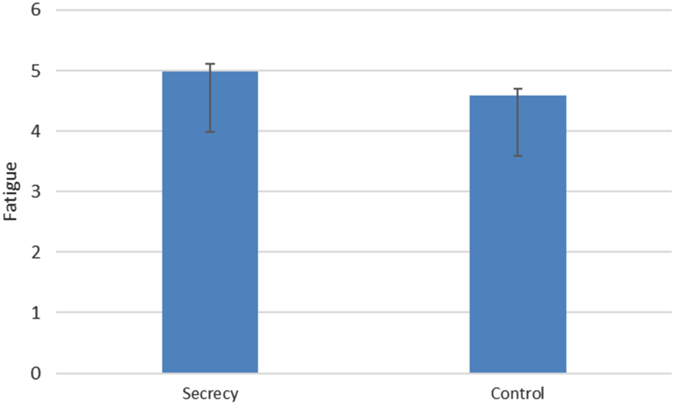
Did participants feel more tired when they were reminded of a secret? We obtained the fatigue index by calculating the average score of the two relevant items, α = .91, r(163) = .84, p < .001. Figure 3 shows that consistent with our theorizing, participants in the secrecy condition felt more fatigued than those in the control condition, M secret = 4.99, SD secret = 1.04, 95% CI [4.76, 5.21], M control = 4.59, SD control = .97, 95% CI [4.38, 4.8], t(161) = 2.55, p = .012, Cohen’s d = .4, 95% CI [.09, .71]. Thus, recalling a secret can make participants feel more fatigued.
Fatigue in Study 2.
Negative affects
The secrecy condition led to more negative emotions than the control conditions, M secret = 2.49, SD secret = .75, 95% CI [2.33, 2.67], M control = 2.09, SD control = .9, 95% CI [1.9, 2.27], t(161) = 3.15, p = .002, Cohen’s d = .48, 95% CI [.17, .79]. Different negative affects exert different effects on charitable behavior (e.g., guilt vs. shame); thus, we also examined the effect of every negative affect.
These results are presented in the Table 1. The secrecy condition produced greater levels of fear, upset, distress, guilt and shame than the neutral condition. In addition, participants recalling their secrets also felt more afraid and more nervous than participants recalling ordinary things. There were no differences in jitters, irritation or hostility between conditions.
Mean Scores for Self-Report Emotional States in Study 2 (SDs in Parentheses)
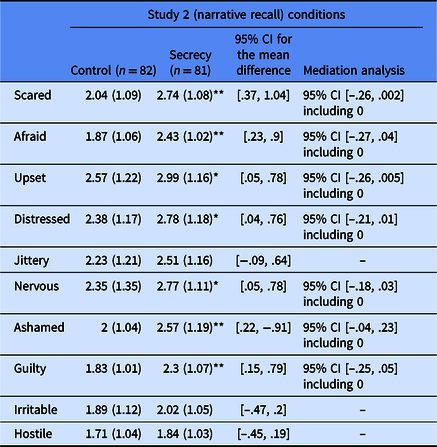
Note: All responses were made using single items and 5-point scales, with higher values indicating greater emotion intensity. For Study 2: *These means are significantly different from those in the control condition (*p < .05; **p < .01); the dependent variable in mediation analysis is donation intention.
We then conducted a mediation analysis, simultaneously testing whether the differences observed in these negative affects would mediate the observed differences in intention to donate and intention to serve as a volunteer in different conditions. However, the indirect effects through these negative affects (e.g., afraid, 95% CI [–.27, .04]; scared, 95% CI [–.26, .002]; upset, 95% CI [–.26, .005]; distressed, 95% CI [–.21, .01]; nervous, 95% CI [–.18, .03]; guilt, 95% CI [–.25, .05]) were not significant; in addition, we also examined the mechanism by calculating the average index of negative affect. However, the indirect effects of negative affects includes a zero (95% CI [–.0002, .31]), and thus, negative affect does not account for the effect of secrecy on charitable intentions.
Mediation analysis
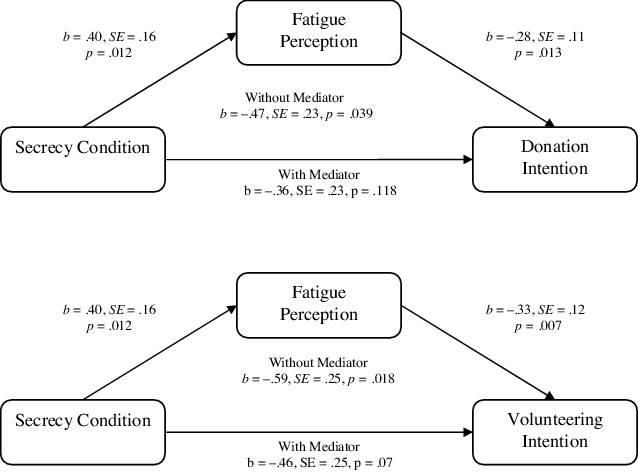
To examine the role of fatigue, we tested whether fatigue mediates the effect of secrecy on charitable behaviors. We first regressed the likelihood of participant donation on the secrecy condition (Secrecy = 1, Control = 0). Consistent with the ANOVA reported earlier, this analysis suggests that recalling a secret decreases the likelihood of donating, β = −.47, t(162) = -2.08, p = .039, R 2 = .026. Second, we regressed fatigue on the secrecy condition, β = .40, t(162) = 2.55, p = .012, R 2 = .039, which confirmed that recalling a secret leads to fatigue. Third, we regressed participants’ fatigue on the likelihood of donation, β = −.32, t(162) = -2.89, p = .005, R 2 = .049, which revealed a significant relationship between the two variables. The more fatigue participants perceived, the lower their willingness to donate. Fourth and last, we regressed participants’ donation likelihood on the secrecy condition and fatigue perception. The association between fatigue perception and donation likelihood remained significant, β = −.28, t(162) = -2.53, p = .012, R 2 = .064, after controlling for the secrecy condition. Consistent with the likelihood of donating, we found the same effect when we regressed the secrecy condition, fatigue and intention to serve as a volunteer.
We tested the proposed mediating effect using a bootstrapping procedure for mediator models recommended by Preacher and Hayes (Reference Preacher and Hayes2004, Reference Preacher and Hayes2008). As recommended by Hayes (Reference Hayes2013), we examined confidence intervals (CIs) using 5,000 bootstrap iterations. We performed a mediation analysis to test whether recalling a secret reduced charitable behaviors via fatigue. Figure 4 illustrates the mediation model of donation intention and provides the path coefficients. The negative association between the secrecy induction (in contrast to the neutral induction) and donation intention decreased when fatigue was included in the model. This technique yielded a 95% bias-corrected confidence interval that did not include zero [−.28, −.02]. Regarding volunteering intention, as predicted, the indirect effect through fatigue on willingness to be a volunteer (CI [−.35, −.03]) was significant. In addition, to rule out the influence of negative affect on the mechanism, we treated negative affect as a covariate, and the mechanism role of fatigue remained significant (donation intention: CI [−.24, −.003]; volunteering intention: CI [−.3, −.004]). The direction of the effects in the mediation analysis indicated that the secret recall led to more fatigue, which in turn contributed to a lower willingness to donate and a lower intention to volunteer.
Mediation Analysis in Study 2.
Summary
Replicating Study 1, secrecy decreased intentions to donate and volunteer. More importantly, this effect of secrecy on charitable intentions was mediated by feelings of fatigue. Notably, negative affect did not account for the diminished effect of secrecy on charitable giving. The findings were consistent with hypothesis 2.
General discussion
Cognitive resources are vital for individuals to override short-term and selfish inclinations and behave prosocially towards others. One prior study strongly suggested that secrecy induces spiritual and physical burden because of the consumption of cognitive resources (Slepian et al., Reference Slepian, Masicampo, Toosi and Ambady2012). Drawing from prior research regarding secrecy as a mental burden, we propose that secrecy reduces the desire to help others.
Across two experiments, we provided convergent evidence to support our hypothesis. To ensure that the secrets of the participants were their own and that the experiments thus resembled real life, we manipulated secrecy through a recall task (Studies 1–2). Charitable behaviors were measured by the amount donated (Study 1) or an indicated willingness to donate money and to serve as a volunteer (Study 2). We showed that secrecy decreased both concrete and general charitable intentions (Studies 1 and 2). Importantly, the effect of secrecy on charitable intentions was mediated by fatigue (Study 2). Furthermore, our findings also addressed an alternative explanation that secrecy weakens the desire to donate and volunteer because it induces negative emotions, as we included negative emotion measures in Study 2 and observed that negative affect did not account for the influence of secrecy on charitable behaviors. Hence, considering all findings, it is likely that secrecy reduces the desire to help others.
This research contributes to the growing body of literature in three ways. First, this research extends prior work related to the influence of secrecy. People are always aware of their secrets, and even 5-year-old children have some understanding of the nature of secrets (Watson & Valtin, Reference Watson and Valtin1997). Although the universality of secrecy has been recognized, prior work in the domain of secrecy is seriously inadequate, and only a few articles characterize the harm of hiding secrets (Slepian et al., Reference Slepian, Chun and Mason2017). More importantly, prior research only focused on the negative influence of secrecy on individuals’ health and their relationships (e.g., Lane & Wegner, Reference Lane and Wegner1995; Slepian, Camp, & Masicampo, Reference Slepian, Camp and Masicampo2015; Slepian et al., Reference Slepian, Masicampo, Toosi and Ambady2012). Furthermore, we suggest that secrecy is a psychological state that not only influences individuals but also might reduce charitable behaviors.
Second, because most research has defined secrecy as “intentional concealment” (Bok, Reference Bok1983), abundant research focuses on the negative effects of secrecy on the interpersonal relationship between the individual and the person from whom one is keeping secrets (Critcher & Ferguson, Reference Critcher and Ferguson2014). For instance, romantic secrecy predicted lower levels of relationship quality (Lehmiller, Reference Lehmiller2009) and mind-wandering (Slepian et al., Reference Slepian, Chun and Mason2017). The current research further extends the literature by demonstrating that secrecy has a negative influence beyond these social interactions. Thus, this work is an important theoretical and empirical supplement to research in the field of secrets.
Third, this research adds to the literature related to charitable behaviors. To the best of our knowledge, the current research is the first to demonstrate the negative effect of secrecy on charitable behaviors. This finding is important because it shows that certain charitable behaviors can be reduced by secrets, which nearly everyone has. There are many factors that promote charitable behavior, such as empathy, nostalgia, awe, perceptions of self-other overlap, and the desire for social approval (Eisenberg & Miller, Reference Eisenberg and Miller1987; Myers, Laurent, & Hodges, Reference Myers, Laurent and Hodges2014; Zhou et al., Reference Zhou, Wildschut, Sedikides, Shi and Feng2012), which have gained popularity among many psychologists. However, the reality is that only a small percentage of people who view help requests proceed to aid victims. In this article, we suggest that failure to help could often be the normal and default response and can be attributed to certain implicit factors such as the secret. Moreover, our results showed that fatigue mediates the link between secrecy and charitable behaviors. While previous research has suggested that ego depletion reduces charitable behaviors (e.g., Baumeister et al., Reference Baumeister, Bratslavsky, Muraven and Tice1998), little research has examined the factors that make people fatigued and depleted in daily life in relation to charitable behaviors. We argue that secrets can bring about fatigue and depletion, which provides an important theoretical complement to the related literature. Although charity appeals employ a variety of strategies to motivate people to help, these approaches cannot work if people lack the cognitive resources to override short-term and selfish inclinations caused by hiding secrets.
The implication from the current findings is that recalling secrets reduces the helper’s self-regulatory resources, which in turn leads to few cognitive resources to override initial selfish inclinations and express willingness to help others. Slepian et al. (Reference Slepian, Chun and Mason2017) demonstrate a broader view of secrecy that suggests that secrecy can result in repeatedly thinking about the secret in irrelevant moments. More importantly, in modern society, many people are trying to hide their private information for security reasons. Many people are unwilling to disclose their personal information even in charitable donation activities, an example of keeping secrets in daily life. In fact, avoiding the disclosure of personal information is a secret and is also widely used as a method of secrecy manipulation (Critcher & Ferguson, Reference Critcher and Ferguson2014). As a result, charitable organizations should pay more attention to implicit factors decreasing donation intention and amount, such as keeping secrets. In addition, while people hide secrets from others to avoid bias and maintain their relationships with others (Newheiser & Barreto, Reference Newheiser and Barreto2014), we propose that hiding a secret has a considerable negative impact on the social welfare activities that are vital for social relationships. Thus, we suggest that people hiding secrets need to disclose such secrets to obtain more social support and engage in more charitable acts, which can relieve their mental burden (Barreto, Ellemers, & Banal, Reference Barreto, Ellemers and Banal2006).
One limitation of our study is that our secrecy manipulation might not have been sufficiently comprehensive because recall prompts access to real secrets unique to each participant. To our knowledge, there are many other approaches to manipulating secrecy. For example, in one study, women with eating disorders were asked to conceal their stigmatized identity when interacting with others (Smart & Wegner, Reference Smart and Wegner1999). However, this method has its own drawbacks because the results only apply to individuals with that secret (e.g., sexual orientation, an eating disorder). To address this limitation, a second approach referred to as secrecy-assignment manipulation has been employed to test the effect of concealment (e.g., keep the word “mountain” a secret; Lane & Wegner, Reference Lane and Wegner1995). However, this approach also has disadvantages because the assigned secret is personally trivial for participants compared with the secrets that they choose to keep on their own. Because of the characteristics of secrecy, different researchers have different attitudes towards these manipulation methods. Perhaps participants exposed to other manipulations would feel more fatigue than people recalling secrets because of the experimenter’s interview or the presence of other participants. Future research might further explore whether similar results are obtained when secrecy is induced in other ways.
Slepian, Masicampo, and Ambady (Reference Slepian, Masicampo and Ambady2014) has begun to examine the downstream effects of revealing secrets and has suggested that revealing secrets can relieve the burdens of secrecy compared with recalling secrets. Future studies could explore whether charitable behaviors increase as a downstream consequence of revealing secrets. For example, does revealing secrets promote charitable behaviors? Some research has investigated the effects of a person’s positive affective state on his or her subsequent helpfulness toward others, supporting that participants who were thus made to “feel good” were more helpful than control participants (Isen & Levin, Reference Isen and Levin1972). We cannot rule out the possibility that revealing secrets could make individuals “feel good”, leading to more helping behaviors. In addition to relieving the mental burden, does revealing secrets promote interpersonal relationships that, in turn, lead to more charitable behaviors? Previous research has suggested that sharing secrets with a best friend was linked with less loneliness and more interpersonal competence (Frijns, Finkenauer, & Keijsers, Reference Frijns, Finkenauer and Keijsers2012) and that both dispositional and experimentally enhanced interpersonal attachment were associated with volunteering to help others (Bowlby, Reference Bowlby1982; Mikulincer, Shaver, Gillath, & Nitzberg, Reference Mikulincer, Shaver, Gillath and Nitzberg2005). Additionally, Song et al. (Reference Song, Zhang, Melloy, Wang, Zhan and Wang2016) suggested that participants with higher levels of self-disclosure are more likely to perform charitable acts. Exploring this line of research would provide insight into the effects that motivate people to help others brought about by revealing secrets. It would be interesting to address this issue in the future.
In summary, our findings shed light on the phenomenon that secrets may weaken people’s desire to help others. The implication of the current findings is that willingness to help strangers partly depends on the helper’s current level of suppression of secrets. When potential helpers think about their secrets, they do not have sufficient cognitive resources to override their initial selfish inclinations and express less willingness to help others, and fatigue appears to bear some responsibility for this effect. In general, we believe that further research on this topic may lead to a broader understanding of the nature of secrecy and related downstream effects.
Funding
This research was supported by grants from the Key Program and General Program (31871095 & 71672169) of the National Natural Science Foundation of China, and the National Science Fund for Distinguished Young Scholars (71925005).
Financial Support
None.


 Open access

