

What roles do intergroup prejudice, common ingroup identities, and other social-identity-based evaluations play in public opinion on foreign policy? Foreign policy attitudes are a product of elite-driven cueing, value orientations, and ideological commitments (Gries and Yam Reference Gries and Yam2020; Guisinger and Saunders Reference Guisinger and Saunders2017; Kertzer et al. Reference Kertzer2014; Kertzer and Zeitzoff Reference Kertzer and Zeitzoff2017; Rathbun et al. Reference Rathbun2016). Yet, recent work – building on the insights of social identity theory (Tajfel and Turner Reference Tajfel, Turner, Austin and Worchel1979) and group-centric models of policy evaluation (Nelson and Kinder Reference Nelson and Kinder1996) – demonstrates that racial, ethnic, and religious identity ties and related group-based evaluations shape foreign policy preferences over trade (Mutz and Kim Reference Mutz and Kim2017), the use of force abroad (Rathbun et al. Reference Rathbun, Parker and Pomeroy2024), and humanitarian intervention (Chu and Lee Reference Chu and Lee2023). Ingroup and outgroup categorizations extend beyond national borders, and the downstream consequences of these categorizations – whether in the form of ingroup bias or outgroup animosity – shape foreign policy preferences.
Anti-Muslim bias is particularly influential for foreign policy attitudes (Clemons et al. Reference Clemons, Peterson and Palmer2016; Isani and Silverman Reference Isani and Silverman2016; Johns and Davies Reference Johns and Davies2012; Lacina and Lee Reference Lacina and Lee2013; Sandlin and Simmons Reference Sandlin and Simmons2022). Yet, evidence comes primarily from the USA or the UK, and experimental vignettes tend to focus on fictional, war-related scenarios that depict Muslims as threats. Little is known about whether anti-Muslim bias influences foreign policy attitudes across countries and in situations where Muslims are counter-stereotypically depicted as victims.
Given these gaps, we assess anti-Muslim bias in foreign policy attitudes through preregistered, harmonized – in treatment, outcomes, and timing – survey experiments in thirteen European countries (N=19,673). We randomly assign participants to read one of four vignettes about religious persecution – of Buddhists, Christians, Muslims, or Taoists – in China. Post-treatment, participants indicate their support for foreign policy actions intended to address human rights violations (Zarpli and Zengin Reference Zarpli and Zengin2022). The cross-country design assesses generalizability, while the factual depiction of Muslims as victims strengthens ecological validity.
In the pooled sample, we find evidence of anti-Muslim bias: Participants are less opposed to persecution and less likely to support intervention when asked about the persecution of Muslims relative to other religious groups. Importantly, however, anti-Muslim bias is not present in all countries. In some countries, participants oppose the persecution of Muslims less than the persecution of any other religious group. In other countries, the persecution of Christians leads to more opposition – that is, a pro-Christian bias manifests instead. And, in some countries, the persecuted group’s identity does not influence foreign policy attitudes at all.
Exploratory analyses evaluate how outgroup hostility and common ingroup identity influence foreign policy preferences. We find that anti-Muslim bias only exists amongst those with negative or neutral views towards Muslims; positive assessments of China are associated with weaker opposition to persecution, regardless of the religious group being persecuted; and Christian respondents exhibit a pro-Christian bias in their foreign policy preferences. By investigating the generalizability and ecological validity of anti-Muslim bias across thirteen European countries, we provide cross-national evidence of how social identity ties and intergroup attitudes influence foreign policy preferences. Our results indicate previous findings related to anti-Muslim bias in foreign policy attitudes are generalizable to some countries but not others. Thus, we reaffirm calls to assess the context validity of international relations experiments conducted primarily in the USA (Bassan-Nygate et al. Reference Bassan-Nygate2024).
Intergroup Attitudes and Foreign Policy Preferences
Individuals categorize themselves and those around them into ingroups and outgroups (Tajfel and Turner Reference Tajfel, Turner, Austin and Worchel1979), and these categorizations lead to both ingroup favouritism and outgroup animosity (Habyarimana et al. Reference Habyarimana2007; Turner et al. Reference Turner, Hogg, Oakes, Reicher and Wetherell1987). These intergroup attitudes – ‘evaluations of social groups on a global dimension, such as favourable-unfavourable’ (Esses et al. Reference Esses, Haddock, Zanna, Mackie and Hamilton1993, 139) – are accessible predispositions that, when activated, affect citizens’ policy preferences (Winter Reference Winter2008). In other words, group-based evaluations serve as ‘an efficient heuristic that conveniently reduces the complexity of policy politics to a simple judgmental standard’ (Nelson and Kinder Reference Nelson and Kinder1996, 1055-1056). Thus, policy attitudes depend on whether a policy benefits ingroup or outgroup members and on the extent of an individual’s ingroup attachment and outgroup hostility (Dovidio et al. Reference Dovidio and Dovidio2010; Duckitt Reference Duckitt, Sears, Huddy and Jervis2003). Existing evidence underscores the influence of group-centrism in policy evaluation – whether through group-specific stereotypes (Findor et al. Reference Findor2024; Gilens Reference Gilens1999), generalized ethnocentrism (Kam and Kinder Reference Kam and Kinder2007), or preferential ingroup bias (Chu and Lee Reference Chu and Lee2023; Renshon et al. Reference Renshon and Powers2024). We contend that group-based evaluations also shape foreign policy attitudes.
We build on a growing literature within international relations that investigates how intergroup attitudes – especially those based on racial, ethnic, and religious distinctions – shape foreign policy preferences (Carson et al. Reference Carson, Min and Nuys2024; Kam and Kinder Reference Kam and Kinder2007; Sides and Gross Reference Sides and Gross2013; Mercer Reference Mercer2023; Tokdemir Reference Tokdemir2021). The attitudinal consequences of ingroup/outgroup categorizations extend to international politics and shape how individuals think about various foreign policy questions (Hlatky and Landry Reference Hlatky and Landry2024; Mutz and Kim Reference Mutz and Kim2017; Rathbun et al. Reference Rathbun, Parker and Pomeroy2024). Thus, for a given foreign policy issue, an individual’s preferences may depend on whether they consider the actors involved as ingroup or outgroup members (Gries Reference Gries2022, 294; Renshon and Powers Reference Renshon and Powers2024, 5), and on the strength of their ingroup attachment and outgroup hostility (Chu and Lee Reference Chu and Lee2023; Tokdemir Reference Tokdemir2021).
To test, we focus on support for intervention to stop religious persecution in China. We evaluate whether the persecution of Muslims – a group subject to widespread prejudice and discrimination in foreign policy (for example, Clemons et al. Reference Clemons, Peterson and Palmer2016; Johns and Davies Reference Johns and Davies2012; Lacina and Lee Reference Lacina and Lee2013; Sandlin and Simmons Reference Sandlin and Simmons2022) and other domains (for example, Bansak et al. Reference Bansak, Hainmueller and Hangartner2023; Quillian and Lee Reference Quillian and Lee2023) – leads to less supportive foreign policy preferences than the persecution of other religious groups. Given extensive evidence of anti-Muslim bias, we preregistered:
Hypothesis 1: The persecution of Muslims will lead to less support for intervention relative to the persecution of other religious groups. Footnote 1
We consider the relational nature of foreign policy scenarios – for example, humanitarian intervention does not occur only to protect the victim but also to stop the aggressor. From the perspective of group-centric policy evaluation, attitudes towards both actors should matter. Thus, we explore whether attitudes towards Muslims moderate the extent to which anti-Muslim bias manifests, and if perceptions of China influence support for intervention. Shared ingroup identity can also influence foreign policy preferences through ingroup bias (Chu and Lee Reference Chu and Lee2023; Renshon and Powers Reference Renshon and Powers2024). To test, we focus on shared Christian identity.
Explorations 1 and 2: To what extent do (1) pre-existing intergroup attitudes and (2) shared ingroup identities influence foreign policy preferences?
We make two other contributions. First, we assess the cross-national generalizability of anti-Muslim bias in foreign policy attitudes. Second, we strengthen ecological validity by using real-world reports of persecution that depict Muslims as victims.
The Generalizability of Anti-Muslim Bias in Foreign Policy Attitudes
Anti-Muslim bias is widespread (Adida, Laitin and Valfort Reference Adida, Laitin and Valfort2010; Bansak, Hainmueller and Hangartner Reference Bansak, Hainmueller and Hangartner2023; Di Stasio et al. Reference Di Stasio2021; Pfaff et al. Reference Pfaff2021; Quillian and Lee Reference Quillian and Lee2023), and foreign policy attitudes are not exempt. However, unlike research on anti-Muslim prejudice and discrimination in other domains, much of the work on anti-Muslim bias in foreign policy attitudes has focused solely on the USA and the UK (for example, Chu and Lee Reference Chu and Lee2023; Clemons, Peterson and Palmer Reference Clemons, Peterson and Palmer2016; Johns and Davies Reference Johns and Davies2012; Lacina and Lee Reference Lacina and Lee2013; Sandlin and Simmons Reference Sandlin and Simmons2022; Sides and Gross Reference Sides and Gross2013). This is also true of research focusing on foreign policy attitudes more generally (for example, Gravelle, Reifler and Scotto Reference Gravelle, Reifler and Scotto2017; Guisinger and Saunders Reference Guisinger and Saunders2017; Kertzer and Zeitzoff Reference Kertzer and Zeitzoff2017). By contrast, we focus on thirteen European countries, ranging from Hungary, Serbia, and Russia to Germany, Spain, and Sweden. Doing so evaluates the cross-country generalizability of anti-Muslim bias in foreign policy attitudes and provides the comparative evidence necessary to assess the context validity of a prominent finding.
The thirteen countries are diverse – in regime type, demographics, and foreign policy capabilities – providing a strong test of external validity. More importantly, however, the countries differ in factors that may explain variations in anti-Muslim bias and opposition to religious persecution. Central-East European countries are more hostile to Muslims than West European countries (Bell, Valenta and Strabac Reference Bell, Valenta and Strabac2021; Doebler Reference Doebler2014; Schlueter, Masso and Davidov Reference Schlueter, Masso and Davidov2020). And, even in Western Europe, there are differences in anti-Muslim sentiment between the more-tolerant North and less-tolerant South (for example, Verkuyten Reference Verkuyten, Tileagă, Augoustinos and Durrheim2022, 119). The countries also differ in their attitudes and foreign policies towards China (Gries and Turcsányi Reference Gries and Turcsányi2021, Reference Gries and Turcsányi2022), potentially influencing the extent to which individuals may oppose religious persecution. Finally, Eastern and Western Europe also differ in universalism (Cappelen, Enke and Tungodden Reference Cappelen, Enke and Tungodden2025) – the extent to which individuals identify with and are concerned about others (Rathbun et al. Reference Rathbun2016). Variations in universalism could lead to differences in baseline opposition to religious persecution across countries. Given these variations, we explore:
Exploration 3: To what extent is anti-Muslim bias generalizable across country contexts?
Improving Ecological Validity via Treatment Specificity
We strengthen ecological validity – that is, expand the study of anti-Muslim bias in foreign policy attitudes to other real-world scenarios – by moving beyond the experimental vignettes used in previous studies. These vignettes are often fictional and/or depict war-related scenarios, possibly reaffirming stereotypes of Muslims as threats (Clemons et al. Reference Clemons, Peterson and Palmer2016; Isani and Silverman Reference Isani and Silverman2016; Johns and Davies Reference Johns and Davies2012; Lacina and Lee Reference Lacina and Lee2013; Sides and Gross Reference Sides and Gross2013). The use of hypothetical scenarios may introduce a fictionalization effect whereby ‘respondents are more willing to use violence against fictitious countries […] more so even than against real-world countries perceived as adversarial’ (Majnemer and Meibauer Reference Majnemer and Meibauer2023, 8; McDonald Reference McDonald2020).
Additionally, a focus on war may prime stereotypical perceptions of Muslims as threats. Negative stereotypical portrayals of Muslims as terrorists or as violent are common in public discourse (Ahmed and Matthes Reference Ahmed and Matthes2017; Lajevardi Reference Lajevardi2021), and condition individuals to consider Muslims as threats (Saleem and Anderson Reference Saleem and Anderson2013, 86; see also Anderson and Carnagey Reference Anderson and Carnagey2004). In turn, these depictions have downstream consequences on prejudice (Velasco González et al. Reference Velasco González2008), willingness to use military force against Muslim countries (Sides and Gross Reference Sides and Gross2013), and perceptions of whether Muslims abroad are persecuted (Sandlin and Simmons Reference Sandlin and Simmons2022). Thus, war-related vignettes may overestimate anti-Muslim bias, and it remains unclear how counter-stereotypical portrayals of Muslims influence foreign policy preferences.
To address these concerns, our experiment focuses on a real-world situation. Participants read factual vignettes – based on reports by Amnesty International (n.d.) and Human Rights Watch (2018) – about religious persecution in China. While many Chinese religious minorities ‘are routinely jailed’ (Grim and Finke Reference Grim and Finke2007, 634), over one million Uyghurs and other Muslims have been ethno-religiously persecuted (Roberts Reference Roberts2020). As such, we depict Muslims as victims rather than as threats.
Research Design
We implemented the preregistered, between-subjects survey experiment with quota-representative (age, education, region, sex, size of settlement) samples in thirteen European countries (Czechia, France, Germany, Hungary, Italy, Latvia, Poland, Russia, Serbia, Slovakia, Spain, Sweden, the UK). We recruited 19,673 participants (N/country=1500-1540). The surveys were fielded between September and October 2020.Footnote 2
The survey experiment was embedded at the end of a larger survey (355 items, 90 per cent identical across countries) about China. Pretreatment, participants answered questions about their attitudes towards China and various identity-based groups, including Muslims. Then, we randomly assigned participants to read one of four vignettes. Only the identity of the persecuted religious group differed across vignettes (manipulations in bold):
In 2019, Beijing continued to tighten its grip on Muslims/Taoists/Buddhists/Christians as China pushed ahead with the ‘sinicization of religion’, which Premier Li Keqiang reiterated at the National People’s Congress. On the direction of the government, many mosques/shrines/churches were damaged or destroyed, believers were prevented from gathering in mosques/shrines/churches, and Qurans/Taoist sacred texts/Buddhist sacred texts/Bibles and other religious materials were confiscated. The authorities jailed Muslim/Taoist/Buddhist/Christian religious leaders who were recognized by the party as ‘endangering state security’.
Post-treatment, participants answered whether: (1) they worried about religious persecution in China; (2) the Chinese government should stop religious persecution; (3) their country’s government and (4) the United Nations should pressure China’s government to stop religious persecution; and (5) they would sign a petition demanding the Chinese government stop religious persecution. Answers were measured on seven-point scales, ranging from ‘strongly disagree’ (1) to ‘strongly agree’ (7). Finally, an attention check asked participants about the religious group mentioned in the vignette.
We pre-registered the simple average of the five questions as the dependent variable. Mokken scale analysis (see SI, pp. 5–6) and the Cronbach’s α (0.88) of the five items suggest few problems with doing so. Thus, our primary analyses use this index, which we term ‘opposition to persecution’. Higher values indicate greater opposition to persecution and more interventionist foreign policy preferences.
Results
We estimate pre-registered random intercept models using restricted maximum likelihood. As non-pre-registered robustness checks, we estimate linear fixed effects models using OLS, and both sets of models with attention check failures included and excluded. Figure 1 plots the effects of the Christian, Buddhist, and Taoist treatments. Muslim is the reference category.
Treatment effects in the pooled sample.
Note: N=19,673, 12,942; estimates with 95 per cent confidence intervals; regression results in SI, Table A3.

Participants were more opposed to persecution and more in favour of intervention when the religious group being persecuted was not Muslim (p<0.001 for all models). For the random intercept model, effect sizes range from 0.18 for the Muslim-Taoist comparison to 0.26 for the Muslim-Christian comparison. Standardized effect estimates range from 0.13 to 0.19 (Hedge’s g), corresponding to small effects. There was little evidence that participants differentiated between the non-Muslim religious groups – that is, the religious persecution of Buddhists, Christians, and Taoists evoked similar levels of opposition. In sum, we find strong evidence of anti-Muslim bias. For additional robustness, we estimate: treatment effects for each of the five outcome measures separately; models with random slopes and intercepts; and models with cluster-robust standard errors. Results remain consistent (SI, Tables A13–A16).
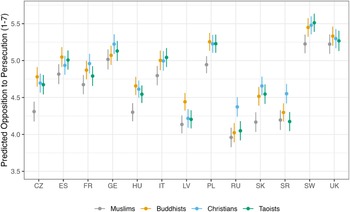
Next, we present the results of non-pre-registered explorations. First, we assess the cross-national generalizability of anti-Muslim bias. To do so, we estimate separate linear models for each country (attention check failures included), and present average predicted values of the opposition to persecution index across experimental conditions (Figure 2).

The country-level results show three variations. First, anti-Muslim bias was present in Czechia, Hungary, Italy, Poland, Slovakia and Sweden. Yet, effect sizes varied substantially. Average treatment effects ranged from 0.63 to 0.65 in the Czech Republic and reached a maximum of 0.74 in Slovakia (for the Muslim-Christian comparison). In Sweden, the effects were less than half as large, ranging from 0.22 to 0.30. Importantly, anti-Muslim bias does not seem to be related to country-level variations in overall opposition to persecution. Polish and Swedish participants were the third-most and second-most opposed in the sample, while Slovaks and Hungarians were among the least opposed. Second, German, Russian, and Serbian respondents exhibited a pro-Christian bias, with participants more opposed to the persecution of Christians than to the persecution of the other three religious groups. Here, effects ranged from 0.29 (Germany) to 0.70 (Serbia). In some countries, intergroup biases followed less consistent patterns. Spaniards opposed the persecution of Buddhists and Taoists – but not Christians – more than the persecution of Muslims. Latvians felt similarly, but only for Buddhists. The French were more opposed to the persecution of Buddhists and Christians but did not differentiate between Taoists and Muslims. Finally, British opposition to persecution was uniform regardless of the religious group being persecuted.
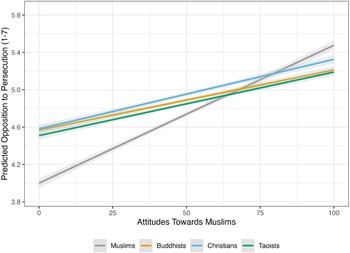
Next, we explore whether participants’ attitudes towards Muslims (0–100 feeling thermometer) moderate treatment effects. To do so, we interact attitudes towards Muslims with the treatment indicator variable, also including country fixed effects.Footnote 3 Figure 3 presents average predicted values of opposition to persecution across attitudes towards Muslims, and shows strong evidence of moderation (p<0.001 for all interactions). The presence and substantive size of anti-Muslim bias depend on participants’ pre-existing attitudes towards Muslims. Anti-Muslim bias is only present amongst participants with negative or neutral attitudes towards Muslims, attenuates as attitudes become positive, and, at positive attitudes, turns into a pro-Muslim bias. The moderation is substantial. For an individual with completely negative attitudes towards Muslims (a thermometer score of 0, N=1985), the size of anti-Muslim bias ranges from 0.55 (Taoists) to 0.63 (Buddhists and Christians). Conversely, an individual with completely positive attitudes towards Muslims (N=681) has a pro-Muslim bias ranging from 0.19 (Christians) to 0.28 (Buddhists) to 0.30 (Taoists). Even the smaller – perhaps more theoretically relevant – change from completely negative to neutral attitudes (that is, a score of 50, N=4551) attenuates anti-Muslim bias by 81 per cent. Additional random slope models (and similarities in estimates between fixed effect and random intercept models) suggest that treatment moderation is primarily driven by individual attitudes rather than country-level compositional effects. Interactions between individual attitudes and treatments remain statistically and substantively significant, in contrast to largely negligible cross-level interactions. However, given the small number of level-two clusters (thirteen countries), country-level associations should be interpreted cautiously (Meuleman and Billiet Reference Meuleman and Billiet2009; see SI, Table A10, for results).
Predicted opposition across attitudes towards Muslims.
Note: N=19,673; average predicted values with 95 per cent confidence intervals; regression results in SI, Table A9.

Figure 4 plots average predicted values across attitudes towards China (0–100). These attitudes exert a strong unconditional effect on opposition to persecution, but they have a weak moderating effect (p=0.036, 0.060, 0.072 for the Taoists, Buddhists, and Christians interactions, respectively). Nonetheless, there is some evidence that anti-Muslim bias weakens as attitudes towards China become positive. However, this is due to a lower overall opposition to persecution – that is, participants friendly towards China are less opposed to persecution generally, regardless of the religious group being persecuted. We emphasize that the size of this moderation is substantively small. Anti-Muslim bias (relative to Christians) only decreases from 0.36 to 0.22 when moving from completely negative attitudes towards China (N=1258) to completely positive attitudes (N=594).
Predicted opposition across attitudes towards China.
Note: N=19,673; average predicted values with 95 per cent confidence intervals; regression results in SI, Table A11.

Additionally, we consider the potential moderating effects of how respondents perceive their country’s foreign policy priorities vis-à-vis China. Due to space constraints, we present these results in the SI (pp. 19–23) and summarize them here. Anti-Muslim bias remains largely consistent in magnitude across multiple measures of foreign policy priorities. However, respondents who believe their country should advance human rights in China exhibit anti-Muslim bias, while those who are less staunch advocates do not. The lack of bias amongst the latter group is likely due to the strong unconditional association between human rights propagation and opposition to persecution. If individuals do not value human rights, they are uniformly unopposed to religious persecution, regardless of the persecuted group.
Next, we consider whether common ingroup identity moderates treatment effects. If ingroup bias influences foreign policy preferences, the persecution of Christians should evoke more opposition amongst Christian respondents (Evangelical, Orthodox, Protestant, Roman Catholic) than amongst non-Christian respondents. This is indeed the case (Figure 5). While an anti-Muslim bias exists amongst both groups, Christian respondents are less opposed to the persecution of Muslims and more opposed to the persecution of Christians than non-Christians. In fact, anti-Muslim bias amongst Christian respondents is more than double the size of anti-Muslim bias amongst non-Christians (0.149 versus 0.375 for the Muslim-Christian comparison).
Predicted opposition across respondent Christianity.
Note: N (Not Christian)=9,456; N (Christian)=10,217; average predicted values with 95 per cent confidence intervals; regression results in SI, Table A12.

Finally, the extent to which an individual identifies with their nation or with the larger international community can condition whether intergroup biases influence foreign policy preferences (Chu and Lee Reference Chu and Lee2023, 16). Thus, additional explorations (SI, pp. 24–27) consider whether these attachments moderate treatment effects. Anti-Muslim bias persists in similar magnitude across all levels of national and international community attachment. Those with stronger attachments to the international community have higher levels of overall opposition to persecution than those without said attachments, but the size of anti-Muslim bias does not differ between the two groups.
Discussion
Building from social identity and social categorization theory, models of group-centric policy evaluation, and work on race and ethnicity in international relations, we evaluated the extent to which a specific form of intergroup prejudice – anti-Muslim bias – influences foreign policy attitudes. Focusing on religious persecution in China, we found that individuals opposed the persecution of Muslims less than the persecution of other religious groups. Exploratory analyses showed that anti-Muslim bias does not uniformly extend to a diverse set of Eastern and Western European countries and that pre-existing intergroup attitudes and identity ties are important moderators of the extent to which anti-Muslim bias manifests.
Our study was not explicitly designed to identify why anti-Muslim bias manifests in some countries but not others. However, the exploratory moderation analyses help us rule out several explanations. Anti-Muslim bias was not directly related to general opposition to persecution – it manifested in countries with high and low levels of opposition to persecution. Attitudes towards China also largely failed to explain variations in anti-Muslim bias, though they were associated with overall opposition to persecution. Anti-Muslim bias was strongest in countries with the most hostile attitudes towards Muslims: Czechia, Hungary, and Slovakia. However, the amplification of bias was driven more by negative personal assessments of Muslims than by overall country-level intolerance. Thus, individual attitudes play a central role in explaining variations in anti-Muslim bias within countries. Future research should investigate why the strength of anti-Muslim bias varies across countries and examine how country-level factors interact with individual attitudes to shape these patterns.
This study also has limitations. First, while our vignettes focus on real-world religious persecution and portray Muslims as victims, they mention ‘endangering state security’. Even this brief mention could prime stereotypical perceptions of Muslims as threats. Second, prejudice can amplify victim blaming, especially when victims do not fulfil prior expectations about ‘model’ victimhood (Erentzen et al. Reference Erentzen, Schuller and Gardner2021). Thus, individual-level differences in anti-Muslim sentiment may have led to variations in responses to the portrayal of Muslims as victims. Future research could address this question by directly manipulating victim versus threat framing. Finally, our outcome measures signify varying policies and policy costs across countries, potentially leading to cross-national differences. Consistent results across the combined index and the five separate outcome measures – and the limited moderation effects associated with various foreign preferences on China – suggest that our results are neither a function of one specific question nor of index construction. Nonetheless, future research could unambiguously assess support for the specific foreign policy tools different countries have at their disposal.
Despite these limitations, our study offers four contributions. First, we provide cross-national evidence of how intergroup evaluations structure foreign policy attitudes, adding to the growing literature on the importance of race and ethnicity in international relations. Second, we provide a much-needed evaluation of cross-country generalizability. Previous results suggest that prominent international relations experiments replicate across countries (Bassan-Nygate et al. Reference Bassan-Nygate2024). Our findings suggest that cross-country generalizability may be more tenuous, especially when dealing with foreign policy preferences related to intergroup dynamics. Third, we move beyond previous studies by counter-stereotypically depicting Muslims as victims and by avoiding fictional, conflict-related vignettes. Doing so expands the study of anti-Muslim bias in foreign policy attitudes to other real-world scenarios, is a potential source of country-level variation, and should motivate future research on the threat versus victim distinction. Finally, elites are both responsive to the foreign policy views of their constituents (Chu and Recchia Reference Chu and Recchia2022; Tomz, Weeks, and Yarhi-Milo Reference Tomz, Weeks and Yarhi-Milo2020), and subject to many of the same intergroup biases (Carson et al. Reference Carson, Min and Nuys2024; Mercer Reference Mercer2023). These findings, when combined with our evidence, indicate that anti-Muslim bias may shape foreign policy formation in some countries but not others.
Supplementary material
Supplementary Information for this article can be found at https://doi.org/10.1017/S0007123425000134.
Data availability statement
Replication data for this paper can be found in Harvard Dataverse at https://doi.org/10.7910/DVN/VBWUVG and on Open Science Framework (OSF) at https://doi.org/10.17605/OSF.IO/KTSY2.
Acknowledgements
The authors would like to thank Professor Sultan Tepe and the anonymous reviewers for their helpful comments and feedback, which greatly improved the manuscript.
Financial support
This research was supported by NextGenerationEU through the Recovery and Resilience Plan for Slovakia (Kristína Kironská, project number 09I03-03-V04-00461) and by the Slovak Research and Development Agency (APVV) (Andrej Findor, contract number APVV-21-0114). They were not involved in any stage of the research process.
Competing interests
None.
Ethical statement
All participants provided written consent and were compensated for their participation. The study received institutional review approval at the Faculty of Physical Culture, Palacký University, Olomouc, Czech Republic.



 Open access

