


Introduction
Thick-billed Parrots Rhynchopsitta pachyrhyncha inhabit highland pine forests at elevations above 2,000 m in the Sierra Madre Occidental ranges of north-western Mexico. The parrots spend their breeding season (June to October) primarily within the states of Chihuahua and northern Durango, then overwinter (November to May) within the south-central Sierra Madre Occidental in the states of Durango, Jalisco, Michoacán, Nayarit, and Colima (Snyder et al. Reference Snyder, Koenig, Koschmann, Snyder and Johnson1994, Cruz-Nieto Reference Cruz-Nieto1998, Monterrubio et al. Reference Monterrubio, Enkerlin-Hoeflich and Hamilton2002, 2015). They historically foraged across the US-Mexico border into south-eastern Arizona and possibly southern New Mexico (Lanning and Shiflett Reference Lanning and Shiflett1983, Snyder et al. Reference Snyder, Koenig, Koschmann, Snyder and Johnson1994). The parrots nest in tree cavities and feed primarily on seeds from several high-elevation pine species, including Pinus strobiformis, P. arizonica, and P. durangensis (Lanning and Shiflett Reference Lanning and Shiflett1983, Snyder et al. Reference Snyder, Koenig, Johnson, DeBano, Folliott, Ortega-Rubio, Gottfried, Hamre and Edminster1995).
The Mexican government and the U.S. Fish and Wildlife Service currently list the Thick-billed Parrot as ‘Endangered’ (U.S. Fish and Wildlife Service. 2013). The species is listed in Appendix I of CITES, and IUCN also lists its status at ‘Endangered’ because of its decreasing populations, specialized conifer diet, limited geographic range, and niche as an obligate cavity-nesting bird (IUCN 2017). Thick-billed Parrots have been extirpated from the United States since 1938 likely due to excessive unregulated shooting (Snyder et al. Reference Snyder, Koenig, Johnson, DeBano, Folliott, Ortega-Rubio, Gottfried, Hamre and Edminster1995). Historical population declines occurred in Mexico from unregulated pet trading and more recently from increased logging within the parrots' range (Lanning and Shiflett Reference Lanning and Shiflett1983).
Availability of nesting cavities in mature trees and snags has dramatically decreased in recent decades due to destructive clear-cutting and high-intensity timbering of remnant old-growth primary forests, as well as higher incidences of catastrophic wildfires exacerbated by drier conditions due to climate change (Sáenz-Romero et al. Reference Sáenz-Romero, Rehfeldt, Crookston, Duval, St-Amant, Beaulieu and Richardson2010, Monterrubio‐Rico et al. Reference Monterrubio‐Rico, Charre‐Medellin and Sáenz‐Romero2015). Recent population surveys of Thick-billed Parrots conducted across their remaining five breeding sites indicate that there may be fewer than 1,000 individual birds extant (authors’ unpubl. data), although this number is dubitable due to the irregularity of survey intensity. This precipitous drop in Thick-billed Parrot populations has been linked to the decline in suitable nesting resources (Monterrubio et al. Reference Monterrubio, Enkerlin-Hoeflich and Hamilton2002, Monterrubio-Rico and Enkerlin-Hoeflich Reference Monterrubio-Rico and Enkerlin-Hoeflich2004), which may warrant a revision of the population status of the species to ‘Critically Endangered’ status. The IUCN Red List criteria for ‘Critically Endangered’ requires a population size estimate of < 250 mature individuals and either: An estimated continuing decline of at least 25% within three years or one generation, whichever is longer, or a continuing decline, observed, projected, or inferred, in numbers of mature individuals (IUCN 2017). Less than 20% of the Thick-billed Parrot population will typically breed annually, so the species can persist and recover only if sufficient nesting resources are available and if mortality rates of breeding pairs are kept very low (Monterrubio et al. Reference Monterrubio, Enkerlin-Hoeflich and Hamilton2002, Reference Monterrubio-Rico, Cruz-Nieto, Enkerlin-Hoeflich, Venegas-Holguin, Tellez-Garcia and Marin-Togo2006). Consequently, Thick-billed Parrots will soon meet the Red List criteria for ‘Critically Endangered’ status if current downward population trends continue, especially with the loss of mature individuals and breeding pairs.
Monterrubio et al. (Reference Monterrubio, Enkerlin-Hoeflich and Hamilton2002) identified predation as the third most frequently identified cause of failure in nesting Thick-billed Parrots, after nest desertion and excessive ectoparasite load. Use of high-elevation habitats by Thick-billed Parrots is believed to mitigate against nest predation and egg consumption by arboreal snakes and mammals, a major impact on the productivity of lowland parrot populations (Snyder et al. Reference Snyder, Enkerlin-Hoeflich and Cruz-Neto1999, Monterrubio et al. Reference Monterrubio, Enkerlin-Hoeflich and Hamilton2002). However, we have observed what may be an increasing trend in predation events on Thick-billed Parrot nests in recent years and we believe that effective predator management and nest predation minimization should now be key components of a successful conservation management plan for the species. We have identified five species of predators of Thick-billed Parrots occurring within their breeding range: Bobcat Lynx rufus, coati Nasua narica, western spotted skunk Spilogale gracilis, common raccoon Procyon lotor and Stellers Jay Cyanocitta stelleri (authors’ unpubl. data). Monterrubio et al. (Reference Monterrubio, Enkerlin-Hoeflich and Hamilton2002) speculate that the ring-tailed cat Bassariscus astutus, Northern Goshawk Accipiter gentilis, Red-tailed Hawk Buteo jamaicensis, Great Horned-owl Bubo virginianus, and the Common Raven Corvus corax also depredate nesting thick-billed parrots and their chicks. We conducted an investigation into the frequency and intensity of predation on thick-billed parrots during the 2018 and 2019 breeding seasons to obtain empirical evidence of patterns and trends in predation events. We report on what appear to be increasing predation events by bobcats and provide recommendations to control and manage these impacts to improve the demographic viability and long-term conservation outlook for Thick-billed Parrot populations.
Methods
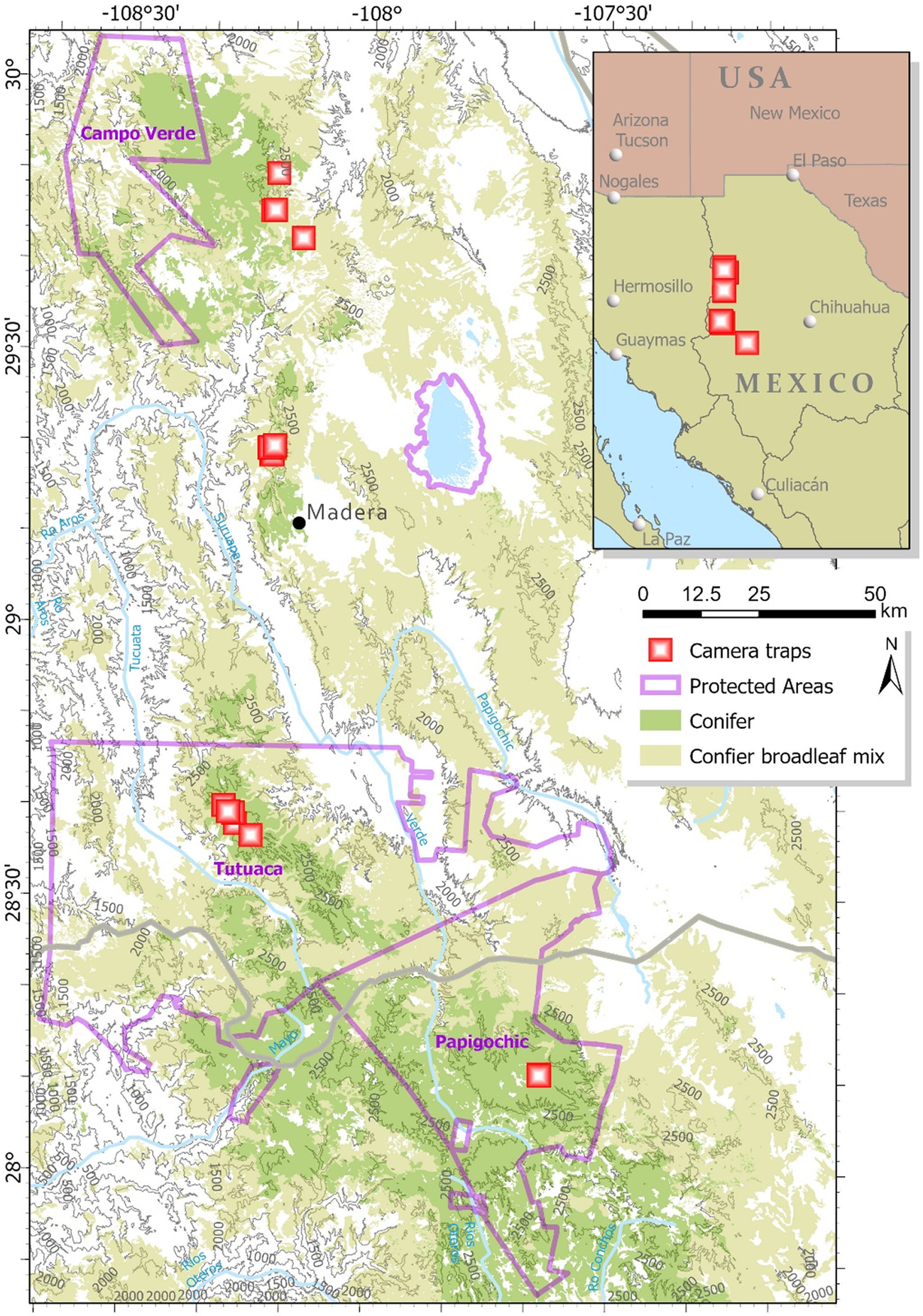
All mean statistics are recorded with ± standard deviation values except where indicated. During 2018 and 2019 biologists from the Mexican conservation NGO Organización Vida Silvestre A.C. (OVIS) deployed a total of 34 Reconyx microfire™ camera traps at four sites along 324 km of the northern Sierra Madre Occidental mountains along the western border of the state of Chihuahua (Figure 1). Camera traps were deployed at the start of each thick-billed parrot breeding season, from 7 July 2018 to 27 September 2018 and from 22 June 2019 to 30 September 2019, for an average of 51 ± 25 days. Sites were selected within high-elevation conifer and mixed-broadleaf forests that comprise historical breeding areas for Thick-billed Parrots: 1) Campo Verde (108°12'47"W, 29°47'29"N); 2) Tutuaca (108°16'2"W, 28°39'5"N); 3) Papigochic (107°38'22"W, 28°11'11"N), and; 4) Madera (108°12'34"W, 29°19'15"N). Mean elevation for the four sites is 2,369 ± 126 m (min 2,310, max 2,799). Local mean daytime surface temperatures around the sites in 2018 and 2019 were 19.7 ± 8.2 °C (min -2.73, max 40.6) and mean nighttime surface temperatures were 6.7 ± 5.2 °C (min -16.5, max 19.0) (1 km2 resolution TerraMODIS satellite derived (AppEEARS Team Reference Team2020).
Map of the four sites in the Sierra Madre Occidental ranges of northern Mexico where 34 camera traps were deployed to observe predation events on Thick-billed Parrots.
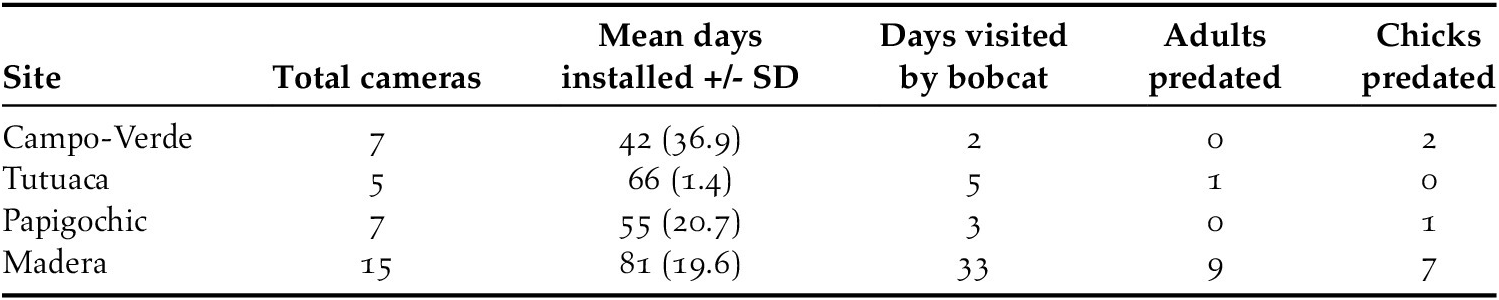
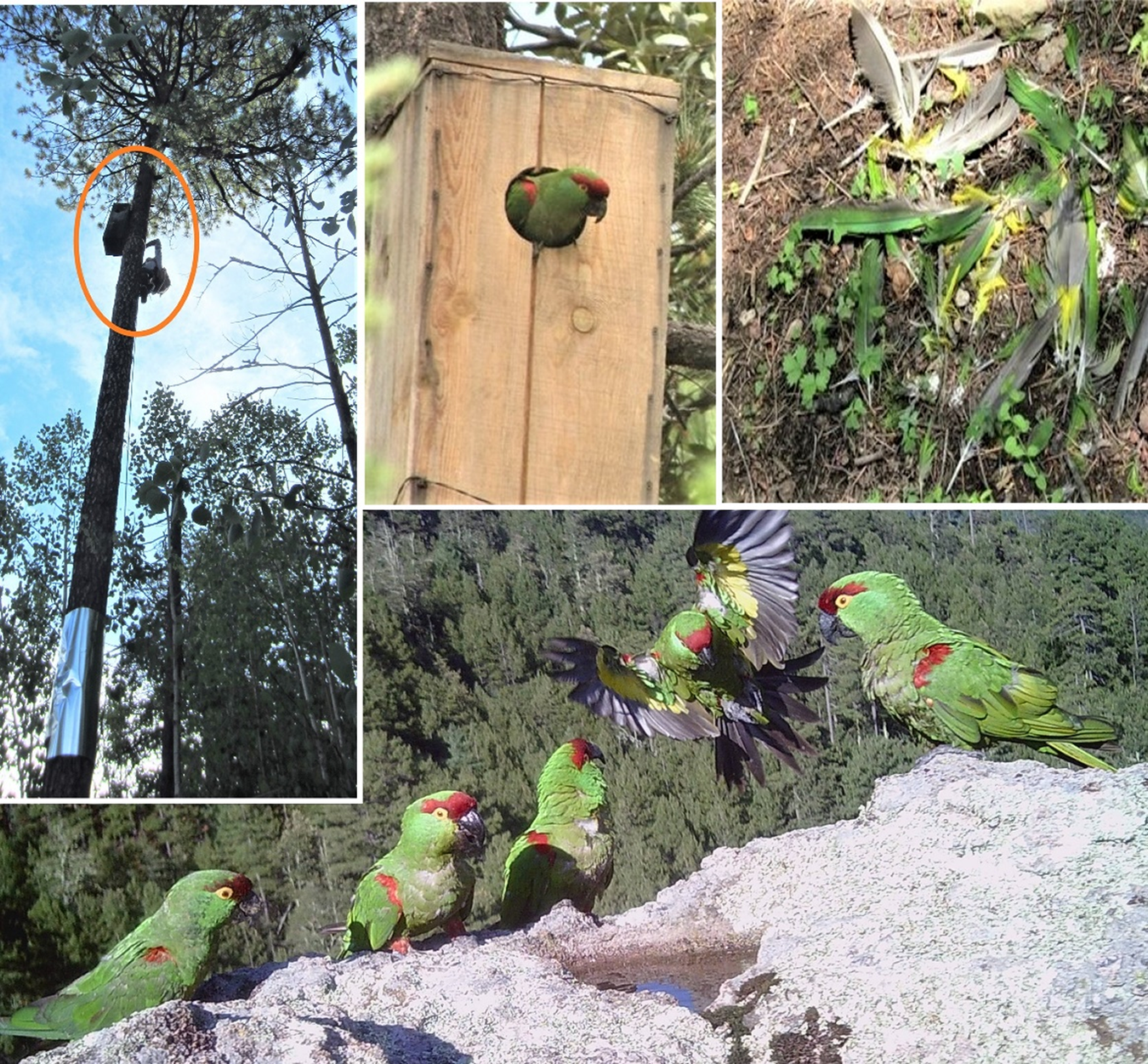
We deployed 22 camera traps on trees adjacent to active natural nests in tree cavities and nine on trees adjacent to artificial nest boxes (Table 1). As part of a conservation strategy started in 2014, more than 110 wooden nest boxes have been installed on trees throughout parrot breeding sites to encourage breeding and boost nesting success in Thick-billed Parrot populations (Figure 2). Nest boxes are attached to trees at heights between 12–18 m to deter predation on breeding pairs and their chicks. Two camera traps were also deployed at communal water sources in high-elevation rock pools at the Tutuaca site and another was deployed by a water source at the Campo Verde site (Figure 2). We used climbing spikes, ropes, and harnesses to inspect nest cavities and artificial nest boxes. Once per month during the camera trap trial we surveyed a 15-m radius area at the base of each nest tree to check for the remains of depredated nesting thick-billed parrots.
Summary statistics for the 34 camera traps deployed within four breeding sites in northern Mexico to observe predation events on thick-billed parrots during 2019.
(TOP LEFT & CENTRE) Artificial wooden nest boxes installed throughout key breeding sites by a climber (orange circle) to facilitate nesting success in Thick-billed Parrots. Note aluminum flashing to deter climbing predators. (TOP RIGHT) Parrot remains at the base of a nesting tree following bobcat predation. (BOTTOM) Thick-billed Parrots drinking at a communal water hole.
Results
We observed a total of 940 Thick-billed Parrots from our population survey during the 2019 breeding season. Of these, 165 birds (17.6%) exhibited breeding behaviour, from which 59 (35.8%) were confirmed to form breeding pairs and produce active nests at the four study sites. The 2019 egg-laying season began on 10 July and ended on 25 July, with egg hatching occurring from 5 to 19 August. Thick-billed Parrots nested within a variety of deciduous and conifer species that occur within their range including Populus tremuloides, Pinus strobiformis, Pseudetsuga menziensii, Pinus durangensis, and Abies concolor. Parrot nest trees were on average 25.5 m tall and parrot nests occurred in cavities at heights of roughly 17.5 m. We inspected a total of 44 nest cavities at the Tutuaca site and confirmed 24 active nests, and we inspected 15 nest cavities at the Papigochic site, of which 11 were active. We inspected 86 nest cavities at the Madera site and confirmed 51 actives nests. We inspected nine nest cavities at the Campo Verde site and confirmed that seven of these were active. On average, 3.09 ± 0.7 eggs were produced per nest across all sites during the 2019 breeding season, with a productivity of 1.09 ± 1.3 fledglings per nest.
From a total of 4,525 images of wildlife captured by the camera traps during the 2018 and 2019 breeding seasons, we observed 25 species within the immediate vicinity of the nest sites, including nine birds and 16 mammals. Of these species, we identified coati, western spotted skunk, common raccoon, Steller’s Jay, and bobcats as potential predators of nesting Thick-billed Parrots. Camera-trap data provided direct evidence of predation events only during 2019 and all these events were by bobcats. Bobcats depredated upon a total of 10 adults and 10 chicks during 2019, comprising 16.9% of active nests for the season. Madera had the most bobcat predation events, although this was likely an artifact of the greater number of camera traps deployed at this site. We suspect that at least eight predation events on nesting parrots were also by bobcats during 2018 based on our detection of bobcats at 20 nest trees and our inspection of bird remains within nests and at the base of nest trees (Figure 2). Remains of parrot chicks were found inside of four nests and adult and chick remains were discovered at the base of trees at nine of the nest sites during 2019. Parrot remains were located an average distance of 2.4 ± 2.2 m (min 0.25, max 7.0) from the base of the nest where the predation event occurred. Average radius of predation remains was 40.1 ± 5.8 cm (min 29, max 50). Although they did not show signs of teeth marks, broken feathers were detected in all predation events, mostly on secondary covering feathers. In some cases, we located the remains of wings, legs, and beaks. Only two of the 2018 predation events occurred during the incubation stage while the remainder occurred about a week after the chicks hatched. All the 2019 predation events occurred after the chicks hatched and a high percentage of these (47.6%) occurred in the third week post-hatching.
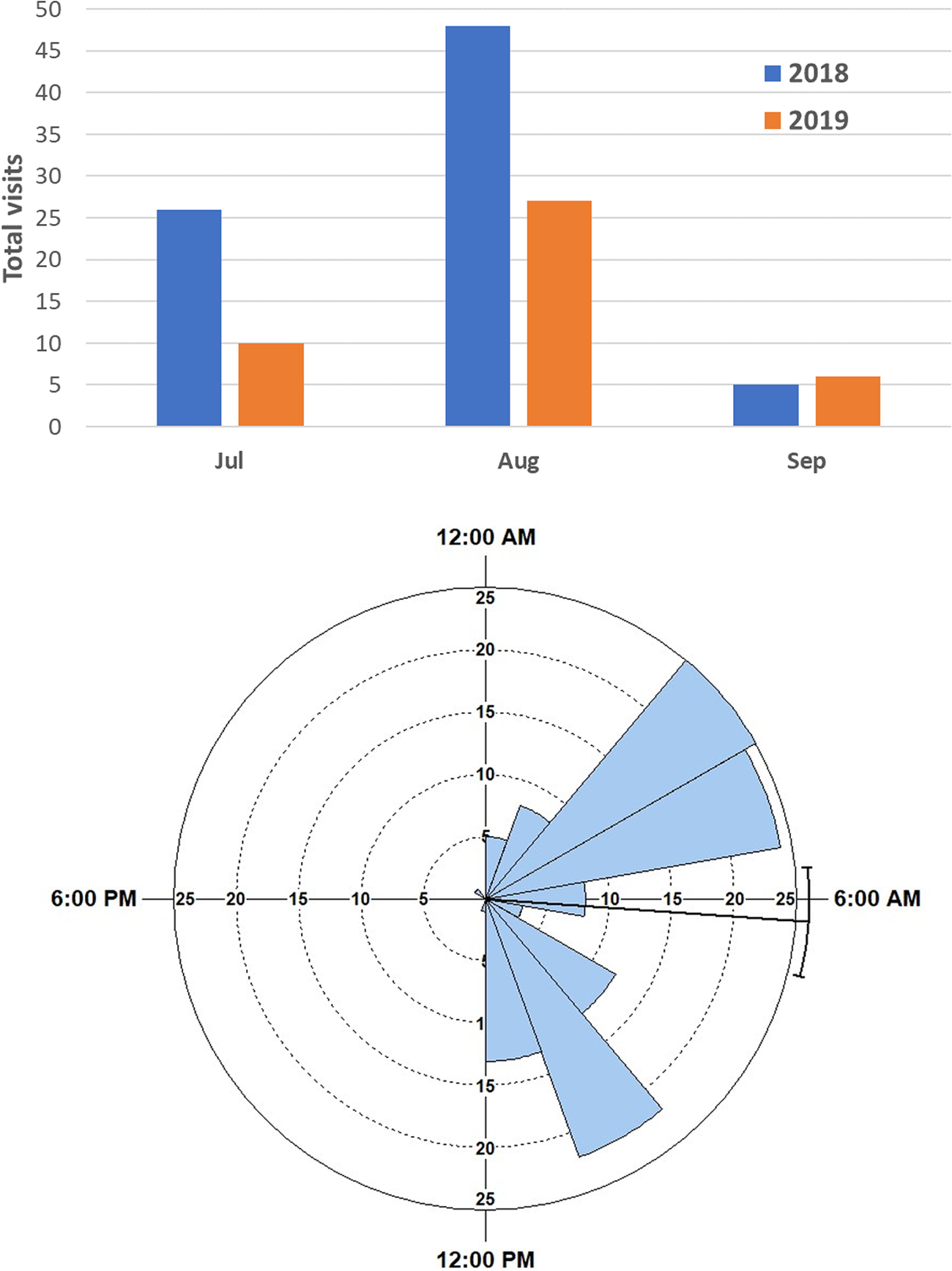
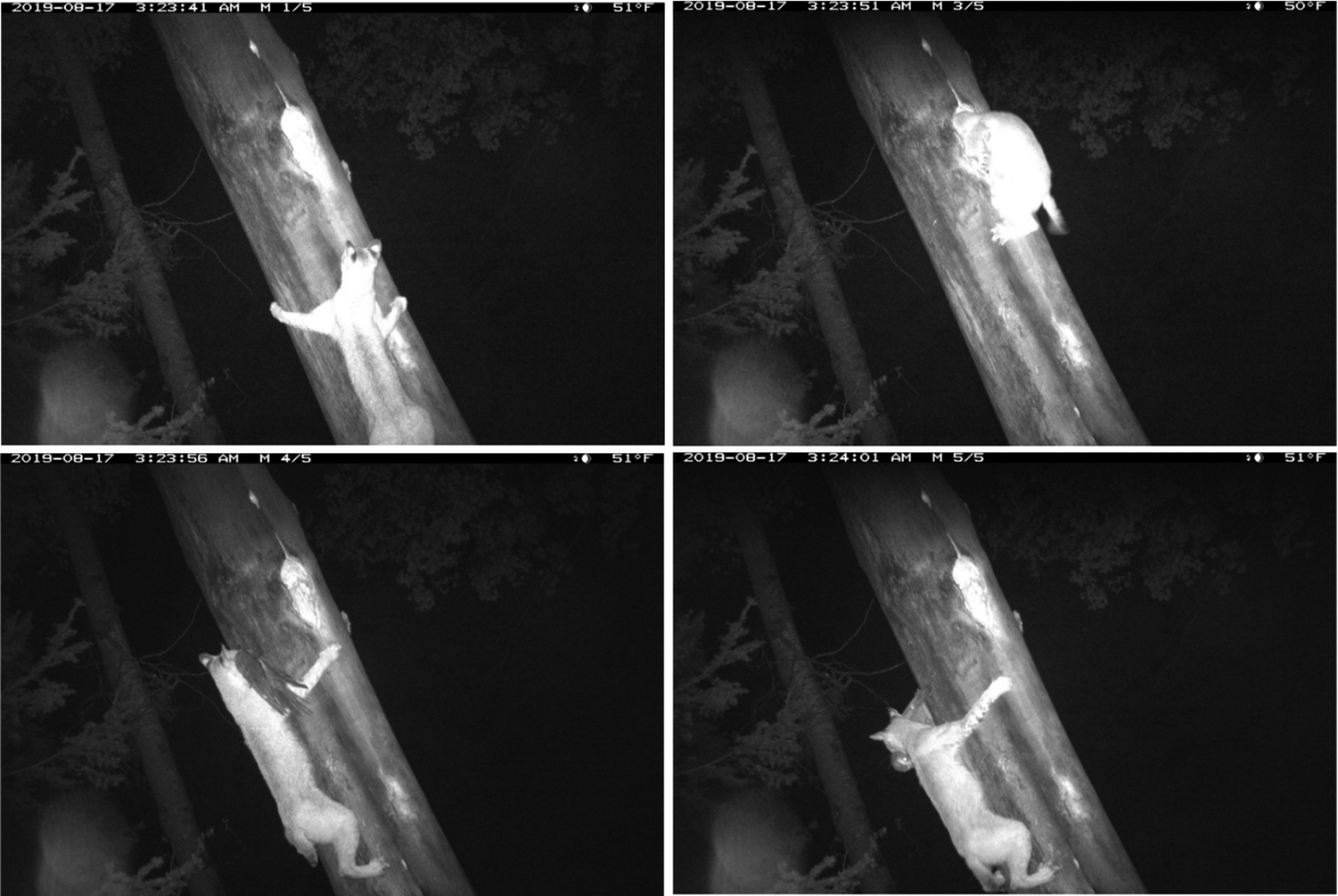
Although we were unable to differentiate individual animals or confirm repeat visits, we observed bobcats spending a total of 79 days visiting 12 nests only at the Madera study site during 2018, for an average of 6.1 ± 4.6 days per nest (min 1, max 16). Bobcats spent a total of 43 days visiting 13 nests at all four study sites during 2019, for an average of 5.8 ± 5.1 days per nest (min 2, max 22) (Table 1). Bobcats visited parrot nests a total of 47 times during the night and 32 times during the day during 2018. Bobcats visited parrot nests a total of 68 times during the night and 54 times during the day during 2019. Mean time of detection at the nests across both years was 06h16 ± 3:35 hours (Figure 3). We confirmed bobcat predation events only on parrots that were nesting within tree cavities, although we also observed bobcats attempting to pull out birds by reaching within the artificial nest boxes (Figure 4). We also captured imagery of female bobcats climbing trees and removing parrots from nest cavities and boxes while accompanied by kittens. We did not observe predation events occurring at any of the three communal water pools.
(TOP) Total bobcat visits to parrot nests by month during the 2018 and 2019 breeding seasons. (BOTTOM) Mean time of day (blue wedges) with confidence intervals (black bar) that bobcats were detected by camera traps at the nest sites.
Sequence from top-left to bottom-right of a bobcat preying on nesting Thick-billed Parrots by reaching into a nest cavity at night.
Discussion
Our study highlights what appears to be an increasing impact of predation on populations of Thick-billed Parrots as well as the urgent need for intensified management practices to reduce predation intensity so that parrot populations can stabilize and recover. Thick-billed Parrot populations continue to decline within their remaining highland forest redoubts and these habitats are increasingly threatened with fragmentation and degradation from timbering activities and climate change (U.S. Fish and Wildlife Service 2013). Several of the key breeding areas are formally protected, but the level of protection afforded to a given area depends on the type of official designation and whether there are active management plans in place (Figure 1). Consequently, increasing predation pressure on nesting parrots by bobcats must be effectively mitigated as a key recovery criterion of a successful conservation management plan. Although bobcats include nesting birds as prey items and have been detected within Thick-billed Parrot ranges over the previous four decades, only within the last three years have bobcat sightings and predation events at parrot breeding sites rapidly escalated. We observed the majority of predation events occurring within the Madera site, so bobcat predation may not yet have as strong an impact on birds within the other sites. However, the Madera site is historically the most important parrot breeding site, so a sustained increase in predation events there would be a serious threat to the integrity and recovery of parrot populations. Our field observations indicate that bobcats are cueing in to the locations of active nests via the vocalizations of adult birds they direct at their chicks during feeding transfers. We postulate that this phenomenon is being driven by accelerated degradation of bobcat habitats and a reduction of their traditional prey base due to anthropogenic impacts such as agriculture and increasing wildfire events.
We continue to explore and refine anti-predation methods. Following our detection of increasing bobcat incursions into parrot nesting areas, we began installing flashing around nesting trees to deter predation after the 2018 breeding season. We attached 1.5 m wide, 30-gauge aluminum sheets around nesting trees at heights of 3 to 7 meters from the tree base to hinder climbing. Flashing has been installed around 20 nesting trees at the Campo Verde site and 22 nesting trees at the Papigochic site to date. However, its efficacy as a predation deterrent has had mixed results with bobcats still managing to enter nests at a number of trees with flashing installed. Consequently, we added additional flashing around trees directly adjacent to nest trees to prevent bobcats from jumping horizontally across branches to access nests. Our evidence of unsuccessful predation attempts by bobcats on parrots within artificial nest boxes is encouraging and we believe the bobcat predation impacts on reproducing pairs we documented would have been considerably higher without our intervention. We are designing nest box upgrades to strengthen their ability to resist bobcat entry, including extending the distance between the entry hole and the base of the box so that the parrots nesting below remain out of bobcat reach. If long-term efforts to reduce the impacts of bobcat predation on breeding thick-billed parrots are insufficient to prevent their population decline, we believe that a targeted bobcat trapping and translocation program may be justified. This option would have to be carefully planned and coordinated between wildlife professionals, local stakeholders, and regulatory agencies.
Acknowledgements
This research was supported with the assistance of the Comisión Nacional de Áreas Naturales Protegidas (CONANP) through their Programa para la Protección y Restauración de Ecosistemas y Especies en Riesgo (PROREST 2019). Project support was also provided by the Arizona Game and Fish Department (AZGFD), Organización Vida Silvestre A.C. (OVIS), the Universidad Autónoma de Nuevo León (UANL), and the San Diego Zoo Global Wildlife Conservancy. This research was approved by the Secretaría de Medio Ambiente y Recursos Naturales (SEMARNAT) under permit SGPA/DGVS/04637/19. We wish to thank Ron Swaisgood, Nacho Vilchis, Angie Olvera, Francisco Puente, Mateo Rangel, Jesús Márquez, Abel Guerrero, Horacio Barcenas, the Ejidos: El Largo, J. Rojo Gómez and Tutuaca. All of the authors of this study have no conflict of interest to declare. The data that support the findings of this study are available from the corresponding author upon reasonable request.


 Open access

