


Introduction
How does rising access to the Internet affect the quality of elections? For some, online platforms are ‘liberation technology’ that helps topple autocrats and reduce the power of dominant parties (Diamond Reference Diamond2010; Miner Reference Miner2015; Manacorda and Tesei Reference Manacorda and Tesei2020). For others, they polarise voters and allow false information to dominate campaigns (Lelkes, Sood, and Iyengar Reference Lelkes, Sood and Iyengar2017; Jerit and Zhao Reference Jerit and Zhao2020), harming accountability by weakening the incentive of governments to perform well (Fearon Reference Fearon, Przeworski, Manin and Stokes1999).
But despite a growing literature on the Internet’s political consequences, we know little about its effects in low-income countries (Tucker et al. Reference Tucker, Guess, Barbera, Vaccari, Siegel, Sanovich, Stukal and Nyhan2018). Beyond Western Europe and the US, many of the world’s democracies are characterised by low economic development, weak media infrastructure, and regular accusations of electoral malpractice. Information technology can profoundly shift the way voters learn about politics and are engaged by politicians (Grossman, Humphreys, and Sacramone-Lutz Reference Grossman, Humphreys and Sacramone-Lutz2014; Kosec and Wantchekon Reference Kosec and Wantchekon2020). But the extent to which existing findings travel, and the mechanisms by which new technologies matter, remain open questions.
I document two channels by which online platforms can improve election quality in low-income settings. First, opposition parties can directly reach voters and improve their organisation, undercutting some of the unfair advantages held by incumbents. Second, election officials and civic education campaigns can better coordinate, reducing irregularities and uncertainties about results.
I study these questions in Malawi, a multiparty democracy that is characterised by unfair incumbency advantages, episodic political violence, and allegations of election fraud (Dulani and Dionne Reference Dulani and Dionne2014; Patel and Wahman Reference Patel and Wahman2015). The country is one of the world’s poorest and least urbanised, with recent internet coverage expansions building on weak pre-existing infrastructure to ‘leapfrog’ conventional ways voters learn about politics (Mbiti and Blumenstock Reference Mbiti and Blumenstock2015; Kosec and Wantchekon Reference Kosec and Wantchekon2020). I study the country’s 2019 election, which saw significant irregularities and was eventually overturned by the courts. I triangulate multiple data sources and methods to establish both aggregate effects and the mechanisms that might underpin them.
First, I use geocoded polling station returns and high-resolution maps of 3G mobile internet coverage taken directly from telecom providers. I leverage the expansion of coverage between the country’s 2014 and 2019 elections, in which hundreds of thousands of voters entered reception for the first time. In a difference-in-differences setting, I show that ruling party vote share and election irregularities fall in polling stations that entered coverage. These findings are robust to a series of modelling choices, including matching on pre-treatment characteristics and adjusting for changes in station-level organisation. I use a range of qualitative data and descriptive statistics to validate identification assumptions.
I then turn to focus group discussions and elite interviews from across Malawi to examine mechanisms. This gives voice to key actors involved in the 2019 campaign and yields insights that can guide future research. Consistent with existing literature, a recurrent theme is that opposition parties made more effective use of online platforms to undermine incumbent dominance. This included reaching out to voters directly, alongside community leaders in rural parts of the country. Declining irregularities can be partly explained by civic education content being shared by relatives on social media, and election officials’ use of WhatsApp groups to co-ordinate and resolve logistical issues.
Taken together, these results make a series of contributions to the literature. The first is to expand the study of the Internet’s political consequences to a globally important, and understudied, type of country case. In low-income democracies like Malawi, growing access to mobile internet is arguably more transformative than in its wealthy counterparts (Zhuravskaya, Petrova, and Enikolopov Reference Zhuravskaya, Petrova and Enikolopov2020). This paper points to ways in which mobile technology can shape political development, moving beyond an existing literature focused on economic shifts alone (for example, Aker and Mbiti Reference Aker and Mbiti2010; Aron Reference Aron2018; Hjort and Poulsen Reference Hjort and Poulsen2019), and speaking to wider debates about accountability and ‘people power’ (Marks, Chenoweth, and Okeke Reference Marks, Chenoweth and Okeke2019). Moreover, the early stage of Malawi’s internet adoption allows us to study its initial electoral effects, before ruling elites develop a response (Freyburg and Garbe Reference Freyburg and Garbe2018; Weidmann et al. Reference Weidmann and Rød2019; Gohdes Reference Gohdes2023).
The second is to triangulate multiple data sources to pair the aggregate impacts of internet coverage with contextual information on the ground. By using high-resolution coverage maps and geocoded polling station returns, the paper’s quantitative analyses offer an unusual level of spatial precision that goes beyond much existing work. Blending this with interviews and focus group discussions with key actors in Malawi, I provide direct support for modelling assumptions and descriptive leverage on causal mechanisms (Seawright Reference Seawright2016). Most existing scholarship on the Internet and politics choose one technique or the other. This paper is among the first to combine the two.
Lastly, the discussion of mechanisms raises a series of topics for future research. For instance, accounts from Malawi stress the supply-side importance of social media; even when voters do not have personal access to a device, parties use platforms like Facebook and WhatsApp to organise activists and to communicate with local leaders. Civic education organisations emphasise the online spill-over effects of their campaigns; the reach of in-person events was magnified by attendees’ ability to share photos and videos with relatives unable to attend. And election officials saw online platforms, especially WhatsApp groups, as important for election day coordination and management. These themes speak to ongoing debates about how parties learn about voter preferences (Jablonski and Seim Reference Jablonski and Seim2022), if and how civic education is effective (Harris, Kamindo, and van der Windt Reference Harris, Kamindo and van der Windt2021), and the underlying behaviours and incentives of bureaucrats (Rundlett and Svolik Reference Rundlett and Svolik2016).
The paper proceeds as follows. Section ‘Internet access and election quality’ outlines existing debates and expectations about the Internet’s impact on elections, while sections ‘Case and research design’ and ‘Data’ introduce the case of Malawi and the fine-grained spatial data with which I study it. Section ‘Polling station difference-in-differences’ presents evidence that the expansion of mobile internet reduced incumbent vote share and ballot irregularities. Section ‘Mechanisms and avenues for future research’ draws on qualitative data to examine mechanisms, before section ‘Discussion’ reflects on the findings and their implications.
Internet access and election quality
Background
Rising access to the Internet poses a marked, structural change for politics around the world. This has sparked debate about its merits and drawbacks for democratic accountability but is often focused on particular types of country cases.
A first body of work, largely inspired by events of the Arab Spring, suggests that growing access to online platforms fosters mass mobilisation and can aid the overthrow of autocratic regimes.Footnote 1 Related work shows how the Internet allows voters to learn about government performance and hold ruling parties accountable (Guriev, Melnikov, and Zhuravskaya Reference Guriev, Melnikov and Zhuravskaya2021). This can particularly benefit opposition groups (Miner Reference Miner2015; Donati Reference Donati2023), and explains, in part, why many regimes use censorship and shutdowns to minimise political discussion online (for example, King, Pan, and Roberts Reference King, Pan and Roberts2013; Freyburg and Garbe Reference Freyburg and Garbe2018; Weidmann et al. Reference Weidmann and Rød2019; Gohdes Reference Gohdes2023).
Others, however, raise concerns about biases in online content that undermine elections and accountability. Social media platforms can expose users to like-minded content (Cinelli et al. Reference Cinelli, De Francisci Morales, Galeazzi, Quattrociocchi and Starnini2021) and drive polarisation (for example, Lelkes, Sood, and Iyengar Reference Lelkes, Sood and Iyengar2017; Bail et al. Reference Bail, Argyle, Brown, Bumpus, Chen, Hunzaker, Lee, Mann, Merhout and Volfovsky2018), while the challenges of regulating and fact-checking false claims are a growing issue (Lewandowsky and van der Linden Reference Lewandowsky and van der Linden2021). These weaken electoral responsiveness to government performance, challenging a core premise of democratic accountability (Fearon Reference Fearon, Przeworski, Manin and Stokes1999).
Many of these studies, however, focus on countries and regime types that are difficult to compare. Work on the Internet’s ‘liberating’ potential falls, by definition, in less free states. These are usually autocratic environments, characterized by repression and lack of free speech or institutionalised opposition (Diamond Reference Diamond2010). Conversely, most studies of polarisation and electoral behaviour are based in the US or other Western democracies, where internet access is saturated and overlays strong political institutions and media infrastructure (Tucker et al. Reference Tucker, Guess, Barbera, Vaccari, Siegel, Sanovich, Stukal and Nyhan2018).Footnote 2
By contrast, there is very little work on the electoral impact of Internet access in lower-income democracies. These countries are a theoretically and substantively important type of case, in which elections take place at regular intervals, opposition parties occasionally win power, and there is some degree of free speech. But there remain concerns about how well democracy functions, from unfair incumbency advantages to political violence and election irregularities. The Internet is a new technology, building on a weak infrastructural base, and there is room for both accountability and election administration to shift in response.
I study two ways in which internet access may affect election outcomes in low-income democracies; the extent to which it diminishes unfair incumbency advantages, and its impact in reducing election irregularities. By levelling the playing field for the opposition, and raising the quality and fairness of election administration, rising access to online platforms can improve the overall quality of elections.
Diminishing incumbency advantages
The first way the Internet can shape politics in low-income settings is by diminishing incumbency advantages. Ruling parties leverage state power to secure an informational and organisational edge, which opposition parties can counteract through online platforms.
First, online platforms can be used to inform. Ruling parties often heavily influence conventional mass media platforms – like radio, television and newspapers – which are often state-funded (Levitsky and Way Reference Levitsky and Way2010; Bleck and van de Walle Reference Bleck and van de Walle2018). This confers institutional advantages in elections, ensuring that voters only learn about positive aspects of government performance (Prat and Strömberg Reference Prat and Strömberg2013). As access to online platforms rises, the public can access content from a wider range of political perspectives and parties. This might be through direct exposure to online news or an indirect lack of exposure to biased broadcasts as voters substitute conventional media with their online counterparts (for example, Diamond Reference Diamond2010; Miner Reference Miner2015). Over time, exposure to credible new information can shift support away from the government (Adida et al. Reference Adida, Gottlieb, Kramon and McClendon2020; Bhandari, Larreguy, and Marshall Reference Bhandari, Larreguy and Marshall2021).
Second, online platforms can expand the organisational reach of under-resourced parties. Opposition groups no longer need to physically travel across the country to reach voters, nor bear the risk of violence that can accompany campaigning in government strongholds or remote regions (von Borzyskowski and Wahman Reference von Borzyskowski and Wahman2021). Instead, party HQ can co-ordinate remotely with local activists to reach voters and campaign (Lynch and Gadjanovaa Reference Lynch and Gadjanovaa2022; Fisher, Gadjanova, and Hitchen Reference Fisher, Gadjanova and Hitchen2023). This helps overcome the large ‘ground operation’ of the incumbent, and its electoral benefits.
There is some evidence of these dynamics in low-income democracies around the world, particularly in Africa (for example, Hassan and Hitchen Reference Hassan and Hitchen2022; Dwyer and Molony Reference Dwyer and Dr Molony2019; Nyabola Reference Nyabola2018). In these environments, the Internet is most often used in a coordinating fashion, as voters and party activists use platforms like WhatsApp to share information. But few studies draw a direct link between internet availability and election results. Donati (Reference Donati2023) provides evidence that mobile internet access benefitted opposition parties in South Africa, Bessone et al. (Reference Bessone, Campante, Ferraz and Souza2022) consider how politicians in Brazil strategically engage voters online, and Miner (Reference Miner2015) shows that internet access contributed to the defeat of a dominant party in Malaysia. Beyond this, however, evidence remains scarce.
These channels lead to the overall expectation that mobile internet reduces incumbent support, driven by better access to information and opposition-party mobilisation. Using the case of Malawi, I show that the expansion of 3G internet coverage reduced incumbent vote share, and use focus groups, interviews, and survey data to evidence the mechanisms underpinning this effect. ${H_1}$
(Incumbent support | Mobile Internet): Incumbent support falls in areas exposed to mobile Internet. This is driven by opposition parties improving organisational reach, and exposure to more diverse political information.
${H_1}$
(Incumbent support | Mobile Internet): Incumbent support falls in areas exposed to mobile Internet. This is driven by opposition parties improving organisational reach, and exposure to more diverse political information.
Improving election administration
Many low-income democracies face regular accusations of fraud and malpractice, so the quality of election administration and the presence of irregularities are important outcomes to study. Existing literature outlines two ways in which internet access might improve the quality of election administration; monitoring and efficiency.
First, several experimental studies have shown online platforms can be used to monitor vote counting, deterring irregular behaviour.Footnote 3 Requiring election observers to share photographs of ballots reduced irregularities in Afghanistan (Callen and Long Reference Callen and Long2015; Callen et al. Reference Callen, Gibson, Jung and Long2016), while evidence from Colombia and Afghanistan suggests that social media can be an effective platform for citizen oversight (for example, Garbiras-Díaz and Montenegro Reference Garbiras-Díaz and Montenegro2022; Gonzalez Reference Gonzalez2021). But while existing work shows how online platforms can be an effective tool in the hands of civic groups, they do not explicitly test the effects of internet access as it expands organically, outside a deliberate experimental setting. This paper makes such a contribution.
Second, electoral commissions can use internet-based technologies to work more efficiently, aggregating votes and communicating outcomes in real-time. Polling station and commission staff can also coordinate with each other on election day, and resolve logistical problems that might have previously benefited one party over another.Footnote 4 This significantly speeds up processes (Igboechesi Reference Igboechesi2019), minimises the risk of upstream irregularities (Birch Reference Birch2011), and can build confidence in results (Brancati Reference Brancati2014).
These channels suggest that exposure to mobile internet reduces election irregularities, driven by monitoring and the potential for key actors to coordinate. I provide evidence that entering 3G internet coverage reduced the ballot rejection rate in Malawi, a key irregularity in the country’s controversial 2019 election. I then use interviews with staff and civil society groups to examine the mechanisms underpinning this effect. ${H_2}$
(Election irregularities | Mobile internet): Election irregularities fall in areas exposed to mobile internet. This is driven by enhanced monitoring and coordination on election day.
${H_2}$
(Election irregularities | Mobile internet): Election irregularities fall in areas exposed to mobile internet. This is driven by enhanced monitoring and coordination on election day.
Case and research design
Research design
I adopt a mixed-methods approach to study the impact of mobile internet on election quality. Using the case of Malawi, I first leverage the expansion of 3G internet coverage to examine incumbent support and election irregularities in a difference-in-differences setting. I then turn to qualitative focus group and interview data, collected in Summer 2023, to scrutinise assumptions and examine mechanisms. These analyses were part of a wider iterative process, which began with background knowledge and quantitative tests, followed by qualitative work and further examination of election results.
Using a mixed-methods approach provides important inferential leverage in this context. First, I demonstrate the broad, direct impact of mobile coverage across Malawi while also considering the real-world experiences of voters and political actors. This approach provides both credible estimates of the Internet’s effects, and grounded explanations for how these effects may emerge. Second, and relatedly, I provide qualitative support for the identification assumptions that underpin the difference-in-differences estimates, instilling greater confidence in their causal interpretation (Seawright Reference Seawright2016). This article is among the first to study the political impacts of the Internet in this way.
Malawi in comparative perspective
Malawi is one of many ‘third-wave’ democracies that has held multiparty elections since the 1990s (Cheeseman Reference Cheeseman2015). These are meaningful, with evidence that voters reward or punish government performance, and that government has become more responsive since democratisation.Footnote 5
But Malawi’s elections are not perfect, characterised by institutional advantages for the ruling party, concerns about irregularities, and sporadic incidents of violence and intimidation (Dulani and Dionne Reference Dulani and Dionne2014; von Borzyskowski and Wahman Reference von Borzyskowski and Wahman2021). The ruling party dominates public broadcast media and is accused of using state resources to fund rallies, using the police to disperse opposition campaigns, and targeting development projects in competitive areas (European Union 2020). Moreover, there are regular complaints about irregularities, and accusations of fraud, in the aftermath of voting (Patel and Wahman Reference Patel and Wahman2015).
In its politics, Malawi is representative of a much broader type of country case. In Africa, countries from Ghana to Kenya, or Senegal to neighbouring Zambia, have witnessed handovers of power to opposition parties amidst concerns about electoral fairness (Resnick Reference Resnick2013; Riedl Reference Riedl2014; Cheeseman Reference Cheeseman2015; Hern Reference Hern2023). This is equally true for states across Latin America, South and South East Asia (for example, Mainwaring and Scully Reference Mainwaring and Scully1995; Miner Reference Miner2015; Dasgupta 2018), while worries about irregularities continue to arise in Eastern Europe (Myagkov, Ordeshook, and Shakin Reference Myagkov, Ordeshook and Shakin2009). Panel (a) of Figure 1 below suggests that Malawi closely maps the global median on V-Dem’s electoral democracy score (Coppedge et al. Reference Coppedge, Gerring, Glynn, Knutsen, Lindberg, Pemstein, Seim, Skaaning and Teorell2020). This highlights the contrast with areas most often studied in the Internet and politics literature; wealthy democracies in the West, or autocratic states across North Africa and the Middle East.
Contextualising democracy and internet access in Malawi.
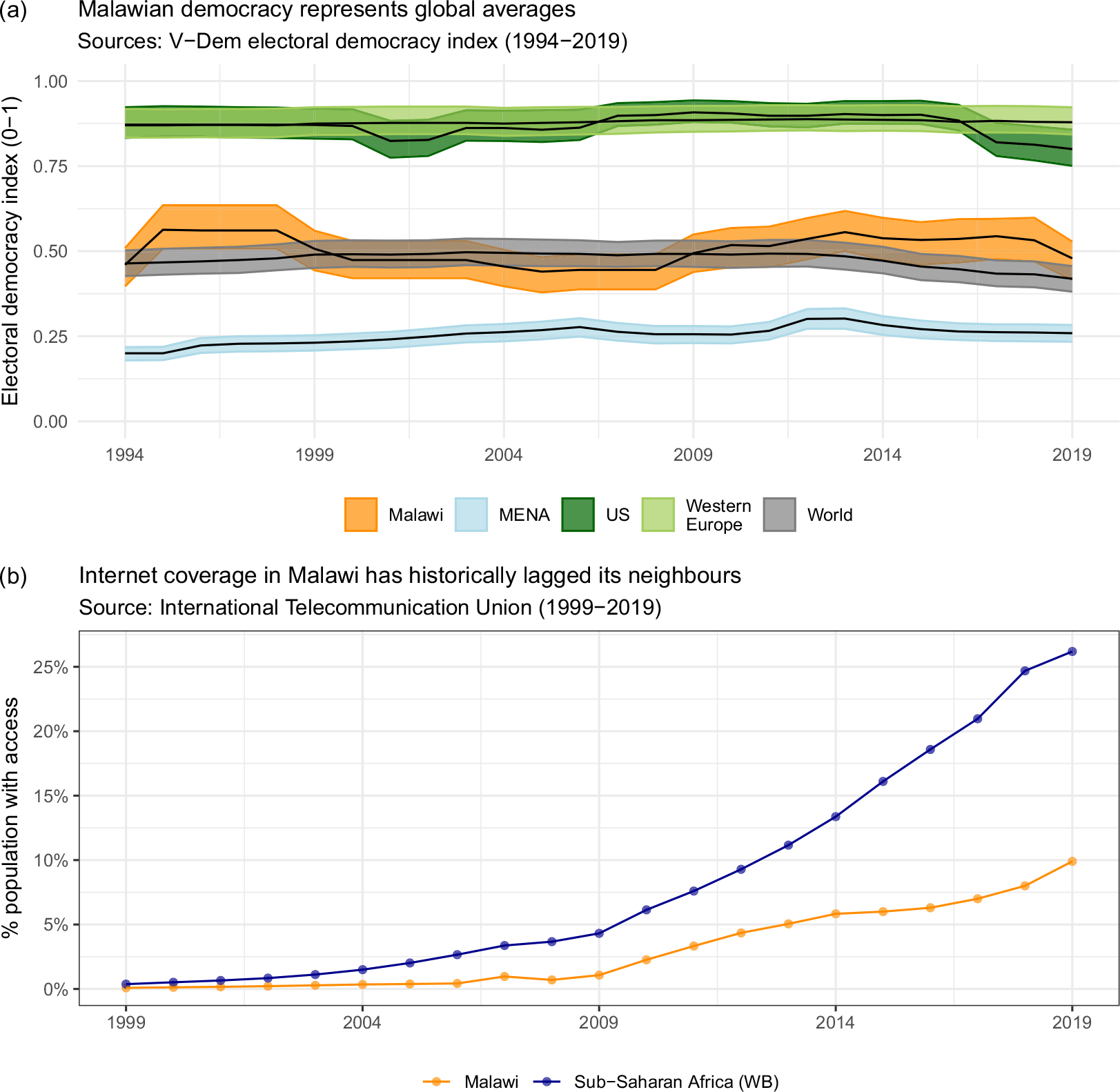
Where Malawi differs and provides more unique empirical leverage, is its relative lack of economic development. In 2022, the country’s GDP per capita was just USD 1500 (in real terms), the 7th lowest in the world (World Bank 2024a). Only 20 per cent of the population live in towns and cities, the fourth lowest in a rapidly urbanising African continent (World Bank 2024b). As shown in panel (b) of Figure 1 this translates into low levels of access to information technology infrastructure. Historically, the share of Malawi’s population with access to the Internet, from any type of device, has been among the lowest across Africa (Ritchie et al. Reference Ritchie, Mathieu, Roser and Ortiz-Ospina2023). This low baseline makes the expansion of 3G coverage, analysed in this paper, so transformative.
In recent years, the Internet has become increasingly important to how ordinary Malawians learn about politics. Online platforms, typically WhatsApp or Facebook, provide means to contact friends and relatives, share photos and videos among social groups, and are often cheaper than conventional SMS messages or phone calls.Footnote 6 As has been observed in many African countries, exposure to online content continues to grow despite low smartphone ownership figures. This is partly due to device sharing, particularly in rural settings, where members of a household or community lend their device to others (Aker and Mbiti Reference Aker and Mbiti2010).Footnote 7 And as I will show, political parties and election authorities can use online platforms to improve organisational efforts. These can drive substantial changes on the ground, without voters necessarily needing personal access to an internet-capable device.
Taken together, these features make Malawi a strong setting in which to study the political effects of information technology. The country offers an observational window in which to analyse rising internet access among a predominantly rural population, for whom online platforms provide new sources of political information or exposure to party mobilisation. Malawi’s internet roll-out is in its early stages and is proceeding slower than elsewhere due to its high rural population. This lends empirical insight into the Internet’s gradual impact on electoral politics and does so prior to any widespread response from governing elites that may follow (Weidmann et al. Reference Weidmann and Rød2019).
Electoral politics and the 2019 election
I study Malawi’s controversial 2019 election, in which a narrow incumbent victory was overturned by the courts due to significant irregularities.
The election was dominated by Malawi’s two largest political parties. First is the Malawi Congress Party (MCP), formed in 1959 towards the end of British rule (Mccracken Reference Mccracken1998). The MCP governed as a single party for three decades in the post-independence period, until multiparty elections were established in 1994 (Kalua Reference Kalua2011). The party was out of power in the multiparty era, until re-taking office in 2020 as leaders of an opposition alliance.
Second is the Democratic Progressive Party (DPP), formed in 2005 by then-President Bingu wa Mutharika. The DPP has been electorally dominant, winning the 2009, 2014 and (initially) 2019 general elections (Ferree and Horowitz Reference Ferree and Horowitz2010; Patel and Wahman Reference Patel and Wahman2015). Part of this time was in opposition after President Mutharika died in office in 2012 and his replacement, Joyce Banda, formed her own party (Cammack Reference Cammack2012). The DPP won the 2014 election to reclaim power under Mutharika’s brother Peter.
In 2019, the DPP narrowly held the Presidency amid mass outrage and accusations of malpractice (Cotterill Reference Cotterill2020; Matonga Reference Matonga2020).Footnote 8 Complaints centred around the use of correction fluid to alter results sheets, ballots being inconsistently marked null and void, more people voting than registered, and discrepancies between polling station tallies and official results. International election observers were reticent to call fraud but noted the DPP’s institutional advantages and the presence of irregularities in certain areas (European Union 2020; African Union 2019).
Opposition parties challenged the election results in court. In February 2020, judges annulled the vote and scheduled a re-run under a new electoral system more favourable to the opposition.Footnote 9 This was won by an MCP-led alliance, and their candidate, Lazarus Chakwera, peacefully took power (Nkhata, Mwenifumbo, and Majamanda Reference Nkhata, Mwenifumbo and Majamanda2021).
Incumbent support and election irregularities
I focus on two salient and systematically observable outcomes from Malawi’s 2019 election: vote share for the ruling party and the proportion of ballots deemed null and void at a polling station.
First, I focus on DPP vote share to proxy incumbent support. This offers a direct measure of the President’s electoral backing, which we would expect to fall as areas gain local exposure to the Internet and opposition parties gain popularity.
Second, I use null and void ballots to proxy local variation in the quality of election administration. In 2019 many saw ballot rejection as highly irregular, and even suspicious. International observers note ‘random decisions about null and void votes’ (European Union 2020, p31), polling officials’ ‘inability to reconcile’ voting tallies with the number of rejected ballots (African Union 2019, p28), and ‘inconsistent interpretations of what constituted a null or void vote’ (Commonwealth Observer Group 2019, p3).
There are two ways in which ballot rejection rates might misrepresent the true number of null and void votes in any given area.
Inside polling stations, rejecting ballots was a subjective decision made by the presiding officer, in the presence of party monitors. There was often ‘pressure from those [parties] who are losing. Sometimes the officials sway to those making noise … [they] can reasonably accept [the ballot] or be strict and let it go’. Footnote 10 This fed concerns that presiding officers, who are recruited by the government, may be biased toward the ruling party when making such decisions.
Polling station votes were then sent to constituency tallying centres, in which staff used a new IT system to aggregate them. This system could only accept results that added up completely, with the total number of votes matching the sum of those for each candidate. This posed a problem, as many polling station result sheets contained simple arithmetic errors. To fix this, constituency officials would sometimes add or subtract votes from the ‘null and void’ column to make figures align.
It is contested whether this process carried partisan bias; opposition parties claim the procedure was used to increase the DPP’s tally, while the electoral commission insists it was just a technicality. There is some evidence in other African countries that ballot rejection can be strategic, and used to selectively benefit ruling parties (Friesen Reference Friesen2019). But these claims are beyond the scope of my analysis, which treats ballot rejection as a proxy for the local quality of election administration, but not necessarily fraud.
Data
Election results
I used geocoded polling station results from the Malawi Electoral Commission (MEC) for the 2014 and 2019 elections. In 2019 complete data is available, while in 2014 returns are available from around 70 per cent of stations. Less data was available in 2014 due to widely reported problems storing results sheets, with many subject to water damage in transit or lost in fires at warehouses (European Union 2014; BBC News Reference BBC2014). I combine this with near-complete polling station coordinates, covering 98 per cent of 2019 stations, to create a geocoded panel dataset containing 6,070 observations.Footnote 11 This offers an unusual degree of spatial specificity, allowing us to effectively measure electoral changes within very small communities, held constant between elections.
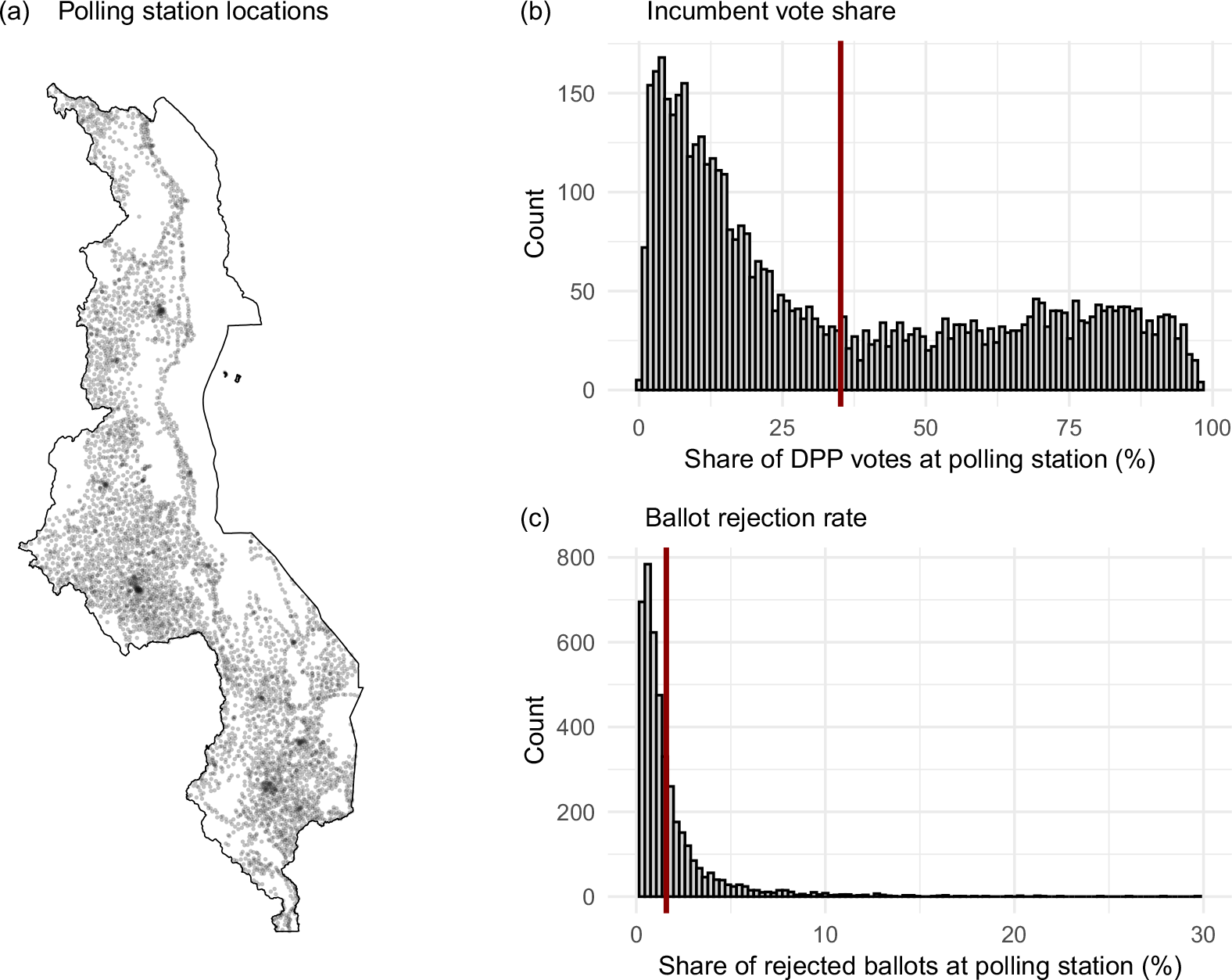
Figure 2 maps the location of stations across the country, and presents initial descriptive statistics from the 2019 election. Stations are distributed across the country and follow major population centres. Within each station, an average of 35.1 per cent of votes were cast for the incumbent, and 1.59 per cent were rejected.Footnote 12
Overview of polling station data. Panel (a) presents the geocodes of available stations across Malawi, while panels (b) and (c) plot the distribution of station-level incumbent support and ballot rejections in the controversial 2019 election. Red lines represent mean share.
In addition to the Presidential race, I analyse additional results from the parliamentary and local council elections which were held on the same day. I discuss this data in section 1.1 of the supplementary materials.
Mobile internet coverage
I use 3G coverage maps to proxy local exposure to the Internet in Malawi. Like many African countries, Malawi’s mainline internet infrastructure, like broadband or fibre-optic connectivity, remains limited outside corporate environments (Hjort and Poulsen Reference Hjort and Poulsen2019). Most public use takes place through mobile phones, using 3G technology. As discussed, this has become increasingly accessible as coverage has expanded and data packages have become cheaper.
I use proprietary spatial data on coverage, taken directly from telecom providers and submitted to the Global System for Mobile Communications Association (GSMA), an industry body. In conjunction with Collins Bartholomew, this data is sold under license as a series of yearly coverage maps. These offer a credible estimate of local coverage availability on the ground: areas are inside coverage if the signal strength is above an industry-standard decibel level, accounting for local topography (Crabtree and Kern Reference Crabtree and Kern2018). Since maps are released under license there is no clear incentive to systematically misestimate provision. There is growing precedent for using this data in academic research, from studies of political behaviour to economic development and public health.Footnote 13 I outline this dataset, and how researchers can acquire access, in the supplementary materials.
In Malawi, coverage maps are available for December 2014, 2016, and 2017.Footnote 14 Table 1 shows how the number of stations inside coverage rose by at least 13 per cent between the 2014 and 2019 elections, a significant amount given Malawi’s low level of pre-existing digital infrastructure. This change affected a large number of people, with newly covered stations processing almost 150,000 votes in the 2019 Presidential election. The total number of impacted individuals is likely much higher, once accounting for non-voters and those aged below 18, neither of whom appear in election statistics.
3G coverage provision in Malawi

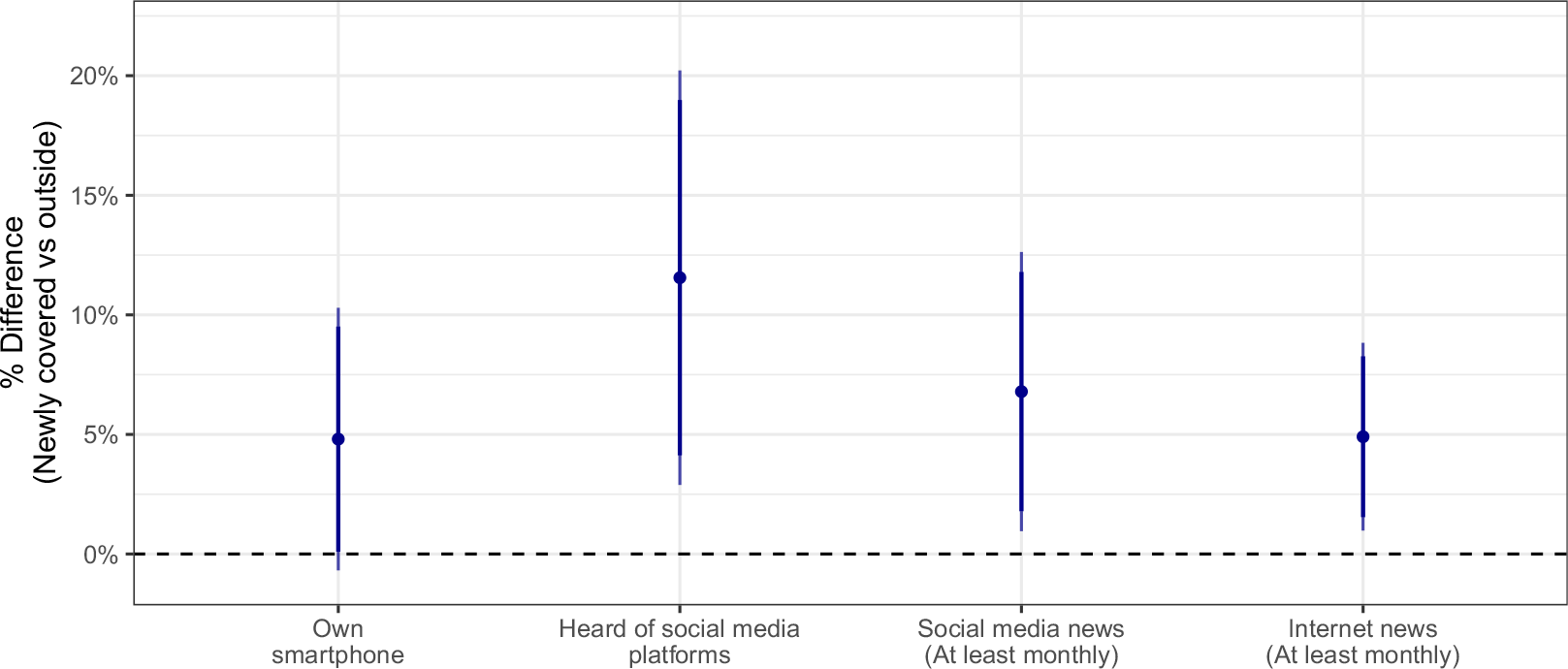
Mobile coverage provision matters because it proxies individual-level access to the Internet. To validate this, I turn to individual-level geocoded survey data from round 8 of the Afrobarometer in Malawi, fielded in late 2019. I overlay survey coordinates onto the coverage maps, and compare individuals living in covered areas with those living outside.Footnote 15 The results, in Figure 3, confirm that respondents inside coverage are more likely to own a smartphone, to have ‘heard of’ common social media platforms, and to regularly get news from the Internet and social media.Footnote 16 I discuss these results in more detail in section 1.2 of the supplementary materials.
Mobile coverage and individual-level access to the Internet (Afrobarometer round 8). Bars represent 95 per cent (thick) and 90 per cent (thin) confidence intervals respectively.
Polling station difference-in-differences
Specification
I leverage the expansion of mobile internet coverage between Malawi’s 2014 and 2019 general elections in a difference-in-differences setting. I present results from three specifications, which collectively address the dynamic nature of mobile coverage, pre-treatment differences between covered and non-covered areas, and variation in logistical arrangements on polling day. I find that entering coverage lowers vote share for the ruling party, with nuanced reductions on the ballot rejection rate.
Baseline
First, I present baseline models that measure whether a given polling station is in or outside coverage in election $t$
. Throughout, I adjust for polling station and election fixed effects,
$t$
. Throughout, I adjust for polling station and election fixed effects, ${\gamma _i}$
and
${\gamma _i}$
and ${\alpha _t}$
, respectively. This represents a two-wave difference-in-differences set up, with identifying variation coming from stations that enter coverage between elections.
${\alpha _t}$
, respectively. This represents a two-wave difference-in-differences set up, with identifying variation coming from stations that enter coverage between elections.
 $${y_{it}} = {\beta _1}\left( {{\rm{insid}}{{\rm{e}}_{it}}} \right) + {\gamma _i} + {\alpha _t} + {\epsilon _{it}}\;$$
One important feature of coverage exposure, however, is that represents a dynamic effect. As coverage arrives more people begin using devices, political parties adapt their strategies, and electoral effects accrue gradually over time.
Under a straightforward two-way fixed effects specification this can cause problems, as ‘always treated’ units – those inside coverage for both the 2014 and 2019 elections – continue to exhibit treatment effects (Goodman-Bacon Reference Goodman-Bacon2018). To address this concern, I follow recommendations from recent literature and remove these stations from the baseline analysis (Dube et al. Reference Dube, Girardi, Jordà and Taylor2023). In turn, the comparison polling station is one which never enters coverage, representing a ‘clean’ control.
Matching on pre-coverage characteristics
In a difference-in-difference setting, causal identification stems from cross-temporal variation within polling stations, rather than cross-sectional differences between them. As a result, the rollout of mobile internet coverage need not be as-if random for us to identify unbiased estimates of its effects.
Nonetheless, if particular types of stations are more likely to enter coverage than others, this can raise concerns. First, we risk estimating an ATT for an unrepresentative treatment group, making our results less theoretically useful. Second, and more importantly, there is a risk that treated stations might have diverged in electoral outcomes anyway, confounding the impact of coverage.
To alleviate these worries, I collect open-source data on a range of demographic and geographical features of polling stations in the period immediately prior to their receiving coverage. I then use entropy balancing to re-weight the data along these dimensions, generating a more similar set of control group units that removes small imbalances in wealth, population density, and demographic structure (Hainmueller Reference Hainmueller2012). Section 3.1 of the supplementary materials outlines this process, and the data used, in greater detail.
Accounting for polling day logistics
Lastly, I address ways in which polling-day logistics may shape vote counting, potentially masking the impact of coverage on observed outcomes.
I first account for the fact that presidential results were processed at distinct administrative levels and that local elections took place on the same day. Votes in the presidential election are counted at polling stations and then sent to constituency tallying centres. The same staff oversaw ballots from all polling stations in a constituency, raising the possibility that constituency-level factors might determine the nature of irregularities. In other words, comparing polling stations rather than constituencies might omit important cross-sectional variation in how ballots were counted.
In addition, the 2019 election was ‘tripartite’ with simultaneous elections for the Presidency, parliament, and local councillors. Voters were exposed to constituency-level campaigns from prospective MPs, and ward-level campaigns from prospective councillors. While distinct from the Presidential race, with more independent candidates and higher turnover, these contextual differences might shape wider voting patterns (Chiweza, Kayuni, and Muriaas Reference Chiweza, Kayuni and Muriaas2021).
I address these concerns by re-running each specification with constituency ( $N=193$
) and ward (
$N=193$
) and ward ( $N=433$
) fixed effects, rather than polling station. This compares stations with others in their constituency or ward, accounting for cross-sectional variation while holding constant higher-level patterns.
$N=433$
) fixed effects, rather than polling station. This compares stations with others in their constituency or ward, accounting for cross-sectional variation while holding constant higher-level patterns.
A second issue regards the way polling stations were themselves organised on election day. Stations with more than 800 voters were subdivided into ‘streams’, or queues, to which voters would be assigned. A range of studies have used arbitrary cut-offs like this to isolate variation in the logistical complexity of polling, connecting this to various electoral outcomes (for example, Larreguy, Marshall, and Querubín Reference Larreguy, Marshall and Querubín2016; Bowles, Larreguy, and Liu Reference Bowles, Larreguy and Liu2020; Challú, Seira, and Simpser Reference Challú, Seira and Simpser2020; Harris Reference Harris2021).
If mobile internet coverage tends toward rural areas with fewer polling streams, it is possible that its effects on ballot rejection are confounded by this difference in logistical complexity. I alleviate this concern by adjusting for the number of streams at a polling station as a time-varying control.Footnote 17
Identifying assumptions
Before proceeding to the results, I consider the conditions necessary for causal interpretation. As in any difference-in-differences design, this entails assuming parallel trends and no anticipation of treatment. The former suggests that stations receiving coverage would have exhibited outcomes like those in the control group, had they not actually received coverage. The latter requires that voters do not anticipate future coverage provision nor shift their behaviour accordingly. I provide both quantitative and qualitative support for these assumptions (Seawright Reference Seawright2016), by analysing the electoral determinants of coverage and interviews with officials from Malawi’s telecoms regulator.
First, in section 2.2 of the supplementary materials, I show that coverage rollouts are not correlated with incumbent support in previous elections. Ruling party vote share in the 2014 Presidential election does not predict whether a polling station will receive coverage by 2019, while ‘always treated’ stations already inside coverage in 2014 are generally in large cities, where incumbent support is mixed (Dulani and Dionne Reference Dulani and Dionne2014).
Second, Malawi’s telecoms infrastructure and allocation decisions are managed by an independent regulator. Licenses are granted by the Malawi Communications Regulatory Authority (MACRA), a non-political body established in 1998 (MACRA 2022). Cell tower construction and maintenance are handled by private sector providers, who are obliged to fill coverage gaps identified by MACRA as part of its regular audits and ‘network gap analyses’ (Phiri Reference Phiri2021). In interviews with MACRA officials, described in detail in the qualitative appendix, it was stressed that there are ‘no political considerations. It’s us, the regulator, who decides where the network needs to go’. Expanding coverage has been a bipartisan part of Malawi’s economic strategy for decades, with MACRA itself estimating that coverage gaps were costing around $13 million a year in GDP (Phiri Reference Phiri2021).
It is also very unlikely that voters anticipate the future provision of coverage. Given I observe elections five years apart, this would require that voting behaviour in 2014 is shaped by knowledge of when, and where, coverage rollouts would fall over the next half decade. In focus group discussions with voters, described in section ‘Mechanisms and avenues for future research’, it is clear that this information was not available. Instead, internet coverage ‘was just there one day’, people ‘just saw [their] phone updated’, and ‘the politicians never took part’.
Overall, there is no clear evidence that coverage was politically targeted to certain types of voter, nor that voters knew in advance when coverage would arrive in their community. This gives confidence in the parallel trends and no-anticipation assumptions that underpin the design.
Results
I present results from each specification below, showing that coverage reduces both incumbent support and, in some cases, ballot rejection. I present estimates of baseline and matching models, with and without controlling for the number of polling streams, and alternate between polling station, ward and constituency fixed effects. This generates twelve estimates for each outcome.
Incumbent support
The first results are presented in figure 4 below, and provide evidence that entering mobile internet coverage reduced incumbent support in the 2019 election.
Difference-in-differences estimates (incumbent support). Results presented for multiple specifications, each under alternative fixed effects. Bars represent 95 per cent (thick) and 90 per cent (thin) confidence intervals respectively.
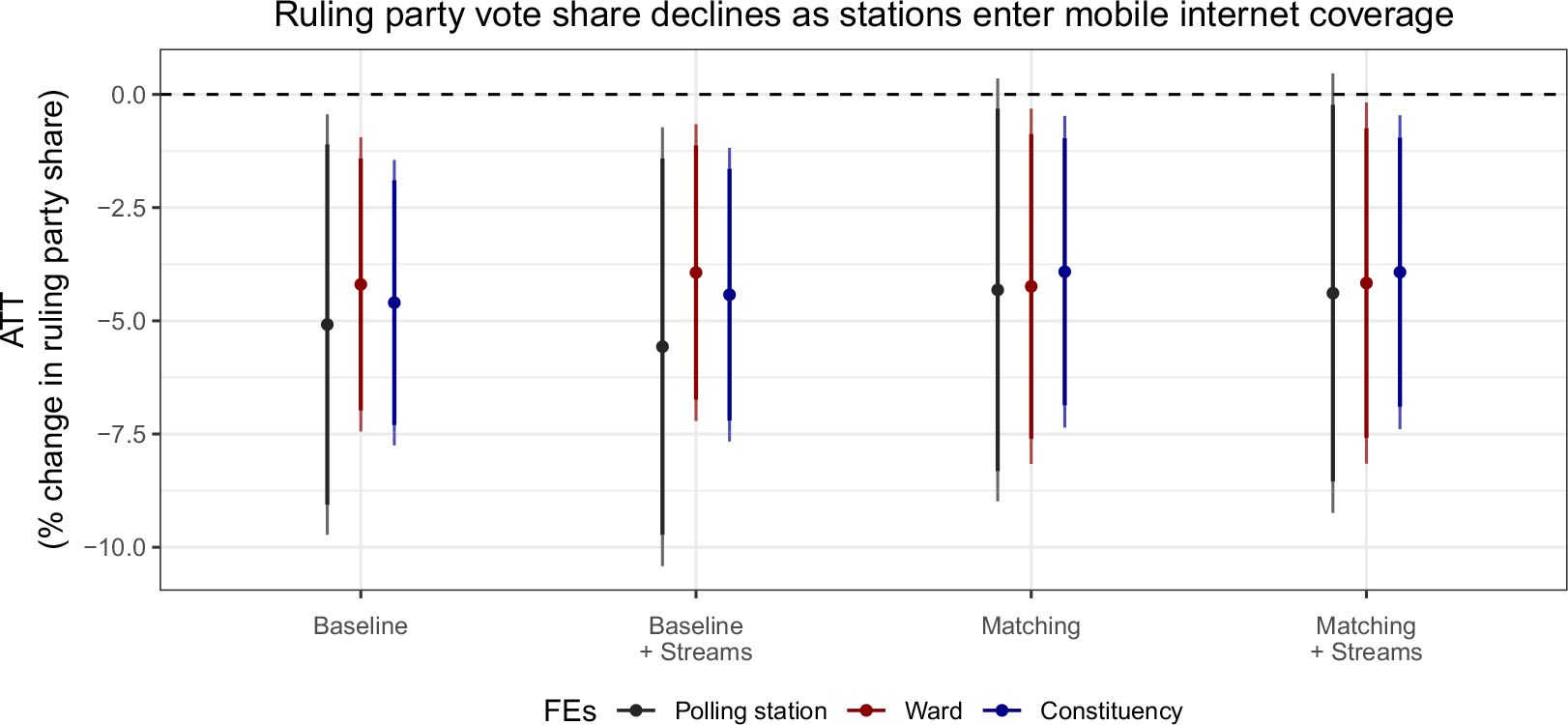
Looking first at the left-most estimates, ruling party vote share reduces by 4–5 per cent at baseline as polling stations enter coverage. This is unchanged when controlling for the number of polling streams or vary the spatial fixed effects. Results remain robust after including matching weights, though estimates fall to around 4 per cent and some specifications are significant at only the 10 per cent level.
Overall, coverage has a significant and negative effect on incumbent support across all twelve possible specifications. This is consistent with the claim that exposure to mobile internet coverage reduced the ruling party’s vote share in the 2019 election.
Ballot rejection
The second set of results, in Figure 5, shows that 3G coverage reduced the ballot rejection rate.
Difference-in-differences estimates (ballot rejection rate). Results presented for multiple specifications, each under alternative fixed effects. Bars represent 95 per cent (thick) and 90 per cent (thin) confidence intervals respectively.
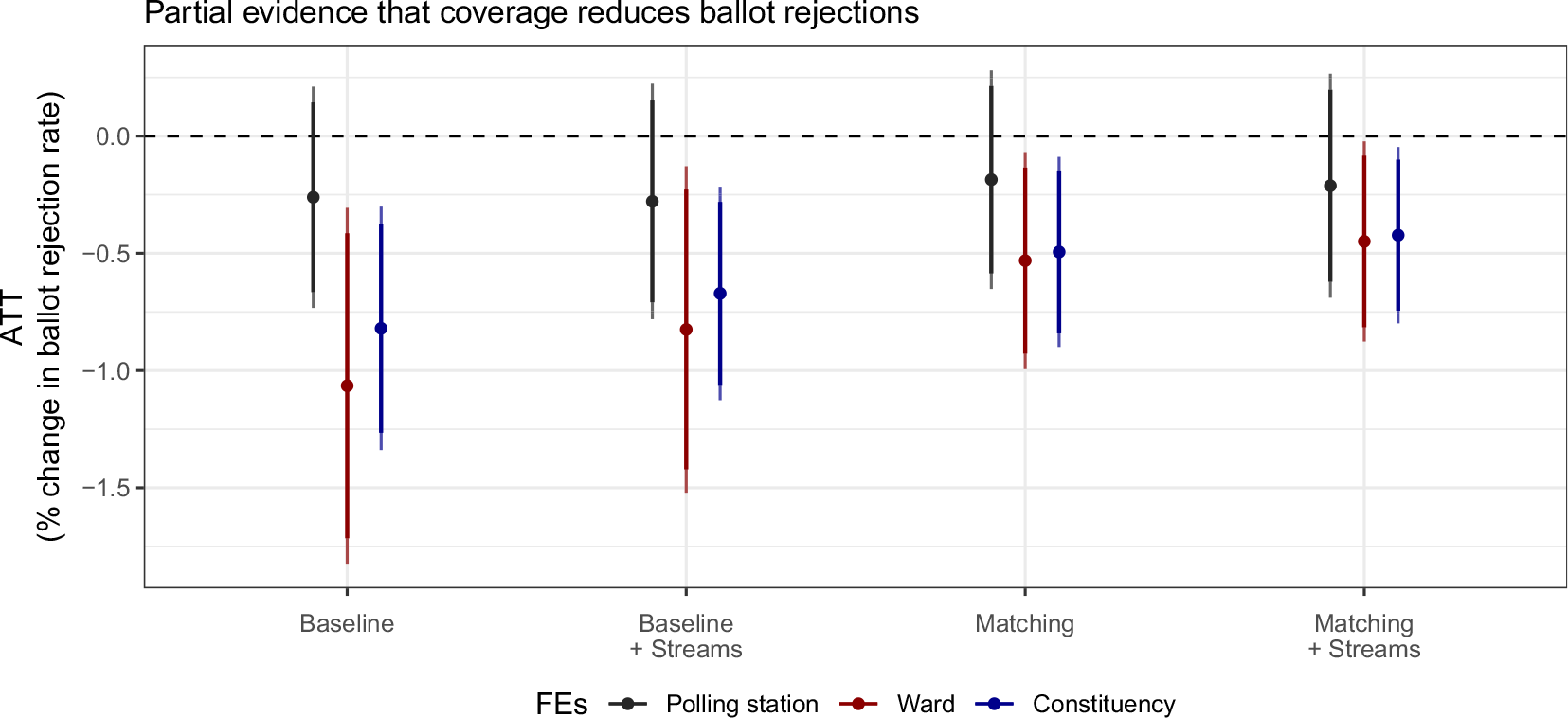
Looking first at the left-most estimates, we see that entering coverage decreases rejection by around 0.5–0.75 per cent at baseline. Unlike incumbent support, however, this result varies across spatial units. Under the most stringent polling station fixed effect specifications, coefficients fail to reach statistical significance. But under their ward and constituency counterparts, entering coverage precipitates a decline.
When matching on pre-treatment characteristics, effects shift slightly but remain robust. Under ward fixed effects, the point estimates grow to around 1 per cent, while under their constituency counterparts, they shrink to around 0.5 per cent. In both cases, though, these negative effects remain statistically significant. It is possible that this shift reflects the impact of demographic differences between stations, which might be influencing the number of ‘objectively’ invalid ballots.Footnote 18
Lastly, controlling for the number of polling streams has no bearing on the findings. This is reassuring, as one potential threat to identification was that changing patterns of ballot rejection reflect polling station complexity (streams), rather than the impact of coverage. Under both the baseline and matching specifications, controlling for the number of streams makes no impact on the magnitude or significance of the estimates. This goes some way to ruling out this alternative explanation.
These results provide evidence that 3G coverage impacted ballot rejection in the 2019 election. The arrival of mobile internet sees fewer rejected ballots across several specifications and is broadly robust when adjusting for pre-treatment characteristics and time-varying changes in the number of polling streams. But the estimates also highlight the importance of spatial units, with cross-sectional ward and constituency variation seeming to capture something about changing patterns of rejection. The central role of constituency tallying centres, and the ability of election officials to co-ordinate on election day within wards and constituencies, might provide some explanation for these findings. I return to these potential mechanisms in section ‘Mechanisms and avenues for future research’.
Additional results
In section 2.4 of the supplementary materials, I present a series of additional results to complement these main effects.
First, I look to additional electoral outcomes. I find that entering coverage increases the number of voters registered to a station and the number of votes cast at the election, though there is no corresponding rise in turnout. Higher levels of registration would be consistent with existing literature, which has shown how activists can use online platforms to mobilise voters (Donati Reference Donati2023). But a lack of turnout effect suggests that these efforts do not drive additional support on election day itself.
Second, I use ward-level 3G coverage to impute the treatment status of polling stations with missing coordinates. This is an empirical trade-off, with a rising sample size offset by a more coarse measure of coverage. Using this approach has little impact on the results; ruling party vote share falls across the board, and ballot rejection continues to fall under ward and constituency fixed effects.
Third, I leverage data from parliamentary and council elections. While lesser profile than voting for the President, and not overturned by the courts, these took place on the same day so we might expect to see similar patterns in incumbent support.Footnote 19 I first combine all elections together and find that negative effects on ruling party vote share persist. Looking at each race individually, I find that DPP candidates for parliament lose support in areas that enter coverage, but in council elections, there are null effects across the board. This likely reflects the particular dynamics of council elections in Malawi, which feature a high number of independent candidates and turnover rates (Chiweza, Chunga, and Chunga Reference Chiweza, Chunga and Chunga2021). Moreover, these elections are inherently local in nature, with candidates campaigning more through ‘small meetings and door-to-door canvassing’ (European Union 2020, p16) than in the Presidential election, which ‘dominated news coverage’ across the country (African Union 2019, p23).
Mechanisms and avenues for future research
The results so far suggest that exposure to mobile internet coverage reduced incumbent vote share and election irregularities in Malawi’s controversial 2019 election. In this final empirical section, I use qualitative data to examine the mechanisms that underpin these effects.
I draw on a series of focus groups and elite interviews conducted in Malawi in 2023. To understand the dynamics shaping voters throughout this period, I conducted focus group discussions across Malawi’s southern and central regions. These regions collectively comprise 90 per cent of the country’s population, and within these, I sampled areas that were both urban and rural and lent more towards the DPP and MCP. To understand the behaviours and perceptions of key political actors, I conducted semi-structured interviews with party figures, election officials, and staff from a leading civic education organisation. In section 4 of the supplementary materials, I provide additional detail on sample composition, questionnaires, protocols, and analysis.
I collected this data with two purposes in mind; explaining the empirical results, and validating statistical assumptions. The former was a more iterative process, extracting key themes that build gradually on earlier interviews and focus groups, known results from the quantitative analysis, and subject knowledge. The latter, discussed in section 5.2, focused on pre-specified outcomes to evidence a lack of anticipation and political targeting of coverage.
I find support for three explanations that help make sense of the empirical patterns in section ‘Polling station difference-in-differences’. First, opposition parties campaigned more effectively online and this helped to reduce incumbency advantage. Second, civic education campaigners used social media to amplify their message to more people, and third, election officials used online platforms to coordinate on polling day. Collectively, these point toward a fall in ruling party vote share and the ballot rejection rate in polling stations more exposed to mobile internet. They also provide insight into why constituency and ward-level dynamics matter for election administration, and thus why estimates varied across spatial fixed effects.
This analysis is not intended to offer definitive proof of any one mechanism. Rather, the aim is to offer plausible channels to explain systematic empirical regularities and document evidence of their necessary conditions among a reasonable sample of voters and actors. This process adds valuable context to the article and aids future theory-building and empirical work going forward.
Explaining a fall in incumbent support
One reason that internet exposure reduced incumbent support in 2019 is that the main opposition (MCP) adapted to online platforms faster than the incumbent. In urban areas, the opposition could garner strong support among young people. But even in remote rural areas, the party made use of WhatsApp groups to keep regular communication with community leaders. This allowed them to make specific campaign promises and offer viable alternatives. By contrast, the ruling party relied more on the conventional institutional advantages they enjoyed as incumbents.
First, the opposition made a deliberate effort to use online platforms to target voters in urban areas. This involved sharing photos and videos, alongside publicising upcoming rallies. In the words of one party organiser: ‘most of the people who are living here [in Lilongwe] access our information using social media … [they] use smartphones, so read our information, our manifestos, what it is we are talking about’.
Rural areas, where fewer people own smartphones, require a different strategy. The party relied on community leaders - like chiefs or heads of local governance committees - individuals more likely to have access to an internet-capable device and be connected to others offline. The MCP used platforms like WhatsApp to share campaign materials with them and receive policy ideas. One activist described how ‘we have structures in every district … those guys [community leaders] help us organise. We communicated with them on WhatsApp, it was easier to organise, they helped us get people to come to rallies’.
Embedding themselves within rural communities, the MCP was able to earn trust among residents. In focus groups, voters said that this allowed the party to make credible, targeted promises. One participant said the MCP would engage him on WhatsApp to find out ‘what people need’. Another described how chiefs could ‘communicate the development issues and infrastructure projects and are getting seen’. At the same time, however, many could not recall specific contact from either political party. On the one hand, this reiterates the importance of local intermediaries over direct appeals from activists. On the other, it suggests that while the MCP’s reach may have expanded, this was not uniform, and many voters and communities were unimpacted.
This twin-pronged approach – direct engagement with urban voters, and targeted engagement with rural community leaders – was not matched by the DPP. Instead, the party used more conventional campaign tactics, which stemmed from the institutional incumbency advantages they enjoyed.
One tactic was control of state media. The DPP ‘dominated the airwaves on both state-owned radio and television…’, and ‘the separation between the President’s political party and presidential functions were unclear’ (African Union 2019, p23). One MCP activist lamented state media for saying only ‘good things about DPP [and] bad about MCP’, and that ‘it didn’t inform the nation’. This point was conceded by a DPP activist, saying ‘it was too biased…It was our strategy. You do everything just to win the elections’.
Another was the use of patronage and campaign handouts to keep voters onside. EU election observers note that ‘abuse of incumbency during elections is a recurring problem in Malawi’ and that there were ‘extensive reports indicating an unlevel playing field in the campaign, with the ruling party unduly benefiting from misuse of state resources’ (European Union 2020, p18). This included the allocation of parastatals to politically relevant areas to enhance local services, and a greater amount of cash and in-kind payments at rallies than opposition parties could afford. There were also some reports of opposition activities being suppressed, particularly in ruling party strongholds, and a lack of police action in response.
But the DPP remained sceptical about the value of using online platforms in the campaign. A senior 2019 election strategist for the party told me ‘if you depend a lot on social media you may not succeed…If your dependence is on social media or ICT as a whole, once they shut it down then you are gone’. They also suggested that only younger urban voters used the Internet to learn about politics, voters who ‘will always want to side with the opposition parties’. While the strategist admitted that ‘MCP did use [online platforms] more in 2019’, they saw this strategy to be redundant among the country’s rural majority.
This resulted in weaker ties with voters, who, in 2019, reported less contact with the ruling party. Rural voters described how they ‘had no way to communicate with [DPP officials]’, it was hard to get in touch ‘because [they] didn’t know anybody’, and the DPP were like ‘visitors in their own country’. Even in Blantyre, a DPP stronghold, some described switching to the MCP in 2019, asking ‘how can someone represent us if they don’t know the problems we are facing?’.
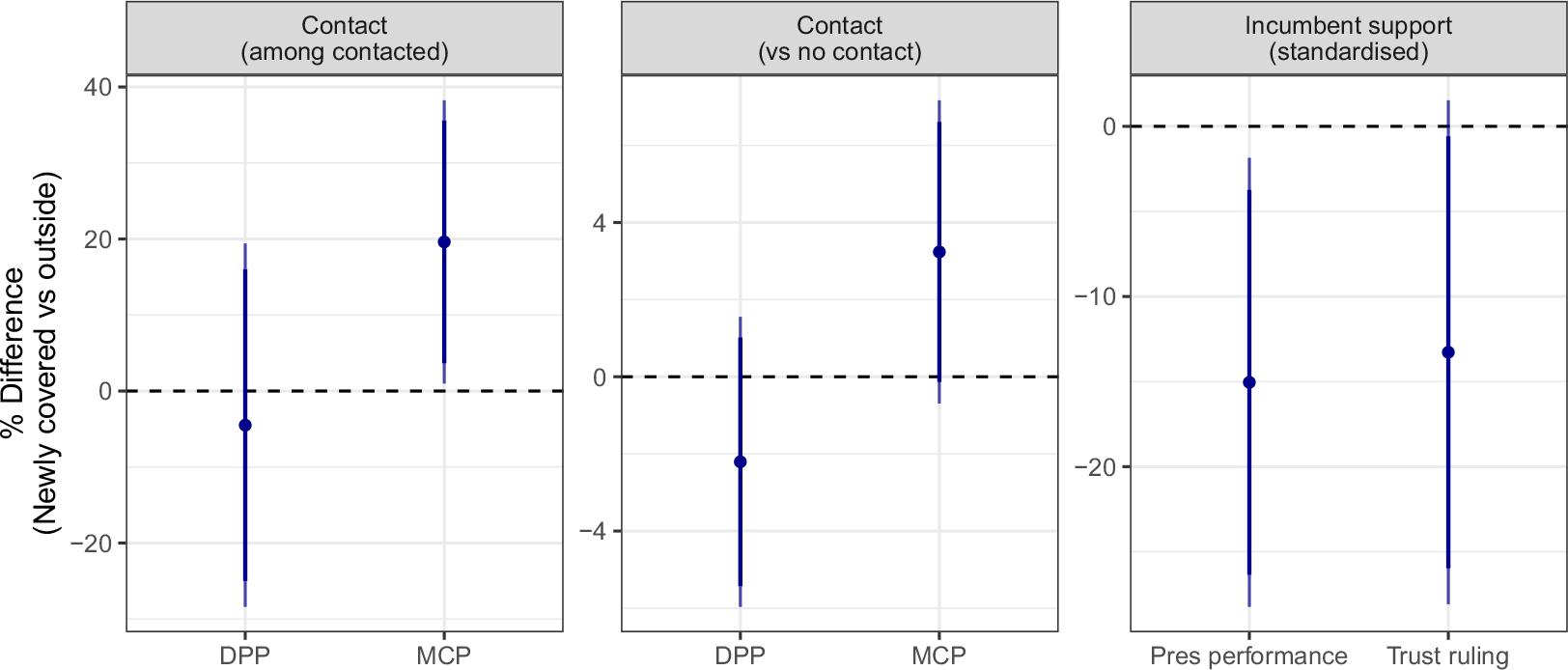
While focus group discussions appear to confirm the importance of diverse media and opposition mobilisation, one drawback is the small population with which they were held, who are likely more interested in politics than the typical citizen. To see how these claims resonate across the wider electorate, I thus turn to individual-level Afrobarometer data from across Malawi. I compare rates of party contact and incumbent support in areas that newly entered mobile internet coverage. The results, in Figure 6, show that these respondents are more likely to report being contacted by the MCP in the 2019 campaign, relative to both no contact (p=0.04) and that with other parties (p=0.11). There is also evidence that incumbent support, measured by trust in the ruling party and Presidential performance evaluations, is lower in these parts of the country. More details about these specifications, and corresponding results tables, are in section 3 of the supplementary materials.
Mobile coverage, self-reported party contact and incumbent support (Afrobarometer round 8). Bars represent 95 per cent (thick) and 90 per cent (thin) confidence intervals respectively.
In many ways, these findings are consistent with existing scholarship on party strategy in African democracies. The ways in which ruling parties leverage resources of the state in elections are well documented, and the DPP’s tactics resonate with the wider literature (Bleck and van de Walle Reference Bleck and van de Walle2018). Likewise, the MCP’s strategies fit with newer work on how African parties have adapted to social media platforms, using these to both directly target voters and to improve ‘offline’ organisation (for example, Fisher, Gadjanova, and Hitchen Reference Fisher, Gadjanova and Hitchen2023).
Going forward, researchers should further investigate the ways parties communicate with local community leaders, especially in rural areas. While there is a growing literature on how politicians learn about voters’ needs in contexts of weak state capacity (for example, Jablonski and Seim Reference Jablonski and Seim2022), it is less clear how these dynamics map onto the adoption of new information technologies.
Explaining a fall in ballot rejection
The qualitative data highlights two ways in which mobile internet might reduce the share of rejected ballots. The first relates to civic education, with campaigners able to use social media platforms to amplify content to more voters. The second focuses on how election officials coordinate on polling day.
Civic education
Malawian elections see efforts by non-partisan civic education campaigns. These are widespread, revolving around voter registration, mock voting exercises, and candidate debates. Organisations like NICE (National Initiative for Civic Education) and the CCJP (Catholic Commission for Justice and Peace) educate voters across the country about election procedures and party platforms, while outreach efforts by the electoral commission offer targeted registration campaigns. These programmes can shape electoral politics by reducing the costs of participation, generating motivating social norms among peers, and increasing citizen knowledge (Harder and Krosnick Reference Harder and Krosnick2008).
While conducting fieldwork, I learned that reducing ballot rejection was a specific goal of many civic education groups in 2019. For instance, one national coordinator described how ‘one of the things which we work on is the number of null and void votes. This is where we intensify our civic education approaches. We are able to reach a big number of people’. While campaigns usually take place in person, there is often a heavy associated online presence. Participants share content ‘on WhatsApp groups so people who are not there can learn’, and younger voters, in particular, are ‘very good at following up issues through social media’.
Through exposure to online platforms, voters can thus receive the content of civic education campaigns without physically attending events, which may help reduce eventual ballot rejection rates. There was some evidence of this in rural focus groups, where one participant recalled his brother in Lilongwe ‘sending pictures to show how to vote right’, while another attended an event in a neighbouring village and took videos to show those in his community. This was not universal, however, with many participants being unable to recall such campaigns. This may partly reflect the limited resources of civic education providers in Malawi, or that the election was a relatively long time ago. It may also highlight how campaigns often centre around small numbers of people, who act as wider brokers of information.
These findings slot into existing empirical evaluations of voter education campaigns in Africa, with a focus on increased electoral competition, registration, and electoral fraud (for example, Harris, Kamindo, and van der Windt Reference Harris, Kamindo and van der Windt2021; Mvukiyehe and Samii Reference Mvukiyehe and Samii2017). Results of this literature are mixed, but we know little about how online platforms put social pressure on voters, how this shifts electoral outcomes, and the conditions under which these effects are most likely to obtain. This qualitative evidence from Malawi provides a starting point for such investigations.
Election day co-ordination
There is also evidence that officials used online platforms to improve administration on the day of the vote. Staff from the electoral commission used shared WhatsApp groups to coordinate, while party monitors used them to send information and receive advice from their national headquarters.
In Malawian elections, officials are stationed at various levels of vote counting. Ballots are cast in polling stations, from which results sheets are delivered to constituency tallying centres, where they are verified, aggregated, and sent to the national office. Polling stations are managed by presiding officers, while returning officers oversee constituency activities. Staff are drawn almost exclusively from the education sector, with local teachers being deployed in polling stations, managed by more senior school inspectors at the constituency level. Staff have different levels of experience, with polling station officers being less likely to have worked in an election before, and their constituency counterparts still requiring assistance from national headquarters (European Union 2020, p11).
This asymmetry creates a need for communication, and co-ordination, within constituencies. When speaking with MEC officials, it became clear that this interaction was made easier in areas with mobile internet coverage. Officials could communicate across WhatsApp groups, rather than relying on individual phone calls or SMS messages. For instance, one official reported that ‘we make groups on Whatsapp for each constituency, those who have internet can send problems directly’. This was ‘easier to manage as we can use photos. If a call comes I’m busy with other things, it’s easy to forget a bit’.
One caveat to these results is that only a small number of election administrators were interviewed, each discussing events that took place four years previously. It is possible that other workers had different experiences, or that memories have faded. Nonetheless, the findings point to ways in which WhatsApp groups, enabled by mobile internet coverage, made it easier for polling staff to coordinate in order to solve problems on election day.
These themes resonate with existing work on election integrity, often stressing the importance of aggregation fraud as vote counts move between levels of administration (see: Callen and Long Reference Callen and Long2015; Beber and Scacco Reference Beber and Scacco2012), and the role of election observers and party monitors in mitigating this (for example, Ichino and Schündeln Reference Ichino and Schündeln2012; Asunka et al. Reference Asunka, Brierley, Golden, Kramon and Ofosu2019). But within these literatures, the specific role of online platforms, and how they are used by election staff, remains under-theorised. Malawi’s experiences point to broader trends that scholars should develop going forward. In particular, researchers should survey a broader set of election administrators, ideally on or closer to polling day.
Discussion
Rising access to the Internet is a profound technological change, with political consequences that reverberate around the globe. Nowhere is this truer than in low-income democracies, where online platforms have leapfrogged conventional forms of mass media present in wealthier parts of the world (Mbiti and Blumenstock Reference Mbiti and Blumenstock2015). Yet these countries remain considerably under-represented in the wider literature, leaving significant gaps in understanding (Tucker et al. Reference Tucker, Guess, Barbera, Vaccari, Siegel, Sanovich, Stukal and Nyhan2018).
In this paper I begin to address these shortcomings, studying the effects of growing internet access in a controversial election in Malawi. I analyse the country’s 2019 Presidential election, in which the ruling party was re-elected before a court-ordered re-run. I ask how online platforms shaped two important dimensions of election quality: unfair incumbency advantages and ballot irregularities. The evidence suggests that local exposure to mobile internet coverage reduced both ruling party support and the share of rejected ballots.
I first draw on fine-grained election data to uncover aggregate patterns across the country. Linking polling station returns to high-resolution maps of 3G coverage, I show that internet exposure reduces support for the ruling party. Polling stations inside coverage also have a lower rate of ballot rejections, a salient irregularity in 2019, once we account for coverage gaps within wards and constituencies. These findings are robust when matching on pre-coverage characteristics and accounting for changes in polling station complexity.
I then use qualitative data to examine mechanisms, drawing on focus group discussions and interviews with voters, party activists, civic education groups and election officials. These suggest that the incumbent was slow to adapt to social media, that online platforms allowed civic education campaigns to reach more voters, and that election officials used the Internet to coordinate on election day. These provide multiple paths that connect the arrival of 3G coverage with a systematic decline in ruling party support and ballot rejection. Taken together, the paper thus provides evidence that is both statistically robust and accounts for the experiences of voters and officials on the ground.
By studying elections in a low-income democracy, the paper makes an important empirical contribution to the literature. Like many countries around the world, Malawi has seen multiple handovers of power in conjunction with accusations of electoral malpractice and concerns about irregularities (Dulani and Dionne Reference Dulani and Dionne2014; Patel and Wahman Reference Patel and Wahman2015). This, combined with a lack of economic and infrastructural development, highlights the political impacts of early internet adoption. These impacts are harder to study when internet access reaches high levels, or when governments have had time to develop a pronounced response (Weidmann et al. Reference Weidmann and Rød2019).
The paper also raises a series of theoretical questions for future research. First is the nuanced relationship between mobile coverage availability and personal use of online platforms. As discussions with opposition activists made clear, political parties can make effective use of social media channels to communicate with local opinion leaders, who themselves disseminate information to residents without access to a device. This suggests that internet coverage can be politically consequential, even with limited uptake of devices. A large body of work has studied how information percolates through in-person social networks in rural Africa (for example, Larson, Lewis, and Rodriguez Reference Larson, Lewis and Rodriguez2022), but we know less about how online content filters through, particularly in election campaigns.
Second is the spill-over effects of civic education. In discussions, there was often a belief that social media allowed in-person campaigns to reach voters who were not physically present. In turn, this offers one way in which 3G coverage – through the ability to receive information online – can reduce election irregularities. This presents a nuanced account of why civic education experiments often yield mixed results (Harris, Kamindo, and van der Windt Reference Harris, Kamindo and van der Windt2021), perhaps driven, in part, by online spillovers. But these remain empirical questions without clear answers and should be investigated in future work.
Third is the ways election staff use online platforms. There has been minimal analysis of how officials interact and coordinate on election day. How, precisely, might polling station officers engage constituency returning officers, and does this reduce administrative irregularities? Equally, in what contexts might the ability to coordinate increase the capacity of biased officials to engage in fraud? Both questions remain open and important but understudied.
The findings also raise implications for policymakers and practitioners operating in low-income settings more widely. The paper’s focus on political outcomes adds nuance to ongoing efforts to expand access to information technologies, typically rooted in the economic benefits that these can bring. By highlighting how the Internet can improve accountability, the paper taps into wider studies on how fairer elections drive welfare gains for voters, especially those historically marginalized from politics (Fujiwara Reference Fujiwara2015; Ofosu Reference Ofosu2019). And third, the results speak to ongoing debates among officials, monitors and civil society groups, on how limited resources can be best targeted in future elections.
Supplementary material
The supplementary material for this article can be found at https://doi.org/10.1017/S0007123424000814
Data availability statement
Replication data for this paper can be found at: https://doi.org/10.7910/DVN/JIZM3L.
Acknowledgements
I am grateful to Ryan Jablonski, Boniface Dulani, Johan Ahlback, Ursula Daxecker, Ruben Ruiz-Rufino, Jacob Nyrup, and anonymous reviewers for their comments and advice on this project. I also thank seminar and workshop audiences at the London School of Economics, King’s College London, University of Zurich, ESRF Tanzania, GLD Gothenburg, WZB meeting on the political economy of development, and the Nordic conference in development economics. Andrew Hills Banda, Vitu Khonje and Jimmy Mkandawire provided excellent research assistance.
Financial support
This work was supported by the Governance and Local Development Institute (small travel grant); the London School of Economics (graduate studentship); and the research initiative ‘Structural Transformation and Economic Growth’ (STEG), a programme funded by the Foreign, Commonwealth & Development Office (FCDO) (grant number: STEG_LOA_3073_Yeandle). The views expressed are not necessarily those of FCDO.
Competing interests
None.
Ethical standard
Original data collection in Malawi received institutional ethical approval from the London School of Economics (reference: 214926).


 Open access

